A Design Research Approach
Alex H B Duffy and F J O’Donnell
Keywords: research framework, validation template, methodology
1. Introduction
The significance of the design process in determining the success or failure of a product in the market place is becoming increasingly more articulated. Consequently companies are implementing and developing new techniques and tools to support design more effectively. Design research is directed at gaining a greater understanding of design, ultimately to better support it through the development of improved techniques, methods or tools. To facilitate the research and development of appropriate means to support design the CAD Centre at the University of Strathclyde has developed an overall research approach that takes the form of a number of elements that build and relate to each other:
• Research mission/vision - reflects the overall objective and motivation behind the area of research.
• Needs Analysis - sets the basis and justification for carrying out the research. This is essentially a needs analysis of design practice, identifying key areas for developing better tools, methodologies or techniques to improve design and highlights various issues for research and development.
• Research Framework - provides an encompassing framework in which to carry out the research and an overall methodology without pre-defining a particular starting point.
• Research Approach - presents a basis for carrying out the research and acts as a template that is subject to alteration depending upon the nature of the work.
• Validation and Evaluation methods - describes and presents different means of assessing the effectiveness and validity of the research results.
This paper presents the above elements as the research approach developed and adopted at the CAD Centre, University of Strathclyde (UoS).
2. Research mission/vision
The research mission/vision encapsulates the overall motivation and drive behind the research work. It embodies the focus area of interest and bounds the research activity. It should reflect the long term objective of the group/team carrying out the research and be technique independent. As an example, the mission of the CAD Centre, UoS, is:
This mission bounds the research work within the design area and more specifically within developing a computational environment to support design. It also encapsulates a belief that such an environment cannot be fully developed without a fundamental understanding, in the form of theories or models, of the activity or processes that they are developed to support.
Visions of how such a mission may be achieved can also be defined. For example, the Intelligent Design Assistant (IDA) [2], Figure 1, and the Integrated Design Environment (IDE), Figure 2, were defined in 1984 and still serve as general visions for the centre’s computational research work. Such visions provide a basis to map the research activity and progress upon. For instance knowledge based techniques to support design activities, design co-ordination environments to support “ida team management”, product and knowledge modelling, design reuse techniques and machine learning to support effective reuse of past design knowledge.
3. Needs Analysis - an approach to identifying key research areas
Design is complex, involving many inter-related and complimentary aspects. Within industry it is natural to support those aspects of design that focus upon developing design tools that are the most explicit, well understood and manageable. It would seem that companies often focus
“Intelligent interface”
Designer IDA:
• Control
• Define
• Direct
• Inquire
• Judge
• Question
• Specify
• Adapt
• Calculate
• Evolve
• Explain
• Guide
• Learn
[image:2.595.198.403.166.266.2]• Model :
Figure 1: An Intelligent Design Assistant (IDA) [1]
IDA IDA IDA IDA
IDA IDA IDA IDA
Team Manager
- KB Techniques
Team Manager
- Design Coordination
Past
Designs Prototypes
Concept Models
Design Model Common
Model
- Product & Knowledge Modelling
- Design Reuse & Machine Learning
[image:2.595.179.427.458.634.2]upon and develop tools for the issues that are most evident, incurring clearly apparent costs, or that vendors are able to present as being the most important. Needs analysis provides a more thorough basis to identify the need for design research and for these needs to be suitably prioritised in order to focus effort, resources and identify the type of research and/or development required.
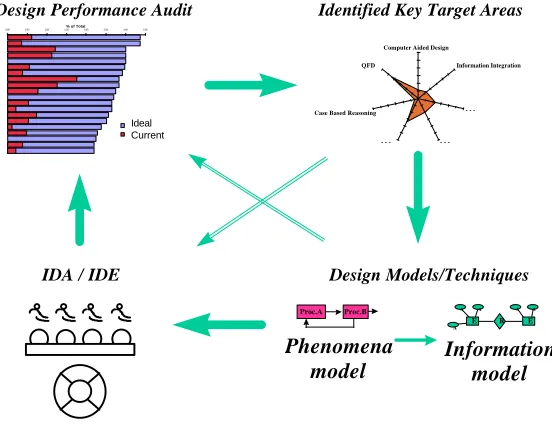
Figure 3 illustrates an approach to consider and analyse the impact of existing, new or foreseen means to support actual design development requirements rather than that perceived or the most noticeable in practice. The approach starts with an analysis of various aspects of design practice against maximum performance achievable. From this a number of aspects are targeted to develop models, methods, tools or techniques (means) to improve current performance. The results can then be fed back directly to industrial practice or the research and/or development of a computational environment, such as IDA or IDE, before their impact are assessed. This approach is essentially cyclic in nature as the results of the research impacts upon design practice and so creates or highlights new areas for further research and development. It also provides a basis upon which to make more objective judgements and justify the design research. The audit also acts as a datum to evaluate the effect of research results introduced at a later date.
3.1 Identifying Key Target Areas
The audit analyses and identifies key target areas for design process improvement and corresponding research areas. It is conducted in two phases where the first phase analyses the various aspects of design against stated product and company objectives. The analysis highlights the difference between the greatest achievable impact (ideal) of various aspects of design against a company’s current impact. Thus, it provides a basis upon which to identify key target areas for maximum performance improvement given a degree of required effort. These target areas are then used as the basis for the second phase of the analysis. The identified target areas are analysed in a similar manner against current and future techniques, methods and tools. The result is a set of targeted design technology (e.g. AI techniques) to achieve maximum performance improvement given the effort involved. Such effort can be a
0.00 0.50 1.00 1.50% of Total2.00 2.50 3.00 3.50
Ideal Current
Design Performance Audit
Case Based Reasoning
Identified Key Target Areas
Computer Aided Design
Information Integration
-QFD
Design Models/Techniques
Phenomena model Proc.A Proc.B
Information model
A
E R E
A A A A
IDA / IDE
combination of “off the shelf” packages or long term research and development projects. An example of comparing the ideal and current impact of design technology is given below in Figure 41.
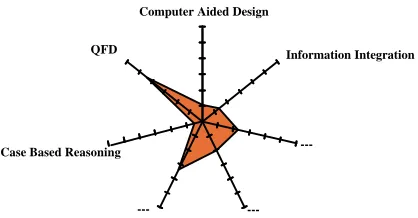
Taking into account the ease of effort to enhance particular aspects of design provides a star diagram whereby the return on investment to achieve the greatest impact can be clearly identified, providing the basis upon which to target appropriate research and areas for collaboration (Figure 51).
4. Research Framework
The design process is becoming increasingly and inextricably linked to computational design tools and data models. A common hypothesis of developing such tools is that computational environments when integrated with human based activities allow design to be carried out more effectively. A presumption in this hypothesis is that computer systems can be structured to provide active support for human limitations without infringing on the fundamental strengths of human activities. A necessary consequent of this is that the computer environment will impact significantly on the normal processes of design and that consequently the use of design technology will require innovative models of design as well as knowledge of how to deliver human/computer symbiosis [3].
1
To maintain confidentiality agreements the aspects considered have been altered and are not fully illustrated.
Means for Improvement
Computer Aided Design Info integ'n & sharing
Quality Function Deployment Case Based Reasoning
0.00 0.50 1.00 1.50 2.00 2.50 3.00 3.50
% of Total Ideal
ideal current
-Figure 4: Impact of current vs ideal design support
Computer Aided Design
Information Integration
---Case Based Reasoning QFD
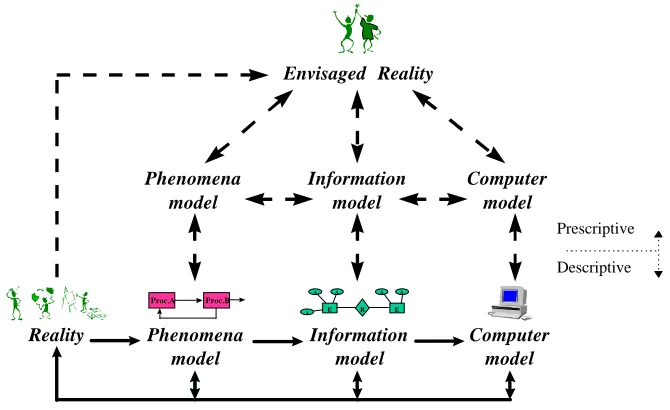
[image:4.595.193.402.437.546.2]A framework for conducting design research has been established [4] that is based upon the hypothesis that any developed tools (be they human or computationally based) will make an impact upon the design process itself when employed (see Figure 6). It should be stressed that the research work can focus and start on any element of the framework. In general it is intended that models are built based upon the “reality” of design (i.e. design practice) and continually evolved to develop tools to support design. The reality and models would act as the criteria upon which to base critical and objective evaluations of the consequent models, but when employed as tools would affect the “reality” in which design is carried out. Further, where practical, the models should be evaluated upon “blind” test cases in order to foster a more objective and scientific approach. Thus, the approach is a continual refinement of our understanding of engineering design, its evolution, as well as the supporting design technology.
Descriptive phenomena models are based upon observations and analyses of the “reality” of design and the use of the tools employed, and hence reflect design practice. Where appropriate, these models are then developed in more detail as information models and similarly as computational models and tools. Such information and computational models can encompass existing or new techniques, methods or processes in order to support the other models. At each stage any model can be compared or evaluated against any previous model or reality in order to enhance our understanding and hence models. Information and/or computational models can be developed in a similar manner directly from reality or other models.
Prescriptive models are based upon an envisaged or foreseen reality that would be considered as enhancing design practice. Thus, if employed these models impact upon the way in which design is carried out, which in turn affects the basis of the “descriptive” models. That is, prescriptive models could be introduced to alter the design process and their effect may be evaluated upon the reality and respective models. In this scenario prescriptive models are considered as ones which have not been based upon, used or adopted within the domain or process under consideration. These prescriptive models can be a hypothesis, theory or based
Prescriptive
Descriptive
Phenomena model Proc.A Proc.B
Reality Information
model A
E R E
A A A
A
Computer model Envisaged Reality
Phenomena model
Information model
[image:5.595.131.466.268.473.2]Computer model
upon an envisaged or postulated design reality and used to alter, test and/or optimise the design process. For example, a prescriptive design methodology or new computational technique may be adopted as the phenomena model and used to change the design reality. The effect of such an action can be evaluated and used to improve our understanding of the prescriptive model and to enhance design performance.
This research approach does not only support the development of design tools but ensures a consistent basis upon which to build and evolve such tools. It presents a sound foundation upon which to develop design systems and provides a basis upon which to introduce hypothetical design practice. Design research would normally focus upon prescriptive and descriptive phenomena models whereas computer supported design such as AI techniques would normally encompass all the models with a relatively narrower focus.
5. Research Approach
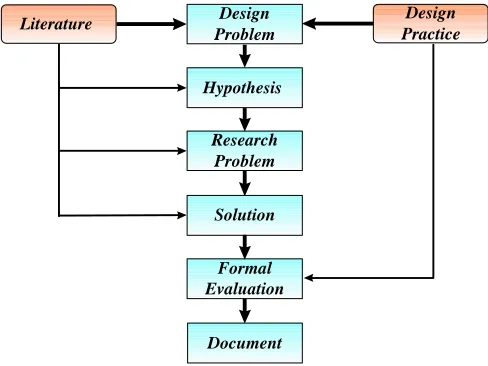
[image:6.595.175.419.391.574.2]The general research approach acts as an overall guide to conducting the work (see Figure 7). For the purpose of this paper the approach will not be elaborated upon in details but in general a hypothesis of how to better support design is proposed based upon an analysis or understanding of design. This hypothesis is formulated into a research problem within the field of interest, for example design reuse, machine learning, etc. A solution is then developed, evaluated and the overall results and appropriate documentation generated.
Figure 7: Overall research methodology
6. Validation and Evaluation methods
A distinction is made here between validation and evaluation. The former focuses upon ascertaining a degree of truth for a particular hypothesis or result. Thus, if a hypothesis or result is proven to be true then it is regarded as being validated. Evaluation, according to some criteria, measures the relation between a result, concept, method, tool, etc. against a datum of some kind such as a requirements specification, known practice, or performance targets.
6.1 Validation template
In order to provide some evidence of support for the research work any hypothesis, solution,
Literature Design
Practice Design
Problem
Hypothesis
Research Problem
Solution
Formal Evaluation
etc. must be based and logically argued upon sound theories or models. Figure 8 presents a validation template whereby any hypothesis or solution should be soundly based upon well founded theories or models. The theories themselves build upon axioms, literature, experiments and models. Models are themselves built and influenced by findings in literature, experiments, known theories and reality.
6.2 Evaluation methods
Evaluation focuses upon ascertaining a degree of performance change with respect to a set criteria. Some of the main problems with carrying out effective evaluation is being able to sufficiently define the evaluation datum, criteria measures and appropriate means to carry out the evaluation. Further, within the AI in Design research field the affects from new research results are not always immediately apparent or quantifiable. This leads to ambiguity and uncertainty in the efficiency or effectiveness gains to design.
Both validation and evaluation use a variety of methods such as:
• Case studies - particular instances of design are studied and analysed.
• Experiments - predefined criteria and methods of evaluation are established and artificial scenarios are constructed. Design experiments are artificial in nature whereas the other methods are more closely based on actual design practice.
• Industrial studies - actual design practice is studied and analysed through a variety of techniques, e.g. interviews, protocol analysis, methods study, etc.
• Protocol analysis - records of design practice or experiments, using audio/video tapes or other means, are analysed.
• Worked examples - similar to case studies, scenarios of particular design problems are simulated and analysed.
Hypothesis Theories
Models Axioms
Reality Literature
Analysis
[image:7.595.167.426.160.323.2]Experiment
Acknowledgements
This paper was firt published in the Workshop on Research Mehods in AI in Design, AID’98, Lisbon, Portugal, 19 July 1998. The material presented has been partly developed through fruitful discussions with past and current researchers. We would like to thank the researchers of the CAD Centre who contributed to the evolution of the research approach and in particular to Dr J Borg, Mr S-W Lim, Dr J Manfaat, Dr Y Zhang and Mr D Stevenson.
References
1. Duffy, A.H.B., Computer Modelling of Early Stage Numerical Ship Design Knowledge and Expertise, in Ship and Marine Technology. 1986, University of Strathclyde: 26 Richmond Street, Glasgow. p. 203.
2. MacCallum, K.J., A. Duffy, and S. Green. An intelligent concept design assistant,. in
Proceedings of the IFIP WG 5.2 Working Conference on Design Theory for CAD Tokyo Japan October 1985. 1987. Elsevier Science Pubs. B.V. (North Holland) Amsterdam The Netherlands.
3. Duffy, A.H.B., et al., Design coordination for concurrent engineering. International Journal of Engineering Design, 1993. 4(4): p. 251-265.
4. Duffy, A.H.B. and M.M. Andreasen. Enhancing the evolution of design science. in
Proceedings of the Tenth International Conference on Engineering Design (ICED'95) Prague 22-24 August 1995. 1995: Heurista Zurich.
A H B Duffy and F J O’Donnell CAD Centre
Department of Design, Manufacture and Engineering Management University of Strathclyde
75 Montrose Street Glasgow G1 1XJ United Kingdom
Telephone: +44 (0)141 548 3134
Fax: +44 (0)141 552 3148
E-mail: [email protected]
![Figure 1: An Intelligent Design Assistant (IDA) [1]](https://thumb-us.123doks.com/thumbv2/123dok_us/1733510.126844/2.595.179.427.458.634/figure-an-intelligent-design-assistant-ida.webp)