STRUCTURAL ANALYSIS AND PREDICTION OF ·oLECULAR GEOMETRY OF CHELATE COMPLEXES
A Thesis
submitted for the Degree of Doctor of Philosophy
in the
Australian National University
.- by
Ian E. Maxwell
ii
The work described in this thesis is the candidate's own, except as otherwise stated.
--
.-Research School of Chemistry Australian National University
Canberra, A.C.T.
iii
PREFACE
This thesis covers problems in structure, conformation and relative
~tabi~ities of multidentate cobalt
(III)
complexes. For convenience thet1esis has been divided into two parts. Part
I
introduces the necessarybackground chemistry and nomenclature, and reports the results of X-ray
stru0~ural analyses and chemical studies on s number of multidentate
cobalt (
~II)
complexes. These results providea
large porti on of theexperimental data which is vital to the calculations described in Part
II.
The strain energy minimisation calculations described in Part
II
wereperformed in an attempt to understand the factors governing ligand
cotd'ormations, coordination geometries and isomer relative stabilities
in tnese systems. The ultimate goal of these types of calculations would
be to provide a method for accurately predicting detailed molecular
geometries and relative stabilities of metal complexes.
A portion of the results of this thesis has been published as follows:
The Crystal Structures~of the Glycylglycine 0-Ethyl Ester and Chloroaquo
-complexes of ~-(Triethylenetetramine) cobalt
(III), D.A.
Buckingham,P.A.
Marzilli,I.E.
Maxwell,A.M.
Sargeson,M.
Fehlmannand H.C.
Freeman1Chem. Comm.,
488 (1968).
The crystal and Molecular Structure of Racemio
ois-13--(Chloroaquo-triethylenetetramine) cobalt
(III)
Perchlorate, \H.C. Freeman andI.E.
Maxwell , Inorg. Chem.,.§.,1293 (1969).
The Crystal Structure of a Bifurcated Quinquedentate Cobalt (III)
iv
and H.C. Freeman, Chem. Comm.,
473 (1969).
The Crystal Structures of Two Diastereoisomeric ~2
-Cobalt(III)-Triethylenetetramine-S-proline Complexes,
D.A.
Buckingham,L.G.
Marzilli,I
I.E. Maxwell, A.M. Sargeson and H.C. Freeman·, Chem. Comm., 583
(1969).
Stereospeoific Effects in Cobalt (III)-Triethylenetetramine-N-methyl-(s)-alanine Complexes, D.A. Buckingham,
I.E.
Maxwell and A.M. Sargeson,Chem. Comm., 581
(1969).
The following papers have been submitted to Inorg. Chem. for publication. The Crystal Structure and Absolute Configuration of L(-) 589~2
-RRS-(triethylenetetramine-S-Proline)cobalt(III) diiodide dihydrate,
H.C.
Freeman and I.E. Maxwell.The Prediction of Molecular Geometries and Relative Stabilities in Chelate Complexes : Application to Cobalt (III)
Triethylenetetra.mine-(S)-
Prolinato Complexes,D.A.
Buckingham, I.E. Maxwell, A.M. SargesonV
ACKNOWLEDGMENTS
The work described in this thesis was carried out under the
supervision of Dr. A.M. Sargeson at the Research School 9f Chemistry
of the Australian National University. The author is indebted to Drs.
A.M. Sargeson
andD.A.
Buckingham for
theiradvice and encouragement
throughout this work. A portion of the crystallographic work described
in this thesis was carried out at Sydney University under the supervision
of Dr. H.C. Freeman. The generous advice and X-ray diffractometer
facilities offered by Dr. Freeman and the assistance of the following
members of his research group, Mrs. A. Wood, Messrs. J.M. Guss, J.D. Bell,
M.T. Barnett and Dr. C.E. Nockolds is gratefully acknowledged. Preliminary
crystal structure studies were carried out using the facilities of Drs.
M. Sterns and R.A. Eggleton and their assistance was greatly appreciated.
Drs. L.G. and P.A. Marzilli kindly supplied crystals for the
structural analyses and the work described in Chapter
5
was carried outin association with Dr. L-G· Marzilli.
The author is indebted to Dr. M.R. Snow of Adelaide University for
valuable discussions and kindly supplying a computer program for part of
the calculations described in Part II. Technical assistance was provided
by Messrs. H. Satrapa and C. Arandjelovic. The skilful typing of Mrs. B.
Moore and Mrs. B. Rann is gratefully acknowledged. The author also wishes
vi
Computing assistance and facilities were provided by Dr. M. Osborne
'
and the staff of the Computer Centre, A.N.U., and the Computing Research Section of C.S.I.R.O. at Sydney and Canberra. Financial assistance from
the Australian National University and D.S.I.R., New Zealand is gratefully
acknowledged.
Finally, the author wishes to thank his wife for her patience and
vii
TABLE OF CONTENTS PART I
CRYSTAL STRUCTURE ANALYSES AND '
STEREOCHEMICAL STUDIES OF COBALT( III) COMPLEXES
Page
Chapter 1 Introduction 1
1 .1 Isomerism 1
1.2 Coordinated Secondary Nitrogen Centres
3
1.3 Stereospecificity and Relative Stabilities of Complexes
5
1.4 Mutarotation of Chelated Amino Acids6
1.5 The Scope of Part I
7
Chapter 2 The Crystal and Molecular· Structure of Racemic
S-(chloroaguo-triethylenetetramine) Cobalt(III) Perchlorate
2.1 Introduction 2 .2 Experimental -
-2
.3
Description of the Structure2.4 Chemical Significance of this Structure
Chapter
3
The Crystal and Molecular Structure of Racemic(4-(2-aminoethyl)-11417,1O tetra-azadecane-azido) cobalt (III) nitrate hydrate
3.1 Introduction 3.2 Experimental
9
9
10
14
22
25
25
3.3
Chapter 4
4.1
4.2
Chapter
5
Chapter 6 6 .1
Chapter
7
7
.17.2
7.3
viii
Description of the Structure
The Crystal Structure and Absolute Configuration
of
L-B
2-RRS-(trietnylenetetramine-S-proline) I cobalt
(III) diiodide dihydrate
Introduction
Experimental
Description of the Structure
The Crystal Structure and Absolute Configuration of
D-~
2-sss-(triethylenetetramine~S-proline) cobalt(III)
tetrachlorozincate
Introduction
Experimental
Description of the Structure
The Geometry of ~-trien Complexes
Introduction .
-Comparison of ~-trien Geometries
Relative Stabilities of
cobalt(III)-triethylenetetramine-N-methyl-S-alanine Complexes
Introduction
Experimental
Results and Discussion
Page
29
41
41
42
47
59
59
60
64
78
78
79
86
86
87
ix
PART II
THE PREDICTION OF MOLECULAR GEOMETRY
AND RELATIVE STABILITIES USING STRAIN ENERGY MINIMISATION
Chapter 1 The Minimisation Method and Potential Functions
1.1 Introduction
1.2 Potential Functions
1.3
Minimisation MethodChapter 2 Strain Energy Minimisation Calculations of
~
2-fco(trien)(S-Pro)]
2
+ Isomers
2.1 Introduction
2.2 Results and Discussion
2.3
ConclusionsChapter ,3 Strain Energy Minimisation Calculations on other
cobalt(III) triethylenetetramine Amino Acid Complexes
--3.1
Introduction3.2
Results and DiscussionChapter 4 Variations in the Strain Energy Minimisation Force
Field and General Conclusions
4.1 Introduction
4.2 Variations in the Force Field
4.3
General ConclusionsReferences
Page
96
96
98
103
107
107
108
118
120
120
121
133
133
133
137
PART I
CRYSTAL STRUCTURE ANALYSES .AND STEREOCHEMICAL STUDIES
OF
COBALT (III) ·coMPLEXES
1.1 Isomerism
CHAPTER 1
INTRODUCTION
A brief coverage of isomerism in cobalt (III) multidentate
polyamine complexes needs to be included not only to distinguish
between the various sources of isomerism but also to introduce the
nomenclature. The sources of isomerism include geometrical, optical
1
and conformational isomerism. The term geometrical isomer is still
consistently used in inorganic nomenclature although it is
indistinguish-able from any other form of ster~oisomerism. These terms need to be
reviewed and they are only used here to conform with current inorganic
usage.
Geometrical isomerism arises through different topological
arrange-ments of ligands about the metal ion, and is demonstrated by the cis
and trans isomers of [Co(en)
2
c1
2J
+ (Figure I.1a) (en= ethylenediamine).Likewise there are three distinct geometrical isomers of [Co(trien)C12] +
designated~, ~ and trans. (Figure I.1b) (trien = triethylenetetramine).
The condition for a metal complex or any molecule to exhibit optical
isomerism is that the molecule lacks an alternating axis of symmetry,
S (n = 1, 2,
3 •..••• ).
However an optically active molecule may haven
a proper axis of symmetry, C (n = 2,
3 ••...• )
and such a molecule is{a)
N
Cl
N--
----N
/ /
I " __...,...
I
Co~
I/ ~
"'/
N-- - _
1
__
N
Cl
N--
----Cl
/1 "
~ /
/ / __...,...co
/~ "I
/
N---CI
N
+
a- [Co(trien)C.Q, 2]
{b)
Cl
.-N - - - - --.-N
/i
"'co~l'l
f/~
"",1/
N - - - -
--N
Cl
. +
trans-[Co(trien)C£
2]
Cl
Figure I.l
+
Geometrical isomers of (a) [Co (en)
2c.Q,2
J
and(b) [Co(trien)C£
2
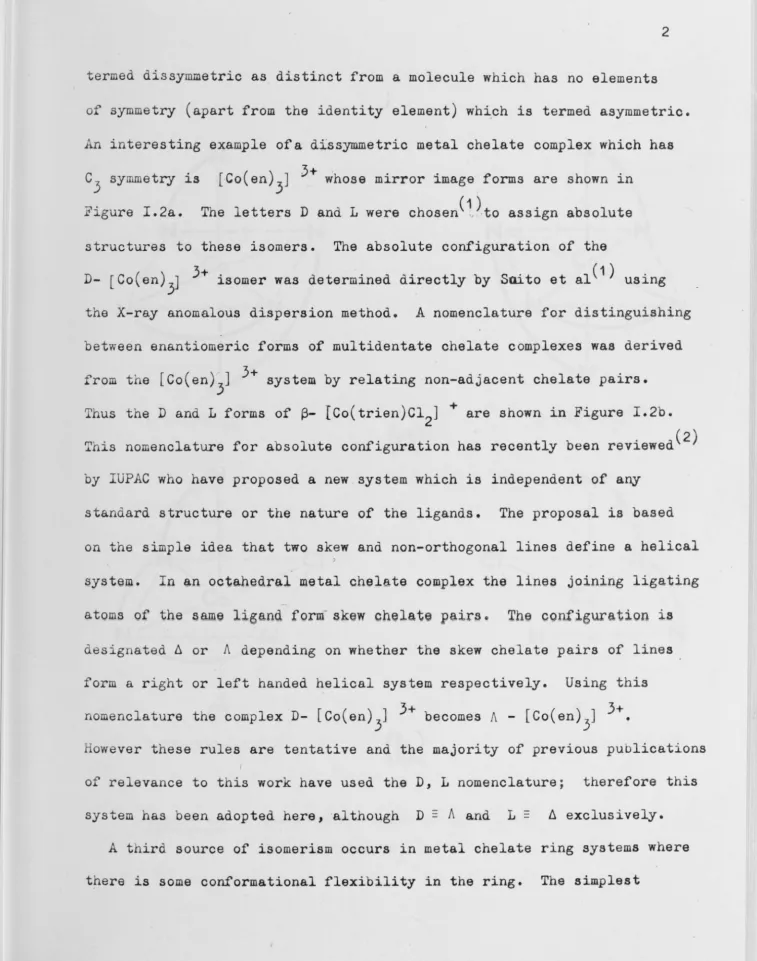
termed dissymmetric as distinct from a molecule which has no elements
of symmetry (apart from the identity element) which is termed asymmetric.
An interesting example ofa dissymmetric metal chelate complex which has
c
[image:12.799.20.778.28.990.2]3
symmetry is [Co(en)3
J
3
+ whose mirror image forms are shown inFigure I.2a. The letters D and L were chosen(1)to assign absolute
structures to these isomers. The absolute configuration of the
D- [Co(en)~ 3+ isomer was determined directly by Saito et a1(1) using
the X-ray anomalous dispersion method. A nomenclature for distinguishing
between enantiomeric forms of multidentate chelate complexes was derived
from the [Co(en)
3
J
3+ system by relating non-adjacent chelate pairs.
Thus the
D
andL
forms of~- Ico(trien)Cl2] + are shown in Figure I.2b.
This nomenclature for absolute configuration has recently been reviewed(2)
by IUPAC who have proposed a new system which is independent of any
standard structure or the nature of the ligands. The proposal is based
on the simple idea that two skew and non-orthogonal lines define a helical
system. In an octahedral metal chelate complex the lines joining ligating
atoms
of the&ame ligand
fornf~kew
chelate
pairij.
The
c.onfiguratign
is
designated~ or A depending on whether the skew chelate pairs of lines
form a right or left handed helical system respectively. Using this
nomenclature the complex D- [Co(en)
3J
3+ becomes A - [Co(en)
3J
3+.
However these rules are tentative and the majority of previous publications
of relevance to this work have used the D, L nomenclature; therefore this
system has been adopted here, ·although D
=
A and L=
~ exclusively.A third source of isomerism occurs in metal chelate ring systems where
IN
N - - - N
/ ' c o ~
1
1 ~ ~ / /
N - - - - , - - N
I
N
3+
L- (Co (en) 3]
N
;;
)'I"'--- - ~
f
I
Co
1/ ~
""'
/
.N ~ N
I
Cl
N
(a)
N
Cl-
- - - --N
\"--c/'\
\ 0 ~ \\
/
~ \N -.._[__., N
I
Cl
(b)
D-(Co(trien)C£2] +Figure I.2 Enantiomeric forms of (a) (Co(en) 3] 3+ and
(b) [Co (tr i en) C Q,
[image:13.792.11.778.21.953.2]and most common example is the five membered ring formed by the
co-ordination of ethylenediamine to a metal ion (Fi&ure
r.3).
There are3
two possible mirror image gauche conformations which the five membered
ring can adopt. In an early treatment of this problem Corey and Bai la.r(3)
designated these two conformations ask and k' (see Figure
r.3).
Howeveran unfortunate error in a diagram in this paper led to an ambiguity in
this nomenclature. This problem is resolved using the IUPAC proposal
for conformational nomenclature(2) which also has the advantage that it
is based on the helical system formed by two skew, non-orthogonal lines.
In the ethylenediamine ring the lines joining the ligating nitrogen atoms
and the carbon-carbon bond form such a system. A right-handed helical
system is designated
o
and a left-handed system, A (see Figurer.3).
This system is also independent of any standard structure and in view of
the confusion which arose f or the earlier nomenclature, the IUPAC system
will be adopted to describe conformation.in this thesis.
1 .2 Co-ordinated Secondaa ..Nitrogen Centres
In recent years the significance of isomerism generated by
co-ordinated secondary nitrogen atoms (sec-N) has become evident. For
example it was shown(
4)
that [Co(NH3
)
4
sar]2+ (sar
= sarcosine =
N-methylglycine) could be resolved into two optical forms which differed
only in the coaj;iguration at the asymmetric sec-N centre of the amino
acid (see Figure
I.4).
This resolution was achieved in acid soluti onwhere the rate of inversion at the sec-N centre is sufficiently slow for
k
~
N
N
Figure I.3 Mirror image conformations of coordinated ethylenediamine
k'
.•
Figure I.4 The complex ion [Co(NH) sar] 2+
[image:16.789.22.777.18.940.2]4
racemisation of the sec-N centre was observed.
A considerable number of chemical and structural studies have now
been made on complexes containing co~ordinated secondary N centres and
a number of general properties of these systems are now lglown. For
cobalt (III) complexes the rates of proton exchange,~ and inversion, k1
generally have the same rate law, where
rate= k [complex](OH-j
but markedly different rate constants. In the systems discussed here the
3(5)
ratio ~/k
1, known as the retention rat~G, is generally greater than 10.
The co-ordinated sec-N centre has tetrahedral stereochemistry and the
Rand S nomenclature used to describe absolute configurations at
asymmetric carbon centres has been adopted in these systems. This
nomenclature was first suggested by Cahn, Ingold and Prelog(G) and is now
accepted by IUPAC.(
7)
An interesting example of isomerism generated by co-ordinated sec-N centres occurs in the ligand trien co-ordinated to cobalt (III) in the
~ configuration (Figure I.1b). In these types of complexes it is useful
.•
to distinguish between two different types of sec-N centres (see Figure
1.5).
The configuration at the-•angular' sec-N atom N3, is fixed by the
ligand geometry, whereas the configuration at the 'planar' sec-N atom
N
2 can undergo inversion with simult~neous inversion of the conformations
of the adjacent chelate rings. This type of conformational isomerism •
only appears to be possible at the junction between two chelate rings
which share a common coordination plane.
Inversion at the 'planar' aec-N atom in ~-trien was first observed
for the~- [Co(trien)(H
2o)2
J
3
+ complexes.(B) The mutarotation of the•
-·,
H2Q-I--
---N3
.,, //
__
'Co -
,rr;I"
'H
N
~~
--
-,.-
'NQ
1
2
I
H2Q
D- B-SS-[Co(trien)(OH) ]3+
2 2
~2Q~cl-
~t)j3'H
~
0
~ . - . . , I~
N---
-r
N2
1
"H
H20
D-B-SR-[Co(trien) (OH
2)2] 3
+
Figure I .S. Diastereoisomeric forms of B- [Co(trien)(OH2) 2]
5
less stable D-~-SR- [Co(trien)(OH
2)2
J
3
+ to the more stableD-~-SS- [Co(trien)(oH
2)2]
3
+ was observed.(B) (S~e FigureI.5).
Thistype of isomerism could be considered as both optical and conformational
isomerism.
It is evident that there are several sources of isomerism in these
systems. This complexity means that it is often difficult to assign·
exact configurations to these complexes without the use of X-ray structural
analysis.
Stereospecificity and Relative Stabilities of Complexes
The subject of stereospecificity has intrigued chemists for
many years perhaps because of its vital role in biochemical reactions.
An example of stereospecificity in inorganic chemistry occurs in the
[Pt(l-pn)
3
J
c14
system. (1-pn = 1-1 ,~ propylenediamine.). From thepreparative mixture it was found(
9)
that the D- IPt(l-pn)3
]
4+ isomerwas present in excess of the 1- IPt(l-pn)
3
J
4+ isomer by a factor of1.5.
However, under equilibrium conditionij the D isomer is present in exce~s
by a
factor of at
least7
.
The
[Pt(l-pn)
4+
3
]
complexes provide an
illustration of two distinct types of s~ereospecif'icity, the former of
kinetic origin and the latter of thermodynamic origin.
When testing for kinetic stereospecificity, care must be taken to
determine all reaction products and ,their relative abundances in the
reaction mixture. Likewise for thermodynamic stereospecificity care
must be taken to ensure that equilibrium has been attained. Lack of
distinction between these two types ,of stereospecificity and incautious
6
· d' t if' ' t
<
10 )inorganic literature regar ing s ereospec ici y. In cases of
thermodynamic stereospecificity the equilibrium constant, K is a measure
of the relative stability between two isomers. Their free energy
difference, 6G is given by the equation,
6G = -RT log K
e
A part·cular example of thermodynamic stereospeoifioity will be
dis-cussed in some detail because of its direct relevance to the work reported
in this thesis. It was shown(11 ) that coordinated sarcosine in the
[C ( o en ) ] 2+ . t if.
2 sar ion was s ereospec ic. This was demonstrated by the
fact that inversion of the secondary N-methyl centre was not observed in
the active complex (Dor L) even under quite basic conditions (pH
8.8)
.
'
It was noted that under similar conditions inversion at the N-methyl centre
was a very rapid process in the [Co(NH
3
)
4
sar]2
+ ion.(
4)
A simplecon-formational analysis treatment involving a consideration of non-bonded
interactions alone as measured from Dreiding models, supported the
argument that mutarotation was excluded by unfavourable steric
inter-actions. The energy difference betweQn the L-S- [Co(en)
2 sar] 2
+ and
L-R- [Co(en)
2 sar] 2
+ ions (see Figure
I.6;
Sand R denote the absoluteconfigurations about the amino acid sec-N centres) was estimated to be
10.5 kcal/mole in favour of the 1-S isomer. A crystal structure
analysis of the (-)
589- [Co(en)2 sar] 2
+ ion confirmed the structural
assignment of the most stable isomer as
L-s.<
12)1.4 Mutarotation of Chelated Amino Acids
N
H
\
N---1---N~CH
I"'
·
~;
~
3
I
C
~
I
I
~
0
I
, 1 ~
" '
I
N----1--N
-=
-,,,,,,
I
0
2+
L-S-[Co(en) 2sar]
Figu_re I.6 Diastereoisomeric £01111s of [Co(en) 2sar]2+
N
CH
3
N--1--
\
/ "-
---N-H
/
__.,;/" C
O
I
I
N~-
"- /
- -1--N
-I
0
2+
L-R-[Co(en) 2sar]
carbon centre of an a-C substituted amino acid may play a role in determining stereospecific co-ordination.
Chelated amino acids have been shown to undergo base catalysed
a-proton exchange and mutarotation with the same rates and rate laws
7
i.e. R = k[complex]
[OH-J
.<13) Thus the retention ratio~/\t
for theseprocesses is unity in contrast to secondary nitrogen centres.
Mutarotation at the chelated amino acid a-carbon centre provides a
method of establishing equilibrium between diastereoisomerio forms and
thereby measuring relative stabilities. Under equilibrium conditions the
ratios D- [Co(en)
2 (R-val)]
2
+ / D-[ Co(en)
2(S-val)]
2
+ =
1.7
and·D- [Co(en)
2 (R-ala)]
2
+/
D- [Co(en)2 (S-ala)]
2
+
= 1.0(
9)
(S-val =1-valina, S-ala = 1-alanine). The thermodynamic stereospecificity in
the case of chelated valine could not be interpreted on the basis of
steric interactions. It was therefore suggested that the small difference
in free energy (6G =
-0.3
kcal/mole) might arise through differences insolvation energies for the two diastereoisomers.<13 )
Clearly, with regard to th~rmodynamic stereospecifioity the effect
of substituents on the a-carbon centre is very much less than substituents
on the amino nitrogen atom.
1
.5
The Scope of Part IAlthough the stereochemistries and relative stabilities of
these types of complexes have received considerable attention in recent
years, many problems still remain. At the time the work described in
8
of cobalt (III) multidentate amine complexes was sparce. Rigorous
calculations of isomer relative stabilities were frustated by insufficient
accurate structural data. Chelate ring conformations could only be
estimated from an examination of stereomodels. A_number of chemical
studies were incomplete due to the difficulties of assigning configurations
to one or more components. Further, there was an obvious need for more
measurements of absolute configuration to aid the interpretation of
circular dichroism and optical rotatory dispersion spectra in these
types of complexes.
X-ray structural analyses and where possible absolute configuration
determinations were carried out on a number of multidentate amine
complexes, in an attempt to provide •the required detailed structural data.
The final chapter in part I reports some chemical studies on the
thermodynamic stereospecificity of co-ordinated N-methyl-S-alanine in a
series of [co(trien)(N-me-S-ala)] 2+ complexes.
CHAPTER 2
The Crystal and Molecular Structure of Racemic ~-(Chloroaguo-triethylene tetramine)
Cobalt (III) Perchlorate
2.1
Introduction9
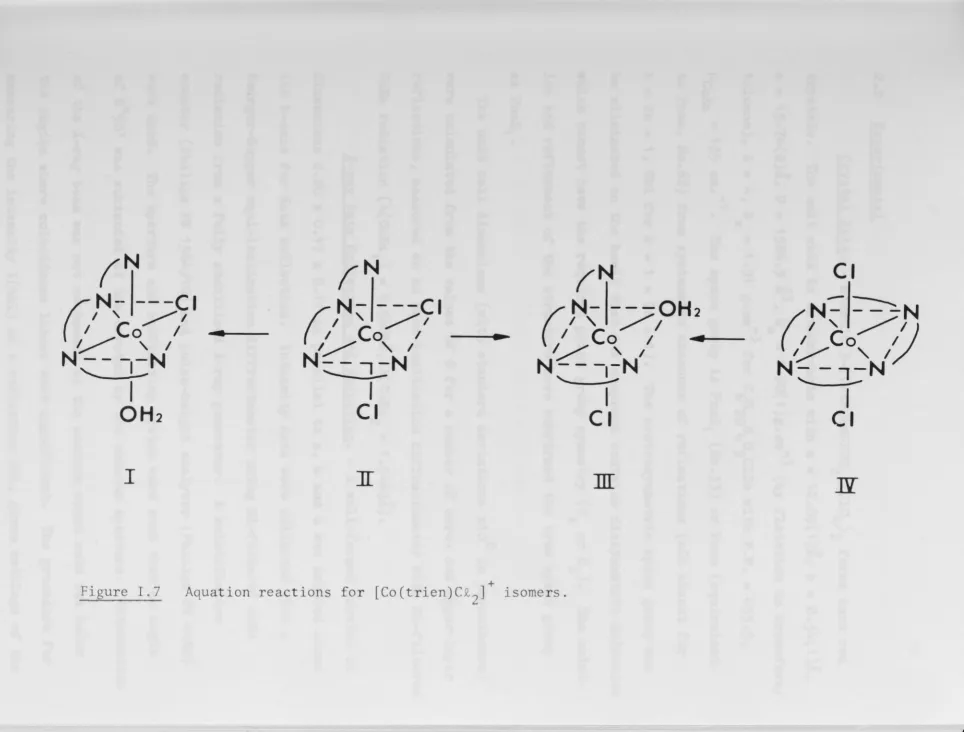
It has been shown(1_4)(1S) that
'3-I
Co(trien)C12] +, (II, Figure I.7) aquates to form two chloroaquo species (I and III, Figure I.7) which
I
can further aquate to form a common diaquo product. From a similar study on the aquation of trans-[ Co(trien)C1
2
J
+ (IV, Figure I.7) it could be reasoned(1~)that isomer I was the only chloroaquo intermediate obtained in this case, and that this was the major chloroaquo isomer formed in the hydrolysis of'3- [
Co( trien)C12] +. Correct structural assignments to the
'3-
[Co(trien)ClOH 2]2
+ isomers are particularly important as these structures are the basis of a number of further studies on (triethylenetetramine)
cobalt(III) complexes.(16 ~1
a)
A detailed knowledge of the atereochemistry of trien coordinated in the'3
geometry will also be of interest, partic7 ularly with respect to the configuration around that asymmetric secondary amine nitrogen which connects the two chelate rings sharing a commoncoordination plane. (The nomenclature follows that of refs.
14-16.)
.
(N
1
,N;:
,-...---s
1
( 1
1
_...-,Co
1----~-N
,.,.,,,,,-
~ N
'\.
II
OH2
I
/N
/,N,
1-/~I
(
11
~Co
1N ~
- -
...____7 -
' /
N
-I
Cl
1[
•
/N
(; ~;:: 1-___;;pH2
1/
Co,
I ~ ~-N - - -1--N
1'---=--"
I
Cl
III
+ Figure I. 7 Aquat ion react ions for [Co(trien)C£
2] isomers.
Cl
---1
(
N- ----...
I '
--N
1
Co~)
1 / '\.
IN-
~ N
'
I
Cl
[image:25.1004.29.994.31.763.2]10
2.2 Experimental
Crystal Data. - Racemic ~-[CotrienCl0H
2J(Cl04)2 forms dark red
.
crystals. The unit cell is orthorhombic with a= 1,2.09(1
)A,
b = 8.34(1 )A,c = 15.74(2) , U = 1586.9136 D = 1.90(1)g.cm-3 (by £lot t ·on in bromoform/
m
)
-3
.
toluene , Z = 4, Dx = 1 .91 g.cm for c
6tt20N4
o
9c1co with F.W. = 455.5,µCuKa, = 135 cm.-1• The space group is Pna2
1 (No.33) or Pnam (equivalent
to Pruna, No.62) from systematic absences of reflections (h0l absent for
h = 2n + 1, 0kl fork+ 1 = 2n + 1). The centrosymmetric space group can
be eliminated on the basis that the compound contains dissymmetric molecules
which cannot have the required point group symmetry (C or
C.).
Thesolut-s l.
ion and refinement of the structure have confirmed the true space group
as Pna2 1•
The unit cell dimensions (with standard deviations x102 in parentheses)
were calculated from the values of g for a number of zero- and upper-layer
reflections, measured on an equi-inclination diffractometer with Ni-filtered
X-ray Data Col~ecti-on and Reduction. - A well-formed crystal of
dimensions 0.20 x 0.17 x 0.11 mm parallel to a, band c was mounted about
its b-axis for data collection. Intensity data were collected with a
Buerger-Supper equi-inclination diffractometer using Ni-filtered CuKo.
radiation from a fully stabilised X-ray generator. A scintillation
counter (Philips PW 1964/10) and pulse-height analyser (Philips PW 4280)
were used. The aperture and collimating system were such that an angle
0
of 2 50' was subtended at the crystal by the counter aperture. Attenuation
of the X-ray beam was not ne·cessary as the maximum count rate was below
the region where coincidence losses were significant. The procedure for
equi-inclination anglesµ (crystal) and v (counter) appropriate for a
reciprocal lattice zone,( 19 ) was as follows:
(1) The counter was brought manually to the position I (hkl)
(2) The crystal was manually rotated to the angle,
11
where¢ (hkl) was the calculated setting for the diffraction maximum.
0
The scan-angle w(hkl) was normally set at
3°,
but was increased (anda re-measurement was made) whenever the chart-recorder trace of the
rate-meter output showed that a reflection had been truncated.
(3) The first background, B
1, was measured fort sec.
(4) The crystal was moved by a motor through an angle w(hkl) at 3°/min
to
¢
2 = [¢0 (hk1) + w(h.kl)/2} Total scan time was 2t sec. and the
integrated count was P.
(5) The second background, B
2, was measured fort sec. at the angle
¢
2•Steps (3) - (5) were controlled by an automated stepping mechanism.
Peak profiles for all reflections were recorded on a chart recorder to
check on peak centering -and p9ssible overlapping of adjacent reflections.
Data were collected in the range 1
o
0 ~ T ~ 14JJ0 for the zones hXl( 0 ~ K ~
9).
Ten strong zero-layer reflections were remeasured atregular intervals.
For each reflection, the net count I(hkl) was calculated as
This corrected count was then tested for significance above background,
i • e •
12
a set of corrected relative structure amplitudes I F(hkl) I were obtained.
Standard deviations in the relative structure amplitudes (both observed
and unobserved) were assigned using an expression due to Hoard and
Jacobson.(20) The con tants
1S,,
~ a n d ¾ in thia expression were givenvalues 0.02 ,
0
.
05
and 0, respectively. Using accurate measurements of the crystal dimensions , absorption corrections were applied by the methodof Coppens , Leiserowitz and Rabinovich,(21 ) using a 4 x 6 x 6 grid with
axes parallel to a, band c, respectively. Calculated transmission
coefficients ranged from
0.17
to0.43.
Finally, scale factors between ten sets of ten standard reflections (see above) were calculated by a least-squares method.(22) These scale-factors indicated a time-dependent decrease in the intensities of the standard reflections during the periodof X-irradiation. Appropriate corrections were applied. A total of
1591
reflections was recorded, of which 466 were unobservably weak.
Solution and Refinement of the Structure. - The structure was solved using a sharpened Patterson and standard Fourier syntheses. It
-was evident from the spread of electron density around the perchlorate
oxygen atoms that they were not rigidly fixed.
Least-squares refinement was then carried out, minimising the function E w( IF I- s IF I )2 where the weights w = 1/o2(F) ands= inverse of
0 C
scale factor to be applied to the IF I. Unobservably weak reflections
0
were given zero weights. After three cycles in which only the coordinates
and isotropic temperature factors were varied, the residuals R
1
and R
2 = (E w ~ 2
/ E w F!)
1
/
2 were0
.
156
and0
.
059
,
respectively( ~ = I IF 1-s I F 11 ) •
0 C
13
Before commencing anisotropic refinement, new weights were derived from an analysis of the variation of <1/62
>
in ranges ofI
FI
0
The
I
F
I
-
dependence could be adequately described by a modified0
Cruickshank function( 23 ) of the type w = K/ (1+((F - P~)/p1)~ . 0 ~
The angular dependence was shown to be negligibly small. The weighting
scheme was revised after each subsequent refinement cycle. The weighting parameters conv~rged to the values K
=
0.203,
p1
=
34.0, p2 = 53.0.A (F - F )-synthesis, computed after two cycles of anisotropic
0 C
refinement, had positive regions of electron density in all eigAteen expected hydrogen atom positions of the trien ligand. The inclusion of
hydrogen atoms at their calculated positions caused an improvement in the residual R
1 from 0.090 to
0.077,
and in R2 from 0.120 to 0.096. Thehydrogen atom positions were recalculated after each cycle, but otherwise
the hydrogen atom parameters were not refined. After five cycles, the anisotropic refinement converged with residuals R
1 = 0.070 and R2 = 0.076. No parameter changed by more than 0.3 of its standard deviation in the last refinement cycle. A fin~l difference Fourier had no positive maxima greater than 0.4 e/
X
3 , the standard deviation of the electron density being 0.15 e/X
3 .The atomic scattering factors of Cromer and Waber(24) were used for
3+
Co , Cl, O, N and C. The values for H were taken from the tabulation
by Ibers.(25) In view of the polar nature of the space group, the Co and Cl atoms were treated as anomalous scatterers(26) with 6f' and 6f" values listed by Cromer.(27 ) The refinement was repeated in the space
pre-14 ( 26 '2.6dJ
dieted by Cruickshank and McDonald, ~ and led to unacceptable bond lengths (e.g. Co - N(1)
=
2.14A,
Co - N(3)=
1.71A),
showing that the original choice of polarity was correct. The observed and calculated structure factors are compared in Table I.1.1 Structure factors were calculated for unobserved data and no calculated value differed from the value assigned to the correspondingI
F uno s bI
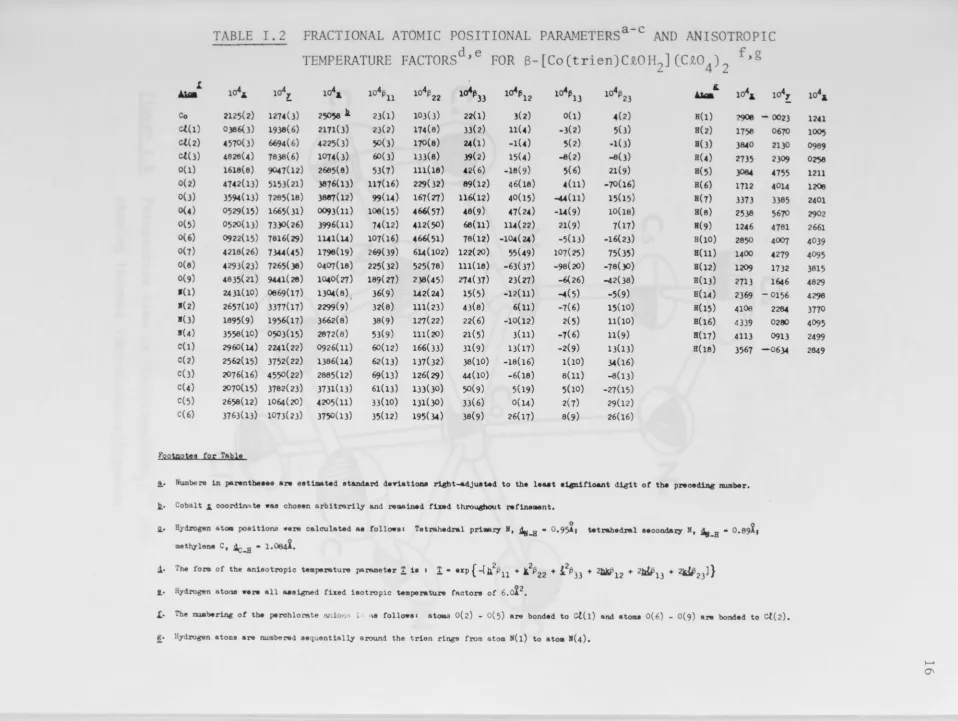
by more than 3o (F uno s b ) •The final atomic positions and anisotropic thermal parameters are presented in Table I.2. Although the refinement was based on data recorded about
only one crystal axis, the vibrational parameters correspond to physical~y
reasonable thermal vibrational ellips_oids (Figurea I.8 and I. 9).
Computer Programs. - The following crystallographic computer
programs were used in the present and subsequent structural analyses.
Data reduction, Fourier syntheses and subsidiary calculations were carried
out on a CDC
3600
computer using programs written by Dr. J.F. Blount.Full matrix least-squares refinements and difference Fourier syntheses were calculated on an IBM
360/50
computer using modified versions of ORFLS(2B)
and FORDAP( 29 ) respectively. ~ Estimated standard deviations includingcorrelation terms for interatomic parameters were calculated by means of
program ORFFE,(
3
o) adapted for use on IBM360/50
computer. Perspective molecular and unit cell diagrams were drawn under computer control using program ORTEP( 31 ) on the CDC3600
computer.Description of the Structure
The crystal structure can be described in terms of successive
..
~,-.a-TABLE I.2 FRACTIONAL ATOMIC POSITIONAL PARAMETERSa-c AND ANISOTROPIC
TEMPERATURE FACTORSd,e FOR B-[Co(trien)C£OH
2] (C£O4)2
f,g
1
104• 10\: 1o4.1, 4 4 1o41133 1o41112 1o41113 4
'
104• 104,.~ 10 i;
11 10 '322 10 '323 A.Ma
Co 2125(2) 1274(3) 25058 ll. 23(1) 103(3) 22(1) 3(2) 0(1) 4( 2) H(l) 2906 -0023
c.t(1) 0386(3) 1938(6) 2171(3) 23(2) 174(8) 33(2) 11(4) -3(2) 5(3) H(2) 1758 0670
c.t(2) 4570(3) 6694( 6) 4225( 3) 50(3) 170(8) 24(1) -1(4) 5(2) -1( 3) H(3) 3640 2130
c.t(3) 4828(4) 7838( 6) 1074(3) (i()( 3) 133(8) 39(2) 15(4) -8(2) -8(3) H(4) 2735 2309
0(1) 1618(8) 9047(12) 2665(8) 53(7) 111(18) 42(6) -18(9) 5(6) 21(9) H(5) 3084 4755
0(2) 4742(13) 5153(21) 3876(13) 117(16) 229(32) 89(12) 46( 18) 4(11) -10(16) H(6) 1712 4014
0(3) 3594(13) 7285(18) 3687(12) 99(u) 167(27) 116(12) 40(15) -4-4(11) 15(15) H(7) 3373 3385
0(4) 0529(15) 1665(31) ()()IJ3(11) 106(15) 466(57) 48(9) 47(24) -1.4(9) 10(18) H(8) 2538 5670
0(5) 0520(13) 73)0(26) 3996(11) 74( 12) 412(50) 66(11) 11.4(22) 21(9) 7(17) H(9) 1246 4781
0(6) 0922(15) 7816(29) 11.41(1.4) 107(16) 466(51) 78(12) -104(24) -5(13) -16( 23) H(l0) 2850 4007
0(7) 4218(26) 7~(45) 1795(19) 269( 39) 614(102) 122(20) 55(49) 107(25) 75(35) H(ll) 1400 4279
0(8) 4293(23) 7265(38) 0407(18) 225(32) 525(78) 111(18) -63(37) -98(20) -78()0) H(l2) 1209 1732
0(9) 4835(21) 9441(26) 1040(27) 189(27) 238(45) 274(37) 23(27) -6{ 26) -42(38) H(13) 2713 1646
1(1) 2431(10) 0669(17) 1304(8),, 36(9) 142(24) 15(5) -12(11) -4(5) -5(9) H(14) 2369 - 0156
1(2) 2657(10) 3377(17) 2299(9) 32(8) 111(23) 43(8) 6(11) -7(6) 15(10) H(15) 4106 2284
1(3) 1895(9) 1956(17) 3662(8) 38(9) 127(22) 22( 6) -10(12) 2(5) 11(10) H(l6) 4339 0280
1(4) 3558(10) 0503(15) 2872(8) 53(9) 111(20) 21(5) 3(11) -7(6) 11(9) H(17) 4113 0913
C(l) 29(i0( 14) 2241(22) 0926(11) (i0(12) 166(33) 31(9) 13(17) -2(9) 13( 13) H(18) 3567 -0634
c(2) 2562(15) 3752(22) 1386(14) 62( 13) 137(32) 38( 10) -18( 16) 1(10) 34(16)
c(3) 2076(16) 4550(22) 2885( 12) 69(13) 126( 29) 44(10) -6(18) 8(11) -8(13)
c{4) 2070(15) 3782(23) 3731(13) 61(13) 133(30) 50(9) 5(19) 5(10) -21(15)
c(5) 2658(12) 1064(20) 4205(11) 33(10) 131(30) 33(6) 0(14) 2(7) 29(12)
C(6) 3763(13) 1073(23) 3750( 13) 35(12) 195(34) 38(9) 26(17) 8(9) 26(16)
Footnot§e for Table
!,, Numbers in paNntbeHe &N eatim&ted standard derlationa r18ht-adju.eted to the leaat •i&nifioant d.181t of the pNoeding number.
R.• Cabal t 1. coordlni\ te was chosen arbi trsrily and remai.Jwd find thro~t NfineMnt,
i.• Hydrogen at011 positions "•re calculated ae follows• Tetrshedral pri111&:r,r Ii, ~..Ji • 0,9~1 tetrahedral Hcondary N, ~-H • 0,89i,
meth,ylene c, ~..Ji • 1,oe.µ,
,1. The for,ii of the anisotropic temperature p&I'61Deter ! 1a 1 ! • exp { -(b,2!\
1 + l1322 + 121333 + 2.Wl12 + 2Mf!13 + 2W23J}
Jl.• Hydrogen ator.111 ••N all aa111&ned fixed ieotropic temperature faotora of 6.oi 2•
L• The numbering of the perohloI?.te Mio11,-; i: •111 followa• at01AB 0(2) - 0(5) are bonded to c.l(l) and ato11111 0(6) - 0(9) are bonded to c.t(2).
!· Hydrogen atoms are nu~bered sequentially around the trien rings from atom N(l) to atom 1(4),
104.1,
1241 1005 0989 0258 1211 1208 2401 2902
2661
4039 4095 3815 4829 4298 3770 4095
2499
2849
f---1
[image:32.1002.28.986.42.763.2]Figure I.8
Cs
Perspective view of [Co(trien)C£OH
2] 2+ ion
Q4
Figure I.9
Q3
06
02
Perspective views of perchlorate anions in B-[Co(trien)C£OH 2]
2+
showing thermal vibrational ellipsoids.
Os
[image:34.1002.7.985.35.757.2]17
roughly parallel to the a-axis. A perspective diagram of the unit cell
as viewed down the b-axis is shown in Figure I.10. The crystal contains
no water of crystallisation. Thermal ellipsoids for the perchlorate
anions (Figure I.9) indicate high thermal motion or slight disorder of
.
the oxygen atoms. This feature of the:structure, the relatively large
pro nt ge of nobs rved r fl otione, tha ff ot of fluoresoent r di tion~
and the use of single-axis data have combined to reduce the precision and
accuracy of the structure analysis.
Description of
S-
(Co(trien)ClOH2]
2
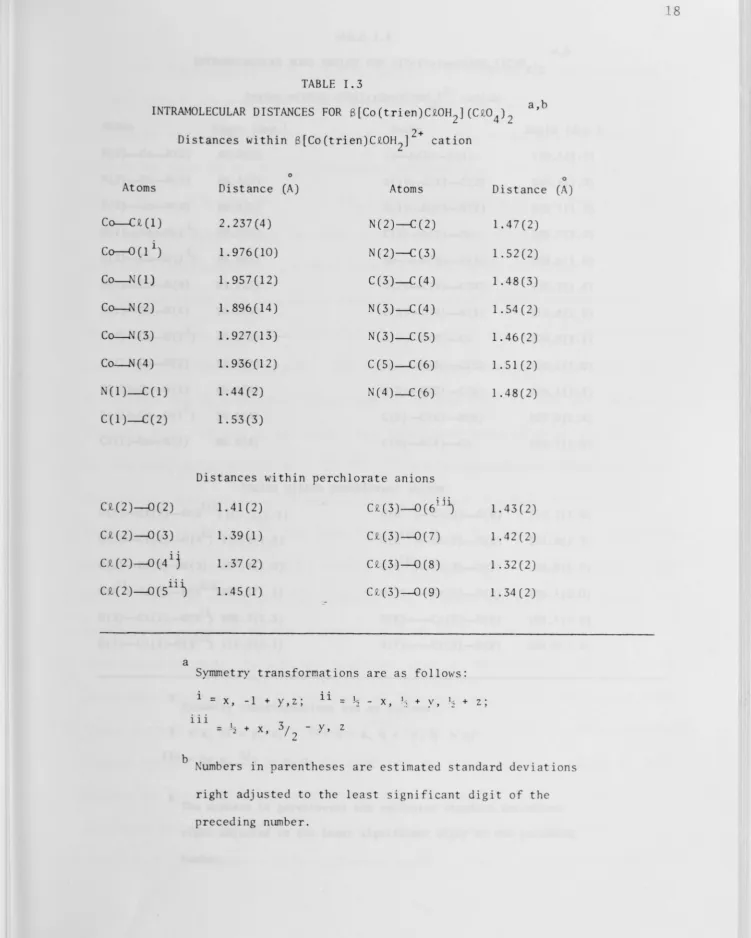
+ cation. Intramolecular
bond distances and angles with their estimated standard deviations are
given in Tables
r.3
and I.4. The Co111-N bond distances are all equalwithin 3 standard deviations, although the bonds are not chemically
equivalent. Their mean is 1.93(1)A, comparable with 1.96(2)A in
trans-[Co(en)2c12 ]S
2
o
6.H2o(
32
), 1.97(2)A in D- [Co(en)
2(L-glutamic acid)] c104,
( 33 ) 1.97(1)A in [Co(en)
2sarcosine ]I2.2H20,(
12) and 1o94(2)A ~n
trans-[Co(en)2so3NCS l2H 20,(
34)~tandard deviations are given in parentheses,
right adjusted to the least significant figure of the preceding number).
III :
The Co -Cl bond-length, 2.237(4)A lies in the range of other recent
determinations: 2.230(1)A,( 32 )i.303(6)A in [Co(NH
3)5c1 ]siF6,( 35 ) and
2.286(2)A in [Co(NH
3\C1 ]_c12.( 36 ) (A number of' earlier determinations
(37-41) I I I I I I
of Co -N and Co -Cl bond-lengths have been omitted from the
comparisonso The reported values were significantly greater but were
based on limited data and refinements)o
III There are no suitable structures containing Co -OH
2 bonds wi th~1which
.
to compare the distance of 1.98(1)A found from this analysis. The only
previously reported structures containing such bonds have been disordered
(42-44)
Figure 1.10 A perspective diagram of the unit cell of S-[Co(trien)C£OH 2] (C£0 4) 2
as viewed down the b-axis.
c-axis is horizontal.
[image:36.1002.12.995.39.739.2]TABLE I.3
INTRAMOLECULAR DISTANCES FOR S[Co(trien)C£OH
2)(C£04)2
a,b
Distances within S[Co(trien)C£OH 2]
2
+ cation
0
0
Atoms Distance (A) Atoms Distance (A)
CO--C£ (1) 2.237(4) N(2)-C(2) 1.47(2)
Co---0 (11) 1. 976 (10) N(2)~(3) 1.52(2)
Co----N ( 1) 1.957(12) C(3)--C(4) 1.48(3)
Co----N (2) 1. 896 (14) N(3)--C(4) 1. 54 (2)
Co----N (3) 1.927(13) N(3)--!:(5) 1. 46 (2)
Co----N ( 4) 1.936(12) C(5)--!:(6) 1.51(2)
N(l)-C(l) 1.44(2) N(4)-C(6) 1.48(2)
C(l)--!:(2) 1.53(3)
Distances within perchlorate anions
(£(2)--0(2) 1. 41 (2) C£(3)-0(61
j½
1.43(2)C£ (2)--0 (3) 1.39(1) (£(3)--0(7) 1.42(2)
C£(2)-0(4i1 1.37(2) C£(3)--0(8) 1.32(2)
C£(2)-0(5ii~ 1.45(1) C£(3)-0(9) 1.34(2)
.•
a
Symmetry transformations are as follows:
i = x, -1 + y,z; ii = 1: 1 - X , I~ + "f, 12 + z ;
111
= ½ + x,
b 1
umbers in parentheses are estimated standard deviations
right adjusted to the least significant digit of the preceding number.
[image:37.783.16.768.22.961.2]TABLE I. 4
a,b
I TRAMOLECULAR BOND ANGLES FOR B[Co(trien)C£OII
2] (C£04)2
Angles within B[Co(trien)C£OH
2]
2
+ cation
Atoms Angle (deg.) Atoms Angle (deg.)
N(2)-CO-..N(l) 86.0(6) C~(l)-C(l) 110.3(1.0)
(2)-C~(3) 86.4(6) N(l)-C(l)-C(2) 108.6(1.3)
N (3)-Co--N ( 4) 86.9(5) C(l)-C(2)-N(2) 105.2(1.4)
N ( 1 )-Co--0 ( 1 i) 92.0(5) C(2)-N(2)-Co 109. 7 (1.1)
N(3)-Co--O(l i) 95.6(5) CO----N (2)-C (3) 109.6(1.0)
N(2)-C~(4) 93.1(5) N(2)-C(3)-C(4) 105.7(1.4)
N(l)-C~(4) 93.5(5) C(3)-C(4)-N(3) 111.4(1.5)
N(4)-Co--O(l i) 85.6(5) C(4)-N(3)-Co 109. 8 ( 1.1)
C£ (1)--{;~(2) 92.8(4) c ~ c 3 )-Cc 5) 108.1(1.0)
C£ (1 )-{;o--N ( 1) 89.6(4) N ( 3 )-C ( 5 )-C ( 6) 106 .1 (1. 3)
C £ ( 1 )-{;o--0 ( 1 i ) 88.6(3) C(5)-C(6)-N(4) 107.0(1.4)
C£ (1)--{;~(3) 90. 8 ( 4) C (6)-N(4 )-Co 108.7(1.0)
Angles within perchlorate anions
0 ( 2 )-C £ ( 2 )--0 ( Si i
½
10 7 . 2 ( 1. 1 ) 0 ( 6ii ~-C£ (3 )-0 (9) 112.2(1.4)0(2)-C£(2)--0(4i~ 112.6(1.5) 0 (6ii½-ei (3)---0 (8) 111.8(1.7)
0(2)-C£(2)--0(3) 107.4(1.0) 0 (61 i ~-C£ (3)---0 (7) 108.0(1.7)
0 (
i
~-C £ ( 2 )--0 ( ~i½
109. 1 (1 . 1) 0(7)---C£(3)---0(8) 106.1 (2 .0)
--0 ( 3 )-C £ ( 2 )--0 ( 4i i) 108. 3 ( 1. 3) 0(8)---C£(3)-0(9) 109.5(2.2)
0 (3)-C£ (2)-0 (~i ~ 112.2(1.1) 0(7)---<::£(3)--0(9) 109.0(2.2)
a
Symmetry transformations are as follows:
i = x, -1 + y, z.
' ii= ½ - x, !<: 2 + y, !-, 2 + z.
'
iii = ½+ x, 3/ 2 - y, z.
b
The numbers in parentheses are estimated standard deviations
right adjusted to the least significant digit of the preceding
number.
20
Conf'ormations of Chelate Rings. - Since the angles subtended
at the cobalt atom by the trien chelate rings are all close to 86°
(as
in simple ethylenediamine complexes( 32 , 34)), the coordination geometry
cannot be that of a precisely regular octahedron. The bonds from Co to
N(1), N(2), N(3) and 0(1 ') (= OH
2) are coplanar (plane 1, Table I.5),
but the four donor atoms in each of the other two coordination planes
deviate significantly from them (planes 2 and
3,
Table I.5).The two outer chelate rings have unsymmetrical skew conformations.
The ring carbon atoms C(1) and C(2) lie at -0.12 and 0.54
A,
respectively,from the N(1)-Co-N(2) plane. The corresponding deviations of C(5) and
C(6) from the N(3)-Co-N(4) plane are -0.48 and 0.22
A.
In the centralchelate ring, on the other hand, the methylene carbons C(3) and C(4) lie
on the same side of the N(2)-Co-N(3) plane (unsymmetrical envelope
con-formation, deviations 0.73 and 0.23
A).
In the crystal, for the1-~- [Co(trien)ClOH 2
J
2
+ ion (see Figure I.8 ), the chelate ring
conform-ations are as follows : N(1) - C(1) - C(2) - N(2), A; N(2) - C(3) - C(4)
-N(3),
o;
N(3) - C(5) - C(6) ~ N(4), 6 • Models suggest that, given theconfiguration found at the asymmetric atom N(2), both the distorted
coordination geometry and the conformations of the chelate rings in this
structure minimise the distortions of the bond angles in the ligand from
their normal values. Ibers et al.( 45 )recently examined the dihedral angles
formed by the C-N and C-C bonds (defined in their paper as angle~) in a
number of tris-ethylenediamine complexes of Co(III), Cr(III) and Ni(II).
The most accurately known values of~ were quoted for a number of
[Cr(en)
-I
TABLE I.5
LEAST SQUARES PLANES a
(a) Equations of planes AX+ BY+ CZ+ D = 0,
where X = ax, Y = by, Z = cz
Atoms included in plane Plane A B C
o.
Co, O(li), (1) , N ( 2) , (3) 1 -0.9303 0.2843 -0.2318
Co, C£(1), N(l), (3), N(4) 2 0.3331 0.9281 -0.1665
Co, C£ (1) , 0(1 i), ~: (2) N ( 4) 3 0.2003 -0.2308 -0.9522
(b) Distances of atoms from planes /
0
Atoms Deviations (A) from
Plane 1 Plane 2 Plane 3
Co 0.01 -0.01 0.01
C£ (1) -0 .11 -0.04
0(11) -0.01 0.04
-·
(1) 0.01 0 .12
(2) -0.01 0.04
(3) 0.01 0 .12
(4) -0. 12 -0.05
a
Symmetry transformation 1s as follows:
l
= x, -1 + y, z.
21
D
3.0124
-1.1940
22
indepenqently determined cations varied from 48.4° to 55.0° (mean value
= 51.6°). We find that the~ angles for the two outer chelate rings in
~-trien (The use of~ as a symbol for a particular dihedral angle is
unrelated to its significance in ·~-trien') have values (47.4°, 51 .8°),
similar to those found by Ibers,( 45 ) in contrast to the central chelate
ring which has a much smaller~ (37.0°) .
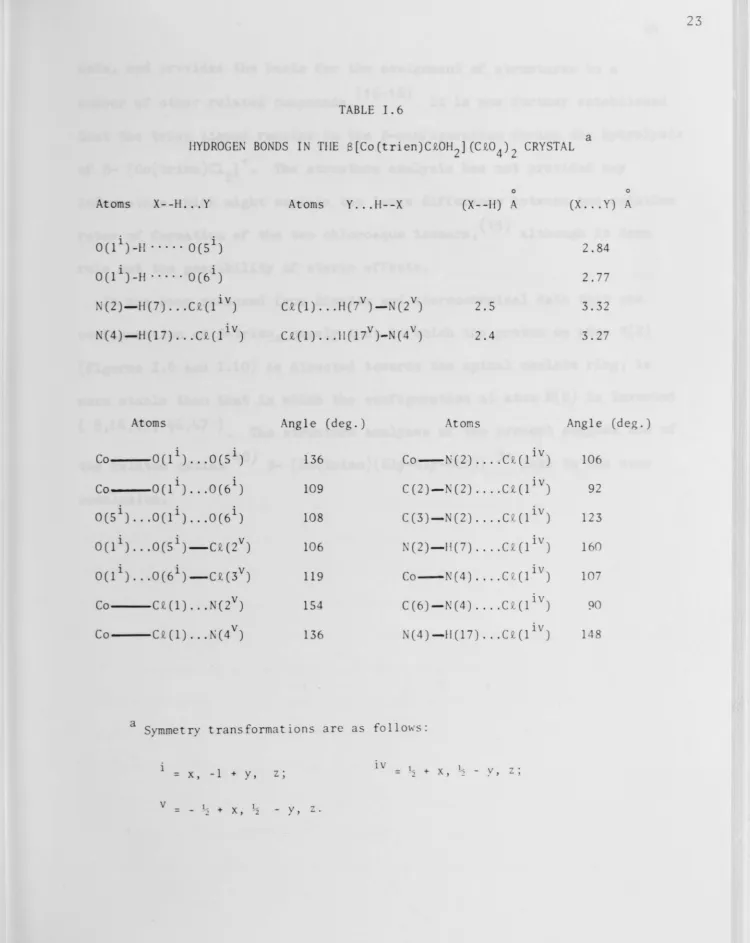
Intermolecular Contacts. - Each complex cation makes six
hydrogen-bonded contacts (Table I.6). Two of these are between the
coordinated H
20-molecule and perchlorate oxygen atoms. The ligand nitrogen
atoms N(2) and N(4) are donors, and the coordinated chloride C1(1) is the
acceptor, in two pairs of N-H ••• Cl bonds which link each complex to the
two complexes related to it by the a-glide operation.
The shortest non-bonded contacts (2.3 ± .1
A)
are all between hydrogensattached to ligand nitrogen atoms, and perchlorate oxygens:
H(2) ••• o(4), H(12) ••• 0(2v), H(18) ••• 0(3), H(1) ••• 0(9). Not surprisingly,
if hydrogens are omitted then the shortest non-bonded contacts of each
complex are still with perchlorate oxygens: C1(1) ••• 0(4), 3.28
A
andc1(1 ) ••• 0(2iv), 3.30
A.
2.4 Chemical Significance of this Structure
This crystal structure analysis has shown that the major
-
.
chloroaquo isomer obtained from the partial hydrolysis of the ~
ICo(trien)-Cl2]+ ion is that in which the co-ordinated water molecule is trans to
those two chelate rings which have a common co-ordination plane (Figures
23
TABLE I. 6
a
HYDROGE BO OS I TIIE B[Co(trien)C£OH
2] (C£04)2 CRYSTAL
0 0
Atoms X- -H ... Y Atoms Y ... H--X (X--H) A (X ... Y) A
i i
0(1 )-H · · · 0(5 ) 2.84
i i
0(1 )-H"·"0(6) 2.77
(2)-H(7) ... C£(11v) C£(1) ... H(7 V )- (2 V) 2.5 3.32
(4)-H(l 7) ... C£(1 iv) C£(1) ... II(l7 )- (4v) V 2.4 3.27
Atoms Angle (deg.) Atoms Angle (deg.)
Co 0(1 i ) ... 0(5 ) i 136 Co- l\(2) .... C£(1 iv) 106
Co 0(1 i ) ... 0(6 i ) 109 C(2)-N(2) .... C£(1 lV ) 92
i i i
0(5 ) ... 0(1 ) ... 0(6 ) 108 C(3)- (2) .... C£(1 iv ) 123
. .
iv
0(11) . . . 0(51) - C£(2v) 106 (2)- 11(7) .... C£(1 ) 160
0(1 i) ... 0(6i)-C£(3v) 119 Co- '(4) .... C£(1 iv) 107
Co C£(1) ... (2v) 15J C(6)- N(4) .... C£(1 iv) 90
Co C£(1) ... "(4v) 136 "(4)- H(l 7) ... C£(1 iv) 148
a Symmetry transformat ions a re as fo 11 Oh'S :
1 iv 1/ !-; ':1, z .
-1 z· = + X '
-= x, + y,
' 2 '
V
½
[image:42.781.21.771.18.961.2]24
data, and provides the basis for the assignment of structures to a
number of other related compounds.(
16
-
18
)
It is now further establishedthat the trien ligand remains in the ~-configuration during the hydrolysis
of~ (Co(trien)C1
2
]+.
The structure analysis has not p~ovided anyinformation which might explain the large difference between the relative
rates of formation of the two chloroaquo isomera,<15 ) although i t does
rule out the possibility of steric effects.
It has been reasoned from kinetic and stereochemical data that one
configuration of ~-trien, namely that in which the proton on atom N(2)
(Figures
I.8
andI.10)
is directed towards the apical chelate ring, ismore stable than that in which the configuration at atom N(2) is inverted
( 8 ' 14-'15 · ,· -~' }. 6
47
'
)
• The structure analyses of the present complex and ofthe related cation(48) ~- [Co(trien)(Gly-Gly-OEt)] 3+ lead to the same conclusion.
CHAPT'iR 3
The Crystal and f.o_ecular Structure of Racemic
(4-(2-aminoethyl)-1
,4,7,
10
tetra-azadecane-azido)cobalt(III)nitrate hydrate
Introduction
25
As part of a general study on the stereochemistry and mechanisms
o~ hydro~ysis of compl xes of the typ ICoN
5
xJ
2
+ (where N
5
is a multi-dentate amin, a monodentate amine, ammonia or a combination, and Xis
an acido group) four [Co(tetraen)I ]2+ (tetraen =
tetraethylene-pentamine co~plexes wer prepared and characterised.(49 ) The commercially
availabl linear tetraen (Union Carbide) was known to contain a considerable
percen age of some impurity, probably a branched chain isomer. This posed
the problem of deciding not only between topological isomers in the
complexes but also between ligand isomers. In view of the very large
number of isomeric possibilities it was very difficult to make unequivocal
structural assignments to the jsolated complexes.
Detailed structural knowledge is essential to any comprehensive study
of the mechanisms of hydrolysis of these compounds. Further, the
conformations of the chelate rings in these types of complexes are of
interest in determining the factors governing the geometries of multi
-dentate amine complexes. Such information could be provided by a crystal
structure analysis and this chapter describes the results of an X-ray
) 2+
structural analysis on a ICo(tetrae~ N
3
J
complex. The azido complex26
first fraction from the reaction mixture. Therefore the results of this
analysis will be relevant to the kinetic studies on the chloro complex.
lso accurate structural data on coordinated azide is sparce and additional
data might aid in defining the bonding requirements for aoordinated azide
ion. Suitable single crystals of the racemic complex were obtained as
the dinitrate salt.
3.2 Experimental
Crystal Data.
crystallised in well formed air stable orange crystals. The unit cell
1as monoclinic with a= 8~32(1)A, b = 7.64(1)A, c = 27.69(3)A,
~
= 96.3(3)0 , U = 1749.6A3 , D = 1.66g~cm3 (by flotation in bromoethane/m
ethanol), Z = 4, D
X
-3
.
= 1 .64g.cm for c
8H25N10
o
7co with F.W. = 4}2.4,-1
µCuKa. = 86.2cm • From systematic absences of reflections (hOl absent
for 1 = 2n+1, OkO absent fork= 2n+1) the space group was determined to
be P2
1/c (C~; No 14). Unit cell dimensions were calculated from Q
measurements on high angle re~Jections using an equi-inclination
diffractometer and Ni-filtered CuKa. radiation.
X-ray Data Collection-and Reduction. Two crystals of dimensions
0.10 x 0.05 x 0.04 mm and 0.07 x 0.20 x 0.04 mm (parallel to axes a, band
c respectively) were mounted about the a and b axes respectively for data
collection. Data were collected on an automated Buerger-Supper
equi-inclination diffractometer using Ni-filtered CuKo. radiation from a fully
stabilised X-ray generator. The control program was an early version of
27
setting angles¢ (crystal) and
.r_
(counter), and scan rangew
were input from punched paper tape. The background and peak intensities B1,P,
B2 were recorded under computer control, using a sequence of operationsanalogous to those described in Chapter 2.
The angle subtended at the crystal by the counter aperture was increased
with increasingµ in the range 2°501
- 3°50•. A constant scan speed of
3°/min was used and the scan range was generally
3°
being increased forvery extended reflections. Attenuation of the X-ray beam was not necessary
since the maximum observed count rate was within the linear range of the
counter.
0
400
Reflection data were collected in the range 10 ~ y ~ 1 for the
zones Hkl (H=0) and hK.l, hK.l (0~K~6). The net count I(hkl), for each
reflection was calculated as I(hkl) = P-(B
1+B2) where P ·= spot count and B1 ·and B
2 are the first and second ba~kground counts. A reflection was
considered unobserved if I(hkl) <2(B
1+B2) 1
/ 2• Lorentz-polarization
corrections were applied and estimated standard deviations were calculated
by the method of Hoard and Jacobson,(2o} using values of 0.02, 0.05 and 0
for~,¾ and~ respectively, Absorption corrections were applied by
the method of Coppens, Leiserowitz and Rabinowich,(21 ) The grids used
were 2 x 10 x 6 and 4 x 10 x 2 (parallel to a, band c) for the a and b
axis crystals respectivelyo
Scale factors between layers were calculated by a least squares
procedure(22) and indicated a small amount of decomposition of the b-axis
crystal. A total of 2739 independent reflections were obtained of which
28
Solution and Refinement of the Structure. The structure was
solved using a sharpened Patterson synthesis and the usual Fourier
analyses . One molecule of water of crystallization was located from a
(F -F ) synthesis calculated in the final stages of solution of t he
0 C
structure. Full matrix least squares refinement was carried out minimising
the function
tw(
I
F I-
s
IF I )
2 where W =1/o
2(F)
anda=
inverse of0 C
scal e f actor applied to
IF
I
.
The unobserved reflection data were0
assigned zero weights. At an early stage in the least squares refinement
i t became apparent that the initial weights were unsatisfactory. Two ·
cycles were carried out varying an overall scale factor, atomic co-ordinates
and isotropic temperature factors using unit weights. The residuals
R
1 = ~ / [
I
F
OI
and R2(6= 11F
I
-
slFII
).
0 C
= [DV62
/I:WF
2 ]1/ 2 were 0.150 and 0.174 respectively.0
An improved weighting scheme w~s obtained from an analysis of
<
1/112;:;-in ranges of
I
F
land &in9/A.
TheIF
I
dependence was fitted to a0 0
modified Cruickshank function(23} of the type W = K/[1+((F
0
-p
2)/p
1)2
] .
This type of analysis was repeated after each subsequent cycle and the
paramet ers K, p
1 and p2 modified to fit the
I
F OI
dependence.A (F -F) synthesis after a further cycle of refinement in which
0 C
anisotropic temperature factors were varied, indicated significant
electron density in the regions where hydrogen atoms of the ligand would
be expected. The inclusion of ligand hydrogen atoms at calculated positions
reduced R1 from 0.089 to 0.085. Hydrogen atom positions were recalculated
after each subsequent refinement cycle. The refinement converged (maximum
parameter shift 0.30) after three more cycles to residuals R
![Figure I.2 Enantiomeric forms of (b) [Co (tr i en) C Q, 2 ] +](https://thumb-us.123doks.com/thumbv2/123dok_us/1753222.128826/13.792.11.778.21.953/figure-i-enantiomeric-forms-tr-en-c-q.webp)
![Figure I.4 2The complex ion [Co(NH) sar]3 4 +](https://thumb-us.123doks.com/thumbv2/123dok_us/1753222.128826/16.789.22.777.18.940/figure-i-the-complex-ion-nh-sar.webp)
![Figure I.8 Perspective view of [Co(trien)C£OH2] 2+ ion showing thermal vibrational ellipsoids](https://thumb-us.123doks.com/thumbv2/123dok_us/1753222.128826/33.784.10.768.19.960/figure-perspective-view-trien-showing-thermal-vibrational-ellipsoids.webp)