Rochester Institute of Technology
RIT Scholar Works
Theses Thesis/Dissertation Collections
3-1-2007
Solution strategies for a supply chain deterministic
model
Ming Hong
Follow this and additional works at:http://scholarworks.rit.edu/theses
This Thesis is brought to you for free and open access by the Thesis/Dissertation Collections at RIT Scholar Works. It has been accepted for inclusion in Theses by an authorized administrator of RIT Scholar Works. For more information, please [email protected].
Recommended Citation
Rochester Institute of Technology
Solution Strategies
For
A Supply Chain Deterministic Model
A Thesis
Submitted in partial fulfillment of the requirements for the degree of
Master of Science in Industrial Engineering
In the
Department of Industrial and Systems Engineering
Kate Gleason College of Engineering
By
Ming Hong
MS, IE candidate
Acknowledgements
The successful completion of this thesis is a result of input from numerous
contributors, and I would like to thank each and every one of them. I am grateful for all the
resources and support provided to me by Department of Industrial and Systems Engineering.
I would especially like to thank my advisor and mentor Dr. Moises Sudit for the
direction and support he has provided along the way. He has given me valuable insight and an
intuitive view on the behavior of mathematical models, as well provided me with knowledge
and tools required to solve the model. His constant guidance kept me on track and moving
towards achieving my goals.
I would also like to thank my committee members, Dr. Andres Carrano and Dr. Brian
Thorn, for their help in carefully reviewing my thesis and providing feedback. Both have been
a tremendous help.
Last but not the least; I want to thank my family and friends for their continuous
Committee Members:
Dr. Moises Sudit
Associate Adjunct Professor, Director of Business Development Industrial and Systems Engineering Department
Rochester Institute of Technology
Dr. Andres Carrano
Associate Professor
Industrial and Systems Engineering Department Rochester Institute of Technology
Dr. Brian Thorn
Associate Professor
Industrial and Systems Engineering Department Rochester Institute of Technology
Approved By:
Dr. Moises Sudit _____________________________ Date ___________
Dr. Andres Carrano _____________________________ Date ___________
Abstract
To most firms, intelligent supply chain decisions are essential to achieve
competitiveness in an environment characterized with increasing globalization and relentless
changes. As the supply chain concept largely evolved from traditional logistics management,
practitioners and researchers have historically focused on the individual processes of a supply
chain. A wide array of mathematical models have been developed to tackle such functional
issues as inventory level, lead-time performance, delivery performance, customer satisfaction
and so on. This research presents a model that aims to evaluate and optimize the overall
performance of the supply chain. The key nodes and variables in the model are composed of
plant location and production volume, storage location and volume, transportation mode and
volume. Optimization of the model is to minimize the total supply chain operation cost,
expressed as the sum of production cost, storage cost, transportation cost and lost-sale cost.
Our methodology is a three-phased approach. First, we build a mixed integer-programming
model of 3-tier supply chain with plant, warehouse, and retailer,
multi-period and restricted capacity. This mathematical model is solved by CPLEX/OPL. Due to
excessive computation time to reach the Optimal Solution, we introduce the second phase to
develop heuristic solutions to reduce the computation time. In the final phase, we evaluate the
proposed heuristic solutions. Result analysis shows that the computation time is generally
exponentially correlated to the data size in seeking Optimal Solutions, whereas it generally
follows the polynomial distribution when the Heuristic Solutions are applied. Consequently,
TABLE OF CONTENTS
1 INTRODUCTION ...5
2 LITERATURE REVIEW ...7
3 SCOPE AND SOLUTION STRATEGY ...12
3.1 SCOPE... 12
3.2 SOLUTION APPROACH... 13
3.2.1 Build Mixed Integer Programming Model ... 13
3.2.1.1 Model Assumptions... 14
3.2.1.2 Model Indexes ... 15
3.2.1.3 Model Decision variables ... 16
3.2.1.4 Model Coefficients ... 16
3.2.1.5 Model Constraints ... 17
3.2.1.6 Model Objective ... 19
3.2.2 Solve Model in CPLEX/OPL ... 20
3.2.3 Issue with Mixed Integer Model in CPLEX/OPL ... 21
4 HEURISTIC DEVELOPMENT ...23
4.1 HEURISTIC SOLUTION I... 23
4.2 HEURISTIC SOLUTION IRESULT... 26
4.3 ISSUE WITH HEURISTIC I ... 29
4.4 HEURISTIC SOLUTION II ... 30
4.5 HEURISTIC SOLUTION IIRESULT... 33
4.6 HEURISTIC SOLUTION II VS.OPTIMAL SOLUTION AND HEURISTIC SOLUTION I ... 36
5 RESULT ANALYSIS ...38
5.1 PAIRED T-TEST... 38
5.2 ONE –SAMPLE T-TEST ANALYSIS... 41
6 CONCLUSION & FUTURE RESEARCH ...49
7 BIBLIOGRAPHY...54
APPENDIX A: MIXED INTEGER MODEL IN CPLEX ...60
APPENDIX B : OPL SCRIPT FOR HEURISTIC SOLUTION I ...67
1
Introduction
A supply chain is a network of facilities and distribution options that performs the
functions of procurement of materials, transformation of these materials into intermediate and
finished products, and the distribution of these finished products to customers.
Supply chain management calls for understanding the complex interactions among
individual flows, functions and stages within the supply chain, and based on that
understanding, maximizing the overall supply chain performance and profitability.
Traditionally, distribution, planning, manufacturing, marketing and transportation operate
independently. Functional objectives are often conflicting with each other at the best. For
instances, marketing objectives of brand recognition and reputation through discreet designs,
on-demand delivery, or impeccable customer service are invariably in conflict with
manufacturing goals of smooth process and scale economy through mass production and
distribution. Many manufacturing operations are designed to maximize throughput and lower
costs with less consideration for the impact on inventory levels and distribution capabilities.
Clearly, the design and management of these processes and functions determines whether the
supply chain would meet its requisite performance objectives. This study assumes a total
supply chain strategy on which our mathematic models are developed and calibrated to
achieve overall optimization.
The supply chain is a dynamic system. Not only does the demand fluctuates over time,
but also production cost, logistics cost, capacity change from time to time. For instance, the
crude oil price has increased drastically in last 5 years and transportation cost is typically
chain partner operating at low cost due to labor condition or land use in distant sites or foreign
countries may lose its advantage after the increased transportation cost breaks the balance.
Therefore, to truly optimize supply chain performance over time, specific characteristics of
cost for each period of time should be calculated. However, certain supply chain dynamics,
such as demand fluctuation, production uncertainty and transportation instability, are omitted
in most mathematical models. Our research develops a generic model to address the dynamics
of supply chain configuration.
In this paper, we propose a high level holistic model for an integrated dynamic supply
chain with multi-input/multi-output. The mixed integer programming models is built in
CPLEX/OPL to minimize the total supply chain cost. Due to the often disparate goals of
individual functions and processes within the supply chain and complexity of modeling
constrains and value boundaries, finding an optimal equilibrium for the entire supply chain
can be a serious challenge. Computational Complexity Theory categorizes most of these
problems as NP-Hard, which makes optimal solutions unattainable. We address this issue by
applying stepwise heuristic solutions such that CPLEX/OPL solves a model with fairly large
2
Literature Review
The topic of supply chain modeling and analysis has been of great interest, from practical
and research perspectives, due to its importance in the competitive environment of
present-day global economy.
The body of literature on supply chain configuration design is vast and keeps growing
over the last two decades. Geoffrion and Graves (1974) initiated one of the earliest works.
They introduce a commonly occurring problem in distribution system design, which is the
optimal location of intermediate distribution facilities between plants and customers. A
multi-commodity capacitated single-period version of this problem is formulated as a mixed integer
linear program. A solution technique based on Benders Decomposition is developed,
implemented, and successfully applied to a real problem for a major food firm with 17
commodity classes, 14 plants, 45 possible distribution center sites, and 121 customer zones.
A succession of papers by Cohen and Lee address a variety of issues of supply chain
network design. Cohen and Lee (1988) present a comprehensive model framework for linking
decisions and performance throughout the material-production-distribution supply chain. The
purpose of the model is to support analysis of alternative manufacturing material/ service
strategies. A series of linked, approximate sub-models and a heuristic optimization procedure
are introduced. Cohen and Lee (1989) developed a normative model for resource deployment
decisions in a global manufacturing and distribution network. This model can be used to
support analysis of global manufacturing policies. Its constraints include facility capacity,
regional demand requirements, material balance, and government offset requirements. The
distribution, and transportation. Lee and Billington (1995) validate these models by applying
it to analyze the global manufacturing strategies of Hewlett-Packard. The paper gives details
of Hewlett Packard's experiences. Lee and Kim (2000, 2002) develop an analytical model to
solve the integrated production-distribution problems in supply chain management. They
propose a hybrid approach combining the analytic and simulation model for multi-product,
multi-period problems at strategic level. Operation time in the analytic model is considered as
a dynamic factor. They obtain the more realistically optimal production-distribution plans for
the integrated supply chain system reflecting stochastic natures by performing the iterative
hybrid analytic-simulation procedure.
Tremendous practical research has been done in the area of integrating the supply chain
system in recent years. Integration involves the joint decision making among the producer, the
distributors and the retailers. The success experiences of National Semiconductor, Wal-Mart,
and Procter & Gamble have demonstrated that integrating the supply chain has significantly
influenced the company’s performance and market share (Simchi-Levi et al. 2001). Yang and
Wee (2000) develop an economic ordering policy of a deteriorating item with a constant
production and demand rate. By considering the view of both of the vendor and buyer, a
mathematical model subject to single-vendor-single-buyer and multiple deliveries per order is
developed. It can be shown that the integrated approach results in an impressive
cost-reduction compared with an independent decision by the buyer. Jack et al. (2000) presents a
method for modeling the dynamic behavior of food supply chains and evaluating alternative
designs of the supply chain by applying discrete-event simulation. Its modeling method is
based on the concepts of business processes, design variables at strategic and operational
transportation and infinite horizon multi-echelon inventory cost function. It considers the
trade-off between inventory cost, direct shipment cost, and facility location cost in such a
system. The problem is to determine how many warehouses to set up, where to locate them,
how to serve the retailers using these warehouses, and to determine the optimal inventory
policies for the warehouses and retailers. The objective is to minimize the total multi-echelon
inventory, transportation, and facility location costs. They structure this problem as a
set-partitioning integer-programming model and solve it using column generation. More recently,
Iida (2002) present a non-stationary periodic review dynamic production-inventory model
with uncertain production capacity and uncertain demand. The maximum production capacity
varies stochastically. Wee and Yang (2002) derives an optimal solution by revising Goyal's
model. A heuristic solution model is also developed for a producer-distributors-retailers
inventory system using the principle of strategic partnership. Numerical results indicate the
heuristic solution is a good estimation of the optimal solution.
Most existing studies assume a single transportation mode with a fixed lead-time. Matta
and Miller (2002) study the problem of coordinating production and transportation scheduling
decisions, in particular, how changes in plant capacity and costs affect the coordination of
scheduling decisions as well as the choice of transportation modes and carriers. They
formulate the problem as a mixed integer-programming model and use a solution procedure
that exploits the underlying structure of our problem. The result shows that coordinated
schedules yield significant cost savings resulting from the modest use of the expensive fast
transport mode, coordinated product changeovers.
For supply chain optimization practitioners, one major obstacle is related to supply chain
computationally intractable. Ding, Benyoucef and Xie (2004) present a simulation-based
optimization method for multi-criteria production-distribution network design. The method
consists of a multi-objective optimizer and a simulation module. The uniqueness of their
proposed method is that it not only performs multi-objective optimization, but more
importantly it optimizes supply chain structure and addresses each configuration’s operational
performances. Stochastic facts along the whole supply chain (demand fluctuation,
transportation uncertainty, etc.) are taken into account during the optimization process.
Moreover, it enables the optimization of qualitative parameters.
Computational Complexity Theory categorized most of mixed integer programming
problems as NP-Hard, which makes optimal solutions unattainable. Their exact methods are
impractical for real problems. Most researchers attempted to find effective heuristic or
approximate approaches. Chu and Chen (2003) developed a heuristic approach that combines
Lagrangian Relaxation (LR) with local improvement for supply chain planning modeled as a
multi-item multi-level capacitated lot-sizing problem. They explored some structural
properties of the problem and improve the approach by reducing the number of Lagrangian
multipliers. As the previous one, their new LR approach only relaxes the technical constraints
that each 0-1-setup variable is positive. By taking the advantages of the reduced number of
the multipliers, the new approach can obtain solution of the same high quality with reduced
computation time.
A supply chain consists of complicated operations and relationships, and its analysis
requires a carefully defined approach. Supply chain modeling can be overwhelming due to
sheer amount of data and structural complexity. On the other hand, it is also possible to
the supply chain. This research presents the development of a high-level supply chain model.
A mixed integer programming model is developed for a Plant-Distribution-Retailer chain with
the consideration of uncertain capacity, uncertain demand, uncertain production cost,
uncertain storage cost and transportation modes and lead time. Heuristic approaches are
presented to solve the model within computationally acceptable timeframe. Data analysis is
3
Scope and Solution Strategy
The following sections in this chapter explain the scope of the research, methodologies
employed, and the integer-programming to be used for problem solving.
3.1 Scope
The objective of this research is to develop and solve a deterministic analytical model
that minimizes the cost of the total supply chain operation, by considering manufacturing cost,
transportation cost, storage cost and backorder cost. In so doing, the research results can be
applied to determine the optimal supply chain configuration, for any given cost, capacity
demand and lead time metrics.
There are 3 types of multi-locations included in this research: plants, warehouses and
retailers.
• Plant: Plants are the upstream of the chain. Its functionality is making finish
goods. In this research, it’s assumed that there is no inventory stored at any
plant. Whatever produced is shipped out at the end of each time period.
• Warehouse: Warehouses do the transshipments. It receives, stores and ships
products. The same items come in that go out, and are not transformed.
• Retailers: Retailers are the downstream of the chain. It stores and distributes the
products and is the point where products are consumed
Transportation is a very important factor in our configuration; both its lead-time and its
3.2 Solution Approach
The solution methodology consists of developing and analyzing the mathematical
model in three phases. Phase 1, an integer-programming model is developed, and therefore
defines the problem and research scope. To improve the computational efficiency, the
heuristic solution would be mathematically developed in Phase 2. A series of experiments
will be conducted in Phase 2. In Phase 3, the performance of the proposed heuristic is
evaluated to demonstrate its advantage.
3.2.1 Build Mixed Integer Programming Model
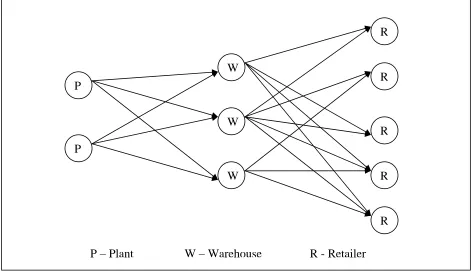
Figure 1 shows a typical supply chain network. The configuration of this network is
based on determination of:
(i) Locations and production volume for Ps;
(ii) Locations and production volume for Ws
(iii) Locations and production volume for Rs;
(iv) Transportation mode volume between Ws and Rs;
P
W
W W
R R R R R
P
[image:16.612.78.553.79.350.2]P – Plant W – Warehouse R - Retailer
Figure 3.1: Structure of Typical Supply Chain Network
3.2.1.1 Model Assumptions
The following are the assumptions made in the formulation:
• Three facility levels: plants, warehouses and retailers;
(Mitigation: more layers can always be added and won’t structurally change the
configuration)
• At each location step and each transportation step, only 1 cost coefficient is
applied which includes all the cost incurring while operating this step
(Mitigation- aggregation of all costs into one is practical)
(Mitigation - similar consideration of inventory at warehouse could be extended
to plant)
• No backorder happening at Plants and Warehouses
(Mitigation: similar consideration of backorder cost at retailers could be
extended to warehouses and plants)
• Only one product is considered
(Mitigation - we could talk about generic shipment units)
• No upper bound for transportation amount
(Mitigation – make an artificial mode with a “Huge” cost)
• No Setup cost considered
(Mitigation – fixed-cost problem adds complexity)
• One shipment order has to go on the same mode
(Mitigation –cost will increase, but it can be done manually)
3.2.1.2 Model Indexes
• i = index for Plant ( i = 1,2,3……I )
• j = index for Warehouse (j = 1,2,3……J)
• k = index for Retailer (k= 1,2,3……K)
• m = modes of transportation combined with transportation volume level
Low/Med/High
(m = airL, airM, airH, seaL, seaM, seaH, railL, railM, railH, truckL, truckM, truckH)
3.2.1.3 Model Decision variables
Decision variables are used to completely define the problem.
• p
it
X = Amount of products produced at Plant i at time t
• Xijmt = Amount of products transported from Plant i to Warehouse j by transport
mode m at time t
• Wijmt = 1 if products transported from Plant i to Warehouse j by mode m at time t; 0,
otherwise.
• w
jt
X = Amount of products stored at Warehouse j at time t
• Yjkmt = Amount of products transported from Warehouse j to Retailer k by transport
mode m at time t
• Ujkmt = 1 if of products transported from Warehouse j to Retailer k by mode m at
time t; 0, otherwise.
• R
kt
X = Amount of products stored at Retailer k at time t
• Zkt = 1 if there is back order at Retailer k at time t; 0, otherwise.
• Bkt = Back order quantity at Retailer k at time t
3.2.1.4 Model Coefficients
• PCit = Production cost at Plant i at time t, $ per unit
• TCijmt = Transportation cost from Plant i to Warehouse j at time t via transport mode
• WCjt = Storage cost at Warehouse j at time t, $ per unit
• TCjkmt = Transportation cost from Warehouse j to Retailer k at time t via transport
mode m, $ per Unit
• RCkt = Storage cost at Retailer k at time t, $ per unit
• LCkt = Backorder cost at Retailer k at time t, $ per unit
• Tijm = Transportation time from Plant i to Warehouse j via transport mode m
• Tjkm = Transportation time from Warehouse j to Retailer k via transport mode m
• Lit = Production limit of Plant i at time t
• Ljt= Storage limit of Warehouse j at time t
• Lkt = Storage limit of Retailer k at time t
• Dkt= Demand at Retailer k at time t
• w
j
INV 0 = Starting inventory at Warehouse j
• R
k
INV 0 = Starting inventory at Retailer k
• TLm = Lower bound of transportation volume via mode m
• TUm = Upper bound of transportation volume via mode m
• M = a large natural number
3.2.1.5 Model Constraints
1. The volume produced at Plant i can’t exceed its capacity limit at time t
t i L
The amount of products transported from each plant i to all warehouse j at time t via
all transport modes is equal to the production volume at plant i at time t for all plant i
t i X X ijmt m j p
it =
∑
∑
∀,2. The amount of products transported from each plant i to each warehouse j at time t via
mode m is within the volume limit of this mode
t m j i W TU X W
TLm* ijmt ≤ ijmt ≤ m* ijmt ∀, , ,
3. The inventory at warehouse j at time t is equal to the inventory at warehouse j at time
t-1 plus the products transported to j from all i at time t minus the products transported
from j to all k at time t
t j Y X X X jkmt m k Tijm t ijm m i w jt w
jt = −1 +
∑
∑
,−1+ −∑
∑
∀ ,The inventory at Warehouse j at time 0 is equal to the starting inventory
t j INV X w j w
j0 = 0 ∀,
The inventory at Warehouse j at time t can’t exceed its capacity limit at time t
t j L
X jt
w
jt ≤ ∀,
4. The amount of products transported from each warehouse j to each retailer k at time t
via mode m is within the volume limit of this mode
t m k j U TU Y U
TLm* jkmt ≤ jkmt ≤ m* jkmt ∀, , ,
5. The inventory at Retailer k at time t is equal to the inventory at retailer k at time t-1
plus the products transported to k from all j at time t minus the back order of k at time
t k B D B Y X
X jkmt Tjkm kt kt kt
m j R kt R
kt = −1 +
∑
∑
,−1+ − −1 − + ∀ ,If there is back order at Retailer k at time t, the ending inventory at k at time t is equal
to Zero.
t k Z
M
XktR ≤ *(1− ktR) ∀ ,
If there is no back order at Retailer k at time t, the back order quantity at k at time t is
equal to Zero
t k Z
M
Bkt ≤ * ktR ∀ ,
The inventory at Retailer k at time 0 is equal to the starting inventory
k INV
X kR
R
k0 = 0 ∀
The inventory at Retailer k at time t can’t exceed its capacity limit at time t
t k L
X kt
R
kt ≤ ∀ ,
6. Xitp, Xijmt, w jt
X , Yjkmt , XktR, Bkt, Zkt, Wijmt, Ujkmtare non-negative integer
3.2.1.6 Model Objective
Total production cost occurred at all plants locations (i) in time period t:
it p it i PC X *
∑
Total transportation cost from all plants locations (i) to all warehouse locations
(j) using all transportation modes (m) in time period t: ijmt ijmt
m j i TC X *
∑
∑
∑
Total storage cost occurred at all warehouse locations (j) in time period t:
Total transportation cost from all warehouse locations (j) to all retailer
locations (k) using all transportation modes (m) in time period t:
jkmt jkmt m k j TC Y *
∑
∑
∑
Total storage cost occurred at all retailer locations (k) in time period t:
kt R kt k RC X *
∑
Total back order cost occurred at all retailer locations (k) in time period t:
kt kt k LC B *
∑
Therefore, the objective function of this model that minimizes the total supply
chain cost (the sum of production cost, storage cost, transportation cost and backorder
cost) is: Minimize: jkmt jkmt m k j jt w jt j ijmt ijmt m j i it p it i t TC Y WC X TC X PC
X * * * *
(
∑
∑
∑
∑
∑
∑
∑
∑
∑
+ + +
) *
* kt kt
k kt R kt k LC B RC X
∑
∑
+ +3.2.2 Solve Model in CPLEX/OPL
Programming it into ILOG CPLEX 9.0 tests the feasibility of the proposed model. We
write the programming codes for the mixed integer model in CPLEX, which is attached in
APPENDIX A. Considering the amount of time required to solve the model in CPLEX, we
and 6 transportation modes. The feasible optimal solution for the small data model is
calculated within 1 second. (All the applications in this research are run on the computer with
1.0G RAM)
3.2.3 Issue with Mixed Integer Model in CPLEX/OPL
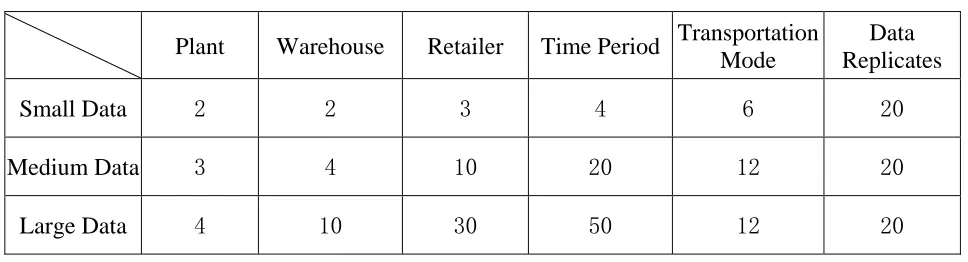
With increased data sizes, the model computation time increases correspondingly. We
categorize the data sets as “Large”, “Medium”, and “Small” size. All the coefficient data are
[image:23.612.76.560.370.501.2]randomly generated out of MATLAB.
Table 3.1 Model Data Size
Plant Warehouse Retailer Time Period Transportation
Mode
Data Replicates
Small Data 2 2 3 4 6 20
Medium Data 3 4 10 20 12 20
Large Data 4 10 30 50 12 20
“Small” model consists of 2 plants, 2 warehouses, 3 retailers, 4 time periods and 6
transportation modes. The average running time for the small model is less than 1 second.
“Medium” model consists of 3 plants, 4 warehouses, 10 retailers, 20 time periods and 12
transportation modes. The running time for the medium model varies from 5 seconds to 3
minutes depending on the data. Its average is about 1 minute.
“Large” model consists of 4 plants, 10 warehouses, 30 retailers, 50 time periods and 12
10 warehouses / 30 retailer distributions appears to be relatively practical size for the
contemporary real business. 50 time periods are set as 50 weeks for one year. 12
transportation modes are set for air, sea, train and truck at high / medium/low shipping size.
20 “Large” data sets are randomly generated in MATLAB. The running time of these data
sets is much longer than the “Small” data and “Medium” data, which vary from 8 hours to 22
hours. It takes averagely about 13 hours to complete solving the model, which is not
4
Heuristic Development
4.1 Heuristic Solution I
Ideally, the best solution of mixed integer mathematical model is its optimal solution.
However, the excessive running time makes it less practical and less appealing in the real
business world. In order to solve the problem in a reduced computation time, we introduce the
heuristic solutions.
We run Linear Models in CPLEX, whose decision variables are all set as non-integer.
For the same data size, the running time for Linear Model is much less than that of Mixed
Integer Model. Hence, the idea of the heuristic solution is to assume all the decision variables
to be non-integer, solve this linear model first within a small amount of time, and then force
the non-integer result to integer number as per some conditions. The goal of the heuristic
solution is to shorten the model solving time in CPLEX.
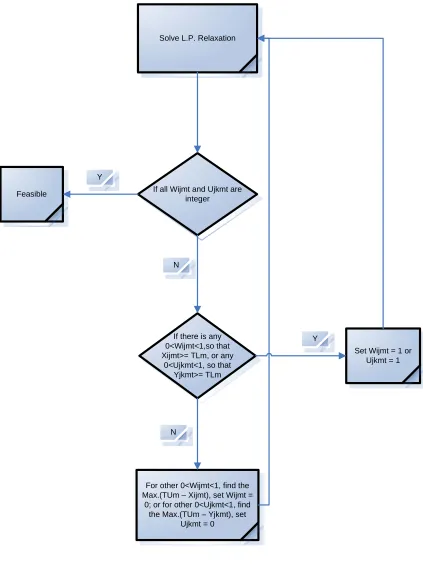
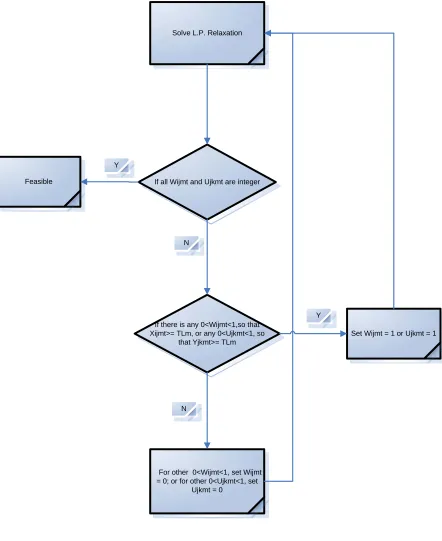
Heuristic Solution I is our first trial. The flow chart of the Heuristic Solution I is
shown as below in Figure 4.1.
1. Change the data type of all integer decision variables from integer to linear, solve
the linear model relaxation in CPLEX;
2. If all Wijmt and Ujkmt are integer, then the result is feasible, we obtain the heuristic
solution;
* = 1 if products transported from Plant i to Warehouse j by mode
m at time t; 0, otherwise.
ijmt W
* = 1 if of products transported from Warehouse j to Retailer k
by mode m at time t; 0, otherwise
3. If any of Wijmt are non-integer, and if there is any 0<Wijmt<1, so that Xijmt ≥ TLm,
we set these Wijmt = 1. If any of Ujkmt are non-integer, and if there is any
0<Ujkmt<1, so that Yjkmt ≥ TLm, we set these Ujkmt = 1.
4. For the rest of Wijmt which is 0<Wijmt<1, find out the Maximum (TUm-Xijmt), set
this Wijmt = 0. For the rest of Ujkmt which is 0<Ujkmt<1, find out the Maximum
(TUm-Yjkmt), set this Ujkmt = 0.
5. Continue running the Linear Model until it yields feasible solution.
It takes hundreds of cycles to find the heuristic solution; therefore it becomes even
more time consuming if we change the data manually. We write OPL script to run the
heuristic solution automatically. The codes for Heuristic Solution I is attached in
Solve L.P. Relaxation
If all Wijmt and Ujkmt are integer
If there is any 0<Wijmt<1,so that Xijmt>= TLm, or any
0<Ujkmt<1, so that Yjkmt>= TLm
For other 0<Wijmt<1, find the Max.(TUm – Xijmt), set Wijmt =
0; or for other 0<Ujkmt<1, find the Max.(TUm – Yjkmt), set
Ujkmt = 0 Feasible
Set Wijmt = 1 or Ujkmt = 1 Y
N
Y
[image:27.612.118.541.71.645.2]N
4.2 Heuristic Solution I Result
For consistency and later result comparison, we use the same data sets to run the
Heuristic Solution for all “Large”, “Medium” and “Small” size.
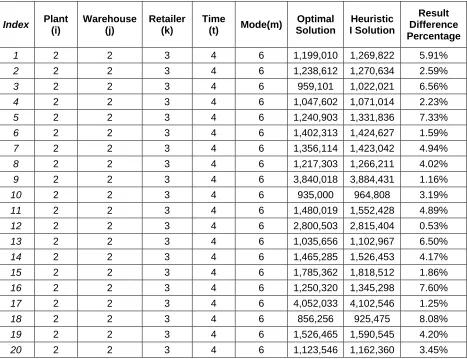
We run 20 “Small” data sets first. There is no large time difference between the optimal
solution running and heuristic solution running since the running time for both two is less
than 1 second, which is very short and could be ignored. The results are shown as below in
TABLE 4.1. We can see that the heuristic result is about 0.5% ~ 8% worse than the optimal
[image:28.612.81.548.347.706.2]result.
Table 4.1 Result Comparison between Optimal and Heuristic I for Small Data Sets
Index Plant
(i) Warehouse (j) Retailer (k) Time
(t) Mode(m)
Optimal Solution Heuristic I Solution Result Difference Percentage
1 2 2 3 4 6 1,199,010 1,269,822 5.91%
2 2 2 3 4 6 1,238,612 1,270,634 2.59%
3 2 2 3 4 6 959,101 1,022,021 6.56%
4 2 2 3 4 6 1,047,602 1,071,014 2.23%
5 2 2 3 4 6 1,240,903 1,331,836 7.33%
6 2 2 3 4 6 1,402,313 1,424,627 1.59%
7 2 2 3 4 6 1,356,114 1,423,042 4.94%
8 2 2 3 4 6 1,217,303 1,266,211 4.02%
9 2 2 3 4 6 3,840,018 3,884,431 1.16%
10 2 2 3 4 6 935,000 964,808 3.19%
11 2 2 3 4 6 1,480,019 1,552,428 4.89%
12 2 2 3 4 6 2,800,503 2,815,404 0.53%
13 2 2 3 4 6 1,035,656 1,102,967 6.50%
14 2 2 3 4 6 1,465,285 1,526,453 4.17%
15 2 2 3 4 6 1,785,362 1,818,512 1.86%
16 2 2 3 4 6 1,250,320 1,345,298 7.60%
17 2 2 3 4 6 4,052,033 4,102,546 1.25%
18 2 2 3 4 6 856,256 925,475 8.08%
19 2 2 3 4 6 1,526,465 1,590,545 4.20%
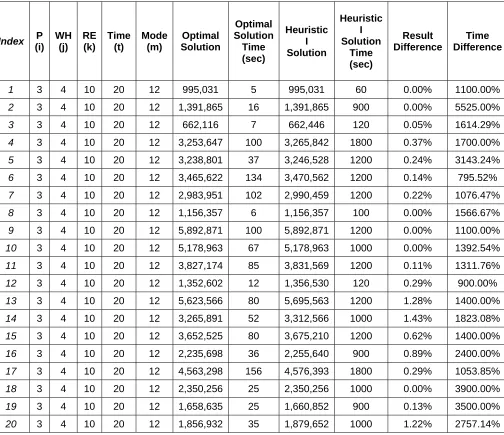
We then run 20 “Medium” data sets. The results are shown as below in TABLE 4.2.
We can see that the heuristic result is about 0.0% ~ 1.5% worse than the optimal result, which
is less damaged than the small data sets. However, the running time for the heuristic solution
is even much longer than that of the optimal solution. The sacrifice of the time varies from
[image:29.612.86.590.264.699.2]800% ~ 5500%.
Table 4.2 Result Comparison between Optimal and Heuristic I for Medium Data Sets
Index P
(i) WH (j) RE (k) Time (t) Mode (m) Optimal Solution Optimal Solution Time (sec) Heuristic I Solution Heuristic I Solution Time (sec) Result Difference Time Difference
1 3 4 10 20 12 995,031 5 995,031 60 0.00% 1100.00%
2 3 4 10 20 12 1,391,865 16 1,391,865 900 0.00% 5525.00%
3 3 4 10 20 12 662,116 7 662,446 120 0.05% 1614.29%
4 3 4 10 20 12 3,253,647 100 3,265,842 1800 0.37% 1700.00%
5 3 4 10 20 12 3,238,801 37 3,246,528 1200 0.24% 3143.24%
6 3 4 10 20 12 3,465,622 134 3,470,562 1200 0.14% 795.52%
7 3 4 10 20 12 2,983,951 102 2,990,459 1200 0.22% 1076.47%
8 3 4 10 20 12 1,156,357 6 1,156,357 100 0.00% 1566.67%
9 3 4 10 20 12 5,892,871 100 5,892,871 1200 0.00% 1100.00%
10 3 4 10 20 12 5,178,963 67 5,178,963 1000 0.00% 1392.54%
11 3 4 10 20 12 3,827,174 85 3,831,569 1200 0.11% 1311.76%
12 3 4 10 20 12 1,352,602 12 1,356,530 120 0.29% 900.00%
13 3 4 10 20 12 5,623,566 80 5,695,563 1200 1.28% 1400.00%
14 3 4 10 20 12 3,265,891 52 3,312,566 1000 1.43% 1823.08%
15 3 4 10 20 12 3,652,525 80 3,675,210 1200 0.62% 1400.00%
16 3 4 10 20 12 2,235,698 36 2,255,640 900 0.89% 2400.00%
17 3 4 10 20 12 4,563,298 156 4,576,393 1800 0.29% 1053.85%
18 3 4 10 20 12 2,350,256 25 2,350,256 1000 0.00% 3900.00%
19 3 4 10 20 12 1,658,635 25 1,660,852 900 0.13% 3500.00%
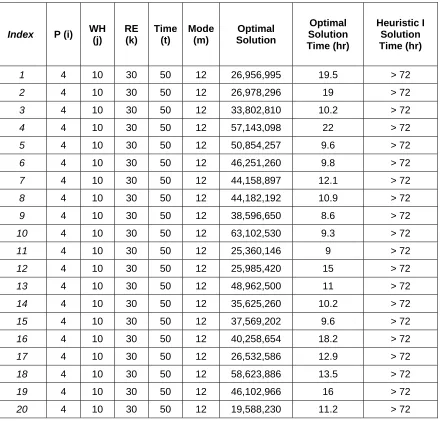
Finally, we run 20 “Large” data sets, which are the biggest bottleneck of optimal
solution running time. The results are shown as below in TABLE 4.3. Unfortunately, the
running time for the heuristic solution is much longer than that of the optimal solution. We are
not able to retrieve the solution even after 72 hours. We did not run all the models to the end
[image:30.612.81.521.263.684.2]due to the time constrain.
Table 4.3 Result Comparison between Optimal and Heuristic I for Large Data Sets
Index P (i) WH (j) RE (k) Time (t) Mode (m) Optimal Solution Optimal Solution Time (hr) Heuristic I Solution Time (hr)
1 4 10 30 50 12 26,956,995 19.5 > 72
2 4 10 30 50 12 26,978,296 19 > 72
3 4 10 30 50 12 33,802,810 10.2 > 72
4 4 10 30 50 12 57,143,098 22 > 72
5 4 10 30 50 12 50,854,257 9.6 > 72
6 4 10 30 50 12 46,251,260 9.8 > 72
7 4 10 30 50 12 44,158,897 12.1 > 72
8 4 10 30 50 12 44,182,192 10.9 > 72
9 4 10 30 50 12 38,596,650 8.6 > 72
10 4 10 30 50 12 63,102,530 9.3 > 72
11 4 10 30 50 12 25,360,146 9 > 72
12 4 10 30 50 12 25,985,420 15 > 72
13 4 10 30 50 12 48,962,500 11 > 72
14 4 10 30 50 12 35,625,260 10.2 > 72
15 4 10 30 50 12 37,569,202 9.6 > 72
16 4 10 30 50 12 40,258,654 18.2 > 72
17 4 10 30 50 12 26,532,586 12.9 > 72
18 4 10 30 50 12 58,623,886 13.5 > 72
19 4 10 30 50 12 46,102,966 16 > 72
4.3 Issue with Heuristic I
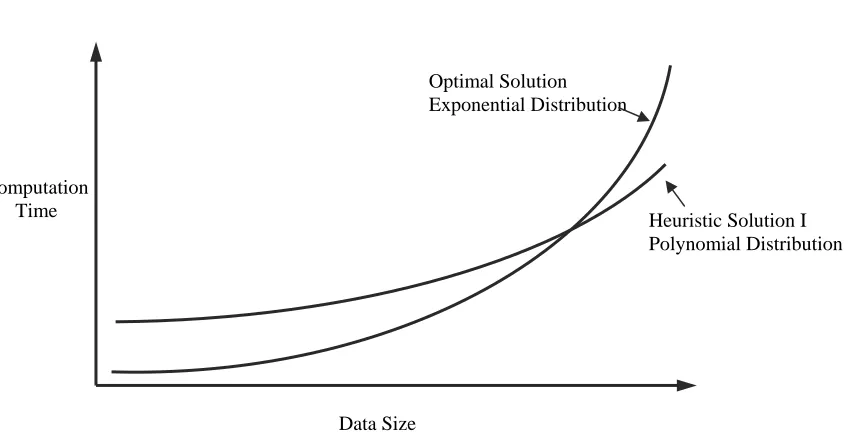
Computation
Exponential Distribution Optimal Solution
Time Heuristic Solution I
Polynomial Distribution
[image:31.612.88.512.122.344.2]Data Size
Figure 4.2: Data Size vs. Computation Time (Optimal Solution & Heuristic Solution I)
As Figure 4.2 showed above, when we run Optimal Solution, the running time
exponentially increases with expanding of the data size. In contrast, it increases following the
polynomial distribution when we run Heuristic Solution.
The time constrain hasn’t be solved by Heuristic Solution I. The computation time for
Large Data is still not acceptable. And it is even much longer than the Optimal Model when
we run the Small data and Medium data. Therefore, we have to come up with another
Heuristic Solution. However, Heuristic Solution I only slightly impairs or distorts the solution
4.4 Heuristic Solution II
As noted above, Heuristic Solution I conducted earlier doesn’t distort the optimal
result significantly. The bottleneck of Heuristic Solution I is suspected as the running time to
force the fraction parameters to Zero only once each time. Heuristic Solution II is build up
onto Heuristic Solution I; however all fraction parameters are forced to Zero at one time.
The flow chart of the Heuristic Solution II is shown as below in Figure 4.3.
1. Change the data type of all integer decision variables from integer to linear,
solve the linear model relaxation in CPELX;
2. If all Wijmt and Ujkmt are integer, then the result is feasible, we get the heuristic
solution;
* = 1 if products transported from Plant i to Warehouse j by mode
m at time t; 0, otherwise.
ijmt W
* = 1 if of products transported from Warehouse j to Retailer k
by mode m at time; 0, otherwise
jkmt U
3. If any of are non-integer, and if there is any 0< <1, so that ≥
, we set these = 1. If any of are non-integer, and if there is any
0< <1, so that , we set these = 1.
ijmt
W Wijmt Xijmt
m
TL Wijmt Ujkmt
jkmt
U Yjkmt ≥ TLm Ujkmt
4. For the rest of which is 0< <1, set = 0; for the rest of
which is 0< <1, set this = 0.
ijmt
W Wijmt Wijmt Ujkmt
jkmt
U Ujkmt
It takes hundreds of cycles to get the heuristic solution II, which is very time
consuming if we change the data manually. We use OPL script once again to develop the
Solve L.P. Relaxation
If all Wijmt and Ujkmt are integer
If there is any 0<Wijmt<1,so that Xijmt>= TLm, or any 0<Ujkmt<1, so
that Yjkmt>= TLm
For other 0<Wijmt<1, set Wijmt = 0; or for other 0<Ujkmt<1, set
Ujkmt = 0 Feasible
Set Wijmt = 1 or Ujkmt = 1 Y
N
Y
[image:34.612.85.527.73.614.2]N
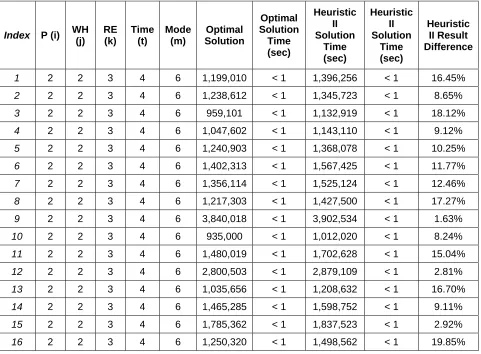
4.5 Heuristic Solution II Result
For consistency and later result comparison, we still use the same data sets to run the
Heuristic Solution II for all “Large”, “Medium” and “Small” size.
We run 20 “Small” data sets first. There is no meaningful time difference between the
optimal solution running and heuristic solution running since the running time for both two is
less than 1 second. The results are shown as below in TABLE 4.4. We can see that the
heuristic result is about 3% ~ 20% worse than the optimal result, which is considered as a
[image:35.612.80.561.361.715.2]significant difference.
Table 4.4 Result Comparisons between Optimal and Heuristic II for Small Data Sets
Index P (i) WH
(j) RE (k) Time (t) Mode (m) Optimal Solution Optimal Solution Time (sec) Heuristic II Solution Time (sec) Heuristic II Solution Time (sec) Heuristic II Result Difference
1 2 2 3 4 6 1,199,010 < 1 1,396,256 < 1 16.45%
2 2 2 3 4 6 1,238,612 < 1 1,345,723 < 1 8.65%
3 2 2 3 4 6 959,101 < 1 1,132,919 < 1 18.12%
4 2 2 3 4 6 1,047,602 < 1 1,143,110 < 1 9.12%
5 2 2 3 4 6 1,240,903 < 1 1,368,078 < 1 10.25%
6 2 2 3 4 6 1,402,313 < 1 1,567,425 < 1 11.77%
7 2 2 3 4 6 1,356,114 < 1 1,525,124 < 1 12.46%
8 2 2 3 4 6 1,217,303 < 1 1,427,500 < 1 17.27%
9 2 2 3 4 6 3,840,018 < 1 3,902,534 < 1 1.63%
10 2 2 3 4 6 935,000 < 1 1,012,020 < 1 8.24%
11 2 2 3 4 6 1,480,019 < 1 1,702,628 < 1 15.04%
12 2 2 3 4 6 2,800,503 < 1 2,879,109 < 1 2.81%
13 2 2 3 4 6 1,035,656 < 1 1,208,632 < 1 16.70%
14 2 2 3 4 6 1,465,285 < 1 1,598,752 < 1 9.11%
15 2 2 3 4 6 1,785,362 < 1 1,837,523 < 1 2.92%
17 2 2 3 4 6 4,052,033 < 1 4,150,236 < 1 2.42%
18 2 2 3 4 6 856,256 < 1 1,020,520 < 1 19.18%
19 2 2 3 4 6 1,526,465 < 1 1,652,963 < 1 8.29%
20 2 2 3 4 6 1,123,546 < 1 1,210,236 < 1 7.72%
We then run 20 “Medium” data sets. The results are shown as below in TABLE 4.5.
We can see that the heuristic result is about 0.0% ~ 2% worse than the optimal result, which is
much better than the small data sets. In the meanwhile, the running time for the heuristic
solution is sometimes shorter than that of the optimal solution while sometimes longer than
[image:36.612.73.563.71.144.2]that of optimal solution. The time difference percentage varies a lot from -90% ~ 170%.
Table 4.5 Result Comparisons between Optimal and Heuristic II for Medium Data Sets
Index P
(i) WH (j) RE (k) Time (t) Mode (m) Optimal Solution Optimal Solution Time (sec) Heuristic II Solution Heuristic II Solution Time (sec) Heuristic II Result Difference Heuristic II Time Difference
1 3 4 10 20 12 995,031 5 995,031 10 0.00% 100.00%
2 3 4 10 20 12 1,391,865 16 1,391,864 11 0.00% -31.25%
3 3 4 10 20 12 662,116 7 662,116 8 0.00% 14.29%
4 3 4 10 20 12 3,253,647 100 3,276,895 40 0.71% -60.00%
5 3 4 10 20 12 3,238,801 37 3,250,240 64 0.35% 72.97%
6 3 4 10 20 12 3,465,622 134 3,492,626 15 0.78% -88.81%
7 3 4 10 20 12 2,983,951 102 3,007,255 57 0.78% -44.12%
8 3 4 10 20 12 1,156,357 6 1,156,357 16 0.00% 166.67%
9 3 4 10 20 12 5,892,871 100 5,892,871 56 0.00% -44.00%
10 3 4 10 20 12 5,178,963 67 5,178,963 34 0.00% -49.25%
11 3 4 10 20 12 3,827,174 85 3,856,024 30 0.75% -64.71%
12 3 4 10 20 12 1,352,602 12 1,360,523 12 0.59% 0.00%
13 3 4 10 20 12 5,623,566 80 5,723,695 30 1.78% -62.50%
15 3 4 10 20 12 3,652,525 80 3,679,526 40 0.74% -50.00%
16 3 4 10 20 12 2,235,698 36 2,275,211 25 1.77% -30.56%
17 3 4 10 20 12 4,563,298 156 4,589,635 60 0.58% -61.54%
18 3 4 10 20 12 2,350,256 25 2,350,256 25 0.00% 0.00%
19 3 4 10 20 12 1,658,635 25 1,661,956 40 0.20% 60.00%
20 3 4 10 20 12 1,856,932 35 1,880,563 30 1.27% -14.29%
Finally, we run 20 “Large” data sets, with which Heuristic Solution I doesn’t work out
very well. The results are shown as below in TABLE 4.6. We can see that the heuristic result
is about 0.2% ~ 0.9% worse than the optimal result which is much better than the small data
sets. The best thing is the running time for Heuristic Solution II is much shorter than that of
the optimal solution and heuristic solution I. The time difference percentage between optimal
[image:37.612.81.589.451.718.2]solution and heuristic solution II varies from -96% ~ -99%.
Table 4.6 Result Comparisons between Optimal and Heuristic II for Large Data Sets
P (i) WH (j) RE (k) Time (t) Mode (m) Optimal Solution Optimal Solution Time (hr) Heuristic II Solution Heuristic II Solution Time (hr) Heuristic II Result Difference Heuristic II Time Difference
1 4 10 30 50 12 26,956,995 19.5 27,005,708 0.25 0.18% -98.72%
2 4 10 30 50 12 26,978,296 19 27,033,882 0.3 0.21% -98.42%
3 4 10 30 50 12 33,802,810 10.2 33,933,464 0.3 0.39% -97.06%
4 4 10 30 50 12 57,143,098 22 57,303,828 0.35 0.28% -98.41%
5 4 10 30 50 12 50,854,257 9.6 51,042,089 0.3 0.37% -96.88%
6 4 10 30 50 12 46,251,260 9.8 46,505,826 0.3 0.55% -96.94%
7 4 10 30 50 12 44,158,897 12.1 44,546,182 0.25 0.88% -97.93%
8 4 10 30 50 12 44,182,192 10.9 44,421,371 0.3 0.54% -97.25%
9 4 10 30 50 12 38,596,650 8.6 38,900,685 0.2 0.79% -97.67%
10 4 10 30 50 12 63,102,530 9.3 63,678,530 0.3 0.91% -96.77%
12 4 10 30 50 12 25,985,420 15 26,102,343 0.25 0.45% -98.33%
13 4 10 30 50 12 48,962,500 11 49,056,230 0.25 0.19% -97.73%
14 4 10 30 50 12 35,625,260 10.2 35,686,996 0.25 0.17% -97.55%
15 4 10 30 50 12 37,569,202 9.6 37,769,658 0.25 0.53% -97.40%
16 4 10 30 50 12 40,258,654 18.2 40,410,326 0.3 0.38% -98.35%
17 4 10 30 50 12 26,532,586 12.9 26,586,028 0.2 0.20% -98.45%
18 4 10 30 50 12 58,623,886 13.5 58,812,005 0.3 0.32% -97.78%
19 4 10 30 50 12 46,102,966 16 46,389,665 0.25 0.62% -98.44%
20 4 10 30 50 12 19,588,230 11.2 19,754,622 0.25 0.85% -97.77%
4.6 Heuristic Solution II vs. Optimal Solution and Heuristic Solution I
Optimal Solution Exponential Distribution
Heuristic Solution II Polynomial Distribution
Heuristic Solution I Polynomial Distribution Computation
Time
[image:38.612.85.559.293.544.2]Data Size
Figure 4.4: Data Size vs. Computation Time
(Optimal Solution & Heuristic Solution I & Heuristic Solution II)
As Figure 4.4 shown above, when we run Optimal Solution, the running time
exponentially increases with expanding of data size. In contrast, it increases following the
polynomial distribution when we run Heuristic Solution.
From the Heuristic Solution II curve, it is clear that its computation time for Large Data
indicates that Heuristic Solution II saves 96% ~ 99% amount of time comparing to Optimal
5
Result Analysis
5.1 Paired T-test
To compare the optimal results and heuristic result, we conduct the Paired T-tests with
Minitab.
Paired T-Test and CI: SMALL DATA SIZE - Optimal, SMALL DATA SIZE - Heuristic I
Paired T for SMALL DATA SIZE - Optimal - SMALL DATA SIZE - Heuristic I
N Mean StDev SE Mean
SMALL DATA SIZE - Optimal 20 1590571 905721 202525
SMALL DATA SIZE - Heuristic I 20 1643522 900727 201409
Difference 20 -52950.7 22691.6 5074.0
95% CI for mean difference: (-63570.6, -42330.7)
T-Test of mean difference = 0 (vs not = 0): T-Value = -10.44 P-Value = 0.000
Paired T-Test and CI: SMALL DATA SIZE - Optimal, SMALL DATA SIZE - Heuristic II
Paired T for SMALL DATA SIZE - Optimal - SMALL DATA SIZE - Heuristic II
N Mean StDev SE Mean
SMALL DATA SIZE - Optimal 20 1590571 905721 202525
SMALL DATA SIZE - Heuristic II 20 1728993 882540 197342
95% CI for mean difference: (-164827, -112016)
T-Test of mean difference = 0 (vs not = 0): T-Value = -10.97 P-Value = 0.000
Paired T-Test and CI: SMALL DATA SIZE - Heuristic I, SMALL DATA SIZE - Heuristic II
Paired T for SMALL DATA SIZE - Heuristic I - SMALL DATA SIZE - Heuristic II
N Mean StDev SE Mean
SMALL DATA SIZE - Heuristic I 20 1643522 900727 201409
SMALL DATA SIZE - Heuristic II 20 1728993 882540 197342
Difference 20 -85470.8 44762.0 10009.1
95% CI for mean difference: (-106420.1, -64521.5)
T-Test of mean difference = 0 (vs not = 0): T-Value = -8.54 P-Value = 0.000
Paired T-Test and CI: MED DATA SIZE - Optimal, MED DATA SIZE - Heuristic I
Paired T for MED DATA SIZE - Optimal - MED DATA SIZE - Heuristic I
N Mean StDev SE Mean
MED DATA SIZE - Optimal 20 2930290 1558717 348540
MED DATA SIZE - Heuristic I 20 2942258 1565987 350165
Difference 20 -11967.7 18371.2 4107.9
95% CI for mean difference: (-20565.7, -3369.7)
Paired T-Test and CI: MED DATA SIZE - Optimal, MED DATA SIZE - Heuristic II
Paired T for MED DATA SIZE - Optimal - MED DATA SIZE - Heuristic II
N Mean StDev SE Mean
MED DATA SIZE - Optimal 20 2930290 1558717 348540
MED DATA SIZE - Heuristic II 20 2950408 1570210 351110
Difference 20 -20117.7 25134.1 5620.2
95% CI for mean difference: (-31880.8, -8354.6)
T-Test of mean difference = 0 (vs not = 0): T-Value = -3.58 P-Value = 0.002
Paired T-Test and CI: MED DATA SIZE - Heuristic I, MED DATA SIZE - Heuristic II
Paired T for MED DATA SIZE - Heuristic I - MED DATA SIZE - Heuristic II
N Mean StDev SE Mean
MED DATA SIZE - Heuristic I 20 2942258 1565987 350165
MED DATA SIZE - Heuristic II 20 2950408 1570210 351110
Difference 20 -8150.00 9614.90 2149.96
95% CI for mean difference: (-12649.91, -3650.09)
T-Test of mean difference = 0 (vs not = 0): T-Value = -3.79 P-Value = 0.001
Paired T for LARGE DATA SIZE - Optimal - LARGE DATA SIZE - Heuristic II
N Mean StDev SE Mean
LARGE DATA SIZE - Optimal 20 39831792 12348167 2761134
LARGE DATA SIZE - Heuristic II 20 40021235 12425888 2778513
Difference 20 -189443 128825 28806
95% CI for mean difference: (-249735, -129151)
T-Test of mean difference = 0 (vs not = 0): T-Value = -6.58 P-Value = 0.000
The Minitab results show a very low P-value which indicates that there is significant
difference between Optimal Solution and Heuristic Solution.
5.2 One – Sample T- Test Analysis
Paired T-test shows that there is significant difference between Optimal Solution and
Heuristic Solution, the data shows a very small difference though. We then conduct
One-Sample T-Test on percentage difference between optimal and heuristic for both result and
Table 5.1 Percentage Difference between Optimal Solution and Heuristic Solution
Small
Data Size Medium Data Size Large Data Size
Index Heuristic I Result Difference Heuristic I Result Difference Heuristic I Time Difference Heuristic II Result Difference Heuristic II Time Difference Heuristic II Result Difference Heuristic II Time Difference
1 5.91% 0.00% 1100.00% 0.00% 100.00% 0.18% -98.72% 2 2.59% 0.00% 5525.00% 0.00% -31.25% 0.21% -98.42% 3 6.56% 0.05% 1614.29% 0.00% 14.29% 0.39% -97.06% 4 2.23% 0.37% 1700.00% 0.71% -60.00% 0.28% -98.41% 5 7.33% 0.24% 3143.24% 0.35% 72.97% 0.37% -96.88% 6 1.59% 0.14% 795.52% 0.78% -88.81% 0.55% -96.94% 7 4.94% 0.22% 1076.47% 0.78% -44.12% 0.88% -97.93% 8 4.02% 0.00% 1566.67% 0.00% 166.67% 0.54% -97.25% 9 1.16% 0.00% 1100.00% 0.00% -44.00% 0.79% -97.67% 10 3.19% 0.00% 1392.54% 0.00% -49.25% 0.91% -96.77% 11 4.89% 0.11% 1311.76% 0.75% -64.71% 0.49% -97.78% 12 0.53% 0.29% 900.00% 0.59% 0.00% 0.45% -98.33% 13 6.50% 1.28% 1400.00% 1.78% -62.50% 0.19% -97.73% 14 4.17% 1.43% 1823.08% 1.86% -51.92% 0.17% -97.55% 15 1.86% 0.62% 1400.00% 0.74% -50.00% 0.53% -97.40% 16 7.60% 0.89% 2400.00% 1.77% -30.56% 0.38% -98.35% 17 1.25% 0.29% 1053.85% 0.58% -61.54% 0.20% -98.45% 18 8.08% 0.00% 3900.00% 0.00% 0.00% 0.32% -97.78% 19 4.20% 0.13% 3500.00% 0.20% 60.00% 0.62% -98.44% 20 3.45% 1.22% 2757.14% 1.27% -14.29% 0.85% -97.77%
For Small Data Size, the mean of the result difference is 4.1%. As we noted before,
there is no noticeable time difference between the optimal solution running and heuristic
solution running since the running time for both is less than 1 second. Needless to say, there is
no significant advantage by implementing Heuristic Solution on Small Data Size Model.
Variable N Mean StDev SE Mean 95% CI
Heuristic I Resu 20 0.041019 0.023263 0.005202 (0.030132, 0.051906)
Heuristic I Result Diff-Small
0.09 0.08
0.07 0.06
0.05 0.04
0.03 0.02
0.01 0.00
_ X
Boxplot of Heuristic I Result Diff-Small
(with 95% t-confidence interval for the mean)
For Medium Data Size, we compare the results for both Heuristic Solution I and
Heuristic Solution II. As for Heuristic Solution I, the Mean value of the result difference is
0.36%, which can be considered a very small sacrifice from the optimal solution. However,
the trade off of Heuristic I is unacceptable. The Mean value of the running time is increased
by 1972.98%.
Variable N Mean StDev SE Mean 95% CI
Heuristic I Resu 20 0.003648 0.004681 0.001047 (0.001457, 0.005839)
He u r is t ic I R e s u lt Diff- M e d iu m
0.0 16 0 .01 4
0.0 12 0.0 10
0 .00 8 0.0 06
0 .00 4 0.0 02
0 .00 0
_ X
B o x plo t o f H e ur is tic I R e s ult D iff- M e dium (w ith 95 % t-co nfide nce inte r va l fo r the m e a n)
One-Sample T: Heuristic I Time Diff-Medium
Variable N Mean StDev SE Mean 95% CI Heuristic I Time 20 19.7298 12.2175 2.7319 (14.0118, 25.4477)
He urist ic I Time Diff-Me dium
60 50
40 30
20 10
_ X
Boxplot of Heuristic I Time Diff-Medium
We then look at Heuristic Solution II for Medium Data Size. The Mean value of the
result difference is 0.61%, which can be considered minor. The Mean value of the running
time difference is -11.95%, which means that the running time is decreased by applying
Heuristics Solution II. Standard Deviation and 95% Confidence Interval are calculated for
running time difference. Its Standard Deviation is 65.3%, and its 95% confidence interval
ranges from -42.5% to 18.6% which is not stable and too wide to be predicted.
One-Sample T: Heuristic II Result Diff-Medium
Variable N Mean StDev SE Mean 95% CI
Heuristic II Res 20 0.006081 0.006346 0.001419 (0.003111, 0.009051)
Heuristic II Result Diff-Medium
0.020 0.015
0.010 0.005
0.000
_ X
Boxplot of Heuristic II Result Diff-Medium
(with 95% t-confidence interval for the mean)
One-Sample T: Heuristic II Time Diff-Medium
Variable N Mean StDev SE Mean 95% CI
Heuristic II Time Diff-Medium
2.0 1.5
1.0 0.5
0.0 -0.5
-1.0
_ X
Boxplot of Heuristic II Time Diff-Medium
(with 95% t-confidence interval for the mean)
For Large Data Size, we only conduct Heuristic Solution II since Heuristic Solution I
takes way too long time to run through the end. The Mean value of the result difference is
0.47%, which can be considered minor trade off from the optimal solution. Moreover, the
Heuristic II substantially reduces the running time. The Mean value of the running time
decreasing is 97.8%. Its 95% confidence interval ranges from 98.1% to 97.5%, which is
considered reliable.
One-Sample T: Heuristic II Result Diff-Large
Variable N Mean StDev SE Mean 95% CI
Heuristic II Result Diff-Big
0.010 0.009
0.008 0.007
0.006 0.005
0.004 0.003
0.002 0.001
_ X
Boxplot of Heuristic II Result Diff-Big
(with 95% t-confidence interval for the mean)
One-Sample T: Heuristic II Time Diff-Large
Variable N Mean StDev SE Mean 95% CI
Heuristic II Time Diff-Big
-0.970 -0.975
-0.980 -0.985
-0.990
_ X
Boxplot of Heuristic II Time Diff-Big
6
Conclusion & Future Research
The supply chain model presented in this study consists of 3 layers of variables –
Plant, Warehouse and Retailer. We tested the Mathematical Model with Small Data Size,
Medium Data Size and Large Data Size, and apply Heuristic Solution I and Heuristic Solution
II on them respectively. Upon performing further statistic analysis on the test results, we draw
[image:51.612.81.593.323.594.2]our conclusions as summarized in the following table:
Table 6.1 Summary and Conclusion
Optimal Solution Heuristic Solution I Heuristic Solution II
Result Time Result Time Result Time
Recommendations
Small
Data - < 1 sec
4.1%
worse < 1 sec
10.9%
worse < 1 sec Run Optimal
Medium
Data -
About 1 min 0.36% worse 20 min (1973% longer) 0.61% worse 40 sec (12% shorter) Run Optimal Large
Data -
About 13
hrs - >72 hrs
0.47% worse 15 min (98% shorter) Run Heuristic Solution II
i) Small Data Size -
(2 Plants, 2 Warehouses, 3 Retailers, 4 Time Periods and 6 Transportation
The run time for Optimal Solution is less than 1 second. When Heuristics
Solution is applied to data sets of this size, the deviation from optimal result is over
4.1% and 10.9% for Heuristic Solution I and II respectively. Hence the Optimal
Solution best fits data sets of this size.
ii) Medium Data Size -
(3 Plants, 4 Warehouses, 10 Retailers, 20 Time Periods and 12 Transportation
Modes)
The run time of Optimal Solution is about 1 minute. In the case of Heuristic
Solution I, the running time is about 15 minutes, much longer than the optimal
solution time. In the case of Heuristic Solution II, the average running time is about 30
seconds, and the heuristic result impairs by 0.61% on average. However, because the
standard deviation for both running time decreasing and result value increasing is
significant, Heuristic Solution II is less likely yield reliable results for Medium Data
Size either. Optimal Solution is the best choice for Medium data size as well.
iii) Large Data Size -
(4 Plants, 10 Warehouses, 30 Retailers, 50 Time Periods and 12 Transportation
Modes)
The optimal solution running time is about 13 hours, which is excessive. With
Heuristic Solution I, the running time is even much longer than the optimal solution
running time. Heuristic Solution I will clearly be rejected. In contrast, the running time
running time is about 15 minutes, and the heuristic result is impaired by 0.47%
averagely. Moreover, the standard deviation for both running time decreasing and
result value increasing is insignificant. Heuristic Solution II is therefore recommended
for large size of data.
Our proposed deterministic model clearly reflects a strategy of total supply chain
management. The result analysis demonstrates that our stepwise heuristic optimization with
CPLEX/OPL coding is novel and powerful in solving supply chain models of fairly large data
sets.
The research discussed in this thesis is the foundation for many potential areas of
future work,
i) More Layers –
The mathematical model in this paper consists of 3 layers, which are Plant,
Warehouse and Retailer. There could be more components in a real-world supply
chain, e.g. raw material supplier, sub-contract manufacturer, distribution center, etc.
These layers could be taken into account to make the model more realistic.
ii) More products –
There is only one product considered in this paper, which is not typical in real
manufacturing world. Realistic supply chains have multiple end products with shared
components, facilities and capacities. Multi-products could be investigated.
In this paper, only 1 cost coefficient is applied at each location and there is no
setup cost considered for all the operations. Operation cost at each location could be
broke down into more detailed level, like labor cost, material cost, etc. Setup cost for
each plant/warehouse/retailer could be considered as well.
iv) Safety inventory at each location –
In our model, there is no inventory stored at all plants, whatever produced are
shipped out. While, manufacturers always keep some safety stock to satisfy customer
needs better. Different safety inventory level could be applied to make the model more
practical.
v) User Interface –
We build all the model, data and script in CPLEX/OPL. It is not convenient to
be applied by any end-user. The customer interface could be build to make this model
7
Bibliography
Chung-Piaw, T. and Shu, Jia Warehouse-Retailer Network Design Problem Operations
Research, v 52, n 3, May/June, 2004, pp 396-408+497
Cohen, M.A. and Lee, H.L. Strategic Analysis of Integrated Production-Distribution Systems:
Models and Methods, Operations Research, v 36, n 2, Mar-Apr, 1988, pp 216-228
Cohen, M.A. and Lee, H.L. Resource Deployment Analysis of Global Manufacturing and
Distribution Networks, Journal of Manufacturing and Operations Management, v 2, n 2,
Summer 1989, pp 81-104
Geoffrion, A.M. and Graves, G.W. Multicommodity Distribution System Design by Benders
Decomposition, Management Science, v 20, n 5, Jan, 1974, pp 822-844.
Iida, T. A non-stationary periodic review production-inventory model with uncertain
production capacity and uncertain demand, European Journal of Operational Research, v
140, n 3, Aug 1, 2002, pp 670-683
Jack, G.A.J., Vorst, V.D., Beulens, A.J.M. and Beek, P.V. Modelling and Simulating
Multi-echelon Food Systems, European Journal of Operational Research, v 122, n 2, Apr, 2000, pp
Lee, H.L. and Billington, C. The Evolution of Supply Chain Management Models and
Practice at Hewlett-Packard, Interfaces, v 25, n 5, Sept.-Oct. 1995, pp 42-63
Lee, Y.H. and Kim, S.H. Production-Distribution Planning in Supply Chain Using a Hybrid
Approach, Production Planning and Control, v 13, n 1, January/February, 2002, p 35-46
Lee, Y.H. and Kim, S.H. Production-Distribution Planning in Supply Chain Considering
Capacity Constraints, Computers and Industrial Engineering, v 43, n 1-2, Jul, 2002, pp
169-190
Matta, Renato de and Miller, T. Production and inter-facility transportation scheduling for a
process industry, European Journal of Operational Research, v 158, n 1, Oct 1, 2004, pp
72-88
Simichi-Levi, D., Kaminsky, P. and Simichi-Levi, E. Designing and Managing the Supply
Chain: Concepts, Strategies, and Case Studies, 2001, Irwin/McGraw-Hill
Yang, Po-Chung and Wee, Hui-Ming Economic Ordering Policy of Deteriorated Item for
Vendor and Buyer: An integrated approach, Production Planning and Control, v 11, n 5,
2000, pp 474-480
Yang, Po-Chung and Wee, Hui-Ming The Optimal and Heuristic Solutions of A Distribution
Barbarosoglu, Gulay An Integrated Supplier-Buyer Model for Improving Supply Chain
Coordination,