JOURNAL OF VIROLOGY, Dec. 1993, p. 7522-7532 0022-538X/93/127522-11$02.00/0
Copyright© 1993, American Society forMicrobiology
Hepatitis C Virus
(HCV)-Specific Cytotoxic T Lymphocytes
Recognize Epitopes in the Core and
Envelope
Proteins of HCV
MARGARET JAMES KOZIEL,l* DARRYLL DUDLEY,' NEZAM AFDHAL,2 QUI-LIM CHOO,3
MICHAELHOUGHTON,3 ROBERTRALSTON,3 ANDBRUCE D. WALKER1
Infectious Disease Unit, Massachusetts General Hospital and Harvard MedicalSchool, Boston, Massachusetts 021141; Division ofGastroenterology, Boston City Hospital, Boston,Massachusetts, 021182; andChiron Corporation,
Emeryville, California 946083 Received24 May 1993/Accepted24August 1993
Hepatitis C virus (HCV) is a major cause of posttransfusion and community-acquired hepatitis, and a
majority of individuals infected with thisvirus will subsequently develop chronic hepatitis. Characterization of the host immuneresponsetothisinfectionisanimportant firststepthatshouldfacilitate thedevelopment of immunomodulatoryagentsand vaccines.Cellular immuneresponses,especially those mediated by cytotoxic T
lymphocytes (CTL), are important in the control of many viral diseases. In this study, liver-infiltrating lymphocytes frompersons with chronic HCV hepatitiswere examined for evidence ofHCV-specific CTL by
usingtargetcells infected with recombinant vacciniavirusesexpressing the HCVcore,El, E2, andpartofthe NS2proteins.Bulkexpansion of liver-derived CD8+ lymphocytes resultedinthe detection ofHCV-specific CTL activity, whereasactivity couldnotbefound in CD8+ lymphocytes expanded from peripheral blood.Epitopes recognized by these CTL were defined by using CTL clones obtained by limiting dilution and target cells
sensitized with synthetic HCV peptides. Four distinct HLA class I-restricted epitopeswereidentified, including twoepitopesintheamino-terminalportion of thecoreprotein. These studies provide evidence that the highly
conserved core protein is a target for HCV-specific CTL and identify CTL epitopes within the more highly
variable E2envelope protein. Our studies alsosuggestthatHCV-specific CTLarelocalizedatthe site of tissue injuryininfectedpersonswithchronic hepatitis.Identification of the epitopes recognized by HCV-specific CTL will facilitate exploration of their role in disease pathogenesis and may provide information useful in
development oftherapeuticinterventionsorvaccines.
Hepatitis C virus (HCV) is a major etiologic agent of posttransfusion and sporadic community-acquired non-A, non-Bhepatitis (7, 12, 43). Althoughviralparticleshaveyetto
be isolated, there has been a rapid accumulation of data regardingthemolecular biologyof the virus since itwasfirst cloned (12, 13). On the basis of sequence homology with pestivirusesand flaviviruses (12, 48), itappearsthat there isa singleopenreadingframeencodingapolyproteinprecursorof 3,011 amino acids (aa), which undergoes cotranslational or posttranslational processing to the final structural and
non-structural proteins (32). The structural proteins consist ofa coreprotein (pl9),ahighlyglycosylated envelopeprotein (El or gp33), and a 72-kDa glycoprotein that most likely is a
secondenvelope protein [E2orE2(NS1)] (30, 31, 66, 67).The remaining two-thirds of the genome encodes nonstructural proteins (NS2, NS3, NS4, and NS5), with NS3 thoughtto be theviral helicase (21, 29) andNS5 thought to be the RNA-dependentRNApolymerase (15).
Of thoseinfected withHCV,50to70%willdevelopchronic liverdisease (4, 19),withsubsequent morbidity and mortality duetocirrhosis and hepatocellularcarcinoma (61, 65).Given thatscreeningofblood donorswillreduce the number ofcases
of posttransfusion HCV hepatitis (20, 47) but not eliminate sporadic community-acquired HCV hepatitis, there isa need
for a vaccine to prevent infection. The immune responses
necessarytoelicit protectiveimmunityarepresentlyunknown. Althougha humoral response directedagainstmultiple HCV antigens is present, the specificity or titer of the antibody
*Corresponding author.
response does notcorrelate with the diseasecourse in either
chronically infected chimpanzees (1) or humans (3, 7). High
titers ofantibodyhave been associated with disease transmis-sion and persistent viremia in chimpanzees (1, 24, 58) and humans (3, 7). In the absence of an in vitro system for measuringvirusreplication, however,thepresence orabsence ofneutralizing antibodycannotbereadilyevaluated.
Cellular immune responses, particularly those mediated by cytotoxicTlymphocytes (CTL), areimportantcomponentsof protective immunity againstmanyviralinfections(forareview, seereference55). Insome circumstances, however,CTLmay
mediate tissuedamagein anattempt tolimit viralreplication (52, 53,80). InHCV infection,the role of CTL in protecting against viral infection versus causing tissue damage is
un-known.Characterization of theCD8+ lymphocyteresponseto
HCVisanimportantstepindefiningthe role of these cells in diseasepathogenesis. Previously, thislaboratory has reported HLA class I-restricted CTL specific for the El and NS2 proteins among liver-infiltrating lymphocytes ofpersonswith chronic HCV infection, establishing the existence of a CTL
responseto this virus inchronically infected humans(42). In
addition to these class I-restricted responses, a cellular
im-muneresponsemediatedbyclass1I-restricted, CD4+
lympho-cytes hasrecentlybeenreported (8).Inthisreport,weextend the findings regarding cellular immunity to HCV by demon-stratingthat the highlyconservedcore protein isa targetfor HCV-specificCTL andbyidentifyingadditional CTLepitopes within the more highly variable E2 protein. In addition,
identification of minimal epitopes recognized by these class I-restricted CTLsuggests possible allele-specific binding
mo-tifs.
7522
Vol.67,No. 12
on November 9, 2019 by guest
http://jvi.asm.org/
CYTOTOXIC T LYMPHOCYTES IN HEPATITIS C VIRUS INFECTION 7523 MATERIALS AND METHODS
Subjects. Three HCV-seropositive subjects with evidence of chronic liver disease (at least fourfold elevations in serum transaminasesfor at least 6 months) underwent liver biopsyby modified Klatskin techniqueprior to alpha interferon therapy. All subjectswere hepatitis Bvirus (HBV) and human immu-nodeficiency virus type I (HIV-1) seronegative and showed evidence of mild to moderate chronic active hepatitis on histologic examination of liver tissue. All subjects gave in-formedconsent, and the study was approved by the Massachu-settsGeneral Hospital Human Studies Committee. Peripheral blood forEpstein-Barrvirustransformation, HLA typing, and expansion ofCD8+ cells was obtained at the time of the liver biopsy.
Celllines.Epstein-Barr virus-transformedB-lymphoblastoid cell lines (B-LCL) were established and maintained as de-scribed previously (74) inRPMI 1640 medium (Sigma Chem-icalCo., St.Louis,Mo.)supplementedwith 2 mML-glutamine, 50Uofpenicillinper ml, 50
jig
ofstreptomycin per ml, and 10 mMHEPES(N-2-hydroxyethylpiperazine-N'-2-ethanesulfonic acid), in addition to 20% heat-inactivated fetal calf serum (R-20 medium). Additional B-LCL were obtained from the American Societyfor Histocompatibility and Immunogenetics B-cell line repository.HLAtyping. HLA typing of subjects was performed on fresh peripheral blood mononuclearcells (PBMC) by the Massachu-setts General Hospital Tissue Typing Laboratory, using stan-dardserologic techniques.
Vaccinia virusconstructs. Vaccinia virus-HCVrecombinant viruseswereconstructed toexpress the core,El, E2, and part ofthe NS2 proteinsof the HCV-1 strain of virus (Ila,41,
42,
67). Insertion of genomic sequences coding for the HCV proteinswasachieved by ligation of the nucleotide sequences into the pscll vector by standard techniques (10). (The designation vv stands for vaccinia virus in construct names below.) vv-C/E1 expresses amino acids Met-I to Ile-340 of HCV, which constitute the core (C) and El
proteins,
and vv-E2/NS2 expresses amino acids Met-347 toLeu-906,
which constitute the carboxy terminus of El, the entire E2protein,
andone-halfof the NS2 proteinofHCV (31,32). Avaccinia virus construct expressing only the Escherichia coli 3-galacto-sidase gene(vv-Lac)wasused as a control (10). Anadditional vector,vv-E2/NS2/NS3,which expresses amino acids Met-364 to His-1619, was available for screening of clones from one subject(92N),but no clones with specific activity for this vector were identified (data not shown). All vaccinia virus-HCV recombinant viruseswere demonstrated toexpressthe appro-priate HCVproteins byradioimmunoprecipitation
(Ila,
67).Synthetic peptides. Synthetic peptidescorrespondingto the aminoacid sequences ofthe HCV-1 strain of Choo et al. (13) weresynthesizedbyCambridge Research Biochemicals by the Fmoc method (5). Peptide I corresponds to aa 1 to
20,
and adjacent serial peptides overlap by 10 aa. Fine mapping was achieved by using additional smaller peptides 5 to 13 aa in length (IDECPharmaceuticals,
La Jolla,Calif., and Research Genetics, Huntsville, Ala.).Allpeptides were reconstituted in sterile distilled watercontaining 10% dimethyl sulfoxide (Sig-ma) and 1 mMdithiothreitol (Sigma).Cloning of liver-infiltrating lymphocytes. Liver-infiltrating lymphocytes were cloned from the liver biopsy specimens as previouslydescribed (42). In brief, a 2- to 4-mm section of liver tissue obtained by percutaneous needle biopsy was placed directly in R-10 medium (RPMI 1640 plus 10% heat-inacti-vated fetal calf serum, antibiotics, L-glutamine, and HEPES buffer) plus 100Uof recombinant interleukin-2 (rIL-2)
(Hoff-man-La Roche, Nutley, N.J.) per ml in one well of a 24-well plate. The bispecific monoclonal antibodyCD3,4B (76) (kindly supplied by Johnson Wong) was added at 0.5
,ug/ml.
This antibody has one arm which is specific for the CD3 cell surface antigen and one arm specific for the CD4 cell surface antigen, with a common Fc portion (76), leading to the selective expansion of the CD8+ lymphocytes (77). Fluorescence-acti-vated cell sorter (FACS) analysis demonstrated that the lym-phocytes stimulated in this manner were 95 to 98%CD8S
(data not shown).
Once lymphocytes reached confluence (2 x 10" to 3 x 10" cells in a24-well plate), 1 x 10" cellswere restimulated with 4 ml offeeder cell suspension, which consisted of 10" irradiated (30 Gy) allogeneic PBMC per ml of R-10 medium supple-mented with 100 U of rIL-2 per ml and 0.1
,ug
of the CD3-specific monoclonal antibody 12F6 per ml as .ionspe-cific stimulus to T-cell proliferation (74). After beiing fed with fresh rIL-2-containing medium on days 3 and 7, cells were tested for HCV-specific cytolytic activity on day 10. At that time, cells had expanded 10- to 15-fold from the original10'
cells and were 95 to 98% CD8+ as determined by FACS analysis (data not shown). In addition, cells were cloned at limiting dilutions at 300, 100, 50, and 25 cells per well into 96-well microtiter plates in 200 p.l of feeder cell suspension (74). These cell concentrations have been shown to approxi-mate limiting dilutions by this technique (36, 42, 74). Devel-oping cells were selected from 96-well plates in which less than 33% of the wells displayed visible growth. These cells were restimulated with irradiated feeder cells and 12F6 as previ-ouslydescribed(74) and then tested forHCV-specific cytolytic activity.
Expansion of CD8+ lymphocytes in PBMC. For subjects 92Gand 92H, PBMC wereexpandedwith CD3,4B at the same time as liver-infiltrating lymphocytes. PBMC were isolated fromwhole blood by Ficoll-Hypaque density gradient centrif-ugation. Then 106 cells were suspended in R-10 medium supplemented with 100 U of rIL-2 per ml, and the bispecific antibody CD3,4Bwas added at 0.5
p.g/ml.
Cells were fed with fresh medium containingrIL-2 on days 3 and 7 and tested for HCV-specific cytolytic activity on day 10. At that time, cells had expanded 10- to 15-fold from the original 10" cells and were 95 to 98% CD8+ by FACS analysis (data not shown).Cytotoxicity assay using vaccinia virus-infected target cells. B-LCL were infected with either recombinant vaccinia virus-HCV vectors or a control vaccinia virus at a multiplicity of infection of 5 to 10 PFU per cell, incubated overnight at37°C in 5%
CO2,
labeledwithNa,5"CrO4,
andused as target cells (5 x10³
cells per well) in a chromium release assay (73). For cloned T cells, supernatants were harvested at 4 h, and for assays with bulk liver-infiltrating lymphocytes, supernatants were harvested at 5 h. Percent specific cytotoxicity was deter-mined by the formula [(release in assay - spontaneous release)/(maximum release - spontaneous release)] x 100. For subjects 92G and 92H, results are shown for autologous target cells or partially HLA-matched target cells expressing HCVantigens asindicated below. For subject 92N, it was not possible to establish and maintain a B-LCL despite repeated attempts; for this reason, all assay results shown are for HLA-matched B-LCLexpressing HCV antigens. Assays were excluded from analysis if the spontaneous release value was >30%. Results arereported as the means of triplicate values, with astandard deviation of less than5%.Cytotoxicityassay using synthetic peptide-sensitized target cells. B-LCL were pelleted, resuspended in fresh R-20, and labeledovernightwith
5'Cr.
Cells(10")werethenresuspended in 0.2 ml of R-10, and peptide was added; after a 1-hVOL. 67? 1993
on November 9, 2019 by guest
http://jvi.asm.org/
7524 KOZIELET AL.
100:1 50:1
D.
100:1 50:1
'T1
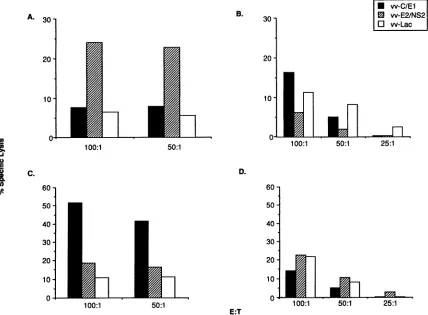
FIG. 1. Specific localization ofHCV-specific CTLamong the intrahepatic lymphocytes compared with PBMC. (A) Bulk-expanded CD8+ intrahepatic lymphocytes from subject 92Gspecifically recognized E2(NS1)/NS2-infectedtargetcells. (B)Bulk-expanded CD8+ lymphocytes from PBMC ofsubject 92G donotspecifically lyse autologous B-LCL expressing HCV proteins. (C) Bulk-expanded CD8+ intrahepatic lymphocytes fromsubject 92H demonstrated specific lysis oftargetcellsexpressing the C/El protein. (D) Bulk-expanded CD8+ lymphocytes from PBMC of subject 92H donotspecifically lyse autologous B-LCL expressing HCV proteins. The effector-to-target cell ratio (E:T) is shown.
incubationat37°C, cellswerewashed three times and used as
targetsinthecytotoxicityassay.The concentration ofpeptides forscreening ranged from 100to 300 ,ug/ml unless otherwise indicated. High concentrations of peptide were used for screening because of a previous demonstration that such
concentrations may be necessary when peptides longer than the optimal peptide are used for sensitization (reference 36 and data not shown). For screening of large numbers of peptidesinsomeassays,B-LCLweresimultaneously sensitized withtwononcontiguouspeptides,amethod whichgaveresults
equivalent to those from screening with individual peptides (datanotshown).
For finemapping experiments, the results presentedarefor
the cloneswhich grewbest inlong-term culture. Because ofa
laboratory freezer failure, sufficient numbers of clones from subjects 92G and92Hforonlyalimitednumber ofassayswith amino- and carboxy-truncated peptides were available. For clones from subject 92N, sufficient numbers of cells were
available to permit construction of dose-response curves for
recognition oftarget cells sensitized with serial 10-fold dilu-tions of truncated peptides. For these experiments, B-LCL
were labeled with 'Cr, washed three times, and then
incu-bated with the indicatedconcentration ofpeptide ina96-well
plate (5 x
103
cellsperwell). Aftera 1-hincubation,effectorcells were added to the wells, and the supernatant was
har-vestedat4 h inastandard cytotoxicity assay(74).
RESULTS
HCV-specific CTL are detectable among bulk-stimulated
liver-infiltrating lymphocytes. Liver-infiltrating lymphocytes
were expandedin the presenceofrIL-2 and irradiated alloge-neic feeder cells, as wellas a bispecific monoclonal antibody
whichresultsintheproliferationofCD8+ lymphocytes.Atno
time were these cells exposedto exogenous viral antigens in vitro. The resulting CD8+ lymphocytes were then tested for their ability to lyse autologous target cells expressing HCV proteins, by using vaccinia virus-HCV recombinant viruses.As shown inFig. 1AandC, subjects 92Gand 92Hhad detectable activity in CD8+ liver-infiltrating lymphocytes even in the absence ofinvitroviralantigenic stimulation, with specific lysis oftargetcellsexpressing eitherE2/NS2(subject 92G)orC/El
(subject 92H) comparedwith autologous targetcells
express-ing other HCVproteinsorwith acontrol. CD8+ lymphocytes
from PBMC from these subjectswere expanded in a similar
mannerand didnothave detectableHCV-specific activity (Fig.
1B and D). Although it is not possible to determine the absolute numberofCD8+ lymphocytesinthesmallfragments of livertissue received,the CD8+ lymphocytes obtained from the liver tissue and peripheral blood had no apparent
differ-enceintheirabilitytoproliferate afteranonspecificstimulus
toT-cellproliferation suchas12F6.Thesefindingssuggestthat HCV-specific CTLareconcentrated within thehepatic
paren-A. 30
20
10'
B.
*w-EvC/El 1§ vv-E2/NS2 El vv-Lac
0O
.-J-C) C.
60 -50 -40 -30
20- 1
0-60
-50
- 40-30
-20
-10
1
0
E:T
lUU:l 50:1 25:1
J. VIROL.
on November 9, 2019 by guest
http://jvi.asm.org/
[image:3.612.97.525.78.393.2]CYTOTOXIC T LYMPHOCYTES IN HEPATITIS C VIRUS INFECTION 7525
100- w-C/E1
v
w-E2/NS2
80- 0 w-Lac
~60-
~40-20
20
1
l
1]
2
0
100:1 50:1 25:1 100:1 50:1 25:1
GR
B-LCL
92F
B-LCL
[image:4.612.319.560.99.250.2]E:T
FIG. 2. HCV-specific cytolytic activity of bulk-expanded CD8+ lymphocytes from theliverofsubject92N.CD8+wereexpanded from the liverbiopsysampleofsubject92N asdescribed above and tested
against two HLA-matched lines, as an autologous B-LCL was not
available. These CD8+ cells recognized target cells (GR B-LCL) expressing C/El. The B-LCL GR shares HLAA28, B7, C6, DRw52, and DQwl. The B-LCL 92F sharesA3, B51, C4, C7, DR7, DRw53, andDQwl,2.DR6 is theonlyclass IorIImoleculeexpressed by92N
that is notexpressed by these lines. The effector-to-target cell ratio (E:T)isasindicated.
chyma and, if present inthe peripheral blood, are present at
lowerfrequencies than in the liver.
CD8+ lymphocytes expandedfrom theliverbiopsy specimen of subject 92N also had detectable HCV-specific cytolytic activity. Because an autologous B-LCL was not available, cytolytic activitywasevaluatedby usingtwo differentpartially HLA-matched B-LCL, B-LCL GR and B-LCL92F, as target
cells(Fig. 2). Therewasspecificrecognition of the B-LCL GR
cellsexpressing C/El compared with those expressing E2/NS2
orthecontrol. Forsubject 92N,itwasnotpossible toevaluate PBMC inparallel with liver-infiltrating lymphocytes, since an
autologous B-LCLwasnotavailabledespite multiple attempts to establish such a line and since background levels of lysis from using stimulated PBMC against allogeneic target cells
were too high.
HCV-specific cytolytic activity in liver-infiltrating lympho-cytes. After expansion of the CD8+ lymphocytes from the biopsyspecimen, these cellswere thencloned in the presence
ofa CD3-specific monoclonal antibody, rIL-2, and irradiated
allogeneic feeder cells. Atno time were clones derived from liver-infiltrating lymphocytes exposed to exogenous HCV
an-tigens invitro.Developing cellswere tested forHCV-specific
cytolytic activity. In all three subjects, HCV-specific CTL which recognized target cells infected with recombinant vaccinia virus-HCV viruses and grew in sufficient numbers to allow performance of multiple assays on multiple dates (Table 1).
werefound. Forsubject 92G,twocloneswhichwere stable in
long-term culturewereisolated. These clonesspecifically lysed
targetcellsexpressing HCV E2/NS2. Clonesfromsubject 92H recognizedtargetcellsexpressing C/El. For subject 92N, there
was apolyclonal HCVresponse,withtwodifferentpopulations
ofHCV-specificclonesidentified. Onepopulation recognized targetcellsexpressing C/El proteins,and the otherrecognized target cells expressing E2/NS2 proteins. All HCV-specific
TABLE 1. Lysis ofHCV-expressing target cells by liver-infiltrating lymphocytes from persons with chronic HCV hepatitis"
%Specificcytotoxicity of construct Subject Clone" E:TP
w-Lac w-C/EI w-E2/NS2
92G 110 20:1 0.9 0 30.2
118 20:1 0.9 0 50.3
92H 5 10:1 0.8 35.0 ()
32 2:1 - 0.5 59.3 0
92N 2 1:1 4.7 29.6 0
8 10:1 0 31.3 0
43 2:1 5.0 23.6 0
47 2:1 0 54.5 0
107 10:1 -0.5 0 45.1
118 10:1 0 0 27.1
135 2:1 2.3 39.6 0
'HCV-specificcytolyticactivity of CTL clones derived from liver-infiltrating lymphocyteswastested in a standard 4-h5'Crrelease assay.Autologousor,in the case of subject 92N, HLA-matched B-LCL infected with recombinant vaccinia virus-HCVviruses were used as target cells.
"CTL clones were derived from CD8+ liver-infiltrating lymphocytes by cloning in the presence ofanti-CD3 monoclonalantibody,IL-2.andallogeneic feedercells. Clones listed are the result ofscreeningthefollowingnumbers of clones: forsubject92G, 200 clones;forsubject 92H, l()( clones;and for subject 92N, 150 clones.
E:T, effector-to-targetcell ratio.
cloneswereconfirmedtobeCD8+ by FACSanalysis (datanot shown).
HCV-specificCTL are restricted by HLA class I molecules. Recognition of endogenously synthesized proteins, such as occurs on the surface of cells infected withviruses, occurs in the context of a short fragment of protein presented as a trimolecular complex with the major histocompatibility com-plex classImolecule and beta2microglobulin(79).Inorderto further define thecharacteristics of the observed
HCV-specific
cytolytic activity, CTL clonesweretestedfor theirabilityto
lyse
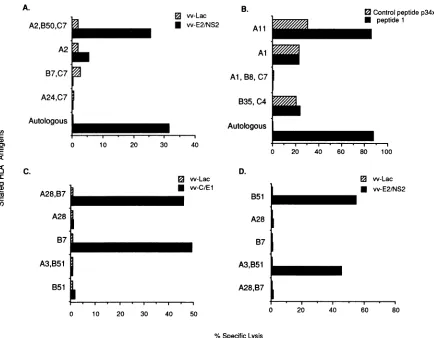
allogeneic targetcellsexpressing HCV antigens. Asshown in Fig. 3, the HCV-specific cytotoxic effector cells recognized allogeneictargetcellsonly inthe contextofasharedHLAclass Imolecule, with different HLAmoleculesrestricting recogni-tion of different HCV antigens. Clone 92G-118 recognizes targetcellsexpressing E2/NS2 onlyin the contextofHLAB50 (Fig. 3A). As shown in Fig. 3B, clone 92H-32 recognizes a specificcorepeptide only inthe context ofHLAAll. Clones withtwodifferent specificities from subject 92Nwereisolated, with one population directed against
C/El
and the other against E2/NS2. Epitope recognition by these clonesoccurred in the context of different HLA molecules (Fig. 3C and D). Clone92N-135 recognizesC/El protein
onlyin the contextof HLAB7,
and clone92N-107recognizesE2/NS2inthecontext ofHLAB51.HCV-specific CTL recognize HCV core and envelope pro-teins.
Crystallographic
resolution of thepeptide
binding sites of classImolecules(26, 44,63),
aswell aselution of naturally processed viral proteins bound to class I molecules (23, 60), has shown that peptide fragments presented to class I-re-stricted CTL are 8 to 10 aa in length. Incubating target cells with synthetic peptide has been shown to bypass the normal requirements for endogenousprocessing ofviralpeptide
into fragments of the appropriate length (71) and thus enables definition of the epitopes recognized byvirus-specific
CTL. Overlapping20-aasynthetic
peptides spanning
theappropriate
viralproteinswereusedtomapthe
regions containing
epitopes
recognized by the
HCV-specific
CTL.AsshowninFig. 4,
clone VOL.67, 1993on November 9, 2019 by guest
http://jvi.asm.org/
7526 KOZIEL ET AL.
A.
A2,B50,C7 A2 B7,C7 A24,C7
Aidtninnnim
Ea
W-Lac * vv-E2/NS2B. All
Al Al, B8, C7
B35, C4 Autologous
0 10 20 30 4(
N
wv
.I . I . .
C.
A28,B7 A28 B7 A3,B51
B51
0
)
0 20 40 60 80 100
v-Lac
v-C/El D.
B51 A28 B7 A3,B51 A28,B7
10 20 30 40 50
[image:5.612.92.526.74.412.2]%SpecificLysis
FIG. 3. HCV-specific CTLareHLAclass I restricted. Clonesweretested for theabilitytolyseautologous and allogeneictargetcellsexpressing
HCVantigens.Target cellswereinfected with the vaccinia virusconstructexpressing the relevant antigenaswellasthecontrolvirus w-Lac. Shared
HLAmoleculesareshown.(A) Clone 92G- 118 recognized E2(NS I)/NS2 in thecontextof HLA B50.(B) Clone 92H-32 recognized theHCVcore
protein in thecontextof HLA Al1. Target cellswere sensitized with the HCVcore peptide recognized by this clone (see Fig. 7). Both thecore
peptide and the control peptide p34x(ALVMAQLLRIPQAILDMIAG)wereused atasaturating concentration of 100 jLg/ml.(C)Clone 92N-47 recognized C/El in thecontextof HLA-B7.(D) Clone 92N- 107recognized E2/NS2in the context of B5 1. ThecompleteHLAtype ofsubject92G isA2,24, B7,50, Bw6, C6,7, DR2,7, DRw53, andDQ1,2. The complete HLAtypeofsubject92His Al,l1, B8,35,Bw6,Cw4,w7, DR1,3, DRw52,
andDQwl,w2.ThecompleteHLA typeofsubject92N isA3,28,B7,51,Bw4,6, C4,6, DRw6,7, DRw52,53, andDQwl,2.All resultsareshown at
an effector-to-target cell ratio of 10:1.
92G-1 18lysedtargetcells sensitized withapeptide fragment of
theE2protein. Synthetic 20-aa peptides (57 in all) correspond-ing to the proteins expressed by the w-E2/NS2 vector were
used tosensitize autologous B-LCLfor lysis. Only peptide 57 (aa 561 to 580) sensitized target cells for recognition by this B50-restricted clone (only data for peptides 54 to 60 are
shown; no other peptides sensitized cells for specific lysis). Further definition of the epitope was accomplished by using
l0-aapeptides which overlappedoneanotherby 8aa(Fig. 4B).
Peptide 57D(CVIGGAGNNT, aa569to578)wassufficientto
sensitize target cells forlysis.
Synthetic peptides were also used to define the epitope recognized by clone 92H-32. Overlapping 20-aa peptides de-fined this Al 1-restricted epitope asbeing in the first 20 aaof the core (data not shown); further mapping with 13-aa
pep-tideswhich overlapped by 10 aa showed the epitope tobe in thefirst 13aa (Fig. 5A). Amino- andcarboxy-terminal
trunca-tionofthe 13-aapeptidewasusedtofurther define theepitope recognized (Fig. SB). Incubation of target cells with the peptides containing thesequence STNPKPOK(aa 2to9)was
sufficient to sensitize cells for lysis but not incubation with
peptides which didnot contain the amino-terminal serine (aa 2) orthe carboxy-terminal lysine (aa 9), suggesting thatthese amino acids are important for binding to the HLA Al I molecule.
In a similar manner, 20-aa overlapping synthetic peptides
wereusedtodefine the B7-restrictedepitoperecognized by the core-specific clone 92N-135 toamino acids present within the overlapoftwo adjacent peptides, peptide4(aa 31 to 50) and peptide 5 (aa 41 to 60) (Fig. 6A). By using 10-aa peptides whichoverlapped by 8aa, the region recognized bythis clone was confirmedtoliewithinaa41 to50(data notshown).The availability of large numbers of cells permitted a more
exten-sive analysis of the minimum epitope recognized by clones from subject 92N. Fine mapping of this epitope showed that optimal recognition was achieved with the sequence GPRL-GVRAT (aa 41 to 49), as evidenced by the ability of this peptide tosensitizetargetcells forlysis atthe lowest
concen-tration ofpeptide (Fig. 6B). Lysiswasreduced when either the
amino-terminal glycineorthecarboxy-terminal threoninewas
removed. Thepeptide GPRLGVRAwasstill abletosensitize cells forlysiswhen high peptide concentrationswere used. In
e Controlpeptidep34x
_. peptide1
cn
I
Cu
c
C,)
w3
W-Lac * vv-E2/NS220 40 60 80
J. VIROL..
w%tvivyu
on November 9, 2019 by guest
http://jvi.asm.org/
CYTOTOXIC T LYMPHOCYTES IN HEPATITIS C VIRUS INFECTION 7527
A.
60s
50
-J C)
-j
IL)
40
-30
20
10
A.
AA1-13
AA4-16 AA7-19
a)
c AA10-21 AA13-24
w-Lac w-C/E1
Nc o) 1t I) co0 o o
(a U) LO) U) U) o) LO CO
> ~~~~Target
10 20
%SpecificLysis
30
[image:6.612.71.282.77.381.2]60
FIG. 4. Mapping of the HCV epitope recognized by the HLA B50-restricted clone 92G-118. (A) Clone 92G-118was tested for its
ability to lyse autologous target cells individually incubated with
synthetic 20-aa HCVpeptides spanning the E2(NS1) and NS2
pro-teins. This clonerecognizedtargetcells sensitized withpeptide57(aa 571 to590)intheE2(NSI) glycoprotein. Lysisoftargetcellsinfected
with the recombinant vaccinia virus is shown as a control. The
effector-to-targetcell ratio shown is 10:1.(B)Clone 92G-118wasalso tested for itsabilitytolyseautologoustargetcells incubatedwith 10-aa
peptideswhichspannedaa573to588.Peptide57D(aa569to578)was
ableto sensitize targetcells forlysis.Theeffector-to-target cell ratio
was5:1, and allpeptideswereusedataconcentration of 50
VLg/ml.
a separate experiment using 10-fold dilutions of the 9-aa peptide GPRLGVRAT, half-maximal lysiswasachieved even
at 100pg/ml (data notshown).
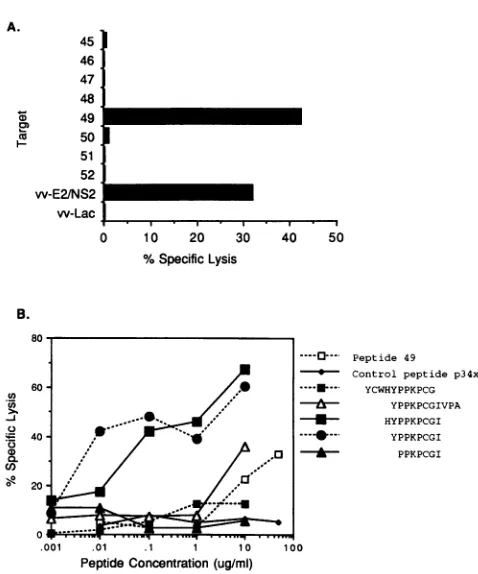
Clone 92N-107, which recognizedtarget cells infected with the E2/NS2vector,wastestedfor itsabilitytolyse autologous target cells individually incubated with synthetic 20-aa HCV peptides spanningthe proteins expressed by vv-E2/NS2 (Fig. 7A). Only peptide 49 (aa 481 to 500)was found to sensitize cells forlysis, suggesting that the B51-restricted epitope
rec-ognized by this clone lay within this 20-aa peptide. Further definition of the epitope was accomplished by using 10- to
11-aa peptides which overlapped by 8 aa. Of these, only
peptides 49C (WHYPPKPCGI) and 49D (YPPKPCGIVPA) sensitized targetcells forlysis (datanotshown), suggesting that theepitope lay within the region (YPPKPCGI) shared by these
two peptides. Examination of dose-response relationships of peptides spanningthisregion demonstrated thatoptimal
rec-ognitionwas achieved when target cells were sensitized with the 8-aapeptideYPPKPCGI(aa489to496),which sensitized cells for lysis even at 10 ng/ml (Fig. 7B). Removal of the amino-terminal tyrosine or the carboxy-terminal isoleucine
B.
Targetcells sensitized with: STNPKPQKK
TNPKPQKKNK MSTNPKPQKKNK MSTNPKPQKKN MSTNPKPQKK MSTNPKPQK MSTNPKPQ MSTNPKP MSTNPK
NPKPQKKNKR
Control peptide p34x
Peptide 1
0 30
%SpecificLysis
FIG. 5. Mapping of the HCV epitope recognized by the HLA All -restricted clone 92H-32.(A)Clone92H-32recognizesautologous
target cells incubated with the 13-aa peptide IA (aa 1 to 13,
MST-NPKPQKKNKR); allother peptides spanning the core and El
pro-teinsfailedtosensitize targetcells forlysis (datanotshown).Lysisof
autologous target cells infected with recombinant vaccinia virus is shownas a control. Theeffector-to-target cell ratio was2:1, and the
concentration ofpeptide used forsensitizationwas5 ,ug/mI. (B)Fine
mappingof the epitope recognized by clone 92H-32. Recognition of
target cells sensitized for lysis with amino- and carboxy-terminal
truncations ofpeptide lAindicated thatthepresenceof thesequence STNPKPQK (aa2to9)wassufficienttosensitizetargetcells forlysis.
The effector-to-target cell ratio was 5:1, and the concentration of
peptideused forsensitization was5 jig/ml.
abrogated recognition. Addition of an amino-terminal
histi-dine resulted in sensitization oftargetcellsbutrequiredhigher concentrations ofpeptide. Ofnote, the II -aapeptide
YPPK-PCGIVPA, which contains the entire 8-aa epitope, was less efficientforsensitization oftargetcells thanthe 8-aapeptide,
as would be expected of peptides longer than the minimal
epitope.
DISCUSSION
The role of cellular immune responsesinHCV infection is still in the early stagesof characterization. In this report,we
identify thecore and E2proteins as targets for HCV-specific CTL in chronically infected persons. HCV-specific cytolytic
activity is present in bulk-expanded liver-infiltrating
lympho-cytes in the absence of any in vitro antigenic stimulation, whereas such activitycould notbe detected in bulk-expanded PBMC, suggesting a tissue-specific localization of
HCV-spe-B.
0)
I
Peptide57
57A(VCGAPPCVIG)
57B(GAPPCVIGGA)
57C(PPCVIGGAGN)
57D(CVIGGAGNNT)
w-Lac
w-E2/NS2
10 20 30 40 50
%Specific Lysis
I
0
VOL.67, 1993
on November 9, 2019 by guest
http://jvi.asm.org/
[image:6.612.319.553.85.411.2]7528 KOZIEL ET AL.
A.
a) 6_
7 _
8
w-C/E1
w-Lac
0 20 40 60 80
%SpecificLysis
A.
45 46 47 48
a 49
cm
co 50
51
52
w-E2/NS2
w-Lac
0 10 20 30
%SpecificLysis
B.
B.
(O .c
cn
-j
0)
.O
-.--
-0-.-
-
we.'-{'--Peptide 4
Control p34x
GPRLGVRATR
PRLGVRATR
GPRLGVRAT
GPRLGVRA
GPRLGVR
.001 .01 .1 1 10
Peptideconcentration(ug/ml)
FIG. 6. Mapping of the HCV epitope recognized by the HLA
B7-restricted clone 92N-135. (A) Clone 9N-135 was tested for its
ability to lyse autologous target cells individually incubated with
synthetic20-aa HCVpeptides spanningthecoreand Elproteins.This
clonerecognizedtargetcellssensitized with either oftwoadjacentcore peptides (aa 31to50 and 41 to60); peptidetitration curvesshowed
identicalrecognition of thesepeptidesdowntopeptideconcentrations of
10-'
M (data not shown). This suggested that the epitope wascontained in theregion overlapped bythe twopeptides, aa41 to50
(GPRLGVRATR). The effector-to-target cell ratiowas5:1, and the
concentration ofpeptidesusedwas50 p.g/ml. (B)Amino-and
carboxy-terminal truncations of theoverlap region ofpeptides4 and 5were
tested fortheirabilitytosensitizetargetcells forlysis. Targetcellswere
sensitized with the indicated concentrations of peptide, and clone 92N-135wastestedforrecognition. Optimal recognitionwasachieved
with thesequenceGPRLGVRAT (aa41to49). The effector-to-target
cell ratiowas 1:1.
cificCTL. Withnonspecific stimulation strategies, suchashave beenemployedindetectingHIV-1-specificCTL(74)aswellas
HCV-specific CTL (42), it is possibleto detectCTLdirected against multiple different antigens without influencing the specificities of the CTL in vitro. For subjects 92G and 92H,a
single epitope could be defined by using cloned CTL, whereas forsubject 92N the CTLresponse wasfoundtobedirected at epitopes in twodifferentviral proteins.
Liver biopsy specimens from three other patients with chronicactive hepatitis C during the period of this studywere
evaluable, and HCV-specific clonescouldnotbe isolated from these subjects (datanot shown). The clinicalcharacteristics of these patientswere no different from those ofpatients from
whomHCV-specific CTLwereisolated.Theinabilitytodetect
such responses maybe due to alow frequency orabsence of
CTL or due to CTL activity directed againstportions of the virusnotpresentin thevaccinia virusrecombinants. For five of the sixsubjects studied, vaccinia virus recombinants expressing
U,
.r4
-J
-j
a)
cL
C/)
...
.: ;-, O._In E
.001 .01 .1 1 1 0
Peptide Concentration (ug/ml)
....
W...
----.=---
A.-Peptide 49
Control peptide p34x YCWHYPPKPCG
YPPKPCGIVPA HYPPKPCGI
YPPKPCGI PPKPCGI
FIG. 7. Mapping of the HCV epitope recognized by the HLA
B51-restricted clone 92N-107. (A) Clone 9N-107was tested for its
ability to lyse autologous target cells individually incubated with
synthetic 20-aaHCVpeptides spanningtheE2 andNS2proteins. Only
the E2peptide49(aa481to500)wasfoundtosensitize cells forlysis.
The effector-to-target cell ratio was 10:1, and the concentration of
peptide usedforsensitizationwas50 ,ug/ml. (B) Clone 92N-107was
alsotestedfor itsabilitytolyseautologoustargetcellsincubated with amino-andcarboxy-terminaltruncations ofpeptide49. Tenfold serial dilutions of amino- and carboxy-terminal truncations ofa region of
peptide49 were incubated with targetcells, and clone 92N-107was
tested for itsabilitytolysetargetcells.Optimal lysiswasachieved with the sequenceYPPKPCGI (aa489to496).Theeffector-to-targetcell
ratiowas2:1,andtheconcentrations ofpeptideused for sensitization
wereasindicated.
only thefirst 906 aaofHCV-1 were available at the time of study. An additional vector, w-E2/NS2/NS3, which expresses
Met-364toHis-1619,wasavailable fortheevaluation of clones
from subject 92N, although no clones with specific activity solely for NS3weredetected(datanotshown).Inaddition,the vectorsusedwere derivedsolelyfromtheHCV-1 strain.Since HCV displays considerable sequence heterogeneity among
isolates(forareview,seereference 32) and since CTLmaybe eithergrouportypespecific (2, 17),it islikelythatourresults actually underestimate the frequency andspectrum of HCV-specific CTL in the liver-infiltrating lymphocytes of these chronically infected individuals.
The ability to define both the HLA restriction and the minimumepitope recognized by HCV-specific CTLfacilitates the prediction ofallele-specific motifs recognized in natural infection (for a review, see reference 59). Identification of epitopes byothermethods, suchassolid-phase peptide binding
assays (14) or amphipathicity profiles (45), has not always
predicted the specificities of virus-specific CTL. Allele-specific motifs have been proposed for several murine and human HLA types, including A2, B27, A3, and B8 (18, 23, 33, 35).
40 50
J. VIROL.
on November 9, 2019 by guest
http://jvi.asm.org/
[image:7.612.320.559.70.357.2] [image:7.612.66.302.71.370.2]CYTOTOXIC T LYMPHOCYTES IN HEPATITIS C VIRUS INFECTION 7529 TABLE 2. Epitopesrecognized by HLAAl1-restrictedand HLA B7-restricted CTL
Amino acid at position": Sourceor
CTL Antigen (aa)
rce(sr
- 1 2 3 4 5 6 7 8 9 - reference(s)
HLAAl restricted HCV core (2-9) S T N P K P Q K This report
HIV-1 pol(325-333)" A I F Q S S M T K 74
HIV-1pol (508-517) I Y Q E P F K N L K 34a,37
HIV-l nef(73-82) Q V P L R P M T Y K 40
HIV-1 nef(83-94) A A V D L S H F L K 16
Epstein-Barrvirus I V T D F S V I K 78
EBNA(416-424)
HBVpre-SI(21-28) P L G F F P D H 34
HLA B7restricted HCV E2(41-49) G P R L G V R A T Thisreport
HIV-1 nef(126-138) N Y T P G P G V R Y P L T 16
Forthepeptides for which theminimumepitope hasnotbeendefined, alignmentwasdonebycomparisonofchargeamongresidues,and the hestalignmentis shown. Aminoacids which arc identical tothe HCVcore areshowninboldface type.-,noposition number.
"Amino acidcoordinates for the HIV-1 sequence are basedonthe LAI sequence(50a).
Recognition of otherviralepitopes restricted byHLAAll has beenreported foranumberofotherviralinfections, including HIV-1 (72), Epstein-Barrvirus (27), and HBV(34). Compar-ison of the HLA All-restricted core peptide (aa 2 to9) with other
peptides containing
HLA A11-restricted
epitopes indi-cates similarities amongpeptides
which bind to HLA All (Table 2). All but one of the peptides containing AlI-re-stricted epitopes have alysine
at the C terminus(referred
to hereasposition9). The only exception isanHBVepitope with a histidine at position 9, representing a conservative amino acid substitution. Other shared features of these peptides in thisalignment include nonpolaror uncharged polarRgroups atpositions 2, 5, 7,and 8. Asimilar motif forpeptidesbinding tothe HLAAlI molecule hasrecently been proposed (78). By using synthetic peptides with amino acid substitutions within an epitope recognized by Epstein-Barr virus-specific CTL, a motifwhichconsists ofahydrophobic amino acidatposition 2, amino acids with small side chainsatpositions 3 and6, and a positively charged amino acidatposition9 wasproposed. The Al -restricted peptides shown in Table 2 suggest that larger side chains such as the lysine in the HCV core protein are possible at position 6 and that polar uncharged amino acids such asserine andglutamine
canoccupyposition 2. Bothour proposedmotif and thatproposed by Zhangetal.(78)indicate the need for a small side chain at position 3 and a lysine or other positively charged R groupin position 9. Differences in themotifs,suchasthe substitution ofalargepositively charged R group at position 6, might be explained by differences in molecular structure among Al1 molecules which share sero-logic cross-reactivity(6).
Although fewer HLA B7-restricted epitopes have been reported, one alignment of the peptide representing the epitope in HCV E2 recognizedby an HCV-specific CTL and apeptide representing the epitope in HCV E2 recognized byanHCV-specific CTL and apeptide repre-sentingtheepitopein HIV-1 nefproteinisstrikingin that 4 aa can beperfectly aligned (Table 2).Theepitopes recognized bytheHCV-specificCTL identified in this study are present within both highly conserved and variable regions ofthe virus. The epitopes within the HCV core recognized by clones from
subjects
92H and 92N arerelatively highlyconserved amongreported isolates, although variationstill existsinthis region (9, 13, 30,31, 38,54,69, 70). Ofnote, these CTL epitopespresent within the core
protein
alsooverlap with B-cell epitopes reported inahighpercentage of chronically infected subjects (51, 62). The presence of a proliferative response to core proteins was shown to be the onlydiscriminatory Th-cell responsewhich separated subjects with chronic HCV infection from those who appeared to be healthy carriers of HCV (8). These observations suggest that the HCVcore proteinmaybe relatively immunodominant for humoraland
T,,-cell
responses,inadditiontobeingatargetfor CTL.Clones 92G-118 and 92N-107 recognized epitopes within morevariable regions of theE2protein, with multiple conser-vative and nonconservative amino acid substitutions within these epitopes reported (9, 13, 30, 31, 38, 54, 69, 70). Such sequence heterogeneity amongHCV isolates is not randomly
distributed,
with the highest degree of diversityamongisolates observed in theenvelopeproteinsandthe least in thecoreand NSproteins (25, 46, 54, 75).Thefunctional implications of this diversity in HCV are unknown. For other viruses, such as HIV-1,it has been demonstrated thatsequencediversity within CTLepitopesmayfacilitateescapefrom immunesurveillance, sinceevensingleamino acidchangeswithin CTLepitopesmay abrogate recognition by CTL (17, 35, 57, 68). Although conclusive evidence regarding the clinical importance of this mechanism is lacking, our system will allow us to test the hypothesis that sequence variation in an individual over time correlates with escape from immune recognition in these chronically HCV-infected subjects.If CTL are important to host defenses against HCV, this responseappears tobeinsufficient toclearviruscompletelyin the majority of HCV infections. In suchcircumstances, CTL may contribute to disease pathogenesis. Several lines of evi-dence support this hypothesis with regard to chronic HBV infection(for reviews, seereferences 49 and56). CD8+ Tcells capable of lysing hepatocytes in a major
histocompatibility
complex-restrictedmannerhave beenisolated from individuals with chronic HBVhepatitis, although the antigenic
specificity
ofthese cellscouldnotbedefined(22).Morerecentdata have
VOL.67, 1993
on November 9, 2019 by guest
http://jvi.asm.org/
[image:8.612.60.565.92.281.2]7530 KOZIEL ET AL.
shown that adoptive transfer of HBV-specific CTL into hepa-titis B surface antigen-transgenic mice led to liver cell necrosis (50). This tissue damage is due to direct cell lysis by the CTL, with amplification of liver necrosis by cytokines suchasgamma interferon and tumor necrosis factor alpha (11, 28).
Although HCV-specific CTL may mediate liver damage in chronic infections, it remains possible that HCV-specific CTL contribute to either clearance of viremiaorlack ofprogression to chronic disease in some individuals. IfHCV-specific CTL are shown to be important in limiting viral replication, the identification of epitopes recognized by HCV-specific CTL may have important implications for vaccine development. Immunization with peptides alone has been shown to lead to the induction of a protective CD8+ CTL response (39, 64), although such approaches may be limited by the need to include multiple peptides in order to confer protection in human populations with diverse HLA backgrounds. Knowl-edge of the epitopes recognized byHCV-specific CTL should facilitate design of peptide-based vaccines and may be impor-tant in understanding the mechanisms of persistent viral infection.
ACKNOWLEDGMENTS
Wethank David Nunes forassistance inproviding patient material; KentThudium, Kim Berger, and Christine Dong for expert technical assistance; M. Gately of Hoffmann-La Roche for the gift of rIL-2; Donna Fitzpatrick and the MGH Tissue Typing Laboratory for assistance in HLAtyping; Johnson Wong for thegiftof the anti-CD3 antibody 12F6and thebispecific antibody CD3,4B;and Joan Kaplan andMartin Hirsch forcritical review of themanuscript.
M.J.K. is supported by a National Research Service Award, and B.D.W. issupported by National Institutes of Health grantA131563.
REFERENCES
1. Abe,K., G. Inchauspe,T.Shikata,and A.M. Prince. 1992. Three different patterns of hepatitis C virus infection in chimpanzees. Hepatology 15:690-695.
2. Aebischer, T.,D.Moskophidis,U.Rohrer,R.Zinkernagel,and H.
Hengartner. 1991. Invitro selection oflymphocytic choriomenin-gitis escapemutantsbycytotoxicTlymphocytes.Proc.Natl. Acad. Sci. USA 88:11047-11051.
3. Alter,H.J.,R.Purcell, J. Shih, J.Melpolder,M.Houghton,Q.-L. Choo,andG. Kuo.1989.Detection ofantibodytohepatitisCvirus in prospectively followed transfusion recipients with acute and chronicnon-A, non-B hepatitis.N.Engl. J. Med. 321:1494-1500. 4. Alter,M.J.,H. S.Margolis,K.Krawczynski,F.Judson,A.Mares,
W. Alexander, P.-Y. Hu, J. Miller, M. A. Gerber, and R. E.
Sampliner. 1992. The natural history of community-acquired hepatitisC in the United States. N.Engl.J. Med. 327:1899-1905. 5. Atherton, E.,and R.Sheppard. 1989.Solidphasepeptide
synthe-sis, p. 1-203.Oxford UniversityPress, Oxford.
6. Bodmer, J.,S.G.E.Marsh,E.Albert,W. F.Bodmer,B.Dupont,
H. A. Erlich, B. Mach, W. R. Mayr, P. Parham, T. Sasazuki,
G. M. T. Schreuder, J. L. Strominger, A. Svejgaard, and P. Terasaki. 1992. Nomenclature for factors of the HLA system,
1991. Hum.Immunol. 34:4-18.
7. Bortolotti, F., A. Tagger, and P. Cadrobbi. 1991. Antibodies to
hepatitis C virus in community-acquired acute non-A, non-B hepatitis. J. Hepatol. 12:176-180.
8. Botarelli, P.,M.Brunetto,M.Minutello,P.Calvo,D.Unutmaz,A.
Weiner, Q.-L. Choo, J. Shuster,G.Kuo,F.Bonino,M.Houghton,
and S. Abrignani. 1993. T-lymphocyte response to hepatitis C virus in different clinical courses of infection. Gastroenterology 104:580-587.
9. Cha,T.-A., E. Beall,B.Irvine, J. Kolberg,D.Chien, G. Kuo, and
M.S. Urdea. 1992. Atleast five related, but distinct, hepatitisC virus genotypes exist. Proc. Natl. Acad. Sci. USA 89:7144-7148. 10. Chakrabarti, S.,K.Brechling,and B. Moss. 1985. Vaccinia virus
expressionvector:coexpressionof
P-galactosidase
providesvisualscreeningof recombinant virusplaques. Mol. Cell. Biol. 5:3403-3409.
11. Chisari, F. Personal communication. l1a.Choo,Q.-L. Unpublisheddata.
12. Choo,Q.-L.,G.Kuo,A.J. Weiner, L. R. Overby,D. W.Bradley,
and M.Houghton. 1989. Isolation ofacDNAclone derived from
a blood-borne non-A, non-B viral hepatitis genome. Science 88:359-362.
13. Choo, Q.-L., K. H. Richman, J. H. Han, K. Berger, C. Lee, C. Dong, C. Gallegos, D. Coit, A. Medina-Selby, P.J. Barr, A. J. Weiner,D. W.Bradley,G.Kuo,and M.Houghton. 1991.Genetic
organization and diversity of the hepatitis C virus. Proc. Natl. Acad. Sci. USA 88:2451-2455.
14. Choppin, J., F. Martinon, F.Connan,E.Gomard, and J. P. Levy. 1991. HLA-binding regions of HIV-1 proteins. I. Detection of
sevenHLAbinding regionsin the HIV-1Nefprotein.J.Immunol. 147:569-574.
15. Chung, R., and L.Kaplan. Personal communication.
16. Culmann, B., E. Gomard, and M.P. Kieny. 1991. Six epitopes reactingwith humancytotoxicCD8+ T cells in the centralregion of theHIV-1 nefprotein.J. Immunol. 146:1560-1565.
17. de Campos-Lima, P.-O.,R.Gavioli, Q.-J. Zhang, L.Wallace,R.
Dolcetti, M. Rowe, A. B. Rickinson, and M. G. Masucci. 1993. HLA-AlIepitopeloss isolatesofEpstein-Barrvirus fromahighly All+ population.Science 260:98-100.
18. DiBrino, M.,K.Parker, J. Shiloach,M.Knierman, J. Lukszo,R.
Turner,W. Biddison,andJ.Coligan.1993.Endogenouspeptides bound to HLA-A3 possess a specific combination of anchor residues thatpermit identificationofpotential antigenicpeptides. Proc. Natl.Acad. Sci. USA 90:1508-1512.
19. Dienstag, J.L. 1983.Non-A, non-Bhepatitis: recognition, epide-miology,andclinical features. Gastroenterology85:439-462. 20. Donahue, J.G.,A.Munoz,P.M.Ness,D. E.Brown,D. H.Yawn,
H. A. McAllister, B. A. Reitz, and K. E. Nelson. 1992. The declining risk ofpost-transfusion hepatitis C virus infection. N. Engl.J. Med. 327:419-421.
21. Eckart, M. R., M. Selby, F. Masiarz, C. Lee, K. Berger, K.
Crawford,C.Kuo,G.Kuo,M.Houghton,andQ.L.Choo. 1993.
The hepatitis C virus encodes a serine protease involved in processing of the putativenonstructural proteins from the viral polyprotein precursor. Biochem. Biophys. Res. Commun. 192: 399-406.
22. Eddleston,A. L. W. F., M. Mondelli, G. Mieli-Vergani, and R.
Williams. 1982. Lymphocyte cytotoxicity to autologous
hepato-cytesin chronichepatitisBvirusinfection.Hepatology2(Suppl.): 122S-127S.
23. Falk, K., 0.Rotzschke,S.Stevanovic,G.Jung, andH.-G.
Ram-mensee. 1991. Allele-specific motifs revealed by sequencing of self-peptides eluted from MHC molecules. Nature (London) 351:290-296.
24. Farci, P., H. Alter, S. Govindarajan, D. Wong, R. Engle, R.
Lesniewski, I. Mushahwar, S. Desai, R. Miller, N. Ogata, and R.H. Purcell. 1992.Lack ofprotective immunity against reinfec-tionwith hepatitisCvirus. Science 258:135-140.
25. Farci, P.,H.J. Alter,D.Wong,R. H.Miller, J.W. Shih,B.Jett,
and R. H. Purcell. 1991. Along-term study of hepatitisCvirus replicationinnon-A,non-Bhepatitis.N.Engl.J.Med. 325:98-104. 26. Garrett,T.P.,M. A.Saper,P.J. Bjorkman, J.L.Strominger,and D.C.Wiley.1989.Specificitypocketsfor the sidechains ofpeptide antigensinHLA-Aw68. Nature(London)342:692-696. 27. Gavioli,R.,M.G.Kurilla,P.0.deCampos-Lima,L. E.Wallace,
R.Dolcetti,R.J. Murray,A. B.Rickinson, and M.G. Masucci. 1993. Multiple HLA Al1-restricted cytotoxic T-lymphocyte epitopesof differentimmunogenicities inthe Epstein-Barr virus-encoded nuclearantigen4.J. Virol. 67:1572-1578.
28. Gilles,P.,D.Guerrette,R.Ulevitch,R.Screiber,andF.Chisari. 1992. HBsAg retention sensitizes the hepatocyte to injury by physiologicalconcentrations ofinterferon-y.Hepatology 16:655-663.
29. Grakoui, A.,D. W.McCourt,C.Wychowski,S.M.Feinstone,and
C. M. Rice. 1993. Characterization of the hepatitis C virus-encoded serine proteinase: determination of the proteinase-de-pendentpolyproteincleavagesites. J. Virol. 67:2832-2843.
J. VIROL.
on November 9, 2019 by guest
http://jvi.asm.org/
CYTOTOXIC T LYMPHOCYTES IN HEPATITIS C VIRUS INFECTION 7531
30. Grakoui, A., C. Wychowski, C. Lin, S. M.Feinstone, and C. M.
Rice. 1993. Expression and identification of hepatitis C virus polyprotein cleavage products. J. Virol. 67:1385-1395.
31. Hijikata, M., N. Kato, Y. Ootsuyama, M. Nakagawa, and K. Shimotohno. 1991.Genemapping of the putative structural region of the hepatitis C virus genome by in vitro processing analysis. Gene 88:5547-5551.
32. Houghton, M., A.Weiner, J. Han,G.Kuo,andQ.-L.Choo.1991.
Molecular biology of the hepatitis C viruses: implications for diagnosis, development and control of viral disease. Hepatology 14:381-388.
33. Jelachich, M. L., E. Cowan, R. Turner, J. Coligan, and W.
Biddison. 1988. Analysis of the molecular basis of HLA-A3 recognition by cytotoxic T cells using defined mutants of the HLA-A3 molecule. J. Immunol. 141:1108-1113.
34. Jin, Y., W.-K. Shih, and I. Berkower. 1988. Human Tcellresponse tothesurface antigenofhepatitisBvirus(HBsAg).J. Exp.Med. 168:293-306.
34a.Johnson,R.P.,P. Price,and B. D. Walker. Unpublisheddata. 35. Johnson, R. P.,A.Trocha, T. M. Buchanan, andB. D. Walker.
1992.Identification ofoverlapping HLA class I-restricted cytotoxic
Tcellepitopes inaconserved regionof the human immunodefi-ciencyvirustype 1 envelope glycoprotein: definition of minimum
epitopesandanalysisof the effects ofsequence variation. J.Exp. Med. 175:961-971.
36. Johnson,R.P.,A.Trocha,L.Yang, G.P.Mazzara,D. L.Panicali,
T. M. Buchanan, and B. D. Walker. 1991. HIV-1 gag-specific cytotoxic T lymphocytes recognize multiple highly conserved
epitopes. Fine specificity of thegag-specific response defined by using unstimulated peripheral blood mononuclear cells and cloned effector cells. J. Immunol. 147:1512-1521.
37. Johnson, R. P., and B. D. Walker. 1991. Identification ofHIV-1
cytotoxic T-lymphocyte epitopes and implications for vaccine development. Biotechnol. Ther. 2:137-146.
38. Kato, N.,M. Hijikata,Y.Ootsuyama,M.Nakagawa, S.Ohkoshi,
T.Sugimura, and K.Shimotohno. 1990.Molecularcloning of the human hepatitis C virus genome from Japanese patients with
non-A,non-Bhepatitis. Proc. Natl. Acad. Sci. USA 87:9524-9528. 39. Klavinskis, L. S., J. L.Whitton, and M. B. A. Oldstone. 1989. Molecularlyengineered vaccine whichexpresses an
immunodomi-nant T-cell epitope induces cytotoxic Tlymphocytes that confer protectionfrom lethal virus infection.J.Virol. 63:4311-4316. 40. Koenig, S., T.R. Fuerst,L. V.Wood,R. M.Woods, J.A. Suzich,
G.M.Jones,V. F. de laCruz,R. T.J. Davey,S.Venkatesan,and B. Moss. 1990. Mapping the fine specificity ofacytolytic T cell
response to HIV-1 nefprotein.J. Immunol. 145:127-135.
41. Koziel,M.J. 1993. Erratum. J. Immunol. 150:2563.
42. Koziel,M. J.,D.Dudley,J. Wong, J. Dienstag,M. Houghton, R.
Ralston,and B. D. Walker.1992.Intrahepatic cytotoxicT
lympho-cytesspecificforhepatitisCvirus inpersonswith chronichepatitis. J. Immunol. 149:3339-3344.
43. Kuo,G., Q.-L. Choo,H.Alter, G.Gitnick,A.Redeker, R. Purcell, T.Miyamura, J.Dienstag,M.Alter, C.Stevens,G.Tegtmeier,F.
Bonino,M.Colombo,W.-S.Lee,G.Kuo,K.Berger, J. Shuster,L.
Overby, D. Bradley, and M. Houghton. 1989. An assay for circulatingantibodiesto amajor etiologicform ofhuman non-A,
non-Bhepatitis. Science 244:362-364.
44. Madden,D. R.,J. C. Gorga, J. L.Strominger,and D. C. Wiley. 1991. The structure of HLA-B27 reveals nonamer self-peptides bound in an extended conformation. Nature (London) 353:321-325.
45. Margalit, H., J.L.Spouge, J. L. Cornette, K. B.Cease, C. Delisi,
andJ. A.Berzofsky. 1987. Prediction of immunodominantTcell
antigenicsites from theprimarysequence.J. Immunol.
138:2213-2229.
46. Martell, M., J. I. Esteban, J. Quer, J. Genesca, A. Weiner, R.
Esteban, J. Guardia,andJ.G6mez.1992.HepatitisC virus(HCV) circulatesas apopulation of different but closely relatedgenomes:
quasispecies nature of HCV genome distribution. J. Virol. 66:
3225-3229.
47. McOmish, F.,S. W.Chan,B.C.Dow, J.Gillon,W. D.Frame,R.J. Crawford, P. L. Yap, E. A. Follett, and P. Simmonds. 1993. Detection of three types ofhepatitis C virus in blood donors:
investigation of type-specific differencesinserologic reactivityand
rateof alanine aminotransferase abnormalities. Transfusion (Ar-lington) 33:7-13.
48. Miller, R. H.,and R. H. Purcell. 1990. Hepatitis Cvirus shares amino acidsequencesimilarity with pestiviruses and flavivirusesas
wellasmembers oftwoplant virussupergroups. Proc.Natl.Acad. Sci. USA87:2057-2061.
49. Mondelli, M.,and A. L. W. F. Eddleston. 1984. Mechanisms of
liver cellinjuryinacuteandchronichepatitisB.Semin.Liver Dis. 4:47-58.
50. Moriyama, T., S. Guilhot,K. Klopchin, B. Moss, C. Pinkert,R.
Palmiter,R.Brinster, 0. Kanagawa,and F.Chisari.1990.
Immu-nobiologyandpathogenesisofhepatocellularinjuryin transgenic mice. Science 248:361-364.
50a.Myers, G., J. A. Berzofsky, A. B. Rabson, T. F. Smith, and F. Wong-Staal. 1991. Human retroviruses and AIDS 1990:a
compi-lation andanalysisof nucleic acid and aminoacidsequences. Los
Alamos National Laboratory,LosAlamos,N.Mex.
51. Nasoff, M. S., S.L.Zebedee, G. Inchauspe, andA.M.Prince. 1991.
Identification ofan immunodominant epitope within thecapsid
proteinofhepatitisC virus. Proc. Natl. Acad. Sci. USA 88:5462-5466.
52. Odermatt, B., M. Eppler,T. P. Leist,H. Hengartner,and R. M.
Zinkernagel. 1991.Virus-triggered acquiredimmunodeficiencyby cytotoxic T-cell-dependentdestruction ofantigen-presentingcells andlymphfolliclestructure.Proc.Natl. Acad. Sci. USA 88:8252-8256.
53. Oehen,S.,H.Hengartner,and R. M.Zinkernagel. 1991.
Vaccina-tion for disease.Science 251:195-198.
54. Ogata, N., H.J. Alter, R. H. Miller, and R. H. Purcell. 1991.
Nucleotidesequenceandmutationrateof theHstrainofhepatitis C virus. Proc. Natl. Acad. Sci. USA 88:3392-3396.
55. Pasternack,M. 1988.CytotoxicTlymphocytes.Adv. Intern. Med. 33:17-44.
56. Peters, M., J. Vierling, M. E. Gershwin,D.Milich,F.Chisari,and
J. Hoofnagle. 1991.Immunologyandthe liver.Hepatology
13:977-994.
57. Phillips, R.,S.Rowland-Jones,D.Nixon,F.Gotch, J. Edwards,A.
Ogunlesi, J. Elvin, J. Rothbard, C. Bangham, C. Rizza, and A.
McMichael. 1991. Humanimmunodeficiencyvirus genetic
varia-tion thatcanescapecytotoxicTcellrecognition.Nature(London) 354:453-459.
58. Prince, A.,B.Brotman,T.Hiuma,D.Pascual,M.Jaffery,and G.
Inchauspe. 1992.ImmunityinhepatitisCinfection. J. Infect. Dis. 165:438-443.
59. Rotzschke, O., and K. Falk. 1991. Naturally-occurring peptide
antigensderived from the MHCclass-I-restrictedprocessing
path-way. Immunol.Today 12:447-455.
60. Rotzschke, O.,K.Falk,K.Deres,H.Schild,M.Norda, J. Metzger, G.Jung, and H.-G. Rammensee. 1990. Isolation and analysisof naturally processedpeptidesasrecognized by cytotoxicT
lympho-cytes. Nature (London)348:252-254.
61. Saito, I.,T.Miyamura,A.Ohbayashi,H.Harada,T.Katayama,S.
Kikuchi,Y.Watanabe,S.Koi,M. Onji,Y.Ohta, Q.-L. Choo, M.
Houghton, and G. Kuo. 1990. Hepatitis C virus infection is
associated with the development of hepatocellular carcinoma. Proc. Nati.Acad.Sci. USA87:6547-6549.
62. Sallberg, M., U. Ruden, B. Wahren, and L. 0. Magnius. 1992. Immuneresponseto asingle peptidecontainingan
immunodomi-nantregionofhepatitisCviruscoreprotein:the isotypesand the recognition site. Immunol.Lett.33:27-33.
63. Saper, M. A., P. J. Bjorkman, and D. C. Wiley. 1991. Refined
structureofthe humanhistocompatibility antigenHLA-A2at2.6
Aresolution. J. Mol. Biol. 219:277-319.
64. Schild, H., K. Deres, K. H. Wiesmuller, G. Jung, and H. G. Rammensee. 1991. Efficiencyofpeptides andlipopeptides for in
vivopriming ofvirus-specific cytotoxic Tcells. Eur. J.Immunol. 21:2649-2654.
65. Seeff, L.B., Z.Buskell-Bales, E. C.Wright, S. J. Durako, H. J. Alter,F.Iber,F.Hollinger,G.Gitnick,R.Knodell,and R.Perillo. 1992. Long term mortality after transfusion-associated non-A,
non-B hepatitis.N.Engl.J. Med.327:1906-1911.
66. Selby,M.J.,Q.L.Choo,K.Berger,G.Kuo,E.Glazer,M.Eckart, VOL.67, 1993
on November 9, 2019 by guest
http://jvi.asm.org/
7532 KOZIEL ET AL.
C. Lee, D. Chien, C. Kuo, and M.Houghton. 1993. Expression, identification and subcellular localization of the proteins encoded by the hepatitis C viral genome. J. Gen. Virol. 74:1103-1113. 67. Spaete, R., A. D'Anna, M. Rugroden, Q.-L. Choo, K. Berger, K.
Crawford, C. Kuo, S. Leng, C.Lee, R. Ralston, K. Thudium, J. Tung, G. Kuo, and M. Houghton. 1992. Characterization of the hepatitis C virus E2/NS1 gene product expressed in mammalian cells.Virology 188:819-830.
68. Takahashi, H., S. Merli, S. D. Putney, R. Houghten, B. Moss, R. N. Germain, and J. A. Berzofsky. 1989. Asingle amino acid inter-change yields reciprocal CTLspecificities forHIV-1 gpl60. Sci-ence246:118-121.
69. Takamizawa, A., C.Mori, I. Fuke, S.Manabe, S. Murakami, J.
Fujita, E. Onishi, T. Andoh, I. Yoshida, and H. Okayama. 1991. Structure and organization of the hepatitis C virus genome isolated from human carriers. J. Virol. 65:1105-1113.
70. Takeuchi, B., S. Boonmar, Y. Kubo, T. Katayama, H. Harada, A. Ohbaysahi, Q.-L. Choo, G. Kuo, M. Houghton, I. Saito, and T. Miyamura. 1990. Hepatitis C viral cDNA clones isolated from a healthy carrier donor implicated in post-transfusion non-A, non-B hepatitis. Science 91:287-291.
71. Townsend, A. R., J. Rothbard, F. M. Gotch, G. Bahadur, D. Wraith, and A. J. McMichael. 1986. The epitopes of influenza nucleoprotein recognized by cytotoxic T lymphocytes can be definedwith shortsyntheticpeptides.Cell44:959-968.
72. Venet, A., and B. D. Walker. 1993. Cytotoxic T cell epitopes in HIV/SIVinfection. AIDS 7:S117-S126.
73. Walker, B. D. 1990. HIV-1-specific cytotoxic T lymphocytes, p. 201-209. In A. Aldovini and B. D. Walker (ed.), Techniques in
HIVresearch.Stockton Press, New York.
74. Walker, B. D., C. Flexner, K. Birch-Limberger, L. Fisher, T. J. Paradis, A.Aldovini, R. Young, B. Moss, and R. T. Schooley. 1989. Long-term culture and fine specificity of human cytotoxic T-lymphocyte clones reactivewith human immunodeficiency virus type 1. Proc.Natl. Acad.Sci.USA86:9514-9518.
75. Weiner, A. J., M. J. Brauer, J. Rosenblatt, K. H. Richman, J. Tung, K. Crawford, F. Bonino, G. Saracco, Q.-L. Choo, M. Houghton, andJ. H. Han. 1991. Variable and hypervariable domains are found in the regions of HCV corresponding to the flavivirus envelope and NS1 proteinsandthe pestivirusenvelope glycopro-teins.Virology180:842-848.
76. Wong, J. T., and R. Colvin. 1987. Bispecific monoclonal antibod-ies: selectivebindingand complementfixationtocells that express twodifferent surfaceantigens.J.Immunol. 139:1369-1374. 77. Wong, J. T., C. Pinto, J.Gifford, J. Kurnick, and R. Kradin. 1989.
Characterization of the CD4+ and CD8+ tumor infiltrating lymphocytespropagated withbispecificmonoclonalantibodies. J. Immunol. 143:3403-3411.
78. Zhang, Q.-J., R. Gavioli, G. Klein, and M. Masucci. 1993. An
HLA-A11-specific motif in nonamerpeptides derived from viral and cellularpeptides. Proc. Natl. Acad. Sci. USA 90:2217-2221. 79. Zinkernagel, R., and P. Doherty. 1979.MHC-restricted cytotoxic T
cells: studies onthe biological role ofpolymorphic major trans-plantation antigens determining T-cell restriction-specificity, function,andresponsiveness. Adv. Immunol. 27:51-177. 80. Zinkernagel, R., E. Haensler, C. Leist, R. Hengartner, and A.
Althage. 1986. Cell-mediated hepatitis in mice infected with lymphocytic choriomeningitis.J.Exp. Med. 164:1075-1092.
J. VIROL.