A STUDY ON INCIDENCE OF MALIGNANCY IN PATIENTS UNDERGOING SURGERY FOR BENIGN THYROID DISEASES
Dissertation submitted in
Partial fulfilment of the regulations required for the award of
M.S. DEGREE
In
GENERAL SURGERY – BRANCH - I
THE TAMILNADU
DR. M.G.R. MEDICAL UNIVERSITY
CHENNAI
i
CERTIFICATE
This is to certify that this dissertation titled “A Study On Incidence
Of Malignancy In Patients Undergoing Surgery For Benign Thyroid Diseases” submitted to the Tamil Nadu Dr. M.G.R. Medical University, Chennai in partial fulfilment of the requirement for the award of M.S
Degree Branch - I (General Surgery) is a bonafide work done by Dr.
Elankumar S, post graduate student in General Surgery under my direct
supervision and guidance during the period of September 2011 to
November 2012.
Prof.V Elango, M.S.
Professor of Operative Surgery, Dept. of General Surgery,
Coimbatore Medical College Hospital.
Prof. P.V. Vasantha Kumar, M.S. Professor and Head of the Department Dept. of general Surgery
Coimbatore Medical College Hospital
Dr. Vimala, M.D.
Dean,
v
ACKNOWLEDGEMENT
I express my sincere thanks and gratitude to our Dean DR.
R.VIMALA M.D. for allowing me to utilize the hospital facilities for
conducting this study.
I take this opportunity to express my profound gratitude to
Professor of Surgery and Head of the Department, Prof. Dr.
P.V.VASANTHA KUMAR M.S., for his support and encouragement
throughout this study.
I sincerely thank my Unit Chief Prof. Dr.V.ELANGO, M.S.,
Professor of Operative Surgery, for his constant guidance and motivation
throughout the period of this study.
I am extremely thankful to Prof. Dr.P.SWAMINATHAN, M.S.,
Prof.Dr.RANGANATHAN, MS., Prof.Dr.NATARAJAN, MS., and
Prof.Dr.RAVINDRAN, MS., the chiefs of other surgical units for
gracefully granting permission to include their respective unit patients in
my study.
I sincerely thank all my assistant professors who gave valuable
suggestions and guidance for me to conduct this study.
I thank all my colleagues, paramedical persons and more
importantly all my patients for their kind cooperation extended to me
vi
DECLARATION
I hereby declare that the dissertation entitled " A STUDY ON INCDENCE OF MALIGNANCY IN PATIENTS UNDERGOING SURGERY FOR BENIGN THYROID DISEASES " was done by me at Coimbatore Medical College Hospital Coimbatore under the
guidance and supervision of Prof. Dr. V.Elango M.S., Professor of
Operative surgery, Department of General Surgery, Coimbatore
Medical College, Coimbatore – 641018 during the period of my post
graduate study for M.S. Degree Branch-1 (General Surgery) from 2011
to 2012.
This dissertation is submitted to the Tamil Nadu Dr. M.G.R.
Medical University in partial fulfilment of the University regulations for
award of M.S., Degree in General Surgery.
Dr. S.Elankumar
Post Graduate Student
M.S. General Surgery
vii
CONTENTS
Sl No Topic Page No.
1 Certificate i
2 Declaration v
3 Acknowledgement vi
4 Contents vii
5 Introduction 1
6 Aim of the study 2
7 Review of Literature 3
8 Materials & Methods 65
9 Observations 68
10 Discussion 83
10 Summary 88
11 Conclusion 89
12 Appendix I - Proforma
13 Appendix II - Bibliography
viii
LIST OF IMAGES TABLES
Sl.
No. Title
Page
Number
1 Age & sex distribution 68
2 Clinical presentation 70
3 Pre-op cytological diagnosis 71
4 Thyroid surgeries performed 72
5 Incidence of malignancy 73
6 Histological variants of malignancies 74
7 Age distribution of incidental malignancies 76
8 Incidental malignancy – sex & clinical
presentations 77
9 Nature of thyroid enlargement 78
10 Cytological correlation with incidental
malignancies 79
11 Distribution according to surgical procedures 81
A STUDY ON INCIDENCE OF MALIGNANCY IN PATIENTS
UNDER GOING SURGERY FOR BENIGN THYROID DISEASES
ABSTRACT:
Keywords: Incidental thyroid carcinoma, Total thyroidectomy, Benign thyroid diseases.
BACKGROUND:
Total thyroidectomy has been suggested by many people at various places for benign thyroid conditions which needs surgical intervention. According to them, one of the important factor in substantiating total thyroidectomy is increased occurrence of incidental carcinoma in resected thyroid specimens. This study was conducted in our hospital to know the incidence of malignancy reported post operatively.
METHOD:
This was a prospective observational study conducted in Coimbatore Medical College Hospital from the period of September 2011 to November 2012. This study included 109 consecutive patients operated for benign thyroid conditions in our hospital. Patients having proven cytological diagnosis of malignancy were excluded from the study. Specimens of any form of thyroid surgeries( Hemithyroidectomy, subtotal thyroidectomy, Near total thyroidectomy, Isthumectomy) done for benign thyroid conditions were subjected to HPE by serial sectioning technique. HPE reports were documented and analysed.
RESULTS:
Out of 109 patients (94 females and 15 males in the age range 16-88years), 7 patients were found harbouring malignancy in the resected specimens(6.4%). There were 2 papillary micro carcinoma, 1 papillary carcinoma, 2 follicular carcinoma, 1 minimally invasive follicular carcinoma and 1 lymphoma. Also it was observed that, there was no significant difference in the incidence of malignancy in MNG(6.5%) and SNG(5.4%) patients.
CONCLUSION:
ix
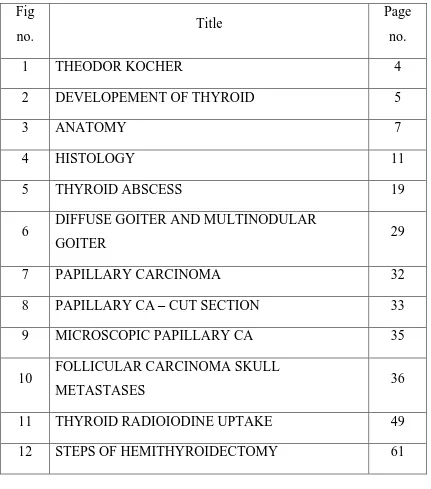
LIST OF COLOUR PICTURES
Fig
no. Title
Page
no.
1 THEODOR KOCHER 4
2 DEVELOPEMENT OF THYROID 5
3 ANATOMY 7
4 HISTOLOGY 11
5 THYROID ABSCESS 19
6 DIFFUSE GOITER AND MULTINODULAR
GOITER 29
7 PAPILLARY CARCINOMA 32
8 PAPILLARY CA – CUT SECTION 33
9 MICROSCOPIC PAPILLARY CA 35
10 FOLLICULAR CARCINOMA SKULL
METASTASES 36
11 THYROID RADIOIODINE UPTAKE 49
[image:11.595.102.533.113.602.2]1
INTRODUCTION
Goiter is defined as an enlargement of the thyroid gland. It may be
diffuse or nodular. It may be toxic and non toxic. Further more, goiters
are divided into endemic and sporadic depending on the prevalence of
goiter in that area. World wide, nodular goiter remains an important
health problem.
Benign thyroid swellings like nodular goiter and autoimmune
thyroiditis are the most common thyroid diseases in our country.
Although they are benign, they may harbour malignancy that requires
prompt and accurate diagnosis.
The thyroid malignancy remains the most common endocrine
malignancy and have very good prognosis except few. Occult
malignancies in thyroid swellings are increasingly reported nowadays
worldwide due to improved diagnostic modalities. According to the
literature incidental malignancies are more common in endemic areas.
In this part of Tamil Nadu, the soil has low iodine content and thyroid
diseases are more prevalent. Hence this is conducted here to study
incidence of malignancies in patients operated for presumably benign
2
AIM OF THE STUDY
Objectives of this study are:
1. To find out the incidence of thyroid malignancy in patients
undergoing surgeries for apparently benign thyroid diseases in
CMCH.
2. To study its distribution in age, sex, clinical presentation, and
histological types.
3. To find out the incidence of malignancy in patients with follicular
3
REVIEW OF LITERATURE
HISTORY
[3,4]The name „GOITER‟ was known since 2700 B.C, and was derived
from the latin word „GUTTER‟, meaning throat. In the 7th
century A.D,
„Paul of Aegina‟ was the first physician who reported goiter. Initially he
called it as bronchocele. In 1619 A.D, „Fabricus‟ identified the thyroid
gland and identified that the goiters arise from it. The name „Thyroid
gland‟ was derived from the greek word „thyreoeides‟ meaning shield
shaped, it was meant to refer thyroid cartilage initially. The name thyroid
was given by „Thomas Wharton‟ in 1656 A.D.
Most people believed that goiters were caused by a toxin, a
bacterium or a parasite in water. „Graves and Basedow‟ reported patients
with goiter and palpitations. In 1820s the burnt seaweed containing iodine
was found to treat goiters.
Hypothyroidism was first defined in London in 1870s and was
called „Myxedema‟. In 1895 „Baumann‟ found iodine in thyroid gland. In
1914 „Kundal and Osterberg‟ isolated and named „thyroxin‟. In early 20th
century it was found that small amount of iodine given to school girls in
4
The first documented thyroid surgery for goiter was done by
„Roger Frugardi‟ in 1170A.C, by seton suturing which had very high
morbidity and mortality. With the advent of general anaesthesia,
antiseptic techniques and hemostasis, in the latter half of 19th century,
thyroid surgery had its peak evolution in reducing morbidity and
mortality.
Emil Theodor Kocher(1841-1917), C.A. Theodar
Billroth(1829-1894), Charles Mayo(1866-1939),William Halsted(1852-1922) & George
Crile(1864-1943) in the western world contributed a lot for thyroid
surgeries. After that thyroid surgery had evolved little, till now.
Theodor Kocher was given Nobel prize in the field of medicine in
1909 for his works on the thyroid gland.
5
THYROID ANATOMY
EMBRYOLOGY[1,3,4]:
The thyroid gland develops from the midline diverticulum of
primitive foregut. It arises from the foramen caecum at the tongue base.
The midline diverticulum forms the medial thyroid anlage that is
connected to foramen caecum through thyroglossal duct. Thyroid follicles
arise from the cells of medial thyroid anlage. Lateral thyroid anlage arises
from the fourth branchial pouch and fuses with medial thyroid anlage.
The lateral anlage gives rise to para follicular cells. They are
neuroectodermal in origin. Thyroid gland development starts around third
week of intrauterine life and colloid synthesis starts around eleventh week
of gestation.
6 THYROID GLAND[1,3,4]:
Thyroid is a highly vascular gland having two symmetrical lateral lobes
united by an isthmus that is „H‟ or „U‟ shaped. It is situated in the anterior
aspect of lower neck and its extent is from C5 to T1 level. It weighs
around 25-30gms. It is covered by its own capsule and an envelope of
pretracheal fascia. The lobes on either side extend from the oblique line
of thyroid cartilage superioly, to 5th or 6th tracheal ring inferiorly. Isthmus
lies infront of the 2nd, 3rd and 4th tracheal rings.
The lateral lobes are approximately triangular in cross section,
having lateral, medial and posterior surfaces. The lateral surface lies deep
to the strap muscles. The medial surface is related to lateral aspect of
larynx, upper trachea, lower pharynx , upper esophagus, cricothyroid and
inferior constrictor muscles, recurrent and external laryngeal nerves. The
posterior surface lies over the medial part of carotid sheath. The posterior
surface of isthmus is firmly adherent to 2nd,3rd and 4th tracheal rings
through pretracheal fascia.
The pretracheal fascia merges with the thyroid capsule posteriorly
and laterally to form suspensory ligament of Berry. It is attached to the
cricoid cartilage and to the upper tracheal rings which is responsible for
up and down movement of thyroid gland during swallowing along with
7
RECURRENT LARYNGEAL NERVES[1,3,4]:
The right and left recurrent laryngeal nerves are branches of right and
left vagus nerves respectively. The left recurrent laryngeal nerve recurves
around the arch of aorta in the superior mediastinum and enters the
tracheo esophageal groove and usually passes posterior to inferior thyroid
artery, though variations may be present . The right nerve recurves
8
tracheoesophageal groove. They provide motor supply to all pharyngeal
muscles except cricothyroid and sensory supply to larynx and trachea.
EXTERNAL LARYNGEAL NERVES[1,3,4]:
The external laryngeal nerve is also a branch of vagus nerve arising at
the base of the skull, descends along internal carotid and lies closely
behind the superior thyroid artery, runs on the surface of inferior
constrictor muscle to supply cricothyroid.
PYRAMIDAL LOBE[1,3,4]:
A pyramidal lobe may be present in around 50% of patients,
projecting upwards from isthmus usually left to the midline. It develops
from the distal end of thyroglossal duct. It may be attached to inferior
border of the hyoid bone through fibromuscular tissue named „levator
glandulae thyroidae‟.
THE PARATHYROIDS[1,3,4]:
The parathyroid glands usually lie behind the posterior surface of lateral
lobes between thyroid and pretracheal fascia. They are usually four in
number and each weighs around 40-50mgs.The superior gland is more
constant in location, lies in middle of the back of the lobe at the level of
9
usually within the pretracheal fascia behind the lower pole, buts its
position may be highly variable.
BLOOD SUPPLY[1,3,4]:
The thyroid gland receives its blood supply from superior and inferior
thyroid arteries. Rarely in <3% „thyroidae ima‟ artery a direct branch of
aorta also produces little contribution.
Superior thyroid artery is the first branch of external carotid artery and
it pierces the pretracheal fascia as single vessel to reach upper pole of
lateral lobe. The artery divides into anterior and posterior branches. The
anterior branch runs down to isthmus to anastomose with its fellow artery
from opposite side and the posterior branch descends on posterior surface
to anastomose with inferior thyroid artery.
The inferior thyroid artery is a branch from thyrocervical trunk, that
arches upwards and medially behind the carotid sheath and then passes
downwards to the lower pole. It usually divides outside the pretracheal
fascia into branches and pierce pretracheal fascia to reach the lower part
of the gland. It supplies both superior and inferior parathyroid glands.
During surgery it should be ligated well away from the gland, due to
10
Venous drainage of the gland is through the superior , inferior and
middle thyroid veins. Superior thyroid veins runs laterally along with
superior thyroid arteries and drain into internal jugular vein directly.
Middle thyroid veins also drains directly into internal jugular vein they
are less consistent and sometimes may be multiple. During thyroid
surgeries they should be ligated first. Both inferior thyroid veins joins to
form a plexus and drains into brachiocephalic veins.
LYMPHATIC DRAINAGE:
Thyroid gland has rich lymphatic supply. Lymphatic channels are
present just beneath the thyroid capsule and they are highly
intercommunicating. They drain mainly to deep cervical nodes, pre and
para tracheal nodes, superior mediastinal nodes, nodes in relation to upper
3rd of esophagus.
NERVE SUPPLY[1,3,4]:
Thyroid gland receives its sympathetic supply from superior, middle and
inferior sympathetic ganglia. They reach the gland along with arteries.
They are vasomotor to the gland. Parasympathetic supply is from the
11 HISTOLOGY[1,2,3,4,7,8]:
Thyroid gland is divided into multiple lobules through multiple septae
entering into the gland from capsule. Each lobule has multiple follicles.
Each follicle has a single layer of cuboidal cells surrounding a cavity
containing thyroglobulin(colloid). Spaces in between follicles contain
extensive capillary and lymphatic channels. They also contain connective
tissues and parafollicular cells. During hyperfuntioning state, follicular
cells become more columnar with decreased colloid substance. While in
hypofunctioning state, follicular cells become more flat and follicles will
12
PHYSIOLOGY OF THE THYROID
[3,4,5,6]Thyroid gland is an endocrine gland that secretes the hormone
tri-iodothyronine(T3), tetra-iodothyronine(T4) and reverse
tri-iodothyronine(rT3). T3&T4 are metabolically active, rT3is metabolically
inactive. Thyroid hormones are synthesized in thyroid follicles.
PITUITARY THYROID AXIS:
Thyroid stimulating hormone (TSH), secreted by anterior pituitary is
the main regulating factor in thyroid hormone synthesis. Thyrotropin, a
hormone secreted from the hypothalamus stimulates TSH synthesis and
increased levels of circulating thyroid hormones (mainly T3) inhibits
TSH secretion from anterior pituitary. Increased T3 has negative
feedback effect both in hypothalamus and pituitary.
TSH acts on TSH-receptor (TSH-R) situated in the basolateral surface
of thyroid follicular cells. It stimulates the follicular cells to increase the
synthesis of thyroglobulin and thyroid hormones. It also promotes
growth and differentiation of follicular cells.
IODINE METABOLISM IN THYROID:
Iodine is essential for thyroid hormones synthesis. Iodine is absorbed in
the proximal small intestine in iodide form. Iodide is transported into the
13
symporter situated in the basolateral surface of follicular cells. About
90% of iodine in the body is in the thyroid gland. Iodide is oxidised to
iodine and transported to exocytic vesicles to form iodotyrosyl residues
and stored along with thyroglobulin as colloid in the cavity.
SYNTHESIS AND TRANSPORT OF THYROID HORMONES:
Thyroglobulin(Tg) is a large glycoprotein, containing multiple tyrosine
residues. Oxidised iodine bind to tyrosine residues in Tg to form
monoiodotyrosine(MIT) and diiodotyrosine(DIT), catalysed by thyroid
peroxidase enzyme situated in apical surface of the follicular cells.
Coupling of MIT & DIT gives rise to T3. Coupling of DIT&DIT gives
rise to T4. Both T3 and T4 are bound to Tg and stored in the colloid.
When need arises Tg is taken back into the follicular cells by endocytosis.
Proteolysis occurs in lysosomes to release thyroid hormones. They
diffuse along the basolateral surface to enter the circulation. Rest of the
Tg is secreted again into the follicular cavity.
Thyroid gland produces predominantly T4 and less amount of T3.
Majority of T3 is produced by peripheral deiodination of T4 that occurs
in the liver, muscles, brain, kidneys. T3 is the most active thyroid
hormone. >99% of thyroid hormones are protein bound, mainly
thyroxine-binding globulin. Only free(unbound) thyroid hormones are
14
days. Thyroid gland can store the reserve of thyroid hormones for 10-14
days.
THYROID HORMONE-FUNCTIONS:
Thyroid hormones are necessary to maintain normal metabolic
activities. They are mandatory for fetal brain development and skeletal
maturation. They sensitise the heart to adrenaline, increase the BMR,
regulates respiratory drive. They increase GI motility, plays vital role in
15
EPIDEMIOLOGY
The most common thyroid disease in the community is simple
goiter.The most common cause of thyroid diseases in the world is iodine
deficiency that leads to goiter formation and hypothyroidism. In iodine
sufficient areas, thyroid diseases are mainly caused by autoimmune
diseases,that leads to hypo/hyperthyroidism.
A region is said to be endemic for goiter, if the prevelance of goiter is
more than 10% among the children aged 6 to 12 years in that region. If
the prevalence is less than 10% it is termed sporadic goiter.
In western countries the incidence of goiter has come down
following measures like fortification of salt, fortification of fertilizers etc.
Yet in certain parts of asia, Africa, Europe there is higher prevalence of
goiter.
In India there is a goiter belt along the northern border extending
from Jammu and Kashmir eastward along the southern valleys and
foothills of Himalayas into Assam. Endemic goiter is also prevalent in
Southern India. Coorg in Karnataka, north Arcot, foothills of Nilgris and
16
Recent studies shows high frequency of thyroid disorders being
detected in diabetes mellitus patients. High prevalence of hypothyroidism
is seen in patients with Down‟s and Turner‟s syndrome.
Thyroid carcinoma contributes less than 2% of all malignancies and is
also the most commonly seen endocrine malignancy(around 90%).
Incidental carcinomas in thyroid are more common in endemic areas.
17
PATHOLOGICAL
CLASSIFICATION
OF
THROID DISEASES
[7,8]1.THYROIDITIS
A. Acute thyroiditis
B. Granulomatous (De Quervain‟s) thyroiditis
C. Other granulomatous inflammations
D. Auto immune thyroiditis
- Hashimoto‟s thyroiditis
- Lymphocytic thyroiditis
E. Reidel‟s thyroiditis
2.HYPERPLASIA
A. Dyshormonogenic goiter
B. Grave‟s disease(Diffuse toxic goiter)
C. Nodular hyperplasia
3.TUMOURS
A. Epithelial tumours
- Follicular adenoma
- Papillary carcinoma
18
- Hurthle cell tumours
- Clear cell tumours
- Squamous cell, mucinous and related tumours
- Poorly differentiated carcinoma
- Undifferentiated carcinoma
B. Medullary carcinoma and related neuroendocrine tumours
C. Lymphoid tumours and tumour like conditions
D. Mesenchymal tumours
E. Other primary tumours and tumour like conditions
F. Metastatic tumours
19
BENIGN DISEASES OF THYROID
[3,4,6,7,8]ACUTE THYROIDITIS:
Acute thyroiditis occurs due to infectious etiology of the thyroid,
commonly following bacterial infection rarely fungi, parasites and virus
may be the cause. Most common organisms isolated are streptococcus
hemolyticus and staphyloccus aureus. Sometimes pneumococcus, gram
negative bacteria, rarely candida, pneumocystis and cytomegalovirus may
be the cause. Spread of infection occurs via haematogenous, by lymphatic
route, penetrating injury to the neck and by pyriform sinus fistula. It
occurs following URI, septicaemia, in immune compromised patients and
debilitated individuals. Recurrent cases of acute suppurative thyroiditis
occur mainly due to persistent pyriform sinus fistula.
Patients usually present with neck pain radiating to jaw, fever,
chills, odynophagia and dysphonia. Infections will cause neutrophilic
infiltration and tissue necrosis, sometimes evolve into abscess. Diagnosis A patient with acute
20
is made by FNAC. Treatment is usually medical, includes IV antibiotics,
analgesics and symptomatic management. Thyroid abscess requires
drainage, pyriform sinus fistula best treated by fistulectomy.
GRANULOMATOUS THYROIDITIS:
It is also known as De Quervains thyroiditis and sub acute
thyroiditis. It usually occurs in middle aged women following upper
respiratory tract viral infection. It has been suggested that the post viral
inflammatory response is the cause for this condition. It is strongly
associated with HLA B 35 haplotype.
Patients usually present with sudden or gradual onset of neck pain
radiating to mandible and ear. The gland is enlarged, firm and tender. In
contrast to Riedel‟s thyroiditis there will not be adherence to adjacent
structures. Most of the patients initially have hyperthyroid phase, then
hypothyroid phase and finally euthyroid phase. Microscopically, areas of
inflammation with non-caseating granulomas, containing foreign body
giant cells that characteristically surround the follicles are seen. ESR will
be more than 100mm/hr.
Medical treatment with NSAIDs and in severe cases steroids will
be sufficient. Thyroidectomy is rarely indicated and is restricted to
21
SUBACUTE PAINLESS THYROIDITIS:
It occurs between 30-60 years of age, either sporadically or in post
partum period. It is thought to be an auto immune disease. Patients have
normal or mildly enlarged, firm, non tender thyroid gland. Patients have
normal ESR in contrast to painful thyroiditis. Patients are usually
symptomatically managed with thyroxine or beta blocker. Thyroidectomy
is rarely indicated, only in patients with recurrent and disabling episodes.
OTHER GRANULOMATOUS INFLAMMATIONS:
Palpation thyroiditis(Multifocal Granulomatous Folliculitis):
It is a common incidental finding noted during histopathological
examination. It is thought to be caused by minor trauma to the gland or
vigorous palpation on physical examination. It is clinically insignificant
and grossly inconspicuous thyroid process. Microscopically, collections
of histiocytes, lymphocytes and multinucleated giant cells are noted in the
lumen of thyroid follicles.
TUBERCULOSIS:
It rarely occurs as a primary clinical manifestation within the
thyroid. It commonly occurs in disseminated miliary tuberculosis to form
a tubercle within the gland. Sometimes, tuberculosis of cervical
22
usually present with painless enlargement of thyroid. Diagnosis is
confirmed by HPE.
SARCOIDOSIS:
It can involve thyroid gland to form multiple interstitial
non-caseating granulomas. Usually it occurs in patients with systemic disease.
Diagnosis is confirmed by HPE.
MYCOSIS:
It is a very rare condition occurring in immuno-compromised
patients with disseminated fungal infections. Most common organism
causing this condition is Aspergillus. Histoplasma, Candida, Nocardia
can also cause mycosis of thyroid. Microscopically, it is characterised by
acute inflammation and necrosis and sometimes abscess formation.
HASHIMOTO’S THYROIDITIS:
It is the common cause of hypothyroidism in non iodine deficient
areas and the most common inflammatory disorder that affects thyroid
gland. It commonly affects females (F:M-15:1), occurs in the 4th and 5th
decade. It was initially described by Hashimoto in 1912 as “STRUMA
LYMPHOMATOSA” – transformation of thyroid tissue into lymphoid
tissue. It is an auto-immune disease due to the production of antibodies
23
NaI symporter(20-25%). Follicular epithelial cell damage is mediated by
both humoral and cell mediated immunity. It is also has been associated
with increased intake of iodine and long term intake of drugs such as
amiodarone, lithium and interferon alpha. It has been suggested that
genetic predisposition also plays a role.
Clinically, the gland is diffusely enlarged, painless and firm.
Sometimes patients may present with multinodularity, pressure
symptoms, hypothyroidism and occasionally hyperthyroidism(<5%).
Initially there may be hyperthyroid features but ultimately all the patients
land up with hypothyroidism.
Microscopically it is characterised by atrophied thyroid follicles,
lymphocytic infiltration of the stroma and extensive oncocytic change of
follicular cells. Fibrous variant of Hashimoto‟s thyroiditis is usually
confused with carcinoma and Riedel‟s thyroiditis, characterised by very
firm goiter, severe pressure symptoms and physical signs suggestive of
cancer. Hashimoto‟s thyroiditis, along with lymphocytic infiltration of
adrenal gland and other organ is known as „Schmidt‟s syndrome‟.
Elevated TSH and the presence of antithyroid antibodies confirms
the diagnosis. FNAC is done in patients with nodularity and rapidly
enlarging goitre. Treatment includes Thyroxine in hypothyroid patients
24
occasionally needed for patients with pressure symptoms, cosmetic
deformity and suspicion of malignancy.
Complications include high risk of developing Lymphoma(around
80 fold) , Leukemia, Papillary Carcinoma, Hurthle cell neoplasms.
LYMPHOCYTIC THYROIDITIS:
Lymphocytic thyroiditis and Hashimoto‟s thyroiditis represent
different phases of an organ specific autoimmune disorder, characterised
by production of auto antibodies that affect thyroid function.
Lymphocytic thyroiditis has been more commonly diagnosed in children.
Diagnosis is made through FNAC. Usually patients present with
asymptomatic goiter of short duration. Thyroid gland is diffusely
enlarged, firm with vague nodularity. Microscopically, lymphocytic
nodules with germinal centers are seen scattered in the interstitium.
Clinical course mimics Hashimoto‟s thyroiditis. Surgery may be
indicated in patients with pressure symptoms, rapidly enlarging goiter and
suspicion of malignancy.
REIDEL’S THYROIDITIS:
It is an extremely rare form of thyroiditis that typically affects
elderly females. It is also known as Invasive thyroiditis, Fibrous
25
associated with some auto immune diseases and may represent a
manifestation of the group of idiopathic disorders known as
„Inflammatory Fibrosclerosis‟ , that is associated with mediastinal, retro
peritoneal and retro-orbital fibrosis and sclerosing cholangitis.
It may affect part or whole of a thyroid gland. When the whole
gland is involved, patient may be hypothyroid. Patients usually presents
with hard irregular, painless mass in the neck with respiratory difficulty,
swallowing difficulty and voice change. Clinically, the mass will be very
hard and fixed to the adjacent tissues. Diagnosis is confirmed by open
biopsy that shows extensive fibrosis of the affected gland that extends
beyond the capsule to the adjacent soft tissue.
Some patients may show response to corticosteroids and
tamoxifene. Most patients need surgery to decompress trachea by wedge
resection of the gland and to rule out the presence of malignancy.
Complete thryoidectomy is very difficult to achieve due to the
obliteration of tissue planes by fibrous infiltration.
GRAVE’S DISEASE:
It was first described by Robert Grave in 1835. He initially
described long and continuous palpitations in three young females and
26
characterised by a triad of Diffusely enlarged thyroid gland,
Hyperthyroidism and Ophthalmopathy. It is an autoimmune disease and
has strong familial predilection. Female to male ratio is 5:1. Common age
group is between 30-60years. Postpartum state, iodine excess, lithium
therapy, bacterial and viral infections are suggested as possible
stimulating factors for autoimmunity. Grave‟s disease may also be
associated with autoimmune diseases like Type 1 DM, Myasthenia
Gravis, Addison disease, Pernicious anemia.
Autoimmunity cause production of Thyroid Stimulating
Immunoglobulins(TSI) that binds to TSH receptor and produce long
standing continuous stimulus to thyroid follicle cells causing increased
rate of growth and excess synthesis of thyroid hormones. Clinically,
patients will have heat intolerance, loss of weight inspite of good
appetite, increased thirst and sweating, palpitations, diarrhoea, decreased
sleep, tremors, amenorrhoea etc. Long standing cases may develop atrial
fibrillation and high output cardiac failures.
Patients will have smooth, diffusely enlarged, non tender gland with
increased blood supply evidenced by bruit, moist and warm skin.
Widening of pulse pressure occurs due to cutaneous vasodilation. Fine
tremors, proximal muscle weakness, muscle wasting and hyperactive
27
Grave‟s disease will have eye signs including lid lag, widened palpebral
fissure, proptosis, ophthalmoplegia etc. Less than 2% of patients will
have thyroid dermopathy.
Serum T3, T4 levels will be elevated, while TSH levels will be
decreased. Elevated TSH-R Ab is diagnostic. 123 iodine uptake scan
shows diffuse uniform uptake. Microscopically, the gland is hyperplastic
containing tall columnar epithelial cells with scanty pale staining colloid
and increased vascularity. Lymphocytic infiltration and aggregation may
be present. Treatment includes antithyroid drugs, radioactive iodine
ablation and thyroidectomy. Choice of treatment depends on several
factors and individual preferences.
DIFFUSE GOITER:
The enlargement of thyroid is called as goiter. It may be toxic or
non toxic and can be endemic and sporadic. Diffuse goiter and MNG are
most often caused by impaired thyroid hormone synthesis, due to iodine
deficiency. The compensatory rise in TSH will cause hypertrophy and
hyperplasia of follicular epithelial cells and enlargement of thyroid.
Endemic goiter can also be caused by ingestion of goiterogens
(excessive calcium, cabbage, cauliflower, cassava and turnips). Sporadic
28
young life and goiterogens, hereditary enzyme deficiencies may be the
cause.
Clinically the gland is diffusely enlarged, soft in consistency.
Patients usually will be in euthyroid state. Microscopically follicles lined
with hyperplastic, tall columnar epithelium - „Parenchymatous goiter‟. If
iodine is available in adequate quantity or the demand of thyroid hormone
synthesis decreases the follicular epithelium involutes and form colloid
rich follicles-„colloid goiter‟. The cut surface of the gland appears glassy
and translucent. The follicular epithelium is flattened and cuboidal with
abundant colloid.
NODULAR GOITER:
Due to repeated episodes of hyperplasia and involution in untreated
colloid goiter, irregular enlargement of gland occurs and is called as
multinodular goiter. Usually MNG occurs in older individuals than
colloid goiter. It occurs due to variations among follicular cells in
response to various external stimuli. Both polyclonal and monoclonal
nodules can coexist within the same MNG. Some longstanding MNG will
develop into autonomous nodules that secrete thyroxine without TSH
29
Patients usually present with asymmetrically enlarged thyroid
gland with pressure symptoms, often in euthyroid state. Sometimes they
may grow behind the sternum – „Intrathoracic or Plunging goiter‟.
Minority of patients may present with toxic symptoms. Sudden
enlargement of the thyroid nodules happen sometimes due to
haemorrhage. TFT will be normal. RAI scan shows patchy uptake with
areas of hot and cold nodules. Incidence of malignancy in MNG is
5-10%. Treatment involves suppression of TSH with thyroxine,
thyroidectomy and radio iodine ablation.
FOLLICULAR ADENOMA:
Follicular adenomas of the thyroid are discrete, solitary masses
resulting from clonal expansion of follicular cells due to gain of function
(growth advantage) in TSH signalling system. For significant proportions
of adenomas, etiology could not be identified. Clinically follicular
30
thyroid enlargement. Most of them present as unilateral, asymptomatic,
solitary nodular swelling. Majority of them are non functional. Few
adenomas may produce thyroid hormones independent of TSH
stimulation and are termed as toxic adenomas – „Plummer‟s disease‟.
Microscopically they have increased number of uniform appearing
follicles, that contain colloid. The entire lesion is covered by well defined
capsule with compression of adjacent thyroid tissue. FNAC cannot
distinguish between follicular adenoma and carcinoma. Variants of
follicular adenoma include colloid adenoma, atypical follicular adenoma,
hurthle cell adenoma. Most of the adenomas take up less Radio active
Iodine than normal thyroid parenchyma. About 10% of cold nodules
eventually prove to be malignant on histologic analysis. Treatment
31
THYROID MALIGNANCIES
[3,4,5,6,7,8]They account for less than 2% of all cancers. Most of the thyroid
cancers occur in adults, but papillary carcinoma may occur at young age.
Female sex is most frequently affected, particularly in early and middle
adult age group. This may be related to neoplastic thyroid epithelium
expressing oestrogen receptors. Carcinomas in childhood and late adult
life have equal sex distribution. Even though most of the thyroid
malignancies arise from thyroid follicular epithelium, each variant has
different clinical and biological features.
There are various factors including genetic and environmental
factors implicated in the pathogenesis of thyroid malignancies. Genetic
factors play a main role in pathogenesis of Medullary thyroid
cancer(MTC). Familial papillary and follicular carcinomas are very rare.
Various gene mutations are involved in the histologic variants of thyroid
malignancies.
a. Follicular Carcinoma – Mutation in RAS family oncogenes and
PAX 8-PPAR fusion gene.
b. Papillary Carcinoma – Rearrangement of RET or NTRK1,
mutations in BRAF oncogenes, RAS mutation.
32
d. Anaplastic Carcinoma – Point mutation in p53.
Ionising radiation is a major predisposing factor for developing
thyroid cancer especially when exposure occurs younger than 20 years.
Upto 9% of people exposed to radiation in head and neck will develop
thyroid malignancies after many decades of exposure.
Longstanding MNG has also been implicated as a risk factor in
developing malignancy. Iodine deficient areas have higher prevalence of
follicular carcinoma. Most of the thyroid lymphomas arise from the pre
existing Hashimoto‟s thyroiditis.
PAPILLARY CARCINOMA:
It accounts for 75-80% of all thyroid malignancies in iodine
sufficient areas. It is the most common thyroid malignancy that occurs in
adults with history of childhood radiation and in children. Female to male
ratio is 2:1. Common age of presentation is 30-40 years.
33
Most patients present with painless, enlarged hard mass in the
thyroid region. They are usually euthyroid. Sometimes the initial
presentation may be an enlarged neck node – “Lateral aberrant thyroid”.
Dyspnoea, dysphagia and change in voice usually develop in locally
infiltrative disease. Most common mode of spread is lymphatic spread.
Hematogenous spread occurs in very few persons. Distant metastasis is
seen in 20% of patients and common sites include lungs, bone, liver and
brain.
FNAC is diagnostic. USG neck is mandatory to rule out the presence
of neck nodes. On cut section, grossly the tumour may contain areas of
calcification, necrosis and cystic change. Microscopically, the tumour
may contain papillary projections. Cells are cuboidal and containing pale
abundant cytoplasm with intranuclear grooves. The nuclei contain finely
dispersed chromatin, which produces optically clear or empty
appearance-„ORPHAN ANNIE EYED NUCLEI‟.
34
Diagnosis of papillary cancer is mainly based on these nuclear
features. Microscopic calcified deposits-„PSAMMOMA BODIES‟ may
also be present. Multifocal lesions are identified upto 85% of specimens
undergoing microscopic examination.
Variants of papillary carcinoma include encapsulated, tall cell,
clear cell, follicular, insular, hyalinising trabecular and diffuse sclerosing
type. They represent less than 1% of all papillary carcinoma and carry
poor prognosis.
Patients with papillary carcinoma generally have excellent
prognosis with ten year survival rate more than 95%. There are several
scoring systems that include various factors as prognostic indicators. But
the limitation is that the scoring system depends also on post operative
HPE findings. Some of the scoring systems are
a. AGES
b. MACIS
c. AMES
d. Simplified system of De Groot and associates.
e. TNM
Of these, the widely followed one is the TNM staging system. In
35
metastasis, poorly differentiated tumour are associated with poor
prognosis. Treatment of choice is total or near-total thyroidectomy with
functional or modified neck dissection followed by radio active iodine
ablation for ablating micrometastasis.
PAPILLARY MICRO CARCINOMA:
They are defined as papillary carcinoma less than 1 cm in size with
no capsular or blood vessel invasion and without lymphnode metastasis.
Clinically they are undetectable. They are usually detected by HPE
following thyroidectomy for benign conditions. Their incidence following
surgery is varying from 4-14% in studies conducted in various parts of
the world. Studies from autopsies have shown the incidence of occult
papillary carcinoma ranging from 2-36%.
36
Generally occult papillary carcinoma is associated with very good
prognosis. When occult papillary thyroid carcinoma diagnosed following
lobectomy or isthumectomy for some benign conditions, completion
thyroidectomy is not mandatory, unless the tumour has evidence of
angioinvasion, multifocality, positive margins or high grade tumour.
FOLLICULAR CARCINOMA:
Follicular carcinoma constitutes 10-15% of all thyroid
malignancies. Their prevalence is more in iodine deficient areas than in
iodine sufficient areas. Female to male ratio is 3:1. Mean age of
presentation is around 50 years. They usually present as slow growing
painless solitary nodule. Patients are generally euthyroid. Occasionally
they may present in patients with longstanding goiter. Less than 1% of
follicular carcinoma may present with features of thyrotoxicosis due to
hyperfunctioning malignancies. Principal route of metastasis is
haematogenous. Lymphatic metastasis is rare.
37
FNAC cannot differentiate between follicular adenoma and follicular
carcinoma. Pre operative clinical diagnosis of malignancy is suspected in
patients with large lesions(greater than 4cms) in older men. DNA micro
array test having being developed for differentiating benign and
malignant follicular thyroid tumours. The specific micro RNAs, miR-197
and miR-364 are upregulated in follicular carcinoma[3].
Microscopically follicular carcinomas are single lesions and most
of them are surrounded by a capsule. Malignancy is identified by the
presence of capsular and vascular invasion, mainly involves large vessels.
Tumour thrombus may be present in jugular and middle thyroid veins.
Patients with FNAC diagnosis of follicular neoplasm should undergo
lobectomy since atleast 80% of patients have benign adenomas.
Completion thyroidectomy should be performed in patients diagnosed as
follicular carcinoma following lobectomy, so that radioactive ablation can
be used to ablate metastasis.
The cumulative mortality rate for follicular carcinoma is around
15% in 10 years and 30% in 20years. Poor prognostic factors include age
more than 50years, size more than 4cms, marked vascular and
extrathyroidal invasion, high grade tumour and distant metastasis at the
38
MINIMALLY INVASIVE FOLLICULAR CARCINOMA:
Minimally invasive follicular carcinoma is less aggressive than
widely invasive follicular carcinoma. It contains encapsulated lesions and
have microscopic invasion through the capsule without extension into the
normal glandular parenchyma . It may show invasion into small and
medium sized vessels in the capsule or immediately outside the capsule,
but not within the tumour. The role of completion thyroidectomy in
minimally invasive follicular carcinoma is controversial. Larger the size,
higher the grade. Older the age, one can proceed with completion
thyroidectomy.
HURTHLE CELL CARCINOMA:
Even though it is a variant of follicular carcinoma, it differs from
follicular carcinoma in many ways. They are often multifocal and
bilateral, more likely to metastasize through lymphatics to local nodes.
They are less amenable to radioactive ablation. They account less than
3% of all thyroid malignancies.
Hurthle cell carcinoma is also characterised by vascular and
capsular invasion. Hence FNAC is not diagnostic. Microscopically, it is
characterised by sheets of eosinophilic cells with abundant mitochondria
39
isthumectomy is adequate for hurthle cell adenoma. If it is confirmed as
carcinoma by HPE, completion thyroidectomy along with central
compartment node dissection is routinely performed. If needed MRND
should be performed. Radioactive iodine ablation is not very effective in
treating this tumour.
MEDULLARY CARCINOMA THYROID:
It arises from the parafollicular cells or „C‟ cells of the thyroid,
that are concentrated in the superolateral portions of the thyroid lobes and
secrete calcitonin. MTC accounts for 5-10% of all thyroid malignancies.
Most of the MTC occurs sporadically. Around 25% of MTC occur as
inhertited syndromes that include Familial Medullary Thyroid
Carcinoma, MEN 2A and MEN 2B. Female to male ratio is 1.5:1. Most
common age of presentation is 50-60 years.
Familial cases present in children and in younger age group.
Patients usually present with enlarged neck mass with mild pain. There
may be associated cervical lymphadenopathy. Locally invasive disease
may produce dyspnoea, dysphagia and dysphonia. In addition to
Calcitonin MTC secretes CEA, prostaglandins, serotonin and rarely
ACTH. Patients with extensive metastatic disease may present with
40
MTC is usually unilateral in presentation in sporadic cases. In
familial cases, it involves both lobes with features of multifocality.
Microscopically, the tumour is composed of sheets of infiltrating
neoplastic cells separated by collagen and amyloid.
Immunohistochemistry for calcitonin is used as diagnostic tumour
marker. All patients diagnosed as MTC should undergo screening for
RET point mutations, pheochromocytoma and hyperparathyroidism.
In patients with pheochromocytoma and MTC, pheochromocytoma
should be operated first. Total thyroidectomy and bilateral central
compartment neck dissection is the treatment of choice for tumours less
than 1cm confined to thyroid and without cervical node involvement.
Tumors greater than 1cm, palpable neck nodes should undergo MRND.
Chemotherapy and radioactive iodine ablation are not effective. External
beam radiotherapy is reserved for unresectable residual and recurrent
tumours. Annual measurements of calcitonin and CEA are done for
routine follow up.
Stage is an important prognostic factor. Patients with tumour
confined to thyroid will have 80% ten year survival rate whereas patients
with node involvement has 45% ten year survival rate. Best prognosis is
in patients with non-MEN familial MTC and worst prognosis is for MEN
41 ANAPLASTIC CARCINOMA:
This is an undifferentiated cancer arising from the thyroid
epithelium. It is the most aggressive thyroid malignancy with 100%
mortality within 6months to 1year of diagnosis. Females are most
commonly affected. The common age group is 60-80 years. Patients
usually present with rapid enlargement of a long standing goiter. It may
be fixed to adjacent structures or overlying skin may be ulcerated.
Compressive symptoms such as dyspnoea, dysphagia, hoarseness of voice
are common. Both lymphatic and haematogenous metastasis can occur
and they are usually present at the time of diagnosis.
It has been documented that around 50% of anaplastic carcinomas
arise from the long standing MNG and 25% of patients with this tumour
have a history of differentiated thyroid cancer(mostly papillary). 20-30%
of patients have synchronous differentiated thyroid cancers.
FNAC is diagnostic. Sometimes incision biopsy may be needed to
confirm the diagnosis. Microscopically, sheets of cells with marked
heterogeneity are seen. Cells may be giant and multi nucleated, spindle
shaped, polygonal, small cells. There is no satisfactory treatment regime
for patients with anaplastic cancer. Sometimes isthumectomy and
42
patients who are undergoing thyroidectomy for resectable mass may have
improved survival. Adjuvant chemotherapy and combined radiation may
also provide some survival advantage in these patients.
LYMPHOMA:
Lymphomas constitute less than 1% of all thyroid malignancies.
They usually arise from the patients with pre existing chronic
lymphocytic thyroiditis and may arise as a part of generalised
lymphomas. Patients usually have symptoms similar to anaplastic cancer,
but the rapid enlargement of neck mass will not produce pain. Some
patients may present with acute respiratory distress. Core needle biopsy
or open biopsy is needed for the definitive diagnosis. Patients with extra
thyroidal disease wil have poor prognosis.
Thyroid lymphoma usually respond well to combined
chemotherapy and radiotherapy. Cyclophosphamide, Adriamycin,
Vincristine, Prednisolone is the commonly used regimen. Patients with
respiratory obstruction who do not rapidly get relieved by chemo and
radiotherapy needs surgical resection of the enlarged thyroid and
lymphnodes to relieve the obstruction. The overall five year survival rate
43 SQUAMOUS CELL CARCINOMA:
Pure squamous cell carcinomas are exceptional in thyroid.
Squamous cells may be found in thyroid as a result of persistent
thyroglossal duct and structures derived from the pharyngeal pouch.
Expression of squamous metaplasia may occur in Hashimoto‟s thyroiditis
and papillary cancer. Tall cell variant of papillary carcinoma has a
tendency to evolve into spindle cell type of squamous cell carcinoma. In
the presence of pure squamous cell carcinoma, the possibility of
secondary extension from the tumors of larynx, trachea or metastasis
from other sites should be considered.
METASTATIC TUMOURS:
Majority of metastatic tumours in thyroid are squamous cell
carcinomas. In 10% of patients dying of malignant tumours, blood borne
metastasis to thyroid is noted during autopsy. The most common site of
primary tumour is skin(melanoma-31%), followed by breast, kidney,lung.
Most commonly they are solitary lesions. Metastasis to thyroid is usually
not misunderstood as primary thyroid tumour except in metastasis from
renal cell carcinoma where it can present even decades after removal of
primary tumour. Metastatic neuroendocrine tumour of various types can
44 TERATOMA:
Teratomas of thyroid usually occur infants and children. Most of them
are benign and cystic. They can cause obstruction of the airway. Thyroid
teratomas in adult are very rare and are mostly malignant.
OTHER MALIGNANCIES:
Plasmocytoma, Langerhan cell histiocytosis, Rosai-Dorfmann
disease(sinus histiocytosis with massive lymphadenopathy) may involve
thyroid as a part of systemic disease. Benign mesenchymal tumours like
lipoma, hemangioma, lymphangioma, schwannoma, solitary fibrous
tumour have also been reported. Sarcomas like fibrosarcoma,
liposarcoma, leimyosarcoma, chondrosarcoma, osteosarcoma, peripheral
nerve sheath tumour are also reported.
45
EVALUATION OF THYROID GLAND
THYROID FUNCTION TESTS[3,4,5,6,]:
SERUM TSH:
Measuring the level of serum TSH is the most important
determinant of thyroid function. Normal TSH value is around
0.5-5μU/ml. It is usually measured through immunometric assay. Clinically
euthyroid patient having normal TSH indicates a normally functioning
thyroid gland. There is inverse relation between the levels of free T4 &
TSH in serum. A high TSH level indicates that the thyroid gland is
hypofunctional, because of a problem that is directly affecting the thyroid
(primary hypothyroidism). If the TSH level is low, it indicates that the
person is having an overactive thyroid that is producing too much thyroid
hormone (hyperthyroidism). Sometimes a low TSH may result from the
reduced function of pituitary gland (secondary hypothyroidism).
SERUM T4:
Thyroxine presents in blood in two forms,
1) protein bound form
2) free T4 – the biologically active form
It can be measured as total T4 & free T4 by radioimmunoassay. Total T4
46
conditions. It can also be raised in euthyroid patients with pregnancy,
OCP use, hormone therapy, tamoxifen due to elevated levels of thyroid
binding globulin (TBG). Similarly total T4 levels can be decreased,
where TBG binding is reduced in conditions like nephrotic syndrome,
androgen excess. Hence the measure of free T4 fraction is preferable than
total T4, and tests to measure this are called the Free T4 (FT4) and the
Free T4 Index (FT4I or FTI). It can be measured directly through
radioimmunoassay or indirectly through T3 resin uptake study.
Individuals with hyperthyroidism will have an elevated FT4 or FTI,
whereas patients who have hypothyroidism will have a low level of FT4
or FTI. Combining the TSH test with the FT4 or FTI accurately
determines the function of thyroid gland.
The finding of an elevated TSH and low FT4 or FTI indicates
primary hypothyroidism due to disease in the thyroid gland. A low TSH
and low FT4 or FTI indicates hypothyroidism due to a problem involving
the pituitary gland. A low TSH with an elevated FT4 or FTI is found in
47 SERUM T3:
Serum T3 is also present in both, protein bound and free form. They
can be measured through radioimmunoassay. Serum T3 levels in normal
thyroid conditions are more indicative of peripheral metabolism of
thyroid hormone. Hence it is not suitable for general screening test. Free
T3 tests are useful to diagnosis early hyperthyroidism or to determine the
severity of the hyperthyroidism and to find out whether the patient is
having T3 thyrotoxicosis. Patients who are hyperthyroid will have an
elevated T3 level. T3 testing rarely is helpful in the hypothyroid patient,
since it is the last test to become abnormal. Patients can be severely
hypothyroid with a high TSH and low FT4 or FTI, but they have a normal
T3 level.
HORMONES NORMAL RANGE UNITS
TSH 0.5 - 5.0 μU/ml
Total T4 55 – 150 nmol/L
Total T3 1.5 - 3.5 nmol/L
Free T4 12 – 28 pmol/L
48 TRH EVALUATION:
This is used to evaluate TSH secretory function of anterior pituitary.
TRH is administered intravenously(500μg) and TSH levels measured
after 30 and 60 minutes. In a normal person, TSH level should be
elevated at least 6μIU/ml from baseline. Failure to raise indicates
pituitary cause of hypothyroidism (secondary).
THYROID ANTIBODIES:
Thyroid antibodies do not reveal thyroid function, but may indicate
underlying etiology for thyroid dysfunction, usually autoimmune thyroid
diseases. Thyroid antibodies include Anti-Tg, Anti- TPO and Thyroid
stimulating immunoglobulin(TSI) . More than 95% of patients with
autoimmune hypothyroidism and 80% of patients with Grave‟s disease
will have Anti-TPO at high levels. TSI stimulate TSH receptor in Grave‟s
disease. Its main use is to predict neonatal thyrotoxicosis due to high
maternal levels of serum TSI in last trimester of pregnancy.
SERUM Tg LEVELS:
Serum Tg levels are increased in all types of thyrotoxicosis except
Factitious thyrotoxicosis. Tg levels are increased in thyroiditis. The main
use of measuring Tg is in the follow-up of thyroid cancer patients who
49
detectable in follow-up and if there is measurable level of serum Tg, it
indicates incomplete ablation or recurrence.
SERUM CALCITONIN:
It is secreted by parafollicular or C cells of thyroid. Its normal level is
0-4pg/mL. It is a sensitive marker for Medullary Carcinoma of
thyroid(MTC).
THYROID IMAGING
[3,4,5,6]:
RADIONUCLIDE SCANNING:
Radioisotopes I-123, I-125, I-131, 99mTc pertechnetate and
18-fluorodeoxyglucose are used in radionuclide scanning of thyroid. These
are selectively transported into the thyroid gland allowing imaging and
quantifying the uptake.
Thyroid radioiodine uptake scan- 123I
50
I-123 has half life of 12-13 hours and emits low dose radiation.
Hence it is used to image the lingual thyroid and goitres. Whereas I-131
has longer half life, around 8-10 days, and it is used to treat the patients
having differentiated thyroid cancers with metastatic disease. 99mTc also
having shorter half life, used for evaluation of thyroid gland. It is very
sensitive in detecting nodal metastases. 18FDG-PET is more sensitive in
detecting the metastases in thyroid carcinoma. It is particularly more
effective in patients, in whom other types of radioimaging studies are
negative.
In nuclear imaging, findings observed are as below,
1. Grave‟s disease – increased, homogenous tracer uptake with
enlarged gland
2. Toxic adenoma – focal area of increased tracer uptake, with
reduced uptake in rest of the gland.
3. Toxic MNG - enlarged gland, with distorted architecture, with
multiple areas of relatively increased or decreased tracer uptake.
4. Sub acute thyroiditis – very low tracer uptake.
5. Thyrotoxicosis factitia – very low tracer uptake.
Thyroid radio nuclide imaging also used in follow-up of patients
operated and radioablated for thyroid carcinoma. I-131 radioisotope is
51 THYROID ULTRASOUND:
Ultrasound is a non invasive, easily accessible imaging modality.
High-resolution (7-15 MHz) ultrasound is the most sensitive imaging modality
available for examination of the thyroid gland. It can diagnose nodules
>1mm.
It is useful to detect whether a swelling arises from the thyroid or
from the adjacent structures, calculate their dimensions, multicentricity,
differentiate between solid and cystic component, identify the internal
structure and vascularization , evaluate diffuse changes in the thyroid
parenchyma and to check for presence of associated neck nodes. It is also
used in guided FNAC.
There are certain sonographic findings that are more consistent with
malignancy. They include presence of microcalcifications, irregular thick
walled cystic cavity, hypo echogenicity, increased vasculature. Presence
of these findings are sonologic indications for FNAC.
Role of CT , MRI, FDG-PET:
CT&MRI provide very good imaging of thyroid gland and nodal
involvement, especially in very large goiters with retrosternal extension.
Their relationship with airway and involvement of vascular structures can
52
should be taken, if contrast CT is taken therapy should be delayed for
several months.
Combined PET-CT has a limited role in diagnosis. It plays a vital role
in post-surgical management of a patient with thyroid cancer. It has been
recommended for,
1) patients with elevated serum thyroglobulin and negative
radioiodine whole body scans post operatively
2) patients with adverse histology
3) patients with high risk disease
4) patients with histological diagnosis of Hurthle cell carcinoma
5) FDG-PET has also been advocated for post treatment response
assessment.
THYROID FNAC[7,8]:
Fine-needle aspiration cytology (FNAC) of the thyroid has become the
best test for preoperative evaluation of thyroid nodules. Thyroid FNAC
has reduced the number of unnecessary thyroid surgeries and has
increased the proportion of cancers found before surgery.
According to the nature of the thyroid nodule, FNAC can function as a
diagnostic test or a triage tool. As a diagnostic test, FNAC can be used to
53
carcinoma , anaplastic carcinoma, metastatic malignancy, thyroiditis, and
most benign nodular goitres and cysts. Yet follicular adenoma,
well-differentiated carcinoma and some hyper cellular goitres cannot be
diagnosed through FNAC.
Indications:
-every patients with clinically palpable nodule should undergo FNAC.
-incidentalomas that are detected by USG should undergo FNAC, if there
is any presence of sonographic features that are suggestive of malignant
nodule.
-incidentalomas with PET scan avidity should undergo FNAC.
-diffusely enlarged thyroid
-unco-operative patients and patients with bleeding diathesis are
contraindications for performing FNAC.
Procedure:
Before doing a FNAC, a complete history should be obtained; a
thorough physical examination of the thyroid gland and cervical lymph
nodes should be performed; and a serum thyroid stimulating hormone
level (TSH) and if possible thyroid ultrasound (US) should be obtained.
After antiseptic preparation of the neck, a 25 or 27 gauge needle