0022-538X/94/$04.00+0
Copyright© 1994,AmericanSocietyforMicrobiology
trans
Complementation by RNA of
Defective Foot-and-Mouth
Disease Virus Internal Ribosome Entry Site Elements
JEFFDREWANDGRAHAM J. BELSHAM*AFRC Institutefor Animal Health, Pirbright, Woking, Surrey GU24 ONF, United Kingdom Received 6 July 1993/Accepted 29 October 1993
A region of about 435 bases from the 5' noncoding region offoot-and-mouth disease virus RNA directs internal initiation of protein synthesis. This region, termed the internal ribosome entry site (IRES), is predicted to contain extensive
secondary
structure. Precise deletion of five predictedsecondary
structure features has beenperformed. The mutant IRES elements have been constructed into vectors which express bicistronic mRNAs and assayed within cells. Each of themodified IRES elements was defective in directing internal initiation when assayed alone. However, coexpression of an intactfoot-and-mouth disease virusIRES complemented four of these defective elements to an efficiency of up to 80o ofwild-type
activity. No complementationwasobservedwith thestructurally analogous element from encephalomyocarditis virus. The roleof RNA-RNA interactions in the function of thepicornavirus IRES is discussed.The initiation of protein synthesis on picornavirus RNAs occursatAUG codons whichare600to 1300nucleotides (nt) downstream from the 5' termini of the molecules. No cap
structure is present at the 5' terminus of the viral RNA, in contrasttocellularmRNAs. Anumberof featuressuggestthat theinitiation ofproteinsynthesisontheseRNAsmustoccurby amechanism which is distinct fromthatdescribed for cellular
mRNAs (see reviews in references 11 and 16). The long 5' noncoding regions (NCRs) of picornavirus RNAs contain several unused AUGcodons, and these regions arepredicted to form extensive secondary structure. Translation of many
picornavirus RNAs also has to occur when cap-dependent
translation is abolished following the cleavage of the
cap-bindingcomplex(eIF-4F)componentp220. Inrepresentatives of each of the genera of these viruses, evidence has been obtained forthepresenceofanelementwhich directs internal
initiationofproteinsynthesis (2, 5, 12, 17, 26). This element is usually termedtheinternal ribosomeentrysite (IRES).
Thereisconsiderable conservation of thesestructureswithin certain groups of picornaviruses. The IRES elements from aphthoviruses (foot-and-mouth diseaseviruses[FMDV]) and cardioviruses (e.g., encephalomyocarditis virus [EMCV]) are
about50% identicalin sequence,and theirpredicted
second-ary structures arevery similar(29) (Fig. 1). These structures have been defined on the basis of phylogenetic comparisons andbiochemicalprobingof these RNAmolecules. The entero-virus(e.g.,poliovirus [PV])and rhinovirusIRES elements also show extensive similarity in their predicted secondary struc-tures (30, 33). However these elements are very different in
sequence and predicted structure from the aphthovirus and
cardiovirus elements. A conserved feature acrossall of these
elements is the presence of a pyrimidine tract about 25 nt
upstreamfromanAUGcodon. In thecaseof thecardioviruses and aphthoviruses, this AUG codon is an initiation site of
proteinsynthesis. In contrast,in the enterovirusesand rhino-viruses, aregionofupto 120nt ispresentbetween theAUG codon associated with the pyrimidine tract and the initiation codon. Mutagenesis of this cryptic AUG codon in PV has
*Correspondingauthor.Mailingaddress:Departmentof
Biochem-istry, McIntyre Medical Sciences Building, McGill University, 3655
Drummond St., Montreal, Quebec,Canada H3G 1Y6. Phone: (514)
398-7275. Fax:(514)398-1287.
shown that it is not essential for virus viability. However, uniquelyamongthe upstream AUGcodons,itsmodification is deleterious to the virus. The mutant has a small-plaque phenotype (25). InFMDV, two initiationcodons, some 84nt apart,are usedto initiateprotein synthesis. Ithasbeen shown thatsomeribosomesscanthrough the region following the first initiationcodon,presumablyfollowingrecognitionof theRNA at apoint upstream of the first initiation codon (1).
Considerable attention has been focusedondeterminingthe mechanism by which thepicornavirusIRES elementsfunction. Several studies have identified cellularproteinswhich interact with them. The IRES elements of FMDV and EMCV cross-linkprincipallyto aproteinof 57or58kDa. Twobindingsites havebeen mapped for thisproteinonthe FMDV IRES(18). Onlyasinglesite has beenidentified in EMCV(13).The latter is analogous to the 5' proximal site in FMDV. A distinct proteinof 52 kDa has been showntocross-linktothe PV IRES (21), althoughsome evidence for interaction with the 57-kDa protein has also beenpresented (28). Recently evidence has been obtained(3) that the 58-kDa protein is the polypyrimi-dine tract-binding protein (PTB), which has been previously assigned a function within the nucleus in the process of pre-mRNA splicing (24). The 52-kDa protein has been re-cently identified as La, a protein involved in maturation of RNA polymerase III transcripts, also located within the nu-cleus(20).Theroleof both of theseproteinsinIRES function isnotyetclear.Mutagenesisof the 58-kDaprotein bindingsite in theEMCV IRES indicated that loss ofprotein bindingwas associated with loss of ability to direct internal initiation of protein synthesis (13). However, other studies (7) suggested that this region of the IRES is notessential for the IRES to
function, and hence theimportance of this interaction is not certain.
Extensiveanalysisof thePVIRES has beenperformed.The sequence from nt 140 to 630 was initially defined as being necessary to direct internal initiation of protein synthesis. However, more recent studies (22, 27) have shown thattwo
predicted stem-loop structures within this sequence are not essential for IRES activity. Indeed, the3'-terminal structure, containing the cryptic AUG, can be deleted from
full-length
virion RNA without abolishing infectivity. However, the vi-ruses recovered haveregenerated
an AUG codon in an appropriate position(31).
697
on November 9, 2019 by guest
http://jvi.asm.org/
FIG. 1. Secondary structure prediction for theFMDVIRES. The nomenclature used for the different predicted elements within the structure is indicated. Thestructure wasgenerated and presentedby using the FOLD and SQUIGGLES programs (6). The precise
se-quencesremovedby each ofthe indicated four domain deletions and the hammerheadstructure(deletion 5)areindicated in Table 1.The 5'
terminus of the IRES is indicated by the filled circle, and the 3'
terminus isrepresented by the filled oval.
Surprisingly, studies of the PV IRES showed that coexpres-sion offull-length PV RNA within cells containing defective PVIRES elements partiallyrestored activity tothe defective elements(27). Furthermore, these studiesrecently have been extended to show that merelycoexpression of the 5' NCR of PV with the defective IRES elements efficiently restored function (35). These studies suggested that complementation intrans between IRES elementsoccurred.
Inthisstudy,wehaveinvestigated therequirement foreach of the major predicted stem-loop structures in the FMDV IRES for efficient internal initiation of protein synthesis. Furthermore,wehavesought further evidence for theability of an intact IRES element to complement defective IRES ele-ments.Sincethe FMDVIRES isverydifferentin sequence and predicted structure from the PV IRES, equivalent results would strengthen the view that such complementation may have a role in thebiology ofpicornaviruses. We now showthat four of five defective FMDV IRES elements tested can be efficiently complemented in trans by an intact FMDV IRES. Thelossofthelargest motifrenders theIRES defectivewhen assayed alone or inthe presence ofan intact IRES.
MATERIALS AND METHODS
Plasmid constructions. Standard methods (32) were used for themanipulationandgrowth ofplasmidDNAs, whichwere purified by CsCl density gradient centrifugation priorto usein the transient expression assay. Plasmid pKSGC (Fig. 2) ex-presses abicistronic mRNAtranscript, encoding
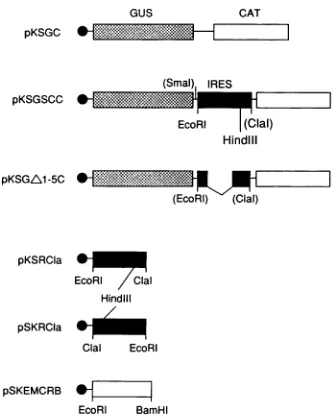
3-glucuroni-dase (GUS) (14) and chloramphenicol acetyltransferase (CAT) (10) reporter proteins, under the control of the T7 promoter. The FMDV IRES, as an EcoRI-Clal fragment derived frompKSMRHMRI.Cla (2),wasinserted into pKS+ (Stratagene)toproducepKSRClaand used as the template for deletion analysis. The same fragment was also inserted into EcoRI-and Clal-digestedpSK+ to producepSKRCla,so that anantisensetranscriptis expressedfromthe T7 promoter (Fig. 2). The SmaI-Clal fragment from pKSRCla containing the wild-type (wt)FMDVIRESwasblunt ended andinserted into thevectorpKSGC, previously digested withHindlIl andblunt ended, toproduce pKSGSCC (Fig. 2).The PCRwasperformed essentiallyasdescribed previously
GUS CAT
pKSGC=
(Smal) IRES
pKSGSCC
OEZIME
EcoRI (Clal) Hindlll
pKSGA1-5C5C
(EcoRI) (Clal)
pKSRCIa E _l
EcoRI Cla Hindlil
pSKRCIa
Clal EcoRI
pSKEMCRB
[image:2.612.353.519.69.278.2]EcoRl BamHI
FIG. 2. Structure of the plasmids expressing bicistronic mRNAs and the FMDV and EMCV IRES elements. The T7 promoter is indicatedby filled circles. Note theoppositeorientation of the FMDV IRES(black rectangles) inpKSRCla (sense orientation)andpSKRCIa (antisense orientation).
(32). The EMCV IRES element was produced by using primers GTGGCCATATAAGGATCCTG7'FF'ITTC and GG GAGACCGGAATTCCGCC, which create BamHI and EcoRI restriction sites nearthe termini of the PCRfragment (about 550bases in length), using plasmid pE5LVPO (23) as the template. The BamHI site is at the position ofAUG10, some8 nt upstreamof the initiation site. The EcoRI-BamHI-digested PCR product was ligated into similarly digested pSK+ toproduce pSKEMCRB (Fig. 2). This EMCVelement functions efficiently to direct internal initiation of protein synthesis when assayed within cells in the context ofa bicis-tronicmRNA transcript (datanotshown).
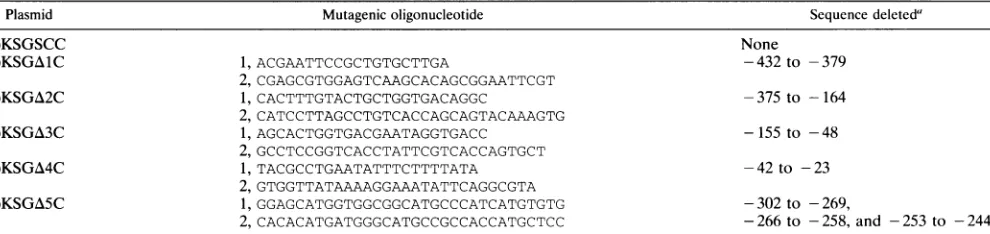
Theprecise deletion of regions within the FMDVIRESwas performed by thePCR in two stages. One setof reactionswas performed with the forward sequencing primer (GTAAAAC GACGGCCAGT) together with specific primers 1 (Table 1), which introduced the required deletions. Separate reactions using the complementary mutagenic primers (primers 2;Table 1) togetherwith the reverse sequencing primer (AACAGCT ATGACCATG)werealsoperformed. The half-reaction prod-ucts were purified by agarose gel electrophoresis and mixed appropriately, and furtherPCRs wereperformed withonlythe forward and reverseprimers.Thefragments obtainedweregel purified, digested with EcoRI and Clal, and ligated into EcoRI- and Clal-cut pSK+ or pKS+. Modified FMDV ele-ments were constructed into the pKSGCvector as described abovefor thewtelement except thatblunt-endedEcoRI-ClaI fragments were used. All mutants were sequenced by direct double-stranded DNA sequencing using a T7 DNA poly-merase-basedsequencingsystem (Amersham).
Transient expression assays. Plasmids were assayed by transfection, using Lipofectin (Life Technologies), into HTK-143 cellsinfected with the recombinant vaccinia virusvTF7-3 (8), which expresses the T7 RNA polymerase as described previously (2). After 20 h, cell extracts were prepared and assayed for GUS activityin afluorescence assay (14) and for CATprotein ina quantitative enzyme-linked immunosorbent assay(ELISA) (Boehringer Mannheim).
on November 9, 2019 by guest
http://jvi.asm.org/
[image:2.612.81.277.70.205.2]TABLE 1. Deletions introduced into the FMDV IRES
Plasmid Mutagenic oligonucleotide Sequencedeleted"
pKSGSCC None
pKSGllC 1,ACGAATTCCGCTGTGCTTGA -432to -379
2,CGAGCGTGGAGTCAAGCACAGCGGAATTCGT
pKSGA2C 1, CACTTTGTACTGCTGGTGACAGGC -375to -164
2,CATCCTTAGCCTGTCACCAGCAGTACAAAGTG
pKSGA3C 1, AGCACTGGTGACGAATAGGTGACC -155 to -48
2,GCCTCCGGTCACCTATTCGTCACCAGTGCT
pKSGA4C 1, TACGCCTGAATATTTCTTTTATA -42to -23
2,GTGGTTATAAAAGGAAATATTCAGGCGTA
pKSGA5C 1, GGAGCATGGTGGCGGCATGCCCATCATGTGTG -302 to -269,
2, CACACATGATGGGCATGCCGCCACCATGCTCC -266 to -258, and -253 to -244 "Thenumbering system used positions the A of the first initiation codon as nucleotide 1.
RESULTS
Determination of secondary structure motifs required for FMDVIRESfunction.The secondarystructurepredictionfor the FMDV IRES, essentially as derived previously (29), has been usedasthe basis for precisely deleting predicted domains within theIRES (Fig. 1).Verysimilarmodels were proposed for the FMDV IRES and for the element from EMCV. Different laboratories have used alternativenomenclatures (7, 13) for the various predicted secondary structure elements within the cardiovirus and aphthovirusIRES. Asimplersystem is shown in Fig. 1 and was used throughout this study. An alternative model for the EMCV IRES(7) is similar inmany respects.However,atthe 3' terminus, several short stem-loop structures(termedL, M, andN)whichare notcompatible with theFMDV sequence arepredicted by the latter model. Within thisregion, the latter model (7) also includes the polypyrimi-dine tract in secondary structure, in contrast to the models predicted forFMDVand EMCV previously (29). Alternative foldings of shortsequenceswithin thelargest domain(domain 2)remain unresolved butdo notaffect theexperiments under-taken in thisstudy.
a)
pKSGGIC 1
pKSG.62C 100
pKSGG3C 39
pKSGtbC pKSGSCC pKSGC
C)
pKSGAlC
pKSGQ2C
pKSGA3C
pKSGLAC pKSG.5C pKSGSCC
0 20 40 60 81 _ 102
_100 - 125
pKSGC 5
0 20 40 60 80 100 120 140
Each of the deletions indicated Fig. 1 and Table 1 was constructed by PCR as described in Materials and Methods. Each deletion was designed to precisely delete a predicted secondarystructurefeature.Notethat deletion5 removesonly the hammerhead structure at the endofdomain2. The PCR fragmentsgeneratedwerecloned,sequenced, and constructed into vectors expressing bicistronic mRNAs transcribed from the T7 RNA polymerase promoter. The vectors contain the GUS gene as an indicator ofcap-dependent translation, and this activity alsoverifies the expression of the plasmid within the cells. The efficient expression of CAT requires internal initiation ofprotein synthesis and is dependent on an active FMDVIRES.
Each of theplasmidsexpressingbicistronicmRNAs contain-ing thewt or mutantIRES elementsefficientlyexpressed GUS activity (Fig. 3a). However, marked differences inthe level of CAT expression were observed (Fig. 4a). The expression of CATdirectedby thewtIRES (plasmidpKSGSCC) servedas a positive control, whereas the lack of expression from a plasmid (pKSGC) containing the GUS and CAT genes but lacking anyIRES element (Fig.2)servedas acontrol forany
b)
pKSG61C
pKSGL22C
pKSGA3C 7
pKSGA4C _5
pKSGA5C 6
pKSGSCC pKSGC _
0 20 40 60
d)
pKSG 1C
pKSG62C
pKSG,5C pKSGA5C pKSGSCC pKSGC
I*+pKSRCla
0 20 40 60 80 100 120 140
FIG. 3. Effects of coexpression of IRES elements on the expression of GUS activity. The indicated plasmids were transfected into
vTF7-3-infectedcells alone(a)orwithpKSRCla (wtFMDVIRES; b),pSKRCla (antisenseFMDVIRES; c)orpSKEMCRB (EMCVIRES;d).
After 20h, cell extractswere prepared and assayed for GUS activity. GUS activity from pKSGSCC assayed alone wasset at 100% in each experiment,andother valueswererelatedtoit. Mean values from fourindependentdeterminationsareshownexceptforpaneld,in whichvalues
arefromasingle experiment repeatedtwicewithsimilarresults.
* 100 120 140
f17 |*+pSKRCIa
4
*19
in2 *1
15i
80 100 120 140
-38 *+pSKEMCRB
_48
2
N2
-34
_8
ND
r-6
pKSGu,n3G
on November 9, 2019 by guest
http://jvi.asm.org/
[image:3.612.64.559.88.205.2]a)
pKSG A1 C
pKSGt62C
pKSGA3C pKSGA4C
pKSGt65C
pKSGSCC 100
pKSGC
C)
pKSGA1C pKSG 02C pKSGA3C pKSG 64C
pKSGt65C
pKSGSCC pKSGC
b)
pKSGA1 C m
pKSG62C
pKSGA3C pKSGt64C
pKSG&5C
pKSGSCC 1
0
pKSGC
d)
pKSGA1C
pKSG&lC pKSGb3C pKSGMnC pKSG65C pKSGSCC pKSGC
0 20 40 60 80 100 120 0 20 40
[image:4.612.155.464.75.273.2]0O
FIG. 4. Complementationof defective FMDV IRES elementsby coexpressionof thewtFMDVIRES. Cellextractspreparedasdescribedfor Fig. 3werealsoassayedfor CATexpression by usingaquantitative ELISA. CATexpressionfromplasmidpKSGSCC (containingthe wt FMDV
IRES) assayed alonewassetat100%,and CATexpressionfrom otherconstructswascomparedwith this value in eachexperiment. Appropriate dilutionsof cellextractswereusedsothattheassays wereperformedwithin therangeof thestandardcurve.Theresultspresentedarethemean
valuesobtained from fourindependent determinationsexceptforpanel d,in whichvaluesarefromasingle experiment repeatedtwice with similar
results.
expression resulting from reinitiation. Essentially no CAT
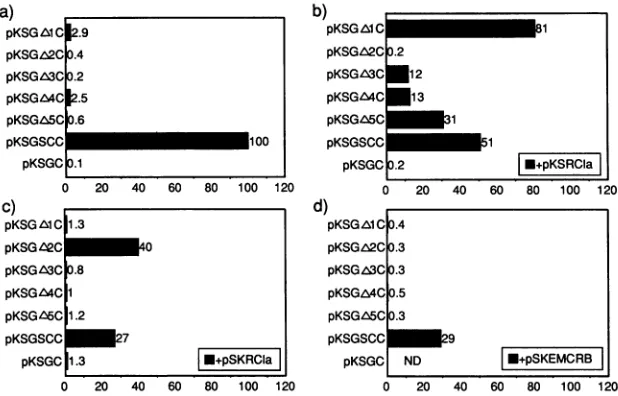
expressionwasdetected from thisconstruct(Fig. 4a). Individ-ual deletion of domains 2, 3, and 5 from the FMDV IRES reduced CAT expression to almost the background level. However,significantbutlow-levelexpression (ca.3% of thewt
level) of CAT was observed when domains 1 and 4 were
individuallydeleted(Fig. 4a).
Complementation of mutant FMDV IRES elements. To determinewhether the defects in the ability ofthe defective IRES elements were complementable in trans, each of the plasmids expressingthe bicistronic mRNAswascotransfected
withaplasmid (pKSRCla) expressingthe intactFMDV IRES.
Theresultsobtained fortheIRES-directedexpression of CAT
are presented in Fig. 4. The results, mean values from four
determinations, are presented as a percentage of the CAT expression obtained fromplasmid pKSGSCC, which contains thewt FMDV IRES. The coexpression of the FMDVIRES, unlinkedto any open reading frame, fromplasmid pKSRCla enhancedexpressionof CAT frommutantswithdomains 1, 3, 4, and 5 individually deleted (Fig. 4b). The level of CAT expressionobservedwasbetween 12 and81% ofthat observed
from thewt IRES. Thedeletion of domain 1wasparticularly
efficientlycomplemented. Noenhanced CATactivitywas ever
observed from the construct lacking the large domain 2 or
lacking allIRES sequences. Itisnoteworthy thatthe plasmid containing deletion 5(deletion ofonly partofdomain 2[the hammerhead]) was very efficiently complemented. It may be
thatdeletion of all ofdomain 2interferes with theability of the
restof the IREStoadopt its native conformation.
Coexpressionof theintact FMDVIRES hadsomeinhibitory
effect on theexpression of GUS from the plasmids (compare
Fig.3aandb),butthiseffectwas verysimilarineachcaseand
probably reflectscompetitionfor cellularcomponents. The high efficiency of the complementation and also the inability tocomplement thedeletion of domain 2 bothargue
strongly against theeffectresultingfromsomeformof
recom-bination event between the plasmid DNAs. As a further
control against this possibility, cotransfection with a plasmid
(pSKRCla) containing the FMDV IRES in the opposite orientation to the T7 promoter was also performed. Under
these conditions, no complementation, as indicated by
en-hanced CAT expression, of the defective mutants lacking domain 1, 3, 4,or5wasobserved(Fig. 4c). Very surprisingly,
however, a consistent enhancement of CAT expression from
the domain 2 deletionconstructwas observed. The antisense IRES also inhibited GUS expression (Fig. 3c). The latter findingwasobservedpreviously(35)in analogousstudies with
the PV IRES. The inhibition of GUSactivity bythe antisense IRES was most marked on the RNAs which contained the FMDV IRES. A substantially less severe inhibition of GUS
expression from pKSGCwasobserved. This findingindicates
that the interaction with the antisense RNA reduces the activity of the bicistronic mRNA in translation, perhaps by reducing its stability.
Todeterminewhether thestructurally related EMCVIRES
wasabletocomplementthedefectiveFMDVIRESelements,
weconstructedaplasmid (pSKEMCRB; Fig. 2) containingthis element unlinked to any open reading frame. The element
used extends from the poly(C) tract to AUG10 just 8 bases upstream from the initiation codon. This EMCV IRES was
unable to complement any of the defective FMDV IRES elements(Fig. 4d)butcouldcomplement deletions withinthe EMCV IRES when assayed with analogousplasmids (2a). It had aninhibitoryeffectsimilartothat of theFMDV IRESon
the expression ofGUS activity (Fig. 3d). DISCUSSION
The FMDV and EMCV IRES are strikingly similar in
predicted secondary structure. There is considerable
agree-mentamongseveral laboratoriesthatasegmentof about 450 bases issufficienttodirectefficientinternalinitiationofprotein synthesis. However,somecontradictorydataontheprecise5'
terminus of the elementhave been presented. Studiesonthe FMDV element (2) and the EMCV element (13) suggested that loss of sequence within domain 1 grossly impaired the
0.1
0.2 *12 *13
_J1
*+pKSRCla
0.2 20 40 60 80 100 1
1.3 0 .8
1.2 _27
1.3 |*+pSKRCIa
0 20 40 60 80 100 121
, .4 .3 .3 .5 :0.3
I; 9
:ND |*+pSKEMCRB d)~~~~~~~~~~~~~~~~~~~~~~~~~~~~~~~~~~~~~~
11 -A A . .11nrs 4on1
60 80 100 120I'll
on November 9, 2019 by guest
http://jvi.asm.org/
activity of the element. However, other studies (17) reported thatpartial loss of domain1 of FMDVonly hadamodest effect (50% loss) on translational efficiency. Similarly, it has been reported that partial loss of sequence from this terminal stem-loop structure in EMCV impaired activity by about 70%, while complete loss of the element (and loss of a few bases from the next stem) resulted in a deficiency of only about 35% compared with the wt element (7). These results are of importance since this terminal structure is reported to be the major site of binding of the 58-kDa protein (PTB) which interacts with each of these elements. Resolution of these various results is not entirely clear. The data suggesting a minimal role for domain1 have been obtained by using in vitro translation reactions on monocistronic RNAs, whereas the evidence forarequirement for this structure has been obtained by using bicistronic mRNAs in cell culture. It has been suggested that partial motifs may interfere with other struc-tures and hence give false answers (7). The presence of the upstream open reading frame in the bicistronic mRNAs may alsoperturb the structure of partial motifs. The precise dele-tion of this element in this study, without anypredicted effect onthe neighboringstructures, severely inhibited the abilityof the FMDV IRES to direct internal initiation, although some low-level (ca. 3% of the wtlevel) activity persisted. This result was consistent with our previousobservations that the partial loss of this element made itseverely defective (2).
Only limited mutagenesis of domains 2 and 3 has been performed previously. Linker insertions into the hammerhead structure atthe end of domain 2 (as deleted in the domain 5 deletion) and into domain 3 completely abolished the function ofthe EMCV IRES(7). The results presented here show that precise deletion of the hammerhead structure and domain 3 within theFMDV IRES also totallyabolished function.
Wehave used thesecondarystructuremodel for the3' end of the IRESproposed byPilipenkoetal. (29), since theL, M, and N motifs suggested by Duke et al. (7) for the EMCV sequence are notcompatiblewith the FMDV sequences. The stem-loopstructure proposed by Pilipenko et al.
(29)
is com-patiblewith bothFMDVandEMCV sequences and leaves the polypyrimidine tract unstructured. Precise deletion of the predicted 3'-terminal motif(domain 4), leavingthepolypyri-midine tract intact, also severelyinhibited the activity of the IRES, although the activitywasabove thebackgroundlevel.
Complementation of defectiveIRES elements. The FMDV IRES is substantiallydifferent from that ofPV.The sequence has little similarity, and the secondary structure
prediction
is completelydifferent. However, theydo have thesamebiolog-ical activity. In each case, not surprisingly, it has been shown that precise deletion ofpredicted secondary structure motifs can abolish the activity of the element when assayed alone. Deletion of domain IV from the PV IRES produces an element which retains significant activity, but none of
major
features of theFMDVIRES appeardispensable. More
signif-icantly, uponcoexpression withanintacthomologous element, unlinkedtoanyother gene, enhancedactivityisobserved from thedefective elements within bicistronicmRNAs. Recombina-tion between theplasmidDNAsis ruledout
by
three lines of evidence. First, theefficiency of this unselected event is very high; up to 80% of the wt activity is observed from the defective elements whencoexpressed
with the intact IRES. Second, no enhanced CATexpression
is observed when a plasmid containingthe identicalFMDV cDNA sequence,but in the opposite sense to the T7 promoter, is used(the
oneexceptionisdiscussedbelow). This
plasmid
should be ableto recombine with the defective IRES elementsin anequivalent
manner totheconstruct containing the IRES in theopposite
orientation.
Third,
the constructlacking
domain 2 did not exhibit enhanced CATexpression
when the wt IRES wascoexpressed.
Ifrecombinationwasresponsible
for the restora-tion of CATexpression
from the defectiveelements,
one would expectthat this defect would also be corrected.It may be
significant
that the deletion of domain 1 is the mostefficiently complemented (up
to81% ofwt IRESactivi-ty).
This is theregion
of the IRES towhich different labora-tories attribute very distinctproperties
(as
discussedabove)
andtowhich
p57/p58
(PTB)
binds. It may be that this terminal region has anenhancing
function asproposed
for thestem-loop structure
only
on the 5' side of this domain in EMCV(13),
which may alsoconstituteabinding
site forp57.
Thus,
its activity may befully
revealedonly
understringent
assayconditions,
such aswhen the RNAisassayed
incompetition
with other RNAs
(cf.
in vitro translationassays). However,
since the EMCV IRES failedto
complement
eventhedeletion of this motif from the FMDVIRES,
this element must do morethansimply
bind PTB.The
structurally
related EMCV IRESwas unable tocom-plement
any of the defective FMDV elements. Thisclosely
mirrors the
inability
of the rhinovirus 5' NCRtocomplement
thedefectivePVIRES elements and the very limitedability
of themoreclosely
relatedcoxsackievirusB45' NCRtoperform
thesamefunction
(35).
Theseelementsareabout 60 and70%,
respectively,
identical tothe PV IRESoverthisregion
of the genome. Thisis ahigher degree
ofidentity
than between the EMCV andFMDV IRES(about
50%).
Deletion of any sequence uptont528within thePV5' NCR (742nt
long)
hasproved
tobecomplementable,
but deletionof sequencesatthe 3'endof theIRES, including
theregion
from nt528to620,
werenotcomplemented by
the cotransfection of theintactPVgenome(27).
Fourindependent
deletions of the FMDV IRES have beencomplemented. However,
itwas notpossible
tocomplement,
with theFMDVIRES,
the deletion of thelargest element,
domain 2. It may be that thetertiary
structure of the IRES is
severely
compromised by
thislarge
deletion. It is of interest that a
single point
mutation at the base of thislarge
domain enhanced theactivity
of thetype C FMDV IRES(19), suggesting
that this domain iskey
to the structureand/or
activity
of the IRES.The strangestresult thatweobservedwastheenhancement of CAT
expression
directedby
thedefective elementlacking
domain2when
coexpressed
with the antisensetranscript
of the FMDV IRES. We have no verysatisfactory
explanation
for thisphenomenon
atpresent. Antisenseoligonucleotides
have been shownpreviously
to enhance the translation of masked mRNAs(34).
Itwasproposed
that this resulted from compe-tition with cellularproteins
which werebinding
to the RNA andinhibiting
its translation. It isdifficulttoadapt
thisconcept to the enhancedactivity
of the defectiveIRES,
however. An alternativepossibility
is that the antisensetranscript,
when foldedby
itself,
forms a structure which allows the defective IRES topartially
anneal to it and form a scaffold for the residual featuresof the defective IRESto function.All of thedataso far obtained
indicating
complementation
of defective IRES elements
by
thecoexpression
of an intactIRES havebeen obtained
by
using
the vaccinia virus-T7RNApolymerase
expression
system(this
report and reference35).
The cellular environment is
clearly
modifiedby
the vaccinia virus infection.However,
thereisconsiderable accordbetween the results obtained in this assay system for otheraspects of IRES function and those obtainedby
other workersusing
alternativestrategies (2, 17,
22, 27,
35).
Anadvantage
of the vaccinia virus system is that itproduces
high
levelsofon November 9, 2019 by guest
http://jvi.asm.org/
mic transcripts asobtained with a natural picornavirus
infec-tion.
Two models for complementation of the PV IRES were
suggested (35). One modelsuggestsanRNA-RNA interaction inwhich the defective (and missing) element inone IRES is substitutedby that domain from the intact element sothat a
functional unit is re-formed. This would beanalogous to the regeneration in vitro ofa functional EMCV IRES from two
molecules by the melting and annealing ofoverlapping
tran-scripts (4).Thecosynthesisof the RNAtranscriptswithin cells in our studies could obviate the need for such a melting
procedure. The second model involves the transfer of a
functional initiation complex from the functional IRES ele-menttosomepointonthe defective IRESstructureintrans.In thecaseof FMDV andEMCV,thisseemsparticularly
attrac-tive sinceprevious studies (15) suggest that the viral RNA is recognizedwithrespect toitsabilitytoinitiateprotein synthe-sis fromapointwithin 8ntof the initiation codon itself.Thus, the region of the RNA in the immediate vicinity of the initiation codon may serve as anacceptorsite forapreformed
initiation complex. Very recently, it was shown (9) that a
nonlinear migration of ribosomeson cauliflower mosaic virus
RNA,whichwasdemonstratedonindividual RNAmolecules,
could also be achieved between two RNA molecules. These authors suggested analogous donor/acceptor regions for the ribosome shunt mechanism proposed.
Since thecomplementationof defective IRES elements has been observed for both majortypes of element found within the picornavirus family, it seems likely that this activity is important in the lifecycleof these viruses.
ACKNOWLEDGMENTS
We thank JuliaBrangwynfor excellent technical assistance. J.D. acknowledges receiptofanIAH studentship.
REFERENCES
1. Belsham,G.J. 1992. Dual initiation sites ofprotein synthesison
foot-and-mouth disease virus RNAareselectedfollowinginternal
entryandscanningof ribosomes in vivo. EMBO J. 11:1105-1110.
2. Belsham, G. J., and J. K.Brangwyn. 1990. A region of the 5'
noncoding region of foot-and-mouth disease virus RNA directs efficient internal initiation ofprotein synthesis within cells: in-volvement with the role of Lprotease intranslational control. J. Virol. 64:5389-5395.
2a.Belsham,G.J., J.K.Brangwyn, and A.vanderVelden.
Unpub-lished data.
3. Borman, A.,M. T.Howell, J.G.Patton,and R.Jackson.1993. The involvement ofaspliceosomecomponentin internalinitiation of human rhinovirus RNA translation. J. Gen. Virol. 74:1775-1788. 4. Borovjagin,A.V.,M. V.Ezrokhi,V. M.Rostapshov,T. Y.Ugarova,
T. F.Bystrova,andI.N.Shatsky.1991.RNA-protein interactions
within the internal translationinitiationregionof
encephalomyo-carditis virus RNA.Nucleic Acids Res. 19:4999-5005.
5. Brown,E.A.,S. P.Day,R. W.Jansen,and S. M.Lemon. 1991. The 5' nontranslated region of hepatitis A virus RNA: secondary
structureand elements requiredfor translation in vitro. J. Virol.
65:5828-5838.
6. Devereux, J.,P.Haeberli,and0.Smithies. 1984. Acomprehensive
set ofsequence analysis programs for the VAX. Nucleic Acids
Res. 12:387-395.
7. Duke,G.M.,M.Hoffman,and A.C.Palmenberg.1992. Sequence
and structuralelements thatcontributetoefficient
encephalomyo-carditis viral RNAtranslation. J.Virol. 66:1602-1609.
8. Fuerst, T. R., E. G. Niles, F. W. Studier, and B. Moss. 1986.
Eukaryotic transient expression system based on recombinant vaccinia virus thatsynthesizes bacteriophageT7 RNApolymerase.
Proc. Natl. Acad. Sci. USA83:8122-8126.
9. Futterer, J., Z.Kiss-Laszlo, and T. Hohn. 1993.Nonlinear
ribo-some migration on cauliflower mosaic virus 35S RNA. Cell 73:789-802.
10. Gorman, C. M., B. M.Moffat, and B. H. Howard. 1982. Recom-binant genomes which expresschloramphenicol acetyltransferase inmammaliancells. Mol. Cell. Biol.2:1044-1051.
11. Jackson, R.J., M. T. Howell,and A. Kaminski. 1990. The novel mechanism of picornavirus translation. Trends Biochem. Sci. 15:477-483.
12. Jang, S. K., H.-G.Krausslich,M.J.H.Nicklin,G. M.Duke,A. C. Palmenberg,and E.Wimmer.1988. A segment of the 5'
nontrans-latedregionofencephaloymyocarditisvirus RNA directs internal entryof ribosomes duringinvitro translation. J. Virol. 62:2636-2643.
13. Jang, S. K., andE.Wimmer.1990.Cap-independent translation of encephalomyocarditisvirus RNA:structural elements of the inter-nal ribosome entry site and involvement ofa57kD RNAbinding protein. Genes Dev. 4:1560-1572.
14. Jefferson, R. A. 1987.Assaying chimericgenes inplants:the GUS genefusion system. Plant Mol. Biol.Rep.5:387-405.
15. Kaminski, A.,M.T.Howell,and R.J. Jackson.1990. Initiation of encephalomyocarditis virusRNAtranslation:the authentic initia-tion site is not selected by a scanning mechanism. EMBO J. 9:3753-3759.
16. Kozak, M.1989. Thescanningmodel for translation:anupdate.J. Cell Biol. 108:229-241.
17. Kuhn, R.,N.Luz, and E. Beck. 1990. Functionalanalysisof the internal initiation site of foot-and-mouth disease virus. J. Virol. 64:4625-4631.
18. Luz, N., and E. Beck. 1991. Interaction ofacellular 57-kilodalton proteinwith theinternalinitiation site offoot-and-mouthdisease virus. J. Virol. 65:6486-6494.
19. Martinez-Salas, E.,J.-C. Saiz,M.Davila,G.J.Belsham,and E. Domingo. 1993. A single nucleotide substitution in the internal ribosome entry site of foot-and-mouth disease virus leads to
enhancedcap-independenttranslation in vivo. J. Virol. 67:3748-3755.
20. Meerovitch,K., H. S. Lee, Y.Svitkin,D.J. Kenan,E. K. L.Chan,
V.I.Agol, J. D. Keene, and N.Sonenberg. 1993. Laautoantigen enhances andcorrectstranslation ofpoliovirusRNAin reticulo-cytelysate.J.Virol. 67:3798-3807.
21. Meerovitch, K., J. Pelletier,and N. Sonenberg. 1989. A cellular proteinthat bindstothe 5'non-coding regionofpoliovirusRNA: implicationsfor internal translationinitiation. Genes Dev. 3:1026-1034.
22. Nicholson, R., J. Pelletier, S.-Y. Le, and N. Sonenberg. 1991. Structural and functionalanalysisof the ribosomelandingpadof poliovirus type 2: in vivo translation studies. J. Virol. 65:5886-5894.
23. Parks, G.D.,G.M.Duke, and A. C.Palmenberg. 1986. Encepha-lomyocarditis 3C protease: efficient cell-free expression from clones which link viral 5'noncodingsequencestothe P3region. J. Virol. 60:376-384.
24. Patton, J. G., S. A. Mayer,P.Tempst,and B.Nadal-Ginard.1991. Characterization andmolecularcloningofapolypyrimidine
tract-binding protein: a component ofa complex necessaryfor pre-mRNAsplicing. Genes Dev. 5:1237-1251.
25. Pelletier, J., M. E.Flynn, G. Kaplan, V. R. Racaniello, and N. Sonenberg.1988.Mutationalanalysisof upstream AUG codons of poliovirusRNA. J.Virol. 62:4486-4492.
26. Pelletier, J.,and N.Sonenberg. 1988. Internal initiation of
trans-lation ofeukaryoticmRNAdirected byasequencederived from poliovirusRNA. Nature(London)334:320-325.
27. Percy, N., G. J. Belsham, J. K. Brangwyn, M. Sullivan, D. M.
Stone, andJ. W. Almond. 1992. Intracellular modifications in-ducedbypoliovirusreduce therequirementfor structural motifs in the 5' noncoding region of the genome involved in internal initiationofprotein synthesis. J.Virol. 66:1695-1701.
28. Pestova, T. V., C.U. T.Hellen, and E. Wimmer. 1991.Translation ofpoliovirus RNA:role ofanessentialcis-acting oligopyrimidine element within the 5' nontranslatedregionand involvementofa
cellular57-kilodaltonprotein.J.Virol.65:6194-6204.
29. Pilipenko, E.V., V.M. Blinov, B. K. Chernov, T. M. Dmitrieva,
on November 9, 2019 by guest
http://jvi.asm.org/
and V. I. Agol. 1989. Conservation of the secondary structure
elements of the5'-untranslated region of cardio- and aphthovirus RNAs. Nucleic Acids Res. 17:5701-5711.
30. Pilipenko,E. V., V. M. Blinov, L. I.Romanova, A. N. Sinyakov,
S. V.Maslova, and V.I.Agol.1989. Conservedstructural domains in the5'-untranslated region of picornaviralgenomes:ananalysis of thesegmentcontrollingtranslation and neurovirulence.
Virol-ogy 168:201-209.
31. Pilipenko, E. V., A. P.Gmyl, S. V. Maslova, Y. V. Svitkin, A. N.
Sinyakov, and V.I.Agol.1992.Procaryotic-like cis elements in the cap-independent internal initiation of translationonpicomavirus
RNA. Cell68:119-131.
32. Sambrook, J., E. F. Fritsch, and T. Maniatis. 1989. Molecular cloning:alaboratorymanual, 2nd ed. Cold SpringHarbor
Labo-ratory, Cold Spring Harbor, N.Y.
33. Skinner,M.A., V. R. Racaniello, G. Dunn, J. Cooper, P. D. Minor, and J. W. Almond. 1989. New model for the secondarystructureof the5'non-coding RNA of poliovirus is supported by biochemical andgenetic data thatalsoshowthat RNAsecondarystructureis
important inneurovirulence. J. Mol. Biol. 207:379-392. 34. Standart, N., M. Dale,E. Stewart,and T. Hunt. 1990. Maternal
messengerRNAfromclamoocytescanbespecifically unmasked
invitro by antisenseRNAcomplementarytothe 3' untranslated region. Genes Dev.4:2157-2168.
35. Stone,D.M., J.W.Almond,J.K.Brangwyn,and G.J.Belsham.
1993.trans complementation ofcap-independent translation
di-rectedby poliovirus 5' noncoding regiondeletion mutants:
evi-dencefor RNA-RNA interactions. J. Virol.67:6215-6223.