Rochester Institute of Technology
RIT Scholar Works
Theses
Thesis/Dissertation Collections
8-1-1978
Inner Realities
Timothy Kilby
Follow this and additional works at:
http://scholarworks.rit.edu/theses
This Thesis is brought to you for free and open access by the Thesis/Dissertation Collections at RIT Scholar Works. It has been accepted for inclusion in Theses by an authorized administrator of RIT Scholar Works. For more information, please [email protected].
Recommended Citation
INNER REALITIES
by
Timothy J. Kilby
Candidate for the Degree
MASTER OF FINE ARTS
MFA PHOTOGRAPHY PROGRAM
SCHOOL OF PHOTOGRAPHIC ARTS AND SCIENCES
ROCHESTER INSTITUTE OF TECHNOLOGY
ROCHESTER, NEW YORK
August, 1978
Nile Root, Chairman
Rochester Institute of Technology
Richard D. Zakia
Rochester Institute of Technology
Martin L. Scott
The author
freely
grants permission to reproduce this thesis in whole or in partby
electrostatic copying methods for educational purposes only.Photocopying
by
other methods, especially of illustrations and accompanying slides or prints, is strictly prohibited without written consent of the author.Copyright
1979Timothy
J.Kilby
CONTENTS
ILLUSTRATIONS V
PREFACE Vi
THESIS PROPOSAL vii
INTRODUCTION 1
Zone System Approach 1
Thesis Organization 3
My
Approach toPhotography
4Inner Realities 6
ANALYSIS OF PHOTOGRAPHS 8
World Line 8
Mind Space 10
Rest-Energy
14The Other Photographs 16
ON BOUNDARIES 19
INNER REALITIES 23
COSMOLOGY AND THE PHOTOGRAPHIC IMAGE .... 27
APPENDIX A - DETERMINING EXPOSURE AND
DEVELOPMENT TIMES 29
APPENDIX B - SPECIAL PHOTOGRAPHIC FORMULAS
. 32
BIBLIOGRAPHY 33
ILLUSTRATIONS
1. World Line 9
2. Mind Space 11
3.
Rest-Energy
154. Limestone Mine 26
5. Parametric Curve for Ilford FP-4
PREFACE
Ideas flow freely. Vision coalesces. Imagination has
been set free to seek its own rewards. Value as a total
being
has been established. So has this experience changedme that I am for the first time satisfied and fulfilled
by
my accomplishments.The thesis experience has been the
beginning;
the building
of a foundation upon which new experiences will follow. I waslucky
enough to discover a point of departure through readings, guidanceby
my board members, and trust in my ownintuition.
This report and the exhibit of prints have meant an ending to the thesis project. And yet I am reluctant to say the project has ended, for the experiences have not waned.Every day
I understand better what it is to see through theeyes and through the mind. Simple encounters take on rele vance. One source of knowledge Just leads to another, and
another. And in writing of my experiences
today,
I am frustrated
by
the thought of omitting the new things I shall know tomorrow.This report in no way takes the place of viewing the primary segment of this thesis: the photographs. This written report only supplements the images
by
explaining mytechnique,
operating procedures, and philosophy towards the arts. It canonly be hoped that through viewing the photographs, the visual
language will speak when my own written description fails.
THESIS PROPOSAL
February
1978Thesis Board: Professor Nile
Root,
Chairman Dr. Richard ZakiaMr. Martin Scott
Title: Inner Realities
Purpose of the Thesis:
I intend through this thesis to continue to analyze my
visual communication process and produce an exhibit of prints
using this personalized visual technology. I shall employ techniques of visual and mental perception to communicate sub
conscious expressions through realistic imagery.
Objectives:
1. to
develop
consistent photographic technique using zone systemtechnology
to allow for previsualization ofimagery
2. to continue to build upon the visual foundation developed while working with Professor Root
a. multiple meanings
-what else it is b. artist/subject relationships
c. visual,
intellectual,
intuitive,
and emotional awarenessd. conscious creativity/sub-conscious technique
3. to postvisualize
imagery
into sequences and/or groupings based uponformalistic,
intellectual,
or intuitiverelationships or associations
Scope of the Thesis:
During
the past three months I have discovered certaineffective means of communicating using the photographic medium. Alfred
Stieglitz,
EdwardWeston,
and Minor White used realisticsubjects to convey non-literal ideas. I have found personal
relevance in each, but particularly in Weston's technique of
"significant
presentation."By
enhancing the illusion of physical depth through tonal control, print surface, and choice
of subject Weston created psychological depth.
Thus,
realisticobjects become
abstract,
demanding
more involvement from theviewer. The techniques Weston used, and likewise Stieglitz and White in their "equivalents,"
can be explained in visual per
ception and psychological terms.
By
understanding these principles, I shall be able to utilize them in my own work. For this thesis I shall avoid a painterly approach, concentrating
on definition of detail and
transparency
of print surface,recognizing
qualities only available in photographs.Zone system
technology
is important to significant presentation, i shall strive for consistent technical results to
allow for previsualization of an image.
I have no preconceived ideas of subject matter.
Working
in familiar surroundings seems to yield the best photographs.
Therefore,
I shall be shooting in the Rochester area and nearmy home in Virginia.
Approximately thirty
fine prints will beprepared and as many exhibited as space is available in the
graduate gallery.
Procedures:
I primarily intend to shoot large-format 4"x5"
black and
white photographs. On occasions when small-format photography
is more effective or more practical, 35mm will be used.
In order to
fully
utilize the potentials of photographicmaterials, I have chosen FP-4 film and FG-7 developer for
large-format and Panatomic-X developed in Rodinal for 35mm work. I
shall be printing on Agfa Portriga-Rapid and Polycontrast papers.
Since the thesis project will be an exhibit, prints will be
11"x14",
16"x20",
or larger.I have carefully planned my time to make a total commitment
to the thesis
Spring
quarter. No other course work will be attempted. I expect to complete the thesis project
by
the lateMay
exhibit date. Research and personal evaluation will take place
throughout
Spring
quarter; the written report will follow.Bibliography:
["preliminary
readings for preparation of thesisproposal]
Buerger,
Janet E."Minor
White: The Significance of FormalQuality
in his Photographs,"Image,
September1976,
pp.20-3
2.Feldman,
Edmund B. Varieties of VisualExperience,
2nd ed. New York:Harry
N.Abrams,
n.d.Gassan,
Arnold. A Handbook forContemporary
Photography,
3rd ed.
Athens,
Ohio: HandbookCo.,
1974.Green,
Jonathan,
ed. Camera Work: A Critical Anthology.Millerton,
New York: Apeture. 1973.Gregory,
R. L. The Intellegent Eye. New York:McGraw-Hill,
1970.
Held,
Richard,
comp.Image,
Object,
and Illusion. San Francisco: W. H.Freeman,
1974,
readings from Scientific American.
Lyons,
Nathan,
ed. Photographers on Photography. EnglewoodCliffs,
New Jersey:Prentice-Hall,
1966.
White,
Minor;
Zakia,
Richard;
Lorenz,
Peter. The New ZoneSystem Manual. Dobbs
Ferry,
New York: MorganPress,
1976.Zakia,
Richard D. Perception and Photography. EnglewoodCliffs,
New Jersey:Prentice-Hall,
1975.
INTRODUCTION
When people's eyes are open,
they
see landscapes in the outer world. When people's eyes are closed,they
see landscapes with their mind's eye. People spend hours
looking
at outerlandscapes,
but there is just as much to see in inner landscapes. The landscapes are-i
different,
butthey
are equally valid.Language is the
key
tofulfilling
human potential. It is through the organized structure that language provides thatwe are able to arrange thoughts into meaningful order to be
assimilated and communicated. In the course of
history
wehave developed
highly
specialized but adaptable systems ofwritten words; words
being
symbols easily recognized within aculture. And along with the written word we have a correspond
ing
spoken word, an auditory symbol; each an equivalent of theother. And yet we have often neglected to build a vocabulary
of visual
language,
a language that may give clarity to understanding the complexities of this world.
In part this thesis is about symbols, equivalents and
equivalence, and about a visual language that can be used to
communicate the meaning of an experience. I did not know at the
beginning
of the project what the outcome might be or whatimages might result. It was necessary,
however,
to have aplan of procedure and a method of organization.
Zone System Approach
Photographic technologies are established.
Adapting
those technologies to a personal operating procedure is easily
done.
The zone system approach provides thetechnology
by
which the photographic
image
can be controlled and matched to the mentalimage
visualized at the time of the exposure. Oneof the objectives of this thesis was to establish a procedure
for exposing and
developing
sheet film and then the fine printwith maximum
fidelity
to the original experience.Naturally
there were initial tests to be made with both equipment and
materials.
My
light meter was calibrated, and my lenses werechecked for shutter speed accuracy. The next step, establish
ing
standard developmenttimes,
although time consuming, was 2a simple enough procedure. This procedure, once established
and practiced, allows for control over the tones of an image
within the limitations of the photographic process. And per
haps more important is that previsualization becomes possible because of predictable results. It is much easier to make a
photograph when the mechanics of exposure do not absorb mental
energies.
The result of the preliminary
testing
and zone systemmetering at the scene was consistently well exposed negatives.
This is not to say that every negative was perfect and printed
on normal paper. The negatives that were off in contrast usu
ally were shot in severe situations. The problem was not in
metering nor in
developing
and printing.My
failure was inaccurately
judging
which areas of the scene should be represented as Zone III (detailed shadows) and Zone VII (textured
highlights). Color vision may have affected my Judgement some
what, but the errors were probably due to my inexperience in
using the system.
However,
I am convinced that the zone sys tem approach can free the creative photographer from the prepossessing and often chancy mechanics of exposure.
2A
technical description of this procedure with accom3
Thesis Organization
The zone system is one of several methods of organization
adopted for this thesis. As in other aspects of
life,
I findit necessary to establish systems approaches. Whether I am
organizing data on file cards or mentally organizing visual
information
in a scene, disorder isirritating
and time con suming. I adapt systems to handle information input.For example, in planning thesis procedures, I decided to
keep
a field diary. As I made a photograph, I recorded pertinenttechnical data and a sketch of the scene in a notebook. I also
recorded a brief written account of psychological reactions to
the event, suggestions for presentation, and titles for the
photograph, if any. The
diary
became a valuabledaily
record of shooting, but I found it sometimes too time consuming.Thoughts would come to me at any time. Readings would
stimulate new
ideas;
sometimesthey
would come spontaneously.To organize these thoughts I outlined in broad catagories major
topics I would discuss in the thesis. Then each thought and
each reference was recorded under its appropriate topic head
ing
using a numbering system similar to that used inliterary
style manuals. This structure allows for easy reference andcross-reference of information. No doubt many of the ideas I
had and many of the relevant passages I found in readings would
have been forgotten if not recorded in some orderly fashion.
The same necessity for systems of organization can be
found in my seeing. It is easy to be confused
by
the complexities of nature. Gestalt psychology provides a system for re
lating
line,
color,balance,
Juxtaposition,
and all the othervisual elements to an organized, coherent visual structure.
The complexities are made simple
by
systemizing using a newly found visual language. What was before a confusing array ofnatural objects becomes an ordered landscape. Love of life
can only come from understanding, and understanding can only
come from order. So the real importance of a systems approach
4
My
Approach toPhotography
Many
photographic artists and critics have spoken ofthe virtues of the
unmanipulated,
"straight"photograph.
While the photographs that I present in this thesis could fall into this catagory, it is not true that my work remains
pure and authentic to this ideal.
The fact is that photography has not, does not, and
never will objectively portray nature in all its complexity
and infinite detail. Photographs are interpretations of nature that represent experiences of individuals.
Photography
is themedium that yields the closest
thing
to factual representation,and yet it is
infinitely
far frombeing
that which it imitates. Black and white is better suited than color for abstractionbecause of the inherient reality color lends to photography.
The black and white photographer communicates an experience
through a print that is
two-dimensional,
monochromatic, distorted in perspective, usually enlarged or reduced in size, selec
tively
focused,
and quite often altered in tonal relationships;and many call this reality!
Now,
before I am accused ofbeing
aheretic,
let me explain my understandings of this medium that I employ.It is time that artists and critics accept the limitations
of the medium and recognize its potential. I take issue with those that think photography is extraordinary and revolution
ary.
Photography
is just one of many media. It is no more extraordinary
than any other medium in its time. Each medium hasits evolution.
Photography
will eventually be overshadowedby
some as yet undiscovered technology.
Photography
is not unlike painting or sculpting or drawing
in that it has the capability of communicating the artist'sabstract ideas and stimulating individual responces in the view
er. It can subjectively document a person's face just as can a
painting.
Photography
can through abstract presentation stimulate our imagination and reveal an unrecognized inner potential
within us all. But so can the other media. Photography is
differ-ent, but should not
deny
it its due respect as a valid visualmedium. Perhaps artists who use other media, whether
they
will admit it or not, are offendedby
the ease with which an imagecan be made. I disagree with those that will not accept photo
graphy as a valid and serious art form. Arguments against photography seldom seem well-grounded. It is probable that
the critic of this medium disdains the
immediacy
of the process.Do these same people reject their own work-saving tools of the
trade as
being
restraints to creativity? We should rejoice inthe
technology
that allows us freedom fromdrudgery
and freedomto create. And we should not feel threatened that everyone
with a camera becomes an artist, no matter how automated the
camera might be. This is as ridiculous as saying everyone that draws or paints is an artist. It all boils down to creativity
and
imagination;
the artistbeing
one that can communicatethrough his or her own unique perspective a fresh interpreta-^
tion of life experience.
Photographers have
traditionally
chosen one of twoschools of thought: the straight, purely photographic approach
expounded
by
Paul Strand and EdwardWeston,
or the manipulative,"painterly"
approach practiced
by Jerry Uelsmann,
ManRay,
andothers. Advocates of each approach rarely accept the opposing
view. Some critics like to classify photographers as either formalists or anti-formalists,
depending
on the artist's beliefor not in the finished print as an art object in itself. Re
cently a new set of classifiers have been used
by
curators and3
critics: "mirrors" and "windows." The first term refers to
those artists that use photography to reflect upon
themselves;
the latter term refers to those that document the world
they
see although not primarily revealing themselves through their
works. While classifying terms may
help
indrawing
relation ships between photographers and their works, in thelong
runthey
can only restrict free thinking. A careful analysis ofany
body
of work will reveal an overlapping of approaches. In3These
terms originated with John Szarkowski in histhe politics of photography the independent photographer finds
virtue in all schools. I align myself with this party, although
non-alliance is usually thought of as a weakness in style.
Since I have already shown that "straight"
photography
is in fact manipulative
by
the very nature of the photographicprocess, a new definition is in order. Prior to
beginning
thisthesis I decided that the experience of seeing and the related
mental, emotional, and intuitive responses became an event in
itself.
Photography
became a way ofinterpreting
the event.After the event has ended, after the exposure has been made,
nothing can be added to the photograph
by
way of unfaithfulmanipulations. If the photographer presents the truth of his
experience this is not necessarily the reality of the scene
he has done his duty. This may require
dodging
andburning,
tone modification, multiple exposures, or even tonal reversals.
Nature has created; the photographer only interprets. And an
interpreter is justified in modifying an image if that modi
fication better portrays the truth that is the photographer's
vision. This to me is straight photography. The
joy
andamazement is in
being
able to interpret an abstract conceptthrough a relatively unmanipulated visual
image.
Inner Realities
Black and white photography reinforces the theoretical.
While all photographs are documents of the objects or scenes
they
portray, black and white photographs inhibit the realitythat color photographs exhibit. It is therefore easier to see
through the document and into the underlying essence. Several
techniques can be utilized to open the window to the photograph's
true purpose.
Edward Weston called it "effective communication." It
means providing the least number of obstacles for the viewer to
hurdle in seeking the inner truth of the artist's work.
First,
print surface should be transparent so the full range of tones
will be seen.
Glossy
paper is appropriate.Next,
the illusionef-fects and perspective control and through extended tonal scale.
Here the zone system approach becomes invaluable in
bringing
thebrightness range of the scene within the limits of the photo
graphic paper and
film.
Presentation of the work is also important to the viewer. Print size must be appropriate for the
viewing
distance
and detail revealed in the photographs. Theviewer must have the freedom to move within the picture area
in a fashion similar to the photographer scanning the scene
before him at the time of exposure. This requires detail in
virtually
every part of theimage,
and thus largeformat,
sharpphotographs are essential.
One might assume that in providing the maximum amount
of
image
detail;
in allowing freedom to scan, select, and interpret;
and in utilizing all available formalist techniquesfor presentation, that documentation was the single, ultimate
goal.
However,
these techniques merely become mechanical prerequisite for offering the inner reality which lies within.
If properly presented the conscious observer may enjoy both
aspects of the photograph. The fact that a photograph appears
on the surface as a document does not negate the viewer's
deeper involvement with the photograph on emotional, intellec
tual,
and intuitive levels. Of this Rudolf Arnheim said, "Ina work of art, the generalities are not hidden when we contem
plate the particulars; nor do we need to abandon the realm of 4
concreteness in order to grasp
abstraction."
Now,
the question becomes content; is there in factsomething within to be found
by
the viewer?Many
of the photographs that I took for this project were successful in disclos
ing
that inner reality. Others were not successful,being
weakin substance and unclear in purpose. I shall pick several
photographs to discuss in detail in the next section.
ANALYSIS OF PHOTOGRAPHS
Very
often when the viewer of a particular photograph isasked why he or she likes that picture, the viewer responds,
"I don't
know;
I Just like it."Most people are not aware of
what is
happening
in their mind that makes them find a photograph appealing. To come to an understanding of visual per
ception, it would
help
to know the principles of Gestalt psychology. Gestalt provides a "language" of formal elements of
structure that
help
the viewer read theimage.
Composition ismore than Just
framing
the photograph with borders. The rightcombination of visual elements within carefully selected bor
ders,
like the right set of letters and words within a sentence,provides ease in communicating the photographer's message. I
have chosen three
distinctly
different but representative photographs for specific analysis.
World Line
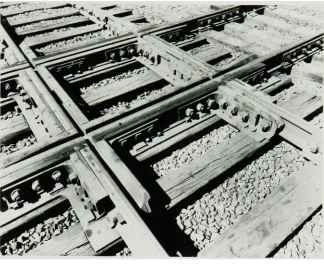
Of the three photographs I shall analyze, World Line is
the most pleasing. It best displays the conceptual equivalent
of the depicted physical structure, in this case
intersecting
railroad tracks.
At the scene the focal point for seeing became a magnetic
center for me to mentally and visually explore. There was no
hurry
for me to set up the camera; the tracks were allowing meample time for contemplation and discernment. Intuition was
impelling
me to make the photograph. On the ground glass theimage seemed to lock in as if there was only one possible compo
sitional choice. This required a position
directly
above onerail and very near the
intersection;
a vulnerable position hada train been approaching.
Sidelighting
provided the needed modeling of form and definition of texture.
Figure 1. World Line
World Line relies
heavily
upon continuation of line. Theimpression must be made that in any of four
directions,
the tracks continue infinitely. The tracks intersect at the great est possible angle in three-dimentional spaceindicating
opposing
directions. Pairs of rails are seen as symmetrical, par allel tracks. The tracks are seen as twointersecting
lines with the center squarebecoming
the point of intersection.Strong
contrast anddeep
shadows add to the hard edged mechani cal character of the objects and separate details from background.
It is necessary to be able to view the railroad crossing
[image:18.566.138.462.70.334.2]10
into some unknown person.
My
line intersects the other person'sline and an event occurs.
Something
may be learned from theevent: I see the man wears black shoes; he sees that I have a
camera around my neck.
Nothing
more than that may occur.But,
this event has become a part of my life experience! This is
worthy of recognition and appreciation.
Of course,
intersections
and events aretaking
place constantly for every person and every thing. The greater the event
the greater the
impact
on our lives. Photographs have becomemomentous events in that the objects of my photographs and I
intersect
at some point, and I have found value in recognizingthe object's right to existence. The intersection- of lines
carries no
judgement,
no emotion, no sentimentality. To aninanimate
object it is just an event; only I can have any opinion as to the value of the event. The significance of World
Line is its conceptual equivalent: natural events which col
lectively
carve life experience.Mind Space
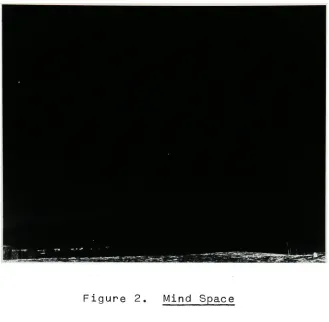
Mind Space has had more impact on viewers and attracted
more controversy than any other photograph taken
during
thisthesis period. It has remained one of my favorite photographs
mainly for the technical achievement and the faithfulness to
my mental
image.
Obviously,
many of those that have seen thephotograph share my perception of the night sky, even if it
does not exactly match real life tonal relationships.
Technically
the photograph is deceptive. It's a doubleexposure photograph under two very different and difficult light
ing
conditions. But that is beside the point if the photographmeets the viewers perception and their personal reality.
My
reality required that a photograph of the night sky over a
darkened landscape would have to have the
following
elements: agenuine star pattern in a recognizable constellation, no move
ment in the star
images,
a dark but detailedlandscape,
and atransparent sky. From a technical standpoint this is not easy
11
Figure 2. Mind Space
My
plan fordocumenting
the mental image called for twoseparate exposures on one sheet of film. The first exposure
was of the constellation
Orion,
one of the most easily recognized star fields. When we view stars in nature, there is no
apparent motion. In order to photograph the stars without
streaking the
images,
it was necessary to counteract the motionof the earth with a motor driven telescope mount. The exposure
time required was
twenty
minutes. Attention was paid to thealignment of the camera so that the position of the stars would
appear exactly as
they
do near the horizon. The exposure wasmade as the constellation neared the horizon so that stars in
the lower third would gradually be blocked
by
thicker atmosphere. Some bright stars did overlap the foreground detail in
the finished negative;
they
were retouched in the print. Thefirst exposure was not sufficient for the background sky to
fog
the film as much as one zone because of the moonless,
[image:20.566.148.477.66.388.2]12
The second exposure took more careful planning to yield
the proper tonal relationships. The camera had to be placed
on a tripod for a stationary platform. The next evening I
attempted to use the light of a crescent moon to light the
scene from the right and the late dusk glow on the horizon to separate the mountains from their background.
Relatively
short exposure times were needed if star streaks were to be
avoided. And at the short exposure times the moonlight was
not sufficient to light the foreground. The actual
luminosity
was less and the contrast greater than that perceived. An
alternative plan was devised.
In a second attempt the foreground exposure was made at
dawn with the
breaking
sunlighting
buildings and landscape.The light provided just enough modeling in the mountains to
give shape and depth. The sky would have been recorded too
light if it had not been for the use of contrast filters.
Natural polarization gives a gradation to the sky above the
horizon. A red filter would darken the blue sky appreciably.
The decision was to use both the red filter and the polarizer
to
bring
the upper sky to Zone I and the sky Just above thehorizon to Zone III. The remainder of the scene was unaf
fected
by
the filters and fell into a range from Zone I fordeep
shadows to Zone VI for the white houses. Expanded development increased the contrast slightly in the low values of the
mountains, made the gradation in the sky values more pronounced,
increased the contrast in the star
images,
and brought out thewhite buildings and light foreground field. That one and only
negative, difficult as it was to make, printed with a little
dodging
and burning-in to provide a photograph to match my perception.
Why
did I choose to include foreground landscape in thepicture, and why did I want a horizon glow? The illusion of
depth is difficult enough in the real life scene at night. Look
ing
straight up provides nothing upon which to draw size relationships. Mountains we know for their size. So I chose to
13
sky were all
black,
no visual element would place the starsbehind the mountains. The horizon glow outlines the mountains
and provides a
background;
the mountains in effect overlap thesky.
Continuity
of tone and "surface" of the sky makes us perceive the entire sky as behind the mountains, therefore very
far away. This is one
important
way depth can be portrayed ina subject that relies on faith for the illusion of depth.
The horizon glow also gives tone to the empty sky furnish
ing
an illusion oftransparency.
The glow depicts atmospherewhich becomes a transparent object through which the stars
shine. In a solid black background stars are just white spots
on a two-dimensional surface.
Transparency
provides the thirddimension in which stars can "float" at different distances
from the viewer. The larger star images appear closer, the
smaller images recede far to the distance. These are subtle
ways of giving an illusion of depth and a sense of realism to
the photograph.
It was not intended that Mind Space should imitate the
works of any other artist.
However,
some of the first reactionsinsinuated that I had plagiarized Ansel Adams' Moonrise-Hernandez .
It was not until I heard these comments that I even considered
the possible similarities.
Formally they
are somewhat alike:predominantly
low-key,
high contrast images. The bright whitebuildings in my photograph, as objects, stand out Just as the
cemetary markers do in Mr. Adams'
photograph. It is with these
points to me trivial coincidence that similarities cease.
In Mind Space the buildings are Just objects in the land
scape, useful as scale references, but little more. In
Moonrise-Hernandez we see the cemetery crosses as symbols that reinforce
the spiritual, surrealistic nature of the cloud formation. Spe
cific objects the moon, the clouds, the crosses create visual
impact.
Mind Space has no visually strong objects. Its impactcomes from the combination of all elements. This image is a
field,
no one point attracting attention or suggesting symbolism.Viewing
pleasure is a continuous sensation rather than a climac14
This vision does have prerequisites: a free and open mind
and no expectations. This may not sound like much to
ask, but
too many people are so
intent
on experiencing only excitementthat
they
miss thesmaller,
more significant events. The oldadage about
merchandise,
if it's free it must not be worth much,expresses the attitude of many persons toward vision. What
nature offers
freely
can be rewarding andfulfilling
for thosewho would open their eyes and minds.
Rest-Energy
Rest-Energy
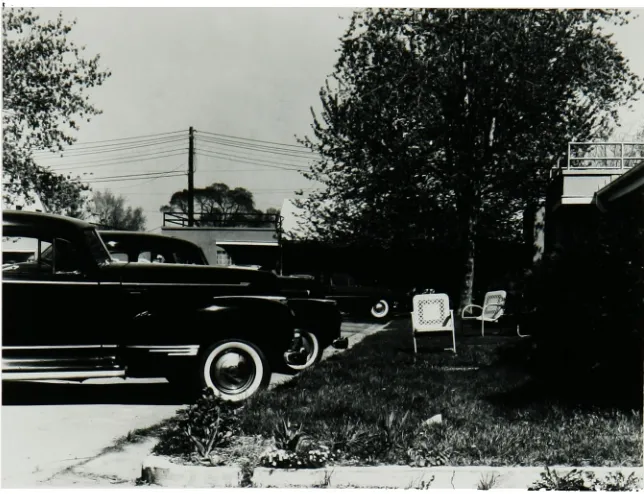
has some unique qualities that deserve specialattention. The nostalgic subject matter should not segregate
this photograph from the other thirty-five in the exhibit. It
continues to be one of the most enjoyable to study for structure
and implied motion.
The composition found itself on the ground glass. Just as
if there was a board fence with only one knothole to see
through,
there seemed to be one exact camera angle and position. A pho
tograph made prior to this exposure and from a point several
feet away failed to show the dynamic structure this vantage point
reveals. No element exist to demonstrate activity: no people
moving about, no wind in the
trees,
no motion in the cars. Sowhere is there motion?
Rudolf Arnheim has written that the shape of objects, their
juxtaposition,
and the balance in the composition will eitherin-5
duce or hinder a perceived motion response. Perceived motion
may be caused
by
eye movements, memory associations, and/ordy
namic structure.
Rest-Energy
makes use of each technique toinduce a sense of
impending
motion and stored energy.The dynamic patterns at work in this composition are most
obvious. Three cars point into the center of the
frame.
Inthe closest car we see a pattern of three metalic stripes of
different lengths that have a forward
thrusting
effect. The15
Figure 3.
Rest-Energy
curving fenders create a swirling movement response. One lawn
chair that faces us
directly
contains a pattern of geometricallyreceding squares that creates an illusion of depth. These
shapes lead us in and out of an
imaginary
tunnel. A wedge ofgrassy lawn thrusts us left as the cars redirect our vision
right creating motion perception through eye movement.
Eye movements play the greatest role in creating a motion
illusion. Three similar cars overlap; the shapes repeat. Each
car has white rimmed tires that again repeat and cause shift
ing
eye movements. The wedge of lawn and the cars create aswirling movement near the center. Dark objects on the
left,
the cars, and on the right, the
bush,
keep
our eyesbouncing
across the center. The telephone lines provide tracks for our
vision to dance between trees. When our eyes move from the
larger tree to the distant
tree,
we are also moving in and out.The same is true of the cars'
wheels. Different sizes create
[image:24.566.136.458.81.328.2]16
movement: in and out,
diagonally,
and laterally.Motion could be implied
by
the associations of cars withmovement. This is evident in
Rest-Energy
only to a lesserdegree for the cars have no drivers and
they
are parked againsta curb that will allow no
further
forward movement. We knowthough that
they
could be moved;they
have potential just asthe trees will bend with the wind and the chair will rock. What we have is a state of dynamic equilibrium. Forces of ten
sion and compression
balance,
yet remain ready to spring loosein all directions should the laws of nature fail.
The
framing
of this picture is intentional. Not enoughof the motel
building
is visible to document the location. Thecars are cut in half
by
the left-hand border that eliminatesdocumentation of their lines. This specific
framing
creates anabstraction, an abstraction needed for fuller involvement
by
the viewers imagination.
Some of the fun of this photograph is
knowing
that it was taken in 1978 rather than in the fourties. Perhaps this creates,for me at
least,
a surreal sense of timelessness. I was privileged to be at the point at which elements of architecture and
automotive design from another era reappeared in time.
Rest-Energy
expresses the essence of that event.The Other Photographs
Several other photographs deserve comment as well as the
body
of work as a whole. The psychological responses to thescene were different with each situation, yet the general ap proach was consistently straight-forward and photographic.
The most
fulfilling
situations were those when some intellectual concept was clarified.
Wormhole,
for example,help
ed me understand several cosmological theories
dealing
with blackholes,
space/time, and evolution of the universe. The image became a way of visualizing what I had read about and imagined in my mind's eye. The light at the end of the tunnelimag-17
ination will accept the challenge. Other photographs that work in
this conceptual mode
include
the clock (photograph#2),
Man' sFavorite
Sport,
and World Line.Some photographs elicit deeper emotional appeal. Examples
are Mother and
Child,
grasses(#35),
puppies(#34),
and pineboughs
(#24).
War Hero is perhaps the best illustration. Ido not know who is buried beneath these markers or even if he
was a soldier. Since there is no inscribed
headstone,
the remains could be thought of as an unknown soldier. I thought of
the
futility
of war and the senselessness ofdying
this way.The frozen
dog
photograph(,#16)
has been understandablydisturbing
for many viewers who see the picture as gruesome orgrotesque. The photograph is not about death as much as it is
about the
living
and their response to and awareness of death.Living
in the country puts one in a position to see this typeof scene quite often. One learns to accept mortality. I was
saddened to see this
dog,
but less so because of the nonviolent way it died. The one
thing
that does disturb me isthat the
dog
might have been abandonedby
its owner, as indicated
by
the collar. I have not violated thisdog
by
recordingits death. A straight-forward approach is the only appropriate
method of recording this situation.
Occasionally,
my response to a scene is primarily visual.Form and structure are exciting. So I use the ground glass to
find the best composition of lines and shapes available. The
landscape with clouds
(#8)
is such a photograph. It is beautiful and
dramatic;
a moment to be savoredby
the eyes. Photograph number eleven is similar in effect except that the un
usual cloud form excites the imagination to attribute monsterish
characteristics to the clouds. In
doing
so, size relationshipsbecome ambiguous. The clouds may be larger than the mountains!
Unusual tonal relationships add surrealism to the image. Our
mind's eye picks up where our sight leaves off.
The most difficult approach for me to understand and
adopt is the intuitive approach. It would be easy to
lump
18
intuitive approach. The ice and
fog
photograph(#25)
does notstir my emotions. It has a
loosely
defined structure thatapproaches confusion.
However,
it has been the favorite photograph of many viewers and it has strong appeal for me. The
unfamiliar character of an
ice
storm led me to thelocation,
but the specific composition seemed instinctive. It was as if
I had yielded to my subconscious self to analyze and select
the subject for the photograph. I can explain only fragments
of my understanding of the situation; much remains unknown. I
want to trust in my intuition to occasionally provide me with
subjects to photograph. Weak composition,
though,
can not bejustified because the subjects came intuitively.
The complete
body
of work becomes a foundation for continued work in this mode. Since the exhibition I have taken
many more photographs that are exciting and fulfilling.
My
goals have been reached, but the pleasures of seeing have just
ON BOUNDARIES
Photographs and other two-dimensional works of art are
physically closed systems; that
is,
they
have borders that restrain our vision within a specific area. The act of visualiz
ing
and photographing a scene implies selectionby
the photographer of what information shall be included in tnat image.
It is this selection that makes the difference between the
artist and nature.
In choosing what objects and scenes to photograph, the
photographer also decides the shape and position of the bound
aries. The
boundary
is that edge where information essentialto the photograph stops and superfluous information in the
remaining environment begins. Two opportunities are available
for establishing borders: the first
by
cropping the image inthe camera at the time of exposure and the second
by
croppingthe negative in the printing stage. The shape and position of
the borders greatly affect the viewers perception of the photo
graph.
Traditionally,
horizontal or vertical rectangles witha one to one and one quarter ratio have been used as standards
for photography.
However,
other shapes of formats have beenused, most notably the square shape of medium format cameras
and the round shape of fish-eye lenses and the early Kodak
cameras. What are the effects of these image shapes?
6
This is based on the standard sizes for photographic
papers
being
8"x10",
11"x14",
16"x20",
20"x24",
etc. Interestingly,
if one of these sheets is bisected along the short dimen sion, the resulting sheets have dimensions in the ratio of fiveto eight. This ratio (approximately) is known as the "golden
mean"
and can be found in nature and throughout
history
inman-made arts. For an
interesting
article on this ratio see WilliamHoffer,
"A Maqic Ratio Recurs Throughout Art and Nature," Smith sonian, December1975,
pp. 111-124.20
The rectangular shape is thought of as aesthetically
pleasing as
long
as onedimension
does not exceed the otherby
more than about sixty percent. This shape can complimentand dramatize vertical or horizontal subjects. On the other
hand,
a rectangularimage
that is excessively tall or widecan create a lack of acceptance
by
viewers who see the shapeas confining or unnatural. Square formats neutralize the re
inforcing
effect providedby
rectangularly shaped boundaries.The square shape makes the viewer achieve any psychological
change from the subject alone. The circular and oval frames
are also neutral but more closely approximate the effect of
human sight.
The human eye is a remarkable and
fascinating
organ.If one closes one eye to eliminate depth perception, the
other eye acts as an extreme wide-angle, rectilinear receptor.
In this situation if we "focus" on one spot in the
distance,
our peripheral vision enables us to see far to the sides and
top
and bottom in a circle of about one hundred sixty degreesand only interrupted
by
our nose.However,
only a very smallangle of acceptance will be sharply detailed: that portion
received
by
the centrally located fovea. The remaining portionis less and less sharp at increased angles from the center spot.
Our mind fills in blanks in peripheral vision so that we can
sense and maybe
identify
large objects to the side but cannotsee their details.
The photographer could make images that were only sharp
in the center and less sharp near the edges. The photograph
would appear normal if our visual attention could be held on
that one central spot. But our eye must be able to roam a
scene that is detailed in all areas. Our perception of a
scene is a quick composite of many scanning movements of the
eye. Our perception is of overall sharpness because of these
eye movements. The natural parallel for photography would be
to render the image in sharp detail throughout.
Viewing
distance becomes important at this point. In a21
we are very close to the photograph or the photograph is very
large,
eye movements equal to those of the actual scene wouldnot be possible within the borders of the print. A curved,
wrap-around photograph would
imitate
natural vision (exceptfor depth perception), but this is not practical. Large
detailed photographs are necessary for exhibition. For this
thesis I made large prints 11"x14" and 16"x20" based upon
an average viewing
distance
of three feet. Large format photography
provides the detail if the viewer wants to move infor closer examination.
The location of each border is important. In many of
the images careful consideration was given even when cropping
ever so slightly. Each scene seems to have set its own bound
aries, edges at which superfluous information stopped and
relevant information began. This required visual study of the
subject and exploration via the ground glass image.
Occassion-ally, the photographic negative was not cropped exactly like
the previsualized mental image. The rectangular porportions
might not have been right or camera vantage point may not have
been optional. I do not hesitate in such situations in crop
ping the negative to achieve a print that approximates my
mental image. The end justifies the means in this instance.
Photographing
a scene is attributing significance toeverything within the frame and
denying
significance to everything
outside at that moment. Borders are established aroundthe significant information.
However,
in nature all objectsare of equal importance no matter how
large,
howbeautiful,
how fragile. Arnheim said it this way: ". . . the visual world
presents itself as a continuum, devoid of clear-cut
breaks,
and expanding beyond any
frame."
If photographs have to have
borders,
then I shouldtry
to present subjects that createmental pictures that have none. I believe Mind Space does
Just that. While the edges of the physical print are confining,
the stimulated mental image expresses the limitlessness of
22
space. The mind's eye can create an image that does not re
INNER REALITIES
External reality, the objective facts of existence, can
be supplemented in the human perception
by
a second, personal,inner reality. Information about an object, non-analytical
and
non-interpretative,
will be either accepted or rejectedby
theindividual
psyche based upon a perceived reality. External realities are singular,
bounded,
and inflexible. Innerrealities, on the other
hand,
are open to various interpretations and modifications at the will of the unconscious mind
as expressed through imagination.
In photographing a natural structure such as a melting
ice
form(photograph
#4),
is the reality that specific frozenstructure or can the reality be the symbolic images in the
mind's eye? For this photographer, reality is a combination
of both the external reality supplied
by
the ice sculpture andits environment and the internal reality supplied
by
symbolicassociations. The experience of the event is more than mere
recognition of the external reality. In speaking of "what
else it is,"
a concept of equivalence, one must be able to ex
perience an event on several different levels.
Photographs,
at the very
least,
provide visual documentation of the external reality. But contemplating the event can reveal inner
realities which may lead to greater personal understanding.
External reality is a shared phenomenon while inner re
alities are entirely personal. Anyone may see a cloud as an
amorphous collection of water vapor
hovering
at specific layersof atmosphere. We all share this reality for which science has
provided rational explanation. But what of the poet, the phi
losopher,
or the painter that sees the cloud as adynamic,
living
creature of nature or as a symbol of stability in anotherwise turbulent existence?
Reality
for the artist will24
include
all that he brings to his perception from his imagination an act of creativity. Individuals may find relevance in
their own
interpretation
above and beyond the externalreality
of the event.
A basic need for man is to feel that he is not alone in
his perception of the world around him. Events are perceived
by
people in ways similar to all. For example, few would notagree that
flowers
arebeautiful.
Perceiving
beauty
is acommon human experience.
However,
we do not seebeauty,
weperceive
beauty,
a difference causedby
the input of valuejudgements.
There
is nobeauty
(ortruth,
or any other valuejudgement)
in nature that is not the product of the analyticalmind
functioning
in response to both externaland inner reali
ties. To record "the
thing
itself"requires not faithful docu
mentation but
loyality
to perception.".
. . the work of artsymbolizes all levels of reality that lie between the phenome-g
non and the idea."
Even allowing for individual differences
in perception, people are remarkably alike in their psycholog
ical responses. Unless the artist has lost all touch with
external reality, others will recognize the common human ex
perience represented in a photograph. Minor White was in touch
with his inner self when he said:
Reality
is not to be avoided, it is to be penetrated to its other side. Perhaps the other side of reality is exactly the world the painter seeks in his own way of alter
ing
the visual world. The camera,however,
targets on reality and stops down to get beyond.9Getting
in touch with the inner world isn't difficult noris it psychologically unwise. Drugs have been used
by
all cultures and at all times in
history
to enter the world of theunconscious. Other safer methods can be used with equal suc
cess. I have found that entering into a visual experience with
no preconceptions and no impositions allows for free
communi-8Ibid.,
p. 221.Minor
White,
"Your Concepts Are Showing,"American
25
cations between the object and myself.
Drug
inducedimagery
does not allow for the union of the unconscious with external
reality.
By
allowing nature to speak its visuallanguage,
theattentive viewer may better understand the importance of his
individual perception of external reality.
Other artists have expressed similar techniques. Edward
Weston used contemplation and concentration on the ground glass
image. Minor White gave this advice: "Be still with yourself,
10
until the object of your attention affirms your presence."
James Joyce continually switches from the present to past re
membrances or to fantasies in his novels, for he thought
memor-ies and fantasies were just as real as external reality. Sam
uels refers to the effects of visualization
by
commenting:Henri Rousseau's paintings show that he was in contact with
the coherent inner world which was as real to him as the
external world. It is said that he used no specific exer
cise to get in touch with his visualizations and drew no
hard and fast line between inner and outer. '
Each photographer will express a different purpose for
making pictures. I have discovered that
involving
my psychicself along with my physical self with objects creates an exper
ience,
an event.Photography
creates a deeper involvement atthe time of exposure and later in viewing the print. An ex
perience I had in making a photograph since the exhibition may
help
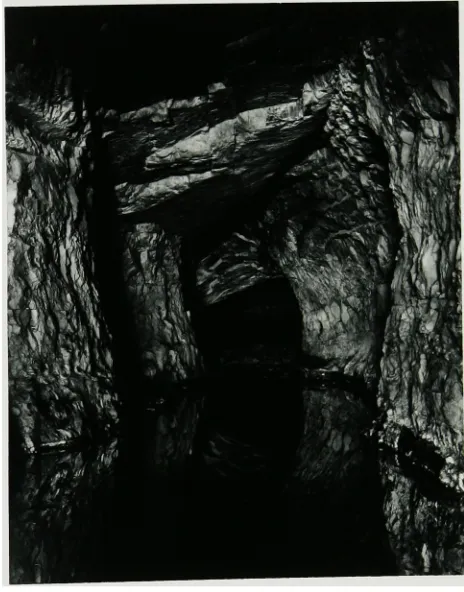
in clarifying my position.The scene was an abandoned limestone mine, a huge man-made cave gutting a mountain. It was a challenge to my fears
to enter the cave, but I continued to explore as far as the light from the entrance would carry. I was
becoming
involvedin seeing a radically different world of cold rock, distorted
scale, and dark recesses. Emotions ran deep. At the far end
of one
tunnel,
still in line with the light from the entrance,I found a lake.
Naturally,
the surface of the water wasab-"10Minor
White,
Mirrors,Messages,
and Manifestations(Millerton,
N.Y.:Apeture,
1969),
p. 42.26
solutely still, revealing a mirror image of the rock walls and
ceiling. The
intensity
of the experience matched my inner fearswith the quiet reality of the cave. I set up the camera. It was difficult emotionally for me to remain for several six min
ute exposures.
Leaving
the mine was a relief, and yet the experience had been exhilarating and fulfilling. Anticipating
seeing the print later added to my sense of personal accomplish
ment. I knew the photograph would not be a document of the cave
alone; it would be a record of the total event.
The print enables me to re-experience seeing the beautiful subterranean world and
feeling
the same emotional intensity.My
inner realities, manifest in fears and apprehension, were modi
fied
by
the external reality of the natural rock surfaces. Theexperience would have been
incomplete,
in fact nothuman,
if itwere not for the involvement with my inner self.
[image:35.566.165.397.371.667.2]COSMOLOGY AND THE PHOTOGRAPHIC IMAGE
Many
of the photographs takenduring
this thesis yearare titled with terms of cosmology: wormhole, world
line,
rest-energy,
space/time, etcetera. Some mysteries of the universe are
beginning
to unfold. Science isbeginning
to piecetogether the
jig
saw puzzle that will tell us of the past andmore accurately predict the future. Awareness of the expanse
of the universe seeds
imagination.
The possibilities conceptualized
by
the cosmologists nurtureimagery.
Occasionally
thetheoretical concepts of universal evolution seem understandable
as a result of earthly visual experiences. It is in these in
tellectually
exciting moments that I sense that I understandsome cosmological concept based upon an equivalent terrestrial
phenomenon. New freedom for my imagination has been found
reaching beyond the edges of the universe.
One such event happened with the previously described
photograph of a tunnel through a mountain titled Wormhole
(photograph
#1).
I had walked through and driven through thistunnel hundreds of times before making this image.
By
quietlystudying its entrance in preparation for
taking
the photograph,I remembered a concept I had read, the concept of "wormholes."
Some astronomers speculate that black
holes,
extraordinarilydense collapsed stars, may be the entrances to time tunnels.
Wormholes cross space
terminating
perhaps thousands of lightyears away but in a time that to us would be past. An object
falling
into a black hole wouldinstantly
fall through theworm-hole to another part of the universe. Astronomers have imagined
that this could account for the evolution of the universe: stars
falling
into blackholes,
thrust back in time to another partof space, evolving over billions of years only to fall into yet
another black hole. The cycle goes on forever. There is no
28
evidence to either prove or
disprove
the theory. But the concept at least is very exciting. I could now see the
earth-bound tunnel in symbolic terms.
My
tunnel could be an avenueto knowledge light is
knowledge
or it could be a pathwayfrom conscious to subconscious, from reality to fantasy. The
angle of view,
directly
in front of the entrance, entices themind, if not the
body,
to sample the delights of a new worldat the end of the tunnel.
My
imagination can not resist allthe possibilities offered
by
this one experience.Albert Einstein has supposedly said that mystery is the
only true source for art and science. What can be more mys
terious than the alien worlds of the
infinitely
large universeor the
infinitely
small subatomic particles? Neither is partof our perceived world because of the narrow scale with which
we are accustomed.
Only
our imagination can react to eithersuch a small or such a large scale. Rudolf Arnheim puts it
beautifully
this way:Man's senses are geared to a particular range of magnitude, located between the atomic and the astronomic realm, and in
this realm we observe conglomerations of shapes that lack
most of the simplicity found at other cosmic levels. This
intricate landscape is our reality in the most immediate
sense. But it is not the only reality to which the human mind can refer.
Whether,
intrying
to answer the question: What is reality?, we look at what is close at hand or whatis remote, apparent to the eye or
hidden,
superficial oressential, shaped or unshaped, is a matter of philosophical outlook or, aesthetically, of style.
It is my style to see the universe in every
tree,
in everymountain, in every star.
APPENDIX A
DETERMINING
EXPOSURE AND DEVELOPMENT TIMESFor film
development
standardization I used a proceduresuggested in Arnold Gassan's Handbook for
Contemporary
Photography. That procedure is as follows:
Step
1. Find the film's true film speed. For this testa number of exposures were made of a gray card on Ilford FP-4
film,
metering
so as to place the 18% reflectance gray side inZone I. Various exposure indexes were used to yield a series
of
barely
perceptibledensities.
The film was developed inEdwal FG-7 developer diluted 1:15 according to the manufactur
er's recommendations. The
density
which was the lightest andyet perceptibly different from the film base was chosen as
representative of Zone I and the true film speed, in this case
ASA 125.
Step
2. Find a standard exposure for paper. A secondstrip of film was prepared
by
shooting a gray card anddevelop
ing
as before. But this time the exposure was adjusted to placethe gray card in Zone II. The reason for Zone II instead of
Zone I is that Zone I can not be printed on photographic paper
except as solid black. On paper Zone II is the first perceptible
change in
density
from maximum black. The minimum exposure timeneeded with the enlarger that shows the difference between Zone 0-1 and Zone II on paper is the standard exposure for paper.
Step
3. Determine normal film development. Several sheetsof film were exposed exactly at Zone V but each developed at a
different development time. Then the negatives were printed on
photo paper using the standard exposure. The negative that gave
a print that was closest to Zone V gray was developed normally.
This step takes into account variations in enlarger contrast and
lens inaccuracies.
30
Step
4. Prepare a graph of densities for various development times. Expose a series of sheets of film to Zones
I through XI.
Develop
the filmusing
normal development timejust
determined.
Using
adensitometer
measure the densitiesof each zone, then plot the measurements on a development
versus
density
graph. Repeat this sameprocedure for
50%,
75%,
and 150% normal
development.
Again plot theresulting densities,
Four series of test is enough to plot
"parametric
curves" foreach of the eleven zones and Zone
0,
film base plus fog. Thegraph for Ilford FP-4 film developed in FG-7 developer diluted
1:15 (at 68) is shown in Figure 5.
X X
1.8
1.6
1.4
1.2
^^ j^- ~>^^
~~i^^7- ^^^^C . ^^^
>. 1.0 t-<J) 2 B LU 0 .6 .4 2
8 10 12 14
DEVELOPMENT 16 18 IX VIII VII VI IV III II I O
[image:39.566.52.493.299.640.2]31
Step
5. Determine exact plus or minus development timesfor expansion or compaction. In my tests normal development
time was determined to be 10 1/4
minutes. It is necessary to
look at Zone VIII print
density
to determine plus or minus development
times.
Zone VIII is the threshold betweenbarely
perceptible tones and brilliant
white, the zone most affected
by
variations indevelopment.
As revealed in the accompanyinggraph, at normal
development
time Zone VIII yields a negativedensity
of1.15.
Formy enlarger and with my equipment a 1.15
density
in the negative will print as Zone VIII at the standardexposure time on grade two paper. If normal minus
(
N-1)
development is called for because of scene contrast, that
is,
aZone IX subject developed to yield Zone VIII (1.15
density),
then the new
development
time would be 8 3/4 minutes. 1.15density
becomes a baseline fordetermining
expanded or compacted
development.
Of course, for any other enlarger systema new baseline would have to be determined.
Zone system metering becomes a very simple two