JOURNAL OFVIROLOGY, Sept. 1995, p. 5773–5780 Vol. 69, No. 9 0022-538X/95/$04.0010
Nucleotide Sequence Variation of the Envelope Protein Gene
Identifies Two Distinct Genotypes of Yellow Fever Virus
GWONG-JEN J. CHANG,1* BRUCE C. CROPP,1RICHARD M. KINNEY,1
DENNIS W. TRENT,2
ANDDUANE J. GUBLER1
Division of Vector-Borne Infectious Diseases, National Center for Infectious Diseases, Centers for Disease Control and
Prevention, Public Health Service, U.S. Department of Health and Human Services, Fort Collins, Colorado 80522,1
and Division of Viral Products, Center for Biologics Evaluation and Research,
Food and Drug Administration, Bethesda, Maryland 208922
Received 3 April 1995/Accepted 19 June 1995
The evolution of yellow fever virus over 67 years was investigated by comparing the nucleotide sequences of the envelope (E) protein genes of 20 viruses isolated in Africa, the Caribbean, and South America. Uniformly weighted parsimony algorithm analysis defined two major evolutionary yellow fever virus lineages designated E genotypes I and II. E genotype I contained viruses isolated from East and Central Africa. E genotype II viruses were divided into two sublineages: IIA viruses from West Africa and IIB viruses from America, except for a 1979 virus isolated from Trinidad (TRINID79A). Unique signature patterns were identified at 111 nucleotide and 12 amino acid positions within the yellow fever virus E gene by signature pattern analysis. Yellow fever viruses from East and Central Africa contained unique signatures at 60 nucleotide and five amino acid positions, those from West Africa contained unique signatures at 25 nucleotide and two amino acid positions, and viruses from America contained such signatures at 30 nucleotide and five amino acid positions in the E gene. The dissemination of yellow fever viruses from Africa to the Americas is supported by the close genetic relatedness of genotype IIA and IIB viruses and genetic evidence of a possible second introduction of yellow fever virus from West Africa, as illustrated by the TRINID79A virus isolate. The E protein genes of American IIB yellow fever viruses had higher frequencies of amino acid substitutions than did genes of yellow fever viruses of genotypes I and IIA on the basis of comparisons with a consensus amino acid sequence for the yellow fever E gene. The great variation in the E proteins of American yellow fever virus probably results from positive selection imposed by virus interaction with different species of mosquitoes or nonhuman primates in the Americas.
Yellow fever (YF) virus, an arthropod-borne virus in the
Flavivirus genus of the family Flaviviridae, is the etiologic agent
of YF, a viral hemorrhagic fever that occurs in six tropical South American countries and much of sub-Saharan Africa (29). The primary transmission cycle involves nonhuman pri-mates and tree-hole-breeding mosquitoes. Mosquitoes of the genera Haemagogus in tropical America and Aedes in equato-rial Africa are the principal vectors responsible for year-round virus transmission (28). Humans, when they intrude into this cycle, are exposed to the infective mosquitoes, and transmis-sion may occur by sylvatic vectors. The urban mosquito, Aedes
aegypti, is a very efficient vector and may transmit the virus to
humans, resulting in explosive outbreaks of urban YF (28). A safe and effective YF vaccine, 17D, has been available since 1937. However, it is not used effectively, and the disease continues to occur in Africa and South America, where 21 and 3 outbreaks, respectively, were recorded between 1940 and 1987 (29). A major public health concern in Africa has resur-faced as a result of a devastating YF outbreak in Nigeria and surrounding countries between 1986 and 1993 (8, 36) and the first recorded YF outbreak in the East African country of Kenya in 1992 and 1993 (26).
YF virus has a single-stranded, positive-polarity RNA ge-nome of 10,862 nucleotides (nt) which encodes three structural
proteins (C, PrM, and E) and seven nonstructural proteins (NS1, NS2A, NS2B, NS3, NS4A, NS4B, and NS5) in a single open reading frame (33). Antigenic differences between South American and West African strains of YF virus have been shown by antibody absorption techniques (6). Strains can also be differentiated on the basis of mouse virulence (2, 16). Four genetic topotypes of YF virus have been distinguished by RNA oligonucleotide fingerprinting (9), and three have been iden-tified by analysis of limited envelope (E) protein gene se-quences (23).
The E protein is important in receptor binding, hemagglu-tination of erythrocytes at acid pH, induction of the protective immune response, and involvement in an intraendosomal, ac-id-catalyzed fusion step necessary for infection (18). Because of its biologic importance, we have sequenced the entire YF E protein gene of 20 epidemiologically important viruses. Phylo-genetic analysis of the 1,479-nt E gene sequences identified two E genotypes of YF viruses. The data genetically link YF viruses isolated during outbreaks that occurred from 1986 to 1993 in Nigeria and from 1992 to 1993 in Kenya to previously isolated YF viruses. Amino acid sequence comparisons of the E proteins of antigenically distinct YF viruses have provided an explanation for the observed antigenic variation among these viruses.
MATERIALS AND METHODS
Virus strains and reverse transcription (RT)-PCR amplification of viral RNA.
YF viruses sequenced in this study were obtained from the Division of Vector-Borne Infectious Diseases, National Center for Infectious Diseases, Centers for
* Corresponding author. Mailing address: Division of Vector-Borne Infectious Diseases, National Center for Infectious Diseases, Centers for Disease Control and Prevention, P.O. Box 2087, Fort Collins, CO 80522. Phone: (970) 221-6400. Fax: (970) 221-6476.
5773
on November 9, 2019 by guest
http://jvi.asm.org/
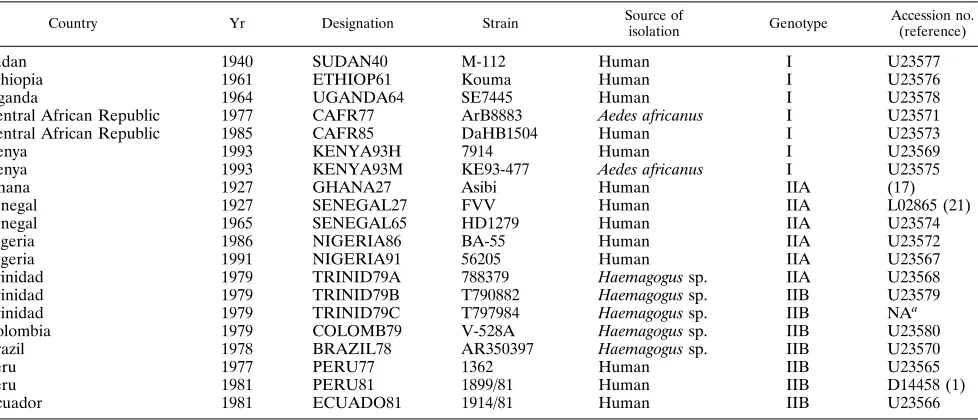
Disease Control and Prevention (Fort Collins, Colo.). Of the 20 YF virus se-quences analyzed, 3 were obtained from previous publications (1, 17, 21). Des-ignation, country of origin, year of isolation, E genotype, and GenBank accession number for the E gene sequence of each virus are summarized in Table 1.
Viral RNA was extracted directly from virus stock, as previously described (24). The YF virus-specific oligonucleotides used in the RT-PCR amplification of viral RNA and the sequencing of the E gene are shown in Table 2. The RT-PCR to convert single-stranded YF RNA to cDNA and to amplify double-stranded
cDNA was performed in a reaction volume of 100ml containing 10 mM Tris-HCl
(pH 8.5), 1.5 mM MgCl2, 50 mM KCl, 0.01% gelatin, 1mM (each)
deoxynucle-otide triphosphate, 5 mM dithiothreitol, 100 pmol (each) of two amplimers, 0.15 U of RAV-2 reverse transcriptase (Amersham, Arlington Heights, Ill.), 40 U of RNasin (Promega, Madison, Wis.), 2.5 U of Amplitaq polymerase (Perkin-Elmer
Corp., Norwalk, Conn.), and 5 to 15ml of viral RNA. This single-tube RT-PCR
was incubated at 508C for 1 h, denaturated at 948C for 4 min, and then subjected
to 30 cycles of denaturation at 948C for 30 s, primer annealing at 508C for 30 s,
and primer extension at 728C for 5 min and terminated with a final extension step
at 728C for 20 min before being held at 48C in a thermocycler GeneAmp PCR
System 9600 (Perkin-Elmer).
Nucleotide sequencing.Double-stranded PCR-amplified DNAs from multiple amplification reactions were purified with a Geneclean II kit (Bio 101, Inc., La Jolla, Calif.). Sequencing reactions were performed with Taq DyeDeoxy Termi-nator cycle sequence kits (Applied Biosystems, Foster City, Calif.). Sequences were resolved with an ABI 374 sequencer (Applied Biosystems).
Nucleic acid and protein sequence analysis.The YF E gene sequences and deduced amino acid sequences were analyzed with a computer program, HIBIO DNASIS/PROSIS (Hitachi Software Engineering, Brisbane, Calif.). A strict con-sensus sequence of the YF E gene, YFCONSEQ, was obtained with the com-puter program CONP (22). This program calculated the frequency of occurrence of each nucleotide at each E gene position and applied the majority rule method to assign a specific nucleotide to this position in the consensus sequence.
The nucleotide sequences of the YF E genes were aligned with YFCONSEQ or the E gene sequences of dengue 1, dengue 2, dengue 3, dengue 4, Japanese encephalitis, St. Louis encephalitis, Kunjin, tick-borne encephalitis, and cell-fusing-agent viruses by the Clustal V alignment program (3, 7, 11, 19, 27, 31, 32, 34, 37, 38). Phylogenetic trees were constructed with the PHYLIP version 3.5c program package (14, 15). The most parsimonious tree was generated with the uniformly weighted parsimony program of DNAPARS. The significance of the phylogenetic trees was subjected to statistical bootstrap analysis with the pro-grams SEQBOOTS (to generate 100 reiterated data sets), DNAPARS (random-ize input order option ‘‘on’’ and 10 replicas), and CONSENSE or with the programs SEQBOOTS, DNADIST, FITCH, and CONSENSE. The resulting phylogram was drawn with the program DRAWGRAM.
[image:2.612.66.555.83.293.2]Nucleotide and amino acid signature pattern analysis.Nucleotide and amino acid signature pattern analysis based on phylogenetically informative characters was applied to examine the genetic similarity of YF virus strains in each geno-type. Unique signature sites within the E gene of each genotype were identified
TABLE 1. YF viruses used to analyze the E protein gene sequence
Country Yr Designation Strain Source of
isolation Genotype
Accession no. (reference)
Sudan 1940 SUDAN40 M-112 Human I U23577
Ethiopia 1961 ETHIOP61 Kouma Human I U23576
Uganda 1964 UGANDA64 SE7445 Human I U23578
Central African Republic 1977 CAFR77 ArB8883 Aedes africanus I U23571
Central African Republic 1985 CAFR85 DaHB1504 Human I U23573
Kenya 1993 KENYA93H 7914 Human I U23569
Kenya 1993 KENYA93M KE93-477 Aedes africanus I U23575
Ghana 1927 GHANA27 Asibi Human IIA (17)
Senegal 1927 SENEGAL27 FVV Human IIA L02865 (21)
Senegal 1965 SENEGAL65 HD1279 Human IIA U23574
Nigeria 1986 NIGERIA86 BA-55 Human IIA U23572
Nigeria 1991 NIGERIA91 56205 Human IIA U23567
Trinidad 1979 TRINID79A 788379 Haemagogus sp. IIA U23568
Trinidad 1979 TRINID79B T790882 Haemagogus sp. IIB U23579
Trinidad 1979 TRINID79C T797984 Haemagogus sp. IIB NAa
Colombia 1979 COLOMB79 V-528A Haemagogus sp. IIB U23580
Brazil 1978 BRAZIL78 AR350397 Haemagogus sp. IIB U23570
Peru 1977 PERU77 1362 Human IIB U23565
Peru 1981 PERU81 1899/81 Human IIB D14458 (1)
Ecuador 1981 ECUADO81 1914/81 Human IIB U23566
aNA, not available.
TABLE 2. Oligonucleotide primers used to amplify and sequence YF virus E protein genes
Primera
Sequence Melting temp
(8C) Utility
b
YF791 59CGGCAAGAAAAATGGATGACTGGAAGAATGGG 66.4 Amp and seq
YF1196 59CCCAGCACTGGAGAGGCCC 61.3 Seq
cYF1196 59GGGCCTCTCCAGTGCTGGG 61.3 Seq
YF1268 59AGAGGCTGGGGCAATGGCTGTGG 68.7 Seq
YF1402 59GCATGTAGGGGCCAAGCAGGAAA 64.8 Seq
YF1459 59CAGTTACATCGCTGAGATGGAAACAGAGAGCTGGA 71.6 Amp and seq
cYF1459 59TCCAGCTCTCTGTTTCCATCTCAGCGATGTAACTG 71.6 Seq
cYF1623 59CCCCGCCACTTCCACTCTGCC 66.5 Amp and seq
YF1823 59AGAGTGAAACTGTCAGCTTTAACACTCAAGGG 66.8 Seq
cYF1823 59CCCTTGAGTGTTAAAGCTCACAGTTTCACTCT 64.6 Seq
YF1921 59CACTGTTGTGATGCAGGTGAAAGTGT 61.0 Seq
cYF1921 59ACACTTTCACCTGCATCACAACAGTG 61.0 Seq
cYF2470 59CAACTTTGGCAAGAGAGAGCTCAAGTGCGGAG 71.7 Amp and seq
cYF2649 59CTCATCTGCCCTGCTTCTCCACATCT 64.5 Amp and seq
a
The number indicates the genomic position of the oligonucleotide primer. A ‘‘c’’ indicates an antigenomic-sense oligonucleotide primer.
b
Amp, amplification; seq, sequencing.
on November 9, 2019 by guest
http://jvi.asm.org/
[image:2.612.60.556.553.710.2]by comparing the alignments of genotypes I, IIA, and IIB virus E gene sequences with the nucleotide and amino acid sequences of YFCONSEQ.
RESULTS
Nucleotide and amino acid sequence analysis.A comparison
of the 20 YF virus E gene sequences revealed nucleotide sub-stitutions scattered throughout the entire gene. There were no base insertions or deletions. Viruses isolated in West Africa and East and Central Africa had nucleotide sequence similar-ities of 89.7 to 99.7 and 90.7 to 99.9%, respectively (Table 3). American viruses had a similarity of 89.3 to 99.6%, except for the TRINID79A isolate, which had a higher similarity to West African viruses (89.7 to 98.2%) than to American viruses (84.2 to 84.8%) (data not shown). Intergeographic similarities were lower than intrageographic similarities; however, the intergeo-graphic similarities range was narrower than the intrageo-graphic similarities range. A YF virus consensus sequence, YFCONSEQ, which represents the dominant genetic code in the collection of YF E gene sequences, was constructed from a total of 20 E gene sequences. This YFCONSEQ had nucle-otide similarities to the West African, American, and East and Central African virus sequences in the ranges of 89.8 to 91.6, 89.7 to 90.3, and 85.9 to 88.4%, respectively (Table 3).
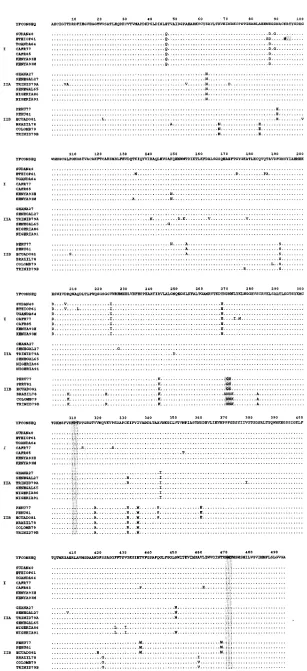
The ratio of silent base substitutions to substitutions result-ing in an amino acid change in the encoded E protein was 10 to 1 (data not shown), which was reflected in the greater conservation among amino acid sequences than among the nucleotide sequences (Table 3). The E proteins of all YF vi-rus strains had potential N-linked glycosylation sites at amino acid positions 309 and 470. An additional glycosylation site was present at position 269 in five of the American viruses (PERU77, PERU81, COLOMB79, EQUADO81, and TRINID79B) but was absent from the isolates TRINID79A and BRAZIL78. The Lys-to-Asn change at E-93 in the ETHIOP61 isolate created an additional potential glycosyla-tion site at this posiglycosyla-tion (Fig. 1).
The TRINID79A virus had 11 unique amino acids relative to those of the E protein of other wild-type YF viruses. Three of these unique amino acids (E-54, -153, and -249) were identical to those of the FNV vaccine virus, a derivative of the SENE-GAL27-FVV isolate (Fig. 1) (21). TRINID79A also had Arg at E-331, as did SENEGAL27, FNV, and all other South Amer-ican viruses. The aligned E gene nucleotide sequences of 20 YF viruses are available upon request.
Phylogenetic analysis of YF virus E protein gene sequences. The pairwise similarity measurements presented in Table 3 do not provide information about the geographic relationships among the viruses. To examine the range of relationships among viruses, we subjected the E gene nucleotide sequence data sets to phylogenetic tree analyses. The data sets were aligned with those of the E genes of other flaviviruses (dengue 1, dengue 2,
dengue 3, dengue 4, Japanese encephalitis, St. Louis enceph-alitis, tick-borne encephenceph-alitis, and cell-fusing-agent viruses) or YFCONSEQ. Most of the parsimony trees constructed with these data sets were identical, except when data were aligned with the E gene sequence of the cell-fusing-agent virus. Use of various outgroup virus sequences, except for that of the cell-fusing-agent virus, had little effect on the outcome of phylo- genetic tree construction (data not shown). We selected YFCONSEQ to serve as the outgroup and reference sequence in the phylogenetic analysis of the YF virus E gene data.
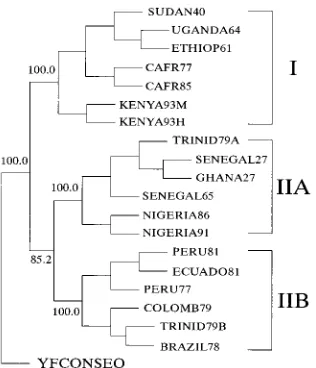
The most parsimonious tree required 919 steps (data not shown). Two trees of equal lengths with no differences in the monophyletic grouping were generated when DNAPARS was used with the randomized input sequence order in effect. Boot-strap resampling that used either a parsimony algorithm or the distance method of Fitch produced identical phylograms. A strict consensus tree, compiled from the bootstrap analysis with the parsimony algorithm (14, 15), is presented in Fig. 2. The numbers at the forks indicate the number of times the monophyletic group consisting of the viruses to the right of that fork occurred among the 100 trees. Higher numbers indi-cate higher confidence levels that the monophyletic nest con-sists of viruses to the right of the fork. By this procedure, two major genetic lineages or genotypes of YF viruses were iden-tified. The monophyletic grouping of East and Central African viruses, as well as that of viruses from West Africa and Amer-ica, was observed in all of the 100 reiterated data sets. E genotype I included all viruses from East and Central Africa. Genotype II consisted of two monophyletic nests, one of IIA viruses from West Africa and TRINID79A virus from America and the other of IIB viruses from America. Because of the eccentric genetic relationship of TRINID79A virus to IIA vi-ruses, the E gene of two more 1979 Trinidad virus isolates, TRINID79B and TRINID79C, was sequenced. These virus isolates were identical, but they differed from the TRINID79A isolate. Only the sequence of the TRINID79B virus was used in our analysis.
[image:3.612.59.557.92.179.2]A human isolate, KENYA93H, and a mosquito isolate, KENYA93M, both from a recent YF outbreak in Kenya, had a nucleotide sequence similarity of 99.9% and belonged to genotype I. The NIGERIA86 and NIGERIA91 viruses, iso-lated from same general area in Nigeria during a prolonged epidemic from 1986 to 1993, belonged to genotype IIA and had a nucleotide sequence similarity of 99.7%. SUDAN40 and ETHIOP61, isolated during epidemics in 1940 and 1961 in Sudan and Ethiopia, respectively, had a similarity of 98.2% and shared 99.1 and 98.5% nucleotide sequence similarities with UGANDA64, respectively. The remarkable similarity among these three viruses implied that the 1940 Sudan and 1961 Ethiopia epidemics were caused by a similar, UGANDA64-like virus.
TABLE 3. Ranges of nucleotide and amino acid sequence similarities for the E protein gene of YF viruses from different geographic locations
Virus by sourcea
Similarity (%)
West Africa America East and Central Africa
Nucleotide Amino acid Nucleotide Amino acid Nucleotide Amino acid
YFCONSEQ 89.8–91.6 97.0–99.4 89.7–90.3 96.6–97.4 85.9–88.4 97.4–99.0
West Africa 89.7–99.7 97.0–99.8 83.8–85.5 93.9–96.8 79.2–82.0 94.3–98.4
America 89.3–99.6 95.7–99.8 79.0–81.3 93.9–96.3
East and Central Africa 90.7–99.9 97.4–99.8
a
YFCONSEQ is the consensus sequence of the YF virus E gene.
VOL. 69, 1995 YELLOW FEVER VIRUS GENOTYPES 5775
on November 9, 2019 by guest
http://jvi.asm.org/
FIG. 1. Aligned deduced amino acid sequences of the E protein of YF viruses from different geographic locations and years of isolation. See Table 1 for virus isolation and designation information. The shaded areas indicate the potential N-linked glycosylation sites.
5776
on November 9, 2019 by guest
Population mixing among different genotypes was not ob-served. This was reflected by the narrower range of variation observed in the pairwise similarity comparisons of viruses of different genotypes (Table 3) and by the clustering of related viruses within genotypes established by 100% bootstrap confi-dence values (Fig. 2). A near linear phylogenetic relationship among genotype I and IIA viruses was observed. These viruses had average genetic drifts of 1.631023(from 1927 to 1991)
and 1.73 1023(from 1940 to 1993) substitutions per nt per
year, respectively. Genetic drift between two viruses isolated from the Central African Republic was higher, running at a rate of 3.631023substitutions per nt per year. The
NIGE-RIA86 and NIGERIA91 viruses, isolated during the same ep-idemic from 1986 to 1993, had a drift rate of 6.8 3 1024
substitutions per nt per year.
Nucleotide and amino acid signature patterns of YF virus E
genotypes.Nucleotide and amino acid signature pattern
anal-ysis based on phylogenetically informative characters was ap-plied to examine the genetic similarities of the genotypes. A unique signature pattern composed of 111 nt and 12 amino acids (aa) was identified within the E gene by comparing an alignment of genotype I, IIA, and IIB virus sequences with the nucleotide and amino acid sequences of YFCONSEQ (Table 4). Six signature amino acid sites were encoded by codons that contained two signature nucleotides at codon positions 136 to 138, 184 to 186, 571 to 573, 802 to 804, 952 to 954, and 1030 to 1032. Viruses from East and Central Africa had a signature pattern consisting of residues at 60 nt and 5 aa positions, and these residues differed from the residues found in those posi-tions in West African and American viruses. West African viruses had 25 unique nt and 2 unique aa signature sites, and American viruses had 30 such nt and 5 such aa sites.
The nucleotide signature sites were scattered throughout the entire E gene. Although G-to-A transitions were the most common change observed (20.87%), transversion and transi-tion frequencies were about the same, 50.45 and 49.56%, re-spectively (data not shown). The substitution matrix was highly asymmetric. T-to-A (12.17%) and T-to-G (5.22%) nucleotide transversions were more common than T-to-C (3.48%) nucle-otide transitions. Nuclenucle-otide transversions occurred at 60.3,
29.6, and 44.8% of the signature sites of genotype I, IIA, and IIB viruses, respectively (data not shown).
The predicted structural characteristics of amino acid changes observed in the signature sites of the E protein se-quences of viruses from different genotypes are summarized in Table 5. On the basis of the tick-borne encephalitis virus E protein model of Mandl et al. (25), 8 aa changes were in the antigenic domain A of the E protein and seven of these changes were located in the hydrophilic region. This domain is sensitive to low pH, sodium dodecyl sulfate, and the reduction of disulfide bridges and contains flavivirus cross-reactive and subtype-specific epitopes. The E protein changes at aa residues 46, 268, and 344 resulted in a predicted secondary structural alteration of the protein.
DISCUSSION
Two major evolutionary lineages or genotypes of YF viruses were identified by analysis of the E protein gene sequences of 20 virus strains isolated over a period of 67 years. The uniform weighted parsimony method was used to analyze sequence data, because we observed an equal probability of transition and transversion in the E protein genes of YF viruses. Hillis et al. (20) assessed the performance of various phylogenetic anal-ysis methods by numerical simulation and by experimental evolution of organisms under controlled laboratory situations. The parsimony method consistently performs better than the unweighted pair-group method of averages with Kimura dis-tances (UPGMA), the neighbor joining method with Kimura distances, or the evolutionary parsimony of Lake’s invariants method. Division of the YF viruses into two major E genotypes was further supported by bootstrap analysis with the parsimony algorithm (15) (Fig. 2) and nucleotide signature analysis (Ta-ble 4).
Selection of the outgroup sequence can influence the out-come of sequence alignments and significance of phylogenetic relationships. A deviate phylogram was observed when the data set was aligned with the sequence of the cell-fusing-agent virus (data not shown). The YF virus strict consensus se-quence, YFCONSEQ, generated a significant, accurate phylo-gram and represents a collective and dominant sequence of 20 YF viruses isolated over the past 67 years. It also has the advantage of eliminating both any sequence abnormality caused by cloning or sequencing artifacts and the inherent geographical bias of the resulting root in choosing a single viral sequence.
Recently, Nichol et al. (30) described the evolution of the vesicular stomatitis virus (VSV) as being highlighted by a step-wise evolutionary pattern outward from the tree’s ancestral root to the terminal branch tips, with grossly unequal rates of change within the species. These authors attributed this obser-vation to positive Darwinian evolution due to selection pres-sure by a great diversity of potential insect hosts in the different ecological zones of VSV disease activity (30). We did not observe the VSV-like stepwise evolutionary pattern in our analysis of the YF virus. The primary transmission cycle of the YF virus involves wild nonhuman primates and two genera of mosquitoes, Haemagogus in tropical America and Aedes in equatorial Africa, with humans as incidental hosts (28, 29). It is possible that the less complex and restricted virus-host rela-tionship of YF virus is the reason for the observed differences in VSV and YF virus evolution and why only two distinct genotypes of YF virus were observed.
[image:5.612.100.258.69.253.2]YF virus has evolved independently in different geographic locations, as evidenced by the monophyletic grouping of vi-ruses from the same region (Fig. 2). The genetic variation of
FIG. 2. Phylogram derived from the nucleotide sequences of the E gene of YF viruses, illustrating the evolutionary relationships of genotypes I and II (IIA and IIB) of YF viruses. The procedures used for tree construction are described in Materials and Methods. The numbers at the forks indicate the number of times the monophyletic group consisting of the viruses to the right of that fork occurred among the 100 trees.
VOL. 69, 1995 YELLOW FEVER VIRUS GENOTYPES 5777
on November 9, 2019 by guest
http://jvi.asm.org/
RNA viruses is the result of at least two distinct processes (for a review, see reference 12). An array of mutations generated by the error-prone nature of RNA polymerase (referred to as the mutation rate) during viral RNA replication must be checked by the competitive ability of mutant viruses to arise as a viable virus (referred to as the mutation frequency). Population equi-librium is represented by a dynamic spectrum of mutants. Wild-type viruses exist as a quasispecies composed of a self-perpetuating population of diverse, related entities which may include one or several dominant, master sequences that act as a whole (12, 13). The narrow intrageographic similarities range
TABLE 4—Continued
Positionb YFCONSEQ
signature
Genotype signaturec
I IIA IIB
nt aa nt aa nt aa nt aa nt aa
924 — G A z z
927 — C z z T
933 — T G z z
939 — T A z z
953 318 T V z p z p C A 954 318 T V z p z p A/C A
972 — G C z z
975 — A C z z
987 — C A z z
1005 335 A I A/T p z p G M
1020 — A z T C
1030 344 G V z p A I z p 1032 344 C V G p z I z p
1035 — C z T z
1044 — T A z z
1053 — A T z z
1062 — C z z A
1065 — A z C z
1089 — G C z z
1090 — C z z T
1092 — G z A z
1098 — G A z z
1150 — C A z z
1179 — A z z C
1191 — G z A z
1194 — G A z z
1209 — C A z z
1218 — C A z z
1227 — C T z z
1230 — G T z z
1242 — T z A G
1257 — C z T z
1269 — T A z z
1293 — G z z A
1302 — T z z A
1320 — T A z z
1323 — C T z z
1377 — T z G A
1386 — A C z z
1405 — A C z z
1416 — A C z z
1426 — A T z z
1427 — G C z z
1434 — C T z z
1446 — G z z C
1479 — G A z z
Total 111 12 60 5 25 2 30 5
aBoldface indicates amino acid (aa) changes at that nucleotide (nt) position.
bPositions are numbered from the 59end of the E protein gene. Amino acid
sites 46, 62, 191, 268, 318, and 344 are encoded by codons containing 2 nt signature sites. —, no amino acid change.
c
Dots and asterisks indicate nucleotides and amino acids identical to those of YFCONSEQ, respectively.
TABLE 4. Nucleotide and amino acid signatures in the E protein gene of YF virusesa
Positionb YFCONSEQ
signature
Genotype signaturec
I IIA IIB
nt aa nt aa nt aa nt aa nt aa
3 — T A z z
6 — C T z z
12 — T z z A
27 — G A z z
42 — G T z z
54 — A C z z
81 — G z A z
90 — T C z z
114 — G z z A
132 — A G z z
136 46 G E C Q z p z p 138 46 A E G Q z p z p
147 — C A z z
150 — T A z z
177 — G T z z
185 62 G S z p A N z p 186 62 T S C p z N z p
189 — A G z z
193 — C z z T
207 — G A z z
237 — G z z A
252 — A G z z
255 — A z G z
261 87 A E T D A/G p A/G p
264 — T z G A
288 — C z T z
379 — C z T z
390 — T G z z
420 — G z A z
426 — G z A z
450 — G z A z
462 — A z C T
474 — T A z z
495 — A T z z
513 — G A z z
525 — T z z C
528 — G z A z
531 — A z z G
543 — G z A z
571 191 G G z p z p A S 573 191 C G z p C/T p z S
588 — A z T z
603 201 G E C D z p z p
615 — G T z z
619 — A C z z
645 — A z G z
648 — A z z T
666 — C T z z
670 — G A z z
672 224 G V A I z p z p
678 — A G z z
699 — A G z z
717 — C z z T
728 243 G R z p z p A K
750 — A z G z
753 — A G z z
787 — C z A z
801 — C z z T
802 268 A T G E z p z p 803 268 C T A E z p z p 812 271 A D z p z p G S
834 — T z z G
840 — T z z C
900 — C z z T
921 — C G z z
Continued
on November 9, 2019 by guest
http://jvi.asm.org/
[image:6.612.64.310.90.729.2]obtained by pairwise comparison can be viewed as a well-established equilibrium of YF virus quasispecies resulting from positive selection pressures in the ecosystem to maintain ge-notypic homogeneity.
It has been suggested that YF virus originated in Africa (5, 35) and was disseminated to South America during slave trad-ing. The genetic relatedness of American YF to West African YF viruses in our study supports this notion and suggests that the dissemination originated from West Africa. Virus isolate TRINID79A is more closely related to West African than to American viruses. The presence of both West African and American YF virus strains in Trinidad confirms and extends the report of Cane and Gould (4) in which a Trinidadian strain (YF 4205) more closely resembled African strains of YF virus than South American strains, as determined by immunoblots. An identical virus strain, 788379 (TRINID79A), was grouped as the American topotype on the basis of an RNase T1 oligo-nucleotide fingerprint of viral RNA (Table 1) (9). Our result with TRINID79A is probably not the result of contamination during virus propagation, viral RNA extraction, or PCR am-plification. All viral RNAs in this study were extracted directly from stock seed viruses. An identical result was obtained by repeating the viral RNA extraction, RT-PCR amplification, and sequencing. It had Arg at E-331, as do SENEGAL27, FNV, and all other South American viruses. Three unique amino acids at E-54, E-153, and E-249 occurred in both TRINID79A and FNV viruses (21). Most importantly, 9 aa were strictly unique to the TRINID79A virus (E-6, -7, -71, -140, -151, -163, -177, -378, and -407) (Fig. 1). Although there is no evidence for the introduction of FNV virus into nature, it is possible that TRINID79A evolved from FNV, originating in a vaccinated viremic patient, and may represent a recent in-troduction of West African YF virus to the Americas. The TRINID79A-like virus may have had an evolutionary disad-vantage because of its close relationship to the FNV virus and may have been eliminated from natural circulation, since the two other Trinidad viruses analyzed conformed to the other American viruses in genotype IIB.
Recently, the geographic distribution and evolution of 22 YF viruses have been studied on the basis of the sequencing of limited E gene regions (23). The UPGMA method and 10% nucleotide divergence were subjectively chosen to separate YF
viruses into three geographically distinct topotypes. Because of the inconsistency of the UPGMA method (20) and the inclu-sion of only a single American virus in this study, we reana-lyzed our data and those of Lepiniec et al. (23) by limiting the analysis to the E gene region between nt 871 and nt 1218 and using bootstrap resampling with the parsimony algorithm (data not shown) (14). By phylogenetic analysis of this limited 348-bp region, West African viruses were not consistently separated into a distinctive lineage. American viruses were closely related to East and Central African viruses and were grouped together in 68.9 out of 100 observations. Use of a different analysis method (parsimony versus UPGMA) and larger numbers of American viruses (six versus one) and application of an out-group sequence (YFCONSEQ versus none) may contribute to the differences between our reanalyzed results and those of Lepiniec et al. (23). A limited number of phylogenetically informative sites obtained by the limited sequencing may be the major contributor to this dissimilar result (Fig. 2) (23).
Changes in virus-host relationships imposed by different spe-cies of mosquitoes or nonhuman primates may have altered the quasispecies of YF virus in America. More unique amino acid changes relative to the number of nucleotide substitutions in the E protein gene region have accumulated in American vi-ruses than in vivi-ruses of YF virus genotypes I and IIA (Table 3 and 4). This evolution has also altered mouse virulence, anti-genic character, and monoclonal antibody reactivity (2, 5, 10, 16). The 5 unique aa signatures in the American viruses may be the result of positive selection pressure by virus-host interac-tions (Table 4).
REFERENCES
1. Ballinger-Crabtree, M. E., and B. R. Miller. 1990. Partial nucleotide se-quence of South American yellow fever virus strain 1899/81: structural pro-teins and NS1. J. Gen. Virol. 71:2115–2121.
2. Barrett, A. D. T., and E. A. Gould. 1986. Comparison of neurovirulence of different strains of yellow fever virus in mice. J. Gen. Virol. 67:631–637. 3. Cammisa-Parks, H., L. A. Cisar, A. Kane, and V. Stollar. 1992. The
com-plete nucleotide sequence of cell fusing agent (CFA): homology between the nonstructural proteins encoded by CFA and the nonstructural proteins en-coded by arthropod-borne flaviviruses. Virology 189:511–524.
4. Cane, P. A., and E. A. Gould. 1989. Immunoblotting reveals differences in the accumulation of envelope protein by wild-type and vaccine strains of yellow fever virus. J. Gen. Virol. 70:557–564.
5. Carter, H. R. 1931. Yellow fever: an epidemiological and historical study of its place of origin. The Williams & Wilkins Co., Baltimore.
6. Clarke, D. H. 1960. Antigenic analysis of certain group B arthropod-borne viruses by antibody absorption. J. Exp. Med. 111:21–32.
7. Coia, G., M. D. Parker, G. Speight, M. E. Byrne, and E. G. Westaway. 1988. Nucleotide and complete amino acid sequences of Kunjin virus: definitive gene order and characteristics of the virus-specific proteins. J. Gen. Virol.
69:1–21.
8. De Cock, K. M., T. P. Monath, A. Nasidi, P. M. Tukei, J. Enriquez, P.
Lichfield, R. B. Craven, A. Fabiyi, B. C. Okafor, and C. Ravaonjanahary.
1988. Epidemic yellow fever in eastern Nigeria, 1986. Lancet i:630–633. 9. Deubel, V., J.-P. Digoutte, T. P. Monath, and M. Girard. 1986. Genetic
heterogenecity of yellow fever virus strains from Africa and the Americas. J. Gen. Virol. 67:209–213.
10. Deubel, V., R. M. Kinney, and D. W. Trent. 1988. Nucleotide sequence and deduced amino acid sequence of the nonstructural proteins of dengue type 2 virus, Jamaica genotype: comparative analysis of the full-length genome. Virology 165:234–244.
11. Deubel, V., J. J. Schlesinger, J.-P. Digoutte, and M. Girard. 1987. Compar-ative immunochemical and biological analysis of African and American yellow fever viruses. Arch. Virol. 94:331–338.
12. Domingo, E., J. Diez, M. A. Martinez, J. Herna´ndez, A. Holguin, B. Borrego,
and M. G. Mateu.1993. New observations on antigenic diversification of RNA viruses. Antigenic variation is not dependent on immune selection. J. Gen. Virol. 74:2039–2045.
13. Eigen, M. 1993. Viral quasispecies. Sci. Am. (7):42–49.
14. Felsenstein, J. 1985. Confidence limits on phylogenies: an approach using the bootstrap. Evolution 39:783–791.
15. Felsenstein, J. (Department of Genetics, University of Washington, Seattle). 1993. PHYLIP (Phylogeny Inference Package) version 3.5c.
[image:7.612.57.297.92.246.2]16. Fitzgeorge, R., and C. J. Bradish. 1980. The in vivo differentiation of strains of yellow fever virus in mice. J. Gen. Virol. 46:1–13.
TABLE 5. Characteristics of amino acid changes observed in the signature sites of YF virus E protein genes
Signaturea
Antigenic
domainb
Predicted characteristic YFCONSEQ
(position) I IIA IIB
Hydro-phobicityc Secondary
structured
E (46) Q p p 1 H3S
S (62) p N p A 1 S
E (87) D p p A 2 T
G (191) p p S A 2 C
E (201) D p p A 2 H
V (224) I p p A 2 H
R (243) p p K A 2 S
T (268) E p p A 2 S3T
D (271) p p S A 2 C
V (318) p p A B 1 S
I (335) p p M B 1 S
V (344) p I p B 1 H3S
ap, same amino acid as that of YFCONSEQ.
bFrom Mandl et al. (25). The domain for position 46 is not known.
c1, hydrophobic region;2, hydrophilic region.
dH,a-helix; S,b-sheet; T, turn; C, random coil.
VOL. 69, 1995 YELLOW FEVER VIRUS GENOTYPES 5779
on November 9, 2019 by guest
http://jvi.asm.org/
17. Hahn, C. S., J. M. Dalrymple, J. H. Strauss, and C. M. Rice. 1987. Com-parison of the virulent Asibi strain of yellow fever virus with the 17D vaccine strain derived from it. Proc. Natl. Acad. Sci. USA 84:2019–2023. 18. Heinz, F. X., and J. T. Roehrig. 1990. Immunochemistry of viruses. II. The
basis for serodiagnosis and vaccines, p. 289–305. In M. H. V. van Regen-mortel and A. R. Neurath (ed.), Flaviviruses. Elsevier Science Publishers, Oxford, United Kingdom.
19. Higgins, D. G., and P. M. Sharp. 1989. Fast and sensitive multiple sequence alignments on a microcomputer. Comput. Appl. Biosci. 5:151–153. 20. Hillis, D. M., J. P. Huelsenbeck, and C. W. Cunningham. 1994. Application
and accuracy of molecular phylogenies. Science 264:671–677.
21. Jenning, A. D., J. E. Whitby, P. D. Minor, and D. T. Barrett. 1993. Com-parison of the nucleotide and deduced amino acid sequences of the envelope protein genes of the wild-type French viscerotropic strain of yellow fever virus and the live vaccine strain, French neurotropic vaccine, derived from it. Virology 192:692–695.
22. Kinney, R. M. (Centers for Disease Control and Prevention). 1994. Personal communication.
23. Lepiniec, L., L. Dalgarno, V. T. Q. Huong, T. P. Monath, J.-P. Digoutte, and
V. Deubel.1994. Geographic distribution and evolution of yellow fever vi-ruses based on direct sequencing of genomic cDNA fragments. J. Gen. Virol.
75:417–423.
24. Lewis, J. G., G.-J. Chang, R. S. Lanciotti, and D. W. Trent. 1992. Direct sequencing of large flavivirus PCR products for analysis of genome variation and molecular epidemiological investigations. J. Virol. Methods 38:11–24. 25. Mandl, C. W., F. Guirakhoo, H. Holzmann, F. Heinz, and C. Kinz. 1989.
Antigenic structure of the flavivirus envelope protein E at the molecular level, using tick-borne encephalitis virus as a model. Virology 63:564–571. 26. Marfin, A. A., P. M. Tukei, N. N. Agata, E. G. Sanders, J. W. Den Boer, I. P.
Reiter, C. B. Cropp, P. S. Moore, and D. J. Gubler.1993. Epidemiologic aspects of a yellow fever outbreak in northwest Kenya, 1992–1993. Am. J. Trop. Med. Hyg. 49:185.
27. Mason, P. W., P. C. McAda, T. Mason, and M. J. Fournier. 1987. Sequence of the dengue-1 virus genome in the region encoding the three structural
proteins and the major nonstructural protein NS1. Virology 161:262–267. 28. Monath, T. P. 1986. Yellow fever, p. 139–231. In T. P. Monath (ed.), The
arboviruses: epidemiology and ecology, vol. V. CRC Press, Boca Raton, Fla. 29. Monath, T. P. 1990. Flaviviruses, p. 763–814. In B. N. Fields and D. M. Knipe
(ed.), Virology, vol. 1. Raven Press, New York.
30. Nichol, S. T., J. E. Rowe, and E. M. Fitch. 1993. Punctuated equilibrium and positive Darwinian evolution in vesicular stomatitis virus. Proc. Natl. Acad. Sci. USA 99:10424–10428.
31. Osatomi, K., I. Fuke, D. Tsuru, T. Shiba, Y. Sakaki, and H. Sumiyoshi. 1988. Nucleotide sequence of dengue type 3 virus genomic RNA encoding viral structural proteins. Virus Genes 2:99–108.
32. Pletnev, A. G., V. F. Yamshchikov, and V. M. Blinov. 1990. Nucleotide sequence of the genome and complete amino acid sequence of the polypro-tein of tick-borne encephalitis virus. Virology 174:250–263.
33. Rice, C. M., E. M. Lenches, S. R. Eddy, S. R. Shin, R. L. Sheets, and J. H.
Strauss.1985. Nucleotide sequence of yellow fever virus: implications for flavivirus gene expression and evolution. Science 229:726–733.
34. Sumiyoshi, H., C. Mori, I. Fuke, K. Morita, S. Kuhara, J. Kondou, Y.
Kukushi, H. Nagamatu, and A. Igarashi.1987. Complete nucleotide se-quence of the Japanese encephalitis virus genome RNA. Virology 161:497– 510.
35. Tayor, R. M. 1951. Epidemiology, p. 529–533. In G. K. Strode (ed.), Yellow fever. McGraw-Hill, New York.
36. Tomori, O., A. Nasidi, and R. Spiegel. 1993. Yellow fever in Nigeria, 1986– 1993: considerations on epidemic preparedness and control. Am. J. Trop. Med. Hyg. 49:185.
37. Trent, D. W., R. M. Kinney, B. J. B. Johnson, A. V. Vorndam, J. A. Grant, V.
Deubel, C. M. Rice, and C. Hahn.1987. Partial nucleotide sequence of St. Louis encephalitis virus RNA: structural protein, NS1, ns2a, and ns2b. Vi-rology 156:293–304.
38. Zhao, B., E. Mackow, A. Buckler-White, L. Markoff, R. M. Chanock, C.-J.
Lai, and Y. Makino.1986. Cloning full-length dengue type 4 viral DNA sequences: analysis of genes coding for structural proteins. Virology 155:77– 88.