This is a repository copy of
eRNA binding produces tailored CBP activity profiles to
regulate gene expression
.
White Rose Research Online URL for this paper:
http://eprints.whiterose.ac.uk/125238/
Version: Accepted Version
Article:
Bose, D.A. orcid.org/0000-0002-0276-6486 and Berger, S.L. (2017) eRNA binding
produces tailored CBP activity profiles to regulate gene expression. RNA Biology. ISSN
1547-6286
https://doi.org/10.1080/15476286.2017.1353862
[email protected] https://eprints.whiterose.ac.uk/ Reuse
Items deposited in White Rose Research Online are protected by copyright, with all rights reserved unless indicated otherwise. They may be downloaded and/or printed for private study, or other acts as permitted by national copyright laws. The publisher or other rights holders may allow further reproduction and re-use of the full text version. This is indicated by the licence information on the White Rose Research Online record for the item.
Takedown
If you consider content in White Rose Research Online to be in breach of UK law, please notify us by
eRNA binding produces tailored CBP activity profiles to regulate gene
1
expression.
2
3
4
1,2Daniel A Bose, 3,4Shelley L Berger
5
6
Affiliations
7
1Department of Molecular Biology and Biotechnology, University of Sheffield, Firth
8
Court, Western Bank, Sheffield, S10 2TN, United Kingdom.
9
10
2Sheffield Institute for Nucleic Acids,University of Sheffield, Firth Court, Western
11
Bank, Sheffield, S10 2TN, United Kingdom.
12
13
3Department of Cell and Developmental Biology, Genetics, Biology, University of
14
Pennsylvania, Philadelphia, Pennsylvania 19104, USA.
15
16
4
Epigenetics Institute, Perelman School of Medicine, University of Pennsylvania,
17
Philadelphia, Pennsylvania 19104, USA.
18
19
20
21
Summary
22
23
Enhancers are cis- regulatory genetic elements crucial for controlling temporal and
24
cell-type specific patterns of gene expression. Active enhancers generate
bi-25
directional non-coding RNA transcripts called enhancer RNAs (eRNAs). eRNAs are
26
important for stimulating gene expression, but precise mechanisms for this ability
27
remain unclear. Here we highlight recent findings that demonstrate a direct
28
interaction between RNAs and the transcriptional co-activator Creb-binding protein
29
(CBP). Notably, RNA binding could stimulate the core histone acetyltransferase
30
activity of the enzyme, observable in cells as a link between eRNA production,
CBP-31
dependent histone acetylation and expression of genes regulated by specific
32
enhancers. Although RNA binding was independent of RNA sequence, specificity
33
arises in a locus-specific manner at transcribed sites where CBP was bound to
34
chromatin. The results suggest a functional role for eRNAs as regulatory molecules
35
that are able to stimulate the activity of a key epigenetic regulatory enzyme, thereby
36
promoting gene expression. Furthermore, they suggest an intriguing role for eRNAs:
37
by modulating the activity of chromatin modifying enzymes, they could directly impact
38
transcription by altering the chromatin environment.
39
40
41
Introduction
43
44
The transcription of bi-directional, non-coding RNAs known as enhancer RNAs
45
(eRNAs) is a key signature of active enhancer regions1. It is now widely recognized
46
that eRNA transcripts themselves play direct roles in promoting enhancer dependent
47
gene expression; depletion of eRNAs can therefore affect transcription from
48
enhancer-associated genes 2-7. eRNAs have been implicated in controlling looping
49
between enhancers and promoters 5,8. In human breast cancer cells, eRNAs stabilize
50
interactions between estrogen-receptor activated enhancers and promoters by
51
interacting directly with cohesin 5. eRNAs also facilitate recruitment of Mediator to
52
promoters 4 and promote the release of paused RNA Polymerase II (Pol II) from the
53
promoter into the gene body at poised genes 9. However, until recently eRNAs were
54
not thought to play a direct role in directing the post-translational modification of
55
histones to modify the chromatin environment. Indeed, enhancer specific histone
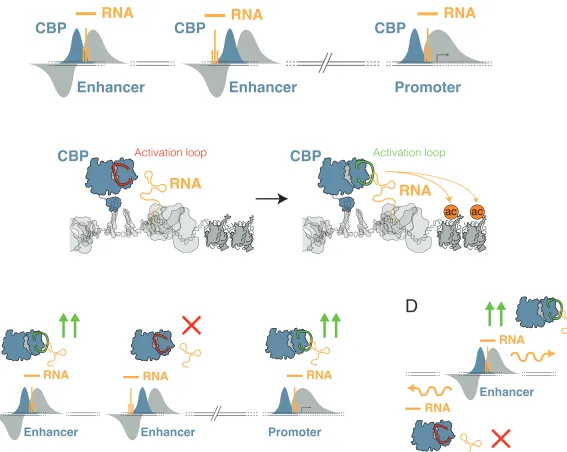
56
methylation changes that signpost enhancer activity, such as di-methylation of
57
histone H3 on lysine 4 (H3K4me2), arise due to transcription of the active enhancer
58
by RNA polymerase II; these modifications are independent of eRNA transcripts 10.
59
As H3K4me2 occurs at enhancers without the need for eRNAs, this raises the
60
question of whether eRNAs are capable of sculpting the chromatin milieu.
61
The transcriptional co-activator Creb binding protein (CBP) contains a core
62
enzymatic histone acetyltransferase (HAT) activity within a central catalytic domain
63
11,12. CBP acts as a transcriptional Ônetwork-hubÕ, interacting with hundreds of
64
transcription factor (TF) binding partners 13. Enhancers are typically formed of
65
clusters of TF binding sites; consequently, CBP is recruited to almost all enhancers
66
through its interactions with TFs, and CBP occupancy is considered a defining
67
characteristic of enhancer elements 14,15. Localizing CBP HAT activity to enhancers
68
using de-activated Cas9 nuclease (dCas9) is sufficient to promote transcription of
69
enhancer-associated genes 16. Moreover, CBP-dependent histone acetylation,
70
specifically acetylation of histone H3 on lysine 27 (H3K27ac), is a characteristic
71
epigenetic signature of enhancers across the genome 14,17.
72
73
A number of recent studies have revealed that chromatin associated proteins interact
74
with RNA in cells at high frequency 18-20. In many cases, these interactions do not
75
involve canonical or previously annotated RNA binding regions (RBRs) within the
76
interacting proteins 18,19. Notably, RNA binding through non-canonical regions
77
appears to be especially common for chromatin-modifying epigenetic enzymes 18.
78
Chromatin-associated enzymes or enzyme complexes that bind to RNA, such as
79
PRC2 and DNMT1, demonstrate a slight preference for structured RNA elements,
80
but binding is often considered to be promiscuous as they have similar affinities for
81
more than one RNA sequence 21-25. Moreover, a number of examples have now been
82
described where RNA binding can directly modulate the catalytic activity of these
83
enzymes 21,22,25-28.
84
85
We recently demonstrated an interaction between CBP and RNA 29, where specificity
86
for RNA binding arises in a locus-specific manner, dictated by locations of CBP
recruitment to chromatin. Although independent of RNA sequence, these interactions
88
were sufficient to stimulate the catalytic HAT activity of the CBP enzyme, increasing
89
CBP-dependent H3K27ac and thus promoting transcription 29. Given the high
90
frequency of interactions between RNAs and chromatin associated proteins, this
91
raises an intriguing question: Does RNA binding convey a localized activity profile to
92
chromatin bound epigenetic enzymes, and does this enable eRNAs to modify the
93
local chromatin environment at a particular locus? Here, we utilize the example of
94
CBP to explore the potential role of eRNAs as regulators of chromatin-modifying
95
enzyme activity, and explore the implications of such a mechanism for enhancer
96
function.
97
98
99
Locus specificity for RNA binding
100
101
Our data revealed that CBP could interact with RNA in cells under native conditions,
102
and importantly that CBP binds directly to RNA in photoactivatable
ribonucleoside-103
enhanced crosslinking and immunoprecipitation (PAR-CLIP) experiments 29-31.
104
Profiling of CBP-bound RNAs across the genome using high-throughput sequencing
105
of PAR-CLIP libraries, revealed that bound RNAs arise from sites where CBP is
106
recruited to chromatin. As CBP is strongly bound to enhancer regions and promoters,
107
we observed a strong bias towards RNAs transcribed from these regions. These
108
transcripts were especially enriched given their relatively low abundance and high
109
turnover compared to coding transcripts from exonic regions. CBP therefore
110
preferentially binds to RNAs transcribed from sites where it is recruited to chromatin
111
29. Thus, although binding does not rely on a particular RNA sequence, RNA binding
112
to CBP displays locus-specificity Ð transcripts are preferentially bound according to
113
where CBP is bound to chromatin (Figure 1A). We note that, in common with other
114
interactions between chromatin modifiers and RNA, a preference for specific RNA
115
structures within eRNAs remains a possibility and requires further investigation for
116
CBP.
117
118
One important consequence of locus-specific binding, was that RNAs interacting with
119
CBP in vivo included a large number of eRNAs due to the high frequency of CBP
120
recruitment at enhancers. A locus-specific binding model is logical in the context of
121
the biological function of CBP: CBP is almost universally recruited to enhancer
122
elements across the genome, regions that differ in their underlying DNA sequence.
123
eRNAs arising from these enhancers will therefore also display different sequences
124
and structural features. By retaining the ability to interact with RNAs independent of
125
sequence, the activity of CBP could thus be modulated by RNAs wherever it binds to
126
chromatin, i.e by eRNAs transcribed from any enhancer element where CBP is
127
bound. Locus-specificity therefore opens the possibility that RNA binding to CBP,
128
and potentially other epigenetic enzymes, could confer highly localized effects on
129
specific CBP populations across the genome. Thus, RNAs, and eRNAs in particular
130
could function as local regulators of CBP activity.
131
132
Direct binding to eRNAs stimulates CBP HAT activity
134
135
To investigate this potential regulatory function of eRNAs in more detail, we
136
reconstituted binding to CBP in vitro29. RNA pull downs and EMSAs revealed that
137
eRNAs bind to the large, full-length CBP protein, but also to the much smaller
138
catalytic HAT domain of CBP. We mapped RNA binding within the HAT domain to a
139
contiguous region of 49 basic and disordered amino acids 11,12,29. Importantly, this
140
RBR had been previously identified as an important regulatory motif for the HAT
141
activity of CBP 32. This region, known as the activation loop, binds within the active
142
site of CBP and blocks substrate binding until it is displaced by auto-acetylation 32.
143
Consistent with the importance of the activation loop for regulating catalytic activity,
144
we found that RNA binding to the RBR within the HAT domain caused a pronounced
145
stimulation of the HAT activity of CBP (Figure 1B). This was evident both in
146
radioactive filter binding HAT assays, and by western blot for specific
CBP-147
dependent histone modifications, H3K27ac and H4K5ac, on reconstituted
148
nucleosomes in vitro. HAT assays under steady state conditions revealed that
149
stimulation results from displacement of the activation loop from the active site upon
150
RNA binding 29 (Figure 1B). Our results also revealed that eRNAs possess variable
151
abilities to bind to CBP, and to stimulate its HAT activity. For example, eRNAs that
152
failed to bind strongly to CBP in pull-down experiments, also failed to strongly
153
upregulate its HAT activity, and different eRNA sequences produced different
154
patterns of stimulation 29. These findings support a model that various sequences,
155
and potentially structures of eRNAs, may have differential binding to CBP and
156
generate alternative patterns of HAT stimulation.
157
158
Therefore, one intriguing possibility is that the activity of CBP can be modulated by
159
eRNAs at different enhancers to generate a tailored activity profile at that enhancer
160
(Figure 1C). Such a model could help to explain the observation that some eRNAs
161
display strong strand-specificity in their ability to stimulate gene expression: if one
162
strand is able to bind strongly to CBP and stimulate activity, but the other is unable to
163
bind, then a difference in the ability of each eRNA strand to direct transcription would
164
be observed at that enhancer (Figure 1D). We also note that while we observe a bias
165
towards eRNA binding to CBP due to the prevalence of enhancer-bound CBP 33,
166
promoter-derived transcripts could also potentially bind to and stimulate CBP activity
167
(Figure 1C). The observation that eRNAs can control the activity of CBP in an
168
enhancer specific manner, can also help explain the surprising observation that
169
recruitment of CBP to enhancers and promoters is a relatively poor predictor of
170
downstream gene activation 33. For example, eRNAs that strongly stimulate the
171
activity of CBP could contribute to a stronger enhancer activity profile. However,
172
more work is required to fully characterize the relationship between transcribed
173
eRNAs, stimulation of CBP activity and enhancer strength.
174
175
176
Could eRNA have a general role as a regulatory molecule?
177
The regulatory activation loop within the HAT domain of CBP, which contains the
179
RBR, binds in the active site of the enzyme and blocks substrate binding. The ability
180
to bind within the CBP active site is derived from the positive charge of the RBR
181
within the activation loop; this positive charge also enables the loop to bind to RNAs.
182
Other histone acetyltransferases, such as the MYST family member Males Absent on
183
the First (hMOF) are not regulated by an activation loop in the manner of CBP, thus
184
their HAT activity remains unaffected by the presence of RNA 29.
185
186
Nevertheless, it is clear that the activity of other epigenetic-enzyme complexes, such
187
as PRC2 and DNMT1, are sensitive to RNA binding: Binding of RNA to PRC2
188
decreases both its methyltransferase activity and recruitment to promoter regions
189
22,25,26
, and ncRNAs transcribed proximal to the C/EBPA locus interact with DNMT1 to
190
block DNA methylation at the promoter 21. In both instances, RNA binding was driven
191
more by RNA secondary structure than sequence, with more structured RNAs
192
binding more strongly, and different RNA sequences producing different effects on
193
enzyme activity 21-23. In cells, the ability of ncRNA to inhibit the methyltransferase
194
activity of PRC2 is thought to arise from competition between RNA and nucleosomes
195
for binding to PRC2 25. For DNMT1, RNA binding was mapped to the catalytic
196
domain of the enzyme 21. This suggests that in order for a chromatin-modifying
197
enzyme to be susceptible to direct regulation by RNA binding, there must be a link
198
between potential RBRs within the protein and the catalytic domain. Interestingly,
199
many epigenetic complexes - such as PRC2 - contain multiple subunits and
200
components, often with individual abilities to bind to RNA. It remains to be
201
determined what the combined effect of RNA binding to individual components of
202
these complexes plays to regulate overall complex activity. Full elucidation of the
203
mechanisms of RNA-dependent stimulation will require further biochemical and
204
structural studies of the interactions between the enzyme and bound RNA species.
205
206
207
Concluding remarks
208
209
Recent studies have highlighted the high frequency of binding between
chromatin-210
associated proteins or enzyme complexes and RNA in cells, and the importance of
211
non-canonical RBRs for these interactions 18,19. The observation that locus-specific
212
RNA binding to CBP can directly stimulate its catalytic HAT activity presents an
213
interesting role for these interactions: RNA binding events could enable local
214
ÔtailoringÕ of enzymatic-activity profiles.
215
216
In the case of CBP, this tailoring is driven by the binding of RNAs transcribed
217
proximal to sites where CBP is recruited to chromatin. RNAs bind to CBP through a
218
non-canonical, positively charged RBR within the catalytic HAT domain. Because this
219
region is crucial for the regulation of CBP activity, RNA binding can stimulate the
220
catalytic activity of the enzyme and promote gene expression. The structure of CBP,
221
and its method of regulation by the activation loop, renders it particularly susceptible
222
to regulation by RNA binding to this region. Whilst it is increasingly clear that RNA
223
binding to other chromatin-modifying enzymes is widespread, the extent to which this
binding can modulate their enzymatic activity is less well understood. A number of
225
examples suggest that RNA does play such a regulatory role 21,22,25-28, however
226
further biochemical work is required to fully determine the mechanisms that RNAs
227
use to modulate the activity of these complexes.
228
229
For CBP, locus-specific RNA binding leads to preferential binding of CBP to eRNAs,
230
as CBP is enriched at enhancers. Our results suggest a functional role for eRNAs as
231
regulatory molecules that are able to stimulate the activity of a key epigenetic
232
regulatory enzymes, thereby promoting gene expression. Furthermore, they suggest
233
an intriguing, RNA sequence-independent (but potentially structure-dependent) role
234
for eRNAs in modulating the activity of chromatin modifying enzymes, that could
235
directly impact transcription by altering the chromatin environment. In contrast, we
236
note that enhancer-specific methylation changes appear to be reliant on transcription
237
at enhancers, rather than eRNA transcripts themselves 10. A key outstanding
238
question is whether eRNA transcripts can play a role in modifying the activity of
239
epigenetic complexes when enhancers loop to contact promoter regions.
240
241
Chromatin-modifying enzymes and enzyme complexes are crucial for directing gene
242
expression profiles across the genome. In particular, eRNAs are attractive
243
candidates as regulatory molecules due to their highly localized expression profiles,
244
rapid turnover and low abundance 2,3,5. The prevalence of RNA binding to
chromatin-245
modifying enzymes, and the potential for modulation of their catalytic activity,
246
suggests that RNAs could modulate their activity in a similar manner to CBP to
247
generate tailored patterns of histone modifications and gene expression profiles.
248
249
250
Figure Legend
251
252
Figure 1: RNA binding can generate localized CBP activity profiles and tailored
253
patterns of histone acetylation. A) Locus specificity for RNA binding to CBP. CBP
254
bound RNAs (dashed-line) correspond to sites of CBP recruitment to chromatin
255
(dark-grey) and nascent RNA transcription (light-grey) at enhancers and promoters;
256
B) RNA binding to the activation loop of CBP stimulates catalytic HAT activity by
257
displacing the loop from the active site, and thereby promotes CBP dependent
258
histone acetylation (H3K27ac); C) eRNA binding could generate enhancer specific
259
patterns of CBP activity by differential regulation of CBP activity. At more active
260
enhancers, CBP activity is stimulated more strongly by eRNA binding (arrows) than
261
at enhancers with weak stimulation of CBP activity (crosses); D) Differences in the
262
ability of sense and antisense eRNA transcripts to stimulate CBP activity. The eRNA
263
strand that binds and stimulates CBP strongly (arrows) could promote associated
264
gene expression more strongly than weaker binding eRNA strands (crosses).
265
266
267
References
268
269
1. Kim T-K, Shiekhattar R. Architectural and Functional Commonalities between
Enhancers and Promoters. Cell 2015; 162:948Ð59.
271
2. Lam MTY, Cho H, Lesch HP, Gosselin D, Heinz S, Tanaka-Oishi Y, Benner C,
272
Kaikkonen MU, Kim AS, Kosaka M, et al. Rev-Erbs repress macrophage gene
273
expression by inhibiting enhancer-directed transcription. Nature 2013;
274
3. Kim T-K, Hemberg M, Gray JM, Costa AM, Bear DM, Wu J, Harmin DA,
275
Laptewicz M, Barbara-Haley K, Kuersten S, et al. Widespread transcription at
276
neuronal activity-regulated enhancers. Nature 2010; 465:182Ð7.
277
4. Lai F, Orom UA, Cesaroni M, Beringer M, Taatjes DJ, Blobel GA, Shiekhattar
278
R. Activating RNAs associate with Mediator to enhance chromatin architecture
279
and transcription. Nature 2013;
280
5. Li W, Notani D, Ma Q, Tanasa B, Nunez E, Chen AY, Merkurjev D, Zhang J,
281
Ohgi K, Song X, et al. Functional roles of enhancer RNAs for
oestrogen-282
dependent transcriptional activation. Nature 2013;
283
6. Melo CA, Drost J, Wijchers PJ, van de Werken H, de Wit E, Oude Vrielink
284
JAF, Elkon R, Melo SA, LŽveillŽ N, Kalluri R, et al. eRNAs are required for
285
p53-dependent enhancer activity and gene transcription. Mol Cell 2013;
286
49:524Ð35.
287
7. Mousavi K, Zare H, DellÕOrso S, Grontved L, Gutierrez-Cruz G, Derfoul A,
288
Hager GL, Sartorelli V. eRNAs Promote Transcription by Establishing
289
Chromatin Accessibility at Defined Genomic Loci. Mol Cell 2013; 51:606Ð17.
290
8. Hsieh C-L, Fei T, Chen Y, Li T, Gao Y, Wang X, Sun T, Sweeney CJ, Lee
G-291
SM, Chen S, et al. Enhancer RNAs participate in androgen receptor-driven
292
looping that selectively enhances gene activation. Proceedings of the National
293
Academy of Sciences 2014; 111:7319Ð24.
294
9. Schaukowitch K, Joo J-Y, Liu X, Watts JK, Martinez C, Kim T-K. Enhancer
295
RNA Facilitates NELF Release from Immediate Early Genes. Mol Cell 2014;
296
10. Kaikkonen MU, Spann NJ, Heinz S, Romanoski CE, Allison KA, Stender JD,
297
Chun HB, Tough DF, Prinjha RK, Benner C, et al. Remodeling of the enhancer
298
landscape during macrophage activation is coupled to enhancer transcription.
299
Mol Cell 2013; 51:310Ð25.
300
11. Wang L, Tang Y, Cole PA, Marmorstein R. Structure and chemistry of the
301
p300/CBP and Rtt109 histone acetyltransferases: implications for histone
302
acetyltransferase evolution and function. Curr Opin Struct Biol 2008; 18:741Ð
303
7.
304
12. Delvecchio M, Gaucher J, Aguilar-Gurrieri C, Ortega E, Panne D. Structure of
305
the p300 catalytic core and implications for chromatin targeting and HAT
306
regulation. Nat Struct Biol 2013;
307
13. Bedford DC, Kasper LH, Fukuyama T, Brindle PK. Target gene context
308
influences the transcriptional requirement for the KAT3 family of CBP and
309
p300 histone acetyltransferases. Epigenetics 2010; 5:9Ð15.
310
14. Creyghton MP, Cheng AW, Welstead GG, Kooistra T, Carey BW, Steine EJ,
Hanna J, Lodato MA, Frampton GM, Sharp PA, et al. Histone H3K27ac
312
separates active from poised enhancers and predicts developmental state.
313
PNAS 2010; 107:21931Ð6.
314
15. May D, Blow MJ, Kaplan T, McCulley DJ, Jensen BC, Akiyama JA, Holt A,
315
Plajzer-Frick I, Shoukry M, Wright C, et al. Large-scale discovery of enhancers
316
from human heart tissue. Nat Genet 2012; 44:89Ð93.
317
16. Hilton IB, D'Ippolito AM, Vockley CM, Thakore PI, Crawford GE, Reddy TE,
318
Gersbach CA. Epigenome editing by a CRISPR-Cas9-based acetyltransferase
319
activates genes from promoters and enhancers. Nat Biotechnol 2015; 33:510Ð
320
7.
321
17. Jin Q, Yu L-R, Wang L, Zhang Z, Kasper LH, Lee J-E, Wang C, Brindle PK,
322
Dent SYR, Ge K. Distinct roles of GCN5/PCAF-mediated H3K9ac and
323
CBP/p300-mediated H3K18/27ac in nuclear receptor transactivation. EMBO J
324
2011; 30:249Ð62.
325
18. He C, Sidoli S, Warneford-Thomson R, Tatomer DC, Wilusz JE, Garcia BA,
326
Bonasio R. High-Resolution Mapping of RNA-Binding Regions in the Nuclear
327
Proteome of Embryonic Stem Cells. Mol Cell 2016; 64:416Ð30.
328
19. Castello A, Fischer B, Frese CK, Horos R, Alleaume A-M, Foehr S, Curk T,
329
Krijgsveld J, Hentze MW. Comprehensive Identification of RNA-Binding
330
Domains in Human Cells. Mol Cell 2016; 63:696Ð710.
331
20. G Hendrickson D, Kelley DR, Tenen D, Bernstein B, Rinn JL. Widespread
332
RNA binding by chromatin-associated proteins. Genome Biol 2016; 17:28.
333
21. Di Ruscio A, Ebralidze AK, Benoukraf T, Amabile G, Goff LA, Terragni J,
334
Figueroa ME, De Figueiredo Pontes LL, Alberich-Jorda M, Zhang P, et al.
335
DNMT1-interacting RNAs block gene-specific DNA methylation. Nature 2013;
336
503:371Ð6.
337
22. Cifuentes-Rojas C, Hernandez AJ, Sarma K, Lee JT. Regulatory Interactions
338
between RNA and Polycomb Repressive Complex 2. Mol Cell 2014; 55:171Ð
339
85.
340
23. Davidovich C, Zheng L, Goodrich KJ, Cech TR. Promiscuous RNA binding by
341
Polycomb repressive complex 2. Nat Struct Biol 2013; 20:1250Ð7.
342
24. Kaneko S, Bonasio R, Salda–a-Meyer R, Yoshida T, Son J, Nishino K,
343
Umezawa A, Reinberg D. Interactions between JARID2 and Noncoding RNAs
344
Regulate PRC2 Recruitment to Chromatin. Mol Cell 2014; 53:290Ð300.
345
25. Beltran M, Yates CM, Skalska L, Dawson M, Reis FP, Viiri K, Fisher CL,
346
Sibley CR, Foster BM, Bartke T, et al. The interaction of PRC2 with RNA or
347
chromatin is mutually antagonistic. Genome Res 2016; 26:896Ð907.
348
26. Kaneko S, Son J, Bonasio R, Shen SS, Reinberg D. Nascent RNA interaction
349
keeps PRC2 activity poised and in check. Genes Dev 2014; 28:1983Ð8.
350
27. Wongtrakoongate P, Riddick G, Fucharoen S, Felsenfeld G. Association of the
351
Long Non-coding RNA Steroid Receptor RNA Activator (SRA) with TrxG and
PRC2 Complexes. PLoS Genet 2015; 11:e1005615.
353
28. Yang YW, Flynn RA, Chen Y, Qu K, Wan B, Wang KC, Lei M, Chang HY.
354
Essential role of lncRNA binding for WDR5 maintenance of active chromatin
355
and embryonic stem cell pluripotency. Elife 2014; 3:e02046.
356
29. Bose DA, Donahue G, Reinberg D, Shiekhattar R, Bonasio R, Berger SL. RNA
357
Binding to CBP Stimulates Histone Acetylation and Transcription. Cell 2017;
358
168:135Ð149.e22.
359
30. Hafner M, Landthaler M, Burger L, Khorshid M, Hausser J, Berninger P,
360
Rothballer A, Ascano M, Jungkamp A-C, Munschauer M, et al.
Transcriptome-361
wide identification of RNA-binding protein and microRNA target sites by
PAR-362
CLIP. Cell 2010; 141:129Ð41.
363
31. Huppertz I, Attig J, D'Ambrogio A, Easton LE, Sibley CR, Sugimoto Y, Tajnik
364
M, Kšnig J, Ule J. iCLIP: protein-RNA interactions at nucleotide resolution.
365
Methods 2014; 65:274Ð87.
366
32. Thompson PR, Wang D, Wang L, Fulco M, Pediconi N, Zhang D, An W, Ge Q,
367
Roeder RG, Wong J, et al. Regulation of the p300 HAT domain via a novel
368
activation loop. Nat Struct Biol 2004; 11:308Ð15.
369
33. Kasper LH, Qu C, Obenauer JC, McGoldrick DJ, Brindle PK. Genome-wide
370
and single-cell analyses reveal a context dependent relationship between CBP
371
recruitment and gene expression. NAR 2014; 42:11363Ð82.
372
RNA
RNA
RNA
Enhancer
Enhancer
Promoter
CBP
RNA
RNA
RNA
Enhancer
Enhancer
Promoter
RNA
RNA
Enhancer
A
B
C
D
ac ac
CBP
RNA
CBP
RNA
Activation loop
[image:11.612.22.589.40.492.2]Activation loop