><
..
w
w
(.)
1/L.
.'"'
1.1 ',.'
-,, ...',...,
....
,.
\
-~1 ..- ' · '
r-,
I ,', .;... ... /
~J-(
/\
-'.-,
.
', ,' ; . .)i .· . · ' .
J
European Commission
Edith Cresson, Member of the Commission,
responsible for Research, Innovation, Education,
Training and Youth
DG XII - International role of Community research
Contact : Charles-Henri Metzger
Fax : +32-2-296.5936
E-mail: [email protected]
Internet : http://europa.eu.int/comm/dg 12
European Commission
,.J
.
(/
A great deal of additional information on the European Union is available on the Internet
It can be accessed through the Europa server (http://europa.eu.int).
Cataloguing data can be found at the end of this publication.
Luxembourg: Office for Official Publications of the European Communities,
1998
ISBN
92-828-5849-9
©
European Communities,
1999
Reproduction is authorised provided the source is acknowledged.
In November 1994, the european Council
adopted the
Speci~ic
Re&earch and Technological
Development Programme in the field
o~
Cooperation with Third Countrie& and
International Organi&ation& - known al&o more
&imply
a&
INCO (International Cooperation).
The objective
o~
thi& initiative wa& to provide
the Fourth RTD Framework Programme with a
tool with which to react to the growing
globali&ation
o~
&cience and the economy.
E
u
ropeart
c·o
"~
.. - .
L
rorary
.,
.
.
.
ntons
\;1~
)ton
D I
e
egatJon
.
2300 .M S:rcot, NW
:
'f
Waslungton, DC
20Da7
I
NCO has permitted the successful linking of European
scientific efforts with those undertaken outside the
Union or outside the Community framework. In response
to internal concerns (the desire to use cooperation as a
way of strengthening the Union's scientific and
techno-logical bases, of boosting the competitiveness of its
industry and increasing the impact of other Community
policies) but also external ones (the concern to find
ans-wers to problems rising in partner countries or at the
global level), INCO has played a significant role in
anchoring European research solidly and permanently
within the scientific and technological networks which
are shaping up at the dawn of the 21st century.
As the first Community programme specifically
dedica-ted to integrating and coordinating the Community's
RTD activities directed at third countries and
internatio-nal organisations, INCO has been the interface of 58:T
relations between the European Union and the rest of
the world.
With RTD activities often providing a bridge for relations
in other areas, INCO has also contributed effectively to
other policies of the Union, like preparing applicant
coun-tries for membership, rapprochement with Mediterranean
countries, development policy, and strengthening ties with
both industrialised and emerging economy countries.
Moreover, INCO has played a pioneering role in
promo-ting cooperation and coordination between the specific
European research programmes, thereby pre-figuring an
important aspect of the innovative approach of the Fifth
Framework Programme (1999-2002).
Edith Cresson,
Member of the European Commission,
Responsible for Research, Innovation,
Education, Training and Youth
3
-
CQen
en
e
E
0
Cl'l
!
Cl'l
E
E
Contents
Editorial
3
An international cooperation programme in science and technology - Why?
5
6
6
7
7
Maastricht takes a new step forward
Adding value to the Union's objectives
The principle of mutual benefit
A programme adapted to partner diversity
Scientific and technological Europe within the world
The enlarged frameworks of S&T cooperation
COST: 28 European countries coordinate research
EUREKA: a "bottom-up" approach
Cooperating with non-European industrialised countries
Better managing new global challenges
The challenges of "the other Europe"
The scientific heritage
!NCO, the East-West interface
The strategic options of !NCO-Copernicus
9
9
10
10
11
12
13
13
14
15
S&T cooperation: a tool for successful enlargement
16
Specific initiatives for research scientists from the ex-USSR
18
Research at the service of development
21
Specific partnership for science
21
Political dialogue at the core of effective cooperation
23
Organisation and results of INCO-DC
24
Euro-Mediterranean partnership
25
The intere&t &hown
by
the european Commi&&ion
in internationaL cooperation in RID re~lect& the
growing importance o~
the internationaL
dimen&ion in tho&e &ector& and activitie& linked
to &cienti~ic re&earch.
T
he reasons for this ever-present internationalisation
are many. The growing interdependence of large
eco-nomic blocks and the globalisation of trade, coupled
with the disappearance of the ideological opposition
between East and West has had, and is still having today,
a knock-on effect at the scientific level. Research poles
have multiplied, both in emerging countries and in those
which have freed themselves from the clasp of the
for-mer Eastern block. Sectoral and political partitions in
the world of science and research have tended to
disap-pear- all the more quickly because the decentralisation
of RTD activities has been facilitated by the
opportuni-ties for borderless cooperation offered by the new
infor-mation technologies.
Parallel with this, it is becoming clearer day by day that
vital problems- in particular those involving health, the
environment and nutrition - can be effectively solved
only at the global scale.
Finally, the trend towards stronger global scientific and
technological cooperation is also dictated by the need to
share the costs, the human and technical resources, and
also the risks attached to RTD innovations in the coming
years. The scientific challenges involved in the
explora-tion and exploitaexplora-tion of space
,
in finding sustainable
solutions for energy consumption and in mastering
bio-technological issues, can be met only through a vast
international mobilisation.
5
00
C') C')
E
E
C'l 0 0..
0
u
6
-E
E
C"l 0
c..
0
u
z
Table 1.1
The place of international S8:T cooperation
in the Fourth RTD Framework Programme
(1994-1998)
First action
Second action
Third action
Fourth action
Maastricht takes a new step forward
This "globalisation"
of research -
and
of its imperatives
-
has
led
the European Union
to
provide an explicit
legal
basis to
its
international RTD policy
in
the Treaty of
Maastricht
signed
in February
1992.
Article 130 G of the
Treaty on European Union specifically
lists
the
"promo-tion
of
cooperation
in the field of Community research,
technological
development and
demonstration with
third countries
and
international organisations" as one
of the four essential activities of Community RTD policy.
The three
others
are
the specific Community research
programmes,
the
dissemination and optimisation of
results,
and
stimulating the training and mobility of
researchers in
the Union (see table 1.1 ).
-Euros 10,045 m
Euros 575 m
Euros
352m
Euros 792
m
Euros 11,764 m
Adding value to the Union's objectives
Conceived to provide integrated management of all
relations between the Community's research
efforts
and
outside players, the INCO programme
has,
during the
past four years, been
implemented
along two lines:
• it has supported and supervised numerous
research
projects combining EU and non-EU partners in
speci-fic areas within
the
programme itself (see table 1.2);
•
it
has also supported the participation of non-EU
scientific and technical partners in certain RTD
pro-jects undertaken under other specific Community
research programmes (actions 1, 3,
4-
see table 1.1).
In both cases, international cooperation
in
the RTD area
has played an integral part in implementing the
priori-ties
of the Union's technological research and
develop-ment policy. These are:
• strengthening the competitiveness and the position of
the European economy in international trade;
• creating jobs inside the Union;
[image:6.586.6.301.588.849.2]In this perspective, the INCO programme has provided a
specific added value to the Community's research
activi-ties. Scientific cooperation, largely international in
nature, allows Europe's research scientists to meet and
work together with partners with different S&T training
and cultural backgrounds, and enables them to access
new networks and to work in laboratories and with
equipment developed in scientific research poles
else-where in the world. As well as contributing to the
world-wide dissemination of Europe's own science and
techno-logy, these links strengthen the Union's innovative
capa-city, with the ensuing benefits in terms of competitiveness
a
nd employment within the Community.
Development of INCO
commitments 1995-1998
In
d
icati
ve
figures (Se
ptember
1
998
)
The principle of mutual benefit
This type of transnational
-
and transcontinental
cooperation is based obviously on a principle of "mutual
advantage': It is beneficial and sustainable only in so far
a
s it takes on board the mutual interests of the different
partners involved and provides them with the scientific
a
nd technological returns which they expect from it.
These expectations vary significantly according to the
dif-ferent areas of RTD cooperation in which the European
Union is involved. For this reason, the INCO programme
has been designed to target those forms of cooperation
that are specifically adapted to these partner groups.
This "variable geometry" approach has also enabled
INCO to make an effective contribution to European
Union policies which fall outside the strictly defined
field of RTD. For example, cooperation with industrial
countries has been steered partly towards the objectives
of telecommunications policy (DG XIII), energy policy
(DG XVII) and transport policy (DG VII). It has of course
been possible to coordinate joint research activities with
developing countries with the objectives of EU
develop-ment policy (DG VIII). Finally, as part of the eastward
enlargement of the European Union, cooperation with
former Eastern block countries has been carefully
coor-dinated with the objectives of DG I, which is responsible
for external relations
.
A programme adapted to partner diversity
The structure of the INCO programme reflects its
coope-ration objectives, which vary from one group of countries
and organisations to another. In each of the four major
fields covered by the programme (see table 1.2), European
RTD cooperation policy responds to a specific logic,
orga-nised to suit the particular characteristics of the partners
concerned, depending on whether they are from:
• The industrialised world, both other European fora and
international organisations (area A
1),
and
non-indus-trialised European countries {area B)
• Central European countries and countries of the
for-mer Soviet Union {area A2)
• Developing countries (area C).
The considerable size of the budget resources which the
Union has allotted to scientific cooperation with Central
and Eastern European countries (area A2) and with
developing countries (area C) is explained by the fact
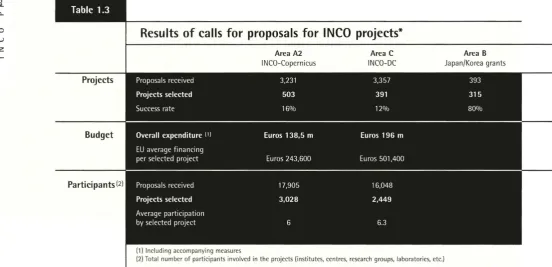
that, in these two groups, INCO supports joint research
projects - an arrangement that does not exist in the
two other areas. These projects are co-financed by the
programme following calls for proposals in research
areas which reflect problems in the concerned regions.
7
-
co
en
en
E
E
C'l Q
0
u
-E
E
c..
0
u
z
Table 1.2
Area Al
(details on
p.
70)
Area A2
(details on p.14)
Area
B
(details on p.12)
Area C
(details on p.22}
Areas of international cooperation in RTD
Cooperation with other European S&T cooperation frameworks
(COST, EUREKA, International RTD organisations)
• RTD
association agreements
for third countries (EEA) to participate on
a "project by project" basis in all the EU's specific RTD programmes
• secretariat of the inter-governmental COST programme
Cooperation with Central and Eastern European countries
and
with
the Newly Independent States (NIS) of the former USSR
• I NCO-Copernicus (financing and management of joint research
activities and joint initiatives)
• "project by project" participation in certain Action 1, 3 and 4 RTD
programmes and possibility of financial assistance
• EU participation in INTAS and ICST
Cooperation with non-European industrialised countries
• S&T cooperation agreements with third countries (Canada, Israel,
Southern Africa, USA) "project by project" participation in certain
RTD strands of specific EU programmes
• Japan/Korea research grants
Cooperation with developing countries
• INCO-DC (financing and management of joint research activities
and joint initiatives)
• "project by project" participation in certain Action 1 RTD Programmes
• possibility of financial assistance
Euros 49 m
Euros 247m
Euros
32m
Euros 247m
When it comes to relations with other European
coope-ration partners (area A
1)
and the non-European
indus-trialised countries, the financing of research activities
strictly speaking is not covered by the INCO
budget
(except in the case of Japan/Korea research grants). In
these areas of cooperation with scientifically and
tech-nologically
advanced countries, the programme plays
primarily
a
catalyst role, by implementing
RTD
coopera-tion
agreements with
certain
non-EU countries (area B),
·
and
a
coordination role, in
particular
by providing the
secretariat for the European COST Programme (area A
1).
Table 1.3
Results of calls for proposals for INCO projects*
Area A2
Area C
I
NCO-Copernicus
I
NCO-DC
Projects
Proposals received
3,231
3,357
Projects selected
503
391
Success rate
16%
12%
Budget
Overall expenditure
(1)
Euros 138,5 m
Euros 196m
EU average financing
per selected project
Euros 243,600
Euros 501,400
Participants (2)
Proposals received
17,905
16,048
Projects selected
3,028
2,449
Average participation
by selected project
6
6.3
(1) Including accompanying measures
(2) Total number of participants involved in the projects (institutes, centres,
research
groups,
laboratories,
etc.)
• Indicative figures (September 1998)
Area
B
J
apan/Korea
grants
393
315
[image:8.585.20.573.519.786.2]A& an acknowledged Leader in many area&
o~
technology
and under&tanding, the european Union
play& a major role on the world &tage. But
compe-tition i&
~ierce.
Other major indwtrial power& (the
United
State&,
Canada, japan, Awtralia and other&)
have a Level
o~
S&T
experti&e that i& comparable,
i~
not &uperior, to that
0~
eu countrie&.
Competition doe& not, however, exclude
cooperation. t&tabli&hing &u&tained and mutually
pro~itabLe
Link& with the main poLe&
o~
worLd
re&earch con&titute& a priority objective
~or
the
tU'& &cience and technology poLicy.
In
order to
pre&erve and improve the
e~~ectivene&&
and
"added
value"
o~
it&
own RID
programme&.
(7}
Special
mention should be made here of the particular status of
"associate" cooperation, which is currently being re-negotiated
pre-paratory to the launch of the Fifth Framework
Programme.
This will
enable three countries belonging to the
European
Economic
Area
-Norway,
Iceland and
Liechtenstein
- to participate in all the Union's
REtTD activities. A specific association agreement is also right now
being concluded with Switzerland (see Table 2. 7.}
D
uring
its four years of activity, the I
NCO
programme
has
been the main tool for opening up and "mooring"
European research policy to other major international
centres of science and technology. This has taken the
form of a double approach:
• coordinating the research activities of the fifteen EU
Member States with other international S&T
coopera-tion organisacoopera-tions, both those at the pan-European level
such as COST and EUREKA, and the main world-wide
networks which depend on the United Nations or other
frameworks (area A 1 }
;
•
establishing specific scientific and technological
coope-ration agreements with other
industrialised
countries
(1)
(area B).
In each of these two approaches, !NCO's primary objectives
have been to create synergies between Community
re-search efforts and outside efforts in what are considered
to be priority areas. Unlike in A2 areas (Central and Eastern
European countries} and C areas (developing countries},
the European support is aimed not at financing scientific
activities, but ensuring essential coordination.
The
enlarged frameworks of
SaT
cooperation (area A 1)
The European Union is involved in different European
scientific and technological cooperation frameworks in
which various non-EU countries also take part. Using
resources provided under area A
1
of the I
NCO
pro-gramme, the Commission has made a major effort to
develop effective interaction between COST, EUREKA
and the Framework Programme, with a concern to
pro-mote the optimal use of the results of European
research.
The Union
has also maintained close cooperation
with
various major
research bodies, such as the European
Laboratory for
Particle
Physics (CERN} in Geneva,
the
European
Molecular Biology
Laboratory (EMBL, in
Heidelberg},
the European
Space Agency
(ESA}, etc.
9
E
E
en
0
c..
0
u
10
co
(j') (j')
E
E
C'l
0
0
u
z
COST: 28 European countries
coordinate research
Since it was first set up in 1971, the inter-governmental
COST initiative (European Cooperation in the area of
Scientific and Technological Research) has coordinated a
vast range of S8:T activities carried out and financed
nationally by its 28 member states. With an estimated
cumulative cost of around Euros 1 billion a year, the
volume of research enjoying COST support has more
than tripled between 1990 and 1997. 170 "COST
Actions", involving some 10,000 research teams, make
this programme one of the major instruments of
scien-tific cooperation in Europe.
The research undertaken within the COST framework
covers both the exact and human sciences, including
various leading edge technologies. Many synergies exist
between the 17 scientific areas covered by the initiative
and the research areas covered by the Community's RTD
programmes. Despite not being not a member in its own
right of this inter-governmental initiative - though it
expects to join soon - the European Commission is
res-ponsible for the scientific coordination and
administra-tive management of COST. Overall responsibility lies
with DG XII, in consultation with DG VII and XIII for all
research activities which relate to transport and
tele-communications respectively.
COST provides a holistic approach
to urban problems
A
relatively new COST action combines town
plan-ning, urban design and civil engineering so as to
contribute more effectively to the management and
operation of the physical urban environment.
Tradi-tional approaches to civil engineering in the urban
context tend to be determined by sectoral and
invest-ment interests
.
The approach adopted in COST by
con-trast is more ho
l
istic and innovative in that it sees the
urban context in terms of an interrelated system.
Indeed, it is the only programme of its type in Europe.
There are clear links too with the transport sector and
with some of the work being undertaken in COST in
both the environmental and social science sectors.
EUREKA: a "bottom-up" approach
This inter-governmental initiative, launched in 1985, and
in which 25 countries and the European Commission are
now involved, is aimed principally at combining the
finan-cial support provided by the different States in order to
create transnational European R8:D partnerships directed
towards developing advanced technologies in all
indus-trially strategic areas. The essential originality of EUREKA
is to have placed the accent on a so-called "bottom-up"
approach: it is the industrial, technological and scientific
partners themselves who define the content of the R8:D
projects presented for funding. These projects all carry the
EUREKA label, which is granted by the national
govern-ments of countries taking part in the initiative.
Certain "pre-competitive" research required in order to
carry forward various EUREKA projects has met the
scientific and technological objectives of the European
Union and has therefore enjoyed active support from
Community research programmes. The Commission has
intervened financially to support research linked to
around 40 such projects. It has also helped finance the
running of the initiative's International Secretariat as
well as various activities promoting the initiative,
finan-ced out of the I NCO programme budget.
Cooperating with non-European
industrialised countries (area B)
The present globalisation of knowledge and skills
is
inti-mately linked to the globalisation of trade and financial
flows. Within this double movement, industrialised
countries- such as the United States, Japan, Canada or
Australia - are both potential scientific partners and
commercial competitors of the European Union. The
cooperation activities undertaken with them, within the
framework of I NCO, bear the mark of this duality.
This scientific
cooperation with
industrialised
countries
is
also aimed at promoting the acceptance of jointly
developed
technology on these countries' markets.
Given the many
possibilities for RTD partnerships with
these countries,
topics offering balanced and selective
synergy have
been carefully identified
in
the light of the
Union's different
policies and of Member States'
indivi-dual relationships
with these countries.
In this perspective
the scientific and
technological
coope-ration agreements that the EU has negotiated with the
non-European
industrialised countries play a key role. The
initial agreements
with Australia and Canada, signed
in
1994
and
1996
respectively, have proved the
effective-ness of
this approach. Far from duplicating the many
bila-teral agreements
already signed with these countries by
most Member
States, they have marked the way forward
for cooperation which
reflects the specific experience of
partner states
and the
special
nature of the areas
invol-ved,
by opening up
certain
European research
program-mes to projects
from these countries, and by ensuring
that Community
legislation on the protection of
intellec-tual property rights is
respected.
These activities are based on the principle of reciprocity
between partners situated on an equal footing. Admitting
"advanced"
outside
partners into the Community's RTD
cooperation system- and participation by European
insti-tutes in these countries' research efforts - facilitates
ac-cess to the S&T results which they have achieved, thereby
imparting additional value to the Union's RTD, and
impro-ving its economic competitiveness. By enabling the Union
to benefit from its partners' experience, this cooperation
also contributes to the better definition of certain other
EU policies (for example, transport, energy and fisheries}.
Table
2.1
SB:T cooperation agreements negotiated between the EU,
industrialised countries and emerging economy countries
Norway, Iceland, liechtenstein
Associate cooperation within
the
EEA framework
Re-negotiation under way for the 5th FP
Switzerland
Associate cooperation under negotiation at end 1998*
NON-EUROPEAN COUNTRIES
United States
Agreement signed in December 1997,
came into force in October 1998
Canada
Agreement concluded in 1996 for an indefinite period
Amendment under negotiation end 1998
Agreement EURATOM concluded end 1998
Australia
Agreement concluded in 1984 for unlimited period
Amendment under negotiation end 1998
Israel
Agreement concluded in 1996
New agreement under negotiation end
1998
Argentine (EURATOM Treaty)
Agreement concluded in 1997 for
an unlimited period
SaT cooperation agreement in preparation end 1998
South Africa
Agreement concluded in 1997
Russia
Agreement under negotiation end 1998
China
SaT cooperation agreement concluded end 1998
RTD areas concerned
All the Union's RTD activities (excluding the nuclear field)
In principle, all the Union's RTD activities
The environment (including climate), bio-medicine and health (including AIDS,
infectious illnesses, drugs), agriculture and fishing, engineering research,
non-nuclear energy, natural resources, materials technologies and
standardisation, telematic applications, marine science and technologies,
research in social sciences, transport, science and technology policy, management,
training, researcher mobility
Agriculture, fishing, forestry, bio-medicine and health, non-nuclear energy,
environment (including earth observation), information and communication
technologies, telematic applications, ore processing
Nuclear energy
Biotechnology, bio-medicine and health, marine science and technology,
the
environment,
information and communication technologies
RTD areas concerned: all areas of EU RTD research programmes
(excluding the nuclear field)
Nuclear energy
Research areas of Action 1 and developing countries research activities
of Action 2 (excluding the nuclear field)
RTD areas concerned: all areas of EU RTD research programmes
(excluding the nuclear field)
Not yet determined
All the research areas of the EU RTD programmes (excluding the nuclear field)
(*} However, Switzerland already participate
s
in the controlled thermonuclear fusion programme
[image:11.583.17.563.358.814.2]12
E
E
C'l
0
0
u
z
Graph 2.1
Better managing new global challenges
As part of the cooperation with those countries whose
RTD potential is comparable to that of the Union, I NCO
contributes to the multidisciplinary research which is
vital for meeting a certain number of major global
chal-lenges. Joint work has been carried out, for example, on
climate change, preventing earthquake damage, nuclear
safety and population growth. Particular attention has
been paid to research into the human genome, as well
as controlled nuclear fusion (via large-scale funding of
the research being carried out in and around the ITER
thermonuclear reactor).
The various S&T cooperation agreements presented
above constitute a cooperation framework
par
excel-lence
for handling all these programmes of common
interest. The regular monitoring meetings offer many
opportunities for exchanges of views on partners'
res-pective RTD policies, in this way enabling them to be
more effectively inter-connected.
Scientific areas for Japan research
grants (1986-1997)
Trans-Atlantic biotech
T
oday research into life sciences represents a
strate-gic dimension for the whole world's scientific
community. For this reason the European Union and
the United States set up a joint "biotechnology task
force" in September 1990 to serve as a consultation
framework on the major directions of S&T on both
sides of the Atlantic. Its mandate was subsequently
extended for five years on 26 June 1996. This task
force has arranged a host of symposia and workshops
to facilitate the exchange of information on priority
topics of mutual interest. Joint studies and
recommen-dations have also been submitted to the European
Commission's Biotechnology Coordination Council
(BCC) and the US National Science and Technology
Council (NSTC).
Programmes for research
grants in Japan
A
ware of the major potential of cooperation, given
Japan's experience in many areas, the European
Union launched in 1986 a grant programme to allow
highly qualified European research scientists to visit
Japan for periods of between six and twenty-four
months. By the end of 1997, 322 European scientists
had been sent to Japan with the help of Community
financing in order to perfect their know-how. In 1998
the EU awarded an additional 76 grants, and Japan in
turn financed more than 170 European researchers
working in its country.
The
collap&e
o~
the Berlin Wall
in
1989 Led
to
a
complete
rede~inition o~
relation&
between
the
european Union and the ~ormer
War&aw Pact
countrie&
o~
ewtem
europe. It &oon
became
clear that the comiderable S&T capacitie&
developed in a clo&ed &y&tem by the&e countrie&,
particularly in the military-indu&trial complex,
did not allow them
to
re&pond
e~~ectively
to
the
new challenge&
po&ed
by their gradual
incorporation into the market
economy. Thi&
&cienti~ic potential wa& al&o
threatened
by the
dinicultie& inherent in the tramition. Several
european initiative& to maintain and adapt the
RID
capacitie&
o~
the Central and
ea&tem
european Countrie& (ceec),
w
well a& tho&e
o~
the New
Independent
State& (NIS) that
~ormerly
were part o~
the Soviet Union, were
&tarted
~rom
1992 onward&. A~er
1995 the&e were integrated
into and coordinated within the INCO
programme.
I
n the ex-Soviet Union and its former C
e
ntra
l
and
Eastern European satellites, scientific and techn
i
cal
progress was seen as a decisive and prestigious element
in their ideological struggle against the West. In this
con-text, the mission of the scientific sector consisted mainly
of permitting the development of certain technologies,
primarily in order to achieve military super
i
ority and
demonstrate the supremacy of communism. Highly ad
-vanced skills were thus developed in fields such as
aero-nautics and space exploration, mathematics, theoretical
physics, mechanics
,
chemistry, optics and biology.
The scientific heritage
The RTD
system of the Eastern European Warsaw
Pact
countries was organised with aims that were different
from those governing contemporary scientific research
in
democratic
countries with market economies. As a
result, this system was completely unable to meet the
new requirements created by the transition. The
govern-ments concerned made radical cuts in scientific
expen-diture,
especially
in
the
NIS
.
It soon became clear that it
would
be difficult to restructure SttT activities, however
necessary,
even for the Central and Eastern European
Countries, whose
scientific potential had nevertheless
remained
more
diversified
and
better
integrated into
their national industrial and socio-economic fabrics.
From
1990
onwards, the
European
Union devoted
parti-cular attention to the problems created by this
destabi-lisation of the S&T sector in the countries of the "other
Europe". After launching the structural assistance
pro-grammes PHARE(1)
(1990)
and TACI5(2l
(1991},
the Union
began gradually to establish a specific
policy
of
scienti-fic and technologica
l
cooperation based on three
prio-rity
objectives:
(1)
Poland-
Hungary
:
assistance for the re-structuring of their economies
(2)
Technical
Assistance to the Commonwealth of Independent States and
Georgia
.
13
-
co
C'l C'l
E
E
C"'
Q
c..
0
u
14
-
c:o
CTl CTl
E
E
0
u
z
•
preserving
these countries'
research potential;
• re-developing
it to
help
in
resolving the
major and
immediate
social,
economic, and ecological problems
facing
these countries;
• establishing mutually advantageous relations in those
RTD
areas
in which these countries are world leaders.
The main
instrument established
in order
to attain
these
objectives was Copernicus, started
in 1992.
This action
permitted the rapid financing of a large number of
re-search projects associating partners
from
the Union with
others from Central and Eastern Europe. It was
also
ope-ned
to the
countries
of the former USSR in 1994.
INCO, the East-West interface
With the
launch
of
the
4th Framework Programme
in
1994,
the
whole of the SftT
cooperation
with the CEEC
and the NIS was coordinated in the INCO Programme.
This integration greatly improved the clarity
and the
efficiency of
the
Community's scientific
cooperation
policy towards these countries.
The partnerships established under the Copernicus
Pro-gramme
-
the spearhead of the European Union's SftT
Table
3.1
cooperation
with
the CEEC and the NIS between 1992
and
1994
- were considerably strengthened thanks to
the
possibilities
of
financing
now granted via INCO,
i
n
three
forms:
• the joint research
projects, proposed by multinational
teams, in domains chosen by both the EU and the
partner
countries on the basis of their priority needs
;
•
concerted actions to establish networks and to
disse-minate
SftT knowledge and skills among the research
teams in these
same domains;
•
accompanying measures, aimed at maintaining and
exploiting the
results
of the RTD cooperation activities
after
their
conclusion.
As a complement
to the action now known as !NCO
-Copernicus,
the other specific RTD programmes establi
-shed
in
the
4th Framework
Programme
(3)
were also
ope-ned to CEEC and European NIS research bodies. This
"project by
project" participation was funded by the
INCO Programme
budget.
Finally,
specific support
was
organised in 1993-1994 in
response to
the
particularly
critical situation
experien-ced
by
research scientists in the former Soviet Union
countries.
The I NCO Programme
took an active part here
in the
creation
of
the
International Association for the
Promotion of Cooperation with
the
Scientists
of
the NIS
(I NT AS).
(3) Actions
7,
3 and 4 of tabl
e
7.1 pag
e
76.
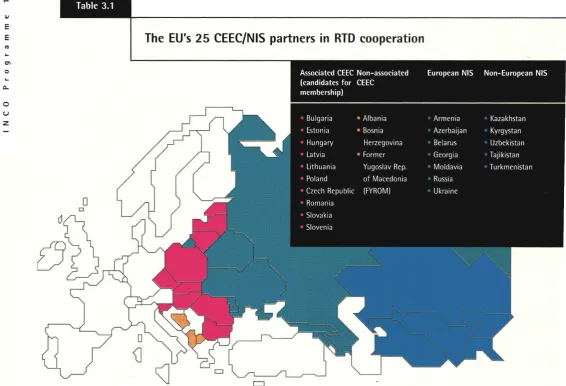
The EU's 25 CEEC/NIS partners in RTD cooperation
[image:14.586.12.579.445.831.2]I
1
SaT cooperation with CEEC/NIS
countries-financial resources made available
(INCO 1995-1998)
Total 233 million Euros (CEEC: 121, NIS: 112)
in millions
of
Euros
I NCO-Copernicus
138
(59%)
I
(including accompanying measures)
CEEC
88
NIS
50
~
'i•
Participation in the specific programmes
40
(17%)
I
of the 4th FP
J
I NT AS
The strategic options of INCO-Copernicus
The experience acquired during the first phase of
Coper-nicus ( 1992 -1994) showed that the pol icy of scientific
cooperation with the CEEC/NIS needed to be judiciously
targeted on the real problems encountered by these
coun-tries if it were to become more effective. Efforts were
the-refore strengthened to focus some of these countries'
research capacities towards the major social, economic
and ecological problems they were experiencing.
In this perspective, specific emphasis has been placed on
correcting the most manifest shortcomings - inherited
from the past - of the RTD of the CEEC/NIS, in which
industrial production had been organised without
concern for questions of environment or energy
eco-nomy, in particular because public health requirements
were never a priority. Parallel to this, the desire strictly
to control public freedom had considerably hampered
the development of communication and information
technologies.
The weak and rigid links between the world of RTD and
the economic and industrial structures represent
ano-CEEC
33
NIS
7
54
(23%)
NIS
54
ther major limiting
factor.
Interaction between
the
nas-cent market
and social
needs on the one hand and
applied research on the other remain particularly fragile.
In both traditionally
privileged
sectors (aeronautics and
space research, materials technology, etc.) and neglected
areas, research
is
not efficiently linked to production
activities. One of the priority objectives of the I
NCO-Copernicus Programme has been to find a
remedy
for
these structural deficiencies, which considerably slow
down the movement of social and economic
restructu-ring. The two calls for proposals organised in 1995 and
1997 helped to establish partnerships in two main areas:
• improvement of living conditions and public health;
• modernisation of industrial procedures in
the
sectors
of energy, food, and information.
Furthermore, mutually advantageous relations continue
to be established in the fields in which the CEEC/NIS
lead the world. The interest shown in concerted actions
leading to the formation of operational networks in
high tech sectors
,
has been confirmed throughout the
European scientific community in both West and East.
15
E
E
C'l
0
0..
0
u
z
Table
3.2
Results of INCO-Copernicus
of a Romanian technological firm
W
hen the Ceaucescu regime fell in 1990, state
funding was suddenly cut off to the Romanian
undertaking Plasmaterm, which specialises in surface
treatment. This threatened the jobs of 200 employees,
as well as their unique skills and knowledge and the
very high quality machinery the firm had developed.
Thanks to its participation in three research
partner-ships in a Copernicus project involving British,
Hungarian, Polish and German research scientists
,
this
SME was able to diversify its technologies and its
pro-ducts
.
Its reopening has saved 70 jobs and Plasmaterm
now exports 90% of its production.
Prop
osa
ls
r
ec
e
iv
ed
Proj
ec
t
s
sel
ec
ted
INCO
f
in
a
n
ci
ng
(i
n Eu
ros m
il
l
i
ons)
Indi
ca
tiv
e fi
gu
res
(S
ep
t
e
mb
er
1998
)
SHT cooperation:
a tool for successful enlargement
Between March 1994 and Jun
e
1996
,
seven Central
Euro-pean Countries (Hungary, Poland
,
Romania, Slovakia
,
Bulgaria, the Czech Republic and Slovenia), which were
already associated with the EU by "European agreements"
in the field of SttT, and the three Baltic republics applied
for membership of the European Union
.
Their
internatio-nally recognised SttT expertise now opens up the
pers-pective of considerably boosting Europe's scientific and
technological potential on a global level. Thus, beyond its
overall geo-political upshot, this expansion has, in the
shorter term, introduced a new dimension into SttT
cooperation relations with these countries since 1992
.
After the Council of Madrid's call in December 1995 fo
r
"equal treatment of candidate countries"
,
the objectives
of the Community S&T cooperation policy were adapted
to the possibility of their membership in the near future.
In !NCO-Copernicus, particular priority was placed on
common research projects aimed at accelerating the
modernisation of the industrial sector and making it
more effective. Improved protection of the environment
and conformity of production technologies with
[image:16.592.7.531.25.794.2]At the same time, the specific research programmes of the
4th Framework Programme were already open to these
new countries. The high entry requirements (conditions of
eligibility, the level of scientific expertise required, etc.),
acted as a catalyst for enhancing the RTD sector in the
associated countries. To promote this closer cooperation,
INCO has played its part in funding their participation to
theses programmes, in this way supporting the activities
of several hundred research bodies in the CEEC in high
technology sectors
(4).
The high level of participation on a project-by-project
basis by scientists from CEEC in specific programmes of
the 4th Framework Programme foreshadowed the
deci-sion to associate these countries integrally into the 5th
Framework Programme in 1999.
Research institutes, industrial laboratories and university
cen
t
res of
the
associated countries will, where their
governments
contribute
directly a fixed amount to the
budget of the Framework Programme under specific
arrangements, be able to participate in all Community
research activities on a strictly equal footing with the
Member State organisations. This active cooperation
can
be seen as an essential instrument for better preparing
associated countries for membership of the European
Union, hastening the integration of their research
po-tential into the scientific community of the EU and
hel-ping them to adapt to the requirements of a market
economy. This adaptation will considerably strengthen
the development capacities of associated countries'
eco-nomic and industrial structures.
INCO support for CEEC-NIS
Participation in the EU's specific
RTD programmes
(in Euros millions)
Indicative figures (September 1998)
(4) Part of
the
/NCO finan
c
ing line for this participation in
the
EU
pro-jects
has also been made
available
to the N/5
,
though
with
limitations
applicable to
the
non-European N/5 (see
graph
3.2).
INCO support for CEEC-NIS
participation in the EU's specific
RTD programmes
(in Euros millions)
E
E
en
0
c..
0
u
18
-
CIOO'l
O'l
E
E
C'\
0
0
u
z
Specific initiatives for research
scientists from the ex-USSR
Sct:T cooperation between the European Union and the
f
ormer Soviet Union has taken a variety of forms. Calls
f
or applications for !NCO-Copernicus programmes have
been opened up to participants from the NIS, and in
November 1997 the European Union also opened
nego-t
iations with Russia with the aim of concluding a
speci-f
i
c agreement on scientific and technological
coopera-tion
.
This agreement is intended to outline more clearly
the domains of S&T cooperation with the Russians during
the coming years
.
Establishing an integrated information system
for European RTD
I NT AS
J
ointly financed by the EU and its Member States,
plus Norway, Switzerland and Israel, the INTAS
ini-tiative (International Association for the Promotion
of Cooperation with the Scientists of the NIS) was
established in 1993 in order to respond to the serious
difficulties many scientists from NIS countries were
finding in obtaining funding and to permit them to
continue their research activities in their own
coun-tries. Priority was given to research projects
presen-ted by the most competitive teams, in the light of the
respective interests of the EU Member States and the
NIS beneficiaries. Almost one thousand INTAS projects
corresponding to these criteria were financed by the
I NCO budget during the 4th Framework Programme, at
a total cost of Euros 54.4 million.
The very constructive partnership established between
INTAS and the Russian Foundation for Basic Research
should also be mentioned. This institution, which is
responsible in particular for co-financing, for joint
selection of strategic priorities and for assessment of
the research
r
esults obtained in INTAS-financed
pro-jects, also plays a decisive role in the overall
restructu-ring of RTD in the former Soviet Union.
Previously, because of the gravity of the crisis affecting
the RTD sectors of the ex-USSR in the first half of the
1990s, the EU had, from 1993 onwards, established and
actively supported more specific instruments. In the NIS
countries, the RTD sector was particularly inflated, with
an average 12.9 research scientists for 1,000 workers in
1989, as against 4.2 in the EU at the same time. The
sud-den collapse of public funding for scientific research in
the early 1990s (diminishing from 3.5% to less than
0.5% of GNP between the late 1980s and 1995)
produ-ced a major crisis. The major scientific potential
develo-ped during the 70 years of communism was directly
threatened. The international community, concerned to
preserve this original research expertise in certain high
tech areas (aeronautics, materials, space research), and
to avoid a proliferation of military experts, launched
two initiatives: INTAS (1993) and ICST (1994). Both of
these receive decisive support from the European Union
(see boxes).
Redeployment of military RTD in the
N/5 for civilian use also involves
recycling one million tonnes of TNT.
Simply stocking this puts the
environment in serious danger.
Three years' research (from basic
chemistry to materials synthesis)
should make it possible to process
the TNT for use in materials with
applications in advanced
technologies (polymers used in micro
-electronics or aeronautics) or the
development of new products
-particularly in the field of
biotechnology.
I CST
T
he future of advanced technologies produced by
the military-industrial complexes of the ex-Soviet
Union quickly became a problem at the beginning of
the 1990s. The economic crisis and the almost absent
demand for high technology products in the new
countries that had once been part of the Soviet
Union meant that there were practically no
opportu-nities for spontaneously converting these complexes
to civilian activities. A high-level scientific potential
was thus threatened with disappearance, not to
mention the risk for the international community of
potentially dangerous military-industrial skills
proli-ferating out of control.
In response to these concerns, the ICST (International
Centre for Science and Technology) was founded in
Moscow in 1994 under the terms of an agreement
between the EU, the United States of America, Japan
and the Russian Federation. This international
coope-ration programme has enabled more than 20,000
scientists and engineers from the military-industrial
complexes of the former Soviet Union to receive
sup-port for working on over 400 projects in various areas
such as nuclear reactor safety, radio-active waste
management, the recycling of armaments,
aeronau-tics, the development of new materials, etc.
The European Union has made a particularly important
investment in the activities of the ICST, with the TACIS
programme putting up the Community share of the
funding for the Centre and DG XII providing the
assess-ment and scientific monitoring of the joint projects
.
19
E
E
C'l 0