This is a repository copy of
A Deep Hybrid Graph Kernel through Deep Learning Networks
.
White Rose Research Online URL for this paper:
http://eprints.whiterose.ac.uk/132042/
Version: Published Version
Conference or Workshop Item:
Cui, Lixin, Bai, Lu, Rossi, Luca et al. (1 more author) (Accepted: 2018) A Deep Hybrid
Graph Kernel through Deep Learning Networks. In: 24th International Conference on
Pattern Recognition, 21-24 Aug 2018. (In Press)
[email protected] https://eprints.whiterose.ac.uk/
Reuse
Items deposited in White Rose Research Online are protected by copyright, with all rights reserved unless indicated otherwise. They may be downloaded and/or printed for private study, or other acts as permitted by national copyright laws. The publisher or other rights holders may allow further reproduction and re-use of the full text version. This is indicated by the licence information on the White Rose Research Online record for the item.
Takedown
If you consider content in White Rose Research Online to be in breach of UK law, please notify us by
A Deep Hybrid Graph Kernel Through Deep
Learning Networks
Lixin Cui
∗§, Lu Bai
∗§, Luca Rossi
†, Yue Wang
∗, Yuhang Jiao
∗, and Edwin R. Hancock
‡∗Central University of Finance and Economics, 39 South College Road, Beijing, China †School of Engineering and Applied Science, Aston University, Birmingham, B4 7ET, UK
‡Department of Computer Science, University of York, York, YO10 5DD, UK
§These authors are co-first authors
Abstract—In this paper, we develop a new deep hybrid graph kernel. This is based on the depth-based matching kernel [1] and the Weisfeiler-Lehman subtree kernel [2], by jointly computing a basic deep kernel that simultaneously captures the relationship between the combined kernels through deep learning networks. Specifically, for a set of graphs under investigations, we commence by computing two kernel matrices using each of the separate kernels. With the two kernel matrices to hand, for each graph we use the kernel value between the graph and each of the training graphs as the graph characterisation vector. This vector can be seen as a kernel-based similarity embedding vector of the graph [3]. We use the embedding vectors of all graphs to train a deep autoencoder network, that is optimized using Stochastic Gradient Descent together with the Deep Belief Network for pretraining. The deep representation computed through the deep learning network captures the main relationship between the depth-based matching kernel and the Weisfeiler-Lehman subtree kernel. The resulting deep hybrid graph kernel is computed by summing the original kernels together with the dot product kernel between their deep representations. We show that the deep hybrid graph kernel not only captures the joint information between the associated depth-based matching and Weisfeiler-Lehman subtree kernels, but also reflects the information content over all graphs under investigations. Experimental evaluations demonstrate the effectiveness of the proposed kernel.
I. INTRODUCTION
In recent years, graph kernels have been shown to provide powerful tools for the analysis of graphs [4]. One main advan-tage of using graph kernels is that they can better preserve the structural information of graphs by mapping them to points in a high dimensional Hilbert space.
Generally speaking, most state-of-the-art graph kernels are instances of the generic R-convolution kernel developed by Haussler [5], i.e., they compare pairs of substructures resulting from the input graphs decomposition. Thus, any graph decomposition approach can be employed to develop a new graph kernel, e.g., walks [6], paths [7], restricted subgraphs [8], or subtrees[9], [2], [10], [11]. Unfortunately, most R-convolution based kernels suffer from the drawback of ignoring the relative arrangement of correspondences between decomposed substructures. This problem occurs when an R-convolution kernel roughly identifies any pair of isomorphic substructures and does not consider locational arrangement of correspondences between the substructures.
To overcome the shortcoming of neglecting structural cor-respondence information of R-convolution kernels, Neuhaus and Bunke [12] introduce an aligned random walk kernel
by identifying the alignments through graph edit-distances. Fr¨ohlich et al. [13] developed a family of optimal assign-ment kernels based on aforehand aligned substructures. Bai et al. [14] developed a depth-based matching kernel by aligning vertices through depth-based representations [15]. All these kernels establish reliable structural correspondence information and reflect more precise kernel-based similarities between graphs. However, these graph kernels are all generally based on the analysis of one type of substructure, hence potentially missing some important structural information. This is because it is difficult to define a graph kernel that encapsulates any type of structural pattern. One way to overcome this problem is to compute a hybrid kernel by combining a number of alternative kernels with different properties. Specifically, with two existing kernel measures K1 and K2 to hand, a hybrid graph kernel
KHyb[16] can be defined as
KHyb=µK1+ (1−µ)K2, (1)
where 0 ≤ µ ≤ 1. The main objective here is to learn the rate µ which ensures that KHyb combines the similarity
information of the original kernelsK1andK2while achieving
a higher performance than using the original kernels individ-ually. Unfortunately, determining the optimal rate µ is not trivial and typically requires cross-validation methods to search hyperparameters space in a principles way. Furthermore, the optimal value ofµusually varies across different datasets, thus influencing the runtime of the learning process.
the kernel value between the graph and each of the training graphs as the graph characterisation vector. This vector can be seen as a kernel-based similarity embedding vector of the graph [3]. We use the embedding vectors of all graphs to train a deep autoencoder network, that is optimized using Stochastic Gradient Descent together with a Deep Belief Network for pretraining. Based on [17], the deep autoencoder network can minimize the reconstruction error of the output and input embedding vectors that encapsulate the joint kernel-based in-formation of the combined graph kernels, the deep network can jointly capture the salient information between the kernels in a highly non-liner latent space. As a result, unlike the traditional hybrid kernel that needs learning of an associated rate µ to reflect the relationship between the combined kernels, we can directly capture the main relationship between the combined kernels through the deep autoencoder network. Furthermore, we compute the deep representation of each graph through the deep network. The resulting deep hybrid graph kernel is computed by summing the matching kernel, the subtree kernel and the dot product kernel between the deep representations of the graphs. We show that the deep hybrid graph kernel not only captures the joint information between the associated com-bined depth-based matching and Weisfeiler-Lehman subtree kernels, but also reflect the information content over all graphs under investigations. Experimental evaluations demonstrate the effectiveness of the proposed kernel.
The remainder of this paper is organized as follows. Section II illustrates the preliminary concepts that will be used in this work. Section III gives the definition of the deep hybrid graph kernel. Section IV provides our experimental evaluation. Finally, Section V concludes this work.
II. PRELIMINARYCONCEPTS
In this section, we will introduce two state-of-the-art graph kernels that will be used to compute the deep hybrid graph kernel. We commence by reviewing the concept of the depth-based matching kernel. Finally, we review the concept of the Weisfeiler-Lehman subtree kernel.
A. The Depth-based Matching Kernel
The depth-based matching kernel is a vertex alignment kernel based on aligning the depth-based representations root-ed at vertices between graphs [1]. Unlike most existing R-convolution kernels that ignore the structural correspondence information between substructures [5], this kernel can be seen as an aligned subgraph kernel that incorporates locational correspondences between pairs of isomorphic subgraphs.
Specifically, assume a graphG(V, E)withV as the vertex set and E as the edge set. We commence by computing the shortest path matrix SG for G, and each element SG(v, u)
represents the shortest path length between vertices v ∈ V andu∈ V. The K-layer neighborhood vertex set NK
v for a
vertexv∈V is determined by
NvK ={u∈V |SG(v, u)≤K}, (2)
For the graph G(V, E), the K-layer expansion subgraph
GK
v (VvK;EvK)rooted at vertex v is
VK
v ={u∈NvK};
EK
v ={u, w∈NvK, (u, w)∈E}.
(3)
Note that, ifK is equal to or greater than the longest shortest path length L from v to the remaining vertices, the K-layer expansion subgraph rooted at v is the global structure of G(V, E). For the graph G(V, E), we compute the K-layer depth-based representationDBhG(v)aroundv∈V as the point
of v, and
DBKG(v) = [HS(Gv1),· · ·, HS(Gkv),· · · , HS(GvK)]⊤, (4)
where (k ≤ K) and HS(GvK) is the Shannon entropy of
the subgraph GK
v associated with the steady state random
walk [18].
For a pair of graphs Gp(Vp, Ep) and Gq(Vq, Eq), we
compute an affinity matrix R between pairwise vertices of Gp and Gq for vertex matching. Specifically, for each pair
of verticesvi ∈Vp and uj ∈Vp, we compute the Euclidean
distance between their K-layer depth-based representations DBKGp(vi) and DB
K
Gq(uj) as the element Rpq(i, j) of Rpq, i.e.,
Rpq(i, j) =kDBKGp(vi)−DB
K
Gq(uj)]k2, (5) where i ∈ {1,2,· · · ,|Vp|}, j ∈ {1,2,· · ·,|Vq|} and R is a
|Vp| × |Vq| matrix. If Rpq(i, j) is the smallest element both
in row i and in column j, we say that there is a one-to-one correspondence between the vertices vi ∈ Vp uj ∈ Vq. The
state of correspondence between the vertices ofGpandGq is
recorded in a correspondence matrixCpq∈ {0,1}|Vp||Vq|, and
each elementCpq(i, j)satisfies
Cpq(i, j) =
( 1 if R(i, j) is the smallest element
both in rowi and in columnj; 0 otherwise.
(6)
Eq.(6) indicates that if Cpq(i, j) = 1, the verticesvi and vj
are matched.
For a pair of graphs Gp(Vp, Ep) and Gq(Vq, Eq), we
compute the depth-based matching kernel k(DBh)(Gp, Gq) by
counting the number of aligned vertex pairs associated with the correspondence matrixCpq, i.e.,
kDB(h)(Gp, Gq) =
|Vp| X
i=1
|Vq| X
j=1
Cpq(i, j). (7)
B. The Weisfeiler-Lehman Subtree Kernel
In this subsection, we review the concept of the Weisfeiler-Lehman subtree kernel. This kernel is based on counting the number of the isomorphic subtree pairs, as identified by the Weisfeiler-Lehman algorithm [19].
Specifically, for a sample graph G(V, E) and a vertex v ∈ V, we denote the neighbourhood vertices of v as
N(v) ={u|(v, u)∈E}. For each iteration m wherem >1, the Weisfeiler-Lehman algorithm strengthens the current label
LmWL−1(v) of each vertex v ∈ V as a new label Lm WL(v) by
taking the union of the current labels of vertex v and its neighbourhood vertices inN(v), i.e.,
Lm WL(v) =
[
u∈N(v)
{Lm−1
WL (v),Lm− 1
Note that, when m= 1 the current label L0
WL(v)of v is its
initial vertex label. Based on the definition in [19], for each it-erationmthe new labelLM
WL(v)ofvcorresponds to a specific
subtree structure of height m rooted atv. Furthermore, for a pair of graphsGp(Vp, Ep)andGq(Vq, Eq), if the new updated
vertex labels of vp ∈ Vp and vq ∈ Vq at the m-th iteration
are identical, the subtrees corresponded by these new labels are isomorphic. Thus, the Weisfeiler-Lehman subtree kernel k(WLM)(Gp, Gq), that counts the pairs of isomorphic subtrees [2],
can be defined by counting the number of identical updated vertex labels at each iterationm, i.e.,
kWL(M)(Gp, Gq) = M
X
m=0
X
vp∈Vp X
vq∈Vq δ{Lm
WL(vp),LmWL(vq)},
(9)
where
δ(Lm
WL(vp),LmWL(vq) =
1 if Lm
WL(vp) =LmWL(vq),
0 otherwise.
(10)
III. THEDEEPHYBRIDGRAPHKERNEL
In this section, we introduce a framework for computing a new deep hybrid graph kernel. We commence by reviewing the concept of deep autoencoder network [17]. Finally, we show how to compute the deep hybrid graph kernel based on the depth-based graph kernel and the Weisfeiler-Lehman subtree kernel through the deep network.
A. Deep Autoencoder Networks
In this subsection, we review the deep autoencoder, which is an example of unsupervised deep learning network [17] and consists of an encoder network and a decoder network. On the one hand, the encoder network comprises a number of non-linear functions that can transform the original input data into a lower dimensional deep representation [20], [21]. On the other hand, the decoder network comprises a number of non-linear functions that can reconstruct the original input data based on the deep representations. It has been proven that these deep representations are able to capture the manifold structure of the input data embedded in a highly non-linear space. In other words, the deep representation enhances the linear separability of the original input data [17].
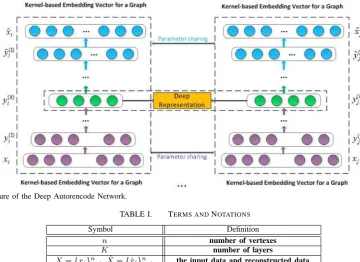
Fig.1 shows the deep autoencoder network architecture that will be used in this work. The parameters of the network are shown in Table.I. Letxi be an input. For each t-th layer, we
compute the hidden representationyt i as
yit=
σ(W(1)xi+b(1)) if t= 1;
σ(W(t)yt−1
i +b(t)) if t= 2, ..., T.
(11)
AfterT steps, we transform the input dataxiintoyi(T)through
the encoder network. Then, after anotherT steps, we reverse the calculation process of the encoder network and reconstruct xi as output xˆi based on y
(T)
i through the decoder network.
yi(T) is the resulting deep representation of the input data xi.
The objective of the deep autocoder network is to minimize
the reconstruction error of outputxˆiand inputxi, and the loss
function is defined as
L=
n
X
i=1
kxˆi−xik22 (12)
To optimize the deep autocoder network, we first use the Deep Belief Network [17] to pretrain its parameters to avoid trapping in local optimum in the parameter space. Then, the deep network is optimized by means of the Stochastic Gradient Descent method, where the gradients can be conveniently obtained by applying the chain rule to backpropagate error derivatives first through the decoder network and then through the encoder network, i.e., back-propagate ∂L∂θ to updateθk.
As [20] stated, minimizing the reconstruction error can smoothly capture the manifold structure of the original data and thus capture the main characteristics of the data.
B. The Deep Hybrid Graph Kernel
In this subsection, we propose a new deep hybrid graph kernel based on the depth-based graph kernel [1] and the Weisfeiler-Lehman subtree kernel [2] through the deep autoen-coder network. The reason of using these two state-of-the-art graphs is twofold. First, the Weisfeiler-Lehman subtree kernel can not only accommodate vertex labels but also capture rich intrinsic structure information through the expanding subtree rooted at each vertex. Second, the depth-based matching kernel can establish reliable structural correspondence information between graphs that is ignored by the Weisfeiler-Lehman subtree kernel. In other words, while these two graph kernels have different characteristics with different advantages, the resulting hybrid kernel will combine these advantages.
Assume we have a set of graphs G =
{G1,· · ·, Gi,· · ·, GN}. We commence by computing
the kernel matrices KDB and KWL using the depth-based
matching kernel and the Weisfeiler-Lehman subtree kernel, respectively. Each kernel matrix K· is a N × N matrix, and each element K·(i, j) indicates the similarity between a pair of graphs Gi ∈ G andGj ∈ G in terms of a graph
kernel measure. For each graph Gi ∈ G, we compute the
characteristics vector Vi of Gi associated with thei-th rows
of the kernel matricesKDB andKWL, i.e.,
Vi= [KDB(i,1),· · · , KDB(i, M), (13)
KWL(i,1),· · ·, KWL(i, M)],
whereM denotes the number of training graphs. Based on the definition in [3],Vican be seen as a vectorial representation of
Gi based on the similarity betweenGi and a set of prototype
graphs. Here, we use the graph kernels as the similarity mea-sures and the training graphs inGas the prototype graphs. As
a result, this joint kernel-based similarity embedding vectors encapsulate rich structural information from both the depth-based matching kernel and the Weisfeiler-Lehman subtree kernel.
With the kernel-based similarity embedding vectors of all graphs in G to hand, we use these embedding vectors as
input data to train the deep autoencoder network introduced in Section III-A. Based on Eq.(11) we obtain a set ofN deep representation vectors of all graphs inGas
DRs={y1(K),· · · , y(K)
i , . . . , y (K)
Fig. 1. The Architecture of the Deep Autorencode Network.
TABLE I. TERMS ANDNOTATIONS
Symbol Definition
n number of vertexes
K number of layers
X={xi}ni=1,Xˆ={xˆi}ni=1 the input data and reconstructed data Yk
={yk i}
n
i=1 the k-th layer hidden representation Wk
,Wˆk
the k-th layer weight matrix
bk ,ˆbk
the k-th layer biases
θ(k)
={Wk ,Wˆk
, bk ,ˆbk
} the overall parameters
whereyi(K) is the deep representation of graphGi ∈G. The
deep representation y(iK) of each graph Gi can effectively
capture the manifold structure of the graph space through the the autorencoder network.
With the deep representation yi(K) ∈DRs of each graph
Gi∈Gto hand, we compute a deep graph kernelk for each
pair of graphsGi∈GandGj ∈Gas
kDP=hy(iK), y (K)
j i, (15)
i.e., the dot product between the deep representationsyi(K)and yj(K) of Gi and Gj. The resulting deep hybrid graph kernel
based on the depth-based matching kernel and the Weisfeiler-Lehman subtree kernel is defined as
kDHK=kDP+kWL(M)+kDB(K), (16)
i.e., the deep hybrid kernel consists of three basic kernel measures. Specifically, k(WLM) reflects the intrinsic structure information through the subtrees rooted at each vertex with increasing heights that vary from1toM.k(DBK)is based on the structural correspondence information between substructures identified through the K-layer depth-based representations rooted at each vertex. On the other hand, the deep graph kernel kDP directly encapsulates the joint kernel-based similarity
information of the kernels k(WLM) and k(DBK). This is because the deep representations for kDP are computed through the
deep autoencoder network, that minimizes the reconstruction error of the output and input kernel-based similarity graph embedding vectors associated withk(WLM)andk(DBK). As a result, this is turn allows us to avoid the problem of determining the
optimal mixing between the input kernels (as in the hybrid reproducing kernel [16]) by encapsulating this information in kDP.
Finally, note that, to eliminate difference in scales resulting when combining the different graph kernels, we suggest to transform the basic deep kernelkDP, the depth-based matching
kernelkDB(K)and the Weisfeiler-Lehman subtree kernelkWL(M)in Eq.(13), Eq.(15) and Eq.(16) into their normalized versions. For instance, for a sample kernelk(i, j), its normalized version knm(i, j) is defined as
knm=
k(i, j)
p
k(i, i)k(j, j). (17)
The resulting normalized kernel value is therefore bounded between0 and1.
C. Discussions
The proposed kernel has a number of advantages. First, unlike most state-of-the-art graph kernels [8], [22], [9], [23], [24], [14], [25], [26] that only reflect the similarity information between pairs of graphs, the deep hybrid graph kernel kDHK
can encapsulate similarity information between a larger num-ber of graphs. This is because the associated basic deep graph kernelkDP of kDHK is computed as the dot product between
the graph and all the training graphs. Second, unlike other hybrid graph kernels (e.g., the hybrid reproducing kernel [16]) that need to compute the weighted coefficients associated with each combined graph kernel to reflect the relationship between these combined kernels, our deep hybrid graph kernel can smoothly capture the joint relationship between the combined kernels through the deep representations computed through the autoencoder networks. Furthermore, since the deep autoen-coder network can significantly capture the manifold structure of the graph embedding space, the resulting deep hybrid graph kernel can reflect richer graph structural information. The above observations suggest the theoretical effectiveness of the proposed deep hybrid graph kernel.
IV. EXPERIMENTALRESULTS
A. Datasets
MUTAG:The MUTAG dataset consists of graphs representing 188 chemical compounds, and here the goal is to predict whether each compound possesses mutagenicity [27]. The maximum, minimum and average number of vertices are 28, 10 and 17.93 respectively.
PPIs:The PPIs dataset consists of protein-protein interaction networks (PPIs). The graphs describe the interaction relation-ships between histidine kinase in different species of bacteria. Histidine kinase is a key protein in the development of signal transduction. If two proteins have direct (physical) or indirect (functional) association, they are connected by an edge. There are 219 PPIs in this dataset and they are collected from 5 different kinds of bacteria (i.e., a) Aquifex4 and thermotoga4 PPIs fromAquifex aelicusandThermotoga maritima, b) Gram-Positive52 PPIs fromStaphylococcus aureus, c) Cyanobacteri-a73 PPIs fromAnabaena variabilis, d)Proteobacteria40 PPIs from Acidovorax avenae, and e) Acidobacteria46 PPIs). The number of maximum, minimum and average vertices for the PPIs dataset are 128, 3 and 109.63 respectively.
Reeb:The SHREC 3D Shape database consists of15 classes and 20 individuals per class, that is 300 shapes [28]. This is a standard benchmark in 3D shape recognition. From the SHREC 3D Shape database, we establish the Reeb graph datasets through the mapping function: ERG barycenter, i.e., the distance from the center of mass/barycenter. The number of maximum, minimum and average vertices for the Reeb dataset are 220, 41 and 95.42 respectively.
Shock:The Shock dataset consists of graphs from the Shock 2D shape database. Each graph is a skeletal-based represen-tation of the differential structure of the boundary of a 2D shape. There are 150 graphs divided into 10 classes. Each class contains 15 graphs. The number of maximum, minimum and average vertices for the Shock dataset are 33, 4 and 13.16 respectively.
B. Evaluation on Graph Classification
We evaluate the performance of our kernels on several standard graph datasets, including MUTAG, Reeb, PPIs and Shock.
Experimental Setup: We evaluate the performance of the deep hybrid graph kernel (DHGK) on graph classification
problems. We compare our kernel with several alternative state-of-the-art graph kernels. These graph kernels include 1) the depth-based matching kernel (DBMK) [1], 2) the Weisfeiler-Lehman subtree kernel (WLSK) [2], 3) the shortest path graph kernel (SPGK) [7], 4) the graphlet count graph kernel with graphlet of size4(GCGK) [29], and 5) the hybrid reproducing graph kernel (HRGK) [16]. For the DHGK kernel, we set the parametersK= 10(i.e., the greatest subgraph layer associated with the combined DBMK kernel) and M = 10 (i.e., the greatest subtree height associated with the combined WLSK kernel), because of the good performance of the kernels with these parameters based on the works in [1], [2]. Similarly, for the independent DBMK and WLSK kernels, we set both their own associated parameters M and K as 10. Moreover, for the associated multi-layer deep autoencoder network of the proposed HRGK kernel, we set the dimension of each layer is 600, 400, 200 and 100, i.e., the associated encoder and decoder network both have 4 layer learning structures. The classification performance of each kernel is evaluated using 10-fold cross-validation and a C-Support Vector Machine (C-SVM). Moreover, we employ the LIBSVM library [30]. For each fold, we choose the parameters of each kernel together with the C parameter of the C-SVM by cross-validation on the training data. For each kernel and dataset, we repeat the whole experiment 10 times and we compute the average classi-fication accuracy and standard error. The average classiclassi-fication accuracies (±standard error) are shown in Table II.
Results and Discussions:In terms of classification accuracy, we can see that the proposed DHGK kernel can outperform the alternative graph kernels, with the exception of the WLSK kernel on the PPIs dataset. However, the proposed DHGK kernel is still competitive to the WLSK kernel on the PPIis dataset. The effectiveness of the proposed DHGK kernel are threefold. First, unlike the remaining graph kernels that only reflect the information between pairwise graphs, the proposed DHGK kernel can reflect comprehensive information over all graphs under investigations. This is because the associated deep basic kernel for the DHGK kernel is computed through a kernel-based embedding vector, and this embedding vector of each graph is computed based on measuring the kernel value between the graph and each of the training graphs. Second, unlike the HRGK kernel, which is also a kind of hybrid graph kernel, only the proposed DHGK kernel can jointly capture the relationship between the combined kernels through the deep autoencoder network. Furthermore, since the deep network can capture the manifold structure of kernel-based graph embedding space, the proposed DHGK kernel can reflect richer graph characteristics. Third, the proposed DHGK kernel can simultaneously encapsulate the joint information and the independent information from the DBMK and WLSK kernels, thus leading to a significant improvement over the original kernels.
V. CONCLUSIONS
TABLE II. CLASSIFICATIONACCURACY(IN%±STANDARDERROR).
Datasets MUTAG Reeb PPIs Shock
DHGK 88.05±.61 69.73±.51 87.61±.87 42.13±.55 DBMK 85.27±.69 69.40±.56 83.74±.73 35.20±.62 WLSK 82.05±.57 58.53±.53 88.07±.41 36.40±1.00 SPGK 83.38±.81 55.73±.44 59.04±.44 37.88±.93 GCGK 82.04±.39 23.40±.60 46.61±.47 26.93±.63 HRGK 84.35±.71 32.71±.51 53.61±.23 26.93±.63
between the associated depth-based matching and Weisfeiler-Lehman subtree kernels, but also reflects the similarity infor-mation between each graph and the set of training graphs. Experimental evaluations demonstrate the effectiveness of the proposed kernel. Overall, the proposed work provides us a new way of defining new hybrid graph kernel. Our future work will investigate different hybrid kernels based on other state-of-the-art graph kernels.
Acknowledgments
This work is supported by the National Natural Science Foundation of China (Grant no. 61503422 and 61602535), and the Open Projects Program of National Laboratory of Pattern Recognition. Lu Bai is supported by the program for innovation research in Central University of Finance and Economics.).
REFERENCES
[1] L. Bai, P. Ren, X. Bai, and E. R. Hancock, “A graph kernel from the depth-based representation,” inProceedings of S+SSPR, 2014, pp. 1–11. [2] N. Shervashidze, P. Schweitzer, E. J. van Leeuwen, K. Mehlhorn, and K. M. Borgwardt, “Weisfeiler-lehman graph kernels,”Journal of Machine Learning Research, vol. 12, pp. 2539–2561, 2011.
[3] E. Z. Borzeshi, M. Piccardi, K. Riesen, and H. Bunke, “Discriminative prototype selection methods for graph embedding,”Pattern Recognition, vol. 46, no. 6, pp. 1648–1657, 2013.
[4] M. Neuhaus and H. Bunke, “Bridging the gap between graph edit distance and kernel machines,”World Scientific, 2007.
[5] D. Haussler, “Convolution kernels on discrete structures,” inTechnical Report UCS-CRL-99-10, Santa Cruz, CA, USA, 1999.
[6] T. G¨artner, P. Flach, and S. Wrobel, “On graph kernels: hardness results and efficient alternatives,” inProceedings of COLT, 2003, pp. 129–143. [7] K. M. Borgwardt and H.-P. Kriegel, “Shortest-path kernels on graphs,” inProceedings of the IEEE International Conference on Data Mining, 2005, pp. 74–81.
[8] N. Kriege and P. Mutzel, “Subgraph matching kernels for attributed graphs,” inProceedings of the 29th International Conference on Ma-chine Learning, ICML 2012, Edinburgh, Scotland, UK, June 26 - July 1, 2012, 2012.
[9] F. Costa and K. D. Grave, “Fast neighborhood subgraph pairwise distance kernel,” inProceedings of ICML, 2010, pp. 255–262. [10] A. Feragen, N. Kasenburg, J. Petersen, M. de Bruijne, and K. M.
Borgwardt, “Scalable kernels for graphs with continuous attributes,” inProceedings of NIPS, 2013, pp. 216–224.
[11] M. Neumann, N. Patricia, R. Garnett, and K. Kersting, “Efficient graph kernels by randomization,” inProceedings of ECML-PKDD, 2012, pp. 378–393.
[12] M. Neuhaus and H. Bunke, “Edit distance-based kernel functions for structural pattern classification,”Pattern Recognition, vol. 39, no. 10, pp. 1852–1863, 2006.
[13] H. Fr¨ohlich, J. K. Wegner, F. Sieker, and A. Zell, “Optimal assignment kernels for attributed molecular graphs,” inProceedings of ICML, 2005, pp. 225–232.
[14] L. Bai, L. Rossi, Z. Zhang, and E. R. Hancock, “An aligned subtree kernel for weighted graphs,” inProceedings of ICML, 2015, pp. 30–39. [15] L. Bai and E. R. Hancock, “Depth-based complexity traces of graphs,”
Pattern Recognition, vol. 47, no. 3, pp. 1172–1186, 2014.
[16] L. Xu, X. Jiang, L. Bai, J. Xiao, and B. Luo, “A hybrid reproduc-ing graph kernel based on information entropy,”Pattern Recognition, vol. 73, pp. 89–98, 2018.
[17] G. E. Hinton and R. R. Salakhutdinov, “Reducing the dimensionality of data with neural networks,”science, vol. 313, no. 5786, pp. 504–507, 2006.
[18] L. Bai and E. R. Hancock, “Graph kernels from the jensen-shannon divergence,”Journal of Mathematical Imaging and Vision, vol. 47, no. 1-2, pp. 60–69, 2013.
[19] B. Weisfeiler and A. Lehman, “A reduction of a graph to a canon-ical form and an algebra arising during this reduction,” Nauchno-Technicheskaya Informatsia, vol. Ser.2, no. 9, 1968.
[20] D. Wang, P. Cui, and W. Zhu, “Structural deep network embedding,” inProceedings of KDD, 2016, pp. 1225–1234.
[21] C. Hong, J. Yu, J. Wan, D. Tao, and M. Wang, “Multimodal deep autoencoder for human pose recovery,”IEEE Trans. Image Processing, vol. 24, no. 12, pp. 5659–5670, 2015.
[22] H. Kashima, K. Tsuda, and A. Inokuchi, “Marginalized kernels between labeled graphs,” inProceedings of ICML, 2003, pp. 321–328. [23] F. R. Bach, “Graph kernels between point clouds,” inProceedings of
ICML, 2008, pp. 25–32.
[24] Z. Harchaoui and F. Bach, “Image classification with segmentation graph kernels,” inProceedings of CVPR, 2007.
[25] L. Bai, P. Ren, and E. R. Hancock, “A hypergraph kernel from isomor-phism tests,” in22nd International Conference on Pattern Recognition, ICPR 2014, Stockholm, Sweden, August 24-28, 2014, 2014, pp. 3880– 3885.
[26] L. Bai and E. R. Hancock, “Fast depth-based subgraph kernels for unattributed graphs,”Pattern Recognition, vol. 50, pp. 233–245, 2016. [27] A. Debnath, R. L. de Compadre, G. Debnath, A. Shusterman, and C. Hansch, “Structure-activity relationship of mutagenic aromatic and heteroaromatic nitro compounds, correlation with molecular orbital energies and hydrophobicity,”J. of Med. Chem., vol. 34, pp. 786–979, 1991.
[28] S. Biasotti, S. Marini, M. Mortara, G. Patan`e, M. Spagnuolo, and B. Falcidieno, “3d shape matching through topological structures,” in
Proceedings of DGCI, 2003, pp. 194–203.
[29] N. Shervashidze, S. Vishwanathan, T. Petri, K. Mehlhorn, and K. Borg-wardt, “Efficient graphlet kernels for large graph comparison,”Journal of Machine Learning Research, vol. 5, pp. 488–495, 2009.