I I
w
w
()EUROPEAN COMMISSION
DIRECTORATE GENERAL Ill-INDUSTRY
Study on new biodegradability test methods
for suriactants in detergents
Contract ETD/96/50021 0
Final Report
16 October 1997
Europlus s.a.
EUROPEAN COMMISSION
DIRECTORATE GENERAL Ill-INDUSTRY
Study on new biodegradability test methods
for surfactants in detergents
Contract ETD/96/50021 0
Final Report
-16 October 1997
Europlus s.a.
rue Van Elewijck 11
B-1 050 Bruxelles
~uropean
Commission Defegation
lrbrary
2300
~.n ~""~-:t
1\HN
ttA§§g~:gg;::GINX§Ni::::~~:~::
:;uu:MasM:l.
Europlus s.a.
1. INTRODUCTION •.•.••••••.••••.•.•••••••••.•..•....•.••.••••.•...•.••••.••••...•...••.•••••.••••.•••...••••.•••••••••••...•.••.••••••••••••••••• 6
2. THE EXISTING ANALYTICAL METHODS •.•..•..•••..•.•..•...••....••...•.•.••.••..•••.•••••••.•••••••••.•••••••.••••••••••••••••. 7
2.1 ANIONIC SURF ACT ANTS ... 7
2.1. 1 Semi-specific n1ethod ... ... 7
2. 1. 2 Instrumental ana~vtica/methods .. ... 8
2.2 NON-IONIC SURFACTAJ\T'fS ... 10
2. 2. 1 Senzi-specific nzethods ... ... 10
2. 2. 2 Instrumental ana(vticalmethods ... 14
2.3 CATIONIC SURFACTANTS ... 17
2.3. 1 Senzi-specific 111ethod ... 17
2.3.2 Instrumental ana~vticalmethod ... 18
2.4 MfPHOTERIC SURFACT:\NTS ... 20
2. 4. 1 Semi-specific nzethods ... ... 20
2.4.2 Instrumental ana~vtica/ method ... 21
3. REMARKS AND PROPOSALS CONCERNING THE ANALYTICAL METHODS •.•.•••..•..•••.•••••..•... 23
3 .1 ANIONIC SURF ACT ANTS ... 23
3.2 NON-IONIC SURFACTA.NTS ... 23
3. 3 C.A. TIONIC SURF ACT AJ\T"fS ... 24
3.4 MfPHOTERIC SURFACTANTS ... 25
4. APPLICABILITY OF ANALYTICAL METHODS TO THE COMMERCIALLY AVAILABLE SURFACTANTS USED IN DETERGENTS ... 25
4.1 TABLES OF COMMERCIALLY AYAILABLE SLTRFACTANTS USED IN DETERGEI'\TS ... 25
4.2 SUMMARY CONCERNING THE APPLICABILITY OF THE ANALYTICAL !\IETHODS TO COt-.lt-.IERCIAL SURF ACT ANTS IN DETERGENTS ... 29
4.2. 1 Anionic surfactants ... · ... 29
-1.2.2 Non-ionic surfactants ... 29
4. 2. 3 Cationic surfactants ... 29
4. 2. 4 44nlphoteric Surfactants ... ... 30
5. BIODEGRADABILITY TESTS •...•..•...••...••.•.•..•..•.•.•.••..••.•.••••.•.••••••••.•.•..••..••••••.•••••••••. 30
5.1 EXISTING BIODEGRADABILITY TEST METHODS ... 30
5.1.1 Directive on Detergents ... 30
5. 1.2 Other existing biodegradability test methods.. ... 31
5.2 OPERATING PROBLEMS: ADSORPTION. SOLUBILITY. TOXICITY ... 33
5.2.1 44dsorption ... 33
5.2.2 So/ubi/if)' ... 34
5.2.3 Toxicif)' ... 34
5.3 ADAPTATION OF THE EXISTING TEST r-.tETHODS ... 35
5.3.1 Screening test- Possible changes to the method ... 35
5.3.2 Confirmatory test: Possible adaptation of the test method ... 35
5.4 NEW BIODEGRADABILIIT TEST ... 37
6. OPERATION COSTS ... 41
Europlus s.a. ·
7. CONCLUSIONS ••••••••••••••••••••••••••••••••.••.•••••••••••••••••••••••.••••••••••••.•••••••••••••.••••••••••••••••••••••••••••••••••••••••••••••••• 42
7.1 ANAL\'TICALMETHODS ... 42 7.2 BIODEGRADABILIT\' TESTS ... 43 7.3 PROPOSALS ... 43
8. BmLIOGRAPHY .••••••••.•••••••••••••••••••.•••••....••••.••••••.••••.••...•.•.•...•..••••••••••••.••••••••••••••.•••.•.••.••.••••••••••••••••••••• 44
9. ANNEXES ···-:···.,.··· ... •·•••·•···••••••••••••••• 4 7 9.1 OECD TECHNICALREPORT 1976 ... 47 9.2 FRENCH STAN"DARDPR., T 73-280 ... ~ ... 47 9.3 ISO/DIS 14593 HEADSPACEMETHOD ... 47
Europlus s.a. ·
~BQMM.ABYI~\I~:
The present study is making a state of the art concerning the new biodegradability test methods available to measure the biodegradability of surfactants contained in detergents.
It is intended to be used for determining which developments are to be considered by priority, in the field of analytical techniques and biodegradation test methods needed to update Directive 73/404/EEC on detergents and daughter Directives.
To help in the realisation of this project, the consultant has used the results of the research provided by the expert rapporteur for each surfactant, namely anionic, non-ionic, cationic and amphoterics. In addition, all the relevant issues regarding this subject have been collected from recent literature and have been assembled in this report.
Two major areas of development have been investigated. One concerns the analytical methods used for determining the concentration of surfactants in the biodegradation test. The other concerns the operational aspect of biodegradation tests.
Regarding the analytical techniques used, both semi-specific and specific analysis have been described.
For the determination of the concentration of anionic and non-ionic surfactants, the semi-specific methods currently used (Directive 82/242 and 82/243) are still valid today. The possibility to include a new analytical semi-specific method in the Directive is also envisageable. The real problem encountered concerns mainly the separation of the surfactants from interfering substances.
For cationic surfactants, the semi-specific disulfine blue method has been reported as . a candidate for inclusion in the Directive. However, some questions regarding the applicability of this method to all categories of cationic surfactants have to be discussed. Furthermore, the method needs to be validated by an intercomparison test between European laboratories.
A semi-specific method for measuring the conce~tration of amphoteric surfactants is under
development/test by industry. The results of this exercise are expected to help deciding on further measures.
In general, the alternative instrumental techniques allowing the determination of the concentration of specific surfactants within each classes of surfactants, are used for environmental samples (rivers, sediments, etc.) which have very low concentration. Thus, these methods are not exactly suited for samples from biodegradability tests.
However, for surfactants not responding to the current semi-specific analytical methods such as MBAS, BiAS or DBAS, these instrumental methods may be the only alternative.
Regarding the operational aspects of the biodegradation tests, the latest developments concerning two types of test have been investigated; the screening tests and the activated sludge simulation tests.
In addition to the existing OECD/die-away test to measure the primary biodegradability of surfactants, several screening tests to measure the ultimate biodegradability of chemical substances have been well validated.
It has been suggested to incorporate these tests in the overall decision strategy used to allow surfactants on the market.
Europlus s.a. ·
A comparison of the operational parameters is provided.
The latest developments concerning the activated sludge simulation tests have also been presented and suggestions of modification to the existing operation parameters have been made to apply these methods to surfactants.
Europlus s.a. ·
a~~ijij[UN~B.o~P.I~IgN.:j:~:~:I~lji~i·
Since 1996 the services of the Commission have undertaken to examine the existing European legislation on detergents in force since 1973 in order to propose its updating in relation to the scientific and technical progress of today.
To achieve this objective the Commission has proposed to take the following points into consideration:
• Does the existing legislation on detergents still respond to today's requirements concerning the high level of protection of men and the environment?
• Is this existing legislation still well integrated into fast changing international arena concerned with environmental issues?
• Are there important scientific and technical progress to take into account for a possible up-dating of the legislation?
To answer to these quest~ons a task force with several. experts groups was created.
Regarding technical issues relating to the problems of primary biodegradability of surfactants the services of the Commission established a group of experts within this task force.
One rapporteur per class of surfactants i.e. anionics, non-ionics, cationics and amphoterics volunteered to submit to the Commission a short review of the state of the art concerning the latest development in the field of analytical techniques for the determination of primary biodegradability of these surfactants.
The task assigned by the services of the Commission to Europlus was to examine any new biodegradability tests, including the analytical methods, which could serve the purpose of determining the primary biodegradability of surfactants contained in. detergents. The reports provided by each rapporteur was used as a basis to carry out this task.
In addition, all recent developments concerning this topic published in the literature were examined and reported.
Throughout the establishment of his report, the consult~nt took contact with the services of the Commission and with the Industry and national co-ordinators. He wishes to thank all those who have co-operated so actively to the realisation of this report.
To fulfil the request of the services of the Commission the contractant has divided his report in two subjects:
=> One concerns the existing analytical methods for the determination of surfactants => The other concerns the existing biodegradation tests.
Europlus s.a. ·
i~IIlOCH~il~~§IIIIG:~;~gAt.tiiJ.P.~~t~iM.§XHQQ$IIi~I~~i~~~~~~~
The analytical methods to detect the different classes of surfactants are of two types:
1. Semi-specific (i.e. applicable to the 'entire' class of surfactants) or
2. Specific (i.e. applicable to single compounds within the class of surfactants).
The latter methods are essentially instrumental techniques using chromatography whereas the former are classical chemical methods principally based on colorimetry.
In the following chapters, the methods of analysis will be presented with respect to each class of surfactant i.e. anionic, non-ionic, cationic and amphoteric. .
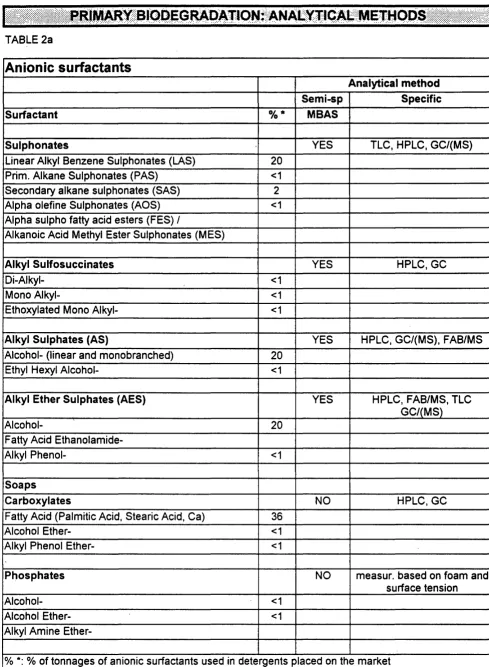
A summary of the analytical methods available for each class of surfactants is given in tables 1 a
to 1e.
2.1
ANIONIC SURFACTANTS2.1.1 Semi-specific method
The classical method currently used to follow the primary biodegradation of anionic surfactants is a colorimetric method. The principle of the method is that the anionic surfactant reacts with a cationic dye to form a paired ion association complex which is soluble in organochlorinated
solvents. After extraction the concentration of the paired ion is then determined
spectrophotometrically.
The cationic dye used is methylene blue.
Methylene Blue Active Substances- MBAS
Soaps, carboxylates, phosphates and phosphonates anionic surfactants do not react to methylene blue (see also table 2a for applicability).
The following procedure is currently applied to measure anionic surfactants (Painter 1995):
• Reaction of the anionic surfactant with the methylene blue
• Extraction of the complex from the alkaline solution of the dye into chloroform
• Back extraction from the chloroform phase with an acidified methylene blue solution (to remove interference such nitrate and chloride anions)
• Determination of the complex concentration by spectrophotometry at 650 nm.
In parallel to the blank a series of concentrations of a chosen standards are run to obtain the calibration curve.
Both sulphates and sulphonates react to the methylene blue. To differentiate between the two classes of anionic surfactants, the sample can be hydrolysed in acid. Alkyl sulphates and also ethoxy sulphates will be transformed into inorganic sulphate and the corresponding alcohol.
For LAS extraction is reported to be completed from
C,s
toC
8 while for homologues with a lowernumber of carbon extraction occurs to a less extend.
The detection limit is in the range of 0.02- 0.05 mg/1.
Europlus s.a. ·
This analytical method is described in the European legislation on detergents Directive 82/243/EEC.
This method has also been adopted by the OECD (1976) and as a standard by ISO (1984a).
An automated method for the methylene blue active substances is also available. It is reported that in the presence of suspended solids, the results may be lower than those obtained by using the manual method because of adsorption of the complex on the solid in the coil system.
Limit of detection: 0,2 mg/1.
2.1.2 Instrumental analytical methods
Thin Layer Chromatography (TLC), Gas Chromatography (GC) and High Performance Liquid Chromatography (H PLC) methods have been used with success for the determination of anionic surfactants. TLC is considered as a semi-quantitative method.
These methods can be used for separating the different types of anionic surfactants and also for the determination of homologues and isomers.
Gas Chromatography- CG
As it is the case for non-ionic surfactants gas chromatography cannot be applied to anionic surfactants if they have not been previously derivatised. This is due to the low volatility of these compounds.
Derivatives used today include methyl esters, fluoride and also thiols. Conditions for separation depend on the efficacy of capillary column used and on the temperature programming system.
GC coupled to mass spectrometry offers powerful means of detection.
High Performance Liquid Chromatography- HPLC
The most commonly used instrumental technique for the determination of anionic surfactants in waste waters, activated sludge or in environmental samples is certainly HPLC. This method allows to identify all homologues and isomers present for one type of anionic surfactant for example LAS (Feijtel et all 1995).
The advantage of H PLC over gas chromatography is that derivatisation is not needed. On the other hand preconcentration is required.
The following steps are required to carry out the determination of anionic surfactants (LAS) by HPLC (Matthijs & De Henau 1987):
*
Liquid samples are dried and extracted several times with methanol*
Column ion exchange to separate the anionics from other surface active. materials*
Elution and concentration of the LABS onto a reversed-phase column*
Elution of concentrate extract with methanol*
Analysis on a reversed- phase HPLC system with a fluorescence detector at230-290 nm.
Alternatively UV detection at 230 nm or a sulphur-specific inductively coupled argon-plasma emission spectrometer detector can also be used.
The method can been made compound-specific and the detection limit can be as low as 1 1-1g/l.
Europlus s.a. .
2.2
NON-IONIC SURFACTANTS2.2.1 Semi-specific methods
The semi-specific methods for the determination of non-ionic surfactants are based on the formation of a complex between the polyethoxylated chain and an inorganic cation followed by the reaction of this complex with an anionic compound to yield a precipitated salt or a solvent extractable colour compound. A major draw back to these methods is the interference of other surfactants and of other organic compounds.
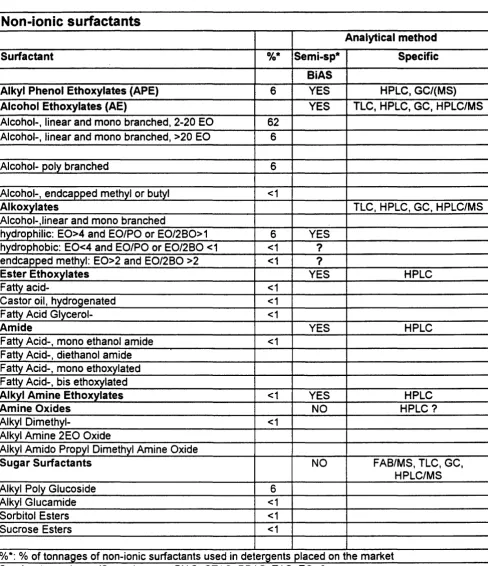
Given that the reaction involves the polyethoxylated chain, non-ionic surfactants not containing ethoxylates will not react. This is the case for some sugar derivatives (see table 2b for applicability).
Bismuth Active Substances- BiAS
The polyethoxylated part of the non-ionic surfactants forms a precipitate with a preparation containing barium tetraiodobismuthate (Dragendorff reagent). Complexes can be formed when
the non-ionic surfactant contains a chain of more than five ethoxylates (> EOS). The surfactant is
measured by potentiometric titration of the bismuth in the precipitate.
The following procedure is currently applied to measure non-ionic surfactants
(Wickbold 1972):
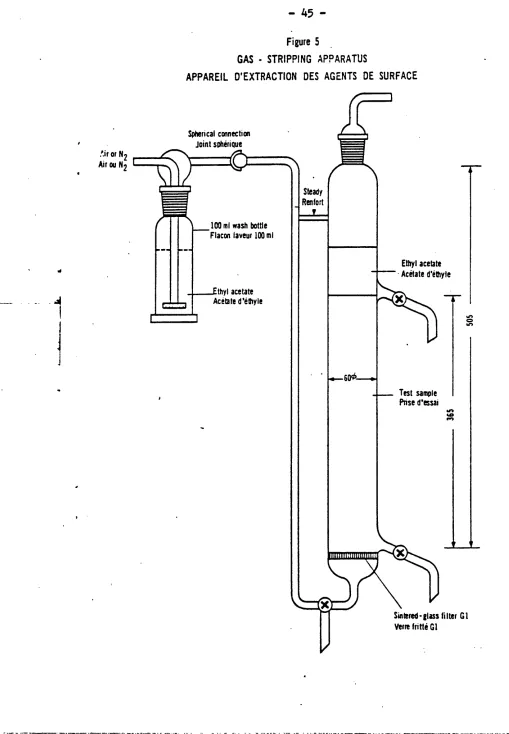
• Removal of particulates by filtration (raw sample from the biodegradation test) • Sublation into ethyl acetate using a stream of nitrogen
• Removal of cationic surfactants by cation exchange resin
• Precipitation of the non-ionic surfactants by the barium bismuth iodide reagent • Dissolution of precipitate in hot ammonium tartrate
• Measurement of the bismuth of the precipitate by potentiometric titration with pyrrolidine dithiocarbamate.
As an alternative to potentiometric titration, bismuth may be determined by UV absorbance at 263.5 nm by adding EDT A to the dissolved precipitate or by atomic adsorption spectrometry by dissolving the precipitate in a nitric acid solution.
Interfering substances : polyethylene glycol, cationic and amphoteric surfactants, biodegradation by-products. Because of the possibility of interference of these compounds, the methods tends to
overestimate the concentration of non-ionic surfactants. This is particularly the case for
environmental samples.
The atomic ratio between bismuth and oxygen from ethoxylates in the precipitate is 1/9.8.
Detection limit: in the range of 0.01 to 0.05 mg/1
This method. has been adopted by the OECD (1976). It is included in the EEC legislation on detergents Directive 82/242/EEC. It also applied as a standard by ISO (1984b).
Europlus s.a. .
Cobalt Thiocyanate Active Substances - CTAS
In this method the non-ionic surfactants are measured spectrophotometrically by absorbance after forming a complex with a cobalt thiocyanate reagent. The procedure is best applicable to non-ionic surfactants having between 6 to 25 ethylene oxide groups. Below 6 and above 25 EO groups the absorbance is not linear.
The following procedure is currently used (Boyer et al, 1977):
• Sublation of the sample in ethyl acetate • lon exchange to remove other surfactants • Reaction with cobalt thiocyanate
• Extraction of complex with methylene chloride • Spectrophotometric determination at 320 or 620 nm.
A calibration curve is prepared by using different concentrations of standard non-ionic surfactants.
The recovery rate of added alcohol ethoxylates is above
90°/o.
The sensitivity of the method is largely dependent on the number of ethoxylate groups and the quality of the extraction procedure.
This method is also influenced by interfering materials, such as strongly basic or acidic solution, cationic and anionic surfactants and polyethylene glycol.
The limit of detection is of 0.1 mg/1.
This method is applied as a standard by the Soap and Detergent Association (SDA) in the USA. This method can be automated.
Potassium Picrate Active Substances- PPAS
After concentration and extraction of the sample into ethylene dichloride the ethoxylate chain of the non-ionic surfactant is complexed with K+ and paired with the picrate anion. The picrate is then determined by spectrophotometry.
The steps are the following :
• Purification/concentration and extraction into ethylene dichloride
• Complexation of the ethoxylate chain with K• and pairing with picrate anion • Extraction into methylene chloride
• Determination of the picrate content by spectrophotometry at 378 nm.
The method is applicable to non-ionic surfactants with ethoxylate chains ranging from 7 to 28 EO.
<;;ationic surfactants present in the sample can interfere with the method.
The range for the limit of detection is of 0.05 to 0.1 mg/1.
Europlus s.a •.
Tetrakis Active Substances - TAS
This method, like PPAS, is based on the reaction of the ethylene oxide units with the potassium ion but it uses tetrakis-(4-fluorophenyl) borate salt as complexing agent. The positively charged formed complex is determined by two phase titrimetric analysis.
Procedure:
• Alkalinisation with KOH of an aqueous solution of an ethoxylated non-ionic surfactant • Addition of the 'Victoria blue' indicator and dichloroethane.
• The two phase mixture under stirring conditions is titrated by a 'tetrakis' solution.
The method is reported to be very simple. There is no mention of interferences.
Limit of detection: 0.5 mg/1.
TABLE 1b ' .. :,:.::.. ,, .. ··
Semi-specific
analytical
methods
Method Reagent Complex Extraction Detection Limits of Applicability with method detectionBiAS
Tetraiodo orange complex ammonium potentiometric 0.01-0.05 Much used hard working bismuth-ate with EO 6-30 tartrate titration, mg/1 method but most reliable. Ba(Bil.t)2 atomic absorp.(Bi) E0<5 not detected (modified orUV Extraction by sublation Dragendorff)CTAS
Ammonium colored ion Dichloromethane spectrometric 0.1 mg/1 official standard of SDA in cobalto association CH2CI2 at 320 nm or 620 USA -simpler and faster than thiocyanate complex nmBiAS E0<5
Europlus s.a. .
2.2.2
Instrumental analytical methods
These methods have two advantages. They are far more sensitive than the semi-specific methods (detection of non-ionic surfactants in the microgram per liter range) and give information on the nature of the surfactant and its degradation intermediates. Therefore, these methods can be regarded as specific.
Thin Layer Chromatography- TLC
The method of Paterson et al 1966 currently used involves:
• The addition of magnesium sulphate to the aqueous sample • Extraction of non-ionic surfactants and polyglycols into chloroform • Washing the extract with saline, acid and alkaline solutions • Spotting on a coated silica gel plate alongside with standards • Development with suitable solvents ethyl acetate. water, acetic acid
• Characterisation and quantification following spraying with modified Dragendorff reagent
The method is applicable to non-ionic surfactants with an ethylene oxide chain of at least 4 EO.
Neither anionic surfactants nor PEG are reported to interfere with the method.
Detection limit in the range of 1 to 5 ~g/1.
This method is reported to be convenient for biodegradation test studies.
Gas Chromatography·
GC
The method can in principle be applied to mixtures containing more than one single non-ionic class.
The method is difficult to apply to non-ionic surfactants with ethylene oxide chain above E07 because of their low volatility and because they decompose at higher temperature. Derivatisation with silyl compounds is needed. The detection is usually made with a flame ionisation detector
(FlO).
This technique has been applied to determine polyoxyethylene chain with 1 to 6 EO of alcohol ethoxylates.
Gas chromatography has been also used for the determination of ethoxylated surfactants in
wastewater by converting
!O
hydrogen bromide cleavage products (fission technique).The following steps were required:
• Extraction from test liquors (sublation into ethyl acetate)
• Clean-up from interfering substances by ion exchange and silica gel • Addition of internal standard
• H Br cleavage
• Extraction with carbon disulphide
• Concentration determined by GC coupled with flame ionisation detector.
A calibration curve is made by plotting the dibromoethane (from the ethylene oxide groups)/dibromobutane (from the internal standard) peak area ratios against weight of standard non-ionic surfactants.
The detection limit is around 5 ~g/1.
Europlus s.a ..
High Performance Liquid Chromatography - HPLC
This technique is useful for separating the ethoxy components of mixtures of non-tontc surfactants and their PEG metabolites as well as for the alkyl and ethoxy chain lengths of individual. The current method of detection is by UV absorption and fluorescence but mass spectrometry and flame ionization detectors can also be used.
Usually the non-ionic surfactants should be derivatised with suitable chromophores to be detectable by UV or fluorescence.
In the case of non-saturated compounds derivatisatlon may be unnecessary before UV detection. Non-derivatised AE can be analysed in a substance-specific way only by coupling HPLC with mass spectrometry detection.
Detection limit around 1 J.Lg/1.
The method has been applied to biodegradation studies.
Europlus s.a. .
2.3
CATIONIC SURFACTANTSContrary to anionic and non-ionic surfactants there is no European 'legally' accepted analytical method to follow the primary biodegradation of cationic surfactants. However, a practical analytical 'colorimetric' method has been in use for more than 10 years in European laboratories and has even been standardised by some Member States of the Community.
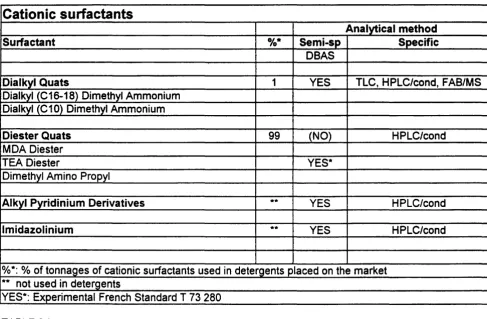
For the applicability of the methods to commercially available cationic surfactants in detergents see table 2c.
2.3.1 Semi-specific method
Disulfine Blue Active Substances • DBAS
As with the two previous surfactants, the disulfine blue method is based on the formation of a
colored association complex between the cationic surfactants and an anionic dye. The
concentration of the complex is determined spectrophotometrically.
The method involves the following steps:
• If the sample contains· anions it should be treated on an ion-exchange resin because cationic surfactants react with interfering anions other than the anionic dye
• Reaction with anionic dye (disulfine blue)
• Extraction of the ion-association complex with trichloromethane • Measurement of the absorbance at 628 nm.
The method is suited for cationic surfactants containing alkyl chain of C8 or C10. It has been used to calibrate instrumental techniques (Nitschke et al, 1992).
The ion-complex formation between the cationic surfactants and the anionic dye is operated in a acidic medium (in the case of instrumental method Nitschke et al (1992), in a medium at pH 1) and is therefore in principle not applicable to Esterquats (quaternary ammonium compounds containing long chain ester groups) because these cationic surfactants tend to hydrolyse under this condition.
It has been reported to us at the meeting of the national co-ordinators in May 1997 by the representative of industry dealing with cationics that by using an adequate ion-complex formation/extraction method, the disulfine blue method was perfectly applicable to Esterquats. This point is of course crucial given that almost 99% of the commercially available cationic surfactants in detergents are Esterquats (see table 2d).
The disulfine blue reacts with other substances than surfactants. The method is therefore referred to as disulfine blue 'active substances'.
The detection limit is around 0.1 mg/1.
This method was published as standard in France T 73-280 and in the Federal Republic of Germany (1989) DIN 38 409 Teil20.
Europlus s.a •.
2.3.2
Instrumental analytical method
High Performance Liquid Chromatography· HPLC
L. Nitschke et al 1992 describe a simple and fast procedure for the determination of trace amounts of commercially used cationic surfactants by HPLC. It is an adaptation of the method of Wee and Kennedy 1982 to routine laboratory analysis.
The method allows to detect individual cationic surfactants at low concentrations.
The method involves the following steps:
• Reaction of the cationic surfactants contained in an aqueous sample with sodium dodecylbenzenesulphonate in an acidic medium
• Extraction of the sample with methylene chloride
• After evaporation to dry the residue is dissolved in a 80 : 20 mixture of chloroform and methanol
• HPLC with the same solvent system • Conductometric detection
This method is suited for the determination of long alkyl chain quaternary ammonium surfactants
in environmental samples. It has been used to detect distearyldimethylammonium chloride
(DSDMAC) and imidazoline derivatives.
Nitschke et al (1992) indicate· that the method is difficult to apply to Esterquats (quaternary
ammonium compounds containing long chain ester groups). These compounds appear as
multiple peaks on the chromatogram.
The problem may be the same as for semi-specific analysis, namely the reaction with the anionic surfactants under strong acidic conditions.
Reproducibility: It is reported that >90o/o recovery of added standard is achieved.
Limits of detection: According to the original procedure of Wee and Kennedy QACs': 0.2 JJ.g/1
RF-DET2.doc
In Nitschke et al (1992):
• Distearyldimethylammonium chloride DSDMAC: 3 JJ.g/1
*
Ditallowimidazolinium methosulphate :16
JJ.g/1• Dodecylpyridinium chloride : 6 JJ.g/1
TABLE 1d
Semi-specific
analytical
method
Method Reagent Complex Extraction Detection Limit of Applicability with method detection DBAS Disulfine Blue ion-trichloromethane spectrometry 0.1mgll responds to cationics. Disulfine anionic dye association at 628 nm except Esterquats also to Blue complex amphoterics This method was reported not to be applicable to Esterquats. However, Dr. Godefroy indicated that upon proper pre-treatment of the samples Esterquats could also be measured by this method.Alternative
instrumental
analytical
method
MethodHPLC
coupled with conductivitydetector L.
Nitschke & al (1992) Detection limits for: Reaction to enable Detection detection method derivatisation conductivity not necessary detector Limit of
detection QACs: 0.2~g/l
• DSDMAC -Distearyldimethyl ammonium. chloride : 3 ~gil • DTIM-Ditallowimidazolinium methosulphate: 16 ~gil • DPC -Dodecylpyridinium chloride: 6 f.lQ/1 Applicability Wee & Kennedy method (1982) Substance specific, reproducible, >90°/o recoveries of stand. addition For Esterquats for example Ditallowestearammonium methosulphate 3 peaks obtained by HPLC. The analysis of these substances seems more
difficult. P.
Europlus s.a ..
2.4
AMPHOTERIC SURFACTANTSSimilarly to cationic surfactants there is no analytical method described in the EEC legislation on detergents to follow the primary biodegradation of amphoteric surfactants. It is true also that amphoteric surfactants represent only a low percentage of all commercially available surfactants used in detergents. Therefore, the development of an analytical method for this category of surfactants has never been considered as a priority.
The interesting feature of these surfactants is that depending on the pH they can display anionic and/or cationic properties. Commercially available amphoteric surfactants have different iso-electric points varying between pH 1 to 11.
For the applicability of the method to commercially available amphoteric surfactants in detergents see table 2d.
2.4.1 Semi-specific methods
The semi-specific analytical method for the determination of amphoteric surfactants is based on the cationic properties of these surfactants.
The DBAS method
The same method as that used for cationic surfactants i.e. Disulfine blue active substances can in principle be applied to amphoteric surfactants in their cationic form. However, this requires that no other cationic surfactants are present in the test sample. If the test sample is passed on a strong cationic exchange resin it is likely that other cationics, if present in the sample, will be retained too.
The rapporteur of the sub-group amphoterics reported that additional work is needed if this method is intended to be included in the European legislation.
The Orange II method
This method is based on the work of Boiteux 1984. The principle of this method is similar to that used for other surfactants, it is based on the formation of solvent-extractable colored complex of
the surfactants and the orange II reagent (anionic dye). The detection is followed
spectophotometrically at 485 nm.
The work carried out by Boiteux was to investigate on the possible use of betaines in detergents and products for personnel hygiene in third world countries areas infested by the parasites causing the Schistosomoses disease (Bilharzioses). The amphoteric surfactants seem to exert
an inhibitory effect on the cercariallarvae responsible for causing this disease. ·
The analytical method requires the following steps:
• Extraction of the amphoteric surfactant from the test liquor
• Formation of a complex of the amphoteric surfactants and an azodye (Orange II) at pH 1-1.5
• Azodye: p(hydroxy 1 naphthyl azo) benzene sulfonic acid, sodium salt • Extraction of the sample with chloroform
• Measurement of absorbance at 485 nm.
Europlus s.a. .
The method as been applied to alkyl betaine C8 or C18 and alkyl amide betaine C12 or C1s at a
concentration range between 1 to 12 ppm.
Limit of detection: around the ppm.
The rapporteur for amphoteric surfactants indicated that the feasibility and optimisation of the Orange II method for determination of selected amphoteric surfactant is being investigated by TEGEWA {the german federation of surfactant manufacturers).
The method to extract amphoteric surfactant from the test liquor is expected to be the sublation method described for other classes of surfactants. Some adaptation may be needed to ensure adequate recoveries. This problem is investigated at this moment by the German federation of surfactant manufacturers-TEGEWA.
As for other surfactants the proposed separation method will be based on ion-exchange. It is reported that both types of amphoteric surfactants i.e. ampholytes and betaines are retained on a strong cationic exchange resin. They can be eluted with an ethanol/hydrochloric acid mixture with
a recovery of 95 to 1 OOo/o. Care must be taken if cationic surfactants are present in mixture with
amphoteric because they are likely to interfere with the detection of amphoteric surfactants.
It is further suggested by the rapporteur that ion exchange procedure described in Directive 82/242/EEC could be used to retain amphoteric surfactants. However, some additional work may be needed.
Polarography
Another analytical method involves the determination of the loss of surface active properties of cationic surfactants by tensiometry or by polarography.
2.4.2 Instrumental analytical method
High Performance Liquid Chromatography- HPLC
A specific method developed for measuring trace levels of quaternary ammonium compounds in river water was adapted to measure also alkyl betaines. ·
The analytical procedure involves the separation of quaternary ammonium compounds on a cyanoamino bonded phase column and the determination of the ionic species by conductivity.
The method is reported to be relatively simple. There is no need for derivatization, ion-pairing or other suppressor methods.
The modification of the method to measure alkyl betaines involves lowering of the pH in order to enhance the cationic form of the amphoteric sur:factants.
Detection limit: 2 J,.Lg/1
TABLE 1e
Semi-specific
analytical
methods
Method Reagent Complex Extraction Detection Limit of Applicability with method detectionORANGE
II
Orange II coloured chloroform spectrometry 1 ppm feasibility and optimisation (Boiteux) complex at 485 nm for quantitative determination of selected amphoterics is investigated by TEGEWADBAS
Disulfine Blue ion-association trichloromethane spectrometry ? for amphoteric in their cationic Disulfine Blue anionic dye complex at 628 nmform Additional
work needed Loss of surface-active property also measured by polarography. During extraction on strong cationic exchange resin if cationic surfactants are also present they will also be isolated
Alternative
instrumental
analytical
method
Method Reaction to enable Detection Limit of Applicability detection detection HPLCwith derivatisation conductivity 2 J.Lg/1 Substance specific Wee & Kennedy conductivity not necessary method for quaternary ammonium detector compds. modified to measure alkylbetaines pH
to
be
Europlus s.a. .
1~~I11ii§MID.~1111.1Qii1RBQPPSI~$.i1i¢tl:N:eeB.&JNG.}[H:~:ii~NAU¥D.eA.u~lile7BO:P.$::::::::::::iii!~:::i:Iiii!
3.1
ANIONIC SURFACTANTSDr. Painter reported that the MBAS method is well suited for routine laboratory analysis providing that the anionic surfactants to be determined is well isolated from potential interfering substances which could also react to the methyl blue reagent and be sufficiently hydrophobic to be extracted by chloroform.
According to the rapporteur of this sub-group, the detergents placed on the market today are no longer made with a single well identified surfactant but are merely mixtures with several categories of surfactants. Hence the essential difficulty of the authorities in charge of the control of compliance with the legislation is to be able to separate correctly the different surfactants from the starting detergent mixture.
If the separation technique is not successful the biodegradability of a surfactant may be overestimated.
It is therefore suggested that for the discussions on analytical methods for anionic surfactants particular attention should be paid to the separation (isolation) procedure proposed.
In the opinion of the rapporteur instrumental analytical method should not be developed for the purpose of measuring primary biodegradability of anionic surfactants given that under normal circumstances the MBAS method would serve the purpose of the legislation. However, they may well be the only alternative regarding surfactants which do not respond to the methylene blue under the condition of the test (see table 2a).
3.2
NON-IONIC SURFACTANTSIn his conclusion the rapporteur of this sub-group Dr Cavalli indicates that the BiAS is a hard working method, essentially because of the need to apply multi sublation steps. However it is considered a reliable method.
Dr. Cavalli however, questions the applicability of the BiAS to modem detergents containing several classes of surfactants. According to his opinion after solvent extraction and ion-exchange the test fraction may still contain substances likely to interfere with the determination of the non-ionic surfactants such as amphoterics or non alkoxylated surfactants.
Because it has been used in biodegradation studies the rapporteur suggest to optimise the methodology for the determination of non-ionic surfactants by introducing the thin layer chromatography technique (TLC) particularly because it is simple, less hard-working and in principle applicable to any class of non-ionics.
Similarly to the problem raised for anionic surfactants, the methodology for separating non-ionic surfactants requires to be considered carefully.
During the meeting in April 1997 the experts of the ad-hoc working group agreed to consider the cobalt thiocyanate (CT AS) method as a candidate for inclusion in the Directive on detergents because it is widely used and because of the possibility of its automatisation.
Europlus s.a ..
3.3
CATIONIC SURFACTANTSThe semi-specific DBAS method has been used for more than 1 0 years in laboratories for measuring concentration of quaternary ammonium surfactants (QACs). This method however, has never been included in the European legislation on detergents.
From the opinion of the experts of the working group this method should be relatively easy to standardise.
Two points need to be discussed:
A) The presence of anionic compounds may interfere with the method given the high affinity of cationic surfactants for anionic compounds including the anionic dye used to form the ion-association complex.
From the information available the way to separate the cationic surfactants from anionic compounds is as follows:
The residues from the pre-concentrated samples are extracted with methanol and the extract is treated on an ion-exchange resin to remove interfering anionic compounds. Then the isolated cationic surfactants is reacted with the dye.
In the proposed French standard T 73 280 there is some confusion as to the solvent used for extraction (methanol or ethanol?) but the procedure followed to separate anionic compounds is similar to that described above.
In the summary report from the rapporteur however, the extraction method is presented differently namely that, the insoluble complex between the cationic surfactants and the dye is extracted from the complex by treating it on a ion-exchange resin to fix the anionic compounds. We do not know whether it is a deviation from the French standard or not?
B) The applicability of the method to Esterquats
Esterquats are according to the information received from industry the most commonly used cationic surfactants in detergents. (see table 2c). The other cationic surfactants used in detergents belong to the family of tallow dimethyl ammonium chloride.
Esterquats contain multiple esters bonding which can be readily hydrolysed under strong acidic conditions. This point is important because the complex formation and solvent extraction procedure is normally performed in acidic conditions. According to some experts such experimental conditions would not allow the extraction of esterquats.
This opinion is challenged by the rapporteur for cationic surfactants who claims that by using an adequate extraction method the esterquats could also be measured by the DBAS method.
It must be underlined that in both the German standard DIN 38 409 T20 and in the French standard T 73-280 the formation of the ion-complex disulfine blue-cationic surfactant is carried out in a buffered medium (pH 3-5).
The rapporteur indicated that the proposed DBAS method has the advantage of using simple equipment. However this method may not be as popular as the HPLC method used more internationally.
The rapporteur proposes a sequential plan of action regarding analytical methods for cationic surfactants.
Europlus s.a. .
This plan has essentially three goals:
• Industry should identify more precisely which cationic surfactants are actually used
in detergents
• To carry out ring tests on the extraction anc;t analysis methods on appropriate
samples identified under the first step
• To define and launch a ring test on the biodegradability method including the
analytical procedure selected from the results of step 2. ·
According to the rapporteur it is essential to be sure that the complete method is reliable and can be used in most cases.
3.4
AMPHOTERIC SURFACTANTSHistorically physico-chemical techniques have been used in laboratories to measure the primary biodegradability of amphoteric surfactants such as the loss of surface active property of the surfactant by tensiometry or by polarography.
More recently non-specific analytical methods were developed to determine these compounds.
The Orange II method based on the formation of a solvent extractable ion-association complex is presently investigated by the German federation of surfactants manufacturers (TEGAWA).
The rapporteur indicated that the feasibility and optimisation of the orange II method for
quantitative determination of selected amphoteric surfactants is examined by TEGEWA. At the
expert meeting in March 1997. a representative of the German industry confirmed that the results
of the exercise should be analysed for the end of September 1997.
The rapporteur indicated also that the use of the DBAS method could be envisaged for measuring amphoteric surfactants in their cationic form but further work would be needed.
~- ~iAIDi:~~rif~f~~f~l~~g~f~',:~E)
1
~~~~~~l~~;~!l
1:ii&l~ili,QiiJ
4.1
TABLES OF COMMERCIALLY AVAILABLE SURFACTANTS USED IN DETERGENTSThe following tables are intended to show which analytical methods are available for each type of surfactant. The information provided by industry allowed also to give a rough estimate of the percentage of tonnage of surfactants used in detergents.
The percentages data were computed on the basis of the information supplied to us by
AIS/CESIO (March 1997).
ABBREVIATIONS:
HPLC: High Performance Liquid Chromatography HPLC/cond: HPLC coupled with conductivity detector GC: Gas Chromatography
MS: Mass Spectrometry
TLC: Thin Layer Chromatography FAB: Fast Atom Bombardment
Europlus s.a. .
[image:27.587.66.556.82.750.2]lli~I:1:1;1~1iil~ll~ll:111lll111l:1:lll1lllll:Il!l1l1t:fJRJMM)):~~:at:Q.t.l~~-MQ..AJIQN::;~:A.NAbY.Zt·lq~t;tMi;yHQP$.:llttl:l1:::::I~::I~:::::::tr::[~~~~::~::l:I~:I
TABLE 2a
Anionic surfactants
Analytical method Semi-sp Specific
Surfactant o/o
*
MBASSui phonates YES TLC, HPLC, GC/(MS)
Linear Alkyl Benzene Sulphonates (LAS) 20
Prim. Alkane Sulphonates (PAS)
<1
Secondary alkane sulphonates (SAS) 2
Alpha olefine Sulphonates (AOS)
<1
Alpha sulpho fatty acid esters (FES) I
Alkanoic Acid Methyl E:ster Sulphonates (M ES)
Alkyl Sulfosuccinates YES HPLC, GC
Di-Aikyl-
<1
Mono Alkyl-
<1
Ethoxylated Mono Alkyl-
<1
Alkyl Sulphates (AS) YES HPLC, GC/(MS), FAB/MS
Alcohol- (linear and monobranched) 20
Ethyl Hexyl Alcohol-
<1
Alkyl Ether Sulphates (AES) YES HPLC, FAB/MS, TLC
GC/(MS)
Alcohol- 20
Fa tty Acid
Ethanolamide-Alkyl Phenol-
<1
Soaps
Carboxylates NO HPLC, GC
Fatty Acid (Palmitic Acid, Stearic Acid, Ca) 36
Alcohol Ether-
<1
Alkyl Phenol Ether-
<1
Phosphates NO measur. based on foam and
surface tension
Alcohol-
<1
Alcohol Ether-
<1
Alkyl Amine
Ether-0/o *: 0/o of tonnages of anionic surfactants used in detergents placed on the market
Europlus s.a •.
TABLE 2b
Non-ionic surfactants
Analytical method
Surfactant 0/o* Semi-sp* Specific
BiAS
Alkyl Phenol Ethoxylates (APE) 6 YES HPLC, GC/(MS)
Alcohol Ethoxylates (AE) YES TLC, HPLC, GC, HPLC/MS
Alcohol-, linear and mono branched, 2-20 EO 62
Alcohol-, linear and mono branched, >20 EO 6
Alcohol- poly branched 6
Alcohol-, endcapped methyl or butyl <1
Alkoxylates TLC, HPLC, GC, HPLC/MS
Alcohol-,linear and mono branched
hydrophilic: E0>4 and EO/PO or E0/2BO> 1 6 YES
hydrophobic: E0<4 and EO/PO or E0/2BO <1 <1
?
endcapped methyl: E0>2 and E0/280 >2 <1
?
Ester Ethoxylates YES HPLC
Fatty acid- <1
Castor oil, hydrogenated <1
Fatty Acid Glycerol- <1
Amide YES HPLC
Fatty Acid-, mono ethanol amide <1
Fatty Acid-, diethanol amide Fatty Acid-, mono ethoxylated Fatty Acid-, bis ethoxylated
Alkyl Amine Ethoxylates <1 YES HPLC
Amine Oxides NO HPLC?
Alkyl Dimethyl- <1
Alkyl Amine 2EO Oxide
Alkyl Amido Propyl Dimethyl Amine Oxide
Sugar Surfactants NO FAB/MS, TLC, GC,
HPLC/MS
Alkyl Poly Glucoside 6
Alkyl Glucamide <1
Sorbitol Esters <1
Sucrose Esters <1
0/o*: 0/o of tonnages of non-ionic surfactants used in detergents placed on the market
Semi-sp*: semi-specific analyses as BiAS, CTAS, PPAS, TAS, E0>6
Europlus s.a . ..
---TABLE 2c
Cationic surfactants
Analytical method
Surfactant 0/o* Semi-sp Specific
DBAS
Dialkyl Quats 1 YES TLC, HPLC/cond, FAB/MS
Dialkyl (C 16-18) Dimethyl Ammonium Dialkyl (C 1 0) Dimethyl Ammonium
Diester Quats
99
(NO) HPLC/condMDA Diester
TEA Diester YES*
Dimethyl Amino Propyl
Alk_yl Pyridinium Derivatives ** YES HPLC/cond
lmidazolinium ** YES HPLC/cond
0/o *: 0/o of tonnages of cationic surfactants used in detergents placed on the market
** not used in detergents
[image:29.586.69.565.80.715.2]YES*: Experimental French Standard T 73 280
TABLE 2d
Amphoteric surfactants
Analytical method
Surfactant 0/o* Semi-sp Specific
Betaines YES* HPLC/cond
Sulpha Betaines C8-18 1
Sulpha Hydroxy Betaines 1
Amidobetaines 80
Alkyl Dimethyl Betaines 8
Other Amphoterics
?
?
Al~l Glycinate C8-18 1
Alkyl Carboxy Glycinates C8-18
8
Alkyl Amino Propionate C8-18 1
0/o*: 0/o of tonnages of amphoteric surfactants used in detergents placed on the market
Semi-specific analytical method: DBAS (cationic), Orange II method YES*: Orange II method under investigation by TEGEWA
[image:29.586.72.559.108.426.2]Europlus s.a ..
4.2
SUMMARY CONCERNING THE APPLICABILITY OF THE ANALYTICAL METHODS TOCOMMERCIAL SURFACTANTS IN DETERGENTS
4.2.1 Anionic surfactants
The semi-specific analytical method M BAS as described in the Directive 82/243/EEC can be used for the determination of 60-65o/o of the anionic surfactants used in detergents on the market.
For 36-38°/o of the soaps - carboxylates on the market the MBAS method can not be used. Specific analytical methods such as HPLC, GC could be proposed. If a specific method could be selected it would require standardisation and a ring-test before it is included in the European legislation.
For the Phosphate Ester surfactants, <1o/o on the market, the MBAS method can not be used. At this moment the determination of primary biodegradability is made on the basis of foam formation and surface tension.
4.2.2 Non-ionic surfactants
The BiAS method can be used for all of non-ionic surfactants contai·ning an ethylene oxide chain with EO>S. Thus from table 2b this method is theoretically applicable to the bulk of commercially available non-ionic surfactants i.e. around 80 °/o.
At the expert meeting Dr. Cavalli indicated that in his opinion that more than 60°/o of the total tonnage of non-ionic surfactants in detergents could be determined by the BiAS method. The experts underlined also the fact that for non-ionic surfactants with EO < 4 the complex formation tends to decrease the hydrophobic balance with the result that less complex is extracted. In such a case more extraction is needed.
It is not clear whether alkoxylated non-ionic surfactants with EO < 4 and with propylene oxide or butylene oxide do respond to the BiAS in the condition of the test.
The larger group of non-ionic surfactants which do not respond to the BiAS method is the group of sugar derivatives 6°/o on the market. For this type of non-ionic surfactants, a specific analytical method such as HPLC could be proposed. To develop such a standard method, the potential increase of tonnage of this surfactant placed on the market would need to be considered.
The rapporteur for non-ionic surfactants indicated that BiAS method was not applicable to amine oxide surfactants < 1 % . He indicated that HPLC method could in principle be used but it would need some research.
During the ad-hoc experts meeting of March 1997 it has also been suggested that the CT AS method could be added to the Directive 82/242/EEC because this method is more easy to handle, it is as valuable as the BiAS method and it can be automated.
4.2.3 Cationic surfactants
The DBAS method is reported to be applicable to the class of tallowdimethyl ammonium chloride surfactants and also to. imidazolinium and pyridinium derivatives. There is however some doubts as to the applicability of this method to Esterquats derivatives (see chapter 2.3).
Europlus s.a. .
On the basis of the information concerning the tonnages of cationic surfactants on the market from AIS/CESIO, Esterquats represent almost 99°/o of the cationic surfactants used in detergents. It is in our opinion critical to find out if indeed the DBAS method is applicable to this category of cationic surfactants.
The application of specific instrumental methods such as ·HPLC to Esterquats has been attempted but has been reported as unsatisfactory.
France made a proposal to use the Experimental French Standard T73 280 which is also based on the use of the disulfine blue reagent for the analyses of Ester Quats. However, this method is still under investigation.
4.2.4 Amphoteric Surfactants
If the results of the investigation carried out currently by TEGAWA are positive the Orange II method could be used for most of the betaines surfactants >80°/o of the existing amphoteric surfactants contained in detergents;
It is unclear whether the glycinates surfactants can be measure by this method.
The Orange II method is under investigation by TEGEWA, the results of the ringtest carried out by
industry is expected for the end of September 19~7.
::$.~:r.::::~JP:P.~G..MP.A~':e.ttx:::T:~$1$/::::~:,~:~
5.1
EXISTING BIODEGRADABILITY TEST METHODS5.1.1 Directive on Detergents
Screening test- Die-Away Test
References:
-Directive 73/405/EEC, 82/242/EEC, 82/243/EEC: - OECD method, technical report 1976 - Germany,Bundesgesetzblatt 1977 - France, AFNOR 1977
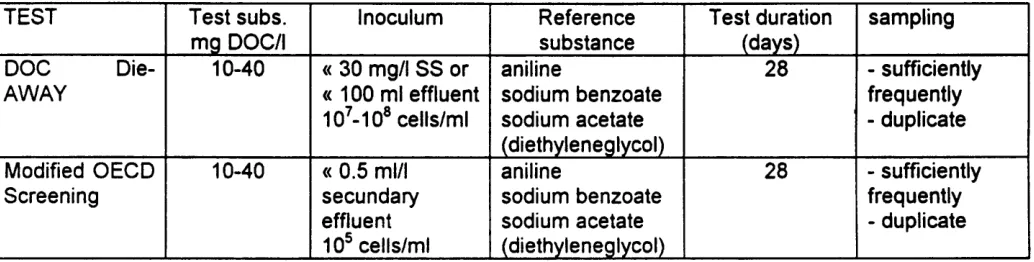
For comparison of operating parameters, see table 3a
Principle:
A solution of the. surfactant at 5 mg/1 active substance in an organic medium is inoculated with
0.05 °/o of secondary effluent from waste water treatment plant. The mixture is aerated at 25
±
1
oc
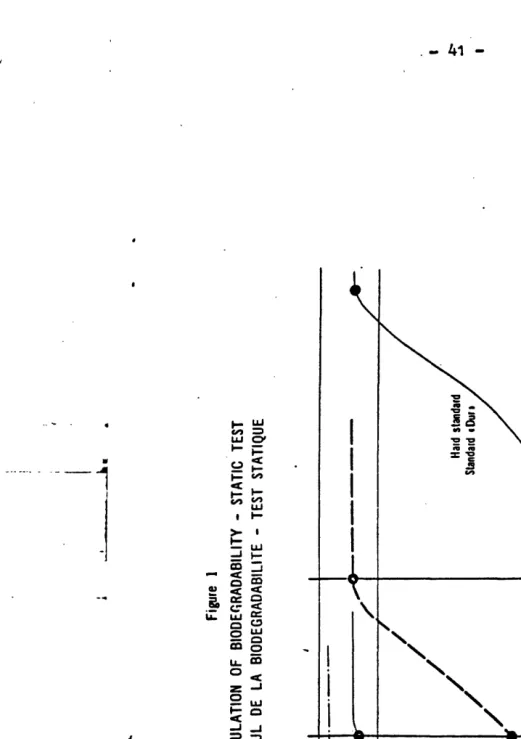
until the concentration of the surfactant falls to a constant level, for a period no longer than 19days. Biodegradation is followed by semi-specific analysis of the samples taken at regularly time intervals. Anionic surfactants are determined by the methylene blue method, reported as MBAS, and non-ionic surfactants as bismuth active substances (BiAS). The procedure is validated by using two standard anionic surfactants, a "soft" or easily biodegradable surfactant and a uhard" or relatively non-biodegradable one.
The French methods (T 73-260 I T 73-270) are die-away tests quite different from the other
screening tests. These tests have two incubation periods: one of 7 days followed by sampling, the next after a new addition of 5 mg/L of test substance from day 8 to 10 followed by analysis of MBAS or BiAS.
Europlus s.a ..
The biodegradation level after 7 days and after 1 0 days is determined to obtain a weighted biodegradation level for the duration of the experiment.
Confirmatory test - Activated Sludge Simulation test
References:
- Annex to Directive 82/242/EEC and 82/243/EEC - OECD method, technical report 1976 - Germany,Bundesgesetzblatt 1977
-United Kingdom, Porous Pot Test, technical report 70/1978
Principle:
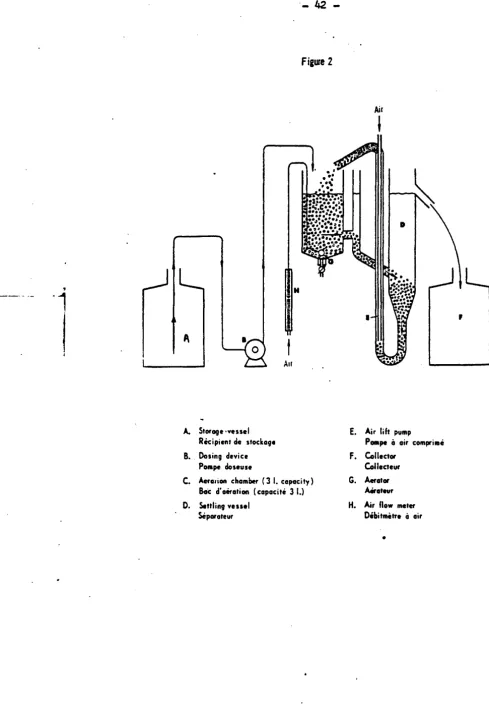
The confirmatory test uses a small activated sludge simulation unit which is fed with synthetic sewage. Synthetic sewage containing the required concentration of the surfactant under test is supplied at a constant rate to a vessel in which 3 I of activated sludge is aerated. The mixed liquor passes to an adjoining vessel where it settles and the settled sludge is continuously
recycled to the aeration vessel, while the supernatant liquid is collected as effluent. The
percentage removal of the surfactant is calculated for each sampling time from the concentrations in the sewage and in the corresponding effluent. The concentration of the surfactant is determined by semi-specific analyses MBAS or BiAS.
In the UK method the Porous Pot is used as an altemative_test system to the Husmann system.
5.1.2 Other existing biodegradability test methods
There exists other comparable OECD and EEC test methods to determine the biodegradability of chemical substances. Some of these methods use non specific analytical methods such as DOC to determine the ultimate biodegradation of a substance. The biological test procedure has been adapted after years of experience with different chemicals. The biological part of the test methods described in the detergent Directive could be adapted in the same way.
Screening Tests
References:
- OECD Guideline 301A, - EC, C4 A: DOC Die-Away
For comparison of operating parameters, see table 3b
Principle:
A measured volume of inoculated mineral medium, containing a known concentration of the test substance (1 0-40 mg DOC/I) as the nominal sole source of organic carbon, is aerated in the dark
or diffuse light at 22 ± 2°C. The inoculum may be activated sludge, sewage effluents, surface
waters, soils or a mixture of these (30 mg55/l, 106 CFU/ml).
Degradation is followed by DOC analysis at frequent intervals over a 28-day period. The degree of biodegradation is calculated by expressing the concentration of DOC removed (corrected for that in the blank inoculum control) as a percentage of the concentration initially present.
Primary biodegradation may also be calculated from supplemental chemical analysis of the parent compound made at the beginning and end of the incubation.
Europlus s.a •.
References:
- OECD Guideline 301E,
- EC, C4 B: Modified OECD Screening test
Principle:
A measured volume of mineral medium, containing a known concentration of the test substance (10-40 mg DOC/I) as the nominal sole source of organic carbon, is inoculated with 0,5 ml effluent
per litre of medium. The mixture is aerated in the dark or diffuse light at 22 ± 2°C. Degradation is
followed by DOC analysis at frequent intervals over a 28-day period. The degree of
biodegradation is calculated by expressing the concentration of DOC removed (corrected for that in the blank inoculum control) as a percentage of the concentration initially present.
The degree of primary biodegradation may also be calculated from supplemental chemical analysis of the parent compound made at the beginning and end of the incubation.
Activated Sludge Simulation Tests
For comparison of operating parameters, see table 4
Reference:
- ISO 11733: Water Quality- Evaluation of the elimination and biodegradability of organic compounds in an aqueous ·medium- Activated Sludge Simulation Test
Principle:
Two continuously operating test units (activated sludge plants or porous pots) are run in parallel under identical conditions, with a mean hydraulic retention time of normally 6 h and a mean sludge age (sludge retention time) of 6 d to 10 d. The test compound is normally added at a concentration 10 - 20 mg/1 DOC, to the influent of only one of the test units, the second unit is used as a control.
The influent is an organic medium. Synthetic sewage, domestic sewage or a mixture of both can be used.
In regularly taken samples of the effluents, the DOC or COD are measured. If required the test compound concentration are measured by specific analyses. The difference between the effluent concentrations in the test and control units compared with the influent concentration of the test compound is used to determine the biodegradation and elimination of the test compound.
Reference:
- OECD Guideline 303 Proposal: Simulation Test Aerobic Sewage Treatment. Being revised as 303A, B, C.
·Principle:
Two continuously operating test units (activated sludge plants or porous pots) are run in parallel under identical conditions which are chosen to suit the purpose of the test. Normally the mean hydraulic retention time is 6 hand a mean sludge age (sludge retention time) of 6 d to 10 d. The test substance is normally added at a concentration 10 - 20 mg/1 DOC, to the influent (organic medium) of only one of the test units, the second unit is used as a control.
Europlus s.a ..
· The influent is an organic medium. Synthetic sewage, domestic sewage or a mixture of both can be used.
In frequently taken samples of the effluents, the DOC or COD is determined, together with the concentration of the test substance (if required) by specific analysis, in the effluent from the unit receiving the test substance.
The difference between the effluent concentrations in the test and control units is assumed to be due to the test substance or its organic metabolites. This difference is compared with the influent concentration of the added test substance in order to determine the biodegradation, elimination of the test compound.
References
- EC method, Part C, Biodegradation: Activated Sludge Simulation Test {Directive 88/302/EEC O.J. L 133 of 30.05.88 p.1)
Principle:
For the determination of the ultimate biodegradability, two activated sludge pilot units (OECD confirmatory test or porous pot units) are run in parallel.
The test substance is added to the influent {synthetic or domestic sewage) of one of the units, while the other receives the sewage alone.
The DOC (or COD) concentrations are measured in the effluents, the difference in mean concentrations between the test and the control effluents is assumed to be due to undegraded test material.
The units may be operated following the " coupled units mode " by a transinoculation procedure.
For the determination of primary biodegradation with specific analysis in the influent and effluent, only one unit is used. Change in the concentration of the parent molecule can be measured by specific analysis {primary biodegradation).
5.2
OPERATING PROBLEMS: ADSORPTION, SOLUBILITY, TOXICITY5.2.1 Adsorption
Surfactants which strongly adsorb, such as cationic surfactants, may lead to false degradation/elimination results. Therefore it is prudent to determine the amount of surfactants adsorbed on to suspended solids.
The shape of the removal-time curve can give an indication of what is occuring. A typically shaped biodegradation curve has a lag phase followed by a steady rise in removal over a number of days until it reaches a plateau, but if adsorption takes place as well as degradation a positive removal occurs initially followed by a decrease, thereafter a normal biodegradation curve is obtained.
To control the loss on to suspended solids a preliminary test can be done or suitable control vessels can be set up in the biodegradability test.
Supplementary information can be obtained by determining the content of the surfactant on sludge and on the suspended solids in the effluent , so that a mass balance may be made.
Europlus s.a.
In some cases pre-treatment of the test vessels could be necessary. Methods for the
pre-treatment of the test vessels with the surfactant are developed by the manufadurer.
5.2.2
Solubility
Some cationic surfactants are not very soluble, so that they cannot be assessed by DOC methods or by the DBAS die-away method unless special measures are taken.
To determine the biodegradability of poorly soluble surfactants a "ready" biodegradability test will be more appropriate.
The ISO 10634 (1995) describes four techniques for dispersing organic products, which are to be subjected to biodegradability tests in an aqueous medium, which are not enough soluble to perform the tests in the normal manner.
The four techniques are: direct addition, ultrasonic dispersion, adsorption on an inert medium and dispersion with an emulsifying agent.
These techniques are applicable where the evaluation of the biodegradability of the substances under test is carried out in accordance with the methods by analysis of the released carbon dioxide or by determination of the oxygen consumption (OECD 3018, D, F).
New ready biodegradability test methods are also under development to determine the biodegradability of poorly soluble test substances.
The "Headspace" C02 method could be appropriate for testing poorly soluble surfactants
(see new test methods-ISO/DIS 14593) (Annex 9.3).
5.2.3 Toxicity
The toxicity of the surfactant to the activated sludge can be determined in an activated sludge respiration inhibition test to determine the test concentration to use in the biodegradation test. In the case where the surfactant is toxic to the activated sludge a lower test concentration compared to that given in the method of the Directive has to be used. When using a lower test concentration attention should be paid that the semi-specific analyses can still be done (detection limit).
Another possibility is to perform specific analyses or to use labelled carbon.
To decrease the level of toxicity pre-adaptation of the bacterial inoculum can be performed before starting the biodegradation test. A proposal has been made to use pre-adapted inoculum for "ready" biodegradability tests.