(2008)
www.electrochemsci.org
Digital Simulation of Diffusion Limited Chronoamperometry at
Disk Electrodes without Neumann Boundary Conditions on the
axis or at the insulating plane
D. Britz*
Dept. of Chemistry, Aarhus University, 8000 Århus C, Denmark
*E-mail: [email protected]
Received: 23 June 2008 / Accepted: 20 July 2008 / Published: 8 September 2008
It is proposed that in the digital simulation of a disk (or band) electrode flush with an insulating plane, the customary Neumann boundary conditions can be dispensed with on the axis and at the insulating plane, and diffusion can be applied in the relevant regions instead. It is suggested that the application of Neumann boundary conditions in these cases in fact corresponds to the neglect of information. Results show that the application of diffusion conditions leads to practical the same results, but not that results are better.
Keywords: Boundary Conditions; Computational Electrochemistry; Digital Simulation
1. INTRODUCTION
coordinates (R,Z). Because of the problems associated with the singularity at the disk edge, it became evident that coordinate transformation is desirable, and several were suggested, among them that by Michael et al [8] and by Verbrugge and Baker [9] which transformed (R,Z) space into elliptic (θ,Γ) coordinates, eliminating the singularity, and leading to greatly improved simulation efficiency. In this paper, we will consider the representative Verbrugge and Baker transformation (see below). In these transformed systems, the axial and insulating plane regions are represented as well (see later), and again, NBCs can be invoked and usually are, for example, in the works of Michael et al [8], and our own work [10]. The related simulation area of the Scanning Electrochemical Microscope (SECM), which often is a disk electrode in a special environment, again most workers invoke NBCs. The works cited above are only a small representative section of the total possible citations. It will be argued in this paper that NBCs are not necessary, and may even be undesirable. For further details on the theory of the disk electrode and simulations of electrochemistry at it, see [11]. In that work, the subject of this paper is briefly mentioned but not detailed.
-6
Z
R
0
Zmax
[image:2.612.202.417.293.470.2]1 Rmax
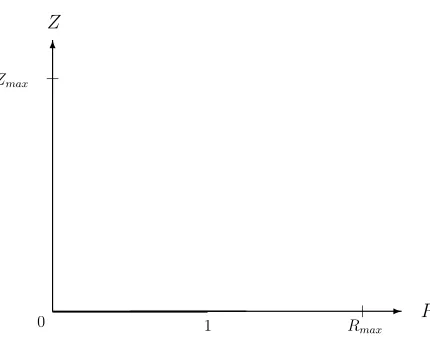
Figure 1. Diagram of the cross section of a disk electrode flush with an insulating plane
2. THEORY
In cylindrical coordinates, the transport equation for the disk electrode, in dimensionless form, is
R
C
R
R
C
Z
C
T
C
∂
∂
+
∂
∂
+
∂
∂
=
∂
∂
1
2 2
2 2
(1)
2
4
a
Dt
T
=
(2)in which a is the electrode radius and D the diffusion coefficient. The common (Dirichlet) boundary condition for the diffusion-limited chronoamperometric experiment is
.
0
)
,
0
(
:
0
,
1
0
,
0
≤
≤
=
=
>
R
Z
C
R
T
(3)All workers cited above use the Neumann boundary condition
0
/
:
0
,
1
=
∂
∂
=
>
Z
C
Z
R
(4)and some also use
.
0
/
:
0
∂
∂
=
=
C
R
R
(5)Discretisation of these NBCs are described in the next section.
Simulations using direct discretisation in the cylindrical coordinates are inefficient, because of the singularity at the disk edge, for which reason transformations are commonly used. The transformation by Verbrugge and Baker [9] is one of these:
Γ = Γ = sinh sin cosh cos θ θ Z R (6)
(writing, for convenience,
Γ
'
≡
Γ
/(
1
−
Γ
)
), resulting in the new coordinates (θ,Γ). The transport equation then transforms to(
−Γ Γ− −Γ)
∂∂Γ+ Γ ∂ ∂ Γ − + ∂ ∂ − ∂ ∂ Γ + = ∂
∂ C C C C
T
C 2 3
2 2 4 2 2 2
2 sinh ' tan (1 ) (1 ) tanh '2(1 ) sin
1
θ θ θ
θ (7)
Condition (3) here becomes
0
)
0
,
(
:
0
,
0
Γ
=
=
>
C
θ
T
(8)and the NBCs are
0
/
:
0
∂
∂
=
=
θ
θ
C
(9)0
/
:
2
∂
∂
=
=
π
θ
θ
C
(10)(corresponding to the axis). Discretisations of these too are described below.
However, there is no need to invoke NBCs. Consider the system axis in Fig. 1, and consider that although it is true that there is no concentration gradient normal to the axis (R=0), there is indeed diffusion along the axis, described by the transport equation there. As pointed out by Crank and Furzeland [2], there is, at
R
=
0
, the problem of the 1/R term. They invoked the Maclaurin series (a special case of the Taylor series) to approximate the first derivative term in (1), resulting in the axial diffusion equation2 2
2 2
2
R
C
Z
C
T
C
∂
∂
+
∂
∂
=
∂
∂
. (11)The second derivative in R can be expressed discretely without problems, see below, and this has been done by some, for example Gavaghan [12]. This practice is an example of the NBCs being replaced by a specification of diffusion.
6
z
Z
R
Figure 2. Diagram of an infinitely thin disk floating in space
It can be argued that if we invoke NBCs at these two regions, we are throwing away information, which we do not throw away by invoking diffusion there. This is because when we express discrete approximations that correspond to the NBCs, we let the points on the axis and on the plane depend on neighbouring points, without using the information we might obtain from the diffusion equation. This suggests that invoking diffusion, rather than NBCs, should improve simulations. It turns out that it makes almost no difference.
In what follows, we shall distinguish between the two cases of NBCs and what will be called diffusion here, that is, dispensing with NBCs and invoking diffusion instead.
Similar arguments can be invoked for the band electrode flush with an insulating plane, where there is a vertical plane instead of an axis, and no problem with a
1
/
R
term.Note that this does not apply to simulations involving a Neumann boundary condition at the electrode itself (for example, chronopotentiometry). These must be discretised as such.
3. DISCRETISATIONS
No details of the actual discretisations will be presented here, except for the regions in question; the reader can find details of these in [11]. The method of simulation, too, is not detailed here; there is a variety of choices, also described there. We shall here focus on the discretisations at the axis and insulating plane only, in both the cases of NBCs and diffusion.
-6
Z
R
i
=
n
Z
-i
= 0
-j
= 0
j
=
n
A 6 [image:5.612.215.398.412.607.2]j
=
n
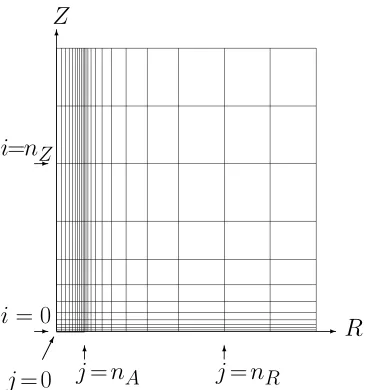
R 6Figure 3. Discrete grid representing the cylindrical disk system
disk edge in both directions. Let the index of grid positions be i in the Z direction and j in the R direction, so that we have points on the grid, with values
C
i,j.Applying NBCs now on the axis, we simply express the first derivative in R as a discrete approximation and set it equal to zero. For example, a four-point approximation might be chosen, using the positions (-1, 0, 1 and 2) along j, where the point at
j
=
−
1
is the same as that atj
=
1
by symmetry, giving.
0
)
(
β
1+
β
3C
i,1+
β
2C
i,0+
β
4C
i,2=
(12)This, effectively using the point on the other side of the axis, might be a better approximation than the one-sided one,
.
0
3 , 4 2 , 3 1 , 2 0 ,
1
C
i+
β
C
i+
β
C
i+
β
C
i=
β
(13)In these expressions, the
β
coefficients are those for the first derivative on arbitrarily spaced points, for which a routine has been described [15], but an algorithm due to Fornsberg [16] is in fact preferable (a Fortran subroutine based on this, yielding interpolation values or first- or second-order derivatives at any point within a group of arbitrarily spaced points can be obtained from the author).On the insulating plane, similar discretisation formulae can be used, in the Z direction, again using a chosen set of points, for example the four-point approximation
.
0
)
(
β
1+
β
3C
1,j+
β
2C
0,j+
β
4C
2,j=
(14)The two-dimensional system to be solved is thus cast into a large banded linear system including the above expressions, and can be solved by a sparse matrix technique. The present author favours the package MA28 [17], available from the Harwell site [18] or the package YM12 [19], available from netlib [20]. There are other methods of solving the system, but they will all in some manner use the above formulae.
On the axis, using (11), the second derivative term in R is readily discretised as a three-point approximation, but due to symmetry this reduces to
(
,0 ,1)
2 2 2
2
2
1
i
i
C
C
R
R
C
≈
−
+
∂
∂
δ
(15)With
δ
R
=
R
1, the other term, in Z, being straight-forward.)
(
1
1
2 , 0 4 1 , 0 3 , 0 2 1 , 0 1 2 , 0 4 1 , 0 3 , 0 2 1 , 0 1 2 2 + + − + + −+
+
+
+
+
+
+
≈
∂
∂
+
∂
∂
j j j j j j j j j jC
C
C
C
R
C
C
C
C
R
C
R
R
C
β
β
β
β
α
α
α
α
(16)again using coefficients for the four-point approximations, and
j j
j
C
C
C
Z
C
, 2 4 , 0 2 , 1 3 1 2 2)
(
α
+
α
+
α
+
α
≈
∂
∂
(17)where the coefficients are now those for the
Z
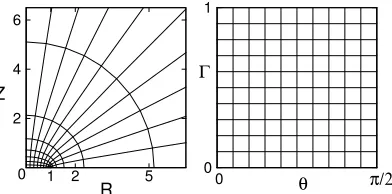
direction, again using symmetry.Simulation using discretisation directly in (R,Z) is however not an efficient procedure, and transformation greatly improves the matter. The transformation by Verbrugge and Baker (6), yielding the new transport equation (7) is used preferentially by the present author, and Fig. 4 shows an evenly divided grid in
(
θ
,
Γ
)
space and its equivalent in (R,Z). The two regions where NBCs usually are applied are the left-hand edge, corresponding to the insulating plane, and the right-hand edge, corresponding to the axis. The base line corresponds to the electrode. [image:7.612.210.406.384.481.2]2 4 6 5 2 1 0 R Z 0 1 0 θ Γ π/2
Figure 4. Discrete grid in transformed coordinates on the right with equal intervals, and the equivalent grid in cylindrical coordinates on the left (some grid lines are outside the picture in (R,Z))
NBCs are expressed very simply here; we have equal intervals, and three-point approximations yield second-order approximations. Again using i as the vertical, and j as the horizontal index, we have, for example, on the insulating plane, the one-sided three-point expression (at
θ
=
0
)δθ
θ
2
4
3
C
i,0C
i,1C
i,2C
≈
−
+
−
∂
∂
(18)with
δθ
being the intervals inθ
, and for the axis (2
π
.
2
3
4
, 1 ,2 ,
δθ
θ
θ θ θN i N
i N
i
C
C
C
C
≈
−
+
∂
∂
− − (19)The coefficients are tabled in [11, p. 281].
Upon invoking diffusion in this space, we use (7), setting the first derivatives with respect to
θ
to zero but retaining the second derivatives. These can be approximated by mirroring points on the other side of the respective edge, so that the three-point approximation at the left-hand edge (θ
=
0
) becomes, similar to (15)(
,0 ,1)
2 2 2
2
2
1
i
i
C
C
C
≈
−
+
∂
∂
δθ
θ
(20)and at the right-hand edge (
2
π
θ
=
)(
2
2
)
.
1
, 1 , 2 2 2
θ θ
δθ
θ
C
iNC
iNC
≈
−
∂
∂
− (21)
As before, these approximations will join those for the bulk of the points making a large banded linear system to be solved.
4. COMPUTATIONAL
All the above cases have been implemented using Intel Fortran 90/95, running on a PC under Suse Open Linux, always specifying a precision of at least 14 decimals. For the simulations, the algorithm used was a single backwards implicit step followed by three-point BDF, see [11] for details. The particular algorithm employed is not important, however.
5. RESULTS AND DISCUSSION
For the grid in (R,Z), it was possible to go up to a grid of 160 x 220, and choosing a smallest interval in R and Z as 10-6, which means expansion factors
γ
[11, p. 108] of 1.088 along Z, and respectively 1.072 and 1.276 along R, going left and right away from the disk edge, all reasonable values. Computed currents were compared with the recent formula of Mahon and Oldham [21], found to be very accurate [10]. Time intervals of 0.01 were used, 100 steps toT
=
1
.errors become smaller and more equal. In
(
θ
,
Γ
)
space, using a 100 x 100 grid and the same step size in time, the error at T=1 was -0.01% in both cases.The same boundary conditions (or lack thereof) can be invoked for the steady state, setting the left-hand side of (1) or (7) to zero and solving. Since the current was normalised to the steady state value (Saito, [1]), this should be equal to unity. This was tried only in
(
θ
,
Γ
)
space, and in both NBCs and diffusion discretisations, the steady state flux came to 1.000, with an error of -0.004% in both cases.6. CONCLUSIONS
It is seen that it is possible to replace Neumann boundary conditions with diffusion equations, suitably adapted to the various cases R=0, using, in (R,Z) space, approximations derived from Maclaurin expansion, and symmetry consideration for points on the insulating plane. Results of simulations are almost the same with or without Neumann boundary conditions. It can be argued nevertheless that it is better to use diffusion-based expressions, as these use more information on points in the grid than when invoking Neumann conditions. The same argument applies to other electrodes, such as the band electrode flush with an insulating plane, and the disk in a SECM cell. References
1. Y. Saito, Rev. Polarog. (Japan) 15 (1968) 177
2. J. Crank and R. M. Furzeland, J. Inst. Maths. Applics 20 (1977) 355 3. J. Heinze, J. Electroanal. Chem. 124 (1981) 73
4. J. Heinze, M. Störzbach and J. Mortensen, J. Electroanal. Chem. 165 (1984) 61 5. D. J. Gavaghan and J. S. Rollett, J. Electroanal. Chem. 295 (1990) 1
6. D. J. Gavaghan and J. S. Rollett, C. E. W. Hahn, J. Electroanal. Chem. 325 (1992) 23 7. J. Galceran, D. J. Gavaghan and J. S. Rollett, J. Electroanal. Chem. 394 (1995) 17
8. A. C. Michael, R. M. Wightman and C. A. Amatore, J. Electroanal. Chem. 267 (1989) 33 9. M. W. Verbrugge and D. R. Baker, J. Phys. Chem. 96 (1992) 4572
10. D. Britz, K. Poulsen and J. Strutwolf, Electrochim. Acta 50 (2004) 107
11. D. Britz, Digital Simulation in Electrochemistry, 3rd Ed., Springer, Heidelberg, 2005 12. D. J. Gavaghan, J. Electroanal. Chem. 456 (1998) 1
13. S. W. Feldberg, J. Electroanal. Chem. 127 (1981) 1
14. Y.-H. Pao and R. J. Daugherty, Time-dependent viscous incompressible flow past a finite flat plate, Technical Report DI-82-0822, Boeing Sci. Res. Lab., 1969
15. D. Britz, Electrochem. Commun. 5 (2003) 195 16. B. Fornberg, Math. Comp. 51 (1988) 699
17. I. S. Duff and J. K. Reid, ACM Trans. Math. Soft. 5 (1979) 18 18. http://hsl.rl.ac/archive/hslarchive.html.
19. Z. Zlatev, J. Wasniewski and K. Schaumburg, in G. Goos, J. Hartmanis (editors), Lect. Notes Comp.Sci., volume 121, Springer, Berlin, 1981
20. http://www.netlib.org
21. P. J. Mahon and K. B. Oldham, Electrochim. Acta 49 (2004) 5041