COMMISSION OF THE EUROPEAN COMMUNITIES
Brussels, 07.04.1998
COM(1998) 219 final
COMMUNICATION FROM THE COMMISSION
Table of contents
I. I.NTRODUCTION .•...•••... ~ ... ~ •.••••.•..•...•.•.•...••.••...•.•.•..••.•...•...•••..••••.••.••.••.•••••••.••...••. ~ •••..•••.••••. 4
2. ANALYSIS OF THE UNDECLAnED LABOUR MARKET ••..••.••...••• ~ .•..••..•.••. ; .•..•••••••.•.••• _. ••••••. ~.4 2.1. DEFININ<i IINDI·:CI./\!U;D WORK AND TilE SIZE OF TilE l'ROBLEM ... : ... .4·
2.2. WilY DOES lJNDI'CI.ARI·:D WORK I;XIST? ... : .... _. ...
.> ...
:···52.J. Wll<> /\RI; TilE iiNJ>i'<"l.ARI-:Jl WORKI,RS? ... _. ... 7
2.4. IN WlJICI I SECTORS IS,IIND!TLAI{ED WORK l'REV/\I.J;NT IN Till' MEMilER STi\TES? ... , ... 8
2.5. Tl iiRD COUNTRY NATIONIII.S AND lJNl>ECI.ARJ;D W:>RK ... _. ... 9
3: IMPACT OF UNDECLARED WORK ., ....•.. ; ... ~ ...•• : .•... :.: ...••...•...•.••••...•••. · .•.•••. : .•....••• : .•.... 9
' . . 3.1. SOCIAL SECURITY AND 71'1 IE IMPACT ON PUBLICFINANCES ... , ... 9
3.2. TilE IMPACT ON INDIVIUUALS ... : .... , ... : ... ~ ... : ... ! 0
3.3. EFFECTS ON COMPETlTION ... : ...•... .-.•... 1 0 4. POLICY ISSUES ...•..•...•.... .-...••....•...•...•.. 11
. . . . 4.1. POLICY OPTIONS ... , ... ~ .. , .. .' ... ~ ... ; ... 11·
4.2. REVIEW 01' POLICY MEASURES INTRODUCED IN TilE MEMBER STATES ... ; .... I2 4.3. Tl IR:'E CO!JNTRY EXAMPLES OF AN INTEGRATED STRATEGY ... ~ ... 15 .
5. C()NCLUSJON ... ~ ....•... : ... 17.
6. TABLE. I: LEGAL OR CONTROL RELATED. MEASURES: ... 18
. . 7. T,ADLE 2: MEASUR~S.RELA.TING TO SUBSJD!ES OR COST REDUCTIONS .•..•. : •••...••••.• 19
8. TABLE 3: OT,HER i'V1EASUR'ES ... :· ... .-••.••.•.••. ~ ••• ~···;:.20
Executive Summary
Undeclared work is one of the issues of common concern in the employment field.The concept of "undeclared work1' is taken to mean any paid activities that are lawful as regards their nature hut not declared to the public authorities, hearing in mind that dirtcrences in the regulatory system of Mcmhcr States must he taken into account. Applying this definition, criminal activities would be excluded, as would work which does not have to be declared.
The main motivation for employers, employees and self-employed for participating in the undeclared economy is economic. Working in the undeclared economy offers the opportunity to increase earnings and to avoid taxation and social contributions or to reduce costs. There are three contributing factors: a growing demand for "personalised services"; the re-organisation of industry into long lines of vertical disintegration and chains of sub-contracting; and the spread of light technology which opens up new working opportunities and new areas of service activities. Undeclared work is generally present in sectors which are labour intensive and with low profits such as agriculture, construction, retail trade, catering or domestic services; manufacturing and business services where costs are the major factor of competition; and modem 'innovative sectors.
Four main groups of participants in the undeclared economy can be identified: second and multiple job holders; the "economically inactive" population; the unemployed; ,and third country nationals illegally resident in the EU. The age and gender of undeclared workers depend to a large extent on the sectors' aflcctcd.
Undeclared work risks undermining the foundations of financing and delivery of social protection and public services. The curtailment of receipts means a reduction in the levet' of services the State can offer, and this creates a vicious circle, as the government raises taxes to continue to provide the services, thus creating more incentives to undeclared work. In countries where socia{ protection coverag~ is universal or where individuals have rights derived from their partners, undeclared work may not affect health or pension rights. The same is true for second job holders. However, undeclared workers who are normally inactive forego all the benefits derived from working with a formal contract, such as training, a specific career profile, pay rises, a sense of belonging to the enterprise. These people will a[so have
diffic~lty
in moving into other jobs. The impact on enterprises is felt through the distortion of competitive conditions, especially at the m iero-level.. ' . .
The establishment of a ctimprchcnsivc targeted strategy is essential if .combating , undeclared work is to .be dTcctivc. A strategy, which is to have ariy effect on reducing undcclarcq work should involve a mix of clements .. This policy mix will inevitably ~ary · from one Member State to another. Effective implementation and enforcement remain
an imp(>rtant part of the overall strategy whatever the measures chosen:
This paper airris to launch a debate on the causes -of undeclared work and the poli<;y · · options for combatting it. It suggests that there is, firstly, a need to identify correctly the_ causes and extent _of the problem, and, secondly, to regard combating undeclared wO'rk as part of the overall employment strategy. ·
1.
INTIU)IllJCTIONUndeclared work affects all Member States and is therefore one of the issues of common concern in the employment field. Undeclared work risks undermining the financing Of social services, already under pressure, decreases individuals' social protection status and labour market prospects and may affect competitive conditions. It also runs counter to European ideals on solidarity and social justice.
The White Paper on Growth, Competitiveness and Employment launched by the European Commission in late 1993 called, inter alia, or a widening of the concept of work, and encouraged the Member States to facilitate "the re-entry into the formal labour market of many citizens who have to work at the margins". Subsequently in the Medium Term Social Action Programme 1995-97, the Commission announced its intention to launch a debate on illegal work.
As part of the follow-up to the White Paper, several studies and reports dealing with the characteristics and typologies of undeclared work have been undertaken. This Communication builds on the inf(mnation gathered in these reports and reviews measures to combat undeclared work. The objective of this paper is t6 launch a debate on how Member States can tackle this problem more effectively on the basis of exchange of good practices or, where appropriate, co-ordinated action at EU leveL If the outcome of this debate indicates that action at EU level would be appropriate, it could be considered in the context of the 1998 Joint Report and the Employment Guidelines for 1999.
2. ANALYSIS OF THE UNDECLARED LABOUR MARKET
2.1. Defining undeclared work and the size ofthe problem
The very nature of undeclared work makes it a difficult problem to deal with. From a European perspective it is hard to find a common definition of undeclared work owing to its differing characteristics in the di fTcrent parts of the Union. Moreover, it is difficult to make a definite statement on the size of the problem since it can only be estimated.
In a major study carried out tor the European Commission from 1988-1992 the concept of the underground economy and irregular forms of employment was found to be defined by the regulatory system. Illegal work does not exist in a totally non-regulated and permissive context. Thus some economic activities might be illegal in some countries but legal in others, and this makes it difficult to achieve a common EU definition.
I h~.: usu;al r~.:gulalory franwwork imd which docs not have to be. declared to th-e. punlic authorities, such as activ-ities undertaken within the_ household ecorioiny.
It is difficult to identify what proportion of the Gross Domestic Product is undeclared and· various methods have been used to estimate it. ·On average, the size of the undeclared CC(;nomy in~ the El J can he estimated at between 7% and
16cY.I or ElJ GDP, which would correspond to anywhere between 10 and 28 . miliion labour units, or between 7% and 19% of lhe volume of total· declared employment, according to the ~assumptions made about the sectors _where this activity takes place and hence the average productivity. This must not be . confused with people in unemployment, as most undeclared work is carried out by people who also work in the formal economy and they are of course 'already . counted as part of total employment. If all undeclared work were to pass to the
-formal economy, it is therefore not Clear-by how much GDP would increase.
E~ti~ates of !he underground economy vary significantly according to the method u;;cd; nevertheless groups of countries can be identiticd 1• On the one hand there is a group of countries where the undeclared economy is estimated at around 5% of GOP (the Scandinavian c~untries, Ireland, Austria ·anq the Netherlands); on tht? _ other hand, in Italy and Greece it is estimated at more than 20%. There are two intermediate groups: the Ul( Germany and France, form a group roughly halfway
b~tween the two extremes, while Belgium and Spain aresomewhat higher ..
2.2. Why does undeclared work exist?
· The main motivation for . employers, employees _ and self-employed · for participating in the undeclared economy is economic. Working in the informal economy offers the opportunity to increase earnings -and to' evade taxation on-income and social contributions. For employers, the incentive is to reduce costs. From an historical perspective there are three factors which, contribute jointly, but in varying qegrees, to the existence of undeclared work:
-a) the emergence of a highly disparate dema-nd lor 'personalised services' to · lamilies and individuals (such as _care, cleaning .. :); tbese services _have a high labour content and low- productivity growth;
1 These estimates ha~e been obtained by consulting national experts on labour markets of the EC Networks - . SYSDEM _ (Systeme d'evaluation et de monitorage) and MISEP (Mutual Information System on Employment Policy). The following comparative studies have also been consulted: "Underground economy and irregular forms of employment- (travail au noir)" by Philippe Barthelemy, Fausto Miguelez, Enzo Mingione, Raymond Pahl and Alois Wenig, commissioned by DGV, 1990; "Measurement of the Shadow _ Economy - Study on five European countries (Germany, Belgium; France, Great Britain, Italy)" by
b) the reorganisation of industry and firms into long lines of vertical disintegration and chains of subcontracting, in order to make production more flexible and to increase the capacity for innovation and adaptation to specific situations and market fluctuations. This kind of flexibilisation leads to an increase in self-employment and of worker-entrepreneurs, some of whom may be operating within the undeclared economy.
c) the impact of the spread of light technology, such as personal computers, which provides new working opportunities and opens up new areas to service activities ..
·The scope for and extent of undeclared work vary according to different institutional aspects of the economy in each Memb~r State, such as:
• Tax and social contribution levels: The level of tax and social contributions· clearly influences the level of undeclared work. A higher tax burden is an incentive to enter the underground economy both for the worker and the employer. Apart from the level of tax and social security contributions, the structure ofthese contributions will also shape the black economy. In countries where income taxation is high, the push will come from labour supply, and the undeclared worker will characteristically be self employed; in countries where social security contributions are high, the push will be from the demand side and undeclared labour will tend to be structured in (completely or partially) undeclared firms.
o Regulatory and administrative burdens: The weight of excessive overheads and administrative procedures, for example for registering as a service provider or for formalising an employment relationship, may discourage the declaration of work where both sides can see the advantages of not declaring it. The existence of craft corporations may also be conducive to undeclared work since in some countries membership of a craft association is required in order to exercise certain professions. While these exist to guarantee the quality of the product or service, they can also act as barriers to entry with the result that non-members could be tempted to exercise their profession clandestinely.
• Inappropriate labour market legislation: Limited recognition within current legislation tor new kinds of work (tor example non-standard working hours,. part-time work or temporarY. contracts) may also force people into undeclared work.
• Industrial structure: In localities dominated by a few large companies the underground labour market is rel~tively insignificant but, at the other extreme, in local economies composed of a plethora of small firms, not only is undeclared labour more likely, but it is also more likely to be organised rather than on an individual basis. However, where workers are aware of their rights, undeclared work tends to be Jess prevalent.
disorganised and
r~quires
a high degree of mutual trust between the~perators
which makes it- difficult for it to reach beyond a closed circuit.. - .
• Cultural acceptance: There is a certain cuitural understanding or acceptance of the informal economY: Participating in the info~mal economy at local level will often be perceived as an exchange· of services or_ mutual ass~tance which does not need to be declared (cleaning, agricultural seasonal work etc.);
• The existence of easy opportunity: Each individual chooses whether to engage in tmdeclared work, doing a personal cost~benefit analysis in which he or she will weigh the advantages, such as· higher (immediate) income against ·the disadvantages, such as sanctions if caught, the risk of being caught or moral . '_considerations. ·'i'he more an individual has the opportunity. to exercise an_"
undeclared activity at low risk (lor example, because of lax-ity of controls; because he or she is already covered by the insurance of the main employer or
\
of a spouse), the easier it will be to take advantage of it. .
2.3. /Who are the undeclared workers?
-
.Effective access to undeclared work is a major factor determining who becomes
an undeclared worker. -·
-· Undeclared workers comprise:
• The second and multiple job holders. The majority of undeclared work is carried out by people who also have a regular activity. Being able to participate iri the undeclared economy often means that the individual is responding to a-demand, which r_equires certain skills or special qualifications.
o "Economically Inactive" pc_rsons (students, housewives, .and early retired
persons). They have lcwer time constraints on taking part in the ,undeclared economy arid the opportunity will be greater for those who have· had a previous' contact with theworld of work. ' . .
• Tbe unemployed. On the one hand, the risks of participating jn undeclared work may be higher for them as they might lose their une~ployment benefit, especially if it qepends on active job search or participation in training. On the other hand, ~hey may be offered a job on condition that it remains undeclared, -and their ability to resist is very low, particularly where the unemployment benefit' is -.low. However, the longer unemployment, lasts, the more the opportunities to do undeclared work decline.
The age and gender of undeclared workers depend to a large extent on the sectors affected. Women do not form the majority of undeclared workers but they tend to
be in a more fragile position. While most of the second or multiple job holders would be men, women working illegally would typically be officially inactive (housewives). This. has negative consequences where their pension rights depend exclusively on their partner, rather than on their own work.
2.4. In which Sectors is undeclared work prevalent in the Member States?
Three groups of sectors with fairly homogeneous behaviour patterns can be idcnti lied as present in nearly all Mcmhcr Stales:
• the traditional sectors such as agriculture, construction, retail trade, catering or· domestic services (characterised hy labour-intensive production and local economic circuits). The construction sector often uses a high level of sub-contracting, with limited public control; in the hotel/restaurants/catering sector many small businesses are also difficult to control as regards tum-over and employees; private services are highly dependent on cultural traditions and acceptance, indeed, for some personalised services formal jobs do not exist
• manufacturing and business services where costs are the major factor of competition. In Southern Europe the textile sector, with its opportunities for home-working, is considered to be especially affected by undeclared work.
• modem innovative sectors (primarily self-employed) where the use of electronic communications and computers facilitate contracting for, and carrying out, services in different locations, and this allows non declaration of these activities.
The lirst and the second groups can still be considered as those where the majority of undeclared work is carried out and where undeclared work can lead to exploitation, while the third group includes high skilled professionals choosing to do so. This latter phenomenon may be a consequence of inappropriate or um!:nforced regulation. Once these activities become mainstream, there are incentives to become part of the formal economy. Many new businesses start in the undeclared economy, only to be formalised once the business has become established.
National information on the situation in the Member States indicates, however, that there is no common European picture of undeclared work and that there are in . fact many differences between countries.
I
• In Southern Europe the undeclared workers tend to be younger people, women -working from t11e home and illegal immigrants.
/
• In Oennany <ind Austria, the number of illegal . in!migrants taking up undeclared work is significant, although tl1ey arc not the dominant group.
'2.5. Third Country Nationals and undeclared work
The extent to which third country nationals illegally resident in Europe (called illegal
immigra~ts
in- this paper) part;icipate in the informal ecol}omy is even more difticult to estimate than· the size of the underground economy. The involvement· " of illegal immigrants in ~ndedared werk is considered by all Membe~ States as aserious- problem to be addressed as part of their global strategy
of
combating illegal immi~ration.For many illegal immigrants undeclared:__work is a survival strategy. Compared to other categories; illegal immigrants are' particularly vulnerable, because ' in breaching the rule of residence they are'Jikely to be removed when apprehended. · This allows employers to employ illegal immigrants on conditions which would not be accepted by other !ndividuals. -In addition, third country nationals are ·often smuggled into the territory of the Member States and subsequently become engaged in undeclared work.- On the other hand,-there is also·evidence that good possibilities for undeClared work act as~ 'pull' factorfor illegal-immigration.
- . . . . : . ,·· . . .
Although undeclared work performed by illegal immigrants previously tended to he concentrated in the construcHon industry:the trend ·now seems to be tow~rds· undeclared service jobs.
3. . IMPACT OF UNDECLARED WORK
3.1. social security and the impact on. public finances
In terms of social security, undeclared work has implications for health insurance and pension rights, and insurance against accidents·· at: work. For the latter, undeclared workers are usually not covered.
a vicious circle, as the government raises taxes t9 continue to provide the services, thus creating more incentives to be undeclared2.
3.2. The impact on individuals
In the dillcrent Member States, health insurance and pension rights depend on residence (universal), or on contributions made (or derived from a spouse), or a mixture. Second-job holders in all Memher States will normally always he covered by social security. In countries where coverage is universal J()r health and/or pension rights, all undeclared workers would he covered. In countries where coverage depends on contributions, e_ither for old age pension, health, or both, undeclared workers who derive their rights from the spouse are also covered. Officially inactive undeclared workers (mainly women) are more dependent on their partner than if they were declaring their work. In these countries, other undeclared workers, and, of course, illegal immigrants, are not covered.
In all Member States, in cases ofundeclared work, the workers concerned will not be covered by voluntary supplementary schemes, which leaves them wit,!:! the basic pension. And of course, nowhere are undeclared workers covered by · unemployment insurance or insurance against workplace accidents.
Undeclared workers who are not second or multiple-job holders also suffer other consequences by not declaring their work. As their work is not formally recognised, they Jorego all the hcnelits
or
working with a formal contract, such as training, a specilic career prolile, pay rises, a sense of belonging to the enterprise. These people will he locked in their undeclared activity and will have difficulty in moving into other jobs. Indeed, those engaged in activities identified as the ultimate form of flexible labour end up with more difficulty in changing occupation.Consumers also lose out because they do not have the same guarantees of protection for any goods and services provided, while at the same time they are responsible for tolerating, or even encouraging undeclared work.
3.3. Effects on competition
As undeclared work lowers the costs of a firm, it can be argued that it affects co_mpetitive conditions, both within Member States (between enterprises 4sing undeclared work-and those who comply with the rules) and between Member States (lower costs of production in some Member States could be due to use of undeclared work).
But it is important to distinguish between the two cases. At the international level trade is clearly affected by a whole range of factors; as undeclared work is a fraction of all work in the traded sectors, and since 'cost of labour' is only one of the factors that come into play, we can assume that the role of undeclared labour
in distoning ·fair trade i.s minimal (the low-cost advantage ·of · sweat-§hops in textiles is principally exercised through proximity oflocation to the ·market, which is lost if these goods are to be exported too far.)
However most undeclared labour is carried out in non-traded sectors, specifically proximity services. It has been noted that limnal and inlimnal enterprises cut out their separate market niches; at the mi.cro-levcl, however, competitive conditio11s will he more arlccted hy inf(JrmaL enterprises. Normally an enterprise would tlot be working completely in the undechircd economy, so the cost-saving margin is reduced to the proportion of activities carried out in the black. The main impact ~ would be on the receipts of public finances. .
-4. POLICY ISSUES
4.1. Policy options .~
From the discussion abo've it can be seen that
und~clared
work ·is part of the problem affecting the functioning of the European labour market. Given the right incentives, people active in the undeclared sector could·. be encouraged to declare themselves; also customers would·buy more services in the· formal economy if a structured offer existed.· 1The prohlem can he see1i in two ways. If it is mainly an issue of individuals or . linns taking aqvantagc of the system and damaging everybody's welfare in the process, then intervention should be oriented towards· s~nctions and concentrate on:
· • ensuring greater enforcement of 'the rules. If re-distribution of ·income and provision of welfare services is valued in society, it is up to the State to ensure that the number of free riders is limited.
• -fayouring systems where the rights· to social protection benefits are linked to contributions effectiyely made.
• . awareness-raising campaigns highlighting unsociable behaviour· and that defrauding the system damages· everyone:
If it is mainly the outcome of new forms of work or working patterns and slower adaptation of inappropriate legislation to these changes, then policy should dmcentrate on prevention through: . · .
• liberalisation of product and service markets and simplification of procedures for setting up small businesses;
• favouring the~structuring of the supply for some sectors (care, cleaning ... ) and· the recognition of new occupations and competencies
...
• adaptation of inappropriate labour legislation in line with the evolution of new types of work
• reform of the sot:ial protection system to cover short spells of work, irregular work, people in and out of employment, t:are etc.
• decreasing taxation on labour both as a cost for the employer (social security payments) and on the disposable income of the individual
• reducing rates of VAT on labour intensive services.
It is important to decrease the ct:onomic incentives not to declare work and to increase th_e appeal of participating in the formal economy in order to change the overall risk/advantage balance. ln order to be effective in combating undeclared work the establishment of a comprehensive targeted strategy is necessary. A mix of measures drawing on the two. approaches outlined above must be implemented, ensuring that ditl'ercnt measures interact and that other policy initiatives do not contradict the measures taken to combat undeclared work.
4.2. Review of policy measures introduced in the Member States
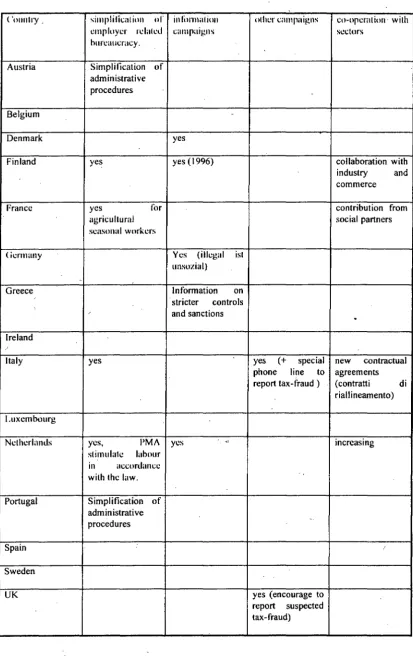
In response to the various short- and long-term impacts of undeclared work, Member States have implemented a number of measures tailored to match the differing forms of the phenomenon and their prevalence (tables 1-3). In some Member States initiatives have concentrated on undeclared work in the form of second jobs, whereas in others, they' have been targeted towards the more "industrialised" form of undeclared work. It is important to note, however, that some initiatives have been taken with other objccti\les in mind, but have had some positive side effects as regards undeclared work. However, when it comes to measuring the impact ofthese policies it is in many cases premature to draw any firm conclusions.
Legislative measures and 'enforcement
Most Member States have reinforced and strengthened legislation as regards criteria and sanctions for violation of regulations on tax and social contributions and benefit fraud in. order to combat undeclared work. Changes in labour market regulations to promote access to the formal labour market have been introduced in some Member States,. such· as Spain, where there have been certain changes regarding non"'standard work arrangements, and in Italy, where a new type of work contract enabling people to enter the formal labour market has been introduced. Although it was not its main aim, the transposition of Directive n° 91/5333 has been used in some Member States as a means of fighting undeclared
work. ·
i\s legal measures as such· cannot be said to have a substantial _ impact in themselves, f(>llow-up in the form of enhanced control of implementation has been provided for in some_ Member States., Inspection at various levels has also been- · reinfi.1reed. Th!-! instruments fi.1r this vary from one Member_State to the other: in e(wntries where the workforce is highly unionised, the unions have an active role in control, while in other· co~ntries the role of labour inspectorates ts more important.
. Furthermore, control-campaigns with the participation of both tax authorities and - labour market authorities have been introduced, both directly and indirectly as ·
, preventive measures, oflen with positive dlccts. Greater co-ordination between - different parts orthe public administration helps_ enforcement. Co-operation at the_
European level has also increased, notably through the sharing of inf(mnation4 •.
Most countries have strengthened sanctions relating to either. the non-declaration of work or benefit fraud: In some countries measures have been targeted at all levels in sub-contracting- chains. Increased control· measures have also been introduced for tbe service secto~ (hotel, restaurants and catering) in some countfies and the labour market authorities have collaborated with the tax-authorities. with some positive results both directly and by dissuasion of other cases of "organised" undeclared work: ·
Information and awareness
Another area where some Member States ·have initiated action . is that of 'campaigns against undeclared work. The _c~paigns focus on enhancing the
feeling of belonging to _a common society from which everybody re~eives and to which everybody should contribute. The German, example "illegal ist unsozial"· can he considered as a general encouragement to the population to declare' any work carried out. Some Member States have introduced information campaign~
about the risks of using undeclared labour such as in the construction sector where the usc of undeclared labour means tbere is no recourse agai'nst any detects in the W<;rk carried OUt llr when using unauthorised moving firms where there is no cover against the risk of burglary or damage.
Subsidies or reductions in-overheads as encouragement measures:.
- \
The issue ·of second jobs and undeclared work in the private service sector (households) has been addressed specifically in Belgium;, Denmark, Finland, _ Germany,-Sweden and France. Examples ofmeasuresto help reduce bureaucratic_ burdens include· service vouchers and one-stop-shops for SMEs. In_ Belgium,
Germany and France a service voucher scheme has been introduced, whereby households can buy household services at a lm-verprice, but stilr ensure that social security contributions and taxes are paid through the voucher.
_ 4 See article 4 of the Directive concerning the posting of workers in the framework of the provision of services.
The approal:h in the North of Europe has focused on both tax-deductions and subsidies for certain services and has aimed at encouraging households to usc formal lahour and not undeclared labour. Tax-deductions and subsidies for re-ILirhishing and improvements or houses have been particularly successful in encouraging more people to usc the opportunity to repair their houses legally, and had the eflcd of moving work which might have heen done inl(>rmally to th~:
l(xmal and registered sector.
Subsidies for domestic services have also been introduced in Denmark, Finland and Germany in order to encourage· household work (cleaning and gardening) to be carried out in the formal economy instead of in the informal economy, as is often the case. The subsidies are given by the state as a part of the wage which has to be paid to the worker and, in that way, they reduce expenses for users of the service. The State, for its part, ensures that this activity is declared (and t~ereby
also taxed) since there is a clear incentive for the user to apply for the subsidy.
Tax measures:
Most countries have made changes in tax legislation concerning levels of personal taxation and lax-deduction possibilities. The changes have in some cases had certain positive side effects
lor
the combat against undeclared work.The implicit tax rate on labour (taxes and social contributions) in the EU has risen from 35% in 1981 to more than 42% in 1995. This is the result of taxation progressively moving away from mobile tax bases, such as capital. Since 1996 the need to reverse this structural trend and more in general the link between taxation ·and employment have been investigated at EC level in the High Level Group and its successor, the Taxation Policy Group, both chaired by Commissioner_ Monti. This process has led to the adoption of the Resolution of the Council and the Representatives of the Governments of the Membe~ States, on a code of conduct for business taxation - Taxation of saving, O.J. N°. C 002 , 06/01/1998 (98/C 2/01 ).
The Employment Guidelines tor 1998 also provide l(lr Member States to examine the advisability
of
reducing the rates of VAT' on labour intensiveservices.-I nh.:rventio.ns from the supply side
Another kind of intervention is to favour the restructuring and .professionalisation of the supply side in certain sectors. For example widespread public childcare facilities in some countries have eliminated this sector from the undeclared economy. -The liberalisation of product and service markets also acts as a structural intervention favouring the declaration of certain activities.
The fact that administrative and regulatory requirements are among the most suious constraints faced by businesses has been recognised by the Commission in
its Recommendation on simplifYing and improving the business environment for
husiness start ups5 . Based on best practices in Member States it sets out measures
. to reduce the administrative .-burden imposed on newly created enterprises, including th~ burden resulting fn)m tax and social security paym~nts.
Social Dialogue
The social partners can have an important role to play ·in combat_ing undeclared work. This may lor exari1ple take the form of vigilance at individual work places . to ensure that regulations and working contractsare respected.- In some countries ·collaboration with the industrial and trade union bodies from . the . sectors concerned has also been initiated. In France, for example, the government and certain industries have collaborated on information campaigns in order to encourage people to use declared labour for construction and. for house-moving. Moreover, wherever there are- wide ranging. tripartite agreements any strategy to favour the reintegration of undeclared work _is negotiated and monitored through the social partners.
Measures relating to third-country nationals
With regard to the problem of third-country nationals inv~lved in undeclared work, France in particular has· introduced special measures which are mostly related to _control, but also include monitoring of current developtpents. IIi the UK, legislation obliging employers to ensure that their employees have residence and work permits was introduced in 1996. · The same. kind of regulation· was introduced in the Netherlands in the early 1990s. In Portugal and Greece legislation concerning immigrants has been changed.
At European level, combating undeclared work by third country nationals on the territory of the Member States is considered a matter of common interest and falls . under Ti~le VI of the Treaty. A gains~ -this legal background and. because of the ·
substantive common interest in tackling this _issue the Council has adopted _two recommendations on fighting illegal employment6 • The Amsterdam Treaty will·. include a specific chapter on Fr~edom, Security and Justice with a specific Community competerice for immigration.
4.3.. Three Country Examples
of
an Integrated Strategy/\n integrated approach has been taken in some countries where a co-ordinated effort has been made involving different services -of the public administration. Efficiency · depends to a large extent on -broad political initiatives covering . different areas from labour. law to fiscal . measures . target~d according . to the
features of the problem in the individual Member States .
. 6 Council Recommendation of22 December 1995 on harmonising means
of
combating illegal immigration and illegal employment and improving the relevant means of control, .Official journal NO. C 005 , I 0/01/1996; Council Recommendation of 27 September 1996 on combating the illegal employment ofthirdcountry _Denmark
Several initiatives have been taken to combat undeclared work. Some initiatives targeted at other areas have had some positive side-effects and have worked in harmony with the policy measures introduced against illegal work.
First or all enhanced control was initiated in the fields or tax and labour inspection to detect benefit fraud. This has been carried out in co-operation between the tax and labour market authorities. Secondly, various schemes to encourage work to be carried out within the formal economy were established, in response to the fact that in certain sectors undeclared work had appeared to be the rule rather than the exception (primarily in the field of dom~stic services):
• Home service schemes: A subsidy scheme for consumer services was introduced in 1994.
• Subsidies for house repair
Finally, the implementation of a tax-reform in 1994 lowering marginal income taxes had the side effect of reducing the incentives to activities in the underground economy ..
The Netherlands
Initiatives hav(;! been focused on benefit fraud and legislation on this issue was passed recently. The law is intended to ensure that recipients of social benefits fulfil certain criteria and do not take up second/illegal occupations contrary to the conditions of receipt of a benefit. It is considered that the best way to combat undeclared work is through tax-legislation and reduction in VAT levels. For this reason there have not been any initiatives taken to step up sanctions and controls to combat undeclared work.
Moreover, non-wage labour costs have been reduced in the Netherlands. These reductions relate specifically to low wage earners. The measures were introduced with the aim of promoting employment, but has also had some positive side effects in reducing undeclared ~ork.
France
A special agency was established to combat undeclared work (Mission de liaison Interministerielle pour Ia lutte contre le tra:vail clandestin, 1' emploi non declare et le traffic de main-d'oeuvre, MILUTMO) and all actions are co-ordinated at the national level through MILUTMO. At the regional and the local level control measures have been reinforced. '
A service-voucher scheme has also been established to.encourage the declaration · ~lf domestic work and tax-credits l(lr repairs to housing and employment of
tlomcstic persorincl were.also increased.
' .
Finally, inl(mnation campaigi1s hav~.:. been launch~.:d in wllaborution between the ·
gi.wernmer~t
and the social partners o[ c<;rtain sectors in' order to raise awareness ofsome of the risks taken when undeclared labour is used. Moreover', Social dialogue· was also initiated and an agreement between social partners .and the Ministry Of Labour has been concluded.
5. CONCLUSION
UndecJared work is ari important element in the dysfunctioning of product, service and labour markets and it risks undermining the .foundations of financing and delivery of social protection _cmd. public services as the curtailment of receipts entails a reduction in the level of services the State can offer.
We could say thcr~ arc two kinds of undeclared work: one which is mainly evasion of taxes and so~.:ial contributions by pc()plc in employment with a second activity; and the sort of 'organised' undeclared work which does not respect labour legislation·. At present, undeclared work is mainly- of the first kind, while ' labour market policy makers tend to concentrate on the second kind;
.
,. .
·A strategy which is to have
~y
effect on reducing. imdeclared work should involve a mix of the elements set out in par 4.1. This policy mix will inevitably vary from one Member State to another. Effective implementation andenforcem~nt
remain . an important part of the overall strategy whatever . the' measures chosen.This. paper aims to launch 'a debate· on· the causes of undeclared work and the· policy options for combatting it. It suggests that there is, firstly, a needto identify correctly the causes-- and extent of the problem, and, secondly, to regard combating undeclared work as part of the overall employment strategy.
\ . . . . .
The Commission hopes and expects that the Member States, Community institutions arid social partners wi 11 participate vigon>usly in this ·debate. An increased awareness. of the ~.:auscs and extent of· undeclared work, the" identification of best practices in combating it and the possibility of co-ordinated EU action should be considered in this context. Implementation of several of the 1998 employment guidelines, such as thos~ on developing entrepreneurship and encouraging adaptability, will he~p to · discourage undeclared work. If the · outcome of this debate indicates . th'l-t further action . at EO. -level would be appropriate, it could be considered in the context of the 1998 Joint Report and th~
6. TABLE 1: LEGAL OR CONTROL RELATED MEASURES:
Increased control Increased control strengthening of _change in labour legislation or by tax authorities hy labour market sanctions other
authorities.
Austria yes ycs simplili_cntinn Ill' t 'mnllll'l'\:inl and Industrial Activities Regulation and more flexible working time arrangements.
Belgium Yes yes raise of fines
Dcnmark Yes ycs
Finland Re-en l(Jrced liscal increased control yes changes concerning atyph:al aclinn an control on uncrnployed. work
France Increased control
-
increased yes inspection and control- establishment of MILUTMO
Uermany Yes yes, more staff nf yes. raise of lines more restrictive towards black
employment work
services lilT outside control.
Greece Re-enforced fiscal yes, raise of fines registration of illegal
control immigrants legalising their
situation for 9-12 months.
Ireland Rc-enJ'brced yes
application of tax- -.. laws.
Italy Yes
Lux.
NL Yes yes yes liberalisation of private
manpower agencies
Portugal -yes, for child deregulation on illegal
labour immigrants
Spain changes in atypical work
arrangements.
Sweden More fiscal control
[image:19.597.42.463.61.750.2]7. TAIJLE 2: MEASURES RI<:LATING TO SUBSIDIES OR;-COST REDUCTIONS.
-
-Service subsidies, - house_. change In tax- tax- reduction of non
--
vouchers repairs or domestic legislation deductions wage· labourserv1ces (services) costs. '
-Austria pi lot projects for the yes.
unemployed ;
Belgium Introduction of
·-. cheque-service
-Denmark yes, home service yes (lower marginal
-scheme. taxes) ·
Finland yes
-France Introduction of ... ' yes (loi Robien)
-cheque-service
-
-'
Germany Introduction of yes
cheque-service (domestic
services)
Greece tax-reform reducing yes , yes
possibil1tics of
tax--
evasionIreland .- yes, reduction of yes, reduct-ion of
personal taxation social secufity
-
contributions forc_ertain.
-categories ·of workers.Italy . tax reduction for yes yes
house repairs (professional
services) '·
Lux. subsidies for house-
-repairs,
tax-·- deductions
NL subsidies to suppliers yes
of some services
Portugal. yes I
Spai!l Fiscal
'
reform lower taxation on labour
'
Sweden tax reform lowering ·yes (house yes'
marginal taxes refurbishing)
'
8. TABLE 3: OTHER MEASlJRES
< 'onnlry _ simpli lkal ion ol' in timnal iou olh~o:r campaigns co-opera I ion· with
employer 1dalctl campaigns sectors
hurcaucrm:y.
Austria Simplification of
adm in istrati ve
procedures
-Belgium
-Denmark yes
Finland yes yes (1996) collaboration with
industry and
commerce
France yes for contribution from
agricultural social partners
seasonal workers
< icrmany Yes (ilh.:gal ist unsuzial)
..
Greece Information on
stricter controls
/ and sanctions
.
Ireland J
Italy yes yes (+ special new contractual
phone line to agreements report tax-fraud) (contratti di
riallineamento) I.uxcmbourg
Netherlands yes, J>MA yes
,.
increasingstimulate labour
in accordance
with the law. . '
Portugal Simplification of
administrative
-.
procedures Spain
Sweden
UK yes (encourage to
[image:21.596.42.456.63.721.2]9. ANNlJi:X: COIINTRY 1FiCBIES7
Austria
. ' .
CharactcR"istics of the undeclared worker: 1/10 of all people· in working age have a sideline ' .activity: The focus has been on illegal employment of foreign labour ·
Undeclared work distributed by sector: 40% in building and craft, 16% in other trade arid' . industrial enterprise (auto repair, machinery, etc.), 16% in service sector, 13% in entertainment
busine~s
and 15% in other trades and services(re~edial
training, hairdressing, baby-sitting)Measures/ Pol~cies: "Increased control by labour inspectors; simplification o( Commercial . and Industrial Activities regulation; more flexible working time arrangements; simpljfication of administrative procedures. Pilot projects for the unemployed in domestic services have also been introduced. Non wage labour costs are reduced for apprentices arid when hiring. older unemployed
~Belgium
Characteristics of the undeclared worker: semt- or low skilled wor~ers, men,. young · people
Undeclared ·work distributed by sector: catering industry, retail trade, construction . industry, textile sector, traffic/transpoft, household services (private cleaning etc.), agriculture
(fruit-pic~ing)
Measures/ Policies: Legal measures. Extension of inspection services .. More control of certain industries. Raise of fines. Attempts to decrease labour costs through several initiatives (textile plan, Maribel). Service vouchers systems. ·
Denmark
Cha~racteristi~s of the undeclared worker: skilled and unskilled workers, students, men (twice as frequent as women). There Is a geographical divide (cultural); (young skilled m~n living outside Copenhagen) ·
Undeclared work distributed by sector: 33% in construction sector, 50% in private service sector (baby-sitting, cleaning, car-repairs gardening etc.)
Measures/ Policies: Strengthening of sanctions in tax\ l1ws, Lowering of marginal taxes, · subsidies for house repairs, subsidies for consumer services, increased, control by fiscai and
labour market authorities, ' . .
7 Source: National experts on lahour' 1~arkcts of the EC Network·,. SYSDEM (Systeme d'evaluation et de
Finland
Characteristics ofthe-undedared worker: younger skilled men
-
.Undeclared work distributed by sector: construction, hotel/restaurants, rclai I trade ( i nd u~c
car repairs), real estate services
Measures/ Policies: Preparation of subsistence benefits/ Subsidies for special services in households. Increased control measures also with regard to unemployed. Re-enforcement of tiscal action and control. Changes in the legislation concerning atypical work. Collaboration with industry and commerce. Simplification of eri1ployer related bureaucracy. Extensive inf(>rmation campaign.
France
Characteristics of the undeclared worker: nationals, legal immigrants, illegal immigrants
Undeclared work distrihuted hy sector: 60% in the service sector (primarily hotels, cafes, restaurants), 27% in construction business, 13% other sectors
Measures/ Policies: Re-enforcement of legislation. Establishment of MILUTMO._ Introduction of service-vouchers system. Increase of control by labour inspectors. Extension of public authorities competence toward illegal work. Enhanced co-operation between labour market authorities and other parts of the administration. Strengthening of sanctions. Social partners contribution. Simplification of procedures tor agricultural seasonal workers.
Germany
Characteristics of the undeclared worker: illegal immigrants, double workers and also those only working in the black
lJndeclared work distrihuted by sector: construction, hotel/restaurants, transport (persons or goods), clcani ng sector, entertainment/art/culture
Measures/ Policies: Increase of control measures, strengthening of legal instruments, raise of fines. Information campaign ('illegal ist unsozial')
Greece
Characteristics of the undeclared worker: illegal/legal immigrants; pensiOners, women/homeworking; young people - mostly seasonal jobs
Measures/ Poiicftes Legal action: Strengthening of sanctions /fines. Step up in enforcement . of--tax laws., Tax reform reducing the possibilities' of tax evasion. Red'uction of-taxes on·
presentation of receipts for purchases and services. De-regulation con_cerning immigrants possibilities to stay in the country. ,· __
irchmd
' ' ' . ' .
Charac~eristiCs of the undeclared worker: students, double workers. No illegal immigrants
Undeclared. work distributed by sector: building, construction, distribution
·Measures/ Policies Enforced application of existing legislation as regards ta:X.-evasion etc: . . Reduction of personal taxation. Reduction of social insurance contribution. for 'some . categories ofworkers.
-Italy
Characteristics oftheundeclarcd worker: moonlighters, young people, wo~en, pensioners
Undeclared work distributed hy sector: agriculture, construction, priv<~;~e service sector;
"'\ ' "'
textile (horf1eworking).
Measures/ a•oliCies Increased control of tax authoritie~. Tax-deductions tor professional services. Reduction of non:-wage labour costs. simplification of administrative proeedirr~s. new contractual agn!einents ( contratti di riallideamento) . ··
>
Luxembourg
Soine ~ndeclared work in the construction sector. if any. No measures introduced . . ' '
The Netherlands
Characteristics ofthc undeclared worker: men, skilled with a formal job-. ·
· llndeclared work distributed hy sector: hotel and catering, taxi-business; couriers services; bus enterprises, metal industry, ready made Clothes sector ·
·Portugal
Characteristics of the undeclared worker: illegal immigrants, women, unregistered workers
Undeclared work distributed by sector: construction, textile sector, retail trade
Measures/ Policies Legal initiatives concerning illegal immigrants and child labour. Tax reform. Simplification of some administrative procedures.
Spain
Characteristics of the undeclared worker: under 25 years old. women, skilled, in SMEs
Undeclared work distributed by sector: agriculture, Service sector (hotels and restaurants ), private service sector
Measures/ Policies Certain changes regarding atypical work arrangements.
Sweden
Characteristics of the undeclared worker: no characteristic, mostly sc\f.-c:mploycd. l'r skilled males
Undeclared work distributed by sector: private service sector, rcstuurants, cleaning !inns
Measures/ Policies More fiscal controL Tax reform lowering marginal rates. Tax deduction for house refurbishing. Reduction of non-wage labour costs.
UK
Characteristics of the undeclared worker: men, (25-55 years old) skilled/working. class
Undeclared work distributed by sector: construction sector, Streets markets, hotels and catering
ISSN 0254-1475
COM(98) 219 final
DOCUMENTS
EN
04 06 05
10
...
. --- --- --. - --- -. -- . ----.. -- ---- --- ----· --- - - --- --_____ :____ ______ ___:_ _________ ~----:.._. __
---Catalogue number
CB-C0-98-249-EN-C
ISBN
92~78-35108-3·.
Office for Official Publications of the European Communities