. I:
t
0Ill''
-'
>
i(·
..
u.lw
(.)DIRECTORATE GENERAL XV Internal Market and Financial Services
General matters and coordination, free movement of persons and direct taxation
External dimension of the internal market and financial services
CANADA
Brussels, 12 June 1995
Ref: N /gg - jv\tcr\canada
XV-A-2
Rue de la Loi 200, B-1049 Brussels, Belgium - Office: C 107 8/4327.
Introduction
In 1993, GDP in Canada was CAD 711.6 bn (ECUl 456.4 bn) with a real growth rate of 3.3%. With a population of 28. 7 mn this represented a per capita GDP of 24,796 CAD (16,731 ECU)
compared to 15,800 ECU in the EU. ·
CREDIT INSTITUTIONS
The Canadian banking sector is characterised by so-called Schedule I and Schedule II banks. Schedule I banks have capital in excess of CAD 750 mn and are widely held because ownership is restricted to 10% for a single entity whether domestic or foreign. Schedule I banks controlled over 90% of banking assets at the end of 1993.
Schedule II banks are institutions with capital not exceeding CAD 750 mn. Ownership can be closely held for the first ten years after which time the bank must become widely held. However, foreign banks may remain closely held indefinitely. Schedule II banks include 54
foreign bank subsidiaries. ·
Schedule Il banks may include banks that are directly owned by a widely-held regulated financial institution that is not itself a bank. Owners of such a bank could be a widely-held trust, loan or stock life insurance company.
In principle a 35% rule will apply to Schedule Il banks when a capital size of CAD 750 mn
is reached i.e. at least 35% of the total voting rights in the company must be attached to shares that are widely-held and listed for public trading. A ministerial exemption may be granted for firms that reach the threshold through internal growth or through successive acquisitions of small Canadian financial institutions, on a case-by-case basis.
Financial institutions are allowed to diversify into new financial businesses through the setting up of subsidiaries. Legislation passed in 1987 allowed federal financial institutions to own securities dealers. Legislation passed in 1991 permits banks to own insurance companies and trust companies. Institutions are, in certain circumstances, permitted to network financial services offered by affiliates or independent financial institutions. However banks, trust and loan companies are prohibited from offering tnost insurance services on behalf of insurance companies.
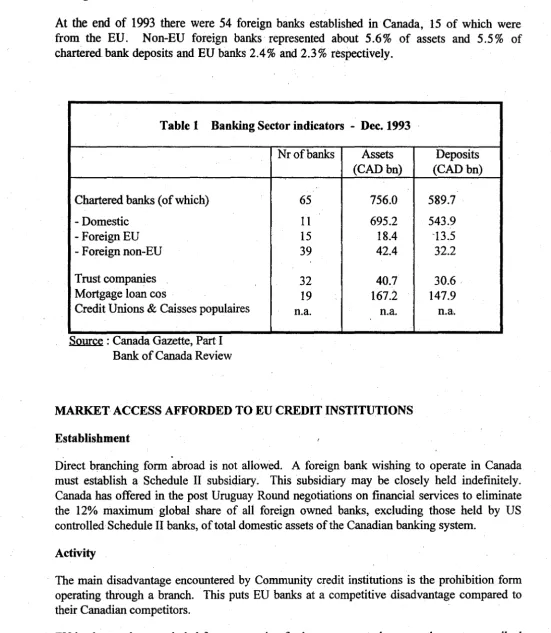
Total assets of chartered banks amounted to CAD 756 bn in 1993 and deposits amounted to CAD 589.7 bn. The top 10 banks2 accounted for 94.6% of assets and 94.9% of the deposits in 1993.
2
Exchange rates :
At 1993 year end l ECU = 1.482 CAD Annual average l ECU = 1.101 CAD.
Foreign banks
At
the end of1993
there were 54 foreign banks established in Canada, 15 of which were from the EU. Non-EU foreign banks represented about 5.6% of assets and 5.5% of chartered. bank deposits and EU banks 2.4% and 2.3% respectively.Table 1 Banking Sector indicators - Dec. 1993
Chartered banks ( of which) -Domestic
-Foreign EU - Foreign non-EU Trust companies Mortgage loan cos
Credit Unions & Caisses populaires
Source : Canada Gazette, Part I
Bank of Canada Review
Nrofbanks 65 11 15 39 32 19 n.a. Assets (CAD bn) 756.0 695.2 18.4 42.4 40.7 167.2 n.a.
MARKET ACCESS AFFORDED TO EU CREDIT INSTITUTIONS
Establishment ' . Deposits (CADhn) 589.7 543.9 ·13.5 32.2 30.6. 147.9 n.a.
Direct branching form abroad is not allowed. A foreign bank wishing to operate in Canada must establish a Schedule II subsidiary. This subsidiary may be closely held indefinitely. Canada has offered in the post Uruguay Round negotiations on financial services to eliminate the 12% maximum global share of all foreign owned banks, excluding those held by US controlled Schedule II banks, of total domestic assets of the Canadian banking system.
Activity
The main disadvantage encountered by Community credit institutions is the prohibition form operating through a branch. This puts EU banks at a competitive disadvantage compared to their Canadian competitors.
EU banks are thus precluded from competing for large corporate loans, as they are proscribed from extending loans to a single borrower in excess of 100% of the subsidiary's capital, and cannot take advantage of their parent bank's capital. In addition, subsidiaries are only expected to reach the 100% limit in exceptional cases, and must notify the Office of the Superintendent of Financial Institutions when they exceed the 50% level. Another disadvantage of operating as a subsidiary is the added expense and complication of maintaining a separate board of
[image:3.600.15.566.87.720.2]INSURANCE
Insurance companies operating in Canada are regulated either federally or provincially and there is no one government agency to oversee the whole industry. Life insurance and non-life business must be carried on in separate companies. Widely-held insurance companies are permitted to own Schedule II banks and to network products of other financial institutions, including other insurers. Insurance undertakings are also to be given greater access to capital through the issuance of preferred shares and debt instruments and they will be permitted to borrow for short-term liquidity purposes.
At the end of 1993 there were 156 life and 232 non-life companies operating in Canada, 100% of which are regulated at federal level. Life premiums amounted to CAD 22.3 bn (3.1% of GDP) and non-life premiums to CAD 13.5 bn (1.9% of GDP)in 1993. Total assets of life insurance companies amounted to CAD 239.7 bn in 1993 and CAD 32.6 bn in non-life.
Foreign insurance companies
Foreign insurance companies play an important role in the Canadian market. About three quarters of all insurance companies operating in Canada are either foreign controlled subsidiaries or branches and agencies of foreign undertakings. Foreign undertakings account for 11. 7% of total life premiums and 21.5% of non-life business.
Table2 Indicators of Insurance Business Year 1993
Life Non-life Total
Premiums (CAD bn) 22.3 13.5 35.8
.
Premiums underwritten by foreign.
.
2.6 2.9 5.5
msurance companies
Premiums underwritten by EU
.
.msurance companies n.a. n.a. n.a.
.
Premiums as% of GDP 3.1 1.9 5.0.
Premiums per capita (CAD) 777.0 470.0 1247.0Number of insurance companies of 156 232 388
which:
EU insurance companies n.a. n.a. n.a.
.
Foreign insurance companies 91 133 224Total assets of insurance companies 239.7 32.6 272.3
MARKET ACCESS AFFORDED TO EC INSURANCE UNDERTAKINGS
Establishment
Foreign insurance companies may establish as either a subsidiary or branch. Authorisation of foreign insurers may be subject to consideration of the value of the market entrant to Canada, as may the acquisition of control of an existing Canadian enterprise by a foreigner. Notification of Investment Canada is required to establish a new insurance business and approval is
necessary for larger acquisitions. ·
The 10% rule applies to the acquisition by non-residents of shares of a Canadian controlled life insurance company. This rule does not apply to federal companies under foreign control. US investors have been exempted from this rule under the terms of the US-Canada FTA.
Activities
Foreign insurance companies are subject to certain measures affecting their operations. For instance, registration in Canada requires that the parent company must have C$ l 00 million worth of assets, in its home country, in addition to the requirements common.to Canadian companies, however there are no domestic capital requirements associated with the establishment of foreign branches;
SECURITIES
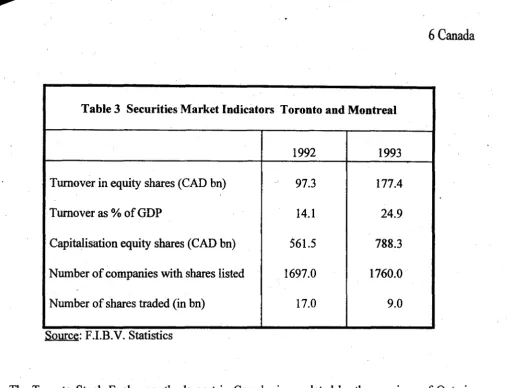
Table 3 Securities Market Indicators Toronto and Montreal
1992 1993
Turnover in equity shares (CAD bn) 97.3 177.4
Turnover as % of GDP 14.1 24.9
Capitalisation equity shares (CAD bn) 561.5 788.3
Number of companies with shares listed 1697.0 1760.0
Number of shares traded (in bn) 17.0 9.0
Source: F .LB. V. Statistics
The Toronto Stock Exchange, the largest in Canada, is regulated by the province of Ontario
under the Ontario Securities' Act. Equity share turnover in this market in 1993 amounted to
CAD 147 bn. Foreign-owned firms are allowed to enter this market and like domestic firms must register with the Ontario Securities Commission.
Since 1983 foreign firms have been permitted to operate on the Montreal Exchange. Over recent years there has been a deliberate policy by the Quebec authorities to stimulate the role of the Montreal Exchange through regulatory reforms and innovation.
[image:6.597.60.569.14.402.2]