COMMISSION OF THE EUROPEAN COMMUNITIES
Brussels, 31.05.1995 COM(95) 225 final 95/0131 (SYN)
COMMUNICATION FROM
THE
COMivfiSSIONconcerning the promotion of energy efficiency in the European Union (~AVE ll Programme)
Proposal for a CQUNCIL DECISION
concerning a multi-annual programme for the promotion of energy efficiency in the Community - SAVE II
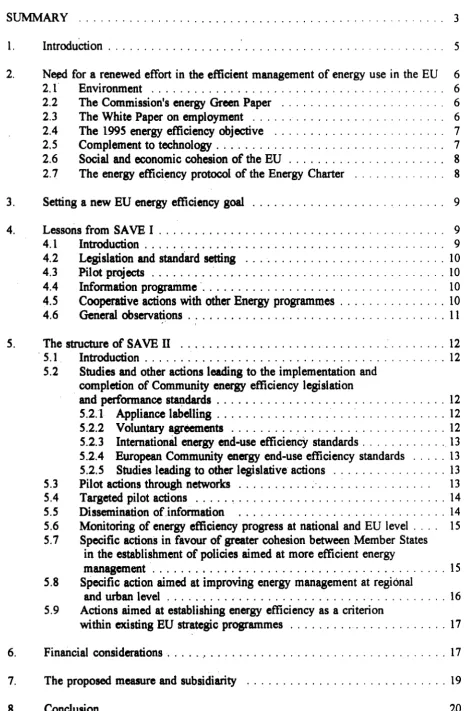
TABLE ·oF CONTENTS
SillvfMARY
31. IntroduCtion . . . ·. . . . . 5
2. N~ for a renewed effort in the efficient management of energy use in the EU 6 2.1 Environment . . . 6
2.2 The Commission's energy Green Paper . . . 6
2.3 The White Paper on employment . . . 6
2.4 The 1995 energy efficiency objective . . . 7
2.5 Complement to technology. . . 7
2.6 Social and economic cohesion of the EU . . . . . 8
2. 7 The energy efficiency protocol of the Energy Charter . . . 8
3. Setting a new EU energy efficiency goal . . . 9
4. Lessons from SAVE I . . . 9
4.1 Introduction . . . 9
4.2 Legislation and standard setting . . . 10
4.3 Pilot projects . . . 10
4.4 Information programme·. . . 10
4.5 Cooperative actions with other Energy programmes . . . 10
4. 6 General observations . . . . 11
5. The structure of SAVE II ... 12
· 5 .I Introduction . . . . . 12
5.2 Studies and other actions leading to the implementation and completion of Community energy efficiency legislation and performance standards . . . . 12
5.2.1 Appliance labelling . . . · . . . 12
5.2.2 Voluntary agreements . . . 12
5.2.3 lntemationil energy end-use efficiency standards . . . 13
5.2.4 European Community energy end-use efficiency standards . . . 13
5.2.5 Studies leading to other legislative actions . . . 13
5.3 Pilot actions through networks . . . ·. . . 13
5.4 Targeted pilot actions . . . , . . . 14
5.5 Dissemination of.information . . . 14
5.6 Monitoring of energy efficiency progress at national and EU level . . . . 15
5.7 Specific actions in favour of greater cohesion between Member States in the establishment of policies aimed at more efficient energy management . . . 1 5 5.8 Specific action aimed at improving energy management at regional and urban level . . . 16
5.9 Actions aimed at establishing energy efficiency as a criterion within existing EU strategic programmes . . . 17
6. Financial considerations . . . . .. · . . . 17
7. The proposed measure and subsidiarity . . . 19
SUMMARY
The SAVE programme was established by Council Decision 91/565/EEC and began officially
on 29 .October 1991. SAVE will expire on 31 December 1995. An evaluation of the
programme has been carried out by a
group
of independent experts and a series of
recommendations have been made by them for improvement in the overall content and
operation of
a new SAVE programme.
The Commission considers that a continuation of the SAVE programme is necessary due to
the essential contribution of an improvement in the rational use of energy resources
to the
Community's strategy
to stabilize C0
2emissions at the
1990level by the year 2000. This
objective is in conformity with Article 130s of the Treaty.
The prudent and. rational management of energy end-use
al~makes an invaluable
contribution to the attainment of the Community's energy efficiency objectives and is one of
the pillars on which the
Green Paper on the Community's future energy policy, which
hasbeen presented by the Commission,
has been
baaed.
The Commission's White Paper on Growth, Competitiveness and Employment recognized the
pre-eminent role of prudent energy
use
in improving the competitiveness of the Community's
industry while at the same time
creatinga significant number of new jobs. Improved
energyend-use efficiency introduces a demand aide management approach which
alsocontributes
tosocial cohesion within the Community,
promotes the valorization of local energies and.
accelerates the j>enetration of new energy technologies (many of which have been developed
with Community funding) into the
marketplace.
In the light of the consider&tion mentioned above,
theCommission is proposing a continuation
of
theSAVE programme which will embody many of the recommendations made by the
independent
experts as
well
as
the
experience
gained by the Commission in the operation of
the SAVE programme and other
eneiJYactions.
This increase in the scope
of the SA VB ll programme actions, through the incorporation of
the Community's actions in improving energy management at regional and urban level. ind
through the necessity to develop policy instruments which complement existing Community
actions in the field of energy· efficiency, is justified by
the
im~ceof the programme in
the Community's C0
2limitation
strategy.The enlarged SAVE II programme will have the following elements:
(a)
reinforced existing actions:
labelling and standardization actions in the area of energy using equipment;
pilot actions to be
carried
outby appropriate networks;
targeted pilot
actions;
(b) New actions:
monitoring of energy efficiency progress at national and EU level;
specific actions in favour of greater cohesion between Member States in the field of the establishment of policies aimed at efficient energy management; specific action aimed at improving energy management at regional and urban level;
actions aimed at establishing energy efficiency as a criterion within existing EU strategic programmes.
lntro4uction
1.
This Communication has a dual purpose. First, it constitutes the report on the SAVE
programme which was required by Article 7 of Council Decision 91/565/EEC setting
up the programme. Secondly, it serves as the preamble to a Commission proposal for
the continuing of the Community's energy efficiency actions through the setting-up of
a SAVE II programme.
2.
Energy efficiency will
beused in its broadest definition in this paper, i.e. the prudent
and efficient use
of
energy resources in all sectors of the economy and related to all
resource types.
3.
An evaluation has been made of the SAVE programme by a
teamof independent
experts and the report is annexed· to this document. Many of the suggestions of the
teamrelating to. a future SAVE programme have been incorporated in the proposal for
.the SAVE II programme.
4.
5.
6.
(I)
Another element of programme evaluation was a conference held in Florence from
26 to 28 October 1994. This conference brought together over 300 participants who
had been involved with the SAVE programme either · as national officials of
Member States (the SAVE Committee) or ·as SAVE contractors on pilot projects. The
conference discussed the contributi,on of the SAVE programme to imprQving the
energy management infrastructures within the Community and developed suggestions
for future Community actions ..
In the light of the recent effort to reduce the amount of Community legislation in the
energy field and in order to clarify the existing situation, it is proposed that the
Community action programme for improving the efficiency of electricity end-use
(the PACE programme) set up under Council Decision 89/364/EEC<
1>
be completely
incorporated into SAVE II permitting the cancellation of the original legislation.
With the same preoccupation, rather than presenting a new regulation as a follow-up
to the regional and urban energy programming pilot action which has been carried out
since 1990 without a legal basis, it is proposed to incorporate in the SAVE II
programme the elements of this programme relating to actions on energy management
in regions, cities and islands.
The incorporation of these two programmes added to the inclusion of the
recommendations of the experts who evaluated both SAVE and the Community's
programme for energy management in regions, islands and cities and the discussions
undertaken during the SAVE Conference, have led to the development of a series of
actions which greatly increase the effectiveness and scope of the programme. Some
existing SAVE actions will continue in an adapted form while a series of new actions .
have been added.
2.
Need
~or
a
renewed effort
inthQetllpienrin·em~t-9(1#f.r&Y~inlh~EU
.. ··.·.·,··.·.·:· .. · .. ·.·.·;-:-.-:···.·.·
2.1 Environment
7. Since the efficient use of energy reduces the emission of pollutants to the atmosphere, it has been hailed as the single most important policy objective in attaining the EU's stated objective of stabilizing C02 emissions to the 1990 level by the year 2000. In recognition of this fact, .the SAVE programme has been recognized by the Commission as a cornerstone of the Community's C02 reduction strategy. This situation has been· reinforced by the Conclusions of the Environment Council of
15/16 December 1994 which states "The Council underlines once more that the target of stabilizing C02 emissions can only be achieved by a coordinated package of measures to improve energy efficiency and the rational use of energy which are based on supply 'and demand at all levels of energy production, conversion, transport and consumption and to exploit renewable energies"(l>. This does not mean that the· efficient management of energy use should be seen as a panacea for our environmental problems but it is widely recognized that, under normal economic growth conditions, a substantial improvement in the rational use of energy will be necesSary if the EU is to attain its objective. This will inevitably mean that Member States will have to supplement their efforts to manage the use of their energy resources and
that
the EUwiJI
have a role to play in coordinating and optimizing the Member States' efforts.2.2 The Commission's energy Green Paper
8. The Commission has established a Green PapefO> which outlines a proposal for the Community's future ·energy policy and which will act as a basis for a discussion on an energy chapter in a revised Coq~munit)' treaty. The Green Paper establishes three tenets to which energy policy should respond; industrial competitiveness, security of supply and protection of the environment. Energy efficiency satisfies these three imperatives. It safeguards security of supply by the wise use of energy resources, it reduces factor costs of industry thereby raising ·productivity, and it protects the environment by reducing the amount of harmful pollutants emitted into the air.
2.3 The White Paper on employment<">
9. The White Paper on employment mentioned the role of the new eco-industries such as energy efficiency as a generator of jobs. The Commission estimated that such industries ·have an employment creation potential in the region of I 00 000 permanent jobs and 200 000 man years by the year 2000. However, there is evidence that this may be a conservative estimate, and that the employment creation potential is much greater. There is also substantial empirical evidence to demonstrate that energy demand
(2)
(3)
(4)
11870/94 (Presse 273-G).
COM(94) 659 final. •
2.4
10.
11.
2.!
12.
{5)
(6)
reduction investments
create3-4 times the number of jobs as equivalent energy supply
projectsm.
Alandmark study canied out in the EC in 1984(6) has estimated that
an enforced energydemand
policyaimed at reducing energy consumption by
15%over
15years might have
anoverall yearly net employment effect of about
520 000man years.
The
199!enefiY efficiency
objectiveIt is now virtually certain that the Community
willfall well short of the ambitious
objective
whichthe Council
setin September 1986 for a
200/oat
leastimprovement
in the Community's energy intensity by
1995.The attainment of such an objective
would have required a confluence of increased Member State initiatives in energy use
management allied
tocontinuous price rises. In effect, Member States' efforts in the
field of enerSY efficiency declined during the ten year period in question while oil
pricescollapsed in 1986.
The difficulty in attaining the
energy
efficiency objective demonstrates the very
real barrierswhich impede the development of
thevery' considerable potential which
existsfor further enqy efficiency
gains
withinthe EU. The existence of the objective
alone
wasnot sufficient
toamintain Member States' efforts
toimprove the rational use
ofenergy
and the benefits
ofan energy efficient society were foregone for the
short-termgains assOciated
with cheaper
energy.
The ·SAVE programme
address
in practical
terms the baniers which exist
todeveloping
theenergy efficiency potential by
examining
throughpilot
projects how aucb ~strativeand institutional barriers
canbe overcome.
·
CompleiDUt to teclllloiOIY
The European Community, mainly through the JOULE and THERMIE programmes,
hu
supported a great deal
of development in
the area
of improved energy production
and end-use technologies.
Much
of this development has taken place against a
background of_
difficulty
in introducing
energy
.technologies to the
marketplace.
Since
1989,
the
THERMIEprogramme
hasdeveloped tools
to assistmarket penetration of
the technologies already developed. However, there is much which
can
be done on a
JM?licy level
to
removebarriers,
both
institutional and financial, to the introduction of .
efficient
energy technology.
The
SAVE
programme is the policy vehicle which · ·
complements the Community's
energytechnology programmes. SAVE in itself is
technology neutral. For example, the SAVE I programme presented a directive on
energy
auditing in industry. Some Member States did not have a well developed cadre
of energy managers capable of carrying out such audits. SAVE supported the training
Power
toSpare-A plan for increasing New England's Competitiveness through energy
efficiency, New Ensland Policy Council July 1987.
of energy managers for energy auditing. Well" qualified energy managers could be
considered a tool in ensuring the penetration of energy technologies; therefore the
SAVE initiative complements the efforts of the technological programmes in bringing
energy technologies to the marketplace.
2.6 Social and economic· cohesion or the EU
13.
Studies have shown that where energy efficiency programmes have been launched the
savings made tend to be spent in the local economy and thereby increase the level of
local economic activity with consequent improvements in the quality of life. Whereas
investment in energy supply (generally located near major population centres) have
a distinct confined effect (only those in the general area of the construction benefit),
investments in improving the efficiency of energy end-use produce jobs across a wide
geographical area which may be important for the less-developed regions and towns
of the Community. Furthermore, effective energy efficiency policies will diminish the
economic vulnerability of the Union to any future supply-side shortage.
14.
Energy management, through the reduction of factor costs, increases industrial
competitivity thereby increasing the chances of industrial growth and increase of
employment. Again this is particularly important for peripheral areas of the
Community.
IS.
The adhesiol). o( three new States on 1 January 1995 has improved the average
Community energy intensity and thereby placed greater pressures on the Community
to achieve cohesion in this important area of economic activity.
16.
There is empirical evidence to show that policy programmes such as SAVE do much
to accomplish the aim of social and economic cohesion by creating disposable income
from energy savings. There is also evidence that technological-based programmes have
a negative effect .on social and economic .cohesion since they tend
toconcentrate their
efforts on areas where a high-technical competence already exists. These are generally.
not the areas in most need of social and economic cohesion.
·
2. 7 The energy efficiency protocol or the Energy Charter
3. · Setting
a
new EU energy efficiency goal18. As mentioned above in the paragraph 2.4, an energy efficiency objective for 1995 was set by the Council in 1986. It is very unlikely that this objective will be attained. It could be argued that the objective was too ambitious in the first place since the most economic energy efficiency options had been taken during the period 1973/86 and that the marginal cost of each unit of energy saved would rise over time. However, the fact that the objective exists tends to focus Member States' minds on the subject of energy management. Without such an objective, Member States might possibly have reduced their energy efficiency programmes yet further. It is therefore proposed that an energy efficiency objective be set for the programme so that the progress of the Member States and the initiatives undertaken by the Commission can be monitored. Since 1986 the improvement in energy intensity of final demand has been ,in the region of 1% per annum. Most of this improvement was related to either structural effects or the implementation of new end-use technologies entrained in production related investm'ents. Over the next five years we expect the reinforced SAVE might contribute as much as 1
o/o
point more than expected as an improvement to the energy intensity of final demand. This quantifiable goal will _ be agreed with the Member States and will represent a yardstick against which SAVE II and the individual programmes of the Member States can be judged. Such a level of improvement in the energy intensity of final demand will result in significant avoidance of C02 emissions and other pollutants.· ... ·· .... · ... ·.
' . J .··
···~
4.1 Introduction
4.2 Legislation and standard setting
20. The experience of SAVE in the area of administrative actions was less positive than originally planned. The programme coincided with the introduction of the subsidiarity principle and while it is acknowledged that the principle is particularly valid in the case of energy efficiency actions which undoubtedly have their greatest effect in closest proximity to the consumer, the effect on the package of administrative measures announced in SAVE I has been considerable. It appears that the only reasonable way to proceed is to develop measures only in those areas where the Community has a well-established competence. Such an area would appear to be traded goods where a substantial amount of work has already been done. under SAVE I. The absence of an energy related Article in the Mastricht Treaty left no specific legal basis for legislation in the energy area. Therefore, new legislative action under SAVE II must concentrate on areas where individual action by Member States could lead to a disruption of a major Community policy such as the Internal Market. While the current climate appears to be against further general energy efficiency legislation, the Commission is, of course, constantly monitoring the situation and will bring such legislation forward as it deems effective, necessary and timely.
4.3 Pilot projects
21. The purpose of the pilot projects was to strengthen energy efficien~y infrastructures within the Member States and to assist Member States with the introduction of the legislative actions proposed in SAVE I. In effect, a very large number of individual. projects were undertaken (more than 200). This placed a large administrative burden on the staff managing SAVE and led to a restricted effort in the setting up of cooperative projects and in the diffusion of results which represent an important element of "added value".
An
effort to redress this situation was undertaken in the fourth year of the programme and it is intended that SAVE IT will place a greater emphasis on having Member States help each other through the transfer of experience ·regarding different policy options.4.4 Information programme
22. A comprehensive information programme was launched starting in 1993 through the use of the EnR network (a network of Member State energy efficiency bodies). This action has proved very effective and has been a good example of subsidiarity. To date the information programme has been proposed on an annual basis by EnR and discussed with the Commission. It might be more suitable to develop an information strategy within the SAVE. Committee and have, if necessary, various information networks respond to elements of this announced strategy. Such an action would stress the "added value" of Community support.
4.5 Cooperative actions with other energy programmes
(a novel financing mechanism which could be seen either as a technique to accelerate investments in the rational use of energy or as a technique for speeding up the introduction of new technology). This type of action will be expanded in SAVE II always taking into account that the concentration of THERMIE is on gaining market penetration for new energy technologies while SAVE is concerned with the promotion of policy instruments. The SYNERGY programme and the regional and urban energy management programme will now become part of this common third party financing initiative. Other areas of cooperation, such as education and training, demand side management, targeting and monitoring, obviously exist and should be developed during the life of the SAVE II programme.
24. It should perhaps be mentioned that while the JOULE and THERMIE programmes research, develop and demonstrate energy technology and advance mechanisms to assist the penetration of these technologies in the marketplace, SAVE and SYNERGY are technology neutral (see discussion in paragraph 12). However, all three programme use the same tools to get part of their message across, but address themselves to different audiences. All the above mentioned programmes use conferences, seminars, workshops, brochures and other informational medias. An effort must be made to build into specific events elements of one or more of the programmes mentioned above the theme of energy efficiency. This effort is not as simple as it appears as the audience for THERMIE events is generally drawn from a different areas of the energy efficiency sector than SAVE events.
4.6 General observations
25. Energy efficiency can be accomplished in either of two ways: direct investment or behavioural change. Since the modest budget of the SAVE programme precluded it from being a vehicle for accelerating investment through direct subsidy, the main thrust of the programme has been aimed at creating a more positive environment for energy efficiency within the Community. This has been accomplished· through administrative 'measures such as directives and through "capacity building" in the Member States via pilot projects and information activities. The cost of large public promotional exercises was beyond the scope of the programme.
26. The PACE programme, which was aimed at the development of policy initiatives aimed at improving the rational use of electricity, was an attempt to influence consumer behaviour directly via information and the development of standards. Because of the synergy between its objectives and the more global objective of the SAVE programme, PACE was ineorporated into SAVE. The two programmes have successfully operated together and a range of electricity based directives have been developed in the course of the SAVE programme.
appropriate energy solutions; This action, like PACE, has a large element of behavioural change which appears synergetic with SAVE. Because of this synergy the former Regional and Urban Energy Management action activities has been incorporated into SAVE. This inclusion will lead to the enrichment of both programmes and the initiatives developed for the SAVE II programme will benefit greatly from this concentration of interest.
Is~<.···
u .·Th~
structure
ofSAVE II
II
5.1 Introduction
28. The·actions outlined below have drawn their inspiration from five sources. First, there is the experience of the Commission in operating the SAVE programme over the past five years. Secondly, there are the conclusions and recommendations of the group of experts who were charged with carrying out an evaluation of the SAVE programme. Thirdly, there are the opinions expressed by the attendance at the SAVE Conference held in Florence. Fourth, there are those initiatives formerly found. within the PACE and Regional and Urban Energy Management Programmes which have now been incorporated into SAVE. Finally, there is the evaluation of the national C01 abatement
programmes which have been developed by the Member States in response to the Council's C01 limitation objective.
5.2 Studies and other actions leading to the implementation and completion of Community energy efficiency legislation and performance standards
29. Studies are required to prepare the technical dossiers which are necessary to develop effective energy efficiency standards and legislative activity, if appropriate. A certain amount of on-going work in the area of labelling and equipment standards will be completed under SAVE II. These efforts fall mainly into four areas:
5.2.1 Appliance labelling
30. This relates in particular to continuing initiatives in the area of appliance 1$belling under framework Directive 92/75/EEC. Several applications directives have already been adopted by the Commission and there is a continuous effort in this area to bring forward additional applications directives for a range of energy using equipment. 5.2.2 Voluntary agreements<•>
31. Negotiations to establish voluntary agreements relating to improvements in the efficiency of energy end-use are underway with associations representing energy using equipment manufacturers. Such negotiations are, by their nature, of a very technical nature. It is intended under SAVE II to continue investigations on the expected technological improvements and the long term potential for improving the end-use
efficiency in the area of energy
using equipment. The work will act as the basis for
the Commission's negotiating position with the manufacturers.
5.2.3. lateraatioaal eDeJ'IY ead-uH elftcleacy
standards•
32;
The Commiuion is. currently
negotia~ngwith the European Community's major
trading
partAenon
theestablishment of international standards for
seyeral
~lasses ofenergy-using equipment.
At the moment the emphuis is on office equipment with
large ltlndby
power requirements. However.
the whole subject of
comprehensive
international
eaav
eacl-ule
effteieacystandards
needs to be pursued.
Aseries of
mandael have already
beencommunicated to CEN/CENELEC reprding the
establishment
of measuremenlstandards for certain
energyusing appliances: This
effort
willbe continued
underSAVE
II.33.·
In cues where theapproaches outlined above prove
tobe unproductive, the
Commission
may consider proposing. through directives, European Community
standards
indicating maximum
energy·consumption for specific classes of energy using
equipment.5.2.5.
Studielleadiq
tootller lePJative
actions
34.
While activity
of SAVE II Will be concentrated on the items listed above, the
Commillion will from time
totime carry
out such ·studies as it thinks opportune
u
pr_eparation for
future
legislative
icti0111
in the field on energy efficiency. Such studies
·may.
coverthe entire
spectrum ofthe improvement
of energymanagement.
5.3
Plot actio• tllroup
aetworb
3S.
The experience on the information pfOgl'llllme of SAVE I has demonstrated
theeffectiveaeu
ofparticular
-Mtworb
in carrying out the strategic objectives set by the
Commiuion. Networks
haveseveral advantages over individual action. First, many of
theprogrammes aapported by SAVE I had a dimension far larger than the boundaries
of the Member State in which the work
was
carried
out.·In some specific cases, the
111e
of Community-wide networks u contractors
wouldtherefore
appear to bethe ideal
· vehicle to ~mize
the
Communitydimension of many of these prosrammes and
tooptimize
themultiplier effect
of
the programme projects. Such networks involve large
numbers of individuall and
orpnizations and information
flowshave already
beenestablished. SA VB II will assign part of
its
budget
tolarge cooperative projects
managed by relevant eXisting pan-Community networks. Actions in this area might
involve trans-national transportation networks in exploring how best
toorpdze
energy efficient
transportsystems or international architecture associations might
beCODtrlded
to develop energy efficient solutions ·for new
andexisting buildings and
disseminate these solutions
toall their
memb~p.Networks of energy
educatonWould
be ltimul~ todevelop
-energymanagement course material
baed·on the
latest multi-media tecbnolOSY and
todisseminate this material as widely as
pouible.and distribute such materials throughout their industry. Similar pilot actions relating to regions, cities and islands will be promoted. Consumer associations would be used to develop materials promoting better energy behaviour and disseminate them through their networtc<**>. This list could be extended. This is a new activity which endeavours to optimize pilot action dissemination by utilizing existing effective networks.
5.4
Targeted pilot actions
36. By the end of 1995, SAVE I will have supported approximately 250 sectoral pilot actions. The main areas of interest were education and training, integrated resource planning, transport, buildings, cogeneration and monitoring and targeting. While a large amount of information has been gathered there is still scope for pilot initiatives in all these areas. The Commission proposes to continue pilot actions in these sectors but to change the mechanism for supporting individual actions in order to establish a more coordinated approach. A specific topic will be developed, for example how to overcome the barriers to cogeneration or the problems associated with urban transport systems, and a specific call for tender launched. A high degree of international cooperation will be required by renderers and the results of these targeted actions will be disseminated as widely as possible. Other areas which would be considered as priorities for targeted pilot actions would be electricity end-use and the development and dissemination of novel financing mechanisms such as third party financing. This is a new activity which has been developed from the experience of the SAVE programme and which has been propcised by the team which evaluated that programme.
5.5
Dissemination of information
37. Information to the consumer is an important element in raising the awareness of improved energy consumption behaviour. As with 5.2 above, the network Concept seems particularly appropriate to· the dissemination of information. The experience of this concept within SAVE I was positive and should be continued and built on. In SAVE I only one pan-Community network was used but it is proposed in SAVE
n
that, where appropriate, .additional existing networks might be responsible for different elements of the information programme and that the Commission, in consultation with the SAVE Committee, will c&rry out a strategic review with the networks inv~lved to decide on the direction of the programme. This action would be closely coordinated with the results being obtained on all the initiatives developed under the SAVEn
programme.5.6
Moaitoriq
ef eMI'J1 efRdeacy prosressat national and EU level
38. A number of importlat
analytical tool
have been developed under SAVE I. Theseinclude
theextension
of theMURE
"It<'>
model
to policyactions in the field of energy
efti.cieacy.
a databue oa
theSAVE I and Member
State initiatives
and
the
develop~Mnt of
a
~friendly method
ofdisaggregating energy intensity information
in
IUCh
a way~to
hiJhliaht
the
advaacesattributable
toenergy efficiency alone.
Itis proposed within SAVE
n
to
litup a mODitoring activity which will use a
comm011
metltoclology
toaulyze on a
CODtiauous
buis the
energy
efficiency
level
within the
Communityand will chart the PfOIRII toward• the
achievement of the
energy
efficiency
objectivediiCUIIed
in
chapter 3. above. MemberStates already
have a largeamcum
of datacoacemina
theirown
enef8Y situation.AD
annual meetingwill
be heldof
Member
State 8Kpertlon
theevolution
~theenergy
efficiency
indicators
and on
the
efficacy
of
energy
ef&ciency initiatives.
This
will
be a
jointexercise between
.the
Commitlioa
and
the
Member States. This
it
a
aewactivity
and
is
direcdylinked
to thedevelopment of the appropriate tools
.
~·theSAVE
programme.
5.7 Spedlc actleal
Ia
favour
of...-
eollllioa
betweea
Member Statesia
tbelltiiPI'tllrMC
Ofpelidll
aillledat . .
re
elf'Jeieot
aeJ'I)'maupment
39.
Delpite
daeir
best
efForts
and
thebest
efforts of the
SAVE
progr1111me
thereremains
a'hip
level
ol
ditplrity between
the energy manapmentinfrastructures
of theMember States
of
theCommunity
and,
indeed, betweenregions.
While some
Member
Statelbepa
their eaeriyefficiency
efforts inthe wake
of the fint oilcrisis
of
1973 otherhave teareely
bepntheir
own
natiOnal programmes.
Itis therefore
impartB
that SA VB Btbould.
be Uled u a vehiclefor
seeking a greatercobesioft
betwem
the
MemberStites
and regions
in
the area
of
the
prudent
and rational use
of
meru
I'IICIUI'COI.SA VB U wauld
dtafore launch a aeries
of initiatives
aimed
atthole
Member
StiteS
andf'llkN
where
relatively
little
has
thus far
beendone in
the
area
of
eablilbiftl
eurgy
Ullpriorities which are more relevant
toenvironmental · .
and
ecoaomic objective~.This illitiative would
belimited
toMember States and in
.lOme
CIMI lpiCift~reaion•
of·U.vidual
Member States whose
enefiYefficiency
infrutru~ are underdeVelapecl.
The
purposeof
this action wiHbe
to harnessthe
experience
of
tbe
Member States
~create
the
greatestlevel of alignment
ofregional
or local
apacity.ACtions in
this
area mipt
be:the
lltti.q-up
of
linkagea
between
different
Member·States
or regions
or
different
MemberStates
witl:i
a
view totile exchange of information;
the
creaticxi of the
oeceMsry
databues
toallow those
responsible
for
public
policy toac:ceu·
informatioD
oneffective local initiatives;
usiJtuce
in sctting-up
AJiiooal
centres of
excellence
whichwill
actu focal
paintlfor local
ellei'IYlllllllpftlent activities
aDd
which will have the
experd•
todevelop
regional
energy resource
solutiont.('7) The
MUU
aodel
is
~preclictative model
which
simulates the effect of different
5.8
40.
This regional energy resource management capacity building is an important
consideration in developing effective management solutions to the very different
energy supply/demand situations of Member States and regions.
This is a new activity which is linked to the movement within the Community to
create greater economic and social cohesion. Energy efficiency creates wealth through
· the consequent increase in disposable income and has been shown to be an effective
regional development tool. This need is not simply philosophical but is very real in
the context of the Member States' efforts to achieve the C0
2objective
setby the
Council of Ministers.
Specific action aimed at improving energy management at regional and urban
level<•••>
The pilot action programme established to improve energy management in the regions
and the cities of the
~ommunity,and which has been in operation since
1990,has
shown the importance of responding as a priority to local energy issues and actively
researching local solutions. The programme provides assistance to local IU,lthorities in
regions, islands and in cities to help them create energy management agencies whose
main role will be to implement the regional and local .policies for
opti~umenergy use.
By this means, the programme contributes to the integration of energy into local plans
for sustainable development and contributes to local and regional environmental
efforts. This bottom-up approach requires, as a necessity, a proximity
With
the
consumers through very decentralized channels of information, education and advice
on energy management. This effort can sometimes be at the level of all consumer
classes such as small companies (including SME), public bodies, and even at the
level of the citizen who perhaps represents the greatest
poten~alfor energy
management actions. This point was highlighted in the SAVE I ·programme which
considered actions close to the consumer aimed at changing his energy use pattern to
be of paramount importance. SAVE II would not only continue this action by
co-ordinating the activities of SAVE with those of the programme for energy
management in the regions and in the cities but would propose to re-inforce this
action. Actions in this area would be complementary to those in 5.3, 5.4, 5.5 and 5.7.
and shall be focused on the setting up regional and local. energy management agencies.
They might include flanking supports such as the creation of energy end-use
education programmes, setting up of local energy management and information
agencies and the carrying out of
targetedprojects with a high dissemination potential.
The focus of this action is on regional. and local authorities and is oriented towards
altering the energy habits of all classes of consumers. The specific actions which will
take place in this sector will be discussed with 'the SAVE Committee.
5.9 Actions aimed at establishing energy efficiency as a criterion within existing EU strategic programmes
41. The more rational use of energy is a strategic objective which impacts on many aspects of EU life. Chapter 2 at the beginning gave a short exposition of the effect of improving energy efficiency on employment, the environment, regional development and industrial competitiveness. However, the SAVE programme has been established to accomplish only one aim - an improvement in the way we utilize our energy resources. It is therefore important that SAVE link with other Community programmes which have been set up to accomplish specific aims to which improved energy use can contribute. This linkage has already been acknowledged by the Commission who have made strenuous efforts to include energy efficiency and renewable energy projects in the latest ERDF funding exercise. Every effort must be made to ensure that the very considerable investment funds which have been granted by the Community are used in an efficient manner. SAVE, through its capacity building exercises, will complement the investment funds by assisting planners within the Objective 1 regions to optimize the Community contribution towards their development. The SAVE programme must, through cooperation with other Services of the Commission, endeavour to ensure that improving the efficient use of energy resources is permitted to make· its full contribution to the aims of the Community's programmes. The first element of this strategy will be a set of comprehensive studies which will examine the role the prudent and efficient management of energy end-use can play in job creation and in regional and local development.
This is a new activity which has evolved as the Community's programmes have evolved. Programmes such as V ALOREN (now included within INTERREG) which was funded by the European Development Fund have shown the enormous potential of energy efficiency as an engine for regional development. This very positive
experience should be built upon. ·
11
.
•·.6 ....•. , •...•. , •. ·.·.•.•.•·.••·.··.·•·.··.••.•·.:.• •..•·.r.•·.·••·:·F···.J.~.
:::.::::::::,·::::::-::.::.:-:;:::: •Qiat!
~<lirltiQl'ls
-::- :··· ..·.·· ··
. . . ·~
42. The budget for SAVE II has been set at ECU 150 million for the five-year period. This increase in budget from the earlier SAVE programme is justified for the following reasons:
The SAVE II programme will be an integral part of the Union's future C02
strategy. In effect, with the failure to agree on a common approach to the CO/Energy tax there will be a greater burden on SAVE to produce short-term results in the area of C02 reduction. It is well established that efforts in energy efficiency produce the fastest and easiest quantifiable effects on the reduction of C02 emissions. Energy efficiency initiatives taken today will produce
immediate reduction in energy use with consequent reductions in C02 emissions. Other strategic options such as fuel switching, clean energy technologies, new energy technologies or a move to a greater use of renewable energies all have greater lead times than energy efficiency.
Given the relatively short time scale for positive impacts to the year 2000,
The gains estimated for the SAVE I programme were in very large measure (+/-800/o) associated with the legislative programme. These estimated results were derived on the basis of a wholehearted response from the Member States to the proposed Union legislation. The subsidiarity principle leads to an uneven response to Union initiatives and the 1990 estimates for the impact of SAVE I could be viewed as optimistic. On the basis of the experience gained on SAVE I it
is
intended to reduce the legislative element of the SAVE programme. Therefore, a consequently larger effort in the promotional area will be necessary. Taking the 80% figure above, a five-fold increase in the budget w<,>uld be required for the same impact in SAVE II as had been hoped for in SAVE I. This would have led to a budget of ECU 170 million for energy efficiency promotion within SAVE activities alone.It- should. also be pointed out that the Programme on Regional and Urban Energy Management (PERU) is being incorporated into SAVE with an estimated budget of ECU SO million. There is a substantial synergy between the two programmes and the utilization of this synergetic effect will permit significant savings on the total funds required for the PERU and SAVE programmes if they had been adopted individually. PERU actions also have a similar short-term effect and should begin to produce positive results almost immediately.
The Union has grown from 12 to 15 members since the inception of the SAVE programme. This growth alone would have required a modest increase in the budget to maintain thefonner (and ostensibly inadequate) SAVE efforts, especially since the Community's. expansion towards the north to different climatic ~ones may necessitate new energy saving actions A certain, though small, increase would have also been justified by inflation.
SAVE II will be a major (perhaps the major) strategic initiative for the attainment of the Union's C02 objective. B~use Union legislatio~ in the field
of energy efficiency poses major problems in terms of subsidiarity, the future gains in energy efficiency will have to be paid for. Such gain can only be achieved by developing programmes and policies which can effectively change the behaviour of our citizens. This in tum can only be accomplished by the creation of a positive environment for energy efficiency and by using the weight of the Union to create within our Member States the capacity to carry out our energy efficiency initiatives.
The proposed budget for the SAVE II is realistic in that in has been developed with the aim of contributing in a meaningful way to the Union's strategic objective in the area
of
C02 reduction. A lesser would budget inevitably mean a smaller impact and.•. J
43. The measure proposed by this communication is presented within the framework of Article 130s of
the
Treaty establishing the European Community whichhu
u
its object:44.
45.
46.
(I)
(9)
to preserve, to protect and to improve the quality of the environment; to ensure a prudent and rational utilization of natural resources.
The proposal will thus contribute to the attainment of the Council's environmental and energy efficiency objectives.
While the Community does not have an exclusive competence in this
area,
there isa
shared
competencewith
the Member States.The proposed programme is a seneral action programme setting
out
priorityobjectives
to be attainedas
defined by the Treaty on European Community<'>.The proposed action is complementary to actions being undertaken by
Member States
and the Community. At their meeting on the 15/16 December 1994~ the Council of EnvironmentalMinisters
underlined the need for both Member State and COmmunityefforts
in thearea
of
C02 emissions. reduction by stating "the Cooncil invitesthe
Commission to submit to the Councilas
soonas
possible, in due time before. the first Conference of theParties
of the World Climate Conference, a set of options in terms of policies to be taken at Community level and by Member States ... n<9). Therefore theCouncil
recopized
that aconcerted
effort at both Community and Member State level would be required if the Community's C01 objective is to be .attained. The trans-national nature ofcol
emissions u well as the possible distortion in competitiveneu caused by different and unconnected nationalmeasures
requires a common approach. The actions proposed by the programme would represent a real added value in that they would contribute to the· development of trans-national solutions to energy efficiency bottlenecks, endeavour to build upon the experience of some Memberstates·
in developing energy management solutions by transferring this experience toother
regions and assist existing networks to create a positive environment for energy management within the BU.The actions envisaged under this proposal are economically viable and jultified. The added value element of the programme is enhanced in that it will improve the competitiveness of EU industry and increase the purchasing power
of
enersy
consumers by exploiting the laige energy-saving potential which exists within the industrial,tertiary
and building sectors. Sincethe
objective of the programmeia to
remove the very considerable barriers to energy efficiency, the success of the programme will also provide Member States with a "no-cost" element for the C01abatement "trategies.
,,8.
.· Conclusion
. ...•...•.•.. · Jl
47. The SAVE programme has been assessed as having a positive effect on the evolution of the efficient use of energy in the EU. There are many important reasons for continuing and expanding this effort including environmental protection, energy policy considerations, employment, regional and local policy and social cohesion. Lessons learned from the SAVE programme indicate a re-orientation of activities towards those action with a high Community dimension and actions aimed at coherence within the Community in energy-efficiency infrastructures.
48. The proposal for a SAVE IT programme represents a comprehensive approach by the Community to the great environmental and economic potential for further rational use of energy. In order to create this comprehensiveness two existing initiatives (the programme for efficiency end-use in the electricity sector and the programme for the promotion of energy management in the regions, the islands and in local communities) have been included in the SAVE II proposal. The proposal incorporates those elements which have proved successful in SAVE I, augmented
by
a series of new actions aimed at strengthening the programme and creating a more effective and synergetic approach to the ~ommunity's environmental and energy problems.ANNEX I Short evaluation of the existing SAVE programme<1>
SAVE stands for Specific Actions for Vigorous Energy Efficiency. It was approved by the European Council on October 29, 1991 as one of the three main Union-wide programmes to promote energy efficiency. The other two programmes, THERMIE and JOULE, are technology-oriented, representing the spectrum from research through to demonstration and dissemination of energy technologies, of which energy efficiency is but one of the technologies promoted.
SAVE's role is intended to be complementary to THERMIE and JOULE, i.e. through legislation and "capacity building/infrastructure" activities, to facilitate and promote the implementation of energy efficiency policies and programmes at the EU and MS levels. This framework consists of Union-wide measures and support for national and regional efforts. The SAVE programme consists of three main elements: technical measures, financial measures and measures relating to consumer behaviour. These elements relate to the main areas of legi$lative initiatives, creating and developing and infrastructure for energy efficiency policies and programmes, and an information network.
The objective of this short evaluation is to provide a basis for the examination of the draft · proposal on the renewal of the SAVE programme and is intended to be read in conjunction
with the draft prepared by DG XVII. ·
Overall programme
The debate amongst the Commission, Council and Parliament who approved SAVE caused delays . in launching the programme which reduced the momentum for programme effectiveness. Furthermore, the legislative programme suffered difficulties due to the clarification of the principals of subsidiarity leading up to the Maastricht Treaty. Since SAVE was intended to focus on the legislative programme, this had an important impact on both the· legislative· and the overall shape of SAVE.
Legislative programme
Under the SAVE umbrella, the following legislative measures have b~n adopted:
I. Council Directive 92/42/EEC on "efficiency requirements for new hot-water boilers fired with liquid or gaseous fuels";
2. Council Directive 92/75/EEC on "the indication by labelling and standard product information of the consumption of energy and other resources by household appliances"; 3. Council Directive 93176/EEC "to limit carbon dioxide emissions by improving energy
efficiency (SAVE)";
(I)
4. Commission Directive 94/2/EEC implementing Council Directive 92/75/EEC "with regard to energy labelling of domestic electric refrigerators, freezers and their combinations".
The Directive on hot-water boilers has been succe1sful (nevertheless it must be noted that five Member States have not yet implemented it at national level and are late according to the Council Decision timetable). The implementation of this Directive resulted in a considerable reduction of energy consumption. A study for the European Union estimates a primary energy saving of about 11.2 mtoe a year by 2010 when the Directive will be fully effective. With the EUs current fuel mix, this would imply a carbon dioxide savings of approximately 7 Mt C/annum .. This does not mean that any future adoption of Community legislation on the principle of minimum standards will be welcomed by all Member States, and other competent bodies.
The C02 Directive is not
as
powerful as most other Community Directives, because it does not require Member States to adopt any legislative measures but they must undertake specified measures. However, this rather "light" measure has already led to the adoption of a range of energy efficiency related legislation in some Member States. However, studies carried out in the course of 1990-1992 suggest that if the Directive is fully applied by the Member States, savings of 17 MT of C02 could be made for the building sector measures (3 MT for building certification, 3 MT for heat billing, 5 MT for third-party financing and 6 MT for insulation}, 16 MT C02 for the energy certification element and 20 MTC0
2 for theinspection of boilers element. ·
The Directive on labelling of household appliances provides for the implementation of this regulation in seven categories of appliances, However, only one of them has been covered so far, by the Commission Directive on refrigerators and freezers. In general, both Directives have been welcomed by the interested parties, despite initial reservations by some manufacturers on the initial cost implications for consumers and from some Member States. on the effectiveness of labelling on its own to influence the consumer. There will be further Commission Directives on washing machines and dryers and other appliances.
The Directive regarding energy labelling of domestic electric refrigerators, freezers and their combinations is important as it provides a standardized meaJuring system for each appliance under consideration. There is empirical evidence emerging that it has contributed significantly to improving the energy efficiency of appliances in general. The EU labelling system has been adopted by four Central and Eastern European countries.
It should be noted that while some Member States are pleased to date with the progress on the directives, other countries want to go further and faster than the current pace. It is intended that future measures will concentrate on specific technologies and appliances
that
are traded goods in the European Union. Most Member States appear to be keen to pursue energy labelling directives although there is no agreement on establishing minimum performance standards for appliances.Creating and extending infrastructure
A crucial aspect of the SAVE programme is to provide various support projects, partly funded
by SAVE, aimed at strengthening Member States' energy efficiency structures. This "capacity
building" includes a wide range of activities including training, education, developing
expertise and methods and policy tools, and establishing networks and/or organizations to
undertake both policy analysis and deliver local programmes. This capacity building can
occur at the national, regional or local levels.
Based on a sample of projects, most of the projects funded by the SAVE programme would
not have gone ahead without SAVE funding. Furthermore, there appears
tobe a value added
by the SAVE support which ranged from countries where it was essential for the development
of the national' programmes through to raising the profile because of SAVE participation,
helping secure other sponsors and even reassuring senior management within companies.
Similarly, the projects improved EU cohesion and many of the later projects in particular have
a distinct "European added value." A vital element of the pilot projects are the "contractors
meetings" which bring together contractors having projects in a specific sector, such
u
buildings or transport, to report on
theprogress of their work to their peers.
There is an important need to develop experience in "tools" that are
non-techni~(training,
education, financial,
M&t,
etc.)and the pilot projects and general studies funded by SAVE
are an important way of developing such expertise.
·
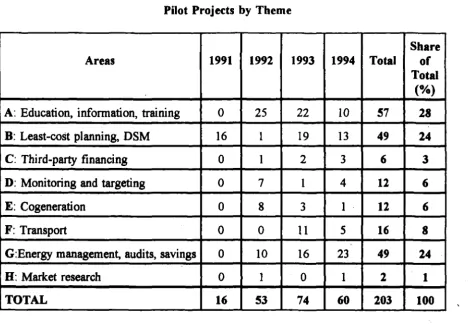
Table 1
Pilot Projects by Theme
Share
Areas
1991
1992
1993
1994
Total ofTotal (%)
A: Education, information, training 0 25 22 10
57
28
B: Least-cost planning, DSM 16 1 19 13
49
24
C: Third-party financing 0 1 2 3
6
3
D: Monitoring and targeting 0 7 1 4
12
6
E: Cogeneration 0 8 3 1
12
6
F: Transport 0 0 11 5
16
8G:Energy management, audits, savings 0 10 16 23
49
24
H: Market research 0 1 0 1
2
1
TOTAL
16
53
74
60
203
100
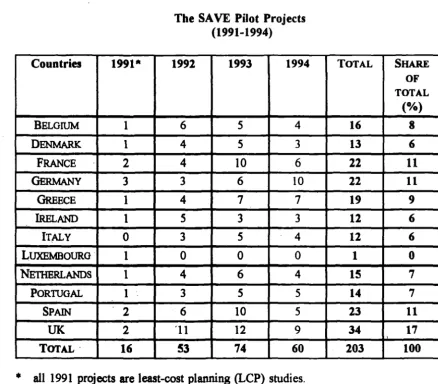
Clearly, it is important to establish that all Member States have participated and benefited from the SAVE programme. However, ~ince one of the original intentions of the Commission and SAVE is to improve the infrastructures of all Member States, but in particular those with less mature programmes, the distribution of projects and funding is important.
Countries
1991*
BELGIUM 1
DENMARK 1
FRANCE
2GERMANY 3
GREECE 1
IRELAND 1
ITALY 0
LUXEMBOURG 1
NETHERLANDS 1
POR1UGAL 1
SPAIN 2
UK
2TOTAL·
16
Table 2
The SAVE Pilot Projects
(1991-1994)
1992
1993
1994
6 5 4
4 5 3
4 10 6
3 6 10
4 7 7
5 3 3
3 5 4
0 0 0
4 6 4
3 5 5
6 10 5
'11 12 9
53
74
60
• all 1991 projects are least-cost planning (LCP) studies.
TOTAL
16
13
22
22
19
12
121
15
14
23
34
203
To date, SAVE has provided ECU 20.982 million to fund the pilot projects. Information Activities SHARE OF TOTAL (%) 8 6 11 l l
9
6 60
7
7
l l17
100
One of the major elements of the SAVE programme is to foster the creation of an information network. In view of the limited manpower resources available to the SAVE team within
00 XVII, it was decided to utilize EnR, an existing network of national energy agencies, to carry out the information programme.
[image:25.588.60.499.76.460.2]The strong links between the ENR members and the Member States at the programme level has been a very positive aspect; however, this has not removed the complaints from Member States of insufficient feed-back on projects that have Been initiated.
It has now been decided to incorporate infonnation on all SAVE activities into the CORDIS database and this activity should be completed by July 1995. This will ensure that detailed data on all SAVE projects will be available to the 14 000 subscribers currently connected to the database, Those interested in obtaining further infonnation on specific projects will find the name and address of the. project coordinator in the database and will be able to contact him directly with their queries.
Conclusion
The SAVE programme has contributed to the Union's strategic objectives by:
enacting energy efficiency legislation which will contribute to the Union's C02 reduction
strategy;
assisting Member States in establishing programmes aimed at building an "energy efficiency capacity" nationally, regionally and locally;
developing methodological tools which will assist energy efficiency professionals in setting up cost effective and efficient programmes;
assisting Member States to implement SAVE Directives;
setting up linkages between contractors on various energy efficiency "themes" with a view to creating synergy between individual projects;
promoting a Union-wide energy efficiency infonnation activity which has disseminated the SAVE "message" through publications, seminars, workshops and conferences. A SAVE conference was held in Florence in October 1994 which was attended by some 300 delegates who, in large measure, endorsed the conclusions above.
ANNEX D Evaluation of the action for energy programming
in the regions, towns and islands of the European Union (PERU) over the period 1989- 1993