This is a repository copy of
Unsupervised word segmentation from speech with attention
.
White Rose Research Online URL for this paper:
http://eprints.whiterose.ac.uk/150390/
Version: Published Version
Proceedings Paper:
Godard, P., Boito, M.Z., Ondel, L. et al. (4 more authors) (2018) Unsupervised word
segmentation from speech with attention. In: Proceedings of Interspeech 2018.
Interspeech 2018, 02-06 Sep 2018, Hyderabad, India. ISCA , pp. 2678-2682.
10.21437/Interspeech.2018-1308
© 2018 ISCA. Reproduced in accordance with the publisher's self-archiving policy.
[email protected]
https://eprints.whiterose.ac.uk/
Reuse
Items deposited in White Rose Research Online are protected by copyright, with all rights reserved unless
indicated otherwise. They may be downloaded and/or printed for private study, or other acts as permitted by
national copyright laws. The publisher or other rights holders may allow further reproduction and re-use of
the full text version. This is indicated by the licence information on the White Rose Research Online record
for the item.
Takedown
If you consider content in White Rose Research Online to be in breach of UK law, please notify us by
Unsupervised Word Segmentation from Speech with Attention
Pierre Godard
∗1, Marcely Zanon Boito
⋆1, Lucas Ondel
⋄, Alexandre Berard
⋆‡,
Franc¸ois Yvon
∗, Aline Villavicencio
†, Laurent Besacier
⋆∗
LIMSI, CNRS, Universit´e Paris-Saclay, Orsay, France
⋆
LIG, UGA, G-INP, CNRS, INRIA, Grenoble, France
⋄BUT, Brno, Czech Republic
†
CSEE, University of Essex, UK
‡CRISTAL, Universit´e de Lille, France
contact: [email protected], [email protected] (1) Both first authors have contributed equally to this paper
Abstract
We present a first attempt to perform attentional word segmen-tation directly from the speech signal, with the final goal to automatically identify lexical units in a low-resource, unwrit-ten language (UL). Our methodology assumes a pairing be-tween recordings in the UL with translations in a well-resourced language. It uses Acoustic Unit Discovery (AUD) to convert speech into a sequence of pseudo-phones that is segmented us-ing neural soft-alignments produced by a neural machine trans-lation model. Evaluation uses an actual Bantu UL, Mboshi; comparisons to monolingual and bilingual baselines illustrate the potential of attentional word segmentation for language doc-umentation.
Index Terms: computational language documentation, encoder-decoder models, attentional models, unsupervised word segmentation.
1. Introduction
Speech technology often relies on minimal linguistic expertise and textual information to build acoustic and language models. However, for many languages of the world, text transcripts are limited or nonexistent; therefore, recent efforts have been de-voted toZero Resource Settings[1, 2, 3] where the aim is to build speech systems without textual or linguistic resources for e.g.: (1) unwritten languages [4, 5]; (2) models that mimic child language development [6]; (3) documentation of endangered languages by analyzing speech recordings using automatically discovered linguistic units (phones, morphs, words, etc) [7].
This paper focuses on unsupervised word segmentation from speech: the system must output time-stamps delimiting stretches of speech, associated with class labels, corresponding to real words in the language. This task is already considered in the Zero Resource Speech Challenge1in a fully unsupervised
setting: systems must learn to segment from a collection of raw speech signals only. We investigate here a slightly more favor-able case where speech utterances are multilingually grounded: they are aligned, at the sentence level, to a written translation in another language. Such a condition is realistic in language documentation, where it is common to collect speech in the lan-guage of interest and have it translated or glossed in another language [8]. In this context, we want to examine whether we can take advantage of the weak form of supervision available
1http://zerospeech.com/2017
in these translations to help word segmentation from speech. Our hypothesis is that textual translations should help in seg-menting speech into words in the unwritten language, even in the absence of (manually obtained) phonetic labels. As a first contribution in this direction, we recently proposed to leverage attentional encoder-decoder approaches for unsupervised word segmentation [9]. However, this was done from an unsegmented sequence of (manually obtained) true phone symbols, not from speech. It was shown that the approach proposed can compete with a Bayesian Non Parametric (BNP) baseline [10] on a small corpus in Mboshi language (5k sentences only).
In this paper, ourcontributionis to develop an attentional encoder-decoder word segmentation from speech (§2) that op-erates in two steps: (a) automatic Acoustic Unit Discovery (AUD), based on Bayesian models, to generate time-marked pseudo-phone symbols from the speech; (b) encoder-decoder word segmentation using these pseudo-phones.2 Experiments with AUD outputs of increasing complexity (see§3) are psented for word boundary detection using the Mboshi corpus re-cently made available [13] (§4). Our best pipeline from speech has a word boundary F-measure of 50.0% while segmenting from true phone symbols leads to 61.0%.
2. Attentional Encoder-Decoder Approach
for Word Discovery
For word segmentation, given a parallel corpus pairing se-quences of pseudo-phone units in the unwritten language (UL) with sequences of words in the well-resourced language (WRL), we compute attention matrices as the result of training a standard Neural Machine Translation (NMT) system trans-lating from the WRL into the UL. Then, these soft-alignment matrices are post-processed to derive word boundaries.
2.1. Neural Architecture
The NMT architecture, equations (1)-(4), are inspired by [14]. A bidirectional encoder reads the input sequencex1, ..., xAand
produces a sequence of encoder statesh=h1, ..., hA∈R 2×n,
wherenis the chosen encoder cell size. At each time stept, the decoder uses its current statest−1and an attention mechanism
2End-to-end speech processing can be performed with an encoder-decoder architecture for speech translation (e.g. [11, 12]); early attempts to train end-to-end from speech to translated text, in our language doc-umentation scenario, were not viable due to limited data.
Interspeech 2018
to compute a probability distributionytover a target vocabulary
of size|V|. It then generates the symbolzthaving the highest
probability, stopping upon generating a special end-of-sentence token. The decoder updates its internal representationst, using
the ground-truth symbolwt, instead of the generated symbol
zt, since in our alignment setting the reference translations are
always available, even at test time. Our system is described by the following equations:
ct= attn(h, st−1) (1)
yt= output(st−1⊕E(wt−1)⊕ct) (2)
zt= arg maxyt (3)
st= LSTM(st−1, E(wt)⊕ct), (4)
where⊕is the concatenation operator. s0 is initialized with
the last state of the encoder (after a non-linear transformation), z0 = <BOS>(special token), andE ∈ R|V|×nis the target
embedding matrix. Theoutputfunction uses a maxout layer, followed by a linear projection toR|V|, as in [14].
The attention mechanism is defined as:
et,i=vTtanh (W1hi+W2st−1+b2) (5)
αt,i= softmax(et,i) (6)
ct= attn(h, st−1) = A
X
i=1
αt,ihi (7)
where v, W1, W2, andb2 are learned jointly with the other
model parameters. At each time step (t) a scoreet,iis computed
for each encoder statehi, using the current decoder statest−1.
These scores are then normalized using a softmaxfunction, thus giving a probability distribution over the input sequence
PA
i=1αt,i = 1and∀t, i,0 ≤ αt,i ≤ 1. The context vector
ctused by the decoder is a weighted sum of the encoder states.
This can be understood as a summary of the useful information in the input sequence for the generation of the next output sym-bolzt. Likewise, the weightsαt,ican be viewed as defining a
soft-alignment between the inputxiand outputzt.
2.2. Word Segmentations from Attention
The main aspects of our approach are detailed below.
Reverse Architecture: in NMT, the soft alignments probabilities are normalized for each target symbol t (i.e.
∀t,Piαi,t = 1, withiindexing the source symbols).
How-ever, there is no similar constraint for the source symbols, as discussed by [5]. Rather than enforcing additional constraints on the alignments, as in the latter reference, we propose to re-verse the architecture and to translate from WRL words into UL symbols, following [9]. This “reverse” architecture notably pre-vents the attention model from ignoring some UL symbols. As experiments with actual phone sequences have shown that the best results were obtained with this WRL-to-UL translation [9], we will use this reverse architecture throughout.
Alignment Smoothing:to deal with the length discrepancy between UL (pseudo-phones) and WRL (words), we imple-mented the alignment smoothing procedure proposed by [5]. It consists of first adding temperature to thesoftmaxfunction (we use T=10 for all experiments) used by the attention mechanism; and then post-processing the resulting soft-alignment probabil-ity matrices, averaging each score with the scores of the two neighboring words. Even if boosting many-to-one alignments should not hold in the case of the reverse architecture, we keep it for our experiments given the gains reported by [9], even in the reverse case.
Hard Segmentation Generation:once the soft-alignment matricesαare obtained for all utterances in the corpus, a word segmentation is inferred as follows. We first transform soft-alignments into hard-soft-alignments by aligning each UL symbol wtwith the wordxisuch that:i= arg maxi′αt,i′.The source
sequence is then segmented according to these hard-alignments: if two consecutive symbols are aligned with the same WRL word, they are considered to belong to the same UL word.
3. Acoustic Unit Discovery (AUD)
Our AUD systems are based on the Bayesian non-parametric Hidden Markov Model (HMM) of [15]. This model is topo-logically equivalent to a phone-loop where each acoustic unit is represented by a left-to-right HMM. To cope with the unknown number of units needed to properly describe the speech, the model assumes a potentially infinite number of symbols. How-ever, the prior over the weight of the acoustic units (a Dirich-let Process [16]) will act as a sparsity regularizer, leading to a model which explains the data with a relatively small unit set.
We implemented two variants of this original model. The first one, referred to asHMM, approximates the Dirichlet Pro-cess prior by a simpler symmetric Dirichlet prior, as pro-posed by [17]. This approximation, while retaining the spar-sity constraint, avoids the complication of dealing with the variational treatment of the stick breaking process in Bayesian non-parametric models. The second variant, denoted Struc-tured Variational AutoEncoder (SVAE) AUD, is based on the work of [18] and embeds the HMM model into a Variational Auto-Encoder (VAE) [19] where the posterior distribution of the HMM and the VAE parameters are trained jointly us-ing Stochastic Variational Bayes [20, 18]. To initialize the model, the prior distribution over the HMM parameters (mix-ture weights, means and covariance matrices) was set to the posterior distribution of the phone-loop trained in a supervised fashion (Baum-Welch training) on the TIMIT data set. This procedure can be seen as a cross-lingual knowledge transfer as the AUD training on the UL language is essentially adapting the English phone set distribution to the Mboshi corpus. Fi-nally, both models were trained using two features sets: the well-knownMFCC+∆+∆∆features and the Multilingual BottleNeck (MBN) features [21]. Note that the MBN features were not trained on any Mboshi data, and only use languages as listed in [21]).
4. Word Segmentation Experiments
4.1. Corpus, Baselines and Metric
We used the Mboshi5k corpus [13] in all our experiments.3 Mboshi (Bantu C25) is a typical Bantu language spoken in Congo-Brazzaville. It is one of the languages documented by the BULB (Breaking the Unwritten Language Barrier) project [7]. This speech dataset was collected following a real language documentation scenario, using Lig Aikuma,4 a mo-bile app specifically dedicated to fieldwork language documen-tation, which works both on Android powered smartphones and tablets [8]. The corpus is multilingual (5,130 Mboshi speech utterances aligned to French text) and contains linguists’ tran-scriptions in Mboshi in the form of a non-standard graphemic
3The dataset is documented in [13] and
avail-able at https://github.com/besacier/
mboshi-french-parallel-corpus
4http://lig-aikuma.imag.fr
Mboshi w´a´a ng´a iw´e l´eekund´a ng´a s´a oyo´a lend´uma saa m ´ot´ema
French si je meurs enterrez-moi dans la forˆet oyoa avec une guitare sur la poitrine
Figure 1:A tokenized and lowercased sentence pair example in our Mboshi-French corpus.
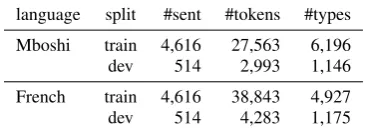
language split #sent #tokens #types
Mboshi train 4,616 27,563 6,196
dev 514 2,993 1,146
French train 4,616 38,843 4,927
[image:4.595.79.262.146.212.2]dev 514 4,283 1,175
Table 1:Corpus statistics for the Mboshi corpus
form close to the language phonology. Correct word segmen-tation of the Mboshi transcripts was also provided by the lin-guists and a forced-alignment between speech and transcripts was computed to obtain time-stamps-delimited word tokens for evaluation. The corpus is split in two parts (trainanddev) for which we give basic statistics in Table 1. We also include an example of a sentence pair from our corpus in Figure 1.
Our neural (attentional) word segmentation is compared with two baselines: a naive bilingual baseline (proportional) that segments the source according to the target as if the align-ment matrix between symbols (AUD symbols in Mboshi and graphemes in French) was diagonal;5 a monolingual baseline [10] which implements a Bayesian non-parametric approach, where (pseudo)-words are generated by a bigram model over a non-finite inventory, through the use of a Dirichlet process (ref-ered to asdpseg). We evaluate with theBoundarymetric from theZero Resource Challenge 2017[22, 3]. It measures the qual-ity of a word segmentation and the discovered boundaries with respect to a gold segmentation (P, R and F-score are computed).
4.2. Details of the NMT system
We use the LIG-CRIStAL NMT system.6 Our models are
trained using the Adam algorithm, with a learning rate of0.001
and a batch size (N) of32. We minimize the cross-entropy loss between the output probability distributionpt=sof tmax(yt)
and a reference translationwt. Our models use global
atten-tion and bidirecatten-tional layer in the encoder; encoder and decoder have 1 layer each, with a cell size of 64. Dropout is applied with a rate equal to 0.5. For NMT training, we split the 5,130 sentences into training and development, with about 10% of the corpus for the latter. However, the soft-alignment matrices are obtained from both train and dev sets after forced-decoding and segmentation is evaluated on all 5,130 utterances.
4.3. Results
Unsupervised word segmentation results obtained from speech with different AUD configurations as well as from true phones (upper-bound performance corresponding to atopline) are re-ported in Table 2, using theBoundarymetric. We trained 5 dif-ferent NMT models changing the train/dev split7and either (i)
5Blank spaces on the French side are then used to segment the Mboshi input.
6Seehttps://github.com/eske/seq2seq.
7The difference between best and worst configurations varied from 0.5% to 1.3% for AUD, and 1.6% for true phones.
averaging the scores over the 5 runs (columns att. (biling.)
in Table 2) or (ii) averaging the obtained soft-alignment ma-trices (columns att. average in Table 2). The latter slightly boosts boundary detection performance. For all AUD configu-rations, our method outperforms two baselines (dpsegand pro-portional), as well as a pure speech-based baseline using seg-mental DTW [23], which only achieves a F-score of 19.3 on our data. While competitive with true phones, the results of the monolingual method (dpseg) are heavily degraded on dis-covered (noisier) units, as also reported by [2]. Conversely, our method is much more robust to noise and seems better suited for real-world scenarios. While straightforward, the bilingual base-line (proportional) is rather strong compared to its monolingual counterpart (dpseg). This suggests that multilingual grounding provides a useful signal for word segmentation from speech.
Regarding AUD specifically, we observe that the best F-score for word boundary detection was obtained with MBN features and the SVAE model. The results of ourattentional
segmentation are the best results reported so far on this cor-pus. This confirms that we can effectively take advantage of the weak supervision available in the translations in order to help word segmentation from speech.
4.4. Discussion
The NMT system requires a sequence of unsegmented symbols (the phones) and their aligned sentence translations in order to provide segmentation. Therefore, the AUD method chosen to encode the speech input has an impact on the quality of the fi-nal segmentation. Our best word segmentation results (see Ta-ble 2) are obtained using the SVAE model (this holds for both Bayesian and neural segmentation approaches). One natural ex-planation would be to posit that phone boundaries (and conse-quently word boundaries) are more accurately detected by the SVAE model than the HMM model. [24] show that this is true in terms of precision for phone boundaries, and in term of nor-malized mutual information, but that the recall on these bound-aries is lower than its HMM counterpart. This indicates that the SVAE model extract more consistent pseudo-phone units, although it misses some boundaries, than the HMM model, and we confirm here the result of [24] showing that this is beneficial for the word segmentation task.
Another additional explanation might be that shorter se-quences of symbols are easier to segment. For instance, even if the attention helps the system to better deal with long sen-tences, it is still prone to performance degradation when faced with very long sequences of symbols [14]. Table 3 (left side) shows how the different AUD approaches are encoding the UL sentences. We observe that the HMM model uses more symbols to represent an utterance, while the SVAE model offers a more concise representation.
AUD feat.
AUD model
dpseg (monoling.)
proportional baseline (biling.)
[image:5.595.95.506.74.168.2] [image:5.595.324.527.223.350.2]attentional (biling.)*
att. average (biling.)+
P R F P R F P R F P R F
MFCC HMM 27.9 80.2 41.3 42.6 49.9 46.0 51.6 44.9 48.0 55.5 43.7 48.9
MFCC SVAE 29.8 69.1 41.7 42.2 51.9 46.6 52.7 45.0 48.5 55.7 44.1 49.2
MBN HMM 27.8 72.6 40.2 42.5 48.1 45.2 50.8 44.5 47.4 54.1 42.9 47.8
MBN SVAE 30.0 72.9 42.5 42.5 51.6 46.6 57.2 43.0 49.1 60.6 42.5 50.0
true phones 53.8 83.5 65.4 44.5 62.6 52.0 60.5 59.9 60.3 62.8 59.3 61.0
Table 2:Precision, Recall and F-measure on word boundaries over the Mboshi5k corpus, using different AUD to extract pseudo-phones from speech. True phones toplines are also provided. *averaged scores over 5 different runs; +averaged 5 attention matrices
Phones per Sentence
Tokens per Sentence
avg max min avg max min
true phones 21.8 60 4 6.0 21 1
MFCC HMM 37.0 95 11 3.6 22 1
MFCC SVAE 26.3 73 7 7.6 26 1
MBN HMM 32.1 93 12 5.0 14 1
MBN SVAE 23.4 71 7 5.4 21 1 Table 3: AUD methods differ in their ability to encode speech utterances (left side); which impacts the final segmentation of the attentional model (right side).
is another clue as to why the MBN SVAE is performing best on our task.
Analyzing the averaged attention model’s results in Table 2, we can see an increase in performance of about 0.8% in all cases. This improvement also holds for tokens and types scores (not reported here). However, while thetoplineachieves 34.3% of vocabulary (types) retrieval, our best AUD setup achieves 13.5% only. This illustrates the difficulty of the word discovery task – a task already challenging with true phones – in noisy setups. The large difference between true phones and pseudo-phones for type’s retrieval could be explained by the fact that a single change in the pseudo-phone sequence representing two speech segments of a same word will have the consequence to split the word cluster in two parts (in two types). A deeper analysis of the word clusters obtained is probably necessary to better understand how AUD from speech affects the word dis-covery task, and to come up with ways to better cluster speech segments in relevant types.
The attention-based segmentation technique remains much more robust for word boundary detection than our monolingual (Bayesian) approach. Figure 2 shows an example of a (good quality) soft alignment (attention) matrix produced in our best setup (MBN SVAE).
5. Related Work
Word segmentation in a monolingual setup was previously in-vestigated from text input [10] and from speech [23, 25, 26, 27]. Word discovery experiments from text input on Mboshi were reported in [28]. Bilingual setups (cross-lingual supervision) for word segmentation were discussed by [29, 30, 31, 9], but applied to speech transcripts (true phones). Looking at NMT from speech, the research by [11, 12] are recent examples of approaches to end-to-end spoken language translation, but
us-Figure 2:NMT output alignment for true phones (top) and AUD using MBN SVAE (bottom). For illustration purposes, we give the transcription of the audio in Mboshi.
ing much larger data conditions than ours.
Among the most relevant to our approach are the works of [5] on speech-to-translation alignment using attentional NMT and of [32] for language documentation. However, the former does not address word segmentation and is not applied to a lan-guage documentation scenario, while the latter does not provide a full coverage of the speech corpus analyzed.
6. Conclusions
Different from these related works and inspired by [9], this pa-per presented word segmentation from speech, in a bilingual setup and for a real language documentation scenario (Mboshi). The proposed approach first performs AUD to generate pseudo-phones from speech, and then uses these units in an encoder-decoder NMT for word segmentation. Our method leads to promising results for word segmentation from speech, outper-forming three baselines in noisy (pseudo-phones) setups and fi-nally delivering the best results reported so far for the Mboshi5k corpus. Future work includes investigating sources of weak su-pervision and minimal viable corpus sizes.
7. Acknowledgements
This work was partly funded by French ANR and German DFG under grant ANR-14-CE35-0002 (BULB project). This work was started at JSALT 2017 in CMU, Pittsburgh, and was sup-ported by JHU and CMU (via grants from Google, Microsoft, Amazon, Facebook, Apple). It used the Extreme Science and Engineering Discovery Environment (NSF grant number OCI-1053575 and NSF award number ACI-1445606).
8. References
[1] J. Glass, “Towards unsupervised speech processing,” in Proc.
IEEE-ISSPA, 2012, pp. 1–4.
[2] A. Jansen, E. Dupoux, S. Goldwater, M. Johnson, S. Khudan-pur, K. Church, N. Feldman, H. Hermansky, F. Metze, R. Rose, M. Seltzer, P. Clark, I. McGraw, B. Varadarajan, E. Bennett, B. Borschinger, J. Chiu, E. Dunbar, A. Fourtassi, D. Harwath, C.-y. Lee, K. Levin, A. Norouzian, V. Peddinti, R. Richardson, T. Schatz, and S. Thomas, “A summary of the 2012 JH CLSP Workshop on zero resource speech technologies and models of early language acquisition,” inProc. ICASSP, 2013.
[3] E. Dunbar, X. Nga-Cao, J. Benjumea, J. Karadayi, M. Bernard, L. Besacier, X. Anguera, and E. Dupoux, “The zero resource speech challenge 2017,” inProc. Automatic Speech Recognition
and Understanding (IEEE ASRU), 2017.
[4] L. Besacier, B. Zhou, and Y. Gao, “Towards speech translation of non-written languages,” inSpoken Language Technology
Work-shop, 2006. IEEE, 2006, pp. 222–225.
[5] L. Duong, A. Anastasopoulos, D. Chiang, S. Bird, and T. Cohn, “An attentional model for speech translation without transcrip-tion,” inProc. NAACL-HLT, San Diego, CA, 2016, pp. 949–959.
[6] E. Dupoux, “Cognitive science in the era of artificial intelligence: A roadmap for reverse-engineering the infant language-learner,”
Cognition, vol. 173, pp. 43–59, 2018.
[7] G. Adda, S. St¨uker, M. Adda-Decker, O. Ambouroue, L. Be-sacier, D. Blachon, H. Bonneau-Maynard, P. Godard, F. Ham-laoui, D. Idiatov, G.-N. Kouarata, L. Lamel, E.-M. Makasso, A. Rialland, M. V. de Velde, F. Yvon, and S. Zerbian, “Break-ing the unwritten language barrier: The BULB project,”Procedia
Computer Science, vol. 81, pp. 8–14, 2016.
[8] D. Blachon, E. Gauthier, L. Besacier, G.-N. Kouarata, M. Adda-Decker, and A. Rialland, “Parallel speech collection for under-resourced language studies using the LIG-Aikuma mobile device app,”Procedia Computer Science, vol. 81, pp. 61–66, 2016.
[9] M. Zanon Boito, A. Berard, A. Villavicencio, and L. Besacier, “Unwritten languages demand attention too! Word discovery with encoder-decoder models,” inProc. Automatic Speech Recognition
and Understanding (IEEE ASRU), 2017.
[10] S. Goldwater, T. L. Griffiths, and M. Johnson, “A Bayesian frame-work for word segmentation: Exploring the effects of context,”
Cognition, vol. 112, no. 1, pp. 21–54, 2009.
[11] A. B´erard, O. Pietquin, C. Servan, and L. Besacier, “Listen and translate: A proof of concept for end-to-end speech-to-text trans-lation,” inNIPS workshop on End-to-end Learning for Speech and
Audio Processing, 2016.
[12] R. J. Weiss, J. Chorowski, N. Jaitly, Y. Wu, and Z. Chen, “Sequence-to-sequence models can directly transcribe foreign speech,”arXiv preprint arXiv:1703.08581, 2017.
[13] P. Godard, G. Adda, M. Adda-Decker, J. Benjumea, L. Besacier, J. Cooper-Leavitt, G. Kouarata, L. Lamel, H. Maynard, M. M¨uller, A. Rialland, S. St¨uker, F. Yvon, and M. Z. Boito, “A Very Low Resource Language Speech Corpus for Computational Language Documentation Experiments,” inProc. LREC, Miyazaki, Japan, 2018.
[14] D. Bahdanau, K. Cho, and Y. Bengio, “Neural machine transla-tion by jointly learning to align and translate,” inProc. ICLR, San Diego, CA, 2015.
[15] L. Ondel, L. Burget, and J. ˇCernock`y, “Variational inference for acoustic unit discovery,”Procedia Computer Science, vol. 81, pp. 80–86, 2016.
[16] Y. W. Teh and M. I. Jordan, “Hierarchical Bayesian nonparametric models with applications,” inBayesian Nonparametrics:
Princi-ples and Practice, N. Hjort, C. Holmes, P. M¨uller, and S. Walker,
Eds. Cambridge University Press, 2010.
[17] K. Kurihara, M. Welling, and Y. W. Teh, “Collapsed variational Dirichlet process mixture models,” inProc. IJCAI. Morgan Kauf-mann Publishers, 2007, pp. 2796–2801.
[18] M. Johnson, “Composing graphical models with neural networks for structured representations and fast inference,” inAdvances in
Neural Information Processing Systems, D. D. Lee, M. Sugiyama,
U. V. Luxburg, I. Guyon, and R. Garnett, Eds. Curran Associates, Inc., 2016, pp. 2946–2954.
[19] D. Kingma and M. Welling, “Auto-encoding variational Bayes,”
inProc. ICLR, Banff, Australia, 2014.
[20] M. Hoffman, “Stochastic variational inference,”Journal of
Ma-chine Learning Research, vol. 14, pp. 1303–1347, 2013.
[21] F. Gr´ezl and M. Karafi´at, “Adapting multilingual neural network hierarchy to a new language,” inProc. SLTU, 2014, pp. 39–45.
[22] B. Ludusan, M. Versteegh, A. Jansen, G. Gravier, X.-N. Cao, M. Johnson, and E. Dupoux, “Bridging the gap between speech technology and natural language processing: an evaluation tool-box for term discovery systems,” inProc. LREC, 2014.
[23] A. Jansen and B. Van Durme, “Efficient spoken term discovery using randomized algorithms,” inProc. Automatic Speech
Recog-nition and Understanding (IEEE ASRU), 2011, pp. 401–406.
[24] L. Ondel, P. Godard, L. Besacier, E. Larsen, M. Hasegawa-Johnson, O. Scharenborg, E. Dupoux, L. Burget, F. Yvon, and S. Khudanpur, “Bayesian Models for Unit Discovery on a Very Low Resource Language,” inProc. ICASSP, Calgary, Alberta, Canada, 2018.
[25] C.-y. Lee, T. J. O’Donnell, and J. Glass, “Unsupervised lexicon discovery from acoustic input,”Transactions of the Association
for Computational Linguistics, vol. 3, pp. 389–403, 2015.
[26] C. Bartels, W. Wang, V. Mitra, C. Richey, A. Kathol, D. Vergyri, H. Bratt, and C. Hung, “Toward human-assisted lexical unit dis-covery without text resources,” inSpoken Language Technology
Workshop (IEEE SLT), 2016, pp. 64–70.
[27] M. Elsner, S. Goldwater, N. Feldman, and F. Wood, “A joint learn-ing model of word segmentation, lexical acquisition, and phonetic variability,” inProc. EMNLP. Association for Computational Linguistics, 2013, pp. 42–54.
[28] P. Godard, G. Adda, M. Adda-Decker, A. Allauzen, L. Besacier, H. Bonneau-Maynard, G.-N. Kouarata, K. L¨oser, A. Rialland, and F. Yvon, “Preliminary experiments on unsupervised word discov-ery in mboshi,” inProc. Interspeech, 2016.
[29] S. St¨uker, “Towards human translations guided language discov-ery for ASR systems,” inProc. SLTU, Hanoi, Vietnam, May 2008.
[30] S. St¨uker, L. Besacier, and A. Waibel, “Human Translations Guided Language Discovery for ASR Systems,” inProc.
Inter-speech. Brighton (UK): Eurasip, 2009, pp. 1–4.
[31] F. Stahlberg, T. Schlippe, S. Vogel, and T. Schultz, “Word seg-mentation through cross-lingual word-to-phoneme alignment.” in
Spoken Language Technology Workshop (IEEE SLT), 2012, pp.
85–90.
[32] A. Anastasopoulos, S. Bansal, D. Chiang, S. Goldwater, and A. Lopez, “Spoken term discovery for language documentation using translations,” inProc. Workshop on Speech-Centric Natural