COMMISSION OF THE EUROPEAN COMMUNITIES
Bmssels, 26. 06. 1996
COM(96) 286 final
REPORT FROM THE COMMISSION
SUMMARY
The present report, which relates to the application of Directive 83/189/EEC in 1 992, 1993 and 1994, provides background information for the European Parliament as provided by Article 11.2 of Directive 83/189/EEC, amended by Directive 88/182/EEC.
Directive 83/189/EEC, which was aimed at preventing the appearance of barriers to the operation of the Internal Market, proved to be a basic instrument for the realization of the Internal Market through the promotion of co-operation between the Member States and through the detection of fields in which joint action was revealed to be necessary.
The report upon the operation of this instrument in 1992, 1993 and 1994 is divided into three chapters:
1. The information procedun~ for standards :
This chapter relates to the information procedure for standards, as provided by Articles 2 to 7 of Directive 831189/EEC. After a brief description of the procedure, its operation during the years from 1992 to 1994 is explained, together with an analysis of the statistics. The report also discusses the quality of the notifications, the use of the information at various levels and the issue of authorizations to the European standards institutes, namely the European Committee for Standardization (CEN), the European Committee for Electro-technical Standardization (CENELEC), and the European Institute for Telecommunications Standardization (ETSI). The short and medium-term improvement connected with the revised procedure is also analyzed.
2. Information procedure in the field of technical regulations :
This chapter outlines the development of the procedure provided by Directive 83/189/EEC in the field of national technical regulations. It examines the flow of exchanged information, particularly problems of application and the various reactions by the Commission and the Member States, in addition to the various responses to the procedure.
3. The exchange of information on technical regulations between -the EEC and the EFT A countries.
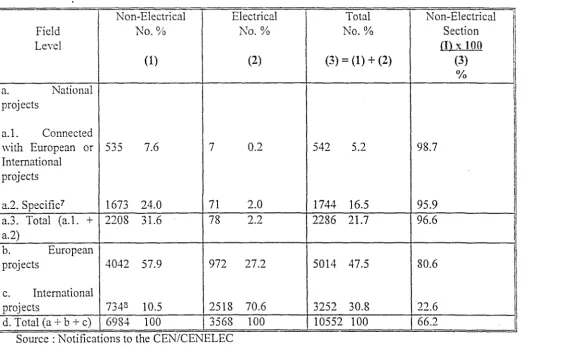
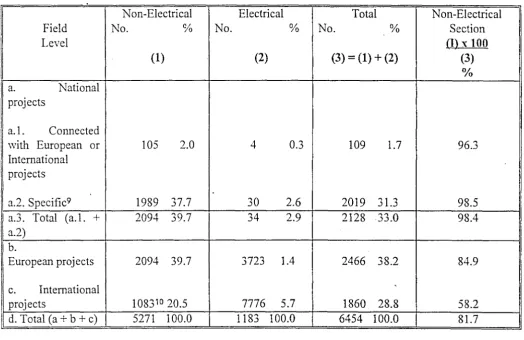
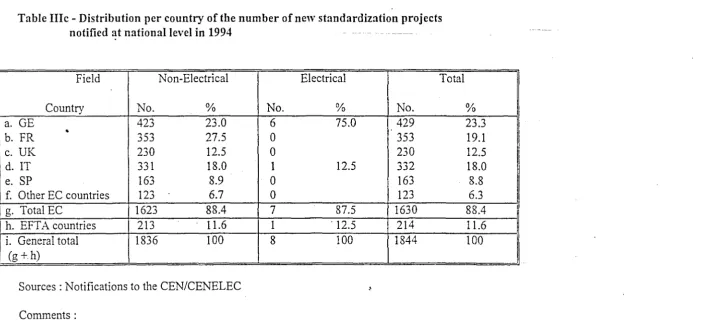
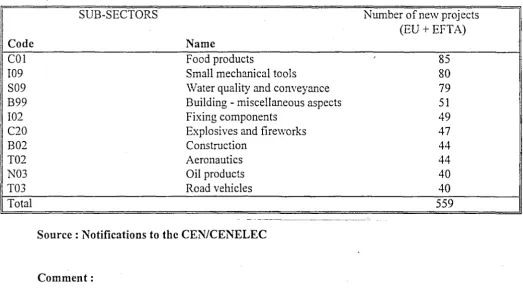
This chapter analyzes the exchange of information provided by the Agreement between the Member States of EFT A and the European Economic Community, which set up a procedure for the exchange of information in the field of technical regulations (Council Decision 90/518/EEC), an Agreement which was concluded for a period of two years. This Agreement expired on 1st November 1992. It was extended for the period from November 1992 to December 1993 by bilateral agreements in the form of an exchange of letters.
In 1994, the EEA Agreement came into force. This Agreement contains the provisions of Directive 83/189/EEC, adapted in Section XIX of Annex II.
As far as the Swiss Confederation is concerned, although not part of the EEA Agreement it continues to take part in exchanges of information with the Community.
REPORT BY THE COMMISSION ON THE OPERATION OF DIH.ECTIVE 83/189/EEC
IN 1992, 1993 AND 1994
Introduction
1. This report on the operation of Directive 83/189/EEC in 1992, 1993 and 1994 contains the information for Parliament called for by Article 11(2) of Directive 83/189/EEC, as amended by Directive 881182/EEC.
2. The free movement of goods is a cornerstone of the Internal Market and the elimination of technical barriers to trade is a m<tior condition for its proper operation. Only transparency can enable barriers to the free movement of goods to be dealt with swiftly. A notable example of an instrument which enables the Community to avoid -after the realization of the Internal Market per 1.1.1993 and the coming into force of the European Economic Area - the introduction of new barriers by means of a procedure which ensures transparency, is Directive 83/189/EEC which requires the notification of technical legislation or standards which could have implications for the free movement of goods.
3. A proposal to amend the. Directive in order to fill gaps in its coverage was put before the Council and the European Parliament at the end of 1992, which has been adopted unanimously afte lone~ and intensive debates on 23rcl March 1994 (Directive 94/1 0/EC amending for a second time Directive 83/189/EEC). It will enter into force on 1st July 1995.
4. This report on the operation of this mechanism in 1992, 1993 and 1994 is divided into the following chapters :
the information procedure for standards (Chapter I);
the information procedure in the field ofteclmical regulations (Chapter II);
the Agreement on the exchange of information in the field of technical regulations between the EEC and the EFT A countries (Chapter III).
CHAPTER 1
THE INFORMATION I.)ROCEDURE FORST ANDARDS
Introduction
5. The present chapter relates to the information procedure for standards as provided by Articles 2 to 7 of Directive 83/189/EEC. After a brief description of the procedure, its operation during the years from 1992 to 1994 is explained, together with an analysis of the statistics. The report also discusses the quality of the notifications, the usc of information at various levels and the issue of authorizations to the European standards institutes, namely the European Committee for Standardization (CEN), the European Committee for Electro-technical Standardization (CENELEC), and the European Institute for Telecommunications Standardization (ETSI). This Chapter ends with an analysis of the short and medium-term improvement connected with the revised procedure.
A Brief Description of the Procedure
6. In practice, the information procedure for standards began on 1st January 1985. Since then the national standards institutes, members of the CEN and of the CENELEC (including those of the EFTA countries) have notified the necessary information to the Central Unit of the CEN/CENELEC (a unit which is responsible to the Central Secretariats of the CEN and the CENELEC). The notifications relate to amendments made to the national standardization programmes, namely :
new projects undertaken (cf. Article 2 ofthe Directive), projects for public screening (cf. Article 4 of the Directive), the adoption of national standards (
ct:
Article 2 of the Directive).The information gathered is sent periodically to all the members of the CEN and the CENELEC, who arc responsible for distributing them to the sectors conccmcd in order to gain reactions. The information is also examined by the competent authorities within the CEN and the CENELEC (Central Secretariats, Planning Committees, etc) as well as by the Commission departments.
Following the Commission's proposal of 28th November 19921 regarding the amendment of Directive 83/189/EEC, aimed at making the infom1ation procedure more efficient, the CEN and the CENELEC have, since the beginning of 1993, already introduced some of the measures set out in this proposal. As a result, notifications made since 1st January 1993 have been limited to new projects undertaken on a national level.
O.J.E.C. C 340 of23.12.1992
Appropriat<.: annual contracts were concluded between the European Commission and the CEN and CENELEC in order to cover the technical operation of the information procedure for standards.
7. It being given that the European Institute for Telecommunications Standardization (ETSI) was included in the Annex to Directive 831189/EEC, though a Decision by the Commission of I 5th July I 9922, this institute should automatically take part in the information procedure for standards. In practice, this participation is limited to receiving and examining information sent by the members of the CEN and CENELEC, which is forwarded by the Central Secretariats of these two institutes. In fact, the ETSI is not comprised of national standards institutes, under the terms of the definition in Article I of Directive 83/I 89/EEC.
Information relating to drawing up technical specifications in the field of telecommunications on a national level is conveyed, in principle, either via the information procedure in the field of technical regulations in the case of legislation, or via the members of the CEN and the CENELEC with regard to the voluntary sector. Despite the fact that there is no procedure within the ETSI for notifying new national standardization projects, it can be assumed that these projects should be limited, since the ETSI programmes cover a wide range of subjects, and the internal standstill rule applies to each one of them.
The present chapter of the report is therefore solely concerned -. ;ith operations notified by the members ofthe CEN and the CENELEC, these institute:· heing indexed in f.ist 2 ofthe Annex to Directive S3/189/EEC.
The opcnlHon ofthc information procedm·c in 1992, 1993 :mu 199-1
8. In 1992, the method of operating the information procedure for standards remained unchanged in comparison with preceding years. It is a matter of collecting and examining the notifications received, processing them, storing them in a databank and distributing the results on a monthly basis. The information procedure has also been· supplemented this year by entering new initiatives taken on a Europc.:;m and international level.
9. Beginning from January 1993, the CEN introduced the simplified procedure laid down in the Commission's proposal for amending Directive 8311 89/EEC. Notifications were limited in principle to new n:1tional initiati~es at the time they entered the working programme. Notifications of these initiative~; entering the public screening stage in addition to the stage of adoptiou have thus been discarded. Despite a relatively difficult transition period during the first months of 1993, this simplification has enabled the CEN Central Secretariat to control the flow of information more effectively and to examine certain notifications in more detail, with
2 O.J.E.C. L 221 of 6th i\ugust 1992
regard both to their presentation and their content. Since 1993, this simplification has also made it possible to obtain full and realistic statistics relating to the new national initiatives launched.
The exchange of draft standards for public screening has been carried out since the beginning of I 993, case by case, by mutual agreement between the institutes concerned and with a view to the participation specified in Article 3 of Directive 83/189/EEC.
10. As for the CENELEC, it has strengthened its internal procedure, known as the "Vilamoura" procedure, by allowing it to conform with the information procedure provided by Directive 83/189/EEC. In effect, the "Vilamoura" procedure requires each member of the CENELEC to notify, as soon as possible, even in the early stages, every wish for and/or intention of a standardization initiative. A reaction emanating from any one of the other members, within a period of three months, is sufficient to activate a standstill period. This can only be lifted by the highest technical authority within the CENELEC, namely the Technical Board. It is only in circumstances where this authority ascertains that it is not appropriate to work on a European level that it authorizes the development of the notified initiative upon a national level and this then becomes a national initiative under the terms of Directive 83/189/EEC. Notifications relating to these initiatives arc then distributed every quarter to the larger circle of participants named in Directive 83/1 89/EEC.
11. The statistics given by the CEN and the CENELEC in their annual report supply an overall view of the standardization initiatives which were notified to the Central Unit in the years from 1992 to 1994.
Amongst these statistics, those which relate to new projects3 reflect the most recent trends in standardization initiatives. These latter statistics can be examined from three complementary angles :
a breakdown by level (national, European or international), as well as the trends in the initiatives at each level;
a breakdown by country;
a breakdown by sector and sub-sector of activity.
12. As indicated in previous reports, the statistics must be interpreted with some caution for the following reasons :
the statistics for 1992 and previous years do not take into account the relatively high number of new initiatives which were directly notified at the public screening stage, without prior notification, which was contrary to the 3 "New project" is understood to mean any new standardization initiative which is entered into the
regulations stipulated in the past by the CEN/CENELEC;
a new initiative launched upon a European level may cover a much wider field than an initiative upon a national level;
the stage at which a new standardization project is notified is not the same for all the members of the CEN and the CENELEC, as a result of different working methods.
With the change in the system since 1993, it is no longer easy to make a simple comparison between the number of national notifications received in 1993 and the number of these notifications received in previous years.
Trends in standardization initiatives
13. Taking these reservations into account, a certain number of observations upon the trends in European and national standardization can be made on the basis of Tables I, II, III and IV which arc appended to this report.
a. The total level of new projects launched stabilized in 1992 after four years of rapid growth. The number then fell considerably in 1993, principally as a result of the significant reduction in new European initiatives and, to a lesser extent, international initiatives.
b. On the national level, the number of new initiatives in 1992 and 1993 was maintained at the stable level of previous years, being on average 2150 units. In 1994, this number fell to 1630, following the implementation, after the period of transition in 1993, of the simplified system introduced by Directive 94/1 0/EC. The proportion of very specific projects within this number increased, however, from 76% in 1992 to approximately 93% in 1994.
c. The number of new initiatives upon a European level fell sharply in 1992 in comparison with the two previous years, both in the electrical sector and in the non-electrical sector. This reduction was principally due to the new standardization policy by the European institutes of concentrating upon feasible programmes, after several years of problems resulting from the sudden increase in the number of new subjects in the working programme.
d. Upon an international level, a negative trend was also observed in 1993 after continuing growth in 1992.
the countries. In 1992, approximately one third of new national standardization initiatives in the Union came from Spain, with approximately another third from france. In 1993 and 1994, Germany and france alone produced approximately 20% of the notifications. The significant increase in notifications from the EfT A countries in 1993, principally from Austria, should also be noted.
f. The ten principal sub-sectors for national initiatives in the years 1992 to 1994 arc given in Table IV. A high level of initiatives in 1992 can be noted in the field of aerospace, building and chemical products. In 1993 and 1994, national initiatives arc in the main observed in the field of food products, the quality of water conveyance and, once again, building. A high level of national activity should also be noted in the field of rail construction in 1993 and in the small mechanized tools sector in 1994.
The quality of the notifications issued by national standards institutes
14. The previous report of 1990/1991 indicated that, for the period under consideration, there were still problems both with regard to compliance with the notification periods and the intrinsic quality of notifications. In this report, the Commission had insisted upon additional efforts being made on a national and European level with a view to remedying this unsatisfhctory situation. This was to be achieved by a critical examination of the information system upon a national level and by the implementation of a quality assurance system by the Central Secretariat.
15. Beginning from 1992, the Commission introduced two clauses relating to the quality of information into its annual contracts with the CEN and the CENELEC.
Firstly, the European institute concerned undertook to define clearly the internal rules necessary in order to ensure that notifications were accurate, clear and reliable. Secondly, the European institute had to provide, within its Central Secretariat, the necessary resources for monitoring the quality of the received notifications. ·
16. In April 1992, the CEN/CENELEC Work Group, namely the JWG-ESD (Joint Work Group - European Standards Databank), adopted certain basic principles relating to the new system of notification. In addition, in 1993 the CEN Central Secretariat initiated the production of a detailed guide to the system. In September 1993, the CENELEC, for its part, updated its manual relating to the 11
Vilamoura" system.
17. With regard to the quality of the notifications received, the CEN Central Secretariat, in spite of the difficult transition period in 1993, had already initiated during this
period a systematic examination, the detailed results of which were set out in its 1993 report. Amongst the most important conclusions, which were confirmed by the CEN's 1994 report, the following points should be mentioned :
a. With regard to respect for the notification obligation, sampling tests have shown that members have not avoided this obligation.
b. Early notification by members seems to be a significant problem. As it stands, in 1993 approximately 28% of national initiatives (namely 674 cases) were notified only when they had already reached the public screening stage ( 641 cases) or even the publication stage (33 cases). An analysis between countries showed that approximately half of the German and British initiatives were only notified at the public screening stage. , Moreover, amongst the 641 late notifications which were already at the public screening stage, it was possible to observe that approximately 33% did not allow time for any reaction, as a result of the fact that they were only sent one or two weeks, or even a few days, before the date of closure of the public screening period. This seemed to be the case in particular with regard to late notifications from the United Kingdom; late notifications from Germany still allowed time for reaction within the public screening period. A detailed analysis of 417 late notifications in 1994 (being 23% of all national initiatives) revealed a similar situation.
c. As indicated by the CEN in its report, these cases of late notification, which arc aggravated by being sent at the end of the public screening period, arc in complete contradiction with the principles of the information procedure provided by the Directive. In spite of the fact that the analysis also showed that during the years 1993 and 1994 the proportion of these late notifications had fallen, this proportion must be considered to be too high. Measures arc therefore necessary in this connection. Moreover, this problem was raised in the previous report in which this proportion was estimated to he approximately one third for the years 1990 and 1991.
d. Another problem lies in the vague description given of the new projects. The CEN Central Secretariat observed that, in several cases, either the notified title of the new project was very vague, or the statement explaining the title was simply a precise copy of the title. It is obvious that in these circumstances, an assessment of the field of application of the notified initiative is made very difficult and that, once again, the objective of the information procedure cannot he attained. The CEN considers that this problem can be solved by the introduction of the detailed guide already mentioned above.
notifications is due to the complete absence or the erroneous nature of certain basic information, such as the sub-sector code, the stage of the draft and even its identification number. Despite the fact that greater discipline was introduced in 1994 by the CEN Central Secretariat, this kind of problem seems to have persisted during this year.
18. With regard to the CENELEC, a detailed analysis similar to that carried out by the CEN is not available for 1993. However, taking into account the existence of the internal "Vilamoura" procedure, which contains relatively strict rules of notification, and the lower volumes involved, it can be considered that the quality of the notifications made by members of the CENELEC is satisfactory. This should certainly be the case from January 1993, as confirmed by the CENELEC Central Secretariat in its 1994 report. Moreover, this Secretariat drew up, in April 1994, a detailed description of the procedure in order to ensure the quality of the information.
The usc of the information received through the procedure
19. With regard to distribution on a national level of the infonnation resulting from the procedure, the Commission has not received recent information from the CEN or the CENELEC. An analysis upon this level would seem to be useful now that the notification system has been simplified since the beginning of 1993 and, as a consequence, the reduced volumes should enable the information to be processed by the sectors which arc directly concerned.
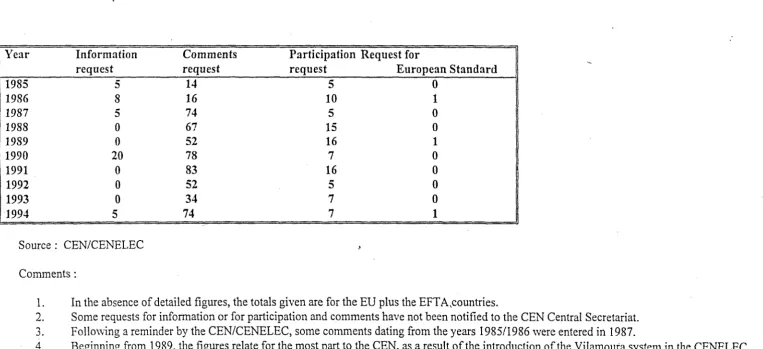
20. The application of Article 3 of the Directive, namely the association with national initiatives and requests for the development of European standards, still remains peripheral. Table V confinns the observations made in previous reports, and in particular the fact that within the context of the Directive :
' - despite the twofold increase in 1994 in comparison with 1993, the number of comments made by the standards institutes remains very low in comparison with the number of notifications received;
requests for participation within the projects of other members remain equally minimal;
requests for the development of European standards arc, with the exception of a single isolated case submitted by France in 1994, non-existent.
It can thus once again be concluded from these statistics that the mechanisms provided by Article 3 of the Directive arc not being used.
21. In the electro-technics sector, it is nevertheless necessary to take into account the application of the "Vilamoura" procedure, as explained in Paragraph I 0 above. As it stands, this procedure provides, for each new initiative launched by a member, at least the same type of participation as that provided by Article 3 of Directive 83/189/EEC. In 1994, this procedure enabled 17 and 4 operations, notified over several years, to be respectively transferred to the European and international level.
22. Monitoring of the application of the standstill rule provided by Article 7 of Directive 8311 89/EEC has been carried out on two levels, these being the CEN/CENELEC and the Commission.
Within the CEN Central Secretariat, notifications have formed the subject of a · periodic examination by technical experts. In 1993 and 1994 respectively, 30 and 60 cases were examined in detail by the relevant member of the CEN.
Since the beginning of 1993, the Commission departments have also intensified their examination of the notifications received, both in order to monitor the standstill rule in comparison with the authorizations sent to the European standards institutes, and in order to examine whether it would be appropriate to transfer the notified initiative to the European level. Approximately 30 and 76 cases were respectively returned to the CEN Central Secretariat in 1993 and 1994.
It can be observed that in the majority of cases detected by the CEN and the Commission departments, responses made by the notifying members seemed to be equivocal, to say the least. These responses either indicated that the national initiative notified was in fact a draft European standard for public screening upon a national level, or that it concemed a preliminary analysis on a national level, which was designed as a contribution to European projects currently in progress.
It can be observed that, in the first case, there is no obligation to notify and even that notification on this subject is excluded under Directive 83/189/EEC. In these circumstances, there arc definitely other methods of consulting the sectors concerned on a national level with regard to initiatives which arc in progress upon a European level, for example by distributing documents from the technical committees of the CEN. In the second case, it must be possible to indicate clearly, from the outset, the planned initiative's envisaged objective.
In future, a systematic monitoring of the application of the standstill rules is thus necessary, in addition to a detailed examination of responses made by notifying members.
23. In closing this paragraph relating to the usc made of the information received, the following points of view may be put forward :
a. According to the CEN, 1993 should be considered to be a year of transition, following the introduction of the new procedure, which encountered some difficulties. This institute considers that the experience gained this year docs not yet enable definite conclusions to be drawn, but it has expressed some optimism for the future, as a result of the simplifications which have been introduced.
b. As far as the Commission is concerned, additional conditions must be fulfilled in order to ensure a more efficient usc of the information received. In the first place this relates to a considerable improvement in the information notified and the establishment of other organizational measures as stipulated in the amended Directive 94/1 0/EC.
Information on standardization initiatives in general
24. Information relating to new standardization initiatives, as provided by the information procedure in the field of standards by Directive 83/189/EEC, is only a limited part of the information on standardization initiatives. There is the general problem relating to infom1ation on adopted national standards and on all the standardization initiatives, whether in progress or adopted, on the European and international levels.
As indicated in its second Communication4 , the Commission considers it to be necessary to have, on all standardization initiatives, information tools which are accessible to all the sectors concerned, at reasonable terms.
Accessibility and transparency regarding standardization initiatives should be one of the basic characteristics of the standardization system. Continuous effort should be made on a national and European level with a view to satisfying the information requirements of all the interested parties. A judicial review of the satisfaction of these requirements would appear to be useful.
25. Upon the European level, the CEN, the CENELEC and the ETSI have issued several publications explaining their present initiatives and their adopted standards and listing transpositions at national level. In addition, in 1993 the CENELEC established a
database which included all its initiatives. This database can at present be directly accessed by the Central Secretariat personnel, certain members of the CENELEC, the Commission departments and the EFTA Secretariat. It is anticipated that in future this database will be open to the general public. For its part, the CEN has also planned the establishment of a similar database, which will firstly be made accessible to its direct contacts. This project is at present under research by the CEN Central Secretariat.
4 COM (92) 491 of27th November !992
Actions to impr·ove the present system and implement the revised procedure provided by the amended Directive 94/10/EC.
28. The previous report of 1990/1991 had emphasized the importance of revising the technical operation of the information procedure for standards provided by Directive 83/189/EEC. With this in mind, the Commission proposed an amendment to this Directive on 27th November 1992, which was adopted on 23rd March 1994 by the European Parliament and the Council, but which did not come into force until 1st July
1995.
The Commission is pleased that the CEN and the CENELEC have, within their sphere of competence, already implemented several of the basic principles stipulated in the amended Directive 9411 0/EC since the beginning of 1993. In particular, the CENELEC's "Vilamoura" procedure, in association with the procedure outlined 111
Directive 83/189/EEC, must be considered now to be effective.
29. The analysis of the quality of the notifications made in 1993 and 1994 by the CEN, as well as the assessment of the usc made of the information collected during this period, shows however that it is necessary to implement several more application measures in the short term, on both a European and national level, in order to attain the o~jectives
of the amended Directive in the non-electrical sector.
30. On a European level, action can be envisaged by the Commission and the European standards institutes.
a. For its part, the Commission has, from the beginning of 1993, inserted into the annual contracts with the CEN and the CENELEC; amongst others, two measures to facilitate the implementation of the revised procedure. Firstly, this relates to the obligation to define the new notification regulations within a determined period. The second clause requires the Central Secretariats of these institutes to set up the necessary resources for monitoring the quality of notifications.
b. Whilst respecting the principle that it is a matter for the European standards institutes to define operating methods, the Commission is minded to co-operate directly with these institutes on this planning, as well to facilitate the introduction of other measures. It is, moreover, in this context that the Commission has supported the CENELEC in establishing its new databank by becoming connected with it as one of the first external paying users.
31. The Commission considers that in addition to the first action taken by the CEN, namely a detailed examination of the quality of notifications, other actions arc necessary in order to attain a significant improvement in this quality as well as in the
speed of notification. ·
There is also a database in existence ut the ETSI which is at present accessible to a limited number of people.
26. The PERINORM information service, which is distributed monthly on a CD-ROM compact disk, initially containing British, French and German standardization initiatives, has been extended on several levels : the standardization initiatives of other national institutes, of the European CEN and CENELEC institutes, and of the international ISO and CEI institutes. This commercial service includes bibliographic references for adopted standards as well as for standards which arc at the public screening stage.
This service is permanently distributed through several national standards institutes and some private companies, and has approximately one thousand subscribers. Despite the fact that there is no research in existence relating to the users' satisfaction, it can be considered that this product genuinely responds to market needs.
The Commission finances subscriptions to this service for thirty Euro Information Centres, considered to be those most concerned with this field, covering a wide geographical area. This should enable some response to be made, taking into account the Commission's limited financial resources, to the requirements of the small and medium sized enterprises.
Additional CD-ROM products, contammg the full texts of standards and draft standards, h:wc rcccnti:v been placed on the market. There arc, amongst others, approximately 80 sets of standards published by the private firm Il-lS-Information Handling Services, and distributed by several national standards institutes.
Planning and st:mdanlization authorizations
27. Pursuant to Article 6, Paragraph 3 ofthe Directive, the Standing Committee delivered in the years from 1992 to 1994, assent in favour of 32, 22 nnd 46 authorizations respectively (see Table VIa, b, c in appendix). Some of these authorizations relate to implementation of Directives of the "New Approach" type, adopted for realizing the Internal Market. Other authorizations have been issued, principally in support of other Community policies : authorizations in the field of information technology and some authorizations in the field of telecommunications come within the context of the implementation of industrial policy and the correct operation of the Internal Market. Authorizations which relate to methods used in measuring toxic substances are principally issued in support of the environmental Directives. The planning authorization, which relates to air traffic control equipment and systems, comes within the context of the implementation of Council Directive 93/65/EECS. Several standardization authorizations were issued in 1994 in order to support the implementation ofthe energy policy.
5 O.J.C. L 187 of 29.07.93
a. Firstly, it is necessary to publish a detailed guide for CEN members, which should include strict and clear notification rules. Additionally, information and training days for those directly involved could, for example, be considered.
b. It is also essential to maintain and even strengthen the resources within the CEN Central Secretariat, in order to monitor the quality of the information in direct association with those making the notifications, and in order to introduce a genuine system of quality assurance. A more frequent report than at present upon aspects of quality and timing would additionally appear to be very useful.
32. With the entry into force of the amended Directive half way through 1995, the Commission considers that necessary measures should also be taken on a national level and that initiatives should be launched with a view to ensuring from the outset the efficient operation of the revised procedure.
a. At a national level, it is firstly a matter for the Member States to take measures connected with transposing the amended Directive 9411 0/EC. This should create a legal framework which will enable their standards institutes to comply with the obligations specified in the new regulations specified in this Directive, and with the regulations established within the European standards institutes.
Monitoring the transpositiOn of Directive 9411 0/EC, as well as the establishment of agreements between the governments and the national standards institutes can only encourage the implementation of the revised procedure.
b. The national institutes, for their part, should examine the need for revising and adapting their systems of notification, particularly with regard to quality and to forwarding notifications within the required periods. In effect, the analysis carried out in 1993 and again in 1994 once again confirms that there arc permanent weaknesses on this level. With regard to the use made of the infom1ation, it also appears necessary to re-examine the present system of distribution and to promote the interest of the relevant sectors in the information provided by the new procedure.
Conclusions
33. · Up until 1993, the number of new national standardization initiatives remained stable, at the level already attained during previous years. With the introduction of the simplified procedure in 1994, as stipulated by Directive 9411 0/EC, this number was reduced to around 75% of this level. At the present time, however, it is impossible to
say whether this improvement is due to this rationalization or to an actual reduction in national initiatives. It is therefore necessary' to view this situation with caution. As indicated previously, it is necessary for the economic sectors concerned to assess whether this level is acceptable and whether it will prevent disruptions to the operation of the Internal Market. A vigilant and continuous monitoring remains nevertheless necessary, in view of the high proportion of specific initiatives and in view of the latent risks involved in allocating resources as a priority upon a national rather than a European level, thus risking transgressing European stability.
Upon a European level, the Commission has observed a significant reduction in new initiatives, particularly since 1993. This is principally due to the adaptation of planning policy by the European standards institutes. It relates, amongst other things, to the decision to respect commitments already undertaken in the past, to place more emphasis upon the application of co-operation agreements with the international standards institutes, and to becoming limited to a genuinely feasible working programme, taking account ofthe fact that resources are increasingly limited.
Introduction
CHAPTER II
TilE NOTIFICATION PROCEDURE IN THE FIELD 0~
TECHNICAL REGULATIONS
35. The present chapter describes the development of the procedure provided by Directive 83/189/EEC in the field of technical regulations. It examines the flow of information exchanged, particularly with regard to problems of application and the various reactions by the Commission and the Member States, in addition to the various responses to the procedure.
Brief description of the procedure applicable to technical regulations
36. Under the terms of Article 8, Paragraph 1 of Directive 83/189/EEC, the Member States arc obliged to send all draft technical regulations to the Commission, unless these relate simply to a full transposition of an international or European standard. 37. Beginning from the date of notification to the Commission, a standstill period of three
months begins, during which the Member State which has made the notification cannot adopt the technical regulation in question. This standstill period is provided in order to enable the other Member States and the Commission to react to the notification. The following stage of the procedure will be dependent upon the content of this reaction :
a. If the Member States and/or the Commission do not wish to issue a reaction, the Member State which has made the notification can adopt the draft regulation upon the expiry of the three months standstill period.
b. If the Member States and/or the Commission make comments pursuant to Article 8, Paragraph 2 of the Directive, the Member State which has made the notification must then, in as far as possible, take these comments into account in the subsequent work of developing the technical regulation.
c. In accordance with Article 9, Paragraph 1 of the Directive, the Member States and/or the Commission can issue a detailed opinion if they consider that the draft regulations could risk creating barriers to the free movement of goods. In this case, the Member State concerned will put back the adoption of its draft regulation by six months from the date of the notification and will inform the Commission of the ways in which it intends to respond to this detailed opinion.
it can make known its intention of proposing or deciding upon a Directive which is applicable to the same field as the notified draft (Article 9, Paragraph 2 of the Directive). The Member State concerned must then put hack the adoption of the technical regulation by twelve months from the date of notification;
it can observe that a proposal for a Directive relating to the same subject as the notified draft has already been submitted to the Council (Article 9, Paragraph 2 a). In this case, the Member State concerned will suspend the adoption of the technical regulations for a period of twelve months from the date upon which the proposal for the Directive was submitted to the Council.
38. Article 9, Paragraph 3 of the Directive makes provision for an urgent procedure, in certain circumstances, for the immediate adoption of national draft regulations. If a Member State wishes to adopt a technical regulation for urgent reasons which relate to the protection of public health, safety, or the protection of the health and life of animals and plants, it can request the application of this procedure without being obliged to respect the standstill period. The notification must state the reasons which justify the urgency of the measures, the Commission then giving a decision regarding
the justification for the urgent procedure.
Article 8, Paragraph 3 provides that the final text of the notified regulation should be sent to the Commission, at the request of other Member States or the Commission. 39. The Commission plays a deciding role in the progress of the procedure. It is
responsible for distributing notified drafts to the Member States, as well as other messages which pass between the Commission and the Member States, in addition to having these texts translated in order to facilitate the correct operation of the procedure.
40. The Standing Committee, which is composed of representatives of the Member States (provided by Article 5 of the Directive) is a consultative body which meets approximately six times each year and plays an important role in supervising the progress of the procedure and in examining policy questions raised by the notifications.
Applkation of the procedure
A. Tlte Polume of notifications
Breakdown by country
41. The statistics in Table VII of the Annex show that the Commission received 362 draft technical regulations in 1992, 385 in 1993 and 389 in 1994. The total number of notifications received each successive year is relatively stable.
As can be seen in Chart 1, most of the notified draft regulations in 1992, 1993 and 1994 came, as in the years before, from Germany, France and the United Kingdom. But whereas France shows a more or less constant pattern in the number of notified draft regulations, both Germany and the United Kingdom show a fluctuation in the number of notified draft regulations. In 1994, Germany signed responsible for a quarter of the total number of notifications received, followed by the United Kingdom with 16% and France with 15%. In 1993, it was the United Kingdom who signed for more than a quarter of the total number of notifications received, followed by Germany with 21% and France with 17%. In 1992, all three countries signed for about 20% each of the total notifications received.
Chart 1
Number of Notifications per Member State 1992-1994
120
100
(/)
c 80
0 ~ (.) t;:: 60 :g z '+-0 40
,_ OJ .0 E 20 :J z 0
a> t
cL "' ro
·tn .g- E
Q)J!' c
Q) . , ro
Q) 0
TI ro
"'
"' TI .~ £:' TIc: c 0 ~ c
~ ::J c
m ro c (\) ro
:c ll. <J QJ
~ 0 "C
VJ U:: :r: D QJ
u E
VJ w "0
:5 (lJ QJ
X z
QJ :J
0 Member States --'
Breakdown by sector
42. A breakdown by sector (Tables VIII to X of the Annex) shows that 85% of the notifications received over the three year period concerned the same five sectors : Telecommunications, Agriculture and Food Products, Mechanical Engineering, Building and Construction and Transport. In 1992, the four largest sectors were Telecommunications (24.6%), Agriculture and Food Products (21.3%), Building and Construction (15.2%) and Transport (10%). The four largest sectors in 1993 were
If)
c:
Telecommunications (34%), Transport ( 13.5%), Agriculture and Food Products (13%~) and Mechanical Engineering (9.6%). In 1994, the four largest sectors were Telecommunications (28%), Mechanical Engineering (19%), Agriculture and Food Products ( 16.7%) and Building and Construction ( 15.2% ). The most striking development which can be seen in Chart 2 is the dominance of the telecommunications sector in 1993 and 1994. In 1993 more than
a
third of the notified drafts concerned Telecommunications, whereby the United Kingdom signed for almost 50% of all notifications in this sector. In 1994, telecommunications notifications accounted for almost a third of all the notifications in the sector whereby the United Kingdom and Germany together signed for almost half of the notifications.Chart 2
Number of Notifications per Sector 1992-1994
140
120
0 100.
~
u
t;:::
~ 80
z
....
o GO·,., c -a
"' 5 ;;; u
c 0 c: 0 u r.
"' "' ·u "' " "f' ·~
u
.8 ro :;0> l"
"' -a
c ~ "U
.,
•.
0
;1 e .c u
" u l"
~ u
.,
,., " .cc: :l a. ~
':J 0 u ,., E e " e ~
OJ u "<= 0 ., a. " ·w
0> 0 .c a. 0 ..J
<{ u. a. I
Application problems
. j·_·
· ) .
,,@a
l!m..,cr:J..
~'
II
m
"' .,; ~ -o -e r:
{j c
e
"' .," 0 0 "t:
.,
c: ~"' g- u ·c:
" " E ·c;, F
.,
ru "
~~
c"' £. n. c: ~ ;,:;
{j ·c:;, c: e ""' u '::i 1-
1--"' c '5 "' ro rr
~!.-- c a. .,
::: lU w UJ
I
..
c: w Sector ~I.,
{'; 0~-~~~!]
D199443. Numerous notifications relating to national regulations for proprietary names and registered designations of origin relating to certain agricultural products were made the subject of application of the procedure under Directive 89/189/EEC in 1992 and 1993 in the agricultural sector. The desire to protect the geographical origin of identifiable agricultural or food products has led some Member States to establish "certified designations of origin". These national practices, often disparate, led the Commission to propose to the Council that a Community approach be adopted in order to provide a system of protection to guarantee equivalent conditions of competition between the producers. Regulation 2081/92 was adopted by the Council on 14th July 1992 and laid down an obligation from 24th July 1993, for Member States wishing to obtain Community protection, of informing the Commission of designations of origin and geographical ascriptions relating to agricultural or food products.
44. Consequently, as a result of Article I, Paragraph 3 ofthc Regulation concerned, which stipulates that Directive 83/189/EEC docs not apply either to designations of origin or geographical ascriptions, technical regulations covering provisions relating to these designations of origin no longer form the subject of a notification under Directive 83/189/EEC. The same principle applies within the context of Regulation 2083/92, relating to certificates of identity of agricultural and food products (Article I, Paragraph 3). This situation may in part explain the fall in the number of notifications from the agricultural sector during the years 1993 and 1994.
45. The Commission has also examined, within the context of Directive 83/189, some national drafts which were adopted partly with the objective of codifying legislation which was already in existence but which· was made up of several legislative instruments and partly in order to add new provisions to those already in existence. Concerns expressed by the Member States that these codifying provisions should not lead to decisions by the Commission which may result, amongst other things, in extending the standstill period beyond the three months stipulated in the Directive, led the Commission to adopt the practice of discriminating amongst these drafts, principally for adoption in the field of agricultural and food products, between those sections actually under proposal and those which related to codification, so that examination could be limited to the former.
46. Finally, the Commission has observed, regarding the management of the procedure, the need to ensure that the Member States observe the obligation stipulated in Article 8, Paragraph 3 of the Directive, which states "upon the express request of a Member State or of the Commission, the final text of a technical regulation must be sent immediately". Along with this obligation, as the Commission is aware, there must be a systematic monitoring of acceptance of the definitive text and a detailed examination of the final text for the purpose of the correct application of Directive 83/189 (adoption of the text of the notified draft with due regard for the procedure concerned, without modification calling for a new notification) and for Community law as a whole (adoption of the text having taken into consideration any possible objections expressed by the Commission departments to the draft concerned). The Commission, through concern for respect for the principle of transparency implemented by Directive 831189, undertakes to ensure that the tasks necessary for such monitoring are carried out as mentioned above.
B) Use of the urgent adoption procedure
4 7. In 1992, 1993 and 1994, the Member States made 44 requests for application of the urgent adoption procedure. These represented only about 4% of the technical regulations notified in those three years, a similar order of magnitude to the 5% of all notifications in 1990 and 1991. The Commission found only one fourth (11) of these requests justified; seven related to Agriculture and Food Products, one to Chemical Products, two to Transport and one to Health and Medical Equipment.
C) Reactions by the Commissioll
4S. In 1992, the Commission reacted upon 62% of the total number of notifications. In 1993, the Commission reacted upon 55% and in 1994 the Commission reacted upon 69% of the notifications. These reactions were made in the form of comments, detailed opinions or the announcement of the intention to propose a directive: It is also quite common that a notification is subject to a combination of more than one reaction from the Commission.
Chart 3
250
I
200~150 .0
E :I
Z100 50 0
8.2 MS
Comments
Number of Reactions per Type 1992-1994
8.2 EC 8.2 EFTA 9.1 MS 9.1 EC 9.2
Type of Reaction
i) Statistics :
9.2a
49. In the period 1992 until 1994, the Commission made comments on 46% of the total number of notifications. This percentage has slightly increased compared with the years 1990 and 1991, where the Commission made comments on 42% of the total number of notifications.
ii) Reasons
50. Generally, the comments made by the Commission seck the clarification needed to allow its relevant departments to examine the drafts, express the Conmiission's position or remind the Member State concerned of commitments given in an infringement procedure or in an earlier notification.
51. The Commission also opted for this response where the other possibilities were no longer open, particularly where proposals for Community measures had been before the Council for over one year, thus precluding recourse to Article 9(2(a)) of the Directive.
52. It is also important to indicate the practice developed, during the years 1992, 1993 and 1994, by which the Commission uses comments in order to raise objections to existing texts which the notified draft refers to or uses as its legal basis. As it stands, the notification procedure gives the Commission departments the opportunity of learning of these texts and assessing their impact upon Community law. The Commission has also adopted the practice, in these comments, of laying down response deadlines for the Member States concerned in order to obtain an efficient and rapid method of resolving situations which, as a result of former legislation, restrict the correct application of drafts notified under Directive 83/189/EEC.
53. Part of the comments made by the Commission departments is also constituted by having observed a standardization ini~iativc, within the European standards institutes, in the field to which the notified draft relates. The Commission departments must limit their reaction to comments since this type of "European hannonization" docs not prevent the Member States from adopting technical regulations which relate to the same subject but which inevitably hinder the work of these institutes. In this way, national regulations deflect the standstill which exists, on the other hand, for drafts of national standardization, within the national standards institutes.
54. Since October 1993 and subsequent to the conclusion of the Agreement on the European Economic Area between the twelve Member States qf the European Union and four members of EFTA, the Commission has sent comments to the Member States drawing their attention to the entry into force of this Agreement on 1st January 1994. These comments sought in particular to act as a reminder that the principle of mutual recognition arising from Article 30 of the EC Treaty, as interpreted by the Court of Justice, should also be applied to the movement of goods between the Member States of the Union and the Member States of EFT A who had signed this Agreement. As it stands, under the terms of Article 6 of the Agreement, the existing case law of the Court of Justice interpreting Article 30 of the EC Treaty upon the date of entry into force of the Agreement, is extended to the provisions of the latter with regard to the free movement of goods (Articles 11 to 13).
55. These comments have had positive results. In fact, in the large and even leading sectors (for example Telecommunications Equipment or Building Products), clauses of mutual recognition which take account of the system introduced by the European Economic Area Agreement arc automatically inserted into drafts notified by the Member States, as well as into the basic regulations within the context of which some of the notified drafts will enter. This development took place quite quickly in practice. In effect, most of the Member States have had to extend a system which was in most cases already stipulated in their regulations for Community products or those freely moving within the Community, to products originating from the Member States of EFT A which signed the agreement.
Detailed Opinion
i) Statistics
56. In 1992, 1993 and 1994, the Commission delivered 357 detailed opinions (i.e. on 31% of the draft technical regulations; in 1990 and 1991 the figure was 37%). The Commission delivers detailed opinions if the draft regulations notified might create barriers to the free movement of goods (Article 9.1. of the Directive).
ii) Reasons
a) The principle of mutual recognition
57. The absence of provisions ensuring respect for the principle of mutual recognition continued to be the point most frequently raised by the Commission in the detailed opinions which it delivered against drafts notified by the Member States during 1992 and 1993 (59% and 53% respectively). During 1994, absence of respect for this principle represented 37% of the detailed opinions delivered by the Commission. In fact there has been some change in the handling of this issue recently. Years of practice in the notification procedure have enabled the Member States to develop a good understanding of the principle of mutual recognition. The Commission departments thus now try to draw the Member States' attention to the need for ensuring that the necessary clauses arc present at the highest possible level in the structure of applicable regulations.
As it stands, the Member States most often notify draft technical specifications relating to products for which application exists within the framework of more general regulations governing the approval or inspection of product conformity. In so far as these general regulations stipulate the acceptance of products which arc ]awfully manufactured and/or marketed within the other Member States, technical specifications which arc notified at the draft stage already benefit from the system of mutual recognition provided by the basic regulations. Through concern for clarity and legal certainty, the Commission requests the Member States if necessary to state, in the notified drafts, the provisions of the basic regulations which relate to mutual recognition, in order to ensure that economic operators, who search through technical specifications for the requirements which must be fnlfillcd in order to gain access to the markets of the various Member States, arc correctly informed. On the other hand, the principle of mutual recognition also operates in relation to certificates proving conformity of products to national regulations and in relation to the national bodies designated to issue new ccrtificntcs.
58. The Commission has also had the opportunity of deciding against other requirements likely to create barriers to the movement of goods which arc not directly linked with mutual recognition. These requirements relate in particular to markings, to the usc or languages in labelling, to specifications relating to the ingredients or materials used in
product manufacture, to limits upon the usc of dangerous substances, and also requirements relating to the arrangements for certain approval procedures (for example, the establishment of marketing arrangements in the Member State in order to gain access to the approval procedure).
As it stands, the Commission requests the Member States not only to ensure the mutual recognition of products from other Member States in response to a level of protection of the legitimate interests concerned, which is equivalent to that provided by the notified drafts, but also that material requirements relating to the products which arc considered to be excessive with regard to these same interests should be eliminated or reduced to a reasonable level. It is not sufficient for the Member States to accept products from other Member States which arc "equivalent" to theirs. In so far as this acceptance is based on a statement of equivalence with national requirements,
it
is important to ensure that these arc not themselves excessive, failing which products which respond satisfactorily to the legitimate objectives envisaged by the regulations (health and safety, etc ... ) may encounter unjustified difficultiesm
entering the market of the recipient Member State. b) Other provisions of secondary legislation
59. Amongst the other reasons leading to the delivery of a detailed opinion arc the non-conformity of the draft with a directive or a community regulation relating to the same issues. During the :1cars 1992, 1993 and 1994, the number of detailed opinions based upon objections other than that of breach of the principle of mutual recognition increased considerably : . in 1992, 41% of total detailed opinions, in 1993, 4 7% and in 1994, 63%. (In 1990 and 1991 these detailed opinions represented only 12% of the total). It should also be observed that whereas in 1992 a third of this 41% related to infringements of Directive 79/112/EEC relating to the labelling and presentation of food products destined for the final consumer in addition to the advertising of these products, in 1993 the percentage relating to this directive fell to 9%. In fact in 1993, 41% of the detailed opinions delivered by the Commission were based upon infringements of Directive 89/336/EEC relating to electromagnetic compatibility and 34% upon infringements of Directive 73/23/EEC relating to electrical equipment designed to be used within certain voltage limits ("low voltage" directive"). In 1994, 41% of these detailed opinions were based upon infringements. of Directive 89/336/EEC relating to electromagnetic compatibility.
60. It is also important to indicate that 8% of the detailed opinions delivered by the Commission in 1993 consisted of breaches of the transitional periods of certain Community directives (89/336/EEC mentioned above, 90/396/EEC on gas appliances, and 89/392/EEC on machinery). The Commission departments place emphasis on reminding the Member States of the obligation to respect the transitional periods of Community instmments determined by the legislature; as it stands these arc adopted in order to provide an adequate period during which the marketing of products
manufactured in accordance with national regulations in force before the implementation of the direction concerned is authorized. Thus the Commission departments consider that the Member States do not have the right to legislate in the fields covered by the directives in question, in the absence of reasons which are duly justified.
, iii) Responses
61. Article 9.1 (2), of the Directive stipulates an obligation for the Member State which receives a detailed opinion to "report to the Commission upon the response which it intends to give to this detailed opinion. The Commission will comment upon this response". On the basis of this Article, a dialogue is set up between the Memb<,:!r States and the Commission departments such that an appropriate response is made to decisions made by the Commission which are delivered with a formal request to the Member State concerned to amend or adapt the notified draft as a result of an infringement of Community Jaw.
62. It is important also to indicate in this respect that the Commission organizes a systematic monitoring of the responses from Member States through the Directive's Committee by entering upon its agenda a list of notifications regarding which the Member States have not supplied a response and requesting them to provide explanations for this. (Sec Point 6.1. below "Committee Meetings 831189). ·
Intention to propose a directive
63. In the period 1992 - 1994, the Commission announced that it intended to propose a Directive covering the same subject as the notified draft in 32 cases. In 1992, the Commission announced that it intended to propose a Directive covering the same subject as the notified draft in 18 cases, in 1993 in 5 cases and in 1994 in 9 cases. Most of these notifications in 1992 related to Agriculture and Food Products (6), Health and Medical Equipment (4), Transport and Packaging (3) and Chemistry (3). In 1993, one notification related to Agriculture and Food Products, one to Chemistry, one to Mechanical Engineering, one to Transport and one to Telecommunications. In 1994, two notifications related to Agriculture and Food Products and six to Telecommunications.
Submission of a proposal to the Council
64. . In 1992, the Commission applied Article 9.2 (a) in 25 cases and in 1993 in five cases. In 1994 the Commission did not apply this Article. Most of these notifications in 1992 related to Agriculture and Food Products (13), Mechanical Engineering (3) and Transport and Packaging (3). In 1993, one notification related to Agriculture and
Food Products and four to Mechanical Engineering.
65. The application of Article 9.2 (a) implies that the Member States cannot adopt the draft in question within a period of one year from the date of submission of the proposal of the Community instrument to the Council. The objective is to defer the application of a regulation covering the same field of application as a harmonization proposal upon a Community level. The figures show, however, that this period has not proved to be long enough for the Council to adopt the proposed instrument. With regard to 1992 cases, only six of the twenty-five decisions made by the Commission led to the adoption of the proposal in question by the Council in the standstill period. The other sixteen decisions led to the adoption of Community instruments after the proposal had been before the Council for more than a year, with the exception of four cases where the proposals were not adopted at all. With regard to cases in 1994, none of the five applications of Article 9.2.(a) led to the adoption by the Council of the Community instrument within the standstill period.
D. Reactions by the ·Member States
66. In 1992, 50% of the notified drafts were made the subject of comments by the other Member States, whereas in 1993 this percentage was only 34% and in 1994, 31%. With regard to detailed opinions, the delivery of such a decision by the other Member States on notifications amounted to 18% in 1992, 19% in 1993 and 16% in 1994.
It often happens that several Member States make comments or deliver detailed opinions on the same notification. In 1992 nearly 50% and in 1993 nearly 60% of the notifications which caused a reaction from more than two Member States related to Agriculture and Food Products. 30% in 1992 and 23% in 1993 related to notifications relating to environmental problems. In 1994, the sector most concerned was again Agriculture and Food Products, with 35%, followed by Domestic Appliances with 24%.
E. Dealing with injri11gements
67. At the end of 1992, the Commission entered into a contract with a new private organization with a view to carrying out the task of detecting national technical regulations which are adopted in infringement of Directive 89/189/EEC.
The reports drawn up by the contractor for the years 1993 and 1994 made it possible
t
for the first time to gain some idea of all the Member States initiatives in the sphere of technical regulations. Thus, as shown in Diagram 4 below, in 1993 and 1994 a total of some 4340 national laws were revealed. Approximately 45% were transpositions of Community Directives, 13% were technical regulations notified at draft stage within the context of Directive 83/189/EEC, 10% were designations of origin and