Moving Past Exploration and Adoption:
Considering Priorities for Implementing
Carey MATHERa,1 and Elizabeth CUMMINGSb a, b University of Tasmania, Australia
Abstract. Successful implementation of mobile technology for informal learning and continuing professional development within healthcare settings cannot be achieved or sustained, until end-users recognise that the benefits of using this innovation, outweigh the issues of non-use. At a systems level there is a need for standards, guidelines and codes of conduct to support deployment of mobile technology at an individual level. The aim of this research was to explore findings of a previous focus group study to elucidate priorities for action, provide evidence and focus impetus for advocating progression of the installation of standards and guidelines at an organisation level. The study confirms nurse supervisors’ preparedness and readiness to employ mobile learning at point of care. However, successful implementation requires organisations engaging with, and embracing the evolving digital landscape, and supporting this new andragogy. Organisational level commitment will promote contemporary nursing practice, support the best clinical outcomes for patients, and provide educational support for nurses. Nurse leaders and professional bodies must drive and guide development of robust standards, guidelines, and codes of conduct to prioritise mobile learning as a component of digital professionalism within healthcare organisations.
Keywords. Continuing professional development, digital professionalism, implementation framework, informal learning, leadership, mobile learning, nursing, standards
Introduction
Registration as a nurse in Australia includes a commitment to completing annual continuing professional development. Enabling nurses to augment their mandatory professional development requirements while in the workplace can provide new learning opportunities and positive outcomes [1]. The rapid growth of mobile technology and rationales for limited adoption of its use in healthcare environments has been explored [2]. Barriers, challenges, risks and benefits of using this technology for clinical, administrative, research and education have also been well-documented in Australia [3, 4] and Internationally [5, 6]. Application of an implementation framework [7, 8] demonstrates the limited adoption of mobile learning at point of care for nurses. The lack of leadership by nursing profession bodies and lack of acknowledgement by healthcare organisations in understanding the potential value of
1 Corresponding Author: Carey Mather, Email: [email protected]
Mobile Learning by Nurses
© 2017 The authors and IOS Press.mobile learning to support nursing practice and improve patient outcomes persists [9]. Currently the implementation of mobile learning as a legitimate nursing function in Australia is stalled at the exploration and adoption stage [7]. Initiation of access to mobile technology at point of care will remain fraught while professional bodies and organisations disregard supporting implementation. Ignoring the need to develop standards, guidelines, codes of conduct and policies to enable installation of mobile technology at point of care prevails [2]. This lack of preparedness will continue to hinder the installation stage of this new andragogy [10, 11].
The release of the new Australian Registered Nurse Standards for Practice and Continuing Professional Development Standard omit any direct reference to the use of digital technology in nursing [12, 13]. At an individual level this lack of guidance hinders deployment of this technology for enhancing nursing practice and potential for improving patient outcomes at an organisation level. Impedance of mobile learning in the workplace will dissuade the development of digital professionalism and promote ‘workarounds’ for learners in healthcare settings [2]. Further progression of the stages within the framework will be unachievable until there is readiness by the purveyors and stakeholders to transition to a state of preparedness for installation within the implementation framework [7].
Opportunities exist to create change, garner acceptance, and enable nurses to transition from the current situation to the installation stage. It will require leadership [10]; harnessing of change champions [14]; advocacy for involvement in the development of standards, guidelines and codes of conduct; and the inclusion of nurse leaders in partnerships with stakeholder organisations to ensure mobile learning by nurses becomes accepted as a legitimate nursing function [15-17]. Moreover, drivers of this process within organisations includes nurses who have moved into managerial or educational roles and retain leadership influence within their professional group. These nurses are known as professional hybrids [18-20]. Nurse supervisors are responsible for guiding and supporting the next generation of students towards work-readiness. They are role models for students who mimic their behavior [21]. Modelling digital professionalism is essential for ensuring undergraduate nurses understand and develop appropriate attributes to promote formation of positive professional identity [21]. Enabling nurse supervisors to model safe and appropriate behaviour when using mobile technology for informal learning and continuing professional development is vital [21]. This paper reports on a study undertaken with a cohort of nurse supervisors, aimed at exploring findings of a previous focus group study [2, 22]. Previously, twenty-seven nurse supervisors from two Australian States participated in one of six focus groups that explored mobile learning strategies utilised by nurse supervisors to augment learning in tertiary and community-based healthcare settings. Organisational governance impacts on individual governance and the capacity of nurse supervisors to utilise opportunities to expand knowledge within the workplace [22].
contemporary nursing practice and support the best clinical outcomes for patients and educational support for nurses.
1.Method
A year after the focus groups study was undertaken the previous participants were invited to attend a new workshop where the research findings were presented. The emergent themes were introduced to a group of 15 nurse supervisors who had previously participated in the focus group research. Participants then undertook activities to explore and expand upon the findings, and to enable identification of priorities for focus in the next stage of the research.
Each nurse supervisor was presented with cards describing the themes that emerged from the previous research. They were requested to rank them in their preferred order of most to least important. The lists were photographed and tabulated to explore the priorities of the group. The results of this activity regarding how they could progress the use of mobile learning in the workplace were listed on a whiteboard and discussed. Lastly, a pre-formatted prompt sheet was distributed, so participants could list their perceived top three mobile learning issues for both nurse supervisors and students. This research was approved by the Tasmanian Human Research Ethics Committee (H0013729).
2.Results
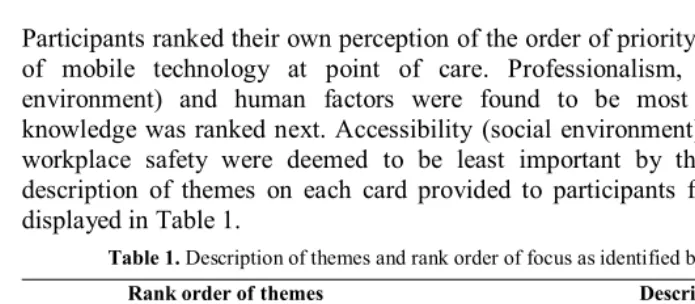
[image:3.595.49.397.446.598.2]Participants ranked their own perception of the order of priority for progressing the use of mobile technology at point of care. Professionalism, accessibility (physical environment) and human factors were found to be most important. Expanding knowledge was ranked next. Accessibility (social environment), legal framework, and workplace safety were deemed to be least important by the group. Ranking and description of themes on each card provided to participants for the first activity are displayed in Table 1.
Table 1. Description of themes and rank order of focus as identified by nurse supervisors
Rank order of themes Descriptor
1 Professionalism Governance at all levels including competency standards; codes and guidelines
2 Accessability (1) Environment (physical/location) including inconsistency, lack and place of access
3 Human factors Entrustability such as confidence, ehealth literacy; learning styles; age
4 Expanding knowledge Equipment including devices; software; data etc 5 Accessability (2) Environment (social/ward culture/social referencing)
including health professions; time management; presence; attitudes of workplace; safety; security; convenience/real-time
6 Legal framework/Policy/guidelines (systems/organisation)
Communication including documentation; error reduction and storage.
Participants were asked about their perceptions of enablers and barriers to deploying or implementing mobile learning in their workplace. Using a whiteboard, a mapping exercise was undertaken. Access to the Internet/wifi; policy related to respecting emerging care partnerships of nurses and patients; educational preparation; pace of change; compliance of students; patient-centred control of care and confidentiality were cited as barriers. Two of the barriers were also described as enablers. These were policy change to reflect the emerging partnerships of patient-centred care and control and access to the Internet/wifi for themselves and students. A “trial period to ‘run use of mobile learning’ to see issues” was also articulated. Finally, nurse supervisors listed the top three issues they would like addressed to enable mobile learning and on the other side of the card, three issues to enable student use. The prioritised lists extracted from the nurse supervisor responses are shown in Table 2.
Table 2. Top three mobile learning issues to be addressed as identified by nurse supervisors
Nurse supervisor Student nurse
Access to Internet/wifi Access to Internet/wifi
Cost Up to date information ie University and clinical
information
Provision of device Guidelines or rules regarding appropriate use
3.Discussion
Exploration and prioritisation of themes demonstrated the limited adoption of mobile learning, and the findings suggest professionalism, accessibility (physical) and human factors continue to dominate as the main barriers and challenges to be overcome. These themes are pertinent at an individual level because they impede nursing practice but require addressing at an organisation and systems level before progression to the next stage of implementation can be achieved. The findings of the ranking activity by participants are congruent and confirm the previous research [2, 22, 23]. However, successful deployment will remain unachievable until healthcare environments enable accessibility and prepare end-users to become proficient and confident in using mobile technology for learning and teaching [24]. Encouragement in developing digital literacy and modelling of digital professionalism by nurse supervisors, and engagement of change champions to model leadership [14, 25] will promote preparedness for moving towards successful implementation of mobile learning [10].
Participants perceived that students needed access to credible contemporary information. They also indicated students required guidelines and codes of conduct for appropriate use to prevent fear of ‘missing out behaviour’ [29] or distraction [26]. Lack of support and guidance at systems and organisation levels for professional hybrid nurses is further complicated because they are expected to model digital professionalism, which is currently unsupported by standards, or codes of conduct, nor are they assisted by organisational guidelines or policies [9]. Pressure to progress accessibility, promote professionalism and enable appropriate and safe use of mobile technology at point of care using systems ‘top-down’ and individual ‘bottom-up’ drivers can influence organisations to change their organisational policies to enable mobile learning to become a legitimate nursing function. However, support at an organisation level through development of standards, guidelines, codes and policies at a systems level is necessary. Combined leadership from nurses and informatics professionals is essential to effect change [30].
4.Conclusion
Nurse supervisors are professional hybrids who often have both educational and leadership roles. These clinicians have an opportunity to lead driving access to mobile technology for informal learning and continuing professional development at point of care. The participants in this research identified and confirmed the barriers and challenges that persist within healthcare environments and hinder progression of preparedness of installation of this new andragogy in the workplace. The priorities identified demonstrate that digital literacy and professionalism of nurses is mandatory if deployment is to be progressed. Additionally, these clinicians will need to partner with other stakeholders to advocate for developing guidelines and policies to enable the benefits of mobile technology use within their organisations. Furthermore, at a systems level nurse leaders and change champions will need to continue lobbying professional organisations to include guidance regarding mobile technology within the standards and codes of conduct for nurses. The provision of guidance for nurses will enable a framework for installation enabling preparation for implementation of mobile learning at point of care.
References
[1]. K. Ross, J. Barr, J. Stevens. Mandatory continuing professional development requirements: what does this mean for Australian nurses. BMC Nursing 12 (2013) (9), 1.
[2]. C. A. Mather, E. Cummings. Unveiling the mobile learning paradox. Studies in Health
Technology and Informatics 218 (2015), 126-31.
[3]. K. Gray, A. Dattakumar, A. Maeder, K. Butler-Henderson, H. Chenery. Advancing Ehealth education for the clinical health professions. Sydney NSW Office for Learning and Teaching Department of Education 2014.
[4]. R. Eley, Fallon, T., Soar, J., Buikstra, E. and Hegney, D. The status of training and education in information and computer technology of Australian nurses: a national survey. Journal of Clinical
Nursing 17 (2008) (20), 2758-67.
[5]. S. Mickan, J. K. Tilson, H. Atherton, N. W. Roberts. Evidence of effectiveness of health care professionals using handheld computers: a scoping review of systematic reviews. 15 (2013)(10), e212.
[7]. D. L. Fixsen, S. F. Naoom, K. A. Blasé, R. M. Friedman, F. Wallace. Implementation Research:
Synthesis of the Literature. Tampa, Florida: University of South Florida; 2005.
[8]. T. Ogden, D. L. Fixsen. Implementation science. Zeitschrift für Psychologie (2015).
[9]. C. Mather, F. Gale, E. Cummings. Governing Mobile Technology Use for Continuing Professional Development in the Australian Nursing Profession. BMC Nursing 16 (2017) (1-11). [10]. K. Yagasaki, H. Komatsu. Preconditions for successful guideline implementation: perceptions of
oncology nurses. BMC Nursing 10 (2011), 23.
[11]. D. L. Fixsen, K. Blase, S. Naoom, M. Duda. Implementation Drivers: Assessing Best Practices. Chapel Hill: University of North Carolina; 2015.
[12]. NMBA (Nursing and Midwifery Board of Australia). Registration Standard: Continuing
Professional Development. 2016;
http://www.nursingmidwiferyboard.gov.au/News/2016-02-01-revised-standards.aspx. Accessed 2 March 2017.
[13]. NMBA (Nursing and Midwifery Board of Australia). Registered Nurse Standards for Practice. 2016; http://www.nursingmidwiferyboard.gov.au/News/2016-02-01-revised-standards.aspx. Accessed 2 March 2017.
[14]. C. M. Shea, C. M. Belden. What is the extent of research on the characteristics, behaviors, and impacts of health information technology champions? A scoping review. BMC Medical
Informatics and Decision Making 16 (2016) (1), 2.
[15]. S. Guri-Rosenblit. Eight paradoxes in the implementation process of e-learning in higher education. Distances et savoirs 4 (2006)(2), 155-79.
[16]. M. Noordegraaf. Hybrid professionalism and beyond:(New) Forms of public professionalism in changing organizational and societal contexts. Journal of Professions and Organization (2015), p.jov002.
[17]. N. J. Shariff. Empowerment model for nurse leaders’ participation in health policy development: an east African perspective. BMC Nursing 14 (2015) (1), 31.
[18]. B. S. Kuipers, M. Higgs, W. Kickert, L. Tummers, J. Grandia, J. Van der Voet. The management of change in public organizations: A literature review. Public Administration 92 (1) (2014), 1-20. [19]. C. Croft , G. Currie, A. Lockett. Broken ‘Two-way Windows’? An Exploration of Professional
Hybrids. Public Administration 93 (2015) (2), 380-94.
[20]. G. Currie, N. Koteyko, B. Nerlich. The dynamics of professions and development of new roles in public services organizations: the case of modern matrons in the English NHS. Public
Administration 87 (2009) (2), 295-311.
[21]. C. A. Mather, E. A. Cummings, L. Nichols. Social Media Training for Professional Identity Development in Undergraduate Nurses. Studies in Health Technology and Informatics 225 (2016), 344-8.
[22]. C. Mather, E. Cummings. Modelling Digital Knowledge Transfer: Nurse Supervisors Transforming Learning at Point of Care to Advance Nursing Practice. Informatics 4 (2017) (12), 1-14.
[23]. C. A. Mather, E. Cummings. Issues for Deployment of Mobile Learning by Nurses in Australian Healthcare Settings. Studies in Health Technology and Informatics 225 (2016), 277-81.
[24]. D. W. Bates. The quality case for information technology in healthcare. BMC Medical Informatics
and Decision Making 2 (2002) (1), 7.
[25]. R. H. Ellaway, J. Coral, D. Topps, M. Topps. Exploring digital professionalism. Medical Teacher
37 (2015) (9), 844-9.
[26]. D. McBride, S. A. LeVasseur, D. Li. Nursing performance and mobile phone use: are nurses aware of their performance decrements? JMIR Human Factors 2 (2015) (1).
[27]. E. G. Poon, A. K. Jha, M. Christino, M. M. Honour, R. Fernandopulle, B. Middleton, et al. Assessing the level of healthcare information technology adoption in the United States: a snapshot.
BMC Medical Informatics and Decision Making 6 (2006) (1), 1.
[28]. T. L. Davis, R. DiClemente, M. Prietula. Taking mHealth forward: examining the core characteristics. JMIR mHealth and uHealth 4 (2016)(3).
[29]. D. Alt. Students’ Wellbeing, Fear of Missing out, and Social Media Engagement for Leisure in
Higher Education Learning Environments. Current Psychology , 1-11. (2016).