A Comparison of Some Numerical
Methods for the Advection-Diffusion
Equation
M. Thongmoon 1 & R. McKibbin2
1King Mongkut’s University of Technology Thonburi, Thailand
2Institute of Information and Mathematical Sciences
Massey University at Albany, Auckland, New Zealand
This paper describes a comparison of some numerical methods for solving the advection-diffusion (AD) equation which may be used to describe transport of a pollutant. The one-dimensional advection-diffusion equation is solved by using cubic splines (the natural cubic spline and a ”special” AD cubic spline) to estimate first and second derivatives, and also by solving the same problem using two standard finite difference schemes (the FTCS and Crank-Nicolson methods). Two examples are used for comparison; the numerical results are compared with analytical solutions. It is found that, for the examples studied, the finite difference methods give better point-wise solutions than the spline methods.
1
Introduction
Pepper et al. (1) and Okamoto et al. (2) solve the one-dimensional advection equa-tion by using a spline interpolaequa-tion technique that they call a quasi-Lagrangian cubic spline method. In section 4 of (3), Ahmad & Kothyari solve the one dimensional advection-diffusion equation by using cubic spline interpolation for the advection component and the Crank-Nicolson scheme for the diffusion component. Sastry (6) uses a cubic spline technique to approximate the solution of the one-dimensional diffusion equation.
2
Governing Equation and Numerical Methods
2.1
Governing Equation
The volumetric concentration of a pollutant in a moving, turbulent fluid may be described by the advection-diffusion equation
∂C
∂t +∇·(VC) =∇ ·( ¯K⊗ ∇C) (1)
Here, C(x, y, z, t) is the concentration (mass per unit volume) of pollutant at point (x, y, z) in Cartesian coordinates, at timet. The vector V is the fluid velocity field and ¯K is the eddy-diffusivity or dispersion tensor.
In this study, we consider one-dimensional motion with constant speed u and dispersionD which gives the 1-D advection-diffusion equation:
∂C ∂t +u
∂C ∂x =D
∂2C
∂x2 (2)
with appropriate initial and boundary conditions. Here,C(x, t) is the concentration of the pollutant at point x (0≤ x ≤ L) and time t, u is the constant wind speed in the x direction and D is the diffusivity coefficient in the x direction. Several combinations of boundary conditions are possible. We distinguish three cases, all for a finite domain:
Case 1:
C(x,0) = f(x)
C(0, t) = c0
C(L, t) = cL
(3)
Case 2:
C(x,0) = f(x)
C(0, t) = c0
∂C
∂x(0, t) = 0
(4)
Case 3:
C(x,0) = f(x)
C(0, t) = c0
q(0, t) = (Cu−D∂C
∂x)(0, t) = constant
(5)
where c0, cL are constant concentration values, while the quantity q = uC−D∂C∂x
is the mass flux of pollutant per unit cross-sectional area, and includes both of the advective and dispersive components. All cases correspond to a fixed constant con-centration at the left-hand end, together with one of: a constant concon-centration at the right-hand end (Case 1), advective pollutant inflow only at the left-hand end (Case 2) or fixed constant pollutant influx there (Case 3).
For construction of interpolating cubic splines at any step in a numerical approx-imation procedure, 2 extra conditions are required apart from the Ci values at the
mesh points xi. The ”natural” cubic spline requires the condition that ∂
2C
the interpolants at x = 0, L. How does this requirement impact on the boundary conditions?
For all cases above,C =c0 at x= 0 implies that
∂C
∂t (0, t) = 0,
and therefore
u∂C ∂x −D
∂2C
∂x2 = 0
at x = 0, i.e. ∂q∂x(0, t) = 0. This implies that q(0−
, t) = q(0+, t). Assuming that
the pollutant source is well-mixed, then C = c0 upstream and q = uc0 at x = 0 −
. Because C = c0 at x = 0+, this means that ∂C∂x = 0 at x = 0+ and so ∂
2C
∂x2 = 0 at
x= 0+. Cases 1 and 2 therefore are consistent with the boundary condition atx= 0
corresponding to the natural cubic spline, while Case 3 is not. Hence the motivation for developing a ”special” cubic spline scheme for the advection-dispersion equation, as outlined in a letter section of this paper.
2.2
Finite difference (FTCS) method
Finite difference schemes involve calculating approximate values of the unknown function at a finite number of (mesh- or grid-) points in the domain. Here we let 0 = x1 ≤ xj ≤ xN+1 = L be the grid points in x-domain. The time is divided into
equal steps of size ∆t, with timetn−n∆t. Derivatives are approximated by truncated
Taylor Series expansions. For our purposes, we use an explicit forward difference estimate for the time derivative (FT), and central difference approximations for the space derivatives (CS) that both have the same truncation error; hence the acronym FTCS. The approximate solution of the governing equation using the finite difference scheme satisfies:
Cjn+1−Cjn
∆t +u Cn
j+1−Cjn−1
2∆x =D Cn
j+1−2Cjn+Cjn−1
(∆x)2 +O(∆t,(∆x)
2) (6)
for j = 2,3, . . . , N, while for j =N + 1, one-sided forms of the difference formulae are required:
CNn+1+1−Cn N+1
∆t +u
3Cn N+1−4C
n N+CNn−1
2∆x
=D2CNn+1−5C
n N+4C
n N−1
−Cn N−2
(∆x)2 +O(∆t,(∆x)2)
(7)
all for for n= 0,1,2, . . ., where the initial values are C0
j =C((j −1)∆x,0).
Hindmarsh (7) and Sousa (8), show that the conditions that the finite difference scheme in Equation (6) is stable are
and
(u∆t ∆x)
2
≤2D∆t ∆x2.
Rearrangement and simplification of both of these conditions gives the restriction on the size of the time step in terms of the parameters and the grid-size:
∆t≤min{∆x
2
2D ,
2D u2 }
2.3
The Crank-Nicolson method
The Crank-Nicolson scheme approximates the governing equation by using central differences in time; the spatial derivatives are estimated by the average of their values at time step n and step n+ 1, in the form:
Cjn+1−Cn j
∆t +u(
1 2(
Cjn+1+1−Cjn+1
−1
2∆x +
Cn j+1−C
n j−1
2∆x ))
=D(1 2(
Cjn+1+1−2C
n+1
j +C n+1
j−1
(∆x)2 +
Cn
j+1−2Cjn+Cjn−1
(∆x)2 )) +O(∆t,∆x2),
(8)
with a similar equation for the right-hand end-point. The Crank-Nicolson scheme is unconditionally stable (4).
2.4
Cubic spline method (”natural” cubic spline)
For this work the definition of the ”natural” cubic spline includes:
(i) The interpolating spline segments are cubic polynomial functions on each sub-interval [xj, xj+1],j = 1,2, . . . , N, and the segments agree with the function values
at the grid-points;
(ii) the first and second derivatives of the cubic spline segments are continuous at the internal points;
(iii) the second derivatives of the cubic spline segments at the first and the last grid points are equal to zero.
The approximate solution of the governing equation using the cubic spline method satisfies:
Cn+1
j −Cjn
∆t +uP n
j =DQnj. (9)
for j = 1,2, . . . , N + 1;n = 0,1,2, . . . where Pn
j is the first derivative and Qnj the
second derivative of the cubic spline function at the pointxj at timen∆t. Equation
(9) can be written in the explicit form:
Cjn+1 =C n
j +D∆tQ n
j −u∆tP n
j . (10)
The values of the slopes Pn
j can be obtained by solving the following system of
the continuity conditions for the spline segments; see (5) for details of algebraic working):
2 1 0 0 0 . . . 0 0 0
α2 2 µ2 0 0 . . . 0 0 0
0 α3 2 µ3 0 . . . 0 0 0
. . .
. . .
. . .
0 0 0 0 0 . . . αN−1 2 µN−1
0 0 0 0 0 . . . 0 1 2
Pn 1 Pn 2 Pn 3 . . . Pn N Pn N+1 = dn 1 dn 2 dn 3 . . . dn N dn N+1 (11) where dn
1 = 3(
Cn
2−C1n
x2−x1 )
dn
i = 3
µj
hj+1(C
n
j+1−Cjn) + 3 αj
hj(C
n
j −Cjn−1) for j=2,3,. . . ,N
dn
N+1 = 3(
Cn N+1−CNn
xN+1−xN)
and where αj =
hj+1
(hj+hj+1), muj = 1−αj =
hj
(hj+hj+1), hj+1 = xj+1−xj and hj =
xj −xj−1.
The values of Qn
j are the second derivatives of cubic spline at points xj for j = 2,3, . . . , N, at timen∆t. For the natural cubic spline it is assumed thats′′
1(x1) =
s′′
n(xn+1) = 0 (i.e. Qn1 =QnN+1 = 0). Then we have:
Qn j = 6
Cn
j+1−Cjn
(xj+1−xj)2 −
4 P
n j
xj+1−xj −
2 P
n j+1
xj+1−xj
(12)
for j = 2,3, . . . , N.
2.5
Cubic spline method (”Special A-D” cubic spline)
The boundary condition C=c0 atx= 0, implies that
∂C
∂t (0, t) = 0, (13)
and so
(u∂C ∂x −D
∂2C
∂x2)(0, t) = 0. (14)
In this section we present a cubic spline interpolation scheme that satisfies the condition (12).
The requirement is that uPn
Qn
1 = DuP
n
1 and QnN+1 = DuP
n
N+1 (compare with natural cubic spline where Qn1 =
0;Qn
N+1 = 0). The values ofPjn can then be calculated from the following system:
AP =d (15)
where A=
2 + u(x2−x1)
2D 1 0 0 0 . . . 0 0 0
α2 2 µ2 0 0 . . . 0 0 0
0 α3 2 µ3 0 . . . 0 0 0
. . .
. . .
. . .
0 0 0 0 0 . . . αn−1 2 µn−1
0 0 0 0 0 . . . 0 1 4D−u(xN+1−xN)
2D P = Pn 1 Pn 2 Pn 3 . . . Pn N Pn N+1 and d= dn 1 dn 2 dn 3 . . . dn N dn N+1 where dn
1 = 3(
Cn
2−Cn1
x2−x1 )
dn
j = 3
µj
hj+1(C
n
j+1−Cjn) + 3 αj
hj(C
n
j −Cjn−1) for j=2,3,. . . ,N
dn
N+1 = 3(
Cn N+1−CNn
xN+1−xN)
and αj =
hj+1
(hj+hj+1) and µj = 1−αj =
hj
(hj+hj+1). For this case Q
n
j, j = 2,3, . . . , N
can be obtained from
Qn j = 6
Cn
j+1−Cjn
(xj+1−xj)2 −
4 P
n j
(xj+1−xj) −
2 P
n j+1
(xj+1−xj)
whileQn
1 andQN+1nare calculated directly using the formulae already given above.
3
Numerical Experiments
Two examples are solved by the various methods outlined above, and the calculated numerical approximations are compared with the analytical solutions and with each other. The idea is to try to find the method which gives the best estimates for solu-tions of the advection-dispersion equation. Example 1 is a boundary value problem on a finite domain, as in Case 1 defined in Section 2.1 above. Example 2 is for a semi-infinite domain, but a finite-domain solution is sought.
3.1
Example 1.
The one-dimensional advection-diffusion equation:
∂C ∂t +u
∂C ∂x =D
∂2C
∂x2 (17)
is to be solved with the boundary and initial conditions:
C(0, t) = 0
C(L, t) = 100
C(x,0) = 100x
L 0≤x≤L
The analytical solution is (4):
C(x, t) = 100[ e
P x L −1
eP −1 +
4πeP x2Lsinh(P/2)
eP −1
∞
X
m=1
Am+ 2πe
P x
2L
∞
X
m=1
Bm] (18)
where P is the Peclet number
P = uL
D
and the coefficients Am, Bm are given by
Am = (−1)m m βm
sin(mπx
L )e
−λmt
Bm = [ (−1)m+1 m βm
(1 + P
βm
)e−P
2 + mP
β2
m
] sin(mπx
L )e
−λmt,
where
βm = ( P
2)
2+ (mπ)2
and
λm = u2
4D +
m2π2D
L2 =
Dβm L2
In this study, we assume that L = 1.0 m, D = 0.01 m2s−1
, u = 0.1 ms−1
0 0.2 0.4 0.6 0.8 1 0
10 20 30 40 50 60 70 80 90 100
x
concentration C
Compare the solutions
Cubic Spline (natural) FTCS
Analytical Crank−Nicolson Special cubic spline Steady state
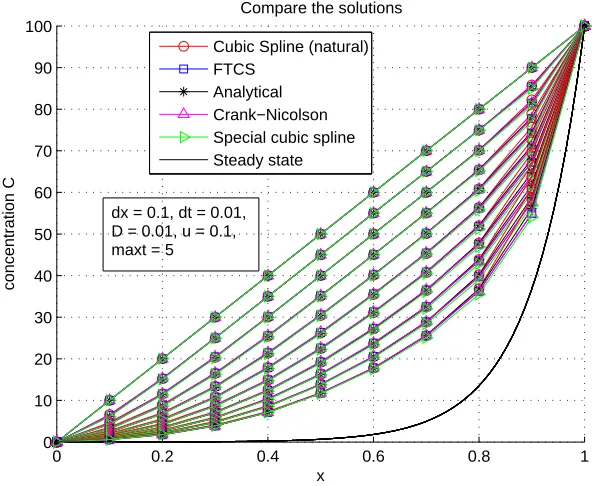
[image:8.612.133.429.65.308.2]dx = 0.1, dt = 0.01, D = 0.01, u = 0.1, maxt = 5
Figure 1: Comparisons of the solutions for Example 1 using various methods
It can be seen in Figure 1 that the numerical solutions given by all of the methods decrease with time from the initial (linear profile) condition. The calculated values are shown at times t = 0(0.5)5s. The time T = 5s is still too early for the steady state to be approached. The errors in the numerical results are shown in Figure 2.
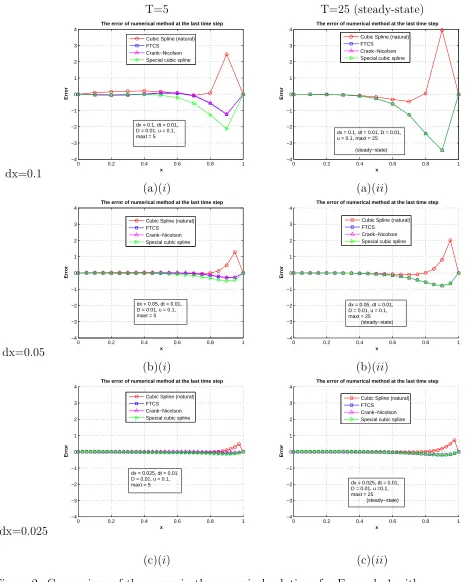
Figure 2 shows the error in the numerical solutions from each of the methods when compared with the analytical solution, for the three casesN = 10, N = 20 and
N = 40, corresponding to ∆x = 0.1,0.05 and 0.025 respectively. Comparisons are made for the solutions at timet= 5sandt = 25s. The latter time corresponds very closely to steady state. From Figure 2(a)(i) forT = 5 and ∆x= 0.1, the errors are all small except near x = 1. The error for the natural cubic spline is positive and larger in magnitude than the errors for the other three methods, which are all negative. For smaller ∆x [in (b)(i)∆x = 0.05 and (c)(i)∆x = 0.025] the errors all reduce in size and appear to be O(∆x2).
T=5 T=25 (steady-state)
dx=0.1
0 0.2 0.4 0.6 0.8 1
−4 −3 −2 −1 0 1 2 3 4 x Error
The error of numerical method at the last time step
Cubic Spline (natural) FTCS
Crank−Nicolson Special cubic spline
dx = 0.1, dt = 0.01, D = 0.01, u = 0.1, maxt = 5
0 0.2 0.4 0.6 0.8 1
−4 −3 −2 −1 0 1 2 3 4 x Error
The error of numerical method at the last time step
Cubic Spline (natural) FTCS
Crank−Nicolson Special cubic spline
dx = 0.1, dt = 0.01, D = 0.01, u = 0.1, maxt = 25
(steady−state)
(a)(i) (a)(ii)
dx=0.05
0 0.2 0.4 0.6 0.8 1
−4 −3 −2 −1 0 1 2 3 4 x Error
The error of numerical method at the last time step
Cubic Spline (natural) FTCS
Crank−Nicolson Special cubic spline
dx = 0.05, dt = 0.01, D = 0.01, u = 0.1, maxt = 5
0 0.2 0.4 0.6 0.8 1
−4 −3 −2 −1 0 1 2 3 4 x Error
The error of numerical method at the last time step
Cubic Spline (natural) FTCS
Crank−Nicolson Special cubic spline
dx = 0.05, dt = 0.01, D = 0.01, u = 0.1, maxt = 25 (steady−state)
(b)(i) (b)(ii)
dx=0.025
0 0.2 0.4 0.6 0.8 1
−4 −3 −2 −1 0 1 2 3 4 x Error
The error of numerical method at the last time step
Cubic Spline (natural) FTCS
Crank−Nicolson Special cubic spline
dx = 0.025, dt = 0.01 D = 0.01, u = 0.1, maxt = 5
0 0.2 0.4 0.6 0.8 1
−4 −3 −2 −1 0 1 2 3 4 x Error
The error of numerical method at the last time step
Cubic Spline (natural) FTCS
Crank−Nicolson Special cubic spline
dx = 0.025, dt = 0.01, D = 0.01, u =0.1, maxt = 25 (steady−state)
[image:9.612.106.573.57.639.2](c)(i) (c)(ii)
Because the solutions of the FTCS and Crank-Nicolson methods give better point-wise approximations to the analytical solutions than the ”natural” cubic spline and ”Special A-D” cubic spline schemes for Example 1, for the next example we will present only the solutions given by the FTCS method and the natural cubic spline schemes.
3.2
Example 2.
Solve the one-dimensional advection-diffusion equation:
∂C ∂t +u
∂C ∂x =D
∂2C
∂x2 (19)
on a semi-infinite domain x= [0,∞), with the initial and boundary conditions:
C(x,0) = 0 ;x≥0
C(0, t) = 1 ;t >0
∂C(∞,t)
∂x = 0 ;t >0.
The analytical solution to this problem is given by (9):
C(x, t) = 1 2[erf c(
x−ut √
4Dt) + exp( xu
D)erf c( x+ut √
4Dt)]
where erf c(x) is the complementary error function defined by
erf c(x) = 1−erf(x)
where
erf(x) = √2
π
Z x
0
e−z2
dz
In this example, the solution is required for a semi-infinite domain but we will solve this problem over a finite domain x = [0,2] by assuming that L = 2 m, D = 0.01 m2s−1
, u = 0.1 ms−1
,∆x = 0.1 m (i.e. N = 20) and ∆t = 0.01 s. We will then comparer the solutions for 0≤x≤1 only.
In this example the special cubic spline method is not presented. The conditions for a specialized A-D cubic spline method for this example are Pn
1 = 0 and Qn1 = 0,
which are different from the conditions for the ”Special A-D” cubic spline in Example 1.
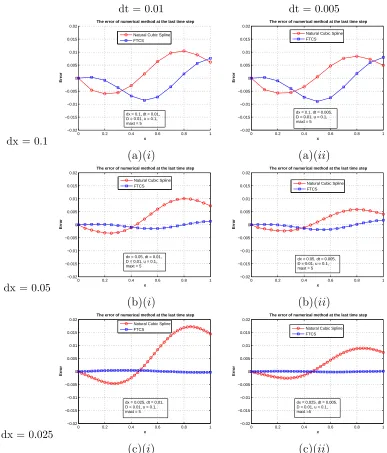
The numerical solutions and the analytical solution for this example may be compared in Figure 3. Figure 4 shows the error of the numerical solutions when compared with the analytical solution, for the two cases N = 10 and N = 40, respectively. The values in Figure 4 are plotted every 50 time steps [i.e. at t = 0(0.05)5s].
0 0.5 1 1.5 2 −0.2
0 0.2 0.4 0.6 0.8 1 1.2
x
Concentration C
Solutions
Natural Cubic Spline FTCS
Analytical
[image:11.612.138.474.214.491.2]dx = 0.1, dt = 0.01, D = 0.01, u = 0.1, maxt = 5
dt = 0.01 dt = 0.005
dx = 0.1
0 0.2 0.4 0.6 0.8 1
−0.02 −0.015 −0.01 −0.005 0 0.005 0.01 0.015 0.02 x Error
The error of numerical method at the last time step
Natural Cubic Spline FTCS
dx = 0.1, dt = 0.01, D = 0.01, u = 0.1, maxt = 5
0 0.2 0.4 0.6 0.8 1
−0.02 −0.015 −0.01 −0.005 0 0.005 0.01 0.015 0.02 x Error
The error of numerical method at the last time step
Natural Cubic Spline FTCS
dx = 0.1, dt = 0.005, D = 0.01, u = 0.1, maxt = 5
(a)(i) (a)(ii)
dx = 0.05 0 0.2 0.4 0.6 0.8 1
−0.02 −0.015 −0.01 −0.005 0 0.005 0.01 0.015 0.02 x Error
The error of numerical method at the last time step
Natural Cubic Spline FTCS
dx = 0.05, dt = 0.01, D = 0.01, u = 0.1, maxt = 5
0 0.2 0.4 0.6 0.8 1
−0.02 −0.015 −0.01 −0.005 0 0.005 0.01 0.015 0.02 x Error
The error of numerical method at the last time step
Natural Cubic Spline FTCS
dx = 0.05, dt = 0.005, D = 0.01, u = 0.1, maxt = 5
(b)(i) (b)(ii)
dx = 0.025
0 0.2 0.4 0.6 0.8 1
−0.02 −0.015 −0.01 −0.005 0 0.005 0.01 0.015 0.02 x Error
The error of numerical method at the last time step
Natural Cubic Spline FTCS
dx = 0.025, dt = 0.01, D = 0.01, u = 0.1, maxt = 5
0 0.2 0.4 0.6 0.8 1
−0.02 −0.015 −0.01 −0.005 0 0.005 0.01 0.015 0.02 x Error
The error of numerical method at the last time step
Natural Cubic Spline FTCS
dx = 0.025, dt = 0.005, D = 0.01, u = 0.1, maxt =5
[image:12.612.87.474.102.555.2](c)(i) (c)(ii)
all methods increase with time. The numerical solutions continue to increase to the steady state solution (C(x,∞) = 1).
From Figure 4 (a)(i) for ∆x = 0.1 and dt = 0.01, the errors for the natural cubic spline scheme are larger in magnitude than the errors for FTCS method. For smaller ∆x [in (b)(i)∆x = 0.05 and (c)(i)∆x = 0.025] the errors all reduce in size and appear to be O(∆x2).
For the small time step sizedt= 0.005 in Figure 4 (a)(ii), (b)(ii) and (c)(ii), the error for the natural cubic spline is again larger than the FTCS method. However, as expected, the errors for the spline scheme decrease as the grid-size decreases.
4
Conclusion
Finite difference methods and cubic spline schemes for the one dimensional advection-diffusion equation have been presented. For the test examples studied, it has been found that the FTCS and the Crank-Nicolson finite-difference methods give better point-wise solutions than the ”natural” cubic spline and ”Special A-D” cubic spline schemes. However, the ”Special A-D” cubic spline method gives better point-wise solutions than the ”natural” cubic spline method.
Acknowledgements
The first author would like to thank the Faculty of Science, Mahasarakham Uni-versity (MSU), Thailand and King Mongkut’s UniUni-versity of Technology Thonburi (KMUTT), Thailand for giving academic leave and financial support during his period of study at Massey University’s Albany campus in Auckland, New Zealand.
References
[1] D.W. Pepper, C.D. Kern and P.E. Long, Jr. Modeling the dispersion of atmo-spheric pollution using cubic splines and chapeau functions. Atmos. Environ.,13, 1979, 223-237.
[2] S. Okamoto, K. Sakai, K. Matsumoto, K. Horiuchi and K. Kobayashi. Devel-opment and application of a three-Dimensional Taylor-Galerkin numerical model for air quality simulation near roadway tunnel portals.J. Appl. Meteor.,37,1998, 1010-1025.
[3] Z. Ahmad and U.C. Kothyari. Time-line cubic spline interpolation scheme for solution of advection equation. Computer & Fluids,30, 2001, 737-752.
[5] E.V. Shikin and A.I. Plis. Handbook on splines for the user. CRC Press Inc. 1995.
[6] S.S. Sastry. Finite difference approximations to one-dimensional parabolic equa-tions using a cubic spline technique. J. Comp. Appl. Math., 2, 1976.
[7] A.C. Hindmarsh, P.M. Gresho and D.F. Griffiths. The stability of explicit Euler time-integration for certain finite difference approximations of the multi-dimensional advection-diffusion equation. Int. J. Numer. Methods Fluids,4, 853-897, 1984.
[8] E. Sousa, The controversial stability analysis. Applied Mathematics and
Com-putation,145, 777-794, 2003.