Full Length Research Paper
Differences in yield parameters of emmer in
comparison with old and new varieties of bread wheat
Petr Konvalina
1*, Ivana Capouchová
2, Zden
ě
k Stehno
3and Jan Moudrý
11
Department of Applied Plant Biotechnology, Faculty of Agriculture, University of South Bohemia, Studentská 13, 370 05
České Budějovice, Czech Republic.
2
Department of Crop Production, Faculty of Agrobiology, Food and Natural Resources, Czech University of Life Sciences, Kamýcká 120, 165 21 Prague 6, Czech Republic.
3
Crop Research Institute, Drnovská 507, 161 06 Prague 6, Czech Republic. Accepted 13 January, 2012
Emmer wheat (Triticum diccocum Schrank) belonged to the most frequent species of cereals in the
past. Nowadays, it is grown in arid and montane areas in particular. Interest in this cereal species has increased, as it is tolerant to biotic and abiotic stressing factors. Therefore, yield parameters were evaluated in three-year (2007, 2008 and 2010) trials that were carried out in two different localities in the Czech Republic. Results of the research were compared to characteristics of four old and two top modern bread wheat (Triticum aestivum L.) cultivars. The emmer wheat varieties were resistant to usual
wheat diseases. They formed their yield by a quantity of productive tillers (2.5), whereas the varieties of bread wheat had less productive tillers (1.5) per one plant. The distribution of assimilates was worse in the emmer wheat plants and it provoked a lower harvest index (0.33) there. Grain yield of the emmer wheat varieties reached 58% of the yield level of the mean of control bread wheat varieties. High crude protein content in grain (17.91%) was an advantage of the emmer wheat varieties; the control bread wheat varieties reached 13.73%. Protein content was positively influenced (P < 0.01) by an ability of the emmer varieties to uptake as much nitrogen as possible from the soil during the flowering period. Adaptability to the land and climatic environmental conditions was another positive characteristic of the emmer wheat landraces in comparison with old and modern bread wheat varieties.
Key words: Emmer wheat, bread wheat, landraces, sustainable farming, yield formation.
INTRODUCTION
Wheat genetic resources are usually not as productive as modern bread cultivars (Ehdaie et al., 1991). However, they have become more interesting for farmers. These crops are less demanding and more adaptable to the environmental conditions (Kotschi, 2006). Tolerance to drought is one of the most important advantages of this cereal species (Zaharieva et al., 2010). It is an important aspect of the growing of such crop (Bucur et al., 2006, 2010). Therefore, they are suitable for low-input and organic farming systems. They provide lower but more stable yield levels, if being grown in less favoured areas
*Corresponding author. E-mail: [email protected].
for agriculture (Collins and Hawtin, 1999). In spite of a high quantity of available genetic resources, their use is still limited in a sustainable farming at the moment (Wolfe et al., 2008). The tetraploid emmer wheat cultivar, Triticum dicoccum (SCHRANK) SCHUEBL, is one of the model crops suitable for low-input and organic farming systems. It belongs to the hulled wheat cultivars and has been grown and used as a part of the human diet for a very long time (Marconi and Cubadda, 2005).
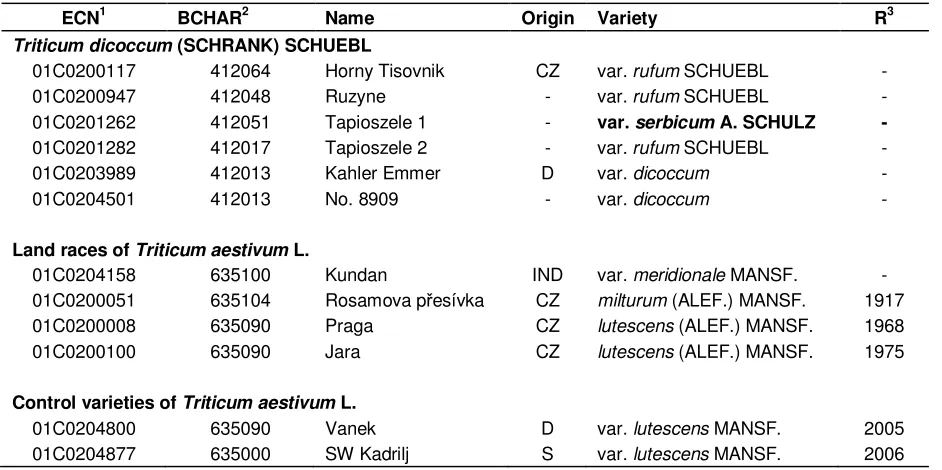
Table 1. List of used varieties.
ECN1 BCHAR2 Name Origin Variety R3
Triticum dicoccum (SCHRANK) SCHUEBL
01C0200117 412064 Horny Tisovnik CZ var. rufum SCHUEBL -
01C0200947 412048 Ruzyne - var. rufum SCHUEBL -
01C0201262 412051 Tapioszele 1 - var. serbicum A. SCHULZ -
01C0201282 412017 Tapioszele 2 - var. rufum SCHUEBL -
01C0203989 412013 Kahler Emmer D var. dicoccum -
01C0204501 412013 No. 8909 - var. dicoccum -
Land races of Triticum aestivum L.
01C0204158 635100 Kundan IND var. meridionale MANSF. -
01C0200051 635104 Rosamova přesívka CZ milturum (ALEF.) MANSF. 1917
01C0200008 635090 Praga CZ lutescens (ALEF.) MANSF. 1968
01C0200100 635090 Jara CZ lutescens (ALEF.) MANSF. 1975
Control varieties of Triticum aestivum L.
01C0204800 635090 Vanek D var. lutescens MANSF. 2005
01C0204877 635000 SW Kadrilj S var. lutescens MANSF. 2006
Remarks: 1 ECN = identifier; 2 BCHAR = taxonomical code; - = unknown; 3registration.
organic farming system, where it may develop its potential as a less demanding crop. As it contains a high quantity of protein in grains, it may be used for the production of good-quality healthy local foodstuffs (Marconi and Cubadda, 2005). Emmer wheat has never been bred. Nowadays, only landraces and wild forms are available and are being grown. Several studies dealing with opportunities for growing emmer wheat have been published in the last few years. All of them have led to common conclusions and results; however, they have not answered all of the questions concerning the opportunities for growing and using the emmer wheat landraces in sustainable farming systems.
The yield level, indicated in particular literary sources, is lower compared to the bread or hard wheat cultivars (Marconi and Cubadda, 2005). Most of the emmer wheat landraces ripen later than the hard wheat cultivars (D´Antuono et al., 1998). Morphology of the spike is characterised by an inclination of the spike to breaking during the harvest. Some published studies (Stehno and Manev, 1999; Troccoli and Codianni, 2005) show that the plants are more than 100 cm long in average. Stallknecht et al. (1996) state that after selection of productive genotypes from genetic resources, the yield rate could be 48 to 84% of the spring bread wheat yield rate at the arid station. Some literary sources cite a comparable production rate of the emmer wheat landraces grown in conditions that are not suitable for the growing of bread wheat. The emmer wheat grains are much better quality (Marconi and Cubadda, 2005).
The objective of our study was to analyse the possibility and opportunity of using emmer wheat as an alternative
crop in sustainable farming systems. In this paper, we reported the results of the analysis of the selected agronomically important traits in comparison with emmer wheat landraces, old and modern bread wheat varieties.
MATERIALS AND METHODS
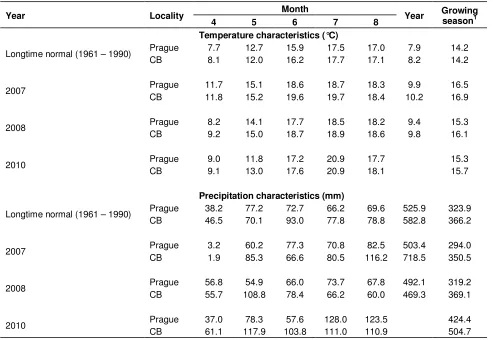
Tested varieties come from the Gene Bank of the Research Institute of Crop Production in Prague (Prague). Six genetic resources of emmer wheat (T. dicoccum Schrank) were chosen. Four old varieties of bread wheat and two top bread wheat (Triticum aestivum L.) modern cultivars, Vanek (German origin) and SW Kadrilj (Swedish origin), were used as control cultivars there (Table 1). Varieties were sown in a randomized, complete block design on experimental parcels in Prague and České Budějovice (CB) during 2007, 2008 and 2010. The seeding rate was adjusted to a density of 350 germinable grains per m2. Rows were 125 mm wide. Both of the years 2007 and 2008 were characterised higher than the usual mean temperatures in the growing season (Table 2). 2007 was the warmest year, whereas there were slightly higher temperatures at the Prague station in 2008 (1°C in July, in comparison to the 1961 to 1990 longtime mean). 2007 was characterised by a precipitation deficit during emergence, which led to a serious reduction of the field germinable rate. 2008 had common climate conditions. 2010 was wetter and warmer in both localities (Table 2). The Prague station was characterised by an abundance of nitrogen during flowering, DC 69 (NH4-N+ NO3-N = 22 mg/kg) and pH = 7.36. The
České Budějovice station was meanwhile characterised by a deficiency of nitrogen (NH4-N + NO3-N = 12 mg/kg) and weakly
acidic - pH = 6.41 (Table 3).
Yield characteristics
Table 2. Temperature and precipitation characteristics of the experimental stations.
Year Locality Month Year Growing
season1
4 5 6 7 8
Temperature characteristics (°C)
Longtime normal (1961 – 1990) Prague 7.7 12.7 15.9 17.5 17.0 7.9 14.2
CB 8.1 12.0 16.2 17.7 17.1 8.2 14.2
2007 Prague 11.7 15.1 18.6 18.7 18.3 9.9 16.5
CB 11.8 15.2 19.6 19.7 18.4 10.2 16.9
2008 Prague 8.2 14.1 17.7 18.5 18.2 9.4 15.3
CB 9.2 15.0 18.7 18.9 18.6 9.8 16.1
2010 Prague 9.0 11.8 17.2 20.9 17.7 15.3
CB 9.1 13.0 17.6 20.9 18.1 15.7
Precipitation characteristics (mm)
Longtime normal (1961 – 1990) Prague 38.2 77.2 72.7 66.2 69.6 525.9 323.9
CB 46.5 70.1 93.0 77.8 78.8 582.8 366.2
2007 Prague 3.2 60.2 77.3 70.8 82.5 503.4 294.0
CB 1.9 85.3 66.6 80.5 116.2 718.5 350.5
2008 Prague 56.8 54.9 66.0 73.7 67.8 492.1 319.2
CB 55.7 108.8 78.4 66.2 60.0 469.3 369.1
2010 Prague 37.0 78.3 57.6 128.0 123.5 424.4
CB 61.1 117.9 103.8 111.0 110.9 504.7
Remark: 1Growing season – April to August.
Table 3. Agrochemical analysis of soil.
Locality Year Parameter
N-NH4 [mg.kg-1] N-NO3 [mg.kg-1] pH (CaCl2) P[mg.kg-1] K [mg.kg-1] Mg [mg.kg-1] Ca [mg.kg-1]
Prague
2007 2.31 23.32 7.30 78 210 148 4360
2008 1.38 20.6 7.35 75.4 171 156 3211
2010 4.64 12.15 7.43 109 380 183 5277
CB
2007 2.89 7.17 6.27 138 155 163 1557
2008 1.75 13.3 6.30 77 94 112 1186
2010 2.42 7.3 6.67 111 100 137 2027
Remarks: Proportion of mineral nitrogen (NH4 + NO3) 20 - 50 mg.kg -1
(optimum value of fertile arable land).
suitable for sustainable farming systems (Konvalina et al., 2010). The following traits were studied during the growing period: length of the plant (at the end of the flowering stadium – DC 69); the index of lodging (a combination of intensity and degree of lodging of the crop stand on each parcel, mean of two measurements (DC 59 and DC 87) (Van Waes, 2006); the degree of powdery mildew resistance (mean of measurements in growing stages DC 37, DC 61 and DC 77) and brown rust resistance (DC 77) were expressed
by a score in accordance with symptoms of a disease on plants (9 = resistance).
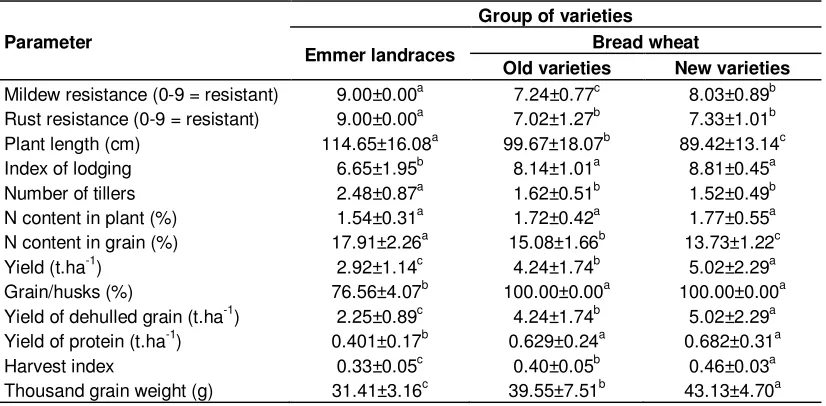
[image:3.612.53.575.496.610.2]Table 4. Differences in selected agronomically important traits in different groups of varieties (mean + SD of three years, two localities).
Parameter
Group of varieties
Emmer landraces Bread wheat
Old varieties New varieties
Mildew resistance (0-9 = resistant) 9.00±0.00a 7.24±0.77c 8.03±0.89b Rust resistance (0-9 = resistant) 9.00±0.00a 7.02±1.27b 7.33±1.01b Plant length (cm) 114.65±16.08a 99.67±18.07b 89.42±13.14c
Index of lodging 6.65±1.95b 8.14±1.01a 8.81±0.45a
Number of tillers 2.48±0.87a 1.62±0.51b 1.52±0.49b
N content in plant (%) 1.54±0.31a 1.72±0.42a 1.77±0.55a N content in grain (%) 17.91±2.26a 15.08±1.66b 13.73±1.22c
Yield (t.ha-1) 2.92±1.14c 4.24±1.74b 5.02±2.29a
Grain/husks (%) 76.56±4.07b 100.00±0.00a 100.00±0.00a
Yield of dehulled grain (t.ha-1) 2.25±0.89c 4.24±1.74b 5.02±2.29a Yield of protein (t.ha-1) 0.401±0.17b 0.629±0.24a 0.682±0.31a
Harvest index 0.33±0.05c 0.40±0.05b 0.46±0.03a
Thousand grain weight (g) 31.41±3.16c 39.55±7.51b 43.13±4.70a
Different letters are statistical differences between varieties for Tukey HSD test, P < 0.05.
protein yield per hectare = (crude protein content/100) x grain yield, harvest index (HI) and weight of one thousand grains (TGW), grain/husks ratio were analysed too.
Statistical data analysis
All statistical analyses were done using Statistica 9.0 software (StatSoft, Inc.). Instruments of basic statistics, an analysis of variance and the evaluation of a potential influence of individual factors (ANOVA) were applied there. The Tukey HSD test was used for division of the cultivars into statistically different groups.
RESULTS AND DISCUSSION
During the three year study the differences of yield formation between landraces of emmer [T. diccocum (Schrank) Schuebl] and old and modern varieties of bread wheat (T. aestivum L.) were analysed. From Table 4, it was evident that all the emmer wheat landraces were resistant to powdery mildew (Blumeria graminis) and brown rust (Puccinia recondita). On the other hand, all the bread wheat varieties were affected by the aforementioned diseases. If we carefully select resistant varieties of emmer from genetic resources, we may expect a minimum yield loss caused by common wheat diseases (Lammerts van Bueren, 2002). The emmer wheat landraces were also used as donors of resistance to wheat diseases in many breeding programmes (Herrera-Foessel et al., 2005).
The regulation of weeds is a serious problem connected with sustainable farming systems which aim to limit all chemical inputs (Wolfe et al., 2008). Therefore, the length of plants could be a positive factor as it
assures a higher competitiveness to weeds (Cudney et al., 1991). All the tested emmer wheat varieties were 25 cm longer (higher) than the control varieties and 15 cm longer (higher) than the old bread wheat varieties (Table 4). On the other hand, some authors (e.g. Lammerts van Bueren, 2002) state the fact that the length of plants can be connected with a low resistance to lodging. This fact has not been confirmed by our tests as the longer material was less lodged than the shorter one. The lodging resistance is among others, influenced by the width of stalks (Stehno et al., 2010). The resistance to lodging is also a factor that influenced the total grain yield rate of all the tested varieties in the research (Table 5). The negative correlation was weaker in the emmer wheat landraces (r= -0.58) and stronger in control bread wheat varieties (r= -0.62).
[image:4.612.106.519.104.307.2]Table 5. Correlation coefficients between selected agronomically important traits.
Parameter
Emmer landraces Bread wheat – old varieties Bread wheat – control varieties Protein
content
Grain yield
Protein yield
Protein content
Grain yield
Protein yield
Protein content
Grain yield
Protein yield
Mildew resistance - - - -0.40ns -0.53* -0.68** -0.20ns -0.77* -0.30ns
Rust resistance - - - 0.15ns 0.02ns 0.03ns 0.42ns -0.81* -0.24ns
Plant length -0.35ns 0.51* 0.31ns -0.48ns 0.63** 0.56* -0.56ns 0.81* 0.74* Index of lodging 0.17ns -0.58** -0.59** -0.26ns -0.62* -0.75* -0.20ns -0.68* -0.73* Number of tillers -0.34ns -0.37ns -0.41* 0.15ns 0.07ns 0.10ns 0.12ns 0.21ns 0.23ns N content in plant 0.76* 0.02ns 0.32ns 0.40* 0.41ns 0.54* 0.77* 0.26ns 0.39ns
Grain/husks -0.07ns 0.19ns 0.33ns - - - -
Harvest index -0.44* 0.31ns 0.23ns -0.23ns 0.25ns 0.20ns 0.78* -0.54ns -0.43ns TGW -0.56** 0.28ns 0.20ns -0.06ns 0.22ns 0.18ns -0.15ns 0.54ns 0.53ns
*P < 0.05; **P < 0.01; nsnot significant.
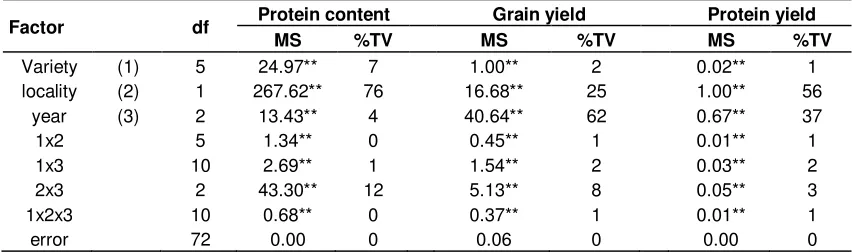
Table 6. Effect of experimental factors on selected agronomically important traits of Emmer (ANOVA).
Factor df Protein content Grain yield Protein yield
MS %TV MS %TV MS %TV
Variety (1) 5 24.97** 7 1.00** 2 0.02** 1
locality (2) 1 267.62** 76 16.68** 25 1.00** 56
year (3) 2 13.43** 4 40.64** 62 0.67** 37
1x2 5 1.34** 0 0.45** 1 0.01** 1
1x3 10 2.69** 1 1.54** 2 0.03** 2
2x3 2 43.30** 12 5.13** 8 0.05** 3
1x2x3 10 0.68** 0 0.37** 1 0.01** 1
error 72 0.00 0 0.06 0 0.00 0
*P < 0.05; **P < 0.01; nsnot significant; MS = mean square; %TV = percentage of total variability.
On the other hand, emmer wheat varieties were characterised by higher and more stable nitrogen uptake when it was grown in a location with a deficit of nitrogen (Table 4). Trčková et al. (2005) have also confirmed such
findings. They have proven a more efficient uptake of NO3 by emmer wheat plants. Correlation analysis (Table 5) has also proven a connection between the quantity of nitrogen in the plant phytomass during the flowering period (DC 61) and the total quantity of nitrogen in the grains of emmer wheat (r = 0.76) and bread wheat (r = 0.77). Low values of the harvest index (0.33) in the case of emmer, also confirm an unsuitable distribution of assimilates in plants. Variability of the harvest index was minimum (Table 4). The thousand grain weight (TGW) of emmer was low (31.41 g), in comparison with the old (39.55 g) and control (43.12 g) bread wheat varieties. A low level of TGW is another reason for lower productivity of some varieties of emmer. Because emmer wheat is a hulled wheat species (Marconi and Cubadda, 2005), after dehulling grains represented 76.56% of the production (Table 4). There were minimum differences between the emmer wheat varieties.
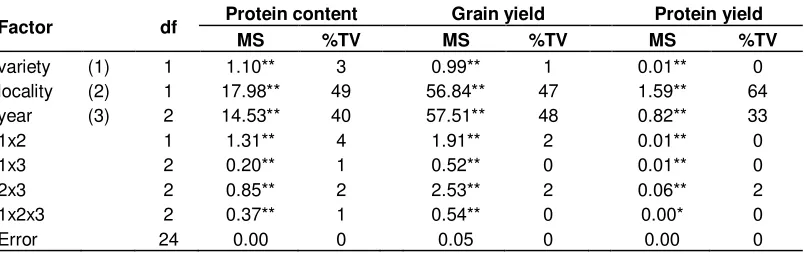
The yield level of emmer wheat varieties was 58% of the yield level of the control cultivars (SW Kadrilj, Vanek) and 69% of the yield level of old varieties of bread wheat. The total hectare crude protein yield was at the same level of difference as grain yield (comparison of varieties). On the other hand, the emmer wheat landraces were characterised by a higher crude protein content in grain (17.91%) than the old (15.08%) and control (13.73%) bread wheat varieties. The grain and protein yield were more stable in the case of the emmer wheat cultivars (Table 4). Evaluation of the impact of each factor and its interactions (ANOVA) have revealed significant differences between varieties.
[image:5.612.96.526.314.440.2]Table 7. Effect of experimental factors on selected agronomically important traits of old varieties of bread wheat (four varietes) (ANOVA).
Factor df Protein content Grain yield Protein yield
MS %TV MS %TV MS %TV
variety (1) 3 12.49** 12 8.50** 7 0.09** 3
locality (2) 1 45.10** 44 52.43** 43 1.77** 63
year (3) 2 35.92** 35 47.49** 39 0.71** 25
1x2 3 4.63** 5 2.46** 2 0.03** 1
1x3 6 2.59** 3 2.97** 2 0.05** 2
2x3 2 0.35** 0 6.73** 6 0.17** 6
1x2x3 6 1.64** 2 0.19* 0 0.00ns 0
Error 48 0.00 0 0.07 0 0.00 0
*P < 0.05; **P < 0.01; nsnot significant; MS = mean squere; %TV = percentage of total variability.
Table 8. Effect of experimental factors on selected agronomically important traits of control varieties of bread wheat (two varieties) (ANOVA).
Factor df Protein content Grain yield Protein yield
MS %TV MS %TV MS %TV
variety (1) 1 1.10** 3 0.99** 1 0.01** 0
locality (2) 1 17.98** 49 56.84** 47 1.59** 64
year (3) 2 14.53** 40 57.51** 48 0.82** 33
1x2 1 1.31** 4 1.91** 2 0.01** 0
1x3 2 0.20** 1 0.52** 0 0.01** 0
2x3 2 0.85** 2 2.53** 2 0.06** 2
1x2x3 2 0.37** 1 0.54** 0 0.00* 0
Error 24 0.00 0 0.05 0 0.00 0
*P < 0.05; **P < 0.01; nsnot significant; MS = mean squere; %TV = percentage of total variability.
These results have indicated the fact that the emmer wheat landraces were more adaptable to different climate characteristics of year and different levels of nitrogen content in the soil than the bread wheat varieties.
Conclusion
The emmer wheat landraces may be grown, if selected carefully, in low input or organic farming systems and in less favourable areas for agriculture too. Emmer wheat is able to become competitive against weeds and other biotic (diseases) and abiotic (e.g. low level of nitrogen fertilization) stressing factors. This advantage may be reduced by the low resistance of some varieties to lodging. Therefore, because of the high variability of the tested varieties, there is the possibility to select resistant varieties.
Furthermore, the total yield level was reduced by the placement of assimilates in straw and a less efficient distribution of grains. On the other hand, this fact may not be disadvantageous if a farmer needs a lot of straw.
Adaptability of the emmer wheat landraces to the land and climatic environmental conditions was another positive aspect (the emmer wheat landraces were much more adaptable than the modern bread wheat varieties). High crude protein content in grain was an advantage of the emmer wheat cultivars from the point of view of grain quality and processing. The aforementioned reasons suggest that after careful selection, emmer could be an alternative crop for low input agricultural systems.
ACKNOWLEDGEMENT
This work was supported by the research project No. NAZV QH82272 of the National Agency for Agricultural Research of the Ministry of Agriculture of the Czech Republic.
REFERENCES
[image:6.612.107.516.104.232.2] [image:6.612.111.514.309.436.2]Bucur D, Cîmpeanu S, Ailincăi C, Konvalina P, Moudry J (2010). Aspects Regarding the Energetically Efficiency of Irrigation of some Crops in Northeast Romania. Ann. Food Sci. Technol., 11: 50-53. Collins WW, Hawtin GC (1999). Conserving and Using Crop Plant
Biodiversity in Agroecosystems. In: Collins WW, Qualset CO (eds) Biodiversity in Agroecosystems, CRC Press, Boca Raton, pp. 267-282.
Cudney DW, Jordan LS, Hall AE (1991). Effect of Wild Oat (Avena fatua) Infestations on Light Interception and Growth Rate of Wheat (Triticum aestivum). Weed Sci., 39: 175-179.
D´Antuono LF, Galletti GC, Bocchini P (1998). Fiber Quality of Emmer (Triticum dicoccum Schubler) and Einkorn Wheat (T. monococcum
L.) Landraces as Determined by Analytical Pyrolysis. J. Sci. Food Agric., 78: 213-219.
Ehdaie B, Hall AE, Fagquahar GD, Nguyen HT, Waines JG (1991). Water-use Efficiency and Carbon Isotope Discrimination in Wheat. Crop Sci., 31: 1282-1288.
Hammer K, Perinno P (1995). Plant Genetic Resources in South Italy and Sicily: Studies Towards In Situ and On Farm Conservation. Plant Genet. Resour. Newslett., 103: 19-23.
Herrera-Foessel SA, Singh RP, Huerta-Espino J, Yuen J, Djurle A (2005). New Genes for Leaf Rust Resistance in CIMMYT Durum Wheats. Plant Dis., 89(8): 809-814.
Konvalina P, Capouchová I, Stehno Z, Moudrý J jr, Moudrý J (2010). Weaknesses of the Emmer Wheat Genetic Resources and Possibilities of its Improvement for Low Input and Organic Farming Systems. J. Food Agric. Environ., 8: 376-382.
Kotschi J (2006). Agrobiodiversity Vital in Adapting to Climate Change. Appropriate Technol., 33: 63-66.
Lammerts van Bueren ET. (2002). Organic Plant Breeding and Propagation: Concepts and Strategies. PhD Thesis Wageningen University, The Netherlands, p. 198.
Marconi M, Cubadda R (2005). Emmer Wheat. In: Abdel-Aal ESM, Wood P (eds.) Speciality Grains for Food and Feed. American Association of Cereal Chemists, St. Paul, Minesota, U.S.A., pp. 63-108.
Reddy MM, Yenagy NB, Rao M, Srinivasan CN, Hanchinal RR (1998). Grain and Gluten Quality of some Cultivars of Wheat Species and Their Suitability for Preparation of Traditional South Indian Sweet Products. J. Food Sci. Technol., 35: 441-444.
Stallknecht GF, Gilbertson KM, Ranney J (1996). Alternative Wheat Cereals as Food Grains: Einkorn, Emmer, Spelt, Kamut and Triticale. In: Janick J (ed.) Progress in New Crops. ASHS Press, Alexandria, pp. 156-170.
Stehno Z, Bradová J, Dotlačil L, Konvalina P (2010). Landraces and Obsolete Cultivars of Minor Wheat Species in the Czech Collection of Wheat Genetic Resources. Czech J. Gen. Plant Breed, 46(Special issue): 100-105.
Stehno Z, Manev IM (1999). Preliminary Evaluation of Triticum Turgidum Subpp. Dicoccum and Polonicum Accessions for Their Possible Use in Food Production. Annu. Wheat Newslett., p. 45. Trčková M, Raimanová I, Stehno Z (2005). Differences Among Triticum
Dicoccum, T. Monococcum and T. Spelta in Rate of Nitrate Uptake. Czech J. Genet. Plant Breed., 41: 322-324.
Troccoli A, Codianni P (2005). Appropriate Seeding Rate for Einkorn, Emmer, and Spelt Grown Under Rainfed Conditions in Southern Italy. Eur. J. Agron., 22: 293-300.
Vita P, Riefolo C, Codianni P, Cattivelli L, Fares C (2006). Agronomic and Qualitative Traits of T. Turgidum ssp. Dicoccum Genotypes Cultivated in Italy. Euphytica, 150: 195-205.
Van WJ (2006). Evaluation of Lodging. In.: Donner D, Osman A. Eds. (2006): Handbook Cereal Variety Testing for Organic and Low Input Agriculture. Louis Bolk Institute, Driebergen, Netherlands.
Wolfe MS, Baresel JP, Deslaux D, Goldringer I, Hoad S, Kovacs G, Löschenberger F, Miedaner T, Ostergard H, Lammerts van Bueren ET (2008). Developments in Breeding Cereals for Organic Agriculture. Euphytica, 163: 323-346.