I hereby declare that I have read this thesis and in my opinion this project is sufficient in terms of scope and quality for the award of
Bachelor of Technology Management (Innovation Technology)
Signature :………
Supervisor’s Name : Dr Murzidah binti Ahmad Murad
Date :………...
Signature :………
Panel’s Name : Datin Suraya binti Ahmad
A STUDY ON USER ACCEPTANCE TOWARDS THE USE OF ONLINE PAYMENT SERVICES
AFIQ FADHLI BIN ABD SAMAD
This thesis is submitted in partial fulfillment of the requirements for the award of Bachelor of Technology Management (Technology Innovation)
Faculty of Technology Management and Technopreneurship Universiti Teknikal Malaysia Melaka (UTeM)
DECLARATION
I hereby declare that the report has been prepared by my own self except the summaries and citation that I have been clarify the resources.
Signature :………
Name : Afiq Fadhli Bin Abd Samad
DEDICATION
ACKNOWLEDGEMENT
First of all, I would like to highly thanks to Dr Murzidah binti Ahmad Murad for her efforts in guiding us in term of advice of doing thesis report for Final Year Project, and evaluating thesis and also to my panel Datin Suraya binti Ahmad.
ABSTRACT
ABSTRAK
TABLE OF CONTENTS
CHAPTER CONTENTS PAGES
DECLARATION i
DEDICATION ii
ACKNOWLEDGEMENT iii
ABSTRACT iv
ABSTRAK v
TABLE OF CONTENTS vi
LIST OF TABLES ix
LIST OF FIGURES x
CHAPTER 1 INTRODUCTION
1.1 Background of Study 1
1.2 Problem Statement 2
1.3 Research Question 3
1.4 Research Objective 3
1.5 Significance of the Study 3
1.6 Scope and Limitation of Study 4
1.7 Summary 5
CHAPTER 2 LITERATURE REVIEW
2.1 Introduction 6
2.1 Online Payment 6
CHAPTER 3 RESEARCH METHODOLOGY
3.1 Introduction 12
3.2 Research Design 12
3.3 Methodological Choices 13
3.4 Primary and Secondary Data Source 14
3.5 Data Collection 14
3.6 Location of Research 14
3.7 Research Strategy 15
3.8 Time Horizon 17
3.9 Summary 18
CHAPTER 4 DATAANALYSIS
4.1 Introduction 19
4.2 Pilot Study 20
4.2.1 Perceived Usefulness 21
4.2.2 Perceived Ease of Use 21
4.2.3 Perceived Enjoyment 22
4.2.4 Safety and Privacy 23
4.2.5 Online Payment Acceptance 23
4.3 Reliability Test 24
4.4 Descriptive Analysis on Demographic 26
4.4.1 Gender 26
4.4.2 Race 28
4.4.3 Age 29
4.4.5 Online Payment Acceptance 31 4.4.6 Types of Online Payment 33
4.5 Descriptive Analysis 34
4.6 Result of Measurement 36
4.6.1 Correlation Analysis 36
4.7 Hypotheses Testing 38
4.7.1 Hypotheses Test Analysis 39
4.8 Summary 41
CHAPTER 5 DISCUSSION AND CONCLUSION
5.1 Introduction 42
5.2 Summary of Descriptive Analysis 43
5.3 Scale Measurement 44
5.3.1 Validity 44
5.3.2 Reliability 44
5.4 Discussion of Objectives and Hypothesis Test 45
5.4.1 Research Objective 1 45
5.4.2 Research Objective 2 46
5.5 Implications 46
5.6 Recommendation for Future Study 48
5.7 Conclusion 49
REFERENCES 50
NO. OF TABLE TITLE PAGES
4.2.1 Cronbach’s Alpha Perceived Usefulness 21
4.2.2 Cronbach’s Alpha Perceived Ease of Use 21
4.2.3 Cronbach’s Alpha Perceived Enjoyment 22
4.2.4 Cronbach’s Alpha Safety and Privacy 23
4.2.5 Cronbach’s Alpha Online Payment Acceptance 23
4.3.1 Cronbach’s Alpha Coefficient range 24
4.3.2 Reliability Test 25
4.4.1 Descriptive Analysis on Gender for Demographic 26 Analysis
4.4.2 Descriptive Analysis on Race for Demographic 28 Analysis
4.4.3 Descriptive Analysis on Age for Demographic 29 Analysis
4.4.4 Descriptive Analysis on Education for Demographic 30 Analysis
4.4.5 Descriptive Analysis on Online Payment Experience for 31 Demographic Analysis
4.4.6 Descriptive Analysis on Types of Online Payment for 33 Demographic Analysis
4.5 Descriptive Analysis 34
4.6.1 Correlation Analysis 36
4.6.2 Rule of Thumb Pearson Correlation 38
LIST OF FIGURES
NO. OF FIGURES TITLE PAGES
2.3.1 Online Payment Acceptance Framework 8
4.4.1 Gender 27
4.4.2 Race 28
4.4.3 Age 29
4.4.4 Education 30
4.4.5 Online Payment Experience 32
INTRODUCTION
1.1 Background of Study
Online payment (e-payment) has become a popular means today for paying for online purchases made. It seems that the growth of internet has facilitated the popularity of this payment instrument as electronic commerce (e-commerce) has created new financial needs that in many cases cannot be effectively fulfilled by traditional payment systems (Sumanjeet, 2009). As stated by Saffu, K., Walker, J.H. and Hinson, R. (2008) there is an increase in applications of e-commerce such as online payment services in businesses in the past ten years. Some of the benefits of e-commerce includes reduction in cost, increasing business opportunities, reducing lead time and providing a more personalized service to the consumers according to Turban, E., King, D., Lee, J., Warkentin, M. and Chung, M.H. (2008).
Ming-Yen Teoh, Siong Choy Chong, Binshan Lin, Jiat Wei Chua, (2013) this is supported by the strong buildup of broadband services and penetration rate in Malaysia.
1.2 Problem Statement
This research was conducted to find out the factors of user acceptance towards the use of online payment services. This research could be useful in order to understand the effect of a new technology such as online payment and how it could help assist in consumer’s daily life. As online payment technology is relatively new and even if people are aware of it, not many are fully understand of its concept and use it in their daily life. With this research, it would be a great sources to understand the reasons for peoples that are using online payment services and looking in their perspective to show the advantage and benefits that online payment services has to offer.
services?
2. What are the factors that influence user acceptance towards online payment services the most?
1.4 Research Objectives:
1. To identify the factors that impact user acceptance towards online payment services.
2. To identify the factors that influence user acceptance towards online payment services the most.
1.5 Significance of the Study
consumer’s perception and opinions as well as creating a new platform for business owner to expand their businesses through online payments and help them to understand consumer’s needs. Online payment has become very popular nowadays due to the increasing of various e-commerce sites in Malaysia so this will help to give new perspective towards the use of online payment services.
1.6 Scope and Limitation of Study
The scope of this research is to find out the factors of user acceptance towards the use of online payment services. This paper will provide an important aspect and fresh perspective from consumer’s perceptions towards a new technology. The study include in this scope will be focusing mainly in Melaka as its e-commerce technologies is growing rapidly. For instance, there’s a lot of potential in Malaysia as popular online payment methods have emerge such as credit cards and Paypal. The respondents from this study are the Gen Y users that are born between 1977 until 1994 that are aware of online payment services and are new in using the services. These respondents must be knowledgeable in new technologies, specifically online payment services.
CHAPTER 2
LITERATURE REVIEW
2.1 Introduction
This chapter will discuss about the factors that influence user acceptance towards the use of online payment is of interest both to researchers in a variety of fields as well as benefits large organizations. Moreover, the researcher will investigate the effectiveness of online payment services compared to traditional payment services. Additionally, this research will also study about the impacts of new technology such as online payment services. The present chapter also reviews literature which demonstrates the nature of technological acceptance by using Technology Acceptance Model (TAM) to investigate the factors that influence the acceptance towards online payment services.
2.2 Online Payment
electronic value of payment from a payer to payee through an e-payment mechanism which allows customers to remotely access and manage their bank accounts and transactions, executed through an electronic network (Sumanjeet, 2009).
2.3 Theoretical Framework
2.3.1 Technology Acceptance Model (TAM)
In 1986, Fred Davis launches the establishment of technology acceptance model (TAM) in an attempt to explain the usage behavior of computer technology (Davis et al., 1989). The goal of TAM is to predict information system acceptance and diagnose design problems before users have experience with a system. Besides that, TAM predicts user acceptance of any technology is determined by two factors: perceived usefulness and perceived ease of use. According to (Koufaris, 2002), several of studies have empirically tested TAM to investigate the acceptance of user of different technologies such as: word processors, spreadsheets, e-mail, voice mail, and also telemedicine technology. Since TAM existed, it has been adopted and extended by plentiful of empirical studies which have support the validity of TAM in explaining a broader range of issues related to the acceptance technology by users (Chen et al., 2002; Johnson and Hignite, 2000; Lin and Lu, 2000; Mohd Suki et al., 2006; Ramayah et al., 2003).
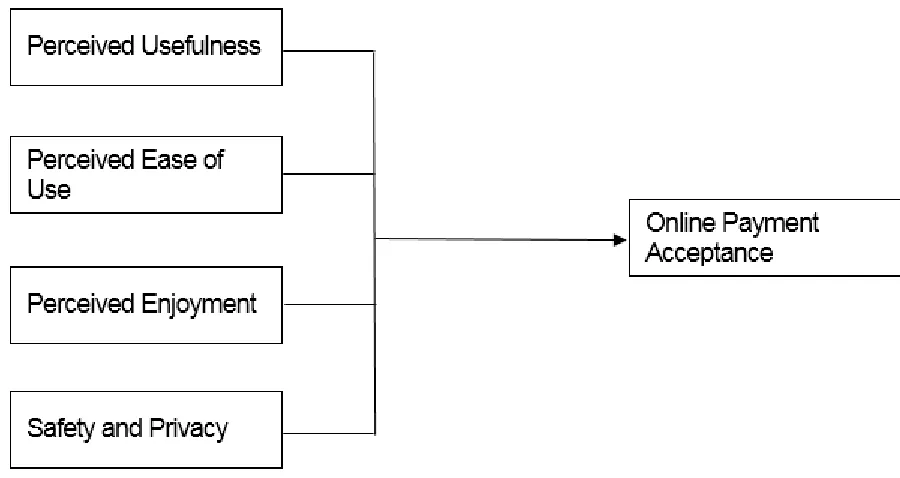
payment services before they actually experience it. According to Davis (1989), he assumed that user acceptance of technology depends on perceived usefulness (PU) and perceived ease of use (PEOU). Hence, the key factors of this model – PU and PEOU were considered to be influential in the capacity of providing perceived advantage to the user’s to influence them to switch to online payments.
Figure 2.3.1 Online Payment Acceptance Framework
2.3.2 Perceived Usefulness
system is online payment system. So, the researcher hypothesized that perceived usefulness has a significant impact on user acceptance towards the use of online payment:
2.3.3 Perceived Ease of Use
According to (Wang and Li, 2011) numerous studies have confirmed that a technology will be perceived as more useful when it is easier to use. Thus, PEOU states that the perception that using a specific technology will not require additional effort (Davis, 1989). In this case, online payment system will be perceived as more useful if it is easy to use and does not require additional effort. Thus, given that users do not have face-to-face interaction in an internet environment, user friendliness and the ease of use of the web sites will lessen the threat to use online payment by the customers.