
Cyberaide JavaScript: A Web Application Development Framework for Cyberinfrastructure
105
0
0
Full text
(2) Cybcraidc JavaScript: A Web Application Developn1ent Frainework for Cyberinfrastructure Fugang Wang Service Oriented Cybcrinfrastruture Lab. Rochester Institute of Technology Bldg 74, Lomb Memodal Drive, Rochester, NY 14623-5608 Email: [email protected]. February 18, 2010. A Thesis Submitted in Partial Fulfillment of the Requirements for the Degree of Master of Science in Computer Science. Committee ~bers: . Cl1air: ___________ __ _ Dr. Hans-Peter Bischof Associate ProJ"cssor Department of Computer Science, Rochester Jnstituc of 'Iechnology Rochester, NY 14623. Reader: _______ _ Dr. Gregor von Laszewski /\ssistant Director of Cloud Computing Pervasive T~chnology Institutue, Indiana University Bloomington, IN 47404. Observer; ---~-------~ Dr. Minscok Kwon Assistant Profcssor. Department of Computer Science, Rochester Institue of Technology Rochester. NY 1:1623.
(3) cmmttm. CONTENTS 6. 1. Introduction. 2. Background and Related Research 2.1 Grid Computing..... 2.2 SOA and Web Service ..... 2.3 Web Portal & Grid Portal.... 2.3.1 Web Portal Standards and Technologies Web2. 0 technologies and implication to portal development . 2 . 3 2 Grid portal - a survey and comparison . 2 . 3 3 Approaches to access Grid.................. 2.3.4. 8 8 11 13 1 4 6 1 0 2 2 1. 3. Design 3.1 Service Stack ...... 3.. 11 Mediator service 3.1.2 Agent service 3.2 Collaborative Queue .. 3.3 Web Client ....... 3.4 Security Considerations.. 23 26 26 27 7 2 9 2 3 3. 4 Implementation 4.1 Mediator service ................ . 4 2 Agent Service...... . . .......... JavaScript Application Programming Interface. . 4 3 . 4 4 Portal As A Web Client.............. 35 6 3 4 2 4 3 46. 5. 48. 6. Use Cases & Performance Evaluation 5.1 Ajax Portal for Teragrid. 5.2 Opensocial Gadgets... 5.3 Cyberaide Shell.... . 5.4 Performance Evaluation.. 48 50 5 2 58 63. Conclusion. A Appendix I List of Deliverables. 70. B Appendix II Administrator's Manual B.1 MEDIATOR SERVER INS TALATION B.1.1 Prerequisite.......... B.1.2 Service build and deployment B.2 AGENT SERVICE INS TALATION . B.2.1 Prerequisite.......... Service build and deployment B.2.2. 74. 2. 7 4 7 4 75 76 76 76.
(4) CONTENTS B.3 JAVASCRIPT API AND WEB PORTAL INSTALL B.3.1 Prerequisite ............ B.3.2 Web application/portal installation C Appendix III Portal User's Manual C.1 Introduction ........... C.2 First Look: Teragrid Information Services C.3 Authentication through MyProxy ..... C.4 Job Submission .............. C.5 Workflow Submission (by using Karajan) C.6 Job/Workflow management ........ C.6.1 Check status of previously submittedjob C.6.2 Retrieve result ofjob . C.7 File Management ....... C.7 .1 GridFTP File Transfer D Appendix IV Developer's Manual D.1 Introduction .. D.2 Authentication .... D.3 job submission ... D.4 workflow submission D.5 list submittedjobs for the authenticated user D.6 queryjob/workflow execution status .... D.7 query output filenames for ajob/workflow execution D.8 get execution output . D.9 file transfer ....................... 3. CONTENTS 77 77 77 78 78 80 83 83 87 87 87 88 90 90 94 94 94 95 97 98 99 100 101 103.
(5) LIST OF FIGURES. LIST OF FIGURES. List of' F'igures 1 2 3 4 5 6 7 8 9 10 11 12 13 14 15 16 17 18 19 20 21 22 23 24 25 26 27 28 29 30 31 32 33 34 35 36 37 38 39 40 41. Cyberaide Framework . Grid Architecture ... SOA .......... A portal structue example . An Example Ajax Portal Netvibe Ajax Portal . Ajax Model ....... System Architecture ... A scenario for a shared Queue. Security view of a typical use scenario Simple Portal UI Screenshot 1 Simple Portal UI Screenshot 2 Simple Portal UI Screenshot 3 An alternative Portal ..... Open Social Gadgets ..... Cyberaide JavaScript When Working With Google Gadget Gadget Version of Teragrid Job Management and File Transfer File Transfer Gadget in Canvas Mode ............ Cyberaide Shell Architecture ... . . ............ Architecutre Comparison of Cyberaide Shell and JavaScript Cyberaide Shell new Architecutre 1 ............. Cyberaide Shell new Architecutre 2 ............. Cyberaide Shell Working under Unified Architeture with JavaScript Overhead of the JavaScript API - Same Host ...... Overhead of the JavaScript API - NAT Wifi ...... Overhead of the JavaScript API - NAT Wired Network Portal UI in Mac OS X Style ...... Functionalities and Icons ........ . Portal With Multiple Windows Opened .. Functionalities For Unauthenticated Users Listing Resources For All The Types Resources Type Filtered ... . . . . Teragrid Network Performance Map Teragrid News/Events RSS Feeds . History Job Listing For Authenticated Users Submitting A Job To Available Resources Job Ids Shown For Status Query And Result Retrieval . Retrieved Job Execution Result Shown .. . ... Karajan Workflow Composition and Submission . History Job Listing And Management Check Job Execution Status . .... 4. 9 10 12 14 16 17 18 25 28 34 46 47 47 49 50 52 52 53 53 54 55 56 57 61 62 62 78 79 79 80 81 81 82 82 83 84 85 86 87 88 89.
(6) LIST OF TABLES 42 Retrieve And Display Job Execution Result 43 File Transfer Window ......... . .. 44 Choose Remote Resource To Browse File List 45 File Listing Being Processed . . . . . . . . . 46 File Listing Displayed For A Remote Resource 47 File Transfered From Remote Resource .... 48 Drag And Drop Style File Transfer ....... 49 File Being Transfered Between Teragrid Resources. LIST OF TABLES 89 90 91 91 92 92 93 93. List of Tables L 2 3. Application Programming Interface .................. Overhead As Percentage Of The Underlying API Execution Time(ms) Performance Data For The Same Host Case ............... 5. 31 59 60.
(7) 1. INTRODUCTION. Abstract This thesis work introduces a service oriented architecture based Grid abstraction frame work that allows users to access Grid infrastructure through JavaScript. Such a framework integrates well with other Web 2.0 technologies since it provides JavaScript toolkit to build web applications. The framework consists of two essential parts. A client Application Pro gramming lnterface(API) to access the Grid via JavaScript and a full service stack in server side through which the Grid access is channeled. The framework uses commodity Web ser vice standards and provides extended functionality such as asynchronous task management, file transfer, etc. The availability of this framework simplifies not only the development of new services, but also the development of advanced client side Grid applications that can be accessed through Web browsers. The effectiveness of the framework is demonstrated by pro viding an Grid portal example that integrates a variety of useful services to be accessed through a JavaScript enabled client desktop via a Web browser, as well as the opensocial gadgets for Grid task management and file transfer. Overall, Grid developers will have another tool at their disposal that projects a simpler way to distribute and maintain cyberinfrastructure related software, while simultaneously delivering advanced interfaces and integrating social services for the scientific community.. Keywords: Cyberinfrastructure, Web Service, Web Application, JavaScript, Grid Com puting, Grid Portal.. 1. Introduction. We are relying on high-performance computing more than ever to do scientific research. From the traditional high energy physics to Gene research, or from drug discovery to aerodynamics work, we cannot perform the works otherwise due to the system complicity requires more computing power and/or produces huge mount of data to be processed. Instead of maintaining such computing facil-. 6.
(8) 1 INTRODUCTION ities independently by each institute and organization, Cyberinfrastructure [1] proposes to build a new environment that could efficiently connect those computing facilities to achieve a higher goal for scientific discoveries. Teragrid [2]is a result of such effort, which connects computing facilities from institutes across the nation to provide huge computing and data processing potential to scien tific users. Grid computing is usually the underlying technology to achieve this. However, setting up a Grid computing environment to use the cyberinfrastructure is a pretty complicated work that requires skills not possessed by all the users from different fields. Grid abstraction has been proved through the Java CoG Kit [3] project an ideal way to lower the entry barrier of the Grid computing. To further continue this approach, together with the booming Web 2.0 and Software as a Service(SaaS) trends, we consider to construct yet a high level abstraction that enables Grid access from a web browser client. The thesis work provides a Service Oriented Architecture (SOA) [4] based Grid abstraction framework that allows us to access Grids through web client using JavaScript. In the framework, we are enhancing the previous approach with a number of advanced services as well as targeting JavaScript as the language of choice for the client to support Web 2.0 style portals. Through the framework we can integrate with a variety of Grid middleware and obtain access to the Grid fabric. The work focus primarily on the integration with Globus [5] and access to the TeraGrid. The framework contains a useful set of JavaScript toolkit to simplify this access. One of the advantages of the JavaScript API is that we can integrate a large number of commod ity libraries available in JavaScript to go beyond the traditional use of Grid technologies. Hence, we are able to leverage from data-structure libraries, social networking and communication libraries to enable Web 2.0 programming features and allow access to additional commodity cyberinfras tructure that would otherwise be difficult to be achieved. As a result the framework will be more than just a Grid client library. In order to emphasize this difference and its ability to function as an aide for integrating cyberinfrastructure in general, we use the term Cyberaide Javascript as the name of the project. 7.
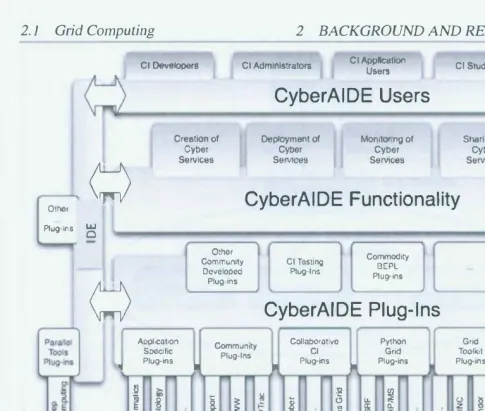
(9) 2 BACKGROUND AND RELATED RESEARCH The article is structured as following. We will discuss the background and the related research, technologies and standards first. It is followed by the system design section, which covers the architecture, service stack design and client side JavaScript library design. In the implementation section, the service stack in server side and the client side library are implemented, with some technical details covered. Evaluation & use cases section introduces several examples of web applications for cyberinfrastructure developed based on the framework and the JavaScript APL A list of deliverables from this project and some important documentations generated are listed as appendices.. 2 Background and Related Research Harnessing super computing power and processing large amount of data to get useful information is not always an easy problem. To better resolve this issue, the NSF answered with the concept of Cyberinfrastructure [1], the main goal of which is to lower the existing entry barriers to the high performance computing. The work of this thesis is part of the Cyberaide (Cyberinfrastructure Agile Development Environment) project [6]. The goal of this project is to develop methods and tools to address the development, deployment and use of the advanced cyberinfrastructure. Figure 1 displays the big picture. As an essential part of the Cyberaide project, Cyberaide JavaScript is to develop a framework that deals with Web application development for the advanced cyberinfrastructure. In this section we will introduce and discuss the background on which this thesis work bases as well as the related research & technologies.. 2.1. Grid Computing. Grid computing [7] is a metaphor that implies the access to computing power is as easy as access ing an electric power grid. Practically it is a kind of distributed computing, containing a number 8.
(10) 2.1. Grid Computing. 2 BACKGROUND AND RELATED RESEARCH. Cl D&veloi,ers. Cl Apptrcallon. Cl Administrators. Cl Studerts. Users. CyberAIDE Users. 01hor Plug,w,s. Paralcl. Toos Plug-ens. w w. Creation of Cyber. Deployment. of Cyber. Services. Monitorng of Cyber. Services. Sharing of Cyber. Services. Services. CyberAIDE Functionality. UJ. O. •. 01h01 Comrrunny Dovclopcd Plug ins. Commodtty BER Plug-ins. Cl Tasting Pfvg·lns. CyberAIDE Plug-Ins AopLca1,ori SJ)Ccific Plug•ins. Jj. �. 0. iS. Community Plug-Ins. •. i. t::. (). Cl). !. j � -. :i!. � :,. - �. Sensor Networks. � l!l i=. Collabot0t1Ve Cl Plug·ins F"'. i. �. .,. I�. u. !}i. � Cc. l �� • ?; ,- � � ,!! - -Cyberinfrastructure - - - - Q;l. Q :. ... �. Commodities. '. z. �. g §. -�-. 1. Absttact Science Services Plug-ins. .-,. F. Ii. 0. Gnd Toolkit Plug-ins. Py1hon Grid Plug•ins. g �. (!). Ji f. •. t. "'. II. 11. 32. i. � - � � �. I. Grid. Figure 1: Cyberaide Framework of geographically distributed computers connected by most likely high-speed networks under dif ferent administration. The loosely coupled computers may share computing resources like CPU cycles, storage spaces, etc. Grid provides an alternative way to access high-performance computing using a number of available computing resources, including a range from fairly cheap to expen sive mainframes or supercomputers. Currently the Teragrid [2] is the nation's largest collaborative effort providing an advanced cyberinfrastructure based on Grid technologies. A simplified Grid system is illustrated as in Figure 2. It is based on the job submission, status. query, result retrieval paradigm. Grid clients interact with some Frontend in the Grid, and the Frontend will do the job dispatch and coordination between the Backend, which does the actual. 9.
(11) 2.1. 2 BACKGROUND AND RELATED RESEARCH. Grid Computing. Grid Client Status & [ Results. Job submit. FrontEnd. Grid Service. . / / Job dispatch, Coordinate / BackEnd. J[. BackEnd. ]. [. BackEnd. Grid Infrastructure. Figure 2: Grid Architecture computing work. This will need some framework and tools to deal with the issues aroused like security, resources discovery and monitor, etc. Globus Toolkit is the de facto standard Grid computing middleware. It is the effort from an open source project. Globus provides ample functionalities for underlying job dispatch, and elementary shell based interface. Grid users, after authenticated himself/herself successfully, could submit a job to execute, query its status, and transfer large mount of data, etc. Globus utilizes internally Service Oriented Architecture. Together they are called Open Grid Service Architecture (OGSA). Globus Toolkit uses the Grid Security Infrastructure (GSI) as the security infrastructure, which provides transport layer security and message level security. A proxy certificate store is often used to deposit certificates and to facilitate the certificate credential delegation, by which some agent can delegate the execution of a complete workflow on behalf of the user. To use the toolkit in Grid. 10.
(12) 2.2 SOA and Web Service 2 BACKGROUND AND RELATED RESEARCH environment, first one need to setup and configure a Globus client environment, which includes some basic modules such as the myproxy module and gsissh module. Then we need to configure the trusted Certificate Authority (CA), making sure that the CA that issued the certificate for the Grid system we are going to use is in our trusted CA directory. After that you need to request a certificate that the Grid system will trust, or if you have already obtained the appropriate certificate, you can retrieve it from myproxy server through command line tool provided by the toolkit, and then login to some Grid frontnode through gsissh to perform grid computing. These steps are not trivial, and sometimes very error-prone. This makes setup a Grid computing environment is very complicated and tedious, which is typically jobs of well-trained system administrators. Java CoG Kit is a set of Java API that interfaces with Grid middlewares and commodity tech nologies. It provides a higher level abstraction of Grid services, through which grid users can get a user-friendly and more convenient environment to access Grid services that the Globus toolkit provides. The abstraction and provided API also simplify Grid developer's work, but do not expose every feature of the Globus toolkit. Java CoG Kit introduces a full-fledged workflow description language and engine called Karajan. The Karajan workflow engine provides an extended XML description in order to to describe workflows. This makes it easy to construct complete workflows, through use of dependencies and parallel constructs. Earlier version of the Java CoG Kit even provides a GUI for user to construct workflow. A Grid user could construct and edit a workflow by drag and drop manner. Due to rich features and easy usage, Java CoG Kit is widely used as the mechanism to interact with underlying Grid middleware and Grid infrastructure.. 2.2 SOA and Web Service Service Oriented Architecture (SOA) is a new approach to construct distributed application, espe cially business application [8, 9]. It is also widely used in Grid community including Globus Toolkit since version 4. The sim11.
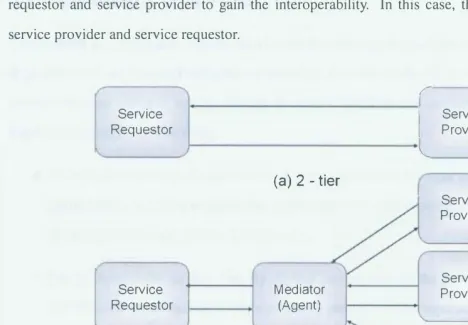
(13) 2.2 SOA and Web Service 2 BACKGROUND AND RELATED RESEARCH plest SOA based use case is a 2-tier architecture, one side providing service and another side consuming the service. W hile for some other cases, some mediator is needed between the service requestor and service provider to gain the interoperability. In this case, the mediator is both a service provider and service requestor.. /. Service Requestor. I. Service Provider. \,__. (a) 2 - tier. Service Requestor. Mediator (Agent). (b) 3 - tier. _,/. ( I. ' Service Provider. Service Provider. Service Provider. Figure 3: SOA The use of SOA can make the entities loosely coupled, so that each part can be modified and updated independently without impact on other parts, as long as the service contract is kept. Web service is a specific form of Service Oriented Architecture, which constructs a SOA through Web. So it can be widely used since web clients can be found almost in every computer for now. A web service is defined using Web Service Description Language(WSDL) [10]; to discover a web service, Universal Description, Discovery, and Integration (UDDI) [11] specification is used. Many web service standards and specifications are still emerging as well as evolving now, while some address security, reliable message transfer, and others transaction. However, the most commonly. 12.
(14) 2.3 Web Portal & Grid Portal 2 BACKGROUND AND RELATED RESEARCH used underlying protocol is SOAP [12], using XML to transfer messages over HTTP.. 2.3. Web Portal & Grid Portal. Traditionally a web portal is a website that is considered as an entry point to other websites. In these days since web services technologies are booming, the concept should go beyond the concept of entrance to other websites, but also include entrance to multiple web services. Web portals usually have the following characteristics: • Multiple sites/functionalities/services. A portal introduces a unique entrance to these multi ple resources, in such a way provides convenient for users that are interested in certain group of functionalities provided by multiple sites. • Single entrance/Single Sign-On. By signing on only once to the portal, users don't need to provide credentials each time when accessing resources from other administrative domains. A user typically delegate the credentials to the portal application, which will be authenticat ing the user automatically when necessary. • Consistent look and feel. Providing a user friendly interface and .consistent look and feel can increase users' experience. • Personalization. This is helpful when the target users of the portal may have various require ments and preferences. Obviously these characteristics define the merits why we are using portal. Grid portal shares the same features as typical portals. It provides a uniform environment for Grid users to interact with Grid services. Some basic functionalities include authentication, sub mitting jobs and monitoring jobs execution status. Other functionalities supported could be client side workflow composition, Grid information services, and collaborative environment. Specially. 13.
(15) 2 BACKGROUND AND RELATED RESEARCH 2.3 Web Portal & Grid Portal we need to pay more attention on user authentication and authorization since Grid is typically a system that across administrative domains. 2.3.1. Web Portal Standards and Technologies. In this section we discuss the traditional web portal standards and technologies, to be specific, JSR168 and WSRP. In the very early web era, a web portal was usually constructed by grouping the links to different sites into one portal page. With the increasing adoption of Java in multi tier web application development, A Java Portlet Definition Standard (JSR168) [13] was formulated. The standard follows the scheme of Java servlet, but introducing portal specific standard features. JSR 168 defines set of concepts like • Portal • Portlet • Portlets container which has relationships depicted through a portal structure example as in Figure 4.. Server. >-------<. CJ. ···- . ·--�. ... �-... ... .._,,·-. .. .. ·-· -. I��:·��.*!;���¥�::=•--�. .•�. ..,,. ......"'•'···:�:.:--....-..,. -0 0 Portlet. Window. Portlet Fragment. ;:i.. CJ) CD CD -,. Figure 4: A portal structue example 14. � r-Login g. () -0 0 Q)· :J CD ,-+. ;:i. CD ,-+ CJ>. B B Eelcom�.
(16) 2.3. Web Portal & Grid Portal Portlet mode could be one of. 2 BACKGROUND AND RELATED RESEARCH. • View/Edit/Help • Custom Portlet request handling defines types to deal with different request • processAction • render Portlet request could be respectively • ActionRequest • RenderRequest And so does the Portlet Response • ActionResponse • RenderResponse It works as following. According to its own mode, user request from a web page could be some action request, which may change state in server side, or simply a render request, which is just requesting to present the current state. Server responds by generating HTML fragment and assembling it into the whole page and then sending back to client side. Each portlet has its separated area in client side, and all the portlets are resides inside portlet container that controls the behavior of the portlets. Another existing standard is Web Services for Remote Portlets [14] verl (WSRP v l), which defines set of web services interfaces to interact with remote portlets. This standard, if being followed, usually works together with JSR168. 15.
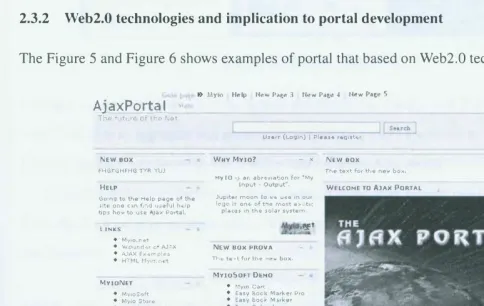
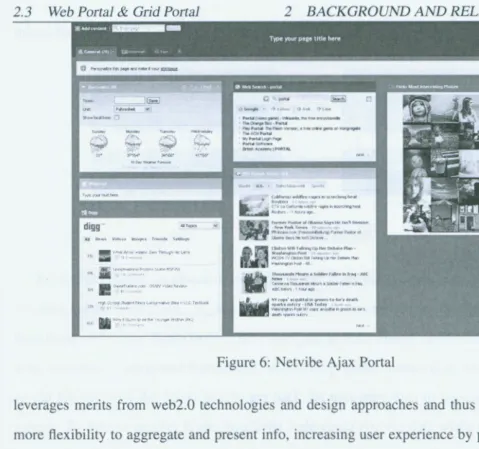
(17) 2.3. Web Portal & Grid Portal 2 BACKGROUND AND RELATED RESEARCH JSR168 has a reference implementation called Apache Pluto [15], which could be used as a. portlet container. Developers could develop JSR168 compatible portlets and deploy them into Pluto. Similarly WSRP also has a reference implementation Apache WSRP4J [16] Other popular portal frameworks include uPortal [17], OpenPortal [18], etc. The above mentioned are mostly based on relatively old web standard and technologies. Some emerging standards include JSR286, which is version 2.0 of the Java portlet specification, and WSRP ver2, would obsolete the current JSR168 and WSRP v l . They claims to support Web2.0 features like Ajax, REST. JSR286 would deal with inter-portlet interaction, which would be bene ficial for flexible data aggregation and presentation which are merits of Web2.0 based portals. 2.3.2. Web2.0 technologies and implication to portal development. The Figure 5 and Figure 6 shows examples of portal that based on Web2.0 technologies.. AJaxPort�J ,,.. �> MylO. H�lp. Hew P•t• 3. ll•w P•te �. tlew Pate 5 M>!.nu. The r- ,tun of the Net. U.stirr (Login) I Pla.u'lt regul:-e:r. NEW BO)( FHGFGHFHG TYR YUJ HELP GoinQ to the Help page of the .litfl ontt c:,n (,nd u!rnf<Jt IH,lp tips how to un AJax Portal.. WHY Mv10?. M•,;10.n•t W�) •Jr,d,hr ,., AJ.�.x AJAX fx<1mp!es H''!"ML �-1·/iO, r,t1t. x. MyIO •.l ar, abratvia'".ion for •My lnp;,;t - Output·.. NEW BOX T�,e text for the new box. WELCOME TO AJAX PORTAL. Jupiter moon Io w• use in our logo lr on,z, of the. rr;o,:t fl>«:-t,<: places in the solar S','stem. ....,. LINKS • • • •. -. NEW BOK PROVA Tiu, t.1. I; ft>r t:hoH nfflw box. MYJ050Fl. DEMO. Mv10NfT • • • • • •. M\•loS<':\ft l'•1vlo Sl:.-:.ro1: p.,y11fi:�·MFree Images My,,.) Lvgo Myto AdS,ems,e h•IP M\·lo Forum. DONATE Donate hough the about box in the rnenu bu In order to kll!ep Ajax Porhl devalopin'ijl. Copyri\1ht � 2004 Myio9oft ®. • • • • • • • • • • • •. My10 E•sy Easy Easy Eu�· Euy Easy Easy Euy Eat:•/ Easy Euy. Car+: Book Market Pro ao,:;I, M 1trker Calendar Cle1uifoo,ld.s Dynamic: p.,gu E:MCard; Gallery Mew; Onhne Ads Publish Publi,h P,·o. Tuts JS A TEST OO>C Haloookk I k1 ,.. Tut 2. �. S-tarch J Zlatii'til:.i I F<·rgo!; Pu1,wod l A.boul/[.•,;,nat... Powtmt•� b·, AJ11..; PNt.11 '),Q. Figure 5: An E xample Ajax Portal They have similar structure and functionalities as the old ones, in users' perspective. But it 16.
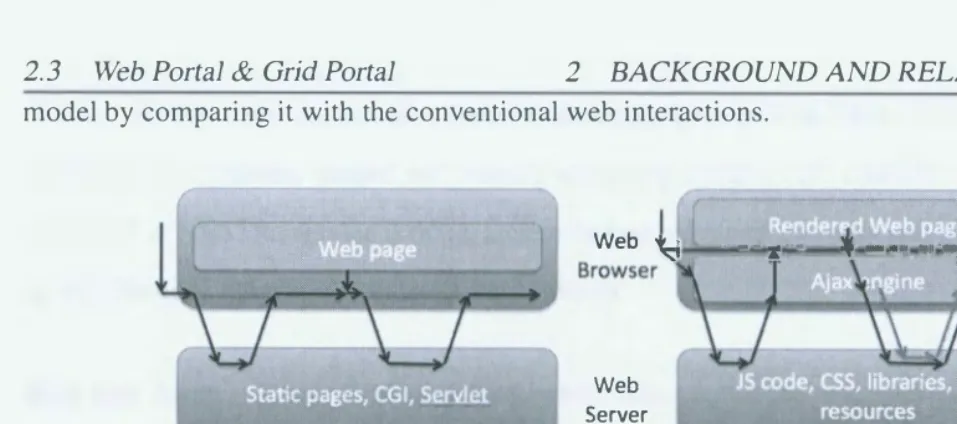
(18) 2.3. ... .~.otm: 1- -. 2. Web Portal & Grid Portal ~ · •1 Pttl·. ........ oltw1. ..... BACKGROUND AND RELATED RESEARCH. Type your PBRe title here. , .t.lQl'lkt. .... P.. tlll ( -....)·M ~, h l < M ~. 1,..-v. ,~. ~y. ~ J''G:'. The0ranlJ'!la:l • POl1111 Plllty',o,to, nwn.n v ..... , TheACM P0t1.i. ..•or*-..g,a,,aon1<ar999111. 111y,-u lL.19'P-.,.. -~ .... ~. flrlllltlAc.....,ll'OfllTAL. -,·~·. Figure 6: Netvibe Ajax Portal leverages merits from web2.0 technologies and design approaches and thus has advantages like more flexibility to aggregate and present info, increasing user experience by providing more user friendly interface and decrease user waiting time by using Ajax model. Web2.0 is still a very buzz word in its meaning, even after several years when it was coined. Basically it's a set of technologies and design patterns followed by developers, which includes but not limited to. AJAX. Asynchronous JavaScript and XML (Ajax) Representational State Transfer (REST) [19). Atom [20) and RSS [21 J Mash up Ajax itself is also a set of design patterns, which usually includes feature like XML [22) as data interchange medium. Asynchronous communication with server side. XHTML [23), CSS [24), and JavaScript [25) to manipulate and render DOM components. By following Ajax in development, it decreases user waiting time and increase user experience, which makes web applications more like desktop applications. Figure 7 depicts the merits of this 17.
(19) 2.3 Web Portal & Grid Portal 2 BACKGROUND AND RELATED RESEARCH model by comparing it with the conventional web interactions.. Web. �r .. --- -1-·····. Browser. '(· m ::___ ::::·-··-:=-. ·1 J. t. Web Server. Figure 7: Ajax Model For the old model, as shown in left side, server hosts static pages mostly, and each time user initiate a request from client, the page will halt and the user need to wait the requested content come back from server side. While in the Ajax model, server hosts mostly JavaScript code, CSS files and other resources. During user interaction, the JavaScript code, through Ajax engine in web browser, would interact with the server side to get back the necessary data to present, typically in XML format. By adding another layer, JavaScript code could retrieve data while not blocking current user's activities, and the result retrieved would be reflected in client side by callback function in JavaScript. It also has feature like secretly prefetch data that most likely would be used in the next steps. Thus when user performs a new request later, the result could be displayed instantly. A good example for this is Google Maps. When you focus on some place and display a certain area in window, the data of adjacent areas are prefetched during this time. So when the user pans the map zones, typically it has a very fast response time. REST. The term REST comes from Roy Fieldings doctoral dissertation [19] in 2000. It defines. resource as functionality with state. A web service is called RESTful when it follows REST de sign approach. RESTful service has advantages of simplicity and requiring less processing and thus lower overhead, comparing with SOAP [26] based web services. Each resource is unique addressable through URI. It simply uses HTIP verb GET, PUT, etc. to operate on the resources 18.
(20) 2 BACKGROUND AND RELATED RESEARCH 2.3 Web Portal & Grid Portal defined. It eliminates the use of additional message layer such as XML. Since state is implicitly contained in resources, session maintaining using http cookies [27] could be avoided. However a drawback of RESTful service is that it lacks a full set of standard to augment the web services such as WS-Security [28] in SOAP based web services. RSS and Atom. A server publish feed, while client subscribe and read them. It is a publish. subscribe model, but provides flexible aggregation and presentation mechanisms by applying a standard format for the feeds. Mashup Mashup is an approach that mingling and combining data from multiple sources, and presenting them in a new perspective. A typical example is online gas station locator while com bining address data of gas stations from a certain area and map info from such as Google. By combining data from the two sources, it presents them in a new form. Mashup typically provides more meaningful and more useful information by combining and sometimes derives new informa tion through that. Web2.0 technologies implication on portal development. As a comparison, we list the charac. teristics of the prevailing JSR 168 approach and web2.0 approach for portal. JSR 168 Portal • Generate markup segments for each portlet and assembly them into a full page. • Info aggregated at server side. • Portlets displayed side-by-side. • Old technologies and about to be outdated. Web 2.0 Portal • Combine raw data from different site/web services. 19.
(21) 2.3. 2 BACKGROUND AND RELATED RESEARCH Web Portal & Grid Portal • Content aggregation can happen in server side or client side. • Could combine data from different source and present in a totally new way. • Web 2.0 technologies used to provide better user experience. Through the comparison it is obvious that web2.0 is good to apply to portal development.. 2.3.3. Grid portal - a survey and comparison. Grid portal development has been going on for quite some time. The first usable library to support the development of Grid portals was the Java CoG Kit [29]. Based on the premise of the Java write once-run-every where concept the Java CoG Kit was designed explicitly to be a 100% Java-based library. Originally, Applets were developed that were soon enhanced by JSR l 68 [30] compatible portlets. These portlets were then integrated and enhanced as part of the Open Grid Computing Environments (OGCE) Project [31] and by Gridsphere [32]. Together these three projects (CoG Kit, OGCE, and Gridsphere) build a major foundation for the TeraGrid portal [33], which is one of the premier NSF sponsored resource in the U.S. to obtain access to Grid resources. TeraGrid uses the Globus Toolkit [5] to manage its Grid resources. Gridsphere portal framework • 100% JSR168 compliant • Easy to develop and integrate new porlets • Easy to create customized portal layouts • Built-in support for Role Based Access Control • Data persistence using Hibernate • Localization 20.
(22) 2.3. Web Portal & Grid Portal • Open source. 2 BACKGROUND AND RELATED RESEARCH. The Open Grid Computing Environments Portal and Gateway Toolkit (OGCE Portal) • JSR 168 compatible portlets • Grid credential management • Secure remote file management and code execution • Views of Grid Information service (GPIR) • Workflow composers (XBaya) • Open source Teragrid user portal • Provides Teragrid related information. • GSI-SSH terminal to login resources through inside a web page. • Uses GridSphere for some functionalities like file management. Other portals also exist, like Genius, Legion, Pegasus, etc. However, the current generation of Web based technologies have integrated JavaScript as one of the major offerings. Unfortunately, to date no JavaScript framework exists that lets us access the Grid easily. This is the main motivation of the work conducted through this thesis. 2.3.4. Approaches to access Grid. In this section we will summaries the approaches to access Grid. First we have tools provided by Grid infrastructure. Some of them provides specific tools like job queue management, while others provides a full infrastructure to construct and manage a Grid. 21.
(23) 2 BACKGROUND AND RELATED RESEARCH 2.3 Web Portal & Grid Portal This approach is most likely platform dependent, and requires a lot time to setup and configure the system. Some examples of this category are: • Condor [34], PBS, LSF, SGE • Globus [5], UNICORE [35], EGEE, Legion Middleware/Upperware is built upon the Grid infrastructure, wrapping the functionalities and provides an abstraction layer for user. This approach provides ability to across platform and even across different Grid infrastructrre. It also requires less work to setup and configure. Some typical examples are: • CoG Kit [36]. On top of Globus, while some components are used by Globus, it provides command line tools and Java library to access Grid. The built-in Karajan workflow engine enables easy workflow composition and execution. • Gridway [37]. A cross infrastructure meta scheduling framework, hiding complexity of the underlying Grids. Grid Portal is yet a higher level abstraction, which requires a little, if any, installation and configuration. Now users could access Grid by simply using a web browser. Some Grid portal examples are: • Teragrid portal [38]. Teragrid users' portal. Information service regarding the Teragrid is provided. It also has file operation functionality over the resources that the user have access to. A GSI-SSH terminal is used to login the resources through inside the web page. • Gridsphere [39], OGCE portal [31]. Two similar projects, both JSR 168 compliant frame works, provide most of functionalities to access Grid.. 22.
(24) 3 DESIGN From the evolving of the approaches we could summaries the road to access Grid as a process of abstraction in which for each transition a newer toolkit reuses the exist toolkit and builds upon them while providing more friendly user interface and easy-to-use application interface. Globus Toolkit provides infrastructure and command line tools to access Grid. Java CoG Kit, while provides command line tools for the similar functionalities, extends the functionalities to support more feature such as GUI based workflow composition. Gridsphere and OGCE, on another hand, introduces JSR-168 based portal framework and portlets, from which users can access Grid from a web portal. Teragrid also provides a web portal for Grid users, from where users could manage their accounts, monitor resources, and access to Grid through a GSI-SSH terminal. While providing the same or similar functionalities, if not more, a newer generation of toolkit or framework requires less time to install and configure. Web portal based technologies free users from the burden by requiring only a little to setup from a client. The proposed Web 2.0 technologies based JavaScript abstraction framework and portal use newer technologies and follow newer design philosophy and patterns like SOA and AJAX based interaction between web client and server. It hides the complexity to interact with Grid and cy berinfrastructure on the backend service tiers, and requires zero installation in client side. This essentially becomes a Software as a Service(SaaS) solution.. 3. Design. In order to design the framework and a JavaScript library for the Grid the following requirements are identified as essential features: • Low installation footprint is necessary to support fast downloads as well as an easy setup and maintenance through a small manageable code base. • Ease of use is important to make the JavaScript based API and interfaces useful for Grid and Web developers. 23.
(25) 3 DESIGN • Security is needed to gain access to Grid resources in order to avoid compromising the sys tem. This is especially important for web applications. • Basic Grid functionality must be provided in order for developers to create Grid-based client applications. • Advanced functionality is needed as many developers do not want to replicate functionality provided by other Grid middleware and upperware. This includes more sophisticated job management functionality, workflow queues, and the availability of elementary graphical user interfaces (GUI). To fulfill these requirements, the framework is methodologically designed as a layered multi tier architecture. The architecture is comprised of several components. The most important com ponents of the architecture are depicted in Figure 8 and more detailed info will be explained next. The architecture contains a Web client providing access to basic and advanced Grid functionalities, as well as the service stack to support the functionalities. To keep the footprint of the library small most of the functionalities in regards to the Grid are executed on a secure server. As this server mediates the tasks to the Grid, we refer to it as the mediator service. First, the Web client provides a high-level application programming interface (API) to the Grid, a Grid workflow system, and components to access simple Grid functionality through graph ical user interfaces. While using the API the developers can build portals specifically targeted for Grids and integrate customized JavaScript-based GUis. Furthermore, the framework provides im portant functionalities such as authentication, file transfer, job and workflow management. These components will be deployed into an application server such as Apache Tomcat. They will be downloaded and run from within a web browser at runtime. Then comes to the service stack behind the scene. All interactions to the backend Grid or cyberinfrastructure are conducted through the backend mediator service. The mediator service is responsible for communicating with Grid services through underlying Grid middleware such 24.
(26) ------------------------------------------------1 :I I: 3. I I. ,a. ·�. --. I (I) ltD. I<. Portal. I. :E. I 1(1) IC" I� 1(1). - - I. --. I. Web services interface / Agent service. ..... l'c. Cc. :8 .2. ii. ...... � User OB. I. I I I I I. ---------------------1--�---�--���-�-�-----�· ----------------------·- -' --�-----------�-�---" JavaScript CoG API. �c<:ount. I I. I. Workflow composite and management. I. I I I I I I I. DESIGN. .!,!�. .§1: .2... <l�. �i !� ::Ei - · _____. __. C. .2 �. ·I! "' ... �u .a ... :, :, .Q Ill. ... c:1 ·! su ..e. I. .2 C:. GI 111 � IP .. :I. e_ ,2 �. .2. n,. !�"'e. 8. !. I! .80. .5 I. :l/li. ".... :I. 8 i!!. :!l. g•. s. a .!f !;. g_. Application Logic / Mediator service. I. !. !. !. I I I. I I I I. .,,--...... _., Joba. ......_.... I. OB. I. -----------r---------------------r----------,,. SSH / Globus Toolkit / Java CoG Kit API I Karajan. Grid & Cyber Infrastructure. II. MyProxy Server. t. I I I I. I -1. Figure 8: System Architecture as the Java CoG Kit, Globus toolkit, or even SSH. Meanwhile it exposes the Grid services via standard Web services. It allows the use of a personal queue management mechanism that keeps track of all jobs and workflows submitted to the Grid in a more convenient form than the current generation of Grid middleware, such as the Globus Toolkit. The mediator service contains several essential functional modules such as user account management, authentication, job and workflow management, collaboration queues, and a persistence module allowing users to keep track of their jobs and tasks on the Grid. An intermediate component exists called agent service that handles all communications be tween the web client and the mediator service. This means the agent service acts both as a service. 25. -.
(27) 3 DESIGN 3.1 Service Stack provider to the web client and as a service consumer of the mediator service. The agent service forwards the action requests to the mediator service, which ultimately sends requests to the Grid services. The results come back from the Grid through the mediator to the agent, which in tum for wards the information back to the client. We have to host the JavaScript files, CSS files and other resources in some web container, and according to the same-origin policy for JavaScript [40], we need to put the web service that the JavaScript calls in the same web container. By separating the real application logic and putting it into the mediator service, it is possible to host the services on different machines, which would increase security and scalability.. 3.1. Service Stack. As described before, the server side contains two logical layers, the Web services interface also referred to as user Agent service and the Mediator service that builds the bridge between the Grid and our client library. This design separates the real application logics that interact with Grid and the services which should be hosted together with the client in some web container like Apache Tomcat. This increases the system security and scalability. 3.1.1 Mediator service The mediator service is where the application logic code resides. It contains several modules to deal with different functionalities and offers a persistent view of interactions with regular Web ser vices, Grid services, or authentication. While the agent service just forwards all requests from the user to the mediator service, the mediator service supports multi-user concurrency by maintaining session and state for each user. A persistent database is used to maintain state about workflows and collaboratively managed queues. It is important to recognize that our notion of compute tasks exceeds that of the basic Globus functionality. It also allows one to integrate services into the tasks managed by a user that are not typically executed by Globus. Thus a query to Web services offered by another organization like Google can be readily abstracted a task with its own status. Hence,. 26.
(28) 3 DESIGN 3.2 Collaborative Queue our task model includes not just tasks that are executed on Globus enabled Web services. 3.1.2. Agent service. The agent service functions as an intermediate service between the Web client and the mediator service. It hides much of the complexity of the Grid and allows for the deployment and integration of resources where the installation of Grid middleware is not possible. Hence, it works as a proxy for users to interact with the mediator service, and through it to Grid services. It can perform proxy credential delegation for users to authenticate to the Grid and to provide single sign on. The agent uses web services to provide functionality calls and communication with web client. Thus, the agent service itself is a service provider for the client but also a service consumer of the mediator service.. 3.2. Collaborative Queue. Besides the typical Grid functionalities such as authentication, job management and file transfer, the design includes features that enable users to share and manage workflows among a group of users collaboratively. As such a shared workflow and a shared queue that can contain multiple workflows to be executed are defined. Through the concept of sharing user-based access control supported by ownership and group based access control supported by membership in a participant list are provided. To fulfill this functionality, we have defined the objects representing a shared queue and a shared workflow:. 27.
(29) 3.2. 3 DESIGN. Collaborative Queue. /. / /. /. Queue Zone. /. /. /. /. /. D. DD ...... ! ! ,t. I. Ownership of a queue. A shared workflow. Ownership of a workflow. A workflow being edited. Currently editing. A user. Figure 9: A scenario for a shared Queue. (queueID, label, owner,. queue. participants, objects). (workfiowID, label, owner,. workflow. lastmodbyuser, lastmoddate, writeToken, type, WFObj), The attributes to these objects are as follows: • label is a field to store a meaningful label to identify the object easily.. 28. -. -. -----------~~-. -~.
(30) 3.3. Web Client • Queue!D is a unique ID for the queue.. 3 DESIGN. • owner for the queue is the one who created the queue. Only the owner can grant other users access to the queue. Ownership can be transitioned. • participants contains a list of participants that are allowed to modify the queue. • objects represent workflows managed by this queue. • workfiow!D is a unique id for the shared workflow. • lastmodbyuser is the last user who modified this queue. • lastmoddate is the last time when it is modified by a user. • write Token is a lock to guarantee atomic write operation of the workflow object. • type is the object's type. It could be system executable script or Karajan workflow, a Globus job, a file transfer, to name only a view. • WFObj is the workflow description wrapped in this workflow object. It is obvious from the definition of the attributes to that it will be possible to provide a shared workflow. As pointed out before, it is important for the activities typically conducted within an ad-hoc virtual organization to coordinate computational experiments as part of group activities. To support the notation of Workflows we have introduced a number of supporting APis that makes the development of workflow related tasks easy for clients and services.. 3.3 Web Client The Web client is where Grid developers develop Grid web applications or science gateways based on the Cyberaide JavaScript APL The API provides the elementary functionalities to access the. 29. 0.
(31) 3.3 Web Client 3 DESIGN Grid, while users could utilize other JavaScript libraries or integrate their own to build Web 2.0 Rich Internet Application (RIA) for Grid. As an example and proof of the toolkit's usability, a simple portal user interface is included. The portal fulfi1ls the tasks by using the JavaScript API allowing access to a number of essential Grid services. These services provide the following functionalities to the user: 1. Creation of jobs and workflows on the client side; 2. Job and workflow composition and submission for execution. 3. Information queries and monitoring of the status of jobs and workflows. It is important to note that at this time Globus GRAM does not support managing jobs by multiple users. We are able to provide this functionality because all user jobs are managed through the mediator service that allows jobs to be executed through a service in behalf of a coordinating user. One of the most important feature for many users will be the definition of APis in JavaScript dealing with job files, and security management. Based on the lessons learned from the Java CoG Kit, we designed APis in JavaScript that address the we11-established functionalities needed by many users [41]. This includes tasks that manifest themselves as authentication, file transfers, jobs, status queries, workflows [42]. The essential of the API is illustrated and explained as in Table 1 . Please note that although JavaScript is not a strong typed language and does not provide a gen eral mechanism for defining a class or object-type definition [25], it is a well-established practice to define custom objects in JavaScript that behave, in many ways like classes in Java. It achieves these through the prototype mechanism, and provides most of what Object Oriented language could achieve. Hence we use the term JavaScript classes throughout the table and rest of the text. We have divided the application programming interface(API) into multiple categories. These 30.
(32) 3.3. Web Client. 3. DESIGN. Table 1: Application Programming Interface Class. org.cyberaide.js.jsExecutable - functions related to Job and Workflow Abstraction Object with a number of attributes that abstracts the concept of execution ofjobs.. Class. org.cyberaide.js.jsAuthenticator - functions related to Security authenticate (callback) Authenticate through the attributes by using the provider defined in the jsAuthenticator object.. 0. Class 0. 0. 0. 0 0 0. 0. Class 0 0. 0 0 0. Class 0 0. 0 0 0 0 0. 0. 0. 0 0 0. 0. org.cyberaide.js.jsUtil - functions related to User Job Management authenticateUsAuthenticator, callback) The jsAuthenticator's authenticate() function will be called. For example, if we use in the attribute provider as part of the jsAuthenticator class attributes the value MYPROXY, then a myproxy authentication will be carried out. submitUsExecutable, callback) Submit an Executable to server for asynchronous execution. transfer(source, destination, callback) transfer data from source to the destination each of which are defined as URI. A transfer itself is packaged as a submit function and is treated the same way as other executables are. list(callback) List all the jsExecutables submitted to the server. queryStatus(executablesids, callback) Get state of the set of executables specified by their ids. queryOutput(executableids, callback) Get list of all the output files the set of executables specifled by their ids. getOutput(executableids, resultFile, callback) Get back the content of one output file of the specified executable ids. org.cyberaide.js.jsWorkflow - functions related to Client Side Workflow Management A new job with a given name is added to this workflow. addJob (name, jsExecutable) deleteJob (name) The job with the name specified by parameter job name is deleted. As a result, all related dependency is deleted as well . listJobs() List all jobs in a work flow. addDependency (parent, child) Add dependency between a job patent and the child. removeDependency(parent, child) Remove dependency between a job parent and child.. org.cyberaide.js.jsQueue - Server Side Shared Queue Management listQueues(callback) List all the queues that the user are participating. grantAccess(queueID, userlist, callback) The owner of a queue can give some other users access privilege to the queue. add(queuename, jsWorkflow, callback) adds a workflow to the queue to be executed. remove(queueID, workflowID, callback) The owner of a work flow can remove it. list(queueID, callback) list all workflows' metadata shared in the queue. listParticipants(queueID, callback) List all the participants of the queue. listByName(queueID, username, callback) List the work flows ' metadata owned by a user from one queue. listByType(queueID, provider, callback) List all the workflows' metadata with the specified type, say, Karajan workflow, from the specified queue. getStatus(queueID, worknowID, callback) Query the specified workflow's status. It could be locked since being edited by a user. browseWorkflow(queueID, workflowID, callback) Download the workflow to client side to browse. obtainWriteToken(queueID, workflowID, callback) The user try to obtain the write token . editWorkflow(queueID, workflowID, callback) The user wil l try to obtain the write token and then to download the workflow to edit. updateWorkflow(queueID, workflowID, WFObj, callback) Update the modified workflow when complete editing.. 31. -. --. - -· ..
(33) 3.3 Web Client 3 DESIGN include JavaScript objects dealing with jobs, workflows, and authentication. In addition we provide functions that are used as part of workflow management, job management, and queue management. The org.cyberaide.js.jsExecutable class is used to define an object that will be executed in the Grid, which could be a single job or a number of jobs that are part of a larger workflow. In summary, the class has two important fields: a provider and attributes. A provider could have the values system, cog-karajan or any other value referring to a workflow engine assuming that support for the workflow type exists within the gridshell. Attributes describe properties of a task to be executed. The org.cyberaide.js.jsAuthenticator class is used to wrap an object that handle the authenti cation in the JavaScript. It has a provider and attributes fields and uses an authenticate() function to initiate the authentication with the server. The provider represents the authentication method to be used. Currently the MyProxy authentication is supportted. The attributes contain the nec essary information to authenticate the user while using the method provided in the Provider field. For MyProxy authentication, the attributes should contain the MyProxy server's hostname, port, usemame and corresponding passphrase to retrieve the proxy credential. The org.cyberaide.js.jsUtil class uses the other defined classes to perform the interactions with the Grid services, through the agent service and Mediator service. The callback functions has a sin gle parameter jsonRet, which contains a JSON [ 43, 44] formatted object containing the response. To avoid security issues this response is wrapped into a single object as discussed in [45-47]. The org.cyberaide.js.jsWorkflow class represents a CoG Karajan workflow. A CoG Karajan workflow can contain multiple jobs, and it supports hierarchical workflow, which means a work flow could be a job in another workflow. A user can manage jobs with dependencies between them as part of a single workflow. The org.cyberaide.js.jsQueue class is used to define objects that deal with the interactions be tween the web client and the server side's collaborative queue management functionality. Users are able to store workflows composed on client side to the server side shared queue zone through 32.
(34) 3.4. Security Considerations. 3. DESIGN. a jsQueue object. T hese workflows can also be managed and shared between users. Callback functions and the returned JSON objects share the same arguments as that in the jsUtil.. 3.4. Security Considerations. Naturally, security is of utmost importance in the development of any portal framework to the Grid. It is important to identify possible security issues that may arise in a JavaScript-based solution. Since HTTP is stateless, we need to maintain some method to record users' states. Typically this is done by using HTTP cookies [27] which may include user and/or session related informa tion. However, due to the well-known Cross-site Scripting(XSS) [48, 49] and Cross-site Request Forge (CSRF/XSRF) [50] vulnerabilities, we avoid the use of cookies to minimize the potential risk of these attacks. Instead we use a security token that is assigned to an authenticated user in order to prove users' identity during the session. Security tokens maintain session information in similar way to cookies. Since we maintain the token only inside a JavaScript object during a session, it is immune to cookie related attacks, which typically access the cookie using document.cookie [51, 52]. The security architecture is supported by the following features. • HTTP over SSL/TLS (HTTPS) [53] is used between the web client and web server to gain transport layer security. • WS-Security standard [28] is used to secure the Web service traffic between the web server and the underlying Mediator service. • Grid Security Infrastructure (OSI) [54] is used between the mediator service and the Grid. To better understand some of the security aspects we walk through the following scenario where a user authenticates using MyProxy and performs tasks such as job submission, status query and result retrieval. In Figure 10 flows are corresponding to (A) user authentication request, (B) 33.
(35) 3.4. Security Considerations. 3. DESIGN. Web Client {Browser) A. HTTPS ~. C I,). A1. U/P. T. B~. I ~. ... Ii>. C1. T + Grid Task I 1J. 0~ Return. Agent service _., I l. A2. WS-Securit y ~. U/P 17. ~3. ~. U/P I. 'J. I J. T. B,. T + Grid Task I. Proxy Credential ... GSI. c. 7. Return. o;. Mediator service _.,. c~. I ). B1. Success/Fall B. MyProxy Server ... I. ' .,. Grid Task. 01. Grid/ Globus Gram Server. ~. Return. D. '. __... Figure 10: Security view of a typical use scenario authentication response, ( C) Grid related actions request and ( D ) Grid responses. A flow consists of multiple steps that are indicated by the inclusion of a number for the step. 1. An authentication request is shown by flow (A ). A user tries to login to the system by providing the usemame/password (U/P) in the web client as in step (A 1 ) . HTIPS guarantees that the traffic is secured between the browser and the agent service. The agent service then forwards the user credential to the user authentication module in the application logic layer (A 2 ). The authentication module could be used together with a user account management module or an external federated identity system such as MyProxy as in step (A3 ) . 2. An authentication Response of the authentication request from server is conducted as part of 34.
(36) 4 IMPLEMENTATION Flow (B). If the user provided a valid credential, then a security token (T) is returned to the agent service from the mediator service, as in step (B2 ). The security token finally returns to the web client, which is depicted by step (B3 ). The token is generated randomly each time. The authenticated username and corresponding security token are maintained in a map so the token could be used later to prove the user's identity and also function as a session ID. This mechanism is similar with what is used in HTTP cookies. Implementing a cookie solution is avoided to eliminate the cookie related security vulnerabilities. 3. Grid related actions such as the submission of jobs, status queries, or retrieval of results are represented by flow (C). The client JavaScript API will append the security token to the user's request to the agent service as shown in step ( Ci ) to prove the user's identity during the current session. Next the agent service could forward the task appended with the token to the mediator service, as shown in step (C2 ). Then the token is checked for validity in the mediator service. If it is valid, the mediator service will invoke Grid services as desired as shown in step ( C3 ). When the user logs out of the system or the session duration is expired, the security token will be invalided and recycled by the Mediator service and no further actions will be carried on to the underlying Grid services. 4. Grid responses that occure during task submission are shown in flow (D). The responses of the Grid related action requests are forwarded all the way back up to the client, which is shown in steps (D 1 )through(D3 ).. 4. Implementation. The system is based on object-oriented model and Service-Oriented Architecture (SOA) [4]. Enti ties in the system are all objects, while the SOA is used for the interaction between the distributed objects. The benefit of this approach is that it enables a loose coupling between distributed objects.. 35.
(37) 4 IMPLEMENTATION 4.1 Mediator service Thus, our concern is how to manage contracts between services and not the actual implementation details of the objects that may be implemented in different languages and frameworks. As long as we keep the contract between entities, changes on implementation of one part would not affect other parts of the system. Java is used to develop server side application logics and Web services. After comparing the Apache CXF framework is chosen to facilitate the service stack development. CXF supports JAX WS quite well, so we could use standard Java SE 6 web service technologies to write code, while using the tools from the CXF framework to assist the development and the deployment of the Web services. Apache Maven [55] is used to manage the project code base. This is quite useful for such a project that has complicated Jar dependencies and building process.. 4.1. Mediator service. In the implementation of the mediator that interacts with the Grid, we use the Java CoG Kit API and command line tools. Thus, through the Java CoG Kit we can enable proxy credential retrieval and delegation. In more detail, the Java CoG Kit JGlobus module provides functionalities to handle the interaction with MyProxy [56]. As long as a user stored his/her credential on a MyProxy server, the user can retrieve the credential by providing the username and user phrase at time when the proxy credential is generated. Thus the user delegates the application server to communicate with the underlying Grid infrastructure during the user session without the need to authenticate each time a job is submitted or a status query is issued. To expose this service to the client, it is implemented and deployed as web service. WS Security is used to secure the service traffic, either by Username-Token mechanism or PKI mech anism. Apache CXF framework [57] is used to develop and secure the mediator service due to its simplicity. For the Username-Token approach, we need some method to maintain valid user accounts. The user account info could be maintained in several states, either through a file or a 36.
(38) 4 IMPLEMENTATION 4.1 Mediator service persistent database. A Java interface is defined to achieve this. Implementing this interface with different mechanism could achieve different management schema. /* * IUserAccount.java */ pack age org. cyberaide. account;. I** * Define user account management interface for WS-Security 's UsernameToken * solution */ public interface IUserAccount{. I** * add a user * * @return true for successful operation and false otherwise */ public boolean addUser(String username, String password);. I** * delete a user * * @return true for succseeful operation and false otherwise */ public boolean delUser(String username);. /* * * change password for a user * * @return true for successful operation and false otherwise. 37. -. ---. -. ". ----------- -. - -. ~.
(39) 4.1. Mediator service. 4. IMPLEMENTATION. */ public bool ean changePasswd(String username, String newPasswd);. I**. * r e set user's password * * @return a string repr e sents the new password */ public String r esetPasswd(String username);. I**. * check user credential's validility * * @r eturn true for valid cr edential and f al se otherwise */ public bool ean i sValid(String username, String passwd);. I**. * get a user's current password */ public String getPassword(String username);. }. Tools and APis from the Java CoG Kit and the Globus toolkit are used to establish the inter action with Grid services. Furthermore, the Java CoG Kit Karajan workflow framework is used to support workflow composition. WSDL document is the standard way to define and describe a Web service. A Web service version of the Hello World example could be described as this: < ?xml version ="l.O" encoding="UTF-8"?> <w sdl: definition s name="HelloWorld". 38.
(40) 4.1. Mediator service. 4 IMPLEMENTATION. targetNamespace=" http :/ /www. example. org / HelloWorld /" xmlns:wsdl=" http :/ / schemas. xmlsoap. org / wsdl /" xmlns: tn s=" http :/ /www. example. org / He! loWorld /" xmlns:xsd=" http :/ / www. w3. org /2001/XMLSchema" xmlns: soap=" http :/ / schemas. xmlsoap. org / wsdl / soap/" > <wsdl: types/> <wsdl: message name=" sayHelloRequest"> <wsdl: p a rt name=" sayHelloRequest" type=" xsd: string"></wsdl: part> </wsdl: message> <wsdl: message name=" sayHelloResponse"> <wsdl: part name=" sayHelloResponse" type=" xsd: string"></wsdl: pa rt> </wsdl: message> <wsdl: portType name="IHelloWorld"> <wsdl: ope ration name=" sayHello"> <wsdl: input message=" tns: sayHelloRequest"></wsdl: input> <wsdl: output message=" tns: sayHelloResponse"><lwsdl: output> </wsdl: operation> </wsdl: portType> <wsdl: binding name=" HelloWorld" type=" tns:IHelloWorld"> <soap:bin ding style=" rpc" tra nsport=" http :/ / schemas. xmlsoap. org / soap/ http" I> <wsdl: ope ration name=" sayHello"> <soap: ope ration soapAction =" http :/ /www. example. org / HelloWorld / sayHel Io" /> <wsdl: input> <soap:body use=" l ite r al " namespace=" http :/ /www. example. org / HelloWorld /" I> </wsdl: input> <wsdl: output> <soap:body use=" lite r al " namespace=" http :/ /www. example. org / HelloWorld /" I>. 39.
(41) 4. 1. Mediator service. 4 IMPLEMENTATION. </wsdl: output> </wsdl: operation> </wsdl: binding> <wsdl: service name="HelloWorldService"> <wsdl: port name="HelloWorldPort" binding=" tns:HelloWorld"> <soap: address loc ation=" h ttp : / / localh ost :8080/HelloWorld" I> </wsdl: port> </wsdl: service> </wsdl: definitions>. However it is not a practical way to define a Web service starting from writing the WSDL document. Instead, we could define a Java interface file with appropriate annotations. /* * IMediator.java * @version: $Id vl .0$ */ package org. cyberaide. ws. m ediator;. im port javax .jws. WebService; import javax.jws.WebMethod; im port org. cyberaide. execution .*;. I**. * The server side m ediator to f u lf il l the m ain application logic * and expose them as web services */ @WebService pu blic interf a ce !Mediator. { /** * list files of t he specified directory. 40.
(42) 4.1. 4. Mediator service. IMPLEMENTATION. * * @param user the a u thentic a te d user * @param dir the rel a tive dir, from the user's homeuser's home * * @return seri alized filelis t *I @WebMethod( a ction = " listDir") pu blic String listDir(String user, String dir);. I** * retrieve a proxy credenti al from a myproxy server * * @param h ost myproxy server h ost * @param port myproxy server's p ort * @param user username * @param p assword p ass phr ase to login to the myproxy server * @param lifetime the lifetime of the proxy credenti a l (in seconds) * * @return true if retrieve successfully, f alse otherwise *I @WebMethod( a ction = " retrieveCertific a te ") pu blic boolean retrieveCertific a te(String host, int port, String user, String p assword, int lifetime);. ...... I I other methods omitted here due to page limit.. }. Popular JAX-WS frameworks such as the Apache CXF framework we used could generate WSDL document to describe the web service defined through a Java interface file. In this way we are still following the Contract First approach but defer the implementation of the application logics to later stage. A more important benefit is that, this way by changing the implementation 41.
(43) 4.2. Agent Service. 4. IMPLEMENTATION. class file would not affect the contract we have agreed between the Web service provider and consumer.. 4.2. Agent Service. We have implemented the agent service with the help of standard Web service technologies. Hence, SOAP [26] messages are used for communicating between the agent service and web client. The connection is secured through HTTP over SSLffLS. Presently, as we have done for the Mediator service, we use Java to develop and deploy the Web services, and we also use JAX-WS [58] annotations from Java SE 6 to specify the service. The packaged web application archive is deployed in a web container such as Apache Tomcat [59].. To interact with the mediator service, the client stubs of the mediator service are generated by tools such as wsimport. The build process is controlled by Apache Maven as mentioned above to allow for easy deployment and upgradability. All Web page resources including static web pages, CSS files, the JavaScript CoG library, Portal JavaScript files, and necessary external JavaScript libraries and images are hosted within the same Tomcat server under the same HTTPS host name and port. Secure traffic between agent service and web client is obtained through HTTPS connection, while WS-Security is used to secure the traffic with mediator service.. 42.
(44) 4.3 JavaScript Application Programming Interface. 4.3 JavaScript Application Programming Interface. 4. IMPLEMENTATION. The API is implemented as a JavaScript file hosted together with the Agent service in a Apache Tomcat web container since the the JavaScript toolkit need to communicate with the Agent service. This is the requirement from JavaScript's same-origin policy, which defines that a JavaScript file from within a web browser could only talk to its origin defined by a host name and port number. SOAP is the message format used by the JAX-WS web services. While we use SOAP as mes sage format between web client and agent service, the output of the JavaScript APis is transformed into JSON [43, 44] format. Since in AJAX style programming the return values are handled as part of callback functions that can be customized by the developers, this allows us to easily integrate data into the JavaScript client program. For example, when the client gets some response from the Agent service side that looks like: < soap: Envelope xmlns: soap=" http :// schemas. xmlsoap . org I soap/ envelope/"> < soap: Body> < ns2: listExecldsResponse xmlns: ns2=" http : // agent . ws. cyberaide. org/" xmlns: ns3=" http :// mediator .ws. cyberaide. orgl"> < return > 2085137299_229231686_54913425_54913426_ </return > </ns2: listExecldsResponse> </soap: Body> </soap: Envelope>. The toolkit will parse the XML formatted message and retrieve the return value, and then code the value in JSON format like this: { wfids: [208 513 7299, 229231686, 54913425, 54913426]}. So the API users could use the convenient JSON data directly in their callback functions to do whatever processing they want. 43.
(45) 4.3. JavaScript Application Programming Interface. 4. IMPLEMENTATION. The goal is achieved through some mechanism within the toolkit that looks like this: function listMyWfResponselnner(r, soapResponse){ var ret t ry{ ret = soapResponse.getElementsByTagNameNS("*"," return ") [OJ .childNodes [OJ.nodeValue; } catch (e) { listMyWfResponse ( n u 11); return. } var mySplitResults = rel.s plit ("_"); var numlds = mySplitResults. length - l; var jsonRet = "{\"wfids\":. [";. for(i = O; i < numlds - 1; i++){ j son Ret += m ySp IitResu I ts [ i J ; json Ret +=. } json Ret += mySp I it Resu Its [ num Ids - 1J + "J } "; listMyWfResponse (json Ret);. }. So upon received response from the Agent service the toolkit will process the message in an inner response callback function and then pass the JSON formatted data as the single parameter to the real callback function that API users predefined before calling the APL This is the typical AJAX style programming when develop web applications. It works in asynchronous mode and a user can pass a predefined callback function as parameter to a method call. The callback function will be automatically called in client side when a response from server side is available. Some 3rd party open-source library is used with some modification to construct SOAP mes sages sent from client to the Agent service. For example, for the file transfer method, we may call this to construct the SOAP message with appropriate format and namespace:. 44. -. --. ----.
(46) 4.3. JavaScript Application Programming Interface. 4. IMPLEMENTATION. var pl = new SOAPClientPara m eters (); pl.add(" user", user); pl.add(" token",. m yS essionld);. pl. add(" fro m ", source); pl.add(" to", d estin ation );. And use this to invoke the remote method exposed through Web service: try { SOAPClient. invoke( agentURL, " tra nsfer", pl, true , transferResp onseln n er); } catc h ( e) {. II. }. Behind the scene, the library will construct the SOAP message, do the serialization, and then invoke the remote method through XMLHttpRequest object [60]. For example, a request constructed and sent by the toolkit from the client to the Agent service might look like: < ?xml version="I.O" encoding="utf -8"?> < soap : Envelope xmIns: xs i=" http :// www. w3. org /2001/XMLSchema-in sta n c e" xmlns: xsd=" http : //www. w3. org /2001/XMLSchema" xmlns: soap=" http : // schem as. xmlsoap. org I soap/ envelope/"> < soap : Body> < ns: l istExeclds xmlns: ns=" h ttp :// agent.ws. cyberaide. org/"> < user>fuwang </user> < token > 133221224 </token> <Ins: listExeclds > </soap: Body> </soap: Envelope>. 45.
(47) 4.4. Portal As A Web Client. 4.4. 4. IMPLEMENTATION. Portal As A Web Client. Built upon the Cyberaide JavaScript APis, a simple portal UI (see Figures 11-13) is developed to provide generic purpose functionalities for access Grid service while communicating through the service stack. External JavaScript libraries such as jQuery library [61], DOJO toolkit [62], EXT JS library [63], etc. can be used to ease the development of a user friendly graphical interface with desktop application comparable performance so we don't need to reinvent wheels . U,t. l.il •. ~; ,.. 1t.,t...-r 1.. i...-u. . '-;,J. Iuh. [il•. JS,,lp. (i; '12Ji.~~~~-,ii,i·;;o,. r,t. ~~·11~4J,i";·;..,J.~;~t..I ·~~1··--.;i \·. - ~; x:; .·,, .. r;.t., t. Y.,tt. lt, i orr. • \t:. avaScript Grid Portal ( Prototype). lulil...rlu. ~. Inh. 11,111. 'i;J l,t~~~ //1,1,01. r tl. ,ohi IMU/p-,.1/j,p..-tol i.t.i. l'l . ,.. -i+ '(;!•. JavaScript Grid Portal ( Prototype ). Auth emkallon t1u ough MyP1oxy. Authen11cat10n through MyP1oxy Remote Job submiHiM. MyP1nxy log no ' ··;!' ,,'1',; ., N1. is: _111 !·.. 1y;. WorUow Compos111on & 1ubm1H1on. mypr01y serve, hosl r oxy. nn a. uiuc. ,du myp,01Cy HIWI port ~6 12 mypro-.:yusername ~ --. SubmitteJ Job.,'Wu1..fl ow1 Moulto1 [wo1kfl ow hf): EOD99525 (Res11ltsJ: 11st (wo1kfl (I W Id}: 91648142~ (ResuhsJ: TEST (wo1 kHow Id): ~188 (RH ulttl: lhedate. mypro.-ypassphrasa!. (Aut.hfflticat•}. Remote Job submission. ,.. Worknow Composr110n & submission. i+. __________________. Submrtted JobU'Norkflows Monrtor. +,. Results O,splay. ...._. 1,J,01 nt •,h,8443. Q. .....,. RHulta Oi,play. ·----D•na. (a) User Login Page. (b) History Jobs. Figure 11: Simple Portal UI Screenshot 1 User authentication is typically the first task. An external MyProxy authentication is used for. user authentication. By providing appropriate My Proxy server settings and the right username and passphrase, users will be able to authenticate as shown in Figure 11.a. The Histrory of jobs allows us to check the history of submitted jobs/workflows as shown in Figure 11. b. Job construction and workfiow composition is supported by GUI for single job submission (see. Figure 12.a) and for workflows (see Figure 12.b). For simple job specification users can fill out a form . For workflows we provide at this time a simple text window that accepts Java CoG Kit. 46.
Figure
+7





Related documents