Rochester Institute of Technology
RIT Scholar Works
Theses Thesis/Dissertation Collections
5-1-2008
Synthesis and characterization of photoplastic
siloxane based thiol-ene polymer systems
Siddhesh Pawar
Follow this and additional works at:http://scholarworks.rit.edu/theses
This Thesis is brought to you for free and open access by the Thesis/Dissertation Collections at RIT Scholar Works. It has been accepted for inclusion in Theses by an authorized administrator of RIT Scholar Works. For more information, please [email protected].
Recommended Citation
Synthesis and Characterization of Photoplastic Siloxane based
Thiol-ene Polymer Systems
Siddhesh N. Pawar
May 2008
Thesis submitted in partial fulfillment of the requirements for the degree of Master of Science in Chemistry
Approved: ______________________________ Thomas W. Smith (Advisor)
______________________________ Paul Rosenberg (Department Head)
Department of Chemistry
Rochester Institute of Technology
Abstract. Photoplasticity is a phenomenon wherein the shape of crosslinked polymers, under
stress, can be induced to change by irradiation with light.1 Photoplasticity in crosslinked polymer systems via stress relaxation has been reported in polyether-acrylate thiol-ene polymer systems
by incorporating allyl thioether functionality by ring-opening copolymerization with
6-methyl-3-methylene-1,5-dithiacyclooctane (MDTO). The object of the present work is to adapt the
photoplastic stress relaxation approach to demonstrate shape change in silicone elastomers. The
apparent way to achieve this is end is to replace the polyether-acrylate thiol-ene monomers,
employed in the published literature, with multi-functional silicone-thiols and alkenyl
end-functional siloxanes chain extended with MDTO. While homogeneous amorphous elastomeric
siloxane-based thiol-enes are well known, it was found that copolymerization of MDTO with the
thiol-ene siloxane monomers leads to formation of stable heterogeneous polymer emulsions.
Such behavior of thiol-ene siloxanes in the presence of MDTO was found to be a result of the
tendency of MDTO to homopolymerize and incipient immiscibility in solutions of MDTO and
functionalized siloxane oligomers. The nature of the emulsion formed and extent of crosslinking
can depend on factors such as the reactivity of the alkene, the nature of the thiol component and
the type of initiation process used. Given that the ring-opening of MDTO was initiated from the
multifunctional siloxane thiol, the degree to which chemically different dialkenyl siloxanes were
incorporated in the reaction was investigated. Irrespective of the reactivity of the alkene,
homopolymerization of MDTO and formation of heterogeneous emulsions and gels always
Contents
Introduction... 1
Actively Moving Polymers... 1
Photoinduced Plasticity... 5
Thiol-ene Chemistry... 12
Thiol-ene Siloxanes... 17
The Current Research... 18
Experimental 18 Materials... 19
Instrumentation... 20
Synthesis of Polymers... 21
Results and Discussion... 29
Characterization of MDTO... 29
Demonstration of Photoinduced Plasticity... 31
Photoplasticity in Siloxanes... 32
Characterization of Emulsions... 41
Photoinitiated Polymerizations... 42
Copolymers with HDT... 45
Copolymers with PETMP... 49
Conclusions and Future Directions... 50
References... 52
List of Figures
Figure 1: Mechanism in a thermal shape memory polymer with thermal switching
temperature Ttrans... 2
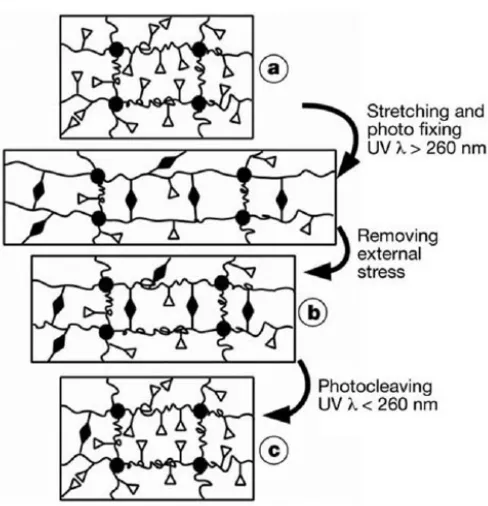
Figure 2: Molecular mechanism in light induced shape memory polymer... 3
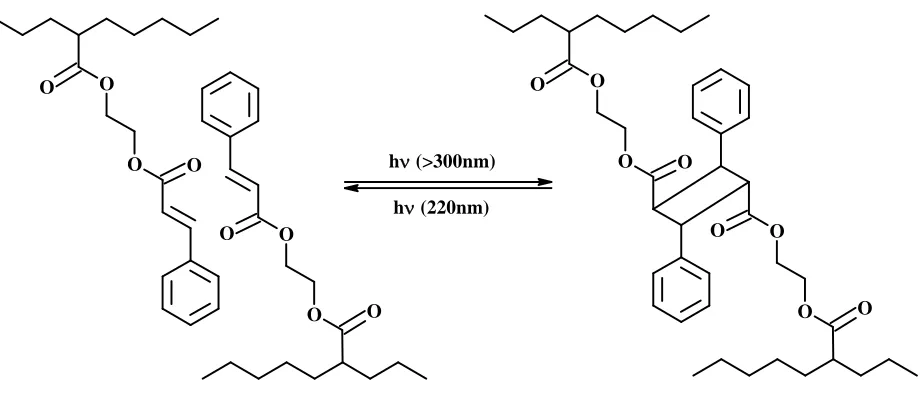
Figure 3: Reversible cyclodimerization in CA type molecules... 4
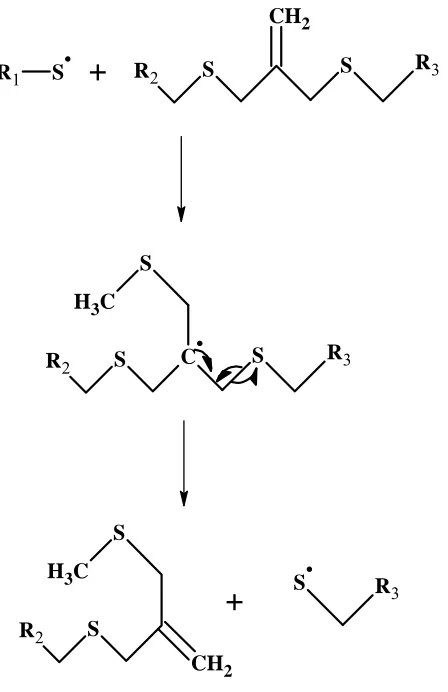
Figure 4: Reaction mechanism of chain-transfer within the polymer backbone... 6
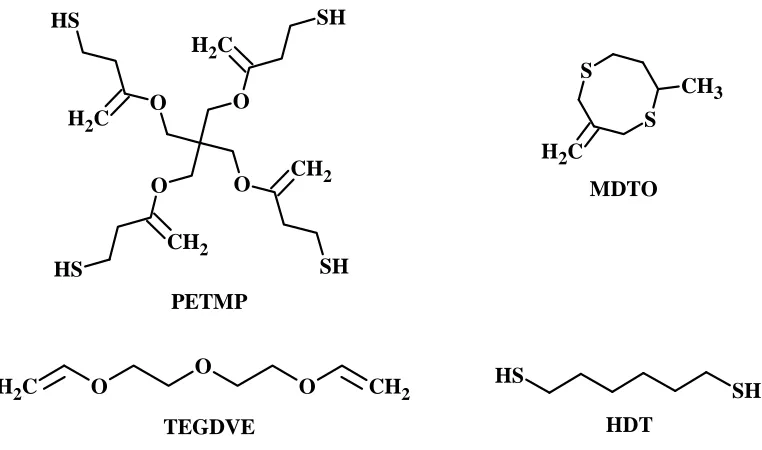
Figure 5: Monomer structures used to produce the photoplastic networks... 7
Figure 6: Radical ring-opening mechanism in MDTO... 8
Figure 7: Strain profiles in PETMP-TEGDVE polymer with varying concentrations of MDTO... 8
Figure 8: Stress versus time plots for PETMP-TEGDVE polymer containing varying amounts of MDTO... 9
Figure 9: Actuation behavior induced by stress relaxation mechanism... 11
Figure 10: Structure of MDTVE... 11
Figure 11: Thiol-ene radical chain mechanism... 13
Figure 12: Three basic types of thiols used in thiol-ene polymerizations... 15
Figure 13: (A) DSC exotherm of a pure acrylate polymerization process. (B) DSC exotherm of a thiol-ene process... 16
Figure 14: Oxygen scavenging mechanism in thiol-enes... 17
Figure 15: Reaction schemes for various thiol-ene copolymerizations with and without MDTO... 19
Figure 16: 1H-NMR for MDTO... 29
Figure 17: UV-Visible spectrum of MDTO in Hexane... 30
Figure 18: Stress relaxation plot at constant strain of 6%... 31
Figure 19: (a) stressed samples before irradiation (b) change of shape achieved after irradiation... 32
Figure 20: 1H-NMR of MDTO homopolymer (ref. 66)... 34
Figure 21: 1H-NMR for THIOL.SIL-VINYL.SIL-MDTO copolymer ... 35
Figure 22: 1H-NMR of THIOL.SIL-NORB.SIL-MDTO copolymer... 36
Figure 23: 1H-NMR of THIOL.SIL-METHAC.SIL-MDTO copolymer... 36
Figure 24: 1H-NMR spectrum for THIOL.SIL-TEGDVE-MDTO copolymer... 37
Figure 26: Free radical events occurring in a thiol-ene-MDTO copolymer system... 40
Figure 27: TEM images of THIOL.SIL-NORB-SIL-MDTO copolymer emulsion... 42
Figure 28: Photoinitiated copolymers of THIOL.SIL-MDTO with (A) VINYL.SIL. (B) NORB.SIL and (C) METHAC.SIL (D) TEGDVE... 44
Figure 29: 1H-NMR for HDT-TEGDVE-MDTO copolymer... 46
Figure 30: 1H-NMR for HDT-VINYL.SIL-MDTO copolymer ... 47
Figure 31: 1H-NMR for HDT-NORB.SIL-MDTO copolymer... 47
Figure 32: 1H-NMR for HDT-METHAC.SIL-MDTO copolymer... 48
List of Tables
Table 1: Tensile moduli of samples before and after irradiations... 10
List of Abbreviations
1. MDTO: 6-methyl-3-methylene-1,5-dithiacyclooctane 2. SMP: shape memory polymers
3. CA: cinnamic acid
4. LCE: liquid crystal elastomers 5. LC: liquid crystals
6. TEGDVE: triethyleneglycol divinylether
7. PETMP: pentaerythritol tetra (3-mercaptopropionate) 8. HDT: 1,6-hexanedithiol
9. MDTVE: 2-methylene-propane-1,3-di(thioethyl vinyl ether) 10. AIBN: 2,2’-azobisisobutyronitrile
11. THF: tetrahydrofuran
12. DMPA: 2,2-dimethoxy-2-phenylacetophenone 13. PTA: phosphotungstic acid hydrate
14. MEHQ: 4-methoxyphenol
15. THIOL.SIL: (4-6% mercaptopropylmethylsiloxane)-dimethylsiloxane copolymer 16. VINYL.SIL: vinyl terminated polydimethylsiloxane
17. NORB-SIL: (bicycloheptenyl)ethyl terminated polydimethylsiloxane 18. METHAC.SIL: methacrylate terminated polydimethyl siloxane 19. NMR: neuclear magnetic resonance
20. DSC: differential scanning calorimetry 21. DLS: dynamic light scattering
Acknowledgements
There is large number of people who have been a source of inspiration and support for me over the two year period of my graduate thesis that I would like to thank deeply. Most important of all I would like to thank my graduate advisor Dr. T. W. Smith for being an excellent mentor and for all the guidance and support he has provided me. I feel extremely privileged to have worked with Dr. Smith and to have learned from him about the ways to perform effective chemistry. His teachings in the classroom and the laboratory have provided me with a strong platform to carry out my future endeavors.
I would like to thank the faculty members in the Department of Chemistry at RIT who have taught me in the classroom and equipped me with all the necessary knowledge and skills. A special thanks to Dr. Gerald Tackas and Dr. Massoud Miri for serving on my graduate committee and being a constant guiding source.
I would like to offer my thanks to Bausch & Lomb for offering financial support to carry out this project. A special thanks to Dr. J. Kunzler for taking out time from his busy schedule to serve on my graduate committee. I also offer my sincere thanks to the other personnel at B&L namely – Dr. Dharmendra Jani, Dr. Ivan Nunez and Dr. Jeff Linhardt for their inspiration and support.
I offer my heartfelt thanks to Mr. Richard Hailstone and Mr. Gary DiFrancesco for their co-operation with TEM and DLS measurements. I also thank Dr. Chang-Feng Ge for providing access to the Instron universal testing machine.
My sincere thanks to Mr. Tom Allston for the help he has provided with the instrumentation involved in this thesis. I thank all the stockroom personnel for providing the chemicals and necessary laboratory equipments as and when I needed them. I also offer my heartfelt thanks to Mrs. Brenda Mastrangelo for all the administrative help provided by her over the past two years.
I would like to congratulate Mr. Glen Labenski and Ms. Jingjing Pan for the excellent work they have carried out as a part of the TWS research group and thank them for their help as co-workers. I also congratulate and thank the entire chemistry graduate cohort at RIT.
I would like to offer my thanks to the current and past faculty in the Paint and Polymer department at U.I.C.T, Mumbai for the teachings they have given me as an undergraduate student. I offer my special and sincere thanks to Prof. V. C. Malshe for being an influential figure in my life, both as a researcher and a mentor.
Introduction
Stimuli responsive polymers are materials that can undergo changes in one or more of
their macroscopic properties in response to any of a variety of forces or energy sources.
Polymers that respond to stimuli by moving actively and changing their shape have been termed
as “actively moving polymers”.2 Photoplasticity is an active moving behavior in which actuation is achieved using light as stimulus1 for stress relaxation in crosslinked networks. This relatively
new phenomenon has, thus far, been demonstrated in carbon chain polymer systems. A unique
objective of the present research is to synthesize silicone-based polymer gels in which
photoplasticity can be observed.
Actively Moving Polymers2
‘Shape memory polymers’ are a classic actively moving polymer system in which a
semicrystalline thermoplastic or thermoset elastomer is deformed and fixed to a new shape. The
material can be converted back to its original thermodynamically stable shape by application of a
triggering stimulus. A second category of actively moving polymers is ‘shape changing
polymers’; these are polymers that are in “an actuated state” as long as a stimulus is applied.
When the stimulus is turned off the object returns back to its original state. Liquid crystalline
polymers are one instantiation of this category.
Shape memory polymers [SMP] have been an area of extensive research for more
than two decades.3-5 SMP’s are networks containing tie points and suitable switching elements, that are sensitive to the external stimulus applied. A set of network points define the initial state
of the material and its permanent shape. These network points may exist in the form of chemical
stimulus activates the molecular switches and allows for the formation of a new temporal shape.
The switches can be re-activated by a trigger of the same or a different stimulus. Figure 1
depicts the process in a thermal shape memory polymer having permanent crosslinked points and
thermally labile tie points.6 The permanent network points define the thermodynamically stable state and the thermally labile segments (Ttrans) act as switching elements.
Figure 1: Mechanism in a thermal shape memory polymer with thermal switching temperature Ttrans
Light energy has also been used as a trigger to induce shape memory effects in
polymers.7-9
Figure 2 depicts a crosslinked amorphous polymer network in which the covalent
Figure 2: Molecular mechanism in light induced shape memory polymer
In state (a) the network is crosslinked at the permanent network points defining the
original shape of the polymer. Stretching and photofixing forms covalent bonds that defined a
new shape (b) upon removal of stress. Irradiation of the object in state (b) convert the object to
state (c), a state which approximates state (a).
Cinnamic acid (CA) ester groups are present and act as reversible photo switches. The
CA-ester functional groups cyclodimerize (2 + 2 cylcoaddtion) with each other upon irradiation
with a suitable wavelength fixing the polymer to a new temporary shape. Irradiation with a
different wavelength breaks the bonds and the original shape is realized again. Figure 3, below
O O O O O O O O O O O O O O O O
hν (>300nm)
[image:13.612.78.538.65.264.2]hν (220nm)
Figure 3: Reversible cyclodimerization in CA type molecules
Other than direct actuation by applying heat or light, indirect actuation of thermal shape
memory effect has been realized through application of infrared light10, 11, electric field12 and magnetic field.13
Shape changing polymers operate on a principle that is different from shape memory
polymers. While the permanent shape remains constant in shape changing polymers, the
geometry of the temporary shape attained cannot be varied cyclically. This is unlike SMP where
the temporary shape required can be programmed to a desired configuration. Thermal shape
changing effects in polymers are often based on phase transitions occurring in semicrystalline
and liquid crystalline elastomers (LCE).14-24 It was first predicted by DeGennes 25 that phase transitions in liquid crystals (LC) could lead to mechanical stress or strain. In pure LCs, this
strain presents itself in the form of flow anisotropy. Tethering the oriented LC moieties to a
crosslinked elastomeric polymer prevents flow and manifests the phase transitions in the form of
polymer actuation behavior.
Light-induced shape change behavior has been demonstrated by using photoactive
triphenylmethane leuco derivatives.26-30 Incorporation of triphenylmethane leuco dyes and subsequent irradiation leads to photo-generation of charged dye molecules. Electrostatic
repulsion between such photo-generated charged species causes the polymer to expand or
contract resulting in actuation behavior. Upon irradiation with UV light, azobenzene moieties
undergo cis-trans isomerization resulting in changes in molecular lengths and dipole moment.
This transition is reversible from trans-cis upon irradiation with light of a different wavelength.
Linking the azobenzene groups in an elastomeric polymer causes actuation on exposure to UV
light.
Thus ‘shape memory’ behavior and ‘shape changing’ behavior are the two well known
categories of actively moving polymers. Photoinduced plasticity is a novel concept which bears
some points of distinctions from the traditionally known actively moving polymers.
Photoinduced Plasticity
In crosslinked elastomers, the equilibrium shape is defined by the shape at gelation.
Photoinduced plasticity is a phenomenon wherein the shape of a crosslinked elastomer can be
changed plastically by mechanism of stress relaxation. Stress relief enables a sample to be
de-stressed from a deformed (de-stressed) state, thus, creating new equilibrium post-stress-relief shape.
The first published report on photoinduced plasticity in crosslinked polymers describes a
covalently crosslinked polymer network capable of undergoing photo-mediated reversible
cleavage of its backbone, thereby enabling stress relaxation.1 The basis of this reversible cleavage is a chemical reaction called the addition-fragmentation chain transfer reaction. This
addition-fragmentation chain transfer process occurs in networks of polymers containing allyl
thio-ether groups that can be activated by a free-radical initiator. Allyl thioether groups are
diffusing radical adds to the carbon-carbon double bond of the allyl thioether group, generating
an intermediate that fragments creating a thiol radical and a new allyl thioether group. The
process is thus a self-regenerative process which continues as long as free radicals are generated
from initiator molecules. Figure 4, below, shows the mechanism of the addition-fragmentation
chain transfer process occurring within the polymer backbone.1
R1 S R2 S
CH2
S R3
R2 S C S R3
S
C H3
R2 S
S
C H3
CH2
R3 S
+
[image:15.612.197.421.210.556.2]+
Figure 4: Reaction mechanism of chain-transfer within the polymer backbone
The number of addition events is accompanied by equal number fragmentation events;
accordingly, the occurrence of addition-fragmentation chain events is characterized by the fact
that the effective bond order in the polymer matrix remains unchanged.
[TEGDVE] and pentaerythritol tetra (3-mercaptopropionate) [PETMP]. An alternate crosslinked
network with a lower modulus and glass transition temperature was produced by replacing a part
of PETMP with a stoichiometric quantity of 1,6-hexanedithiol [HDT]. The network formed was
an elastomer which was swollen in common organic solvents. The base polymer, by itself, is
incapable of exhibiting the photoplasticity effect. In order to affect photoplasticity, the base
monomer mixture was copolymerized with a ring-opening monomer MDTO. Figure 5 shows the
structures of all the monomers used.
C
H2 O O O CH2
[image:16.612.110.491.263.488.2]O O O O C H2 CH2 S H SH C H2 S H SH CH2 PETMP TEGDVE S S C H2 CH3 MDTO S H SH HDT
Figure 5: Monomer structures used to produce the photoplastic networks
The thiol-ene reaction proceeds by a radical step-growth mechanism.34 The radical ring opening reaction of MDTO does not alter the stoichiometry of the thiol-ene process because the
carbon centered vinyl radical formed in the thiol-ene process predominantely abstracts a
hydrogen atom from thiol groups, creating an intermediate thiol radical.35-37 Consequently, the ring-opened MDTO monomer units should distribute themselves randomly throughout the
Figure 6: Radical ring-opening mechanism in MDTO
Stress relaxation at allyl thioether groups in thiol-ene polymers was demonstrated by
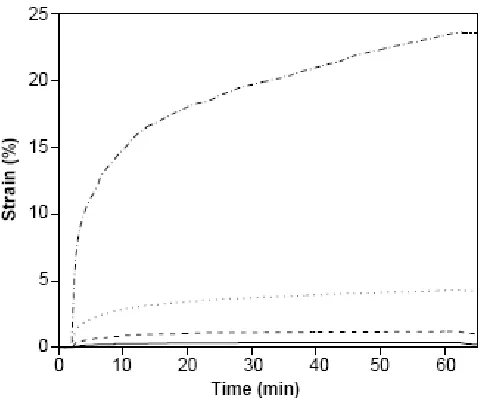
Bowman et.al. by generating stress/strain plots.1 Figure 7 shows published strain profiles of a PETMP-TEGDVE polymer containing varying concentrations of MDTO. The solid line
represents 0 wt% MDTO; the dashed line represents 25 wt% MDTO; dotted line represents 50
wt% MDTO; the dashed-dotted line represents 75 wt% MDTO. The specimens were held under
a constant tensile stress throughout the experiment and the corresponding changes in strain were
measured. Irradiation was carried out in the presence of a free-radical photo-initiator to induce
stress relief.
Figure 7: Strain profiles in PETMP-TEGDVE polymer with varying concentrations of MDTO
Irradiation of the stressed samples, doped with bis
-(2,4,6-trimethylbenzoyl)-phenylphosphineoxide [Irgacure 819], results in generation of free radicals which diffuse through
[image:17.612.203.444.411.610.2]allyl thioether groups. Scission of the crosslinked network and reformation of links in an
alternate low-stress state induces relaxation of the stress and change of shape of the elastomer,
measured in terms of the change in % strain. As seen in the Figure 71, a neat PETMP-TEGDVE sample exhibits only a small increase in the strain, which is primarily a thermal effect caused by
exposure to UV light. An increase in the MDTO concentration results in an increased density of
allyl thioether groups in the network. Thus, the rate of bond breaking and reformation is greater
at higher MDTO concentrations, yielding a substantive increase in the % strain.
Bowman et.al. also performed stress relaxation experiments wherein the samples were
deformed and held constant at a known value of strain, followed by irradiation to relieve the
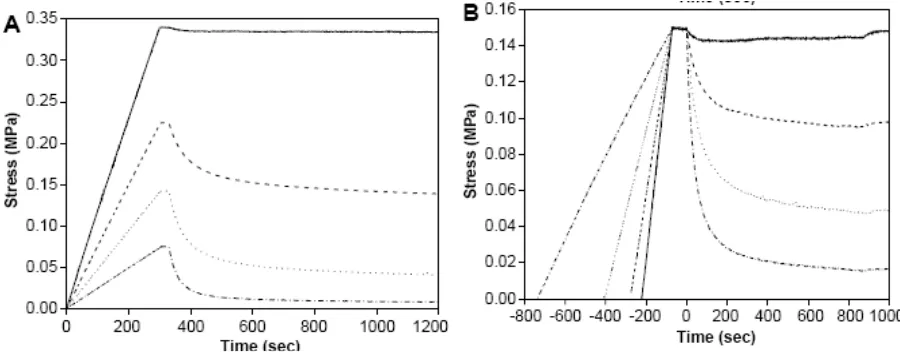
stress which is measured as a function of time. Figure 8A shows a stress relaxation plot where
the all samples are stretched to a constant initial strain before irradiation. Figure 8B depicts a
stress relaxation plot where all samples are stretched to a constant initial stress before
[image:18.612.80.530.458.635.2]irradiation.1 The solid line represents 0 wt% MDTO; the dashed line represents 25 wt% MDTO; the dotted line represents 50 wt% MDTO; and the dashed-dotted line represents 75 wt% MDTO.
Figure 8: Stress versus time plots for PETMP-TEGDVE polymer containing varying amounts of MDTO
An increase in the concentration of MDTO in the polymer, thus, results in an increasing
photodegradation was proven by measuring the elastic modulus of the samples before and after
irradiation. Table 1 shows the recorded tensile modulus values of samples plotted in figure 7A.1 A slight increase in the modulus, post irradiation, indicates that the effect is not a result of
photodegradation.
Table 1: Tensile moduli of samples before and after irradiations
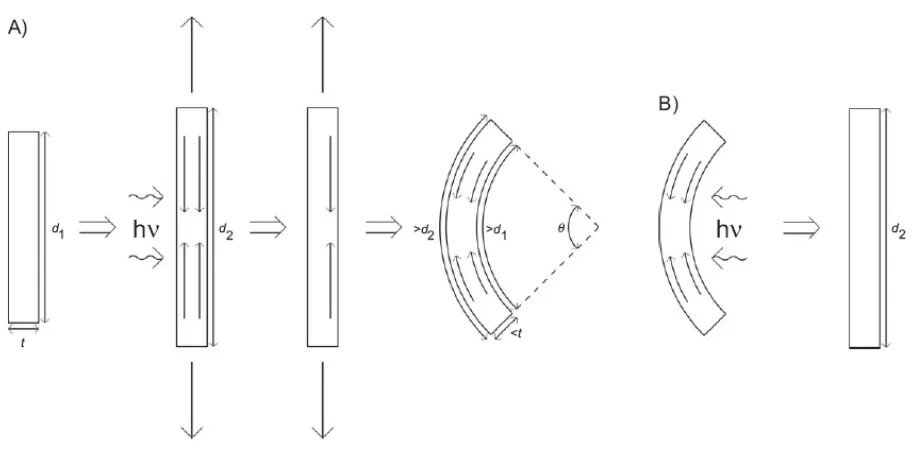
Irradiation of an optically dense polymer film under stress causes relief of stress, on the
side at which irradiation is carried out. The stress gradient created causes the film to change its
shape to a new equilibrium conformation. Subsequent irradiation from the opposite side causes
the unbalanced stresses to be relieved and actuates the film back to a shape approximating the
Figure 9: Actuation behavior induced by stress relaxation mechanism
Incorporation of allyl thioether groups in a crosslinked thiol-ene polymer backbone has
also been reported by using an end functional di-alkene bearing an allyl thioether group.38 2-methylene-propane-1,3-di(thioethyl vinyl ether) [MDTVE] was reacted with a multifunctional
thiol to create a thiol-ene network bearing allyl thioether groups. Figure 10 shows the structure
of MDTVE.38
C
H2 O S S O CH
2
CH2
Figure 10: Structure of MDTVE
Crosslinked polymers capable of affecting photoplasticity can be used to pattern desirable
shapes by creating arbitrary actuation patterns. Masking and selective photolysis of certain
regions of the sample has been reported to create objects of distinct geometries.38 A unique feature of photoplasticity via stress relaxation, compared to other photolytic techniques of
polymer actuation, is the number of groups activated per photon of light absorbed. Since stress
multiple addition-fragmentation events. In all the other photolytic actuation techniques a single
absorbed photon leads to a single event in the process leading to actuation behavior.
Photoinduced plasticity, thus, may be advantaged over the other processes known in the
literature.
Thiol-ene Chemistry
The earliest reports on thiol-enes date back to the 1930s and 1950s.39-41 The first definitive work on photo-initiated polymerization of thiol-ene monomers was published in the
1970s at W. R. Grace. These publications led to a revival of the use of thiol-ene chemistry.42-46 Since then, extensive and comprehensive reviews were published on this topic by Patai47 in 1974, Jacobine48 in 1993 and the Hoyle34 in 2004.
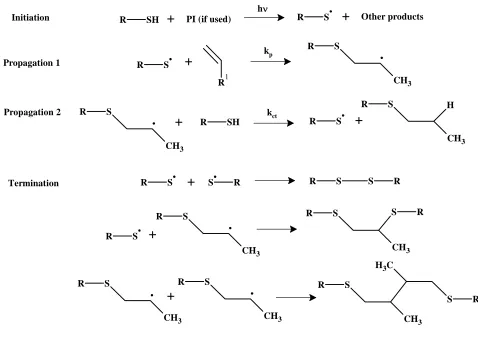
As shown in Figure 11, thiol-enes polymerize by a free radical sequence involving two
steps.48 Step 1 consists in the addition of a thiyl radical to the alkene double bond, creating a carbon centered radical. The radical in step 2 abstracts a hydrogen atom from a thiol group,
generating another free thiyl radical thus perpetuating the chain process. Termination occurs via
R SH
+
PI (if used)hν
R S
+
Other productsR S
+
R1
kp R S
CH3
R S
CH3
+
R SHkct R S R S CH3 H
+
R S
+
S R R S S R [image:22.612.72.550.73.413.2]R S R S CH3
+
R S CH3 R S R S CH3 R S CH3 R S CH3 R S C H3 Initiation Propagation 1 Propagation 2 Termination+
Figure 11: Thiol-ene radical chain mechanism
The rate of the thiol-ene reaction depends strongly on the structure of the alkene
component used. The general trend relative to the alkene reactivity follows the principle that
reactivity is higher for alkenes having higher electron density.34 A few exceptions to this general thumb rule do exist; for example, in reactivity of norbornenes is higher than expected owing
added instability from the ring strain. Similarly, the reactivity of methacrylate, styrene and
conjugated dienes is diminished due to resonance stabilization and lower hydrogen abstraction
coefficients of their corresponding radicals.
Cramer et al. carried out systematic studies to determine the rate-determining step in the
thiol-ene radical mechanism.49 Their results indicated that for more reactive double bonds in
determining. For less reactive double bonds in acrylate, allyl ether and alkenes, the chain transfer
hydrogen abstraction step is the rate determining step. The extent of substitution on the ene is
also an important parameter in understanding the thiol-ene reaction.50-52 As a general rule, highly substituted enes are less reactive than singly substituted enes. It has been reported that for a 1:1
thiol-ene mixture, 1-hexene is 8 times more reactive than trans-2-hexene and 18 times more
reactive than trans-3-hexene. This is an indicator of the fact that steric hindrance plays a crucial
role in the two step propagation sequence. Johansson et al.53, 54 have reported that due to the reversible equilibrium involved in the propagation step, addition of a thiyl radical to a cis-ene
causes reversible isomerization to form a trans-ene. The trans-ene then undergoes efficient
addition from the thiyl radical.
The multifunctional thiols used in thiol-ene polymerizations are typically of one of the
following three types – alkyl thiols, thiol glycolate esters and thiol propionate esters. Figure 12
shows the structures of these thiols.34 Thiols based on glycolate and propionate esters show higher reactivity due to weakening of the S-H bond by intramolecular hydrogen bonding with the
ester carbonyl. The thiols used for crosslinking purposes are generally tri-functional or
tetra-functional. Hoyle34 in his review, provides a complete list of the commonly used commercial
thiols. Higher functional thiols have been reported to be synthesized by Woods et al. by the
R
O SH
O
R
O SH
O
C H3
SH n
Alkyl-3-(mercaptopropionate)
Alkylthioglycolate
Alkyl thiol
Figure 12: Three basic types of thiols used in thiol-ene polymerizations
An interesting feature of thiol-ene polymerizations is their delayed onset of gelation,
compared to traditional acrylate systems. Gel point is the point below which there is
predominance of low molar mass and linear macromolecular species. At the gel point, a
crosslinked network is formed. This network may be swollen with low molar mass and linear
macromolecular materials. Jacobine et al. have reported that the gel point in a thiol-ene
polymerization process can be engineered by controlling the functionality of the monomers
used.59 It has also been reported that the gelation tendency in a thiol-ene process is much
different than traditional acrylate polymerizations. In thiol-enes, gel networks are formed at
much higher conversions compared to acrylates. A direct result of this is that there is much less
stress build-up in the thiol-ene networks subsequent to network formation.
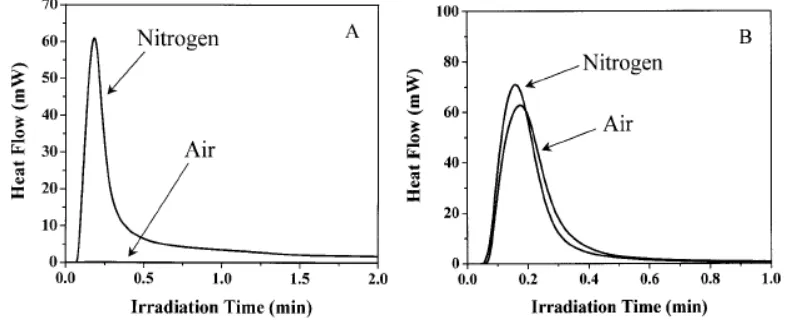
Unlike vinyl and acrylic free-radical polymerizations, where the presence of small
insensitive to the presence of oxygen. Figure 13 shows exotherms generated in an acrylic
[image:25.612.126.519.133.293.2]polymerization process (A) and a thiol-ene process (B) in both nitrogen and air.34
Figure 13: (A) DSC exotherm of a pure acrylate polymerization process. (B) DSC exotherm of a
thiol-ene process
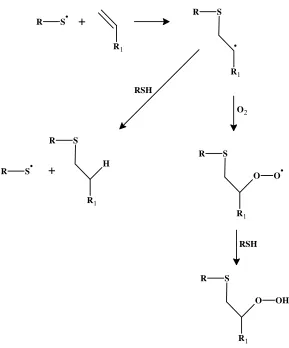
An explanation to the theory behind a thiol-ene process being relatively insensitive to
oxygen inhibition was provided by Gush et al.60 It is reported that the peroxy radicals formed by the reaction of the carbon centered propagating radicals with molecular oxygen maintain their
ability to abstract hydrogens from the thiol groups, thus, avoiding radical termination. Figure 14
R S +
R1
R1
R S
RSH
O2
R1
R S
O O
RSH
R1
R S
O OH
R1
R S
H
+
[image:26.612.161.450.68.416.2]R S
Figure 14: Oxygen scavenging mechanism in thiol-enes
Thiol-ene Siloxanes
Due to their unique properties (insensitivity to oxygen and delayed gelation) and potential
applications, crosslinked siloxane polymers are a topic of significant interest. The majority of the
developmental efforts in the area of photocrosslinkable siloxanes have been focused on the
extension of vinyl siloxanes to traditional platinum addition cure systems and acrylic silicones.61 The photocrosslinking of vinylsiloxane fluids with mercapto functional silicones has been
studied for the past 20 years.62
photopolymers was published by Jacobine.48 Müller and Kunze64 published an article relating specifically to the photoinduced thiol-ene crosslinking of modified silicones. Jacobine et al.65 have also described the photocrosslinking of norbornene resins with multifunctional thiols.
The Current Research
Research described in this thesis provides an extension to the work published by
Bowman et al.1, 38 Previously published reports on photoinduced plasticity in crosslinked polymers report on organic polymer systems having carbon-chain backbones embedded in the
well-studied thiol-ene chemistry. The point of departure for the current research is the
exploration of the phenomenon of photoplasticity in thiol-ene polymers which possess
predominantly siloxane backbones.
The initial objcctive was to synthesize and characterize photoplastic thiol-ene siloxane
polymers by mimicking Bowman type systems with functional siloxanes. The organic thiol
(PETMP) and ene (TEGDVE) monomers used by Bowman are replaced by a multifunctional
siloxane thiol and a difunctional siloxane ene. The active component of the monomer mixture
that imparts photoplasticity, MDTO, is kept constant.
Although the copolymerization of MDTO with the thiol-ene monomers was expected to
proceed to yield a homogeneous, crosslinked network, irrespective of the nature of the thiol and
ene monomer backbones, it was found that with functional siloxane monomers formation of a
homogeneous crosslinked polymer network was frustrated. In our initial experiments, control
reactions, outlined in the Figure 15 below, between PETMP and TEGDVE; PETMP, TEGDVE
and MDTO; and siloxane thiol and siloxane alkene were carried out to yield, in all cases, clear
results report by Bowman, et al. When MDTO was incorporated in the siloxane thiol/siloxane
alkene system a sterically stabilized emulsion was obtained.
PETMP + TEGDVE Δ / hν CLEAR GEL
PETMP + TEGDVE + MDTO Δ / hν CLEAR (PHOTOPLASTIC) GEL
SILOXANE THIOL
SILOXANE ALKENE +
Δ / hν
CLEAR GEL
SILOXANE THIOL
SILOXANE ALKENE
+ + MDTO Δ / hν
NO GEL
STABLE EMULSION FORMED
Figure 15: Reaction schemes for various thiol-ene copolymerizations with and without MDTO
Based on these findings, the primary objectives of the present research are to:
9 explore the effect of the reactivity of the ene component on the incorporation of MDTO
9 elucidate details of the copolymerization/homopolymerization behavior of MDTO in thiol-ene siloxane systems.
9 compare the copolymerization in thermally initiated systems with that in photoinitiated systems.
9 explore alternative routes to the formation of photoplastic siloxane elastomers
Experimental
Materials
3-chloro-2-(chloromethyl)-1-propene (99%) [C31104], sodium borohydride (98%)
[452874], sodium metal [483745], pentaerythritol tetrakis(3-mercaptopropionate) [381462]
{PETMP}, triethyleneglycol divinylether (98%) [329800] {TEGDVE}, dicumyl peroxide (98%)
and tetrahydrofuran (99+%) [360589] {THF} were obtained from Sigma-Aldrich.
2,2-dimethoxy-2-phenylacetophenone (99%) [18784] {DMPA}, Phosphotungstic acid hydrate
{PTA} and 4-methoxyphenol (99%) [12600] {MEHQ} were obtained from Acros Organics.
1,3-butanedithiol [W352918] and 1,6-hexanedithiol (97%) [W349518] {HDT} were obtained from
SAFC. (4-6% mercaptopropylmethylsiloxane)-dimethylsiloxane copolymer (SMS-042)
[THIOL.SIL], vinyl terminated polydimethylsiloxane (DMS-V21) [VINYL.SIL] and
(bicycloheptenyl)ethyl terminated polydimethylsiloxane (DMS-NB25) [NORB-SIL] were
obtained from Gelest Inc. Methacrylate terminated polydimethyl siloxane [METHAC.SIL] was
obtained from Silar Laboratories. Methanol and calcium chloride pellets were obtained from J. T.
Baker. Toluene [TX0735] was obtained from EMD.
Unless otherwise noted, all reagents were used as received without further purification.
Instrumentation
Proton NMR spectra were obtained using a Brucker 300MHz. spectrometer. Solvents
used were Chloroform-d (99.8% D) or Benzene-d6 (99.6% D), both obtained from Acros
Organics.
Glass transition data was gathered using a TA Instruments DSC 2010 with samples
prepared in non-hermetic aluminum pans. All Tg values are reported as the Tg midpoint
temperatures.
UV Visible spectrometric data was collected on a Hewlett Packard 8453 diode array
instrument.
Infrared spectroscopic data was collected on a Shimadzu IR Prestige-21. All data was
Stress-strain measurements were performed on an Instron 5567 universal mechanical
tester operated by Bluehill 2 software.
UV irradiation of samples was performed using UVP model UVGL-25 Mineralight®
lamp with a multiband UV light source of 366 nm wavelengths.
Dynamic light scattering [DLS] were carried out by Mr. Gary DiFrancesco (Scientist,
Rochester Institute of Technology, Center for Imaging Science) and were performed on a
Brookhaven Instruments Corp. 90 Plus particle size analyzer. All measurements were made at an
angle of 90º.
Transmission electron microscopy was carried out by Mr. Richard Hailstone (Associate
Professor, Rochester Institute of Technology, Center for Imaging Science).
Synthesis of Polymers
2-methyl-7-methylene-1,5-dithiacyclooctane [MDTO]. MDTO was prepared by
adaptation of the procedure reported by Rizzardo et al.66 Thus, 3-chloro-2-(chloromethyl)-1-propene (12.88 g, 103.04 mMoles) and 1,3-butanedithiol (12.57 g, 103.04 mMoles) were
dissolved separately in 60 ml methanol each. The two solutions were added simultaneously via
two separate feed lines to a refluxing solution of sodium metal (4.97 g, 216.38 mMoles) in 150
ml methanol. The rate of addition was maintained at 5 ml/hr by adding aliquots of 1 ml for every
12 minutes. Post addition, the reaction mixture was refluxed for 5 more hours. A white salt
precipitate was formed during the reaction. Methanol was then evaporated after which water was
added to dissolve the salt and the solution was extracted with ether. The ether extracts were dried
overnight using calcium chloride pellets. Following this the ether was evaporated to give 17.78 g
of crude product. The crude was bulb to bulb distilled at 95-100 ºC and 0.5 mm pressure to yield
methanol-water-THF and treated with sodium borohydride (0.2843 g, 7.459 mMoles) overnight.
Following this the solvents were evaporated, product dissolved in ether and washed with strong
aqueous sodium hydroxide. The ether extracts were dried overnight using calcium chloride.
Next, ether was evaporated and the oil redistilled bulb-to-bulb at 95-100 ºC and 0.5 mm pressure
to yield 9.53 g (53.18%) clear, water white product. 1H-NMR (benzene-d6): δ 1.16 (d, 3H),
1.2-1.6 (mult., 2H), 2.5-3.1 (mult., 7H), 4.89 (s, 2H)
PETMP-TEGDVE-MDTO copolymers. Stoichiometric mixtures of PETMP and TEGDVE
were polymerized in a 1:2 mole ratio. MDTO was incorporated as a co-monomer on weight
percent basis with respect to the PETMP-TEGDVE mixtures. Four samples were prepared
containing – 0% MDTO, 25% MDTO, 50% MDTO and 75% MDTO. AIBN (1% by weight of
the PETMP-TEGDVE-MDTO mixture) was added as a free radical initiator. MEHQ (1% by
weight of the PETMP-TEGDVE-MDTO mixture) was added as an inhibitor to prevent the
monomers from polymerizing when mixed at room temperature. DMPA (0.1% by weight of the
PETMP-TEGDVE-MDTO mixture) was incorporated as a photoinitiator for photo-induced
stress relaxation experiments, post-crosslinking. The monomer mixtures were injected between
two silanized glass plates spaced by a ~0.5 mm Teflon tape gasket and held together using binder
clips. The sandwiched films were then polymerized thermally, heating overnight in a
Sample Tg (ºC)
0% MDTO -31.50
25 % MDTO -33.45
50% MDTO -35.26
[image:32.612.207.407.69.214.2]75% MDTO -36.02
Table 2: Tg values for PETMP-TEGDVE-MDTO copolymers
Demonstration of Photoinduced Plasticity
Quantitative demonstration. PETMP-TEGDVE-MDTO copolymers with varying
concentrations of MDTO were used – 0% MDTO, 25% MDTO, 50% MDTO and 75% MDTO.
Samples were 1 mm thick and cut into dimensions of 7-9 mm in width and over 20 mm in length.
A custom experiment was set up wherein the samples were stretched to a constant strain of 6%
by applying a strain rate of 0.4% per min for 15 min. After reaching strain levels of 6% the
samples were held constant for 2 min and irradiated thereafter for a period of 15 min. Tensile
stresses in the films were measured throughout the experiments as a function of time. Before
running each sample, the sample dimensions were fed to the software for accurate stress
calculations. Irradiation was performed at a wavelength of 366 nm.
Qualitative demonstration. PETMP-TEGDVE-MDTO copolymers with varying
concentrations of MDTO were used – 0% MDTO, 25% MDTO, 50% MDTO and 75% MDTO.
Samples were 1 mm thick and cut into dimensions of 7 mm in width and 35 mm in length. In
order to induce stress the samples were folded into an inverted U-shaped configuration and held
between the two jaws of a vice. All the samples were stressed and irradiated simultaneously.
min each from the side faces. Thus the total irradiation time was 9 min. Wavelength of the light
source used was 366 nm.
Thiol-ene siloxane copolymerization of THIOL.SIL-VINYL.SIL. DMPA (1 mg, 3.9
μMoles / 0.1% by weight of the monomer mixture) was dissolved in a mixture of THIOL.SIL
(0.3556 g, 46.78 μMoles), VINYL.SIL (0.6443 g, 107.38 μMoles) and MDTO (0.1 g, 574.71
μMoles / 25% by weight of THIOL.SIL-VINYL.SIL mixture). The mixture was placed on a
silanized glass plate within an area bounded by a perimeter of Teflon tape. A quartz window
was placed on top to sandwich the monomer mixture and the sample was irradiated using a 366
nm source for 3 minutes. After irradiation a clear crosslinked polymer film was obtained.
Bulk polymerization of THIOL.SIL-VINYL.SIL-MDTO copolymer. Dicumyl
peroxide (5 mg, 18.51 μMoles / 1% by weight of the monomer mixture) was dissolved in a
mixture of THIOL.SIL (0.0.1422 g, 18.71 μMoles) and VINYL.SIL (0.2577 g, 42.95 μMoles).
DMPA (1.25 mg, 4.88 μMoles / 0.25% by weight of the monomer mixture) was incorporated for
possible stress relaxation. The monomer was immiscible at room temperature but turned clear
above a temperature of 65-70 ºC. The mixtures was then injected between two silanized glass
plates spaced by a ~0.5 mm Teflon tape gasket and held together using binder clips. The
sandwiched films were then polymerized thermally in a conventional oven at 130 ºC overnight.
Post-polymerization an emulsion was obtained between the glass plates.
Thermally initiated THIOL.SIL-VINYL.SIL-MDTO copolymer. AIBN (5 mg, 30.48
μMoles / 1% by weight of the monomer mixture) was dissolved in 0.125 ml toluene in a screw
cap test-tube. THIOL.SIL (0.1422 g, 18.71 μMoles), VINYL.SIL (0.2577 g, 42.95 μMoles) and
MDTO (0.1 g, 574.71 μMoles / 25% by weight of THIOL.SIL-VINYL.SIL mixture) was then
maintained under argon pressure and heated in an oil-bath at a temperature of 70 ºC for 3 hours.
After 3 hours a stable polymer emulsion was obtained having a bluish tinge.
Thermally initiated THIOL.SIL-NORB.SIL-MDTO copolymer. AIBN (5 mg, 30.48
μMoles / 1% by weight of the monomer mixture) was dissolved in 0.125 ml toluene in a screw
cap test-tube. THIOL.SIL (0.0735 g, 9.675 μMoles), NORB.SIL (0.3264 g, 23.31 μMoles) and
MDTO (0.1 g, 574.71 μMoles / 25% by weight of THIOL.SIL-NORB.SIL mixture) was then
added to the test tube and mixed thoroughly. The test tube was attached to a water condenser,
maintained under argon pressure and heated in an oil-bath at a temperature of 70 ºC for 3 hours.
After 3 hours a stable polymer emulsion was obtained having a bluish tinge.
Thermally initiated THIOL.SIL-METHAC.SIL-MDTO copolymer. AIBN (5 mg,
30.48 μMoles / 1% by weight of the monomer mixture) was dissolved in 0.125 ml toluene in a
screw cap test-tube. THIOL.SIL (0.2530 g, 33.29 μMoles), METHAC.SIL (0.1469 g, 80.24
μMoles) and MDTO (0.1 g, 574.71 μMoles / 25% by weight of THIOL.SIL-METHAC.SIL
mixture) was then added to the test tube and mixed thoroughly. The test tube was attached to a
water condenser, maintained under argon pressure and heated in an oil-bath at a temperature of
70 ΊC for 3 hours. After 3 hours a stable polymer emulsion was obtained having a bluish tinge.
Thermally initiated THIOL.SIL-TEGDVE-MDTO copolymer. AIBN (5 mg, 30.48
μMoles / 1% by weight of the monomer mixture) was dissolved in 0.125 ml toluene in a screw
cap test-tube. THIOL.SIL (0.3758 g, 49.45 μMoles), TEGDVE (0.0241 g, 119.19 μMoles) and
MDTO (0.1 g, 574.71 μMoles / 25% by weight of THIOL.SIL-TEGDVE mixture) was then
added to the test tube and mixed thoroughly. The test tube was attached to a water condenser,
maintained under argon pressure and heated in an oil-bath at a temperature of 70 ºC for 3 hours.
Thermally initiated HDT-VINYL.SIL-MDTO copolymer. AIBN (5 mg, 30.48 μMoles
/ 1% by weight of the monomer mixture) was dissolved in 0.125 ml toluene in a screw cap
test-tube. HDT (10.25 mg, 68.20 μMoles), VINYL.SIL (0.0.3897 g, 64.95 μMoles) and MDTO (0.1
g, 574.71 μMoles / 25% by weight of HDT-VINYL.SIL mixture) was then added to the test tube
and mixed thoroughly. The test tube was attached to a water condenser, maintained under argon
pressure and heated in an oil-bath at a temperature of 70 ºC for 3 hours. After 3 hours a milky
white stable polymer emulsion was obtained.
Thermally initiated HDT-NORB.SIL-MDTO copolymer. AIBN (5 mg, 30.48 μMoles
/ 1% by weight of the monomer mixture) was dissolved in 0.125 ml toluene in a screw cap
test-tube. HDT (4.24 mg, 28.26 μMoles), NORB.SIL (0.3957 g, 28.26 μMoles) and MDTO (0.1 g,
574.71 μMoles / 25% by weight of HDT-NORB.SIL mixture) was then added to the test tube
and mixed thoroughly. The test tube was attached to a water condenser, maintained under argon
pressure and heated in an oil-bath at a temperature of 70 ºC for 3 hours. After 3 hours a milky
white stable polymer emulsion was obtained.
Thermally initiated HDT-METHAC.SIL-MDTO copolymer. AIBN (5 mg, 30.48
μMoles / 1% by weight of the monomer mixture) was dissolved in 0.125 ml toluene in a screw
cap test-tube. HDT (30.34 mg, 201.88 μMoles), METHAC.SIL (369.6 mg, 201.88 μMoles) and
MDTO (0.1 g, 574.71 μMoles / 25% by weight of HDT-METHAC.SIL mixture) was then added
to the test tube and mixed thoroughly. The test tube was attached to a water condenser,
maintained under argon pressure and heated in an oil-bath at a temperature of 70 ºC for 3 hours.
After 3 hours a milky white stable polymer emulsion was obtained.
Thermally initiated HDT-TEGDVE-MDTO copolymer. AIBN (5 mg, 30.48 μMoles /
test-tube. HDT (170.53 mg, 1.135 mMoles), TEGDVE (229.46 mg, 1.135 mMoles) and MDTO (0.1
g, 574.71 μMoles / 25% by weight of HDT-TEGDVE mixture) was then added to the test tube
and mixed thoroughly. The test tube was attached to a water condenser, maintained under argon
pressure and heated in an oil-bath at a temperature of 70 ºC for 3 hours. After 3 hours a clear
transparent linear polymer was obtained.
Photo initiated THIOL.SIL-VINYL.SIL-MDTO copolymer. DMPA (1.25 mg, 4.88
μMoles / 0.25% by weight of the monomer mixture) was dissolved in 0.125 ml toluene.
THIOL.SIL (0.1422 g, 18.71 μMoles), VINYL.SIL (0.2577 g, 42.95 μMoles) and MDTO (0.1 g,
574.71 μMoles / 25% by weight of THIOL.SIL-VINYL.SIL mixture) were then added and
mixed thoroughly. The monomer mixture was placed on a silanized glass plate, held within
Teflon tape boundaries and irradiated at a wavelength of 366 nm for 3 minutes.
Photo initiated THIOL.SIL-NORB.SIL-MDTO copolymer. DMPA (1.25 mg, 4.88
μMoles / 0.25% by weight of the monomer mixture) was dissolved in 0.125 ml toluene in a
screw cap test-tube. THIOL.SIL (0.0735 g, 9.675 μMoles), NORB.SIL (0.3264 g, 23.31 μMoles)
and MDTO (0.1 g, 574.71 μMoles / 25% by weight of THIOL.SIL-NORB.SIL mixture) were
then added and mixed thoroughly. The monomer mixture was placed on a silanized glass plate,
held within Teflon tape boundaries and irradiated at a wavelength of 366 nm for 3 minutes.
Photo initiated THIOL.SIL-METHAC.SIL-MDTO copolymer. DMPA (1.25 mg,
4.88 μMoles / 0.25% by weight of the monomer mixture) was dissolved in 0.125 ml toluene in a
screw cap test-tube. THIOL.SIL (0.2530 g, 33.29 μMoles), METHAC.SIL (0.1469 g, 80.24
μMoles) and MDTO (0.1 g, 574.71 μMoles / 25% by weight of THIOL.SIL-METHAC.SIL
silanized glass plate, held within Teflon tape boundaries and irradiated at a wavelength of 366
nm for 3 minutes.
Photo initiated THIOL.SIL-TEGDVE-MDTO copolymer DMPA (1.25 mg, 4.88
μMoles / 0.25% by weight of the monomer mixture) was dissolved in 0.125 ml toluene in a
screw cap test-tube. THIOL.SIL (0.3758 g, 49.45 μMoles), TEGDVE (0.0241 g, 119.19 μMoles)
and MDTO (0.1 g, 574.71 μMoles / 25% by weight of THIOL.SIL-TEGDVE mixture) were then
added and mixed thoroughly. The monomer mixture was placed on a silanized glass plate, held
within Teflon tape boundaries and irradiated at a wavelength of 366 nm for 3 minutes.
Sample preparation for TEM. 3-4 drops of the emulsion were placed in a test-tube and
3 ml methanol was added. Methanol does not dissolve the emulsion particles and an oily layer is
formed at the bottom of the test tube. THF is then added until the layer dissolves and a
homogenous but hazy solution is obtained. A copper coated carbon grid is dipped multiple
number of times in this solution and dried in air. The grid is then imaged under the TEM.
Sample preparation for DLS. Samples prepared by in the TEM sample preparation
Results and Discussion
Characterization of MDTO
MDTO was synthesized by a procedure analogous to that published by Rizzardo et al.66 and outlined in the experimental section. Characterization was performed by 1H-NMR using benzene-d6 as solvent. Figure 16 shows the NMR spectrum obtained for the synthesized
molecule.
ppm (f1)
1.0 2.0
3.0 4.0
5.0
0 500 1000 1500
S h i f t 1 . 1 6 ︵d , J = 7 . 1 H z , 3 H , C H 3 ︶
S h i f t 1 . 2 - 1 . 6 ︵m u l t . , 2 H , C H 2 ︶ S h i f t 2 . 5 - 3 . 1 ︵m u l t . , 7 H , C H 2 - S , C H - S ︶
[image:38.612.72.537.252.644.2]S h i f t 4 . 8 9 ︵s , 2 H , = C H 2 ︶
Figure 16: 1H-NMR for MDTO
MDTO is a clear colorless liquid at room temperature, but solidifies at on refridgeration.
17 shows the UV-Visible spectrum obtained for MDTO in Hexane as solvent. The spectrum
shows that the UV absorption maximum appears at 234 nm and there is no absorption above 367
nm. Thus in order to irradiate films containing MDTO across the entire thickness, light of
wavelength greater that 366-367 nm will have to be used. Therefore in our experiments we use a
[image:39.612.133.479.207.603.2]light of wavelength 366 nm.
Figure 17: UV-Visible spectrum of MDTO in Hexane
Demonstration of Photoinduced Plasticity
Quantitative demonstration. The stress relief experiments performed with the
synthesized PETMP-TEGDVE MDTO copolymers was aimed at reproducing the demonstration
[image:40.612.119.490.210.401.2]carried out by Bowman et al.1 Figure 18 shows the plot of tensile stress measured as a function of time when the samples are stretched and irradiated at 366 nm wavelength.
Figure 18: Stress relaxation plot at constant strain of 6%.
The first 900 seconds on the plot, where tensile stress increases with time, occurred when
the samples were gradually stretched to the required level of strain (6%). Once the samples
reached 6% strain, they were held at constant strain for 120 seconds, at which time irradiation
was initiated. Upon irradiation, relaxation of stress was recorded as a gradual decrease in the
tensile stress value with time. For the sample containing 0% MDTO, stress was relaxed upon
irradiation. This was expected, given the fact that the requisite functionality for
addition-fragmentation processes to occur is not present at 0% MDTO. As the concentration of MDTO
increases, the concentration of photoactive allyl thioether groups in the network is greater and,
Qualitative demonstration. The shape change occurring as a result of stress relief was
demonstrated in this experiment. Figure 19 shows the pictures of (a) stressed samples before
irradiation and stress relief and (b) change of shape achieved post-irradiation.
(a) (b)
[image:41.612.112.524.154.300.2]0% MDTO 25% MDTO 50% MDTO 75% MDTO
Figure 19: (a) stressed samples before irradiation (b) change of shape achieved after irradiation.
The initial shape of the samples in their non-stressed state was similar to that of the 0%
MDTO sample in figure (b). The thicknesses of the samples were 1 mm and the concentration of
the free radical initiator DMPA was 0.1%. At a wavelength of 366 nm, this DMPA level leads to
optical opacity and a gradient in the absorption of light through the film thickness. The samples
containing MDTO changed shape to a new state because of the photochemically induced
gradient in stress relaxation across the film thickness. The magnitude of the change of shape that
persists after irradiation on one side and release from torsion increased in proportion to the
MDTO concentration. The film with no MDTO reverted back to its original shape after torsional
stress was released.
Photoplasticity in Siloxanes
Photoinduced plasticity in crosslinked siloxane polymers is an extension of the chemistry
demonstrated by Bowman et al. in traditional carbon chain polymers.1, 38 Reproducing the results of Bowman et al. in our laboratory serves as a control in our observation of alternative
concept experiments to a new set of systems in the siloxane regime, it was necessary to start by
creating a mimic of the traditional PETMP-TEGDVE-MDTO system.
The PETMP-TEGDVE-MDTO copolymer system was mimicked in siloxanes by
applying the existing knowledge of thiol-ene siloxanes. PETMP, a tetra functional thiol was
replaced by a commercially available multifunctional polydimethylsiloxane thiol, Gelest
SMS-042, (THIOL.SIL) with a molar mass of 7600 g/mol and an average functionality of 4.82.
TEGDVE was replaced by an end-functional vinyl siloxane, Gelest DMS-V21, with a molar
mass of 6000 g/mol (VINYL.SIL). The photo-active co-monomer, MDTO, was kept constant.
Prior to copolymerizing the siloxane thiol-ene mixture with MDTO, a neat thiol-ene mixture was
copolymerized using DMPA as a photoinitiator. The result was a clear crosslinked siloxane
polymer film.
THIOL.SIL-VINYL.SIL-MDTO copolymer. On attempting to copolymerize
THIOL.SIL-VINYL.SIL with MDTO in bulk, it was observed that the monomer mixture was
incompatible at room temperature and phase separated instantaneously. The mixture, however,
became substantially clear when heated to a temperature of 65-70 ºC or greater. Dicumyl
peroxide, a high temperature free radical initiator was incorporated in the system in order to
ensure that the half-life of the initiator at temperatures in excess of 70 ºC was sufficient. On
polymerization, the monomer mixture was observed to form a stable emulsion. In an effort to
enhance compatibililty, 25% by weight of toluene was incorporated in the same monomer
system. Although the toluene-diluted monomer system was clear, when polymerization was
initiated with AIBN at 70 ºC, an emulsion was again obtained.
A noticeable characteristic of the emulsions formed is that they exhibit a bluish tinge
emulsion. The emulsion was dissolved in chloroform-d and NMR spectra were acquired. The
instantaneous dissolution of the emulsion particles showed that the particles were not crosslinked
gels. Figure 20 shows the spectrum obtained for THIOL.SIL-VINYL.SIL-MDTO copolymer.
It can be clearly seen from the NMR data that the vinyl end groups in the emulsion
remained largely unreacted. More importantly a pattern of peaks, a signature, characteristic of
the homopolymer of MDTO can be seen. Figure 20 shows 1H-NMR for the MDTO
[image:43.612.195.416.323.554.2]homopolymer obtained from literature66 and Figure 21 shows 1H-NMR for the THIOL.SIL-VINYL.SIL-MDTO copolymer, with peaks a-g being reflected in the 1H-NMR spectrum of the copolymer.
Figure 21: 1H-NMR for THIOL.SIL-VINYL.SIL-MDTO copolymer
THIOL.SIL-NORB.SIL-MDTO copolymer. In order to achieve a higher ene reactivity
the vinyl end functional, VINYL.SIL was replaced with an end-functional norbornene siloxane,
Gelest DMS-NB25, [NORB.SIL] having a molar mass of 14000 g/mol. The ring strain present in
a norbornene makes the alkene double bond highly reactive and more susceptible to attack by a
thiyl radical followed by ring opening. On solution polymerization of a
THIOL.SIL-NORB.SIL-MDTO mixture in toluene using AIBN initiator at 70 ºC, an emulsion similar in physical
appearance to the one obtained using VINYL.SIL was obtained. The emulsion possessed a blue
tinge characteristic of the presence of submicron sized particles. 1H-NMR of the emulsion was
obtained in chloroform-d solvent and Figure 22 shows the spectrum obtained.
It is clear from the 1H-NMR spectrum that the norbornene double bonds have substantially reacted to covalently incorporate NORB.SIL into a triblock polymer. The
persistence of the MDTO homopolymer signature again confirms the presence of long,
Figure 22: 1H-NMR of THIOL.SIL-NORB.SIL-MDTO copolymer
THIOL.SIL-METHAC.SIL-MDTO copolymer. In addition to reacting with thiyl
radicals, α,β-unsaturated acrylics can add thiols by a Michael reaction using an end-functional
methacrylate siloxane having a molar mass of 1830 g/mol [METHAC.SIL]. Solution
polymerization of a composition comprising of a mixture of THIOL.SIL-METHAC.SIL-MDTO
in toluene initiating with AIBN initiator at 70 ºC, however, yielded an emulsion similar in
appearance to the one obtained using VINYL.SIL. The emulsion exhibited a blue tinge
characteristic of Tyndall scattering from submicron sized particles and the 1H-NMR obtained when the emulsion was dissolved in chloroform-d shows the MDTO homopolymer signature
[image:45.612.77.540.527.645.2]along with peaks indicative of the presence of a significant fraction of unreacted METHAC.SIL.
Figure 23 shows the spectrum obtained.
THIOL.SIL-TEGDVE-MDTO copolymer. Vinyl ethers are perhaps the most reactive
of all alkenes in the thiol-ene reaction and TEGDVE reacts with PETMP and MDTO to yield
clear, homogeneous, gels. Accordingly, in an attempt to copolymerize THIOL.SIL with MDTO
the polyether alkene, TEGDVE, was used as the ene component. Thus, a
THIOL.SIL-TEGDVE-MDTO mixture, diluted with 25% by weight of toluene was copolymerized using AIBN initiator
at 70 ºC. The reaction again yielded an emulsion similar in appearance to the ones obtained using
VINYL.SIL, NORB.SIL and METHAC.SIL. The 1H-NMR spectrum clearly shows that that the vinyl ether bonds have react completely, however, the MDTO homopolymer signature persists
[image:46.612.81.536.345.467.2]indicating the presence of significant chain sequences containing ring-opened MDTO moieties.
Figure 24 shows the spectrum obtained.
Figure 24: 1H-NMR spectrum for THIOL.SIL-TEGDVE-MDTO copolymer
The 1H-NMR data obtained from the copolymerizations carried out using THIOL.SIL with a variety of enes display two common features. First, all the emulsions exhibited a bluish
tinge characteristic of Tyndall scattering from submicron sized particles. Second, the MDTO
homopolymer signature was apparent in all the NMR spectra. The siloxane-based vinyl ene,
VINYL.SIL, was substantially unreacted. The siloxane-based norbornene and methacrylate enes,
NORB.SIL and METHAC.SIL, were more reactive, but peaks for unreacted alkene could still be
hydrogen abstraction from THIOL.SIL followed by the addition of a thiyl radical to MDTO and
its ring-opening, chain-growth polymerization to generate long MDTO homopolymer chain
segments. In the presence of TEGDVE and NORB.SIL, thiyl radicals on THIOL.SIL and
ring-opened MDTO chains add. In the presence of VINYL.SIL and METHAC.SIL, alkenyl
functionality remains substantially unreacted. The MDTO homopolymer chains apparently
collapse and precipitate forming submicron-sized particles. The tethered siloxane chains form a
corona that stabilize the particles against continued accretion, yielding a sterically stablilized
emulsion of diblock or triblock copolymer particles. Figure 25 shows a cartoon of the predicted
particle structure.
C H3 Si
CH3
CH3
[image:47.612.76.540.321.462.2]O Si O Si CH3 CH3 CH3 O Si CH3 CH3 CH3 S CH2 S S C H3 x y n
Figure 25: Predicted particle structure for emulsions formed with THIOL.SIL
The dynamics of the process at the molecular level is depicted in Figure 26. In a reaction
mixture containing THIOL.SIL, MDTO and ene, the first stage in the process is the generation of
free radicals followed by hydrogen abstraction to create a thiyl radical of Type 1. Addition of the
Type 1 thiyl raical to MDTO and ring-opening yields a new thiyl radical of Type 2. The behavior
of Type 2 radical is the critical step because its ability to add to either the double bond of MDTO
or the ene governs the homopolymerization tendency of MDTO. Following route [A] the Type 2
radical may attack the ene double bond and proceed like a traditional thiol-ene reaction. On the
chain-extended Type 2 radical. When homopolymerization of MDTO is the dominant process in
the reaction, the Type 2 radical shows a higher tendency towards route [B] compared to route
[A].
The highlighted loop in the picture shows the initial formation of Type 1 radical followed
by its attack on MDTO to create a Type 2 radical. The attack of this radical of MDTO following
route [B] creates a diblock copolymer like structure. When all the MDTO monomers units in the
reaction mixture are consumed in the process, the free radicals present at the chain ends then add
to the ene at a rate dependent on the relative reactivity of the ene. In case the vinyl enes, the
reaction to form triblock is limited. Vinyl ether bonds, on the other hand, being highly reactive
readily forms the triblock and are consumed to the extent that no NMR signals for vinylic
hydrogens can be observed post polymerization.
A similar process may be occurring in the Bowman type polymers used for the stress
relaxation exercise. The only difference being that, irrespective of whether the Type 1 radical
first attacks MDTO or the ene, the Type 2 radical always shows equal or nearly equal tendency
to adopt either routes [A] and [B]. Thus, the allyl thioether groups present in the Bowman type
system may be isolated monomeric units, or oligomeric block units which are distributed
randomly in the crosslinked network. Higher concentration of MDTO would certainly tend to
R C H2 S S C H2 C H3 R2 S C H2 S S
H R1 S R1
[image:49.612.108.561.70.597.2]ABSTRACTION A B R2 S CH2 S R C H S R C H R1 Type 1 Type 2
Figure 26: Free radical events occurring in a thiol-ene-MDTO copolymer system
Characterization of Emulsions
DLS data. The emulsions obtained with THIOL.SIL were analyzed using DLS. The data
shows a range of particle sizes for all emulsions synthesized. The number average size is about
3-4 times smaller than the intensity average size. This confirms the fact that the particle sizes are
polydisperse.
Ene Component Size by # Wt. (nm) Size by Intensity Wt. (nm)
VINYL.SIL 29.2 108.4
NORB.SIL 48.4 187.6
METHAC.SIL 72.3 209
TEGDVE 20.1 90.2
[image:50.612.151.277.524.720.2]VINYL.SIL (Photopolymerized) 89.8 249.8
Table 3: DLS data for emulsions obtained using THIOL.SIL
TEM data. The data obtained from DLS was corroborated with the TEM data and shows
good correlation. Figure 27 shows the images obtained for a THIOL.SIL-NORB.SIL-MDTO
copolymer emulsion.
Figure 27: TEM images of THIOL.SIL-NORB-SIL-MDTO copolymer emulsion
The TEM images shown above are captured on a 50 nm scale. As seen, each large
particle appears to be an aggregation of a number of smaller sub-particles. The sub-particle
forms the primary structure and has a size of ~50 nm. The size of the larger aggregated particle
may vary depending on the number of sub-particles aggregating together. The size of the
aggregated particle shown in the picture above falls in the range of ~ 200 nm. These values are a
good fit to the values obtained by DLS analyses. As seen in Table 3, the number average size for
the NORB.SIL emulsion is 48.4 nm which correlates to the primary sub-particle size. The
intensity average size obtained is 187.6 nm which is close to the aggregated particle size. TEM
imaging of the emulsions obtained with VINYL.SIL, METHAC.SIL and TEGDVE was
attempted, but clear images could not be obtained due to lack of good contrast.
Thus, the range of particle sizes observed [~ 50–200 nm] is supportive of the Tyndall
blue effect observed in all the emulsions. The small particle sizes lead to scattering such that the
emulsions appear to have a bluish tinge.
Photoinitiated Polymerizations
Photolytic radical generation process differs from thermal radical generation such that in
a photolytic process a large number of radicals can be generated at the same instant. In a thermal
process the rate of radical generation is distributed over a period of time, thus resulting in longer
polymerization time periods. This ability to create a large number of radicals photochemically at
any given instant is seen to have a significant effect on the crosslinking kinetics of the systems
under investigation. Photoinitiated copolymerizations were carried out for systems containing
THIOL.SIL copolymerized with MDTO and the full range of ene monomers at a wavelength of
Photo initiated THIOL.SIL-VINYL.SIL-MDTO copolymer. Polymerization on a
silanized glass plate yields an emulsion which possesses a bluish tinge associated with the
Tyndall-effect of light scattered from submicron size particles. The emulsion obtained is much
more viscous than its thermally polymerized counterpart and clearly has higher gel content.
Although complete crosslinking did not take place since a swollen gel film could not be
recovered from the glass place. Figure 28(A) shows a picture of the polymer after being
transferred to a glass vial.
Photo initiated THIOL.SIL-NORB.SIL-MDTO copolymer. Polymerization with
NORB.SIL on a silanized glass plate yields a partially crosslinked polymer which possesses a
bluish tinge associated with the Tyndall-effect of light scattered from submicron size particles.
Due to incomplete crosslinking the swollen gel could not be recovered from the glass plate
without disintegration of the film. Figure 28(B) shows a picture of the polymer after being
transferred to a glass vial.
Photo initiated THIOL.SIL-METHAC.SIL-MDTO copolymer. Like NORB.SIL,
polymerization with METHAC.SIL on a silanized glass plate yields a partially crosslinked
polymer which possesses a bluish tinge associated with the Tyndall-effect of light scattered from
submicron size particles. Due to incomplete crosslinking, the swollen gel could not be recovered
from the glass plate without disintegration of the film. Figure 28(C) shows a picture of the
polymer after being transferred to a glass vial.
Photo initiated THIOL.SIL-TEGDVE-MDTO copolymer. Copolymerization with
TEGDVE on a silanized glass plate yields a solvent swollen gel which possesses a bluish tinge
associated with the Tyndall-effect of light scattered from submicron size particles. The mass may