City, University of London Institutional Repository
Citation:
Luedicke, M. K. (2011). Consumers' Controversies about Consumption. Marketing ZFP - Journal of Research and Management, 33(1), pp. 46-56.This is the accepted version of the paper.
This version of the publication may differ from the final published
version.
Permanent repository link:
http://openaccess.city.ac.uk/4673/Link to published version:
Copyright and reuse: City Research Online aims to make research
outputs of City, University of London available to a wider audience.
Copyright and Moral Rights remain with the author(s) and/or copyright
holders. URLs from City Research Online may be freely distributed and
linked to.
Consumers’ Controversies About Consumption: A Preliminary Model
by Marius K. Luedicke
Marius K. Luedicke is Assistant Professor at the University of Innsbruck, Universitätsstr. 15, A-6020 Innsbruck, and interim Professor of Marketing at the University of Witten/Herdecke, Germany, Phone: +43 512 507 7205, E-Mail: [email protected]
Keywords
Consumers’ Controversies About Consumption: A Preliminary Model
Abstract
This article introduces a preliminary model that conceptualizes the drivers, expressions, and consequences of consumers’ controversies about the limits of legitimate consumption within a social context. Drawing on qualitative data on the North American conflict over the cultural legitimacy of the Hummer brand of vehicles, the study documents that - contrary to the prevailing consumer-producer centric model - market-mediated social conflicts also emerge as immediate, interpersonal social practices through which consumers contest each others’ consumption choices, ideologies, and behaviors. The study reveals that consumer controversies often begin with violations of social expectations, manifest in vigilant justice,
insult, discredit, ridicule, and instruction practices, and serve consumers to preserve, promote,
and defend the consumption-related meanings, practices, objects, and identities that they consider sacrosanct for themselves and their social peers. The study suggests that consumer controversies affect consumer culture, identity projects, and marketing practices in important ways previously unrecognized by theories of consumer emancipation and resistance.
1. Introduction
“Hey Rudedogg let me just be the first to say fuck your H2. I don't need it to dog it. I drive an H1 almost everyday. Its called Army. Your hummer is a sissy truck. It is for rich girls that want to feel like they are special and older guys that can't afford the insurance on a Porsche. I flip off everyone I see on the road.” (CDUBYA, web-forum)
The study of conflict over illegitimate meanings, practices, and identities in market economies has constituted a vital stream of consumer culture theory (Arnould & Thompson 2005). Beginning from the late 1930s (Dameron 1938; 1941; Sorensen 1941), theorists have developed an insightful body of knowledge on the motivations, morals, ideological agendas, and empirical approaches that consumers adopt for fighting negative influences of capitalist market systems (see Roux [2007] for a review).
Owing to their focus on dramatic forms of consumer resistance against - and
emancipation from - hegemonic market logic and intrusive marketing practices (Kozinets &
Handelman 2004; Thompson & Coskuner-Balli 2007), existent literatures fall short of addressing the motivations, expressions, and effects of more mundane social conflicts emerging between consumers such as our above Hummer brand antagonist CDYBYA and Hummer enthusiast Rudedogg. Sociological studies of social stratification through consumption (Bourdieu 1984; Simmel 1890; Veblen 1927 [1899]) suggest that market-mediated social conflicts may not be limited to dramatic David-versus-Goliath struggles
between consumers and producers, but may also occur in a variety of other social
constellations that lack a clear sense of domination, a presence of hegemonic market institutions, or desires for escaping or emancipating from the market, as premised by prior consumer research (e.g. Giesler 2008).
Prior research on market-mediated moral conflict emerging between admirers and antagonists of the Hummer brand of vehicles (Luedicke, Thompson & Giesler 2010) evoked
the need for further exploring this largely un-theorized terrain of consumer-consumer
conflicts and to develop a conceptual model that helps to explain why consumers like
CDUBYA unload their derogatory charges at other consumers, how they do it, and which effects may result from such practices for consumers, marketers, and their surrounding social environment.
themselves and their relevant social peers. The paper develops this notion by reviewing existing literature on market-mediated social conflict, synthesizing their findings into an a priori theoretical model and describing the methods that were used. It then illuminates the two socio-cultural realms in which Hummer drivers and antagonists violate each other’s social expectations, and details five practices of consumer controversy that permeate this specific social context. The article concludes by presenting a preliminary empirical model of consumer controversy and discussing its practical and theoretical implications.
The study contributes to consumer culture theory on market-mediated social conflict in three ways. First, it provides a preliminary understanding of the reasons for, and expressions of the everyday struggles emerging between consumers that defend their particular ideological positions through consumption choices and behaviors. Second, it demonstrates that in consumer controversies producers are assigned the secondary role of a resource provider for the conflict rather than the primary target. Consequentially, consumer controversies open opportunities for marketers to provide pro- or antagonists with symbolic or material resources that help them defend or leverage their socio-cultural causes. And lastly, the study reveals that consumers balance stability and change in highly dynamic cultural environments not only through maintaining in-group cohesion in brand communities and subcultures of consumption, but also through engaging in passionate controversies with outside consumers.
2. Theory
Seventy years of research on market-mediated social conflict have produced an extensive body of knowledge. The theoretical perspectives that illuminate the various motives, expressions, and implications of market-mediated social conflict for consumers, marketers, and the broader society include, but are not limited to, consumer boycotts (Friedman 1985; Garrett 1987), consumer emancipation (Kozinets 2002a), consumer resistance (Peñaloza & Price 1993; Holt 2002), consumer movements (Kozinets & Handelman 2004; Thompson & Coskuner-Balli 2007), cultural jamming (Handelman 1999; Lasn 2000), marketplace drama (Giesler 2008), or anti-consumption (Cherrier 2009; Lee, Fernandez & Hyman 2009).
contradict their personal and social values. Unsolicited emotions and observations result from corporate activities such as intrusive or misleading advertising (Rumbo 2002), displacement of local suppliers (Thompson & Arsel 2004; Thompson & Coskuner-Balli 2007), environmental destruction (Dobscha & Ozanne 2001), or hegemonic branding (Klein 1999; Thompson, Rindfleisch & Arsel 2006), but can also be induced by a general disenchantment through the extension of the capitalist market logic (Kozinets & Handelman 2004; Kozinets 2002a; Hertz 2001). In these predominantly interpretive studies, conceptualizations of “dominant forces” as well as resulting outcomes and possibilities for consumers vary with the study’s theoretical approaches. Scholars observing and writing in a critical tradition, for example, tend to frame the marketplace (sometimes with a Marxist undertone) as a dominant, oppressive power that reflexively defiant consumers should actively fight and resist (Ozanne, Hill & Wright 1998; Ozanne & Murray 1995), whereas academics who tend to postmodern thinking rather highlight consumers’ emancipation and self-realization potential emerging from an increasingly multifaceted and distributed system of power (Cova & Dalli 2007; Thompson & Coskuner-Balli 2007; Thompson 2004; Giesler 2008).
As a result of perceived domination and exploitation, and an individual “propensity to resist” (Roux 2007), consumers chose different expressions for their emotional and cognitive dissonances. Their practices include individual avoidance of a questionable product, fighting and punishing against (Funches, Markley & Davis 2009; Lasn 2000; Thompson, Rindfleisch & Arsel 2006) or competing with the company (Füller, Luedicke & Jawecki 2008; Hemetsberger & Reinhardt 2009), organizing consumer boycotts, and more generally attempting to escape the detrimental, intrusive, or seductive forces of the market to advance an alternative system of exchange (Elgin & Mitchell 1977; Shaw & Newholm 2002; Dobscha & Ozanne 2001; Kozinets 2002a; Zavestoski 2002).
counter-cultural lifestyles can (or seem to attempt to) entirely escape the logic of market exchanges. They rather produce alternative commercial systems devoid of the aggressive commercialization that they seem to despise (Kozinets 2002a; Thompson & Coskuner-Balli 2007).
Several recent studies on collective consumption indicate that conflicts also exist among consumers with equal cultural, social, and economic capital. Muñiz and O’Guinn (2001, p. 420), for instance, introduce “oppositional brand loyalty”, i.e. the identity-enhancing devaluation of competitive brands, as one driver of brand community building; Kozinets (2001) highlights the negative stigmatization of Star Trek enthusiasts by outside observers;
Kozinets and Handelman (2004, p. 698) detail how consumer activists try to convert “entrenched couch potato” consumers to adopt a more active and responsible lifestyle; and Schouten and McAlexander (1995, p. 49) report on “derisive appellations” of “Rich Urban Bikers” and alike in the vicinity of the Harley Davidson owners’ group.
Luedicke, Thompson, and Giesler (2010) most directly address a form of
market-mediated social conflict that theoretically exceeds the prevailing vertical consumer-producer model of market-mediated social conflict. These authors reveal that consumers with strong but opposing ideological beliefs sometimes engage in passionate disputes over which brands and consumption ideologies legitimately claim a moral high ground in the North-American socio-cultural context, and which brands and ideologies illegitimately try to represent the nation’s founding identity myths. They show that American Hummer owners derive identity value from framing their environmental critics as hypocrites that insult the cultural roots of the American nation. However, as their study focuses on the mythic form and ideological contents of American consumers’ moral conflicts, it does not illuminate the broader motivations and empirical expressions of consumer-consumer controversy.
The relationships that consumers B foster with producers are not explicitly addressed in prior studies, which rather explain how and why producers’ offerings and activities evoke consumer resistance. Consumers are eventually, but not necessarily condemned for accepting
these offers (for exceptions see Kozinets & Handelman 2004; Luedicke, Thompson & Giesler
[image:8.595.107.502.201.494.2]2010).
Fig.1: A Priori Model of Market-Mediated Social Conflict
3. Method and Context
The objective of this research is to create an exploratory, phenomenological account of consumers’ controversies about consumption. The passionate disputes that evolve around the Hummer brand of vehicles provides an ideal context for inquiring into this phenomenon. Quite “like nothing else” – which is the claim of the Hummer brand – Hummer ownership stimulates consumers for negotiating the boundaries of legitimate consumption practices with fellow citizens, not corporations.
“Hummer H2.” Hummer vehicles are typically described as boxy and aggressive looking luxury trucks that consume significant amounts of visual space and ecological resources. Despite its bold design, the Hummer H2 is only slightly wider (2.5 in), higher (0.7 in), and heavier (500 lbs) than the competing Lincoln Navigator SUV, while being noticeably more capable under off-road conditions. According to informants’ measures, the H2 runs 8-14 miles on one gallon (17-30 liters per 100 km). The base price for a new H2 was 45,000 USD. In the U.S., the H2 was categorized as a commercial truck, which allowed business owners for deducting considerable parts of its costs from their tax payments. From January 2003, only seven month after its market launch, Hummer H2 annual sales were steadily on the decline. In May 2006 the birth of a significantly smaller Hummer, the Hummer H3, rejuvenated the brand with its successful market launch. In June 2009, General Motors announced negotiations with Sichuan Tengzhong Heavy Industrial Machines of China and - according to news reports - sold the brand in October. By spring 2010, the Chinese ministry of commerce rejected Tengzhong’s bid to take over Hummer, and soon afterwards, GM announced the discontinuation of the brand. The last Hummer H3 left the Louisiana factory in May 2010. However, the independent national “Hummer Club Inc.” continues to thrive on passionate Hummer owners and continues its off-road events to the present day.
The data collection began with downloading text from online fan- and hate-pages, web-logs, discussion forums, news reports, and corporate commercials and conducting email interviews with Hummer fans and antagonists (Kozinets 2002b). In a second phase, the author conducted phenomenological interviews with a marketing manager of AM General (the producer of the Hummer H1 and the HUMVEE), members of the Hummer Club Inc., leading web forum contributors, random Hummer owners, and the owner of the most popular Hummer hate page www.fuh2.com. Following the guidelines of in-depth qualitative interviewing, conversations with informants were of 15 to 150 minutes in length (McCracken 1988; Thompson 1997). The data were analyzed in an iterative process of hermeneutic interpretation in parallel to the data collection process (Thompson 1997; Denzin & Lincoln 2000).
4. Evidences
This section illuminates the motivating discourses and effective practices of consumer controversy in the context of the North-American dispute about Hummer ownership. All Internet sources are reproduced in their original wording, grammar, and spelling. The information in the brackets after each quote informs about the name, Hummer ownership status, and data source (e.g., Steve, H2, interview). The identities of interview participants are concealed for protecting their privacy.
4.1. Discourses of Consumer Controversy
The prevailing model of market-mediated social conflict emphasizes the importance of imbalanced power relations and the resulting exploitation or domination of consumers as the impetus of market-mediated social conflict. The present data reveal that overcoming power/dominance is seldom at stake in consumer controversies, but rather countering a violation of social expectations (Hellmann 1994). As Hellmann (1994) explains, “social problems” arise if an agent B frustrates an expectation of agent A, if this expectation is attributed to a decision of agent B, rather than an accidental or negligent behavior, and if agent A expects agent B to change his/her behavior to resolve the frustration.
4.1.1. Authenticity
The North American discourse about the legitimacy of Hummer consumption inflames on the question if the Hummer brand is an authentic – i.e. truthful, sincere, realistic (Sartre 1948) – representation of two salient American cultural resources; the iconic HUMVEE military truck, and the myth of American exceptionalism (for a description of the latter see Luedicke, Thompson & Giesler 2010).
The Hummer brand of vehicles derives from a line of assault vehicles that became known as “High Mobility Multi-Purpose Wheeled Vehicles,” or “HUMVEE” through their deployment in operation Desert Storm in 1991. HUMVEEs served the U.S. military since 1979 in civil and bellicose political missions as fast, durable transporters. Even though several hundred troops have lost their lives in HUMVEE trucks, they remain immaculate symbols for American military power. The sight of these stalwart vehicles that serve American troops for fulfilling international political missions, leverages feelings of American pride and strength. Owing to its similarity with the HUMVEE truck and the small number of vehicles built, the Hummer H1 attracts relatively little if any social negativity. As informant Robert reports in an interview, quite the opposite is the case: “When I drive by in my H1 with two U.S. flags on the back, people frequently stand up and salute. They love it.”
However, this construction of the Hummer brand as a legitimate marketization of an American cultural icon is only one of two broader views that permeate the present data. The evidences also contain a directly oppositional interpretation of the H2, the Hummer brand, and Hummer drivers. Drawing on the same cultural resources – the HUMVEE legacy and the myth of American exceptionalism – Hummer haters attest Hummer owners poseur attitudes, limited rationality, and distorted views of American patriotism. Consider the following illustrative statement:
“The H2 is the ultimate poseur vehicle. It has the chassis of a Chevy Tahoe and a body that looks like the original Hummer; i.e. it's a Chevy Tahoe in disguise. The H2 is a gas guzzler. Because it has a gross vehicle weight rating over 8500 lbs, the US government does not require it to meet federal fuel efficiency regulations (…) So while our brothers and sisters are off in the Middle East risking their lives to secure America's fossil fuel future, H2 drivers are pissing away our "spoils of victory" during each trip to the grocery store. (…)” (Steve, none, forum)
The author of this quote is the web master of www.fuh2.com (fuh2 means “fuck you and your Hummer too / H2”) that has become the most prominent forum for Hummer haters. With reference to the marketing claim “ultimate off-road vehicle,” he reframes the truck as an “ultimate poseur vehicle.” Owing to its GM SUV body, its contribution to global pollution, resource depletion, and wars for oil, Steve does not accept the H2 as a truthful, sincere and realistic representation of American exceptionalism nor as a realistic sibling of the HUMVEE. Instead, he describes the H2 as a fake HUMVEE product that tries to free ride on the recognition that the original has earned.
Steve also draws a direct line from the fuel inefficiency of H2 trucks to the deaths of American troops in the Middle East. He first expresses his patriotic support for the troops (the “victory” of “our brothers and sisters”) and then blames Hummer owners for not appropriately appreciating American military achievements. A third critical argument of the author is that politics unrightfully charge conspicuous Hummer consumers with lower taxes for authentic functional business trucks. Interview participant Jay supports this negative image of Hummer owners:
„The H2 is all about form and nothing about function—and yet so many idiots buy into the H2 marketing and foolishly think otherwise.“ (Jay, none, email)
that love the outdoors, love exploring, and “revel in each and every chance [they] get to experience the world” (www.hummer.com, 03/10/2007), H2 owners are rather blindly taken in by seductive marketing practices (cf. Deighton & Grayson 1995).
In summary, the Hummer enthusiast side of the public discourse frames and celebrates Hummer consumption as a culturally authentic expression of rugged American national identity, whereas the antagonist side constructs the brand as a marketing plot and a shiny façade that contradicts American national ideals and deteriorates the political, ecological, and social status of the nation rather than symbolizing American patriotism.
4.1.2. Sociality
The second discourse in which American consumers depart in their idea of legitimate consumption is the sociality of Hummer ownership. Hummer ownership, like any other consumption practice, entails a particular balance of “social utilitarianism” and “possessive individualism” (Giesler 2008), i.e. sharing of public goods such as a clean environment and safe roads versus individual ownership of status, safety, and engine power. Within itself, the Hummer discourse perpetuates two schemes of owners; those who drive Hummers for functional purposes and off-road driving, and those who drive the Hummer for status and style reasons. The appeal of H2 for the latter category, which is also the most contested one, is expressed in the following vignette of a Hummer enthusiast:
“I love this machine! from the first test drive to my daily commute it had me hooked [...] It is still fun to drive looks great! now if i can just get used to all the attention it gets. in short this machine is off the meter, off the chain,off the hook! so you can love me or hate me but I'm still going to wave back to the lil kids,young ladies and old ladies who wave to me as I'm Humming along!" (Hummingbirdman, epinions.com, 06/01/2004)
love it. In summary of this view, Hummer ownership is an inherently positive and pro-social consumption choice.
The anti-Hummer thread of the sociality narrative, instead, constructs a contrary ideology. The following quote introduces into this line of argument:
“The H2 is a death machine. You'd better hope that you don't collide with an H2 in your economy car. You can kiss your ass goodbye thanks to the H2's massive weight and raised bumpers. Too bad you couldn't afford an urban assault vehicle of your own. Or could you…?” (fuh2.com, 03/10/2007)
Hummer antagonists build their case on the features that make Hummers dangerous for humans and the environment. The above quote expresses the concern that the vehicles’ weight and chest-high bumpers impose a threat onto smaller cars, children, and things. With the presence of Hummers, drivers of smaller cars have statistically lower chances of surviving a collision (Gladwell 2004). Antagonists perceive Hummer ownership as ultimately anti-social, because owners buy their road safety on the expense of others. These features culminate in the framing of the H2 as a deadly “urban assault vehicle,” which the author considers inappropriate for American roads.
The anti-Hummer discourse also questions the patriotism that presumably comes with Hummer ownership. The following excerpt of a critical web-blog article illustrates the debate that evolves between Hummer and anti-Hummer patriots:
“"When I turn on the TV, I see wall-to-wall Humvees, and I'm proud," said Sam Bernstein, a 51-year-old antiquities dealer who lives in Marin County, Calif., and drives a Hummer H2, an S.U.V. sibling of the military Humvee. "They're not out there in Audi A4's," he said of the troops. "I'm proud of my country, and I'm proud to be driving a product that is making a significant contribution."[…] I suspect that when we go off to Iran Boom Boom Bernstein will be right there with the rest of the stay-at-home-patriot war mongers, pushing our boys and girls into real Humvees and A1 Abrams tanks, but staying high and dry in Marin County in his shiny boulevard version.” (James Wagner, http://jameswagner.com/mt_ archives/003254.html, 03/10/2007)
and girls” into real assault action. This argument broadly challenges the political sociality of Hummer ownership. According to the author, supporting wars from a safe distance contradicts American patriotism and feeds the flames of the anti-hummer discourse.
Taken together, the above two controversies about Hummer ownership amply demonstrate that anti-Hummer consumers frame Hummer consumption as a violation of sacrosanct social and cultural norms the adherence to which appears to them as key to the American social system and its future viability. Anti-Hummer consumers believe that Hummer owners decidedly – and out of egoistic self-interest – violate their right for using American streets without feeling threatened by massive trucks, for consuming a clean environment, and for preserving the honor of American soldiers that risk their lives in “real” Hummer vehicles. In the Hummer case, the violations of American sociality and authentic consumption norms fire the flames of a social conflict that inspires the practices of consumer controversy that are described next.
4.2. Practices of Consumer Controversy
Consumer controversies are immediate social interactions by which individuals critique other individuals’ consumption choices, ideologies and behaviors to avert expectation-violations and reinforce the adherence of socio-cultural norms. The study reveals five practices of consumer controversy, vigilant justice, insult, discredit, ridicule, and instruction. The practices range from explicit forms of punishing to non-explicit abreacting behaviors of contestation and manifest in both mediated and direct forms. Punishment is an intentional imposing of deprivations on a person in response to a violation of a socially accepted norm (cf. Foucault 1979). Abreaction serves the goal of easing impulsive emotional tensions by restoring the balance of violations. Some messages are delivered affectively and without explicit educational messages to the owner.
The following empirical account focuses on consumers that critique the Hummer H2, even though the data implies that owners may also critique their antagonists in similar ways (see Luedicke, Thompson & Giesler 2010).
4.2.1. Vigilant Justice
“Eco nazis! some ass keyed my h2 while in costco the other day.. and they hocked lugies on the windshield..” (HUMMERManiac, H2, forum).
The author reports on the damaging of his H2 on the parking lot of a Costco store. As reported, the aggressor spat on the vehicle’s windshield and scratched the coating. In this act of contestation, the consumption object does not only serve as a communication medium, but also as an addressee. The actor seems to punish the truck itself for existing as much as penalizing the owner for driving it. If Hummer owners perceive their valued possession as integral parts of their selves, as Belk (1988) maintains, the damaging or disgracing of the truck would hurt the beholder vicariously. The above aggressor has thus chosen two effective ways of hurting the “skin” and spitting at the “face” of the owner through attacking his/her possession. Even though damaging the property of Hummer owners in such a way is illegal and can lead to severe consequences, keying and spitting are a often reported means of consumer controversy in the Hummer context.
4.2.2. Insult
Consumers use various symbolic means of expressing their discontent with other consumers’ consumption choices and behaviors. Insult is an immediate form of consumer controversy that often goes without an explicit educational message. It is motivated by an often situated violation of expectations (e.g. stealing a parking lot) and the abreaction of resulting emotions at the moment of the transgression. Consider the following interview excerpt for an illustration:
„We have however had some unpleasant experiences as well, such as middle finger gestures, obscene yells, people who try to cut us off on the road and other offensive drivers who drive out of turn at a 4 way stop while either flipping the bird or mouthing obscenities and other rude comments.“ (Peter, H2, email interview)
symbolize strong discontent while leaving the interpretation of their motivations to the observer. For the actor, these harsh symbolic gestures seem to function as an instant punishment of an owner, but also as abreaction and revenge for a perceived physical threat. As underlying reasons remain unexplained and insults are spontaneously thrown at the other, there is no explicit educational agenda in the form of insult.
4.2.3. Discredit
Discrediting is the attempt of rhetorically harming the reputation of individuals and, if exerted publicly, to discourage others to adopt their consumption choices. As a practice of consumer controversy it serves the goal of framing the other as an unknowledgeable, ignorant, deviant, evil, etc. consumer with respect to his/her particular consumption choice, ideology, or behavior. In the present data set, owners are often discredited as “impotent idiots,” whereas anti-Hummer citizens are frequently trivialized as “treehuggers.” Both sides make extensive use of such derogatory labels to express their particular opinion about the Hummer brand. Even though they are not highlighted in this study, owners also discredit antagonists, but tend to express their critiques predominantly in reaction to others’ insults. The reason for his or her relative reluctance is the American market ideal of “laissez-faire” which grants every individual the right to choose what he or she likes. The data show no evidence of Hummer owners actively contesting other consumers, unless they have been discredited, insulted, etc. beforehand.
When consumers engage in the practice of discrediting they not only insult them but also assign them a particular trait that better explains why they are considered inauthentic. The following passage cites such an (uncensored) rant against H2 owners:
“The H2 should be renamed "big fucking rip off for men that have a small dick. We buy big so you think we are important". Do you guys think that the average owner passed the 9th Grade, cause with the cost of Gas now, you have to be a really fucking jack ass to be driving a gas hog like that” (Greg, none, forum).
4.2.2. Ridicule
Another influential practice for addressing ideological differences in the realm of consumption is the attempt to humiliate consumers by means of humor. Ridicule as a practice is a form of discrediting with refined rhetorical means and a form of punishment with a stronger educational agenda. In contrast to discrediting, insult, and vigilante justice, ridicule can be as humiliating, but also more easily be ignored. In line with discredit, ridicule relies on and reinforces cultural stereotypes. The following cartoon provides an illustrative example:
Source: http://www.sierraclubplus.org/hummer/page2.html
The cartoon, borrowed from the webpage “Sierraclubplus,” which is dedicated to Hummer satire, focuses on environmental and social issues the brand raises. Using a “before and after”-scenario, the artist frames Hummer drivers guilty for creating a deadly environment for children and animals. Even though no swearwords are used, the carton delivers a quite drastic point.
4.2.4. Instruction
The practice of instruction extents the above forms of controversy in one central way: It explicitly provides ideological guidance on how to get back on the track with legitimate consumption. The following quote illustrates the most salient means of instruction used in the Hummer case:
“I was at the mall the other day and when I came back to my H2, there was a note attached to my windshield with the following remark: ‘Ask yourself...what am I doing to save the environment?’” (Carlos, H2, forum)
The author informs about his observation of a rather considerate act of education expressed with a hand-written note on the windshield of his H2. In a respectful pedagogical tone, the activist asks the driver to reflect on his behavior (“Ask yourself…”). The Hummer vehicle is the anchor of critique and the pin-board of the message to its owner. Other reports on similar incidents allow for the conclusion that most of these acts are spontaneous and impulsive (e.g. “[the note] was written on an Exxon receipt” (Knewitz, none, forum)).
Another salient form of instruction is the attaching of bumper stickers or other deliberately prepared messages onto the contested consumers’ products. This practice, known as “tagging,” is also a mediated act directed at an unknown individual, but in contrast to the above expressions rather in-spontaneous. The Internet offers myriad bumper stickers saying, for instance, “I’m a Gasshole,” or “I drive a … WEAPON OF MASS CONSUMPTION,” which are explicitly manufactured for tagging sport utility vehicles and typically picture a Hummer H2. Clearly, educating consumers this way takes more considerate effort and expresses greater involvement with the issue.
In summary, the above acts vigilant justice, insult, discredit, ridicule and instruction, through which consumers attempt to avert emotional and ideological tensions arising from frustrated social expectations, are documented in the U.S. American Hummer controversy. Controversies about other consumption choices, practices, and ideologies may evoke other expressions of these five forms, or produce entirely different forms of contestation. This empirical account hence must be read as selective, not culturally exhaustive.
5. Discussion
This article unfolds the concept of consumer controversy as a set of localized social behaviors through which consumers contest each other’s consumption practices with the goal
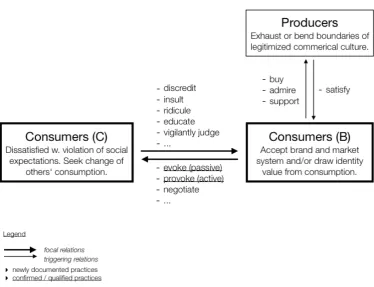
Building on a multi-perspective interpretive study of the Hummer brand controversy, it reveals that consumer-consumer conflicts evolve around A’s presumably deliberate violation of social norms that B considers widely accepted and sacrosanct (see fig. 2 below). In the present empirical case, these violations predominantly concern the in-authenticity and un-sociality inherent in consuming Hummer vehicles, but also tap into broader dialectical tensions such as individualism vs. collectivism (Triandis 1985), open vs. closed (Pitt, Watson & Berthon 2006), sharing vs. owning (Giesler 2008), or modesty vs. conspicuity (Veblen 1927 [1899]), that appear to be the most frequent causes of consumer-consumer conflict. The study illuminated five practices that Hummer adversaries engage in for redressing frustrations with Hummer consumers’ presumably deliberately norm-violating consumption: vigilant justice, insult, discredit, ridicule and instruction. These forms broadly differ by the directness of the act (immediate vs. mediated application) and explicitness of their formulation (explicit vs. implicit message).
By illuminating the violation of social expectations as key impetus and the five expressive forms as manifestation of controversy, this analysis sheds a preliminary light on an unexplored empirical terrain of market-mediated social conflict. In contrast to prior research that has located market-mediated social conflict exclusively in the domain of consumer-producer struggles (Kozinets & Handelman 2004; Klein 1999), the present study reveals that conflict also emerges in the mundane, everyday interactions among people that are endowed with similar social and economic capital but pursue different ideological agendas. The Hummer case uncovers specifically, that consumers defend and reinforce their ideas of a desirable market culture not only by throwing stones at Nike store windows (Lasn 2000), creating derogatory “Doppelgänger brand images” (Thompson, Rindfleisch & Arsel 2006), or symbolically burning wooden men at distant desert festivals (Kozinets 2002a), but often more by directly and spontaneously contesting the behaviors of their immediate social peers when they transgress perceived boundaries of socio-cultural legitimized behavior. What has been considered a domain of leftist and somewhat more enlightened consumer activists (cf. Thompson 2004), appears here as a more mundane (vs. extraordinary), consumption-induced (vs. producer- or system-induced), equal (vs. dominated), and interpersonal (vs. institutionally mediated) set of social practices.
Fig.2: Empirical Model of Consumer Controversy
In developing the idea of consumer controversy, this study also entails the following theoretical contributions to the theory of market-mediated social conflict.
First, in its original definition, “resistance” is defined as the simultaneous presence of three conditions: “that a force is exerted on the subject, that the subject perceives this force, and that he [or she] seeks to cancel its effect.“ (Roux 2007, p. 60). This study has shown that, for instance, the dispute between Hummer hater CDUBYA and Hummer fan Rudedogg (see introductory quote) is triggered by an imposed force (Rudedogg reports about his Hummer consumption in an online forum that CDUBYA reads) which sparked a feeling of dissonance (CDUBYA despises Hummer vehicles and has little respect for their owners), and a desire to cancel its effect (CDUBYA publicly condemns and insults Rudedogg). This constellation allows for diagnosing a form of resistance. However, CDUBYA does not address feeling of domination by Rudedogg’s Hummer ownership (Hummer trucks occupy only a marginal space in the U.S. Sport Utility Vehicle market), nor is he ranting against GM as the producer, or the market as the facilitating institution, nor is his response to Hummers structurally parallel to a complaint against bad customer service, obnoxious telemarketing, or a resource-depleting corporation.
(postmodern) emancipation practices, but rather in responding to other consumers’ (B) specific violations of socio-cultural norms (horizontal arrows). In their immediate conflicts, the initial violation of social expectations is attributed to Consumers (B) for accepting a market offer, while the existence of the offer – i.e. that a truck like Hummer exists on the market – stays within the confines of acceptable or legal marketing conduct (and is not at issue for these informants). Consumers (C) do not challenge the system or political institutions, but other people’s consumption ideology and their (lack of) responsibility for the national cause.
Second, producers, and specifically cultural marketers, appear to play a different role in consumer controversies than in classic consumer-producer conflicts. As Thompson, Rindfleisch, and Arsel (2006) show, negative brand images can be used for diagnosing the current cultural resonance of an emotional branding strategy. In the cases of consumer controversies, producers may even actively adopt the role of a supplier for goods and meanings that animate consumer controversies. As evidenced above, consumers involve in consumer controversies also for reassuring their consumerist identity position and strengthening their consumption ideology (Arsel & Thompson 2011). By bending the boundaries of legitimized commercial culture, marketers can provide provocative cultural material that consumers use to produce distinct, controversial identity positions. Interestingly, Hummer marketers often failed to communicatively support the defiant cultural agenda of their customers. By airing spots that almost ridiculed their customers, the company violated social expectations of their buyers and, thus, lost some emotional resonance rather than leveraging it.
potential for transforming certain elements of consumer culture that appear outdated to one fraction of consumers, while others still believe in its merits.
In conclusion, this study shows that market-mediated social conflict is not the exclusive domain of anti-market activists (Klein 1999; Hertz 2001) and their social movements (Kozinets & Handelman 2004) but a continuum of social practices emerging among multiple stakeholders. As a preliminary account, this study may provide an impetus for expanding the theoretical boundaries of market-mediated social conflict in consumer research and explore the important market system dynamics resulting from consumers struggling to find the best way to consume.
References
Arnould, EJ & Thompson, CJ 2005, 'Consumer Culture Theory (CCT): Twenty Years of Research', Journal of Consumer Research, vol. 32, no. 4, pp. 868-83.
Arsel, Z & Thompson, CJ (2011), 'Demythologizing Consumption Practices: How Consumers Protect Their Field- Dependent Identity Investments from Devaluing Marketplace Myths,' Journal of Consumer Research, vol. 37.
Belk, RW 1988, 'Possessions and the Extended Self', Journal of Consumer Research, vol. 15, no. 2, pp. 139-168.
Bourdieu, P 1984, Distinction: A Social Critique of the Judgement of Taste, Routledge and Kegan Paul, London, UK.
Cherrier, H 2009, 'Anti-Consumption Discourses and Consumer-Resistant Identities', Journal of Business Research, vol. 62, no. 2, pp. 181-190.
Cova, B & Dalli, D 2007, 'Community Made: From Consumer Resistance to Tribal Entrepreneurship', European Advances in Consumer Research, vol. 8, p. 461.
Cova, B, Kozinets, RV & Shankar, A 2007, 'Tribes, Inc,: the new world of tribalism', in
Consumer Tribes, eds B Cova, RV Kozinets & A Shankar, Elsevier, Oxford, pp. 1-26. Dameron, K 1938, 'The Consumer Movement', Harvard Business Review, vol. 17, no. 3, pp. 271-90.
Dameron, K 1941, 'Advertising and the Consumer Movement', Journal of Marketing, vol. 5, no. 3, pp. 234-48.
de Certeau, M [1974] 1984, The Practice of Everyday Life, University of California Press, Berkeley.
Dobscha, S & Ozanne, JL 2001, 'An Ecofeminist Analysis of Environmentally Sensitive Women Using Qualitative Methodology: The Emancipatory Potential of an Ecological Life',
Journal of Public Policy & Marketing, vol. 20, no. 2, pp. 201-14.
Elgin, D & Mitchell, A 1977, 'Voluntary Simplicity', Strategy & Leadership, vol. 5, no. 6, pp. 13-15.
Firat, FA & Venkatesh, A 1995, 'Liberatory Postmoderism and the Reenchantment of Consumption', Journal of Consumer Research, vol. 22, no. 3, pp. 239-267.
Fiske, J 1989, Understanding Popular Culture, Unwin Hyman, Boston.
Foucault, M 1979, Discipline and Punish: The Birth of the Prison, Vintage Books, New York. Friedman, M 1985, 'Consumer Boycotts in the United States, 1970-1980: Contemporay Events in Historical Perspective', Journal of Consumer Affairs, vol. 19, no. 1, pp. 97-117. Füller, J, Luedicke, MK & Jawecki, G 2008, 'How Brands Enchant: Insights From Observing Community Driven Brand Creation', in Advances in Consumer Research, Association for Consumer Research, Memphis, TN, pp. 359-66.
Funches, V, Markley, M & Davis, L 2009, 'Reprisal, retribution and requital: Investigating customer retaliation', Journal of Business Research, vol. 62, no. 2, pp. 231-238.
Garrett, DE 1987, 'The Effectiveness of Marketing Policy Boycotts: Environmental Opposition to Marketing', Journal of Marketing, vol. 51, no. 2, pp. 46-57.
Giesler, M 2008, 'Conflict and Compromise: Drama in Marketplace Evolution', Journal of Consumer Research, vol. 34, no. 6, pp. 739-53.
Gladwell, M 2004, 'Big and bad: How the S.U.V. Ran Over Automotive Safety', The New Yorker, 01/12/2004, pp. 28-33.
Handelman, JM 1999, 'Culture Jamming: Expanding the Application of the Critical Research Project', in Advances in Consumer Research, ed. EJ Arnould & LL Price, Provo, UT:
Association of Consumer Research.
Hellmann, K 1994, 'Zur Eigendynamik sozialer Probleme', Soziale Probleme, vol. 5, no. 3, p. 4.
Hemetsberger, A & Reinhardt, C 2009, 'Collective development in open-source communities: An activity theoretical perspective on successful online collaboration', Organization Studies, vol. 30, no. 9, p. 987.
Hertz, N 2001, The Silent Takeover. Global Capitalism and the Death of Democracy, William Heinemann, London.
Holt, DB 2002, 'Why Do Brands Cause Trouble? A Dialectical Theory of Consumer Culture and Branding', Journal of Consumer Research, vol. 29, no. 1, pp. 70-90.
Humphreys, A 2010, 'Megamarketing: The Creation of Markets as a Social Process', Journal of Marketing, vol. 74, no. 2, pp. 1-19.
Kates, SM 2004, 'The Dynamics of Brand Legitimacy: An Interpretive Study in the Gay Men's Community', Journal of Consumer Research, vol. 31, no. 2, pp. 455-465.
Klein, N 1999, No Logo - Taking Aim at the Brand Bullies, Picador, New York.
Kozinets, RV 2001, 'Utopian Enterprise: Articulating the Meanings of Star Trek's Culture of Consumption', Journal of Consumer Research, vol. 28, no. 1, pp. 67-89.
Kozinets, RV 2002b, 'The Field Behind the Screen: Using Netnography for Marketing Research in Online Communities', Journal of Marketing Research, vol. 39, no. 1, pp. 61-73. Kozinets, RV & Handelman, JM 2004, 'Adversaries of Consumption: Consumer Movements, Activism, and Ideology', Journal of Consumer Research, vol. 31, no. 3, pp. 691-704.
Lasn, K 2000, Culture Jam: The Uncooling of America TM, Quill, New York.
Lee, MSW, Fernandez, KV & Hyman, MR 2009, 'Anti-Consumption: An Overview and Research Agenda', Journal of Business Research, vol. 62, no. 2, pp. 145-147.
Luedicke, MK, Thompson, CJ & Giesler, M 2010, 'Consumer Identity Work as Moral
Protagonism: How Myth and Ideology Animate a Brand-Mediated Moral Conflict', Journal of Consumer Research, vol. 36, no. 6, pp. 1016-1032.
McCracken, G 1988, The Long Interview, Sage Publications, Newbury Park.
Muñiz, AMJ & O'Guinn, T 2001, 'Brand Community', Journal of Consumer Research, vol. 27, no. 4, pp. 412-432.
Murray, JB & Ozanne, JL 1991, 'The Critical Imagination - Emancipatory Interests in Consumer Research', Journal of Consumer Research, vol. 18, no. 2, pp. 129-145.
Ozanne, JL, Hill, RP & Wright, ND 1998, 'Juvenile Delinquents' Use of Consumption as Cultural Resistance: Implications for Juvenile Reform Programs and Public Policy', Journal of Public Policy & Marketing, vol. 17, no. 2, pp. 185-97.
Ozanne, JL & Murray, JB 1995, 'Uniting Critical Theory and Public Policy to Create the Reflexively Defiant Consumer', American Behavioral Scientist, vol. 38, no. 4, pp. 516-26. Peñaloza, L & Price, LL 1993, 'Consumer Resistance: A Conceptual Overview', Advances in Consumer Research, vol. 20, no. 1, pp. 123-8.
Pitt, LF, Watson, RT & Berthon, P 2006, 'The Penguin's Window: Corporate Brands From an Open-Source Perspective', Journal of the Academy of Marketing Science, vol. 34, no. 2, pp. 115-27.
Richins, ML 1983, 'Negative Word-of-Mouth by Dissatisfied Consumers: A Pilot Study', The Journal of Marketing, vol. 47, no. 1, pp. 68-78.
Roux, D 2007, 'Consumer Resistance: Proposal for an Integrative Framework', Recherche et Applications en Marketing (English Edition), vol. 22, no. 4, pp. 59-79.
Rumbo, JD 2002, 'Consumer Resistance in a World of Advertising Clutter: The Case of Adbusters', Psychology and Marketing, vol. 19, no. 2, pp. 127-48.
Sartre, J-P 1948, Anti-Semite and Jew, New York, Grove Press.
Schouten, JW & McAlexander, JH 1995, 'Subcultures of Consumption: An Ethnography of the New Bikers', Journal of Consumer Research, vol. 22, no. 1, pp. 43-62.
Shaw, D & Newholm, T 2002, 'Voluntary Simplicity and the Ethics of Consumption',
Psychology and Marketing, vol. 19, no. 2, pp. 167-185.
Simmel, G 1890, Über sociale Differenzierung: Sociologische und psychologische Untersuchungen, Duncker & Humblot, Leipzig.
Sorensen, HL 1941, The Consumer Movement: What it is and what it means, Harper Bros., New York.
Suchman, MC 1995, 'Managing Legitimacy - Strategic and Institutional Approaches',
Thompson, CJ 1997, 'Interpreting Consumers: A Hermeneutical Framework for Deriving Marketing Insights from the Texts of Consumers' Consumption Stories', Journal of Marketing Research, vol. 34, no. 4, pp. 438-56.
Thompson, CJ 2004, 'Marketplace Mythology and Discourses of Power', Journal of Consumer Research, vol. 31, no. June, pp. 162-180.
Thompson, CJ & Arsel, Z 2004, 'The Starbucks Brandscape and Consumers' (Anticorporate) Experiences of Glocalization', Journal of Consumer Research, vol. 31, no. 3, pp. 631-42. Thompson, CJ & Coskuner-Balli, G 2007, 'Countervailing Market Responses to Corporate Co-optation and the Ideological Recruitment of Consumption Communities', Journal of Consumer Research, vol. 34, no. 2, pp. 135-52.
Thompson, CJ, Rindfleisch, A & Arsel, Z 2006, 'Emotional Branding and the Strategic Value of the Doppelgänger Brand Image', Journal of Marketing, vol. 70, no. 1, pp. 50-64.
Triandis, HC 1985, 'Collectivism vs. Individualism: A Reconceptualization of a Basic Concept in Cross-Cultural Psychology', in Personality, cognition, and value: Crosscultural perspectives of childhood and adolescence, eds C Bagley & GK Verma, McMilllan, London. Veblen, T 1927 [1899], The Theory of the Leisure Class - An Economic study of Institutions, Vanguard Press, New York.
Willis, S 1991, A Primer For Daily Life, Routledge, London.
Zavestoski, S 2002, 'The Social–Psychological Bases of Anticonsumption Attitudes',