
(a, b)-rectangle patterns in permutations and words
Sergey Kitaev
Department of Computer and Information Sciences University of Strathclyde
Glasgow G1 1XH, United Kingdom [email protected]
Jeffrey Remmel
Department of Mathematics University of California, San Diego
La Jolla, CA 92093-0112. USA [email protected]
Submitted: Date 1; Accepted: Date 2; Published: Date 3. MR Subject Classifications: 05A15, 05E05
Abstract
In this paper, we introduce the notion of an (a, b)-rectangle pattern on permutations which is closely related to the notion of successive elements (bonds) in permutations and to mesh patterns introduced recently by Br¨and´en and Claesson. We call the (k, k)-rectangle pattern the k-box pattern. We show that we can derive an explicit formula for the number of permutations ofSnwhich have the maximum possible
oc-currences of the 1-box pattern by using a new enumerative result on pattern-avoidance in signed permutations.
We also study the notion of (a, b)-rectangle patterns in words. In particular, we give a general method for computing the generating function for the distribution of (1, b)-rectangle patterns on words over an alphabet of size k for b ∈ {1,2}. Our method requires to invert a certain matrix depending onbandk, and can be used to give explicit formuals for such generating functions fork= 2, . . . ,7. We also provide similar results for the distribution of bonds over words. As a corollary to our studies, we prove a conjecture of Mathar on the number of “stable LEGO walls” of width 7, as well as prove three conjectures due to Hardin and a conjecture due to Barker. We provide generating functions for two sequences published by Hardin in the On-Line Encyclopedia of Integer Sequences.
Keywords: (a, b)-rectangle patterns,k-box patterns, bond, k-bond, mesh patterns, permutations, words, distribution, successions in permutations, Fibonacci numbers, LEGO
1
Introduction
patterns in permutations and words and also appropriate portions of [3]). This notion was studied further in a series of papers, e.g. in [1, 5, 6, 7, 12].
In this paper, we introduce the notion of an (a, b)-rectanglepattern in permutations and words. Formally, given a sequenceα =α1. . . αn of postive integers, we say thatαi matches
the (a, b)-rectangle pattern in αif and only if there exists a j such that 0<|i−j| ≤a and
|αi−αj| ≤b. The (a, b)-rectangle pattern has a nice pictorial description in permutations.
That is, let σ = σ1. . . σn ∈ Sn be a permutation written in one-line notation where Sn
denotes the set of all permutations of lengthn. Then we will consider the graph ofσ,G(σ), to be the set of points (i, σi) for i= 1, . . . , n. For example, the graph of the permutation
σ = 471569283 is pictured in Figure 1.
1 2 3 4 5 6 7 8 9 1
[image:2.612.240.385.229.364.2]2 3 4 5 6 7 8 9
Figure 1: The graph of σ= 471569283.
We will be interested in the points that lie in the (2a)×(2b) rectangle centred at a point (i, σi), that is, in the set of points (i± r, σi ± s) such that r ∈ {0,1, . . . , a} and
s ∈ {0,1, . . . , b}. Then σi matches the (a, b)-rectangle pattern in σ, if there is at least one
point in the (2a)×(2b) rectangle centered at the point (i, σi) in G(σ) other than (i, σi).
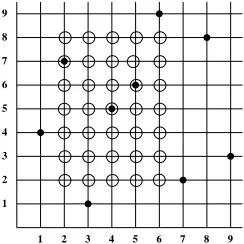
For example, when we look for matches of the (2,3)-rectangle patterns, we would look at 4×6 rectangles centered at points (i, σi) for i = 1, . . . , n, as pictured in Figure 2 for the
point (4,5) where the 4×6 rectangle is represented by the circled points.
1 2 3 4 5 6 7 8 9 1
2 3 4 5 6 7 8 9
Figure 2: The 4×6 rectangle centered at the point (4,5) in the graph of σ= 471569283.
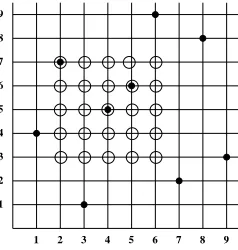
We shall refer to the (k, k)-rectangle pattern as the k-box pattern. For example, if
[image:2.612.241.363.507.629.2]points pictured in Figure 3. Hence, σi matches thek-box pattern in σ, if there is at least
one point in the k-box centered at the point (i, σi) inG(σ) other than (i, σi). For example,
σ4 matches the patternk-box for allk≥1 inσ = 471569283 since the point (5,6) is present
in the k-box centered at the point (4,5) in G(σ) for all k ≥ 1. However, σ3 only matches
the k-box pattern in σ = 471569283 for k ≥3 since there are no points in 1-box or 2-box centered at (3,1) in G(σ), but the point (1,4) is in the 3-box centered at (3,1) in G(σ). Fork ≥1, we let kbox(σ) denote the set of allisuch that σi matches the k-box pattern in
σ =σ1. . . σn.
1 2 3 4 5 6 7 8 9 1
[image:3.612.243.362.200.325.2]2 3 4 5 6 7 8 9
Figure 3: The 2-box centered at the point (4,5) in the graph ofσ = 471569283.
In this paper, we shall mainly be interested in the 1-box patterns in permutations and words. Note that σi matches the 1-box pattern in a permutation σ = σ1. . . σn if either |σi−σi+1|= 1 or |σi−1−σi|= 1, while if w =w1. . . wn is a word of postive integers, then
wi matches the 1-box pattern in w if either |wi −wi+1| ≤ 1 or |wi−1 −wi| ≤ 1. For any
permutation σ =σ1. . . σn ∈ Sn, let 1box(σ) denote the number of i such that σi matches
the 1-box pattern in σ. We let (a, b)rec(σ) denote the number of i such that σi matches
the (a, b)-rectangle pattern inσ.
Avoidance of the 1-box pattern is given by permutations without rising or falling suc-cessions which are also called bonds. That is, abondin a permutation σ=σ1. . . σn∈Snis
a pairσiσi+1 of the forms(s+ 1) or (s+ 1)sfor somes. We let bond(σ) denote the number
of bonds in σ. We note that in general 1box(σ) ̸= bond(σ). For example, if σ = 214365, then 1box(σ) = 6 while bond(σ) = 3. However, for any permutationσ ∈ Sn, 1box(σ) = 0
if and only if bond(σ) = 0.
The distributions of 1box(σ) and bond(σ) forS2, S3, and S4 are given below.
σ 1box(σ) bond(σ)
12 2 1
21 2 1
σ 1box(σ) bond(σ)
123 3 2
132 2 1
213 2 1
231 2 1
312 2 1
σ 1box(σ) bond(σ) σ 1box(σ) bond(σ)
1234 4 3 2134 4 2
1243 4 2 2143 4 2
1324 2 1 2314 2 1
1342 2 1 2341 3 2
1423 2 1 2413 0 0
1432 3 2 2431 2 1
3124 2 1 4123 3 2
3142 0 0 4132 2 1
3214 3 2 4213 2 1
3241 2 1 4231 2 1
3412 4 2 4312 4 2
3421 4 2 4321 4 3
Finding the number of permutations σ of length n with bond(σ) = 0 (equivalently, 1box(σ) = 0) is equivalent to solving the problem of Hertzsprung, which is finding the number of ways to arrange n non-attacking kings on an n ×n board, with one in each row and column. Riordan [10] first derived a recurrence relation for the number an of such
permutations in 1965: a0 =a1 = 1, a2 =a3 = 0, and for n ≥4,
an= (n+ 1)an−1−(n−2)an−2−(n−5)an−3+ (n−3)an−4.
The initial values for an are
1,1,0,0,2,14,90,646,5242,47622,479306,5296790,63779034, . . . .
We refer to the sequence A002464 in theOn-Line Encyclopedia of Integer Sequences(OEIS) for many references and for other interpretations/properties of this sequence of numbers. In particular, the generating function for these numbers was derived by Flajolet:
∑
n≥0
n!xn(1−x)n (1 +x)n .
Riordan [10] obtained a more general result. That is, let Sn,m be the number of
per-mutations in Sn with exactly m bonds, and let S[n] := S[n](t) = ∑
m≥0Sn,mtm. Then
S[0] = 1, S[1] = 1, S[2] = 2t, S[3] = 4t+ 2t2, and for n≥4,
S[n] = (n+1−t)S[n−1]−(1−t)(n−2+3t)S[n−2]−(1−t)2(n−5+t)S[n−3]+(1−t)3(n−3)S[n−4]. In particular, the coefficient of t in S[n](t) gives the number of permutations of length
n with exactly one bond, which, in our terminology, is the number of permutations in Sn
length n with exactly two occurrences of the 1-box pattern. Indeed, to have exactly three occurrences of the pattern in a permutation π means to have in π a factor either of the form a(a+ 1)(a+ 2) or of the form (a+ 2)(a+ 1)a, and no other consecutive successive elements. Removing (a+ 1) from π and decreasing by 1 all elements that are larger than (a+ 1), we get a permutation containing exactly two occurrences of the 1-box pattern. This procedure is obviously reversible. Thus, the coefficient oft inS[n](t) also gives the number of permutations of length n+ 1 with exactly three occurrences of the 1-box pattern.
Thus, our study of 1-box/k-box patterns cannot only be seen as an extension of the study of mesh patterns, but also as an extension of the study of consecutive successive elements (bonds) conducted in the literature. We do not define the notation of mesh patterns in this paper; however, the relevance of these patterns to our patterns is that in both cases we look for presence of points in specified regions in graphical representation of permutations.
In Theorem 3, we will enumerate permutations having the maximum number of occur-rences of the 1-box pattern. To achieve this result, we obtain a result on pattern-avoiding signed permutations (see Theorem 1) thus contributing to the theory of permutation pat-terns (see [4]). Theorem 1 is strengthened by Theorem 2 to actually derive the generating function for the number of occurrences, rather than for avoidance, of what we callbad pairs
in hyperoctahedral group Bn.
In Section 3 we not only provide a general solution (in matrix form) for finding the distribution of bonds and 1-box patterns over words (see Theorems 4 and 5) but also apply our studies to settle a conjecture of Mathar on the number of “stable LEGO walls” of width 7 (see Subsection 3.4), as well as to settle three conjectures of Hardin (see Subsection 3.3) and a conjecture of Barker (see Subsection 3.5). Also, in Subsection 3.5, we find generating functions for two sequences published by Hardin in the OEIS.
Given a word w1. . . wn ∈ [ℓ]n, where [ℓ] = {1, . . . , ℓ}, we say that the pair wiwi+1 is
a k-bond if |wi−wi+1| ≤ k. In Subsection 3.5, we study the distribution of 2-bonds and
(1,2)-rectangle patterns in words.
2
Permutations with the maximum number of
occur-rences of the 1-box pattern
Note that if σ = 1. . . n, then 1box(σ) = n so that the maximum possible number of occurrences of the 1-box pattern in a permutation of lengthn isn.
In order to enumerate permutations with the maximum number of occurrences of the 1-box pattern, we need to prove a pattern avoidance result on the hyperoctahedral group
Bn which is the group of signed permutations of length n. We will indicate the negative
elements of an element of Bn by placing a bar over that element and we will define |i|=i.
For example, if α = 3 4 2 1, then 2 and 3 are the positive elements of α and 1 and 4 are the negative elements of α. If α = α1. . . αn ∈ Bn, then we let |α| = |α1|. . .|αn| be
the permutation of Sn that results by removing all the bars. Every element of Bn can be
some of the σis so that |Bn| = 2nn!. Given α =α1. . . αn ∈ Bn, we shall say that αj αj+1
is a bad pair if either αj αj+1 =i (i+ 1) or αj αj+1 = (i+ 1) i for some i. We let a(n, k)
be the number of elements of Bn with exactly k bad pairs.
Theorem 1. The exponential generating function foran:=a(n,0), the number of elements
in Bn with no bad pairs, is given by
A(t) =∑
n≥0
antn
n! = 1 + 2
∫ t
0
e−z
(1−2z)2 dz. (1)
The initial values for an are
1,2,6,34,262,2562,30278,419234,6651846,118950658,2366492038, . . . .
Proof. Clearly, a(0,0) = 1 and a(1,0) = 2 since the empty signed permutation, as well as 1 and 1, avoid the prohibited factors. Our goal is to show that forn ≥2,
a(n,0) = (2n−1)a(n−1,0) + 2(n−2)a(n−2,0). (2)
Given a permutation α = α1. . . αn ∈Bn, we construct a permutation Di(α) which we
call the doubling of σ at ias follows. First, replace each j which appears in α byj if j < i
and by j + 1 if j > i. Similarly, replace each j which appears in α by j if j < i and by
j+ 1 if j > i. Then, if i appears in α, replace i by the pair i (i+ 1), and ifi appears in α, replacei by the pair (i+ 1) i. For example, ifα = 3 4 2 5 6 1, then D3(α) = 3 4 5 2 6 7 1
and D4(α) = 3 5 4 2 6 7 1. We claim that Di(α) has exactly one more bad pair than α.
That is, suppose that α=α1. . . αn ∈Bn and |αj|=i. Now, if αj =i, then
Di(α) = α′1. . . α′j−1 i(i+ 1) αj′+2. . . α′n+1.
It is then easy to check that if s < j −1, then our definitions ensure that αs αs+1 is a
bad pair in α if and only if α′s α′s+1 is a bad pair in Di(α). Similarly, it is easy to check
that if s ≥ j + 1, then our definitions ensure that αs αs+1 is a bad pair in α if and only
if α′s+1 α′s+2 is a bad pair in Di(α). Note that αj−1 αj is a bad pair in α if and only if
αj−1 =i−1 =α′j−1 if and only if α′j−1 α′j is a bad pair inDi(α). Finally, αj αj+1 is a bad
pair inα if and only if αj+1 =i+ 1 if and only if α′j+2 =i+ 2 if and only ifα′j+1 α′j+2 is a
bad pair in Di(α). This shows that there is a one-to-one correspondence between the bad
pairs inα and the bad pairs inDi(α) which are not equal toi(i+ 1). Thus,Di(α) has one
more bad pair than α. A similar argument will show that if αj = i, then Di(α) has one
more bad pair than α.
It follows that ifα ∈Bn−1 has k bad pairs, then D1(α), D2(α), . . . , Dn−1(α) are (n−1)
distinct signed permutations in Bn which have k+ 1 bad pairs. Clearly, we can recover α
from Di(α) and i. Thus, it follows that if β =β1. . . βn ∈Bn has k+ 1 bad pairs, then for
each bad pairβs βs+1 where {|βs|,|βs+1|}={i, i+ 1}, we can reconstruct aγ ∈Bn−1 with
k bad pairs such thatDi(γ) =β. Thus, it follows that for all n≥0,
a(n, k+ 1) = n−1
In particular, if bn = a(n,1) is the number of elements in Bn with exactly one bad pair,
then
bn = (n−1)an−1. (4)
Next, we claim that
an= 2bn−1+ 2nan−1−an−1. (5)
That is, suppose thatα=α1. . . αnis an element ofBnwhich has no bad pairs and|αj|=n.
Then, it is easy to see that α′ =α1. . . αj−1αj+1. . . αn is an element of Bn−1 which has at
most one bad pair. Now, if β = β1. . . βn−1 ∈Bn−1 has exactly one bad pair, say βs βs+1,
then we can insert either n or n between βs and βs+1 to create a permutation in Bn with
no bad pairs. That is, if βs βs+1 = i (i+ 1), then i n (i+ 1) or i n i + 1 will kill the
bad pair and, similarly, if βs βs+1 = (i+ 1) i, then (i+ 1) n i or (i+ 1) n i will kill the
bad pair. Thus, there are 2bn−1 αs in Bn such that α′ has one bad pair. On the other
hand, if γ = γ1. . . γn−1 is an element of Bn−1 with no bad pairs and |γj| = n−1, then
if γj = n−1, we can insert n in any place in γ except immediately after γj to create an
element ofBnwith no bad pairs, and we can insertnin any place inγ to create an element
of Bn with no bad pairs. Similarly, if γj =n−1, then we can insert n in any place in γ
except immediately before γj to create an element of Bn with no bad pairs, and we can
insertn in any place inγ to create an element ofBnwith no bad pairs. Thus, in each case,
there are 2n−1 elements α∈Bn with no bad pairs such that α′ =γ. Hence,
an = 2bn−1+ (2n−1)an−1 = 2bn−1+ 2nan−1 −an−1.
Using (4) and (5), we obtain (2).
Note that the second derivative of A(t) is given by
A′′(t) = ∑
n≥0
an+2
tn n! =
∑
n≥0
((2n+ 3)an+1+ 2nan)
tn n!
= 2t∑
n≥1
an+1
tn−1
(n−1)! + 3
∑
n≥0
an+1
tn n! + 2t
∑
n≥1
an
tn−1
(n−1)!
= 2tA′′(t) + 3A′(t) + 2tA′(t).
Solving for A′′(t), we see that
A′′(t) = 2t+ 3 1−2tA
′(t)
or, equivalently,
A′′(t)
A′(t) =−1 + 4
1−2t. (6)
Integrating both sides of (6) and using the fact that A′(0) = 2, we see that
ln(A′(t)) =−t−2 ln(1−2t) + ln(2).
Thus
A′(t) = 2 e
−t
Integrating both sides of (7) and using the fact that A(0) = 1, we see that
A(t) = 1 + 2
∫ t
0
e−t
(1−2t)2dt.
Remark 1. Theorem 1 is a result on pattern avoidance in signed permutations (see [4,
Chapter 9.6] for relevant results). In fact, avoidance of factors of the form i(i+ 1) and
(i+ 1)i can be expressed in terms of avoidance of bivincular patterns(see [4, Chapter 1.4] for definition; bars can be incorporated in the definition in an obvious way extending it from
Sn to Bn), and thus, Theorem 1 seems to be the first instance of enumerative results on
signed permutations avoiding bivincular patterns.
In fact, we can use Theorem 1 to find the distribution of bad pairs in elements of Bn.
That is, given α ∈Bn, let bp(α) denote the number of bad pairs in α and let
BPn(x) = ∑
α∈Bn
xbp(α) =
n ∑
k=0
a(n, k)xk.
Theorem 2.
BP(x, t) := 1 +∑
n≥1
BPn(x)
tn
n! = 1 + 2
∫ t
0
ez(x−1)
(1−2z)2dz. (8)
Proof. Note that if α∈Bn has k bad pairs where k ≥1, thenn ≥k+ 1. Thus
BP(x, t) =∑
k≥0
xk ∑
n≥k+1
a(n, k)t
n
n!.
We claim that for k ≥1,
∑
n≥k+1
a(n, k)t
n
n! = 2
∫ t
0
zk
k!
e−z
(1−2z)2dz. (9)
By Theorem 1,
A(t) := ∑
n≥1
a(n,0)t
n
n! = 2
∫ t
0
e−z
(1−2z)2dz. (10)
Iterating (3), we have that for n ≥k+ 1,
a(n, k) = (n−1)↓k
where for any m, m↓k=m(m−1)· · ·(m−k+ 1). Thus
∑
n≥k+1
a(n, k)t
n
n! =
∑
n≥k+1
(n−1)↓k
k! a(n−k,0)
tn n! = ∫ t 0 ∑
n≥k+1
(n−1)↓k
k! a(n−k,0)
zn−1
(n−1)!dz
= ∫ t 0 zk k! ∑
n≥k+1
a(n−k,0) z
n−k−1
(n−k−1)!dz
= ∫ t 0 zk k! ( d dzA(z)
) dz = ∫ t 0 zk k!2
e−z
(1−2z)2dz
= 2
∫ t
0
zk
k!
e−z
(1−2z)2dz.
Hence
BP(x, t) = A(t) +∑
k≥1
xk ∑
n≥k+1
a(n, k)t
n
n!
= 1 + 2
∫ t
0
e−z
(1−2z)2dz+
∑
k≥1
xk2
∫ t
0
zk k!
e−z
(1−2z)2dz
= 1 + 2
∫ t
0
( ∑
k≥0
xkzk
k!
)
e−z
(1−2z)2dz
= 1 + 2
∫ t
0
exz e
−z
(1−2z)2dz
= 1 + 2
∫ t
0
e(x−1)z
(1−2z)2dz.
Using Mathematica, we have computed the following initial values of the polynomials
BPn(x):
BP0(x) = 1,
BP1(x) = 2,
BP2(x) = 2(3 +x),
BP3(x) = 2(17 + 6x+x2),
BP4(x) = 2(131 + 51x+ 9x2+x3),
BP5(x) = 2(1281 + 524x+ 102x2+ 12x3 +x4),
BP6(x) = 2(15139 + 6405x+ 1310x2+ 170x3+ 15x4+x3), and
Theorem 3. The number of permutations in Sn with the maximum number of occurrences
of the 1-box pattern (which is n) is given by
⌊n
2⌋
∑
j=1
(
n−j −1
j−1
)
aj, (12)
where aj’s are given by the recurrence (2) or by the exponential generating function (1).
The initial values for the number of such permutations starting with the case n = 0 are
1,1,2,2,8,14,54,128,498,1426,5736,18814,78886,287296,1258018, . . . .
Proof. Each permutationπ ∈Sn having the maximum number of occurrences of the 1-box
pattern can be uniquely decomposed into maximal factors of consecutive elements of size at least 2, since each element of π must be staying next to a consecutive element. For example, the permutation π = 543126798 is decomposed into maximal factors 543, 12, 67 and 98. Let a permutationπ′ be obtained fromπ by substituting theith largest factor with
iif it is increasing, and withiif it is decreasing. We refer toπ′ as thebasis permutationfor
π and, clearly, π′ ∈ Bm for some m. For π as above, π′ = 2134. Since the decomposition
factors are of maximal possible length, basis permutations must avoid factors of the form
i(i+ 1) and (i+ 1)i, and these permutations were counted by us in Theorem 1.
Finally, to create permutations of length n with the maximum number of occurrences of the 1-box pattern, we choose basis permutations of lengthj, 1≤j ≤ ⌊n2⌋, and decide on the lengths of the j decomposition factors to be made decreasing or increasing depending on the respective elements to have or not to have bars, respectively. These lengths must be of size at least 2, and it is a standard combinatorial problem to see that the number of ways to make such a decision is (n−j−j−11) (indeed, we reserve 2j elements to make sure each decomposition factor will contain at least two elements; the remaining n−2j elements can be distributed among j factors in the desired number of ways). Note that all permutations of interest will be generated in a bijective manner, which completes our proof of (12).
3
Distribution of bonds and
1
-box patterns over words
Given a word w = w1. . . wn, let |w| = n be the length of the w and 1box(w) denote the
number of occurences of the 1-box pattern inw. A bond inw is a pair wiwi+1 of the form
3.1
Distribution of bonds over words.
As in the case of permutations, it is relatively straightforward to find the generating func-tions for the number of bonds in words over [ℓ] for any ℓ≥1. That is, let
Aℓ,1(x, t) =
∑
w∈[ℓ]∗
xbond(w)t|w| = ∑
m,n≥0
aℓ,1(m, n)xmtn,
where [ℓ]∗ is the set of all words over the alphabet [ℓ]. Thus aℓ,1(m, n) is the number of
words w of length n over the alphabet [ℓ] such that bond(w) = m. Note that Aℓ,1 is a
particular case of the function Aℓ,k defined in Subsection 3.5.
The following theorem gives the distribution of bonds over words in matrix form.
Theorem 4. The generating function Aℓ,1(x, t) is equal to
1 + (1| {z }, . . . ,1
ℓ
)A−ℓ,11(−| t, . . . ,{z −}t
ℓ
)T,
where Aℓ,1 is the following ℓ×ℓ matrix:
Aℓ,1 =
xt−1 xt t t t · · · t t
xt xt−1 xt t t · · · t t
t xt xt−1 xt t · · · t t
t t xt xt−1 xt · · · t t
..
. ... ... ... ... . .. ... ...
t t t t t · · · xt xt−1
.
Proof. Let i[ℓ]∗ denote the set of words over [ℓ] that begin with a letter i. For 1 ≤i ≤ ℓ, let
A(ℓ,i)1(x, t) = ∑
w∈i[ℓ]∗
xbond(w)t|w|= ∑
m,n≥0
a(ℓ,i1)(m, n)xmtn.
Thus a(ℓ,i)1(m, n) is the number of words of length n over [ℓ] such that w begins with the letter i and bond(w) = m. Clearly,
Aℓ,1(x, t) = 1 +
∑
1≤i≤ℓ
A(ℓ,i1)(x, t). (13)
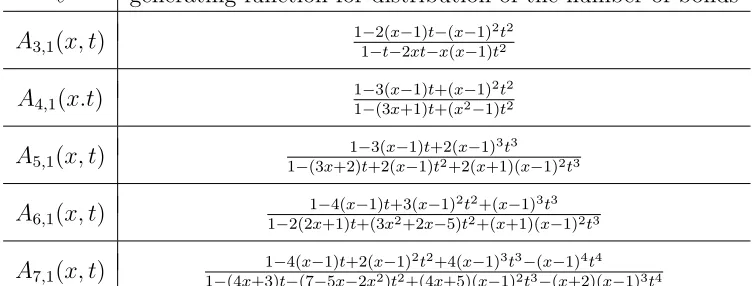
ℓ generating function for distribution of the number of bonds
A3,1(x, t) 1−2(x−1)t−(x−1) 2t2 1−t−2xt−x(x−1)t2
A4,1(x.t) 1−3(x−1)t+(x−1) 2t2 1−(3x+1)t+(x2−1)t2
A5,1(x, t) 1−3(x−1)t+2(x−1) 3t3 1−(3x+2)t+2(x−1)t2+2(x+1)(x−1)2t3
A6,1(x, t) 1−4(x−1)t+3(x−1)
2t2+(x−1)3t3 1−2(2x+1)t+(3x2+2x−5)t2+(x+1)(x−1)2t3
A7,1(x, t) 1−4(x−1)t+2(x−1)
[image:12.612.114.491.81.224.2]2t2+4(x−1)3t3−(x−1)4t4 1−(4x+3)t−(7−5x−2x2)t2+(4x+5)(x−1)2t3−(x+2)(x−1)3t4
Table 1: Distribution of the number of bonds on ℓ-ary words, ℓ= 3, ...,7.
A(1)ℓ,1(x, t) = t+xtAℓ,(1)1(x, t) +xtA(2)ℓ,1(x, t) +tA(3)ℓ,1(x, t) +tA(4)ℓ,1(x, t) +· · ·+tA(ℓ,ℓ1)(x, t);
A(2)ℓ,1(x, t) = t+xtAℓ,(1)1(x, t) +xtA(2)ℓ,1(x, t) +xtA(3)ℓ,1(x, t) +tA(4)ℓ,1(x, t) +· · ·+tA(ℓ,ℓ1)(x, t);
A(3)ℓ,1(x, t) = t+tAℓ,(1)1(x, t) +xtA(2)ℓ,1(x, t) +xtA(3)ℓ,1(x, t) +xtA(4)ℓ,1(x, t) +· · ·+tA(ℓ,ℓ1)(x, t); ..
.
Aℓ,(ℓ1)(x, t) = t+tA(1)ℓ,1(x, t) +tA(2)ℓ,1(x, t) +· · ·+tAℓ,(ℓ1−2)(x, t) +xtAℓ,(ℓ1−1)(x, t) +xtA(ℓ,ℓ1)(x, t).
Solving the system for the functions A(ℓ,i1)(x, t) and applying (13) we get the desired result.
As corollaries to Theorem 4, we can obtain, e.g. using Mathematica, explicit generating functions for ℓ letter alphabets, where 3 ≤ ℓ ≤ 7. These are presented in Table 1. Note that A1,1(x, t) andA2,1(x, t) are trivial since any word wof length n over the alphabet{1}
or the alphabet {1,2} has n−1 bonds. We also give expansions of the functions Aℓ,1(x, t)
for ℓ= 3, ...,7:
A3,1(x, t) = 1 + 3t+ (2 + 7x)t2+(2 + 8x+ 17x2)t3+(2 + 10x+ 28x2+ 41x3)t4
+ (2 + 12x+ 42x2+ 88x3+ 99x4)t5+(2 + 14x+ 58x2+ 154x3+ 262x4+ 239x5)t6
+ (2 + 16x+ 76x2+ 240x3+ 524x4+ 752x5+ 577x6)t7
+ (2 + 18x+ 96x2+ 348x3+ 908x4+ 1692x5+ 2104x6+ 1393x7)t8+· · ·;
A4,1(x, t) = 1 + 4t+ 2(3 + 5x)t2+ 2 (
5 + 14x+ 13x2)t3+ 4(4 + 17x+ 26x2+ 17x3)t4
+ 2(13 + 72x+ 162x2+ 176x3+ 89x4)t5
+ 2(21 + 145x+ 422x2+ 662x3+ 565x4+ 233x5)t6
+ 4(17 + 140x+ 503x2+ 1016x3+ 1239x4+ 876x5+ 305x6)t7
ℓ generating function forℓ-ary words avoiding the 1-box pattern
A3,1(0, t) 1+2t−t 2 1−t
A4,1(0.t) 1+3t+t 2 1−t−t2
A5,1(0, t) 1+3t−2t 3 1−2t−2t2+2t3
A6,1(0, t) 1+4t+3t 2−t3 1−2t−5t2+t3
A7,1(0, t) 1+4t+2t
[image:13.612.109.500.83.225.2]2−4t3−t4 1−3t−7t2+5t3+2t4
Table 2: Distribution of ℓ-ary words which avoid the 1-box pattern for ℓ= 3, ...,7.
A5,1(x, t) = 1 + 5t+ (12 + 13x)t2+ 5 (
6 + 12x+ 7x2)t3+(74 + 222x+ 234x2+ 95x3)t4
+ (184 + 724x+ 1134x2+ 824x3+ 259x4)t5
+ (456 + 2236x+ 4574x2+ 4902x3+ 2750x4+ 707x5)t6
+ (1132 + 6624x+ 16800x2+ 23480x3+ 19290x4+ 8868x5+ 1931x6)t7
+ (2808 + 19124x+ 57696x2+ 99716x3+ 106666x4+ 71418x5+ 27922x6+ 5275x7)t8+· · ·;
A6,1(x, t) = 1 + 6t+ 4(5 + 4x)t2+ 4 (
17 + 26x+ 11x2)t3+ 2(115 + 263x+ 209x2+ 61x3)t4
+ 4(195 + 590x+ 696x2+ 378x3+ 85x4)t5
+ 2(1321 + 4987x+ 7742x2+ 6218x3+ 2585x4+ 475x5)t6
+ 2(4477 + 20230x+ 39031x2+ 41156x3+ 25211x4+ 8534x5+ 1329x6)t7
+ 2(15169 + 79871x+ 183933x2+ 240507x3+ 193107x4+ 95997x5+ 27503x6+ 3721x7)t8+· · ·;
A7,1(x, t) = 1 + 7t+ (30 + 19x)t2+ (
130 + 160x+ 53x2)t3+(562 + 1034x+ 656x2+ 149x3)t4
+ (2432 + 5940x+ 5598x2+ 2416x3+ 421x4)t5
+ (10520 + 32068x+ 39942x2+ 25526x3+ 8400x4+ 1193x5)t6
+ (45514 + 166236x+ 257634x2+ 217088x3+ 105512x4+ 28172x5+ 3387x6)t7
+ (196898 + 838274x+ 1553178x2+ 1625554x3+ 1039904x4+ 409176x5+ 92190x6+ 9627x7)t8+· · ·.
As noted in the introduction, the number of permutationsσ∈Snsuch that 1box(σ) = 0
equals the number of permutations σ ∈ Sn such that bond(σ) = 0. The same applies to
words. Thus, plugging in x = 0 in the functions in Table 1, one gets generating functions for avoidance of the 1-box pattern (alternatively, we can plug in x = 0 in the matrix Aℓ,1
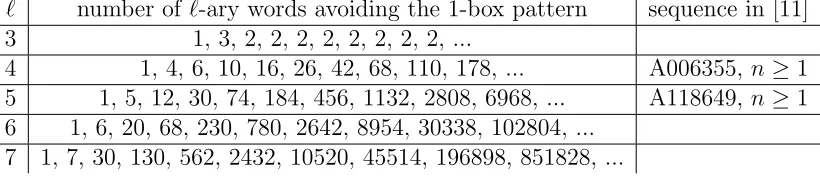
in Theorem 4 to get the most general case and to work out particular small values ofℓ); in Table 3, we list initial values of the respective sequences indicating connections to the OEIS [11]. In particular, the connection to the sequence A118649 led us to solving a conjecture of Mathar (published in [11, A118649]) to be discussed in Subsection 3.4.
[image:13.612.117.492.291.553.2]ℓ number of ℓ-ary words avoiding the 1-box pattern sequence in [11] 3 1, 3, 2, 2, 2, 2, 2, 2, 2, 2, ...
4 1, 4, 6, 10, 16, 26, 42, 68, 110, 178, ... A006355, n≥1 5 1, 5, 12, 30, 74, 184, 456, 1132, 2808, 6968, ... A118649, n≥1 6 1, 6, 20, 68, 230, 780, 2642, 8954, 30338, 102804, ...
[image:14.612.99.509.74.163.2]7 1, 7, 30, 130, 562, 2432, 10520, 45514, 196898, 851828, ...
Table 3: Avoidance of the 1-box patterns inℓ-ary words for lengths n up to 9.
w∈[ℓ]n is smooth if bond(w) =n−1. Let M
n,1,ℓ denote the number of w∈[ℓ]n such that
bond(w) = n−1 and smℓ(t) = 1 + ∑
n≥1Mn,1,ℓtn (by definition, a bond is the k-bond for
k = 1, and the subindex 1 inMn,1,ℓ indicates this). Then Knopfmacher et al. [9, Theorem
2.2] proved that
smℓ(t) = 1 +
t(ℓ−(3ℓ+ 2)t) (1−3t)2 +
2t2
(1−3t)2
1 +Uℓ−1
(1−t
2t )
Uℓ (1−t
2t
) , (14)
where Ur(t) is the Chebyshev polynomial of the second kind defined by
Ur(cos(θ)) =
sin((r+ 1)θ) sin(θ) .
Alternatively, one can define the polynomials by recursion by settingU0(t) = 1, U1(t) = 2t,
and
Ur(t) = 2tUr−1(t)−Ur−2(t) for r≥2.
We can also obtain a formula for smℓ(t) from our generating function Aℓ,1(x, t). That
is, clearly
Aℓ,1(1/x, xt) = 1 +
∑
n≥1
∑
w∈[ℓ]n
xn−bond(w)tn
so that
Cℓ,1(x, t) :=
1
x(Aℓ,1(1/x, xt)−1) =
∑
n≥1
∑
w∈[ℓ]n
xn−1−bond(w)tn.
Hence
smℓ(t) = 1 +Cℓ,1(0, t).
3.2
Distribution of 1-box patterns over words.
One can use similar methods to find the distribution of 1box(w) forw∈[ℓ]∗. In this case we have to keep track of more information. This is due to the fact that the extra contribution to 1box(w) caused by adding an extra letter at the front of a word w depends on the first two letters of w. For example, 1box(12) =x2t2 and 1box(112) = x3t3 so that adding 1 to
1box(113) = x2t3 so that adding 1 to the front of w= 13 increasedx1box(w)t|w| by a factor
of x2t.
For 1 ≤i, j ≤ℓ, let
Bℓ,(ij1) = ∑
w∈ij[ℓ]∗
W T(w),
where W T(w) = x1box(w)t|w| and ij[ℓ]∗ denotes the set of words over [ℓ] that begin with
letters ij. For any statement S, let χ(S) = 1 if S is true and χ(S) = 0 if S is false. Then we claim that for all 1≤i, j ≤ℓ,
Bℓ,(ij1)(x, t) = x2χ(|i−j]≤1)t2+ (15)
ℓ ∑
k=1
(tχ(|i−j|>1) +xtχ(|i−j| ≤1)χ(|j−k| ≤1) +
x2tχ(|i−j| ≤1)χ(|j −k|>1))Bℓ,(jk1)(x, t).
That is, the words in ij[ℓ]∗ are of the form ij plus words ijkv where k ∈ [ℓ] and v ∈ [ℓ]∗. Now
W T[ij] =
{
t2 if |i−j|>1 and
x2t2 if |i−j| ≤1.
Similarly,
W T[ijkv] =
tW T[jkv] if |i−j|>1,
xtW T[jkv] if |i−j| ≤1 and |j−k| ≤1, and
x2tW T[jkv] if |i−j| ≤1 and |j−k|>1.
The set of equations of the form (15) can be written out in matrix form. That is, let
⃗
Bℓ,1 be the row vector of length ℓ2 of the B (ij)
ℓ,1 (t, x) where the elements are listed in the
lexicographic order of the pairs (ij). For example, B⃗3,1 equals
(B(11)3,1 (x, t), B3(12),1 (x, t), B(13)3,1(x, t), B(21)3,1 (x, t), B3(22),1 (x, t), B(23)3,1 (x, t), B3(31),1 (x, t), B(32)3,1 (x, t), B3(33),1 (x, t)).
Similarly, let ⃗Iℓ,1 be the row vector of length ℓ2 of the terms t2x2χ(|i−j|≤1) again listed in
the lexicographic order on the pairs ij. For example,
⃗
I3,1 = (x2t2, x2t2, t2, x2t2, x2t2, x2t2, t2, x2t2, x2t2).
Then one can write a set of equations of the form (15) in the form
(I⃗ℓ,1)T =Bℓ,1(B⃗ℓ,1)T,
xt−1 xt x2t 0 0 0 0 0 0
0 −1 0 xt xt xt 0 0 0
0 0 −1 0 0 0 t t t
xt xt x2t −1 0 0 0 0 0
0 0 0 xt xt−1 xt 0 0 0
0 0 0 0 0 −1 x2t xt xt
t t t 0 0 0 −1 0 0
0 0 0 0 xt xt xt −1 0
0 0 0 0 0 0 x2t xt xt−1
.
Note that since setting x= t = 0 in Bℓ,1 will gives an ℓ×ℓ diagonal matrix with −1s
on the diagonal, Bℓ,1 is invertible. Thus
(B⃗ℓ,1)T =B−ℓ,11(I⃗ℓ,1)T.
Let⃗1ℓ,1 denote the vector of length ℓ2 consisting of all 1s. Then
∑
1≤i,j≤ℓ
Bℓ,(ij1)(x, t) =⃗1ℓ,1B−ℓ,11(I⃗ℓ,1)T.
Taking into account the empty word and all the words of length 1 will yeild the following theorem.
Theorem 5. For all ℓ≥2,
Bℓ,1(x, t) :=
∑
w∈[ℓ]∗
x1box(w)t|w| = 1 +ℓt+⃗1ℓ,1B−ℓ,11(I⃗ℓ,1)T.
We have used Theorem 5 to compute Bℓ,1(x, t) forℓ = 3,4, and 5.
B3,1(x, t) =
1 + 2(1−x)t−(1 + 4x−5x2)t2 + 2x(1−x)2t3+x2(1−x)2t4
1−(1 + 2x)t+ 2x(1−x)t2+x2(1−x)t3 ;
B4,1(x, t) =
1 + 3(1−x)t+ (1−9x+ 8x2)t2−3x(1−x)2t3+x2(1−x)2t4
1−(1 + 3x)t−(1−3x+ 2x2)t2−x(3−4x+x2)t3−x2(1−x)2t4;
B5,1(x, t) =
f5,1(x, t)
g5,1(x, t)
,
where
f5,1(x, t) = 1 + 3(1−x)t+ 9x(1−x)t2−2(1−x)2(1 + 2x)t3+
and
g5,1(x, t) = 1−(2 + 3x)t−
(
2−6x+ 4x2)t2−(−2−6x+ 8x2)t3−
6(1−x)2x(1 +x)t4−4(1−x)2x3t5+ 4(1−x)3x3t6.
Using the generating functions above, we have computed some of the initial terms in their Taylor series expansions:
B3,1(x, t) = 1 + 3t+ (2 + 7x2)t2+ (2 + 8x2+ 17x3)t3+
(2 + 10x2+ 20x3+ 49x4)t4+ (2 + 12x2+ 26x3+ 64x4+ 139x5)t5+ (2 + 14x2+ 32x3+ 88x4+ 200x5+ 393x6)t6+
(2 + 16x2+ 38x3+ 114x4+ 290x5+ 614x6+ 1113x7)t7+
(2 + 18x2+ 44x3+ 142x4+ 392x5+ 932x6+ 1880x7+ 3151x8)t8+· · ·;
B4,1(x, t) = 1 + 4t+ (6 + 10x2)t2+ (10 + 28x2+ 26x3)t3+
(16 + 68x2+ 72x3+ 100x4)t4+ (26 + 144x2+ 174x3+ 338x4+ 342x5)t5+ (42 + 290x2+ 368x3+ 930x4+ 1256x5+ 1210x6)t6+
(68 + 560x2+ 740x3+ 2232x4+ 3612x5+ 4932x6+ 4240x7)t7+
(110 + 1054x2+ 1428x3+ 4996x4+ 8984x5+ 15246x6+ 18820x7+ 14898x8)t8+· · ·;
B5,1(x, t) = 1 + 5t+ (
12 + 13x2
)
t2+ 5 (
6 + 12x2+ 7x3
)
t3+ (
74 + 222x2+ 160x3+ 169x4)t4+(184 + 724x2+ 592x3+ 974x4+ 651x5)t5+ (
456 + 2236x2+ 1932x3+ 4238x4+ 4048x5+ 2715x6)t6+ (
1132 + 6624x2+ 5968x3+ 16036x4+ 18372x5+ 18982x6+ 11011x7)t7+ (
2808 + 19124x2+ 17688x3+ 56072x4+ 71724x5+ 94282x6+ 83828x7+ 45099x8)t8+· · ·.
3.3
Solving three conjectures of Hardin.
Define
Bℓ,1(x, t) :=Bℓ,1(1/x, xt) =
∑
w∈[ℓ]∗
x|w|−(1box(w))t|w|,
so that Bℓ,1(0, t) is the generating function of all words w = w1. . . wn ∈ [ℓ]∗ such that
1box(w) =n, i.e. each letter of w differs from at least one neighbor by 1 or less. We have computed Bℓ,1(0, t) forℓ = 3,4,5.
B3,1(0, t) =
1−2t+ 5t2+ 2t3+t4
1−2t−2t2−t3 .
The initial terms of this series are 1,0,7,17,49,139,393,1113,3151,8921, . . .. This is the sequence A221591 which was apparently computed directly from its combinatorial definition by R. H. Hardin. If B3,1(0, t) =
∑
n≥0b3,1,nt
n, then Hardin observed empirically that
b3,1,n = 2b3,1,n−1 + 2b3,1,n−2 +b3,1,n−3 for n > 4. This recursion follows immediately from
the generating function for B3,1(0, t) so that we have proved Hardin’s conjecture:
B4,1(0, t) =
1−3t+ 8t2−3t3+t4
The initial terms of this series are 1,0,10,26,100,342,1210,4240,14898,52306, . . .. This is the sequence A221569 which was also computed directly from its combinatorial definition by R. H. Hardin. If B4,1(0, t) =
∑
n≥0b4,1,ntn, then Hardin observed empirically that
b4,1,n = 3b4,1,n−1 + 2b4,1,n−2 −b4,1,n−3 +b4,1,n−4 for n > 5. Again, this recursion follows
immediately from the generating function for B4,1(0, t) so that we have also proved this
conjecture of Hardin:
B5,1(0, t) =
1−3t+ 9t2−4t3+ 6t4+ 4t6
1−3t−4t2−6t4−4t5−4t6.
The initial terms of this series are 1,0,13,35,169,651,2715,11011,45099,184063, . . .. This is the sequence A221592 which was also computed directly form its combinatorial definition by R. H. Hardin. If B5,1(0, t) =
∑
n≥0b5,1,nt
n, then Hardin observed empirically that
b5,1,n = 3b5,1,n−1+ 4b5,1,n−2 + 6b5,1,n−4+ 4b5,1,n−5+ 4b5,1,n−6 for n >6. As was the case for
B3,1(0, t) andB4,1(0, t), this recursion follows immediately from the the generating function
for B5,1(0, t) so that we have also proved this conjecture of Hardin.
3.4
Solving an enumerative conjecture on LEGO.
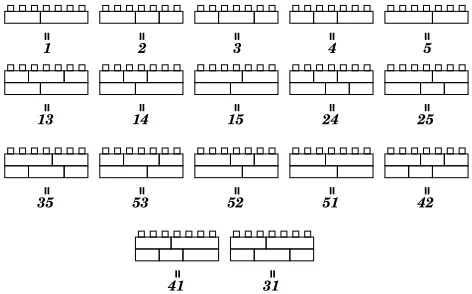
A “stable LEGO wall” is a wall in which seams do not match up from one level to the next. Stable LEGO walls of width 7 and heights 1 and 2 when using bricks of length 2, 3, and 4 can be found in Figure 4 (the numbers should be ignored there for the moment).
=
= = = =
1 2 3 4 5
= = = = =
13 14 15 24 25
= = = = =
35 53 52 51 42
= =
[image:18.612.184.420.387.534.2]41 31
Figure 4: Stable LEGO walls of width 7 and heights 1 and 2.
Lemma 6. There is a bijection between words over the alphabetA ={1,2,3,4,5}of length
n that avoid the 1-box pattern and stable LEGO walls of width 7 and height n when using bricks of length 2, 3, and 4.
Proof. Encode the eligible LEGO configurations of height 1 by the elements ofA as shown in Figure 4, which gives a bijection between the objects in the case of n= 1.
More generally, given a word w = w1w2. . . wn avoiding the 1-box pattern, we let the
corresponding to the letterwi defined in Figure 4. For example, the correspondence for the
case n = 2 is shown in Figure 4.
It is straightforward to check that the prohibited factors of words, namely 12, 23, 34, 45, 54, 43, 32, and 21, correspond to the prohibited configurations in LEGO, and vice versa.
Using Lemma 6, the function corresponding to ℓ= 5 and x= 0 in Table 2, and taking care of the offset (removing the number 2 in the sequence [11, A118649] and shifting down the indices of the larger numbers), we can confirm a conjecture of R. J. Mathar that stable LEGO walls satisfying the assumptions of Lemma 6 are counted by the following generating function:
1 + 3t−2t3
1−2t−2t2+ 2t3.
3.5
(1
, k
)
-rectangle patterns for
k
≥
2
; solving a conjecture of
Barker and enumerating two sequences of Hardin.
Given a word w = w1. . . wn ∈ [ℓ]n and an integer k ≥ 2, we let kbond(w) = |{i : |wi −
wi+1| ≤k}|. It is straightforward to generalize Theorems 4 and 5 to find the distribution
of kbond(w) and (1, k)rec(w), the number of (1, k)-rectangle patterns in w, over words w
in [ℓ]∗. That is, we claim that the same method of proof can also be used to find the generating function
Aℓ,k(x, t) = ∑
w∈[ℓ]∗
xkbond(w)t|w| = ∑
m,n≥0
aℓ,k(m, n)xmtn
for k ≥2. Thus aℓ,k(m, n) is the number of wordsw∈[ℓ]n such thatkbond(w) =m.
Let Aℓ,k be theℓ×ℓ matrix whose entries on the main diagonal consists of allxt−1’s,
whose entries on the first k superdiagonals and the first k subdiagonals are xt, and whose remaining entries aret. Then we have the following theorem.
Theorem 7. For all ℓ, k≥1,
Aℓ,k(x, t) = 1 + (1| {z }, . . . ,1
ℓ
)A−ℓ,k1(−| t, . . . ,{z −}t
ℓ
)T.
Proof. Fori= 1,2, . . . , ℓ, let
A(ℓ,ki)(x, t) = ∑
w∈i[ℓ]∗
xkbond(w)t|w|= ∑
m,n≥0
a(ℓ,ki)(m, n)xmtn.
of the k-box pattern while adjoining letter i from the left side, so that in the terminology of the proof of Theorem 4,
A(ℓ,ki)(x, t) = t+tA(1)ℓ,k(x, t) +· · ·+tA(ℓ,ki−k−1)(x, t) +
xtA(ℓi−k)(x, t) +· · ·+xtA(ℓ,ki+k)(x, t) +
tA(ℓ,ki+k+1)(x, t) +· · ·+tA(ℓℓ,k)(x, t).
Thus, for an arbitrary k, the first row in the matrix Ain Theorem 4 is the vector
(xt−1, xt, . . . , xt| {z }
k
, t, . . . , t),
the second row is the vector
(xt, xt−1, xt, . . . , xt
| {z } k
, t, . . . , t),
and, more generally, any middle row in A in this case is of the form
(t, . . . , t, xt, . . . , xt
| {z } k
, xt−1, xt, . . . , xt
| {z } k
, t, . . . , t).
For example, the generating function Aℓ,2(x, t) is equal to
1 + (1| {z }, . . . ,1
ℓ
)A−ℓ,21(−| t, . . . ,{z −}t
ℓ
)T,
where Aℓ,2 is the following ℓ×ℓ matrix:
Aℓ,2 =
xt−1 xt xt t t t t · · · t t t
xt xt−1 xt xt t t t · · · t t t
xt xt xt−1 xt xt t t · · · t t t
t xt xt xt−1 xt xt t · · · t t t
..
. ... ... ... ... ... ... . .. ... ... ...
t t t t t t t · · · xt xt xt−1
.
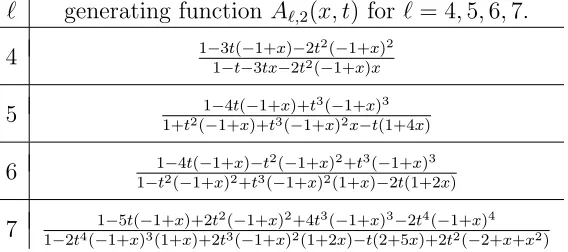
We have used Theorem 7 to compute the generating functionsAℓ,2(x, t) forℓ= 4,5,6,7:
A4,2(x, t) = 1 + 4t+ 2(1 + 7x)t2+ 2 (
1 + 6x+ 25x2)t3+ 2(1 + 7x+ 31x2+ 89x3)t4+
2(1 + 8x+ 42x2+ 144x3+ 317x4)t5+ 2(1 + 9x+ 54x2+ 222x3+ 633x4+ 1129x5)t6+ 2
(
1 + 10x+ 67x2+ 316x3+ 1095x4+ 2682x5+ 4021x6
)
t7+
ℓ generating functionAℓ,2(x, t) for ℓ= 4,5,6,7.
4 1−13−tt(−−31+txx−)2−t22(t−2(1+−1+x)xx)2
5 1+t2(1−−1+4tx(−)+1+t3x(−)+1+t3x(−)21+x−xt)(1+43 x)
6 1−1t2−(4−t1+(−1+x)2x+)−t3t(2−(−1+1+x)x2)(1+2+tx3)(−−21+t(1+2x)3x)
[image:21.612.163.447.73.199.2]7 1−2t4(−1−1+5tx()−31+(1+xx)+2)+2t2t3(−(−1+1+xx)2)2+4(1+2t3(−x)1+−tx(2+5)3−2xt)+24(−t1+2(−x2+)4 x+x2)
Table 4: Distribution of the 2-bond on ℓ-ary words, ℓ = 4,5,6,7.
ℓ generating function forℓ-ary words avoiding the (1,2)-rectangle pattern
A4,2(0, t) 1+3t−2t 2 1−t
A5,2(0, t) 1+4t−t 3 1−t−t2
A6,2(0, t) 1+4t−t 2−t3 1−2t−t2+t3
A7,2(0, t) 1+5t+2t
2−4t3−2t4 1−2t−4t2+2t3+2t4
Table 5: Enumeration of ℓ-ary words which avoid the (1,2)-rectangle pattern for ℓ = 4,5,6,7.
A5,2(x, t) = 1 + 5t+ (6 + 19x)t2+ 5(2 + 8x+ 15x2)t3+(16 + 88x+ 226x2+ 295x3)t4+ (
26 + 176x+ 606x2+ 1156x3+ 1161x4)t5+(42 + 342x+ 1428x2+ 3644x3+ 5600x4+ 4569x5)t6+ (
68 + 644x+ 3170x2+ 9840x3+ 20250x4+ 26172x5+ 17981x6)t7+ (
110 + 1190x+ 6708x2+ 24456x3+ 61446x4+ 106686x5+ 119266x6+ 70763x7)t8+· · ·;
A6,2(x, t) = 1 + 6t+ 12(1 + 2x)t2+ 4 (
7 + 22x+ 25x2)t3+(62 + 294x+ 522x2+ 418x3)t4+
4(35 + 214x+ 552x2+ 706x3+ 437x4)t5+ 2(157 + 1191x+ 3926x2+ 7154x3+ 7245x4+ 3655x5)t6+ (
706 + 6364x+ 25702x2+ 59624x3+ 85166x4+ 71804x5+ 30570x6
)
t7+
2(793 + 8295x+ 39525x2+ 111571x3+ 202491x4+ 239637x5+ 173575x6+ 63921x7)t8+· · ·;
A7,2(x, t) = 1 + 7t+ (20 + 29x)t2+ (
62 + 156x+ 125x2)t3+(186 + 710x+ 962x2+ 543x3)t4+ (
566 + 2820x+ 5658x2+ 5400x3+ 2363x4)t5+(1712 + 10648x+ 27710x2+ 38526x3+ 28766x4+ 10287x5)t6+ (
5192 + 38520x+ 124086x2+ 222928x3+ 239930x4+ 148100x5+ 44787x6)t7+ (
15728 + 135852x+ 519888x2+ 1149548x3+ 1594738x4+ 1409754x5+ 744298x6+ 194995x7)t8+· · ·.
Clearly the number of words w ∈ [ℓ]n such that kbond(w) = 0 equals the number of
ℓ number of ℓ-ary words avoiding the (1,2)-rectangle pattern sequence in [11] 4 1, 4, 2, 2, 2, 2, 2, 2, 2, 2, ...
[image:22.612.90.518.73.148.2]5 1, 5, 6, 10, 16, 26, 42, 68, 110, 178, ... A006355, n≥2 6 1, 6, 12, 28, 62, 140, 314, 706, 1586, 3564, ... A052994, n≥2 7 1, 7, 20, 62, 186, 566, 1712, 5192, 15728, 47688, ...
Table 6: Avoidance of the (1,2)-rectangle patterns in ℓ-ary words for lengths n up to 9.
one gets generating functions for avoidance of the (1,2)-rectangle pattern. In Table 6, we list initial values of the respective sequences indicating connections to the OEIS [11].
We note that the sequence A052994 has no combinatorial interpretation in the OEIS so now we have given a combinatorial interpretation to this sequence. Also, comparing Tables 3 and 6, and using an interpretation of [11, A006355], one has the truth of the following proposition that we explain combinatorially.
Proposition 1. For n≥2, the following objects are equinumerous:
(i) words of length n over the alphabet [5] that avoid the (1,2)-rectangle pattern;
(ii) words of length n over the alphabet [4] that avoid the 1-box pattern;
(iii) binary words of lengthn+ 3 that contain no singletons, that is, any 0has a 0 next to it, and any 1 has a 1 next to it.
Thus, according to [11, A006355], any of these objects is counted by Fn−1+Fn+2 where Fn
is the nth Fibonacci number defined as F0 =F1 = 1 and Fn=Fn−1+Fn−2.
Proof. Equinumeration of (i) and (ii) follows directly from the observation that the letter 3 never appears in words described by (i), so that we can take any such word, make the substitution of letters 4 → 3 and 5 → 4 to get a proper word described by (ii); this operation is clearly reversible.
Equinumeration of (ii) and (iii) is established by the following bijective map from (ii) to (iii). Let a wordw=w1w2. . . wndescribed by (ii) be given and we want to obtain its binary
image u = u1u2. . . un+3. If w1 ∈ {1,2} then u1u2 = 00; if w1 ∈ {3,4} then u1u2 = 11.
Also, no matter what un+2 is, we set un+3 =un+2. To obtain the letters u3, u4, . . . , un+2,
we readw from left to right letter by letter: if wi ∈ {1,4}, thenui+2 =ui+1; ifwi ∈ {2,3},
then ui+2 ̸=ui+1. For example, the word 3142413 avoiding the 1-box pattern is mapped to
1100011100. In Table 7, we provide our map for all words of length n= 2,3.
We do not provide a proper proof of the fact that the map described by us from (ii) to (iii) is a bijection just giving a couple of remarks why this is the case. Indeed, ifwi ∈ {2,3}
and i < n then wi+1 ∈ {1,4} and thus ui+2 = ui+3. This, together with the fact that
un+3 =un+2 makes sure that u has no singletons.
We say that a word w= w1. . . wn ∈ [ℓ]n is k-smooth if |wi −wi+1| ≤ k for 1 ≤i < n.
Thus in our notation, w ∈ [ℓ]n is k-smooth if kbond(w) = n−1. Let M


![Table 8: Distribution of words w ∈ [ℓ]n such that 2bond(w) = n − 1, ℓ = 4, 5, 6, 7.](https://thumb-us.123doks.com/thumbv2/123dok_us/1596136.112410/23.612.225.380.71.222/table-distribution-words-w-n-bond.webp)
![Table 9: Number of words w ∈ [ℓ]n such that kbond(w) = n − 1 for n up to 9.](https://thumb-us.123doks.com/thumbv2/123dok_us/1596136.112410/24.612.118.468.430.551/table-number-words-w-n-kbond-w.webp)