City, University of London Institutional Repository
Citation
: He, Y. (2002). On algebraic singularities, finite graphs and D-brane gauge
theories: A String theoretic perspective (UPR-1011-T). Philadelphia, USA: The University of Pennsylvania.This is the unspecified version of the paper.
This version of the publication may differ from the final published
version.
Permanent repository link:
http://openaccess.city.ac.uk/837/Link to published version
: UPR-1011-T
Copyright and reuse:
City Research Online aims to make research
outputs of City, University of London available to a wider audience.
Copyright and Moral Rights remain with the author(s) and/or copyright
holders. URLs from City Research Online may be freely distributed and
linked to.
arXiv:hep-th/0209230v1 26 Sep 2002
UPR-1011-T
On Algebraic Singularities, Finite Graphs and D-Brane
Gauge Theories: A String Theoretic Perspective
Yang-Hui He
1Department of Physics, The University of Pennsylvania,
209, S. 33rd st., Philadelphia, PA 19104-6396 [email protected]
Abstract
In this writing we shall address certain beautiful inter-relations between the con-struction of 4-dimensional supersymmetric gauge theories and resolution of algebraic singularities, from the perspective of String Theory. We review in some detail the requisite background in both the mathematics, such as orbifolds, symplectic quotients and quiver representations, as well as the physics, such as gauged linear sigma models, geometrical engineering, Hanany-Witten setups and D-brane probes.
We investigate aspects of world-volume gauge dynamics using D-brane resolutions of various Calabi-Yau singularities, notably Gorenstein quotients and toric singulari-ties. Attention will be paid to the general methodology of constructing gauge theories for these singular backgrounds, with and without the presence of the NS-NS B-field, as well as the T-duals to brane setups and branes wrapping cycles in the mirror ge-ometry. Applications of such diverse and elegant mathematics as crepant resolution of algebraic singularities, representation of finite groups and finite graphs, modular invariants of affine Lie algebras, etc. will naturally arise. Various viewpoints and generalisations of McKay’s Correspondence will also be considered.
The present work is a transcription of excerpts from the first three volumes of the author’s PhD thesis which was written under the direction of Prof. A. Hanany - to whom he is much indebted - at the Centre for Theoretical Physics of MIT, and which, at the suggestion of friends, he posts to the ArXiv pro hac vice; it is his sincerest wish that the ensuing pages might be of some small use to the beginning student.
Præfatio et Agnitio
Forsan et haec olim meminisse iuvabit. Vir. Aen. I.1.203
Not that I merely owe this title to the font, my education, or the clime
wherein I was born, as being bred up either to confirm those principles my parents instilled into my understanding, or by a general consent proceed in the religion of my
country; but having, in my riper years and confirmed judgment, seen and examined all, I find myself obliged, by the principles of grace, and the law of mine own reason,
to embrace no other name but this.
So wrote Thomas Browne in Religio Medici of his conviction to his Faith. Thus too let me, with regard to that title of “Physicist,” of which alas I am most unworthy, with far less wit but with equal devotion, confess my allegiance to the noble Cause of Natural Philosophy, which I pray that in my own riper years I shall embrace none other. Therefore prithee gentle reader, bear with this fond fool as he here leaves his rampaging testimony to your clemency.
and Narrow path leading to Theoretical Physics, that Holy Grail of Science.
I have suffered, wept and bled sweat of labour. Yet the divine Bach reminds us in the Passion of Our Lord according to Matthew, “Ja! Freilich will in uns das Fleisch und Blut zum Kreuz gezwungen sein; Je mehr es unsrer Seele gut, Je herber geht es
ein.” Ergo, I too have rejoiced, laughed and shed tears of jubilation. Such is the nature of Scientific Research, and indeed the grand Principia Vitæ. These past half of a decade has been constituted of thousands of nightly lucubrations, each a battle, each une petite mort, each with its te Deum and Non Nobis Domine. I carouse to these five years past, short enough to be one day deemed a mere passing period, long enough to have earned some silvery strands upon my idle rank.
And thus commingled, thefructus laboriof these years past, is the humble work I shall present in the ensuing pages. I beseech you o gentle reader, to indulge its length, I regret to confess that what I lack in content I can only supplant with volume, what I lack in wit I can only distract with loquacity. To that great Gaussian principle of
Pauca sed Matura let me forever bow in silent shame.
Yet the poorest offering does still beseech painstaking preparation and the lowliest work, a helping hand. How blessed I am, to have a flight souls aiding me in bearing the great weight!
For what is a son, without the wings of his parent? How blessed I am, to have my dear mother and father, my aunt DaYi and grandmother, embrace me with four-times compounded love! Every fault, a tear, every wrong, a guiding hand and every triumph, an exaltation.
mul-titudes of friends! I drink to their health! To the Ludwigs: my brother, mentor and colleague in philosophy and mathematics, J. S. Song and his JJFS; my brother and companion in wine and Existentialism, N. Moeller and his Marina. To my col-laborators: my colleagues and brethren, B. Feng, I. Ellwood, A. Karch, N. Prezas and A. Uranga. To my brothers in Physics and remembrances past: I. Savonije and M. Spradlin, may that noble Nassau-Orange thread bind the colourless skeins of our lives. To my Spiritual counsellors: M. Serna and his ever undying passion for Physics, D. Matheu and his Franciscan soul, L. Pantelidis and his worldly wisdom, as well as the Schmidts and the Domesticity which they symbolise. To the fond memories of one beauteous adventuress Ms. M. R. Warden, who once wept with me at the times of sorrow and danced with me at the moments of delight. And to you all my many dear beloved friends whose names, though I could not record here, I shall each and all engrave upon my heart.
And so composed is a fledgling, through these many years of hearty battle, and amidst blood, sweat and tears was formed another grain of sand ashore the Vast Ocean of Unknown. Therefore at this eve of my reception of the title Doctor Philosophiae, though I myself could never dream to deserve to be called either “learned” or a “philosopher,” I shall fast and pray, for henceforth I shall bear, as Atlas the weight of Earth upon his shoulders, the name “Physicist” upon my soul. And so I shall prepare for this my initiation into a Brotherhood of Dreamers, as an incipient neophyte in-truding into a Fraternity of Knights, accoladed by the sword of Regina Mathematica, who dare to uphold that Noblest calling of “Sapere Aude”.
Let me then embrace, not with merit but with homage, not with arms eager but with knees bent, and indeed not with a mind deserving but with a heart devout, naught else but this dear cherished Title of “Physicist.”
I call upon ye all, gentle readers, my brothers and sisters, all the Angels and Saints, and Mary, ever Virgin, to pray for me, Dei Sub Numine, as I dedicate this humble work and my worthless self,
Invocatio et Apologia
De Singularitatis Algebraicæ, Graphicæ Finitatis, & Theorica
Men-suræ Branæ Dirichletiensis: Aspectus Theoricæ Chordæ,
cum digressi super theorica campi chordae. Libellus in Quattuor Partibus, sub Auspicio CTP et LNS, MIT, atque DOE et NSF, sed potissimum, Sub Numine Dei.Y.-H. E. He
B. A., Universitatis Princetoniensis Math. Tripos, Universitatis Cantabrigiensis
We live in an Age of Dualism. The Absolutism which has so
long permeated through Western Thought has been challenged in every conceivable fashion: from philosophy to politics, from religion to science, from sociology to aes-thetics. The ideological conflicts, so often ending in tragedy and so much a theme of the twentieth century, had been intimately tied with the recession of an archetypal norm of undisputed Principles. As we enter the third millennium, the Zeitgeist is already suggestive that we shall perhaps no longer be victims but beneficiaries, that the uncertainties which haunted and devastated the proceeding century shall perhaps serve to guide us instead.
Speaking within the realms of Natural Philosophy, beyond the wave-particle du-ality or the Principle of Equivalence, is a product which originated in the 60’s and 70’s, a product which by now so well exemplifies a dualistic philosophy to its very core.
the fact that the essence of the field still remains to be defined. A chief theme of this writing shall be the dualistic nature of String theory as a scientific endeavour: it has thus far no experimental verification to be rendered physics and it has thus far no rigorous formulations to be considered mathematics. Yet String theory has by now inspired so much activity in both physics and mathematics that, to quote C. N. Yang in the early days of Yang-Mills theory, its beauty alone certainly merits our attention. I shall indeed present you with breath-taking beauty; in Books I and II, I shall carefully guide the readers, be them physicists or mathematicians, to a preparatory journey to the requisite mathematics in Liber I and to physics in Liber II. These two books will attempt to review a tiny fraction of the many subjects developed in the last few decades in both fields in relation to string theory. I quote here a saying of E. Zaslow of which I am particularly fond, though it applies to me far more appropriately: in the Book on mathematics I shall be the physicist and the Book on physics, I the mathematician, so as to beg the reader to forgive my inexpertise in both.
Books III and IV shall then consist of some of my work during my very enjoyable stay at the Centre for Theoretical Physics at MIT as a graduate student. I regret that I shall tempt the readers with so much elegance in the first two books and yet lead them to so humble a work, that the journey through such a beautiful garden would end in such a witless swamp. And I take the opportunity to apologise again to the reader for the excruciating length, full of sound and fury and signifying nothing. Indeed as Saramago points out that the shortness of life is so incompatible with the verbosity of the world.
Contents
1 INTROIT 16
I
LIBER PRIMUS: Invocatio Mathematicæ
26
2 Algebraic and Differential Geometry 27
2.1 Singularities on Algebraic Varieties . . . 28
2.1.1 Picard-Lefschetz Theory . . . 30
2.2 Symplectic Quotients and Moment Maps . . . 32
2.3 Toric Varieties . . . 34
2.3.1 The Classical Construction . . . 35
2.3.2 The Delzant Polytope and Moment Map . . . 37
3 Representation Theory of Finite Groups 38 3.1 Preliminaries . . . 38
3.2 Characters . . . 39
3.2.1 Computation of the Character Table . . . 40
3.3 Classification of Lie Algebras . . . 41
4 Finite Graphs, Quivers, and Resolution of Singularities 44 4.1 Some Rudiments on Graphs and Quivers . . . 44
4.1.1 Quivers . . . 45
4.2 du Val-Kleinian Singularities . . . 46
4.3 ALE Instantons, hyper-K¨ahler Quotients and McKay Quivers . . . . 47
4.3.1 The ADHM Construction for the E4 Instanton . . . . 47
4.3.2 Moment Maps and Hyper-K¨ahler Quotients . . . 49
4.3.3 ALE as a Hyper-K¨ahler Quotient . . . 51
4.3.4 Self-Dual Instantons on the ALE . . . 53
4.3.5 Quiver Varieties . . . 55
II
LIBER SECUNDUS: Invocatio Philosophiæ Naturalis 60
5 Calabi-Yau Sigma Models and N = 2 Superconformal Theories 61 5.1 The Gauged Linear Sigma Model . . . 635.2 Generalisations to Toric Varieties . . . 65
6 Geometrical Engineering of Gauge Theories 67 6.1 Type II Compactifications . . . 67
6.2 Non-Abelian Gauge Symmetry and Geometrical Engineering . . . 69
6.2.1 Quantum Effects and Local Mirror Symmetry . . . 71
7 Hanany-Witten Configurations of Branes 73 7.1 Type II Branes . . . 73
7.1.1 Low Energy Effective Theories . . . 74
7.1.2 Webs of Branes and Chains of Dualities . . . 75
7.2 Hanany-Witten Setups . . . 76
7.2.1 Quantum Effects and M-Theory Solutions . . . 76
8 Brane Probes and World Volume Theories 79 8.1 The Closed Sector . . . 79
8.2 The Open Sector . . . 80
8.2.1 Quiver Diagrams . . . 81
8.2.2 The Lagrangian . . . 82
III
LIBER TERTIUS: Sanguis, Sudor, et Larcrimæ Mei 85
9 Orbifolds I: SU(2) and SU(3) 87
9.1 Introduction . . . 88
9.2 The Orbifolding Technique . . . 89
9.3 Checks forSU(2) . . . 92
9.4 The case for SU(3) . . . 98
9.5 Quiver Theory? Chiral Gauge Theories? . . . 102
9.6 Concluding Remarks . . . 108
10 Orbifolds II: Avatars of McKay Correspondence 110 10.1 Introduction . . . 111
10.2 Ubiquity of ADE Classifications . . . 115
10.3 The Arrows of Figure 1. . . 116
10.3.1 (I) The Algebraic McKay Correspondence . . . 117
10.3.2 (II) The Geometric McKay Correspondence . . . 118
10.3.3 (II, III) McKay Correspondence and SCFT . . . 120
10.3.4 (I, IV) McKay Correspondence and WZW . . . 125
10.4 The Arrow V: σ-model/LG/WZW Duality . . . 128
10.4.1 Fusion Algebra, Cohomology and Representation Rings . . . . 129
10.4.2 Quiver Varieties and WZW . . . 131
10.4.3 T-duality and Branes . . . 133
10.5 Ribbons and Quivers at the Crux of Correspondences . . . 133
10.5.1 Ribbon Categories as Modular Tensor Categories . . . 134
10.5.2 Quiver Categories . . . 137
10.6 Conjectures . . . 140
10.6.1 Relevance of Toric Geometry . . . 142
10.7 Conclusion . . . 143
11.2 Preliminary Definitions . . . 147
11.3 The Discrete Finite Subgroups of SL(4; C) . . . 150
11.3.1 Primitive Subgroups . . . 150
11.3.2 Intransitive Subgroups . . . 155
11.3.3 Imprimitive Groups . . . 156
11.4 Remarks . . . 157
12 Finitude of Quiver Theories and Finiteness of Gauge Theories 159 12.1 Introduction . . . 160
12.2 Preliminaries from the Physics . . . 162
12.2.1 D-brane Probes on Orbifolds . . . 164
12.2.2 Hanany-Witten . . . 166
12.2.3 Geometrical Engineering . . . 167
12.3 Preliminaries from the Mathematics . . . 168
12.3.1 Quivers and Path Algebras . . . 168
12.3.2 Representation Type of Algebras . . . 174
12.3.3 Restrictions on the Shapes of Quivers . . . 176
12.4 Quivers in String Theory and Yang-Mills in Graph Theory . . . 179
12.5 Concluding Remarks and Prospects . . . 185
13 Orbifolds IV: Finite Groups and WZW Modular Invariants, Case Studies for SU(2) and SU(3) 187 13.1 Introduction . . . 188
13.2 su[(2)-WZW . . . 191
13.2.1 The E6 Invariant . . . 193
13.2.2 Other Invariants . . . 195
13.3 Prospects: su[(3)-WZW and Beyond? . . . 197
14.2 A Brief Review of Dn Quivers, Brane Boxes, and Brane Probes on
Orbifolds . . . 204
14.2.1 Branes on Orbifolds and Quiver Diagrams . . . 204
14.2.2 Dk Quivers from Branes . . . 207
14.2.3 Brane Boxes . . . 209
14.3 The Group G=Zk×Dk′ . . . 211
14.3.1 The Binary Dihedral Dk′ ⊂G . . . 212
14.3.2 The whole groupG=Zk×Dk′ . . . 214
14.3.3 The Tensor Product Decomposition in G . . . 217
14.3.4 Dkk′ δ , an Important Normal Subgroup . . . 219
14.4 The Brane Box for Zk×Dk′ . . . 221
14.4.1 The Puzzle . . . 221
14.4.2 The Construction of Brane Box Model . . . 222
14.4.3 The Inverse Problem . . . 225
14.5 Conclusions and Prospects . . . 228
15 Orbifolds VI: Z-D Brane Box Models 230 15.1 Introduction . . . 230
15.2 A Simple Example: The Direct Product Zk×Dk′ . . . 235
15.2.1 The Group Dk′ . . . 236
15.2.2 The Quiver Diagram . . . 238
15.2.3 The Brane Box Model of Zk×Dk′ . . . 240
15.2.4 The Inverse Problem . . . 243
15.3 The General Twisted Case . . . 244
15.3.1 Preserving the Irreps ofDd. . . 245
15.3.2 The Three Dimensional Representation . . . 246
15.4 A New Class of SU(3) Quivers . . . 249
15.4.1 The Group dk′ . . . 250
15.4.2 A New Set of Quivers . . . 251
15.5 Conclusions and Prospects . . . 257
16 Orbifolds VII: Stepwise Projection, or Towards Brane Setups for Generic Orbifold Singularities 259 16.1 Introduction . . . 260
16.2 A Review on Orbifold Projections . . . 262
16.3 Stepwise Projection . . . 265
16.3.1 Dk Quivers from Ak Quivers . . . 265
16.3.2 The E6 Quiver from D2 . . . 273
16.3.3 The E6 Quiver from ZZ6 . . . 275
16.4 Comments and Discussions . . . 276
16.4.1 A Mathematical Viewpoint . . . 277
16.4.2 A Physical Viewpoint: Brane Setups? . . . 280
17 Orbifolds VIII: Orbifolds with Discrete Torsion and the Schur Mul-tiplier 289 17.1 Introduction . . . 290
17.2 Some Mathematical Preliminaries . . . 293
17.2.1 Projective Representations of Groups . . . 293
17.2.2 Group Cohomology and the Schur Multiplier . . . 294
17.2.3 The Covering Group . . . 295
17.3 Schur Multipliers and String Theory Orbifolds . . . 296
17.3.1 The Schur Multiplier of the Discrete Subgroups ofSU(2) . . . 297
17.3.2 The Schur Multiplier of the Discrete Subgroups ofSU(3) . . . 299
17.3.3 The Schur Multiplier of the Discrete Subgroups ofSU(4) . . . 303
17.4 D2n Orbifolds: Discrete Torsion for a non-Abelian Example . . . 304
17.4.1 The Irreducible Representations . . . 305
17.4.2 The Quiver Diagram and the Matter Content . . . 306
18 Orbifolds IX: Discrete Torsion, Covering Groups and Quiver
Dia-grams 312
18.1 Introduction . . . 313
18.2 Mathematical Preliminaries . . . 315
18.2.1 The Covering Group . . . 316
18.2.2 Projective Characters . . . 319
18.3 Explicit Calculation of Covering Groups . . . 320
18.3.1 The Covering Group of The Ordinary Dihedral Group . . . . 320
18.3.2 Covering Groups for the Discrete Finite Subgroups of SU(3) . 323 18.4 Covering Groups, Discrete Torsion and Quiver Diagrams . . . 326
18.4.1 The Method . . . 326
18.4.2 An Illustrative Example: ∆(3×32) . . . 328
18.4.3 The General Method . . . 332
18.4.4 A Myriad of Examples . . . 334
18.5 Finding the Cocycle Values . . . 335
18.6 Conclusions and Prospects . . . 338
19 Toric I: Toric Singularities and Toric Duality 340 19.1 Introduction . . . 341
19.2 The Forward Procedure: Extracting Toric Data From Gauge Theories 343 19.3 The Inverse Procedure: Extracting Gauge Theory Information from Toric Data . . . 352
19.3.1 Quiver Diagrams and F-terms from Toric Diagrams . . . 352
19.3.2 A Canonical Method: Partial Resolutions of Abelian Orbifolds 354 19.3.3 The General Algorithm for the Inverse Problem . . . 358
19.3.4 Obtaining the Superpotential . . . 362
19.4 An Illustrative Example: the Toric del Pezzo Surfaces . . . 366
19.5 Uniqueness? . . . 378
20 Toric II: Phase Structure of Toric Duality 385
20.1 Introduction . . . 385
20.2 A Seeming Paradox . . . 388
20.3 Toric Isomorphisms . . . 392
20.4 Freedom and Ambiguity in the Algorithm . . . 393
20.4.1 The Forward Algorithm . . . 394
20.4.2 Freedom and Ambiguity in the Reverse Algorithm . . . 399
20.5 Application: Phases of ZZ3×ZZ3 Resolutions . . . 401
20.5.1 Unimodular Transformations within ZZ3×ZZ3 . . . 402
20.5.2 Phases of Theories . . . 404
20.6 Discussions and Prospects . . . 407
21 Toric III: Toric Duality and Seiberg Duality 413 21.1 Introduction . . . 414
21.2 An Illustrative Example . . . 416
21.2.1 The Brane Setup . . . 416
21.2.2 Partial Resolution . . . 418
21.2.3 Case (a) from Partial Resolution . . . 419
21.2.4 Case (c) from Partial Resolution . . . 422
21.3 Seiberg Duality versus Toric Duality . . . 423
21.4 Partial Resolutions of C3/(ZZ3 ×ZZ3) and Seiberg duality . . . 424
21.4.1 Hirzebruch Zero . . . 425
21.4.2 del Pezzo 2 . . . 427
21.5 Brane Diamonds and Seiberg Duality . . . 431
21.5.1 Brane diamonds for D3-branes at the cone overF0 . . . 434
21.5.2 Brane diamonds for D3-branes at the cone overdP2 . . . 435
21.6 A Quiver Duality from Seiberg Duality . . . 438
21.6.1 Hirzebruch Zero . . . 439
21.6.2 del Pezzo 0,1,2 . . . 440
21.7 Picard-Lefschetz Monodromy and Seiberg Duality . . . 443
21.7.1 Picard-Lefschetz Monodromy . . . 444
21.7.2 Two Interesting Examples . . . 446
21.8 Conclusions . . . 447
22 Appendices 452 22.1 Character Tables for the Discrete Subgroups of SU(2) . . . 452
22.2 Matter Content for N = 2 SUSY Gauge Theory (Γ ⊂SU(2)) . . . 454
22.3 Classification of Discrete Subgroups of SU(3) . . . 455
22.4 Matter content for Γ⊂SU(3) . . . 460
22.5 Steinberg’s Proof of Semi-Definity . . . 465
22.6 Conjugacy Classes for Zk×Dk′ . . . 467
22.7 Some Explicit Computations for M(G) . . . 469
22.7.1 Preliminary Definitions . . . 469
22.7.2 The Schur Multiplier for ∆3n2 . . . 471
22.7.3 The Schur Multiplier for ∆6n2 . . . 474
22.8 Intransitive subgroups of SU(3) . . . 476
22.9 Ordinary and Projective Representations of Some Discrete Subgroups of SU(3) . . . 477
22.10Finding the Dual Cone . . . 481
22.11Gauge Theory Data for ZZn×ZZn . . . 482
Bibliography 485
Chapter 1
INTROIT
De Singularitatis Algebraicæ, Graphicæ Finitatis, & Theorica
Men-suræ Branæ Dirichletiensis: Aspectus Theoricæ Chordæ
The two pillars of twentieth century physics, General Relativity and Quantum Field Theory, have brought about tremendous progress in Physics. The former has described the macroscopic, and the latter, the microscopic, to beautiful precision. However, the pair, in and of themselves, stand incompatible. Standard techniques of establishing a quantum theory of gravity have met uncancellable divergences and unrenormalisable quantities.
As we enter the twenty-first century, a new theory, born in the mid-1970’s, has promised to be a candidate for a Unified Theory of Everything. The theory is known as String Theory, whose basic tenet is that all particles are vibrational modes of strings of Plankian length. Such elegant structure as the natural emergence of the graviton and embedding of electromagnetic and largeN dualities, has made the theory more and more attractive to the theoretical physics community. Moreover, concurrent with its development in physics, string theory has prompted enormous excitement among mathematicians. Hitherto unimagined mathematical phenomena such as Mirror Symmetry and orbifold cohomology have brought about many new directions in algebraic geometry and representation theory.
duality transformations etc. as well as certain branches of associated mathematics. We will investigate how these gauge theories, of various supersymmetry and in various dimensions, arise as low-energy effective theories associated with hypersurfaces in String Theory known as D-branes.
It is well-known that the initial approach of constructing the real world from String Theory had been the compactification of the 10 dimensional superstring or the 10(26) dimensional heterotic string on Calabi-Yau manifolds of complex dimension three. These are complex manifolds described as algebraic varieties with Ricci-flat curvature so as to preserve supersymmetry. The resulting theories are N = 1 super-symmetric gauge theories in 4 dimensions that would be certain minimal extensions of the Standard Model.
This paradigm has been widely pursued since the 1980’s. However, we have a host of Calabi-Yau threefolds to choose from. The inherent length-scale of the super-string and deformations of the world-sheet conformal field theory, made such violent behaviour as topology changes in space-time natural. These changes connected vast classes of manifolds related by, notably, mirror symmetry. For the physics, these mirror manifolds which are markedly different mathematical objects, give rise to the same conformal field theory.
Physics thus became equivalent with respect to various different compactifications. Even up to this equivalence, the plethora of Calabi-Yau threefolds (of which there is still yet no classification) renders the precise choice of the compactification difficult to select. A standing problem then has been this issue of “vacuum degeneracy.”
Ever since Polchinski’s introduction of D-branes into the arena in the Second String Revolution of the mid-90’s, numerous novel techniques appeared in the con-struction of gauge theories of various supersymmetries, as low-energy effective theories of the ten dimensional superstring and eleven dimensional M-theory (as well as twelve dimensional F-theory).
10-dimensions) between these charges (forms). Such a duality is well-known in su-persymmetric field theory, as exemplified by the four dimensional Montonen-Olive Duality for N = 4, Seiberg-Witten for N = 2 and Seiberg’s Duality for N = 1. These dualities are closely associated with the underlying S-duality in the full string theory, which maps small string coupling to the large.
Furthermore, the inherent winding modes of the string includes another duality contributing to the dualities in the field theory, the so-called T-duality where small compactification radii are mapped to large radii. By chains of applications of S and T dualities, the Second Revolution brought about a unification of the then five disparate models of consistent String Theories: types I, IIA/B, HeteroticE8×E8 and Heterotic
Spin(32)/ZZ2.
Still more is the fact that these branes are actually solutions in 11-dimensional supergravity and its dimensional reduction to 10. Subsequently proposals for the enhancement for the S and T dualities to a full so-called U-Duality were conjectured. This would be a symmetry of a mysterious underlying M-theory of which the unified string theories are but perturbative limits. Recently Vafa and collaborators have proposed even more intriguing dualities where such U-duality structure is intimately tied with the geometric structure of blow-ups of the complex projective 2-space, viz., the del Pezzo surfaces.
With such rich properties, branes will occupy a central theme in this writing. We will exploit such facts as their being BPS states which break supersymmetry, their dualisation to various pure geometrical backgrounds and their ability to probe sub-stringy distances. We will investigate how to construct gauge theories empowered with them, how to realise dynamical processes in field theory such as Seiberg duality in terms of toric duality and brane motions, how to study their associated open string states in bosonic string field theory as well as many interesting mathematics that emerge.
One method was very much in the geometrical vein of compactification: the so-namedgeometrical engineering of Katz-Klemm-Lerche-Vafa. With branes of var-ious dimensions at their disposal, the authors wrapped (homological) cycles in the Calabi-Yau with branes of the corresponding dimension. The supersymmetric cy-cles (i.e., cycy-cles which preserve supersymmetry), especially the middle dimensional 3-cycles known as Special Lagrangian submanifolds, play a crucial rˆole in Mirror Symmetry.
In the context of constructing gauge theories, the world-volume theory of the wrapped branes are described by dimensionally reduced gauge theories inherited from the original D-brane and supersymmetry is preserved by the special properties of the cycles. Indeed, at the vanishing volume limit gauge enhancement occurs and a myriad of supersymmetric Yang-Mills theories emerge. In this spirit, certain global issues in compactification could be addressed in the analyses of the local behaviour of the singularity arising from the vanishing cycles, whereby making much of the geometry tractable.
The geometry of the homological cycles, together with the wrapped branes, deter-mine the precise gauge group and matter content. In the language of sheafs, we are studying the intersection theory of coherent sheafs associated with the cycles. We will make usage of these techniques in the study of such interesting behaviour as “toric duality.”
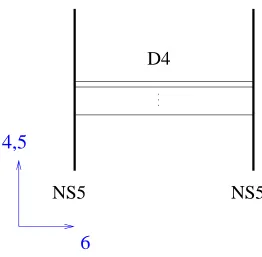
The second method of engineering four dimensional gauge theories from branes was to study the world-volume theories of configurations of branes in 10 dimensions. Heavy use were made especially of the D4 brane of type IIA, placed in a specific position with respect to various D-branes and the solitonic NS5-branes. In the limit of low energy, the world-volume theory becomes a supersymmetric gauge theory in 4-dimensions.
involved in the curved compactification spaces could be avoided altogether.
The open strings stretching between the branes realise as the bi-fundamental and adjoint matter of the resulting theory while the configurations are chosen judiciously to break down to appropriate supersymmetry. Motions of the branes relative to each other correspond in the field theory to moving along various Coulomb and Higgs branches of the Moduli space. Such dynamical processes as the Hanany-Witten Effect of brane creation lead to important string theoretic realisations of Seiberg’s duality.
We shall too take advantage of the insights offered by this technique of brane setups which make quantities of the product gauge theory easily visualisable.
The third method of engineering gauge theories was an admixture of the above two, in the sense of utilising both brane dynamics and singular geometry. This became known as the brane probe technique, initiated by Douglas and Moore. Stacks of parallel D-branes were placed near certain local Calabi-Yau manifolds; the world-volume theory, which would otherwise be the uninteresting parent U(n) theory in flat space, was projected into one with product gauge groups, by the geometry of the singularity on the open-string sector.
Depending on chosen action of the singularity, notably orbifolds, with respect to theSU(4) R-symmetry of the parent theory, various supersymmetries can be achieved. When we choose the singularity to beSU(3) holonomy, a myriad of gauge theories of
N = 1 supersymmetry in 4-dimensions could be thus fabricated given local structures of the algebraic singularities. The moduli space, as solved by the vacuum conditions of D-flatness and F-flatness in the field theory, is then by construction, the Calabi-Yau singularity. In this sense space-time itself becomes a derived concept, as realised by the moduli space of a D-brane probe theory.
As Maldacena brought about the Third String Revolution with the AdS/CFT conjecture in 1997, new light shone upon these probe theories. Indeed the SU(4) R-symmetry elegantly manifests as theSO(6) isometry of the 5-sphere in theAdS5×S5
Into various aspects of these probes theories we shall delve throughout the writing and attention will be paid to two classes of algebraic singularities, namely orbifolds and toric singularities,
With the wealth of dualities in String Theory it is perhaps of no surprise that the three methods introduced above are equivalent by a sequence of T-duality (mirror) transformations. Though we shall make extensive usage of the techniques of all three throughout this writing, focus will be on the latter two, especially the last. We shall elucidate these three main ideas: geometrical engineering, Hanany-Witten brane configurations and D-branes transversely probing algebraic singularities, respectively in Chapters 6, 7 and 8 of Book II.
The abovementioned, of tremendous interest to the physicist, is only half the story. In the course of this study of compactification on Ricci-flat manifolds, beautiful and unexpected mathematics were born. Indeed, our very understanding of classical ge-ometry underwent modifications and the notions of “stringy” or “quantum” gege-ometry emerged. Properties of algebro-differential geometry of the target space-time mani-fested as the supersymmetric conformal field theory on the world-sheet. Such delicate calculations as counting of holomorphic curves and intersection of homological cycles mapped elegantly to computations of world-sheet instantons and Yukawa couplings.
The mirror principle, initiated by Candelas et al. in the early 90’s, greatly simpli-fied the aforementioned computations. Such unforeseen behaviour as pairs of Calabi-Yau manifolds whose Hodge diamonds were mirror reflections of each other naturally arose as spectral flow in the associated world-sheet conformal field theory. Though we shall too make usage of versions of mirror symmetry, viz., the local mirror, this writing will not venture too much into the elegant inter-relation between the mathematics and physics of string theory through mirror geometry.
near the singular point.
As early as the mid 80’s, the string partition function of Dixon-Harvey-Vafa-Witten (DHVW) proposed a resolution of orbifolds then unknown to the mathemati-cian and made elegant predictions on the Euler characteristic of orbifolds. These gave new directions to such remarkable observations as theMcKay Correspondenceand its generalisations to beyond dimension 2 and beyond du Val-Klein singularities. Re-cent work by Bridgeland, King, and Reid on the generalised McKay from the derived category of coherent sheafs also tied deeply with similar structures arising in D-brane technologies as advocated by Aspinwall, Douglas et al. Stringy orbifolds thus became a topic of pursuit by such noted mathematicians as Batyrev, Kontsevich and Reid.
Intimately tied thereto, were applications of the construction of certain hyper-K¨ahler quotients, which are themselves moduli spaces of certain gauge theories, as gravitational instantons. The works by Kronheimer-Nakajima placed the McKay Correspondence under the light of representation theory ofquivers. Douglas-Moore’s construction mentioned above for the orbifold gauge theories thus brought these quiv-ers into a string theoretic arena.
With the technology of D-branes to probe sub-stringy distance scales, Aspinwall-Greene-Douglas-Morrison-Plesser made space-time a derived concept as moduli space of world-volume theories. Consequently, novel perspectives arose, in the understand-ing of the field known as Geometric Invariant Theory (GIT), in the light of gauge invariant operators in the gauge theories on the D-brane. Of great significance, was the realisation that the Landau-Ginzberg/Calabi-Yau correspondence in the linear sigma model of Witten, could be used to translate between the gauge theory as a world-volume theory and the moduli space as aGIT quotient.
In the case of toric varieties, the sigma-model fields corresponded nicely to gener-ators of the homogeneous co¨ordinate ring in the language of Cox. This provided us with a alternative and computationally feasible view from the traditional approaches to toric varieties. We shall take advantage of this fact when we deal with toric duality later on.
various intricacies in algebraic geometry, representation theory and finite graphs, and vice versa, how we could borrow techniques from the latter to address the physics of the former. In order to refresh the reader’s mind on the requisite mathematics, Book I is devoted to a review on the relevant topics. Chapter 2 will be an overview of the geometry, especially algebraic singularities and Picard-Lefschetz theory. Also included will be a discussion on symplectic quotients as well as the special case of toric varieties. Chapter 3 then prepares the reader for the orbifolds, by reviewing the pertinent concepts from representation theory of finite groups. Finally in Chapter 4, a unified outlook is taken by studying quivers as well as the constructions of Kronheimer and Nakajima.
Thus prepared with the review of the mathematics in Book I and the physics in II, we shall then take the reader to Books III and IV, consisting of some of the author’s work in the last four years at the Centre for Theoretical Physics at MIT.
We begin with the D-brane probe picture. In Chapters 9 and 11 we classify and study the singularities of the orbifold type by discrete subgroups ofSU(3) andSU(4) [292, 294]. The resulting physics consists of catalogues of finite four dimensional Yang-Mills theories with 1 or 0 supersymmetry. These theories are nicely encoded by certain finite graphs known as quiver diagrams. This generalises the work of Douglas and Moore for abelian ALE spaces and subsequent work by Johnson-Meyers for all ALE spaces as orbifolds of SU(2). Indeed McKay’s Correspondence facilitates the ALE case; moreover the ubiquitous ADE meta-pattern, emerging in so many seemingly unrelated fields of mathematics and physics greatly aids our understanding.
modular invariant partition functions, graph algebras of the conformal field theory, matter content of the probe gauge theory and crepant resolution of quotient singular-ities all contribute to an intricate web of inter-relations. Axiomatic approaches such as the quiver and ribbon categories were also attempted. We will discuss these issues in Chapters 10, 12 and 13.
Next we proceed to address the T-dual versions of these D-brane probe theories in terms of Hanany-Witten configurations. As mentioned earlier, understanding these would greatly enlighten the understanding of how these gauge theories embed into string theory. With the help of orientifold planes, we construct the first examples of non-Abelian configurations for C3orbifolds [295, 296]. These are direct generalisations of the well-known elliptic models and brane box models, which are a widely studied class of conformal theories. These constructions will be the theme for Chapters 14 and 15.
Furthermore, we discuss the steps towards a general method [302], which we dubbed as “stepwise projection,” of finding Hanany-Witten setups for arbitrary orb-ifolds in Chapter 16. With the help of Frøbenius’ induced representation theory, the stepwise procedure of systematically obtaining non-Abelian gauge theories from the Abelian theories, stands as a non-trivial step towards solving the general problem of T-dualising pure geometry into Hanany-Witten setups.
Ever since Seiberg and Witten’s realisation that the NS-NS B-field of string theory, turned on along world-volumes of D-branes, leads to non-commutative field theories, a host of activity ensued. In our context, Vafa generalised the DHVW closed sector orbifold partition function to include phases associated with the B-field. Subsequently, Douglas and Fiol found that the open sector analogue lead to projective representation of the orbifold group.
another wide class of field theories.
With the aid of such elegant mathematics as the Schur multiplier, covering groups and the Cartan-Leray spectral sequence, we systematically study how and when it is possible to arrive at these theories with discrete torsion by studying the projective representations of orbifold groups [301, 303] in Chapters 17 and 18.
Of course orbifolds, the next best objects to flat (complex-dimensional) space, are but one class of local Calabi-Yau singularities. Another intensively studied class of algebraic varieties are the so-called toric varieties. As finite group representation the-ory is key to the former, combinatorial geometry of convex bodies is key to the latter. It is pleasing to have such powerful interplay between such esoteric mathematics and our gauge theories.
We address the problem of constructing gauge theories of a D-brane probe on toric singularities [298] in Chapter 19. Using the technique of partial resolutions pioneered by Douglas, Greene and Morrison, we formalise a so-called “Inverse Algorithm” to Witten’s gauged linear sigma model approach and carefully investigate the type of theories which arise given the type of toric singularity.
Harnessing the degree of freedom in the toric data in the above method, we will encounter a surprising phenomenon which we callToric Duality. [306]. This in fact gives us an algorithmic technique to engineer gauge theories which flow to the same fixed point in the infra-red moduli space. The manifestation of this duality as Seiberg Duality for N = 1 [308] came as an additional bonus. Using a combination of field theory calculations, Hanany-Witten-type of brane configurations and the intersection theory of the mirror geometry [312], we check that all the cases produced by our algorithm do indeed give Seiberg duals and conjecture the validity in general [313]. These topics will constitute Chapters 20 and 21.
I
Chapter 2
Algebraic and Differential
Geometry
Nomenclature
Unless otherwise stated, we shall adhere to the following notations throughout the writing:
X Complex analytic variety
TpX,Tp∗X Tangent and cotangent bundles (sheafs) of X at point p O(X) Sheaf of analytic functions on X
O∗(X) Sheaf of non-zero analytic functions on X
Γ(X,O) Sections of the sheaf (bundle) O over X
Ωp,q(X) Dolbeault (p, q)-forms on X
ωX The canonical sheaf of X
f : ˜X →X Resolution of the singularity X
g=Lie(G) The Lie Algebra of the Lie group G
e
g The Affine extension of g
µ:M →Lie(G)∗ Moment map associated with the group G
µ−1(c)//G Symplectic quotient associated with the moment map µ |G| The order of the finite group G
As the subject matter of this work is on algebraic singularities and their applications to string theory, what better place to commence our mathematical invocations indeed, than a brief review on some rudiments of the vast field of singularities in algebraic varieties. The material contained herein shall be a collage from such canonical texts as [1, 2, 3, 4], to which the reader is highly recommended to refer.
2.1
Singularities on Algebraic Varieties
Let M be an m-dimensional complex algebraic variety; we shall usually deal with projective varieties and shall takeM to be IPm, the complex projectivem-space, with projective co¨ordinates (z1, . . . , zm) = [Z0 : Z2 : . . . : Zm] ∈ Cm+1. In general, by
Chow’s Theorem, any analytic subvariety X of M can be locally given as the zeores of a finite collection of holomorphic functions gi(z1, . . . , zm). Our protagonist shall
then be the varietyX :={z|gi(z1, . . . , zm) = 0 ∀ i= 1, . . . , k}, especially the singular
points thereof. The following definition shall distinguish such points for us:
DEFINITION 2.1.1 A pointp∈X is called a smooth point of X ifX is a submanifold
of M near p, i.e., the Jacobian J(X) :=∂gi
∂zj
p has maximal rank, namely k.
Denoting the locus of smooth points as X∗, then if X = X∗, X is called a smooth
variety. Otherwise, a point s∈V \V∗ is called a singular point.
Given such a singularityson aX, the first exercise one could perform is of course its resolution, defined to be a birational morphism f : ˜X → X from a nonsingular variety ˜X . The preimagef−1(s)⊂X˜ of the singular point is called the exceptional
divisor in ˜X. Indeed if X is a projective variety, then if we require the resolution
f to be projective (i.e., it can be composed as ˜X → X ×IPN → X), then ˜X is a projective variety.
The singular varietyX, of (complex) dimensionn, is callednormalif the structure sheafs obey OX = f∗OX˜. We henceforth restrict our attention to normal varieties.
The point is that as a topological space the normal variety X is simply the quotient
where∼is the equivalence which collapses the exceptional divisor to a point1, the so-called process of blowing down. Indeed the reverse, where we replace the singularity
s by a set of directions (i.e., a projective space), is called blowing up . As we shall mostly concern ourselves with Calabi-Yau manifolds (CY) of dimensions 2 and 3, of the uttermost importance will be exceptional divisors of dimension 1, to these we usually refer as IP1-blowups.
Now consider the canonical divisors of ˜X and X. We recall that the canonical divisorKX ofXis any divisor in the linear equivalence (differing by principal divisors)
class as the canonical sheaf ωX, then-th (hence maximal) exterior power of the sheaf
of differentials. Indeed for X Calabi-Yau, KX is trivial. In general the canonical
sheaf of the singular variety and that of its resolution ˜X are not so na¨ıvely related but differ by a term depending on the exceptional divisors Ei:
KX˜ =f∗(KX) + X
i
aiEi.
The termP
i
aiEiis a formal sum over the exceptional divisors and is called the dis-crepancyof the resolution and the values of the numbersai categorise some commonly
encountered subtypes of singularities characterising X, which we tabulate below:
ai ≥0 canonical ai >0 terminal
ai ≥ −1 log canonical ai >−1 log terminal
The type which shall be pervasive throughout this work will be the canonical sin-gularities. In the particular case when all ai = 0, and the discrepancy term vanishes,
we have what is known as a crepant resolution. In this case the canonical sheaf of the resolution is simply the pullback of that of the singularity, when the latter is triv-ial, as in the cases of orbifolds which we shall soon see, the former remains trivial and hence Calabi-Yau. Indeed crepant resolutions always exists for dimensions 2 and 3, the situations of our interest, and are related by flops. Although in dimension 3, the
1And soX has the structure sheaff∗
resolution may not be unique (q.v. e.g. [5]). On the other hand, for terminal singu-larities, any resolution will change the canonical sheaf and such singular Calabi-Yau’s will no longer have resolutions to Calabi-Yau manifolds.
In this vein of discussion on Calabi-Yau’s, of the greatest relevance to us are the so-called2 Gorenstein singularities , which admit a nowhere vanishing global
holo-morphicn-form onX\s; these are then precisely those singularities whose resolutions have the canonical sheaf as a trivial line bundle, or in other words, these are the local Calabi-Yau singularities.
Gorenstein canonical singularities which admit crepant resolutions to smooth Calabi-Yau varieties are therefore the subject matter of this work.
2.1.1
Picard-Lefschetz Theory
We have discussed blowups of singularities in the above, in particular IP1-blowups. A most useful study is when we consider the vanishing behaviour of these S2-cycles.
Upon this we now focus. Much of the following is based on [6]; The reader is also encouraged to consult e.g. [7, 56] for aspects of Picard-Lefschetz monodromy in string theory.
Let X be an n-fold, and f :X → U ⊂C a holomorphic function thereupon. For our purposes, we take f to be the embedding equation of X as a complex algebraic variety (for simplicity we here study a hypersurface rather than complete intersec-tions). The singularities of the variety are then, in accordance with Definition 2.1.1,
{~x|f′(~x) = 0} with ~x = (x
1, ..., xn) ∈ M. f evaluated at these critical points ~x is
called a critical value off.
We have level setsFz :=f−1(z) for complex numbersz; these aren−1 dimensional
varieties. For any non-critical value z0 one can construct a loop γ beginning and
ending atz0 and encircling no critical value. The maphγ :Fz0 →Fz0, which generates
2The definition more familiar to algebraists is that a singularity is Gorenstein if the local ring is a Gorenstein ring, i.e., a local Artinian ring with maximal ideal m such that the annihilator of m has dimension 1 over A/m. Another commonly encountered terminology is the Q-Gorenstein singularity; these have Γ(X\p, K⊗n
X ) a freeO(X)-module for some finitenand are cyclic quotients
the monodromy as one cycles the loop, the main theme of Picard-Lefschetz Theory. In particular, we are concerned with the induced action hγ∗ on the homology cycles
of Fz0.
When f is Morse3, in the neighbourhood of each critical point p
i , f affords the
Taylor series f(x1, . . . , xn) = zi + n P j=1
(xj −pj)2 in some coordinate system. Now
adjoin a critical value zi = f(pi) with a non-critical value z0 by a path u(t) : t ∈
[0,1] which does not pass through any other critical value. Then in the level set
Fu(t) we fix sphere S(t) =
p
u(t)−ziSn−1 (with Sn−1 the standard (n −1)-sphere {(x1, . . . , xn) :|x|2 = 1,Imxi = 0}. In particularS(0) is precisely the critical pointpi.
Under these premises, we call the homology class ∆∈Hn−1(Fz0) in the non-singular
level setFz0 represented by the sphere S(1) thePicard-Lefschetz vanishing cycle.
Fixing z0, we have a set of such cycles, one from each of the critical values zi. Let
us consider what are known as simple loops. These are elements of π1(U\{zi}, z0),
the fundamental group of loops based at z0 and going around the critical values. For
these simple loopsτiwe have the corresponding Picard-Lefschetz monodromy operator
hi =hτi∗ :H•(Fz0)→H•(Fz0).
On the other hand if π1(U\{zi}, z0) is a free group then the cycles {∆i} are weakly distinguished.
The point d’appui is the Picard-Lefschetz Theorem which determines the mon-odromy of f under the above setup:
THEOREM 2.1.1 The monodromy group of the singularity is generated by the
Picard-Lefschetz operators hi, corresponding to a weakly distinguished basis {∆i} ⊂ Hn−1
of the non-singular level set of f near a critical point. In particular for any cycle
a∈Hn−1 (no summation in i)
hi(a) =a+ (−1)
n(n+1)
2 (a◦∆i)∆i.
3That is to say, at all critical points x
i, the Hessian ∂x∂fi∂xj has non-zero determinant and all
2.2
Symplectic Quotients and Moment Maps
We have thus far introduced canonical algebraic singularities and monodromy actions on exceptional IP1-cycles. The spaces we shall be concerned are K¨ahler (Calabi-Yau) manifolds and therefore naturally we have more structure. Of uttermost importance, especially when we encounter moduli spaces of certain gauge theories, is the symplec-tic structure.
DEFINITION 2.2.2 Let M be a complex algebraic variety, a symplectic form ω on M
is a holomorphic 2-form, i.e. ω ∈Ω2(M) = Γ(M,V2T∗M), such that
• ω is closed: dω = 0;
• ω is non-degenerate: ω(X, Y) = 0 for any Y ∈TpM ⇒X = 0 .
Therefore on the symplectic manifold (M, ω) (which by the above definition is locally a complex symplectic vector space, implying that dimCM is even) ω induces an isomorphism between the tangent and cotangent bundles by taking X ∈ T M to
iX(ω) := ω(X,·) ∈ Ω1(M). Indeed for any global analytic function f ∈ O(M) we
can obtain its differential df ∈ Ω1(M). However by the (inverse map of the) above
isomorphism, we can define a vector field Xf, which we shall call the Hamiltonian
vector field associated to f (a scalar called the Hamiltonian). In the language of classical mechanics, this vector field is the generator of infinitesimal canonical trans-formations4. In fact, [X
f, Xg], the commutator between two Hamiltonian vector fields
is simply X{f,g}, where {f, g}is the familiar Poisson bracket.
The vector field Xf is actually symplectic in the sense that
LXfω= 0,
where LX is the Lie derivative with respect to the vector field X. This is so since
LXfω = (d◦iXf +iXf ◦d)ω = d
2f +i
Xfdω = 0. Let H(M) be the Lie subalgebra
4If we were to write local co¨ordinates (p
i, qi) forM, thenω=Pidqi∧dqi and the Hamiltonian
vector field is Xf = Pi∂p∂fi∂q∂i −(pi ↔ qi) and our familiar Hamilton’s Equations of motion are
of Hamiltonian vector fields (of the tangent space at the identity), then we have an obvious exact sequence of Lie algebras (essentially since energy is defined up to a constant),
0→C→ O(M)→H(M)→0,
where the Lie bracket in O(M) is the Poisson bracket.
Having presented some basic properties of symplectic manifolds, we proceed to consider quotients of such spaces by certain equivariant actions. We let G be some algebraic group which acts symplectically on M. In other words, for the action
g∗ on Ω2(M), induced from the action m → gm on the manifold for g ∈ G, we
have g∗ω =ω and so the symplectic structure is preserved. The infinitesimal action
of G is prescribed by its Lie algebra, acting as symplectic vector fields; this gives homomorphisms k : Lie(G) → H(M) and ˜k : Lie(G) → O(M). The action of G
onM is called Hamiltonian if the following modification to the above exact sequence commutes
0→C→ O(M) →H(M) → 0 ˜
k տ ↑k
Lie(G)
DEFINITION 2.2.3 Any such HamiltonianG-action onM gives rise to aG-equivariant
Moment Map µ:M →Lie(G)∗ which corresponds5 to the map ˜k and satisfies
k(A) =XA◦µ for any A∈Lie(G),
i.e., d(A◦µ) =ik(A)ω.
Such a definition is clearly inspired by the Hamilton equations of motion as presented in Footnote 4. We shall not delve into many of the beautiful properties of the moment map, such as when G is translation in Euclidean space, it is nothing more than momentum, or whenGis rotation, it is simply angular momentum; for what we shall interest ourselves in the forthcoming, we are concerned with a crucial property of the moment map, namely the ability to form certain smooth quotients.
Let µ: M → Lie(G)∗ be a moment map and c∈ [Lie(G)∗]G be the G-invariant subalgebra ofLie(G)∗ (in other words the co-centre), then the equivariance ofµsays
thatGacts on the fibreµ−1(c) and we can form the quotient of the fibre by the group
action. This procedure is called the symplectic quotient and the subsequent space is denoted µ−1(c)//G. The following theorem guarantees that the result still lies in the
category of algebraic varieties.
THEOREM 2.2.2 Assume thatGacts freely onµ−1(c), then thesymplectic quotient
µ−1(c)//G is a symplectic manifold, with a unique symplectic form ω¯, which is the
pullback of the restriction of the symplectic form on M ω|µ−1(c); i.e.,ω|µ−1(c) =q∗ω¯ if
q:µ−1(c)→µ−1(c)//G is the quotient map.
A most important class of symplectic quotient varieties are the so-called toric varieties. These shall be the subject matter of the next section.
2.3
Toric Varieties
The types of algebraic singularities with which we are most concerned in the ensuing chapters in Physics are quotient and toric singularities. The former are the next best thing to flat spaces and will constitute the topic of the Chapter on finite groups. For now, having prepared ourselves with symplectic quotients from the above section, we give a lightening review on the vast subject matter of toric varieties, which are the next best thing to tori. The reader is encouraged to consult [10, 11, 12, 13, 14] as canonical mathematical texts as well as [17, 18, 19] for nice discussions in the context of string theory.
As a holomorphic quotient, a toric variety is simply a generalisation of the complex projective space IPd := (Cd+1 {0})/C∗ with the C∗-action being the identification
x∼λx. A toric variety of complex dimension d is then the quotient
(Cn\F)/C∗(n−d).
Here the C∗(n−d)-action is given byxi ∼λ Qa
i
integer matrix (of charges) Qai. Moreover, F ∈Cn\C∗n is a closed set of points one
must remove to make the quotient well-defined (Hausdorff).
In the language of symplectic quotients, we can reduce the geometry of such varieties to the combinatorics of certain convex sets.
2.3.1
The Classical Construction
Before discussing the quotient, let us first outline the standard construction of a toric variety. What we shall describe is the classical construction of a toric variety from its defining fan, due originally to MacPherson. Let N ≃ZZn be an integer lattice and
let M = homZZ(N,ZZ) ≃ ZZn be its dual. Moreover let NIR := N ⊗ZZIR ≃ IR
n (and
similarly for MIR). Then
DEFINITION 2.3.4 A (strongly convex) polyhedral cone σ is the positive hull of a finitely many vectors v1, . . . , vk in N, namely
σ = pos{vi=1,...,k}:= k X
i=1
IR≥0vi.
From σ we can compute itsdual cone σ∨ as
σ∨ :={u∈MIR|u·v ≥0∀v ∈σ}.
Subsequently we have a finitely generated monoid
Sσ :=σ∨∩M ={u∈M|u·σ≥0}.
We can finally associate maximal ideals of the monoid algebra of the polynomial ring adjoint Sσ to points in an algebraic (variety) scheme. This is the affine toric variety
Xσ associated with the cone σ:
To go beyond affine toric varieties, we simply paste together, as co¨ordinate patches, various Xσi for a collection of cones σi; such a collection is called a fan Σ =
F iσi
and we finally arrive at the general toric variety XΣ.
As we are concerned with the singular behaviour of our varieties, the following definition and theorem shall serve us greatly.
DEFINITION 2.3.5 A cone σ= pos{vi} is simplicial is all the vectors vi are linearly independent; it is regular if {vi} is a ZZ-basis for N. The fan Σ is complete if its cones span the entirety of IRn and it is regular if all its cones are regular and simplicial.
Subsequently, we have
THEOREM 2.3.3 XΣ is compact iffΣis complete; it is non-singulariff Σis regular.
Finally we are concerned with Calabi-Yau toric varieties, these are associated with what is know (recalling Section 1.1 regarding Gorenstein resolutions) as Gorenstein cones. It turns out that an n-dimensional toric variety satisfies the Ricci-flatness condition if all the endpoints of the vectors of its cones lie on a singlen−1-dimensional hypersurface, in other words,
THEOREM 2.3.4 The cone σ is calledGorenstein if there exists a vector w∈ N such thathvi, wi= 1for all the generatorsvi of σ. Such cones give rise to toric Calabi-Yau varieties.
We refer the reader to [20] for conditions when Gorenstein cones admit crepant reso-lutions.
The nametoricmay not be clear from the above construction but we shall see now that it is crucial. Consider each pointt the algebraic torusTn:= (C∗)n ≃N⊗
ZZC∗ ≃
hom(M,C∗) ≃ spec(C[M]) as a group homomorphism t : M → C∗ and each point
x∈Xσ as a monoid homomorphismx:Sσ →C. Then we see that there is a natural torus action on the toric variety by the algebraic torus Tn as x → t·x such that
(t·x)(u) := t(u)x(u) for u ∈Sσ. For σ = {0}, this action is nothing other than the
2.3.2
The Delzant Polytope and Moment Map
How does the above tie in together with what we have discussed on symplectic quo-tients? We shall elucidate here. It turns out such a construction is canonically done for compact toric varieties embedded into projective spaces, so we shall deal more with polytopes rather than polyhedral cones. The former is simply a compact version of the latter and is a bounded set of points instead of extending as a cone. The argu-ment below can be easily extended for fans and non-compact (affine) toric varieties. For now our toric variety X∆ is encoded in a polytope ∆.
Let (X, ω) be a symplectic manifold of real dimension 2n. Letτ :Tn→Diff(X, ω)
be a Hamiltonian action from the n-torus to vector fields on X. This immediately gives us a moment map µ:X →IRn, where IRn is the dual of the Lie algebra for Tn
considered as the Lie groupU(1)n. The image ofµis a polytope ∆, called a moment
or Delzant Polytope. The inverse image, up to equivalence of the Tn-action, is
then nothing but our toric variety X∆. But this is precisely the statement that
X∆:=µ−1(∆)//Tn
and the toric variety is thus naturally a symplectic quotient.
In general, given a convex polytope, Delzant’s theorem guarantees that if the following conditions are satisfied, then the polytope is Delzant and can be used to construct a toric variety:
THEOREM 2.3.5 (Delzant) A convex polytope ∆⊂IRn is Delzant if:
1. There are n edges meeting at each vertex pi;
2. Each edge is of the form pi+ IR≥0vi with vi=1,...,n a basis ofZZn.
Chapter 3
Representation Theory of Finite
Groups
A wide class of Gorenstein canonical singularities are of course quotients of flat spaces by appropriate discrete groups. When the groups are chosen to be discrete subgroups of special unitary groups, i.e., the holonomy groups of Calabi-Yau’s, and when crepant resolutions are admissible, these quotients are singular limits of CY’s and provide ex-cellent local models thereof. Such quotients of flat spaces by discrete finite subgroups of certain Lie actions, are called orbifolds (or V-manifolds, in their original guise in [21]). It is therefore a natural point de d´epart for us to go from algebraic geometry to a brief discussion on finite group representations (q.v. e.g. [22] for more details of which much of the following is a condensation).
3.1
Preliminaries
We recall that arepresentationof a finite groupGon a finite dimensional (complex) vector space V is a homomorphism ρ :G → GL(V) to the group of automorphisms
GL(V) of V. Of great importance to us is the regular representation, where V is the vector space with basis {eg|g ∈G} and G acts onV ash·Pageg =Pagehg for
h∈G.
THEOREM 3.1.6 (Schur’s Lemma) If V and W are irreducible representations of G
and φ :V → W is a G-module homomorphism, then (a) either φ is an isomorphism or φ= 0. IfV =W, then φ is a homothety (i.e., a multiple of the identity).
The lemma allows us to uniquely decompose any representationRinto irreducibles
{Ri}asR=R1⊕a1⊕. . .⊕R⊕nan. The three concepts of regular representations, Schur’s
lemma and unique decomposition we shall extensively use later in Liber III. Another crucial technique is that of character theory into which we now delve.
3.2
Characters
IfV is a representation ofG, we define its characterχV to be the C-function ong ∈G:
χV(g) = Tr(V(g)).
Indeed the character is aclass function, constant on each conjugacy class ofG; this is due to the cyclicity of the trace: χV(hgh−1) =χV(g). Moreoverχis a homomorphism
from vector spaces to C as
χV⊕W =χV +χW χV⊗W =χVχW.
From the following theorem
THEOREM 3.2.7 There are precisely the same number of conjugacy classes are there
are irreducible representations of a finite group G,
and the above fact that χ is a class function, we can construct a square matrix, the so-called character table, whose entries are the characters χ(γi) := Tr(Ri(γ)), as i
goes through the irreducibles Ri and γ, through the conjugacy classes. This table
will be of tremendous computational use for us in Liber III.
classes:
X
g∈G
χ(gi)∗χ(gj)∗ =
n X
γ=1
rγχ(γi)∗χγ(j)∗ =|G|δij,
where n is the number of conjugacy classes (and hence irreps) and rγ the size of the
γ-th conjugacy class. The other orthogonality is for the columns, where we sum over irreps:
n X
i=1
χ(ki)∗χ(li)∗ = |G|
rk
δkl.
We summarise these relations as
THEOREM 3.2.8 With respect to the inner product (α, β) := |G1| P
g∈G
α∗(g)β(g) =
1
|G|
n P γ=1
rγα∗(γ)β(γ), the characters of the irreducible representations (i.e. the char-acter table) are orthonormal.
Many interesting corollaries follow. Of the most useful are the following. Any rep-resentation R is irreducible iff (χR, χR) = 1 and if not, then (χR, χRi) gives the
multiplicity of the decomposition of R into thei-th irrep.
For theregular representationRr, the character is simplyχ(g) = 0 ifg 6= II and it is |G|wheng = II (this is simply because any group elementhother than the identity will permute g ∈G and in the vector basis eg correspond to a non-diagonal element and
hence do not contribute to the trace). Therefore if we were to decompose theRr in to
irreducibles, thei-th would receive a multiplicity of (Rr, Ri) = |G1|χRi(II)|G|= dimRi.
Therefore any irrep Ri appears in the regular representation precisely dimRi times.
3.2.1
Computation of the Character Table
There are some standard techniques for computing the character table given a finite group G; the reader is referred to [23, 24, 25] for details.
For the j-th conjugacy class cj, define a class operator Cj := P g∈cj
g, as a formal sum of group elements in the conjugacy class. This gives us aclass multiplication:
CjCk = X
g∈cj;h∈ck
gh=X
k
wherecjklare “fusion coefficients” for the class multiplication and can be determined
from the multiplication table of the group G. Subsequently one has, by taking char-acters,
rjrkχ(ji)χ (i)
k = dimRi n X
l=1
cjklrlχ(kl).
These are n2 equations in n2 +n variables {χ(i)
j ; dimRi}. We have another n
equa-tions from the orthonormality |G1|
n P j=1
rj|χ(ji)|2 = 1; these then suffice to determine the
characters and the dimensions of the irreps.
3.3
Classification of Lie Algebras
In Book the Third we shall encounter other aspects of representation theory such as induced and projective representation; we shall deal therewith accordingly. For now let us turn to the representation of Lie Algebras. It may indeed seem to the reader rather discontinuous to include a discussion on the the classification of Lie Algebras in a chapter touching upon finite groups. However the reader’s patience shall soon be rewarded in Chapter 4 as well as Liber III when we learn that certain classifications of finite groups are intimately related, by what has become known as McKay’s Correspondence, to that of Lie Algebras. Without further ado then let us simply present, for the sake of refreshing the reader’s memory, the classification of complex Lie algebras.
Given a complex Lie algebra g, it has theLevi Decomposition
g= Rad(g)⊕˜g= Rad(g)⊕M
i gi,
of g.
The great theorem is then the complete classification of the complex simple Lie algebras due to Cartan, Dynkin and Weyl. These are the
• Classical Algebras: An := sln+1(C), Bn := so2n+1(C), Cn := sp2n(C) and
Dn :=so2n(C) forn = 1,2,3. . .;
• Exceptional Algebras: E6,7,8,F4 and G2.
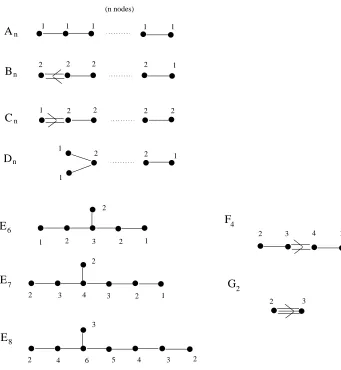
The Dynkin diagrams for these are given in Figure 3-1. The nodes are marked with the so-called comarksa∨
i which we recall to be the expansion coefficients of the highest
root θ into the simple coroots α∨
i := 2αi/|αi|2 (αi are the simple roots)
θ =
r X
i
a∨iαi∨,
where r is the rank of the algebra (or the number of nodes). The dual Coxeter numbers are defined to be
c:=
r X
i
a∨i + 1
and theCartan Matrix is
Cij := (αi, α∨j).
We are actually concerned more with Affine counterparts of the above simple algebras. These are central extensions of the above in the sense that if the com-mutation relation in the simple g is [Ta, Tb] = fab
c Tc, then that in the affine bg is
[Ta
m, Tmb] = fcabTmc+n+knδabδm,−n. The generators Ta of g are seen to be generalised
toTa
m :=Ta⊗tmofbgby Laurent polynomials int. The above concepts of roots etc. are
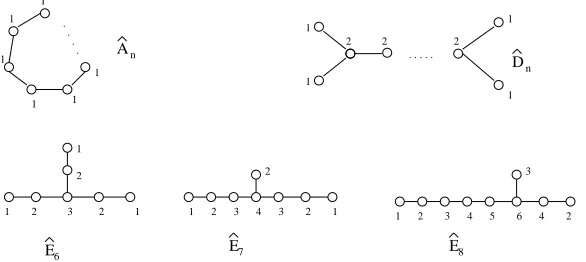
directly generalised with the inclusion of the affine root. The Dynkin diagrams are as in Figure 3-1 but augmented with an extra affine node.
fi-2
3 2 1
4 3 2
1 1 1
1 1
2 2 1
2 2
2 2
1
1
1
2 2 2 2
1
1
2
3
2 2 1
3
2 4 6 5 4 3 2
2 3 4 2
2 3
E7 An
Bn
Cn
Dn
E8
E6 F4
[image:44.612.134.475.76.446.2]G2 (n nodes)
Figure 3-1: The Dynkin diagrams of the simple complex Lie Algebras; the nodes are labelled with the comarks.