EFFECT OF SINTERING TEMPERATURE ON DENSIFICATION OF WC-6CO CEMENTED CARBIDE SINTERED BY COUPLED MULTI-PHYSICAL FIELDS
ACTIVATED TECHNOLOGY
Yu Zhou Yuan Li
School of Manufacturing Science and School of Manufacturing Science and Engineering, Sichuan University Engineering, Sichuan University
Chengdu, 610065, China Chengdu, 610065, China [email protected] [email protected]
Yi Yang Gang Yang
School of Manufacturing Science and School of Manufacturing Science and Engineering, Sichuan University Engineering, Sichuan University
Chengdu, 610065, China Chengdu, 610065, China [email protected] [email protected]
Deqiang Yin Yi Qin
School of Manufacturing Science and Department of Design, Manufacture & Engineering, Sichuan University Engineering Management,
Chengdu, 610065, China University of Strathclyde [email protected] Glasgow G1 1XQ, UK
[email protected] ABSTRACT
WC-6Co cemented carbide was manufactured successfully by coupled multi-physical fields activated technology with the Gleeble-1500 thermal simulation equipment for the reason of studying the effect of sintering temperature on the densification and microstructures of samples sintered under multi-physical fields. And the results demonstrate that the densification is better with the increasing of sintering temperature. The best density about 98.76% is obtained with the sintering temperature of 1200℃. Besides, both the number of closed pores in microstructure and the value of hardness of samples decrease obviously as increasing of temperature.
Keywords: WC-6Co, sintering temperature, densification.
1 INTRODUCTION
Cemented carbides are widely used in a variety of applications such as machining, cutting and drilling because of its high hardness, high wear resistance and toughness properties. Generally, cemented carbide is manufactured by conventional sintering technology. However, it is difficult to improve the mechanical property of cemented carbide due to high sintering temperatures and long sintering times. Therefore, many efforts have been made to explore more efficient sintering techniques including spark plasma sintering (Eriksson et al. 2013), microwave sintering (Bao et al. 2012) and high frequency induction-heated sintering (Shon et al. 2012).
carbide of nearly full densification by microwave irradiation and supposed that the sintering temperature had obvious effects on WC grain size and distribution. Xie et al (2004) discussed the relationship between sintering temperature and properties of nano-grained cemented carbide prepared by spark plasma sintering and analysed the reason of densification during sintering process. Numerous studies have showed that the densification of WC–Co cemented carbides is closely related to sintering temperature.
Recently, a new sintering method named as coupled multi-physical fields activated technology has been put forward for the forming of WC-6Co composites due to its significant characteristics such as lower sintering temperature, shorter forming time, and remarkable inhibition of grain growth without addition of inhibitors (Ankang Du, 2012). Using this novel method, Huang et al (2013) successfully fabricated WC-6Co cemented carbide of which the density could reach over 97% with the sintering temperature of 850℃. However from the microstructure of the sample, it can be seen that there are some holes in the samples, which have bad influences on the mechanical properties of the sample. Thus, it is necessary to further investigate the effect of higher sintering temperatures to eliminate these holes and obtain denser compacts.
In this work, we focused on the manufacturing of WC-6Co samples by coupled multi-physical fields activated technology and discussed the effects of sintering temperature on densification and microstructures of samples.
2 MATERIAL AND EXPERIMENT
For the raw material, WC and Co powders with an average grain size of 0.6μm and a purity of 99% were considered for the experiment. Both types of powders were mixed thoroughly with a composition of 94 wt%WC-6wt% Co where no grain growth inhibitors added and then ball milled for 2 hours. Afterwards, the mixed powder was loaded into a small die with inner diameter of 4 mm.
The experiments were carried out using the Gleeble-1500 thermal simulation instrument (Dynamic System Inc, USA.). The schematic map of the equipment is shown in Fig. 1. The die was installed between the two electrodes of the Gleeble machine and thermocouple wires were soldered onto the surface of the die to measure the temperature. The required experimental heating conditions were pre-programmed into the computer control system. Various sintering temperature were adopted in the experiments. The chamber was first evacuated to less than 10-3 Pa before the sintering process started. Afterwards, WC-6Co powders were rapidly heated to sintering temperature at the preset heating rate of 50℃/s. A pressure of 50 MPa was applied to the powders through the punches when the heating process started for each temperature setting. After a 4 min thermal retardation time, the Gleeble-1500D thermal simulation instrument was turned off and the sample was cooled down to room temperature in a vacuum atmosphere. In the experiments, it is worth mentioning that the total forming process only took less than 5 minutes.
The relative density was measured by the electronic analytical balance TP-214 with Archimedes’ principle. SEM (JSM-5900LV) and XRD ( D/Max-IIIA) were used to examine the microstructure and the phase structure of the sample. The average grain size of a cross-section was measured using analytical software. Rockwell hardness measurements were made on polished sections of the WC-6Co composites.
Table1 Processing parameters
Sample Material Sintering temperature Pressure Heating rate
1# WC-6Co 1000℃ 50MPa 50℃/s
2# WC-6Co 1100℃ 50MPa 50℃/s
Fig. 1 Schematic diagram of Gleeble-1500D equipment
3 RESULTS AND DISCUSSIONS
3.1. Effect of sintering temperature on sintering densification
The densities of WC-6Co specimens sintered at sintering temperature ranging from 1000 ℃ to 1200 ℃ are shown in Fig. 2. From the results, it can be seen that high relative densities (98.03%-98.67% of the theoretical value) are achieved for all the WC-6Co specimens sintered under coupled multi-physical fields. With an increase in the sintering temperature, densities of the sintered specimens also increase. Therefore, it could be concluded that when the sintering temperature was up to 1200℃, the densification degree of the sample will be very high.
1000 1050 1100 1150 1200
98.0 98.1 98.2 98.3 98.4 98.5 98.6 98.7
98.8 98.76%
98.34%
Re
lative
d
en
sity
(%)
[image:3.612.198.392.412.553.2]Temperature(℃) 98.03%
Fig 2 Relative densities of the sintered cemented carbides formed at different sintering temperatures
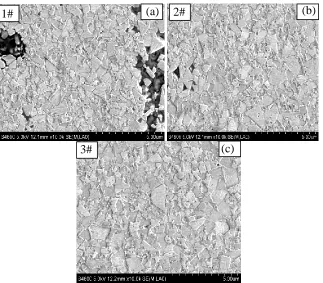
Fig.3 Microstructures of WC-6Co cemented carbide samples at different sintering temperature
3.2 Effect of sintering temperature on grain size
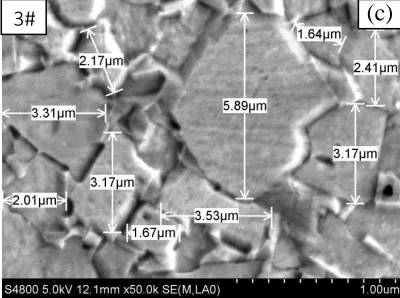
Fig.4 shows the grain size of WC-6Co cemented carbide formed at the different sintering temperature settings. It can be seen that the sintering temperature has obvious effect on grain size, and the grain size of samples sintered by couple multi-physical fields activated technology is small and uniform. The average grain size of samples sintered with sintering temperature of 1000℃, 1100℃, 1200℃ are 1.837 μm, 1.952μm, 2.897 μm respectively. According to the calculated results, it can be seen that the average grain size of samples increased as sintering temperature increased. On the other hand, compared with conventional sintering methods, the WC grain grows slowly respectively without any inhibitors under the multi-physical field coupling technology which contains high sintering efficiency.
1#
3#
2#
1# 2#
(a)
(b)
(c)
[image:4.612.108.504.532.681.2]
Fig.4 The grain size of WC-6Co cemented carbide samples sintered with different sintering temperatures
3.3 Effect of sintering temperature on mechanical properties
Fig 5 shows mechanical properties of WC-6Co cemented carbides sintered with different sintering temperatures. It can be concluded that the porosity of samples decreases with the increasing of sintering temperature. As expected, the relative density of samples would be increase as shown from 98.03% to 98.76% due to pores decreasing. Generally, the hardness of the sample is proportional to the relative density. However, the value of hardness was found to decrease with an increase in relative density as shown in Fig 5. When the sintering temperature reached to 1200℃, the value of Hardness Rockwell A (HRA) of sample down to 80.6. It is thought that the energy which is needed in the process of grain growth rises as the sintering temperature increasing. Therefore, raising sintering temperature would promote grain growth which can decrease the hardness of sample, leading to a larger the grain size of #3 sample compared to #1 and #2 samples. This is the reason why the hardness of #3 sample which contains least pores is lowest.
1000 1050 1100 1150 1200 61.6
61.8 62.0 62.2 62.4 62.6 62.8 63.0 63.2 63.4 63.6
Hardness Rockwell (C) Hardness Rockwell (B)
Sintering temperature(℃)
Hardness Rockwell(C)
80 81 82 83 84
[image:5.612.199.438.467.629.2]Hardness Rockwell(B)
Fig 5 Mechanical properties of sintered WC-6Co cemented carbides with different sintering temperature
4. CONCLUSIONS
The multi-physical field coupling technology is an efficient process which can inhibit the increase
of grain size of WC-6Co cemented carbide without adding grain inhibitors. Moreover, the sintering temperature has an obvious effect on densification, grain size and mechanical properties of samples. From the work completed in this study, the following conclusions can be drawn:
Coupled multi-physical field sintering technology was used to fabricate WC-6Co cemented carbides specimens of nearly full density at over 98%. The relative density of samples increased with an increase of the sintering temperature. The WC-6Co cemented carbides fabricated by this method contains less pores and when sintering temperature reached 1200℃, the closed pores almost disappeared and were hard to be observed in the microstructure.
Sintering temperature has obvious effect on the hardness of WC-6Co samples. The value of hardness decreased as sintering temperature was increased with a value of 80.6 HRA when the sintering temperature was 1200℃. The higher sintering temperature is not used in the study limited of the material of die, we will study higher sintering temperature in the next work.
ACKNOWLEDGMENTS
The authors would like to acknowledge the support from the National Nature Science Foundation of China (No. 51275322) and the UK Royal Society / China NSFC International Exchanges Programme on the collaborative development of a new micro-manufacturing process.
REFERENCES
Ankang Du, Yi Yang, Yi Qin and Gang Yang. 2012. Effects of Heating Rate and Sintering Temperature on 316 L Stainless Steel Powders Sintered Under Multi-physical Field Coupling.
Materials and Manufacturing Processes 28:66-71.
Bao, R. and J. Yi, et al. 2012. A research on WC–8Co preparation by microwave sintering.
International Journal of Refractory Metals and Hard Materials 32 (0): 16-20.
Bao, R., et al., 2013. Effects of microwave sintering temperature and soaking time on microstructure of WC–8Co. Transactions of Nonferrous Metals Society of China 23(2): 372-376.
Eriksson, M. and M. Radwan, et al. 2013. Spark plasma sintering of WC, cemented carbide and functional graded materials. International Journal of Refractory Metals and Hard Materials
36 (0): 31-37.
Kunlan Huang, Yi Yang, Yi Qin, Gang Yang and Deqiang Yin 2013. FABRICATION OF BINDER-FREE ULTRAFINE WC-6CO COMPOSITES BY COUPLED MULTI-PHYSICAL FIELDS ACTIVATION TECHNOLOGY. Proceedings of the 11th International Conference on Manufacturing Research 369-375.
Shon, I. and S. Jo, et al. 2012. Mechanical synthesis and rapid consolidation of nanostructured FeAl–Al2O3 composites by high-frequency induction heated sintering. Ceramics International 38 (7): 6035-6039.