n
a
ly
s
is
o
f
th
e
R
o
le
o
f
th
e
T
e
x
tb
o
o
k
in
th
e
C
o
n
s
tr
u
c
ti
o
n
o
f
A
c
c
o
u
n
ti
n
g
K
n
o
w
le
d
g
e
the Construction of Accounting Knowledge
he education of future generations of accountants is critical to ensure the quality and reputation of the accounting profession. his report examines to what extent introductory inancial accounting textbooks and introductory inancial accounting training manuals used in university and professional education encourage independent learning and ethical awareness among students and enable future accounting professionals to engage in critical thinking.
he study assesses how authors and publishers decide upon the content of textbooks and training manuals, whether such texts refer to a broad range of corporate stakeholders or to a narrower view of reporting to shareholders, and how such texts are used by both educators and students. he research was undertaken by carrying out a variety of interviews and questionnaires with authors, publishers, lecturers and students, at both university and professional level, together with an analysis of introductory inancial accounting textbooks and professional training manuals.
he report identiies that the two main inluences on the content of textbooks are: the ability to increase sales; and the syllabi of professional accountancy bodies. Cost and time constraints appear to limit the inclusion of wider material and thus texts and training manuals have a shareholder/investor emphasis, with an assumed primary goal of proit maximisation. he discussion of wider interests and goals are limited and there is evidence that such texts impact on students’ future views of business and accountancy. he authors conclude with a number of important recommendations for the stakeholders within accounting education to consider
.
ISBN 978-1-904574-41-5 EAN 9781904574415
CA HOUSE • 21 HAYMARKET YARDS • EDINBURGH • EH12 5BH TEL: 0131 347 0237 • FAX: 0131 347 0114
EMAIL: [email protected] • WEB: www.icas.org.uk/research
Collison Covers - 14.3.08.indd 1 9/5/08 12:00:07
An Analysis of the Role of the
Textbook in the Construction
of Accounting Knowledge
KNOWLEDGE
by
John Ferguson David Collison David Power Lorna Stevenson
University of Dundee
Published by
he Institute of Chartered Accountants of Scotland CA House, 21 Haymarket Yards
© 2008
ISBN 978-1 904574-41-5 EAN 9781904574415
his book is published for the Research Committee of he Institute of Chartered Accountants of Scotland. he views expressed in this report are those of the authors
and do not necessarily represent the views of the Council of the Institute or the Research Committee. No responsibility for loss occasioned to any person acting
or refraining from action as a result of any material in this publication can be accepted by the authors or publisher.
All rights reserved. No part of this publication may be reproduced, stored in a retrieval system, or transmitted, in any form or by any means, electronic, mechanical, photocopy, recording or otherwise, without prior permission of the publisher.
C
Foreword ... i
Acknowledgements ... iii
Executive Summary ... v
1 Introduction ... 1
Introduction ... 1
Research questions ... 4
Motivation for the research ... 5
Structure of the report ... 11
2 Literature Review ... 13
Introduction ... 13
Critiques of accounting education ... 13
Textbooks and ideology ... 19
Accounting textbooks ... 20
Summary ... 33
3 Research Approach ... 35
Introduction ... 35
hompson’s (1990) framework for analysis - the Content of the texts: the second stage of hompson’s ‘tripartite approach’ ... 37
Production of the texts: the irst stage of hompson’s framework... 40
framework ... 42
Use of the texts: the third stage of hompson’s framework ... 45
Execution of methods ... 48
4 Production of Accounting Textbooks and
Study Manuals ... 53
Introduction ... 53
he context of higher education publishing and textbooks ... 54
he context of professional accounting education ... 67
Authors’ and publishers’ perspectives ... 70
Summary ... 91
5 Analysis of Content of Accounting Textbooks and Training Manuals ... 93
Introduction ... 93
Typical modes of operation of ideology ... 93
Analysis of introductory inancial accounting textbooks and training manuals ... 96
Summary ... 112
6 Users of Accounting Textbooks and Training Manuals: Lecturers and Trainers ... 113
Introduction ... 113
he lecturers’ survey ... 113
Interviews with lecturers and professional tutors ... 124
Summary ... 141
7 Users of Accounting Textbooks and Training Manuals: Students and Trainees ... 145
Introduction ... 145
Questionnaire ... 146
Focus groups ... 169
8 Discussion and Recommendations ... 189
Introduction ... 189
he production of introductory inancial accounting texts ...190
he content of introductory inancial accounting texts ... 192
he use of introductory inancial accounting texts and the encouragement of critical awareness amongst students ...193
Recommendations ... 196
Summary ... 198
References ... 199
Appendix Analysis of Student and Trainee Questionnaire Responses ... 215
F
he education of future generations of accountants is critical to ensure the quality and reputation of the accounting profession. ICAS is committed to encouraging the use of principles in accounting standards which requires the education of accountants who have the expertise and courage to apply sound and ethical judgements. his report examines to what extent introductory inancial accounting textbooks and introductory inancial accounting training manuals used in university and professional education encourage independent learning and ethical awareness among students and enable future accounting professionals to engage in critical thinking.
he report assesses how authors and publishers decide upon the content of textbooks and training manuals, whether such texts refer to a broad range of corporate stakeholders or to a narrower view of reporting to shareholders, and how such texts are used by both educators and students. he project was undertaken by carrying out a variety of interviews and questionnaires with authors, publishers, lecturers and students, at both university and professional level, together with an analysis of introductory inancial accounting textbooks and professional training manuals.
important recommendations for the stakeholders within accounting education to consider – not least the need to consider whether current accounting texts and education should be widened to include the social and environmental aspects of accounting and the ethical dimensions of, and implicit values relected in, diferent forms of organisations.
his project was funded by the Scottish Accountancy Trust for Education and Research (SATER). he Research Committee of he Institute of Chartered Accountants of Scotland (ICAS) has also been happy to support this project. he Committee recognises that the views expressed do not necessarily represent those of ICAS itself, but hopes that the project will contribute to the development of accounting education.
David Spence Convener
Research Committee
A
We are particularly grateful to all those who have participated in the interviews, questionnaires and focus groups. In addition, we are grateful for the feedback received from participants at the British Accounting Association Education Special Interest Group Annual Conference, Aberdeen, 2005, the British Accounting Association Scottish Regional Group Annual Conference, Dundee, 2005, the Critical Perspectives on Accounting Conference, New York, 2005, the European Accounting Association Annual Congress, Dublin, 2006 and the University of St. Andrews School of Management Research Seminar Series. his report has also beneited from the insightful comments of two anonymous reviewers and from the Director of Research at ICAS, Christine Helliar. We wish also to thank Michelle Crickett and Angie Wilkie for their help and input.
E
his report examines the role of the textbook and training manual in the teaching of introductory inancial accounting. Although it has long been recognised that the textbook plays an important role in the education process, the issue has not been systematically examined in a comprehensive manner with respect to the teaching of introductory inancial accounting. Based on research carried out in 2005, the current report addresses this issue. It does so using a research framework proposed by hompson (1990) which recommends a comprehensive approach to the understanding of texts involving three separate aspects:
• he production of the textbook/training manual;
• he content of the textbook/training manual;
• he usage of the textbook/training manual.
hompson’s framework has been used to address four main questions about the role of the textbook/training manual in introductory inancial accounting courses:
(i) How do authors and publishers decide upon the content of inancial accounting textbooks and training manuals?
(iii) How are inancial accounting textbooks and training manuals used by educators and students and are they supplemented with additional reading material?
(iv) To what extent do inancial accounting educators believe that textbooks, training manuals and other recommended materials encourage active independent learning and ethical awareness among students and to what extent do students engage in a ‘critical reading’ of such materials?
To address these questions the following research was undertaken in 2005:
• he higher education publishing industry was studied;
• Interviews were conducted with authors as well as publishers of textbooks and training manuals;
• An analysis of the content of introductory inancial accounting textbooks and professional training manuals was undertaken;
• he users of introductory inancial accounting textbooks were consulted. Speciically, lecturers who recommend the textbooks and training manuals were interviewed and surveyed via a questionnaire. In addition, students’ views about the usage of textbooks and training manuals were ascertained using questionnaires and focus group discussions;
• he analysis was conducted with both university lecturers and undergraduates as well as professional educators and trainees to examine whether there was any diference between the roles of introductory inancial accounting textbooks and training manuals.
worldviews of their users, the study examines the literature, albeit small, on textbooks within the accounting discipline. A particularly important issue for this study relates to the assumption of shareholder primacy, and the maximisation of shareholder value as the assumed aim of business activity. he contestability of this approach to business organisation, which has been characterised as AngloAmerican, is apparent from the existence of alternative approaches to be found in continental Europe and Japan. hese alternatives typically balance the interests of a range of stakeholders and, traditionally, do not accord primacy to shareholders or to the maximisation of shareholder value. he ethical implications of a preoccupation with proit maximisation have been addressed in literature reviews on the subject of ethics which were recently published by ICAS.
A number of key findings have emerged from the research reported in this report. First, the two main inluences on the content of introductory inancial accounting textbooks are:
• the ability of such material to increase sales; and
• the syllabi of professional accountancy bodies.
doubts. heir manuals are written to cover the syllabus for a professional body’s examination; this is their main aim.
Second, the content of introductory accounting textbooks and professional training manuals had a shareholder/investor emphasis. Where diferent users of accounting information are outlined, the discussion is usually limited and normally contained within the introduction; once this discussion is inished, the majority of the textbook or training manual focusses almost exclusively on reporting to shareholders. In addition, few of the textbooks and none of the training manuals provide a context for inancial accounting. Most simply assume, without elaboration, that the primary goal of the organisation is to maximise the wealth of shareholders; diferent goals are not considered and the assumptions underpinning the maximisation of shareholder wealth are not discussed.
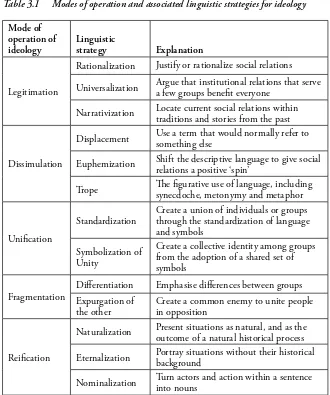
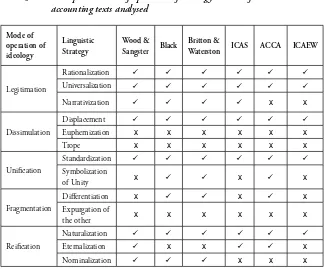
hird, there is evidence within the texts of the typical modes of operation of ideology identiied by hompson (1990). In particular, there are examples of ‘universalisation’ through the implicit assumption that a single set of inancial statements aimed at shareholders will satisfy the needs of all user groups; and ‘reiication’, in other words, the presentation of a socially constructed activity as if it were real or natural.
he study also considers the concept of the ‘selective tradition’, in other words what is missing from the texts. he analysis suggests that certain key issues are not addressed in the examined texts: in particular, the issue of ethics is absent, as is any consideration of the social and political context of accounting. Without such content students are unlikely to recognise that there are contestable issues relating to the function of accounting or the role it plays in society.
textbooks convey a particular view of the world and, as a result, supplement the textbook with additional recommended readings which highlight an alternative perspective. For those professional educators who run courses for accounting trainees, very little additional reading material is suggested; because of time constraints and the pressure to cover material for professional exams, these individuals tend to focus solely on the training manuals.
Fifth, there was some evidence to support the view that textbooks on introductory inancial courses have an impact on students’ views about the world. Questionnaire results suggest that students’ support for the corporate goal of shareholder wealth maximisation increases following an introductory inancial accounting course; this result is especially pronounced for professional trainees and for those who have not studied accounting prior to commencing their undergraduate studies or professional training. Further, the results from the questionnaire vary among undergraduates at diferent institutions; clearly, the lecturers’ use of the textbook and the recommendation of additional material impacts upon students’ critical evaluation of assumptions underpinning inancial accounting.
Sixth, discussions with students following their introductory inancial accounting course or training block conirm that a very narrowly focussed view of business is held. he primacy of the shareholder or owner is largely taken for granted and there is some evidence that little, if any, distinction is made between the incontestable need to make a proit which is necessary for survival, and the more contestable aim of maximising proit, or shareholder value.
Based on these indings, the authors recommend the following matters to be considered in the production of introductory accounting texts and more generally in the context of accounting education:
2) Embody the wider social and environmental impacts of accounting practice in introductory inancial accounting texts, to give more emphasis to the ethical development of accounting students from the beginning of their studies.
3) Widen the contextual issues addressed in accounting education, such as the strong, but indirect, inluence of professional bodies on textbook content due to the importance of accreditation.
4) Extend the teaching of ethical issues beyond issues of professional conduct and probity to include the ethical dimensions of, and the implicit values relected in, diferent forms of socioeconomic organisation.
5) Lecturers should recognise that they are key participants in the introductory textbook selection process; if the wider context of accounting should be introduced to students, lecturers need to request from publishers books which include this material.
6) Recognise the extremely narrow orientation of introductory inancial accounting training manuals, given that they are, typically, the only form of study text used by nonrelevant graduate entrants to the profession in learning about accounting. While this group may possess a very wide range of subject specialist knowledge (Allison, 2007) as well as relative maturity, at the start of their accounting studies, they may also lack an appreciation of the socially constructed nature of the discipline when learning to cope with its technical complexity.
1
Introduction
More than 20 years ago, the American Accounting Association (AAA) commissioned the Bedford Report which recommended, amongst other things, that students be encouraged to become ‘active, independent learners and problem solvers rather than passive recipients of information’ (AAA, 1986). Since then, there have been repeated calls from professional accounting bodies and recruiters for accounting irms to enhance both critical thinking skills and ethical awareness amongst accounting graduates (AAA, 1986; AECC, 1999; Albrecht and Sack, 2000; Gray et al., 2001; Mathews, 1994a). his theme has also been relected throughout the academic literature in the area with numerous studies exploring the ways in which this call can be answered (Baril et al., 1998; Gallhofer and Haslam, 1996a; Loeb, 1988) and seeking to identify reasons why the development of critical awareness and ethical reasoning may not be taking place (Gray et al., 1994; Kelly et al., 1999; Lewis et al., 1992; Power, 1991; Puxty et al., 1994).
In one of a number of works recently published by ICAS in the ield of ethics, undue single mindedness among trainees in regard to the role of business was highlighted by McPhail (2006) who noted concerns about an indoctrination of accounting students with mercenary values. He reviewed a signiicant number of studies which go as far as to suggest that accountants’ moral maturity lags behind those of other professional groups. Indeed, the ICAS publication, Taking Ethics to
A rulesbased approach to ethical decision making has resulted in a relatively unsophisticated state of reasoning by accountants, which is poorer than that of the educated population as a whole.
(p.49)
Further, McPhail (2006, p.6) draws on Loeb (1991) and notes that the indoctrination of accountants induced a belief that:
...ethics and social responsibility are unimportant considerations… unless they have a direct impact on production or proits.
If indoctrination of accounting students is occurring then a likely source of such doctrine is clearly the textbook. Indeed the Bedford Report argued that:
...textbooks are a key aid to instruction…nevertheless, excessive reliance on textbooks reduces the instructor’s incentive to determine constantly what each student should learn. If the teaching process centers on repeating textbook material in the classroom… then the learning process risks becoming uninspiring to capable future
accountants. (AAA, 1986, p.177)
...any human agency that can be inluenced by, or can itself inluence, the activities of the organisation in question.
Therefore, any business entity will have many stakeholders, including, for example, creditors, customers, employees, shareholders, suppliers and the local community.
In this respect, the present study explores the extent to which accounting textbooks and other recommended materials consider the interests of a broad group of stakeholders, such as creditors, employees, the government or the public: the primacy given to the interests of shareholders relative to other stakeholders is critically investigated. In the case of inancial accounting, textbooks can help to shape students’ views regarding the purpose of inancial reporting information and the interests which such information serves. Arguably, the current emphasis placed on shareholders compared to other corporate stakeholders within inancial accounting textbooks could be conceived of as ‘constructing’ a particular view of the world (Ferguson et al., 2004; Hines, 1988). Furthermore, such emphasis may preclude the development of critical faculties and ethical awareness skills which professional bodies claim to be looking for among student recruits (Gray et al., 2001).
To this end, the views of publishers and authors are investigated by means of semistructured interviews, to identify the processes and factors that currently inluence the content of introductory inancial accounting textbooks and training manuals. he research also seeks to elicit the perceptions of academics and professional trainers who are involved in the selection of recommended textbooks and training manuals. his strand of the project will help to identify the perceived importance of the textbook or professional training manual in respect of the overall course objectives and to contribute to an understanding of how textbooks and other materials are used in an educational setting. In addition, this research will also highlight any diferences between the use of the textbook and other materials on university and professional courses.
Opinions regarding the content of inancial accounting textbooks are sought from lecturers, professional educators and university students as well as from professional recruits with nonrelevant degrees. his research strand is supported by an analysis of the content of a selection of recommended introductory inancial accounting textbooks and professional training manuals. he aim of this strand of enquiry is to consider the characteristics of the texts and the emphasis given in textbooks to diferent corporate stakeholders, as identiied in the
Corporate Report 1975 (ASC, 1975).
Research questions
The research seeks to address four related issues in order to explore the role of the textbook in introductory inancial accounting education:
(ii) To what extent do textbooks and recommended materials refer to a ‘broad’ range of corporate stakeholders, or do they encourage students to consider inancial accounting within the narrow context of just reporting to shareholders?
(iii) What is the role of recommended inancial accounting textbooks, professional training manuals and other recommended materials in degree modules or professional training courses; how are they used by educators and students and what importance is ascribed to them?
(iv) To what extent do inancial accounting lecturers and professional educators believe that textbooks and other recommended materials, as pedagogical tools, engender active, independent learning and ethical awareness, and to what extent do students engage in a ‘critical reading’ of such material?
Motivation for the research
It is perhaps the ‘dominance of [an] empirical/calculative tradition’ (Chua, 1996, p.129) in accounting, that has led critics of accounting education to observe that:
Instructors [in accounting education] have used textbooks as a crutch, with the more inexperienced teachers simply becoming
textbook facilitators. (Herring, 2003, p.90)
capitalism (Chua, 1986; Collison, 2003; Collison and Frankfurter, 2000; Gray et al., 1994; Kelly and Pratt, 1994; Puxty et al., 1994). In particular, it has been noted that accounting education reproduces and sustains the notion that society’s welfare is optimised as a result of individuals acting in their own economic selfinterest, and that the only participants in the wealth creating process that should have their interests maximised are shareholders. hus, accounting students are not encouraged to consider alternative approaches to socioeconomic organisation, or to speculate upon the power asymmetries which underpin the prevailing worldview that they encounter. A distinction can be made between what have been broadly categorised as AngloAmerican models of capitalism, for example Britain and the USA, and various forms of ‘social market’ capitalism to be found, for example, in Western and Northern Europe and in Japan (Dore et al., 1999; Dore, 2000). his distinction is often neglected in extant critiques of accounting and accounting education, often implying that ‘capitalism’ is a relatively monolithic and homogenous economic structure.
he primacy accorded to shareholders results in the maximisation of shareholder wealth or, less technically – proit maximisation being widely accepted in the UK and US as the incontestable objective of business. Of course an introductory treatment of accounting typically does not involve incorporated entities with shareholders, rather the archetypal sole trader is usually the irst ownership structure encountered by students of accounting. But the essentials of accounting stay the same for both types of entity and the focus on proit as an overriding business objective will typically remain. Proit maximisation may be defended by appeal to Adam Smith’s (1776) famous observation that:
It is not from the benevolence of the butcher, the brewer, or the baker that we expect our dinner, but from their regard to their
However, while the market power of a sole trader is intuitively consistent with the ‘atomistic competition’ envisaged by Smith, it is questionable whether a similar rationale is appropriate when economic power is highly concentrated in, for example, large corporations. Indeed Berle and Mearns (1932), the most cited authors in the ield of inance, pointed out the best part of a century ago, that:
When we speak of business enterprise today, we must have in mind primarily these very units which seemed to Adam Smith not to it into the principles which he was laying down for the conduct of
economic activity. (p.346)
Their assessment of the dominating power of commercial corporations, even then, was such that they commended public policy rather than self interest, ‘private cupidity’, as the proper mechanism for allocating corporate income streams. he role of power in this context was noted by Lovell (2005) in another of the ICAS sponsored works on ethics. He described how the UK government’s 1997 manifesto commitment to bring pluralism – as opposed to shareholder primacy into company law was frustrated through political lobbying by corporate interests.
Such criticisms are not, of course, criticisms of proit per se; only by making a proit can a private entity survive but making a proit and maximising proit are very diferent things. However, our research suggests that this distinction may not necessarily be apparent to students of accounting. A direct consequence of a proit maximising culture for accountants themselves was highlighted by Pierce, in her literature review, Ethics and the Professional Accounting Firm (Pierce, 2006). She reported that:
a predominantly ‘service in the public interest’ mindset to a ‘commercial business’s proit maximising’ culture. …he tensions created by the irms’ pursuit of proit and growth targets undermine
traditional values. (p.149)
It is not appropriate in this work to seek to make a deinitive case for or against proit maximisation as an appropriate aim for business. However, we invite the reader to at least acknowledge the contestability of that aim and to consider that accounting students, and indirectly wider society, may be illserved by an education and training regime for accountants that does not expose them to that contestability. Indeed McPhail (2006, p.73) notes concerns about the public interest claims of the profession given:
…the apparent inability of practising accountants to engage with the broader politicaleconomy within which accounting functions.
It is worth highlighting the central importance of this ‘contestable’ issue even at the geopolitical level, according to Lovell’s (2005) literature review on Ethics in Business. Drawing on Hutton (2002) he noted that:
European inance and trade ministers have come under intense pressure [from American interests] to enshrine in company law that the primary and exclusive focus of corporations is the shareholder
(as is already the case in the UK). (p.105)
Lovell also cited Hutton as follows:
If the rest of the world is not careful, our future will be to accept globalization almost on American conservative terms and around
As implied by Hutton, there are, of course, many examples of advanced social market economies, particularly in Europe and Japan (see also Dore, 2000; Hall and Soskice, 2002) whose traditional socio-economic cultures have not been focussed on shareholder primacy. heir superior performance on some important health and social indicators (see, for example, Collison et al., 2007) poses signiicant questions about the desirability of the shareholder primacy model and maximising shareholder wealth (MSW).
Given the prevalent use of textbooks as a pedagogical device in accounting education, this research addresses a gap in the literature – by explicitly focusing on the ideological characteristics of recommended accounting textbooks. More speciically, building on the limited prior research which examines the values implicit in accounting textbooks (in particular, Ferguson et al., 2005), this work explores the production, content and use of introductory inancial accounting textbooks and training manuals by drawing on hompson’s (1990) framework for the analysis of mass communication.
Lewis et al., 1992; McPhail, 1999; McPhail and Gray, 1996; Macve, 1992; Matthews, 1994b; Power, 1991; Puxty et al., 1994).
In this techniquedriven learning approach, it is argued that students do not get the opportunity to locate the ‘techniques’ within any social or organisational context and are discouraged from employing a ‘deep learning’ approach to their education (Marton and Saljo, 1976). It is generally held that the development of a deep approach to learning is consistent with the avowed aims of both higher education and the accounting profession. Hirst and Peters (1970, p. 19) contend that an educated person is ‘not just a person who has a knowhow or knack’ but rather one who has a knowledge and understanding which is ‘not too narrowly specialised’ and is thus enabled to distinguish between issues of substance and form.
Structure of the report
Chapter two provides some background to the study; more speciically prior work in the area is briely outlined. he research approach adopted is described in chapter three, while chapter four discusses the indings from the irst empirical component of this research which focuses on the production of introductory inancial accounting textbooks and training manuals. Following a review of the characteristics of the higher and professional education publishing ields, this chapter details the indings from ifteen semistructured interviews with the authors and publishers of introductory inancial accounting textbooks and training manuals.
2
Introduction
Given the prevalence of textbooks in teaching accounting, this chapter outlines some relevant critiques of accounting education before considering the indings of existing research on textbook ideology; this is followed by a review of current knowledge on the production, use and content of accounting textbooks; a concluding section then ends the chapter.
Critiques of accounting education
The accounting education change movement in the United States, an initiative driven by, in particular, the American Accounting Association (AAA, 1986) and the American Institute of Certiied Public Accountants (AICPA, 1998), sought to address the growing perception that accounting education was failing to prepare students for the ‘changing demands made on accountants by public practice’ (BoltLee and Foster, 2003, p.33). In this sense, professional accounting bodies and academic associations were engaging in a ‘functionalist critique’ of accounting education, by highlighting how the needs of business and public practice were being unrealized by the education process (Power, 1991).
the AECC’s (1990a) recommendations for change included the need to have an understanding of general accounting without the memorization of rules and regulations, and an increased focus on developing conceptual thinking skills as well as a host of interpersonal skills, such as listening, interaction with diverse people, group work and leadership (see also, Ainsworth, 2001; BoltLee and Foster, 2003). However, despite the US professional accountancy bodies’ rhetoric for the need to increase the critical thinking skills amongst students, these skills were framed in a very limited way (Cuganesan et al., 1997); in particular, ‘critical’ was taken to refer to the type of decisions students would be required to make in practice concerning ‘complex facts’ for example, in relation to special purpose entities (Hayes and Baker, 2004) and precluded any concern about the purpose of accounting, its role in society or the interests that it serves.
What is implicit from this functionalist perspective, is that university accounting education is viewed as something that:
...must provide an economic return to the society which has funded
and organised the education. (Kelly et al., 1999, p.322)
However, there is a host of problems with this perspective and the critique that it proposes in relation to accounting education – which will be outlined briely in the following paragraph.
In contrast to the accounting change movement, an increasing number of academic studies have started to question the values that accounting education propagates, and the role it plays in imparting a particular worldview to students which is, according to these researchers, at the very least, contestable (Chua, 1986; Collison, 2003; Gray et al., 1994; Humphrey et al., 1996; Kelly et al., 1999; Lewis et al., 1992; McPhail, 1999; Power, 1991; Puxty et al., 1994; Sikka et al., 2007; Sikka and Wilmott, 2002).
In considering the accounting literature which draws attention to aspects of ideology in accounting education, McPhail (2001, p.475) notes that the majority of the studies within it imply that there is a correspondence between accounting education and the economic system; this is due to claims that accounting education:
...provides students with the knowledge of how to perform an essential function within freemarket economies.
McPhail (1999, p.836) had earlier suggested that most managers and accountants are motivated by ‘the ethical conviction that economically appropriate action in itself is ethically good’ (see also, Ghoshal, 2005; McPhail and Gray, 1996). In this respect, the accounting education process leads students to ‘discipline themselves’ into the belief that the pursuit of proit in a freemarket economy, or more speciically, the maximisation of shareholder wealth, is an ethical way of behaving. McPhail notes that accounting is ‘conventionally taught within the rubric of marginalist economics’, and, thus, at least in the accounting aspects of their lives, accounting students behave in a manner consistent with the values associated with AngloAmerican capitalism (McPhail, 1999, p.845).
Students absorb the current (often implicit) values of the industrial system and the accounting profession without being aware that
this is happening and that some matters are contestable. (p.62)
he contestable matters to which Gray et al. (1994, p.62) refer concern the ‘rationalizations of neoclassical economics and especially the pursuit of self interest’. However, whilst accounting and accounting education implicitly adopt the values associated with this particular world view, accounting education presents accounting as a ‘neutral, technical, value free activity’ (Gray et al., 1994, p.62).
Given the values that accounting education implicitly adopts, Gray et al. (1994) raise a number of concerns regarding the ethical and moral development of accounting students. In particular, they note that the theoretical underpinnings of the subject are restricted to only one subset of ethical reasoning: inancial utilitarianism (Gray et al., 1994; Gray et al., 1996; McPhail and Gray, 1996; McPhail, 1999). In this sense, accounting students learn to accept that an action is judged to be desirable if it generates the maximum economic rewards. It is perhaps interesting to note that, according to McPhail and Gray (1996), while accounting students constrain their ethical reasoning to inancial utilitarianism in an accounting context, they:
...are able to ofer evidence of more developed ethical maturity in
nonaccounting areas of their lives. (McPhail and Gray, 1996,
p.2)
McPhail and Gray (1996, p.27) maintain that accounting education could be viewed as a:
In this sense, accounting education ‘fulils a crucial economic role in the maintenance of liberal neoclassical economics’ which it achieves through its presentation as an innocuous technical process (McPhail and Gray, 1996, p.2829; see also: Gray et al., 1994; Humphrey et al., 1996).
In an assessment of how the ethical maturity of accounting students develops during their education process, McPhail and Gray (1996, p.5) consider how ‘accounting education is constructed in society’ and comment upon how accounting education is an ‘essential element in the…suppression of the students’ critical selfawareness’. he study suggests that this dominance reinforces and constructs accounting as a separate category of experience. McPhail and Gray (1996) suggest that the ideology of accounting and inance and how these subjects are presented in the media have had a negative impact upon the moral and ethical reasoning of students. In other words, the ideology reinforces particular, and at the very least, contestable, capitalist values; in particular, maximisation of shareholder wealth assumptions are conveyed, which McPhail and Gray (1996) view as being representative of inancial utilitarianism. Furthermore, it is practitioners who come through the accounting education process who then set, particularly professional, exams and write textbooks and training manuals (Puxty et al., 1994) thus maintaining the dominance of these values.
profession’ (Green and Everett, 2003, p.13) and on that basis decide which type of degree is relevant.
Of particular relevance to the present research, Green and Everett (2003) acknowledge the signiicant impact that teaching materials have on learning. hey suggest that textbooks tend to be Canadian versions of US texts which are authored by academics with strong connections to the accounting profession. hey note that whilst:
…some faculty members teach speciic accounting courses with readings rather than a textbook, most adopt one of the standard texts (p.14).
hey add:
his standardization of texts is an important element in how the ield is structured, and how the boundaries on the accounting educators are circumscribed by both the profession and textbook authors (p.15).
Textbooks and ideology
Crawford (2003, p.5) argues that ‘the symbolism of the textbook is well established in the English Language’, with metaphors such as ‘it was all done by the textbook’ reinforcing the notion that the textbook relects or depicts an idea of convention and procedure. In addition, textbooks are often viewed as constituting an authorised or legitimate body of knowledge (Kuhn, 1962; Luke, 1997). Despite these commonly held perceptions about textbooks, there is relatively little systematic research into textbook production, content and use. Certainly, UK textbook research within the education literature seems peripheral at best (see also Ferguson et al., 2005).
Apple and ChristianSmith (1991, p.1) point out that, despite the progress made in understanding the relationship between school knowledge and wider society:
Little attention has actually been paid to that one artifact that plays a major role in deining whose culture is taught the textbook.
Furthermore, they note that, of the textbook studies that do exist, few consider the political and cultural roles that texts may play. In many respects, this oversight suggests that previous studies of textbooks assume texts to be a ‘delivery system of facts’ as opposed to ‘the result of political, economic, and cultural activities, battles and compromises’ (pp. 12). Poggeler (1985) maintained that political inluence in textbooks is not limited to social science and may occur in subjects thought to be apolitical: he argued that both textbook authors and educators are insuiciently aware of this inluence (see Johnsen, 1993). According to Crawford (2003, p.5), textbooks:
his view is echoed by Apple (1991, p.46) who states that textbooks are ‘conceived, designed and authored by real people with real interests’ and are ‘published within the political and economic constraints of markets, resources and power’. In this respect, textbooks relect the power of dominant groups and have the potential to reinforce cultural homogeneity through the advancement of shared attitudes (Apple, 1993; Crawford, 2003; Crismore, 1989; Gilbert, 1989). his view is developed by Raymond Williams (1989, p.58) when he refers to textbooks epitomizing the ‘selective tradition’:
From a whole possible area of past and present, in a particular culture, certain meanings and practices are selected for emphasis and certain other meanings and practices are neglected or excluded. Yet within a particular hegemony, and as one of its decisive processes, this selection is presented and usually successfully passed of as ‘the tradition’, ‘the signiicant past’. What has then to be said about any tradition is that it is in this sense an aspect of contemporary social and cultural organization, in the interest of the dominance of a speciic class.
In 1991, Apple noted the dearth of empirical studies that examine the economics and social relations involved in the production of cultural products such as textbooks.
Accounting textbooks
The production of accounting textbooks
As part of a study into lecturers’ perceptions of the content of accounting textbooks, Ferguson et al. (2004) consulted with a commissioning editor and a sales representative of two publishing irms regarding issues of content development. Although limited in terms of the number of interviews conducted with publishers, Ferguson et al.
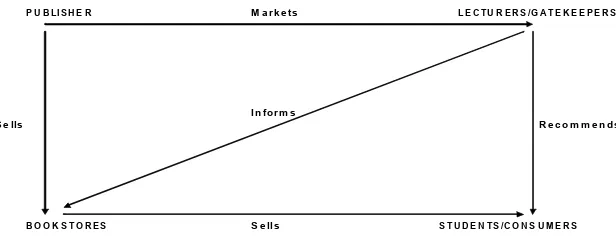
(2004) provide a number of insights which are relevant to the present research; in particular, their study noted the signiicance of marketing activity in terms of content development. For example, Ferguson et al. (2004) describe how the publishing editor would consult course outlines or have proposed manuscripts reviewed by academics in order make a more informed decision regarding the material to be included in a text.
In terms of constraints on the publishing process, both publishers in Ferguson et al.’s (2004) study alluded to the impact of the Research Assessment Exercise (RAE). In particular, it was suggested that the RAE was making it diicult for publishers to ind good authors, since most university departments ‘frowned’ upon their lecturers spending their time on an activity that would not gain the department any direct RAE beneit. In this respect, publishers were inding it diicult to recruit authors with the ‘best reputations’ (Ferguson, et al., 2004, p.22; see also, Cottingham and Hussey, 2000). One may infer that, as a result of not recruiting the best authors, the publishers become much more involved in the content development of textbooks themselves.
The content of accounting textbooks
explicitly consider the values implicit in accounting textbooks. his section provides an overview of such studies, and considers how indings from this body of research may inform the present work.
As part of a wider project concerning the development of management accounting over the twenty year period prior to their study, Scapens et al. (1984) examined the ‘conventional wisdom’ taught to management accounting students through the use of textbooks. Twenty four management accounting and cost accounting textbooks were analysed with the aim of identifying similarities in content. he contents of the textbooks were summarised under ive main headings; planning, cost classiications, control, costing and divisionalised organisations. Scapens et al. (1984) concluded that the core material of management accounting textbooks had not substantially changed in the period covered by the study (p.21). But, of particular relevance to the present research, was their observation that the decisionmaking models in all of the textbooks analysed were underpinned by a neoclassical economic framework. Moreover, they found that the assumptions behind these models implied ‘that the decision maker is either the owner or shares the owner’s goals’ and is a proit maximiser (Scapens et al., 1984, p.34).
In replicating the Scapens et al. (1984) study, Kelly and Pratt (1988) examined the criticisms of management theory and practice in management accounting. heir purpose was to:
…survey conventional wisdom as presented to students of business through current textbooks [and to] identify areas where the wisdom is now suspect and potentially damaging (p.2).
were analysed using a classiication adapted from the one used by Scapens
et al. (1984).
Kelly and Pratt concluded that the perceptions of management accounting that were presented in popular management accounting texts were often over simpliied and incomplete. hey also found that the content of these texts did not equip graduates to tackle management accounting problems within a realworld situation. he authors argued that most of the textbooks which they examined for their study closely followed the format and content of previous textbooks which resulted in ‘monotonous homogeneity’. In particular, they claimed that examples used in the textbook tended to focus on large multinationals rather than introducing students to a wider range of organisations such as small businesses and service organisations. One reason noted for this ‘monotonous homogeneity’ in management accounting textbooks was that academics did not challenge ‘conventional wisdom which they, actively or passively, [helped] to perpetuate to undergraduates’ through use of the textbooks (Kelly and Pratt, 1988, p. 20).
altogether and tended to be ofered on ‘more specialised further courses’ in the latter years of a degree programme (Kelly and Pratt, 1994, p. 317; see also Gray et al., 1994; Humphrey et al., 1996). In his ield study analysis of professional accounting education, Power (1991, p.347) notes that, despite the calls by professional bodies to include ethical issues in accounting curricula, students often view this as ‘unwelcomed’ or ‘wale’.
Kelly and Pratt’s (1994) survey identiied Horngren’s (1991) Cost
Accounting: A Managerial Emphasis as the most widely used introductory
management accounting text on New Zealand degree programmes. his text was then analysed to identify what changes were made over its various editions, and to speculate on possible reasons for these changes. Only seven chapters in the seventh edition (1991) were identiied that did not have a corresponding chapter in the irst edition of this book which was published in 1962: they concluded, following a comparative analysis with other popular management accounting textbooks, that textbook authors were reluctant to change the content of their textbooks, and consequently, management accounting textbooks were fairly homogenous.
In their concluding remarks, Kelly and Pratt (1994) suggested that the accounting profession has had a negative inluence on textbook development (Humphrey et al., 1996; Gray et al., 1994; Green and Everett, 2003). Furthermore, the paper also pointed to a general absence within management accounting textbooks of any explicit discussion of the traditional framework or paradigm that underpins the text. hey argued that a fundamental ‘shift’ is needed in order to accommodate increasing developments in organisations and greater diversity among management accounting as a practice. hey also noted that there is an ‘urgent need’ for textbooks which make explicit the underlying values of accounting.
the ‘economic consequences’ of applying an accounting standard. In this context, Zef (1988) was suggesting that the ‘economic consequences issues’ of selfinterested lobbying activity during the standard setting process should be highlighted; in particular, the motivations of this activity should be discussed in textbooks. Zef found that only about 50 per cent of the textbooks examined contained a minimum level of discussion about the ‘economic consequences issues’ associated with the three topical issues he examined. Zef’s (1988) conclusion that the historical and social developments of accounting standards are not alluded to within accounting textbooks, suggests at least one way in which students may be prevented from ‘acquiring a full appreciation of how change occurs in their ield’ (Zef, 1988, p.434; see also Zef, 1989).
Out of a concern that ‘the social efect of mainstream accounting is to reproduce the statusquo of imbalanced wealth and power structures’, Cuganesan et al. (1997) explored the ‘enabling possibilities’ of accounting education. In particular, their study analysed the content of a popular management accounting textbook, Horngren, Foster and Datar’s (1994) Cost Accounting: A Managerial Emphasis (8th edition), in order to illustrate:
…the subtle ways in which ‘mainstream’ management accounting textbooks exclude an awareness of the partisan nature of accounting and discourages a questioning of its social and organizational
efects. (Cuganesan et al., 1997, p.432)
of 21 introductory inancial accounting, management accounting and inancial management textbooks as recommended by the 11 accounting degree awarding institutions in Scotland (Ferguson et al., 2005).
he analysis of recommended textbooks indicated that the interests of shareholders were predominant within inancial accounting and inancial management textbooks, while management accounting texts had a more pronounced managerial orientation. In this respect, Ferguson
et al. (2005) provided further support to claims made in prior studies that
the primary ethical perspective conveyed to accounting students is that of inancial utilitarianism (see Gray et al., 1994; McPhail, 1996; McPhail and Gray, 1996). Based on the results of the content analysis, Ferguson
et al. (2005) suggested that students were being deprived of a broader
insight into the study of accounting that could be provided through a consideration of other ethical perspectives. In addition, Ferguson et al.
(2005) claimed that a shareholder emphasis in accounting textbooks, together with a lack of critical discussion, might serve to reinforce an uncritical approach to learning which, in turn helped to maintain the incontestability of the ideological statusquo (Collison, 2003; Gray et al., 1994; Humphrey et al., 1996; Kelly and Pratt, 1992; 1994; Lewis
et al., 1992; McPhail, 1996, 1999; McPhail and Gray, 1996; Puxty et
al., 1994).
Professional education
et al. (2007, p.5) undertake a ‘qualitative review’ of books recommended for ‘professional education, including those speciically written by the profession themselves’. As Sikka et al. (2007, p.9) point out:
...recommended books provide authoritative texts, ideas, worldviews and conceptual maps for organising and understanding the world.
heir analysis examined the inancial accounting, management accounting and auditing books which appear on the reading lists published by some of the major UK accountancy bodies; this was supplemented by the reading lists of a number of universities and private institutions that specialise in professional education, including ACCA, CIMA and CIPFA. In total, 19 inancial accounting, nine auditing and 14 management accounting textbooks were subject to analysis. In their review, Sikka et al. (2007, p.10) note that the recommended texts:
...contain virtually no discussion of ethics, morality, notions of public interest, social conlict or social responsibility...
and maintain that authors of introductory texts ‘shy away’ from introducing critical perspectives:
…in the belief that aspiring students need to learn the techniques irst and that somehow later on they will learn to critique the same… the advanced textbooks ofer little comfort [that this does occur].
...lurking in the background, and in many ways, form the heart of the texts, but are not really critiqued.
In their conclusions, Sikka et al. (2007) ask how students are supposed to gain the skills and values such as critical thinking and ethical awareness that the profession claims to want, when these issues are largely absent from, or not suiciently addressed, in the educational material which students encounter.
Even though the majority of accounting studies relating to aspects of textbook content are concerned speciically with management accounting textbooks (Cuganesan et al., 1997; Kelly and Pratt, 1988; 1994; Scapens
et al., 1984), one of the predominant themes to emerge from this
literature is that accounting textbooks often do not acknowledge the framework or paradigm that underpin them. In particular, textbooks are often silent with regard to the interests that are served by business activity or accounting processes; in this respect, accounting textbooks have been criticised for uncritically propagating the view that the sectional interests of the shareholder should be maximised.
The use of accounting textbooks
Studies which consider the use of textbooks are limited, covering a number of diferent issues; for example, the use of textbooks in relation to other teaching methods (Brown and Guilding, 1993), how lecturers use textbooks (Ferguson et al., 2007), how and where students read textbooks (Phillips and Phillips, 2006), and the ‘critical’ reading of accounting textbooks (Manninen, 1997). Given the diference in focus between these studies, a brief synopsis of each will be outlined and a critical assessment of their relevance to the present research project presented.
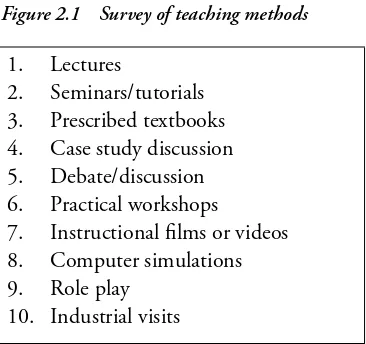
used by accounting and nonaccounting faculties (see Figure 2.1). he indings indicate that for both accounting and nonaccounting schools, the top three teaching methods employed were: lectures; seminars/ tutorials; and prescribed textbooks respectively. However, it was noted that accounting departments placed considerably more emphasis on both lectures and prescribed textbooks than their nonaccounting contemporaries. According to Brown and Guilding (1993, p.211) this was because:
...accounting focuses on widely accepted practices, then much of the teaching can be achieved through textbooks and prescriptive lectures.
adding that if attempts are made...
...to develop analytical and professional judgement skills…then diferent teaching methods are needed.
Figure 2.1 Survey of teaching methods
1. Lectures
2. Seminars/tutorials 3. Prescribed textbooks 4. Case study discussion 5. Debate/discussion 6. Practical workshops
7. Instructional ilms or videos 8. Computer simulations 9. Role play
10. Industrial visits
Adapted from Brown and Guilding (1993)
Phillips and Phillips (2006) argue that, despite the emphasis which institutions place on textbooks in introductory accounting courses, there is little research that actually describes how students interact with textbooks. heir study reports on the accounts of 172 undergraduate students regarding ‘their experiences with 13 chapters of an introductory inancial accounting textbook’ (Phillips and Phillips, 2006, p.2). he purpose of their research was to determine whether students reading behaviours are likely to prevent textbooks from achieving their intended goals.
he results indicated that students used the textbook in a variety of settings: ‘only 15 per cent of students read the textbook in the library as opposed to 78 per cent who read at home’ (Phillips and Phillips, 2006, p.10). Students who read the textbook outside the library stated that they read:
…while watching TV, babysitting, working at a job, working out, visiting friends and family, waiting at a hair salon, travelling in a
car, attending church, or sitting in another class. (p.10)
In addition, various distractions to reading were noted by students, including illness, hangovers, relationship problems, with the biggest barrier being a heavy workload in other courses.
Two reading strategies were typically employed by students – ‘sinking’ or ‘skimming’. Sinking entailed carefully reading the textbook, taking notes and highlighting important topics so that the information content would ‘sink in’. Skimming involved reading quickly over a chapter and often skipping the learning objectives, just to get through the assigned reading. Phillips and Phillips (2006, p.12) reported that students’ approaches to reading the recommended textbook had a bearing on their course performance; for example:
Of those who read the learning objectives, 39 per cent were in the top quartile and 27 per cent were in the second quartile. In contrast, most students who skipped the learning objectives were in the third and fourth quartiles (30 per cent and 33 per cent respectively).
students skipped the selfstudy questions while 68 per cent omitted the end of chapter problembased questions.
In their conclusions, Phillips and Phillips (2006) discuss the merits of talking to students about the sinking versus skimming approaches to reading in an attempt to encourage good reading habits. hey cautioned that:
here is no need to scare students by emphasizing how diicult the material is in an attempt to spur students to put more efort into reading… students already fear the textbook and expect topics to be confusing (p.20).
Business and management textbooks
here have been very few studies into the use or content of business and management textbooks. A notable exception to this generalization includes Cameron et al. (2003a). In a special edition of he Journal of
Management Education, four prominent textbook authors were asked to
consider whether their texts were ‘propaganda’ or relected a particular ideology (Cameron et al., 2003a). Each author’s response to this question indicated that there was a general awareness that their textbooks relected a particular ideology; indeed there was a perception that it was thought desirable for textbook authors to promote a particular ideology, particularly if this was based on scholarly research.