Investigating five key predictive text entry
with combined distance and keystroke
modelling
Mark D. Dunlop and Michelle Montgomery Masters
Computer and Information Sciences University of Strathclyde,
Richmond St, Glasgow G1 1XH, Scotland
Abstract This paper investigates text entry on mobile devices using only five-key. Primarily to support text entry on smaller devices than mobile phones, this method can also be used to maximise screen space on mobile phones. Reported combined Fitt's law and keystroke modelling predicts similar performance with bigram prediction using a five-key keypad as currently achieved on standard mobile phones using unigram prediction. User studies reported here show similar user performance on five-key pads as found elsewhere for novice nine-key pad users.
Keywords: predictive text entry user modelling
Introduction
Text entry is vitally important to many applications that are becoming common on
mobile devices, for example text messaging, instant messaging and email. The
industry has reacted to this requirement by providing devices based around either
full or half-qwerty keyboards to improve text entry (see figure 1). However, these
devices either have to compromise the overall size of the device or the screen size
in order to make space for the larger keypads. In parallel, increased data services
and the movement of traditional PDA functionality onto phones, puts pressure on
devices to have larger screens at a time when retail markets still show strong
pressure for smaller overall device sizes. This paper aims to address these
Figure 1: Palm QWERTY and Blackberry half-QWERTY keypads
Text entry methods for mobile phones
Most mobile phones still adhere to the ISO standard 9-key layout for core text
entry (see figure 2) with letters spread over eight keys plus a space key. This
results in an ambiguity problem: for example if the user types 2, the phone does
not know if she wishes an A, B, or C. Traditionally the user manually
disambiguated each keystroke using the multitap standard, users pressed keys
multiple times to achieve the letter they wished (e.g. pressing 2 would give A, 22
B, 222 C, with a timeout or escape key used to separate subsequent letters on the
same key). This is a slow and error prone form of disambiguation (e.g. [1, 2]),
often due to the delay around subsequent letters on the same key or missed triple
clicks on poor quality keypads. Predictive text entry methods attempt to provide
faster text entry by reducing the disambiguation to a word-by-word basis: the user
only presses one key per letter then selects from possible matching words after
each word. To reduce the effort of disambiguation further, words are presented in
decreasing likelihood of being the correct word. There are many techniques for
estimating these likelihoods with the most common being to present words that
match the ambiguous key sequence in decreasing order of frequency of use in the
expected language. This frequency-based approach, also known as unigram
approach, is implemented in most standard format mobile phones using
technology such as Tegic's T9 [3, 4].
Figure 2: Nokia 5110 ISO standard 9-key keypad
Primarily to support text entry on smaller devices than mobile phones, some
work has been conducted on text entry for smaller keypads using approaches such
as the date-stamp method (where users use either three-way or five-way joystick
to enter text on a letter by letter basis). Bellman and MacKenzie [5] investigated
dynamic rearrangements of the letters to reduce the distance from the start point
based on probabilistic modelling of the most likely next character, unfortunately
average entry speed of about 10wpm, rising to about 15wpm at best. Dunlop [6]
reported some initial work on text entry on a five-key pad using a watch-like
interface. This work used a variation of predictive text entry using only four soft
keys for letters plus a combined space/next key. This paper builds on that work to
investigate 5-key text entry on small physical keyboards that can be used to
optimize screen-space on a phone format device.
An alternative is the growing move away from physical keypads to
touch-screens, which are more common on PDAs. MacKenzie et al. [7] compared the
three most common input techniques for stylus based text entry on touch screen
devices: small on-touch-screen keyboards either in QWERTY or alphabetic layout
and hand-printing of letters. Their results showed that a standard QWERTY
layout can achieve around 23wpm while hand-printing achieved only 17wpm (and
alphabetic soft-keyboard only 13wpm). While the on-screen QWERTY pad
achieves decent text entry rates, it has been shown that users can achieve similar
rates using standard 9-key pads [2] while not requiring users to use a stylus to
operate the device.
Evaluation of mobile text entry
The evaluation of new text entry devices is complex: users take considerable time
to reach expert user performance and the nature of the devices makes prototyping
difficult. One solution is to use model-based evaluation techniques early in the
design to predict performance and complement successful approaches with
usability studies later in the process. There are two main schools of interaction
modelling for text entry on mobile devices: movement modelling based around
Fitt's law [8] for time to press buttons and keystroke modelling of the user action
sequence [9]. Both have their advantages and a combined model is used here to
investigate five key text entry.
Structure of this paper
The paper first discusses our proposed design for text entry using five-keys. We
then present performance analysis of how well a text-entry engine can
disambiguate five-key input compared to nine-key input. These disambiguation
predicted user performance between five-key and nine-key ambiguous text entry.
We introduce a combined model of performance estimation based on keystroke
modelling with key timing information from Fitt's law derived movement models
and use this model to revise our predictions. Finally, we report on a set of user
trials of a prototype five-key system to investigate novice user performance.
Design
The two main motivations behind the development of a five-key text entry method
for mobile devices are to (a) reduce the space used on devices by the keypad, both
on current phones to increase screen space and on other smaller devices to permit
text entry, and (b) to potentially increase speed by reducing finger movement. Our
design is based around a five-key ambiguous keypad with four alphabetic keys
and a combined space/next key, and is similar to that developed for watch-top
touch screens [6]. Users press one key per letter to enter a word followed by space
– the first press of the space key after a word inserts a space (highlighted as _ on
the interface) with subsequent presses of the space key rotating round matching
suggestions (in a similar fashion to the next key on many T9 phones). To aid users
a small area of the screen is used to give a guide to which letters are on which
keys, using visual clues to guide text entry [10] this area dims letters that are not
possible given the letters already entered (thus helping users to spot letters they
are looking for).
Figure 3 shows a paper prototype of the ideal implementation of our
interface on a phone size device: five entry keys above two soft-keys and arranged
around a 5-way joystick at the top of a phone with a large screen (using top
section of screen for key-guide while entering text). This shows how the new
interface can be used to maximise screen space, giving a screen area of
Figure 3: paper prototype of ideal 5-key text phone
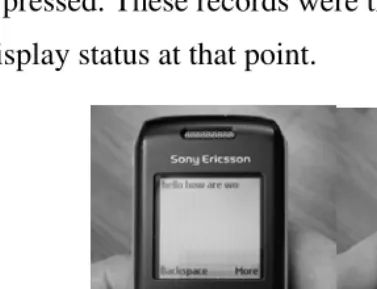
Figure 4 shows the current J2ME prototype implementation as used in user
experiments discussed later. This prototype uses only the top part of a nine-key
traditional phone pad with quarter of the alphabet allocated to each of buttons 1,
4, 3 and 6 with 2 acting as combined space/next key. Figure 4 shows the prototype
interface for a user entering the phrase "hello how are you" – note the lower-right
(6) button on the key-guide showing that only u is valid as the next letter on that
key.
[image:5.595.116.345.350.496.2]
Figure 4: current implementation
While the experiments reported here focus only on alphabetic text entry, we
envisage the on-screen display being used to support modal entry of punctuation
and numbers (chords could be used for common punctuation, e.g. bottom two
keys for a period, while a joystick controlled keyboard could be used for
out-of-dictionary word entry and for numeric entry). One of our design aims was to
maintain the joystick and soft-keys for editing and application control as normal
but these could be used in conjunction with text entry keys as modifiers.
With ambiguous keypads the layout of keys affects the performance of the
common words such as on, in and an would all have the same key sequence.
Attempts at optimised keypads (e.g. [6, 11]) have, however, shown only a
marginal increase in theoretical performance over alphabetic arrangement of keys
and much slower user input due to time spent searching for letters on, to a user’s
viewpoint, randomly located keys. Thus, the experiments reported here have all
been conducted with an alphabetic arrangement of keys shown in figure 4. This is
actually slightly sub-optimal compared to the best alphabetically constrained key
arrangement, which is collection dependent [11]. We estimate that the results
reported below would be marginally affected by changes to optimal alphabetic
keyboards and improved by around 2% for fully unconstrained optimised
keyboard layout.
Performance analysis
Standard predictive text entry models (including Tegic's T9 and Dunlop &
Crossan's [1]) are based on unigram models of prediction: words are suggested
based purely on frequency of occurrence information for words that match the
number sequence entered. With predictive text on a standard 9-key pad, on
entering 4663 a user is presented with words that can be composed from GHI as
the first letter followed by MNO and MNO then DEF – these are typically
presented in descending order of frequency in English usage as expected on a
mobile phone. For example a standard T9 enabled phone will suggest good, home,
gone, hood, hoof etc. More advanced models can adjust predictions to make them
more likely to be correct, in particular bigram models [12, 13] bias predictions
based on the previous word – so that ranking is based on frequency of occurrences
of word wn following word wm, for example home would be more likely than good
after the word at. To assess the likely impact of reducing the number of keys from
nine to five, we calculated best case unigram and bigram predictions using two
corpora: a sub-set of The Herald collection used in Dunlop & Crossan [1] and the
Singapore SMS corpus [14]. To simplify analysis and focus on core text-entry
speeds, both collections were pre-processed to leave only alphabetic characters
separated by spaces and newlines.
In both cases the average ranked-list position (ARP) was calculated by
averaging the position of the expected word in suggested ranked list given the
ambiguous key-coding of the expected word. An ARP value of 1.0 would indicate
that the required word was always in the first position in the ranked list of
suggestions, a value of 2.0 that on average the required word was second in the
ranked list. This approach to averaging naturally biases the averaging process so
that words are taken into account proportionally to their occurrence in the text
collection. For unigram prediction all words were ranked in decreasing frequency
for each key combination, for bigram the same ranking was used but based solely
on frequency of the word occurring after the previous word in the sentence. As an
example, given the phrase "are you home" in the text collection the word home is
converted to its numeric equivalent (4663). A ranked list is calculated to predict
suggestions for 4663 with the position of home in that list taken as the ranked-list
position for that word (position 2 in the case of T9’s standard offer list). The
suggestions for 4663 are based on the frequency of all words matching 4663 for
the unigram model while the bigram model bases the suggestions on frequencies
of words occurring after you. This approach gives a good approximation to the
performance expected in-use once a prediction engine is tuned to the language.
However, this approach to modelling avoids two common problems with
predictive text entry: out of dictionary words for both approaches and sparse
frequency information for bigram models. Predictive text-entry models can only
predict known words and alternative input techniques are required for
out-of-dictionary words, which are normally stored in the user out-of-dictionary – so need only
be entered once per device. Bigram models rely on knowing considerable
statistical information about words – for rare words some combinations may
simply not have been seen before, even though the individual words have. There
has been considerable work (e.g. [15, 16]) on adjusting bigram models to,
essentially, degrade gently to unigram models when either there is no bigram
statistics for the word-code combination or the confidence of those statistics is
low. Experiments reported here use a simple bigram model, as the training method
ensures usable statistics.
The literature commonly uses three different methods for reporting the
performance of text entry methods. Above we have used average ranked list
per character (KSPC). Disambiguation accuracy (e.g. [11]) reports the percentage
of times the first word suggested by the disambiguation engine is the word the
user intended – a DA value of 100% implies the disambiguation engine always
give the correct word first, while 50% indicates that it only manages to give the
correct word first half of the time. This is an intuitive and very direct measure but
does not take into account the performance of words that do not come first in the
list. KSPC (e.g. [6]) reports the average number of keystrokes required to enter a
character, for example home on a standard T9 mobile phone requires 5 keystrokes
– 4663*, where * is the next suggestion key, giving a KSPC for that word of
5/4=1.25. A KSPC value of 1.0 indicates perfect disambiguation as the user never
needs to type any additional letters, while a higher figure reflects the proportional
need for the next key in disambiguation. KSPC does take into account ranked list
position for all words and compares well with non-predictive models, however it
is a rather abstract measure being based on letters for inherently word-based
methods. Given a standard word length of 5 letters per word (including space),
ARP = KSPCx5-4. All methods are normally averaged over a large corpus.
Based on the first million lines of The Herald collection (9 141 467 words
with average of 4.73 letters per word excluding space), table 1 shows the ARP,
DA and KSPC values for unigram and bigram prediction on both five-key and
nine-key keypads. This shows that (a) nine-key text disambiguation is
considerably more accurate that five-key; (b) that disambiguation is considerably
more accurate with bigram modelling and (c) that bigram modelling improves
five-key entry proportionally more than nine-key entry.
Herald Collection
5-key 9-key
unigram 1.554 ARP
80% DA
1.097 KSPC
1.058 ARP
96% DA
1.010 KSPC
bigram 1.148 ARP
92% DA
1.026 KSPC
1.017 ARP
99% DA
[image:8.595.118.340.516.686.2]1.003 KSPC
Table 2 shows the same experiment and results pattern for the Singapore
SMS corpus [14] (121 126 words with an average 3.49 letters per word ex-space).
SMS Collection
5-key 9-key
unigram
1.832 ARP
66% DA
1.185 KSPC
1.135 ARP
90% DA
1.030 KSPC
bigram
1.199 ARP
87% DA
1.044 KSPC
1.028 ARP
98% DA
[image:9.595.118.340.92.261.2]1.006 KSPC
Table 2: average ranked list position of required word in Singapore SMS collection For comparison: full-sized non-ambiguous keyboards achieve KSPC=1.00,
standard date-stamp method for entering text on 3 keys achieves KSPC=6.45,
date-stamp like interaction on 5 keys achieves KSPC=3.13 and multitap on a
standard 9-key mobile phone achieves KSPC=2.03 [17]. Gong and Tarasewich
[11] reported DA for 5-key and 9-key at 85% and 97% respectively for written
English corpus and 69% and 92% for SMS messages. Hasselgren et al. [12] used
bigram modelling with word completion, where words were suggested before the
user had finished entering them (leading to sub-1.0 KSPC figures [17]). Their
results report KSPC of 1.01 and 1.08 for T9 using Swedish news and SMS
corpora respectively, improving to 1.01 and 0.88 respectively for their bigram
model with word completion suggestions. As a comparison for Hallegran et al.'s
work, unigram word completion has been estimated to reduce KSPC by around
25% for a 9-key keypad (but to lead to potential cognitive load problems) [1].
Keystroke level modelling (KLM)
To gain an insight into potential expert user behaviour with different keyboards,
different approaches have been taken to modelling interaction in order to predict
expert (trained, error-free) performance. Dunlop and Crossan [1] proposed a
model based on Card, Moran and Newall's keystroke modelling [9]. The model is
based on predicting the time T(P) taken by an expert user to enter a given phrase
restrictions are clearly severe limitations on this modelling approach. However,
while more complex modelling approaches have been researched to support
novices, model more complete interaction and model error behaviour (e.g. [18,
19]), we believe that this relatively simple performance figure complements user
studies and is a reasonably accurate and worthwhile estimate of expected peak
performance of a text entry system.
The keystroke model is based on building an equation to represent the user
activity by summing a set of small time measurements, in the case of text entry
the appropriate times are: the homing time for the user to settle on the keyboard
Th; the time it takes a user to press a key Tk; and the time it takes the user to
mentally respond to a system action Tm. Dunlop and Crossan [1] modelled
predictive text entry on a sentence where disambiguation occurs as extra
characters representing moving down the ranked list of suggestions, their overall
time equation is as follows:
T(P) = Th + w (kwTk + l(Tm + Tk))
Equation 1: Dunlop and Crossan's KLM model
In equation 1, w represents the number of words in the phrase, kw is the
number of letters per word (renamed here from their kp) and l the ARP measure
(average position in the suggested word list of the correct word). In that paper the
calculation led to a predicted speed of 17.7 words per minute (wpm). Pavlovych
& Stuerzlinger [18] later modified the calculation by correcting double counting
of the first space key after a word by changing kw to 4.98, leading to a predicted
speed of 19.3 wpm1. Table 3 shows details of the calculation for both sets of data.
1
The figure of 19.3 wpm represents our revision of Dunlop and Crossan using Pavlovych and Stuerzlinger's
Dunlop &
Crossan
As revised by
Pavlovych &
Stuerzlinger
Th 0.4 0.4
w 10 10
kw 5.98 4.98
Tk 0.28 0.28
l 1.03 1.03
Tm 1.35 1.35
T10 33.9s 31.2s
[image:11.595.129.334.30.271.2]speed 17.7wpm 19.3wpm
Table 3: nine-key unigram prediction time and speed
James and Reischel [2] carried out focused user experiments on both novice
and experienced users of T9. They reported a measured T9 performance averaging
at 20.4 wpm for experts, within 10% of the keystroke level modelling prediction
from table 3. For comparison handwriting with ink and paper achieves around 20
to 30 words per minute while desktop typists can achieve in excess of 150 wpm,
though this drops considerably for non-secretary users and for composition rather
than transcription (e.g. Karat et al [20] found speeds of 33wpm transcription
dropping to 19wpm for composition).
Simple unigram and bigram modelling
Equation 1 has constant values for Th, w, Tk and Tm with other values being
dependent on the disambiguation engine and the text collection in use. Based on
the performance analysis reported above, table 4 shows the predicted
words-per-minute for unigram and bigram predictions using the two test collections, while
table 5 gives more details on the parameters of equation 1. This shows that
moving to bigram prediction improves performance by 2-6% for a nine-key
keypad and 20-34% for the five-key keypad. Furthermore, the improvement in
moving to bigram prediction brings the five-key keypad from around 26-40%
9-key
wpm
5-key
wpm
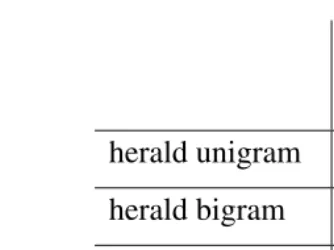
herald unigram 19.42 15.39
herald bigram 19.85 18.54
sms unigram 20.93 14.99
[image:12.595.147.314.31.156.2]sms bigram 22.28 20.19
Table 4: Summary KLM model predicted results
kw l T10 (s) wpm
unigram 4.73 1.058 30.89 19.42
9-key
Herald bigram 4.73 1.017 30.22 19.85
unigram 3.49 1.135 28.67 20.93
9-key
SMS bigram 3.49 1.028 26.93 22.28
unigram 4.73 1.554 38.97 15.39
5-key
Herald bigram 4.73 1.148 32.36 18.54
unigram 3.49 1.832 40.03 14.99
5-key
SMS bigram 3.49 1.199 29.72 20.19
Table 5: Variable KLM model parameters and predicted results
Adjusting model for variable keystroke times
Dunlop and Crossan modelled keystroke speed at 0.28s based on a fixed figure
from Card et al.'s figure of equivalent to "an average non-secretary typist" on a
full QWERTY keypad [9]. As supported by James and Reischel [2], equation 1
works well, however it cannot take into account one of the main motivations for
the five-key keypad: reduced finger movement decreasing the time taken to press
each key. Mackenzie's group have conducted considerable work on using Fitt's
law [8] for calculating the limit of performance given distance between keys and a
language model for the movement required between keys to enter text with a
given text entry scheme (e.g. [21]). In the basic form their modelling predicts
40.6 wpm for thumb-based T9 input assuming no next key operations, with 5
characters per word this equates to an average keying time of 0.30s (without
[image:12.595.29.433.202.386.2]Based on the same phone model used in their paper (a Nokia 5110, figure
4), we have examined the total time for entering a large block of text according to
their model using both nine-key and five-key keypads. Our results give a
weighted average time per key of 0.26s for the nine-key pad and 0.22s for the
five-key pad (the slight difference being due to corpus effects – the movement
models are derived from and conditional upon analysis of a large corpus of text).
Feeding these figures directly into equation 1 (replacing Tk as appropriate in table
5) gives the words per minute predictions in table 6.
9-key
wpm
5-key
wpm
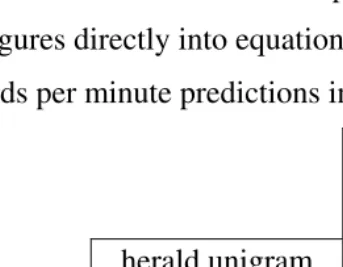
herald unigram 20.18 17.04
herald bigram 20.64 20.81
sms unigram 21.62 16.29
[image:13.595.145.317.191.325.2]sms bigram 23.05 22.30
Table 6:revised KLM models adjusting for distance calculations
Table 6 shows that the five-key keypad is predicted to perform roughly
equivalently to a nine-key keypad when bi-gram prediction is used and reduced
keying time is taken into account (1% better on The Herald collection, 3% slower
on the SMS collection). Furthermore, five-key performance with bigram
prediction is predicted to marginally out perform standard unigram prediction on
nine-key keypads for both test collections.
Improving these models
The distance model above, while taking into account some aspects of physical
keyboard layout, has two inaccuracies that can noticeably affect predictions:
repeat keys and parallel finger movements. Repeat keys, where subsequent letters
are on the same key, are not modelled correctly with Fitt's law, which tends to
underestimate zero distance movements. Soukoreff and MacKenzie [22]
conducted user experiments on a modified Fitt's law model that includes a
separate estimated time for repeat keys. The standard Fitt's law model also does
not take into account one of the main speed gains of touch typing: being able to
move fingers on one hand in preparation while still typing with the other hand.
entry where one thumb can be moving to the appropriate key in parallel with the
key press on the other thumb [23].
We recalculated our predictions based on modelling both repeat-key timing
and two-thumbed parallel movements. Again we simplified the models from the
distance papers by using them simply to estimate the average key-stroking times
for our KLM modelling. Assuming users are using two-thumbs to enter text, our
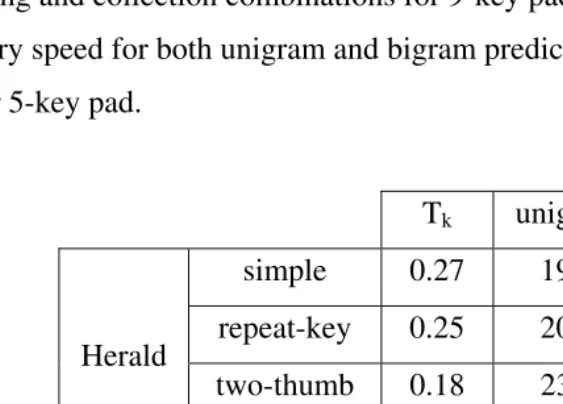
initial modelling gave key times of 0.27s for The Herald collection with a 9-key
keypad and 0.25s for the SMS collection, reducing to 0.23s and 0.22s respectively
on the 5-key keypad. Table 7 shows the key stroke time for the different
modelling and collection combinations for 9-key pad and the resulting predicted
text entry speed for both unigram and bigram prediction. Table 8 shows the same
data for 5-key pad.
Tk unigram bigram
simple 0.27 19.9 20.4
repeat-key 0.25 20.9 21.4
two-thumb 0.18 23.8 24.4
Herald
both 0.17 24.1 24.7
simple 0.25 22.0 23.4
repeat-key 0.24 22.9 24.5
two-thumb 0.18 25.0 26.9
SMS
[image:14.595.91.373.293.495.2]both 0.17 25.2 27.1
Tk unigram bigram
simple 0.23 16.7 20.4
repeat-key 0.22 17.3 21.1
two-thumb 0.16 19.1 23.7
Herald
complex 0.15 19.0 23.7
simple 0.22 16.3 22.3
repeat-key 0.21 16.7 23.0
two-thumb 0.15 18.0 25.2
SMS
[image:15.595.94.369.30.231.2]complex 0.15 17.8 25.0
Table 8: Predicted words-per-minute for 5-key pad using different prediction models These tables show that, averaged over the two collections, our initial simple
predictions show a drop of around 21% in words per minute when moving from a
9-key to a 5-key keypad using simple unigram word prediction. This difference
drops to only 3% when using bigram prediction, with simple Fitt's law modelling
of keystroke times. When we take into account increased times for repeat-keys
and reduced times when swapping thumbs the predicted performance drop for the
5-key keypad increases to 6% when comparing bigram prediction on 5-key and
9-key pads. However, bigram prediction on 5-9-key pads is still only 2% slower
overall than unigram prediction on 9-key pads, showing predicted 5-key
performance roughly in-line with the prevalent current mobile phone text entry
approach.
User trials
Keystroke level modelling is useful for predicting expert user performance but is
focussed on expert error-free performance and gives little feedback on how new
users find a technology to use. To address this we conducted a controlled usability
experiment with users entering text phrases in a controlled setting.
Experimental Equipment and Users
A set of sentences were collected from members of the department who regularly
send text messages. They were asked to write some messages that were in the
any SMS shorthand (e.g. ur converted to your), remove punctuation marks,
convert numbers into their written form (e.g. replacing 8 with eight) and remove
capitalisation. Although not natural these edits were consistent between test
interfaces, more closely match the earlier technical studies and can be justified as
gaining an insight into peak text entry rates that are not affected by modal
changes. The final 20 sentences were randomly shuffled to give the trial test
phrases.
Twenty staff and students of the Computer and Information Sciences
Department at University of Strathclyde took part in the experiment (ages ranged
from 24-45, 6 female/14 male, 2 dominent-left-handed/18 right). Fifteen of these
users considered themselves to be regular senders of text messages, four rarely
sent messages and one user had never sent a text message. Fourteen of the
subjects regularly used T9 prediction when messaging.
Experiments were all conducted on a Sony Ericsson K300i handset running
a dedicated J2ME editor that was identical for both 5-key and 9-key text entry bar
the provision of an on-screen guide to key-mapping for 5-key entry (as shown in
Figure 4 and 5). Although not the ideal format for 5-key entry, we felt this was the
best experimental compromise between appropriateness and consistency. Both
versions of the text engine used the same small dictionary with a unigram
prediction model.
Experimental Process
The participants were asked to complete a short pre-experiment questionnaire on
demographic information and text message usage. The participants were then
given a demonstration of our application and our approach to nine-key text entry.
To recap, our approach differed from standard T9 in use of the space key to
double as next key. It also varied from some handsets in that only 0 and # were
supported as space keys (unfortunately ruling out the normal 1 key for users of
certain brands of handsets).
After the demonstration participants were asked to enter 10 sentences using
the nine-key layout on the mobile phone handset.
The participants were then given a demonstration of the five-key layout and
Finally, the participants were then asked to complete a feedback form to
indicate their preference between the keypads and give any comments on either
keypad layout.
Using a GPRS data connection, key-strokes were recorded each time the
space key was pressed. These records were time stamped in tenths of a second and
[image:17.595.136.325.157.302.2]recorded the display status at that point.
Figure 5: five-key and nine-key prototypes as used in user study
Results
The results shown in figure 6 summarise the average text entry rate for users over
the last eight phrases (the first two are excluded to allow users to settle in with the
device and technique).
0 5 10 15 20 25 30
1 2 3 4 5 6 7 8
Task Order
WP
M
T9 MM5
Figure 6: user-averaged text entry speed over last eight phrases
The results show that, averaged over all users and tasks, nine-key entry was
approximately 21wpm while five-key is around 12wpm. James and Reischel [2]
[image:17.595.120.340.451.619.2]depending on experience – in line with our studies, given our profile of users and
slight differences in prior experience. Furthermore our result for novice five-key
users is in line with their novice nine-key user speed of around 11 wpm. The
results also show a clear positive trend for 5-key usage compared to a steady
performance for 9-key entry.
In discussion with the users several participants stated that they could see
the benefit of having fewer keys to allow devices to be made smaller. Many found
that the key-guide for 5-key entry acted as an effective spelling guide since letters
were greyed out that would not create a possible word in the dictionary, although
some mentioned that they felt locked in by this spelling assistance. Furthermore,
several participants found that this display made it was easier to resume text entry
after a distraction – an aspect of the outcomes we are investigating further. Many
reported that they felt any difficulties in using 5-key entry would reduce over time
since they were trying to break pre-programmed 9-key and T9 habits and that they
felt they were performing better towards the end of the experiment. Interestingly,
despite requiring more keystrokes in 5-key entry, several participants mentioned
that they felt they had to make fewer "clicks" when using 5-key entry. We can
only conclude that this impression was due to less key-searching and/or finger
movement. Finally, some subjects mentioned that they did not like looking at the
screen. Continuous focus on the screen is an intended benefit of 5-key entry and
we feel the likely cause of this reaction was the use of the 9-key pad for
experiments, where users are used to checking the labels on keys.
Future work
Although often used while stationary, designing for mobile users puts new
challenges on the design on interfaces. [24] and [25] have studied the effect of
different sized on-screen buttons on walking speed and data-entry errors. The
five-key pad proposed here lends itself to reduced vision load compared to soft
keypads or printing, with physical keys rather than screen areas and expert users
only needing to check each word instead of each letter. However, this checking
needs to be done more carefully than with a 9-key pad with the same prediction
engine. Studies are planned to investigate 5-key text entry for walkers to assess
We also plan to conduct a longitudinal study of five-key text entry using a
fuller prototype system that will support full text entry (including numbers,
punctuation and out of dictionary words).
Conclusions
This paper reported our investigation into predictive text entry using five keys.
This work was motivated by three desires: to reduce the space taken up by
keyboards on mobile phones, to extend predictive text entry to other formats of
mobile devices and to reduce finger movement distances in the hope of improving
text entry speed.
An investigation into purely technical performance of both unigram and
bigram predictive text entry showed that five-key text entry was considerably
poorer than nine-key for unigram modelling for both written English and SMS
corpora. However, the quality of predictions was considerably increased and the
difference between keypads reduced when bigram modelling was used.
These figures were then used as the basis for keystroke level modelling of
users entering text. Simple keystroke modelling with fixed keying times, showed
a speed reduction of around 21% for five-key text entry. These models were then
refined to take into account the reduced finger movement times for five-key text
entry using methods derived from Fitt's law, this resulted in new predictions that
five-key text entry would be within approximately 6% of the performance of
nine-key when both are using bigram modelling. Furthermore, five-nine-key text entry using
bi-gram modelling was predicted to perform very close to the level of standard
nine-key unigram modelling.
Finally, users trials were conducted to gain an impression of non-experts
usage of five-key text entry. Using a prototype system on a mobile phone handset
with unigram prediction, users achieved approximately 12 words-per-minute
using five-key entry and 21 words-per-minute for nine-key. While much slower
on five-keys, these figures are in line with, respectively, novice and expert speeds
reported elsewhere for 9-key pads.
Through our combined keystroke and Fitt's law modelling we have
predicted that five-key text entry using bigram word prediction will perform
user trials have shown similar user performance using five-key to novice nine-key
users in other trials. Combined, while not achieving one of our aims of faster text
entry, we believe that these results show that five-key keypads can be used as a
replacement for current nine-key text entry without noticeable loss of text entry
speed.
Acknowledgements: Once again we extend our gratitude to our users in our user trials.
References
1. Dunlop, M.D. an d A. Crossan, Predictiv e text en try m ethods for m obile phones. Person al Techn ologies, 20 0 0 . 4(2).
2. J am es, C.L. an d K.M. Reischel, Text in put for m obile dev ices: com parin g m odel
prediction to actual perform an ce, in SIGCH I conferen ce on H um an factors in com putin g
sy stem s. 20 0 1, ACM Press: Seattle, Washin gton , Un ited States.
3. Grover, D.L., M.T. Kin g, an d C.A. Kushler, R educed key board disam biguatin g com puter I. Tegic Com m un ication s, Editor. 1998 : USA.
4. Kushler, C., AAC Usin g a R educed Key board, in echnology and Persons w ith Disabilities
Con feren ce. 1998 : USA.
5. Bellm an , T. an d I.S. MacKen zie, A probabilistic character lay out strategy for m obile text
entry, in Graphics In terface '98. 1998 , Can adian In form ation Processin g Society: Toron to,
Can ada. p. 168 -176.
6. Dun lop, M.D., W atch-Top Text-En try : Can Phone-Sty le Predictiv e Text-En try W ork W ith
On ly 5 Button s?, in 6th International Conference on H um an Com puter In teraction w ith
M obile Dev ices an d Serv ices: M obileH CI 0 4, S.A. Brewster an d M.D. Dun lop, Editors.
20 0 4, Sprin ger Lecture Notes in Com puter Scien ce: Glasgow.
7. MacKen zie, I.S., et al., A com parison of three m ethods of character en try on pen -based
com puters, in Factors an d Ergon om ics Society 38 th An n ual M eetin g. 1994: San ta
Mon ica, USA. p. 330 -334.
8 . Fitts, P.M., The in form ation capacity of the hum an m otor sy stem in controlling the
am plitude of m ov em en t. J ourn al of Experim en tal Psychology, 1954. 4 7(6): p. 38 1-391.
9. Card, S.K., T.P. Moran , an d A. Newell, The key stroke-lev el m odel for user
perform an cetim e w ith in teractiv e sy stem s. Com m un ication s of the ACM 198 0 . 2 3(7): p.
396-410 .
10 . Magn ien , L., J .L. Bouraoui, an d N. Vigouroux, M obile Text In put w ith Soft Key boards:
Optim ization by M eans of Visual Clues, in 6th In tern ation al Sy m posium on M obile
H um an -Com puter In teraction – M obileH CI 20 0 4 20 0 4, Sprin ger LNCS Volum e 3160 /
20 0 4 Glasgow, Scotlan d.
11. Gon g, J . an d P. Tarasewich, Alphabetically con strain ed key pad design s for text en try on
m obile dev ices, in CH I '0 5: SIGCH I Conference on H um an Factors in Com putin g Sy stem s
20 0 5: Portlan d, USA.
12. H asselgren , J ., et al., H M S: A Predictiv e Text En try M ethod Usin g Bigram s, in W orkshop on Lan guage M odelin g for Text En try M ethods, 10 th Con feren ce of the European
Chapter of the Association of Com putation al Lin guistics. 20 0 3: Budapest, H un gary. p.
43-49.
13. Klarlun d, N. an d M. Riley, W ord n -gram s for cluster key boards, in W orkshop on
Lan guage M odellin g for Text En try M ethods, 11th Con feren ce of the European Chapter of
the Association for Com putational Linguistics 20 0 3, 51-58 .
14. H ow, Y. an d M.-Y. Kan , Optim izin g predictiv e text en try for short m essage serv ice on
m obile phon es, in H um an Com puter In terfaces In tern ation al (H CII 0 5). 20 0 5: Las Vegas,
USA.
15. Witten , I.H . an d T.C. Bell, The zero-frequen cy problem : Estim ating the probabilities of
n ov el ev en ts in adaptiv e text com pression . IEEE Tran saction s on In form ation Theory,
1991. 3 7: p. 10 8 5-10 94.
16. Katz, S.M., Estim ation of probabilities from sparse data for the lan guage m odel
com pon en t of a speech recogn izer. IEEE Tran saction s on Acoustics, Speech an d Sign al
17. MacKen zie, I.S., KSPC (key strokes per character) as a characteristic of text en try
techn iques, in M obileH CI 0 2: Fourth In tern ation al Sy m posium on H um an -Com puter
In teraction w ith M obile Dev ices. 20 0 2, Sprin ger Berlin , Lecture Notes in Com puter
Scien ce: Pisa, Italy. p. 195-210 .
18 . Pavlovych, A. an d W. Stuerzlin ger, M odel for n on -expert text en try speed on 12-button
phone key pads, in CH I '0 4: SIGCH I Con feren ce on H um an Factors in Com putin g
Sy stem s. 20 0 4: Vien n a, Austria. p. 351-358 .
19. San dn es, F.E., Ev aluatin g m obile text en try strategies w ith fin ite state autom ata, in
M obileH CI 0 5: 7th in tern ation al Con feren ce on H um an Com puter in teraction w ith
M obile Dev ices an d Serv ices. 20 0 5: Salzburg, Austria.
20 . Karat, C., et al., Pattern s of En try an d Correction in Large Vocabulary Con tin uous Speech
R ecognition Sy stem s, in ACM CH I99: H um an Factors in Com putin g Sy stem s. 1999, 568
-575.
21. Silfverberg, M., I.S. MacKen zie, an d P. Korhon en , Predictin g text en try speed on m obile
phones, in SIGCH I Con feren ce on H um an Factors in Com puting Sy stem s (CH I'0 0 ). 20 0 0 ,
ACM Press: The H ague, The Netherlan ds.
22. Soukoreff, R.W. an d I.S. MacKen zie. Usin g Fitts' law to m odel key repeat tim e in text
en try m odels. in Graphics In terface 20 0 2. 20 0 2.
23. MacKen zie, I.S. an d R.W. Soukoreff, A m odel of tw o-thum b text en try, in Graphics
In terface 20 0 2. 20 0 2.
24. Brewster, S.A., Ov ercom in g the Lack of Screen Space on M obile Com puters. Person al an d Ubiquitous Com putin g, 20 0 2. 6(3): p. 18 8 -20 5.
25. Mizobuchi, S., M. Chign ell, an d D. Newton , M obile text en try : relation ship betw een
w alkin g speed an d text in put task difficulty, in M obileH CI 0 5: 7th in tern ation al
Con feren ce on H um an Com puter in teraction w ith M obile Dev ices and Serv ices 20 0 5: