City, University of London Institutional Repository
Citation
:
Vogiatzaki, K., Kronenburg, A., Navarro-Martinez, S. and Jones, W. P. (2011). Stochastic multiple mapping conditioning for a piloted, turbulent jet diffusion flame.Proceedings of the Combustion Institute, 33(1), pp. 1523-1531. doi: 10.1016/j.proci.2010.06.126
This is the accepted version of the paper.
This version of the publication may differ from the final published
version.
Permanent repository link:
http://openaccess.city.ac.uk/8105/Link to published version
:
http://dx.doi.org/10.1016/j.proci.2010.06.126Copyright and reuse:
City Research Online aims to make research
outputs of City, University of London available to a wider audience.
Copyright and Moral Rights remain with the author(s) and/or copyright
holders. URLs from City Research Online may be freely distributed and
linked to.
City Research Online: http://openaccess.city.ac.uk/ [email protected]
Elsevier Editorial System(tm) for Proceedings of the Combustion Institute Manuscript Draft
Manuscript Number:
Title: Stochastic Multiple Mapping Conditioning for a turbulent jet diffusion flame
Article Type: Research Paper
Keywords: turbulent combustion modelling, turbulent diffusion flames, reacting flows, multiple mapping conditioning
Corresponding Author: Dr. Andreas Kronenburg,
Corresponding Author's Institution: University of Stuttgart
First Author: Konstantina Vogiatzaki
Order of Authors: Konstantina Vogiatzaki; Andreas Kronenburg; Salvador Navarro-Martinez; William P Jones
Abstract: A stochastic implementation of the Multiple Mapping Conditioning (MMC) approach has been applied to a turbulent jet diffusion flame (Sandia Flame D). This implementation combines the
advantages of the basic concepts of a mapping closure methodology with a probability density approach. A single reference variable has been chosen. Its evolution is described by a Markov process and then mapped to the mixture fraction space. Scalar micro-mixing is modelled by a modified ``interaction by exchange with the mean'' (IEM) mixing model where the particles mix with their -in reference space- conditionally averaged means. The formulation of the closure leads to localness of mixing in mixture fraction space and consequently improved localness in composition space. Results for mixture fraction and reactive species are in good agreement with the experimental data. The MMC methodology allows for the introduction of an additional ``minor dissipation time scale'' that controls the fluctuations around the conditional mean. A sensitivity analysis based on the conditional
Stochastic Multiple Mapping Conditioning for
a piloted, turbulent jet diffusion flame
K. Vogiatzaki
a, A. Kronenburg
a,∗
, S. Navarro-Martinez
b,
W.P. Jones
baInstitut f¨ur Technische Verbrennung, University of Stuttgart, 70569 Stuttgart,
Germany
bDepartment of Mechanical Engineering, Imperial College London, SW7 2AZ,
U.K.
Colloquium: Turbulent Flames
Total length is 5741 words determined by method 2 for latex users
main text: 3359; references: 402 (method 1)
Figure 1: 462 (two column figure)
Figure 2: 165
Figure 3: 165
Figure 4: 418 (two column figure)
Figure 5: 418 (two column figure)
Figure 6: 176
Figure 7: 176
∗ Corresponding author: A. Kronenburg, Institut f¨ur Technische Verbrennung,
Uni-versity of Stuttgart, Herdweg 51, 70174 Stuttgart, Germany, Fax:+49-711-68555635
Email address: [email protected](A. Kronenburg).
Preprint submitted to Elsevier Science 5 January 2010
Stochastic Multiple Mapping Conditioning for
a piloted, turbulent jet diffusion flame
K. Vogiatzaki
a, A. Kronenburg
a,∗
, S. Navarro-Martinez
b,
W.P. Jones
baInstitut f¨ur Technische Verbrennung, University of Stuttgart, 70569 Stuttgart,
Germany
bDepartment of Mechanical Engineering, Imperial College London, SW7 2AZ,
U.K.
Colloquium: Turbulent Flames
Total length is 5741 words determined by method 2 for latex users
main text: 3359; references: 402 (method 1)
Figure 1: 462 (two column figure)
Figure 2: 165
Figure 3: 165
Figure 4: 418 (two column figure)
Figure 5: 418 (two column figure)
Figure 6: 176
Figure 7: 176
∗ Corresponding author: A. Kronenburg, Institut f¨ur Technische Verbrennung, Uni-versity of Stuttgart, Herdweg 51, 70174 Stuttgart, Germany, Fax:+49-711-68555635
Email address: [email protected](A. Kronenburg).
Abstract
A stochastic implementation of the Multiple Mapping Conditioning (MMC)
ap-proach has been applied to a turbulent jet diffusion flame (Sandia Flame D). This
implementation combines the advantages of the basic concepts of a mapping closure
methodology with a probability density approach. A single reference variable has
been chosen. Its evolution is described by a Markov process and then mapped to the
mixture fraction space. Scalar micro-mixing is modelled by a modified “interaction
by exchange with the mean” (IEM) mixing model where the particles mix with their
-in reference space- conditionally averaged means. The formulation of the closure
leads to localness of mixing in mixture fraction space and consequently improved
localness in composition space. Results for mixture fraction and reactive species are
in good agreement with the experimental data. The MMC methodology allows for
the introduction of an additional “minor dissipation time scale” that controls the
fluctuations around the conditional mean. A sensitivity analysis based on the
con-ditional temperature fluctuations as a function of this time scale does not endorse
earlier estimates for its modelling, but only relatively large dissipation time scales of
the order of the integral turbulence time scale yield acceptable levels of conditional
fluctuations that agree with experiments. With the choice of a suitable dissipation
time scale, MMC-IEM thus provides a simple mixing model that is capable of
cap-turing extinction phenomena, and it gives improved predictions over conventional
PDF predictions using simple IEM mixing models.
Key words: turbulent diffusion flame, modelling, scalar mixing, multiple mapping
1 Introduction
As the concern for the environment increases and more stringent legislation
requires higher efficiency and reduced emissions, modern combustion systems
tend to use leaner mixtures and run at lower temperatures to restrict the
formation of NOx. These facts lead to an increased interest in the modelling
of flows with substantial finite rate chemistry effects and advanced combustion
models that allow an accurate prediction of the interaction between chemical
reaction and turbulent mixing are needed.
Probabilistic methods such as the probability density function (PDF) [1]
meth-ods have been established as powerful modelling tools for combustion processes
since they allow for a direct and therefore, accurate closure of the chemical
reaction rate. However, the modelling of mixing process poses two problems:
Firstly, the lack of information on small scale structures and consequently lack
of information on the dissipation time and secondly, the requirement for the
mixing process of the stochastic particles to mimic the change in composition
of the real fluid particles due to turbulent mixing. These issues lead to certain
principles that should be satisfied by the mixing models such as boundedness
of the scalars, linearity of scalar transport, independence of the evolution of
the particle properties and -most importantly- localness in the physical and
compositional spaces. Detailed discussion regarding the importance of these
principles can be found in the the literature [1,2]. Here, we only emphasise
the importance of localness for mixing to occur [3]. Generally improvements
to the mixing model are limited by the resolution for the flow field and thus
discrepancies are more pronounced in the RANS context [4]. However, results
neighbour-hood in composition space so that mixing across the reaction zone is avoided,
the description of mixing is improved [2].
Different models have been suggested in the literature for the closure of the
mixing term. Simple models that are easy to implement such as the
“inter-action by exchange with the mean” (IEM) [5,6] and the various Curl’s
mod-els [7,8] do not ensure localness in composition space. In the present work,
we investigate the applicability of an approach that can ensure localness even
if mixing is based on a simple IEM models. Multiple mapping conditioning
(MMC) [9] combines the PDF method with the basic concepts of a mapping
closure for the modelling of the turbulent mixing term. MMC by itself does not
constitute a specific mixing model but it allows the modification of existing
models so that can accommodate the principles of localness while maintaining
their simplicity. The exact MMC model formulation used in the current work
is introduced in the following sections. The implementation methodology and
its limitations are described and predictions of the mixing field and of
reac-tive species are compared with experimental data for a piloted methane/air
jet diffusion flame (Sandia flame D) [10]. In addition, the sensitivity of the
method to an additional time scale, the minor dissipation time, is tested.
2 Reference space
The basic idea of the mapping closure concept [11,12] used in the MMC
methodology is to employ turbulent fluctuations and small-scale mixing in a
mathematical reference space,ξ, with a known (or prescribed) PDF, to model
the turbulent fluctuations and small-scale mixing in the physical composition
leads to mapping functions that map the reference space to the physical space
and the conditional scalar dissipation appears in closed form [13,14]. In the
stochastic implementation the ”randomness” of species mass fraction YI∗ of a
particle is assumed to be reflected by the randomness of the reference variable
ξ∗. This assumption generates three different definitions of fluctuations in the
MMC context: the unconditional fluctuations (YI =YI−YI), the major
fluc-tuations (Y =YI|ξ − Y) and the minor fluctuations ((YI =YI− YI|ξ). In MMC, the particle position is tracked in reference space, mixing is allowed
only among particles that are close to each other in ξ-space, and this directly
controls the minor fluctuations. Ideally, events that are close to each other in
physical space should also be close in composition space and thus in reference
space. If this is satisfied, localness of the MMC model is ensured.
One of the challenges of the method is the estimation of the “minor dissipation
time ”,τmin, that controls the minor fluctuations. The minor fluctuations exist
only in the context of MMC, and the only indication forτmin is that the level
of the minor fluctuations should lead to an accurate level of the “physical”
conditional fluctuations [15].
In a recent study by Clearyet al. [16], Sandia Flame D is modelled using one
reference variable obtained from a -to the particle position interpolated- LES
mixture fraction field. However, this approach cannot be applied to RANS.
Any particle properties interpolated from RANS statistics are mean properties
and do not add any information with respect to their instantaneous
compo-sitional localness. An alternative approached is described here that can be
considered an extention to the work of Wandel et al. [17]. It is a probabilistic
MMC formulation with a single reference variable that is used to enforce
process. MMC allows the choice of any number of reference variables, yet for
flames with low levels of local extinction, localness in mixture fraction space is
normally sufficient to indicate localness in the multidimensional composition
space.
We introduce the stochastic reference variable, ξ∗, which is governed for one
single reference variable by the following set of stochastic differential equations
(sdes)
dx∗ =U(ξ∗)dt, (1)
dξ∗ =Aodt+bdw∗ (2)
and a Fokker-Planck equation
∂ρPξ
∂t +∇(UρPξ) +
∂AoρPξ
∂ξ −
∂2BρPξ
∂ξ2 = 0, (3)
where 2B = b2. If we assume a distribution for the reference space then the
drift and diffusion coefficients of Eq. (2) can be determined from Eq. (3).
3 The model
In the current implementation Eq. (1) and Eq. (2) that account for transport
in the physical and reference space respectively, are solved jointly with
that accounts for the evolution of the composition space. ΩI is the reaction
rate and SI∗ is the mixing term. A detailed derivation of Eqs.(1)-(4) can be
found in [9]
In this paper, one of the simplest models is examined forSI∗: the IEM mixing
model. The original IEM model mixes all particles within one computational
cell with their unconditional means and conventional PDF computations with
IEM are denoted from hereon PDF-IEM. When using the modified IEM model
(MMC-IEM) the particles are mixed with their means conditioned on a certain
value in reference space, YI |ξ.
According to the MMC-IEM model, SI∗ is then given by
SI∗ =
YI(ξ∗)−YI∗
τmin ,
(5)
with < S∗|ξ∗ =ξ, x∗ =x >= 0 [9].
The simplicity of the IEM model is attractive for implementation, especially as
a first modelling attempt that is expected to provide qualitative
understand-ing of the stochastic implementation of the MMC method and its application
to real flames. However, a good estimate of the minor dissipation time needs
to be determined. As Pope [18] pointed out PDF predictions are sensitive to
the velocity-to-scalar time scale ratio CYa value that is not known a priory.
Klimenko [15] suggested that the minor dissipation time should be
consider-ably smaller than the characteristic physical dissipation time, τD, performing
an asymptotic analysis for an homogeneous case, and Direct Numerical
Sim-ulations (DNS) for simple homogeneous flows indeed suggestτmin ≈1/8τD as
flames DNS is not an option, and it is far from being clear how to extract
the correct dissipation time from RANS solutions for the flow field. Here, we
report on results using three different values forτmin.
For the current implementation a single “mixture fraction-like” reference
vari-able is used. The term mixture-fraction like varivari-able has the connotation that
closeness in reference space guarantees closeness in mixture fraction space. For
the derivation of coefficientsAo andB a Gaussian distribution ofξ∗is assumed,
and the coefficients are then given in the following form [9]
U=U(ξ;x, t) =U(0)+U(1)ξ, (6)
Ao =−∂B
∂ξ +Bξ+
1
ρ∇ρU
(1)+ 2
Pξ
∂BPξ
∂ξ , (7)
U(0) =v, (8)
U(1)ξZ=vZ, (9)
wherev is the mean flow field velocity. The turbulent flux can be modelled by
a standard gradient approximation (vZ = −D∇ < Z >). B is modelled
independently ofξ, (B =B(x, t)) [9], and is related to scalar dissipationNZ
by
B
∂Z ∂ξ
2
=NZ. (10)
In addition, the derivative ∂Z/∂ξ is approximated by ∂Z/∂ξ.
It is apparent from Eq. (10) that closure of the MMC model requires
knowl-edge of the unconditional scalar dissipation ofZ. The parameterNZ can be
modelled adopting Corrsin’s suggestion [19] that the decay rate of a passive
kinetic energy i.e.
NZ= Z
2
τD ,
(11)
where τD is proportional to the flow turbulent time scale τ = k/ε with
pro-portionality constant commonly assumed to be CD = 1.
It might appear as a paradox that a distribution is assumed for a variable that
in reality is solved. Equation (2), however, is solved such that every particle
has its own stochastic value ofξ∗ that is indicative of the distance of -say- two
particles in mixture fraction space. Attributing a random value forξ∗ to every
particle that is derived from a Gaussian distribution, without solving Eq. (2)
might present itself as an alternative that would maintain the Gaussianity of
the reference space, however, it would not offer any extra information with
respect to the distance of particles in mixture fraction space. Instead, using
the specific model for Ao and B introduces links between the physical space
and the reference space throughU(ξ), NZ and Zξ.
4 Test case and numerical implementation
The test case (Sandia Flame D) [20,10] consists of a methane/air fuel mixture
that issues from a central 7.2mm diameter nozzle surrounded by coaxial pilot
flame with an outer diameter of 18.2mm. The fuel is 25% CH4 and 75% air
by volume with a stoichiometric mixture fraction of Zst = 0.351. The jet
Reynolds number is 22,400, the pilot inlet velocity is 11m/s and the velocity
of the co-flowing air is 0.9m/s.
(BOFFIN). Turbulence is modeled by a standard k-ε model. A cylindrical
domain extends 0.65m in downstream direction and 0.15m in radial direction
and is discretised by 80 axial and 50 radial finite volume cells. For the
compo-sition field there are 800.000 Lagrangian particles corresponding to an average
number of around 200 particles per cell. The evolution of the particle
prop-erties is modelled by Eqs. (1), (2) and (4). It is important to emphasise that
every particle carries information on its (stochastic) velocity, species
concen-tration andξ. Note that the reference space is Gaussian and unbounded, but
the determinisic drift term counteracts the random diffusion term and keeps
particles close to the mean. Then, depending on their ξ value, the particles
within each cell are ordered in the reference sample space that extends from
-4 to 4 and that is divided into 40 bins. Chemistry is modelled by a reduced
15-step methane-air mechanisms [21].
Two extra equations for the mean mixture fraction and its variance are also
solved in the RANS context. Conventional closure are used for these
deter-ministic equations forZ and Z2. The values are used to initialiseZ∗ and
for comparison with the stochastic solutions for the mixing field.
The mapping functions of mixture fraction and of the reactive species YI(ξ∗)
are obtained from a binning procedure. In every Eulerian cell the sample space
of the reference variable is defined and divided into a number of bins. Then
the particles that are in the cell are ordered depending theirξ∗ value. In each
ξ-bin, YI(ξ) is defined by an ordinary averaging process. For the ξ-bins that
are empty, values are obtained from linear interpolation. The computation
of YI(ξ) is needed for the mixing with the conditional mean, postulated by
5 Results
Three computations with different minor dissipation times have been run and
are compared with experiments and solutions from deterministic,
Reynolds-averaged transport equations for mean mixture fraction and its variance. The
three mixing time scales that are investigated here areτmin =τd,τmin = 0.7τd
and τmin = 0.5τd.
Figure 1 shows the mixture fraction profiles over the reference space at various
axial locations andr/D = 1 for the three test cases of the MMC-IEM mixing
model. It can be seen that particles cluster around the conditional mean (solid
line). At upstream locations the slope is rather moderate due to the low
mix-ture fraction variance in these areas. Downstream the slope increases. There is
significant scatter aroundZ(ξ) for all three cases, however there are
quantita-tive differences. Asτmin decreases, mixing becomes more intense, particles are
mixed faster towards their conditional means and fluctuations are reduced.
This - of course- affects predictions for mixture fraction mean and in particular
its variance. Figures 2 and 3 show radial profiles of mean and rms of mixture
fraction Z at different axial locations. Predictions MMC-IEM are presented
and compared with experimental data. Predictions from the solution of the
conventional RANS equations (solid lines) and from PDF-IEM (diamonds) are
also included, but no results are shown forτmin = 0.7τd for clarity of
presen-tation. Predicted mixture fractions and rms generally fall between predicted
values for τmin =τd and τmin = 0.5τd.
Overall the predictions are in qualitative agreement with the experimental
in the domain and the differences are rather small between all models. With
respect to mixture fraction variance, differences are more pronounced. The
predictions are generally good and they constitute a slight improvement in
comparison to the deterministic RANS and PDF-IEM predictions. However,
the effects of different time scales are apparent and consistent with Fig.1.
In Fig.3, dashed lines denote computations with τmin = τD and stars
repre-sent τmin = 0.5τD. A smaller mixing time scale enhances mixing, it reduces
the scatter around the conditional mean and therefore, predicted Z2 are
noticeably decreased.
It is noted that MMC-IEM profiles are not smooth which can be attributed to
the stochastic MMC implementation. The derivation of the drift and diffusion
coefficients of Eq. (3) is based on the assumption of a normal distribution for
ξ∗. It is important for the accuracy of the method that the computed PDFs
remain close to the presumed distribution throughout the simulation. For all
three test cases the agreement with the normal distribution is satisfactory
(not shown), but 200 particles per cell do certainly not reproduce the exact
continuous Gaussian distribution. Further, computation of YI∗|ξ∗ =ξ
intro-duces inaccuracies. The conditional mean YI∗|ξ∗ =ξ is calculated for every
ξ bin and therefore the calculation is based on a considerably smaller number
of particles than present in the corresponding RANS cell. Temporal averaging
may alleviate these problems but this is not attempted here.
The mixing model performance is now evaluated in terms of scatter plots of
mixture fraction and reactive species. This is presented in Figs 4 and 5 for
the MMC-IEM model. The column to the left shows the experimental data,
the three columns in the middle show MMC-IEM for the three different time
computa-tions. The agreement with experimental data in terms of conditional species
profiles and peak values is rather satisfying. The degree of scattering around
stoichiometric, however, is somewhat underpredicted for all time scales and
our model does not seem to predict local extinction that is evident in the
experiments very accurately. However, the effects of τmin are evident. Only
a minimum dissipation time scale of the order of the integral turbulent time
scale allows some deviation from a fully burning flamelet regimes. Stronger
mixing in conditional (reference) space inhibits all significant deviations from
the conditional mean and reduces the degree of extinction. Small time scales
of the order of 0.1τD as suggested by [15,17], would significantly overpredict
conditional mixing in Sandia Flame D, and MMC-IEM would yield very smilar
prediction as PDF-IEM where conditional mixing is not explicitly modelled.
It can be seen in the right column that PDF-IEM predictions do not exhibit
much scatter around the conditional mean which is consistent with results
reported in the literature[4]. MMC-IEM is thus distincly different from
PDF-IEM that tends to destroy all conditional fluctuations, but a suitable estimate
of τmin should be larger than τmin = 0.5τD. Estimates of τmin ∈ 0.7τD,1.0τD
seem consistent with experiments. An increase of the minimum dissipation
time scale above τmin = τD does not seem physical and cannot be justified.
Not surprisingly, additional computations (results not shown here) have given
a considerable overprediction of the mixture fraction fluctuations that cannot
be consolidated with the experimental data.
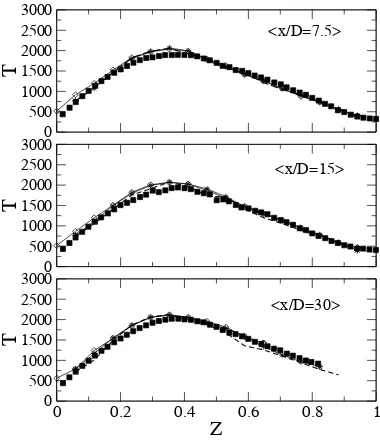
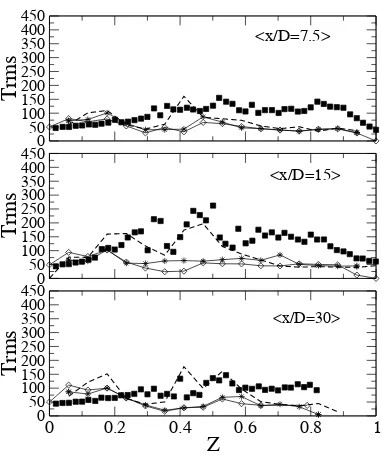
A better quantitative estimate is given in Figs 6 and 7 where temperatures
and their RMS are conditionally averaged on mixture fraction and plotted for
different downstream positions. MMC-IEM and PDF-IEM give good
predic-tions for the conditional temperatures. They are slightly overpredicted due
and 5. Small differences can be seen for the conditional mean at x/D = 15
where MMC-IEM with τmin =τD gives somewhat lower temperature
predic-tion due to the decreased mixing, the increased scatter and therefore increase
local extinction. Differences are more pronounced in Fig.7. It is apparent that
PDF-IEM and MMC-IEM with a small minimum dissipation time scale does
not allow for the correct level of conditional fluctuations and the mixing
implic-itly oppresses variations in conditional temperature. Longer time scales yield a
relatively accurate level of conditional fluctuations, in particular atx/D = 15
and possibly x/D = 30. It is not yet quite clear why conditional fluctuations
remain relatively low atx/D = 7.5, but improvements to conventional mixing
models are clear.
6 Conclusion
The current work is one of the first implementions of stochastic MMC coupled
to a RANS solver for the computation of mixing and reaction in a turbulent
jet flame. A single Markovian reference variable with Gaussian distribution
is selected and mapped to the mixture fraction space. The advantage of the
method is that despite the use of a very simple mixing model such as IEM, the
localness in composition space can be enforced and the conditional fluctuations
can be modelled more accurately and be better controlled. MMC can capture
parts of the physical behaviour of moderately complex phenomena such as
extinction and ignition and can provide accurate levels of fluctuations if a
suitable estimate of τmin is found. It has been shown that for a turbulent jet
flame such as Sandia Flame D, the appropriate time scale needs to be close
to the integral turbulence time scale and good predictions of all quantities of
scalars and their fluctuations can be achieved. Further studies, however, would
need to establish the dependence of τmin on Reynolds number and/or flow
geometries.
7 Acknowledgments
The authors would like to thank Dr M.J. Cleary for many helpful discussions.
SNM acknowledges the financial support by The Royal Society.
References
[1] S. Pope, Prog. Energy Combust. Sci.11 (2) (1985) 119 – 192.
[2] S. Subramaniam, S. Pope,Combust. Flame 115 (4) (1998) 487–514.
[3] A. Norris, S. Pope,Combust. Flame 83 (1-2) (1991) 27–42.
[4] S. Mitarai, J. Riley, G. Kosly,Phys. Fluids17 (4) (2005) 047101 – 1–047101–15.
[5] C. Dopazo, Phys. Fluids 22 (1) (1979) 20–39.
[6] E. O’Brien,Turbulent Reacting Flows, Springer-Verlang, 1980.
[7] R. Curl,AIChE Journal 9 (1963) 175–181.
[8] J. Janicka, W. Kolbe, W. Kollmann, J. Non-Equilib. Thermodyn. 4 (1) (1979)
47 – 66.
[9] A. Klimenko, S. Pope,Phys. Fluids 15 (7) (2003) 1907–1925.
[10] R. Barlow, J. Frank,Piloted methane/air flames C, D, E, and F - Release 2.0,
Tech. rep., Sandia National Laboratories (2003).
[12] S. Pope, Theor. Comput. Fluid Dyn.2 (5-6) (1991) 255–270.
[13] A. Kronenburg, M. Cleary, Combust. Flame 155 (1-2) (2008) 215–231.
[14] K. Vogiatzaki, M. Cleary, A. Kronenburg, J. Kent, Phys. Fluids 21 (2).
[15] A. Klimenko,Combust. Flame 143 (4) (2005) 369–385.
[16] M. Cleary, A. Klimenko, Flow Turb. Comb. 82 (4) (2008) 477–491.
[17] A. Wandel, A. Klimenko,Phys. Fluids 17 (12).
[18] S. Pope, Proceedings of the Sixth International Workshop on Turbulent
Non-Premixed Flames.
[19] S. Corrsin,J. Aeronaut. Sci.18 (1951) 417.
[20] R. Barlow, J. Frank, A. Karpetis, J.-Y. Chen, Combustion and Flame 143 (4)
(2005) 433 – 449.
8 Figures 0 0.2 0.4 0.6 0.8 1 0 0.2 0.4 0.6 0.8 1 Z(
-4 -2 0 2 4
0 0.2 0.4 0.6 0.8 1
-4 -2 0 2 4
-4 -2 0 2 4
<x/D=3> <x/D=3> <x/D=15> <x/D=30> <x/D=3> <x/D=15> <x/D=30> <x/D=15> <x/D=30>
Fig. 1. Profiles of the mixture fraction in reference space at various axial locations and r/D= 1 for τmin =τd (top row), τmin = 0.7τd (middle row) andτmin = 0.5τd (bottom row). Solid lines are the profiles ofZ(ξ) and symbols represent the particles.
0 0.2 0.4 0.6 0.8 1 0 0.2 0.4 0.6 0.8 1
Z [ - ]
0 1 2 3 4 5 6 r/D [ - ] 0 0.2 0.4 0.6 0.8 1
0 1 2 3 4 5 6 r/D [ - ] <x/D=01>
~
<x/D=03>
<x/D=7.5> <x/D=15>
[image:20.612.134.446.55.301.2]<x/D=30> <x/D=45>
[image:20.612.199.384.435.594.2]0 0.1 0.2 0.3 0.4 0 0.1 0.2 0.3 0.4
Zrms [ - ]
0 1 2 3 4 5 6 r/D [ - ] 0
0.1 0.2 0.3 0.4
0 1 2 3 4 5 6 r/D [ - ] <x/D=01> <x/D=03>
<x/D=7.5> <x/D=15>
[image:21.612.196.384.59.216.2]<x/D=30> <x/D=45>
Fig. 3. Radial profiles of mixture fraction rms at different axial locations. Squares represent the experimental data, solid lines the predictions from conventional RANS equations, dashed lines the predictions from the MMC-IEM mixing model with τmin = τD, stars the predictions from the MMC-IEM mixing model with τmin = 0.5τD and diamonds the predictions from PDF-IEM.
500 1000 1500 2000 2500
T [ K ]
0.04 0.08 0.12 0.16
CH
40 0.2 0.4 0.6 0.8 1 Z 0 0.04 0.08 0.12 0.16
CO
0.2 0.4 0.6 0.8 1
Z 0.2 0.4 0.6 0.8 1Z 0.2 0.4 0.6 0.8 1Z 0.2 0.4 0.6 0.8 1Z
D
D
0.7D 0.5D
Exp.
D Exp.
Exp.
0.7D
0.7D
0.5D
0.5D
IEM
IEM
IEM
[image:21.612.95.488.378.610.2]500 1000 1500 2000 2500
T [ K ]
0.04 0.08 0.12 0.16
CH
40 0.2 0.4 0.6 0.8 1 Z 0 0.04 0.08 0.12 0.16
CO
0.2 0.4 0.6 0.8 1
Z 0.2 0.4 0.6 0.8 1Z 0.2 0.4 0.6 0.8 1Z 0.2 0.4 0.6 0.8 1Z
D
D
0.7D 0.5D
Exp.
D Exp.
Exp.
0.5D
0.7D
0.5D
0.5D
IEM
IEM
[image:22.612.93.488.50.279.2]IEM
Fig. 5. Scatter plots of T, CH4 and CO as functions of mixture fraction atx/D = 30.
0 500 1000 1500 2000 2500 3000 T 0 500 1000 1500 2000 2500 3000 T
0 0.2 0.4 0.6 0.8 1
Z 0 500 1000 1500 2000 2500 3000 T <x/D=7.5> <x/D=15> <x/D=30>
[image:22.612.194.384.361.581.2]0 50 100 150 200 250 300 350 400 450
Trms
0 50 100 150 200 250 300 350 400 450
Trms
0 0.2 0.4 0.6 0.8 1
Z
0 50 100 150 200 250 300 350 400 450
Trms
<x/D=7.5>
<x/D=15>
[image:23.612.194.385.193.422.2]<x/D=30>
List of Figures
1 Profiles of the mixture fraction in reference space at various
axial locations and r/D = 1 for τmin = τd (top row),
τmin = 0.7τd (middle row) and τmin = 0.5τd (bottom row).
Solid lines are the profiles of Z(ξ) and symbols represent the
particles. 17
2 Radial profiles of mean mixture fraction at different axial
locations. Squares represent the experimental data, solid lines
the predictions from conventional RANS equations, dashed
lines the predictions from the MMC-IEM mixing model with
τmin =τD, stars the predictions from the MMC-IEM mixing
model with τmin = 0.5τD and diamonds the predictions from
PDF-IEM. 17
3 Radial profiles of mixture fraction rms at different axial
locations. Squares represent the experimental data, solid lines
the predictions from conventional RANS equations, dashed
lines the predictions from the MMC-IEM mixing model with
τmin =τD, stars the predictions from the MMC-IEM mixing
model with τmin = 0.5τD and diamonds the predictions from
PDF-IEM. 18
4 Scatter plots of T, CH4 and CO as functions of mixture
fraction atx/D = 15. 18
5 Scatter plots of T, CH4 and CO as functions of mixture
6 Conditionally averaged temperature at different axial
locations. Squares represent the experimental data, dashed
lines the predictions from the MMC-IEM mixing model with
τmin =τD, stars the predictions from the MMC-IEM mixing
model with τmin = 0.5τD and diamonds the predictions from
the PDF-IEM simulations. 19
7 Conditionally averaged temperature RMS at different axial
locations. Squares represent the experimental data, dashed
lines the predictions from the MMC-IEM mixing model with
τmin =τD, stars the predictions from the MMC-IEM mixing
model with τmin = 0.5τD and diamonds the predictions from