RIT Scholar Works
Theses Thesis/Dissertation Collections
5-11-2011
Are new media credible? A Multidimensional
approach to measuring news consumers’ credibility
and bias perceptions and the frequency of news
consumption
Bonnie McCrackenFollow this and additional works at:http://scholarworks.rit.edu/theses
This Thesis is brought to you for free and open access by the Thesis/Dissertation Collections at RIT Scholar Works. It has been accepted for inclusion in Theses by an authorized administrator of RIT Scholar Works. For more information, please [email protected].
Recommended Citation
The Rochester Institute of Technology
Department of Communication
College of Liberal Arts
Are New Media Credible? A Multidimensional Approach to Measuring News Consumers’
Credibility and Bias Perceptions and the Frequency of News Consumption
by
Bonnie Joy McCracken
A Thesis submitted
in partial fulfillment of the Master of Science degree
in Communication & Media Technologies
Degree Awarded:
The members of the Committee approve the thesis of
Bonnie Joy McCracken presented on May 11, 2011
__________________________________________ Bruce A. Austin, Ph.D.
Chairman and Professor of Communication Department of Communication
Thesis Adviser
__________________________________________ Susan B. Barnes, Ph.D.
Associate Director
Lab for Social Computing @ RIT Libraries Thesis Adviser
__________________________________________ Rudy Pugliese, Ph.D.
Table of Contents
Abstract ……….……..4
Introduction ………...5
Project Rationale ………...8
Review of Literature ………...9
Method ………...16
Results ………...19
Discussion……….….27
Conclusion ………....29
References ……….32
Appendix A………35
ARE NEW MEDIA CREDIBLE? A MULTIDIMENSIONAL APPROACH TO MEASURING NEWS CONSUMERS’ CREDIBILITY AND BIAS PERCEPTIONS AND THE FREQUENCY
OF NEWS CONSUMPTION
Name: Bonnie Joy McCracken Department: Communication College: Liberal Arts
Degree: Master of Science in Communication & Media Technologies Term Degree Awarded: Spring Quarter 2011 (20103)
Abstract
An investigation of news consumers’ self-reported news source preferences, frequency of media
consumption, and perceptions of news bias and credibility was performed to understand where
news consumers are receiving news content and judgments of credibility in mainstream and new
media. A Web-based survey distributed to the Rochester Institute of Technology community was
completed by 107 respondents. Results confirm previous findings that news consumers are more
likely to have a higher frequency of consumption of media they perceive as credible. Results
confirm the shift to online media where consumers report they are receiving their news. New
findings brought forth by the present study provide insight on a direction for future research.
Are New Media Credible? A Multidimensional Approach to Measuring News Consumers’ Credibility and Bias Perceptions and the Frequency of News Consumption
The Internet has altered the way individuals communicate, search for information, and
purchase products. The Internet rapidly revolutionized the communication environment by
enabling a network of simultaneous communication exchanges between both senders and
receivers, capable of immediate and uncontrolled feedback (Sweetser, Porter, Chung & Kim,
2008; Domingo & Heinonen, 2008). Further, the decrease in consumption of traditional
mainstream media has been attributed to the advent of the Internet (Dutta-Bergman, 2004). The
Internet has altered the control of gathering news content and disseminating it to an audience,
shifting the control from mainstream news organizations, comprised of professional journalists,
to lay individuals acting as citizen journalists using new media; (Chung, Kim, Trammell, &
Porter, 2007; Banning & Sweetser, 2007). Further, new technologies with Internet capability
have also created new opportunities for lay individuals to provide mainstream media with news
stories (for example CNN iReport, individuals send their recorded news event/story via mobile
device). This type of citizen reporting has increased dramatically within the past year during
events such as the Japan earthquake/tsunami disaster and the government protests in Libya.
The concept of citizen journalism is nothing new. Citizen journalism, also referred to as
civic journalism or public journalism, has been around since the beginning of print media. The
practice of citizen journalism has been referred to as a challenge to the formal principle of
traditional journalism by altering the process in which news content is gathered, written, and
distributed to news consumers (Chung et al., 2007; Banning & Sweetser, 2007). The Internet and
reporters by distributing information to a mass audience; this is seen most commonly in the use
of new media and user-generated weblogs.
The newfound opportunity for an individual to create and distribute news content via the
Internet to a mass audience has further fueled the on-going discussion of what exactly defines a
journalist. In Journalism and other forms of public speaking, the credibility of the source of
information is important for determining the truth of the information. Questioning the credibility
of a source has existed since the time of Aristotle. Concern over media credibility escalated when
yellow journalism and war propaganda contributed to a disillusioned audience that perceived
journalists to be ethically ill-equipped to accurately portray reality and enhance legitimacy (St.
John, 2009). In the post-World War II era, professionalism crystallized into an enduring
scientific fact-oriented approach to reporting that featured a reliance on experts (St. John, 2009).
Modern-day journalists affirm credibility and integrity in their reporting through the claim that
what is reported is the truth, and authenticity is maintained by focusing on objectivity (St. John,
2009). Thus, journalists are socially responsible by providing informative and unbiased news
content that can enable news consumers to make an informed decision or form an opinion within
society. Professional journalists have gone through formal training and education to maintain the
skills necessary to ethically gather news content and write credible and objective news stories.
However, what has been argued is that citizen journalists (lay individuals) do not have the proper
credentials to be considered professional journalists.
Recently, scholarly research has reported conflicting findings regarding the news
organizations’ perceptions of citizen journalism and new media credibility (Johnson & Kaye,
news consumers; this is particularly due to perceptions of lack objectivity and journalistic
training (Chung et al., 2004). Meanwhile, the paradox of weblogs is brought forth due to the
contradiction of value placement: “while fairness may be considered a hallmark of traditional
journalism, bias is likely seen as a virtue by blog users” (Johnson & Kaye, 2004, p. 633). In other
words, a paradox exists due to mainstream media stressing objectivity; whereas new media blogs
gain readers by stylizing content with more of an editorial-type of reporting, that may lack in
objectivity.
The present study adds to the knowledge of journalism and news consumer’s perceived
frequency of news consumption and preferences. This study looked for differences between what
news sources news consumers reported to prefer and the frequency with which those news
sources were consumed. Further, the research compares news consumers’ perceptions of bias and
credibility for specific mainstream and new media sources with their reported frequency of
consumption.
RQ1: What are the differences between self-reported news source preferences and
frequency with which news sources are consumed?
RQ2: What relationships are there among news consumers’ self-reported frequency with
which news sources are consumed and news consumers’ self-reported perceptions of news
content biases?
RQ3: What relationships are there among self-reported frequency with which various
Rationale
Communications and the way in which individuals communicate are evolving rapidly.
With the introduction of new technologies and the capability to access multiple news sources via
the Internet, it comes as no surprise that new media now compete for readers with mainstream
media. I wondered which news sources consumers preferred, the extent to which they are
exposed to the media, and the level of credibility news consumers ascribe to mainstream media
and new media news sources. The present study of news consumers extends Communication and
Journalism research by contributing to the existent academic literature.
Additionally, it is of societal interest to investigate news consumers’ preferences
because of the rapid change in how news is delivered and received. New media and blogs are not
the first media to compete with mainstream media for news consumers. However, the rate at
which blogs are expanding has already made an impact on news organizations (such as CNN,
MSNBC, and more) by delivering news via blogs, microblogs (i.e. Twitter), and social networks
to reach younger, technology-savvy audiences.
To begin to understand how news consumers perceive mainstream and new media bias
and credibility, it is important to identify how credibility in journalism has been identified
previously. The framework of social responsibility theory is suggested due to its influence in the
belief that media operate on a higher level of journalistic responsibility, of being credible, in
reporting and objectively informing the public (Adams-Bloom & Cleary, 2009). This study takes
a multidimensional approach by examining credibility with the assumption that news consumers
have different bias perceptions of different news media and find those media more or less
categories. Therefore, components of the study were also suggested by Dutta-Bergman (2004),
who focused on analyzing specific content categories (local news, national, international,
political, etc.) rather than a medium-centric approach to media competition.
Literature Review
Social Responsibility Theory
Journalists seek to maintain their credibility through the claim that what is reported is the
truth and that they maintain an objective stance on issues presented (St. John, 2009). Thus,
journalists have a social responsibility to provide informative and unbiased news content to
society, enabling news consumers to make an informed decision or form an opinion.The concept
of social responsibility theory was created by the Hutchins Commission, formally known as the
Commission on Freedom of the Press (1947), and included as a theory in Four Theories of the
Press (Siebert, Peterson & Schramm, 1956). Social responsibility theory is comprised of a set of
ideas regarding how the media should perform (Siebert et al., 1956). The main principle argues
that the press has a role in investigating the political system, enlightening the public by providing
the projection of a representative picture of the constituent groups in society, serving as a forum
for the exchange of comment and criticism, and safeguarding the liberties and wellbeing of the
individual and public as a whole (Commission, 1947; Siebert et al., 1956). Social responsibility
influenced thinking about the proper role of the press and news content decision making, and
insisted on a higher level of journalistic responsibility to inform the public about decisions and
actions (Adams-Bloom & Cleary, 2009). Social responsibility theory encompasses what it means
Credibility in the Media
The advent of new communications technologies has continually prompted a challenge to
existing print journalistic norms, practices, and credibility (Haas, 2005). Credibility research
began with an interpersonal influence as researchers examined what characteristics made a
speaker persuasive (Johnson & Kaye, 2004), and credibility has remained central to
understanding public perceptions of news media (Bucy, 2003). It has been argued that a high
credibility perception is essential for a news consumer to choose a news source preference (Choi,
Watt, & Lynch, 2006).
It has been argued that news consumers are more likely to pay attention to, and become
dependent on, media they perceive as credible (Bucy, 2003; Choi, Watt, & Lynch, 2006). High
credibility perceptions lead to a reliance on a certain medium for news, and in turn, increase the
frequency of exposure to the medium (Choi, Watt, & Lynch, 2006). Further, perceptions of
credibility have also been found to influence the perceived level of topic importance (content
being reported), agenda-setting, and acceptance of information validity (Bucy, 2003).
Hovland and Weiss (1951/1952) investigated how and to what extent individuals’
opinions were formed by high and low credibility sources; and whether these opinions are
maintained over time. Their study investigated differences in subjects’ retention and perceptions
of “trustworthy” and “untrustworthy” sources from communication media (Hovland & Weiss,
1951/1952, p. 636). A “sleeper effect” was found to take place. As time goes by, messages from
those initially considered untrustworthy were remembered the most; and over time, opinions
about the sources changed (Hovland & Weiss, 1951/1952). The study identified two key
Gaziano & McGrath, 1986). This led some scholars to further identify credibility through factor
analysis of multiple underlying dimensions, such as accuracy, fairness, and completeness
(Gaziano & McGrath, 1986).
Credibility as a multidimensional concept.
As researchers’ interest in credibility grew, further development of the concept also grew.
Some scholars have identified credibility as a multidimensional concept (Gaziano & McGrath,
1986). The dimensions that comprise news credibility have been identified as fairness, accuracy,
lack of bias, completeness, depth (Gaziano & McGrath, 1986; Choi, Watt, & Lynch, 2006), and
trustworthiness (Hovland & Weiss, 1951/1952). However, the credibility dimensions vary from
study to study depending upon the context (Gaziano & McGrath, 1986).
The multidimensional approach to measuring credibility presumes that when individuals
consume different media, they have different motives (or news content categories) for their
selected media source, and may have different perceptions of credibility for different news media
(Newhagen & Nass, 1989; Choi, Watt, & Lynch, 2006). For example, news consumers may
expect in-depth coverage from cable news networks (e.g., CNN, MSNBC, etc.) but may expect
timeliness from new media on the Internet. A news consumer could prefer to receive national or
international news from an unbiased and fair news medium, but may also prefer a different news
medium that communicates a political bias that corresponds with what they believe.
Online Shift in Media
New technologies create new challenges for journalistic credibility. “New mass media
technologies have evolved to challenge the print and broadcast industries’ control over
Ceppos, 2007, p. 263). The Internet has revolutionized the process of receiving information from
media; news consumers are no longer passive receivers of information in a communication
process dominated by corporate media, but rather are active in deciding where to receive news
content, from which media, and at their own convenience (Domingo & Heinonen, 2008).
Recently, new media citizen journalism has sparked speculation about the challenges it imposes
on traditional journalistic norms (Haas, 2005). Weblogs in particular have made it possible for
citizen journalism to flourish. The traditional one-way communication flow, from one sender to
many receivers, has evolved into a network of multiple simultaneous communication flows,
capable of both one-to-one and one-to-many senders and receivers of information (Domingo &
Heinonen, 2008; Sweetser, et al., 2008). This simultaneous flow enables news consumers to
respond to the news content they are reading on the Internet and engage in dialogue with other
news consumers, news reporters, and representatives from media organizations.
New media.
Weblogs are a particular form of new media that enables individuals to discuss events
and topics by posting links to, and comments on, other internet-based materials and other
user-generated blogs on the Internet (Haas, 2005). Blogging became popular in the 1990s with the
launch of easy-to-use free software, such as Blogger, LiveJournal, and Weblogger, available to
any individual with access to the Internet (Blood, 2003; Haas, 2005).
One crucial aspect of weblogs is their interactive capability (Domingo & Heinonen,
2008). The interactivity of weblogs, particularly the practice of linking hypertext within text and
commenting on other weblogs, has given rise to a radically different kind of news discourse, not
the concept of weblogging as an appropriate tool in developing citizen journalism via the Internet
(Domingo & Heinonen, 2008).
It is important to note that all weblogs are not the same; they can differ in topics, author
motives, interests, and more. Domingo and Heinonen (2008) identified and categorized four
different weblog categories: A citizen blog – a weblog that is produced by lay individuals outside
of the media on a broad range of topics; Media blogs – weblogs produced by professional staff
journalists in a media organization and part of the media’s news content; Audience blogs -
weblogs that news consumers can contribute to regarding an on-going discussion on specific
topics provided by the media organization on their website; and Journalist blogs - weblogs
professional journalists maintain outside of a media organization’s interests. Citizen journalists
posting weblogs would be categorized within the citizen blog category. Although some blogs
may contain news content, most citizen journalists are outside of any media organization, thus
weblog postings do not represent the interests of any media organization (with the exception of
weblogs posted on news sites, such as CNN or the NYTIMES). Citizen journalists are often
without journalistic training required to be classified as a professional journalist (Domingo &
Heinonen, 2008).
Journalism and new media.
Weblogs have been perceived by some news consumers as a new and better journalism
that is opinionated, independent, and personal (Johnson & Kaye, 2004). Domingo and Heinonen
(2008) argue that professional journalists and citizen journalists have a symbiotic relationship in
which they work together to filter and report the news. Citizen journalists and weblogs are
mainstream media and the public’s attention that otherwise would have not been reported
(Sweetser, et al., 2008). Haas (2005) argues that citizen journalists challenge the narrow range of
topics and sources featured in mainstream media. However, weblogs are also criticized for
delivering news content that is too closely related to that of mainstream media. It was also found
that not only do citizen journalists cover the same news content, but they also rely on mainstream
media for their information, and often include a hypertext to the original source (Haas, 2005).
Together, both mainstream media and new media weblogs allow news consumers to
compare and contrast competing truth claims within the different media sources (Haas, 2005). It
has been argued that “blogs have become watchdogs and critics of the communication industry”
(Sweetser, et al., 2008, p. 169). The watchdog capability of weblogs became clear in the case of
New York Times journalist Jayson Blair and his dishonest reporting. Blair was forced to resign
from the New York Times in 2003 after plagiarism and fabrication within his stories were
discovered. Citizen journalists created a mass amount of negative attention on Blair; which also
put pressure on the Times’ editors who allowed Blair’s breach of journalistic ethics to continue.
The mass amount of negative attention resulted in Blair’s former managing editors to also resign
(Haas, 2005). In this situation, citizen journalism proved to be socially responsible by not
allowing the managing editors in a professional media organization to make unethical decisions.
Credibility in the Media
The rise of the Internet has led to an increase in credibility studies comparing traditional
mainstream media with emerging new media (Johnson & Kaye, 2004). Bucy (2003) questions
website counterpart) is influential in “cultivating perceptions of broadcast news credibility” and
maintaining positive audience perceptions of network news (p. 249).
Research has generally found that news consumers perceive online news similarly to
other media. Johnson and Kaye (1998) surveyed politically-interested Internet users to
investigate whether or not new media publications are perceived to be as credible as their
traditionally delivered counterparts. Results indicated that the online newspapers, news
magazines, and politically-oriented websites were perceived as somewhat credible; further,
online newspapers and online candidate literature were judged as significantly more credible
than their traditional counterparts (Johnson & Kaye, 1998).
Information delivered by new media is still vulnerable to being perceived as not credible
due to readers’ perceptions of accuracy and inconsistencies regarding where the original
information came from (Choi, Watt, & Lynch, 2006). Citizen journalism on the Internet
(specifically via weblogs) has come under attack by academics and professional journalists
because of its perceived lack of objectivity and editorial gatekeeping when compared to the
process that is utilized in traditional journalism that ensures no misinformation or inaccuracies
are published (Johnson & Kaye, 2004). Blood (2003) states that the convention of embedding
hyperlinks to sources of information in user-generated content, that relates to the information
being discussed within the text, has led to an increase in the perceived credibility and reliability
of the blog post.
Online user-generated weblogs rely heavily on peer review by other users and audiences
to point out published mistakes (Johnson & Kaye, 2004). However, Lowrey and Mackay (2008)
serves as a “reliable fact-checking mechanism, the validity of the claim is not well-tested” and
the “problem remains that unchecked information is routinely published, even if it is eventually
corrected” (p. 75).
In recent years, other coverage-related factors have called the credibility of mainstream
media into question due to corporate interests that overshadow gatekeeping and content. In
contrast, an advantage for citizen journalism is that the content is not controlled by corporate
interests; thus, citizen journalists have the flexibility of discussing issues and news content that
mainstream media usually shy away from due to conflict of interests with big media
corporations. It is argued that citizen journalists are socially responsible due to their greater
concentrated interest on citizen involvement and on a healthier public climate, rather than on the
rules and interests of a media organization (Rosen, 1999; Christians & Nordenstreng, 2004).
Further, citizen journalism and weblogs exhibit social responsibility by allowing news
consumers to contribute to the conversation regarding news content.
News consumers’ self-reported perceptions of credibility across mainstream media and
new media remain the focal point for the current research. Credibility has been operationalized
by previous research as the “degree to which news consumers judge network newscasts and web
sites to be believable, fair, accurate, informative, and in-depth” (Bucy, 2003, p. 252). The current
study uses Bucy’s study as a lens to operationalize media credibility for mainstream media and
citizen journalist blogs.
Method
A Web-based survey was distributed at the beginning of December, 2010 at the
collected from a convenience sample of students, faculty, and staff members from the RIT
community. An emailed cover letter and link to the Web-based survey were distributed to 500
individuals [Appendix A and B]. This form of delivery was chosen because each individual
within the RIT community has a registered RIT email address, accessible through the RIT email,
and can receive the survey. Respondents who replied to the survey clicked on the link, which
directed them to the survey on the RIT Clipboard program. The survey closed after being open
for one month. There were a total of 107 responses, and data were analyzed using the Minitab
statistical program.
Measures
The survey consisted of four parts. Each part of the survey was clearly labeled to move
participants through the study, and introductions and directions were provided. The first part
asked the participants to identify which medium they go to for particular news content. The
following survey parts, as described below, measured media exposure frequency, and judgments
of biases and credibility. Validity was judged by providing the survey to a group of individuals
similar to the sample used for the study. The survey was given one time, and then repeated in
order to determine the reliability with which the instrument performs each time. Respondents
were asked whether they believe the questions are measuring what the survey is asking of them.
Media preference.
Respondents were asked to choose one medium that they prefer to receive news content,
from these closed-ended response options: local newspaper and Internet website, local television
broadcast and Internet website, radio, cable television and Internet website, and weblogs. The
politics, the economy, and entertainment/celebrity news. The results were analyzed individually
and then collectively for individual and total percentages of self-reported news consumer
preferences. The media preferences were then categorized by mainstream (newspaper, radio, and
cable and local television broadcasts) and new media (local newspaper and local television
websites, cable news website, and weblogs).
Frequency of media exposure.
Part II of the survey measured the frequency with which news sources were consumed.
Respondents were asked how often they receive news content (almost never, once to twice
weekly, 3 to 4 times weekly, 5 to 6 times weekly, or daily). The specified news media were
broken down as local newspapers, radio, cable and local television news, online news websites,
and weblogs (refer to Appendix B).
Media bias.
Part III of the survey measured self-reported perceptions of news content biases (refer to
Appendix B). Media bias was operationalized as a multidimensional construct consisting of
statements concerning trustworthiness, objective news coverage, believability, balance and
fairness in reporting, and overall perception of bias of the news media. Respondents rated their
degree of agreement with each belief statement on a five-point Likert scale ranging from strongly
disagree (1), to undecided (3) to strongly agree (5). The news media included in the belief
statements are broken down into newspapers, radio, local and cable television, and weblogs.
Media credibility.
Media credibility was measured in part IV of the survey as a multidimensional construct
rating of credibility of the news medium specified (refer to Appendix B). Respondents rated their
degree of agreement with each belief statement on a five-point Likert scale ranging from strongly
disagree (1), to undecided (3) to strongly agree (5) used for each statement.The news media
included in the belief statements are broken down into newspapers, radio, local and cable
television, and weblogs.
Results
A total of 107 web-based surveys were completed. The respondents included
undergraduate and graduate students, as well as faculty, and staff of all ages and educational
backgrounds. Although the findings cannot be generalized to news consumers as a whole, they
do present a picture of the 107survey respondents.
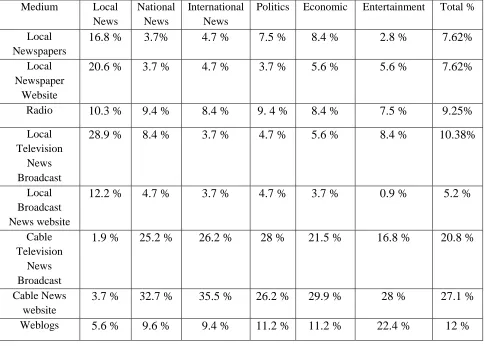
Research question one asked about self-reported news source preferences and the
frequency with which news sources are consumed. One quarter (27.1%) said their preferred news
medium was cable television news websites, followed by Cable television news broadcast
(20.8%), and Weblogs (12%); see total column in Table 1. Local television websites were the
least preferred news medium (5.2%). The results confirm that there is an online shift in news
media preference by news consumers, and a decline in local news. When identified by news
content category, the results indicate that Cable News (both Television and Website) were most
often preferred across news content types, with the exception of local news. Weblogs were
among the most preferred news medium to receive entertainment and celebrity news (22.4%) and
Table 1
Percentage of Preferred Medium by News Content Category
Medium Local News
National News
International News
Politics Economic Entertainment Total %
Local Newspapers
16.8 % 3.7% 4.7 % 7.5 % 8.4 % 2.8 % 7.62%
Local Newspaper
Website
20.6 % 3.7 % 4.7 % 3.7 % 5.6 % 5.6 % 7.62%
Radio 10.3 % 9.4 % 8.4 % 9. 4 % 8.4 % 7.5 % 9.25%
Local Television
News Broadcast
28.9 % 8.4 % 3.7 % 4.7 % 5.6 % 8.4 % 10.38%
Local Broadcast News website
12.2 % 4.7 % 3.7 % 4.7 % 3.7 % 0.9 % 5.2 %
Cable Television
News Broadcast
1.9 % 25.2 % 26.2 % 28 % 21.5 % 16.8 % 20.8 %
Cable News website
3.7 % 32.7 % 35.5 % 26.2 % 29.9 % 28 % 27.1 %
Weblogs 5.6 % 9.6 % 9.4 % 11.2 % 11.2 % 22.4 % 12 %
The media preferences were categorized as mainstream (newspaper, radio, and cable and
local television broadcasts) and new media (local newspaper and local television websites, cable
news website, and weblogs). Paired sample t-tests compared media preferences (for each news
medium) with the self-reported frequency with which a news source is consumed. The difference
between mainstream and new media preference (by content category) and the frequency of local
newspaper consumption were all significant (see Table 2). The mean frequencies of consumption
to four times weekly.” The significant differences were found in frequency of local newspaper
consumption and local news (t = 2.31, df = 104, p = .02), national news (t = 2.86, df = 91, p =
.005), international news (t = 2.77, df = 89, p = .007), political news (t = 2.29, df = 97, p = .02),
economic news (t = 4.04, df = 79, p < .001), and entertainment news (t = 3.04, df = 64, p = .003).
The mean of local newspapers consumption for mainstream media ranged from once to twice
weekly (2.48 – 2.70) and for new media ranged within “almost never” (1.61 – 1.84). Results
indicate that mainstream media were consumed significantly more for the content categories than
[image:22.612.73.543.377.464.2]new media.
Table 2
Mean Differences for Local Newspaper Consumption
Medium Local News National News
International News
Political News
Economic News
Entertainment News Mainstream
Media
2.5 2.6 2.6 2.5 2.7 2.6
New Media 1.8 1.8 1.8 1.8 1.6 1.7
Paired sample t-tests showed that there were few significant differences between
frequency of radio news consumption and media preference, but the majority of t-tests were
statistically non-significant. The differences between the frequency of radio consumption and
international news (t = 2.23, df = 96, p = .03) and economic news (t = 2.92, df = 95, p = .004)
were significant. The mean of consumption for new media was “once to twice weekly” (2.13,
2.27) and for mainstream media was within “three to four times weekly” (3.02, 3.11). The
difference is that mainstream media were consumed significantly more for the content categories
media was significantly greater than new media, more respondents preferred new media (n=56
and n=54) compared to mainstream media (n=47for each).
The differences between local television news consumption and mainstream and new
media preference were all significant (see Table 3). The significant differences were found in
local news (t = 6.16, df = 93, p < .001), national news (t = 2.18, df = 95, p = .032), international
news (t = 2.85, df = 90, p = .005), political news (t = 3.86, df = 98, p < .001), economic news (t =
3.48, df = 91, p = .001), and entertainment news (t = 2.32, df = 76, p = .023). New media was the
most preferred news source for national news (n=54), international (n=56), economics (n=54),
and entertainment (n=61). The mean frequency for local television news consumption for
mainstream media ranged from “once to twice weekly” (2.8) to “three to four times weekly”
(3.0); new media ranged from “almost never” (1.6) to “once to twice weekly” (2.2). The
difference is that mainstream media were consumed significantly more for the content categories
[image:23.612.76.543.514.597.2]than new media.
Table 3
Mean Differences for Local Television News Consumption
Medium Local News National News International News Political News Economic News Entertainment News Mainstream Media
3.0 2.8 2.9 3.0 2.9 2.9
New Media 1.6 2.2 2.1 1.9 1.9 2.2
The paired sample t-tests found that the differences between cable television news
consumption and mainstream and new media preference were all significant (see Table 4). The
significant differences were found in local news (t = 4.88, df = 102, p < .001), national news (t =
df = 99, p = .001), economic news (t = 3.58, df = 85, p = .001), and entertainment news (t = 2.27,
df = 76, p = .026). New media were the most preferred news source for national news (n=54),
international news (n=56), economic news (n=54), and entertainment news (n=61). However, the
mean for frequency for cable news consumption for mainstream media ranged within once to
twice a week (2.5 – 2.6) and new media ranged within almost never (1.5 – 1.9). The difference
found is that for cable television news, mainstream media were consumed significantly more
than new media.
Table 4
Mean Difference for Cable Television News Consumption
Medium Local News National News International News Political News Economic News Entertainment News Mainstream Media
2.5 2.6 2.5 2.5 2.6 2.5
New Media 1.5 1.6 1.8 1.7 1.7 1.9
Paired sample t-test found that the differences between frequency of online news website
consumption and mainstream and new media preference were all significant, see Table 5. The
significant differences were found in local news (t = -3.30, df = 96, p = .0001), national news (t =
2.82, df = 99, p = .006), international news (t = 3.83, df = 95, p < .001), political news (t =
2.50, df = 99, p =.014), economic news (t = 2.98, df = 94, p = .004), entertainment news (t =
-3.39, df = 75, p = .001). New media was the most preferred news source for national news
(n=54), international news (n=56), economic news (n=54), and entertainment news (n=61). The
mean frequency of online news consumption for mainstream media ranged on the higher end of
times weekly (3.5 – 3.7). The difference found is that new media were consumed significantly
[image:25.612.69.546.209.286.2]more than mainstream media.
Table 5
Mean Difference for Online News Website Consumption
Medium Local News
National News
International News
Political News
Economic News
Entertainment News Mainstream
Media
2.7 2.7 2.5 2.8 2.7 2.5
New Media 3.7 3.6 3.6 3.5 3.6 3.6
The differences between the frequency of weblog news consumption and media
preference were all significant (see Table 6). The significant differences were found in local
news (t = -2.84, df = 70, p = .006), national news (t = -4.33, df = 75, p < .001), international
news (t = -3.93, df = 89, p < .001), political news (t = -5.14, df = 63, p < .001), economic news
(t = -4.42, df = 85, p < .001), and entertainment news (t = -3.69, df = 96, p < .001). New media
were the most preferred news source for national news (n=54), international (n=56), economic
news (n=54), and entertainment news (n=61). The mean frequency for weblog news
consumption for mainstream media ranged within almost never (1.3 – 1.6) and new media
ranged within once to twice weekly (2.3 – 2.6). The difference found was that new media were
consumed significantly more than mainstream media.
Table 6
Mean Differences for Weblog News Consumption
Users Local News National News International News Political News Economic News Entertainment News Mainstream Media
1.6 1.4 1.4 1.3 1.3 1.4
New Media 2.4 2.5 2.4 2.6 2.5 2.3
Research question two addressed the self-reported frequency with which news sources
are consumed and self-reported perceptions of news content bias. Almost half the respondents
believed there is a bias in the news: 45.8% disagreed with the statement “I believe the news
media are unbiased.” Although Cable news was found to be the most preferred media source in
research question one, 43.9% of respondents disagreed with the statement “Cable news is
objective, without taking a side”, and 25.2% reported they strongly disagree with the belief
statement. A quarter of respondents (27.1%) disagreed with the belief statement “news printed in
local newspapers is objective, without taking a side.” Weblogs were also reported to be
perceived as biased: 45.8% of respondents agreed with the belief statement “news from weblogs
is biased.” Local television news broadcast had a split response, 24.3% disagreed with the
statement “News presented in local television broadcasts are objective,” 29% agreed with the
statement, and 32.7 were neutral.
Pearson Correlation Coefficient tests measured the relationship between the frequency
with which a news source is consumed and the degree to which respondents perceive news
content bias (broken down into multidimensional constructs consisting of trustworthiness,
fairness, balance, and objectivity). There was a significant positive relationship between the
news (r = .21, p = .03). As the rate of consumption increases, the perceived level of trust
increases. Further, there was a significant positive relationship between the perception of
objectivity in local television broadcasts and the perception of trust in the local broadcast (r =
.30, p = .002). There was also a significant relationship between the frequency of weblog
consumption and the degree of perceived trust in weblog news content (r = .20, p = .04); the
greater the perceived trust in weblogs, the greater the frequency of weblog consumption. Further,
there was a significant positive relationship between the perception of balance and fairness in
weblog news content and perceived trust in weblogs (r = .44, p < .001) and the perception of
objectivity in weblogs and perceived trust (r = .32, p = .001). These significant relationships
indicate that the greater the perception of balance, fairness, and objectivity (in weblogs), the
greater the perceived trust in news consumers.
Research question three addressed the self-reported frequency with which news sources
are consumed and self-reported perceptions of news credibility (broken down into
multidimensional constructs consisting of informative, credible, believability, and accuracy). The
large majority of respondents (78.5%) agreed with the belief statement “Local news is credible.”
Results also indicated that local news was perceived as more credible (78.5% agreement) than
cable news (39.3% agreement). Nearly half of the respondents (57.9%) agreed with the statement
“Radio news is informative” and 41.1% agreed with the statement “News content in weblogs is
informative.” However, 49.5% of respondents were undecided about the statement “News
content in weblogs is credible”; 18.7% agreed with the statement; and 21.5% disagreed.
Respondents were also split in their response to the statement “Cable news is credible”: 39.3%
Pearson Correlation Coefficient tests measured the relationship between the frequency
with which a news source is consumed and the degree to which responses perceive news
credibility. In terms of local television news, there was a significant positive relationship
between the frequency with which local television news is consumed and the perception of local
news credibility (r = .24, p = .01) and the perception of local news believability (r = .22, p = .02).
In terms of radio, there were significant negative relationships between the frequency with which
radio news is consumed and the perception of depth in news content (r = -.29, p < .001); as the
perception of news content depth decreases, the frequency of consumption decreases.
Additionally, a significant positive relationship was found between the frequency of radio news
consumption and the belief to how informative radio news content is (r = .23, p = .02). In terms
of weblogs, there were significant positive relationships between the frequency with which
weblogs were consumed and the perception of how informative weblog news content is (r = .51,
p < .001), perceived credibility (r = .28, p < .001), and perception of accuracy in news content (r
= .32, p < .001). These positive relationships indicate that the greater the perception of how
informative, credible, and accurate weblog news content is, the greater the frequency of
consumption. There were no statistically significant relationships between the frequency of cable
television news consumption and perception of cable news believability.
Discussion
Results confirm previous findings that news consumers are more likely to pay attention
to, and become dependent on, media they perceive as credible (Bucy, 2003; Choi, Watt, &
Lynch, 2006). Previous research also found that credibility is essential for news consumers to
confirm this argument, higher credibility perceptions were positively associated with a news
consumers’ preference for a particular medium. However, there was a gray area with local news;
the local news sources were perceived as credible, but had a very low preference and frequency
of consumption. Although cable news was found to be the most preferred medium, 43.9% of
respondents disagreed that cable news is objective, with a quarter (25.2%) reporting they
strongly disagree with the belief statement. Results indicated a high perceived credibility rating
for local news, however, a low rate of consumption. In contrast, there was a mixed response rate
for perceived cable news credibility, yet the online news media were reported as consumed daily.
Choi, Watt, & Lynch (2006) argued preference for a particular medium often led to an
increase in the frequency of exposure to that medium. Although mainstream cable news had a
high preference, yet low frequency of consumption (43.9% almost never consumed), cable’s use
of new media websites had the highest frequency of consumption of all news sources, with
36.5% daily consumption. These results confirm a news consumer shift to the Internet for
receiving news content. However, the results show that news consumers are receiving their news
from accredited mainstream media websites, and not from new media, citizen journalists, or
weblogs. Although new media and weblogs are becoming more popular for news consumption,
weblogs are still rarely consumed for serious news content. These results also reconfirm findings
from Hargrove and Stempel III (2007); despite the growth in blog use, blogs are still not a major
source for news content.
Results confirmed what Choi, Watt, & Lynch (2006) argued that information on new
media is still vulnerable to being perceived as not credible. It can further be argued that the
that 52.3% of respondents reported that they were undecided on weblog accuracy. Results
indicated that weblogs are preferred more for political, economic, and entertainment news
categories. And although some respondents did prefer weblogs for other news content categories
(local news, national, and international news) it can be argued that weblogs and mainstream
media are consumed in conjunction with each other, allowing news consumers to compare and
contrast competing truth claims within the different media sources (Haas, 2005), adding to the
perceived informative value of weblogs (Sweetser, et al., 2008).
Conclusion
The present study investigated the relationship between the RIT faculty’s, staff’s, and
student’s frequency of news consumption, news source preferences, and perceived news source
bias and credibility. Components of credibility in the media and social responsibility in
journalism were analyzed with the shift in news source preference to online new media and
weblogs. New technologies have dramatically expanded the way in which individuals
communicate and receive information and the process by which mainstream media can reach
consumers. The study of news consumers’ preferences of news source and perceptions of
credibility shed light on the continually evolving path of journalism, online news delivery, and
consumption process.
Limitations and Future Research
The study’s limitations include the instrument used, a web-based survey distributed via
email, the belief statements for measuring perceived biases and credibility (there are alternative
approaches to analyzing perceptions of credibility and biases that may provide more thorough
limitations, this study adds to knowledge of journalism studies and where news consumers are
receiving their information while also providing a direction for future research.
Future research should address the limitations of the instrument and belief statements by
using an alternative approach to testing perceived credibility and biases. Future research could
also narrow the topic of investigation to specific media subgroups (CNN compared to FOX
news) and perceptions of liberal media compared to conservative media. Participants who chose
to submit feedback on the Web-based survey said they preferred to receive news content from
media subgroups (CNN or FOX, New York Times or Rochester’s Democrat & Chronicle).
Future research should also examine potential factors contributing to new media
adoption, such as the Internet self-efficacy, online interactive experience, and views on
technology. Further, researchers should also focus on the gratifications of the particular types of
weblogs to ascertain the relation between news content and motivations; how individuals use
interactive new media, such as weblogs and discussion boards, in order to share information and
views. Studies could be designed to capture how the various interactive capabilities of the
Internet might affect the perception of new media credibility. Also, future research could
examine what categories of weblogs are preferred, and if weblogs written by professional
journalists or citizen journalists’ are attracting a larger audience. This direction for research is
significant due to new media increasingly becoming important informational and communication
tools for journalism.
This study’s findings indicate that while overall perception of weblog credibility is low,
directs future research to investigate why, despite the credibility and bias issues, weblogs are
being used more frequently for news content and other informational purposes.
References
Adams-Bloom, T. & Cleary, J. (2009). Staking a claim for social responsibility: An argument for
the dual responsibility model. The International Journal on Media Management, 11, 1-8.
Banning, S.A. & Sweetser, K.D. (2007). How much do they think it affects them and whom do
they believe?: Comparing the third-person effect and credibility of blogs and traditional
media. Communication Quarterly, 55(4), 451-466.
Blood, R. (2003, Fall). Weblogs and journalism: Do they connect? Nieman Reports, 61-63.
Bucy, E. P. (2003). Media credibility reconsidered: Synergy effects between on-air and online
news. Journalism & Mass Communication Quarterly, 88(2), 247-264.
Choi, J. H., Watt, J. H., & Lynch, M. (2006). Perceptions of news credibility about the war in
Iraq: Why war opponents perceived the internet as the most credible medium. Journal of
Computer-Mediated Communication, 12, 209-229.
Christians, C. & Nordenstren, K. (2004). Social responsibility worldwide. Journal of Mass
Media Ethics, 19(1), 3-28.
Chung, D.S., Kim, E., Trammell, K.D., & Porter, L.V. (2007, Autumn). Uses and perceptions of
blogs: A report on professional journalists and journalism educators. Journalism & Mass
Communication Educator, 62(3), 305-322.
Commission on Freedom of the Press. (1947). A free and responsible press. Chicago:
University of Chicago Press
Domingo, D., & Heinonen, A. (2008). Weblogs and journalism: A typology to explore the
blurring boundaries. Nordicom Review, 29, 1, 3-15.
across traditional and new media. Journal of Broadcasting & Electronic Media, 48(1),
41-60.
Gaziano, C., & McGrath, K. (1986, Autumn). Measuring the concept of credibility. Journalism
Quarterly, 451-462.
Haas, T. (2005). From “public journalism” to the “public’s journalism”? Rhetoric and reality in
the discourse on weblogs. Journalism Studies, 6(3), 387-396.
Hargrove, T. & Stempel III, G. H. (2007). Use of blogs as a source of news presents little threat
to mainline news media. Newspaper Research Journal, 28(1), 99-102.
Hayes, A. S., Singer, J. B., & Ceppos, J. (2007). Shifting roles, enduring values: The credible
journalist in a digital age. Journal of Mass Media Ethics, 22(4), 262-279.
Hovland, C. I., & Weiss, W. (1951/1952). The influence of source credibility on communication
effectiveness. Public Opinion Quarterly, 635-650.
Johnson, T. J., & Kaye, B. K. (1998). Cruising is believing? Comparing Internet and traditional
sources on media credibility measures. Journalism & Mass Communication Quarterly,
75(2), 325-340.
Johnson T.J. & Kaye, B.K. (2004). Wag the blog: How reliance on traditional media and the
internet influence credibility perceptions on weblogs among blog users. Journalism &
Mass Communication Quarterly, 81(3), 622-642.
Lowrey, W., & Mackay, J. B. (2008). Journalism and blogging: A test of a model of
occupational competition. Journalism Practice, 2(1), 64-81.
Newhagen, J., & Nass, C. (1989). Differential criteria for evaluating credibility of newspapers
Rosen, J. (1999). What are Journalists for? New Haven: Yale University Press.
Siebert, F. S., Peterson, T., & Schramm, W. (1956). Four theories of the press. Urbana:
University of Illinois Press.
St. John III, P. (2009). Claiming journalistic trust: US press guardedness toward Edward L.
Bernays’ conception of the minority voice and the “corroding acid” of propaganda.
Journalism Studies, 10, 3, 353-367.
Sweetser, K., Porter, L. V., Chung, D.S., & Kim, E. (2008, Spring). Credibility and the use of
blogs among professionals in the communication industry. Journalism & Mass
Appendix A – Email Cover Letter
Subject: News Consumer Survey
Members of the RIT community,
Everyone is interested in news, but not everyone accesses the news in the same way or
use the same news source to find their information. Further, individuals differ in their
perceptions of different news sources, which can have an impact on their preference for one
news source over another.
To better understand where individuals prefer to access news and their perceptions of
the different news sources available, we have designed a brief survey. In order for us to gain a
full understanding of people's preferences and news habits, we request 10-15 minutes of your
time to fill out the brief survey which will help contribute to Communication research and
fulfillment of a Master's thesis in Communication and Media Technology.
If you have any questions or concerns, please feel free to respond to this email.
Thank you for you participation.
Survey link: https://clipboard.rit.edu/take.cfm?sid=DC331870
Bonnie McCracken
Department of Communication
Appendix B – Survey
You are invited to join a research study examining people’s perceptions of weblogs and
mainstream media news sources. To complete the survey it will take you between 10 and fifteen
minutes.
CONFIDENTIALITY
Your name will not be used when data from this study is published. Your personal
information will be kept confidential.
YOUR RIGHTS AS A RESEARCH PARTICPANT?
Participation in this study is voluntary. You have the right to not participate at all or to
leave the study at any time.
CONTACTS FOR QUESTIONS OR PROBLEMS?
Contact Bonnie McCracken at [email protected].
Part I - Media Preferences: This section asks about which media you turn to for information about a number of topics. For each item, choose the news source that you go to first for specified news content.
1. To learn about local news, I go to _________.
Local Newspapers
Local Newspaper website
Radio
Local television news broadcast
Local news station website
Cable Television News Broadcast (CNN, MSNBC, Fox News, etc.)
Cable Television News website
Weblogs
Local Newspaper
Local newspaper website
Radio
Local television news broadcast
Local news station website
Cable Television Broadcast (CNN, MSNBC, Fox News, etc.)
Cable news website
Weblogs
3. To learn about International news, I go to _________.
Local newspaper
Local newspaper website
Radio
Local television news broadcast
Local news station website
Cable Television News Broadcast (CNN, MSNBC, Fox News, etc.)
Cable news Internet website
Weblogs
4. To learn about Politics, I go to ________ .
Local newspaper
Local newspaper website
Radio
Local television news broadcast
Local news station website
Cable Television News Broadcast (CNN, MSNBC, Fox News, etc.)
Cable news website
5. To learn about economic news, I go to _______.
Local newspaper
Local newspaper website
Radio
Local television news broadcast
Local news station website
Cable Television News Broadcast (CNN, MSNBC, Fox News, etc.)
Cable news Internet website
Weblogs
6. To learn about entertainment news and celebrities, I go to ________ .
Local newspaper
Local newspaper website
Radio
Local television news broadcast
Local news station website
Cable Television News Broadcast (CNN, MSNBC, Fox News, etc.)
Cable news Internet website
Weblogs
PART II - This section asks you how often you read, watch or listen to news content.
7. I read local newspapers:
Almost Never
Once or twice a week
3 or 4 times a week
5 or 6 times a week
8. I listen to Radio news:
Almost Never
Once or twice a week
3 to 4 times a week
5 to 6 times a week
Daily
9. I watch local television news:
Almost Never
Once or twice a week
3 to 4 times a week
5 to 6 times a week
Daily
10. I watch news Cable Television news (MSNBC, CNN, FOX, ect.):
Almost never
Once or twice a week
3 to 4 times a week
5 to 6 times a week
Daily
11. I read news from online news websites:
Almost never
Once or twice a week
3 or 4 times a week
5 to 6 times a week
12. I read news on weblogs:
Almost never
Once or twice a week
3 or 4 times a week
5 to 6 times a week
Daily
PART III - This section consists of belief statements. The statements pertain to perceptions of news bias. Indicate your level of agreement for each statement - 1 being strongly disagree and 5 strongly agree.
13.
Disagree Strongly Disagree Neutral Agree Strongly Agree
I trust the news I read in local newspapers
I cannot trust the news I hear on the radio
I trust the news I watch on local television news broadcasts
I trust the news I read on weblogs
I believe news from weblogs is biased
Weblogs present news in a balanced and fair manner
Cable news is objective, without taking a side
Weblogs present news is objective, without taking a side
I believe news printed in local newspapers is objective, without taking a side
News presented in local television broadcasts are objective, without taking a side
PART IV - The next section is also comprised of belief statements. This time the statements pertain to perceptions of credibility. Indicate your level of agreement for each statement - 1 being strongly disagree and 5 strongly agree.
14.
Disagree Strongly Disagree Undecided Agree Strongly Agree
News content in weblogs is informative
Local new is credible
Local news is believable
Radio news is not in-depth
News content in weblogs is not believable
Radio news is not accurate
Cable news is believable
News content in weblogs is credible
Local news is not in-depth
News content in weblogs is accurate
Radio news is informative