Grierson, David and Hyland, Claire (2010) Towards a framework for university-wide postgradaute
programmes in sustainability. In: Fifth International Conference on Interdisciplinary Socal Sciences,
2 - 5 August 2010, University of Cambridge, Cambridge, UK.
http://strathprints.strath.ac.uk/
28514
/
Strathprints is designed to allow users to access the research output of the University of
Strathclyde. Copyright © and Moral Rights for the papers on this site are retained by the
individual authors and/or other copyright owners. You may not engage in further
distribution of the material for any profitmaking activities or any commercial gain. You
may freely distribute both the url (
http://strathprints.strath.ac.uk
) and the content of this
paper for research or study, educational, or not-for-profit purposes without prior
permission or charge. You may freely distribute the url (
http://strathprints.strath.ac.uk
)
of the Strathprints website.
Introduction
It is intended that this paper add to the current literature and case studies detailing good practice lessons in embedding and promoting education for sustainable development within Higher Education Institutions (HEI’s). At the mid-point of the United Nations Decade of Education for Sustainable Development (UNDESD) it is crucial that educators, particularly HEI’s, who are more autonomous in their policy making than pre-16 education, share their experiences and good practice methods of incorporating Education for Sustainable Development (ESD) within the curriculum. To this end, the paper describes research that has taken place at the University of Strathclyde since January 2009, with the aim of developing a framework for university-wide, cross disciplinary research and postgraduate teaching in the area ESD. The vision for the Strathclyde Masters programme in Sustainability (SMS) is introduced as the objective for the three main stages of the research which have been undertaken: (i) a review of current thinking in ESD, (ii) a structured consultation programme and (iii) the creation of both a current and future ’sustainability map’ showing postgraduate provision of ESD within the University. The narrative is preceded by a brief summary of the definitions of sustainable development (SD) before exploring the concept of ESD and its inherent disciplinary nature. The paper then examines the role that universities play in addressing the challenges of SD and describes the achievements that have established the University of Strathclyde to be a leader in the field of ESD. The review of current thinking in ESD uses literature and case studies detailing initiatives to embed ESD within Higher Education Institutions, to draw on recurring themes, graduate attributes and associated pedagogies. The paper then details the conclusions drawn from the initial multi-stakeholder consultation process involving external stakeholders, students, academic staff and the university’s professional services. In addition, the model ‘Sustainability Map’ is presented offering an overview of postgraduate provision of ESD within the institution as a whole, alongside sample details of the courses offered and contributing departments.
SMS Vision
the context for the development of this proposed multi-Faculty initiative, which will build on the existing high-quality provision of ESD within the University. The SMS project aims to articulate a framework for integrating flagship postgraduate courses & classes, sustainability literacy & skills training workshops, and subsequently CPD. The new pan-university SMS programme will champion critical thinking in sustainability while promoting interdisciplinary working in collaboration with business and industry. Increased internationalisation and an enhanced student learning experience are main objectives for the programme. Central to this is the development of networks and mechanisms for effective knowledge exchange, innovation and engagement with stakeholders. The aim of the first stage of the proposal is to define a clear structure for the integration of postgraduate provision within the sustainability area involving input from relevant stakeholders, and provide an integrated framework for University-wide educational activities in the sustainability area that will enhance the learning experience of students.
Sustainable Development
‘Sustainable development’ and ‘sustainability’ have been given many and varied definitions and this has been described as necessary in order that these concepts can be applicable locally and globally in different situations and cultures. Our Common Future (the 1987 Report of the UN World Commission on Environment and Development – generally referred to as the Brundtland Report) offers the most widely used definition of sustainable development:
“Humanity has the ability to make development sustainable – to ensure that it meets the needs of the present without compromising the ability of future generations to meet their own needs.”
(UNWCED, 1987)
Education for Sustainable Development
Since sustainable development was first endorsed at the UN General Assembly in 1987 the concept of education and learning to support sustainable development has been explored and promoted. The period 2005 – 2014 has been declared as the United Nation Decade of Education for Sustainable Development (UNDESD, Johannesburg Summit, 2002). The goal of DESD is to integrate the principles, values, and practices of sustainable development into all aspects of education and learning. The need for ESD has now been recognised by many national and international education and government bodies (UNESCO, Nov 2008). In countries where environmental education is already a formal part of the curriculum it has been found that ESD tends to build upon structures and policies already in place (UNESCO 2009). The issues relating to sustainable development are complex and multi-layered necessitating interdisciplinary solutions and thinking. Therefore, it is necessary to approach ESD in a holistic fashion and not solely through any single-discipline, viewing it as in integrative, cross-curricular theme which can bring together many subject areas.
Universities and Sustainable Development
UNESCO (2005) contends that education will play a vital role in sharing, applying and creating knowledge in a globalizing world. Universities will fuel the driving forces of transformation towards a global knowledge society. They have the capacity to steer and eventually correct the direction of (negative – unsustainable) trends within globalisation. The process of sustainable development requires that we all attain the skills needed to handle the complex challenges of change and uncertainty, and the ability to communicate with a large number of stakeholders. In this sense universities are working at different levels to become engines of wider societal change - to address both global and local needs and priorities. The contribution of universities to the sustainability agenda is being expressed in trans-disciplinary research and knowledge exchange activity and more recently embedded within teaching and learning provision. Universities have a dual responsibility – to provide graduates with the attitude, knowledge and skills to lead this process, while also developing the knowledge to support research on Sustainable Development (SD) & share knowledge with external partners. In responding to this challenge, universities are developing not only their capability to articulate a vision of a better world (and solutions to today’s problems) but also their willingness and ability to reach out towards an unknown future by working in partnership with many others, both locally and globally.
The University of Strathclyde
requirements to support chartered engineer status. A major benefit is the opportunity for students to complete a group project for an industrial client with input from different disciplines. This provides a vehicle for industrial involvement and knowledge exchange, with findings disseminated at an annual conference. There is widespread use of online learning in the classes where groups of students from different disciplines and cultures have the chance to debate and discuss issues related to the learning resources provided in the class. Over 500 students have graduated from the SE programme with a variety of attributes, including skills dealing with issues of complexity, enhanced communication and networking. Along with knowledge of sustainability, students foster a social and political agency and group work gives them an appreciation of the role of others within an interdisciplinary working environment. This innovative approach to the sustainable development agenda ensures students receive advanced engineering training, and gain invaluable insights into how to address some of the issues that companies face when integrating sustainable practices into their businesses.
Current thinking in ESD
It was also highlighted that an important preliminary step in establishing an appropriate approach to embed ESD within an institution is to analyse provision within the existing curriculum through a process of review and consultation. It is imperative to establish which areas work well and already incorporate ESD, or can be easily adapted to incorporate ESD within a structured process of curriculum renewal. Currently there exists significant variation in practice across many subject areas (HEA, January 2006), however many of the objectives and pedagogies of ESD are similar irrespective of subject area. Provision of ESD is in many cases already part of the formal education curriculum, but not identified as such (UNESCO 2005). The Higher Education Academy’s Review of Education for Sustainable Development in Scotland (HEA, February 2009) found that there has been a gradual penetration of sustainability issues into a wide spectrum of disciplines taking shape in formal ‘flagship’ courses, and a gradual embedding of these issues into the curriculum. ESD has filtered through disciplines such as environmental sciences and architecture, where a specific concern for a more efficient use of natural resources has had an impact on professional regulations and accreditation requirements, and is now emerging in many other subject areas. In order to identify appropriate teaching methods it is important to establish the relevant discipline-related concepts in sustainability and evaluate current course provision (UNESCO 2009). As such, all Departments within the University have been asked to contribute to the creation of a “Sustainability Map” which details postgraduate provision of ESD within the university.
Higher Education Academy’s report, Sustainable Development in Higher Education, Current Practice and Future Developments (HEA, Jan 2006), most subject centres found that this engagement could be achieved either through real-world, project-based work, field work, site visits, case studies and / or by asking students to apply their discussion of literary texts to other areas of their lives. Examples included the use of a Virtual Learning Environment (VLE) as a flexible teaching tool, and the direct involvement of industry through engagement in providing and helping with supervision of ‘live’ projects. The direct input of industrial and practice-based representatives within learning modules also supported wider engagement. Relationships between teachers, researchers, and industry & government can have benefits for all parties, and help support research / teaching linkages. The consultation process has explored the required graduate skills and attributes necessary in order to deal with the demands of sustainable development as well as favoured approaches to helping students develop these skills and how these can be embedded within the curriculum. It is envisaged that through multi-stakeholder involvement in these key areas, opportunities for multidisciplinary real live project-based learning and research, and knowledge exchange activity will be enhanced and strongly supported both externally and within the University itself.
Multi-stakeholder consultation
through a number of meetings and assisted in disseminating relevant information through the faculties. These representatives were also present at the SMS External Focus Group meeting, alongside a representative from Careers Service and the Secretary to the University. Additionally, all Heads of Department were sent an abbreviated review of current thinking in ESD and asked to contribute to the Sustainability Map. Summary reports of each focus group meeting were sent to all attendees and SMS Faculty Representatives and their feedback welcomed. A final report detailing the entire process was also sent to those involved in the consultation process. In the following sections further analysis undertaken in Spring 2010 is presented, drawing on significant results from both the postgraduate student and external stakeholder surveys.
Student Consultation
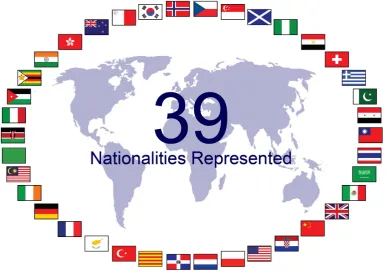
[image:9.595.118.506.443.720.2]A total of 204 postgraduate student responses were collected, with an almost even gender division between female (57%) and male (43%). Participants came from a variety of different backgrounds producing a varied first-degree profile. A total of 39 different nationalities were represented highlighting the large international community that already exists at the university (see Figure 1).
The most popular reason for selecting a particular course or field of study was the chance of enhancing employability (54%) which reinforces the need for close consultation with external stakeholders when identifying necessary graduate attributes. Approximately half of respondents (53%) stated that their research topic or course choice does not relate directly to sustainability issues and almost the same amount (48%) felt that not enough emphasis is placed on sustainability issues in their particular field of research / course choice. Significantly, 46% of respondents said that their current course does not give them the opportunity to mix with students from other disciplines and to learn inter-disciplinary skills, and a large majority (85%) feel that the chance to interact with other disciplines would be beneficial to their studies. Students were asked to rate in order of importance, the skills they believe are necessary in dealing with the main challenges posed by sustainable development in the context of their field of research (see Table 1). Interestingly, the results concurred with those from the external stakeholder group in their selection of the ‘ability to prioritise tasks and manage time’, closely followed by ‘knowledge of sustainability’. However they differed in their ratings of ‘knowledge of recent advances within your field’. Communication and networking skills were seen as more important as technical knowledge, which concurs with important skills identified in relevant case studies.
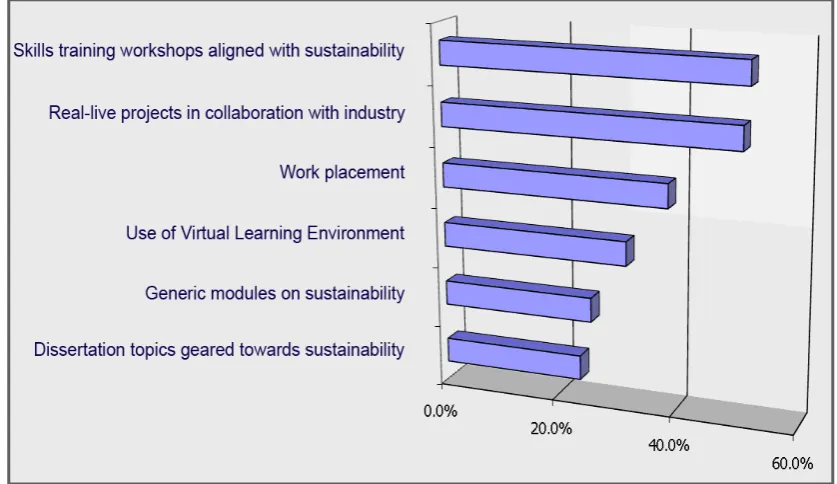
When asked how these skills could be incorporated into the curriculum there was a clear emphasis on ‘skills training workshops aligned with sustainability’ and ‘live projects in collaboration with industry’ as detailed in Figure 2.
Figure 2: Graph showing curriculum preferences in order to instil SD skills
5.3 External Consultation
[image:12.595.95.506.385.675.2]The external stakeholders contacted included government bodies, independent organisations, industry representatives and local authorities. A total of 23 organisations completed the survey and 18 indicated that they would like to have further input into developing the SMS programme. When asked the demands that sustainable development currently places in context of their particular field of work a large and varied range of responses was received indicating that this could vary depending on a particular field of work and would require more detailed consideration when consulting with individual faculties and representative external stakeholders about specific course content. The highest rated skills in order to deal with the demands of SD (Table 2) were an ability to prioritise tasks and manage time, followed by an ability to make strategic decisions based on a broad understanding of technical, economic, social, political and environmental considerations. However it should be noted that all skills received high ratings of 1 and 2, and were therefore seen as important.
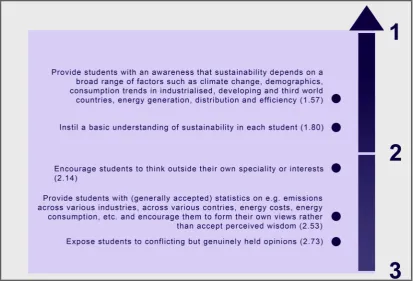
The two highest rated educational approaches seen as the most effective in helping students to develop these skills were firstly to provide students with an awareness that sustainability depends on a broad range of factors such as climate change, demographics, consumption trends in industrialised, developing and third world countries, energy generation, distribution and efficiency, and secondly to instil a basic understanding of sustainability in each student (see Figure 3).
Figure 3: Educational approaches to help students develop SD skills
Consultation findings
Through the multi-stakeholder consultation process it was confirmed that sustainable development (SD) is a priority for both students and employers. It was acknowledged that universities and higher education institutions, as centres of knowledge production & exchange, have the ability to lead the way in response to the sustainable development (SD) agenda, and that collaboration between universities, government and industry is needed. While the SMS initiative has emerged initially from concerns within architecture and engineering the view was upheld that the challenges of SD require responses from all disciplines and professions represented within the institution.
It was reinforced that an understanding of the complex issues involved in SD and interdisciplinary skills are core requirements. Teaching through skills training workshops and live projects in collaboration with industry are favoured methods of instilling these skills. The idea of introducing generic modules with flagship courses was well received by SMS Faculty Representatives and various suggestions offered as to how the structure of the SMS could be developed. Knowledge of sustainability can be instilled through generic modules which allow students of different disciplines to exchange ideas and work at a similar level. Difficulties occur when addressing more specific subject areas as students from different disciplines have varying levels of expertise and both should benefit from the experience. Interdisciplinary group projects allow students to gain practical interdisciplinary skills while at the same time developing technical skills in their specific area of study.
Sustainability Map
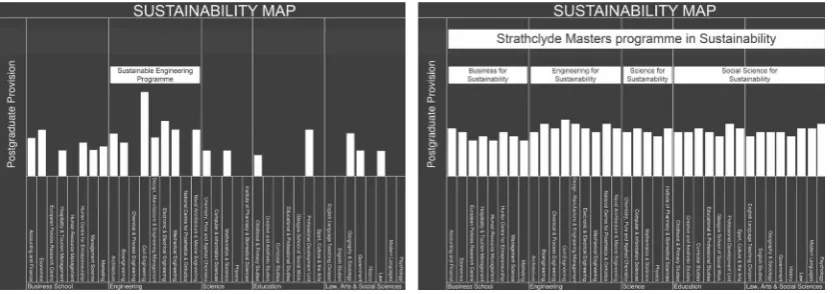
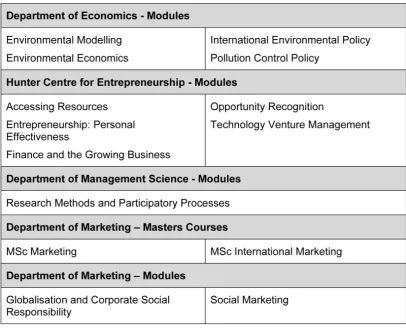
SMS Faculty Representatives and Heads of Department were asked to contribute to the creation of a Sustainability Map by detailing any current or future postgraduate courses or modules they felt could be aligned with ESD intended to inform future discussion focusing on the programme content of the SMS. Figure 4(a) shows general postgraduate ESD activity across the University and the Sustainable Engineering Programme running across the departments of the Engineering Faculty. This diagram was constructed using more detailed tables which list postgraduate courses and modules available under contributing departments, an example of which is given in Table 3. As expected there is a stronger presence of ESD within the Faculty of Engineering. This is concurrent with case studies which acknowledged ESD to be stronger in certain disciplines than others. There was also found to be a strong presence of external links with other HEI’s and industry, as well as internal collaboration with cross-departmental and cross-faculty courses sharing modules, which should be built upon. A future Sustainability Map is presented in Figure 4(b) showing a more even distribution across all subject disciplines and individual Sustainability ‘packages’ to be provided by each Faculty. It is envisaged that these sustainability packages could be based on an amended version of the current Sustainable Engineering package. Three main levels of activity are shown: the SMS programme provides university-wide CPD events, optional SD modules & literary / skills workshops and SD industry-based interdisciplinary group projects; Individual Faculty packages offer faculty-specific CPD events, optional modules and group projects; and finally Discipline-specific courses, modules & individual projects / dissertations.
[image:15.595.91.509.548.695.2]Table 3: Example of Masters courses and modules aligned by Departments within the Faculty of Law, Arts and Social Sciences
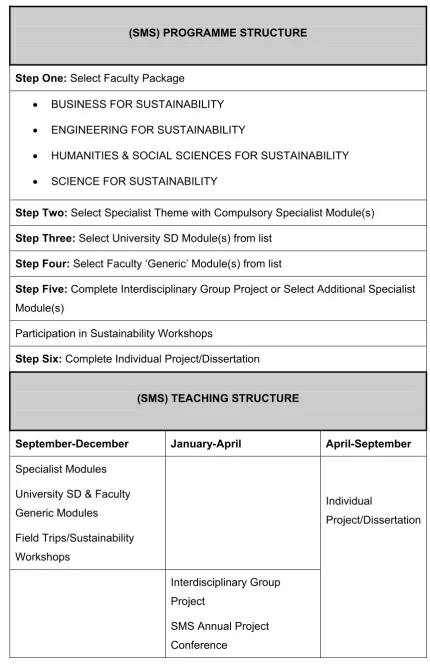
(SMS) PROGRAMME STRUCTURE
Step One: Select Faculty Package
• BUSINESS FOR SUSTAINABILITY
• ENGINEERING FOR SUSTAINABILITY
• HUMANITIES & SOCIAL SCIENCES FOR SUSTAINABILITY
• SCIENCE FOR SUSTAINABILITY
Step Two: Select Specialist Theme with Compulsory Specialist Module(s)
Step Three: Select University SD Module(s) from list
Step Four: Select Faculty ‘Generic’ Module(s) from list
Step Five: Complete Interdisciplinary Group Project or Select Additional Specialist Module(s)
Participation in Sustainability Workshops
Step Six: Complete Individual Project/Dissertation
(SMS) TEACHING STRUCTURE
September-December January-April April-September
Specialist Modules
University SD & Faculty Generic Modules
Field Trips/Sustainability Workshops
Interdisciplinary Group Project
SMS Annual Project Conference
Individual
[image:17.595.79.510.67.736.2]Project/Dissertation
Conclusion
As a leader in the field of ESD, the University of Strathclyde plans to develop a framework to implement a new Strathclyde Masters programme in Sustainability (SMS) which aims to promote and undertake a visionary programme of pan-University, cross-disciplinary research and postgraduate teaching in sustainable development. The SMS Project Management Team has examined the processes involved in developing such a framework and a number of conclusions have been drawn from each stage; the review of current thinking in ESD, the multi-stakeholder consultation process and the creation of a Sustainability Map of the University.
The definition and priorities of SD are complex and multi-layered and the challenges of SD, being inherently holistic, require responses from all disciplines and professions represented within the institution. However, the Sustainability Map has shown that the current level of provision of postgraduate ESD varies greatly across the University. This requires the development of a framework for pan-University, cross disciplinary teaching and the existing Masters Programme in Sustainable Engineering offers a model on which such a framework might be based.
References
Centre for Sustainable Futures Occasional Paper 3, Interdisciplinarity and Sustainability in the Higher Education Institution, (CSF, 2009)
Engineering Education for Sustainable Development, European sustainability rankings, Observatory Report,2008 (EESD, 2008)
Available online:
https://www.upc.edu/eesdobservatory/why/reports/EESD_Observer_2008_.pdf
Higher Education Academy (HEA), Sustainable Development in Higher Education, Current Practice and Future Developments – A Progress Report for Senior Managers in Higher Education (HEA, Jan 2006)
Higher Education Academy (HEA), Engineering Subject Centre Mini-Project Report, Engineering Education for Sustainable Development – Report of a Delphi Consultation (HEA, Apr 2008)
Higher Education Academy (HEA), Dr Alex Ryan, 2008 Review of Education for Sustainable Development (ESD) in Higher Education in Scotland – Final Report (HEA, Feb 2009)
The United Nations, World Summit on Sustainable Development in Johannesburg, South Africa, declared: United Nations Decade of Education for Sustainable Development (UNDESD, Johannesburg Summit, 2002)
United Nations Development Programme. (2007). The Human Development concept. Available: http://hdr.undp.org/en/humandev/. Last accessed 01 June 2010.
(UNDP, 2007)
UNESCO, Guidelines and Recommendations for Reorienting Teacher Education to Address Sustainability (UNESCO 2005)
UNESCO, Review of Contexts and Structures for Education for Sustainable Development 2009 (UNESCO 2009)
UNESCO, Quality Education, Equity and Sustainable Development (UNESCO, Nov 2008)