
Recent Developments in Competition Policy and Regional Aid: : Adjusting to a 'New Normal'
63
0
0
Full text
(2) European Policies Research Centre School of Government & Public Policy University of Strathclyde 40 George Street Glasgow G1 1QE United Kingdom Tel: +44 (0) 141 548 3061 Fax: +44 (0) 141 548 4898. e-mail: [email protected] [email protected] [email protected]. The place of useful learning The University of Strathclyde is a charitable body, registered in Scotland, number SC015263.
(3) Recent developments in Competition policy and regional aid: adjusting to a ‘new normal’. Table of Contents 1.. INTRODUCTION ............................................................................................................................. 1. 2.. TAKING STOCK OF RECENT DEVELOPMENTS ......................................................................... 3 2.1 2.1.1. Assisted area maps changes .......................................................................................... 3. 2.1.2. Review of ‘a’ areas in 2016 ............................................................................................. 3. 2.2. 3.. Uptake of the GBER and Notifications under RAG .............................................................. 7. 2.2.1. Regional aid under the GBER – the picture so far ........................................................... 7. 2.2.2. Notification under the RAG ............................................................................................. 9. 2.3. Evaluation requirements and aid approval ........................................................................ 11. 2.4. State aid, regional policy and definitional issues ............................................................... 17. 2.4.1. Some ‘no aid’ decisions ................................................................................................ 17. 2.4.2. No aid decisions – no effect on trade ............................................................................ 19. 2.4.3. Tax and State aid – horizontal enquiries and formal investigations ................................ 20. 2.4.4. Infrastructure and State aid – a work in progress .......................................................... 20. REGIONAL AID TO LARGE FIRMS IN THE NEW LEGAL ORDER ........................................... 23 3.1. The GBER ‘settles in’ – Commission responses to FAQs .................................................. 23. 3.1.1. ‘Initial investment’ and ‘initial investment in favour of new economic activities’ .............. 23. 3.1.2. New products and new activities ................................................................................... 25. 3.1.3. Establishment ............................................................................................................... 26. 3.1.4. Relocation .................................................................................................................... 27. 3.2. 4.. Assisted area coverage ...................................................................................................... 3. Regional aid and large firms: past and future perspectives ............................................... 27. 3.2.1. Impact of the changes in practice ................................................................................. 27. 3.2.2. Patterns of support for large firms ................................................................................. 29. DISCUSSION ISSUES .................................................................................................................. 33. ANNEX I: pour memoire – key changes in regional aid control 2014-20 v 2007-13 ..................... 34 ANNEX II: national assisted area maps 2014-20 .............................................................................. 44 ANNEX III: GBER 2014-20 aid schemes featuring ‘regional aid’ .................................................... 52 EoRPA RESEARCH ............................................................................................................................. 58. European Policies Research Paper No. 92. i. European Policies Research Centre.
(4) Recent developments in Competition policy and regional aid: adjusting to a ‘new normal’. European Policies Research Paper No. 92. ii. European Policies Research Centre.
(5) Recent developments in Competition policy and regional aid: adjusting to a ‘new normal’. 1. INTRODUCTION State aid control is completing its move to a new phase of development. In 2014 the Commission largely finished its reform programme, the State aid modernisation (SAM) initiative. This placed new emphasis on transparency, effectiveness and evaluation, recast the basis for the assessment and compliance of State aid across a range of policy areas and further increased the ‘self-policing’ element of State aid discipline. The main element of the reform package not (yet) achieved is the adoption of a Communication on the ‘notion’ of State aid. The reform agenda has been wide-ranging, and few aspects of regional aid control have been immune from change. The approval of all the assisted area maps by the European Commission or the EFTA Surveillance Authority under the 2014-20 Regional Aid Guidelines (RAG) provided the basis for the introduction of new aid schemes mainly on the basis of the 2014-20 General Block Exemption Regulation (GBER). The last year or so has seen the implementation of regional aid schemes on the basis of these new rules. The new RAG and GBER place further constraints on the use of regional aid, particularly in terms of the use of regional aid to large firms in the so-called ‘c’ areas. For some Member States, this is an important policy change, with direct implications for the conduct of regional policy; for others there is limited impact since large firms rarely received regional aid anyway and have not traditionally been the target of policy. Fewer aid schemes will be subject to direct scrutiny by the Commission since the scope of the GBER has been broadened to encompass measures with which the Commission considered it had had sufficient experience and could exempt. However, the implementation of the GBER has not been trouble-free: Commissioner Vestager has noted that almost a third of cases reported on the basis of the GBER have ‘issues’; given that the Commission expects up to 90 percent of aid measures to be covered by the GBER, this is a significant error rate. In addition, uncertainties among domestic policymakers have led DG Competition to produce a response to ‘Frequently Asked Questions’; this runs to some 42 pages – more than half the length of the Regulation itself. However, not only does this document fail to address all the interpretation questions raised (only the most common ones to date), but it is also not binding on the Commission as an institution. An important development in the recent State aid reforms has been the emphasis on evaluation. Under both the RAG and the GBER, approval of regional aid schemes can be subject to evaluation plans negotiated with the Commission. Under the GBER, this applies where the estimated annual budget exceeds €150 million. For some countries this limit is well above likely regional aid spend, but for others there have been sometimes intense negotiations over the type of evaluation that should be undertaken. In due course, the outcome of evaluations may have direct implications for the Commission’s willingness to extend approval of the schemes concerned. The definition of State aid remains an issue for many – in fact, in some policy areas, the GBER seems to bring measures within the ambit of State aid that some domestic policymakers had not hitherto considered to involve aid at all, blurring the distinction between the presence of aid and the compatibility of aid with the Treaty. The notice on the ‘notion of State aid’ remains in draft form, but while the new Commissioner has decided to reflect on this issue, she has also signalled her intention. European Policies Research Paper No. 92. 1. European Policies Research Centre.
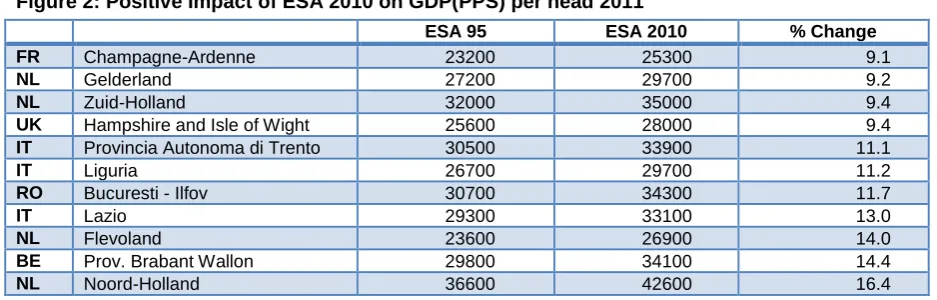
(6) Recent developments in Competition policy and regional aid: adjusting to a ‘new normal’. to propose a Communication for adoption by the Commission. In parallel, and related, a working group on designing infrastructure projects that do not raise issues under State Aid Law is being established by DG Competition. Meanwhile, a number of cases have begun to shed some light on the views of the Commission as to where the edges of the definition lie. Recent developments in regional aid have been characterised by a degree of ‘bedding in’. Although substantial changes have taken place, some unresolved issues remain, and there is a degree of dissatisfaction with the parameters and demands of the new GBER. The aim of this paper is to provide an overview and update of regional aid control issues as Member State introduce measures and adapt to the new regime. Section 2 takes stock of the progress with implementing regional aid under the new rules, reviewing, among other things, the uptake of the GBER and the Commission’s emerging stance on evaluations, as well as some recent developments in the definition of State aid. Section 3 reflects on the changes to treatment of regional aid to large firms, reviewing both the Commission’s response to “FAQs” on the GBER and past patterns of aid to large projects. Section 4 concludes by highlighting some questions and issues for discussion. Annexed to the paper are: (i) a brief outline of the main features of the recent reforms in relation to regional aid, providing a reference point on some of the key changes discussed in the body of the paper, aid rates and assisted area coverage across countries; (ii) copies of the available assisted area maps approved in 2014; (iii) a listing the schemes known to have been reported under GBER 2014 to date.. European Policies Research Paper No. 92. 2. European Policies Research Centre.
(7) Recent developments in Competition policy and regional aid: adjusting to a ‘new normal’. 2. TAKING STOCK OF RECENT DEVELOPMENTS Against the backdrop of the major changes to the legislative context summarised in ANNEX I: pour memoire – key changes in regional aid control 2014-20 v 2007-13, this section takes stock of recent developments largely resulting from the new regulatory context.. 2.1. Assisted area coverage. 2.1.1 Assisted area maps changes Two countries have made small amendments to their assisted area maps within the last year. In both cases, a small population reserve had been left to deal with unforeseen circumstances. In France, this amounted to two percent of the ‘c’ population; in Finland, the reserve amounted 0.669 percent of the national population. In Finland the regions of Viitasaari-Pihtipudas and Äänekoski (representing 1.7 percent of the population coverage) have been added to Aid Area 2 on the basis of their employment-related socioeconomic indicators. The decision by the ministerial group to extend the support area was taken in November 2014 and approved by the Commission in April 2015 (see annex II: national assisted area maps 2014-20 for amended map). Viitasaari-Pihtipudas and Äänekoski were designated on the basis of high unemployment and as it was considered they would benefit from higher aid levels especially in connection with the bioproduction facility planned in Äänekoski, which in turn is expected to accelerate the investments in the supply chain and other businesses. In June 2015, the Commission approved the extension of the regional aid map for France using 26 percent of the population reserve of 233,757 inhabitants. This concerns five municipalities in Burgundy and one in Champagne-Ardenne as non-predefined ‘c’ areas in accordance with Criterion 1 of RAG 2014-20. Criterion 1 concerns contiguous areas of at least 100,000 inhabitants located in NUTS 2 or NUTS 3 regions that have a GDP per capita below or equal to the EU-27 average, or an unemployment rate of 115 percent or more of the national average. All municipalities involved have a GDP below the EU-27 average, and belong to a larger zone of more than 100,000 inhabitants (the municipality in Champagne-Ardenne is part of an assisted area with 845,108 inhabitants, the five in Burgundy are part of an area with 124,562 inhabitants).. 2.1.2 Review of ‘a’ areas in 2016 It is worth recalling that RAG 2014-20 makes provision for a limited review of assisted area coverage in 2016.1 Specifically, the Commission will establish whether any NUTS 2 region which is not listed as an ‘a’ region in Annex I to the Guidelines has GDP per capita below 75 percent of the EU28 average. This will use the most recent data available at the time and will be based on the three-year average. The Commission will publish a Communication on the results, but the impact of these results is not entirely clear. RAG 2014-20 notes that the Commission will “establish at that moment whether these. 1. RAG 2014-20, para 183-5.. European Policies Research Paper No. 92. 3. European Policies Research Centre.
(8) Recent developments in Competition policy and regional aid: adjusting to a ‘new normal’. identified areas may become eligible for regional aid under Article 107(3)(a)…” which implies a degree of discretion on the part of the Commission, irrespective of the outcome of the analysis. Also unclear, is the impact on existing assisted areas: “if these identified areas are designated either as pre-defined ‘c’ areas or as non-predefined ‘c’ areas in the national regional aid map… the percentage of the specific allocation for ‘c’ areas indicated in Annex I will be adjusted accordingly…. A Member State may, within the limit of its adjusted specific allocation for ‘c’ areas, amend the list of ‘c’ areas contained in its regional aid map for the period from 1 January 2017 to December 2020. These amendments may not exceed 50 percent of each Member States’ adjusted ‘c’ coverage”. This can be read as suggesting that changes to ‘c’ areas are only open to Member States where there have been changes in ‘a’ region coverage; however, if this is so, it is unclear why changes to ‘c’ area coverage are so restrictive. Designation of ‘a’ regions for 2014-20 was based on GDP data for 2008-10. Regional GDP data are currently available in Eurostat to 2013 for many but not all countries. It seems probable that the reassessment of ‘a’ region coverage will be based on 2011-13, or possibly 2012-14 data. As well as changes in the economic situation, the new GDP data will also be based on a different methodology – ESA 2010, as opposed to ESA 95. 2 The main changes in the methodology relate to the capitalisation of expenditure on research and development and on weapons; this expenditure is now counted as investment. As well as revised concepts and definitions, ESA 2010 also incorporates statistical ‘improvements’ such as the integration of new or updated sources and better measurement, for instance of the way in which illegal activities are accounted for in GDP. 3 For the EU28, methodological changes revised 2010 GDP upwards by 2.3 percent, of which the bulk (1.9 percent) is accounted for by the capitalisation of R&D expenditure. At country level, the impact is variable. Methodological changes had the most impact in Sweden and Finland where 2010 GDP increased by 4.4 percent and 4.2 percent, respectively (in each case 4 percent being due to the capitalisation of R&D). The largest changes resulting from statistical improvements were in Cyprus (8.4 percent) and the Netherlands (5.9 percent). These changes carry through to the regional level: in the majority of cases (240 NUTS II regions) 4 there is an increase in GDP; in 31 regions there is a decrease; and in the remaining nine, there is no change. However, the regional differences are more extreme than those at national level: in 11 regions the change results in a fall in GDP per capita of more than two percent.. 2. The change in methodology is worldwide – ESA 2010 is the European counterpart of the 2008 SNA adopted by the United Nations Statistical Commission and already implemented in the USA, Australia and Canada. 3 First estimation of European aggregates based on ESA 2010, Eurostat newsrelease 154/2014 of 17 October 2014 4 Including the Norwegian NUTS II regions.. European Policies Research Paper No. 92. 4. European Policies Research Centre.
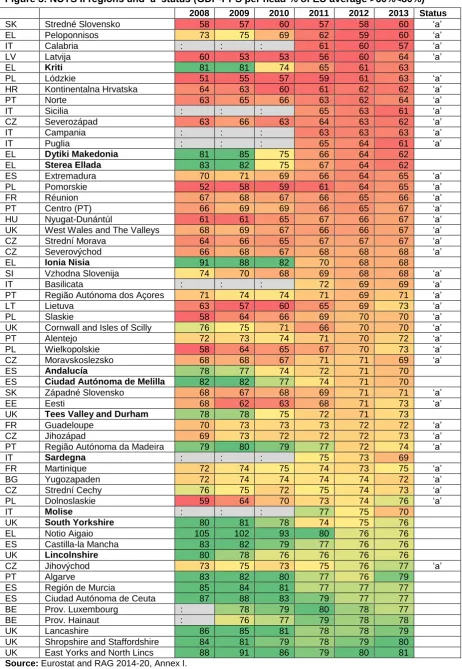
(9) Recent developments in Competition policy and regional aid: adjusting to a ‘new normal’. Figure 1: Negative Impact of ESA 2010 on GDP(PPS) per head 2011 PT EL NL EL EL EL NL ES EL ES BG. Região Autónoma da Madeira Dytiki Makedonia Zeeland Notio Aigaio Ionia Nisia Sterea Ellada Friesland La Rioja Kriti Cantabria Yugoiztochen. ESA 95 24900 20000 31000 22300 18900 18100 26300 27200 17300 23500 9500. ESA 2010 20100 17200 27300 20800 18100 17400 25400 26500 16900 23000 9300. % Change -19.3 -14.0 -11.9 -6.7 -4.2 -3.9 -3.4 -2.6 -2.3 -2.1 -2.1. Source: Own calculations from Eurostat data. At the opposite end of the spectrum, a number of regions see an uplift in GDP per head of over nine percent. Figure 2: Positive Impact of ESA 2010 on GDP(PPS) per head 2011 FR NL NL UK IT IT RO IT NL BE NL. Champagne-Ardenne Gelderland Zuid-Holland Hampshire and Isle of Wight Provincia Autonoma di Trento Liguria Bucuresti - Ilfov Lazio Flevoland Prov. Brabant Wallon Noord-Holland. ESA 95 23200 27200 32000 25600 30500 26700 30700 29300 23600 29800 36600. ESA 2010 25300 29700 35000 28000 33900 29700 34300 33100 26900 34100 42600. % Change 9.1 9.2 9.4 9.4 11.1 11.2 11.7 13.0 14.0 14.4 16.4. Source: Own calculations from Eurostat data. Looking towards the mid-term review of ‘a’ region status, indications from 2013 data are that some additional regions would qualify as ‘a’ regions, compared to the outcome presented in RAG 2014-20.5 The countries potentially affected would be Greece, Spain, Italy and the United Kingdom (see Figure 3): . In Greece, four regions which do not currently have ‘a’ status fall well below the 75 percent threshold on the basis of 2011-13 data.. . In Spain, Andalucía and Melilla would qualify.. . In Italy, Molise and Sardegna appear likely to be below 75 percent in the qualifying period.. . In the United Kingdom, Tees Valley falls well under the threshold based on 2011-13 data, while South Yorkshire and Lincolnshire appear to be close to the cut-off.. Interestingly, there is only one region, Jihovýchod (CZ), which appears to have ‘outgrown’ ‘a’ region status – though RAG 2014-20 does not envisage changes to current ‘a’ regions.. 5. RAG 2014-20, Annex I.. European Policies Research Paper No. 92. 5. European Policies Research Centre.
(10) Recent developments in Competition policy and regional aid: adjusting to a ‘new normal’. Figure 3: NUTS II regions and ‘a’ status (GDP-PPS per head % of EU average >60%<80%) 2008 SK Stredné Slovensko 58 EL Peloponnisos 73 IT Calabria : LV Latvija 60 Kriti EL 81 PL Lódzkie 51 HR Kontinentalna Hrvatska 64 PT Norte 63 IT Sicilia : CZ Severozápad 63 IT Campania : IT Puglia : Dytiki Makedonia EL 81 Sterea Ellada EL 83 ES Extremadura 70 PL Pomorskie 52 FR Réunion 67 PT Centro (PT) 66 HU Nyugat-Dunántúl 61 UK West Wales and The Valleys 68 CZ Strední Morava 64 CZ Severovýchod 66 Ionia Nisia EL 91 SI Vzhodna Slovenija 74 IT Basilicata : PT Região Autónoma dos Açores 71 LT Lietuva 63 PL Slaskie 58 UK Cornwall and Isles of Scilly 76 PT Alentejo 72 PL Wielkopolskie 58 CZ Moravskoslezsko 68 Andalucía ES 78 Ciudad Autónoma de Melilla ES 82 SK Západné Slovensko 68 EE Eesti 68 Tees Valley and Durham UK 78 FR Guadeloupe 70 CZ Jihozápad 69 PT Região Autónoma da Madeira 79 Sardegna IT : FR Martinique 72 BG Yugozapaden 72 CZ Strední Cechy 76 PL Dolnoslaskie 59 Molise IT : South Yorkshire UK 80 EL Notio Aigaio 105 ES Castilla-la Mancha 83 Lincolnshire UK 80 CZ Jihovýchod 73 PT Algarve 83 ES Región de Murcia 85 ES Ciudad Autónoma de Ceuta 87 BE Prov. Luxembourg : BE Prov. Hainaut : UK Lancashire 86 UK Shropshire and Staffordshire 84 UK East Yorks and North Lincs 88 Source: Eurostat and RAG 2014-20, Annex I.. European Policies Research Paper No. 92. 2009 57 75 :. 2010 60 69 :. 53 81 55 63 65 :. 53 74 57 60 66 :. 66 : :. 63 : :. 85 82 71 58 68 69 61 69 66 68 88 70 :. 75 75 69 59 67 69 65 67 65 67 82 68 :. 74 57 64 75 73 64 68 77 82 67 62 78 73 73 80 :. 74 60 66 71 74 65 67 74 77 68 63 75 73 72 79 :. 74 74 75 64 :. 75 74 72 70 :. 81 102 82 78 75 82 84 88 78 76 85 81 91. 6. 78 93 79 76 73 80 81 83 79 77 81 79 86. 2011 57 62 61 56 65 59 61 63 65 64 63 65 66 67 66 61 66 66 67 66 67 68 70 69 72 71 65 69 66 71 67 71 72 74 69 68 72 73 72 77 75 74 74 75 73 77 74 80 77 76 75 77 77 79 80 79 78 78 79. 2012 58 59 60 60 61 61 62 62 63 63 63 64 64 64 64 64 65 65 66 66 67 68 68 68 69 69 69 70 70 70 70 71 71 71 71 71 71 72 72 72 73 73 74 74 74 75 75 76 76 76 76 76 77 77 78 78 78 79 80. 2013 60 60 57 64 63 63 62 64 61 62 63 61 62 62 65 65 66 67 67 67 67 68 68 68 69 71 73 70 70 72 73 69 70 70 71 73 73 72 73 74 69 75 72 73 76 70 76 76 76 76 77 79 77 77 77 78 79 80 81. Status ‘a’ ‘a’ ‘a’ ‘a’ ‘a’ ‘a’ ‘a’ ‘a’ ‘a’ ‘a’ ‘a’. ‘a’ ‘a’ ‘a’ ‘a’ ‘a’ ‘a’ ‘a’ ‘a’ ‘a’ ‘a’ ‘a’ ‘a’ ‘a’ ‘a’ ‘a’ ‘a’ ‘a’ ‘a’ ‘a’ ‘a’ ‘a’ ‘a’ ‘a’ ‘a’ ‘a’ ‘a’. ‘a’. European Policies Research Centre.
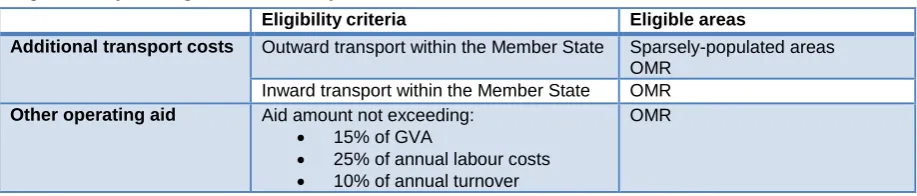
(11) Recent developments in Competition policy and regional aid: adjusting to a ‘new normal’. 2.2. Uptake of the GBER and Notifications under RAG. Recent changes to the regional aid rules have expanded the scope of the GBER to enable a wider range of schemes simply to be reported rather than requiring prior approval. The key extensions in relation to regional aid concern specific types of operating aid and ad hoc aid that otherwise meets the GBER conditions. GBER 2014-20 extends the block exemption to cover types of operating aid that had been routinely approved under RAG 2007-13.6 However, not all operating aid schemes will fall within the GBER and those excluded will be assessed under RAG 2014-20. Operating aid under the GBER falls into two main groups: . Transport aid in sparsely-populated areas and OMR. . Operating aid other than transport costs in the OMR only. Figure 4: Operating aid covered by the GBER Additional transport costs. Other operating aid. Eligibility criteria. Eligible areas. Outward transport within the Member State. Sparsely-populated areas OMR OMR OMR. Inward transport within the Member State Aid amount not exceeding: 15% of GVA 25% of annual labour costs 10% of annual turnover. Source: GBER, Article 15.. The extension of the GBER to include ad hoc aid that otherwise meets the criteria of the GBER may facilitate the use of ‘packages’ of support offered by different agencies to a single project. In addition, in Poland, regional aid awards were made on the basis of individual ‘ordinances’ which were treated as ad hoc aid and notifiable to the Commission under GBER 2008-13 for assessment under RAG 2007-13. Under GBER 2014-20, such awards fall within the scope of the block exemption. However, the ‘incentive effect’ criterion is relatively demanding for ad hoc regional aid to large firms insofar as the Member State must verify that the project would not have been carried out in the area concerned or would not have been sufficiently profitable for the beneficiary in the area concerned in the absence of aid.7 Whilst domestic policymakers might want to assure themselves that proposed aid would have such an effect, being able to ‘verify’ this is quite demanding. The requirements for ‘incentive effect’ are less onerous in the case of aid schemes (although the Commission had initially sought more stringent terms), so domestic policymakers would have an interest in only offering such aid within aid schemes.. 2.2.1 Regional aid under the GBER – the picture so far GBER 2014-20 places considerable emphasis on transparency and reinforces the obligations on Member States in information provision. Indeed, by June 2016, Member States are to have a comprehensive State aid website at national or regional level providing: . summary information on each exempted aid measure in the standardised format (or a link to it);. 6 7. GBER 2014-20, Article 15. GBER 2014-20, Article 6(3)(a).. European Policies Research Paper No. 92. 7. European Policies Research Centre.
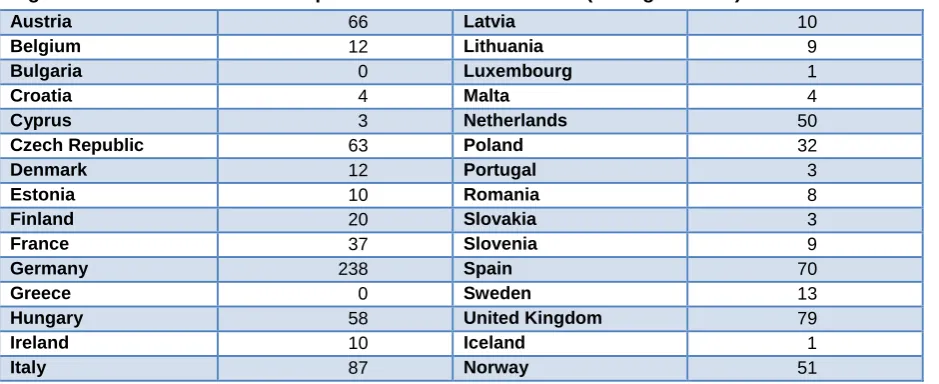
(12) Recent developments in Competition policy and regional aid: adjusting to a ‘new normal’. . full text of each exempted measure or a link to it. . information on each individual award exceeding €500,000.. At present, it appears that most national authorities are some way from providing such comprehensive information sources. Moreover, the Commission’s database of cases, which should provide easy access all GBER 2014-20 exempted schemes, has apparently faced technical problems with the result that it is not yet straightforward to identify all relevant aid measures. By August 2015, some 911 schemes had been reported by EU Member State under GBER 2014-20, with a further 52 by the EFTA countries. Only Bulgaria and Greece (and Lichtenstein) appear not to have reported schemes on the basis of the block exemption. 8 Figure 5: Number of schemes reported under GBER 2014-20 (at August 2015) Austria Latvia 66 10 Belgium Lithuania 12 9 Bulgaria Luxembourg 0 1 Croatia Malta 4 4 Cyprus Netherlands 3 50 Czech Republic Poland 63 32 Denmark Portugal 12 3 Estonia Romania 10 8 Finland Slovakia 20 3 France Slovenia 37 9 Germany Spain 238 70 Greece Sweden 0 13 Hungary United Kingdom 58 79 Ireland Iceland 10 1 Italy Norway 87 51 Source: DG COMP database: http://ec.europa.eu/competition/elojade/isef/index.cfm?clear=1&policy_area_id=3 and EFTA Surveillance Authority State aid register: http://www.eftasurv.int/state-aid/state-aid-register/. In the specific context of regional aid, the way in which schemes have been reported – typically covering a wide range of policy objectives within a given measure – makes it quite difficult to assess the real extent to which the regional aid provisions are being used, or the budgets being allocated specifically to regional aid schemes. Schemes that have been reported under GBER 2014-20 to date and include regional investment aid 9 are listed in Annex III. In many countries this reveals a number of schemes where clearly the regional aid element is minor or incidental, as well as a wide range of budget allocations and schemes offered by various tiers of government within countries. As a result, this listing includes a number of measures that regional policymakers would not regard as falling within their portfolio, as well as major regional aid schemes, some of which are substantial enough to have been caught by the evaluation plan requirement, which discussed further below. One interesting point to note is the ‘umbrella’ approach taken to GBER cover in a few instances. In France and in the UK, aid ‘frameworks’ have been reported under the GBER providing cover for aid schemes operated by different tiers of government. The advantage of this approach lies having a single text which (assuming it is implemented accurately) provides a secure single legal basis under which a range of agencies can offer aid without a proliferation of legal bases and weblinks. On the 8. Clearly there is a potential timing issue here and these totals may not accord with national records depending on possible delays in including reports within the DG COMP database. 9 GBER 2014-20, Article 14.. European Policies Research Paper No. 92. 8. European Policies Research Centre.
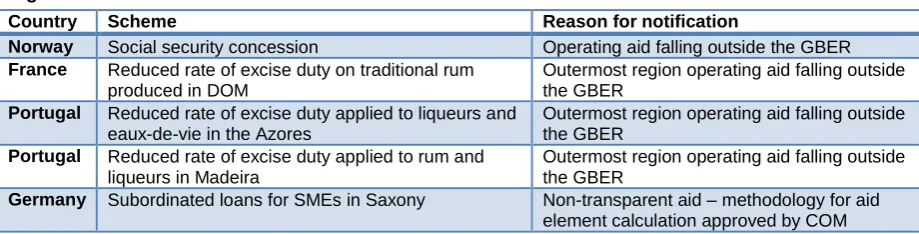
(13) Recent developments in Competition policy and regional aid: adjusting to a ‘new normal’. other hand, reporting is still required by all those availing themselves of GBER cover; the coordination of this across multiple organisations could be onerous. In addition, under the new provisions, there is the issue of being certain, ex ante, that the €150 million annual threshold will not be exceeded when decisions on spending do not lie with the party reporting the measure under the GBER.. 2.2.2 Notification under the RAG One of the Commission’s key objectives under the State aid modernisation initiative was to reduce the number of cases which it was required to scrutinise individually and to focus its attention on measures most likely to have serious implications for competition. To date, just five schemes have come to be scrutinised on the basis of RAG 2014-20. Three of these concern reduction of excise duties in the Outermost regions. Figure 6: Schemes notified under RAG 2014-20 Country Norway France. Scheme Social security concession Reduced rate of excise duty on traditional rum produced in DOM Reduced rate of excise duty applied to liqueurs and eaux-de-vie in the Azores Reduced rate of excise duty applied to rum and liqueurs in Madeira Subordinated loans for SMEs in Saxony. Reason for notification Operating aid falling outside the GBER Outermost region operating aid falling outside the GBER Portugal Outermost region operating aid falling outside the GBER Portugal Outermost region operating aid falling outside the GBER Germany Non-transparent aid – methodology for aid element calculation approved by COM Source: DG COMP database: http://ec.europa.eu/competition/elojade/isef/index.cfm?clear=1&policy_area_id=3 and EFTA Surveillance Authority State aid register: http://www.eftasurv.int/state-aid/state-aid-register/. The German (Sachsen) case essentially concerns the approval by the Commission of a proposed methodology for assessing the aid element in a loan scheme. The precise nature and terms of the loan meant that the gross grant equivalent could not readily be calculated simply on the basis of the reference rates and the scheme was not ‘transparent’ within the meaning of the GBER. The most significant decision taken to date on the basis of RAG 2014-20 is the EFTA Surveillance Authority decision in June 201410 to approve the regionally-differentiated social security contributions in Norway for 2014-20. The decision is based on the ESA Guidelines on Regional Aid, 11 which are analogous to RAG 2014-20 for the sectors covered by the EEA agreement. 12 The Norwegian social security concession is distinctive in several respects. First, it constitutes regional operating aid, which is rarely approved under the regional aid rules and then only in closelydefined circumstances. Second, assisted areas for operating aid are different from those for investment aid – they are not based on the population ceilings or designation criteria set out in the RAG, but rather subject to a separate assessment by the Commission, or, in this case, ESA. Third, the scheme is extremely large – annual spend is around NOK 13 billion – some €1.4 billion, of which around half is accounted for by undertakings engaged in economic activities. In other words, about €936 million involves State aid with the remainder accounted for by, for example, public sector bodies not engaged in economic activities, and therefore not State aid recipients. 10. EFTA Surveillance authority Decision of 18 June 2014 on regionally-differentiated social security contributions 2014-20 (Norway), Dec no: 225/14/COL: http://www.eftasurv.int/media/decisions/225-14-COL.pdf 11 http://www.eftasurv.int/media/state-aid-guidelines/Part-III.pdf 12 The EEA Agreement does not cover the common agriculture and fisheries policies.. European Policies Research Paper No. 92. 9. European Policies Research Centre.
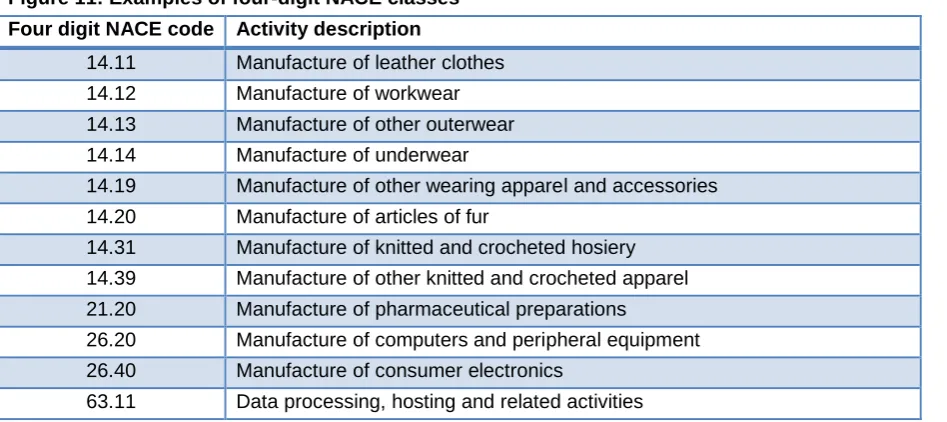
(14) Recent developments in Competition policy and regional aid: adjusting to a ‘new normal’. There was considerable controversy over the approval of the scheme. Perhaps surprisingly, given recent population trends in Norway, the controversy did not concern the assisted area coverage of the scheme. The Norwegian authorities proposed an increase in coverage compared to 2007-13, with the population rising from 17.7 percent 13 to 21.1 percent of the population, but the assisted area map proposals proved uncontentious. By contrast, the sectoral focus of the scheme was the subject of intense negotiations. The previous scheme (2007-2013) had been available to all sectors of activity, with the exception of steel and shipbuilding.14 The new scheme was made subject to the sectoral restrictions introduced under RAG 2014-20, most notably the exclusion of the transport and energy sectors, but also the financial and insurance sectors. These had hitherto been eligible on the basis of the ‘horizontal’ nature of the scheme. The Norwegian authorities argued vigorously for the horizontal approach to be maintained and for precise definitions of the sectors subject to limitations under the RAG and GBER. 15 This approach was rejected by ESA, in league with the Commission, but ESA did specify more closely which sectors would be ineligible.16 These are: . Steel17. . Synthetic fibres18. . Transport – namely, the transport of passengers by aircraft, maritime transport, road or rail and by inland waterway or freight transport services for hire or reward, ie. 19 o. NACE 49: land transport and transport via pipelines, excluding: NACE 49.32 taxi operation; NACE 49.42 removal services; and NACE 49.5 transport via pipeline. o. NACE 50: water transport. o. NACE 51: air transport, excluding NACE 51.22 space transport.. . Airports. . Energy – here the ESA decision refers to the GBER, noting the definition of the energy sector. 20. as “energy generation, transmission and infrastructure”. On this basis it concludes that the entire NACE division 35 should be excluded. 21 . Financial and insurance activities (NACE Section K). 22. 13. Though the population living in the assisted area had declined to around 16.6 percent. EFTA SURVEILLANCE AUTHORITY DECISION of 19 July 2006 on the notified scheme concerning regionally differentiated social security contributions (Norway), Decision No: 228/06/COL, http://www.eftasurv.int/media/esadocs/physical/10178/data.pdf 15 Letter from the Ministers for Local Government and Modernisation and Finance, 28 April 2014: http://www.regjeringen.no/upload/KMD/REGA/letter_almunia_29_4_2014.pdf 16 Somewhat curiously, perhaps, the shipbuilding sector, which was previously excluded, now appears to be eligible. 17 RAG 2014-20, Annex IV; ESA RAG 2014-20, Annex II 18 RAG 2014-20, Annex IV; ESA RAG 2014-20, Annex II(a) 19 This corresponds to the definition in GBER 2014-20, Article 2(45). 20 RAG 2014-20, para 11. 21 Section 35 includes the activity of providing electric power, natural gas, steam, hot water and the like through a permanent infrastructure (network) of lines, mains and pipes. The dimension of the network is not decisive; also included are the distribution of electricity, gas, steam, hot water and the like in industrial parks or residential buildings. This section therefore includes the operation of electric and gas utilities, which generate, control and distribute electric power or gas. Also included is the provision of steam and air-conditioning supply. However, Section 35 excludes the production of crude petroleum, the mining and extraction of oil from oil shale and oil sands and the production of natural gas and recovery of hydrocarbon liquids (Division 06). Section 35 also excludes the (typically long-distance) transport of gas through pipelines, see: Statistical Classification of economic activities in the European Community, NACE Rev. 2, see: http://epp.eurostat.ec.europa.eu/cache/ITY_OFFPUB/KS-RA-07-015/EN/KS-RA-07-015-EN.PDF 14. European Policies Research Paper No. 92. 10. European Policies Research Centre.
(15) Recent developments in Competition policy and regional aid: adjusting to a ‘new normal’. . Undertakings performing intra-group activities and whose principal activity falls under NACE classes 70.10.23. The compatibility assessment itself appears rather mechanistic, though the substance of the underlying discussions is not always easy to discern. In the context of proportionality, for example, the decision appears simply to accept the rates proposed by the Norwegian authorities (which are themselves rolled forward from 2007-13) without attempting explicitly to calibrate these with regional disparities. More noteworthy are the conditions attached to the evaluation of the scheme. This must be delivered to ESA by end 2018 and quite stringent criteria are associated with the goals and conduct of the evaluation. This is discussed in more detail below. A final point to note is that ESA’s decision approving the scheme has been challenged before the EFTA Court. The case, brought by Kimek Offshore AS, a company with operations in northern Norway, involves an action for annulment of the ESA decision on the grounds that it failed in its obligation to open the investigative procedure or to state the reasons on which aspects of its decision were made. The substantive part of the decision at issue concerns the availability of the concession to undertakings registered outside the aid area hiring workers employed within it. Whilst the applicant sought an annulment of the decision as a whole, it also argued for the ‘severability’ of the part of the decision concerning mobile workers. The case was heard in July 2015, but the Court has not yet released its findings.24. 2.3. Evaluation requirements and aid approval. Among the new developments in both RAG 2014-20 and GBER 2014-20 is the scope for the Commission to make aid authorisation conditional on its approval of an evaluation plan. RAG 2014-20 provides the possibility for the Commission to limit the validity of aid schemes to four years in order for an evaluation to be carried out. 25 The precise terms of any requirement to undertake an evaluation. 26. are defined in the approval of the aid measure. However, evaluations must by. undertaken by experts independent from granting authorities, on the basis of a common methodology (which the Commission may provide) and must be made public. The circumstances in which an evaluation would be imposed as a condition of approval are limited to those with large budgets, schemes with novel characteristics or in areas where significant market, technological or regulatory changes are envisaged. Evaluations must be carried out in sufficient time for the results to feed in to the Commission decision on any extension of the scheme proposed, or at expiry. 27 GBER 2014-20 provides for the expiry of GBER cover after six months for schemes with annual budgets exceeding €150 million, pending the approval by the Commission of an appropriate evaluation plan. In effect, this means that unless a Member State is able to provide an evaluation plan 22. RAG 2014-20, para 17. Ibid. 24 Case E23/14, see: http://www.eftacourt.int/uploads/tx_nvcases/23_14_RH_EN.pdf 25 RAG 2014-20, para 27. 26 See also: http://ec.europa.eu/competition/state_aid/modernisation/evaluation_issues_paper_en.pdf 27 RAG 2014-20, para 144. 23. European Policies Research Paper No. 92. 11. European Policies Research Centre.
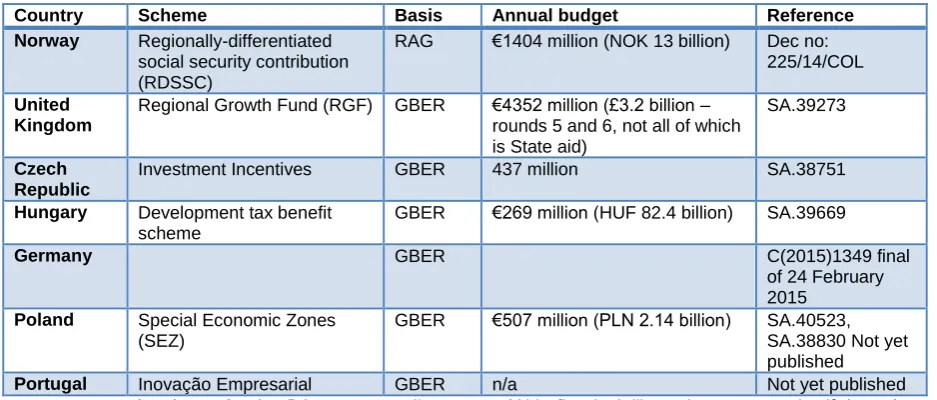
(16) Recent developments in Competition policy and regional aid: adjusting to a ‘new normal’. that is acceptable to the Commission, then GBER cover would be withdrawn and the scheme in question would need to be notified. As the whole scheme would then be subject to appraisal under RAG 2014-20, with the delays inherent in the notification process, there is a strong incentive for domestic policymakers to reach early agreement with the Commission on the evaluation plan. GBER 2014-20 sets out the minimum requirements for an evaluation plan; 28 this should set out: . the objectives of the aid scheme. . evaluation questions. . result indicators. . the methodology envisaged. . data collection requirements. . proposed timing, including the date of submission of the final report. . description of the independent body conducting the evaluation or the criteria to be used for selecting the evaluator. . mechanisms for publicising the evaluation.. A provisional supplementary information sheet for the submission of an evaluation plan is available. Its use is not yet mandatory as this requires changes to the Implementing Regulation. However, its use is recommended and it refers Member States to a staff working document on a common methodology for evaluation.29 A version of this document had been subject to consultation at the end of 2013, and many Member States expressed concern at the ambition of the proposal and, more fundamentally, at the competence of the Commission to require the evaluations of the effectiveness of measures financed with purely domestic resources. Nevertheless, the Commission view seems largely to have prevailed. By August 2015, evaluation plans had been approved for several regional aid schemes, though not all the decisions had been published by the Commission.. 28. GBER 2014-20, Article 2(14). Commission Staff Working Document "Common methodology for State aid evaluation, 28 May 2014, SWD(2014) 179 final http://ec.europa.eu/competition/state_aid/modernisation/state_aid_evaluation_methodology_en.pdf 29. European Policies Research Paper No. 92. 12. European Policies Research Centre.
(17) Recent developments in Competition policy and regional aid: adjusting to a ‘new normal’. Figure 7: Evaluation plans approved under RAG and GBER Country Norway. United Kingdom Czech Republic Hungary. Scheme Regionally-differentiated social security contribution (RDSSC) Regional Growth Fund (RGF). Basis RAG. Annual budget €1404 million (NOK 13 billion). Reference Dec no: 225/14/COL. GBER. SA.39273. Investment Incentives. GBER. €4352 million (£3.2 billion – rounds 5 and 6, not all of which is State aid) 437 million. Development tax benefit scheme. GBER. €269 million (HUF 82.4 billion). SA.39669. Germany. SA.38751. GBER. C(2015)1349 final of 24 February 2015 Poland Special Economic Zones GBER €507 million (PLN 2.14 billion) SA.40523, (SEZ) SA.38830 Not yet published Portugal Inovação Empresarial GBER n/a Not yet published Note : A French scheme for the Départements d’outre mer (Aide fiscale à l’investissement productif) has also had an evaluation plan approved on the basis of the regional aid rules, but DOM policies are not considered part of regional policy per se in France.. The approval of the social security concession in Norway by ESA30 provides for quite an exhaustive evaluation designed to assess: 1. The impact of the scheme on job opportunities and employment in the eligible regions, using results indicators that measure the impact which lowering employment costs through the scheme has on: a. Labour market participation rates b. Employment growth in the public and private sector c.. Wage formation and household disposable income. d. Industrial structure e. Educational level of the workforce f.. Municipal and state finances. The analysis is to include the effects of the scheme on the labour market by region and sector and assess the impact of the scheme on both undertakings and employees, in order to determine who benefits. 2. The impact of the scheme on competition and trade, including issues related to size of undertaking and international competition. A detailed timeline for the evaluation, as well as the participation of ESA in a methodological workshop, is also provided for with the delivery of the evaluation to ESA envisaged by end 2018. Domestically, the process began with a feasibility study31 which was the subject of a wider consultation.32. 30. EFTA Surveillance authority Decision of 18 June 2014 on regionally-differentiated social security contributions 2014-20 (Norway), Dec no: 225/14/COL: http://www.eftasurv.int/media/state-aid/Consolidated_version__Decision_225_14_COL__NOR_Social_Security_contributions_2014-2020.pdf 31 Samfunnsøkonomisk Analyse AS (2015) Evaluation of the regionally differentiated social security contribution scheme in Norway – a feasibility study:. European Policies Research Paper No. 92. 13. European Policies Research Centre.
(18) Recent developments in Competition policy and regional aid: adjusting to a ‘new normal’. Elsewhere, the process is somewhat less advanced since evaluation plans were reported on the basis of the GBER rather than the RAG (which was adopted earlier). In other words, the evaluation requirement was triggered by the budget of the scheme rather than through the notification process. Although the approval decisions have not all yet been published (e.g. the decisions for Germany, Poland and Portugal), it seems that decisions on the evaluation plans are taking in the order of four to six months. In Germany, in particular, the length of these negotiations was a source of irritation. It also seems that the Commission’s working paper33 has been influential in determining the scope and nature of the plans approved – see Figure 7, which shows the prominence of econometric techniques, especially difference in differences, in the evaluation plans. Indeed, some policymakers have criticised the ‘over-prescriptiveness’ of the Commission’s approach, as well as the emphasis on very short-term effects rather than long-term impacts. In the Polish context, a particular issue is the sheer number of evaluations required since much of Polish regional policy is co-financed by Cohesion policy, which has its own evaluation regime. At this stage it is difficult to assess what the implications of the evaluation requirement will be. One concern is the very short-term nature of the effects being measured – because of the timescale of the GBER and RAG requirements (with evaluation results required six months before the end of 2014-20 period) - and whether there is a risk that changes could be sought to schemes before any information about their real longer-term impact is actually known. The German authorities were keen also to examine longer terms impacts and so have agreed to provide, not only an evaluation by the end of June 2020, but also a second evaluation using data for the full 2014-20 period, to be published after the end of the period.. https://www.regjeringen.no/contentassets/de4d96bf32814b9e9e6fb5bc1b8a7b20/rdssc-scheme-feasibilitystudy.pdf 32 RDSSC consultation – workshop on methodology: https://www.regjeringen.no/no/tema/kommuner-ogregioner/regional--og-distriktspolitikk/pameldinger-seminarer-rega/rdssc-evaluation/id2402256/ 33 Commission Staff Working Document "Common methodology for State aid evaluation, 28 May 2014, SWD(2014) 179 final http://ec.europa.eu/competition/state_aid/modernisation/state_aid_evaluation_methodology_en.pdf. European Policies Research Paper No. 92. 14. European Policies Research Centre.
(19) Recent developments in Competition policy and regional aid: adjusting to a ‘new normal’. Figure 8: Regional aid evaluation plans approved by the Commission (at August 2015) Country. Scheme. Objectives. Evaluation questions. Results indicators. Methods. Norway. RDSSC. To prevent or reduce depopulation in already sparsely populated areas by lowering employment costs for companies located in these areas, with the expectation that this will stimulate the local labour markets and lead to increased job opportunities and employment.. What is the scheme’s impact on job opportunities and employment in the eligible regions, and prevention or reduction of depopulation? What is the effect on competition and trade?. Labour market participation; employment level and growth by zone and industry; wage income by zone; disposable income; industrial structure; firms size distribution; education level; central and local government incomes; capital accumulation; use of intermediates; hourly wage costs (Feasibility study proposal). Difference in differences modelling Regression discontinuity design Matching procedure to identify control group (Feasibility study proposal). United Kingdom. Regional Growth Fund (RGF). Stimulate enterprises by supporting projects/programmes with potential for economic growth, leveraging private investment and creating additional sustainable private sector employment Support area which are currently dependent on the public sector to make the transition to sustainable private sector led growth and prosperity.. Impact: what are the causal effects of RGF-funded projects and programmes on beneficiary firms? Economic evaluation: how far are the costs of RGF justified by the benefits achieved?. For firm level grants and loans: capital investment, training expenditure, number of workers trained, research and development, patents, employment levels, profitability, productivity. For land and property: intermediate effects in local property markets (space and rents), employment and unemployment.. Longitudinal panel data sets comprising applicants, nonapplicants, successful and unsuccessful applicants analysed through fuzzy regression discontinuity design, propensity score matching and fixed effects, difference in differences for survey data and synthetic control methods.. Czech Republic. Investment Incentives. Eliminate difference between developed and less-developed regions Reduce difference in unemployment rates through the creation of new jobs Promote creation of higher skilled jobs Promote economic development by supporting investment projects focused on advanced technologies and activities with high added value and export potential Increase international. How did assisted companies develop compared with a control group? Did amendments implemented on the basis of mid-term evaluation contribute to achievement of objective? What are the lessons for future aid schemes?. Projects assisted; amounts of aid; amount of investment aided; leverage effects; net jos created; increase in value-added; increase in labour productivity; increase in sales; total amount of investment;. Control group (non-assisted firms) and aided firms analysed using difference in differences. Qualitative data collected in interviews with beneficiaries and non-beneficiaries.. European Policies Research Paper No. 92. 15. European Policies Research Centre.
(20) Recent developments in Competition policy and regional aid: adjusting to a ‘new normal’. competitiveness in innovation, IT and strategic services Hungary. Development tax benefit scheme. Encourage sustainable new investment and job creation Alleviate regional disparities through regionally-differentiated support. Does the scheme generate additional improvement in the level of investment, employment, gross value-added and labour productivity? Does the scheme incur a deadweight loss? Is the scheme most cost-effective than other support schemes? What is the additional fiscal dividend of the scheme in the long term?. Annual investment flows; capitalised costs of assets; change in non-financial assets; wages and salaries; employment headcount; GVA/average headcount; GVA/wages.. Control group of ‘matched’ nonassisted firms for some eligible groups; case studies for niche sectors and projects with positive spillovers and externalities (R&D, environment). Difference in differences to measure direct impact, deadweight loss, proportionality and appropriateness.. Germany. GRW. To offset the locational disadvantages of the structurally weaker regions by supporting economic development to reduce regional disparities. Has GRW funding had an incentive effective on assisted firms? Does income and employment differ between comparable aided and non-aided firms? Are aided firms more viable in the long term? Is there evidence of other effect? Eg employee skills, R&D intensity? What is the causal impact of the GRW on aided firms? What is the cost of the programme?. Employment Revenue Survival rates Skills. Control group of ‘matched’ nonassisted firms. Difference in differences. Poland. Special Economic Zones (SEZ). Portugal. Inovacao Empresarial. Source: DG COMP and ESA decisions, EPRC country research; the decisions for Poland and Portugal are not yet published.. European Policies Research Paper No. 92. 16. European Policies Research Centre.
(21) Recent developments in Competition policy and regional aid. 2.4. State aid, regional policy and definitional issues. A critical issue in matters of State aid compliance is that a concrete definition remains elusive: “the European Court has not yet provided a consistent and comprehensive interpretation of the conditions for State aid”.34 Moreover, the result of Commission practice has been a tendency to blur the distinction between the presence of aid and its compatibility with the Treaty. This is evident in several provisions of the new GBER which in some cases brings within the ambit of compatibility measures that had not hitherto been considered as aid at all by domestic policymakers. At the same time, the Commission has tended to encourage use of the de minimis Regulation or of the GBER as mechanisms to deal with doubts about whether aid is present. While this may in some respects be regarded as expedient, it should also be recalled that both the GBER and the de minimis Regulation have quite onerous administrative requirements associated with them. In 2014 the Commission sought, for the first time, systematically to clarify the concept of State aid. This took the form of a draft notice35 which was subject to consultation; this closed on 31 March 2014. For the most part the document is a compilation of existing case law – since the ultimate arbiter is the European Court - but it also refers to the ‘decisional practice’ of the Commission. It remains to be seen whether the document is actually finalised – there are questions over the status of the document and while some Member States responded positively to the consultation and attempts at clarification, this was not universal. Nevertheless, there are signs that the Commission is seeking to clarify the scope of aid, not least in order to reduce its own workload and focus on priority cases.. 2.4.1 Some ‘no aid’ decisions In recent months the Commission has reached decisions in a number of cases where it found no aid to be present – perhaps indicating that, following several years of decisional practice in which the tendency has been to widen the definition of aid, the time has come to rein it back in. In Propapier,36 the Commission had been obliged to open an investigative procedure following the General Court’s annulment of its earlier decision to allow aid, which has been challenged by a competitor Smurfit Kappa.37 The complainant had alleged that certain infrastructure projects financed by State resources in an industrial park were exclusively intended for Propapier and should therefore be deemed State aid. These concerned: . the construction of a parking facilities for trucks and cars. . a new connecting road. . widening and deepening of the Oder-Spree Canal. . the construction of a waste-water treatment plant.. 34. Bacon, K (2013) European Union Law of State Aid, Second edition, Oxford University Press, p20. European Commission (2014) Draft Commission Notice on the notion of State aid pursuant to Article 107(1)TFEU, see http://ec.europa.eu/competition/consultations/2014_state_aid_notion/index_en.html 36 Commission Decision 2015/508 of 1 October 2014 on alleged infrastructure aid implemented by Germany in favour of Propapier PM2 GmbH, OJEU L89/72 of 1 April 2015. 37 Case T-304/08 Smurfit Kappa Group plc v Commission. 35. European Policies Research Paper No. 92. 17. European Policies Research Centre.
(22) Recent developments in Competition policy and regional aid. The focus of the Commission analysis was on whether the infrastructures were dedicated to Propapier: “The Commission has considered in the past that public authorities can carry out work to develop their land. They can, for instance, finance investments into infrastructure which will benefit the population as a whole. Moreover, the Commission considers that the reason for setting up such infrastructure is irrelevant, provided it is in the interests of the local community as a whole. However, if such infrastructure will serve the needs of a private company only, that company is responsible for funding it. This follows from the fact that, where State aid is concerned, the Commission’s remit is to analyse the impact of the measures concerned in practice, rather than the objectives pursued. In the present case, the Commission therefore takes the view that it is a matter of analysing which infrastructure is of benefit to the community as a whole (including Propapier) and which is of use only to Propapier. It is only the latter which should be financed by Propapier” The Commission then observed that the issue of aid to owners and operators of the road, car park and canal did not arise because their use was free of charge; they were not, therefore, operated by undertakings. Thereafter, the Commission considered each element in turn. Regarding the parking facilities, the Commission considered that the German authorities had provided sufficient evidence that this was a planned development of the industrial area by the public authorities; it also noted that it was open to other users and that, as Propapier had its own parking facilities, it was not dependent on those that were publicly funded. The absence of rest facilities was not relevant to whether it constituted general infrastructure. Accordingly the Commission concluded that the parking facilities did not involve State aid to Propapier. A similar reasoning applied to the construction of the connecting road – the German authorities showed that it was part of a wider planned development and was accessible to any user. Regarding the canal, this had been extended with a view to attracting firms to the area, but the Commission concluded that there was no causal link between these works and the settlement of Propapier or that these works would offer a selective advantage to Propapier. Regarding the waste treatment plant, this did constitute an economic activity on the part of the operator (which had itself received aid), and the complainant had alleged indirect aid since the plant had benefited from an investment grant. However, although Propapier currently used up to 70 percent of the capacity of the plant, it was not considered to be dedicated to Propapier partly because the modular approach to its construction had been designed to benefit other users as demand rose. As with the other infrastructure elements, the key issues were the presence of an overall plan and the access by other users. In TenderNed38 the Commission had occasion to consider the issue of economic activities. In order to qualify as aid, the recipient of the advantage conferred must be an undertaking. The notion of undertaking is neutral as to ownership, legal status and financing. The term undertaking is not defined in EU law, but it is established that it may be public or private, voluntary, charitable or not-for-profit, involve a group of organisations or a public-private partnership or a self-employed individual; the key is not the status of the organisation, but rather that it must be engaged in an economic activity in order for Article 107(1) to apply. Economic activity is broadly defined as ‘any activity consisting in offering goods or services on a given market’. 39 There is no definitive list of economic activities, but ‘non-. 38. Alleged State aid to The Netherlands e-procurement platform, see http://ec.europa.eu/competition/state_aid/cases/255396/255396_1614207_95_2.pdf 39 C-222/04 Ministero dell’Economia e delle Finanze v Cassa di Risparmio di Firenze [2006] ECR I-289, para 108.. European Policies Research Paper No. 92. 18. European Policies Research Centre.
(23) Recent developments in Competition policy and regional aid. economic’ activities include those related to State prerogatives and public safety such as passports, police, armed forces, air and maritime traffic control, as well as the organisation of public education and compulsory social security contributions. Following the adoption of a new package of public procurement rules, the Dutch authorities established an e-procurement platform, TenderNed, within the Ministry of Economic Affairs. TenderNed is aimed at supporting the public procurement process from the publication of the notice to the award of the contract. The functional requirements deriving from the 2014 Procurement Directives were taken into account in the design and construction of the system. TenderNed consists of a number of elements, made available to potential tenderers at no cost: (i) a publication module, which can be used for the publication of tender notices as well as associated tender documents, at no cost; (ii) a tendering (submission) module, offering functionalities such as the exchange of questions and answers, the uploading and downloading of tenders and bids - this module also includes a virtual company file in which enterprises can introduce and manage their data; and (iii) an e-guide, which supports contracting authorities in using TenderNed. The complainants (firms engaged in the provision of online information on public tenders) alleged that the financing of TenderNed involved unlawful and incompatible State aid. However, in considering the case, the Commission concluded that TenderNed's publication module ensures that contracting authorities and special sector entities comply with the transparency obligation under the Union and Dutch public procurement rules and TenderNed's tendering module ensures that public procurement contracts are appropriately tendered under those rules, while the e-guide fulfils the obligations of The Netherlands under the Union Procurement Directives to offer information and support to contracting authorities and economic operators and the supply of statistical information to the Commission is also laid down by those Directives. As such, the Commission took the view that TenderNed's activities had their origin entirely in supporting the procurement activities of the Dutch public authorities and the obligations of the Dutch State under the Procurement Directives and were not economic in nature. As a result, there could be no State aid present.. 2.4.2 No aid decisions – no effect on trade A series of decisions announced in April provided some guidance on the issue of impact on trade. 40 Measures that do not have an impact on trade do not constitute State, but only on rare occasions have the Court or the Commission concluded that there is no such effect. In these decisions, the Commission provides some indications on the circumstances in which activities can be judged to have a purely local impact and no, or at most marginal, foreseeable effects on trade. In Hradec Králové public hospitals the Commission considered that the main activity of the hospitals is to provide medical care in the local catchment area, and there is no indication of relevant cross-border investments in hospitals or the establishment of healthcare providers from other Member States in the region. Similar issues arose in Medical centre in Durmersheim where the Commission further considered that the alleged beneficiary was not engaged in any activity for which competition is taking place at a wider than local level. Landgrafen-Klinik receives compensation for the losses incurred in the provision of healthcare services, but the Commission noted that of over 3000 patients treated in 2013, not one came from another Member State, reflecting the purely local nature of its activities and 40. European Commission press release, State aid: Commission gives guidance on local public support measures that can be granted without prior Commission approval, 29 April 2015: http://europa.eu/rapid/press-release_IP15-4889_en.htm. European Policies Research Paper No. 92. 19. European Policies Research Centre.
(24) Recent developments in Competition policy and regional aid. the absence of any likely effect on trade. Similarly, investment aid for the lengthening of a fishing quay in Lauwersoog port was not deemed to increase the capacity of the port to cater for larger ships and would be used only by small vessels owing to its proximity to the relevant fishing grounds; it would not attract fishermen from other Member States. Free advisory and consultancy services provided to SMEs and start-ups in a disadvantaged part of Kiel by Projektgesellschaft Kiel-Gaarden GmbH were not considered to affect trade since there was no evidence of cross-border investments in services providing very basic advice in socially-disadvantaged areas. In Glenmore Lodge subsidies provided by SportScotland were found not to involve State aid since the market catered to was largely regional, at most national and there was no evidence of cross-border investment in this type of activity. Last, tax breaks applicable to Member-owned golf clubs were found not to affect trade – the tax breaks are capped at low levels which exclude clubs that generate significant revenues from nonmember players (from the UK and abroad) which could compete with golf courses outside the UK. These decisions are line with the principle enunciated in the State aid modernisation initiative that the Commission should further focus its scrutiny on measures most likely to cause serious harm to competition and aim to both provide comfort to domestic policymakers and reduce the workload of the Commission insofar as it relates to case which do not raise competition concerns.. 2.4.3 Tax and State aid – horizontal enquiries and formal investigations At the opposite end of the spectrum, the Commission has begun a high profile series of actions in the field of taxation. On the one hand, it has launched an enquiry into tax rulings in all Member States,41 having initially restricted this to a few. On the other hand, it has opened investigations into alleged aid to Starbucks (Netherlands), Amazon and Fiat Finance (Luxembourg) and Apple (Ireland). All four cases concern tax rulings dealing with transfer pricing arrangements between companies of the same group. The Commission has already reached a preliminary view that State aid is likely to be present. If confirmed by the in-depth investigation, the beneficiaries would have to repay the aid concerned with interest, subject to a limitation period of 10 years – though calculating the value of the aid received would likely prove contentious since it would not take the form of a direct transfer of State resources as in the case of a grant. The Commission has long shied away from direct scrutiny of such tax arrangements, partly reflecting the complex interface between State aid and taxation, not least associated with issues of sovereignty in tax affairs, but also the considerable difficulty in obtaining information on tax arrangements for multinational enterprises. These investigations, together with the general enquiry, signal the Commission’s determination to address tax practices that have long eluded regulation.. 2.4.4 Infrastructure and State aid – a work in progress An important issue that remains unresolved to date concerns State aid to infrastructure. In the wake of the so-called Leipzig-Halle case the relationship between funding of infrastructure and the State aid rules changed.42 Historically, public funding of general infrastructure was either considered to be 41. European Commission press release: State aid: Commission extends information enquiry on tax rulings practice to all Member States, Brussels, 17 December 2014: http://europa.eu/rapid/press-release_IP-142742_en.htm 42 C-288/11 P, Freistaat Sachsen and others v European Commission (Leipzig Halle) http://curia.europa.eu/juris/document/document_print.jsf?doclang=EN&text=&pageIndex=0&part=1&mode=lst&do cid=131967&occ=first&dir=&cid=17784. European Policies Research Paper No. 92. 20. European Policies Research Centre.
(25) Recent developments in Competition policy and regional aid. within the ‘public remit’ or if non-discriminatory access was granted to all potential users, was not considered to involve State aid.43 The Commission’s reappraisal of the position following Leipzig-Halle extended the reach of the State aid rules into different areas of infrastructure support and created significant uncertainty. In particular, a precise definition of what transactions qualify as State aid remains elusive, while the development of rules on what types of infrastructure aid are compatible with the Treaty is far from complete. The European Court of Justice ruling in Leipzig-Halle44 links the construction of infrastructure to its later exploitation: if the subsequent use of the infrastructure constitutes an economic activity, then the funding of the construction may entail State aid. Importantly, the Commission has made clear its view that:45 “it cannot be denied anymore that the financing of any type of infrastructure (excluding infrastructure related to security, safety, etc.) that is later commercially exploited is State aid relevant.” [emphasis in original]. This means that only infrastructure that is not commercially exploited and is built in the interest of the general public is excluded from the application of the State aid rules. Examples include public roads (other than toll roads / roads operated by a concessionaire) or public parks and playgrounds. In addition, case law has confirmed that infrastructure related to national security, safety, air traffic control, meteorological services all fall within the public remit. Notwithstanding these exclusions, it is evident that there are few types of infrastructure funding that fall clearly outside the scope of the State aid rules, though the precise contours of the public remit have yet to emerge. Following the shift in its thinking in the aftermath of Leipzig-Halle, the Commission provided some initial guidance to Member States in the form of ‘analytical grids’. 46 These outline the key issues associated with: (i) determining the presence of State aid; and (ii) identifying the circumstances in which aid can be found to be compatible. A ‘general’ analytical grid is complemented by sector specific grids concerning the following: airport infrastructures; broadband infrastructures; culture – such as the construction of multipurpose arenas, museums, film studios, cinemas and renovation of historical monuments; port infrastructure; research development and innovation; and water services. For practical purposes, however, the guidance provided by the grids is rather limited and they anyway have no legal status – they explicitly “do not prejudge possible developments in the enforcement practice”. At the same time, in some of the areas noted, specific guidelines already apply but have been subject to review (broadband, airports, for example). In addition, some aspects of support for infrastructure are implicated in horizontal measures including the RAG and the GBER, which extends the exemption to sports infrastructure, multipurpose venues and local infrastructures. Notwithstanding 43. DG Competition (2011) Note to DG Regio (unpublished), see: http://www.esfondi.lv/upload/00vadlinijas/Note_on_State_aid_for_infrastructure_projects.pdf (accessed March 2014). 44 C-288/11 P, Freistaat Sachsen and others v European Commission (Leipzig Halle) http://curia.europa.eu/juris/document/document_print.jsf?doclang=EN&text=&pageIndex=0&part=1&mode=lst&do cid=131967&occ=first&dir=&cid=17784 (accessed March 2014). 45 DG Competition (2011) op cit. 46 Letter to Member States 1 August 2012: http://www.kr-kralovehradecky.cz/assets/kraj-voleneorgany/obce/metodicka-pomoc-obcim/LetterRespectofStateaidrules_cdfd5ace396c4aeeba58e96f7a1c14a1.pdf (accessed March 2014) to which the analytical grids are appended, see: http://www.esfondi.lv/upload/00vadlinijas/EK_ieteikumi_valsts_atbalsta_noteiksanai_(infrastructure_Analytical_Grid).pdf (accessed March 2014). Note that these documents appear not to be available centrally from the Commission (eg. on the DG COMP website), but have been uploaded onto the web by some managing authorities.. European Policies Research Paper No. 92. 21. European Policies Research Centre.
(26) Recent developments in Competition policy and regional aid. these various developments, some significant uncertainties remain. In particular, for a number of areas, it is unclear in what precise circumstances the funding of infrastructure has State aid implications: 47 “(t)he classification as an activity falling within the exercise of public powers or as an economic activity must be carried out separately for each activity engaged in by a given entity.” In addition, where a measure does involve State aid there is no overarching framework under which to determine the compatibility or otherwise of that aid; the coverage of existing sector or activityspecific frameworks is only partial. Importantly, this matters not just for the future, but also for the past since the Commission will have to apply the Leipzig-Halle reasoning in investigating potentially unlawful aid. In recent months, the Commission has reached decisions on a number of infrastructure cases, but the absence of a specific framework means that assessment has to be made directly against the Treaty provisions and case-by-case justification is required. This includes identifying who are the beneficiaries of the project at various levels (owner, operator and user). These are complex analyses with the amount of aid calculated on a case by case basis, based on the funding gap. A further complication for some countries is that there is no coherence between the methodology for the quantification of the aid and the funding gap in the Cohesion policy Common Provisions Regulation. Each major project requires filling in a fiche that has to be approved by DG Regio, but DG Regio calculates the amount of aid in a different way from DG Competition, with the possibility that Cohesion policy funding is lost due to uncertainties over the definition of the public remit, which is not always well-defined in DG Competition decisions. A working group on designing infrastructure projects that do not raise issues under State Aid Law is being established by DG Competition and there has been mention of a framework or guidelines once the Commission has amassed sufficient experience. In the meantime, a piecemeal approach involving considerable uncertainties persists.. 47. Joined cases T-455/08 Flughafen Leipzig Halle GmbH and Mitteldeutsche Flughafen AG v Commission and T443/08 Freistaat Sachsen and Land Sachsen v Commission: http://curia.europa.eu/juris/document/document.jsf?text=&docid=81849&pageIndex=0&doclang=en&mode=lst&di r=&occ=first&part=1&cid=118156. European Policies Research Paper No. 92. 22. European Policies Research Centre.
Figure
+7



Related documents
The growing literature examining the determinants of teacher mobility and retention has focused on a limited set of factors within district control (e.g., wages, class sizes),
Outcomes: MPOD was measured using the Macular Densitometer using heterochromatic flicker photometry (HFP), logMAR ETDRS test chart (Test Chart 2000 Pro, Thompson software
This review continues to influence our Star Ratings and we are therefore proposing to amend the criteria which relates to the limit of indemnity and number of perils covered for
Linear regression, or the slightly larger general linear model, is not fully suitable for non-life insurance pricing, though, since: (i) it assumes normally distributed random
Both of the data training using ANFIS and LS-SVM predictions is used based on the data acquired from the experimental friction identification which is the friction
The study investigates the argument that a negative relationship between external debt burden and economic growth is not only true of the highly indebted poor countries
Seveda so se pred samo odloˇ citvijo o izbiri celovite programske reˇsitv, menedˇ zment podjetja in vodilni projekta seznanili ter ocenili tudi poslovna odloˇ citvena merila za
In the case of SIIIEQ (CSQ) and CSSS de la Côte-de-Gaspé, 2009A-89, the union contested the fact that the employer continuously requires nurses and licensed practical nurses to work
