City, University of London Institutional Repository
Citation
:
Grandori, A. and Furnari, S. (2008). A Chemistry of Organization: Combinatory Structural Analysis and Design. Organization Studies, 29(3), pp. 315-341. doi:10.1177/0170840607088023
This is the unspecified version of the paper.
This version of the publication may differ from the final published
version.
Permanent repository link: http://openaccess.city.ac.uk/3064/
Link to published version
:
http://dx.doi.org/10.1177/0170840607088023Copyright and reuse:
City Research Online aims to make research
outputs of City, University of London available to a wider audience.
Copyright and Moral Rights remain with the author(s) and/or copyright
holders. URLs from City Research Online may be freely distributed and
linked to.
City Research Online: http://openaccess.city.ac.uk/ [email protected]
A chemistry of organization:
Combinatory analysis and design
1Anna Grandori
CRORA, Bocconi University, Milan
Santi Furnari
Cass Business School, City University London
Abstract
This paper is a response to the call for models of organization design as a science revealing the
inner composition of organization and specifying the laws to be respected when crafting it.
It maintains that the needed science is a chemistry of organization, addressing the combination of
‘organizational elements’ playing a role analogous to that of chemical elements in composing a
variety of substances. Drawing both on classic organization design theory and on configurational
and complementarity-based approaches, the paper specifies a set of basic organizational elements
and a set of combinatory laws regulating their effective combinations. Testable propositions are
derived on the necessary and sufficient conditions that the composition of organizations should
respect for achieving high levels of efficiency and innovation. These propositions are tested
empirically on a sample of firms, using an innovative application of Boolean algebra.
Keywords: organization design, configurational approach, complementarity, fit, Boolean algebra.
Acknowledgements: The development of this paper particularly benefited of the suggestions by guest editor George Romme, by two OS anonymous reviewers, and by comments on the invited presentation of its first version at the Institute for Work and Employment Research, MIT Sloan School of Management in 2005. Thanks for contributions to CRORA fund raising for the Metatrend 2004-2005 project (which allowed the data gathering) are due to Ducati, H3G, Pirelli, Unicredit.
1
Introduction
Design has always been an important component of organization studies (e.g. Thompson 1967;
Galbraith 1977; Mintzberg 1979), and it has recently gone through a phase of revitalization, with
new contributions both in business administration (e.g. Hatchuel 2001; Romme 2003; Boland and
Collopy 2004; Van Aken 2004; Grandori and Soda 2006; Burton et al. 2006) and organizational
economics (Roberts 2004).
This paper assesses some core features of classic and emergent approaches to organization
design, and identifies a need for developing a new approach that responds more closely to the
standards of a science of design. In particular, by comparing classic and recent approaches we
identify a fundamental shift in the definition of the design problem: from the comparative
assessment of historically given, frequently occurring, ‘forms’ of organization able to fit certain
recurring circumstances (i.e. organization by product or function or matrix, hierarchy versus market
versus clans, mechanistic versus organic systems, etc.); to the definition of design rules and
processes capable of generating solutions, able to fit any given particular situation.
This shift promises to deliver an organizational engineering or architecture more proximate to a
science of design than we used to have in the field. At the same time, it faces new challenging
questions, not satisfactorily answered yet. In this respect, two important challenges will be
addressed in this paper.
First, what is the precise nature of these rules or laws generating superior organizational
solutions? Among the rules considered in the previously cited contributions, some are about the
social process among decision makers – i.e. how the players may talk to improve the attractiveness
and creativity of the construction; while others are about how to combine organizational attributes –
i.e. to what extent to employ hierarchy, teamwork, programs, pay for performance, specialization by
function or product, etc. Both types of rules are relevant. This paper concentrates on the latter types
of rules: the ‘technical’ rather than ‘relational’ rules that should be respected in designing
organization. In fact, previous contributions have illuminated more the type of social and cognitive
processes that may help design as a decision making process (Romme and Endenburg 2006), while
much less has been said on the substantive ‘technical’ laws of combination that any solution may
have to respect. These substantive basic rules of combination are arguably a component of design
that can be conceived as a science: as much as an architect, while designing a house, should respect
the basic laws of the static of construction and of physics; or as much as a chemist, devising a new
drug, should respect the basic laws of chemistry; so the organization designer, while devising
organizational arrangements, should respect some basic laws of composition of organizational
Second, the paper addresses the problem of specifying the nature of organizational components
or elements to be combined: what are the ‘building blocks’ of organization? How can they be
conceived to predict their capacity of linking to each other and to produce different results?
In response to these questions, the paper develops a ‘chemistry of organization’: a science
specifying how the basic elements composing organization systems can be defined, how they can
and cannot be combined, what results they produce in different combinations.
This science fills a gap in recent design-oriented organization research concerned with
organizational combinations, as it offers a theory for predicting combinations, something that has
not been provided so far, neither in the configurational tradition in organization science, nor in the
complementarity-based tradition in the economics of organization.
The paper is organized as follows. The first section is devoted to reviewing the achievements
and limitations of the former approaches interested in organization design as combination of
elements. In the first section we also highlight the specific contributions of these approaches that we
retained to construct our combinative approach complementing those traditions and overcoming
their limitations. The second section outlines some core propositions of the new science of
‘organizational chemistry’. The final section presents an empirical study on a sample of firms,
providing an initial test of those propositions employing a set-theoretic methodology.
Constructing a Combinative Approach to Design: Inputs from Earlier Perspectives
Various important approaches to organization design have conceived, implicitly or explicitly,
organization forms as systems of interconnected attributes. These approaches constitute the starting
scientific basis for our contribution, aimed at identifying basic elements of organizing and at
specifying general combinatory laws among them.
In the most important classic organization design paradigm, structural contingency theory, the
effective shape of organization has been seen as a ‘consistent’ set of attributes, which fit to some relevant states of world. ‘Attributes’ typically included criteria for specializing units and modes for
connecting them (more or less intense use of lateral communication, hierarchy, rules and
procedures, teams, liaison roles, integration units, etc.) (Thompson 1967; Mintzberg 1979). The
contextual variables, which those attributes should be contingently designed to, included
environmental dynamism and uncertainty, strategies, technology, type of interdependence, system
size. Organizational attributes and contextual variables have been connected through the notion of
fit, understood in at least three ways in contingency studies (Drazin and Van de Ven 1985):
selection fit, implying that structures misaligned with context will simply be selected out;
variables affecting performance; systemic fit, understood as the multivariate interaction of multiple
structural characteristics and multiple context variables affecting performance.
These notions of fit, as well as the notion of organization forms as ‘syndromes of attributes’, are
traceable also in another important approach to organization design, namely transaction cost
economics. That approach has delivered two contributions, not present in classic organizational
design, that are particularly useful for our purposes. First, it has enlarged the portfolio of
organizational attributes, by including incentives and price-like elements. Second, it has partitioned
attributes into classes with specified, different, organizing properties, thereby defining families of
attributes that ‘differ in kind’ (Williamson 2004). Typically, three kinds of attributes have been
identified: market-like, bureaucratic and clan-like (Williamson and Ouchi 1981). These attributes
were constructed in part by observing institutionalized, frequently adopted, packages of organizing
techniques, and in part by assuming that attributes are consistent if they are ‘similar in kind’.
Williamson (1991b) has been particularly explicit on that, and even stated the impossibility of
‘selective intervention’, namely the impossibility to infuse attributes of different kinds into the same
organizational system – for example, and in particular, to infuse market elements into firms, seen as
the realm of plans and hierarchy.
Of these two classical approaches to organization design, some ideas will be retained here,
while some others will be put under revision. We retain the idea, common to both, that an
organizational solution can be conceived as an array of ‘attributes’ – which we are going to define more precisely. We also acknowledge the need for defining what the ‘kinds’ or ‘types’ of attributes are, to be able to talk about combining elements that are ‘similar’ or ‘different’. However, we shall
extend and refine the received three-fold classification in order to assess similarities and differences
more precisely. We shall more radically question, instead, the ideas that organizational attributes
can effectively combine only if they are ‘similar in kind’. In fact, theoretically, it is not clear why
similar ingredients should be more complementary than different elements; empirically, ‘hybrid’
and ‘ambidextrous’ organizational solutions increasingly characterize the economic organization of
firms. As to the notion of fit, we shall build on developments of the ‘systemic fit’ notion made
available by the configurational and complementarity-based approaches illustrated below.
Two important new perspectives have been more recently developing in the direction of a
combinative approach to organization design: the ‘configurational’ approach in organization
studies; and the ‘complementarity-based’ approach in organizational economics.
The ‘configurational’ evolution of structural contingency theory (Miller and Friesen 1984;
organizational devices (actually, devices of all sort, from formal rules and policies in budgetary
processes or in personnel management, to task forces and committees, to environmental scanning
procedures, to central staff units, to the use of equity, and so on and so forth) and correlated these
combinations with indicators of performance. These studies have hypothesized and tested that
deviations from ‘ideal’ organizational configurations for a particular environment should result in lower performance (where the ‘ideal’ is typically identified empirically as the top performing
configuration in a sample). Configurational studies provided a contingency approach that addressed
some of the limitations of earlier contingency theory, but also lost some of its strengths. In
particular, the configurational approach offers three contributions specifically useful for our
purposes. First, it considered the possibility of interaction among organizational traits, rather than
just pair-wise relations between organizational traits and environmental or otherwise external traits,
thereby employing a notion of ‘systemic fit’ (Drazin and Van de Ven 1985). Second, it admitted the
possibility that more than one combination of traits might be effective under the same
circumstances, stressing the concept of equifinality (Gresov and Drazin 1997). Third, it admitted the
possibility of non linear and non monotonic relationships among the values of organizational
characteristics (Meyer et al. 1993). On the weakness side, the configurational approach lost the
capacity of predicting which combinations are going to be effective under what circumstances and
why, a capacity that classic contingency theory derived from the information processing theory of
organization.
The complementarity-based approach to organization design, originating in organizational
economics, has been pointing in a similar direction. Organizational ‘attributes’ have been more explicitly conceived as ‘practices’: packages of techniques, typically including structure, routinized
action and know-how. In empirical studies, large sets of practices have been considered, such as
teamwork and incentive pay, flexible job assignment and knowledge management (Laursen and
Manke 2001; Ichniowski et al. 1997); or process and project organization, horizontal integration,
delayering, outsourcing, and alliances (Whittington et al. 1999).
The notion of fit among attributes has been extended and made more precise through the important
notion of complementarity among organizational components. ‘Complementarity’ is a relation
between elements whereby applying one practice raises the value of employing another practice
(Milgrom and Roberts 1995). This design criterion has, in principle, many advantages: it includes
interactions among organizational attributes (systemic fit), and not only their pair-wise fit with
exogenous conditions; it specifies clearly what ‘consistency’ and ‘systemic fit’ mean; it is wider
However, among the limitations, the complementarity-based assessment of configurations is
characterized by the same ‘theory loss’ as configurational studies: there is no theory allowing
prediction and explanation of which organizational practice is complementary with which other.
In the lack of that theory, the way of establishing which combinations are effective has been based
only on the frequency of occurrence of combinations and their correlations with performance.
However, in this way the complementarity argument is tautological: if what is complementary is
defined as what performs best in combination, than by definition deviations from those high
performing combinations entail lower performance; i.e. the explanatory law is inferred from the
very pattern it should explain.
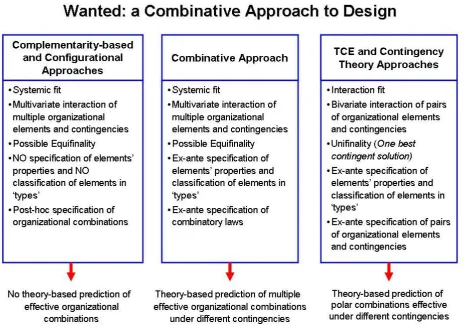
Hence, we will retain some of the lessons of configurational and complementarity-based design
approaches, in particular, the complementarity-based notion of systemic fit and the concept of
equifinality; but we intend to go beyond, by providing the following contributions (as summarized
in Figure 1):
1. specifying the fundamental properties of the organizational attributes to be combined, so as
to obtain an analog of the ‘periodic table of elements’ used in chemistry;
2. providing a theory-based ex-ante prediction of what the effective (and eventually equifinal)
combinations are, arguably an important scientific input to design;
3. distinguishing what organizational elements in what combination are necessary and/or
sufficient for performance, thereby escaping from a mere frequency-based approach to the
identification of organizational configurations;
4. using an innovative methodology to support such an approach (see data analysis section on
Boolean comparative analysis).
FIGURE 1 ABOUT HERE
A Basic Chemistry of Organization: Organizational Elements and Combinatory Laws
Classifying organization forms using any observable difference among real firms, or other
institutions, is a useful part of organization science, as much as the classification of species is a
useful part of natural science. We are proposing to complement it with a theory-based chemistry of
organization. The latter starts from some analogue of natural elements for getting to (and
not gone through yet. Organizations are artificial rather than natural systems though. So we
conceive organizational chemistry as a ‘science of the artificial’ (Simon 1969), whose laws set
limits and give basic guidelines on how to design effective systems, rather than only describing
which substances any system may be composed of.
The construction of the model will address first the definition of organizational elements and,
second, the illustration of combinatory laws.
Organizational elements
Organization theory has focused, for a long time, on the measurement of the dimensions of
organized ‘bodies’ or entities, rather than on the microscopic structure of elements composing them.
Measuring the degree of centralization or formalization is certainly not useless, but it is like
measuring the height and weight of a person, not the molecules composing her blood or tissue. As
said, we wish to shift at the micro-level of components in order to distinguish them into ‘types’ or
‘kinds’ with known properties.
Because of its emphasis on attribute similarity/dissimilarity in kind, and the partially worked out
connection with the principles of behavior infused into organized systems, we are going to use as a
starting point the classification received from organizational economics among the following types
of attributes:
- ‘market-like’ attributes, including price-like devices and control by exit (Von Hayek 1945;
Hirschman 1970; Zenger and Hesterly, 1997) capable of infusing ‘highly powered incentives’ and of coordinating action with minimal communication;
- ‘bureaucratic’ attributes, including the Weberian ‘attributes’ of formal vertical and
horizontal division of labor and of coordination by rules, plans and central ad hoc decision
making (Ouchi 1980; Williamson 1985), infusing predictability, transparency, and
arbitration capacity while economizing on knowledge and information sharing;
- ‘collective’ and ‘communitarian’ attributes, including peer group governance, knowledge
and value sharing (common culture), joint decision making, and norms of reciprocity (Ouchi
1980; Butler, 1982), infusing identity, cohesion and complex problem solving capacity.
We shall extend and refine this starting classification of attributes, though, by using insights
from the organization theory tradition. In fact, organization theorists have observed at least two
anomalies with respect to the three-fold classification of organizing attributes produced by
First, the ‘third type’ of attributes collapses together at least two organizing principles and
techniques that are theoretically different in their properties and not highly correlated in practice:
communitarian culture-based governance and democratic peer-group governance (Alvesson and
Lindkvist, 1993). In fact, cultural elements have to do with the ‘programming of the mind’
(Hofstede 1980), the homogeneity of values and objectives (Schein 1985), the ‘communal sharing’
of artifacts, practices and knowledge (Fiske 1992). Communitarian governance integrates actors by
homogenizing judgments and interests through identity building and knowledge sharing practices
(Fiske 1992; Kogut and Zander 1996). By contrast, things like equally distributed property and
decision rights (Butler 1982), participation and representation of different knowledge and interests
in decision making (Lammers and Széll 1989),‘voice giving’ procedures, fair procedures and
processes for conflict resolution (Greenberg 1990), are typical ingredients of democratic
governance, aimed at integrating the different judgments and interests of multiple actors through
representative devices, and as such are increasingly important in modern knowledge-intensive
organization (Harrison and Freeman 2004).
Second, the notion of ‘bureaucracy’, and even of ‘hierarchy’, as employed in organizational
economics is also too broad and Weberian, and collapses together two modes of organizing that are
known to have different properties and to be rather uncorrelated in practice: the structuring of
activities through formal documents, standards and allocation of rights and obligations; and the
specific configuration and source of those rights' allocations. In fact, a formal, and even
hierarchical, structure can combine with ‘principals’ being at the ‘base’ (as in representative bureaucracies and cooperatives) (Gouldner 1954; Blau and Scott 1962) rather than at the ‘top’ (as
usually assumed); and decision rights are often more centralized in informal systems (from family
firms to informal sub-contracting) than in formal ones, also because decentralization in large
systems requires formalization (Pugh et al. 1969).
Hence, we shall distinguish democratic elements from bureaucratic rule-like elements on one
side, and from communitarian elements on the other. As a result, we stipulate that there are
‘differences in kind’ among at least four types of organizational elements so defined:
market-like elements, including price-like and control-by-exit devices;
bureaucratic elements, including formal rules and plans, and articulation of the division
of labor;
democratic elements, including the allocation of ownership, decision and representation
rights.
It’s important to make clear and stress a couple of features of this typology, which is going to play the role of a ‘Table of elements’ in our chemistry of organization.
First, the four categories are conceived as types of elements and not as types of institutions, or
‘discrete structural alternatives’ themselves (as it is common thinking in new institutional
economics). In the combinative approach that we are proposing, all real institutions are made of
‘practices’ that embody these elements in various degrees – and usually further mixed up with other collateral ‘substances’ that may facilitate their absorption but are not central to our analysis (e.g.
implementation devices, social acceptance caveats, and the like).
Second, there is no pretense that this four-fold Table of elements is exhaustive or unique. Even
in natural science new elements can always be (and have been) discovered; and classification
systems with higher level of detail, or oriented to other purposes, can always be developed. This
must be all the more valid for artificial elements. We are just proposing one way, rooted in previous
analyses, of classifying the humanly devised artifacts that are employed in organizing as ‘elements’
with known general properties, so that combinatory laws can be worked out.
Third, elements are typically infused into organizational systems through the application of
‘practices’. Any real practice can, in principle, embody more than one type of element. However,
for the purpose of simplicity, in the operationalization of the framework in the empirical study
presented in this paper, we will select and measure practices that can be considered ‘carriers’ of one
(dominant) element. For example, ‘pay for performance’, and ‘outsourcing’ practices will be
considered carriers of market-like elements. More refined analyses with multi-element practices
would certainly be possible and worthwhile, but would not change the logic of the model.
Fourth, in order to provide a usable chemistry, each element will be further characterized by a
number, as in chemical formulas, indicating how many atoms of that element characterize the
formula. Thus, convening to indicate elements in capital letters and the number of doses (or atoms)
with a small subscript, the generic organizational formula can be written in the form Mx- By – Cz –
Dw. In the empirical study, we propose a way of operationalizing and measuring the notion of ‘one
dose’ or ‘one atom’ of an element.
The relationships between types of organizational elements, the principles of behavior they
infuse into organization, and a set of contemporary relevant organizational practices predominantly
containing each element are summarized in Table 1, along with the references to the studies that
TABLE 1 ABOUT HERE
Combinatory laws
The dominant hypothesis in organizational economics about combinatory laws is that
complementarities mainly stem from similarity. Hence, the less varied in kind the practices are in
the same system, the better (Williamson 2004). Even though in the Milgrom and Roberts (1995)
seminal article, there is no explicit theoretical argument suggesting that complementarity should
stem from similarity, they also end up, in their examples, considering practices ‘of the same kind’
as complementary – e.g. ‘mass production’ practices versus ‘flexible manufacturing’ practices.
However, empirical research, including that inspired by the complementarity view, has yielded
results that suggest elements of different kinds can be successfully combined.
For example, Whittington et al. (1999) examined the performance effects of the introduction of a
wide portfolio of practices in a wide sample of 500 European firms, finding that the wider and more
differentiated the set of practices introduced, the better. Practices are distinguished as pertaining to
firm boundaries, structures or processes (hence, not as they are different in kind or logic, but as they
invest different aspects of organization). Still, results support the contention that organizational
changes realized through a set of practices encompassing different classes have affected firm
performance more positively. The design implication would be that, for example, adopting together
outsourcing (a boundary spanning practice), delayering (a structural practice) and teamwork (a
process practice), should be better than, say, restructuring by delayering, horizontal integration and
decentralization (a set of practices all of the structural kind). Even more pertinent to our purposes,
researches on effective combinations of HRM practices have consistently shown that the most
successful innovative organizations employ things as different as strongly powered incentives and
teamwork together (Laurse and Manke 2001; Ichniowski et al., 1997).
Hence, there are both theoretical and empirical reasons to doubt that effective organizational
combinations can be generated by a simple monotonic combinatory rule such as ‘the more similar
elements are, the better’. At the same time, the opposite simple combinatory rule, i.e. ‘the more
varied the combination of elements, the better’, is also doubtful: isn’t there any ceiling to the
effective adoption of practices of different kinds? Can’t complementarities vary in sign (e.g. from
positive to negative) depending on the intensity of adoption? Are complementarities ubiquitous
among all elements or limited to only some of them? Under what conditions?
All those questions led us to integrate the two simple laws mentioned above (and some others) into
a more sophisticated set of combinatory laws, presented and justified below, together with some
laws are also much more precise than the available propositions on the relation between the variety
of practices and the overall system performance. In fact, the proposed combinatory laws specify
what types of elements, and at which level of intensity, are necessary and/or sufficient to generate
what type of performance.
‘Law of organizational core variety’. The presence of elements of different kinds is a necessary
condition for an organizational formula achieving high performance of any sort.
As it occurs in living natural systems, elements of different kinds (say iron or carbon), are typically
needed at some basic normal level for combining in molecules performing basic functions, hence,
also for delivering high performance of any kind. In artificial organizational systems, we can
conjecture that a combination of incentives, formal rules of the game, right of appeal and sense of
belonging, each present at some basic level different from zero, is necessary for the system to be
able to function and deliver high performance of any kind. According to this hypothesis,
organizational formulas should always include a ‘core’ in which all elements are present.
This ‘law of core variety’ of organizational formulas can be operationalized in the following
testable necessary condition for high performance:
Proposition I. High performing combinations of practices should necessarily include at least one
dose of each kind of element. The absence of any element is a sufficient condition for not observing
high performance of any sort.
As in natural systems, some dose of, say, iron in the blood is needed, but raising the presence of
iron to unspecified levels is unhealthy. The adoption of many practices, all carriers of one type of
element, raises the intensity of the presence of that type of element in the system. For example, if a
firm introduces pay for performance, stock options, profit sharing, tournaments for positions, and
high personnel mobility and turnover, the presence of market-like elements will increase with the
number of practices of the same kind adopted. The benefits from increased pressure on results
decrease due to limits in the possibilities of increasing efforts and finding new performance
increasing actions (Milgrom and Roberts 1992). In addition behavior is likely to become
dysfunctionally competitive: all unrewarded tasks are likely to be neglected (Roberts 2004); costs
and negative consequences not directly borne are going to be disregarded (Windolf 2004), and
This ‘law of decreasing marginal returns’ to investments in organizational practices infusing
elements of the same kind, just illustrated for market-like infusions, is known to be valid for all the
other elements as well, although usually not expressed in these terms.
For example, to establish some rules and plans in a hypothetical ‘spontaneous order’ is likely to be
generally necessary for achieving better outcomes; but keeping adding procedures and controls to
solve any problem quickly entails larger costs than additional benefits, as the conspicuous critical
literature on bureaucracy demonstrated (from Merton on). Analogously, some social cohesion is
obviously valuable and efficient, but increasing investments in ‘common culture’, easily generate
pathologies of ‘oversocialization’ and ‘groupthink’ (Janis 1972). Finally, although the use of
democracy is by no means common in firms, there have been well known experiments in the
infusion of democracy, even in large incorporated firms, such as, in the past at Volvo or Olivetti, or
more recently and in higher doses, at Oticon and Semco. The Oticon case has been analyzed in
some depth, and, according to our hypothesis, it has been documented that its reorganization,
characterized by a rather full dismantling of bureaucratic practices and a rather intense infusion of
democratic elements (Verona and Ravasi 2000); eventually ran into problems due to lack of
incentives and rules (Foss 2003). Hence we state the following second combinatory law:
‘Law of decreasing marginal returns to organizational homogeneity’. There are decreasing
marginal returns, and, beyond some point, negative returns, to increases in the intensity of the same
kind of element.
Decreasing marginal returns to investments in practices infusing elements of the same type,
therefore, should set a ceiling to the intensity of effective presence of each single element. But other
forces are likely to limit the breadth of effective organizational formulas too. If in low doses
different elements complement each other, at higher doses there are reasons to hypothesize that they
may entail negative complementarities (‘dysinergies’ rather than synergies). In fact, people energy,
cognitive capacity and behavioral flexibility is limited; hence, they are unlikely to be able to attend
and respond simultaneously to strong incentives; to strong demands for identification; to intense
requirements for rule following and the use of procedures; and to the right and duty to exert their
best judgment; being highly entrepreneurial, highly solidaristic, highly compliant, and highly
informed critical participating citizens at the same time. In addition, practices are costly, and choice
among alternative investments in different practices may become an issue as the total amount of
If the above is true, then the following two further laws and third testable necessary condition to be
met by high performing organizational formulas can be stated:
‘Law of decreasing marginal returns to organizational variety’. There are decreasing marginal
returns, and beyond some point, negative returns, to simultaneous increases in the intensity of all
kinds of elements.
Both laws of decreasing marginal returns should lead to ‘forbidding’ the possibility of observing
organizational formulas with one or more elements at maximum level in association with high
performance. Hence, an empirical regularity, and testable proposition, deriving from those laws
should be that a sufficient condition for observing low performance is the violation of the law, and a
necessary condition for success is the respect of the law.
Proposition II. High performing combinations of practices should not be characterized by very
high intensities of any element. The presence of any element in very high doses should be sufficient
for not observing high performance of any sort.
The laws identified so far settle upper and lower bounds to the effective intensity of presence of
elements in organizational formulas. Can we specify some further law predicting and prescribing
which combinations to adopt, within those limits, in order to achieve specific outcomes?
Different elements infuse different principles of behaviour, hence the differential investment in one
or the other (within the specified healthy ranges) can give a dominant orientation to the organization
that may be more or less suitable for reaching different types of outcomes. The selection and pursuit
of different performance parameters should generate complementarities among different sub-sets of
elements that fit best to produce those outcomes. Hence, the type of outcome sought (and eventually
other contingencies to be met) should be relevant for the choice of the element(s) in which to invest
beyond the basic level (and below extreme levels). The relative weight of the different elements,
between a basic level at which they are all necessary, and a very high level at which they are all
dysfunctional, is what can characterize and distinguish a contingently effective organizational
formula from another. Hence we state:
‘Law of structural heterogeneity’. The optimal intensity of each element in an organizational
formula (within the lower and upper bounds) is contingent to the type of performance outcome
Proposition III. High performing combinations of practices should have the following structure: a
‘core’ in which all kinds of elements are represented at a basic level; and a ‘belt’ in which different
kinds of elements are represented in higher doses, depending on the types of performances
outcomesproduced.
Can we specify to some extent how the belt should be composed contingently to different outcomes
to be produced? On the basis of available theory, and within the scope of the evidence that can be
provided by the empirical study presented in this paper, we can advance two initial hypotheses on
the composition of the ‘belt’ of organizational formulas.
A leitmotiv in organization theory is that organization forms effective in innovation and exploration
are different from those effective in efficiency and exploitation. As far as internal organization is
concerned, bureaucratic organization has always been supposed to have a prominent capacity in
achieving efficiency in exploiting existing knowledge and resources (Mintzberg 1979; Burns and
Stalker 1961).
By contrast, in the management of innovation, e.g. in organizing under high uncertainty, different
contributions have alternately pointed out the virtues of investments and infusions into firms of all
the other three classes of elements: either market infusions and incentive-driven organizing (Zenger
and Hesterly 1997), communitarian governance (Ouchi 1979) and/or organizational democracy
(Harrison and Freeman 2004). These different accounts, and indeed the observable differences
among the structuring of highly innovative firms, raise some questions of what’s behind this ‘structural heterogeneity’: are incentive driven and communitarian/democratic arrangements
alternative and fungible solutions in the generation of innovative behaviors (Roberts 2004)? Or,
rather, would combinations among highly powered incentives and team-like organization generate
even superior innovation performance, revealing that investments in those two elements are in fact
complementary in the generation of innovation (Laursen and Manke 2001)? The empirical study
presented in the remainder of the paper will shed some light on the problem of structural
heterogeneity in the governance of innovation.
Proposition IVa. Highly efficient combinations of practices should be composed of a ‘core’ in
which all elements are present, and a ‘belt’ of additional bureaucratic elements.
Proposition IVb. Highly innovative combinations of practices should be composed of a ‘core’ in
which all elements are present and a ‘belt’ of communitarian, and /or democratic and/or
From Organization Forms to Organizational Formulas: A Survey
We illustrate how the approach can be applied and tested by the exploratory study reported in
this section. In order to identify and analyze empirically whether the types of elements combine as
predicted, we conducted a survey on a medium-sized sample of firms.
Data Collection
We conducted a survey on the population of the largest 600 independent firms by revenue and
with more than 150 employees operating in Italy in the year 2004. We distributed to the chief
human resources officers of these firms a questionnaire on organizational structures and practices,
initially tested in a pilot study and in several interviews with more than 40 human resource
managers and directors. The total number of respondent firms was 90 -with an overall response rate
of 15%, comparable to other recent European surveys (Whittington et al. 1999). 15 out of the 90
questionnaires collected were eliminated from the final sample for data unreliability due to the
presence of missing data. Thus, our final sample involves 75 firms.
Measures
We designed the survey questionnaire following the table of correspondence between types of
elements and observable practices introduced in Table 1 above. Data on the use of important
contemporary practices for each element were gathered (for example, market-like type of elements
has been identified by the following organizational practices: ‘individual and team-based pay for
performance’, ‘firm-based pay for performance’, ‘outsourcing’, ‘internal labor market mobility’).
The intensity of adoption of each organizational practice was measured in two ways.
For each organizational practice we identified a set of four more observable and operational
sub-practices (e.g. for the organizational practice ‘pay for firm performance’ the list of sub-sub-practices
included: gain sharing, profit sharing, stock options, employee shareholding). The intensity of
adoption of the organizational practice was measured in two steps: first, the number of sub-practices
adopted by the firm was counted, generating a 0 to 4 scale; second, this indicator was dichotomized
into a dummy variable, coded as ‘1’ if the value of the indicator was equal or higher than the
average value in the sample.
There are however a few practices, such as turnover, whose intensity of use is commonly measured
in firms on percentage scales. In those few cases percentage scales were used as a starting measure
(e.g. the practice “Internal Labor Mobility” was measured as the number of job-reassignments over
the number of employees). These scales were in any case also dichotomized into a dummy variable,
sample. Hence, in the end, we have homogeneous indicators of the intensity of use for all practices.2 In addition, we also have a homogeneous measure of the number of ‘doses’ of an element
(operationalizing the idea of the number of atoms of an element): one dose is infused if the practice
is used at least at average (i.e. normal) level.
Given that we considered four practices for each element (see examples of practices in table 1),
the intensity of use of any element can then range, potentially, from 0 to 4 in this study. We
considered value 4 as ‘high intensity’ (the notion of ‘high intensity’ is relevant for testing
Proposition II). This is justified as follows. First, we considered the maximum average intensity of
application across all the four elements, and added the positive variance above it. This value is 3,57.
Hence, in our sample, an intensity of 4 can indeed be considered very high. At the same time, there
are in the sample enough cases in which value 4 appears for testing the effects of ‘high doses’ on
performance. Second, the questionnaire contained open questions giving respondents the
opportunity to indicate the adoption of other practices beside the four explicitly identified for each
element. No respondent in the entire sample indicated other practices. This evidence is a further
indirect confirmation of the reliability of the above operationalization of 4 practices as ‘very high
intensity” of an element3
.
As to organizational outcomes, in order to test our propositions, we considered two qualitatively
different types of outcomes: efficiency and innovation. They were measured independently
integrating different database sources (Bankscope, Eurostat, Amadeus, Aida), in order to avoid
self-report biases. However, this concern forced us to use proxy indicators for which those data were
available. Efficiency was measured by the revenue per employee of the firm in the year 2005
divided by the average level of revenue per employee of the firms operating in the same industry
(identified by the SIC-CODE) in the same year. Innovation was measured as the number of
trademarks deposited by the firm in the year 2005 divided by the average number of trademarks
deposited by the firms operating in the same industry (identified by the SIC-CODE) in the same
year. These ratio scales were dichotomized into dummy variables (1/0), coding each variable as 1 if
above the average value of the ratio in the sample, and as 0 otherwise. Performance was measured
with reference to 2005 to allow a one-year time lag between organizational arrangement (as adopted
in 2004) and performance, as contingency studies’ methodology suggests (Donaldson, 2001).
2 A more refined measurement could have also considered the percentage of employees touched by the practice.
Unfortunately respondents were unable to provide this type of data reliably.
Data Analysis Method and Findings
The choice of the data analysis method was driven by the need for detecting interaction effects
among the four types of elements, the possible equifinality of different combinations for reaching
the same outcome, and the possible redundancy of elements for outcome generation.
Standard methods -such as linear regression analysis and multivariate techniques as factor and
cluster analysis are not able to adequately take into account all these factors. Although interaction
effects have enriched standard linear regression to assess non-linear relationships, they nevertheless
estimate the fitness of a single path to an outcome. Thus, they are in explicit contrast with the
concept of equifinality (Fiss 2007). Furthermore, three-way interactions currently represent a limit
for regression analysis applications – and concerns about their interpretation and reliability persist
(Drazin and Van de Ven 1985; Ganzach 1998). Finally, cluster and factor analytic methods are
unable to distinguish which independent variables are necessary, sufficient or redundant in affecting
the dependent variable.
For these reasons, we decided to turn to new methods able to overcome these limits.
In particular, we found Boolean comparative analysis (Ragin 1987; 2000) the most suitable for our
purposes. In fact, this is, by design, a methodology and a technique for detecting the combinations
of elements that are necessary and sufficient for obtaining a specified outcome (Braumoeller and
Goertz 2000; Fiss 2007). The methodological passages necessary to understand the study are
exposed together with the findings of the data analysis4.
Formalizing Data into Organizational Formulas through Boolean Algebra
Combinations of elements can be expressed in the Boolean algebra language and its operators in
the following way. Suppose a firm is adopting three market-like elements, two bureaucratic, one
communitarian and one democratic element, and that it is classified as high performing in
efficiency. This case can be formalized as follows:
M3*B2*C1*D1 ---> EFFICIENCY
where "*" denotes the Boolean operator "AND", ---> denotes the logical implication operator and
the number qualifying each capital letter (M = Market-like; B = Bureaucratic; C = Communitarian;
D = Democratic) represents the number of doses (practices employed beyond the average level)
4 For further understanding the basic concepts and procedures employed in Boolean Comparative Analysis (BCA), we
refer the interested reader to the short illustration provided on the topic in the appendix posted on the authors’ website
employed for each of the four types of elements. The above statement can be read as "The
combination of three doses of market AND two of bureaucracy AND one of community AND one of
democracy can be observed in association with a high efficiency outcome".
Let's now suppose that in our sample there is another firm that adopts a different formula and
also achieves high efficiency, such as M1*B3*C2*D2. The presence of these two firms in our sample
can be formalized through the Boolean operator “OR” (+):
M3*B2*C1*D1 + M1*B3*C2*D2 ---> EFFICIENCY
where "+" denotes the logical operator "OR". The above statement can be read as: “A high
efficiency outcome can be observed in association with the combination of three market-like AND
two bureaucratic AND one communitarian AND one democratic doses; OR in association with the
combination of one market-like AND three bureaucratic AND two communitarian AND two
democratic doses of elements.
Thus, when used on sufficiently large sets of possible combinations, the "OR" operator
expresses substitutability (or equifinality), while the ‘AND’ operator expresses relations of
simultaneous necessity or complementarity.
Using these notations, we formalized our dataset into a set of organizational formulas and
explored their association with high performance on efficiency and innovation.5
Testing Proposition I and II
The second step of the analysis should answer the question: are there combinatory patterns
common to the equifinal combinations associated to the same type of outcome? Do they conform to
the propositions derived from the combinatory laws hypothesized?
Our propositions can be best tested distinguishing between necessary and sufficient conditions
(Ragin 1987). Expressed more operationally:
- Proposition I states that the presence of all four elements at some level different from zero
should be a necessary (albeit not sufficient) condition for observing a positive outcome
(high performance in our study) on any performance parameter (efficiency and innovation in
our study);
5 The tables summarizing all the organizational formulas detected in the sample are provided in the Appendix posted on
- Proposition II states that the presence of any element at very highlevel (level 4 in our study)
should be a sufficient (albeit not necessary) condition for observing negative outcomes on all
performance parameter (no high performance on any parameter).
Then , we further operationalized the combinatory rules constructing a dummy variable –labeled
"ALLTYPES_1or2or3"- that was coded as "1" if all the four types of elements are used in a
combination, each with a number of practices greater than 0 and lower than 4; it was coded as "0"
otherwise. According to our hypotheses, we expect the positive values of the variable to constitute a
necessary condition to achieve positive organizational outcomes, whereas the negative values to be
a sufficient condition for negative outcomes. A condition is said to be necessary if the outcome can
be observed if and only if the condition is present, and is said to be sufficient if the presence of the
condition implies the presence of the outcome. Expressed this way, the notions are deterministic.
However, it is possible to express them in a probabilistic way, more compatible with an empirical
test (it would be almost impossible to satisfy these rules with probability one, i.e. in 100% of the
cases). A threshold of frequency lower than 100% can be fixed expressing this notion of
‘statistically necessary’ and ‘statistically sufficient’. A threshold usually employed in Boolean
Comparative Analysis studies is 65% (Ragin 2000: 109), so we adopted this heuristic.
The actual proportion of cases conforming to our rules is in any case usually much higher
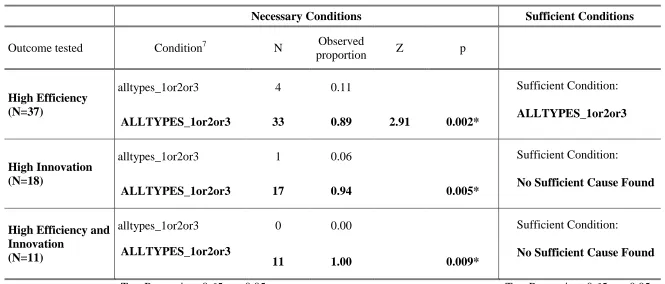
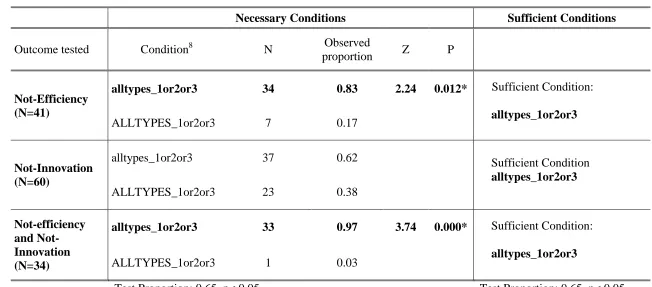
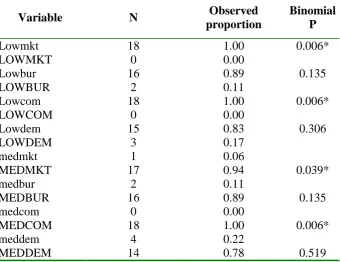
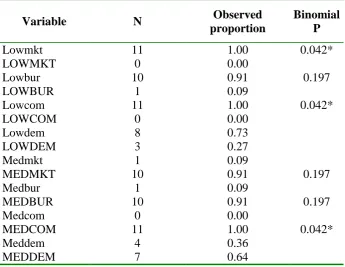
(80-90%). The results of the necessity and sufficiency tests6 are reported in tables 2 and 3 below.
TABLE 2 AND 3 ABOUT HERE
The results are clear-cut in confirming the core combinatory rules hypothesized, and interesting in
the refinements they suggest. They read as follows:
The respect of the combinatory rule ‘all types of elements should be present, with values
comprised between a lower and an upper bound’ (operationalized as 1 and 3 in this study) is a
necessary and sufficient condition for high efficiency. Any violation of this rule (e.g. the use of
zero or four elements per type) is a necessary and sufficient condition for lower efficiency.
- The respect of the combinatory rule ‘all types of elements should be present with values
between a lower and an upper bound’ (operationalized as 1 and 3 in this study) is a necessary
but not sufficient condition for high innovation. Any violation of this rule is a sufficient but not
necessarycondition for lower innovation.
- If we consider a joint outcome function, i.e. achieving both efficiency and innovation, of course
the more restrictive among the conditions for each outcome determines the law for the joint
outcome: the respect of the combinatory rule ‘all types of elements should be present with values between a lower and an upper bound’ (operationalized as 1 and 3 in this study)’ is a
necessary but not sufficient condition for achieving both high efficiency and high innovation (as
for innovation only). Any violation of this rule is a necessary and sufficient condition for not
achieving both outcomes (as for efficiency only).
In other terms, the results indicate that any violation of either the law of organizational core variety
or the laws of decreasing marginal returns to organizational homogeneity and heterogeneity is a
necessary and sufficient condition for ending up with relative inefficiency. For innovation, respect
of the rule is a necessary condition, but, even if respected, the high innovation outcome may not
occur. This is an interesting and sensible asymmetry between organizing for efficiency and for
innovation: as innovation is uncertain by definition, the link between organizational solutions and
the outcome is weaker than for efficiency.
Testing Proposition III and IV
The analyses presented here inquire into the composition of effective organizational formulas
within the lower- and upper- bounds specified by the core combinatory laws tested above.
Operationally, the hypotheses we developed in that respect lead to expect the following:
- Proposition III predicts that the ‘belt’ of organizational formulas, beyond the core, should be
composed of different elements depending on the type of outcome.
- Proposition IVa and IVb specify that bureaucratic elements should prevail in the belt of efficient
formulas, while the other three elements should prevail in the belt of innovative formulas.
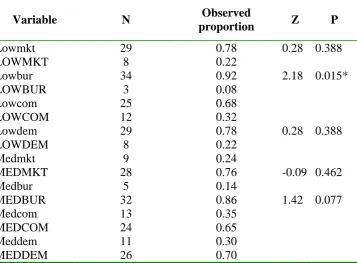
To test these propositions, we first constructed two dummy variables for each element: LOW (1
dose of the element is present), MED (2 or 3 doses are present).
The expectation is that we should observe levels of bureaucracy beyond the base rate (hence at level
2 or 3) in ‘efficient’ formulas; while in ‘innovative’ formulas we should observe those higher levels
in the other three elements. The results of the analyses of necessary and sufficient conditions,
separately conducted for the three levels of presence of each element, are reported separately for
TABLE 4, 5, 6 ABOUT HERE
As predicted by Propositions III, VIa and VIb, operationalizing the law of structural
heterogeneity, the rules of composition of organizational formulas beyond the core, are qualitatively
different for the two types of outcomes: for efficiency, additional doses of bureaucracy are
necessary; for innovation, additional doses of either or both community and market elements are
necessary (Tables 4 and 5). The necessary conditions for getting both results are a union of those
separate conditions, hence additional doses of all three elements, bureaucratic, communitarian and
market-likeare necessary (Table 6).
Results indicate that as the result parameters broaden, the number of necessary elements and the
necessary internal variety of the organizational formula increase. Results also suggest that negative
complementarities among three types of elements, traditionally considered to be ‘inconsistent’
(because of their difference in kind), do not actually arise even at sustained levels of use (level 3).
They might arise at very high levels (level 4), but at those levels even the use of ‘consistent’
(similar in kind) elements is not healthy.
Finally, our empirical evidence suggests that ‘incentive-driven organization’ and ‘communitarian organization’ are neither mutually exclusive structural alternatives nor strictly
complementary in the governance of innovation. Elements of market and community seem to
behave more like fungible substitutes, as (the belt of) organizational formulas generating high
innovation can be composed by either elements of market, or of community, or of both without the
outcome being altered. This fungibility in sustaining innovation seems to apply to some extent also
to the use of democratic elements: the results are in the predicted direction although the test is not
strictly significant (0.519).
Discussion and Conclusion
A chemistry of organization, whose foundations have been laid down in this paper, provides two
much needed ingredients for a ‘science of design’ intended as a set of rules capable of generating
organizational configurations: what the fundamental organizational elements to be combined are,
and which the combinatory rules for generating specified outcomes are. We have shown that some
general, invariant, laws can be specified and that high performing organizational formulas seem to
obey to them, in spite of and beyond their variety. This approach focuses on the scientific part of
design, namely on the basic chemical laws that any design should respect, even though the full
specification of organizational solutions cannot but involve the application of other criteria as well,
should actually enable more healthy and creative application of artistic or political criteria.
A chemistry of organization, as initially operationalized and tested in this study, already provides
precise and strong rules for organization design, which can be summarized as follows.
- Effectively designed systems, both for efficiency and for innovation, should be composed of
organizational attributes of different kinds, rather than of all attributes of the same kind;
- The more varied the type of outcome sought, the more varied the organizational elements to be
infused;
- There is asymmetry between designing organization for efficiency and for innovation: as
innovation is uncertain by definition, following design rules is a necessary but not sufficient
condition for high innovation; while it is possible to identify necessary and sufficient conditions
for high efficiency. Organizational formulas capable of generating high efficiency are enriched
in bureaucracy, while those generating high innovation are enriched in market-like or
communitarian elements (or both).
Our study is the first in its kind. Therefore, it can be extended and refined in a variety of ways,
such as the following:
- The empirical data analyzed here are limited in time and space. They provide an explorative
and illustrative analysis, but more extensive testing would naturally be important.
- The ‘table of elements’ can be refined by further breaking down the types of elements into
more micro elements (e.g. prices, rules, teams, etc.).
- This paper has considered the link between organizational elements and types of outcomes.
A possible straightforward extension of this type of analysis would be to consider some
other relevant elements that are likely to interact with organizational elements.
The characteristics of technology, tasks and resources are obvious candidates. These
variables can be plugged into Boolean analytic terms as further types of elements to explore
necessary and sufficient associations with organizational elements.
- At a more general, modeling level, we should observe that the model developed here is
static. Although a good statics is a necessary initial step for developing any good dynamics,
it would indeed be desirable and interesting to understand how the combinations can change.
The specification of whether any element, or package of elements, is necessary or sufficient,
and which elements are substitutable, provide a starting basis for developing dynamic
typically derived from complementarity-based analysis: namely, that ‘the wider the package
of practices that are changed together, the better’ (Whittington et al 1999). This may be a
sensible strategy only if it is not known where the complementarities lie. Knowing the
chemistry of combinations would allow devising partial, more targeted, less costly changes.
In conclusion, two general implications of a chemistry of organization for the future direction of
organization theory as a science of design can be highlighted. First, it provides a basis for enriching
the available theories of ‘structural contingency’ with a theory of ‘structural heterogeneity’. Second,
by going beyond the traditional archetypical, frequency-based, discrete notion of ‘organization
form’, a chemistry of organization provides a basis for devising new possible configurations,
thereby reconnecting to Herbert Simon’ notion of design as a science of the artificial concerned
with the ‘world as it might be’.
References
Alvesson, Mats, and Lars Lindkvist 1993 ‘Transaction costs, clans and corporate culture’. Journal of Management Science 30/3: 427-452.
Blair, Margaret M. 1995 Ownership and control: Rethinking corporate governance for the 21st century. Washington DC: Brookings Institute.
Blau, Peter M., and Richard W. Scott 1962 Formal organizations: A comparative approach. San Francisco: Chandler Publishing.
Boland, Richard J., and Fred Collopy 2004 Managing as designing. Stanford University Press.
Braumoeller, Bear F., and Gary Goertz 2000 ‘The methodology of necessary conditions’. American Journal of Political Science, 44: 844-858.
Burns, Tom, and George M. Stalker, 1961 The management of innovation. London: Tavistock Publications.
Burton, Richard M., Gerardine De Sanctis G, and Borge Obel, 2006 Organizational design: A step-by-step approach. Cambridge: Cambridge University Press.
Butler, Richard 1982 ‘A transactional approach to organizing efficiency: Perspectives from markets, hierarchies and collectives’. Administration and Society, 15/3: 323-362.
Donaldson, Lex 2001 The contingency theory of organizations. London: Sage.
Drazin, Robert, and Andrew H. Van de Ven 1985 ‘Alternative forms of fit in contingency theory’.
Administrative Science Quarterly 30: 514-39.
Fiss, Peer C. 2007 ‘A set-theoretic approach to organizational configurations’. Academy of Management Review 32/4: 1180-1198.
Foss, Nicolai J. 2003 ‘Selective intervention and internal hybrids: Interpreting and learning from the rise and decline of the Oticon spaghetti organization’. Organization Science 14: 341-349.
Galbraith, Jay R. 1977 Organization design. Wesley.
Ganzach, Yoav 1998 ‘Nonlinearity, multicollinearity and the probability of Type II error in detecting interaction’. Journal of Management24: 615-622.
Grandori, Anna and Giuseppe Soda 2006 ‘A relational approach to organization design’. Industry and Innovation 13/2: 151-172.
Greenberg, Jerald 1990 ‘Organizational justice: yesterday, today, and tomorrow’. Journal of Management 16/2: 399-432.
Gresov, Christopher and Robert Drazin 1997 ‘Equifinality: Functional equivalence in organization design’, Academy of Management Review 22/2: 403-428
Gouldner, Alvin W. 1954 Patterns of industrial bureaucracy. New York: Free Press.
Harrison, Jeffrey S., and Edwin R. Freeman (eds) 2004 ‘Democracy in and around organizations’.
Academy of Management Executive 18/3: 49-53.
Hatchuel, Armand 2001 ‘Linking organization theory and design theory: A unified perspective on collective action’. Keynote presentation, 17th EGOS Colloquium, Lyon.
Hirschman, Albert O. 1970 Exit, voice and loyalty: Responses to decline in firms, organizations and states. Cambridge: Harvard University Press.
Hofstede, Geert 1980 Culture’s consequences: International differences in work-related values. London: Sage.
Janis, Irving L. 1972 Victims of groupthink. Boston: Houghton Mifflin.
Kogut, Bruce, and Udo Zander 1996 ‘What firms do? Coordination, identity and learning’.
Organization Science 7/ 5: 502-518.
Ichniowski, Casey, Shaw Kathryn, and Giovanna Prennushi 1997 ‘The effects of human resource management practices on productivity: A study of steel finishing lines’. American Economic Review 87/3: 291-313.
Lammers, Corndis, and Gyorgy Széll 1989 Organizational democracy: Taking stock. International Handbook of Participation in Organizations, Vol. I. Oxford: Oxford University Press.