Accurately Determining Intermediate and Terminal Plan States Using Bayesian
Goal Recognition
David Pattison
and
Derek Long
Department of Computer and Information Science University of Strathclyde, Glasgow G1 1XH, UK
{david.pattison, derek.long}@cis.strath.ac.uk
Abstract
Goal Recognition concerns the problem of determining an agent’s final goal, deduced from the plan they are currently executing (and subsequently being observed). The set of pos-sible goals or plans to be considered are commonly stored in alibrary, which is then used to propose possible candidate goals for the agent’s behaviour.
Previously, we presentedAUTOGRAPH– a system which re-moved the need for a goal or plan library, thus making any problem solvable without the need to construct such a struc-ture. In this paper, we discussIGRAPH, which improves upon its predecessor by utilising Bayesian inference to determine bothterminalandintermediategoals/states which the agent being observed is likely to pass through.
1
Introduction
Goal Recognition (GR) can be considered a sub-problem of Plan Recognition (PR) where only theterminal goal is required and the plan used to achieve this is somewhat ir-relevant. Traditionally, both of these fields have made use of libraries (Kautz and Allen 1986; Goldman, Geib, and Miller 1999) which contain known, valid plans or goals and the plans used to achieve them, commonly represented as Hierarchical Task Networks (HTNs) (Nau, Ghallab, and Traverso 2004). Construction of these libraries by domain-expert is a time-consuming task, while automatic generation suffers the risk of being incomplete or containing irrelevant and invalid entries.
In our previous work with AUTOGRAPH (Pattison and Long 2010), we removed the need for a plan or goal library by representing the problem as a Planning task in which ob-servations reflected movement through thestate spaceof the associated domain. After each observation O a hypothe-sis was produced which represented a belief in the agent’s final goal. Perhaps expectedly, the accuracy of these hy-potheses was often directly correlated to the number of plan steps observed so far. That is to say, more accurate hypothe-ses were produced towards the end of the plan, while earlier hypotheses often lacked many of the final goals as no pre-vious observation had indicated they were a part of the true goal. Furthermore,AUTOGRAPHassumed a near-optimal (or
Copyright c2013, Association for the Advancement of Artificial Intelligence (www.aaai.org). All rights reserved.
even optimal) plan was being observed – something which is rarely true in real-life.
This paper presentsIGRAPH(Intermediate Goal Recogni-tion with A Planning Heuristic), a recogniRecogni-tion engine which tackles the problem of accurately determining an agent’s in-termediategoal states – that is, states which the agent is ex-pected to pass throughbeforethe end of their plan. To do this we adopt a Bayesian approach to reasoning over which goals are most likely at future timestept, and furthermore provide arelaxed estimateof remaining plan length.
2
Motivation for Intermediate Goal
Recognition
Tackling Goal Recognition without any form of library is a far harder task than if one were available. With such a library present the number of possible goals or plans being pursued is trivial in comparison to having to consider the entire state-space and all possible plans. However, for most real-world problems the benefits of a library-based recognition system are eclipsed by the scarcity of useful candidate plans and goals.
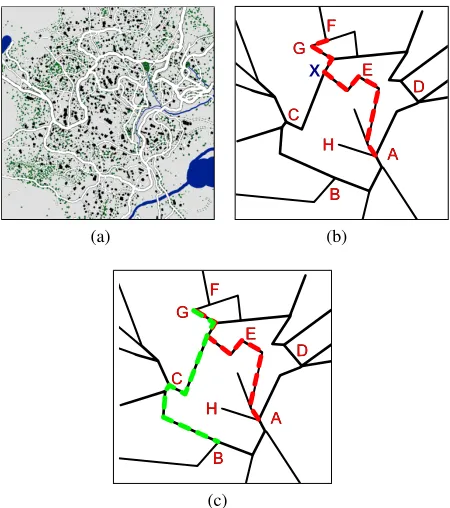
To motivate the need for non-library based recognition, let us consider a typical city shown in Figure 1a which is made up of many buildings, streets and services, with peo-ple in the city able to move between and interact with these. Given that we are to observe the movements of just a single person around this city, the number of possible plans which a library would have to contain for even a fixed starting loca-tion is intractable. However, if we consider each achievable fact to be a single, independent goal, then enumeration of all destinations or tasks becomes possible.
Now let us assume we begin observing an agent who starts at locationA, then proceeds to walk to locationsE andG
before stopping atF (as shown in Figure 1b). If we assume the agent only has a single goal which is to move to another location, then as the plan progresses we can eliminate des-tinations which become harder to reach after each observa-tion. For example, after the agent has moved fromAtoE, it can be deduced that they are probably not trying to reachB,
DorH, as the route they have already chosen would mean a longer plan than had they moved directly towards one of these after starting atA.
the agentbeforethey achieve any of these goals. If we can deduce that they must pass through at tollbooth atX first, then we can plan to stop, hinder or help them in achieving their final destination goal.
However, the assumption in the above example that there will only ever be a single goal is both restricting and un-realistic. It is far more likely that the agent would have several goals. For instance, they may stop at location E
to buy some goods, visit a relative at locationG, then con-tinue to locationB. Their plan may be only 1 step long, or it may run to hundreds of actions. The ability to dynami-cally generate valid goal-conjunctions from otherwise unre-lated goals is central toIGRAPH. This is in contrast to most previous work which assumes plans achieve a known, fixed conjunction or a single-goal (Mott, Lee, and Lester 2006; Lesh and Etzioni 1996).
Expanding this example to that of a real-world formu-lation, GR is often associated with monitoring and track-ing (Huntemann et al. 2008; Geib and Goldman 2001) or in military and video game simulations (Schadd, Bakkes, and Spronck 2007; Kabanza et al. 2010; Albrecht, Zuker-man, and Nicholson 1998; Cheng and Thawonmas 2004). While determining the agent’sfinalgoal is the crux of GR, in all of these cases it would be beneficial to know the in-termediatestates or goals which the agent being observed is most likely to pass through on their way to achieving their final goals. Having this knowledge could be used to prevent the agent from achieving specific undesirable goals, or as an aid to plan deduction by using these intermediate states in a similar manner tolandmarks(Porteous, Sebastia, and Hoff-mann 2001; Richter, Helmert, and Westphal 2008). Con-versely, in a co-operative domain with two or more agents in which communication has been lost but execution is con-tinuing, the ability to pre-empt another agent’s intermediate goals could allow for co-operative tasks to be executed with minimal interruption and aid plan repair.
Many applications of GR relate strongly to adversarial recognition, wherein agents actively try to block their plans or goals from being recognised by the observer (Geib and Goldman 2001). Yet the majority of this work is related to simply thedetectionof adversarial behaviour, not the pre-vention of the outcome. It is also true that much of this has been directed towards plan recognition as opposed to goal recognition. Conceptually, this means that the problem of detecting intermediate goals is a moot point, as any plan hy-pothesis will allow intermediate states to be computed with-out probabilistic reasoning being required. This is the case in Blaylock and Allen’s work (2006), in which they exper-iment with the use of HTNs containing a high-level goal at the root, which decomposes into ordered subgoals (which may also decompose themselves). Intermediate and high level goals are inferred by noting that a subgoal at layern
has been achieved after an observation, and producing agoal chain– a path from the subgoal to the root.
Recently, the field ofinteractive entertainment has pro-duced several works on recognition, based on Bayesian in-ference (Charniak and Goldman 1993) where the intention is to determine the goals of an agent (commonly the player), such that a personal story can be crafted around their
expe-(a)
X
(b)
[image:2.612.330.555.61.315.2](c)
Figure 1: A small city map and several example plans dis-played on a heavily-simplified version.
rience. In (Albrecht, Zukerman, and Nicholson 1998), Dy-namic Belief Networks were used to generate predictions of a player’s next action and current quest in the context of a text-based virtual-reality game, which were trained us-ing recordus-ings of observed plans and actions. Mott et al (2006) offer another Bayesian approach to GR in the detec-tion of goals in an interactive narrative environment. Their results show that goals can be incrementally converged upon as more evidence is provided, but that only single-goals are considered. More recently, (Kabanza et al. 2010) have pre-sentedHICOR, a PR system for detecting an opponent’s in-tentions in a real-time strategy game. While HICOR can present multiple, concurrent plans as a single hypothesis, testing has been performed using only mutually-exclusive single goals (although detecting multiple goals is possible).
Ram´ırez and Geffner (2010) also present a Planning-based model of GR similar to IGRAPH, which computes goal probability based on heuristic estimates after each ob-servation. Probability likelihoods are based on cost dif-ferences, which represent the cost of achieving P(G|O) versus P(G|¬O). While their work allows for multiple plans achieving multiple goals, it is evaluated using do-mains which comprise of only a few hundred actions and goals, whileIGRAPHcan handle thousands or even tens-of-thousands of goals.
3
Problem Definition
definition (McDermott et al. 1998; Fox and Long 2003).
Definition 1. Goal Recognition Problem Base
A goal recognition problem base is a triplehF, A, Ii, where
F is a set of primitive (propositional) facts, A is a set of actions and I ⊆ F is the initial state for the problem. Each action a ∈ A is a triple hapre, aadd, adeli, where
apre, aadd, adel ⊆F are the preconditions, add effects and delete effects ofa, respectively.
We also require aGoal Recognition Problemrepresenting the plan being observed. UnlikeAUTOGRAPHwe do not as-sume that the plan being observed is optimal, near-optimal, or even rational. However, we do retain the assumptions that the plan is fully-observable and totally-ordered, but that we do not know its length. As we will discuss shortly, this final assumption is key to the operation ofIGRAPH.
Definition 2. Goal Recognition Problem
A goal recognition problem is a triple,hG,HI, Pi, whereG is a goal recognition problem base,HI is an initial prob-ability distribution over the hypothesis space Hand P =
ho1, ..., oniis the sequence of plan actions observed one-by-one during the problem.
Enumeration ofHis intractable for all but the most triv-ial of problems, as it is a superset of the state-space. Thus, we define a relaxed hypothesis space, H, which contains each individual reachable fact, f, and note sets of known mutually-exclusive facts1 in order to keep the probability distribution overf∪mutex(f)normalised. However, while we only enumerate individual goals, we still allow for mul-tiple facts to be considered as the goal of planP, i.e. goal
G1can be achieved, then goalsG2andG3achieved in later observations. The mechanics of this last point are discussed in Section 4.
Before recognition begins, we may assign auniform prob-ability distributionover all mutually-exclusive facts, which become theprior probabilitiesfor Bayesian inference. Al-ternatively, we may assign aweighted probability distribu-tionusing the same domain analysis techniques used inAU -TOGRAPH(Pattison and Long 2010). Once all goals have an initial probability we compute theirheuristic estimateh(G) – an approximate measure of the number of actions required to achieveG.
As the agent executes actions, they move through the state-space and subsequently will move closer to achieving certain facts/goals and further away from others. This move-ment can be used as an indication of which subset ofH is being pursued. We update the heuristic estimate for all goals
G∈ Hafter each observation. These new estimates are then used to compute theposterior probabilityP(G|O).
4
Heuristic Estimates as Bayesian
Likelihoods
In AUTOGRAPHwe also made use of heuristic estimation to determine the probability of a factf being the true goal.
1
IGRAPHdoes not assume thatallmutually-exclusive facts for a given domain are known, although not knowing this may affect the accuracy of the final probability distribution.
However, due to the assumption of having an optimal/near-optimal plan, ifh(f)increased after an observation its prob-ability of being a goal was reduced to zero regardless of its previous value. This behaviour is also in line with use of an optimal heuristic, something which does not exist, thus hy-pothesis quality could be affected by inaccurate estimates.
For IGRAPH we have adopted aninterpolated Bayesian approach to probability updates which has been inspired by work in Information Retrieval (IR) (Zhai and Lafferty 2004). We use observationOto update the probability of each goal
P(G|O)by computing thelikelihood functionP(O|G) us-ingh(G). This determines the probability ofO being rel-evant ifGis assumed to be the true goal. By using inter-polated smoothing to computeP(G|O)we remove the abil-ity for (O|G)and thus P(G) to equal zero. This shift to evidence-based probability updates means that goals can no longer be completely eliminated from the set of hypothesis goal candidates. Furthermore, it allows the agent to revisit sections of the search-space after having achieved a goal in another section.
We now define the amount of work expended on a goalG
after an observation has been processed. Given observation
Oand a set of mutually-exclusive goalsG¯, the proportion of work which has been expended in moving towards achieving
G is shown in Equation 1, whereλis a smoothing factor
λ∈[0 : 1]andG¯neareris a set of mutually-exclusive goals
(includingG) whose heuristic estimate has lowered afterOt
has been observed, or whose estimate has been zero for at least the past two observations.
W(G|O) =
1
|G¯nearer| ifht(G)< ht−1(G), 1
|G¯nearer| ifht(G) =ht−1(G) = 0,
0 otherwise
(1)
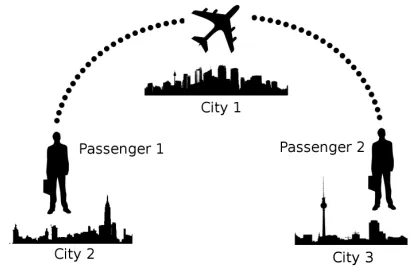
In Section 2 we discussed the requirement of being able to haveanyvalid conjunction of goalsG∈ Hin a hypoth-esis. We implement this by introducing a relaxation in the assignment ofW(G|O). By providing goals which have re-mained true over timestepstandt−1with abonusof 1, we encourage goals which have been achieved to remain valid goal candidates. Consider the simpleZENOTRAVELproblem shown in Figure 2, in which the plan being observed will pick up passenger 1 from city 2, drop them off at city 1, fly to pick up passenger 1 in city 3, then return to city 1. After observing action7:[fly city2 city1], the goal(at city1 passengerA)will have been true for 3 timesteps and no mutually-exclusive facts will have become heuristi-cally closer. However, once action 7 has been observed, the heuristic estimate to (in plane passenger1) starts to reduce again. Without the bonus being applied to facts which have remained true in the intermediate timesteps, the probability of these goals reduces (asP(O|G)is low), while the probability of others can increase.
Figure 2: A smallZENOTRAVELproblem which highlights the need for a bonus being applied to goals which have re-mained true overn >0consecutive timesteps.
indicates how often it has been achieved, thenunachieved in a later observation, with the first achievement being de-noted asGtrue
t and
PGtrue
i the total number of timesteps
Ghas been true since first achievement. In the above exam-ple,(at city1 plane1)is unachieved and re-achieved several times, giving it a low stability relative to other goals such as(at city1 passengerA).
We note that the use of bonus scores is not without its risks. Consider a variable with 2 mutually-exclusive transi-tions{F1, F2}, and thatF1is true initially. IfF1can tran-sition toF2at any time during the observation of the firstk plan steps (i.e. h(F2) = 1), then the probability ofF2will never increase, whileP(O|F1)will receive a bonus after ev-ery observation. If afterkobservations, the final plan action is observed which transitionsF1 toF2, the probability in-crement forF2will be so small as to make no difference to hypothesis generation – more evidence would be needed to rule outF1as the true goal.
While this behaviour is perceivable for some problems, in general the above example would be unlikely. It is also arguable that ifF1holds true for a long time before transi-tioning on the last known observationOk, that it is probable
F1wasthe goal for the plan observed untilOk, and that now
a different plan with different goals is being pursued – or at the very leastF1was an intermediate goal.
We incorporate the stability of a goal into the Bayesian likelihood function when computing the new posterior prob-ability for each goal.
St(G) =
1 ifGunachieved inP,
|Obs| −Gtrue t
P Gtrue
i
otherwise (2)
P(O|G) =λ∗W(G|O)∗S(G) + (1−λ)∗ 1
|G¯| (3)
P(G|O) = PP(G)P(O|G)
P(Gi)P(O|Gi)
∀Gi∈G¯ (4)
Given a goalGand the set of goals which are mutually-exclusive mutex(G), the interpolated likelihood function shown in Equation 3 defines the probability ofObeing rel-evant to the achievement ofGwith respect to all other goals
Gi ∈G¯, whereG¯ = G∪mutex(G). The smoothing
fac-torλprevents any goal from receiving a value of zero for
P(O|G), with low values causing the probability distribu-tion over H to be more evenly spread amongst mutually-exclusive facts.
As as special case, if a goal has no mutexes Equation 3 will not suffice as P(O|G) for any stable goal which has moved closer will be 1. For this we uselaplace smoothing, another IR scoring technique shown in Equation 5, where
µ ∈ Z+ and|O
helpf ul| is number of observations which
have lowered the original estimateh(G), or maintained it at zero overn≥2steps.
W(G|O) =|Ohelpf ul|+µ
|O|+µ iff|mutex(g)|= 0 (5)
We now describe how this Bayesian approach to GR is used to generate bothintermediateandterminalhypotheses.
5
Hypotheses as Intermediate States
Once the probability of every goal has been updated af-ter each observation, we can attempt to estimate the num-ber of remaining steps within the plan ε ∈ Z+. This is computed by generating animmediate goal hypothesisHI,
which is simply the set of mutually-exclusive facts that have the highest probabilities within H, then heuristically esti-mating the number of steps required to achieve the hypothe-sis,ε=h(Hi).
Afterεhas been computed, abounded hypothesiscan be generated for the nextnsteps, which is equivalent to the set of facts that are expected to be true at timet+n(or which of the facts in the current state are the goal if n = 0). If the hypothesis contains a value from every set of mutually-exclusive facts, it is abounded intermediate state, while if
n=εit is aterminal hypothesis.
Definition 3. Bounded Goal Hypothesis A bounded goal hypothesis Hn
t is a set of non-mutually-exclusive facts{G1, G2...Gk}, whereHtn∈Hproduced at timeton the the rationale thatH will be true at timet+n, and that0≤n≤ε.
Facts which are a member of the relaxed-goal-space H
are selected for a bounded hypothesis based on the proba-bility of an actionAwhich achieves them being observed in the nextnsteps (see Equations 6 and 7). As an actions pre-conditionsApremust all be satisfied before it can be applied
and thus its effects added, the probability of these being an intermediate goal must also be considered.
Pn(A) =
0 ifh(A
pre)> n, maxP(f) ∀f ∈Aadd otherwise
(6)
6
Evaluation
IGRAPH has been tested on the propositional versions of theDRIVERLOG,ZENOTRAVELandROVERSdomains taken from the 3rd International Planning Competition along with their best-known-plan solutions (Long and Fox 2003). The FF heuristic (Hoffmann and Nebel 2001) has been used for evaluation, although any heuristic would suffice. A smooth-ing constant of λ = 0.8 was used for Bayesian updates, while µ = 1was used in the computation of W(G|O) if
|mutex(G)|= 0.
Tests were conducted in Ubuntu 9.10 on a quad core 2.8GHz Intel i5 with 4GB of RAM using the latest Java Vir-tual Machine (1.6.0 20), and were given as much time as necessary to complete each stage of the recognition process.
6.1
Intermediate Bounded Hypotheses
As in AUTOGRAPH, intermediate hypotheses produced by IGRAPH have been evaluated using precision and recall (P/R). However, while previously the P/R of a hypothesis was compared with the agent’s true final goal, here they are compared against thestateencountered at timet+n.
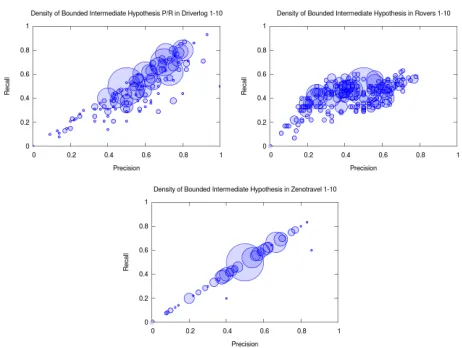
The results of all intermediate hypotheses over each do-main tested are shown in Figure 3. P/R results have been rounded to the nearest two decimal places in order to group together results for easier reading. The radius of a circle indicates the number of results in each grouping.
In the case ofDRIVERLOG, clustering results are largely grouped above P/R = 0.5/0.5 indicating that the majority ofintermediate hypothesesare reasonably accurate for their target bound. Results forROVERSare primarily distributed across R = 0.45, while ZENOTRAVELalso displays strong clustering around P/R = 0.5/0.5.
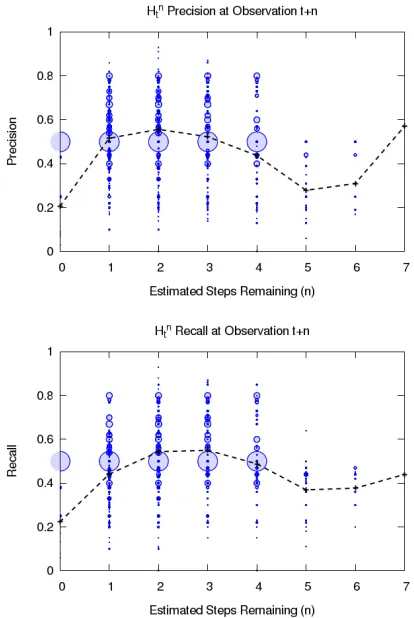
Figure 4 displays intermediate clustering results in rela-tion to their boundn. For example, column 1 relates to the accuracy of all hypotheses withn = 1(hypotheses which are expected to be true after 1 further observation). These re-sults reveal two details: that the majority of rere-sults are above 50% accurate, but also that there is a large number of P/R scores equal to (0.5/0.5) and that the estimation of remain-ing plan steps is often only a few steps from the current state (withε= 7being the highest observed). With regard to the former, the exact reason for the clustering around (0.5/0.5) is currently unknown as these results are spread across all three test domains. The latter observation can be explained by a combination of the accuracy of the heuristic used for estimation and the assumption that we have no knowledge of when the plan will terminate.
6.2
Short Lookahead Estimation
[image:5.612.323.554.54.228.2]The nature of the FF heuristic means that estimates to goals which are far from the current state will often be much lower than their true distance, while goals that are closer will have a more accurate estimate. In fact, it is not uncommon for the estimate to distant goals to remain the same (or even in-crease) over multiple observations, despite the fact they are actually becoming closer. This apparent lack-of-progress to-wards a goalGalone is enough to eliminate it as a candidate for hypotheses, as its probability will likely be low. This
Figure 3: Density of P/R rounded to 2 d.p. over problems 1-15 and over all intermediate hypotheses forDRIVERLOG, ROVERSandZENOTRAVEL. Circle radius is a reflection of the number of results at a specific P/R value.
is further compounded by the chance of multiple mutually-exclusive facts becoming closer after each observation.
Poor heuristic estimates for distant goals can also explain low values forε, as only a consistent decrease inh(G)will ensure they are considered as part of theimmediate hypoth-esisfrom whichεis deduced.
6.3
Terminal Hypotheses
As stated previously, while intermediate goal hypotheses are undoubtedly useful, the ultimate task in GR is to determine the agent’s final goal. Thus, we produce a singleterminal hypothesisafter each observation which is equivalent to the immediate hypothesisproduced to detectε. The P/R results of these hypotheses when computed at various stages of plan observation is displayed in Table 1.
The results show a high average value forrecallover all problems, whileprecisionis often lower. However, as pre-viously stated, whilebounded hypothesesare tested against full states, terminal hypotheses are tested against the true goal only. As both hypothesis types are generated from the same algorithm, the precision for terminal hypotheses will often be much lower than the bounded equivalent.
Figure 4: Density and averages for P/R of all hypotheses for all tests over all domains, when compared against the state encountered afternfurther observations.
ofcommunicatedgoal, despite there often only being a single one required.
Finally, we note that average recall results for IGRAPH are considerably higher than those ofAUTOGRAPH, with an average of 59% recall without any observations even being required. However, while recall has increased over all do-mains, precision has lowered for|P|= 25−100%. This is caused byterminal hypothesesbeing produced in the same manner asbounded hypotheses, wherein the hypothesis is closer to a full state specification rather than a subset of goals. InAUTOGRAPH, many more restricting assumptions were made about the set of goals considered as candidates, which ultimately allowed for more concise hypotheses.
Domain P
= 0%
P
= 25%
P
= 50%
P
= 75%
P
= 100%
Driverlog 0.22/0.3 0.33/0.45 0.46/0.6 0.55/0.69 0.66/0.84 Rovers 0.28/1 0.28/1 0.28/1 0.28/1 0.32/1 Zenotravel 0.28/0.46 0.23/0.39 0.25/0.43 0.36/0.63 0.4/0.68
IGRAPHAvg. 0.26/0.59 0.28/0.61 0.33/0.68 0.4/0.77 0.46/0.84
AUTOGRAPHAvg. 0.02/0.02 0.45/0.12 0.64/0.27 0.76/0.48 0.88/0.73
Table 1: A compilation of averaged P/R scores for all ter-minal hypothesesover all domains tested at 0%, 25%, 50%, 75% and 100% plan completion.
7
Discussion
We have presented IGRAPH, an extension ofAUTOGRAPH which attempts to move the state-of-the-art forward in goal recognition by tackling the problem of recognising mul-tiple unrelated goals and estimation of intermediate plan goals/states. This is done without the need of a plan or goal library, making it applicable in a wide range of situations with only minimal prior effort.
By generating both accurate intermediate and terminal hy-potheses, we have laid the groundwork for expanding into non-library-based plan recognition. As each bounded hy-pothesis is essentially a stepping-stone towards the final goal state, the ability to determine action selection becomes a much simpler task. Indeed, initial experiments have shown thatIGRAPHcan produce highly accuratenext-action predic-tion. By chaining these predictions together we may be able to derive apredicted plan without resorting to fully-blown planning.
References
[Albrecht, Zukerman, and Nicholson 1998] Albrecht, D. W.; Zukerman, I.; and Nicholson, A. E. 1998. Bayesian models for keyhole plan recognition in an adventure game. User Modeling and User-Adapted Interaction8(1-2):5–47.
[Blaylock and Allen 2006] Blaylock, N., and Allen, J. F. 2006. Fast hierarchical goal schema recog-nition. InProc. Nat. Conf. on AI (AAAI), 796–801.
[Charniak and Goldman 1993] Charniak, E., and Goldman, R. P. 1993. A Bayesian model of plan recognition.J. AI Res.64(1):53–79.
[Cheng and Thawonmas 2004] Cheng, D. C., and Thawonmas, R. 2004. Case-based plan recognition for real-time strategy games. InProceedings of the Game-On International Conference, 36–40. [Fikes and Nilsson 1971] Fikes, R., and Nilsson, N. J. 1971. STRIPS: A new approach to the
appli-cation of theorem proving to problem solving. InProc. Int. Joint Conf. on AI, 608–620. [Fox and Long 2003] Fox, M., and Long, D. 2003. PDDL2.1: An extension to PDDL for expressing
temporal planning domains.J. AI Res.20:61–124.
[Geib and Goldman 2001] Geib, C. W., and Goldman, R. P. 2001. Plan recognition in intrusion detection systems.
[Goldman, Geib, and Miller 1999] Goldman, R. P.; Geib, C. W.; and Miller, C. A. 1999. A new model of plan recognition.J. AI Res.64:53–79.
[Hoffmann and Nebel 2001] Hoffmann, J., and Nebel, B. 2001. The FF planning system: Fast plan generation through heuristic search.J. AI Res.14:253–302.
[Huntemann et al. 2008] Huntemann, A.; Demeester, E.; van Brussel, H.; and Nuttin, M. 2008. Can Bayes help disabled users? A Bayesian approach to plan recognition and shared control for steering an electrical wheelchair. InProc. ACM/IEEE Human-Robot Interaction Conf., 67–70. [Kabanza et al. 2010] Kabanza, F.; Bellefeuille, P.; Bisson, F.; Benaskeur, A. R.; and Irandoust, H.
2010. Opponent behaviour recognition for real-time strategy games.
[Kautz and Allen 1986] Kautz, H. A., and Allen, J. F. 1986. Generalized plan recognition. InProc. of AAAI-86, 32–37.
[Lesh and Etzioni 1996] Lesh, N., and Etzioni, O. 1996. Scaling up goal recognition. InKR, 244– 255.
[Long and Fox 2003] Long, D., and Fox, M. 2003. The 3rd international planning competition: Results and analysis.J. AI Res.20:1–59.
[McDermott et al. 1998] McDermott, D.; Ghallab, M.; Howe, A.; Knoblock, C.; Ram, A.; Veloso, M.; Weld, D.; and Wilkins, D. 1998. PDDL - the planning domain definition language. Technical report, Yale Center for Computational Vision and Control.
[Mott, Lee, and Lester 2006] Mott, B.; Lee, S.; and Lester, J. 2006. Probabilistic goal recognition in interactive narrative environments. InProc. Nat. Conf. on AI (AAAI), 187–192.
[Nau, Ghallab, and Traverso 2004] Nau, D.; Ghallab, M.; and Traverso, P. 2004.Automated Plan-ning: Theory & Practice. San Francisco, CA, USA: Morgan Kaufmann Publishers Inc. [Pattison and Long 2010] Pattison, D., and Long, D. 2010. Domain Independent Goal Recognition.
InSTAIRS 2010: Proceedings of the Fifth Starting AI Researchers’ Symposium, volume 222, 238 – 250. IOS Press.
[Porteous, Sebastia, and Hoffmann 2001] Porteous, J.; Sebastia, L.; and Hoffmann, J. 2001. On the extraction, ordering, and usage of landmarks in planning. InProc, European Conference on Artificial Intelligence, 37–48.
[Ram´ırez and Geffner 2010] Ram´ırez, M., and Geffner, H. 2010. Probabilistic plan recognition using off-the-shelf classical planners. InAAAI.
[Richter, Helmert, and Westphal 2008] Richter, S.; Helmert, M.; and Westphal, M. 2008. Landmarks revisited. InAAAI, 975–982.
[Schadd, Bakkes, and Spronck 2007] Schadd, F.; Bakkes, S.; and Spronck, P. 2007. Opponent mod-eling in real-time strategy games. In8th International Conference on Intelligent Games and Simu-lation (GAME-ON 2007), 61–68.