Moving forward in Reverse: A review into strategic decision making in
Reverse Logistics
David Stewart & Winifred Ijomah, DMEM, University of Strathclyde
Abstract
Reverse Logistics, the process of managing the backward flows of materials from a point of use to a point of recovery or proper disposal, has gained increased industry acceptance as a strategy for both competitive advantage and sustainable development. This has stimulated a growing number of researchers to investigate Strategic management issues relating to the set up and control of effective and efficient Reverse Logistics systems.
This paper systematically reviews the most important works in this field, with a focus on papers that concentrate on the strategic decision making process involved in the design and operation of a Reverse Logistics process with remanufacturing. The review found that: the majority of work is primarily focused on OEM specific issues; the sectors receiving the most attention are the ones under the greatest pressure from environmental legislation; and previous research findings from Rubio et al. (2009) and Fleischmann et al. (2000) are reaffirmed that the Reverse Logistics field is growing, but characterised by mainly quantitative, mathematical models. Future research efforts should be focused on the empirical investigation of the Reverse Logistics design process for all types of remanufacturers.
Introduction
The Reverse Logistics research field has received an increasing amount of attention from researchers and academics in recent years. This growing interest can largely be attributed to by the introduction of Extended Producer Responsibility (EPR) legislation, together with a growing spirit of environmental consciousness and social responsibility that has emerged across governments, businesses and society as a whole. Moreover, the concept of ‘Remanufacture’, an emergent product recovery strategy, has added impetus to this growing research area. Many businesses in industries such as the Automotive, Computer, Aerospace and Telecommunication sectors, are now implementing joint Reverse Logistics and Remanufacture processes to collect and recover products that have reached the End of their Life. This increased industry acceptance coupled with calls from leading researchers in the field (such as, Fleischmann et al. 1997; Dowlatshahi, 2000; Guide & Van Wassenhove, 2009; Srivistava 2007) has led to more stress being placed upon the investigation of strategic management issues in Reverse Logistics. In particular, a growing number of contributions have centered on examining the strategic decision making process and the consequential implications for managers. This particular area of Reverse Logistics forms the major focus of this paper, for which the purpose is to examine and understand the evolution of the Reverse Logistics research field through an in depth analysis on the characteristics of the strategic decision making research field. The paper concludes with an agenda for further research, for which investigations have already begun.
Reverse Logistics
According to The European Working group on Reverse Logistics, REVLOG. Reverse Logistics can be defined as: “The process of planning, implementing and controlling flows of raw materials, in
can be thought of as the process of collecting and transporting used or unwanted products from a customer or retailer site to an appropriate facility where the remaining product value can be recovered. The types of returns involved in Reverse Logistics vary from customer returns such as end-of-life, end-of-use and warranty returns, to Distribution returns such as product recalls and commercial returns (de Brito & Dekker, 2002). Key activities in the process include transportation, warehousing, distribution and inventory management, but can be stretched to include inspection, separation and disassembly activities. These activities can be further organised into three primary stages of flow: collection, sort-test and processing (Fleischmann et al. 2004; De Brito et al. 2003; Flapper, 1996).
Reverse Logistics has become a fundamental activity in modern supply chains, with global companies such as BMW, Xerox, IBM and Caterpillar all adopting Reverse Logistics programmes. According to the Reverse Logistics Executive Council, US firms spend more than an estimated $35 billion annually for handling, transporting, and processing returned e-products, and this figure continues to grow (Meyer, 1999). A growing amount of researchers have begun to move away from much of the earlier operational optimisation models on inventory control and capacity planning, and have started to place a greater stress on the strategic importance of Reverse Logistics. Blackburn et al. (2004) state that Reverse Logistics should be given as much attention at the corporate level as forward supply chains and should be viewed and managed as a business process that can create value for the company. Likewise, Stock et al. (2002) states that Reverse Logistics should not be viewed as a ‘costly sideshow to normal operations’ but as an opportunity to gain competitive advantage. This growing recognition of the strategic importance of Reverse Logistics can be further attributed by papers from Thierry et al. (1995); Dowlatshahi (2000) Toffel (2003) and de Brito (2004). The purpose of this literature review is to summarise this emergent stream of research by identifying patterns, themes and issues, and to identify the theoretical content of the research field.
Methodology
According to Tranfield et al. (2003), “Traditional ‘narrative’ reviews frequently lack thoroughness, and in many cases are not undertaken as genuine pieces of investigatory science”. Moreover, they can lack rigour as the review is often made biased by the researcher. To ensure an accurate representation of the research field is achieved, a systematic approach to the review has been taken.
The research questions are as follows:
1. What are the themes and patterns from the Meta data analysis? (e.g. number of articles, research methodology, etc.)
2. What decisions are actively being addressed by researchers? What are the most popular decisions under investigation?
3. Are the decision models generaliseable or specific to a particular industry? What industries are receiving the most attention?
4. Are the articles specific to a particular business type? (e.g. OEM, IR, CR) 5. What are the areas in need of future research?
Literature Review findings
A growing Research field
In this paper’s concentration of the chain of strategic decision-making research in Reverse Logistics, the first paper to be found on the subject was published in 1995 (Thierry et al. 1995). Since then, the field has blossomed, initially growing in a staggered fashion as it has gathered momentum, to a more consistent, year on year growth from 2004 onwards. At the time of this review, the number of papers published in 2010 was 20 articles, the most on any year.
Primarily quantitative and Mathematical models
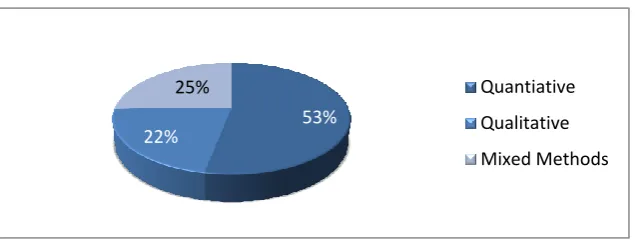
[image:3.595.141.459.645.768.2]The analysis of data collection methods (Figure 1) shows that the use of quantitative approaches in the study of strategic decision-making in Reverse Logistics, holds the significant majority (53%) over mixed methods (25%) and qualitative approaches (22%). Papers that employ mathematical models, mixed integer programming models, numerical models, survey’s and a portion of the mixed-criteria decision making models have been classified under a ‘Quantitative’ data collection approach; while case studies, literature reviews and theoretical based work have been categorised into ‘Qualitative’. Papers that adopt a number of different methodologies, such as the development of a mathematical model together with a case study to verify the results (as in Krikke et al. 1999; Sharma et al. 2007) have been grouped under ‘mixed methods’, as have a number of the Multi-criteria decision making models that utilise both Quantitative and qualitative variables. These findings correspond to the results of Srivistava (2007) and Fleischmann et al. (1997),who found that much of the work relating to research in the general Reverse Logistics field has utilized mainly quantitative approaches. The results from this analysis show that the subset of strategic decision making is also characterised by mainly quantitative models.
Figure 1: Data collection 53%
22%
25% Quantiative
Qualitative
Most popular Decisions
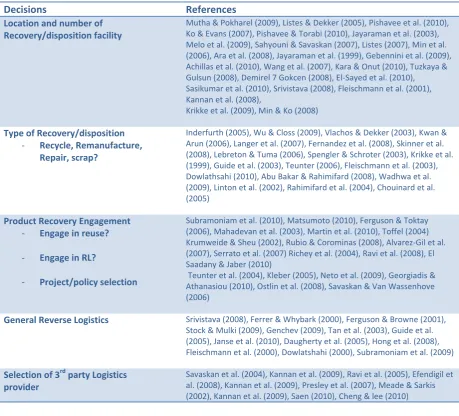
It was found that papers addressing the decision in the determination of the number and location of Recovery/disposition facilities had received the most amount of attention with 20%. Papers included in this category address a number of different issues pertaining to where recovery facilities should be placed and how many are needed for optimal efficiency. A key objective of these models is to minimise the distance, costs and transportation time between locations. Table 2. provides a summary of decisions and a classification of articles against each decision.
Decisions on the type of Recovery/disposition strategy (e.g. Remanufacture, Recondition, Reuse, Recycle, sent to Landfill) to use were found to be the second most popular with 18%. See Table 1. for a summary of the available recovery options. The choice of product recovery strategy largely depends on the product type and the quality it is returned in. From an environmental and economic standpoint, direct Reuse is usually the preferred option as it requires the least amount of energy to bring back to a working function, however the end product will not be ‘as good as new’, as in the case of Remanufacture. Recycling is generally the least preferred option as it requires an intense amount of energy to smelt the materials back down into their raw state, but is sometimes the most economical option, depending on the condition the product is returned in.
Table1.
Summary of Recovery options(adapted from Ijomah, 2002)
Recovery options Definition
Remanufacturing
The process of returning a used product to at least OEM original performance specification from the customers’ perspective and giving the resultant product a warranty that is equal to that of a newly manufactured equivalent
Reconditioning
The process of returning a used product to a satisfactory working condition that may be inferior to the original specification. Generally, the resultant product has a warranty that is less than that of a newly manufactured equivalent. The warranty applies to all major wearing parts
Repair
Repairing is simply the correction of specified faults in a product. When repaired products have warranties, they are less than those of newly manufactured equivalents. Also, the warranty may not cover the whole product but only the component that has been repaired.
Decisions relating to the company’s engagement in Product Recovery and Reverse Logistics are the third most popular with a 14% share. Papers that address the strategic decision over whether to engage in reuse or whether to outsource; the decision to make the company responsible for Reverse Logistics or to contract the collection and transportation to a 3rd party logistics provider; and a company’s selection over Reverse Logistics projects and policies; have been categorised under the umbrella term of ‘Product Recovery engagement’.
decision making methodologies to deal with the multitude of factors in making an assessment, including Kannan et al. (2009); Ravi et al. (2005); Lu et al. (2007); Cheng & Lee (2010); Meade & Sarkis (2002).
[image:5.595.53.513.265.681.2]Articles that take a broader approach to addressing decision making in Reverse Logistics have been categorised under ‘General Reverse Logistics’, and make up 14% of the total published literature. These are papers that consider a number of different decisions and considerations in unison with each other and are generally more theoretical in nature. Other decisions that have been identified, but have not received as much attention include: inventory control and production planning (9%), the selection of an appropriate Acquisition strategy (4%); Pricing (4%); Routes in network design (4%); and Product lifecycle (2%).
Table 2.
Classification of strategic decisions in RL design
Decisions References
Location and number of Recovery/disposition facility
Mutha & Pokharel (2009), Listes & Dekker (2005), Pishavee et al. (2010), Ko & Evans (2007), Pishavee & Torabi (2010), Jayaraman et al. (2003), Melo et al. (2009), Sahyouni & Savaskan (2007), Listes (2007), Min et al. (2006), Ara et al. (2008), Jayaraman et al. (1999), Gebennini et al. (2009), Achillas et al. (2010), Wang et al. (2007), Kara & Onut (2010), Tuzkaya & Gulsun (2008), Demirel 7 Gokcen (2008), El-Sayed et al. (2010), Sasikumar et al. (2010), Srivistava (2008), Fleischmann et al. (2001), Kannan et al. (2008),
Krikke et al. (2009), Min & Ko (2008)
Type of Recovery/disposition
- Recycle, Remanufacture,
Repair, scrap?
Inderfurth (2005), Wu & Closs (2009), Vlachos & Dekker (2003), Kwan & Arun (2006), Langer et al. (2007), Fernandez et al. (2008), Skinner et al. (2008), Lebreton & Tuma (2006), Spengler & Schroter (2003), Krikke et al. (1999), Guide et al. (2003), Teunter (2006), Fleischmann et al. (2003), Dowlathsahi (2010), Abu Bakar & Rahimifard (2008), Wadhwa et al. (2009), Linton et al. (2002), Rahimifard et al. (2004), Chouinard et al. (2005)
Product Recovery Engagement
- Engage in reuse?
- Engage in RL?
- Project/policy selection
Subramoniam et al. (2010), Matsumoto (2010), Ferguson & Toktay (2006), Mahadevan et al. (2003), Martin et al. (2010), Toffel (2004) Krumweide & Sheu (2002), Rubio & Corominas (2008), Alvarez-Gil et al. (2007), Serrato et al. (2007) Richey et al. (2004), Ravi et al. (2008), El Saadany & Jaber (2010)
Teunter et al. (2004), Kleber (2005), Neto et al. (2009), Georgiadis & Athanasiou (2010), Ostlin et al. (2008), Savaskan & Van Wassenhove (2006)
General Reverse Logistics Srivistava (2008), Ferrer & Whybark (2000), Ferguson & Browne (2001),
Stock & Mulki (2009), Genchev (2009), Tan et al. (2003), Guide et al. (2005), Janse et al. (2010), Daugherty et al. (2005), Hong et al. (2008), Fleischmann et al. (2000), Dowlatshahi (2000), Subramoniam et al. (2009)
Selection of 3rd party Logistics provider
Savaskan et al. (2004), Kannan et al. (2009), Ravi et al. (2005), Efendigil et al. (2008), Kannan et al. (2009), Presley et al. (2007), Meade & Sarkis (2002), Kannan et al. (2009), Saen (2010), Cheng & lee (2010)
Business focus
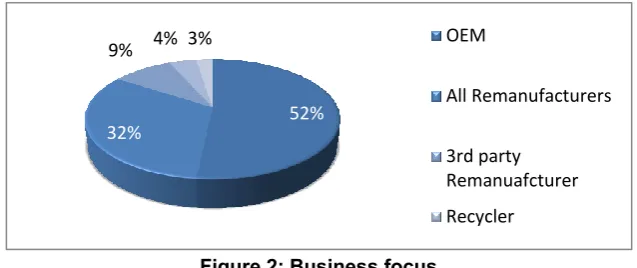
Independent companies (Lund, 1984; Thierry, 1995). It is however understandable, when you consider that OEM’s are in a primary position to achieve completely Closed loop supply chains, from the production of the original products, through to the collection of the same products at the end of their life, recovery of parts and finally the redistribution out onto the market, thus establishing a truly sustainable business process. The analysis also finds that 32% of the models are generalisable to all companies engaged in Remanufacturing. These are papers that address more of a universal recovery problem such as the type of recovery/disposition strategy to use, rather than product recovery engagement issues such as whether to engage in reuse or not, which is more applicable for OEM’s. Papers specific to 3rd party remanufacturers (independent and contractual) were found to hold a 9% share of total papers with authors such as Matsumoto (2010), Seitz (2007), Min & Ko (2008), and Krumwiede & Sheu (2002) all providing valuable contributions to the field.
Figure 2: Business focus
Industry focus
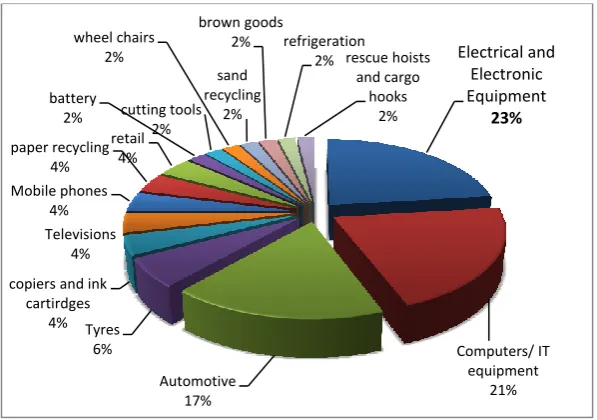
Next, we look at the applicability of these models to specific industries and analyse which sectors have received the most amount of attention from researchers. We find that out of all the papers reviewed, 42% are case specific to a particular industry and the remaining papers (58%) are generic to the Remanufacture industry as a whole. Out of this 42%, we find that sectors under severe legislative and environmental pressure from governments and consumers, are the ones receiving the most amount of attention from the Academic community (Figure 3). In particular, we have witnessed a wealth of papers published that address the WEEE directive. In total, 23% of the case specific papers were focused on the general Electrical and Electronic Equipment sector; Shevtshenko & Wang (2009); Achillas et al. (2010); Gameberinni et al. (2010); Wang et al. (2007). Similarly, with a 21% share, the more specific Computer and IT equipment sector was found to have also received a large proportion of academic treatment, a result of the pressure from the WEEE directive; Ravi et al. (2005); Krikke et al. (1999); A.W.T. Kwan & Kumar (2006); Guide et al. (2005). In the automotive industry, producers are being coerced to collect and recover end-of-life vehicles from customer sites under the End-of-Life Vehicles (ELV) directive; consequently resulting in more papers being published on the subject with a 17% share (Subramoniam et al. 2009; Alvarez-Gil 2007; Richey et al. 2004; Seitz, 2007). Other sectors that have received attention from the academic literature include: the remanufacture and recovery of Tyres (6%), Copiers and ink cartridges (4%), Televisions (4%), Mobile phones (4%), recovery of batteries (2%), cutting tools (2%), wheel chairs (2%) and refrigeration (2%).
52% 32%
9% 4% 3% OEM
All Remanufacturers
3rd party Remanuafcturer
Figure 3: Industry sectors
Agenda for Research
There is a need for further investigation into the business practices of Independent and third party remanufacturers. It is the smaller, independent businesses that make up the majority of the Remanufacturing and Reuse industry, but surprisingly, it’s the OEM’s that have received the majority of attention from researchers and academics. These Independent remanufacturers can be categorised under Small to medium sized enterprises (SME’s). According to Shrader et al. (1989), it is important to understand that these companies are not just smaller versions of larger OEM firms. Their needs and often their decision making processes differ significantly from those of larger firms. Seitz & Peattie (2004) and Ostlin et al. (2008) have suggested that OEM’s do not usually adopt remanufacturing as a profitable business endeavor; instead they will often engage in remanufacturing to deter independent remanufacturers from reusing their products; or as part of long-term corporate strategies, such as moral and ethical responsibility; or in securing the spare parts supply market. Whereas, in the case of Independent and contractual Remanufacturers, making a profit from remanufacturing is a prerequisite in order for their business to survive (Matsumoto, 2009). It is clear that the two types of Remanufacturers differ considerably in their strategic focus.
Further to this, the literature available on the types of decisions that Remanufacturing managers need to make when designing (and redesigning) the Reverse Logistics process is still relatively sparse. With regards to network design (location, number, transport routes, logistics company selection, etc.), much of the existing research is primarily focused on the physical flows of material between actors in the reverse supply chain and not enough on the flow of information. It has been well documented that Remanufacturing is a process that is riddled with uncertainty and requires timely information to be made readily available to help remanufacturers predict the timing and quantity of used cores, forecast the quality in which the core will arrive in and balance supply with demand. Appropriate Information and Communication Technology (ICT) systems need to be designed into the Reverse Logistics and Remanufacture process in order to help limit this uncertainty and thus provide greater visibility of the whole supply chain. Consequently, further research needs to be conducted in the examination of appropriate ICT systems to be implemented into the Reverse supply chain.
Electrical and Electronic Equipment
23%
Computers/ IT equipment
21% Automotive
17% Tyres
6% copiers and ink
cartirdges 4% Televisions
4% Mobile phones
4% paper recycling
4%
retail 4% battery
2% cutting tools 2% wheel chairs
2%
sand recycling
2% brown goods
2% refrigeration 2% rescue hoists
and cargo hooks
We also echo the findings of Rubio et al. (2009) and Dekker et al. (2004) that much of the existing Reverse Logistics literature is characterised by mostly mathematical, numerical and simulation models. For a research field with its roots in Operations Research, this is no great surprise. However, many of these models have been criticised as being too distant from the reality of actual Remanufacturing practices and fail to assess industry relevant issues under realistic conditions. Guide & Van Wassenhove (2009) sum this trend up particularly well: “we have seen a wealth of manuscripts focused on slight technical refinements to existing OR models or that address artificial problems....A focus on technical extensions can trap research in a cycle where each successive model yields a more elegant solution but with little or no connection to the larger business issues”. Hence, we conclude that there is a need for more empirical research in the investigation of the current industry practices of remanufacturing companies so that the information from which can be induced and subsequently fed into future OR models. By doing this, new models can be developed that provide practical solutions to the design, operation and control of the Reverse Logistics process, that are both comprehensive and more realistic.
Taking these limitations of existing research into account, an agenda has been formulated for the next stage of this research, centered around the following questions:
- What are the day to day operations, activities and management systems that govern the Reverse Logistics process for third party Remanufacturers?
- Why have they been setup in such a way?
- What is involved in the design of a reverse Logistics process for 3rd part remanufacturers? What are the decisions, considerations and steps involved in the setup and control?
To answer these questions, research has already begun at a number of Third party Remanufacturers in the UK. For this investigation, a qualitative approach to data collection has been adopted. Altogether, four cases are under investigation, following a multiple case study methodology, as proposed by Eisenhardt (1989). Research methods such as interviews, observation and document reviews are being used to make sense of the practices, experiences and perceptions of the Remanufacturing managers; the respondents consisting of CEO's, logistics managers, purchasing managers and operations managers, as well as shop floor workers. The research is still ongoing at the respective case study companies. It is expected that the full findings and overall contribution from the research will only be realised once each case has been fully and rigorously investigated.
References
Achillas, C., C. Vlachokostas, et al. (2010). "Decision support system for the optimal location of electrical and electronic waste treatment plants: A case study in Greece." Waste Management 30(5): 870-879.
Albert Wee Kwan, T., Y. Wei Shin, et al. (2003). "Improving the performance of a computer company in supporting its reverse logistics operations in the Asia-Pacific region." International Journal of Physical Distribution & Logistics Management 33(1/2): 59.
Kwan, A. W. T. and Arun, K. (2006). "A decision-making model for reverse logistics in the computer industry." International Journal of Logistics Management 17: 331.
Alvarez-Gil, M. J., P. Berrone, et al. (2007). "Reverse logistics, stakeholders' influence, organizational slack, and managers' posture." Journal of Business Research 60(5): 463-473.
Ara, N., D. Aksen, et al. (2008). "Locating collection centers for incentive-dependent returns under a pick-up policy with capacitated vehicles." European Journal of Operational Research 191(3): 1223-1240.
Cheng, Y. and F. Lee (2010). "Outsourcing reverse logistics of hightech manufacturing firms by using a systematic decision-making approach: TFT-LCD sector in Taiwan." Industrial Marketing Management 39: 1111.
Chouinard, M., S. D'Amours, et al. (2005). "Integration of reverse logistics activities within a supply chain information system." Computers in Industry 56(1): 105-124.
Daugherty, P. J., R. G. Richey, et al. (2005). "Reverse logistics: superior performance through focused resource commitments to information technology." Transportation Research Part E-Logistics and Transportation Review 41(2): 77-92.
de Brito, M.P., Flapper, S.D.P. and Dekker, R. (2003). Reverse Logistics: a Review of Case Studies. Research Series Report in Management ERS-2003–012-LIS, Erasmus University Rotterdam, the Netherlands.
De Brito, M. P. and Dekker, R. (2002). Reverse logistics - a framework.
Dekker, R., Fleischmann, M., Inderfurth, K. and Van Wassenhove, L.N. (eds) (2004). Reverse Logistics:
Quantitative Models for Closed- Loop Supply Chains. Berlin:
Springer
Demirel, N. O. and H. Gokcen (2008). "A mixed integer programming model for remanufacturing in reverse logistics environment." International Journal of Advanced
Manufacturing Technology 39(11-12): 1197-1206.
Dowlatshahi, S. (2000). "Developing a theory of reverse logistics." Interfaces 30(3): 143.
Dowlatshahi, S. (2010). "A cost-benefit analysis for the design and implementation of reverse logistics systems: case studies approach." International Journal of Production Research 48(5): 1361-1380.
Eisenhardt, K. M. (1989). Building Theories from Case Study Research. The Academy of Management Review, Vol. 14, pp 532-550
Efendigil, T., S. Onut, et al. (2008). "A holistic approach for selecting a third-party reverse logistics provider in the presence of vagueness." Computers & Industrial Engineering 54(2): 269-287.
El-Sayed, M., N. Afia, et al. (2010). "A stochastic model for forward-reverse logistics network design under risk." Computers & Industrial Engineering 58(3): 423-431.
El Saadany, A. M. A. and M. Y. Jaber (2010). "A
production/remanufacturing inventory model with price and quality dependant return rate." Computers & Industrial Engineering 58(3): 352-362.
Ferguson, M. E. and L. B. Toktay (2006). "The effect of competition on recovery strategies." Production and Operations Management 15(3): 351-368.
Ferguson, N. and J. Browne (2001). "Issues in end-of-life product recovery and reverse logistics." Production Planning & Control 12(5): 534-547.
Fernandez, I., J. Puente, et al. (2008). "A decision-making support system on a products recovery management framework a fuzzy approach." Concurrent Engineering-Research and Applications 16(2): 129-138.
Ferrer, G. and D. C. Whybark (2000). "From garbage to goods: Successful remanufacturing systems and skills." Business Horizons 43(6): 55.
Fleischmann, M., P. Beullens, et al. (2001). "The impact of product recovery on logistics network design." Production and Operations Management 10(2): 156-173.
Fleischmann, M., J. M. BloemhofRuwaard, et al. (1997). "Quantitative models for reverse logistics: A review." European Journal of Operational Research 103(1): 1-17.
Fleischmann, M., H. R. Krikke, et al. (2000). "A
characterisation of logistics networks for product recovery." Omega-International Journal of Management Science 28(6): 653-666.
Fleischmann, M., J. van Nunen, et al. (2003). "Integrating closed-loop supply chains and spare-parts management at IBM." Interfaces 33(6): 44-56.
Galbreth, M. R. and J. D. Blackburn (2006). "Optimal acquisition and sorting policies for remanufacturing." Production and Operations Management 15(3): 384-392.
Gamberini, R., E. Gebennini, et al. (2010). "On the integration of planning and environmental impact assessment for a WEEE transportation network-A case study." Resources Conservation and Recycling 54(11): 937-951.
Gebennini, E., R. Gamberini, et al. (2009). "An integrated production-distribution model for the dynamic location and allocation problem with safety stock optimization." International Journal of Production Economics 122: 286.
Genchev, S. (2009). "Reverse logistics program design: A company study." Business Horizons 52: 139.
Georgiadis, P. and E. Athanasiou (2010). "The impact of two-product joint lifecycles on capacity planning of remanufacturing networks." European Journal of Operational Research 202(2): 420-433.
Guide, V. D. R. (2000). "Production planning and control for remanufacturing: industry practice and research needs." Journal of Operations Management 18(4): 467-483. Guide, V. D. R., V. Jayaraman, et al. (2003). "Building contingency planning for closed-loop supply chains with product recovery." Journal of Operations Management 21(3): 259-279.
Guide, V. D. R., L. Muyldermans, et al. (2005). "Hewlett-Packard company unlocks the value potential from time-sensitive returns." Interfaces 35(4): 281-293.
Guide, V. D. R. and L. N. Van Wassenhove (2009). "The Evolution of Closed-Loop Supply Chain Research." Operations Research 57(1): 10-18.
Hong, I. H., J. C. Ammons, et al. (2008). "Decentralized decision-making and protocol design for recycled material flows." International Journal of Production Economics 116(2): 325-337.
Inderfurth, K. (2005). "Impact of uncertainties on recovery behavior in a remanufacturing environment: A numerical analysis." International Journal of Physical Distribution & Logistics Management 35(5): 318.
Janse, B., P. Schuur, et al. (2010). "A reverse logistics diagnostic tool: the case of the consumer electronics industry." International Journal of Advanced Manufacturing Technology 47(5-8): 495-513.
Jayaraman, V., V. D. R. Guide, et al. (1999). "A closed-loop logistics model for remanufacturing." Journal of the Operational Research Society 50(5): 497-508.
Jayaraman, V. and Y. D. Luo (2007). "Creating competitive advantages through new value creation: A reverse logistics perspective." Academy of Management Perspectives 21(2): 56-73.
Jayaraman, V., R. A. Patterson, et al. (2003). "The design of reverse distribution networks: Models and solution
procedures." European Journal of Operational Research 150(1): 128-149.
Kannan, G., A. Haq, et al. (2008). "An application of the Analytical Hierarchy Process and Fuzzy Analytical Hierarchy Process in the selection of collecting centre location for the reverse logistics Multicriteria Decision-Making supply chain model." International Journal of Management & Decision Making 9: 350.
Kannan, G., P. Murugesan, et al. (2009). "3PRLP's selection using an integrated analytic hierarchy process and linear programming." International Journal of Services Technology and Management 12: 61.
Kannan, G., P. Murugesan, et al. (2009). "Multicriteria group decision making for the third party reverse logistics service provider in the supply chain model using fuzzy TOPSIS for transportation services." International Journal of Services Technology and Management 11: 162.
Kannan, G., S. Pokharel, et al. (2009). "A hybrid approach using ISM and fuzzy TOPSIS for the selection of reverse logistics provider." Resources Conservation and Recycling 54(1): 28-36.
Kara, S. S. and S. Onut (2010). "A stochastic optimization approach for paper recycling reverse logistics network design under uncertainty." International Journal of Environmental Science and Technology 7(4): 717-730.
Kiesmuller, G. P. and C. W. Scherer (2003). "Computational issues in a stochastic finite horizon one product recovery inventory model." European Journal of Operational Research 146(3): 553-579.
Kleber, R. (2006). "The integral decision on
production/remanufacturing technology and investment time in product recovery." Or Spectrum 28(1): 21-51.
Ko, H. J. and G. W. Evans (2007). "A genetic algorithm-based heuristic for the dynamic integrated forward/reverse logistics network for 3PLs." Computers & Operations Research 34(2): 346-366.
Krikke, H. R., A. van Harten, et al. (1999). "Business case Oce: Reverse logistic network re-design for copiers." Or Spektrum 21(3): 381-409.
Krikke, H. R., A. van Harten, et al. (1999). "Business case Roteb: recovery strategies for monitors." Computers & Industrial Engineering 36(4): 739-757.
Krumwiede, D. W. and C. Sheu (2002). "A model for reverse logistics entry by third-party providers." Omega-International Journal of Management Science 30(5): 325-333.
Kumar, R. P., V. Prem, et al. (2004). "Cost optimisation model in recycled waste reverse logistlics system." International Journal of Business Performance Management 6: 245.
Langer, N., C. Forman, et al. (2007). "Assessing the impact of RFID on return center logistics." Interfaces 37(6): 501-514.
Lebreton, B. and A. Tuma (2006). "A quantitative approach to assessing the profitability of car and truck tire
remanufacturing." International Journal of Production Economics 104(2): 639-652.
Linton, J. D., J. S. Yeomans, et al. (2002). "Supply planning for industrial ecology and remanufacturing under uncertainty: a numerical study of leaded-waste recovery from television disposal." Journal of the Operational Research Society 53(11): 1185-1196.
Listes, O. (2007). "A generic stochastic model for supply-and-return network design." Computers & Operations Research 34(2): 417-442.
Listes, O. and R. Dekker (2005). "A stochastic approach to a case study for product recovery network design." European Journal of Operational Research 160(1): 268-287.
Lund, R.T. (1984). Remanufacturing. Technology Review, 87, 18–23.
Mahadevan, B., D. F. Pyke, et al. (2003). "Periodic review, push inventory policies for remanufacturing." European Journal of Operational Research 151(3): 536-551.
Martin, P., V. D. R. Guide, et al. (2010). "Supply Chain Sourcing in Remanufacturing Operations: An Empirical Investigation of Remake Versus Buy." Decision Sciences 41(2): 301-324.
Matsumoto, M. (2009). "Business frameworks for sustainable society: a case study on reuse industries in Japan." Journal of Cleaner Production 17(17): 1547-1555.
Matsumoto, M. (2010). "Development of a simulation model for reuse businesses and case studies in Japan." Journal of Cleaner Production 18(13): 1284-1299.
Meade, L. and J. Sarkis (2002). "A conceptual model for selecting and evaluating third-party reverse logistics providers." Supply Chain Management 7(5): 283.
Melo, M. T., S. Nickel, et al. (2009). "Facility location and supply chain management - A review." European Journal of Operational Research 196(2): 401-412.
Meyer, H. (1999). "Many happy returns." The Journal of Business Strategy 20(4): 27.
Min, H. and H. J. Ko (2008). "The dynamic design of a reverse logistics network from the perspective of third-party logistics service providers." International Journal of Production Economics 113(1): 176-192.
Min, H., H. J. Ko, et al. (2006). "A genetic algorithm approach to developing the multi-echelon reverse logistics network for product returns." Omega-International Journal of Management Science 34(1): 56-69.
Mitra, S. and S. Webster (2008). "Competition in
remanufacturing and the effects of government subsidies." International Journal of Production Economics 111: 287.
Mutha, A. and S. Pokharel (2009). "Strategic network design for reverse logistics and remanufacturing using new and old product modules." Computers & Industrial Engineering 56(1): 334-346.
Neto, J. Q. F., G. Walther, et al. (2009). "A methodology for assessing eco-efficiency in logistics networks." European Journal of Operational Research 193(3): 670-682.
Ostlin, J., E. Sundin, et al. (2008). "Importance of closed-loop supply chain relationships for product remanufacturing." International Journal of Production Economics 115(2): 336-348.
Pishvaee, M. S., M. Rabbani, et al. (2010). "A robust optimization approach to closed-loop supply chain network design under uncertainty." Applied Mathematical Modelling 35(2): 637-649.
design under uncertainty." Fuzzy Sets and Systems 161(20): 2668-2683.
Presley, A., L. Meade, et al. (2007). "A strategic sustainability justification methodology for organizational decisions: a reverse logistics illustration." International Journal of Production Research 45: 4595-4620.
Rahimifard, A., S. T. Newman, et al. (2004). "A web-based information system to support end-of-life product recovery." Proceedings of the Institution of Mechanical Engineers Part B-Journal of Engineering Manufacture 218(9): 1047-1057.
Ravi, V., R. Shankar, et al. (2005). "Analyzing alternatives in reverse logistics for end-of-life computers: ANP and balanced scorecard approach." Computers & Industrial Engineering 48(2): 327-356.
Ravi, V., R. Shankar, et al. (2008). "Selection of a reverse logistics project for end-of-life computers: ANP and goal programing approach." International Journal of Production Research 46(17): 4849-4870.
Richey, R. G., J. D. Patricia, et al. (2004). "REVERSE LOGISTICS: THE IMPACT OF TIMING AND RESOURCES." Journal of Business Logistics 25: 229.
Rubio, S., A. Chamorro, et al. (2008). "Characteristics of the research on reverse logistics (1995-2005)." International Journal of Production Research 46(4): 1099-1120.
Rubio, S. and A. Corominas (2008). "Optimal manufacturing-remanufacturing policies in a lean production environment." Computers & Industrial Engineering 55(1): 234-242.
Saen, R. F. (2010). "A new model for selecting third-party reverse logistics providers in the presence of multiple dual-role factors." International Journal of Advanced Manufacturing Technology 46(1-4): 405-410.
Sahyouni, K. and R. C. Savaskan (2007). "A facility location model for bidirectional flows." Transportation Science 41(4): 484-499.
Sarkis, J. (2003). "A strategic decision framework for green supply chain management." Journal of Cleaner Production 11(4): 397-409.
Sasikumar, P., G. Kannan, et al. (2010). "A multi-echelon reverse logistics network design for product recovery-a case of truck tire remanufacturing." International Journal of Advanced Manufacturing Technology 49(9-12): 1223-1234.
Savaskan, R. C., S. Bhattacharya, et al. (2004). "Closed-loop supply chain models with product remanufacturing."
Management Science 50(2): 239-252.
Savaskan, R. C. and L. N. Van Wassenhove (2006). "Reverse channel design: The case of competing retailers."
Management Science 52(1): 1-14.
Seitz, M. A. (2007). "A critical assessment of motives for product recovery: the case of engine remanufacturing." Journal of Cleaner Production 15(11-12): 1147-1157. Seitz, M.A., K. Peattie. (2004). “Meeting the closed-loop challenge: The case of remanufacturing”. California Management Review, 46(2), 74-89.
Serrato, M. A., S. M. Ryan, et al. (2007). "A Markov decision model to evaluate outsourcing in reverse logistics."
International Journal of Production Research 45(18-19): 4289-4315.
Shrader. C.B.. Mulford, C. & Blackburn, V. (1989). Strategic and operational planning, uncertainty, and performance in small firms. Journal of small Business Management, 27
(October): 45-60.
Skinner, L., R., T. B. Paul, et al. (2008). "Examining the impact of reverse logistics disposition strategies." International Journal of Physical Distribution & Logistics Management 38: 518.
Spengler, T. and M. Schroter (2003). "Strategic management of spare parts in closed-loop supply chains - A system dynamics approach." Interfaces 33(6): 7-17.
Srivastava, S. K. (2007). "Green supply-chain management: A state-of-the-art literature review." International Journal of Management Reviews 9(1): 53-80.
Srivastava, S. K. (2008). "Network design for reverse logistics." Omega-International Journal of Management Science 36(4): 535-548.
Stock, J., Speh, T. and Shear, H. (2002). Many happy (product) returns. Harvard Business Review, 80, 16–18.
Stock, J. and J. Mulki (2009). "PRODUCT RETURNS PROCESSING: AN EXAMINATION OF PRACTICES OF MANUFACTURERS, WHOLESALERS/DISTRIBUTORS, AND RETAILERS." Journal of Business Logistics 30(1): 33.
Subramoniam, R., D. Huisingh, et al. (2009).
"Remanufacturing for the automotive aftermarket-strategic factors: literature review and future research needs." Journal of Cleaner Production 17(13): 1163-1174.
Subramoniam, R., D. Huisingh, et al. (2010). "Aftermarket remanufacturing strategic planning decision-making framework: theory & practice." Journal of Cleaner Production 18(16-17): 1575-1586.
Teunter, R. H. (2006). "Determining optimal disassembly and recovery strategies." Omega-International Journal of Management Science 34(6): 533-537.
Thierry, M., M. Salomon, et al. (1995). "STRATEGIC ISSUES IN PRODUCT RECOVERY MANAGEMENT." California Management Review 37(2): 114-135.
Toffel, M. W. (2003). "The growing strategic importance of end-of-life product management." California Management Review 45(3): 102-+.
Toffel, M. W. (2004). "Strategic management of product recovery." California Management Review 46(2): 120-+.
Trappey, A. J. C., C. V. Trappey, et al. (2010). "Genetic algorithm dynamic performance evaluation for RFID reverse logistic management." Expert Systems with Applications 37(11): 7329-7335.
Tuzkaya, G. and B. Gulsun (2008). "Evaluating centralized return centers in a reverse logistics network: An integrated fuzzy multi-criteria decision approach." International Journal of Environmental Science and Technology 5(3): 339-352.
Vlachos, D. and R. Dekker (2003). "Return handling options and order quantities for single period products." European Journal of Operational Research 151(1): 38-52.
Wadhwa, S., J. Madaan, et al. (2009). "Flexible decision modeling of reverse logistics system: A value adding MCDM approach for alternative selection." Robotics and Computer-Integrated Manufacturing 25(2): 460-469.
Wang, Z. P., D. Q. Yao, et al. (2007). "A new location-inventory policy with reverse logistics applied to B2C e-markets of China." International Journal of Production Economics 107(2): 350-363.