City, University of London Institutional Repository
Citation
:
Madle, G. (2009). Impact-ED : A new model of digital library impact evaluation.
(Unpublished Doctoral thesis, City University London)
This is the accepted version of the paper.
This version of the publication may differ from the final published
version.
Permanent repository link: http://openaccess.city.ac.uk/id/eprint/19619/
Link to published version
:
Copyright and reuse:
City Research Online aims to make research
outputs of City, University of London available to a wider audience.
Copyright and Moral Rights remain with the author(s) and/or copyright
holders. URLs from City Research Online may be freely distributed and
linked to.
Impact-ED: A new model of digital library impact
evaluation
Gemma Madle
Submitted in partial fulfilment for the award of PhD
Supervisors:
Prof Abdul Roudsari, Centre for Health Informatics
&
Dr Patty Kostkova, City eHealth Research Centre
IMAGING SERVICES NORTH
Boston Spa, WetherbyWest Yorkshire, LS23 7BQ www.bl.uk
THE FOLLOWING HAVE BEEN REDACTED AT THE
REQUEST OF THE UNIVERSITY
Table of Contents
Chapter 1 - Introduction
1.1 Research context 10
1.2 Research aims & objectives 11
1.3 Limitations of the research 13
1.4 Organisation of thesis 13
Chapter 2 - Literature Review
2.1 Introduction 15
2.2 Digital libraries 15
2.2.1 Digital library definitions 15
2.2.2 Digital library work models 18
2.3 Digital library evaluation 22
2.3.1 Defining evaluation in a digital library context 22 2.3.2 Current digital library and electronic information services evaluation 24 measures and frameworks
2.3.3 Defining impact 31
2.3.4 Defining the requirements for a digital library impact evaluation 33 2.3.5 Review of previous digital library impact evaluations 34
2.3.6 Impact measured in previous studies 45
2.3.7 Impact not measured in previous studies 51
2.4 Review of data collection methods 53
2.4.1 Questionnaires 53
2.4.2 Web server log analysis 54
2.4.3 Interviews 55
2.4.4 Summary of impact evaluation methods 56
2.5 Discussion 57
2.5.1 Limitations of current approaches to digital library impact evaluation 57 2.5.2 Criteria for a digital library impact evaluation 58
2.6 Summary 60
Chapter 3 - A New Model of Digital Library Impact Evaluation
3.1 Introduction 62
3.2 Defining knowledge 62
3.3 Defining attitude 64
3.4 The theory of planned behaviour 65
.. 3.5 Other approaches to predicting behaviour from attitudes 68
3.6 MeasuriDg knowledge and attitude . 69
.. 3.6.1 Dervin's sense-making approach 69
changes
3.7 The Impact-ED model 72
3.7.1 Stage one - mapping digital library dimensions 72 3.7.2 Stage two - applying impact evaluation criteria 73
3.7.3 Stage three - developing the methods 74
3.7.3.1 Impact study registration and study end questionnaires 74
3.7.3.2 Pre and post visit questionnaires 75
3.7.3.3 Learning exercise/information seeking task 75
3.7.3.4 Web server log collection 75
3.7.3.5 Interviews 75
3.7.4 Does the model meet the requirements? 77
3.8 Summary 78
Chapter 4 - Methodology
4.1 Introduction 80
4.2 Literature Review 80
4.2.1 Digital library impact in the Healthcare domain - Search strategy 80 4.2.2 Digital library impact in other domains - Search strategy 81
4.3 Model development 84
4.3.1 Data collection in the ImpaGt~ED model 85
4.3.2 Data analysis in the Impact-ED model 88
4.3.3 Implementation of the Impact-ED model 89
4.4 Summary 89
Chapter 5 - Implementation of the Impact-ED model
5.1 Introduction 92
5.2 The case study - The National Resource for Infection Control 92
5.3 Proposed sample population and setting 94
. 5.4 Data collection 94
5.5 Data analysis 96
5.6 Results 96
5.6.1 Community 96
5.6.1.1 How the digital library is used in the work setting and what are 96 . the reasons for use
.5.6.1.2 The sUitab,ility of the work environment for integrating the digital 101 library into work practice
5.6.1.3 Awareness of the digital library in the target community 102
5.6.1.4 Basic demographics of users 102
5.6.2.Services 103
needs
5.6.2.2 Preferred resources/services already offered by the digital library and awareness of current services and content in existing users 5.6.2.3 Gaps in provision
5.6.3 Technology
5.6.3.1 Basic web access log statistics 5.6.3.2 Usability of the digital library 5.6.3.3 Search query analysis 5.6.3.4 NaVigation pathway analysis 5.6.4 Content
5.6.4.1 Knowledge and attitude changes as a result of using the digital library
5.6.4.2 The impact of using the digital library on user work
5.6.4.3 The dissemination of information found in the digital library to others
5.6.5 Summary of results of NRIC impact evaluation 5.6.5.1 How NRIC is used in the community
5.6.5.2 How well received is NRIC and its services? 5.6.5.3 Usability and navigation
5.6.5.4 NRIC's impact
5.7 Developing an impact score calculation 5.7.1 The initial impact score
5.7.2 The impact score related to reason for use or outputs 5.7.3 The maximum potential impact score
5.7.3.1 Output 1 - Advice/information for colleagues/patients 5.7.3.2 Output 2 - Business case/grantlbid/proposal writing 5.7.3.3 Output 3 -Implement change in practice at work 5.7.3.4 Output 4 - Personal education
5.7.3.5 Output 5 - Policy and guidance development 5.7.3.6 Output 6 - Training and education of other staff " 5.7.4 Using the impact score to generate hypotheses
5.7.5 Benefits and weakness of the impact score as a measure of impact 5.8 Summary
Chapter 6 - Discussion 6.1 Introduction
6.2 Refining the model 6.3 Limitations of the research 6.4 Potentialtor further development
Chapter 7 - Conclusion
7.1 The value of the research
7.2 Did the model meet the requirements?
7.3 Did the research meet the aim and objectives? 7.4 Summary
References
Appendices
137 138 141 142
143
Appendix 1 - Questionnaire Templates 152
Appendix 2 - Learning Exercise/Information Seeking Task Questionnaire 159
Appendix 3 - Interview Template 161
List of Figures and Tables
Chapter 2 - Literature Review
Figure 2.2.2a - Rowland's and Bawden's adaptation of Yates' model 18
Figure 2.2.2b - Fox and Marchionini's model of research of digital library 19 dimensions
Table 2.2.2 - Definitions of "digital library" identified by a literature review 21 and how they reflect the dimensions of a digital library
Table 2.3.2 - Current digital library and EIS evaluation measures and 26-30 frameworks
Table 2.3.6 -Impact measured by previous studies 47-50
Table 2.3.7 - Digital library impact evaluation requirements not met by 52 previous evaluations
Chapter 3 - A New Model of Digital Library Impact Evaluation
Figure 3.4 - The theory of planned behaviour as applied to a clinician using a 67 digital library to provide information for decision-making about prescribing
antibiotics for a patient with acute otitis media
Figure 3.6.1 - Dervin's sense-making model 70
Figure 3.7.1 - The Impact-ED model (Stage one) 73
Figure 3.7.2 - The Impact-ED model (Stage two) 74
Figure 3.7.3a - Framework for digital library impact evaluation methods 76
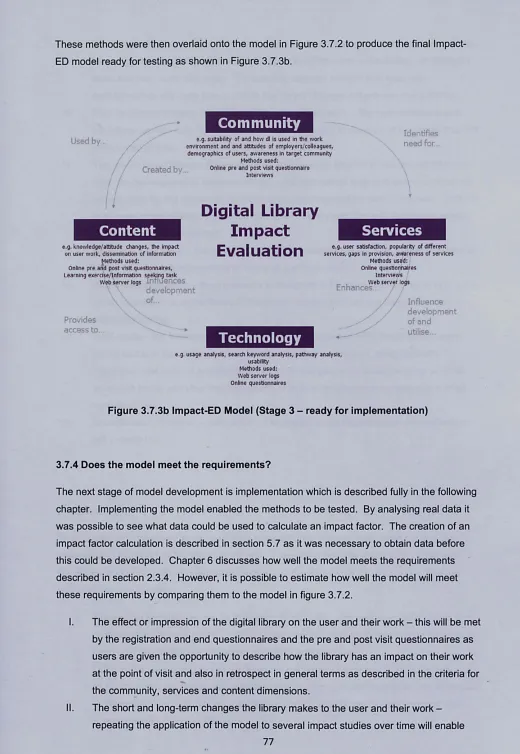
Figure 3.7.3b - The Impact-ED model (Stage three) 77
Chapter 4 - Methodology
Figure 4.2.1 a - Search strategy December 2007
Figure 4.2.1 b - Search strategy update August 2008
83
84
Figure 4.3.1 a - The registration questionnaire for the NRIC Evaluation Study '86
Figure 4.3.1 b - The pre-visit questionnaire for the NRIC Evaluation Study 87
Chapter 5 - Implementation of the Impact-ED Model
Figure 5.2a - The NRIC Library Home Page 92
Figure 5.2b - The NRIC Search Results Page 93
.-Figure 5.2c - The NRIC Resource Catalogue Card 93
Figure 5.2d - Mapping the NRIC Library onto the Impact-ED model 94
Figure 5.6.1.1 a - Reported frequency of use of NRIC 97
Figure 5.6.1.1 b - Actual recorded visits to NRIC during the 3 month study 98 period
Figure 5.6.1.1 d - Type of information sought
Figure 5.6.1.1 e - Actual reasons for use for specific visits Figure 5.6.1.2 - Suitability of work environment
Figure 5.6.2.2 - Use of services
Table 5.6.2.3 - Suggestions for improvements to content coverage Table 5.6.3.1 - Basic access statistics
Table 5.6.3.2 - Comments about the usability of the library and user preferences
Figure 5.6.3.2 - Ease of locating documents in NRIC Table 5.6.3.3 - Search keyword categories
Table 5.6.3.4a - Popularity of browsing categories Table 5.6.3.4b - Navigation strategy and impact
Figure 5.6.4.1 - Reasons for lack of impact of NRIC on user knowledge Table 5.6.4.2 - Impact of NRIC on user work
Figure 5.7.3 -Impact scores for all outputs for the NRIC library
Table 5.7.4 - Statistical significance of the impact of NRIC services and features
Chapter 6 - Discussion
99
99
101 105 106 109 111
112 112 113 113 115 116-117 127 128
Figure 6.2a - The refined Impact-ED model 132.
Figure 6.2b - Refined framework of methods 132
Chapter 7 - Conclusion
Table 7.2 - How does the model compare to the previous evaluations from 140
Acknowledgements
This research would not have been completed were it not for several key people's efforts and sacrifices. Firstly sincere thanks to my supervisors Abdul and Patty for encouraging me to start
this research
&
their belief that I could and would finish! You have both helped me to see whereI have been able to improve but also given me confidence in my own abilities. Thanks to Sue Wiseman for her help with using the NRIC library for testing the model and questionnaire
development. Thanks to Gawesh Jawaheer for his technical support with running the evaluation on the NRIC library. Also thanks to Omid Shabestari for running some statistical analyses on the results of the case study that helped me to see which tests I needed to perform.
I am very grateful to Dr. Anne Adams of the Open University for freely giving her time to guide me in conducting interviews and designing questionnaires for qualitative data collection.
Thanks to my little boys, both of whom made their entry to the world during the course of this research and have put up with a mother whose mind has often been on other things. Finally and most importantly I am indebted to my husband Paul, who not only has picked up the things
I have been unable to do but has supported me throughout with an unwavering belief in my capabilities. You will soon have your wife back!
Declaration
This declaration is made to grant powers of discretion to the University Librarian to allow the thesis to be copied in whole or in part without further reference to the author. This permission
Abstract
Digital library development is a relatively new area of research and previously focus has been mostly on developmental issues or usability. However more recently the focus has started to shift towards impact evaluation both in the digital library and traditional library domains. But what do we mean by impact and how can we measure it? Does information retrieved from a library help to confirm existing user knowledge/decisions, provide new knowledge for the user to make a decision/action, or contradict the user's existing knowledge to prevent a wrong decision or action? Or does the information have no impact on user knowledge, attitudes and
Chapter 1 - Introduction
1.1 Research context
Digital library development is a relatively new area of research and previously focus has been
mostly on developmental issues or usability (Chowdhury et al 2006; Chowdhury
&
Chowdhury2003). Digital libraries themselves are not consistently defined entities (Borgman 2003) and therefore evaluation has taken a back seat whilst developmental research has driven the field. But the field is now much more established with the term "digital library" widely used and a simple Google search for this phrase returns a mind boggling 106 million results! More specifically a basic keyword search for "digital library" in the ACM Digital Library shows the growth in digital library publications over time as follows:
• Between 1952 and 2000 only 4037 publications were published
• Between 2001 and 2004 this had risen to an additional 6979
• But between 2005 and 2008 this figure was now 141301
With more research being undertaken the focus in digital library evaluation has started to shift towards impact evaluation (Chowdhury et al 2006) and this development has been mirrored in traditional library (McNicol 2004; Urquhart 2005) domains.
But what do we mean by impact and how can we measure it? Previous research in the 1980s and early 1990s has shown that traditional hospital library services can contribute to patient care and clinical decision-making (King 1987; Marshall 1992; O'Connor 2002). However these
studies were often d~iven by the need for the library to assert its value in times of economic
constraint, therefore the focus tended to be on efficiency of services, satisfaction with the library and its impact on decision-making through self-reporting by clinicians', rather than measuring any actual outcomes e.g. knowledge and attitudes, length of hospital stay, prescribing rates or patient satisfaction. In contrast, one study did focus on the impact of performing Medline searches on actual outcomes to show that searches performed earlier in the patient's hospital stay were associated with lower costs, charges and length of stay than those whose searches were performed later (Klein et al. 1994). But these are large scale resource intensive studies not always within the scope of digital libraries budgets and staffing levels.
There is potential for using an alternative approach of evaluating knowledge, attitude and b~havioural cha~ges in order to measure the impact of a library on its users (Mad Ie et al. 2004). Social psychology suggests links between attitudes and behaviour (Ajzen 2006, Franzoi 2003)
and this r~,~earch applies this to healthcare digital library evaluation. Does information retrieved
decision or action? Or does the information have no impact on user knowledge, attitudes and behaviour? Where is the impact seen? It could be suggested that as well as a direct
measurable impact on the library user there is also an indirect impact on those people and processes affected by the library user's subsequent work. In the healthcare domain, both patients and health professionals have access to physical and digital libraries. Therefore, the impact of these libraries can be directly on each individual, but also indirectly on the other people involved in decisions made about a patient's care. Knowledgeable patients are able to participate more fully in the management of their health, sharing in decision-making with professionals (Health on the Net Foundation 2005; Ziebland et al. 2004). Therefore it is
important that we can measure the effectiveness of medical DLs in changing the knowledge and attitudes of both health professionals and the public, subsequent decisions and outcomes, so that the healthcare system can exploit these resources to its best advantage. This applies also to other fields such as business environments where retrieved information and gained
knowledge can improve sales/revenue etc or in law where case outcomes could be influenced by improved knowledge.
In addition to measuring knowledge and attitude changes we can gain patterns of use of digital libraries in a way not previously possible with traditional physical libraries. We can track users' activity throughout the library, recording every document, page or file visited or downloaded, unlike in a physical library where we are restricted to knowing only the final transaction of borrowing a book and perhaps the time of entry, rather than the journal articles read or photocopied, those picked up and discarded or IIbookmarked" for later reading. This has important implications for evaluating the impact of the library. Understanding user behaviour within the library can help in library development, ensuring that libraries are designed to best serve their user community. For example, supermarkets track user shopping behaviour through loyalty cards, using this information to strategically place items within the store and tailoring special offers to users, the impact here being to improve the ease of the shopping experience for the user and of course increase the number of items purchased. Data obtained from tracking library users' behaviour could be used in a similar way to develop the library to improve the impact it has on its users by providing access to potentially relevant documents and guidance the user may not be aware of.
Another factor influencing the impact of a library is its accessibility to its users. How easy is it for clinicians to use the library to answer their questions within the time constraints they face? One of the previous studies found that the availability and cost of searching Medline may have influenced its response rate across different hospitals (Marshall 1992) and more recent
and web resources there are social contexts in which these tools are used which may still constrain their accessibility (Adams
&
Blandford 2002; Urquhart et al. 2001).A need therefore arises for investigation into the current state of digital library impact evaluation research and potentially development of a model and framework to provide some consistency in evaluation of these widely varying resources.
1.2 Research aims and objectives
The research aims that follow from this introduction are therefore:
To identify the need for and develop a model and framework for digital library impact evaluation, that when applied will show the impact of a digital library on its user community. This will include:
• developing a new model and framework for impact evaluation across library sectors
• allowing for tailoring of the model/framework by its users to evaluate the impact of the
digital library on knowledge and intended behaviour/decision changes
• investigating the barriers to successful use of the digital library to gain an awareness of
how the library can be improved to increase its impact
The research objectives below describe steps of the research that when completed will ensure the research has met the above aims:
I. Review the literature to identify the current status of impact evaluation research in
digital libraries
II. Identify a need for a digital library impact evaluation model and identify requirements for
digital library impact evaluation
III. Develop a model and framework for digital library impact evaluation with a method of
producing an impact score
IV. Implement the model and framework on a case study digital library
V. Evaluate the model and framework in terms of how well they meet the requirements for
..
a digital library impact evaluation and refine as necessary
1.3 Scope of the research
The scope of this research has boundaries as described below:
• The model will not include, at this stage of development, investigation into objectively
measured outcomes such as prescribing rates, alcohol hand gel usage etc. This is beyond the scope of this project which is a preliminary study to develop a model for digital library impact evaluation and is limited due to the funding constraints on the project and the timescale within which it is to be performed. However, there is potential for the model developed in this research to be extended in future work to include measurement of such outcomes.
• The testing of the model will occur in the medical digital library domain as this is where
the researcher has knowledge and experience and access to a digital library. Therefore the appropriateness of the data collection methods will only be tested in this domain. However, running more than one evaluation to test the model is outside the scope of the project due to the limited funding and time available for the project. As the model is published and used in other settings it is possible that future evaluations can be used to refine the model if necessary.
1.4 Organisation of thesis
This introduction has provided a background to the research project and described the aims and objectives that will be fulfilled. Chapter 2 reviews the current state of the art firstly by defining digital libraries then focusing on defining evaluation and impact. It then presents a set of requirements for digital library evaluation before reviewing current digital library evaluation frameworks and measures and previous digital library impact evaluations published in the literature. The chapter continues by describing how these evaluations have attempted to measure impact and where this fails to meet with the requirements identified earlier in the chapter. It concludes by presenting methods used in previous evaluations and describing the limitations of this previous research. Chapter 3 presents a new approach using knowledge and attitude as indicators of behaviour. It defines knowledge and attitude and briefly introduces the Theory of Planned Behaviour and Dervin's Sense-Making model that are both used to support this research. It then presents the development of the Impact-ED model of digital library impact evaluation and discusses how.this will meet the requirements presented in Chapter 2. Chapter 4 presents the methodology of the research, describing how it will be undertaken and what will be done. The next chapter (chapter 5) presents the results of testing of the model and the calculation of the Impact Score. It discusses the benefits and weaknesses of this score. Chapter 6 describes how the model and template were refined following testing on the case
..
study library, discusses the limitations of the research and presents ideas for potential further
Chapter 2 - Literature Review
2.1 Introduction
This chapter introduces digital libraries, discusses published definitions and their dimensions, and reviews how these current definitions reflect the dimensions of digital library work. It provides a context for the proposed research and identifies the dimensions on which the evaluative framework will be based. The four dimensions of a digital library as identified by Fox and Marchionini (1999) are community, technology, content and services, and in particular the lack of research around community aspects of digital libraries is highlighted.
It also discusses the meaning of evaluation in a digital library context. Definitions and features
of evaluation are discussed and gaps with respect to impact evaluation are highlighted. The importance of determining value in an evaluation and what this means in a digital library context is discussed. It examines digital library evaluation frameworks and measures and identifies gaps in these frameworks. A discussion of what is meant by impact in the context of this research is followed by a literature review of previous individual digital library impact evaluation
projects and impact measures used in these projects are identified and discussed. FoII~.wing
this, is a review of methods used in digital library impact evaluations and the chapter concludes with a discussion of the current limitations of these frameworks, project approaches and
methods.
2.2 Digital Libraries
2.2.1 Digital library definitions
Defining the term "digital libraries" is not as straightforward as it may first seem. Digital libraries are not simply organised collections of electronic resources, just as traditional libraries are not only organised collections of books. Digital libraries are altogether more complex entities for which there exists no single definition from either the research community or the library and information profession. Borgman (1999) reviewed the literature in 1999 and found that existing definitions fit into one of two groups:
• Those with a focus on access and retrieval of digital content. These definitions are
usually provided by the research community.
• Those wittta focus on the collection, organisation and service aspects of a digital
The former group is focussing more on the technology and research aspects of digital libraries whilst the second is more concerned with service delivery. However, given the multidisciplinary nature of digital library research and development (Borgman 1999; Boyack et a12001) it is inappropriate to neglect either of these groups when considering a definition. It seems that this multidisciplinary nature may be what hinders an inclusive definition as each discipline defines its own concept of a digital library. When defining a concept it is necessary to look at the aspects or dimensions of that concept. Arms (2001) lists in detail what he considers to be the benefits of digital libraries, which may be translated as characteristics, including the constant availability across time and space barriers, the ease of updating information, the potential for information sharing and the powerful information retrieval facilities. Chowdhury and Chowdhury (2003) provide a summary of digital library characteristics that they have identified in the literature, in essence highlighting the ubiquitous nature of digital libraries and the need for control over collection development given the risk of "information overload" in the digital world. Definitions of the term "digital library" identified by the literature review can be found below.
Definition 1: Digital libraries are a set of electronic resources and associated technical capabilities for creating, searching and using information. In this sense they are an extension and enhancement of information storage and retrieval systems that manipulate digital data in any medium (text, images, sounds; static or dynamic images) and exist in distributed networks. The content of digital libraries includes data, metadata that describe various aspects of the data (e.g. representation, creator, owner, reproduction rights) and metadata that consist of links or relationships to other data or metadata, whether internal or external to the digital library. Digital libraries are constructed, collected and organised by (and for) a community of users, and their functional capabilities support the information needs and uses of that community. They are a component of communities in which individuals and groups interact with each other, using data, information and knowledge resources and systems. In this sense they are an extension, enhancement and integration of a variety of information institutions as physical places where resources are selected, collected, organised, preserved and accessed in support of a user community. These information institutions include, among others, libraries, museums, archives and schools, but digital libraries also extend and serve other community settings including classrooms, offices, laboratories, homes and public spaces.
Source: UCLA National Science Digital Library (NSDL) workshop (Borgman et al. 1996)
Definition 2: The collection of services and the collection of information objects that support users in dealing with information objects and the organisation and presentation of objects available directly or indirectly via electronic/digital means
n
Definition 3: Digital libraries are organizations that provide the resources, including the specialized staff, to select, structure, offer intellectual access to, interpret, distribute, preserve the integrity of, and ensure the persistence over time of collections of digital works so that they are readily and economically available for use by a defined community or set of communities Source: Digital Library Federation (DLF) (Waters 1998)
Definition 4: A distributed library information service, located either in a physical or virtual space, or a combination of both, in which a significant proportion of the resources available to users exist only in digital form
Source: Rowlands & Bawden (1999)
Definition 5: There are many definitions of a "digital library." Terms such as "electronic library" and "virtual library" are often used synonymously. The elements that have been identified as common to these definitions are:
the digital library is not a single entity;
• the digital library requires technology to link the resources of many;
the linkages between the many digital libraries and information services are transparent to the end users;
• universal access to digital libraries and information services is a goal; and
digital library collections are not limited to document surrogates: they extend to digital artefacts that cannot be represented or distributed in printed formats.
Source: Association of Research Libraries (ARL) (Cullen 2003)
Definition 6: A digital library is an ongoing concern; is a collection of resources (orga!1ised content), including navigation and finding tools, in a distributed networked environment; is a set of services and meets end users' needs
Source: Delphi study (Kochtanek
&
Hein 1999)Definition 7: Systems providing a community of users with coherent access to a large organised repositorY of information and knowledge
Definition 8: A managed collection of information, with associated services, where the information is stored in digital formats and accessible over a network.
Source: William Y. Arms (Arms 2001)
But how well do these definitions reflect what a digital library does? That is its work? The next section presents two digital library work models and discusses how well these definitions reflect the dimensions of digital library work.
2.2.2 Digital library work models
Two digital library work models were identified in the literature (Fox
&
Marchionini 1999;Rowlands & Bawden 1999). These models identify different dimensions to digital libraries and their work. They were the only diagrammatic models identified in the literature review to reflect the different dimensions of a digital library and its work. The reason for discussing these models is to gain an understanding of the different dimensions of a digital library and how these may interact and subsequently to inform the development of the evaluation framework.
The first model is proposed by Rowlands and Bawden (1999). In a review of research into digital libraries they adapt Yates' work-oriented library model for digital libraries (Figure 2.2.2a), highlighting three aspects to digital libraries:
Social
-Systems
Digital Library
Work
[image:20.526.53.440.483.765.2]- - - Informational
Figure.2.2.2a - Rowlands and Bawden's adaptation of Yates' model (taken from
• Social (replaces "work" in Yates' model) e.g. information skills and literacy, impact on work, information law and policy
• Informational (replaces "documents") e.g. knowledge organisation and discovery
• Systems (replaces "technologies") e.g. human-computer interaction, information
retrieval
As this is a model based around digital library research at this time, this may explain a lack of emphasis on the user community. Fox and Marchionini (1999) highlight a lack of research in this area and provide their own model (Figure 2.2.2b) in which they identify the current state of research (in 1999) in four dimensions to digital library work:
• Community e.g. needs, information seeking behaviours and attitudes of user
community. Borgman et al (1996) emphasise the role of user communities in creating digital libraries to support their communities, a view supported by Arms who believes that some of the most successful digital libraries are created by researchers or groups of professionals for themselves and their colleagues (Arms 2001). Geudon (1999) takes a rather more romantic view suggesting that librarians should not see themselves as knowledge bankers focussing purely on content but rather as "hearts dynamising human communities".
• Services (matches to both "informational and social" in Rowlands
&
Bawden's model)• Technology (broadly matches to "systems")
• Content (broadly matches to "informational"). In a digital library content should be mostly digital although some digital libraries may contain reference to non-digital content (Rowlands & Bawden 1999).
Community
Services·
i I I I I
I
I
Technology
[image:21.527.53.470.473.703.2]Content
Figure 2.2.2b Fox & Marchionini Model of Research in Digital Library Dimensions (taken
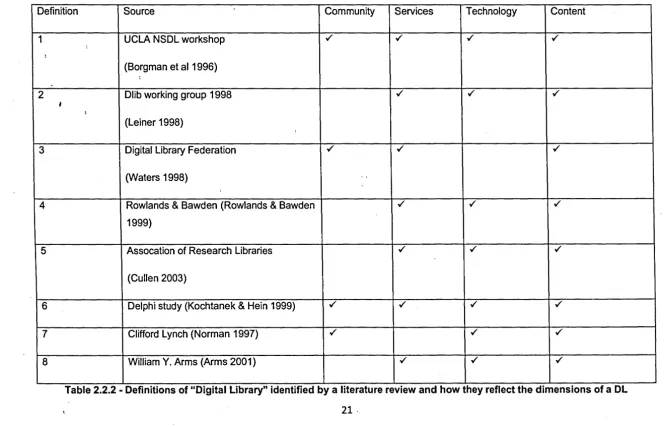
The model shows most research activity occurring in the technology and content dimensions of digital library work. But how are these dimensions reflected by the definitions in the literature presented above? Table 2.2.2 shows how each definition reflects each dimension. The technology dimension of digital library research is reflected in seven of the eight definitions, whilst all eight refer to the content and six to services. Only half refer to the user community. This matches broadly to the model of research in Figure 2.2.2b the exception being the lack of emphasis on services in the research whilst it was referred to in six of the definitions. This is most likely due to this model being published at a time when research into digital libraries was not well established and at an early stage. Research was perhaps driven more by the
Definition Source Community Services Technology Content
1 UCLA NSDL workshop ./ ./ ./ ./
:
:
(Borgman et a11996)
:
2
,
Dlib working group 1998 ./ ./ ./I
(Leiner 1998)
3 Digital Library Federation ./ ./ ./
(Waters 1998) " "
:
4 Rowlands & Bawden (Rowlands & Bawden ./ ./ ./
1999)
5
Assocation of Research Libraries ./ ./ ./(Cullen 2003)
6 Delphi study (Kochtanek & Hein 1999) ./ ./ ./ ./
7 Clifford Lynch (Norman 1997) ./ ./ ./
[image:23.787.41.706.45.472.2]8 William Y. Arms (Arms 2001) ./ ./ ./
Table 2.2.2 - Definitions of "Digital Library" identified by a literature review and how they reflect the dimensions of
a DL
Whilst these models are useful in identifying the different dimensions to digital library work and
how well current definitions are reflecting the whole concept of a digital library and its activity,
they provide little information about how these dimensions fit together, rather focussing on each
as a separate entity. This approach may be appropriate for identifying the state of current research, as was the intention behind these models, but for the purposes of this research it is necessary to take a closer look at the interactions between the dimensions. When evaluating the impact of a digital library one cannot take each dimension in isolation, as each will influence the other. All dimensions have the potential to influence the impact of the digital library on the user either directly or indirectly through their interactions with each other. Therefore any proposed model for digital library impact evaluation will have to take into account the
interactions between the dimensions and should be developed around these. This section has discussed digital library definitions and dimensions to provide a context for the proposed research.
In summary a digital library consists of a collection of resources and services provided to a user community by an underlying technology. Digital libraries are typically dynamic entities with all dimensions (content, services, technology and community) changing frequently (if not
continually) throughout its lifetime. So now we know what we are evaluating the impact of, the next section focuses the literature review on a specific area of digital library research, develops requirements for digital library impact evaluation, reviews current digital library impact evaluation
research to see how well previous evaluations fit these requirements and identifies the gap
which this research will attempt to fill.
2.3 Digital Library Evaluation
2.3.1 Defining Evaluation in a Digital Library Context
Evaluation in a digital library context can be either summative, where the aim is to see how well a library performs i.e. how good it is, or formative, where the aim is to see where it can be improved (Bawden 1990). Blandford et al (2008) describe the former as the approach most often used by the Information Retrieval Community and the latter as the approach taken by the Human Computing Interaction Community. The formative method allows an iterative approach where different versions of the library are developed based on the results. This is perhaps best suited to the digital library domain where libraries are continually changing and developing as
technology moves on. Chowdhury
&
Chowdhury (2003) define evaluation as a judgement ofworth to ascertain a level of performance or value. Saracevic (2000b) takes this further suggesting that perfor'!lance can be broken down into two criteria:
..
• Effectiveness i.e. how well does a system perform that for which it was designed?
He also discusses the meaning of value, suggesting that in the library domain value tends to be
seen as economic justification (Saracevic & Kantor 1997). To illustrate this, an evaluation
looking at a combination of the above criteria is an assessment of cost-effectiveness. Saracevic
goes on to propose three sets of digital library evaluation criteria (Saracevic
&
Covi 2000):• Library criteria e.g. collection issues, information accuracy, representation, library use,
accessibility, library standards
• Information retrieval criteria e.g. relevance, satisfaction, index and search features
• Human-computer interactionlinterfaces criteria e.g. usability, reliability, design features,
navigation, services/help
Most of these criteria are concerned with knowledge organisation and retrieval and how well the
system performs, with little emphasis on services provided and the digital library community.
Marchionini et al (2003) identify the importance of evaluation in the context of the digital library
community, "All efforts to design, implement and evaluate digital libraries must be rooted in the
information needs, characteristics and contexts of the people who will or may use those
libraries". He also believes the ultimate aim of digital library evaluation is to assess the impact
on patron's lives (Marchionini 2000). Borgman (2003) also highlights the importance of the user
and social factors in digital library evaluation but suggests there is still a lack of successful
digital library impact evaluations (Chowdhury et al 2006).
Saracevic also discusses different levels of value in the context of library evaluation (Saracevic
& Kantor 1997). Value on a social level is value that a service provides to the society or
community. Value on an institutional/organisational level is value linked to the mission or
progress of the institution. Finally value on an individual level is the value of a service to
individuals or groups of users needs. These are all interrelated and whilst he acknowledges
that most digital library evaluations are on the individual level (Saracevic
&
Covi 2000) theimpact of a library on individuals accumulates to an impact at an institutional or social level. He
also believes that digital libraries are too complex to be evaluated as one entity and that smaller
evaluations focussing on different aspects of the digital library are more appropriate (Saracevic
2000b). In a similar approach Missingham (2001) discusses value in terms of the value placed
on a digital library by its users and the value of the collection and services provided in relation to
the desired outcomes of the library, i.e. its impact.
The Tavistock Institute was commissioned to undertake an evaluation of the eLib program, a
services in UK Higher Education libraries. They decided there were five important points to take into account when evaluating an open-ended developmental project such as eLib with a wide range of stakeholders (Kellerher et aI1996). These are listed below:
1. The evaluation should contribute to the collective learning i.e. contribute to future decisions and choices
2. It should take into account the views and perspectives of different stakeholders 3. The local projects that were part of the eLib programme needed to collate results to
make available to all stakeholders
4. Evaluation should follow the entire life cycle of a project and not just the effects and outcomes
5. The evaluation should contribute to networking and knowledge transfer
Whilst this list was developed for evaluation of a project rather than a digital library as a service or entity, it is relevant for digital library research. It supports the emphasis Marchionini (2000) and Borgman (2003) place on the user community and their approach to formative evaluation where evaluation is an integral part of digital library design and development (Borgman et al. 2000; Marchionini & Crane 1999).
Clearly evaluation involves measuring in some way the value or impact of the digital library but despite the emphasis placed on value by the research discussed above there is little evidence of measurement of this value or impact in current digital library research. This is perhaps due to the complexity of digital libraries and their wide range of users (Chowdhury et al 2006) resulting in impact evaluation research being limited to specific digital library projects rather than
attempting to create standards or frameworks for evaluation. Whilst there has been significant work towards developing performance measurements and usage statistics for digital libraries, these "value" measurements have tended to focus on user satisfaction and performance targets of the digital library rather than any investigation of impact on users as discussed in the next section.
2.3.2 Current Digital library & electronic information services evaluation measures and frameworks
Framework Developer Methods Comments References
CAPM John Hopkins Quantitative measures. The CAPM (Comprehensive Can be used in conjunction with Libqual TM or (Choudhury et
University access to printed materials) methodology is a Digiqual TM where the latter are used to identify al. 2002)
preference analysis framework developed to evaluate gaps in service and the former to identify user
: user preferences for a robotic system to retrieve, scan preferences to fill those gaps.
and deliver documents and articles from remote locations.
Digiqual TM Association of Quantitative measures. Online survey where 5 survey Adaptation for digital collections of the Libqual+ ( Digiqual
Research questions drawn randomly from a question bank TM tool from the ARL used to measure user 2006;
2004-2006
Libraries (ARL) depending on categories selected by library owner. satisfaction and service quality of libraries. Choudhury, et
One fixed question asks about user satisfaction. All Libqual+ TM was based on Servqual, a tool used al2002)
questions have a 7 point Likert scale
&
all results are by private sector companies to evaluated serviceprocessed by the Digiqual TM team and returned to quality
library owners as a report.
Framework
Emeasures 2003-2004 :
E-metrics 2000-2003
Developer
Evidence Base, University of Central England
Hefce funded project
Association of Research Libraries (ARL)
Methods
Quantitative measures. 17 Performance indicators covering collection availability, usage and cost
Quantitative Measures. 20 Performance measures covering collection availability, usage of the collection, usage compared to usage of print collection and cost
27
Comments
Developed to assist librarians in decision-making and user support and provide performance indicators for Electronic Information Services
Phases 1
&
2 concerned with purely quantitative measures. Forthcoming phase 3 looking at outcomes.References
(Conyers 2004)
Framework
Equinox 1998-2000 :
I
Evalued 2003-2005
Developer
European Union funded project with 7 European partners from the UK, Ireland, Spain,
Germany
&
SwedenEvidence Base, University of Central England
Methods
Quantitative measures. 14 performance indicators covering usage statistics, cost, the physical library providing the electronic collection and user : satisfaction
A toolkit for HE libraries developed alongside the Emeasures project. Mostly qualitative with some quantitative measures Focuses on 3 themes:
Planning, management and impact. Uses a variety of methods including interviews, focus groups,
questionnaires, critical incident technique.
28
Comments
Developed performance measures for physical libraries to include measures for the electronic library environment
Allows users to select tools for areas they are interested in evaluating. Provides tools for evaluating various aspects of service e.g. collaboration between libraries and academic departments, collection availability, staffing issues, costs, technical performance, impact on learning and teaching (e.g. citations in
coursework
&
how staff help students find articles) and on graduate skills and research.References
(Clarke 2000)
,">;
Framework Developer Methods Comments
MINES for Association of Quantitative measures. Mines (Measuring the Impact Been used by over 30 North American Libraries Libraries TM Research of Networked Electronic Services) for Libraries TM as part of the project, one of which was an
: . 2003-2006
NSDL Guide to Evaluating Digital Libraries
2003
Libraries (ARL) uses an online survey to collect data about the academic health library. Showed users were using Electronic Services for teaching and research rather than patient care in this instance. It enables libraries to see which user groups are accessing which resources from where.
National Science Digital Library (NSDL)
: purpose of use of electronic resources and user demographics.
A handbook providing information on various methods Covers service evaluation, usability testing, for evaluating digital libraries e.g. transaction log biometric evaluation, information retrieval. analysis, surveys, interviews, focus groups, Comprehensive and clear guide.
observations.
29
References
(Franklin & Plum 2006)
/ .
Framework Developer Methods Comments References
PretA UCL Interaction A six step framework to be used for planning Has a Human-Computing Interaction focus i.e. (Blandford et
Rapporter Centre
&
evaluations of digital libraries and similar systems. the usability and information retrieval capabilities a12008)School of Outlines the steps involved in undertaking an of the system.
Library, Archive : evaluation i.e. deciding the purpose, identifying
&
Information resources and constraints, ethical issues, techniques, Studies for data capture, analysing the data, and reporting the
(SLAIS) at UCL data.
Table 2.3.2 Current digital library and electronic information service evaluation measures and frameworks
The frameworks identified were mostly aimed at academic libraries and the focus tended to be on physical libraries with digital or electronic collections rather than completely digital libraries (with the exception of the NSDL guide and Pret A Rapporter framework which were aimed at all digital libraries). The key emphasis of most of the frameworks and their measures is on
statistical measures e.g. usage statistics and satisfaction ratings. MINES for Libraries TM begins to look at where and why people are using the library but does not explore this in any depth or attempt to investigate whether it makes a difference to the user's work or information need. A different approach was taken by Blandford et al (2008) who, in developing the Pret A Rapporter framework consider how Information Retrieval systems (including digital libraries) can
be evaluated to assess how well they fit with users' work. Whilst investigating how digital
libraries can be improved by asking users, this is not an impact study. Another study (Xie 2006) asked users to specify criteria for digital library evaluation finding that usability and collection quality were classed as the most important criteria but again there is no discussion of the actual impact the digital library is having on user work.
No real attention is given in any of these frameworks to including generic criteria to investigate the impact of the digital library on end users' work. There are some beginnings towards
including this in the Evalued project but this focuses on the academic physical library with digital resources e.g. a suggested impact measure is analysing citation rates in student coursework, a
method used in the Perseus evaluation (Marchionini
&
Crane 1999) described in Section 2.3.4.However this is a very specific method for academic libraries and not something particularly practical for digital libraries whose users are spread geographically and perhaps anonymous. Measuring the impact of these digital libraries will require different methods .. The Emetrics framework claims to have a third phase looking at outcomes for which the literature did not provide any further information. When the Association of Research Libraries was contacted to provide more detail about this phase they revealed that the outcomes phase was about evaluating how libraries meet their targets rather than the outcomes/impact of the library within
its community. There is clearly therefore, a gap
in
current evaluation frameworks for a digitallibrary impact evaluation framework. Before developing such a framework however it is necessary to define what we mean by impact and what we are trying to measure. The next section discusses definitions of impact, how it relates to digital libraries and presents requirements for an ide.?1 digital library impact evaluation.
2.3.3 Defining Impact
It is not enough to simply eVqJuate use of a digital library or user satisfaction. Fox &
Marchionini's model (Figure 2.2.3b) highlighted the emphasis of digital library research in the
Marchionini 1999). Van House et al agree that usability studies usually only evaluate the user interface which is not sufficient evaluation for something as complex as a digital library (Van House et al. 1996). They believe that the library must have an impact on the user's work. However, the notion of measuring impact on the user is missing from most of the frameworks presented in Table 2.3.2 despite the emphasis placed on impact by Saracevic and others when discussing digital library evaluation (Chowdhury et al 2006; Marchionini 2000; Saracevic 2000a; Saracevic & Kantor 1997).
But what is impact? What are we trying to measure? Impact can be defined simply as "The effect or impression of one thing on another" (Definition of Impact 2006). This implies that evaluating the impact of a digital library is evaluating the effect or impression ,it has on its users. "Impression" implies more than satisfaction, or the opinion a user might have, but a physical impression such as the ripples a stone might make in the water into which it is thrown. A digital library can make such ripples, be it in user knowledge and attitude change or changes in clinical decision-making. The aim of this research is to evaluate them. .
A more comprehensive definition of impact in terms of an intervention is given by Blankenberg (1995):
'Impact concerns long-term and sustainable changes introduced by a given intervention in the
lives of beneficiaries. Impact can be related either to the specific objectives of an intervention or to unanticipated changes caused by an intervention; such unanticipated changes may also occur in the lives of people not belonging to the beneficiary group. Impact can be either positive or nega~~ve, the latter being equally important to be aware of."
This definition extends the idea from impact being simply a small change in knowledge to being a long-term change on the user that is not necessarily positive. This kind of impact is extremely hard to measure in digital library evaluation due to the potentially diverse nature of a digital libraries' user base and the difficulties of identifying long-term impacts on these users. So far digital library impact evaluations have either been one off projects (Chowdhury et al 2006) or an attempt to integrate impact evaluation into digital library design (Borgman et al 2000;
Marchionini & Crane 1999). The latter is a form of long term impact evaluation where repetitions of the evaluation as a library is developed to provide a picture of how the library is both
improving its imme.~iate impact and being integrated into user work or learning over time. An
historical library, the Alexandria library. The impact this library has had on human development and society is huge and evident in today's society in the following ways (Whitehouse 2004):
•
•
•
•
Archimedes invented the screw type water pump that is being used today. Eratosthenes measured the diameter of the Earth
Euclid discovered the rules of geometry
Ptolemy wrote the Almagest, the most influential scientific book about the nature of the Universe for 1,500 years
These are examples of specific results of using the library. Whilst we may not expect individual digital libraries to have such definable single impacts on modern society they can surely have a great impact on modern society as a whole. The key message is that impact is not purely about the short-term but also the long-term sustainable change. For example, is use of the digital library changing a clinician's work practice rather than just helping them on one or two occasions? Does the library provide information that is used as evidence for writing better policies and guidelines for future practice? Is what it provides being embedded in the user's work? Evaluation of digital library impact should involve investigation into the longer-term effects on the user rather than just short-term changes in decision-making therefore any framework should allow comparison of impact over repeated evaluations.
Some work is underway to evaluate impact of academic libraries on teaching, learning and
research (Everest
&
Payne 2001; Payne&
Conyers 2004), however there is no model orframework for evaluation and this research has yet to be applied to the digital library
environment. As already discussed in 2.3.2 the Evalued project begins to address this issue but focuses mainly on cost and management issues with limited evaluation of impact on teaching and lea~~ing. A Library and Information Research Group seminar in 2001 concluded that measuring impact was not an exact science, but that it was important to define your audience and your success criteria as these are necessary to focus your evaluation research, and not to ignore negative impacts (Everest & Payne 2001). These thoughts were echoed more recently
by Christine Urquhart (Urquhart 2005). It is important to investigate what features and
service~
of a library are having what impact and how they can be improved to increase the impact of the library. Evaluating the impact of a DL will require new evaluation models if the impact on users' work and decision-making is to be identifi~d and compared over time.
2.3.4 Defining the requirements for a digital library impact evaluation
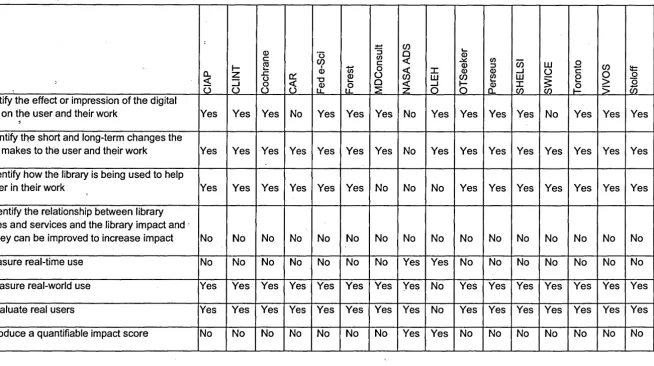
-"I. The effect or impression of the digital library on the user and their work i.e. what the library means to users and what difference it makes to their work
II. The short and long-term changes the library makes to the user and their work i.e.
the difference the library makes to user work both immediately at the point of use and over time as the work the library helped the user complete/achieve is
implemented
III. How the library is being used to help the user in their work i.e. for what reasons is
the library used and how does it help?
IV. The relationship between library features and services and the library impact and
how they can be improved to increase impact i.e. formative evaluation to see if there a difference in the impact of the library depending on which services or features are utilised by the user and how can these services and features be improved to increase library impact?
In addition the ideal evaluation should evaluate real-time, real-world use by real users i.e.
V. Real-time - measure impact at the point of the visit to the library not retrospectively
by relying on user recall but as they visit
VI. Real-world - measure impact of an active digital library in an actual world setting
not a simulated environment or test library
VII. Real users - measure the impact on actual users of the library as they visit for their
own needs not just people recruited to take part in a study and visiting to complete scenario-based tasks
VIII. Finally the impact of a digital library should be quantifiable and the ideal evaluation
should enable calculation of an impact score so that libraries can be compared over time and also potentially with each other.
So how does current research measure up to these requirements for digital library impact evaluation? The next section presents the results of a systematic review of digital library impact evaluations and discusses where they are currently lacking as compared to these requirements.
2.3.5 Review of previo·us digital library impact evaluations
Digital Library: Clinical Information Access Program (ClAP) Where published: Westbrook et al (2007) and Gosling et al (2004)
Description: An evaluation of an Australian online clinical evidence resource Setting: New South Wales, Australia, but not clear which hospitals.
Population: First study surveyed nurses (Gosling et al 2004) and the second more in-depth study (Westbrook et a12007) was investigating experienced users of ClAP (13 doctors and 16 clinical nurse consultants)
Methods: Questionnaire (Gosling et al 2004) and semi-structured interviews (Westbrook et al 2007). Interviews were in two parts; one using the critical incidence technique to discover why people were using ClAP and the other journey mapping to investigate how and with what result. Responses were mapped to a 12 stage journey scoring points for each stage reached. This was part of a wider study into use of ClAP using questionnaires and web logs.
Results: In the questionnaire nurses reported potential for ClAP to impact on patient care. In the interviews nurses reported more impact on policy changes and patient education whilst doctors reported more impact on treatment decisions and patient education. Nurses reported few major impacts whilst doctors reported improvements in patients' health, a life saved on two occasions and prevention of unnecessary procedures or treatment. ClAP was more integrated into doctors' practice than nurses.
Measure of Impact: Self-reported major and minor impacts. Analysis by journey mapping provided some insight into how integrated ClAP was into work practices.
Impact not measured: The relationship between library features and services and the library impact and how they can be improved to increase impact, not a real-time study i.e. relies on user recall; no impact score.
Digital Library: Clinical Information Network (CLINT) Where published: Nankivell et al (2001)
Description: Pilot project to introduce networked. information resources into clinical settings in a large NHS Trust and the impact on clinical decision-making
Setting: Birmingham Heartlands and Solihull NHS Trust
Population: First questionnaire survey 137 hospital staff (consultants or registrars 68.6%, 14.6% junior doctors) Second interview survey 21 CLINT users
Methods: Pre-network questionnaire, analysis of network use (recorded online activity of 30 users), post-network interviews.
Results: The pre-network survey identified MEDLINE as a reliable source of information for medical research, clinical decision-making, supported by the access to MEDLINE by the 30 online users who were tracked. It was used more frequently and for longer than any other
Measure of Impact: Self-reported retrospective and prospective impact of CLINT on decision-making.
Impact not measured: The relationship between library features and services and the library impact and how they can be improved to increase impact; not a real-time study i.e. relies on user recall; no impact score
Digital Library: Cochrane Library Where published: Forbes et al (2007)
Description: evaluation of the impact of the provision of The Cochrane Library to residents of Saskatchewan
Setting: Saskatchewan, Canada
Population: Library staff (36.9%) nurses (16.3%) therapists (7.6%), pharmacists (4.3%), physicians (3.3%), other health care providers (20.7%) in Saskatchewan and other
Saskatchewan residents (9.8%) who attended training sessions in the use of the Cochrane Library.
Methods: Telephone questionnaires three, six, nine and twelve months after the training session. Collection of access data from the publisher of The Cochrane Library.
Results: Access fell over the 12 month period (both reported
&
actual). Most respondents claimed to have learned something from the library (57.5%), that it helped decision making (32.6%) confirmed beliefs (26.11 %) although no actual numbers are provided just percentages so it is not clear if this is a percentage of users who access the library or those who took part in the study. Also few users were clinical staff.Measure of Impact: Self-reported answer to telephone questionnaire.
Impact not measured: The relationship between library features and services and the library impact and how they can be improved to increase impact; not a real-time study i.e. relies on user recall; no impact score.
Digital Library: Critical Appraisal Resource (CAR) Where published: Crowley et al (2003a)
Description: Electronic database of clinical questions and medical evidence
Setting: Inpatient general medicine wards at Duke University Medical Center and the Veterans Administration Medical Center in Durham, North Carolina
Population: 82 residents (some participating more than once as they rotated on the general medicine wards more than once)
Methods: As residents entered a clinical question (CO) they were also prompted for demographic information, patient diagnosis, the resource used to find the answer, and the impact of the information on patient care decisions.
altered care decision involved a medication change, 26% a change in diagnostic test and 13% a change in prognosis communicated to the patient.
Measure of Impact: Self-reported impact of information on decision-making. Specific to a situation
Impact not measured: The effect or impression of the digital library on the user and their work; the relationship between library features and services and the library impact and how they can be improved to increase impact; not a real-time study i.e. relies on user recall; no impact score.
Digital Library: Federal Science eLibrary Where published: Brown et al (2007)
Description: Evaluation of a pilot project for the Federal Science eLibrary for Canadian Government Researchers
Setting: Three Canadian government sites where users had access to the pilot project Population: 500 Canadian government researchers (90 of which returned the main questionnaire and 48 the impact questionnaire)
Methods: Questionnaires, including an impact questionnaire at the end of the pilot, usage statistics, correspondence! teleconferences with the pilot librarians
Results: 80% felt the impact of access to the library on their research and productivity was positive or very positive, specifically in keeping up with the literature and read more widely, meeting tight deadlines, equality of access, environmental benefits, being able to reach all content from one gateway.
Measure of Impact: Qualitative self-reported impact on work
Impact not measured: The relationship between library features and services and the library impact and how they can be improved to increase impact; not a real-time study i.e. relies on user recall; no impact score.
Digital Library: Forest Healthcare Trust Intranet Where published: Freeth et al (2001)
Description: 24-hour access to library materials in clinical areas Setting: Forest Healthcare NHS Trust, North Thames region Population: Stage 1 questionnaire - 110 doctors
Stage 2 Questionnaire - 73 doctors (59 of which completed the first questionnaire) Methods: Two stage questionnaire to explore changes in the use of online materials,
perceptions of the strengths and weaknesses of online resources in clinical areas and changes in practice resulting from the use of online materials
Measure of Impact: Self-reported examples of impact of access to library materials on clinical practice
Impact not measured: The relationship between library features and services and the library impact and how they can be improved to increase impact; not a real-time study i.e. relies on user recall; no impact score.
Digital Library: MDConsult
Where published: Cohn et al (2003)
Description: Evaluation of a the MDConsult Digital Library and an aim to provide a model for future digital library evaluations
Setting: Claude Moore Health Sciences Library, University of Virginia Population: Registered MDConsult users i.e. physicians
Methods: Usage data and registration data, anonymous survey and interviews.
Results: 232 respondents plus 156 non-registered users that were excluded. Overall most MDConsult users agreed or strongly agreed that MDConsult has contributed to their teaching and learning and improved patient care decisions.
Measure of Impact: Self reported impact, Likert scale question.
Impact not measured: How the library is being used to help the user in their work; The relationship between library features and services and the library impact and how they can be improved to increase impact. Not a real-time study i.e. relies on user recall. No impact score.
Digital Library: NASA Astrophysics Data System Digital Library Where published: Accomazzi et al (2005)
Description: Impact of the NASA ADS digital library on astronomical research. Setting: URANIA - bibliographic system in astronomy
Population: Worldwide astronomers
Methods: Usage data from web log statistics
Results: The authors estimate that the ADS digital library has an impact of an equivalent of 736 full-time researchers based on the time it would have taken to find the information should ADS not have been available (utility time).
Measure of Impact: Utility time
Impact not measured: The effect or impression of the digital library on the user and their work; the short and long-term changes the library makes to the user and their work; how the library is being used to help the user in their work; the relationship between library features and services and the library impact and how they can be improved to increase impact.
Description: a point of care information system for anaesthesia providers prepared by the European Society of Anaesthesiologists
Setting: 12 simulated clinical scenarios, 4 different university affiliated anaesthesia departments in Israel
Population: 48 Anaesthesiologists (28 male 20 female) (24 junior, 12 senior residents and 12 board-certified)
Methods: Each participant was presented with the 12 scenarios. They had access to the OLEH for six. These six were assigned randomly for each participant. Two senior
anaesthesiologists evaluated the answers independently and were blinded to the availability of
the OLEH. Differences between the reviewers were evaluated by a 3rd expert.
Results: Statistical tests performed to evaluate significance of the OLEH. The availability of the OLEH was associated with higher scores in 11 scenarios and a decrease in the incidence of critical errors in 10. Using the OLEH only increased the time taken to complete the task in one scenario. Professional experience was associated with better scores in 5 scenarios and a reduced occurrence of errors in 3.
Measure of Impact: Measuring user ability to use an online information resource to improve clinical decision-making and reduce potential errors by using clinical scenarios. Further research is underway to determine how the OLEH can impact in a simulated clinical environment.
Impact not measured: How the library is being used to help the user in their work; the relationship between library features and services and the library impact and how they can be improved to increase impact; not a real-world study - occurs in a simulated environment and is not using real users visiting the library with real needs.
Digital Library: OTSeeker
Where published: Bennett et al (2007)
Desc~iption: Evaluation of an online library for Occupational Therapists containing critical appraisals of trials and document ranking according to methodology quality.
Setting: Website with a worldwide user-base mainly from Western countries including Australia, USA, Canada, UK.
Population: Mostly occupational therapists (93%) and mostly from the UK, Australia, USA and· Canada (80%).
Methods: Online questionnaire with 5-point Likert scale questions placed on the website that launched when a user searched the database for one month. The questions were focusing on
how OTSeeker is used in practice and self~reported impact on knowledge changes and clinical
practice.
Results: 62% felt it improved their ability to locate research, 19% reported changes in practice,
what changes were not specif~d but these changes were associated with perceived employer
"