Factors Affecting the
Sensitivity of Different Viruses
to
Interferon
JULES V. HALLUM, HARSHAD R. THACORE, AND JULIUS S. YOUNGNER
Departmentof Microbiology, School of Medicinle, UnuiversitY of Pittsburgh, Pittsbi,rgh, Pennsylvania 15213
Received forpuLblication8 May 1970
When the sensitivities tointerferon ofNewcastle disease virus (NDV) and
vesicu-lar stomatitis virus (VSV) werecompared by theplaquereductionmethod inchick
embryo cell cultures, NDVwasfound to be45-fold moreresistant than VSV. This
difference was exaggerated whena multiple-cycle yield inhibition method was
em-ployed. In markedcontrast,when thesamevirusesweretestedbyasingle-cycleyield
inhibition method, the difference in sensitivity tointerferonof the twoviruseswas
virtually eliminated. Further investigation showed that, in chick embryo cells
ex-posed to interferon, the resistancetoNDVdecayedmore rapidly than resistanceto
VSV. This findingexplained the divergent results obtained with thetwoviruses when
single-ormultiple-cycle replicationtechniques wereemployed. Experiments carried
outwith L cellsshowed that cellularantiviral resistance decayed muchmoreslowly
inthese cells than in chick embryo cells. Consequently, when measuredbytheplaque
reduction method in Lcells, no differencewas observed in the sensitivityto
inter-feron of VSV and
NDVpi,
a mutant of NDVwhich replicatesefficiently in Lcells.Aprocedureis suggested for determining the relative sensitivitiestointerferon of
dif-ferent viruses under conditions which minimize the role ofdecay ofantiviral
resis-tancein the host cells.
Wide variations in the response of different
viruses to inhibition by interferon (3, 9-11, 13,
17) have suggestedaranking ofviruses based on
their sensitivity to this inhibitor (15). The
arbo-virusgroup is usually considered most sensitive;
vesicular stomatitis virus (VSV), vaccinia, and
other poxviruses are of intermediate sensitivity;
and Newcastledisease virus (NDV), herpes
sim-plex, and cytomegalovirus (9) arethe least
sensi-tive. An example ofthe basis forthis ranking is
the difference in sensitivity of VSV and NDV to
interferon when tested by a plaque reduction
method in chick embryo (CE) cell cultures; a
concentration of interferon which completely inhibits plaque formation by VSV has little or no
effect on NDV. Any mechanism which is
in-voked to explain the action of interferon must
takeinto account such variations in the
suscepti-bilityof different viruses. Theexperiments reported
inthis paper were designed to answer the
follow-ing questions. (i) Isthe variation in sensitivity of
viruses tointerferon in a given host cell a function
of themethod ofassay? (ii) What determines the
sensitivityofagivenvirus when tested in different
hostcellsby the same method of assay?
MATERIALS AND METHODS
Cell cultures. MouseLcells(clone 929) and primary
CEcell cultures were propagated and maintained in
Eagle's minimal essentialmediumplus 4% calfserum
as described in detail elsewhere (18).
Viruses. The Hertsstrainof Newcastle disease virus (NDVO)and asmallplaquemutant(NDVpi,clone 2) isolated fromLcells persistently infected with NDVo
were used in this study. The viruses were grown in CEcellcultures and in chick embryos as previously
described (14). Both NDVo and NDVpi replicatein
CEcell cultureswithout the productionofdetectable
amountsofinterferon.Infection ofLcells with NDVo results inanabortiveinfection whichyieldsfew infec-tive virus particles. In contrast, NDVpi replicates
efficiently in L cells and produces infective virus.
BothNDVoandNDVpiinduce interferonsynthesisin
Lcells (14).
The Indiana strain of VSV was propagated in L
cellsasdescribed earlier (18).
Preparation of interferon. L cell interferon was prepared as follows: L cells grown in 32-oz bottles (ca. 900 ml) were infected with NDVO at an input
multiplicityofinfection (MOI) of100plaque-forming
units (PFU) per cell. After 60 minofadsorption at
37C, the cellswerewashed, refed with medium, and incubated at 37C for48 hr. Theculturefluids were
harvested and clarified by centrifugation, and the
infectivitywasinactivated bytreatment atpH2for2
weeks.Interferonpreparationswerestoredat -20 C.
Chicken interferon was prepared in embryonated eggsby the method of Wagner(16)withthe WS strain
of influenza virus; details oftheprocedureshavebeen reported earlier (4).
Interferon assay. Plaque reduction assays were
156
on November 11, 2019 by guest
http://jvi.asm.org/
carried out in L or CE cell cultures as described
previously (18).
Twotypes of yieldreduction methodswereutilized.
(i) Single-cycle yield reduction was determined as
follows.Cellcultures wereexposedto serialdilutions
of interferonfor 20 hr at 37 C. Thecellswere washed
twice with growth medium and infected with the
appropriatevirus at an input MOI ofI. After
adsorp-tion for 60 min at 37 C, the cultures were washed twice
toremoveunadsorbedvirus, refed withmedium, and
reincubatedat 37 C.Fluids frominfected cultures were
harvested after the time required for a single cycle of
replication.In CEcellculturesthistime was 6 hr for
VSV and 10 hrfor NDVOand
NDVpi.
The per centinhibition of yield by interferon was calculated by
comparing the virus yield from cultures treated with interferon to the yield from untreated control cul-tures. (ii) Multiple-cycle yield reduction was
deter-minedin asimilar mannerexceptthat thefluidsfrom
infectedcellswereharvested 24 hrafterinfection, at which time the cells werecompletely destroyed.
RESULTS
nhibition
ofNDVandVSV byinterferonin CEcell cultures: plaquereduction method. An
experi-ment was carried out to confirm that NDV is
more resistant to inhibition than VSV when
tested by the plaque reductionmethod in CE cell cultures.Serial0.5
log1o
dilutions of chickinter-feron were added to CE cell cultures; after 20
hr at 37C, the interferon was removed, the cells
were washed, and the cultures were divided into
three groups. Eachgroupwaschallenged with40
to 60 PFU of either
NDVo,
NDVpi,
or VSV.The per cent reduction ofplaques at each
inter-feron dilutionwascalculated from thenumber of
plaques of each virus in control cultures which
had been incubated with medium only. The
relativesensitivities of the three viruses to
inhibi-tionbyinterferonareshowninFig. 1. The
inhibi-tion of VSV
plaques
was used to calculate thenumber of units of interferon present in each dilution, asshown in theabscissa ofFig. 1; one
unit of interferon was the amount required to
inhibit VSV plaque formation by 50%. The highest concentration of interferon (70 units)
used in this experiment produced only a 40%
inhibition of
plaque
formation bythe wild typeNDVO. In the case ofthe mutant
NDVpi,
15units of interferon was required to produce a
50% plaque reduction. It is interesting that by extrapolatingfromtheinhibition data plottedin
Fig. 1, the titer of the chick interferon would be
15units,45units,and 700unitsper 3 ml ifNDVO,
NDVpi
, or VSV, respectively, was used as thechallenge virus. These data amply support the
claim thatNDVisrelatively more resistantthan
VSV to inhibition by interferon when tested by
theplaquereduction method in CE cell cultures.
Additional
experiments
were carried out in CEcell cultures
by using yield
reduction methods in 10090
-so8
z
0
5
o
s
z
z
w
C.
ccl 70F
60[
50
1-40_ 30 _ 20 _ 10 F 0
0.02 0.07 0.2 0.7 2.2 7 22 70 INTERFERON CONCENTRATION (UNITS/ml)
FIG.1. InhibitionofND Vand VSVby interferonin
CEcell cultures:plaquereduction method.Cellcultures
wereincubatedwith0.5logio dilutionsof interferonfor
20 hrat 37C, washed, andchallengedwith 40 to60
PFUofND V (0),ND
Vpi
(A),orVSV(0).Culturesincubatedwithmediumalonewereusedascontrol. The
units ofinterferon shown on the abscissa were
calcu-latedfrom theamountrequiredtoinhibit VSVplaque
formationby50%(one unit).
order to
determine
the influence ofsingle
andmultiple
replication cycles
onthe relative sensitivi-ties of different viruses tochick interferon.Inhibition
ofNDVandVSVby interferoninCEcell cultures:
yield
reductionmethods.CE cellcul-tures were incubated
overnight
with interferondilutions
and infected with either NDVO,NDVp
i, orVSVat aninput
MOIof 1 asdescribed above.After 24hr of
incubation,
whencomplete
destruc-tion ofthe cellshad
occurred,
the culture fluidswereharvested and
assayed
forinfectivity
in CEcellmonolayers. Virus
yield
wasalsomeasuredincontrol cultures
exposed
for 24 hr to medium only. Aplaque
reduction assay with the three viruses was carried outsimultaneously
ininter-feron-treated
and control cultures toprovide
astandard for
comparison
and to calculate(from
theVSV
data)
thenumber ofinterferon units in each dilution used to treatthe cells. The resultsplotted
inFig.
2show thatNDVo,
NDVpi,
andVSV were lesssensitivetointerferon whentested
by the
multiple-cycle
yield
reduction methodthanwhen tested
by
theplaque
reductiontechnique,
although the three viruses maintained the same
relative
sensitivity
to interferon. In the case ofNDVOX 500unitsof interferon
(as
determinedby
VSVplaque
reduction)
produced
a 35% decreaseVOL.
O'.." la
on November 11, 2019 by guest
http://jvi.asm.org/
[image:2.492.250.447.64.298.2]100 90 so 70
z
0
x 50 z
0 40
0.30
20 10
0.007 0.03 0.12 0.48 1.9 7.8 31 125 500 INTERFERON CONCENTRATION (UNITS/3m1)
FIG. 2. Inhibition ofND Vbyinterferon in CEcell
cultures:multiple-cycle yieldmethod.Cellcultureswere incubatedwith serialfourfolddilutionsof interferon in
theusualmanner andchallengedwithNDVO,NDV,,j,or
VSVataninputMO! of Iasdescribedinthetext. The culturefluidwasharvestedafter24hr andassayed for infectivityinCE cellmonolayers. Culturesnot treated
withinterferonwereusedascontrol. Aplaquereduction assaywasalso carriedoutsimultaneouslyasdescribed
inthelegend of Fig. 1. Theyield(PFU/ml) ofprogeny virus harvestedfromcontrolcultureswas2.4 X 108for VSV,3.4 X 107 for NDVo, and 1.2 X 10⁷ for NDVpi. Symbols: plaquereduction(brokenline), yieldreduction (solid line); forNDVO (Ol or U), NDV,,i (A or A),
and VSV(Oor @).
inplaque numbers butno inhibition of
multiple-cycle yield. With
NDVp
i, 500units of interferonreduced plaque formation and multiple-cycle
yield by 72% and 20%, respectively; the same
amount of interferon produced complete
inhibi-tion of plaque formation and multiple-cycle
yield by VSV.
The relative sensitivities ofthe threeviruses to
inhibition by interferon was also tested by the
single-cycle yield reduction method. CE cell
cul-tures were exposed to interferon and then
challenged with the three viruses, as described
above. The culture fluid was harvested after the
time required for one cycle ofreplication, i.e.,6
hrfor VSV and 10 hr forNDVOand
NDVp,
.Thepercent inhibition ofyieldofeach virusby
inter-feron is showninFig. 3. These experiments point
out that, when tested by inhibition of a single
cycle ofreplication,allthe viruseswereatleastas
sensitivetointerferonasthecomparisonstandard, 100
90 _
soF
z 0
I-a i z
I--Z hi
a:
hi
A. 70I 60 _
50
_---40 _ 30 _ 20
F
lo 0
0.007 0.02 0.07 0.22 0.7 2.2 7 22 70
INTERFERON CONCENTRATION (UNITS/mI)
FIG. 3. InhibitionofNDVandVSVbyinterferonin CE cell cultures: single-cycle yield reduction method. Cell cultureswereexposedtoiniterferonandchallenged withND VO (U),NDVpi(A),orVSV(0) atan input MOIof Iasdescribedinthe text. Theculturefluidwas
harvestedat 6 hrfor VSV and 10 hrforNDV. and
NDV,,i. Culturesnot treated withinterferonwere used
ascontrol. AplaquereductiontestusingVSV(0) was carriedoutsimultaneously forthedetermination of
in-terferon concentrations used in the experiment. The
yield (PFU/ml) fromcontrol cultureswas8.0 X106for NDVO, 3.7X 10⁶forND
V,pi,
and 6.1 X10⁷for VSV.VSV plaque reduction. This finding is in striking
contrast to the wide variations noted in the
sensitivityofthedifferentviruses when testedby
the plaque reduction methodinCE cell cultures
(Fig. 1). It isdifficult, in the light of these results,
to designate NDVO a "resistant" virus since 1
unitofinterferon,determinedbytheVSVplaque
reduction data, reduced single-cycle yield by
50%.
Inhibition of
NDVpi
and VSV by interferon inLcellcultures. In view of thevariations in
sensitiv-ity ofNDV and VSV to interferon in CE cell
cultures, experiments were carried out to study
the inhibition ofthese agents by interferon in L
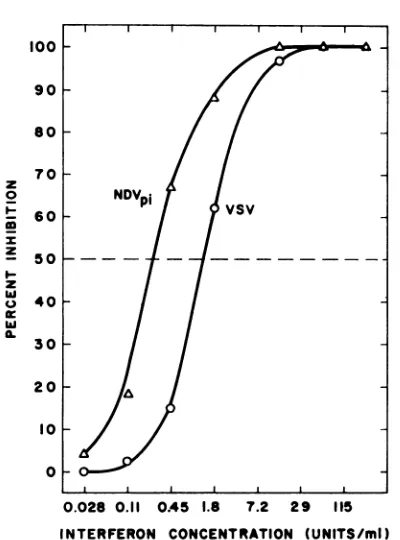
cells. By using the plaque reduction method, the
sensitivity of
NDVpi
and VSVto interferon wasdetermined inthe usualmanner. NDVQ was not
included in thisexperiment since it doesnot
pro-duce plaques inL cells. Figure 4 shows that, by
theplaque reduction method in L cells,
NDVpi
wasslightlymoresensitive thanVSVtoinhibition
by interferon. This is in sharp contrast to the
results in CE cell cultures (Fig. 1); in CEcells,
F
-_ .
A
on November 11, 2019 by guest
http://jvi.asm.org/
[image:3.492.54.247.54.302.2] [image:3.492.233.447.64.296.2]VIRAL
100
90
-80j
z 0
0
co
x z
I.-z hi C.
70
-60
50
-40
30
201-Io
0
0.028 0.11 OAS 1.8 7.2 29 115
INTERFERON CONCENTRATION (UNITS/ml) FIG. 4. InhibitionofNDVpianzd VSVby interferon in L cell cultures. Cell cultures were incubated with variousconcentrations ofinterferonandchallengedwith 40to60 PFUofNDVpi (A)orVSV(0)asdescribed inthelegend ofFig. 1.
NDVpi
was found to be 15 times more resistanttointerferonthan VSV. These results indicate that
the relative resistance ofa virus tointerferon, as
measured by the plaque reduction method, is
determinedinlargepartbythe hostcellinwhich
thetestsareperformed.Stewart and hiscolleagues
(13), who studied the relative sensitivitiesoffive
differentviruses in five different host cellsystems,
cametothe sameconclusion.
Single-cycle yield reduction tests were also
carriedoutin Lcellswith
NDVp
iandVSVasthechallenge viruses. The results of these tests
showed that
NDVpi
was slightly more sensitivethan VSVtoinhibition by interferon, aresultnot
unexpected considering thedata obtainedby the
plaque reduction method. An explanation was
sought for the marked effect of the host cell on
the sensitivityofNDVandVSVtoinhibition by
interferon when measured by the plaque
reduc-tionmethod, atechniquewhich involves multiple
cycles of viral replication over a period of 3
days. Based on reports by several investigators
(1, 2, 7,16),itseemedpossiblethat the resistance
conferred uponCE cells bychick interferonwas
gradually lost during this time, allowing virus
replication and plaque formation, whereas the
resistanceconferredupon Lcells bymouse
inter-feronwas stable over the
period
ofdays required forplaque formation. Totestthis possibility, thefollowing experiment
was carried out.Resitance
of CEandLcell
culturestochallenge
with VSV at different times after removal of
homologous interferon: plaque reduction method.
Serial twofold dilutions of chickand L
cell
inter-feronswereprepared, and each dilutionwasadded
to a large number ofhomologous
cell
cultures.Control cultures received medium only. After
overnight incubation at 37 C, the interferon
dilutions
and the medium were removed,re-placedwith 3 mlofmedium, and incubationwas
continuedat 37 C.Atthe time that theinterferon
dilutions wereremoved
from
the cultures and at4, 8,
12,
16,and24hraftertheir replacementwithmedium, a dilution series of each
cell
type waschallenged
with40 to 60 PFUofVSV in the usualmanner. Bythis procedure, the plaque reduction
titer of the interferonwasdeterminedatdifferent times afterremovalofthe inhibitorfrom the cells, andtherateofloss of cellular resistancecould be
measured. Thedata inTable 1 show that
cellular
resistance was lost more rapidly in CE
cell
cul-turesthan in L
cells.
The experiments wereter-minated
24 hr after the interferondilutions
wereremoved since preliminary experiments showed that, when testedby the plaque reduction method, CEcell cultures
completely
lostresistancetoVSV by 48 hr after removal of interferon, whereas Lcells
retainedmostof their resistanceatthistime.Resistance
ofCE cell cultures tochallenge
withNDVO
orVSV at differenttimes
after removal ofinterferon: single-cycle yield reduction method. CE cell cultureswere incubated
overnight
at 37 C with 1,000 units of chick interferon or with medium alone. Thefluidswereremoved, thecells were washed twice with medium, 3 ml offreshmedium
was added, and the cultureswere again incubatedat37 C. Ontheday the interferonwasremoved, and on each successive day, cultures were
challenged
with VSV orNDVO at aninput MOI of 10. Fluids from infectedcultures
wereharvested after one cycle of
replication
and assayed forinfectivity inCE cell monolayers. Astriking differencewasfound in therateoflossof
resistance when measured
by
using differentchallenge
viruses (Fig. 5). In the case of VSVchallenge,
CEcells
maintained their resistantstatealmost
unchanged
for the3-day period
of theexperiment.Ontheother
hand,
therewasarapid
loss of resistance to
NDVo. Twenty-four
hoursafter removal of the 1,000 units of
interferon,
single
cycleyields
of NDVo were inhibited71%
instead of the 96% inhibition measured
im-mediately after interferon wasremoved fromthe
cultures. Two
days
after removal ofinterferon,
NDVP;
Ivsv
159
on November 11, 2019 by guest
http://jvi.asm.org/
[image:4.492.43.243.64.334.2]TABLE 1.Resistanice of chickembryo(CE)andL cells tochallentgewith vesicularstomatitisvirus atdifferent
timesafter removal ofhonmologous interferona
Plaque-inhibitiontiter ofinterferonat
Cultures _ _ _ _
0hr 4hr 8hir 12hr 16 hr 24hr
CE cells 1,4I00 1,100 1,400 900 520 110
(100)b (78) (100) (64) (37) (8)
Lcells 12,000 10,000 11,000 11,000 7,200 8,500
(100) (83) (92) (92) (60) (71)
aCE or Lcell cultures were incubated overnight at 37 C with twofold dilutions of the appropriate
interferon preparation. The interferon dilutions were removed and replaced with 3 ml of medium,
and incubation was continued. Groups of cultures were challenged with 50 PFU of VSV at different
timesafter the interferon dilutions were removed.
bNumbers in parentheses represent the per cent of titer at 0
lhr.
only a 13
%/O
inhibition of yield was recorded; at 3days the interferon-treated cultures were as
sus-ceptible to NDVO asthe untreated controls.
Effect ofconcentration of interferon on
single-cycle yields of VSV orNDVO in CE cell cultures.
Theexperiments which have been described show
that theapparent "sensitivity"ofagiven virusto
interferon depends on such factors as the virus
mutant, the host cell employed, and the type of
assay performed. The following experiment was
carried out in an attempt to minimize the
influ-enceofloss of resistance indefiningthesensitivity
ofNDVOandVSV to interferon and toestablish
a realistic basis for expressing the relative
sen-sitivities ofthese viruses.
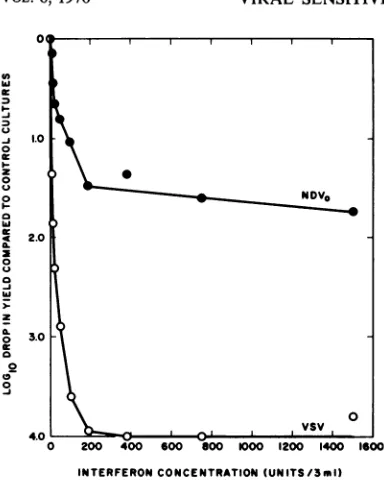
CE cell cultures wereexposed to various
con-centrations of interferon and challenged with
NDVO or VSV at aninputMOI of 1, inthe usual
manner. Culture fluids were harvested after one
cycle ofreplication andassayed forinfectivity in
CEcellmonolayers.The inhibition ofsingle cycle yields of NDVo andVSVisplottedinFig.6. The
maximum level of inhibition ofyieldofboth VSV
and
NDVo
was produced with about 200 unitsof interferon per culture; higher concentrations
of interferon did notfurther decrease theyields.
However, there wasasignificant differencein the
breakpoint of the inhibition curves ofthe two
viruses.Inthecase ofVSV, the maximum
inhibi-tion ofyieldwas4.0logs,whereas with NDVO the
maximuminhibitionwas 1.7 logs. This
charac-teristic difference in maximum inhibition of
NDVo and VSV wasexperimentally
reproduci-bleandprobably is an accurate measure of their
relativesensitivitiestointerferon.Experimentswere
performed which ruled out thepossibility(i)that the
NDVo population
containedinterferon-resistant variants and
(ii)
thatalarge populationof
reversibly
adsorbedNDVOparticles
waseluted. Io o\ vsv
90 80
60 7 1:
z
5 \
z
w
40-w
a.
30 2 0
10 - NDVO
0 --L
-O 2 3
DAYS AFTER REMOVAL OF INTERFERO4
FIG. 5. Resistance of CE cell cultures to challenge
withNDV0 orVSV atdifferent timesafter removal of interferon:single-cycle yield reduction method. CEcell
cultures were incubatedovernight at 37 C with 1,000 unitsofinterferonorwith mediumalone.Cultureswere washed, refed with 3 ml ofmedium, andreincubated at 37C. At various timesafterremovalofinterferon, the
cultureswerechallengedintheusualmannterwitheither VS V(0)orNDV.(0)atanlinput MOI of10.Culture
fluid washarvestedafterone cycle of replication anid
assayedfor infectivityinCE cellmonolayers. Theyield
(PFU/ml) ofprogeny virusfrom control (untreated)
cultures was asfollows: day 0, VSV = 105,NDV. =
1.05 X 10⁷;day 1, VSV = 106,NDVo = 2.1 X 10⁷;
day 2, VSV = 1.6 X 10',ND Vo = 2.4 X 10⁷; day 3,
VSV=5.0 X 10⁶,NDVo =1.8 X 10⁷.
on November 11, 2019 by guest
http://jvi.asm.org/
w
0
z
0
0
0 3.V
w
a 0.
o
0
.0
0 200 400 600 600 1000 1200 1400 1600
[image:6.492.45.237.57.297.2]INTERFERONCONCENTRATION (UN ITS/Dm1
FIG. 6. Effiect of concentration of interferon on single-cycle yields of ND V0 or VSV in CE cell cultures.
Cell cultures were incubated overnight at 37 C with
various concentrations ofinterferon and challenged in
the usual manner with either VSV (0) orNDVO (*) at an input MOlof 1. Cell cultures without interferon were used as controls. Culture fluid washarvested after
one cycle of replication and assayed for infectivity in
CE cell monolayers. The yield (PFU/ml) of progeny
virus from control cultures was 7.4 X 10⁶ for NDVo and3.0X107forVSV.
In the latter experiment, anti-NDVserumn(18) was employed to neutralize all reversibly adsorbed
virus prior to virus replication.
DISCUSSION
The experiments we have described show that
thesensitivity of different viruses to inhibition by
interferon in a given host cell system depends on
the method of assay employed.For example, large
differences in the sensitivities of NDV and VSV
to interferon in CE cells were observed when
methods were used which permitted multiple
cycles of virus replication to occur. When test
methods were employed which involved only
single cycles of virusreplication, these differences
in sensitivity to interferon were obliterated. The
major difference between single- and
multiple-cycle replication methods is the elapsed time
between infection and the harvest of progeny
viruses. It is apparent from our data that the
anti-viral resistance established in CE cell cultures
in-cubated with interferon decreased when the
inter-feron was removed from the cells. The rate of
decrease of antiviral resistance was different for
NDVand for VSV. The more rapid disappearance
ofcellular anti-NDV activitywith time furnishes anexplanationforthe observationthat this virus
is apparently "resistant" to inhibition by
inter-feronwhen tested by the plaque or multiple-cycle
reduction methods. On the other hand, when
testedbythesingle-cycleyield reductionmethod,
whichminimizesthe decay ofestablished antiviral
activity, NDV appears to be as "sensitive" to inhibition by interferon as VSV, a virus considered highly sensitive to interferon.
Ourexperiments alsoidentifyoneof thefactors
which determine variationsinsensitivityof agiven
virus when tested in different host cells by the samemethodof assay. Whentestedbythe plaque
reduction method in CE and L cell cultures,
NDVpi
and VSV differ greatly in their relativesensitivitytointerferon.In CEcells,15times more
interferon is required to inhibit
NDVpi
than toinhibitVSV. In contrast, in Lcell culturesthere is
no significant difference in the inhibition of
NDVpi
and VSV by interferon when tested bythe plaque reduction method. Again, the factor which determines the "sensitivity" of a given
virusto interferon is therateofdecayof
cellular
resistance when interferon is removed; decay of
resistanceismuch morerapid in CE cells thanin Lcells.
Thevariationsin rate of
decay
ofcellular anti-viral resistance when interferon is removed mayexplain
the observations ofStewart et al.(13).
These workersfound
significant
differences inthesensitivity offive viruses to inhibition by inter-feron in cells from five different species. Since they employed the
plaque
reduction method,conditions were provided which allowed rate of
decay ofcellular resistancetoplayamajor role in their
experiments.
Basedonourexperiences withCE and L
cells,
it seems reasonable to suggestthat wide variations in the rateof
decay
ofresist-ancewould be encounteredin the five species of
cells
whichthey
employed.The
finding that,
in CE cell cultures treatedwith interferon, resistance to NDV and VSV
waned at different rates aftertheremoval of
inter-feronwas
unexpected.
Two alternatehypotheses
can be advanced to explain the
finding
that CEcells treated with interferoncan remainresistant
to VSV at a time when they havebecome
com-pletelysusceptibletoNDVO .The first
hypothesis
isquantitativeandsuggests thatagreaternumber
of a single species of intracellular resistance
factor induced by interferon is neededto inhibit
NDVthan toinhibit VSV.
Initially,
afterincuba-tionwithinterferon,there isasufficient numberof
these factors to inhibit both viruses. As
decay
proceeds, the number of resistance factors per
on November 11, 2019 by guest
http://jvi.asm.org/
cell would decrease to a level which, though still greatenoughtoinhibit VSV,nolongeris sufficient
toblockreplicationofNDV. The second
hypoth-esis is qualitative and suggests that more than
one species of intracellular resistance factor is
induced by interferon. These different speciesvary
in their ability to inhibit different viruses and
decay at different rates. Thus, if two resistance
factors were induced in CE cells by interferon,
one factor active against VSV and the other
aganst NDV (the latter less stable than the
former), the results described inFig. 5 would be
obtained. Cell cultures would remain resistantto
VSV atatime whentheyhadbecomecompletely
susceptibletoNDV. In support of thequalitative
hypothesis, one can cite reports that interferon
preparationsoften containtwoormoremolecular
speciesof inhibitor (5, 6, 8, 12). Itseemspossible
that each of these molecularspeciescould induce
a different intracellular resistance factor. At
present,ourdata donotpermit a choice between
thequantitativeandqualitative hypotheses.
The closest we can come to the definition or
expression of the differences in sensitivity of
virusestointerferon is thefollowing.By usingthe
single cycle yield reduction method (which
minimizes the role ofdecay ofintracellular
re-sistancefactors) andby testing concentrations of
interferonwhichproducemaximum inhibitionof
yield, a "sensitivity factor" can be calculated.
This factor foragivenvirus(NDVO) isdefinedas
the ratio of the log10 dropin yield compared to
thelogio drop inyield ofa standard,
interferon-sensitive virus suchasVSV. Intheparticularcase
shown in Fig. 6, this "sensitivity factor" for
NDVo (2.35) was calculated as follows:
(maxi-mumlogio drop for
NDV./maximum
log10 dropfor VSV) = (4.0/1.7) = 2.35. Considering the
number of variables which influence the inhibition of viruses by interferon, the method suggested
for calculating the "sensitivity factor" may
permit a more rational ranking of viruses in
regard to their sensitivity to interferon than has
been available previously.
ACKNOWLEDGMENTS
The excellentassistance of MarionKelly andNancy Kidder is gratefullyacknowledged.
Thisinvestigationwassupported byPublic Health Service
re-searchgrantAI-06264 from theNational Institute ofAllergyand Infectious Diseases.
LITERATURE CITED
1. Baron, S., C. E. Buckler, H. B. Levy, and R. M.Friedman. 1967. Some factors affecting the interferon-induced anti-viralstate.Proc.Soc. Exp. Biol. Med. 125:1320-1326. 2. Buckler, C. E., K. T. Wong, and S. Baron. 1968.Inductionof
theinterferonsystemby various inducers. Proc. Soc. Exp. Biol. Med. 127:1258-1262.
3. Campbell, J. B., and J. S. Colter. 1967. Sensitivitytoand
pro-duction ofinterferon by three variants of Mengo virus. Can. J.Microbiol., 13:931-937.
4. Hallum, J. V., and J. S. Youngner. 1966. Quantitativeaspects ofinhibition of virus replication by interferon inchick
em-bryo cell cultures. J. Bacteriol. 92:1047-1050.
5.Hallum, J. V., J. S. Youngner, and W. R. Stinebring. 1965. Interferon activity associated with high molecular weight proteins in the circulation of mice injected with endotoxinor
bacteria.Virology27:429-431.
6. Ke, Y. H., M.Ho, and T.C.Merigan. 1966.Heterogeneity of rabbitseruminterferons. Nature (London) 211:541-542. 7. Lockart, R. Z., Jr., and T. Sreevalsan. 1963. Viruses, nucleic
acids andcancer, p.447-461. 17th Ann.Symp. Fundamental CancerRes. The Williams & Wilkins Co.,Baltimore,Md. 8. Merigan, T. C. 1964. Purified interferons:physical properties
and species specificity. Science 145:811-813.
9.Osborn, J. E., and D. N. Medearis. 1966. Studies of relation-ship betweenmousecytomegalovirus and interferon. Proc. Soc. Exp. Biol. Med. 121:819-824.
10. Riley, B. P., S. T. Toy, and G. E. Gifford. 1966. Relative effects of interferononvirus plaque formation. Proc. Soc.
Exp. Biol. Med. 122:1142-1144.
11.Ruiz-Gomez,J.,and A.Isaacs. 1963.Optimaltemperaturefor growth and sensitivitytointerferonamongdifferentviruses. Virology 19:1-7.
12. Schonne,E.1966.Properties ofrat-tumorinterferon. Biochim.
Biophys. Acta 115:429-439.
13. Stewart, W. E.,II,W. D. Scott, and S. E. Sulkin.1969.
Rela-tivesensitivities of virusestodifferentspecies of interferon. J. Virol. 4:147-153.
14. Thacore, H., and J. S. Youngner. 1969. Cellspersistently in-fected with Newcastle disease virus.1.Properties ofmutants
isolated from persistently infected L cells.J. Virol. 4:244-251.
15. VilVek, J. 1969. Interferon. Virology Monographs, no. 6. Springer-Verlag, New York.
16. Wagner, R. R. 1961. Biological studies of interferon. I.
Sup-pression of cellular infection with Eastern equine encephalo-myelitis virus. Virology 13:323-327.
17. Wagner, R. R., A. H. Levy, R. M. Snyder, G. A.Ratcliff, Jr., andD. F.Hyatt. 1963. Biologic properties oftwoplaque variants of vesicular stomatitis virus (Indiana serotype). J. Immunol. 91:112-121.
18. Youngner, J.S., A. W. Scott, J. V. Hallum, and W. R. Stine-bring. 1966. Interferon production by inactivated Newcastle disease virus incellcaltures and in mice.J. Bacteriol. 92: 862-868.