Mentoring undergraduate civil
engineering students
Mike MurrayMSc, PhD
Teaching Fellow in Construction Management, Department of Civil & Environmental Engineering, University of Strathclyde, Glasgow, UK Andy RossBSc(Hons), CEng MICE
Project Director, Woolgar Hunter, Glasgow, UK
Nicola BlaneyMEng, CEng
Engineer, CH2M Hill, City Park, Glasgow, UK Louise AdamsonBEng, CEng MICE
Project Manager, Scottish Water, The Bridge, Buchanan Gate, Glasgow, UK
On enrolment at university, undergraduate civil engineering students begin their journey towards a professional career. Associating with graduate engineers throughout their studies provides students with potential role models and assists them to accustomise progressively to the industry. While the procurement of guest practitioners to deliver workshops and lectures remains buoyant, opportunities for students to secure summer placements within the civil engineering sector has been problematic since the 2008financial crisis. Graduate mentoring of student mentees can help to bridge the shortage of vocational placements. This paper discusses the results from a graduate mentoring initiative involving third-year (N= 345) civil and environmental engineering student mentees, 83 graduate mentors and 31 employers. The results show that the student mentees overwhelmingly support and validate the opportunities that this initiative has provided. On completion of their mentoring meetings, and on return to the fourth year of their studies, the majority of the students commit to making behavioural and attitudinal changes regarding their own continued professional development.
1.
Introduction
When they embark on their studies, undergraduate civil engineering students join a ‘community of practice’ (Higher Education Academy, 2011). The members of this community, particularly the practitioner engineers with membership of the institutions, have a moral responsibility to assist, guide and mentor those student engineers who follow them. In turn, the mentees will (in the spirit of Isaac Newton’s dictate of 1676) stand on their mentor’s shoulders and pass the baton once more to younger engineers in training. This virtuous cycle propels the body of knowledge that constitutes civil engineering, through the acquisition of both explicit and tacit knowledge and skills. This provides a foundation for the new members of the community, undergraduate students, to subject their knowledge to industry, while encouraging them to understand and challenge accepted practice.
The accepted custom of introducing undergraduates to the practitioner members of this community of practice is through ‘outward’summer placement opportunities or a longer period in practice as part of a sandwich course, and through‘inward’invited lectures and workshops (UOS, 2015). However, the availability of industry placements in the civil engineering sector is known to be problematic (Oltean-Dumbrava and Galloway, 2012) and at Strathclyde, it is customary tofind many students in less vocation-specific employment during the summer break.
As a means to address this problem, and to ensure the undergraduate students develop an affinity with practising engineers, a graduate mentoring scheme was introduced during the 2010–2011 academic session. This paper examines thefirst four years (2010–2014) of the mentoring initiative and provides an analysis of the 345
questionnaires and reports returned by the participating mentees. Section 2 presents a brief examination of the teacher–practitioner liaisons within the community of practice and a call for closer academic–industry collaboration. The purpose of mentoring and the roles and responsibilities of the mentors and mentees are examined in Section 3. The research methodology and approach to data collection is covered in Section 4. The second half of the paper makes use of the qualitative (verbatim) responses from the mentees and Sections 5 to 7 cover some of the key themes that emerged from the data. Sections 8 and 9 offer a short discussion piece, a conclusion and a recommendation that the legacy benefits secured from the initiative should be further investigated and documented to help both academics and engineers to improve their understanding of the mentoring initiative.
2.
Academic
–
industry liaison
Although the purpose of universities is not solely to develop graduates with applied knowledge and skills, there can be little doubt that undergraduate students, universities and industry all benefit from appropriate academic–industry liaisons. Moreover, it is recognised that such interventions assist the professional institutions through the supply of high-calibre graduates (Scott, 2014). The Joint Board of Moderators (JBM), the body responsible for accrediting civil engineering courses, advises that
Further calls for industry intervention have recognised that universities now have a tendency to employ‘career academics’with little or no practical engineering experience (Barr, 2008: p. 20; Clarke, 2012: p. 203; Graham, 2012: p. 60). Practitioner engineers provide students with access to real-life projects and resources and, as noted by the Confederation of British Industry (CBI, 2009) and the Department for Business Innovation and Skills (BIS, 2009), expose students to practical experience and employability skills. Moreover, a former president of the Institution of Civil Engineers (ICE) noted the role of mentoring regarding succession planning.
In today’s fast-moving, low-margin, bottom-line-focussed business world, it is sometimes hard to value the longer-term benefit of mentoring our young engineers. But if we do not, we are missing a huge factor in the sustainability of our profession and our organisations. (Masterton, 2006: p. 57)
3.
De
fi
ning mentoring
Although the majority of engineers and academics will be familiar with the practice of mentoring through their own professional development, they may be unaware of its origins.
Mentor was a friend to whom Ulysses entrusted the education of his son Telemachus before embarking on his odyssey tofight the Trojan Wars. (Steels, 2001: p. 91)
Whereas one individual such as a mentor can be considered a role model, ICE represents a wider body of knowledge constituted through the community of practice noted. A longitudinal examination of this body of knowledge from 1820 onward can be readily charted through a thematic review of the inaugural addresses of the ICE Presidents. In the 1800s the presidents regularly referred to their audiences as ‘brethren’. Although this word conveys religious overtones, it also suggests a degree of collegiality. George Parker Bidder’s 1860 address provides evidence to suggest that ‘gentleman’ engineers were peer observers and critics of each other’s work.
For upwards of a quarter of a century I have enjoyed his most intimate, and I may add, his most affectionate friendship. Even this term is, perhaps, hardly strong enough, for throughout the whole of this period, his conduct towards me was that of an elder and affectionate brother; he has encouraged me in all he thought right, and has not failed to criticise all he deemed wrong, and had the necessity arisen, he would have applied his whole fortune, to his last sixpence, for my benefit. (Bidder, 1860: p. 216)
Such collegiality is no longer borne out of friendships but is now a condition of membership. Rule 5 of ICE’s rules of conduct states that
All members shall develop their professional knowledge, skills and competence on a continuing basis and shall give all reasonable assistance to further the education, training and continuing professional development (CPD) of others.
Assisting with the continuing personal development (CPD) of others, particularly the initial professional development (IPD) of graduates, typically occurs within an organisation’s ICE-approved training scheme under the guidance of a supervising civil engineer. Although Steels’ guide, Dynamic Mentoring for Civil Engineers (Steels, 2001), is of assistance in this matter, there appears to be a paucity of guidance and empirical research regarding graduate (alumni)–student mentoring, the topic of this paper. However, the initiative of Chrisp and Fordyce (1993) at Heriot Watt University in Edinburgh provides some direction. First-year civil engineering students were mentored by professional engineers termed industrial liaison officers (ILOs). Their paper is somewhat ambiguous as to whether the student mentees ventured into thefield but it appears that the ILOs visited the university. More recently, Davies and Rutherford (2012) reported on an initiative that used students studying civil engineering on a part-time mode acting as mentors to their full-time student mentees.
Despite the overall paucity of published research, it appears that the concept of graduate (alumni)–student mentoring in civil engineering is nowfirmly established at several universities (Bristol University, 2014; Loughborough University, 2014; Teeside University, 2014; University of Edinburgh, 2014). Moreover, the practice has emerged within sectors outside engineering. Swordet al. (2002) examined nursing alumni as mentors to students at a university in Canada, whereas the study by Gannon and Maher (2012) focused on alumni mentoring students in a hospitality and tourism school in a UK university. Both studies provide corroborating evidence as to the positive outcomes achievable from graduate (alumni)–student mentoring.
...mentoring is recognised by mentors and mentees as a potentially valuable intervention deriving networking, industry insights, and advice and support opportunities. (Gannon and Maher, 2012: p. 447)
3.1 Role of the mentee
The main objectives in establishing the mentoring initiative was to expose the students to real-time civil engineering in practice in order to provide context for students’ongoing learning and development. Fundamental to this was their exposure to real projects and multidisciplinary teams.
One of the most effective ways to engage students in their work is to make that work seem meaningful and relevant. Involving students in live or real projects is one way to achieve this.(Sara, 2011: p. 9)
Figure 1.Mentoring (consultant)
[image:3.595.96.513.452.769.2]However, in relation to young undergraduate students, some caution is advised.
Learning from relatively complex experiences in the unfamiliar world of work, requires as it does a substantial measure of reflective judgement, demands a level of maturity which students in the 18 to 22 years age group may not yet possess. (Davies, 2000: p. 444)
While accepting this guidance, the mentoring scheme has the potential to heighten the mentees ‘anticipatory socialisation’ (for example, see Sang et al. (2009) with reference to architecture students) and enables them to form a more robust expectation of their intended profession. Indeed, given that young graduate civil engineers can be subject to the ‘discouraging effects of office politics and status jealousies’(Holden and Hamblett, 2007: p. 553), it is important that they receive an unbiased account of interpersonal behaviour in the workplace. The University of Strathclyde students are regularly encouraged to read ‘career priming guidance’ by Hipkiss (2006), Platts and Tomasevic (2006) and Yusuf (2012).
3.2 Personal development planning and ICE development objectives
For the majority of the third-year undergraduate students (other than those who have secured summer placements), the metamorphosis into a mentee role signifies thefirst step on their transition from student to graduate engineer. However, this journey tends to be largely undocumented with little evidence of personal reflections and‘professional’sightseeing along the way. This is unsatisfactory; the ‘engineers in training’ should be encouraged to chart their development and their medium- to long-term career goals, while appreciating that securing their degree parchment is the initial step towards these ambitions, perhaps‘castles in the air’(Brunel, cited in Buchanan (2006: p. 33)).
The birth of personal development planning (PDP) within higher education began in 1997 with a recommendation in a report suggesting students use a‘progressfile’to record their achievements and personal development (Dearing, 1997). However, despite the subsequent publication of guidance for higher education (QAA, 2001, 2009), there appears to be much rhetoric surrounding this topic and a paucity of research into its implementation across higher education. However, some progress is evident.
PDPs are excellent examples of relationships being forged between educational and professional requirements. Not only are students encouraged to start good habits of lifelong learning, they are given practical experience in reflecting, articulating and recording their achievements and plans. Knowing that PDPs will be required by professional institutions helps convince both staff and students of their value. (Higgins, 2005: p. 2)
The link to the professional institutions is further established.
For engineers, PDP can be seen as rather like IPD (Initial Professional Development) and CPD (Continuing Professional Development) started
while at university. Indeed many of the processes common to IPD and CPD, such as skills auditing, competence assessment, skill development, action planning, evidence gathering, reflection upon practice, and documenting activity or evidence are common to effective PDP practice. (Houghton and Maddocks, 2005: p. 3)
Given that students are advised to start working towards achieving their development objectives during their studies (ICE, 2010: p. 4) and that ‘it is envisaged that students could be in a position to achieve sign off to levels A (Appreciation) and K (Knowledge) in some development objectives by the end of two years of study at college or university’(ICE, 2013: p. 2), the impetus for establishing PDP, and the adoption of the development objectives by students, converge. Indeed, recent research at Leeds University (Creasey, 2013) concluded that development objectives provide a framework for students to articulate existing skills, reflect on their progress, and enable them to plan for their individual skills development.
3.3 Role of the mentor
Most readers will have taken on the role of‘mentor’in some walk of life and parents who teach their children to ride a bicycle and encourage their adoption of a‘moral compass’will recognise the joy of a fruitful outcome. However, the mentoring of undergraduates in early adulthood may require some robust guidance and Steels (2001: p. 3) reflects on his personal mentoring approach, one that might be best described as‘tough love’with best intentions.
Controversy, confrontation and being a devil’s advocate are useful weapons in the arsenal of any mentor, challenging those who are being mentored to produce counter-arguments, crystallise their own thoughts and ideas and develop their own attitudes and methods.
The mentors who have participated to date (see Table 1 for participating companies) have included alumni from the Department and Engineering Faculty at Strathclyde, some of whom are themselves mid-way through their IPD. Although it was recognised that the mentors would have commercial pressures on their time, it was recommended that a minimum commitment of 8 to 10 h, with two meetings taking place in both semesters, would help to ensure a successful outcome, albeit the scheme has potential to employ a blended approach including e-mentoring (Loughborough University, 2014).
4.
Research methodology
The overarching research question that has driven the investigation can be considered exploratory–what are the educational impacts on undergraduate civil engineering students (mentees) following their participation in a mentoring initiative? The data corpus was collated from 4 years of coursework reports, hereafter referred to as‘journals’ (qualitative data) and associated Likert-style questionnaires (quantitative data) submitted by third-year (N= 345) undergraduates enrolled on a compulsory construction project management module. Of the 345 students, 48 (14%) were female and 297 male (86%) with around 7% of each year cohort having secured an industry summer placement before commencing their third-year studies. The coursework journal constituted one-third of the assessment for the module and required the students to submit a reflective account of their mentoring experience. The students were directed to write infirst person (a surrogate for the spoken word) and to express their feelings and subsequent actions in the form of a longitudinal memoire. This was
considered appropriate given that the analysis of these journals aimed to uncover the experiences, meanings and the reality of participants (Braun and Clarke, 2006). As such, the research methodology employed was inductive in nature. The data collection methods involved the thematic analysis of documents (qualitative) and the provision of quantitative data from the Likert questionnaire (Table 2). The philosophical trajectory driving the research was based on the lead authors personal ontological (reality is subjective) and epistemological (knowledge creation is socially constructed) assumptions and beliefs. These are not necessarily consistent with those of the co-authors or indeed typical of academics within engineering education (Montfortet al., 2014).
The list below conveys the scope of the mentoring initiative
■ 345 third-year civil engineering student mentees ■ 83 mentors (44 consultants; 33 contractors; 6 clients) ■ 986 meetings between mentor–mentee groups (average of four
meetings per group)
■ total time in meetings for all groups = 2324 h of new CPD.
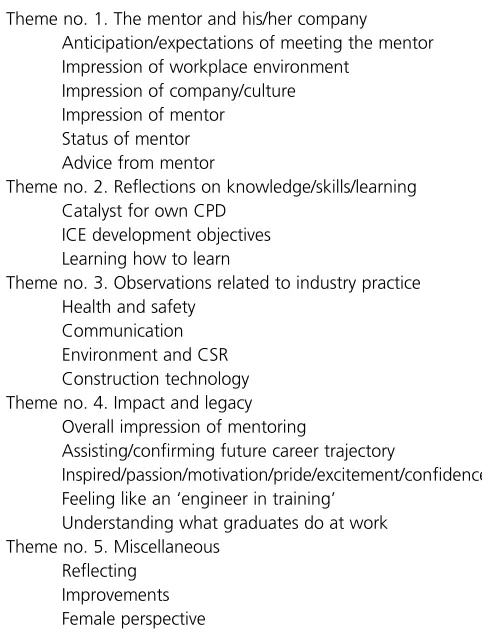
After the grading of each coursework journal for the 2010–2011 session, the lead author read them again, undertaking a thematic analysis through an active interpretation of the text. This involved the coding (searching for words and short phrases to provide meaning and patterns) of each journal. This activity was highly iterative in nature and was undertaken using a highlighter pen to identify relevant text, with the initial codes handwritten in the column of each page. The codes from each journal were subsequently tabulated and thereafter the themes and sub-themes were developed through allocating, collapsing and refining them (Table 3).
Given that each journal (average circa 3000 words) was required to be manually read and graded, it was decided to undertake the coding manually rather than use computer software. This was a pragmatic decision based on the lead author’s personal choice and taking advantage of the immersion within the data corpus through the initial grading exercise. Moreover, both activities share similar cognitive behaviour such as analysis and deliberation and initial grading helped to begin to shape particular patterns in the data. Indeed, as Basit (2003) argues, computer software does not negate the need for such intellectual thinking during the coding process.
The manual coding process was undertaken annually and this method also accommodated the potential for having shifting and emerging codes (akin to constructivist grounded theory) that could emerge from the subsequent analysis of the journals over the 4 years. Moreover, anecdotal evidence suggests that the use of software can have a‘limiting or straitjacketing’impact on the analysis through the adoption of predetermined codes (objectivist grounded theory). As it transpired, the original process of coding and prescribing themes and subthemes was extremely robust and each subsequent coding exercise lead to a theoretical saturation of data (data set) whereby only a few new codes were uncovered over the 4 years. These subthemes were categorised under‘miscellaneous’.
Employer Male Female
Aecom 3 –
Amec 2 –
Amey – 1
Arup 4 3
Atkins – 1
Balfour Beatty 1 –
BAM 1 –
BAM Nuttall 3 –
Black & Veatch 2 1
Brookfield Multiplex 2 1
Buro Happold Ltd 1 –
Carillion 1 –
Forth Crossing Bridge Constructors (FCBC) 5 –
Glasgow City Council 1 –
Goodson Associates 2 –
Graham Construction 1 –
Grontmij 1 –
CH2M Hill (Halcrow) 9 2
I&H Brown 1 –
Jacobs 4 –
Laing O’Rourke 4 –
Lend Lease 1 –
Mott Macdonald 1 –
Network Rail 4 –
Ramboll 1 –
Sir Robert McAlpine 7 2
Tony Gee & partners LLM – 1
Transport Scotland – 1
URS – 1
Waterman 1 –
[image:5.595.59.298.148.549.2]Woolgar Hunter Ltd 5 1
The verbatim (text extracts from the journals that enable voice) presented in the following sections represents a sample of the narrative coded within each theme. Each extract has been extracted from a different student journal and no attempt has been made to interpret and attribute the data based on demographic categories other than some explicit comments made by female students (not included in this paper). The verbatim presented is considered to be‘vivid and compelling’(Braun and Clarke, 2006) and tells the story of the data set and facilitates the development of generalisations.
5.
Theme no. 1: the mentor and his/her
company
5.1 Anticipation/expectations of meeting the mentor A number of students were apprehensive about meeting their mentors and this appeared to be particularly pertinent for the mentees who were yet to secure a summer placement within the construction industry. The narrative below shows a high degree of honesty and conveys a tension and relief somewhat reminiscent of a Hitchcock production. It suggests that some students will require additional encouragement to ensure they pass over the mentoring threshold (physical and psychological).
It was not, however, until I stood outside the front door of my mentor group’s chosen company that I started to think about what this opportunity could mean and, rather anxiously, about what our mentor would be like. As I stood there in a slight daze with all these thoughts
running through my head it was with great relief that one of my friends bravely opened the door to the office.
5.2 Impression and status of mentor
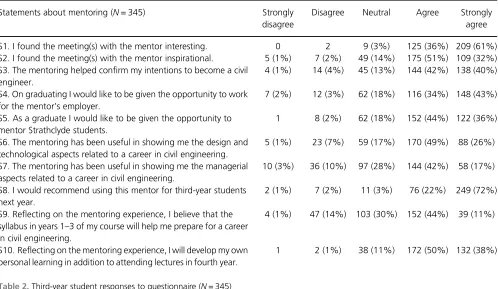
[image:6.595.42.540.145.434.2]Before the year two students retire for their summer break they are required to give notice of a preferred mentor role (client/consultant contractor) to facilitate matching where possible. Table 2 shows that 249 (72%) students strongly agreed and 76 (22%) agreed that their mentor should be used again for students in the following year. The nine (3%) students who did not recommend using their mentor again voiced concerns about their mentors’ ability to provide sufficient meetings, rather than any personality or professional problems. However, the verbatim below reflects the view of the majority of students.
[Our mentor] was an extremely down to earth character who everyone in the group got on very well with. The genuine enthusiasm he had for his work and willingness to help us in any way he could was a real testimony not to just himself, but the company for which he worked.
6.
Theme no. 2: re
fl
ections on knowledge/
skills/learning
Despite the call (QAA, 2001, 2009) for universities to implement PDP within undergraduate courses, its implementation within the department is still developing with extemporary approaches. However, as previously mentioned in this paper, the students are encouraged to view PDP as thefirst step to IPD and integrate with Statements about mentoring (N= 345) Strongly
disagree
Disagree Neutral Agree Strongly agree
S1. I found the meeting(s) with the mentor interesting. 0 2 9 (3%) 125 (36%) 209 (61%) S2. I found the meeting(s) with the mentor inspirational. 5 (1%) 7 (2%) 49 (14%) 175 (51%) 109 (32%) S3. The mentoring helped confirm my intentions to become a civil
engineer.
4 (1%) 14 (4%) 45 (13%) 144 (42%) 138 (40%)
S4. On graduating I would like to be given the opportunity to work for the mentor’s employer.
7 (2%) 12 (3%) 62 (18%) 116 (34%) 148 (43%)
S5. As a graduate I would like to be given the opportunity to mentor Strathclyde students.
1 8 (2%) 62 (18%) 152 (44%) 122 (36%)
S6. The mentoring has been useful in showing me the design and technological aspects related to a career in civil engineering.
5 (1%) 23 (7%) 59 (17%) 170 (49%) 88 (26%)
S7. The mentoring has been useful in showing me the managerial aspects related to a career in civil engineering.
10 (3%) 36 (10%) 97 (28%) 144 (42%) 58 (17%)
S8. I would recommend using this mentor for third-year students next year.
2 (1%) 7 (2%) 11 (3%) 76 (22%) 249 (72%)
S9. Reflecting on the mentoring experience, I believe that the syllabus in years 1–3 of my course will help me prepare for a career in civil engineering.
4 (1%) 47 (14%) 103 (30%) 152 (44%) 39 (11%)
S10. Reflecting on the mentoring experience, I will develop my own personal learning in addition to attending lectures in fourth year.
1 2 (1%) 38 (11%) 172 (50%) 132 (38%)
any CPD while at university. The verbatim in this part of the paper reflects a successful outcome of this objective.
6.1 Relevance to prior university learning/learning how to learn
It could be argued that reflection is the output and the catalyst for students’understanding of the process of‘learning how to learn’ and to interrogate their personal motives for studying civil engineering. The students were encouraged to comment on their studies to date in light of the mentoring experience. The narrative below suggests a preference for active learning and an appreciation of the disadvantages associated with transmission-style lecturing.
Land Surveying and Mapping was a class I particularly enjoyed in second year and spent a lot of time learning in terms of knowledge as well as practical experience. This paid off as I achieved a 93% pass at the end of the year and the knowledge gained during the class has clearly become‘lodged’in my brain and is readily available to me. I feel if all classes had the self-learning through practical experience then links between subjects at university would be much clearer and natural to us. It would be much easier for us to realise links between previous and present problems in our future careers
The mentees’views concerning the utility of attending university and the extent to which they consider how successful it is in satisfying
intrinsic and extrinsic goals is beyond the scope of this paper. However, the answers to S.9 in Table 2 offer some evidence as to their orientation towards assessing how their studies to date had contributed to their readiness to become a civil engineer. A total of 191 (55%) students, reflecting on their mentoring experience, either agreed or strongly agreed that their university studies up to the end of the third year have assisted in preparing them for a career in civil engineering. Worryingly, 103 (30%) students were undecided and 47 (14%) students disagreed, with four students strongly disagreeing.
I felt that the Eurocodes assignment for Mr. XXXX in which we had to calculate values based on these standards has prepared me for this aspect of the job and the work we have done with Dr. XXXX on moments and concrete forming would also have great significance in this discipline.
These graduate engineers gave me a far deeper account of the industry than most of my lecturers and I believe I learned more from him than most of 1st and 2nd year lecturers combined.
6.2 Catalyst for own CPD
The responses to S.10 in Table 2 show that 304 (88%) students either agreed or strongly agreed that they would pursue their own CPD on return to fourth-year studies. The verbatim shown is representative of the qualitative data, albeit the department has not monitored students’ implementation of such planned activities and it is recognised that policing of the PDP is an area for development within the department. Nevertheless, it is evident that the mentors were persuasive in encouraging students to undertake CPD. This supports the observations of Kneale (2004) that students can be motivated to engage with their own PDP when it is linked to employability.
The time I have spent with my mentor has helped to consider my future in engineering. It has helped me realise that we must continue to learn outside university not just when I leave but also during our course. I plan to read about technologies in engineering magazines as well as attending extra lectures the civil engineering department puts on.
6.3 ICE development objectives
Before the mentees embark on theirfirst contact with their mentors they receive presentations from the university engineering faculty careers adviser and the local ICE membership development officer who introduces the ICE 3005 development objectives. The following verbatim reflects the ‘awakening’ that many students express, following the mentoring experience.
By reading through the DO’s its clear that all the things discussed also appear as objectives these include, expanding knowledge of new and existing technology, contributing to solution of problems, control of budgets, taking responsibility for work done and many more. This is what I have taken from the experience with [our mentor] and it’s just unfortunate I never started sooner.
7.
Theme no. 4: impact and legacy
In Section 1 of the paper the students, on embarking their studies, were said to have entered a‘community of practice’. The narrative Theme no. 1. The mentor and his/her company
Anticipation/expectations of meeting the mentor Impression of workplace environment
Impression of company/culture Impression of mentor
Status of mentor Advice from mentor
Theme no. 2. Reflections on knowledge/skills/learning Catalyst for own CPD
ICE development objectives Learning how to learn
Theme no. 3. Observations related to industry practice Health and safety
Communication Environment and CSR Construction technology Theme no. 4. Impact and legacy
Overall impression of mentoring
Assisting/confirming future career trajectory
Inspired/passion/motivation/pride/excitement/confidence Feeling like an‘engineer in training’
Understanding what graduates do at work Theme no. 5. Miscellaneous
[image:7.595.54.295.148.465.2]Reflecting Improvements Female perspective
below, and the results presented in Table 2, show that direct exposure to engineering practice, to the workplace, has boosted their anticipatory socialisation (Sanget al., 2009) along a transition from student to graduate engineer. Whether on a continuum within one community or exposed to two different (higher education and work) communities of practice, it is undeniable that the students considered the mentoring scheme to be of immense value in helping them engage with an array of professions (Mills, 2011: p. 226) and assisting them to construct and shape their own professional identities.
The mentoring experience has been one of the best schemes I have taken part in at university. It helped establish where I was in relation to my current career path, and helped further my understanding of a career in civil engineering.
My faith in my studies at university has been waning recently, I was losing the motivation I needed to continue and enjoy the course and look forward to a career in the construction industry. The mentoring has given me back that motivation with added interest and proved to be the most useful experience I have and perhaps will ever have in university.
7.1 Assisting/confirming future career trajectory Table 2 shows that 282 (82%) students agreed/strongly agreed that the mentoring experience had helped confirm their intentions to embark on a career in civil engineering after graduating. Indeed, the mentoring experience appears to have enhanced the mentees’ employability skills and given many students a new vigour and determination in their studies.
I believe that this mentoring program has been a significant benefit to my knowledge and understanding of the world of construction. It has given me confidence that I have made the right career choice, and has given me enthusiasm and renewed energy in studying at University.
7.2 Feeling like an engineer in training
One of the key tenets of the mentoring initiative was to offer the students a ‘real’ industry experience outside the university. Although the department has a number of activities for students to meet engineers within the university (see CE4R (UOS, 2015)), meeting the mentor in the workplace environment can assist the transformation from the‘student’into an‘engineer in training’.
By the end of site visit my barely used and still quite clean high visibility jacket was looking more akin to a typical builders and I was feeling more like an engineer out in thefield.
We were taken on a tour inside the office and then we were instructed to enter and sit in one of the conference rooms. The moment I sat down, I took a look around the room and imagined myself working as a civil engineer already.
8.
Discussion
The preceding sections of this paper have presented the voice of the mentees to the reader. The research question, akin to a guiding
proposition, sought to ascertain what educational impacts the mentoring experience has had on the mentees. The nature of the mentees’experience placed emphasis on vocational learning through exposure to real, informal and largely unstructured engineering education, outside the formal academic boundaries (physical and psychological) of university life. The thematic analysis has shown that the mentees have engaged in a high degree of reflexive thinking, enabled through social interaction. This active learning contributes to the formation of tacit knowledge and can be contrasted with the explicit knowledge (all too often characterised by rote learning) secured by the mentees at university. It would perhaps be paradoxical given the industrial focus of the mentoring, but nonetheless pleasing, if this led to the mentees taking a less instrumental approach to their education through adopting a more liberal attitude to university studies.
The most prominent educational benefits have been related to behaviour, with the majority of the mentees having understood that developing their personal‘engineering habits of mind’(Lucaset al., 2014) and contextualising their knowledge can be enjoyable, helps fuel their self-motivation and persistence and provides a foundation on which to construct an identity as a professional engineer. This behavioural process could be considered an‘emerging intentional state’ (Richardsonet al., 2009: p.70) whereby their attitudes and feelings about self, their studies, the mentoring, their current and projected ambitions, have been shaped by the interactions with their mentors. Indeed, a former university professor and President of the ICE, Charles Inglis alluded to this over 70 years ago.
Education must aim at giving him [students] a healthy mental digestion and that keen appetite for knowledge which a healthy mental digestion promotes, and it is hardly an overstatement to say that the soul and spirit of education is that habit of mind which remains when a student has completely forgotten everything he has ever been taught. (Inglis, 1941: p. 3)
9.
Conclusion
The mentoring initiative has established a loose, yet credible link between the mentees’ PDP–IPD–CPD (Houghton and Maddocks, 2005) and the ICE development objectives. It has provided the mentees with a professional identity (as recommended by the JBM (2009b: p. 1)) in addition to their student persona. Building on and consolidating the achievements secured from the scheme present several challenges – not least, encouraging and motivating the students to maintain the momentum displayed throughout their third year of studies. This will require a more structured approach to student PDP across allfive years (in Scotland) of the MEng course, so as to optimise all industry–academic–institution interventions. However, given the persuasive power of the Research Excellence Framework in applying a‘stronger pressure to achieve research rather than teaching goals’ (Furber et al., 2014: p. 22), finding time to support such activities continues to create tensions within universities.
perhaps enable the mentees to continue being mentored until they graduate. However, this will require a significant increase in the number of industry mentors. The demand from UK universities offering civil engineering courses would require that the IPD for graduate engineers includes a mandatory requirement to mentor school pupils or university students, a call made frequently in the letter pages of theNew Civil Engineer. Thankfully, the University of Strathclyde initiative has become self-priming, with several mentees from the 2010–2011 session now acting as alumni mentors. This is consistent with research performed by Gallo (2013: p. 1157) which found potential for alumnus/alumna to develop a‘mature, deep and altruistic relationship with their alma mater’.
This paper has considered a mentoring initiative as perceived through the lens of the mentees. The research did not consider the interpersonal dynamics between the mentees’ ‘in-group’ and between the mentees and mentors. Future research examining the formation and development of mentoring relationships, communication patterns, the personality traits of mentees and mentors, would contribute to the body of knowledge. Moreover, assessing the impact that mentoring has on the mentees’academic performance would prove a fruitful line of enquiry.
REFERENCES
Barr B(2008) UK civil engineering education in the twenty-first century.Proceedings of the Institution of Civil Engineers– Management, Procurement and Law161(1): 17–23, http://dx.doi.org/10.1680/mpal.2008.161.1.17.
Basit T(2003) Manual or electronic? The role of coding in qualitative data analysis.Educational Research45(2): 143–154.
Bidder GP(1860) Presidential address of George Parker Bidder, President of the ICE 1860–1862.Minutes of the Proceedings 19(1860): 214–228.
BIS (Department for Business Innovation and Skills)(2009) Higher Ambitions: The Future of Universities in a Knowledge Economy. BIS, London, UK. See http://dera.ioe.ac.uk/9465/ (accessed 03/03/2014).
Braun V and Clarke V(2006) Using thematic analysis in
psychology.Qualitative Research in Psychology3(2): 77–101.
Bristol University(2014)Industrial Tutor Scheme. Bristol University. Bristol, UK. See http://www.bristol.ac.uk/ engineering/departments/civilengineering/courses/industry/ tutor.html (accessed 15/07/2014).
Buchanan A(2006)Brunel, The Life and Times of Isambard Kingdom Brunel. Continuum, London, UK.
CBI (Confederation of British Industry)(2009)Stronger Together: Businesses and Universities in Turbulent Times: A Report from the CBI Higher Education Task Force. CBI, London, UK. See http://195.88.100.72/resource/files/2010/01/11/ CBI_HE_taskforce_report.pdf (accessed 10/02/2015).
Chrisp M and Fordyce D(1993) Using links with industry to develop professionalism and engineering awareness in undergraduate education.Proceedings of the Institution of Civil Engineers–Civil Engineering97(2): 82–87.
Clarke B(2012) The 2011 James Forrest Lecture–engineering education–a historical perspective of the future.Civil Engineering and Environmental Systems29(3): 191–212.
Creasey R(2013) Improving students’employability.Engineering Education8(1): 16–30. See http://journals.heacademy.ac.uk/doi/ pdfplus/10.11120/ened.2013.00006 (accessed 28/02/2014).
Davies JW and Rutherford U(2012) Learning from fellow engineering students who have current professional experience.European Journal of Engineering Education 37(4): 354–365.
Davies L(2000) Why kick the“L”out of“LEarning”? The development of students’employability skills through part-time working.Education + Training42(8): 436–445.
Dearing R(1997)Higher Education in the Learning Society, National Committee of Inquiry into Higher Education. See http://www.leeds.ac.uk/educol/ncihe/ (accessed 02/03/2014).
Furber A, Crapper M, Gillie Met al.(2014) Innovative learning at the University of Edinburgh.Proceedings of the Institution of Civil Engineers–Management, Procurement and Law167(1): 13–24, http://dx.doi.org/10.1680/mpal.13.00020.
Gallo ML(2013) Higher education over a lifespan: a gown to grave assessment of a lifelong relationship between universities and their graduates.Studies in Higher Education38(8): 1150–1161.
Gannon JM and Maher A(2012) Developing tomorrow’s talent: the case of an undergraduate mentoring programme.Education + Training54(6): 440–455.
Graham R(2012)Achieving Excellence in Engineering Education; the Ingredients of Successful Change. The Royal Academy of Engineering, London, UK.
Higgins M(2005)CEBE Briefing Guide Series No. 4, Personal Development Planning or Students (PDP). See https://www. heacademy.ac.uk/site/default/files/BriefingGuide_04.pdf (accessed 24/04/2015).
Higher Education Academy(2011)Tool 4: Community of Practice. See http://exchange.ac.uk/guides/education-theories-on-learning/ tool-4-community-of-practice.html (accessed 01/02/2014).
Hipkiss A(2006) Civil engineering career management–the unwritten rules.Proceedings of the Institution of Civil Engineers–Civil Engineering159(3): 126–131.
Holden R and Hamblett J(2007) The transition from higher education into work: tales of cohesion and fragmentation. Education + Training49(7): 516–585.
Houghton W and Maddocks A(2005)Engineering Subject Centre Guide: Personal Development Planning for Engineering Students. See http://www.heacademy.ac.uk/assets/documents/ subjects/engineering/personal-development-planning.pdf (accessed 28/02/2014).
ICE (Institution of Civil Engineers)(2010)Development Objectives, ICE 3005A. ICE, London, UK. See http://www.ice.org.uk/ Information-resources/Downloads/ICE-3005A---Development-Objectives (accessed 03/03/2014).
Inglis CE(1941) Presidential address of Professor Charles Edward Inglis, President 1941–1942.Journal of the Institution of Civil Engineers17(1): 1–18.
JBM (Joint Board of Moderators)(2009a)Guidelines for Accredited MEng Degree Programmes Leading to Chartered Engineer. See http://www.jbm.org.uk/uploads/JBM111_MEng.pdf (accessed 26/10/2013).
JBM(2009b)Degree Guidelines, Annex F (Professionalism). See http://www.jbm.org.uk/uploads/JBM126_AnnexF
Professionalism.pdf (accessed 13/07/2013).
Kneale P(2004) Motivating student personal development planning by making links with employability.Planet13: 20–21. See http://journals.heacademy.ac.uk/doi/pdf/10.11120/plan. 2004.00130020.
Kolb DA(1984)Experiential Learning: Experience as the Source of Learning and Development. Prentice-Hall, Englewood Cliffs, NJ, USA.
Loughborough University(2014)E-Mentoring for Employability. Loughborough University, Loughborough, UK. See http:// eden-share.lboro.ac.uk/id/item/5 (accessed 15/07/2014).
Lucas B, Hanson J and Claxton G(2014)Thinking Like an Engineer: Implications for the Education System. The Royal Academy of Engineering, London, UK. See http://www.raeng.org.uk/ education/thinking_like_an_engineer/pdf/full_report.pdf (accessed 10/06/2014).
Masterton G(2006) Briefing: promoting value–securing the future.Proceedings of the Institution of Civil Engineers–Civil Engineering159(2): 55–63.
Mills PJ(2011) Civil engineering degrees:fit for the future? Proceedings of the Institution of Civil Engineers–Municipal Engineer164(4): 221–228.
Montfort D, Brown S and Shinew D(2014) The personal epistemologies of civil engineering faculty.Journal of Engineering Education103(3): 388–416.
Oltean-Dumbrava C and Galloway K(2012)“Moving Closer” – Maximising Benefits to University Courses, Students and Employers through Undergraduate Civil Engineering Placements. See http://www.hestem.ac.uk/sites/default/files/ moving_closer.pdf (accessed 02/07/2014).
Platts J and Tomasevic V(2006) Developing productive
relationships in civil engineering.Proceedings of the Institution of Civil Engineers–Civil Engineering159(3): 132–137.
QAA (Quality Assurance Agency for Higher Education)(2001) Guidelines for HE Progress Files. QAA, Gloucester, UK. See http://www.qaa.ac.uk/Publications/InformationAndGuidance/ Documents/progfile2001.pdf (accessed 22/02/2104).
QAA(2009)Personal Development Planning: Guidance for Institutional Policy and Practice in Higher Education. QAA, Gloucester, UK. See http://www.qaa.ac.uk/Publications/ InformationAndGuidance/Documents/PDPguide.pdf (accessed 22/02/2104).
Richardson MS, Meade P, Rosbruch Net al.(2009) Intentional and identity processes: a social constructionist investigation using student journals.Journal of Vocational Behaviour 74(1): 63–74.
Sang K, Ison S, Dainty A and Powell A(2009) Anticipatory socialisation amongst architects: a qualitative examination. Education + Training51(4): 309–321.
Sara R(2011) Learning from life–exploring the potential of live projects in higher education.Journal for Education in the Built Environment6(2): 8–25.
Scott N(2014) Training engineers is a partnership between academia and industry. How could links between these be strengthened for the benefit of the profession?The Structural Engineer92(6): 10–13.
Steels HM(2001)Dynamic Mentoring for Civil Engineers. Thomas Telford, London, UK.
Sword W, Bryne C, Drummond-Young M, Harmer M and Rush J
(2002) Nursing alumni as student mentors: nurturing professional growth.Nurse Education Today22(5): 427–432.
Teeside University(2014)Engagement with Industry and Employers. Teeside University, Middlesbrough, UK. See http://www.tees.ac.uk/undergraduate_courses/engineering/ (accessed 15/07/2014).
Thompson P and Surgeonor D(2014) Bridging the gap: university to professional qualifications.Proceedings of the Institution of Civil Engineers–Management, Procurement and Law167(4): 189–200, http://dx.doi.org/10.1680/mpal.13.00034.
University of Edinburgh(2014)Civil and Environmental Engineering Student Mentoring Scheme. University of Edinburgh, Edinburgh, UK. See http://www.eng.ed.ac.uk/ undergraduate/engineering-disciplines/civil-engineering/ why-civil (accessed 15/07/2014).
UOS (University of Strathclyde)(2013)Department of Civil & Environmental Engineering Industrial Advisory Board, Guide to Mentoring. University of Strathclyde, Glasgow, UK. See http://www.strath.ac.uk/media/departments/civilengineering/ ugstudy/mentoring/IAB-Guide-To-Mentoring-March-2013.pdf (accessed 15/07/2014).
UOS(2015)Civil Engineering 4 Real (CE4R) Project & Problem Based Learning for Undergraduate Civil Engineers. University of Strathclyde, Glasgow, UK. See http://www.strath.ac.uk/ civeng/ug/ce4r/ (accessed 20/02/2015).
Yusuf J(2012) Working for a small engineering consultancy: a graduate’s perspective.The Structural Engineer90(7): 50–51.
WHAT DO YOU THINK?
To discuss this paper, please submit up to 500 words to the editor at [email protected]. Your contribution will be forwarded to the author(s) for a reply and, if considered appropriate by the editorial panel, will be published as a discussion in a future issue of the journal.
Proceedingsjournals rely entirely on contributions sent in by civil engineering professionals, academics and
stu-dents. Papers should be 2000–5000 words long (briefing
papers should be 1000–2000 words long), with adequate
illustrations and references. You can submit your paper online via www.icevirtuallibrary.com/content/journals,