J. D. Pritchard, J. A. Isaacs, M. A. Beck, R. McDermott, and M. Saffman∗ Department of Physics, University of Wisconsin, 1150 University Avenue, Madison, Wisconsin 53706
(Dated: December 18, 2015)
We propose a novel hybrid quantum gate between an atom and a microwave photon in a superconducting coplanar waveguide cavity by exploiting the strong resonant microwave coupling between adjacent Rydberg states. Using experimentally achievable parameters gate fidelities> 0.99are possible on sub-µs timescales for waveguide temperatures below 40 mK. This provides a mechanism for generating entanglement between two disparate quantum systems and represents an important step in the creation of a hybrid quantum interface applicable for both quantum simulation and quantum information processing.
PACS numbers: 03.67.Lx, 32.80.Rm, 32.80.-t
Quantum information processing provides a route to effi-cient solutions for many problems that are intractable on con-ventional classical computers. While there has been tremen-dous recent progress in the realization of small-scale quantum circuits comprised of several quantum bits (“qubits”) using a wide range of physical implementations [1], research indi-cates that a fault-tolerant quantum computer that exceeds what is possible on existing classical machines will require a net-work of thousands of qubits, far beyond current capabilities.
Hybrid quantum computation exploits the unique strengths of disparate quantum technologies, enabling realization of a scalable processor capable of both fast gates and long coher-ence times that has yet to be achieved using a single physi-cal qubit. Superconducting qubits coupled via microwave res-onators have been identified as promising candidates for such an interface offering both fast (∼ns) gate times and a scalabil-ity through fabrication of chip-based superconducting circuits [2–4], which have already been used to implement quantum algorithms [5], many-body Hamiltonians [6] and synthesis of arbitrary quantum states of the resonator mode [7]. However, a limiting factor is the coherence time of the qubits, typically around 60µs [8, 9]. This makes coupling the superconducting circuits to external qubits for quantum memory advantageous. To date a number of systems have been explored for this pur-pose, including solid state spin-ensembles [10], color centers in diamond [11], nano-mechical resonators [12] and atoms.
Atomic systems offer very long coherence times, and can be coupled to the microwave cavity mode via the weak magnetic dipole transition between hyperfine ground states [13–15]. Recently, coherence times exceeding3 s have been demon-strated for a BEC held above a resonator at 4 K [16]. Al-ternatively, the strong electric dipole coupling between close-lying Rydberg states can be used to obtain strong coupling of a single atom to the microwave field[14, 17, 18]. Rydberg atoms have strong dipole-dipole interactions which can be utilised for both atomic and photonic quantum gates [19, 20]. These combined properties can be exploited to create a hy-brid quantum interface capable of fast processing times us-ing the superconductus-ing qubits with long storage time in the atomic quantum memory, as well as the ability to map from the atomic state to optical systems for communication across a quantum network [21]. The microwave resonator can
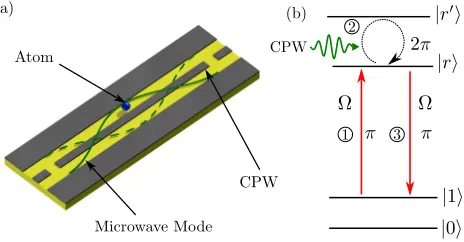
addi-FIG. 1. (Color online). Hybrid Quantum Gate Scheme (a) An atom trapped above the electric field antinode of a superconducting mi-crowave coplanar waveguide resonator. (b) Level-scheme for atom– photon conditional phase gate. The atom is prepared using hyper-fine ground states as the qubit basis. Aπ-pulse excitation maps
|1i → |ri, which is resonantly coupled to close-lying state|r0ivia the microwave cavity and undergoes a2π-rotation conditional upon the presence of a cavity photon. A secondπ-pulse from|ri → |1i
with the resulting phase controlled by the microwave photon.
tionally be utilised to extend the strong interactions between Rydberg atoms to enable entanglement of single photons in-teracting with spatially separated atomic ensembles [22]. Re-cent progress towards chip-based experiments has been the demonstration of coherent driving of Rydberg states near the surface of atom chips [23, 24].
[image:1.612.324.556.221.342.2]a robust hybrid quantum interface. Unlike previous propos-als [14] this scheme only requires a single resonant coupling from an atomic qubit level to the Rydberg state, simplifying the implementation.
We consider an atom held close to the surface of a super-conducting CPW cavity with a cavity frequencyωc and cav-ity lifetime 1/κ. A schematic of the experiment is shown in Fig. 1(a). The relevant atomic level scheme for the gate implementation is shown in Fig. 1(b), with the qubit states encoded in two different hyperfine ground states of an alkali atom. State|1iis resonantly coupled to a high principal quan-tum number Rydberg state|rivia a classical laser field with Rabi frequencyΩ. This Rydberg state is chosen such that the transition frequency, ωrr0 = ωr0 −ωr, from |rito a close lying (∆n = 0) microwave coupled state|r0i is nearly res-onant with the microwave cavity mode, ωc. The choice of ∆n= 0maximizes the dipole momentdrr0 for the transition. The coupling between the Rydberg states and the cavity is de-scribed by the Jaynes-Cummings Hamiltonian [25], which in the rotating wave approximation is given by
ˆ
H =~∆ˆσ+σˆ−+~g(ˆσ+ˆa+ ˆσ−ˆa†), (1)
where∆ = ωc −ωrr0, σˆ+ = |r0ihr| is the Rydberg state atomic raising operator,ˆa,aˆ†the annihilation and creation op-erators for the microwave cavity field andg=E0(xa)·drr0/~ is the vacuum coupling strength between an atom and the cav-ity which is determined by the zero-point electric field of the cavity mode at the position of the atom,xa.
In the strong coupling regime with g κ, γr,r0 where 1/γr,r0 is the lifetime of the Rydberg states, when the atom is on resonance with the cavity (∆ = 0) then a single photon in the cavity will drive coherent vacuum Rabi oscillations be-tween|riand|r0iat a frequency of2g. This can be utilized to realize a conditional phase gate via the following scheme: 1) The cavity is initially detuned from the atomic resonance with∆ g, κ, γto minimize the perturbation of the atomic energy levels due to the coherent coupling to the cavity en-ergy levels. The classical laser field is turned on for a time
τ1=π/Ωto drive a high fidelityπpulse from the upper qubit state to the Rydberg state|1i → i|ri. 2) The cavity is tuned into resonance with∆ = 0for a period of τ2 = π/g. If a photon is present in the cavity it drives a2πrotation of the Rydberg state i|ri → −|r0i → −i|ri, otherwise the Ryd-berg state is unchanged. 3) The cavity is detuned again and an identicalπ-pulse as in 1) is applied to map the Rydberg state back to the upper qubit state±i|ri → ∓|1iin a dura-tionτ3=τ1conditional upon the photon occupation number of the cavity mode. This realizes aCzconditional phase gate withCz =|00ih00| − |01ih01|+|10ih10|+|11ih11|, where the two qubit basis is defined as first the CPW Fock state and second the atomic basis state. The total duration for the gate operation is given byτ =π(2/Ω + 1/g). Combining this uni-versal gate with single qubit rotations it is therefore possible to perform arbitrary two-qubit quantum gates and provides a route to entangle the atom-photon system.
log
1 0[
Q
]
g/
2
π
(M
Hz
)
0.9
0.99
0.
999
0 .99
99
4 4.5 5 5.5 6 6.5
2 4 6 8 10
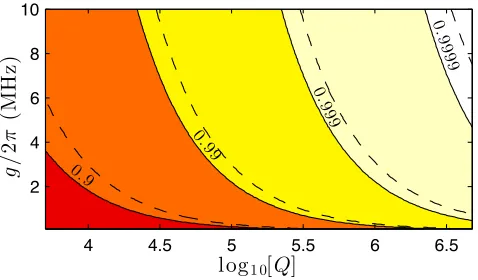
FIG. 2. (Color online). Contour plot of the|Ψ+i
Bell state prepara-tion fidelityFusing the hybrid quantum gate. At highQthe fidelity is limited by spontaneous decay of the Rydberg levels during the con-ditional rotation timeτ =π/g. Dashed lines show analytic fidelity estimate.
This simple gate sequence relies on the ability to rapidly change∆ on a timescale fast compared to g, which can be achieved either using a Stark-shift of the Rydberg states with an external DC electric field to changeωrr0 or by using an intra-cavity Superconducting Quantum Interference Device (SQUID) which can switchωcby 0.5 GHz in 1 ns [26, 27].
To evaluate the gate performance and demonstrate entan-glement generation we calculate the preparation fidelity of the Bell state|Ψ+i = √1
2(|01i+|10i)with the atom ini-tially in|0iand the resonator in a superposition state(|0i+
|1i)/√2. Entanglement is established using the gate sequence
HaCzHa, whereHadenotes a Hadamard gate applied to the atom. Initialisation of the resonator is achieved by control-lably mapping the state of a superconducting qubit onto the cavity mode by shifting the qubit into resonance for a time
π/(2gSC)[28]. This preparation step is included in the sim-ulation using typical parameters for a superconducting qubit withgSC/2π= 100MHz and a lifetime of 2µs [3], however we assume perfect qubit initialisation and single qubit opera-tions to determine the intrinsic hybrid gate fidelity.
We explicitly consider the cavity coupling from the 90s1/2, mj = 1/2to 90p3/2, mj = 1/2in Cs with transition frequencyωrr0 = 2π×5.037GHz and a dipole moment of drr0 =p2/9×8360ea0. The radiative lifetimes of the states are 820µs and 2 ms respectively [29], with negligible contri-bution from the black-body radiation at the milli-Kelvin tem-peratures used for performing superconducting circuit experi-ments. Similarly, theAcoefficient for the decay from 90p3/2 to 90s1/2is 0.2s−1and can also be neglected.
The photon decay rate from the cavity is determined by
κwhich is related to the quality factor of the resonator by
Q = ωc/κ, in addition to a contribution arising from the mean thermal photon number within the cavityn¯th. Finite temperature effects will be considered below but initial cal-culations are performed in the zero-temperature limit with ¯
[image:2.612.321.560.56.196.2]gate sequence is calculated using the Lindblad master equa-tion [30] for a range of coupling strengths g andQ-factors. The fidelity determined usingF = Tr(p√
ρiρ
√
ρi), where
ρi=|Ψ+ihΨ+|is the ideal density matrix for the Bell state. The results are plotted in Fig. 2 which shows a contour map of the Bell state preparation fidelityF for a range ofg and
Q, showing high fidelity gates withF > 0.999 are achiev-able using current capabilities. Accounting for the gate er-rors caused by decay of the atom or photon during the entan-glement preparation results in an analytic fidelity estimate of
F = 1−π/(16g)∗[3(κ+γr)+γr0], which is plotted as dashed contours on Fig. 2 and shows reasonable agreement with the complete numerical simulation. This revealsκis the dominant source of error requiring aQ >2×10⁷to be comparable with the finite lifetimes of then= 90Rydberg states which has yet to be demonstrated using surface fabricated waveguides, how-ever the photon decay is minimised for largegdue to reduced gate time. The simulation neglects errors accumulated during theπ-pulses between|1iand|ri, during which time the domi-nant error arises from spontaneous emission from the Rydberg state which occurs with a probabilityPr = 2(π/Ω)(γr/2). ForΩ/2π = 10MHz,Pr ∼6×10⁻⁵which is small com-pared to a fidelity ofF >0.999.
We now consider the requirements for practical implemen-tation of such a gate, starting with realistic values forg and
Q. The workhorse of superconducting circuit QED is the mi-crowave CPW [3] in Fig. 1(a) which features a central conduc-tor between two large ground planes which is fabricated on a dielectric substrate which supports quasi-TEM microwave fields. The resonator frequency is determined geometrically and can be modified through choice of length and the ratio of the widths of the center conductor, s, to the gap to the ground plane, w[31]. The zero-point energy of the cavity field~ωc/2is shared equally between the electric and mag-netic field modes of the CPW making it possible to normalize the zero-point electric field in the cavity calculated using finite element analysis via the energy density using
~ωc
2 =
Z
(r)|E0(r)|2d3r, (2)
where(r)is the permittivity equal to0above the cavity and
r0in the dielectric substrate. Figure 3 shows the transverse zero-point electric field magnitude and direction at the anti-node of a 5 GHz superconducting λ/2 resonator grown on sapphire (r = 9.6) with a center trace width ofs = 20µm and gap ofw = 10µm, typical of CPW used for supercon-ducting qubits [3]. The peak field is confined within the gap between traces atx= (s+w)/2and falls off approximately exponentially above the surface, as shown in Fig. 3(b) which also plots the coupling strengthgcalculated using the dipole moment ofdrr0 given above, resulting in a peak coupling of g/2π= 4MHz.
Trapping Rydberg atoms close to superconducting circuits presents a significant challenge, as light scattered onto the su-perconductor causes quasi-particle excitations that reduce res-onatorQand qubit lifetimes [32] in addition to atom-surface
x (µm)
z ( µ m ) (a) (b)
−40 −20 0 20 40 0 20 40 60 80 |E 0 | (V / m ) 0 0.02 0.04 0.06 0.08 0.1
0 10 20 30 40 50 0 0.02 0.04 0.06 0.08 0.1
z (µm)
0 1 2 3 4 5 g / 2 π (M H z ) x=0
x= (s+w)/2
FIG. 3. (Color online). (a) Zero-point electric field distribution around superconducting CPW cavity with a center trace of 20µm and a 10µm gap. (b) Field distribution and vacuum coupling strength to the 90s1/2 →90p3/2transition as a function of height above the
surface for both the resonator midpoint and gap centre, which falls off rapidly on a length scale comparable to the slot widthw
.
interactions [33]. Current efforts have focused on the mag-netic trapping of atoms above superconducting waveguides, making it possible to achievez = 10µm [16] corresponding tog/2π∼2MHz forn= 90. Whilst increasing the quantum number of the Rydberg states will increase the dipole moment byn2 this concomitantly reduces the cavity frequency pro-portional ton−3and hence the zero point electric field [34] resulting in an effective reduction ofg ∝1/n. An important figure of merit for the cavity QED system is however the ratio ofg/γr∝n2, makingn= 90an ideal compromise between
gand the Rydberg state lifetime ∝ n3 whilst operating at a frequency matched to state-of-the-art superconducting quan-tum circuits [3, 31].
The second critical cavity parameter is the intrinsic quality factor of the resonator,Qwhich determines the photon life-time within the cavity. This is predominantly limited by the losses inherent in the dielectric medium and the presence of contaminant particles on the chip surface. The best resonators to date have aQ > 106 [35]; however typicallyQ ∼ 105 [31]. Using these parameters mean state fidelities ofF >0.99 can be achieved, as shown in Fig. 2. Assuming a classical coupling rate ofΩ/2π = 10MHz, the total gate duration is 350 ns.
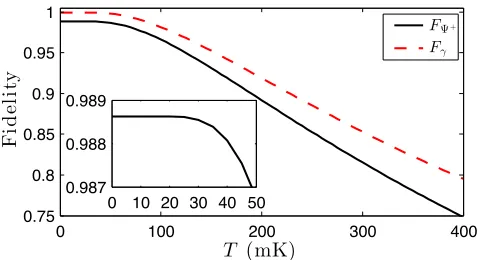
Finally, we consider the effects of finite temperature on the gate fidelity. Unlike optical cavity systems with frequen-cies in the THz regime, superconducting microwave cavities have significant thermal occupation even at cryogenic temper-atures. The mean thermal photon number in the cavity is given byn¯th= (e~ωc/kBT−1)−1, which causes incoherent driving of the|ri → |r0itransition in addition to reducing the fidelity of the cavity photon state preparation. To demonstrate the dependence on CPW temperature we calculate the Bell state preparation fidelity as a function of temperature for the gate detailed above using realistic parameters ofg/2π = 2MHz andQ= 2×10⁵.
[image:3.612.318.558.54.164.2]fol-T (mK)
Fi
d
el
it
y
0 100 200 300 400 0.75
0.8 0.85 0.9 0.95 1
0 10 20 30 40 50 0.987
0.988 0.989
FΨ+
Fγ
FIG. 4. (Color online) Finite temperature effects due to thermal oc-cupation of the cavity mode. Fγ represents the fidelity of
prepar-ing the cavity in state(|0i+|1i)/√2via resonant interaction with a superconducting qubit which drops rapidly above 40 mK due to the thermal occupation of the cavity.FΨ+is the resulting Bell-state preparation fidelity which follows approximately linearly withFγ.
Inset: zoom in around zero temperature.
lowing interaction with the superconducting qubit, Fγ, and the Bell state preparation fidelityFΨ+ for the entire gate se-quence. This shows that whilst the gate evolution is insensi-tive at low temperature the fidelity drops rapidly above 40 mK due to the thermal photon occupation preventing high fidelity preparation of the cavity mode. This represents a physical limitation for any experiments performed at this frequency, necessitating use of a dilution refrigerator. Local heating of the resonator due to the excitation lasers can be minimised us-ing a two-photon transition from|gito|riwith a large single-photon detuning relative to the intermediate state to provide stronger transition matrix elements than the single photon transition, reducing the required optical intensity at the atoms. Additionally, the single atom may be replaced by an ensemble and the Rydberg dipole blockade mechanism used to excite a single collective excitation [36], giving a√Nenhancement in the coupling strengths.
The preceding results demonstrate that the hybrid con-trolled phase gate can generate entanglement between an atomic qubit and cavity field inside a microwave resonator with high fidelity. To extend the gate to application as a quan-tum memory for a superconducting qubit Q1, a teleportation sequence [37] can be used requiring an ancillary supercon-ducting qubit Q2. Following preparation of the atom-photon Bell state, the cavity field is then mapped to Q2. Bell state measurements are then performed on Q1and Q2, with the out-come used to apply the required single qubit rotations onto the atom. This transfers an arbitrary state |ψi from qubit Q1to the atomic qubit to exploit the long atomic coherence time. Bell state measurements on superconducting qubits can be performed and processed in∼500ns [38], offering much faster storage compared to construction of a swap gate from the controlled phase gate above.
In conclusion, we have proposed a method of entangling superconducting cavity photons with Rydberg-atom qubits
which introduces few losses relative to its homogenous coun-terparts. Furthermore, we show that currently achievable ex-perimental implementations in each field can produce hybrid entanglement fidelities in the.99 regime with gate times of order a fewµs, limited only by theQ-factor of the resonator cavity. Utilising the coupling of the microwave resonator to a diverse range of quantum systems via the electric or magnetic dipole transition can then be exploited to map the entangle-ment onto an qubit such as a collective solid state spin sys-tem or a superconducting qubit fabricated within the resonator mode [4]. This provides the possibility to use cold atoms as quantum memories for superconducting systems, as well as offering the potential to convert microwave photons to the op-tical regime where qubits are protected from thermal noise.
This work was supported by funding from the NSF award PHY-1212448 and the University of Wisconsin Graduate School.
∗
[1] T. D. Laddet al., Nature464, 45 (2010). [2] A. Wallraffet al., Nature431, 162 (2004).
[3] A. Blais, R.-S. Huang, A. Wallraff, S. M. Girvin, and R. J. Schoelkopf, Phys. Rev. A69, 062320 (2004).
[4] Z.-L. Xiang, S. Ashhab, J. Q. You, and F. Nori, Rev. Mod. Phys.85, 623 (2013).
[5] L. DiCarloet al., Nature460, 240 (2009).
[6] J. M. Finket al., Phys. Rev. Lett.103, 083601 (2009). [7] M. Hofheinzet al., Nature459, 546 (2009).
[8] J. B. Changet al., Appl. Phys. Lett.103, 012602 (2013). [9] R. Barendset al., Phys. Rev. Lett.111, 080502 (2013). [10] Y. Kuboet al., Phys. Rev. Lett.107, 220501 (2011). [11] R. Ams¨usset al., Phys. Rev. Lett.107, 060502 (2011). [12] A. D. O’Connellet al., Nature464, 697 (2010). [13] J. Verd´uet al., Phys. Rev. Lett.103, 043603 (2009). [14] D. Petrosyanet al., Phys. Rev. A79, 040304 (2009). [15] M. Hafeziet al., Phys. Rev. A85, 020302 (2012). [16] S. Bernonet al., Nature Comms.4, 2380 (2013).
[17] A. S. Sørensen, C. H. van der Wal, L. I. Childress, and M. D. Lukin, Phys. Rev. Lett.92, 063601 (2004).
[18] K. R. Patton and U. R. Fischer, (2013), arXiv:1307.0963 [quant-ph].
[19] M. Saffman, T. G. Walker, and K. Mølmer, Rev. Mod. Phys.
82, 2313 (2010).
[20] J. D. Pritchard, K. J. Weatherill, and C. S. Adams, Ann. Rev. Cold. Atoms and Mol.1, 301 (2013).
[21] H. J. Kimble, Nature453, 1023 (2008).
[22] D. Petrosyan and M. Fleischhauer, Phys. Rev. Lett.100, 170501 (2008).
[23] S. D. Hoganet al., Phys. Rev. Lett.108, 063004 (2012). [24] J. D. Carter and J. D. D. Martin, Phys. Rev. A88, 043429
(2013).
[25] E. T. Jaynes and F. W. Cummings, Proc. IEEE51, 89 (1963). [26] M. Sandberget al., Appl. Phys. Lett.92, 203501 (2008). [27] Z. L. Wanget al., Appl. Phys. Lett.102, 163503 (2013). [28] M. Mariantoniet al., Nature Phys.7, 287 (2011).
[29] I. I. Beterov, I. I. Ryabtsev, D. B. Tretyakov, and V. M. Entin, Phys. Rev. A79, 052504 (2009).
[image:4.612.56.295.54.184.2][31] M. G¨opplet al., J. App. Phys.104, 113904 (2008). [32] R. Barendset al., App. Phys. Lett. , 113507 (2011). [33] See Supplementary Material for details.
[34] Inspection of eq. 2 impliesE0 ∝
√
ωc, however the change in
the resonator length to maintain the same resonant mode
intro-duces an additional factor of√ωc.