Rochester Institute of Technology
RIT Scholar Works
Theses
Thesis/Dissertation Collections
11-1-1994
A Cube as form
Jeoung-Eun Lim
Follow this and additional works at:
http://scholarworks.rit.edu/theses
This Thesis is brought to you for free and open access by the Thesis/Dissertation Collections at RIT Scholar Works. It has been accepted for inclusion
in Theses by an authorized administrator of RIT Scholar Works. For more information, please contact
Recommended Citation
ROCHESTER INSTITUTE
OF
TECHNOLOGY
A Thesis
Submitted
to the
Faculty
ofThe
College
ofimaging
Arts
andSciences
in
Candidacy
for
the
Degree
ofMASTER OF FINE ARTS
A
CUBE AS FORM
by
JEOUNG-EUN LIM
ROCHESTER,
NEW YORK
Adviser: pro:c:awren)e Williams
Date:
/4"
'
£L?//
('
'~/7~{'"
Associate Adviser: Prof. Kathy Vajda
Date:
1~/I.2
/:;If
Associate Adviser: Prof. David Dickinson
Date:
I
7--/1'7_/
q
ct
Special Assistant to the
Dean for Graduate Affairs: Prof. Luvon Sheppard
Date:/y~y
Dean, College of Imaging Arts and Science
Dr. Margaret Lucas
Date:
I, _J_eo_u_n...;;9;...-_Eu_n_L_i_m
, hereby grant permission to the
Wallace Memorial Library of Rochester Institute of Technology"
to
reproduce my thesis in whole or in part.
Any reproduction will not be for commercial use or profit.
TABLE
OF
CONTENTS
ACKNOWLEDGEMENTS
i
LIST
OF ILLUSTRATIONS
ii
INTRODUCTION
1
Part
I:
ANALYSIS
AND
COMPARISON
2
Part
II:
DESCRIPTION
OF EXPERIMENTATION
6
CONCLUSION
9
ACKNOWLEDGEMENTS
I
wouldlike
to thank
my
advisers,
Prof.
Judd
Williams,
Prof.
Kathy
Vajda,
Prof. David
Dickinson,
Wendy
Low,
andZerbe
Sodervick,
who proof read
my
papers,
my instructors
andfriends
atRochester Institute
ofTechnology
for
sharing
their
knowledge
and experiences with me.Especially,
I
own aninestimable
thanks to
my
parents,
whoseLIST
OF ILLUSTRATIONS
Figure
Page
1.
Memory
USA 1
10
2.
Last
Year-Memory
(Installation)
11
3.
Last
Year-Memory
1
12
4.
Farewell 101 992
13
5.
Man;
In
aShade
ofGreen
14
6.
Hey! Francis
15
7.
Inner
Space
1
16
8.
See
myself17
9.
Staring
1
18
INTRODUCTION
Today
science andtechnology
has
created a mechanizedsociety
for
allof us.
Often I feel
alienatedby
the
people around me.This
lack
ofhuman
compassion often casts
my
spiritsinto
a state offrustration
anddespair.
My
workdeals
withmy
personalisolation
andmemories,
and withhow
these
entries areboxed-in
or enclosedin
waysthat
are ambiguous.Perhaps
they
canbe interpreted
asabstract, representational,
two-dimensional,
three-dimensional,
oreven,
in
their
distortions,
hint
at unperceiveddimensions.
Future,
past and present are not parts ofcontinuously
flowing
time,
but
they
are ratherthree
directions
orthree
dimensions into
whichthe
posture ofman can stretch.
We
are not guaranteedthe
realization of our egoin
the
future.
My
working
with combinations ofdifferent
printmaking
processes,
computer
graphics,
andglass,
is
adirect
result ofthese thoughts.
My
ideas
areParti
ANALYSIS
AND
COMPARISON
If
wedefine
art as means ofexpressing
ourtrue
selves andmaking
ourlives
morevaluable,
wefirst
needto
look
at ourselvestruthfully.
I
recognizethat
in
ourpresent,
mechanizedsociety
it is
easy
to
lose
our real self andrespect
for
others.Therefore
I
try
to
expressmy
imagination
and recordmy
world
in
a series of works called"A
Cube
Form Seen Through An Empirical
Image,"
using
allkinds
of memorableimages
accumulatedthroughout
my life
time, along
with some select objects which symbolizethe
presenttime.
By
doing
aseries,
I
try
to
confirmmy
own existencein
this
uncertain world.I
wouldlike
to
establish a view ofmy
theoretical
base for future
worksby
comparing
andanalyzing
the
works of other artists.In this way,
I
can morefully
understandhow
my
created arthas developed
and whatinfluences have
mostimpacted
my
personaldirections..
I
will comparemy
art with workby
two
highly
recognizedcontemporary
artists.
Joseph Cornell
provided me withthe
idea
ofboxed
preservation ofmemories.
Robert
Rauschenberg,
like
myself,
usesjuxtaposed
photographicimages
within geometricdivisions.
Moreover,
I
will also analyze wheremy
Most
ofmy
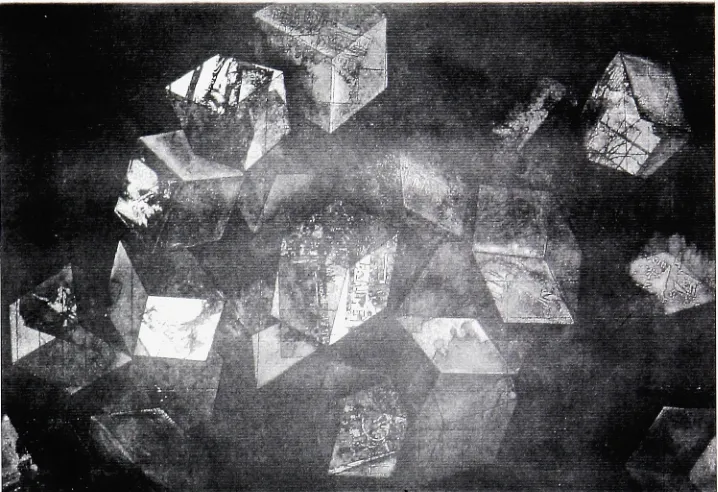
worksare recordedmemories,
such asthe
print"
Last
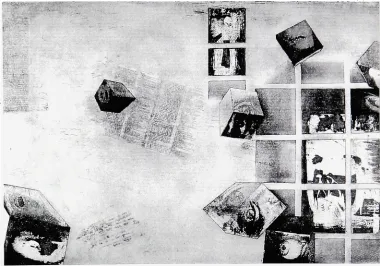
year-Memory l"(Fig.3)
whichis
adiary
ofmy
wholelast
year.The placing
ofthe
memories within cubes wasinspired
by
the
work ofJoseph
Cornell
who put objectsfrom his
childhoodinto
display
boxes. "Fascinated
withflotsam
andjetsam
of ourlives..
.he preservedthese
preciousitems
ascarefully
as
any
curator protectshis
collection."1
In
a similarway
my
work records"precious"
memories.
However,
ratherthan
mounting
real objectscarefully,
I
drew
over modified photographicimages. Like Joseph
Cornell,
I have
kept
boxes
of childhood objectsto
recall pleasant memories.However,
in
my
artmy
memories were precious
for
the
sake ofhonest
assessing
whoI
am and whereI
am
going
as anartist,
morethan
for
nostalgia purposes.To
me.anotherdifference
is
that,
whileCornell's
boxes
are actual woodendisplay
spaces,
my
boxes
are symbolic ofthe
spaces andtime
frames
within whichI have
lived my
life.
Never
the
less,
Cornell's
boxes
may
alsobe
symbolic;
asMcShine
says,
"Perhaps
it
wasCornell's measuring
oftime
by
his
own perceptionthat
allowedhim
to
create aninfinite
number of atmospheres within a small space."2
At first
glance,
my
workmay
look
like it
shouldbe
categorized asCubist
or
Constructivist based
onthe
presence of geometric shapes.Like
mostCubists
or
Constructivists I
see point andline,
or cubes asunderlying
all visible shapes.However,
the
cubesin
my
art"Last
Year-Memory
I"(Fig.
3),"Farewell
101992"1
Kynaston, McShine,
Introducing Mr. Cornell (New York: Themuseum ofModernArt,
1980),
102 Kynaston
McShine,
Introducing Mr. Cornell (New York: ThemuseumofModernArt,
(Fig.
4), "Man;
In
aShade
of Green"(Fig.
5),
"Inner
Space
I"(Fig.
7),
"See
Myself"
(Fig.
8),
"Staring
I"(Fig.
9),
"Sudden
Calamity"(Fig.
10)
are prismsthrough
whichto
seemy life
or spaces within whichtime
moves.I
am notcreating
them
as subjects of geometricstudy;
they
aremerely
containersfor
memory.
Cubists
rendered visiblereality into underlying
geometricform. Then
constructivists
dropped
all concern with objectivereality
in
their
studies of pureform.
Like
suchcontemporary
artists asRobert
Rauschenberg,
I
used geometricspaces as
divisions
for
enacting
a narrative ofjuxtapositions. That is why
the
work can not
be
characterized as cubist(it does
notdissect
visualreality
form
into its underlying
forms)
nor constructivist(it
does
not exclude representationand see
form itself
asthe
whole subject).Understanding
those
definitions,
it is
clear
that the
formal
aspects ofmy
works owe a greatdeal
to
Cubism
andConstructivism;
however,
neitherphilosophy
totally
justifies
my
work andideas.
As Le
Corbusier has
said:"The
'play
offorms
in
light'is here
realizedin
at once
the
mostliteral
and most sensitive of manners.It is only
through
light,
and
the
movement oflight,
that the
forms
cometo
life,
and, through
them,
the
space
also."
3
As
previously
stated,
my
boxes
symbolize spaces andtime
frames.
My
life
time
is
moving
anddisappearing
within geometric shapes whichhave
permanence.The
same canbe
said ofmy
works asRotzler
said ofconstructivism:
"Such
geometric allusions are nodoubt
employedto
symbolizesomething
that
can notbe
directly
depicted,
the
powersthat
be,
for
instance,
or3 RobinKemhall.Who Was Le Corbusier? (Ohio: The World
Publishing Company
conceptions of
time.
"4
Among
contemporary
artists,
the
formal
aspects ofmy
workshave
the
closest resemblanceto
Robert Rauschenberg's
combinationprints and paintings.
Like
Rotzler,
Rauschenberg
is famous
for
his
incorporation
of photographic
images
in
prints.I
add elements ofdrawing
to
photographicimages,
in
the
context of abstractforms. Both
Rauschenberg
andI
areprintmakers who avoid
"The
flatness
oreasy readability
of graphic artthat
characterizes
both
pop
and geometric painting."5
However,
Robert
Rauschenberg
has
said:"I
don't
wantmy personality
to
come outthrough the
piece ....
I
wantmy
paintingsto
be
reflections oflife,
andlife
can'tbe
stopped.
"6
I,
onthe
otherhand,
wantmy
personallife
andpersonality
to
be
shown
in
my
works.I
wantto
isolate, frame,
anddraw
attentionto
capturedmoments.
I
regardCornell's
work asthe
main artistic sourcefor
the
meaning
ofmy
works,
and
Rauschenberg's
artto
be
the
greatestinfluence
onmy
forms.
My
art reflectconcepts
closely resembling
Rauschenberg's,
the
Cubist
ideas
ofrepresenting
essential
forms
which underlinelife,
andConstructivist
conceptspertaining
to
geometric
division
of a picture plane.4 Kynaston
McShine,
Introducing Mr. Cornell (New York: Themuseum ofModernArt,1 980),75Barbara
Rose,
Introduction In Rauschenberg(New York: Vintage Books,1987),5Part
II
DESCRIPTION OF EXPERIMENTATION
Most
ofmy
works arephotoetching
prints.Photoetching,
is
the transfer
offilm
images
to
zincprinting
plates;
it is
a complex process capable of subtleeffects.
For
a recent photoetched printI
decided
on atheme
ofrecording my
experiences of
1992,
andestablishing
a visualdesign
of cubes withphotographic
images
onthe
planes.This
concept wasbased
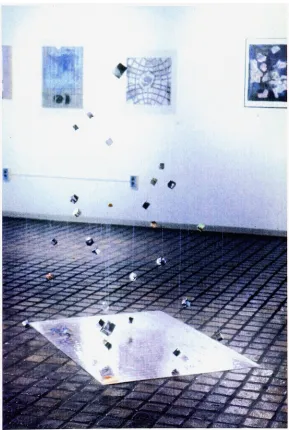
on a previousinstallation,
by
the
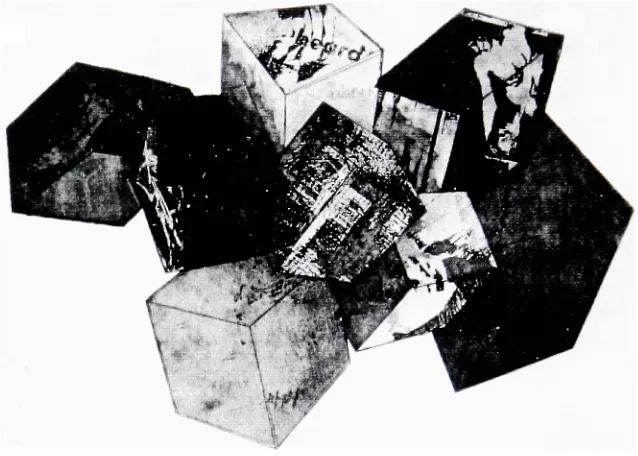
same name of"Last Year-Memory-Installation
"(Fig.
2)
whichinvolved
plexiglass cubes covered with photographs.The
print"Last
Year-memory
I
"(Fig.
3),
like
the
installation,
wasinspired
by
my
desire
to
record agloomy
period ofmy
life,
the
yearof1992.
In
additionto
realizing
the
conceptand
design
ofthe
piece,
I
attemptedto
strengthenmy
skillsinvolving
the
complex process of photoetching.
It
wasnecessary
to
first
maketransparent
photocopies of about
twenty
photographicimages from
my
snapshotcollections.
When I
wantedto
changethe
images,
I
made negativeimages
from
my
snapshots.This
workwasdone
on aMacintosh
Computer
and usedAdobe
Photoshop
software.Then
I
usedK. P. R.
3*
a photo emulsion chemical.
However,
later I
found
a*
K. P. R. 3: Kodark Photo Resist Type 3
new
technique;
I
transferred
photoimages
ontothe
plateby
using Colorless
Blender
makers, in1993 I
was uncomfortablesocializing
withfriends
andacquaintances and was
further
isolated
by
the
boundaries
ofmy
daily
work.My
desire
to
recordthose
memories of alienation andthe
memory
period ofmy
life
became
the
stimulusto
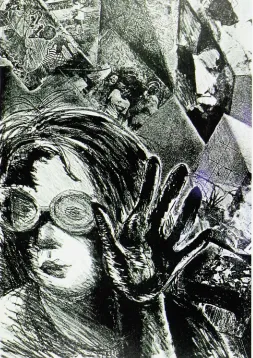
start"Staring
l"(Fig.9). This
piece wasthe
visualdiary
of
my
emotion.I
alsoincluded
scripturefrom
Paslms
21-23,
Old
Testament,
which gave me strength and emotional support.
I
hope
to
overcomemy
isolation
among
people.Unfortunately,
I
still sense a personal separation of myselffrom
popular society.I
oftenfeel
frustrated
andI
attemptto
capturethis
ongoing
despair
visually.Therefore,
cubes, the
form
ofmy
works,
are produced.Time
goes on and on.And
onceit
passesby,
it
willbe
lost in
my
faint
memory.However,
I
always wantto
capturemy
painful memoriesin
some confinedform
sothat
they
willlast
forever "See
Myself"(Fig.
8).
I
encodedmy
sorrowfuldiary
into
the cubes,
asif
word
by
word.Since
the
Renaissance
perspective andshading
have described
mostWestern
art,
withthe
advent ofCubism
much experimentationoccurred,
surfaces and compositions
became
more complex andmany
newdirections
in
technique
and media weredeveloped.
Moreover,
Cubism
usesdifferent kinds
of color and compound surface compositions.
Perspective
andshading
have
characteristics
basic
to
Cubism.
Also,
cubist printmakers used a wide range ofmaterials, the
most significant explanation ofthe
new styleis
reflectedin
the
feverish
activity
that
characterizedthis
revolutionary
movement.7In
orderto
expressthree
dimensions-future,
past and present-through alanguage
of planes-past-present grooves arehollowed
outin
a plexiglass orsandblast on a glass surface.
Ink is
rubbedinto
the
grooves orthe
sheetis
screen printed.
Finally
the
grooves create shadows aslight
shine onthe
printto
expressionthe
future
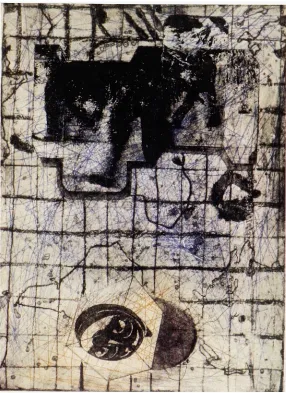
"Memory
USA
I"(Fig.1),
"Farewell
101992"(Fig.
4),
"Hey!
Francis"(Fig.
6).
The
cubes representedthe
packaging
ofmy
life.
Maria
Jolas
says:"The
image
ofthe
house
in
the
solid representationis folded
lengthwise."
8
Often
I
sawmy life
as ahoused
structure.Even though
my
life
appeared secluded and
boxed
in
my
prints, the
workis
both dark
andlight
asthe title
"Memory"implies.
Especially
in
1992,
I
wantedto
escapefrom
society,
and remove myself
from
allthings that
wererestricting
mefrom
conducting
asearch
for
visual expression.Still,
there
were also significant areas oflight.
CONCLUSION
The
conceptbehind my
workis
recognizing
the
opportunity
to
challenge or resist society'sdemands.
Simultaneously,
the
essentiallimitations
ofhuman
abilities are also emphasizedin
my
prints.By
the
juncture
ofthis
opportunity
andthese cubes, the
structure ofmy
works are produced.Having
comparedmy
own worksto that
ofJoseph
Cornell,
Robert
Rauschenberg,
Le
Corbusier,
Cubism
andConstructivism,
I feel
that
I
still ansearching
for
new,
more effective waysto
visually
expressmy
ideas.
I hope
to
expand
my
world and construct new solutionsfor
describing
my
personalexperiences.
I
also planto
incorporate
mixed media and multiple processesinto
my
prints and pushbeyond
traditional
printmaking
techniques.
In
art,
asin life
itself,
today
leads
to
afuture
stepping
stonefor
essential___[__.
:
\m
Figure 1 .
Memory
USA I [image:16.548.133.419.176.569.2]Figure 2. Last
Year-Memory
(Installation)
[image:17.548.129.418.159.589.2]Figure
3.
Last
Year-Memory
[image:18.548.96.455.214.460.2]Figure 4. Farewell 101992
[image:19.548.150.403.200.558.2]Figure 5.
Man;
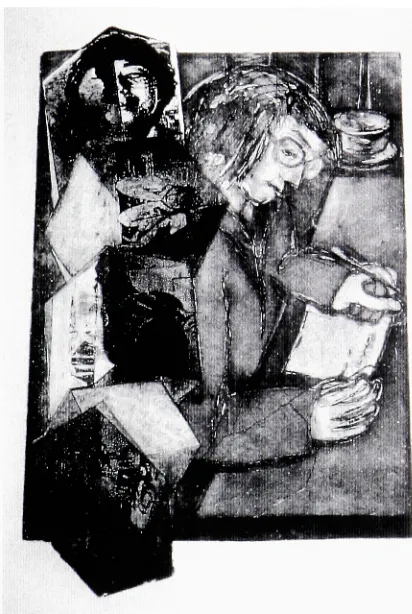
In a Shade of Green [image:20.548.168.374.222.529.2]Figure 6. Hey! Francis
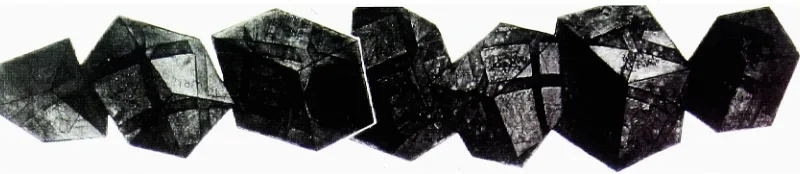
Figure 7.
Inner
Space
w
flWfflBBBSSWW*
[image:23.548.37.511.321.377.2]s3_
Figure 9.
Staring
I
mW
s r
i
[image:25.548.118.437.245.473.2]BIBLIOGRAPHY
Cornell
Joseph,
Joseph
Cornell
Edited
By
Kynaston Mcshine.The
Museum
ofModern
Art,
New
York,
1980.
By
Donna Stein.Cubist
Prints
andCubist
Books.
New York:
Franklin.
Furnace,
1983
By
Kemball Robin.
Who
Was
Le Cobursier?
Ohio: The World
Publishing
Company,
1968.
By
Maria Jolas.The
Poetics
ofSpace.
New York: The Orion
Press,
1964.
Mcshine,
Kynaston. Introducing Mr. Cornell. In Cornell
by
Joseph
Cornell
andKynaston
Mcshine.the
Museum
ofModern
art,
New
York,
1980. 9-13
Rauschenberg
Robert,
Rauschenberg
andRose.
Rauschenberg,
New
York:
Vintage
Books. 1987.
Rose,
Barbara.
Introduction.
In
Rauschenberg by
Robert
Rauschenberg
and
Barbara Rose. New York: Vintage Books 1987.
3-7.
By Willy
Rotzier.Constructivism
andthe
Geometric Tradition. Selections
from
the
McCrory
Corporation Collection
with anessay New York:
McCrory
Corporation,
1979.
Willy
Rotzler.
Aspects
ofConstructive
Art In
Constructivism
andthe
Geometric
tradition.
New
York:
McCrory
Corporation,
1
979.6-1 3