City, University of London Institutional Repository
Citation
:
Huber, P.P. (1996). A study of the fundamentals of actuarial economic models. (Unpublished Doctoral thesis, City University London)This is the accepted version of the paper.
This version of the publication may differ from the final published
version.
Permanent repository link:
http://openaccess.city.ac.uk/7939/Link to published version
:
Copyright and reuse:
City Research Online aims to make research
outputs of City, University of London available to a wider audience.
Copyright and Moral Rights remain with the author(s) and/or copyright
holders. URLs from City Research Online may be freely distributed and
linked to.
A STUDY OF THE FUNDAMENTALS OF
ACTUARIAL ECONOMIC MODELS
by
Paul Philip Huber
A thesis submitted for the degree of Doctor of Philosophy
City University, London
20 20 21 24 24 30 32 35 37 40 40 40 43 45 45 46 49 52
Contents
Page 7 9 10 11 12 13 List of TablesList of Figures
Acknowledgements
Declaration
Abstract
Table of Symbols
1. INTRODUCTION
1.1 Problem Statement 1.2 Overview
2. SETTING THE ECONOMIC ASSUMPTIONS 2.1 Introduction
2.2 Professional Duties of UK Actuaries 2.3 Traditional Actuarial Methods
2.3.1 Description
2.3.2 Actuarial judgement
2.3.3 The strength of actuarial justifications 2.3.4 The use of market information
2.3.5 Economic uncertainty and actuarial techniques 2.3.6 Summary
2.4 Financial Economic Methods
2.4.1 The nature of financial economics 2.4.2 The actuarial response
Appendix 2A: The Derivation of Asset Pricing Models 54
2A. 1 Present value models 54
2A.2 Term structure models 59
2A.3 The capital asset pricing model 61
2A.4 Arbitrage pricing theory 64
3. ECONOMETRIC MODELS 66
3.1 Introduction 66
3.2 Wilkie's Model 67
3.2.1 Introduction 67
3.2.2 Model derivation 69
3.2.3 Description 70
3.2.4 Theoretical properties 75
3.2.5 Statistical properties 80
3.2.6 Extensions to Wilkie's model 85
3.3 Other Models 86
3.3.1 Introduction 86
3.3.2 The Finnish insurance modelling group model 87
3.3.3 Australian models 89
3.3.4 A South African model 92
3.4 Summary 94
Appendix 3A: Statistical Properties of Wilkie's Model 95
3A.1 Distribution of the predicted values 95
3A.2 Averaged price inflation 99
4. THEORETICAL MODELS 100
4.1 Introduction 100
4.2 Dyson and Exley's Model 100
4.2.1 Model derivation 100
4.2.2 Description 102
4.2.3 Statistical properties 104
4.3 The Jump-Equilibrium Model 108
4.3.2 Model derivation 109
4.3.3 Description 112
4.3.4 Statistical properties 114
4.4 Summary 126
Appendix 4A: Statistical Properties of Dyson and Exley' s Model 128
4A. 1 Model derivation 128
4A.2 Averaged total returns 129
Appendix 4B: Statistical Properties of the Jump-Equilibrium Model 132
4B. 1 Expected bond prices 132
4B.2 Total return indices 132
4B.3 Limits of the expected force of price inflation and asset returns 133 4B.4 Variance of the expected force of price inflation and asset returns 135
4B .5 Annual rates of return 136
4B .6 Averaged total returns 138
4B.7 Returns on zero-coupon fixed-interest and index-linked securities 140
5. ECONOMIC METHODOLOGY 142
5.1 Introduction 142
5.2 Philosophical Background 143
5.2.1 Logical positivism 143
5.2.2 Scientific explanation 146
5.2.3 Theory assessment 148
5.2.4 Falsificationism 150
5.2.5 The growth of knowledge 155
5.2.6 Summary 158
5.3 The Scientific Status of Economics 159
5.3.1 The method a priori 159
5.3.2 Falsificationism in economics 163
5.4 Friedman's Instrumentalism 166
5.4.1 The realism of assumptions issue 166
5.4.2 The goals of science 169
5.5 The Limitations of Economic Prediction 170
5.6 The Inexact Deductive Method 173
5.6.1 Theoretical hypotheses arid models 173
5.6.2 The deductive method 175
5.6.3 The separate science of economics 177
5.7 The Importance of Methodology 178
5.8 Implications for Actuarial Economic Modelling 180
6. ASSET PRICING THEORY 185
6.1 Introduction 185
6.2 Tests of the Present Value Model 187
6.2.1 Volatility tests 187
6.2.2 Other anomalies 190
6.3 The Response to the Test Results 192
6.3.1 The CAPM 192
6.3.2 The fundamental valuation equation 194
6.3.3 Structural changes 196
6.3.4 Economic uncertainty and noise 198
6.4 The Justification of Asset Pricing Theories 200
6.5 Summary 203
7. ECONOMETRIC METHODOLOGY 204
7.1 Introduction 204
7.2 Theory-Directed Econometrics 205
7.2.1 The textbook approach 205
7.2.2 The limitations of econometrics 207
7.2.3 Falsificationist econometrics 212
7.3 Vector Autoregressions 215
7.3.1 Unrestricted models 215
7.3.2 Bayesian methods 218
7.4 General-to-Specific Modelling 220
7.5 Actuarial Economic Model Evaluation Criteria 226
8. A REVIEW OF WILKJE'S MODEL 231
8.1 Introduction 231
8.2 Inflation Models 232
8.2.1 Price inflation 232
8.2.2 Wage inflation 235
8.2.3 The VAR inflation model 235
8.3 Equity Models 237
8.3.1 Share dividend yields 237
8.3.2 Share dividend growth 238
8.4 Interest Rate Models 240
8.4.1 Long-term interest rates 240
8.4.2 Short-term interest rates 242
8.4.3 Index-linked interest rates 242
8.5 Property Models 243
8.5.1 Property income yields 243
8.5.2 Property income growth 243
8.6 Summaiy 244
Appendix 8A: The Data 246
8A. 1 Inflation data 246
8A.2 Equity data 248
8A.3 Interest rate data 250
8A.4 Property data 253
9. CONCLUSION 254
9.1 Actuarial Economic Models 254
9.2 The Appraisal of Economic Models 257
9.3 Conclusions and Areas for Future Research 261
References 264
6
Page 71 72 74 83 83 84 84 88 91 92 93
List of Tables
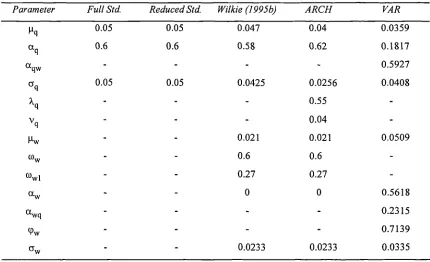
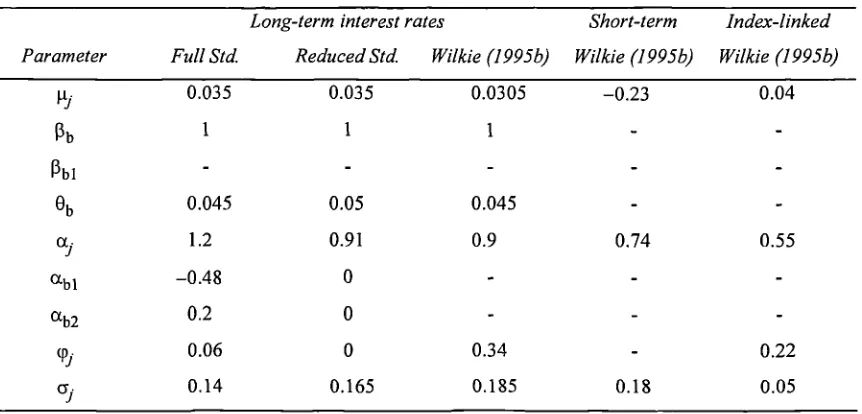
3.2.1 Parameter values for Wilkie's inflation models
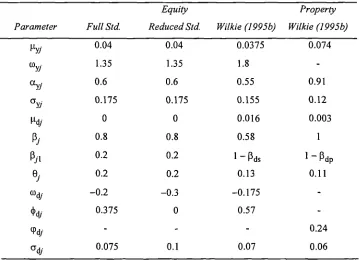
3.2.2 Parameter values for Wilkie's equity and property models 3.2.3 Parameter values for Wilkie's interest rate models
3.2.4 Means and standard deviations of nominal averaged total returns
3.2.5 Correlations between nominal averaged total returns
3.2.6 Means and standard deviations of real averaged total returns 3.2.7 Correlations between real averaged total returns
3.3.1 Parameter values for the Finnish insurance modelling group model 3.3.2 Parameter values for Harris' (1995b) ERCH model
3.3.3 Parameter values for Harris' (1995b) ERCH model 3.3.4 Parameter values for Thomson's (1994) model
4.2.1 Parameter values for Dyson and Exley's model 104
4.2.2 Standard deviations of predicted total nominal return 105 4.2.3 Means and standard deviations of nominal averaged total returns 106
4.2.4 Correlations between nominal averaged total returns 106
4.2.5 Means and standard deviations of real averaged total returns 107
4.2.6 Correlations between real averaged total returns 107
4.3.1 Parameter values for the jump-equilibrium model 113
4.3.2 Distribution of the annual rate of price inflation in year t 116 4.3.3 Distribution of the annual nominal rate of return in year t 120 4.3.4 Distribution of the nominal rate of return on equities over the first interval 121 4.3.5 Means and standard deviations of nominal averaged total returns 123
4.3.6 Correlations between nominal averaged total returns 123
4.3.7 Means and standard deviations of real averaged total returns 124
4.3.8 Correlations between real averaged total returns 124
8.2.1 Estimated parameters for the original price inflation model 234
8.2.2 Estimated parameters for the VAR inflation model 236
8.3.1 Estimated parameters for the dividend model 239
8.4.1 Estimated parameters for the long-term interest rate model 241 8.5.1 Estimated parameters for the property income model 243
List of Figures
2.3.1 The dividend yield on the FTSE-Actuaries All-Share Index, 1962-95 2.3.2 Real equity dividends, 1919-95
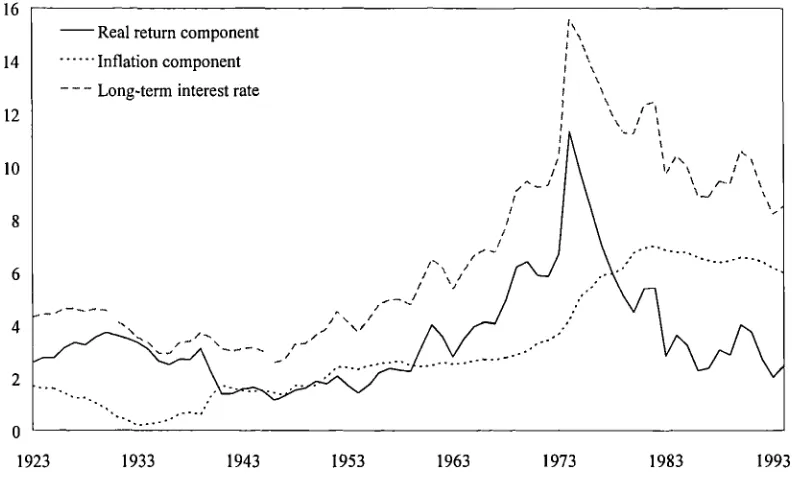
3.2.1 Expected price inflation and real returns, 1923-1994 3.2.2 Expected price inflation, 1923-2003
4.3.1 Expected annual rate and force of price inflation in year t
Page 26 28
75 76
115
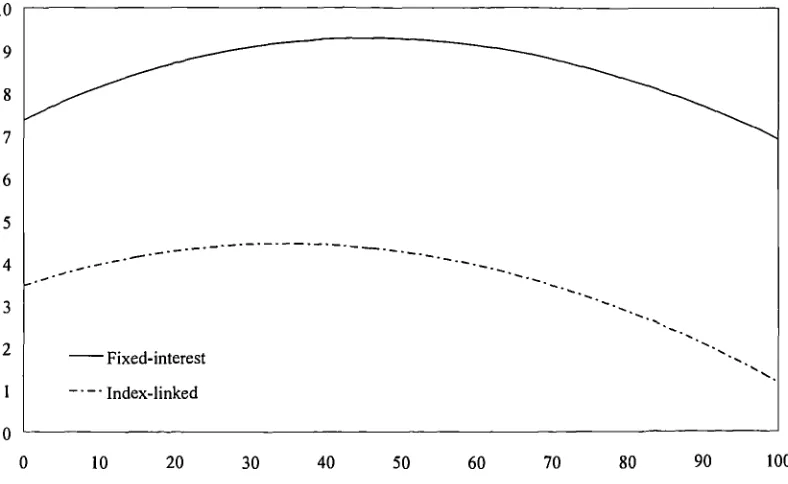
4.3.2 'Neutral' initial zero-coupon yield curves, 'r) and q(O t) 117
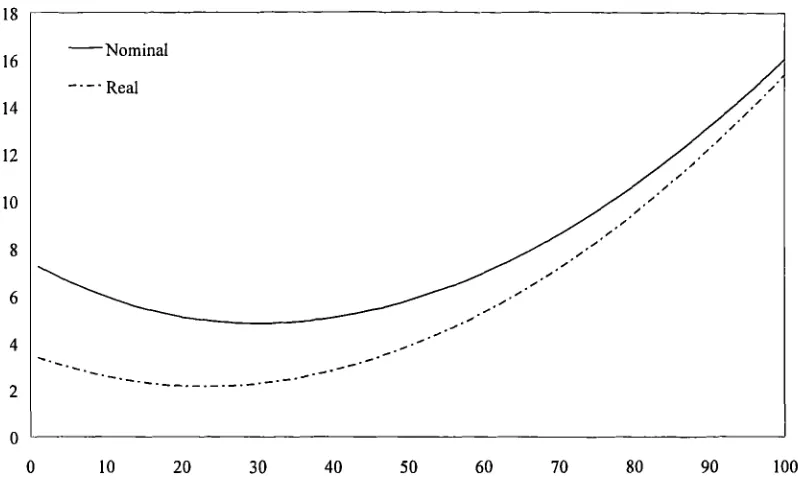
4.3.3 Expected force of return on short-term fixed-interest securities in year t 118
8.2.1 Recursive estimates Of.1 q with approx. 95% confidence intervals, from 1923 232
8.2.2 Recursive estimates of aq with approx. 95% confidence intervals, from 1923 233
8.3.1 (1 —ays L) ,.y(t)—loge Lys ) plotted against (1 —aysL)rq(t) 238
8A.l The force of price inflation, 1923-94 246
8A.2 The force of wage inflation, 1923-94 247
8A.3 The logarithm of the equity dividend yield, 1923-94 249
8A.4 The force of equity dividend growth, 1923-94 249
8A.5 The logarithm of the long-term interest rate, 1923-94 251 8A.6 The logarithm of the short-term interest rate, 1923-94 252 8A.7 The logarithm of the index-linked interest rate, 1982-94 252
8A.8 The logarithm of the property yield, 1967-94 253
Acknowledgements
Chapter 8 draws on "A review of Wilkie' s stochastic investment model" (Huber 1995a,b). Section 4.3 is drawn from "A note on the jump-equilibrium model" (Huber 1996). These papers have been revised and submitted to the British Actuarial Journal.
I am indebted to my supervisors Professor Steven Haberman and Dr Richard Verrall for their support during these past three years and for their helpful comments on earlier drafts of this thesis. Mr Philip Booth was also closely involved with this thesis and I am grateful to him for many useful discussions.
Thanks are due to the many others who have contributed to this research in some way, including: my colleagues Mike Boskov, Peter Hatzopoulos, and Alen Ong; Professor David Wilkie who offered valuable comments and supplied the data used in Chapter 8; Andrew Smith who made insightful comments on Chapter 4; and Dr Russell Gerrard who provided the ideas behind the proof in Appendix 4B.l.
I am very grateful to Meghan for her tireless encouragement, inspiration, and patience. My extended family, especially my Mother, also provided much support and encouragement, for which I am grateful.
I wish to acknowledge the Department of Actuarial Science and Statistics at City University for funding this research.
10
Declaration
Abstract
This thesis examines the methods that have been used by actuaries to describe and model the economic variables required for actuarial calculations. Traditionally actuaries have only used average future values to describe these variables and they have tended to use relatively informal methods for determining these averages. These informal methods are potentially subject to numerous biases. The likelihood of these biases occurring could be reduced by using the more formal methods of financial economics and stochastic modelling. Stochastic models also provide additional information that is essential for some applications.
The main UK stochastic asset models that are considered include: Wilkie's (1995b) model, Dyson and Exley's (1995) expectations model, and Smith's (1996) jump-equilibrium model. Wilkie's model was developed primarily from data considerations, whilst the other two models were developed from theoretical considerations. Wilkie's model is shown to be inconsistent with the rational expectations hypothesis, the efficient market hypothesis, and aspects of portfolio theory. Dyson and Exley's model is shown to be inconsistent with portfolio theory. The jump-equilibrium model is consistent with most financial theories, but it is shown to produce returns with moments that are inconsistent with historical data.
The importance of these limitations is then examined from a methodological perspective. This review emphasises the importance and difficulty of empirical testing. It also suggests that economic predictive success is always likely to be limited. As a result, it is argued that a model's pragmatic qualities are relatively more important than they would otherwise be, that a theoretical framework is invaluable for motivating economic models and for directing research activities, and that actuaries should aim to develop models with shorter time horizons. The empirical adequacy of financial economic theories is then examined and many persistent problems are reported. Despite these problems it is suggested that financial economics provides a useful theoretical framework. Lastly, the empirical adequacy of Wilkie's model is considered using the criteria of Hendry's (1995) general-to-specific approach. This review identifies some apparent weaknesses. In particular, the out-of-sample residuals from Wilkie's (1986a) model do not seem to be independent.
General
S SAP CAPM CCAPM ICAPM APT ARCH VAR BVAR
Table of Symbols
statement of standard accounting practice capital asset pricing model
consumption based capital asset pricing model intertemporal capital asset pricing model arbitrage pricing theory
autoregressive conditional heteroskedastic vector autoregressive
Bayesian vector autoregressive
Asset classes
s stocks, shares, or equity securities
p property
bn n-year fixed-interest securities, n E [0 , cc)
b general bonds or long-term fixed-interest securities m money market or short-term fixed-interest securities
rn n-year index-linked fixed-interest securities, n E [0 , cc) r long-term index-linked fixed-interest securities
q retail or consumer prices
w wages or earrnngs
x sterling
xj exchange rate between pound sterling and currencyj
g gross domestic product
f risk-free asset
market portfolio of assets
Asset variables
R1(t) total return index for assetj at time t
p,(t) - R,(t)/R(t-1)_1
v 1 (t) l/(1+p(z'))
P(t)
p1(t) - A1og F,(t)
L(t)
d1 (t) = AlogD(t)
D,(t)/1.(t)
y,(t) = log e 1(t)
RX(t)
o(t,t)
B(t,t)
rate of return for assetj in year t
discount factor for assetj in year t
price index for assetj at time t
force of price growth for assetj in year t
cash flow for assetj in year t
force of cash flow growth for assetj in year t
yield (running yield) on assetj at time t
logarithm of the yield on assetj at time t
notional currency capital value for assetj at time t
notional currency total return index for assetj at time t
par redemption yield on a t-year assetj security at time t
spot force of interest on a t-year assetj security at time t
price of a T-year assetj zero-coupon bond at time t
Notes.
1 The convention that variables with time subscripts t are always known at time t has been used throughout. Therefore, D(t) is used to denote dividends received in year t
rather than D(t—l), which was used by Campbell and Shiller (1987, 1988). 2 Dividends are assumed to be paid at the end of each interval.
3 For all variables, the subscriptj is only used in formulae that refer to a specific asset and the subscript t is only used for variables that are assumed to vary over time. 4 Retail prices and currency exchange rates are assumed to be assets with no cash
flows. Rq (t) represents the retail price index at time t. R 1(t) represents the pound sterling versus currencyj exchange rate at time t.
Company variables (Section 2.3.3)
b debt to equity ratio
g company growth rate
Q(t) equity capital employed at time t
Utility theory variables
u,(.) von Neumann-Morgenstern utility function at time t
14
C(t) real aggregate consumption at time t W(t) real aggregate wealth at time t
(t) risk premium over assetj at time t
k covariance between security] and k divided by the variance of security k
kth factor of a K factor model
Other, statistical variables
AR(p) autoregressive model of order p
MA(q) moving average model of order q
ARIMA(p , d, q) autoregressive integrated moving average model of order p, d, and q VAR(p) vector autoregressive model of order p
-Lx cY yx E(t) z3(t) r11(t) N(ji,c2) ['(a , G() L A P(xl x2) D[] E,[] H(t) cov(xl, x2) h'(x) exp[J
mean of a random variable x
variance of a random variable x
skewness of a random variable x
general error term at time t
standard normal random variable at time t
shifted gamma random variable at time t
normal distribution with mean j.x and standard deviation c
gamma distribution with parameters a and ? compound Poisson process
lag operator: Lx(t) = x(t - 1)
first difference operator: Ax(t) = x(t) - x(t - 1) probability ofxl given x2
joint density function of X
expectations operator conditional on all information at time t
history, information available at time t
covariance between the random variables xl and x2
derivative of a function h at x absolute value
Chapter 1
INTRODUCTION
1.1 Problem Statement
The core domain of actuarial responsibility is related to the provision and management of contracts of life assurance, pensions and annuities, health insurance, and general insurance. These contracts are characterised by the advance payment of a premium, or a series of premiums, in return for payments that are contingent on pre-specified but unpredictable future events. For example, the basic contingent event in life assurance contracts is the death of the life assured. As the premiums for these contracts are paid in advance, and often well in advance, of the benefits received, they require the policyholder to place substantial trust in the organisation offering the contracts. The gravity of this requirement is usually intensified by the financial vulnerability of the policy beneficiary when a contingent event occurs. Consequently, there is considerable public interest in the financial soundness of these organisations. This interest is represented in the numerous Acts of Parliament of Great Britain, which have been designed to protect the policyholders (see Institute of Actuaries 1996: C4). These Acts have entrusted much of this responsibility to the actuarial profession and the actuarial profession binds its members to provide: "the best possible service and advice" (Institute of Actuaries 1996: A 1.1).
Actuaries usually prepare this service and advice with the aid of mathematical models. These models generally represent simplified descriptions of the relevant future environment and they are used to estimate, amongst other things, the funds currently required to provide for the contingent payments of insurance contracts. Important elements of the actuarial environment are economic variables such as interest rates and inflation rates. This thesis critically reviews the methods that have been used by UK actuaries to describe and model these variables in relation to the obligations and objectives of the actuarial profession. The other relevant elements of the future environment, such as mortality and morbidity rates, are not considered.
16
Actuaries have traditionally used average future values, or deterministic assumptions, to describe the relevant economic variables. These assumptions tend to be based on relatively informal justifications and they do not provide any information on the likelihood of particular events occurring. As a result of these limitations, actuaries have developed stochastic models. These models provide more complete descriptions of the behaviour of the relevant variables. Stochastic models are also generally supported by formal statistical and theoretical justifications. They are seen by many actuaries as becoming an important new actuarial technique. A recent study on the future of the actuarial profession recommended that it should: "Increase emphasis on stochastic and other methods over deterministic approaches" (Nowell et a!. 1995: 5). This study also identified stochastic modelling as a particular skill that is likely to be required by all actuaries. However, Thomson et a!. (1995) reported that stochastic techniques were only seldom used by life offices: less than 10% of life offices surveyed were actively using stochastic methods and half were not using any stochastic methods. Hence, Nowell et a!. (1995: 15) reported that a concern was: "The low levels of involvement of actuaries in probabilistic techniques and realistic evaluation."
An important reason why actuaries have been reluctant to embrace stochastic methods is the lack of a clearly adequate stochastic model. The economy is an extremely complex system that has proved difficult to model. Economic predictions and econometric models have tended to be unreliable, especially over the long time horizons of some insurance contracts. Until an adequate stochastic model is discovered, relatively little confidence can be placed in the results of stochastic investigations. This thesis examines how actuarial stochastic models could be justified and whether the available models are sufficiently adequate. Furthermore, it considers how economists have succeeded in studying the economy and the limitations of economics. This examination offers some insight into how future actuarial economic models could be developed and justified.
1.2 Overview
then reviewed. These methods tend to be relatively informal and attempt to incorporate a variety of information. The alternative, more formal, approaches of selecting the economic assumptions suggested by financial economics and stochastic methods are then briefly described and discussed. These approaches appear to offer methods for improving traditional actuarial techniques, but their worth is not proven. The remainder of this thesis attempts to examine whether financial economic and stochastic methods can significantly enhance actuarial investigations.
The available stochastic models have tended to be developed primarily from either the probabilistic structure of the historical data or from theoretical considerations. Chapter 3 describes the main data based comprehensive stochastic asset models, especially Wilkie's (1986a, 1995b) model. Wilkie's model is examined in detail as it has been the most influential UK stochastic asset model. The theoretical and statistical properties of Wilkie's model are discussed.
Chapter 4 describes the main theoretical stochastic asset models, including Dyson and Exley's (1995) expectations model and Smith's (1996) jump-equilibrium model. The theoretical and statistical properties of these models are compared with those of Wilkie's model.
All the models surveyed in Chapters 3 and 4 are inadequate in some respect and none has acquired universal support. Chapter 5 attempts to lay the groundwork that is required for assessing these models. It initially reviews some of the relevant issues from the philosophy of science. This literature examines past scientific achievements and it considers, amongst other things, how scientific investigations should be conducted and appraised. The more specific philosophical issues from economic methodology are then considered. This literature emphasises the limitations of knowledge, the importance and difficulty of empirical testing, and the role of a theoretical framework. It also stresses the particular difficulties associated with economic investigations. Hausman's (1992) interpretation of economic methodology is then used to justify the theoretical approach to developing actuarial stochastic models.
18
Chapter 6 discusses some of the inadequacies of financial economic theories. Actuaries' concerns about the relevance of these theories seem to be justified because of a number of persistent problems. However, financial economics appears to provide a promising framework for understanding economic phenomena and traditional actuarial techniques do not provide a demonstrably better approach. The difficulties associated with economic modelling are used to support the approach used by, amongst others, Haberman (1994) of initially considering simple tractable stochastic economic models.
Chapter 7 considers econometric methodology and emphasises the particular problems associated with developing econometric models. It examines the theory-directed approach advocated by Darnell and Evans (1990), the vector autoregressive approach recommended by Sims (1980), and the general-to-specific approach developed by, amongst others, Hendry (1995). The general-to-specific approach is recommended as the most promising econometric methodology and it is used to broadly evaluate the main actuarial models that are described in Chapters 3 and 4.
Chapter 8 provides a detailed empirical review of Wilkie's model using the criteria of the general-to-specific approach. Although this model appears to be broadly satisfactory, some potential problems are revealed. In particular the model does not appear to have had constant parameters historically.
Chapter 9 concludes by summarising the main arguments and by suggesting promising areas for future research.
Chapter 2
SETTING THE ECONOMIC ASSUMPTIONS
2.1 Introduction
Economic assumptions, such as the future interest and inflation rates, constitute a significant part of most actuarial bases. For example, if a retirement fund actuary consistently uses an interest rate assumption that is only 1% less than the actual rate, then this is likely to result in surpluses of the order of 60% of payroll (Thornton and Wilson 1992: 259). In addition, when using the discounted cash flow method to value assets, a change of 1% in the real dividend growth assumption changes the assessed values of the assets by between 20% and 25% (Dyson and Exley 1995: 485). However, these variables are exceptionally difficult to forecast because they are influenced by a wide range of factors in complicated ways. Furthermore, there is no single generally accepted 'best' method for setting these long term economic assumptions. Consequently: "There can be no uniquely correct assumptions in most cases" (Institute of Actuaries 1996: B 17.7). This chapter considers how actuaries have responded to the problems associated with economic forecasting. The methods used by actuaries to motivate their economic assumptions are discussed and compared with the methods used in financial economics.
As a result of the uncertainty associated with long term economic forecasts, the nature of actuarial economic assumptions depends on the context in which they are required. The profitability of contracts with fixed conditions, such as general insurance or non-profit life assurance contracts, depends solely on whether the actuarial basis used to calculate the premiums is 'better' or 'worse' than the actual outcome. As a result, a cautious approach is usually adopted in setting these bases; competitive pressures permitting. Relatively cautious or prudent assumptions are also usually required to
determine the statutory solvency reserves required by insurance companies or retirement funds.
20
More realistic, or best estimate, assumptions can generally be used for contracts with relatively flexible conditions, such as defined benefit retirement funds or with-profit life insurance contracts. This is because the actuary is able to adjust the benefits or future contributions of these contracts if the assumptions prove to be inaccurate. The justification for using best estimates or realistic bases in retirement fund valuations is provided by Thornton and Wilson (1992). Thornton and Wilson also attempt to quantify
the terms 'best estimate', 'prudent', and 'cautious'. They suggest that these terms should refer to bases that are expected to result in more favourable long term outcomes 50%, 60%, and 70% of the time, respectively. The actuarial assumptions stated in this chapter are usually best estimates; although more prudent or cautious assumptions may be used in practice. Mehta (1992) and Smith (1996) discuss techniques for adjusting these best estimates to allow for risk. These adjustments are beyond the scope of this chapter, which only considers methods for establishing best estimates.
Section 2.2 outlines the professional duties of UK actuaries relating to the setting of the economic assumptions. Section 2.3 examines the traditional actuarial techniques for determining these assumptions. The methods used by actuaries to allow for economic uncertainty are considered and the use of actuarial judgement is discussed. The
traditional actuarial approach is then compared with the methods used in financial economics. Section 2.4 briefly describes the principal asset pricing models developed in financial economics and considers how actuaries have responded to these models. Section 2.5 discusses stochastic methods of setting the economic assumptions. Section 2.6 summarises the main arguments.
2.2 Professional Duties of UK Actuaries
The Appointed Actuary must decide the rates of interest to be used in the valuation of the liabilities. These
are affected by the Appointed Actuary's estimates of the likely future proceeds of the existing assets and
the rate at which future proceeds of the existing assets and of the rate at which future investment will be
possible. ... Judgement on these factors rests with the Appointed Actuary who must decide the basis of the
valuation of the liabilities. (Institute of Actuaries 1996: B 1.9)
The Appointed Actuary must be satisfied that, in each of the assumptions, the margins in any published
valuation of the liabilities, including any margins required by statute, are adequate having regard to the
Appointed Actuary's own assessment of the risks inherent in the nature and conduct of the company's
business. (Institute of Actuaries 1996: B1.1 1)
Similar principles apply in the context of retirement benefit schemes. However, for SSAP 24 purposes the actuary is instructed to consult the client:
In signing the certificate, the actuary certifies that in his opinion the resources of the scheme are likely in the normal course of events to be sufficient (Institute of Actuaries 1996: B3.2)
The selection of actuarial assumptions to be used in assessing pension cost for SSAP 24 purposes is a
matter ofjudgement for the actuary in consultation with the client. (Institute of Actuaries 1996: B 17.6)
Individual responsibility for the assumptions also extends to actuaries instructed as expert witness's to the courts or other tribunals:
The actuary is normally responsible for ... the actuarial assumptions ... that are used in an actuarial
analysis given in evidence. (Institute of Actuaries 1996: B24.5)
Thus, the actuarial profession has generally given actuaries the freedom to choose their own assumptions. This decision appears to have been motivated by the belief that any set basis could unduly prejudice particular results and would be arbitrary because there is no single infallible method for establishing these assumptions. Nevertheless, the profession has attempted to bound this freedom by a number of loose directives and recommendations. For example, Appointed Actuaries of insurance companies are required to "use prudent bases determined according to actuarial principles" (Institute of Actuaries 1996: B8.3). For retirement fund SSAP 24 purposes: "The financial and demographic assumptions should meet the requirement of providing a best estimate" (Institute of Actuaries 1996: B 17.7).
Moreover, because all assumptions are fallible, actuaries are required to conduct sensitivity analyses to ensure that the financial security of the funds under investigation are sufficiently robust. Consequently, actuaries of retirement benefit schemes are required to express an opinion about whether the scheme's resources are likely to be adequate 'in the normal course of events', which is qualified as:
a prudent view of the future without taking into account every conceivable unfavourable development.
The actuary should regard this as excluding the possibilities of events—including those external to the
scheme—which he cannot reasonably be expected to have allowed for in a conservative approach to the
matter. (Institute of Actuaries 1996: B9.6)
Appointed Actuaries are also advised to "consider the resilience of the valuation to changes in circumstances, with special reference to more extreme changes to which the office may be vulnerable, and provide appropriate margins in the valuation basis" (Institute of Actuaries 1996: B8.4). In particular, Appointed Actuaries are required to make prudent provision against the consequences of possible fluctuations in the value of the assets. This requirement is characteristically imprecise because in determining the range of possible fluctuations: "the actuary must use professional judgement as an experienced financial practitioner" (Institute of Actuaries 1996: B 8.8).
The freedom to select actuarial bases is more strongly limited by the profession in certain cases, such as when actuaries of retirement benefit schemes calculate transfer values, but even in this situation there is still scope for individual actuarial judgement:
Such actuarial value should be assessed having regard to market rates of interest. One of the ways in
which a market value assessment may be made is on the basis of market redemption yields on British
Government Stocks of appropriate duration and type at the time of transfer with allowance for investment
of future interest receipts at such rates as the actuary considers reasonable. In valuing benefits which are
subject to revaluation in accordance with the general index of retail prices, yields on index-linked guts
will be an appropriate criterion. (Institute of Actuaries 1996: Bi 1.2)
This freedom has also been limited by various statutory requirements, including the minimum criteria for setting valuation bases in the Insurance Company Regulations
for calculating the minimum funding requirement for retirement funds (see Jnstitute of Actuaries 1996: B27).
Therefore, within limits, actuaries are generally given the discretion to choose their own particular forecasts of the economic variables required in actuarial calculations. They are required to test the sensitivity of their results to these assumptions and to be prudent. Moreover, setting the economic basis is generally regarded as a matter of mature and experienced judgement, which cannot be easily or quickly acquired. Hence, a large number of relatively ill-defined methods for setting economic assumptions exist and there is much scope for disagreement. Nevertheless, the following section attempts broadly to characterise and examine the methods that are traditionally used by actuaries to set the economic assumptions. This description is inevitably a stereotype, but it attempts to relate the essence of the so-called traditional actuarial approach.
2.3 Traditional Actuarial Methods
2.3.1 Description
Traditionally actuaries have only used expected values to depict the relevant economic variables. Furthermore, they have normally taken advantage of their freedom to base these forecasts on subjective factors referred to as actuarial judgement. Thus, economic variables have conventionally been assumed to be constant over time and have been essentially subjectively determined. These traditional methods of setting the economic assumptions have been described by, amongst others, Lee (1986) and discussed more recently by Thornton and Wilson (1992), Mehta (1992), Jones (1993), Wilkie (1995a), and Dyson and Exley (1995). This section attempts to broadly characterise these methods.
The minimum economic information that is typically required in actuarial calculations includes the expected long term future annual average rate of price inflation and of return on the investments of the fund. To determine the expected return on the fund and to value the assets of the fund, actuaries additionally require the expected long term
future annual average: equity dividend yield, equity dividend growth rate, and interest rate on long-term fixed-interest securities.
These basic variables are first transformed to reflect quantities that are believed to be of the greatest importance and the most stable over time. Real rates of return are commonly used and price inflation is generally left untransformed. Transformations to real returns are justified by the belief that the preservation of spending power is the fundamental motivation for long term savings and that the required real returns are reasonably stable over time. For defined benefit retirement schemes, real rates are more important than nominal rates because the liabilities are generally linked to inflation. Before retirement, benefits are linked to salary inflation and after retirement, benefits are often linked to price inflation, possibly with an upper limit.
Mehta (1992) transformed the asset returns into risk premiums over Treasury Bill yields and considered the real return on Treasury Bills and price inflation separately. Risk premiums were motivated by the belief, obtained from financial economics (see Section 2.4), that: "investors compare equity risk and return with the risks and returns of alternative investment opportunities" (Mehta 1992: 393). Jones (1993) considered the equity risk premium relative to long-term fixed-interest securities. Wilkie (1 995a: 272) analysed the yield gap between the equity dividend yield and the real redemption yield on index-linked securities because: "It is reasonable to argue that index-linked government stocks have taken the place that used to be held by conventional gilt-edged stocks in the non-inflationary era."
12
10
8
6
4
2
0
30/4/62 28/4/67 28/4/72 29/4/77 30/4/82 30/4/87 30/4/92
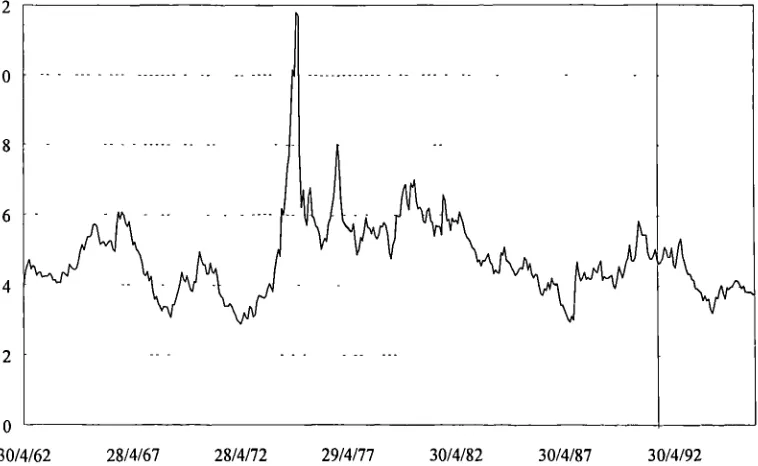
An illustration of the above actuarial approach is provided by Thornton and Wilson (1992: 237), who describe their method for setting the long term assumption for the future yield on equity investments. Note that they appear to believe that structural changes occurred in the mid 1960s, mid 1970s, and early 1980s and, as a result, assume that the average yield will be slightly lower in the future than it has been in the past. Their argument for a future yield of 4.75% is as follows:
From the graph [see Figure 2.3.1, up to mid 1991] it will be seen that the yield on the All-Share Index
rarely strays beyond the range 4-6%, and when it does stray it does not do so for long. The average yield
over the 29 years is just under 5%, and there is little evidence of a trend in either direction away from this
figure. Rather, there is evidence of a random step function, with discrete changes in the mid 1960s, mid
1970s and early 1980s. It is perhaps too early to say whether there has been a step upwards to 5%, or
whether the market will revert to the lower yield found in the latter half of the 1 980s. In consequence, it is
possible to suggest that for the future average yields might lie anywhere in the region of 4¼-5%, and our
preference is to assume 4%%.
[image:27.595.101.480.514.747.2]These historical averages, or 'objective', estimates are not blindly used because it is assumed that economic, political, technological, and social changes imply that the past is not necessarily an adequate description of the future. For example, Wilkie (1995a) attempted to demonstrate how historical averages of the equity risk premium can provide a misleading guide to the future. Hence, the averages are subjectively adjusted after comparing them with other relevant information, including consensus forecasts,
Figure 2.3.1 The dividend yield on the FTSE-Actuaries All-Share Index, 1962-95
26
implied market forecasts, historical levels of dividend cover, and GDP growth rates. Implied market forecasts tend to be influential, but they are not generally considered to be decisive (see Section 2.3.4). Moreover, the market does not unambiguously provide all the necessary information, such as future salary inflation or long term future equity dividend growth rates and yields. Nevertheless, available market forecasts include: the term structure of interest rates, and the yield gap between conventional fixed-interest and index-linked securities, which: "can be taken as representing 'the market's' view of future inflation, or the implied inflation forecast" (Wilkie 1995a: 272).
In certain circumstances, the prevailing market conditions are taken into account by adjusting the long term average assumptions over a limited future interval. This approach is adopted when the assets of the fund are valued using market values. To ensure consistency with this asset valuation method, the rates of return used to value the liabilities are then obtained from current market information. "Although more complicated, it introduces the discipline of requiring the actuary to reconcile his valuation assumptions with the returns implied by the market prices at each valuation" (Thornton and Wilson 1992: 273). As noted in Section 2.2, this approach is recommended when calculating transfer values for retirement funds.
Forecasts of GDP growth are frequently used to rationalise dividend growth rate assumptions. For instance, Thornton and Wilson (1992) assumed that dividends, allowing for rights issues and new issues, will increase in the long term in line with GDP growth. It was recognised that this hypothesis is only partially valid because a large proportion of company earnings is derived from overseas operations. Still, this hypothesis is roughly supported by historical data, which shows that company profits have been a fairly stable proportion of GDP (Dyson and Exley 1995: 486). Thornton and Wilson predicted a long term real GDP growth rate of 2.5% per annum and assumed that rights and new issues will account for between 1% and 2% of this growth; resulting in a prediction for real dividend growth of between 0.5% and 1.5%. Mehta (1992: 428)
Further examples of the use of general economic information are provided by Jones
(1993: 275) who argued that: "Given the high levels of debt in the economy and the low levels of dividend cover, it seems unlikely that [real dividend growth] is going to be much greater than [zero] for some while." Consequently, he suggested that the equity risk premium will be lower in future than it has been over the previous 70 years. In estimating the future real rate of dividend growth, Wilkie (1995a: 288) rationalised his
recommended range of between —1% and 2% and a point estimate of 1% as follows:
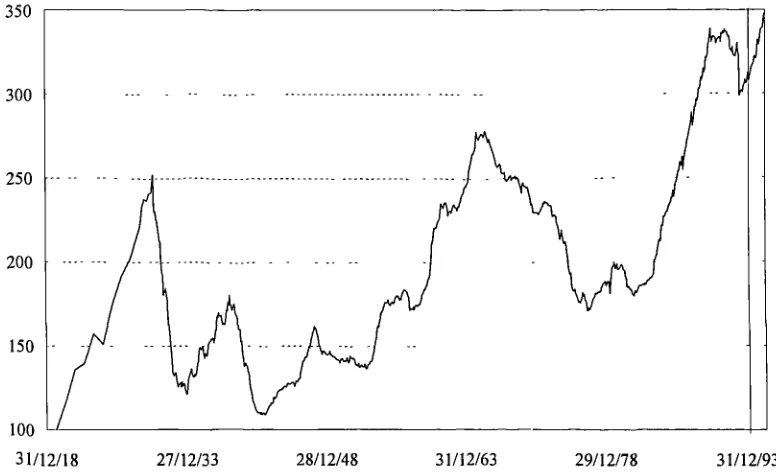
One could argue for the continuation of the 1% real growth that has occurred since 1923; or that we are
just over the peak of a long upswing in real dividends [see Figure 2.3.2, up to 1994] and that the next
swing will be downwards, in which case a real dividend growth of—l% would be possible; or one could
take an intermediate position and go for 0%. One might, instead, take into account a possible economic
recovery, and take a more optimistic view of inflation, which could allow companies to keep a high rate of
real dividend growth, say 2%; but these might both be only medium-term features.
Factors that are even more subjective are also taken into account; for example, when determining a central range for real salary inflation Lee (1986: 262) observed that 2.5% per annum "would probably be thought optimistic in the current climate of opinion." Jones (1993: 254) suggested that the then current low rate of inflation has "an air of permanence about it." Another illustration of the use of subjective factors is provided by Ross in the discussion of Thornton and Wilson (1992: 296). After discussing a number
350
300
250
200
150
100
[image:29.595.93.481.495.731.2]31/12/18 27/12/33 28/12/48 31/12/63 29/12/78 31/12/93
Figure 2.3.2 Real equity dividends, 19 19-95
28
of economic issues such as the ageing population and European integration, he stated that: "I sense that we may be embarking on an era of economic change on a scale which has not been seen for many years." He did not indicate how much this judgement would influence his assumed basis.
Whatever method is adopted, the actuary makes a central forecast of the transformed variables taking all the relevant information into account and usually quotes a confidence interval around these values. These central forecasts are then transformed back into the basic variables required for the actuarial calculations. Allowances are made for dealing expenses and the specific asset mix of the fund.
The difficulties involved in forecasting future economic variables are generally accepted. Lee (1986: 258) admitted that the assumptions "represent no more than the actuary's judgement of what constitutes a reasonable basis." Thornton and Wilson (1992: 287) stated that: "there is nothing immutable about these assumptions." An illustration of the indeterminacy of the economic assumptions is provided by comparing the recommendations of recent authors. Although Thornton and Wilson (1992) and Wilkie (1 995a) suggested similar ranges for long term average real dividend growth of
0.5% to 2% and —1% to 2% respectively, Lee (1986) recommended between —3% and 0%. Moreover, Wilkie's point estimate for real dividend growth of 1% was 3% higher
than Lee's estimate of —2%. These assumptions contrast with the 'cautious projection' made by Pratten (1993: 190), an economist, of a real dividend growth rate of 2.5% over
2.3.2 Actuarialjudgement
The previous section illustrates that actuarial judgement and subjective factors are extensively used in setting the economic assumptions. But ideally these factors should not be used because actuaries have "an obligation in the public interest to provide the best possible service and advice" (Institute of Actuaries 1996: Al .1). Ideally the best possible service and advice is free of personal bias and thus completely objective. Consequently, the actuarial profession directs its members to avoid conflicts of interest and asserts:
For a member in a particular situation to describe the advice he offers as independent he must be free, and
must be seen to be free, of any influence which might affect his advice or limit his scope. (Institute of
Actuaries 1996: A1.3)
However, subjective judgement cannot be avoided because knowledge is fallible: completely objective methods do not exist (see Chapter 5). Judgement is required to determine what to include in a theory or model and whether the model is adequate. It is particularly important when an adequate model does not exist. This includes situations in which the model does not accommodate relevant peripheral information and situations in which a structural change is assumed to have invalidated the model. Hence, the pertinent issue is not whether judgement is appropriate, but to what extent judgement should be used and how it should be used. Resolving this issue requires an
investigation into the characteristics of human judgement.
Human judgement has been found to depend on a limited number of elementary heuristic principles that are usually effective, but are potentially subject to a number of logical and statistical errors (see Kahneman et al. 1982). These heuristics include representativeness, availability, and anchoring (Tversky and Kahneman 1974). Representativeness describes the tendency for people to assess the probability that a particular event belongs to a class of events by solely considering the similarity of the event to the class of events; availability describes the inclination to evaluate the probability of an event by the relative ease with which examples of it can be thought of; and, anchoring describes the tendency to estimate values by making adjustments from an initial value or anchor. The fallacies that have been found to be associated with these heuristics include: that material information, such as events that are difficult to imagine,
30
the sample size, the base-rate frequencies and predictability of events, tend to be ignored; that spurious regressions are held (see Section 7.4); that recent events are given undue weight; and that subjects do not adjust their anchors sufficiently. However, many of these errors and inconsistencies are to be expected because the principles of statistics and logic usually need to be taught; they are not naturally understood.
Furthermore, Evans (1987) asserted that judgement is prone to confirmation and belief bias: where confirmation bias describes the inclination for people to test their hypotheses using tests that maximise the chance of a successful result and then to attach undue significance to this result (see Section 5.2.4); and belief bias refers to the tendency for people to be excessively influenced by their prior beliefs. These biases may
result in overconfident judgements. It has also been found that a regression model of an expert's judgement policy tends to be better than the expert's actual judgements possibly because the model eliminates inconsistencies in application (see Dawes 1979). Moreover, Makridakis et a!. (1993) found that in a real-time forecasting competition of various financial and economic time series, simple quantitative methods, such as exponential smoothing, generally outperformed more sophisticated methods using expert judgement. Thus, Brehmer (1987: 205) concluded that: "Whatever advantages human judgement may have, they are not to be found in any ability to use huge amounts of data, or in any particularly complex form of processing." This research into human judgement emphasises that it is fallible and should only be used with considerable
caution.
credibility of process and exposes the forecaster to greater personal risk. They suggested that forecasters should at least record an audit trail of the information and reasoning used in making the subjective adjustment. Hence, Bunn and Wright (1991: 512) concluded that: "when experts are used in their real world context and the judgmental process is made explicit through a form of decomposition or audit trail, empirical studies and surveys of its practice give a general endorsement of its value."
Actuaries appear to be aware of these problems associated with the use of professional judgement. Thornton and Wilson (1992: 234) warned that: "it is remarkably easy to delude oneself into believing in the reasonableness of the conclusions reached." They suggested that: "this subjectivity has led to bases being further out of line with what would be justified by a more statistical approach than is desirable" (Thornton and Wilson 1992: 235). It was also accepted that there "is a serious danger that too much weight is put on the events of the immediate past" (Thornton and Wilson 1992: 234). Consequently, they argued that: "professional judgement does need to be applied carefully to steer the pension funds through what are likely to be turbulent conditions in the short and medium term, but professional judgement must be based on a proper scientific approach" (Thornton and Wilson 1992: 311). Furthermore, actuaries are experts in long term economic modelling, they have had training in probability, and they usually provide evidential support for their assumptions. This suggests that actuaries are
broadly justified in using professional judgement, especially if it is believed that the economic system is highly irregular.
2.3.3 The strength of actuarial just fIcations
The extent to which a 'proper scientific approach' has been followed by actuaries can be examined by analysing and comparing the justifications, or audit trails, for the equity return assumption suggested by Thornton and Wilson (1992) and Mehta (1992). Thornton and Wilson examined historical equity real returns and found that they were approximately 6%. Projecting this result into the future and assuming a future inflation rate of 5% results in a forecast of 11% for future equity returns. Whereas, Mehta considered the equity risk premium over Treasury Bills and reported that the average historical risk premium was approximately 6%. Using this result and assuming a real return on Treasury Bills of 3% and an inflation rate of 5% results in a forecast of 14%
for future equity returns. The difference between these forecasts is accounted for by the assumption of a future real return on Treasury Bills of 3%, when historically the average real return was 0%. This assumption was justified by the lifting of UK exchange
controls in 1979: "the absence of exchange controls has led to an expectation that real returns in the U.K. will match those in other countries, ... The average real return on short-term instruments for the leading industrialised nations in the period 1979 to 1990 was 3%" (Mehta 1992: 426). Therefore, this difference reflects conflicting opinions on which relationships are temporally stable or robust and whether structural changes have occurred. Mehta's view on this particular issue is largely subjective because relatively little evidence is furnished to support it.
Nevertheless, Mehta (1992) did provide additional evidence to substantiate his equity return assumption by comparing it to likely future economic growth. He argued that, if the economy grows at a real rate of 1% per annum then dividends will grow at a real rate of 4% per annum. This hypothesis rested on the following analysis: assume that a company has a debt to equity ratio of b and grows at a nominal rate of g per annum, then the total capital employed at time t + 1 is equal to (1 + g) . (1 + b) Q(t), where Q(t) represents the equity capital employed at time t. Assuming that the amount of debt remains constant, the equity capital employed at time t + 1:
Q(t + 1) = {(1 + g)(1 + b) - b] . Q(t), which represents a growth rate of (1 + b)g. Hence, assuming that average future inflation is 5%, b = 0.5, g 6% (real economic growth rate of 1%), and that dividends are a constant proportion of equity capital (assumed to be 5%); the real dividend growth rate will be 4% per annum and equity returns will be 14%
per annum.
more detailed than Thornton and Wilson's (1992); it merely provides a promising hypothesis that deserves further consideration. Furthermore, these justifications rely on the debatable assumption that reliable forecasts of GDP growth rates and debt to equity ratios are available. If GDP growth rate forecasts are just as unreliable as dividend growth rate forecasts, then little is achieved by conditioning dividend growth rate forecasts on GDP growth rate forecasts.
Wilkie (1995a) attempted to explain the above difference between an ex post equity risk premium of roughly 6% and the orthodox actuarial assumption of a premium between 1% and 2%. He claimed that this difference is largely because inflation has been higher than was expected. Over the interval 1923 to 1993 inflation averaged 4.5% and Wilkie argued that this was 'wholly unexpected'. As it is inappropriate to assume that investors will continue to underestimate future inflation, Wilkie claimed that the ex post risk premium provides a distorted measure of the future and argued in favour of the orthodox actuarial view. Although this hypothesis is intuitively appealing, it is difficult to test because it is not possible to precisely determine what investors were expecting. Consequently, Wilkie's justification of this hypothesis is not demonstrative.
Wilkie justified his position by firstly showing that inflation averaged approximately zero over the interval 1600 to 1914. This motivated his assumption that investors in
1923 expected that future inflation would be zero. This assumption was also supported by quotations from two actuarial investment text books published in 1949 and 1965. Furthermore, he assumed, without any supporting evidence, that investors in 1923 did not anticipate that dividends would grow. These two assumptions imply that the yield gap between equity securities and long-term fixed-interest securities, which was approximately 2% in 1923, provides a measure of investors' expectations of the future equity risk premium. However, over the intervals 1923 to 1958 and 1923 to 1993 the equity risk premium averaged roughly 5% and 5.5%, respectively. Wilkie accounted for most of the difference between his assumption of investors' expectations and the actual outcomes of 3% and 3.5% by observing that equity dividends had unexpectedly grown by 2.5% and 5.5% per annum, respectively. Moreover, he assumed that equity dividends grew in line with inflation, which had averaged 2% and 4.5% over these intervals. Thus, the differences could be approximately explained by the higher than expected inflation.
This justification is not particularly cogent because it only considers two arbitrary time intervals and does not fuiiy explain the differences. Moreover, the interpretation of the evidence provided by the, somewhat selective, historical texts seems to be biased in favour of the chosen hypothesis and could equally support a range of alternative hypotheses. The assumption that dividends grew in line with inflation may also be inaccurate because companies may have been unable to fully recover their inflationary cost increases by increasing their product prices. As a result, in the discussion of Wilkie (1995a: 323), Dimson, an economist, observed that: "reconfiguring the historical evidence, in order to come up with a figure which we regard as more acceptable, is a poor way to forecast the future." To this, Wilkie (1995a: 330) responded that: "there is much evidence that equity investors often do not expect more than quite a modest extra return to compensate them for the risks." But the details of this supporting evidence were not provided, possibly suggesting that it was subjective information. Furthermore, as Mehta, in the discussion of Wilkie (1995a: 315), pointed out, this opinion appears to contradict one of the major motivations for the paper: that companies employ 'too high' a rate of return when assessing capital projects.
Nevertheless, it is conceivable that unexpected inflation was an important factor that contributed to the seemingly higher than expected equity risk premium over the above intervals. However, this hypothesis does not explain the ex post risk premiums over the other intervals that were examined because Wilkie does not provide any evidence about investors' expectations at the start of these intervals. Over both the intervals 1958 to
1993 and 1978 to 1993 the average equity risk premiums (relative to Consols) were roughly 6% and the average inflation rates were roughly 7%. The corresponding real dividend growth rates were 1.5% and 3.5%, respectively. It would be difficult to explain these results, especially the latter result, in terms of unexpected inflation. Consequently, Wilkie's analysis only provides limited support for the orthodox actuarial assumption. According to Dimson: "we will not be able to play with the numbers to make the high
ex-post equity risk premium go away" (Wilkie 1995a: 323).
2.3.4 The use of market information
also indicates a potential weakness in actuarial methods. As a result, Dyson and Exley (1995) are highly critical of subjective methods for setting the economic assumptions, especially in the context of retirement fund valuations that are used for statutory or public reporting purposes, termed compliance valuations. They asserted that actuaries are not justified in using forecasts that are different from those implied by market information. Adopting non-market forecasts implies that actuaries are taking an investment view that certain assets are cheap relative to others and therefore switching assets will have a material impact on the valuation result (Arthur and Randall 1990). In addition, Dyson and Exley (1995: 489) argued that the long term real dividend growth rate "is not a stable entity and our degree of confidence in a single long-term average is very low indeed for out-of-sample forecasts." This view was motivated by an analysis of historical real dividend growth rates (see Figure 2.3.2) and by arguing that the traditional economic arguments that suggest that dividends will grow in line with inflation are only roughly accurate. As a result, they claimed that it is inappropriate to determine an asset valuation using a 'subjective' real dividend growth rate assumption. They suggested that an 'objective' and 'prudent' method is to use the market values to value the assets and to use the spot real and nominal discount rates implied by index-linked and conventional fixed-interest securities to value the liabilities. These recommendations originate from financial economics (see Section 2.4). Hence, Dyson and Exley (1995: 500) held the view that: "the market gives rational prospective expectations at any point in time" and recommended that these forecasts should be used whenever possible.
Dyson and Exley (1995) also suggested that the economic assumptions that cannot be derived from market information should be prescribed for compliance valuations. McLeish and Stewart (1993: 79) held a similar view by suggesting that the only
'objective' solvency test for retirement funds is whether the market value of their assets is sufficient, after winding-up expenses, to purchase appropriate matching contracts from life insurance companies and, where appropriate, to meet the payment of the premiums to the National Insurance Fund. In replying to the discussion, McLeish then considered alternative solvency tests and asked the questions: "Do we need a statutory basis? ... do we need some kind of standard basis set by the profession? Certainly, I suggest that it should not be left to the individual actuarial opinion of the Scheme
36
Actuary" (McLeish and Stewart 1993: 123). These questions have now been answered with the introduction of a prescribed basis for calculating the minimum funding requirements of retirement funds. These suggestions also accord with the view expressed in the study commissioned by the Institute and Faculty of Actuaries on the future of the Actuarial Profession (Nowell et a!. 1995: 35) that: "There may well be a move to more prescriptive SSAP24 bases". Furthermore, this study predicted a continuing trend towards increased consumer awareness and simple products, which is unlikely to be satisfied by subjective bases that depend on personal judgements.
Implied market forecasts and prescribed bases reduce inconsistencies in actuarial valuations, but they are not necessarily any less subjective or more accurate than individually determined estimates. It remains to be seen how appropriate the current basis for calculating the minimum funding requirement is and how frequently it will need to be altered. Prescriptive bases and 'objective' methods also restrict the freedom that has traditionally been granted to the actuary (see Section 2.2). As a result, in the discussion of Dyson and Exley (1995), a number of actuaries defended the traditional 'subjective' methods of setting economic assumptions. In particular, Wise illustrated when he considered actuarial judgement to be appropriate:
When I consider that I have nothing to add to the combined knowledge of the market, then my
assumptions will be strongly influenced by market valuation. When I consider that the current market is
particularly influenced by investors with short time horizons, then my assumptions will be more
influenced by long-term economic factors. I am justified in taking such views from time to time, for
reasons of long practical experience and investment analysis. (Dyson and Exley 1995: 545)
This issue of whether the market provides 'rational prospective expectations' or whether it can be dominated by investors with short term objectives has been examined in financial economics and is discussed in Section 2.4 and Chapter 6.
2.3.5 Economic uncertainty and actuarial methods
long-term rate of interest is not science: it is science-fiction"; Keynes (1936: 149) claimed that: "Our knowledge of the factors which govern the yield of an investment some years hence is usually very slight and often negligible." Furthermore, historical economic forecasts have often been inaccurate (see Chapters 5 and 7).
Hence, Redington (1983) argued that many actuarial methods, in particular the gross-premium valuation method, are incongruous because they rely on realistic economic forecasts, which are impracticable. He suggested that actuaries should rather aim to develop flexible methods and contracts that explicitly recognise the impossibility of prediction. The aim of these methods should be to enhance understanding rather than to provide more realistic predictions. Consequently, he suggested that long term non-profit contracts were unsuitable and argued in favour of the artificial net-premium valuation method and the flexible funding methods used by retirement funds. Furthermore, he recommended that actuaries should consider the flow of funds as these elements are known with relative certainty. However, even this primitive concept is problematical because dividend growth is highly uncertain and it tends to ignore future asset sales. As actuarial methods are unavoidably associated with the future, actuaries are unlikely to be able to refrain from making some unreliable economic predictions. Still, actuaries appear to have largely recognised and responded to the concerns articulated by Redington. In particular, actuaries have attempted to manage future economic uncertainty by examining, and attempting to reduce, the sensitivity of their methods and contracts to the economic assumptions.
A common approach for managing economic uncertainty in life insurance is "to build up reserves to cushion the impact of events" (Redington 1952: 304). These reserves may be either explicitly established as a distinct reserve or may be implicitly established by using a 'strong' valuation basis or by not giving immediate credit to policyholders for capital appreciation or by including penalties for early withdrawal from the fund. Part of these reserves is usually returned to policyholders in the form of terminal bonuses. This approach considerably reduces the policyholder's flexibility and it may result in a reduction in the rate of return, which is used to set up and maintain the reserve. The reserves required may also be prohibitively large, such as in the case of maturity
38
guarantees (see Ford et al. 1980). Hence, actuaries have been cautious in providing guarantees or options related to economic variables.
Moreover, the disadvantages of setting up reserves have largely contributed towards the introduction and growth of unit-linked contracts, deposit administration retirement funds, managed retirement funds, and defined contribution retirement funds. These contracts all transfer investment risk away from insurance companies to policyholders or to sponsoring employers in the case of defined benefit retirement funds. In return, the policyholders or sponsoring employers gain greater flexibility and full credit for the
actual returns earned on their premiums. In addition, these contracts are more transparent because their rates of return are clearly defined in terms of the value of the underlying assets rather than determined by the actuary on some complicated, possibly subjective, basis.
Other methods for managing economic uncertainty include matching (see Wise 1 984a,b), immunisation (Redington 1952), and mismatching (Wise 1 987a,b). The first two of these techniques involve devising an asset portfolio with similar economic characteristics to the liabilities so that the contracts are immune to general changes in the economy. Likewise, Mehta (1992: 385) proposed that: "an investor can examine the individual cash flows which make up the aggregate net revenue of the office and can
consider the returns available on traded securities in order to obtain an assessment of comparative value." These methods are difficult and usually impossible to implement precisely, but they provide a useful theoretical benchmark. Mismatching involves quantifying the effects of adopting a portfolio that is different to the 'matching portfolio', but still 'efficient' in some sense. The importance of the principles underlying these techniques is illustrated by their inclusion in the Guidance Notes; for retirement benefit schemes the actuary is required to comment on "the compatibility of the basis of valuing the assets with that of valuing the liabilities" (Institute of Actuaries
1996: B9.3); for long term insurance business:
The Appointed Actuary must also pay regard to the relationship between the term of the assets and that of
the corresponding liabilities. The importance of this will vary widely from one situation to another, but
Hence, although there is a great deal of uncertainty about future economic events, actuaries have managed this uncertainty by reducing their exposure to it or by building up reserves. As a result, the economic assumptions are not as critical as they would otherwise have been and actuaries have tended to avoid referring to setting actuarial bases as forecasting. Nevertheless most actuarial methods, such as gross-premium valuations and the projected unit method of retirement funding, attempt to model the future realistically.
2.3.6 Summary
The traditional actuarial approach uses information from a variety of sources and often borrows individual theories from other disciplines, including financial economics. Individual intuition, or actuarial judgement, is usually relied on to select the relevant information that is used to motivate a particular set of economics assumptions. Actuaries have not developed a unified body of formal theories. This informal approach is motivated by the view that: "the synthesis of wide judgement is a better guide than the analysis of narrow mathematics" (Redington 1952: 3 10).
The traditional approach is potentially susceptible to the numerous fallacies associated with human judgement and it tends to be vulnerable when challenged. Consequently,
actuaries should keep audit trails of the motivations for their particular decisions and should use more rigorous methods whenever possible. Furthermore, actuaries should attempt to develop contracts that minimise the negative consequences of making incorrect forecasts because any set of economic assumptions is likely to be unreliable. The following sections consider techniques that may improve the traditional method of setting realistic economic assumptions.
2.4 Financial Economic Methods
2.4.1 The nature offinancial economics
Financial economics and actuarial science are both concerned with the valuation of financial contracts under uncertainty. However, whereas actuaries have tended to rely on informal methods, financial economists have developed a set of formal mathematical