Theses
Thesis/Dissertation Collections
5-18-1988
Painted Shibori
Soon-Hye Kim
Follow this and additional works at:
http://scholarworks.rit.edu/theses
This Thesis is brought to you for free and open access by the Thesis/Dissertation Collections at RIT Scholar Works. It has been accepted for inclusion in Theses by an authorized administrator of RIT Scholar Works. For more information, please [email protected].
Recommended Citation
ROCHESTER INSTITUTE OF TECHNOLOGY
A Thesis Submitted to the
Faculty
ofThe College of Fine and Applied Arts
in
Candidacy
for the Degree ofMASTER OF FINE ARTS
PAINTED
-SHIBORI
by
SOON-HYE KIM
Advisor:
Date:
Advisor:
Date:
Had.
~~iq
_
Associate Advisor:
David Dickinson
Date:
Special Assistant to the
Dean for Graduate Affa Irs:
Philip M Bornarth
Date:
~
61'OF
Dean, College of
Fine and App I led Ar7'
Or:
~ert
H JCbllSlcll
Date:
C.
9/
~
rK.
_
rl
I ,
_ _ _ _ _ _
So
onLj€
rll-
kim
,
prefer to be contacted each time a
request for production is made.
I can be reached at the following address.
Soon-Hye Kim
One Liberty Street,
#L7
Little Ferry,
New Jersey
07643
ACKNOWLEDGEMENTS
I would like to express my appreciation to Donald Bujnowski, Max L.
Lenderman, and David Dickinson for their support throughout my challenging
thesis work. Also, I wish to extend my gratitude and special thanks to Heather
Pedersen and Nuntaporn Warote for all their encouragement and patience, and
especially to my parents for encouraging me to become who I am today. Thank
you.
Page
Acknowledgements
List of Illustrations
Introduction
The Historical Development of Shibori
Discussion of the Artist's Work:
Movement I
Movement 1 1
Conclusion
1 1 lustrations
Bibl
iography
Glossary
i i
iv
1
2
6
7
10
13
15
24
25
LIST OF ILLUSTRATIONS Page Figure 1: Figure 2: Figure 3:
Drawing
1:Photograph 1 :
Photograph 2: Photograph 2a: Photograph 3: Photograph 3a: Photograph 4: Photograph 4a: Photograph 5: Photograph 5a: Photograph 6: Photograph 6a:
Motif from "Legends of Shigi-san Temple". 15
Example of "divided dyeing"
(somewake) dated 1309. 15
"Pine bark lozenge"
motif (matsukawabishi ) of
tsujigahana textiles. 15
Crisscross binding. 16
The combination of stitching and binding. 16
Running
stitch on a single thickness. 17Maki-age shibori. 17
Running
stitch on a double thickness. 18Ori-nui shibori. 18
Overcast stitch on a double thickness. 19
Maki-nui shibori. 19
Movement I
(approximately
5'x 5'6"). 20Deta i 1 in Movement 1 . 21
Movement II (approximately 10'x 11') 22
Detail in Movement II. 23
INTRODUCTION
Over the centuries, people around the world have been producing resist
designs in textiles
by
gathering a section of cloth and securing it in variousways before dyeing. Fabrics can be
ingeniously
shaped in this manner to createbeautiful designs
by
plucking, pinching, stitching,folding,
pleating andwrapping. When the dye enters the manipulated fabric, it creates a layered,
rich, and almost magical coloring that is enhanced
by
combinations of stitchingand
binding
techniques. The results are soft energetic and spontaneous designsthat belong to the
family
of manipulative techniques called Shibori.Sh i bor i is a uni que method of resist that originated in Japan. In the
past, it included a wide range of conventional techniques that were used to
produce fabric designs in high quality garments. Such uses of Shibori cloth
are prevalent in Japanese chronicles, diaries, romances, paintings and
photographs.
This unique technique plays an important role in the creation and
appreciation of my work. Indeed, in order to
fully
understand Movement I andMovement II,
they
should be seem in light of the historical development of-2
THE HISTORICAL DEVELOPMENT OF SHIBORI
Shibori dates back to the sixth century AD, to the Asuka (552AD-645AD) and
Nara
(645AD-794AD)
periods. The textiles preserved in the Shoso-in show threetypes of resist-dyed fabrics. These are kokechi, rokechi and kyokechi. One
might speculate that the word "kechi" originates from the Chinese word for
"resist",
however, the etymological evidence indicates that had this been aChinese technique it probably would not have received and retained its Japanese
name over the centuries (Wada, 1983:11-12). A verse from an old poem reads:
"
When I was a child with hair down to my shoulders
I wore a sleeved robe of shibori cloth."
(Ibid:14)
During
the Heian period (789AD-1 185AD), shibori resistdyeing
becameincreasingly
widespread. The elite developed shibori-patterned silk cloth(yuhata and narabi-sakume) using simple stitches. These were then fashioned
into robes and worn
by
the ladies of the court, the participants of religiousceremonies, and the appointees to the emperor's palace.
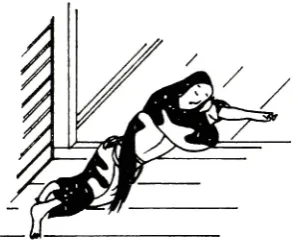
A visual record of Japanese shibori fabrics extends back to paintings of
the late twelfth century. The textile pattern motif from the "Legends of
Shigi-san Temple"
resembles a web (Ibid: 17). Later on, this motif became known
as kumo ("spider web") shibori (see figure 1). The fan-shaped papers that
contain Buddhist sutras provide further evidence of shibori. Several of these
have been reproduced in full color together with scroll paintings, and include
By
the end of the Heian period, different types of shibori-patternedcloth were
being
duplicated with stenciled patterns of silver and gold. Thisdecorative cloth, once found in palace curtains, temple banners, canopies, and
ship flags as well as among the garments of the different social classes, had
become common place. It was no longer confined only to royalty and the elite.
In the periods between 1185AD and 1513AD (the Kamakura and Muromachi) the
fabrics were characterized by the appearance of divided
dyeing
(somewake, seefigure 2) and refined stitch resists. When these were combined with
multicolored dyebaths,
they
produced elaborate and detailed designs on areserved ground.
The development in stitch shibori reached its height in the tsujigahana
textiles of the sixteenth and early seventeenth centuries
during
the Momoyamaperiod. Initially, between 1573AD and 1615AD, the lower classes wore indigo
dyed cotton while the elite wore more colorful and sophisticated silk garments.
In the later years of the Momoyama period, known in Japan as the "Golden Age of
Shibori", all classes of people wore the colorful silk and cotton
shibori-patterned cloth. Seiroku Noma, an authority on Japanese costume and textiles,
states that "at no other time in Japan's
long history
were the streets so fullof color"
(Wada, 1983:24).
The tsujigahana style is
typically
a combination of shibori-dyed designswith decorative detail added in sumi ink. Here stitching provides a means to
delineate dyed or reserved motifs, and a way of creating a textured design
effect.
By
using extremely small stitches andtaking
up only two or three4
-achieve sharp outlines instead of fuzzy-edged resist.
By
the end of the Momoyama period, a new style of textile decoration haddeveloped. This was typified
by
bold, contrasting diagonals that seem to bedrawn from the "pine bark lozenge"
motif (matsukawabishi ) of the tsujigahana
textiles (see figure 3)(Ibid:26). Stitched shibori, once so important in the
tsujigahana textiles, was now limited to
dividing
a larger design area. Assuch, textiles at this time were dyed in different colors through the process
of "divided dyeing"
(somewake). (lbid:26)
The Edo period of the seventeenth and eighteenth centuries marked the
beginning
in the mass production of shibori cloth. In the village of Arimatsuan increase in sales, coupled with the demand for variety in shibori cloth and
garments, led to a division of labor in production. With more cloth
being
produced came the need for quality control, and the beginnings of cloth guilds.
Not surprisingly, this specialization in production led to a specialization in
design. The combinations of stitching, binding, pleating and
dyeing
testify
tothe artisan's skills during the Edo period.
In the Meiji period ( 1868AD-1912AD) , the methods of production changed
even more due to the rising cost of silk. Consequently, more cotton was
incorporated into the fabrics than ever before, and machinery began to replace
the manual production of cloth. Although workers still stitched and bound the
cloth in their homes, most of the
folding
and pleating were doneby
machineoutside the home. At the same time chemical dyes began to displace the
In the years
following
World WarI,
shibori was incorporated Into westernstyle clothing and exported to Korea, Taiwan, Singapore and Africa. Meanwhile,
the social life in Japan was undergoing dramatic changes. Symbolized
by
theadoption of western dress, the younger generation no longer wanted to pursue
the traditional crafts of their parents.
This,
combined with the competitionfrom machine printed cloth, led to a sharp decline in the production of shibori
textiles. (Wada,1983)
Shibori is now but a precious part of tradition. However, thanks to the
hobbyist a new demand for shibori is
being
created and a number of shiboriobjects reflecting different techniques are
beginning
to appear. As my own workexhibits, these contemporary shibori techniques are gradually
being
-6
-DISCUSSION OF THE ARTIST'S WORK.
After World War I, the once common place Japanese textile of Shibori had
become a fabric of the past. The remaining demand for this stitch and dye
technique was due to artisans who transferred the various Shibori techniques
onto such items as purses, neckties and formal kimonos. This is still true
today, and as an artist I have a strong committment to the continuity and
development of Shibori
-a dynamic craft in an equally dynamic world.
In creating Pa inted-Shi bor i (Movement I
-photograph 5,5a. Movement 1 1
-photograph
6,6a),
I experimented and adjusted technique to achieve a desiredlook. Often I used dyes experimentally much as an unconventional chef might
create a new dish, but an essential aspect of my work remained the study of my
craft and a return to the source (the fabrics) that have always been my
teachers. As such, stitching was used as the means to delineate motifs that
are dyed or reserved, and as a way of creating a textured effect in my work.
It is the contrast of sharply drawn details with the soft edges of the resisted
motifs and the tonal contrast of the dark dyes with the delicate blues, greens,
yellows, and pinks that give my designs their unique quality.
My
work is essentially a blend of past and present: the combination of theShibori
history
and my own contemporary design. Thus to the sixteenth century"pine bark lozenge"
MOVEMENT I:
The first step in creating Movement I was to
develop
a line design orpattern as a stitching guide. In the Painted-Shi bor 1 the design motifs were
inspired
by
water formations. These motifs evolved from a desire for movementand love of shapes common to an aquatic environment.
Rising
waves and theircrests, swirling eddies and serpentine currents inspired the individual shapes
and motion of the overall pattern. Both the large, undulating shapes and the
small, clustered shapes were juxtaposed to create a dynamic, fluid composition.
The line design was transferred onto silk broadcloth which functioned as a
white canvas. Before painting, the silk was washed to remove the dust from the
natural fibers. Once dried it was stretched over a frame. The dyes in this
piece were French Dyes used in combination with water or alcohol to achieve a
desired effect. Water added to a dye lightened the color while alcohol, which
encourages the fabric to absorb a dye, strengthened the color. Thus in order
to achieve soft images and eliminate the dark edges made
by
a brushstroke, thefabric was dampened with water before painting.
In both my Shibori pieces, pastel underpainting is a prominent theme. This
is an idea prompted
by
my childhood memories of the ocean. The light pinks,greens, yellows, oranges, corals, and blues are all colors common to the sea
shore. The accent colors such as the bright pinks, yellows, and greens suggest
a sunset splendor.
Once the painting was finished, the original line design was transferred to
-8
-with straight stitching and crisscross
binding
(seedrawing
1) which is acombination
frequently
found in Shibori, particularly in the noted Arimatsuvillage of the seventeenth and eighteenth centuries. This technique is not
only fast but allows for a wide range of design possibilities.
Any
motifregardless of size, may be resisted in this way. The crossed
binding
threadand the random folds of the cloth create a distinctive patterning within
stitch-outlined motifs. (Wada, 1983)
Th is is the "mak i-age shI bor 1"
(see photograph 2,2a ) and predominates in
Movement I. Once the design motif was outlined in running stitch with silk
thread, the thread was drawn, bound with cotton thread, and secured
by knotting
(see photograph 1). The gathered silk was then immersed in water to inhibit
dye penetration in the gathered area and then placed in the dye baths. Three
different dye baths were used: a light, a medium and a dark brown. Before the
silk was immersed in
increasingly
darker dye baths, it was twisted and tied inlarge, loose knots. Each different dye bath needed a different twist and knot.
The latter were either removed or added to accomodate changes in the design.
With the
dyeing
process complete the fabric was left to dry naturally andthe stitched and bound thread were removed. In order to emphasize the elastic
texture of the surface, the fabric was partially pressed to retain its
Sting
Ray
shape from the image of the "pine bark lozenge" and to maintain the desiredtexture akin to the moon's surface. The soft, puckered shapes fill part of the
fabric and float against richly muted colors. These surrounding motifs were
further accentuated
by
a chain stitch of silver metallic thread that casts anIt is the combination of the positive and negative areas in Movement I
that gives it its totality. In other words, the embroidery (the positive
areas) and the dyes (the negative areas) combine to give the piece a full range
of texture and color. These in turn give the piece a tactile and visual
-10
-MOVEMENT II.
The initial stages in creating Movement II were much the same as in
Movement I. The line design was drawn up as a stitching guide and, as with
Movement
I,
this design evolved from a desire for movement specifically in anaquatic environment. The overall effect of this design is, in a sense, a shift
in impresssion from a close up view of water rippling over pebbles to a distant
view of an ocean wrapped in a
floating
mist. The latter is the product of the final dye bath. The rythmical geometric designs of this piece need space. Thespaces both within the design and in the manner in which this piece is
exhibited (in three seperate pieces) create a
feeling
of movement which is theessence of the design itself. In order to grasp this concept of the design, it is necessary to understand the origin and development of the design repeat.
The design was first drawn on a large piece of paper that was then used as
a guide for the spontaneous application of water color onto another larger
piece of paper. Energetic brushstrokes and numerous layers of color combined
to produce an effect of swirling water. In order to create a design from the
original painting, a small "window" was made from a piece of matt board and
used to find exciting compositions and color combinations from within the
original painting. This was eventually cut up into 5"
by
5" squares.Using
myoriginal line
drawing
as a reference, these5"
by
5" squares were rearrangedaccording to color and the direction of brushstrokes. The result was a unified
composi t ion.
large painting surface measuring 10'
by
11'. This was then tacked onto a frameand because the latter was not large enough to allow painting the entire
surface at once, it was painted in sections using the French Dyes and painting
methods already described for Movement I. Once the painting was complete, the
drawn design was then transferred onto the silk with a water soluble ink pen.
In accordance with the original line drawing, the silk was stitched with
silk thread. This was done using a combination of running stitches on a single
thickness (maki-age shibori, see photograph 2,2a), double thickness (ori-nui
shibori, see photograph 3,3a), or an overcast stitch on a double thickness
(maki-nui shibori, photograph 4,4a).
By
using three different kinds ofstitches in a particular design, the traditional technique was consequently
modified. After three weeks, the stitching was completed and the fabric was
drawn up into tight gathers along the stitching lines, bound with connected
cotton thread, and secured
by
knotting.As with Movement I, the whole piece of gathered silk was immersed in
water. It was then twisted and tied in large, loose knots and subjected to
five different dye baths.
Among
these were deep greens, browns, and blues ,all colors found in the ocean depths. Before the silk was immersed in the
increasingly darker dye baths the knots were either added, removed or changed
to accomodate design changes. The fabric was then dried naturally, the
stitching completely removed and the silk was pressed.
The final part of Movement II is the edge of the fabric. Rather than
-12
-and the flow of the design, the unhemmed fringe continues the image of
sparkling sand and marine colors
-an integral part of both Movement I and
CONCLUSION.
For years I have enjoyed working in water colors, however the emphasis in
my formal educational studies has been on the textile arts. While I was
studying in New York in 1984, I had a chance to see the exhibit "KOSODE 16TH
-19TH CENTURY TEXTILES FROM THE NOMURA COLLECTION"
at the Japan House in New
York City. What drew my attention in this exhibition was the way in which the
materials and the processes responded to the artist's hand. The relationship
between my hand and the resulting images created through Shibori enable me to
have the kind of control I feel essential in creating a work with integrity.
Understanding
and creating this technique from a technical and emotionalbase was
initially
unsuccessful. But, through trial and error I arrived atsome unique technical solutions that would
help
fulfill my aspirations.Stitching, a tension exerted on the shape of a fabric, and the transformation
of colors that occurred
during dyeing
and discharging, all contained infinitevariation in color, pattern and texture. In experimenting with the fabric I
was inspired to explore
three-dimensionality
in a slightly different manner.In contrast to the obvious three d intentional
ity
of a sculpture, Painted-Shi bor iis concerned with a two d intentional form. But because of the crinkled surface,
elastic shapes, and variations in color, the appearance of three dimentional
ity
is created.
In the first section of this thesis I discussed the
history
of Shibori,later I presented my work as a continuation of this historical process. A
-14
this discussion. There are, as there have always been, many possibilities for
future work in Sh i bor i :
1. To produce the Shibori technique as a painting as seen
in Movement I and Movement 1 1.
2. To create sculptured
forms,
all obviously three dimentionalsuch as containers, baskets, and various garment forms.
3. To use the technique solely for fabric design whose
function would be every
day
fashion wear. This issomething common to various periods in Japanese textile
history.
4. To apply Shibori to a different medium such as paper. The
latter retains the shape into which it has been manipulated
that would serve as both an added surface element and as a
new form.
As we have seen, Shibori is a dynamic technique in a changing world. I
have taken advantage of this as is illustrated in the Painted-Shi bor i described
throughout this essay. However, I do not see my involvement in Shibori in a
finite or
temporary
state but rather on a continuum of change, a process thatFigure 1: Motif from "Legends of Shigi-san Temple".
Figure 2: Example of "divided dyeing"
(somewake) dated 1309.
[image:21.562.212.359.306.428.2]-16
-Drawing
1: Criscross binding.Photograph 2:
Running
stitch on a single thickness.
-18
-Photograph 3:
Running
stitch on a double thickness.Photograph 4: Overcast stitch on a double thickness.
-20
-22
-Photograph 6: Movement II
(approximately
10'
-24
-BIBLIOGRAPHY
Beytebiere,
D'Arcie.1986. "
Windswept Designs in Pleated Silk". In Fiberarts.
January/February,
1986: 28 -29.Hedstrom,
Ana Lisa.1986. "The Intuitive Language of Shibori". In Fiberarts.
January/February,
1986: 26-27.Held,
Shirley
E.1978. Weaving: A Handbook of the Fiber Arts. New York:
Holt, Rinehart and Winston. Ito, Toshiko.
1980. Tsujigahana: The Flower of Japanese Textile Arts. Translated
by
Monica Bethe. Kodansha International Ltd.Tokyo,
New York, and San Francisco.Noma, Se iroku.
1974. Japanese Costume and Textile Arts. Translated
by
Armins Nikovskis. The HeibonshaSurvey
of Japanese Art. Vol. 16. New York and Tokyo: Weatherhill, Heibonsha.Stinchecum, Amanda Mayer. 1984. Kosode 16th - 19th
Century
Textiles from the NomuraCollection: with essays
by
Monica Bethe and Margot Paul.Edited
by
Naomi Noble, Richard and Margot Paul. Tokyo, NewYork, and San Francisco: Japan
Society
and Kodansha International Ltd.Textile Designs of Japan I: Designs Composed
Mainly
in Free Style.1959. Osaka, Japan: Japan Textile Color Design Center. Yoshida, Mitsukuni.
1975. Kyo Kanoko: B1 to dento (Kyoto kanoko:
Beauty
and tradition).Limited edition of 1000. Thorough investigation of shibori tradition
in Kyoto. Kyoto: Kyoto Shinbori Kogyo Kumiai.
Wada, Yoshiko and
Mary
Kellogg Rice and Jane Barton.1 983. Shi bor i : The Inventive
Art of Japanese Shaped Res ist
Dyeing - Tradition, Techniques, Innovation. Tokyo, New York,
GLOSSARY
Kasuri
Katazome.
This is the Japanese term for
ikat,
and involves the processof patterning cloth
by
binding
yarns before weaving, so as toreserve areas from dye. It requires calculation of where the
reserved areas of yarn will appear in the final woven piece.
This is paste-resist stencil dyeing. Rice paste is applied
through a special paper stencil to resist selected areas from
dye. The fabric is often dip-dyed, but sometimes dye is
applied
by
brush or thickened and applied with a tube.Bingata is the
bright,
polychrome katazome developed in Ok inawa.Keicho kosode. A style of kosode that was first popular
during
the Keicho era( 1596AD-1614AD). Typically,
interlocking
or overlapping areasfor contrasting colors and complex, disparate designs fill the
entire gound.
Somewake,
shibori, and nuihaku were most oftenused.
K imono. The traditional garment of Japan that developed from the kosode
during
the early Edo period ( 1615AD-1868AD). It isa straight-cut, wrap-around robe worn with a sash (obi).
Kokech i An ancient term for tied or bound resist. Examples from the
seventh and eighth centuries are in the Shoso-in repository.
Kyokechi
Matsukawabishi
Nuihaku.
Obi
Overdyeing.
An ancient Japanese resist process In which the cloth is
folded and then clamped between carved wooden blocks. Several
colors are applied through holes in the blocks that form
reservoirs for the dye. Examples from the seventh and
eighth centuries are in the Shoso-in collection.
"Pine bark lozenge", a geometric motif composed of three
superimposed diamond forms (see figure 3) used as an all
over repeating pattern as well as a single unit.
A combination of embroidery and applied gold or silver leaf
(see surihaku).
A sash worn with the kimono. A woman's obi is wide and tied
in a large knot or bow. A man's obi is narrow and worn around
the hips.
Dyeing
one color over another to obtain a desired hue,
-26
-Reserve or
Res ist.
Resist dyeing.
Rokech i .
Somewake.
A substance or technique used to protect an area of yarn or
texti le from dye.
Patterning
of yarn or fabricby
protecting selected areas fromdye. Patterns can be created
by
the application of substancessuch as wax, paste, and mud, and
by
physically manipulatingthe cloth. Typical of this process are ikat (kasuri), batik,
paste and stencil
dyeing
(katazome),
and shibori.An ancient term for wax-resist dyeing. The Shoso-in
collection has examples of this from the seventh and eighth
centuries.
Dyeing
in which large areas of ground are dyed in differentcolors. This technique is typical of tsujigahana and Keicho
kosode text i 1es.
Surihaku.
Tsujigahana.
The stenciled application of gold or silver leaf using a
special adhesive. Tsujigahana textiles and Keicho kosode
provide examples of surihaku.
The name given to a group of textiles that became fashionable
during
the latter part of the fifteenth and early sixteenthcenturies. The literature and surviving examples show the
fashionable clothing of this period to be made of silk.
St itched shi bori of both 1arge and sma1 1 areas is used to