A DYNAMIC NATURAL-RESOURCE-BASED FRAMEWORK FOR INNOVATIVE SUSTAINABLE OPERATIONS
Natalie McDougall
University of Strathclyde Business School, Glasgow, UK [email protected]
Beverly Wagner
University of Strathclyde Business School, Glasgow, UK [email protected]
Jillian MacBryde
The York Management School, University of York, York, UK jill.macbryde.ac.uk
Whilst some twenty years old, Hart’s (1995) natural-resource-based-view (NRBV) of the firm is presented in modern literature as an effective and innovative approach to sustainable operations. This said, it is argued that the theory has struggled to transition into industry, largely due to insufficient managerial guidance (Hart & Dowell, 2011). In particular little definition is provided as to the capabilities required to support the NRBV, in some disregard of the intrinsic nature of resources and capabilities (Barney, 2001). This paper builds on seminal NRBV studies, a synergistic relationship with sustainable supply chain management and innovation and application of Teece’s (2007) theory of dynamic capabilities to construct a definitive framework of NRBV capabilities. The results of an empirical study involving semi-structured interviews with UK food companies support a relationship between the NRBV, sustainable supply chain management and innovation and reinforce NRBV capabilities. In its completion, this study aims to overcome a twenty-year theory practice gap and promote an innovative approach to sustainable operations for managers.
INTRODUCTION
Hart’s (1995) natural-resource-based-view (NRBV) of the firm still features in literature as an effective and innovative approach to sustainable operations (e.g. Shi et al, 2012; Johnson et al, 2014). The value of the theory is derived more from its competitive appeal than its sustainable intentions (Hart & Dowell, 2011), in that the NRBV is intended to deliver benefits for the firm with regards to cost, quality, efficiency and differentiation. (Hart, 1995; Russo & Fouts, 1997). Whilst such benefits have encouraged widespread academic approval, it has been argued that the NRBV has struggled to transition into industry (Mencug & Ozanne, 2005), resulting in a twenty year theory-practice gap (Hart & Dowell, 2011). In the most part this is attributed to a lack of managerial guidance (Mencug & Ozanne, 2005), in that in spite of the intrinsic nature of resources and capabilities (Barney, 2001), NRBV capabilities have never been defined.
sustainable supply chain management (SSCM) and innovation reveal further capabilities that may support NRBV realisation. Bringing these capabilities together, Teece’s (2007) theory of dynamic capabilities is applied to guide the construction of a comprehensive framework of NRBV capabilities.
In order to assess this framework a series of semi-structured interviews with UK food companies is undertaken, permitting empirical reinforcement of the previously acknowledged capabilities and identification of additional, unforeseen capabilities. In its completion this study offers an empirical definition of NRBV capabilities in an attempt to overcome the theory-practice gap and refine existing literature. In addition, it offers an appealing and approachable framework for managers in pursuit of innovative, sustainable operations.
THEORETICAL BACKGROUND
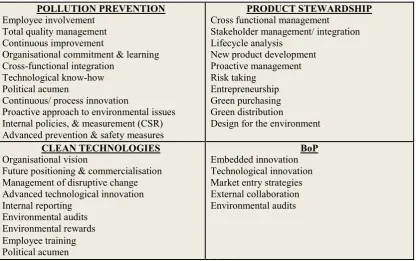
Inspired by traditional resource based theory, the NRBV argues that by prioritising ecological and social environments a firm will benefit from enhanced competitiveness (Hart, 1995; Golicic & Smith, 2013). Initially, this resulted in conception of three symbiotic resources: pollution prevention, product stewardship and sustainable development. Whilst pollution prevention and product stewardship were well received, sustainable development was criticised for its evasive nature and overwhelming scope (Ashby et al, 2012) and was widely neglected throughout literature (Hart & Dowell, 2011). Consequently, sustainable development was later divided into two separate resources: clean technologies (Hart, 1997) and base of the pyramid (Hart & Christensen, 2002). Whilst this undoubtedly offered some clarity, it is notable that this division is commonly overlooked in literature (e.g. Menguc & Ozanne, 2005; Shi et al, 2012; Matapolous et al, 2014) and pollution prevention and product stewardship remain dominant (Hart & Dowell, 2011). In the interest of promoting practical applicability this study is inclusive of pollution prevention, product stewardship, clean technologies and base of the pyramid, each of which is briefly discussed below and examined for potentially significant capabilities, which are depicted in figure 1.
Pollution Prevention
Pollution prevention promotes the minimisation of waste and emissions throughout internal operations (Hart, 1995) and benefits from empirically reinforced (Russo & Fouts, 1997) links with cost reduction and efficiency. As opposed to traditional approaches to waste management, pollution prevention looks beyond the responsible disposal of waste to instead prevent the occurrence of waste in the first place (Hart, 1995; Hart & Dowell, 2011). As such pollution prevention is still presented as sustainable and competitive cost cutting strategy in modern business (Christmann, 2000; Golicic & Smith, 2013).
continuous improvement as the key strategic resource of pollution prevention, whilst innovative capabilities, commitment and proactivity also warrant discussion.
Product Stewardship
Product stewardship expands upon pollution prevention, encouraging the prioritisation of the natural environment throughout each stage of the product lifecycle (Hart, 1995). In doing so, the natural environment itself is presented as a key stakeholder forcing issues such as conservation, the avoidance of harmful substances and recyclability to the forefront of operations (Hart, 1995). This is intended to render both economic and environmental advantages, as well as permitting access to scarce resources and offering competitive differentiation (Hart, 1995; Menguc & Ozanne, 2005; Ashby et al, 2012; Svensson & Wagner, 2012; Golicic & Smith, 2013).
With regards to capabilities Hart (1995) emphasises the role of cross-functional management, stakeholder management, lifecycle analysis and new product development. Subsequent studies have reinforced the significance of lifecycle analysis (Christmann, 2000; Johnsen et al, 2014), drawn links between the reliance on new product development and innovation (Hart, 1997; Menguc & Ozanne, 2005; Johnsen et al, 2014), and expanded on lifecycle analysis and stakeholder management to consider the role of supply chain management (Vachon & Klassen, 2008; Ashby et al, 2012; Shi et al, 2012; Wu, 2013). Hart & Dowell (2011) later define the key strategic resource of product stewardship as stakeholder integration.
Clean Technologies
Hart (1997) describes clean technologies as stage 3 where pollution prevention is stage 1 and product stewardship is stage 2. More specifically, whilst pollution prevention and product stewardship aim to reduce operational impact or even to realise zero impact operations, clean technologies is focused upon the pursuit of positive impact operations. Building upon the argument that technological innovations have always provided substitutes for non-renewables, Hart (1997, p73) argues that companies ‘must begin to plan for and invest in tomorrow’s technologies’.
Unsurprisingly, when it comes to discussion of capabilities for clean technologies the focus falls upon innovative and entrepreneurial activities (Hart & Milstein, 1999; Hart & Dowell, 2011). Organisations require vision (Hart & Milstein, 1999) and future positioning and commercialisation capabilities (Hart & Dowell, 2011). They must manage and accept disruptive change in the form of creative destruction (Hart & Milstein, 1999) or even cannibalising technologies (Hart & Dowell, 2011). Bjornali & Ellingsen (2014) also discuss the significance of political acumen, highlighting it as means by which to overcome policies and legislative barriers.
Base of the Pyramid
permit the exploration of radical innovations in a low risk environment (Hart & Christensen, 2002).
Again, the majority of implications for BoP capabilities surround innovation, with links drawn with embedded innovation (Hall & Vrendenburg, 2004; Hart & Dowell, 2011), technological innovation (Prahalad & Hart, 2002) and entrepreneurship (Arnold & Valentin, 2014). Market entry strategies (Hart & Christensen, 2002; Prahalad & Hart, 2002) and external collaboration (Prahalad & Hart, 2002; London & Hart, 2004) also warrant some discussion.
NRBV Extensions and Developments
There exist several attempts at NRBV extension and development which in offer additional insight to potential NRBV capabilities. First, Aragon-Correa & Sharma’s (2003) Contingent Proactive Environmental Strategy attempts to assist practical realisation of the NRBV’s pollution prevention, and in doing so highlights stakeholder integration, continuous improvement, higher order shared learning, the interpretation of environmental issues as opportunities and resource reconfiguration as significant capabilities. Second, Mencug & Ozanne’s (2005) Natural Environment Orientation empirically links corporate social responsibility measurement to pollution prevention, risk taking and entrepreneurship with product stewardship; and internal reporting, environmental audits, environmental rewards and employee training with Hart’s original sustainable development. The third attempt comes from Shi et al’s (2012) natural resource based model of green supply chain management which links environmental policy, consideration of environmental criteria, process optimization, internal management procedures and advanced prevention and safety methods with pollution prevention, and green purchasing, green distribution and design for the environment with product stewardship.
POLLUTION PREVENTION
Employee involvement Total quality management Continuous improvement
Organisational commitment & learning Cross-functional integration
Technological know-how Political acumen
Continuous/ process innovation
Proactive approach to environmental issues Internal policies, & measurement (CSR) Advanced prevention & safety measures
PRODUCT STEWARDSHIP
Cross functional management Stakeholder management/ integration Lifecycle analysis
New product development Proactive management Risk taking
Entrepreneurship Green purchasing Green distribution
Design for the environment
CLEAN TECHNOLOGIES
Organisational vision
Future positioning & commercialisation Management of disruptive change Advanced technological innovation Internal reporting
Environmental audits Environmental rewards Employee training Political acumen
BoP
[image:4.595.92.509.443.704.2]Embedded innovation Technological innovation Market entry strategies External collaboration Environmental audits
The NRBV and SSCM
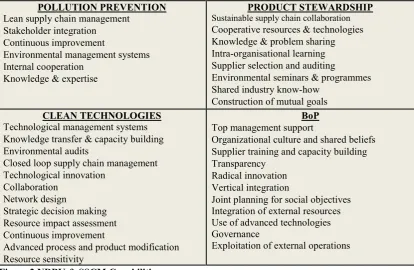
Existing literature hints at a synergistic relationship between the NRBV and SSCM (e.g. Markley & Davis, 2007; Johnston et al, 2014) but is yet to empirically explore this relationship. With particular regards to this study, SSCM’s widespread industry acceptance and application (Ashby et al, 2012; Pagell & Shevchenko, 2014) potentially offers some resolve to the NRBV’s practical avoidance. As such, this section provides an overview of the basic parallels between SSCM and each NRBV resource, and in doing so attempt to highlight capabilities of significance, the results of which are depicted in figure 2.
Synergies between pollution prevention and SSCM largely come down to their paralleled focus on waste and cost reduction (Markely & Davis, 2007; Hart & Dowell, 2011). This has encouraged links to be drawn between pollution prevention and lean (Galeazzo et al, 2013; Hajmohammad et al, 2013), which is in turn dependent upon capabilities of stakeholder integration, continuous improvement and total quality management (Dües et al, 2013). Building on the significance of total quality management, environmental management systems in a broader sense have been linked with pollution prevention (Hajmohammad et al, 2013), reinforcing the significance of capabilities such as environmental plans, measurements and policies, internal cooperation and knowledge and expertise (Ferenhof et al, 2014).
Product stewardship arguably assumes the strongest relationship with SSCM, with various studies suggesting product stewardship is dependent upon effective supply chain management (Vachon & Klassen, 2008; Asby et al, 2012; Shi et al, 2012; Wu, 2013). In particular, an emphasis is placed upon sustainable supply chain collaboration (Vachon & Klassen, 2008; Johnson et al, 2014), which is reliant upon investment in cooperative resources and activities, knowledge sharing, intra-organisational learning, supplier monitoring and technology (Vachon, 2007). Reinforcing this is Shi et al’s (2012) references to environmental awareness seminars and programmes for suppliers, shared industry know-how, the construction of mutual goals, choice of suppliers by environmental criteria and certification and supplier auditing throughout construction of their natural resource based green supply chain model.
Synergies can easily be identified between the NRBV’s clean technologies and SSCM’s green technologies or sustainable supply chain technologies. Existing links between the two (e.g. Vachon, 2007; Schrettle et al, 2014) has rendered consideration of technological management systems, knowledge transfer and capacity building, environmental assessments and audits and environmental lifecycle analysis. Additional links have been made between clean technologies and closed loop supply chains (Vachon & Klassen, 2008; Ashby et al, 2012; Matapolous et al, 2014) which Jensen et al (2013) suggest are reliant on technological innovation and collaboration and Garg et al (2015) link with network design, strategic decision making and system optimization. Furthermore, Matapolous et al (2014) suggest that resource impact assessment, continuous improvement, advanced process and product modification and resource sensitivity may help to support clean technologies in resource efficient supply chains.
with external collaboration (Prahalad & Hart, 2002) render consideration of integration of external resources, use of advanced technologies, governance and exploitation of external operations (Wang et al, 2015).
POLLUTION PREVENTION
Lean supply chain management Stakeholder integration
Continuous improvement
Environmental management systems Internal cooperation
Knowledge & expertise
PRODUCT STEWARDSHIP Sustainable supply chain collaboration
Cooperative resources & technologies Knowledge & problem sharing Intra-organisational learning Supplier selection and auditing
Environmental seminars & programmes Shared industry know-how
Construction of mutual goals
CLEAN TECHNOLOGIES
Technological management systems Knowledge transfer & capacity building Environmental audits
Closed loop supply chain management Technological innovation
Collaboration Network design
Strategic decision making Resource impact assessment Continuous improvement
Advanced process and product modification Resource sensitivity
BoP
Top management support
Organizational culture and shared beliefs Supplier training and capacity building Transparency
Radical innovation Vertical integration
Joint planning for social objectives Integration of external resources Use of advanced technologies Governance
[image:6.595.91.506.127.397.2]Exploitation of external operations
Figure 2 NRBV & SSCM Capabilities
The NRBV and Innovation
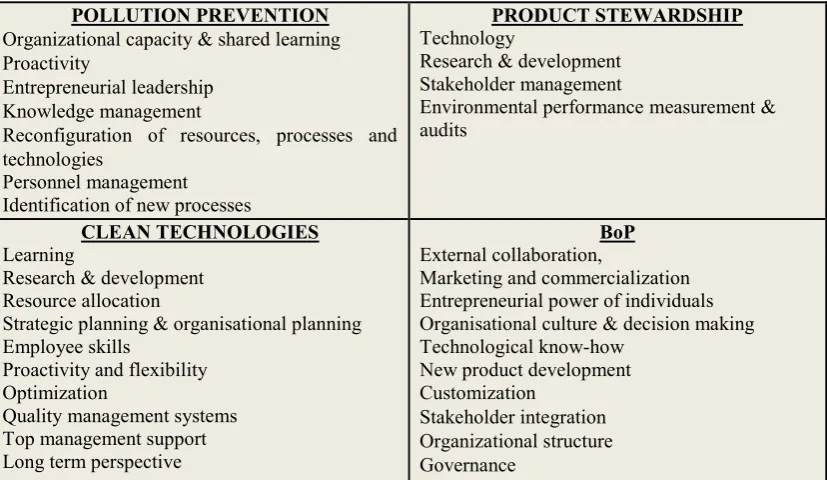
Innovation features prominently in both NRBV (e.g. Hart, 1995; 1997; Aragon-Correa & Sharma, 2003; Mencug & Ozanne, 2005; Shi et al, 2012) and associated SSCM (e.g. Markley & Davis, 2007; Ageron et al, 2012; Ashby et al, 2012; Golicic & Smith, 2013) literature. However, in spite of its apparent relevance, the role of innovation in the NRBV is yet to be empirically assessed, and rarely takes centre stage in literature. This along with the argument that innovation exists at the root of all economic, social, technological and business developments (Birkenshaw et al, 2008) calls for consideration of innovative capabilities in the practical realisation of the NRBV. Again, the relationship between each NRBV resource and relevant forms of innovation is discussed here, and potentially significant capabilities are displayed in figure 3.
Pollution prevention has been directly linked with continuous innovation (Hart, 1995; Hart & Dowell, 2011; Vachon & Klassen, 2008; Golicic & Smith, 2013) and process innovation (Hart, 1995; Aragon-Correa & Sharma, 2003). Literature suggests that continuous innovation capabilities include higher order shared learning, proactivity, entrepreneurial leadership, knowledge management and the reconfiguration of processes and technologies (Sharma & Vrendenberg, 1998; Shang et al, 2008). Walker (2014) defines process innovation capabilities as personnel management, identification of new processes, organisational capacity and learning, resource management and technology.
2013; Johnsen et al, 2014). This renders consideration of the emergent topic of sustainable supply chain innovation which is reliant on technology (Ageron et al, 2013), research and development (Chakrabarty & Wang, 2012), stakeholder management, environmental performance measurement and audits (Ikasson et al, 2010).
Clean technology arguably possesses the most obvious connection with innovation, and unsurprisingly topics of technological innovation (Hart, 1997; Hart & Dowell, 2011) and environmentally motivated innovation (Szekely & Strebel, 2013) emerge with significance. According to Yam et al (2010) technological innovation is dependent upon learning, research and development, resource allocation, strategic planning and organisational planning. Environmentally motivated sustainable innovation literature makes references to employee skills (Andersson & Batemann, 2000), proactivity and flexibility (de Medieros et al, 2013), optimization (Quist & Tukker, 2010), quality management systems (Cuerva et al, 2014) and top management support and a long term perspective (Lee & Min, 2015).
BoP is linked with radical innovation (Hart & Christensen, 2002; Prahalad & Hart, 2002) and disruptive innovation (Hart & Christensen, 2002), whilst socially motivated sustainable innovation also emerges with significance. Radical innovation places a dependency on external collaboration, marketing and commercialization and the entrepreneurial power of individuals (Story et al, 2011). Disruptive innovation places a dependency on organisational culture and decision making, technological know-how, new product development and customization (Christensen, 1997; Christensen et al, 2006). Reinforcing these capabilities, socially motivated sustainable innovation literature bears implications for stakeholder integration, external collaboration, shared vision (Quist & Tukker, 2010), individual creativity, organisational structure, technology and governance (Baker & Abid, 2015).
POLLUTION PREVENTION
Organizational capacity & shared learning Proactivity
Entrepreneurial leadership Knowledge management
Reconfiguration of resources, processes and technologies
Personnel management Identification of new processes
PRODUCT STEWARDSHIP
Technology
Research & development Stakeholder management
Environmental performance measurement & audits
CLEAN TECHNOLOGIES
Learning
Research & development Resource allocation
Strategic planning & organisational planning Employee skills
Proactivity and flexibility Optimization
Quality management systems Top management support Long term perspective
BoP
External collaboration,
Marketing and commercialization Entrepreneurial power of individuals Organisational culture & decision making Technological know-how
New product development Customization
[image:7.595.93.507.444.684.2]Stakeholder integration Organizational structure Governance
Figure 3 NRBV & Innovation Capabilities
Dynamic Capabilities
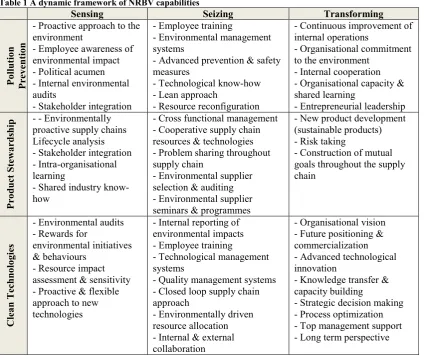
& Martin, 2000). In some response to this, Teece et al (1997) produced dynamic capabilities; a theory which encouraged the continuous development of organisational competencies. Dynamic capabilities was largely well received, and in particular has been credited with overcoming one of the major flaws of the NRBV (Aragon-Correa & Sharma, 2003; Hart & Dowell, 2011). However, the theory was not without criticism, pertinently for lacking practical applicability and failing to define any concrete dynamic capabilities (Agragon-Correa & Sharma, 2003). Teece (2007) contests this in a later paper, arguing that dynamic capabilities by their very nature cannot be explicitly defined. Furthermore, Teece stresses that dynamic capabilities should not be seen as an ‘add-on’ to the NRBV, but rather should be used to describe and guide the diffusion of NRBV resources. In support of this, Teece divides dynamic capabilities into three categories: sensing activities that seek and shape opportunities; seizing activities that implement and manage new opportunities; and transforming activities that influence organisational evolution. Given this study’s intention to explicate NRBV capabilities and enhance practical applicability, Teece’s (2007) theory of dynamic capabilities is used to categorize the amalgamated NRBV, SSCM and innovation capabilities. Pertinently, high levels of repetition between NRBV, SSCM and innovation capabilities reinforce the feasibility of their amalgamation and add robustness to the framework.
Table 1 A dynamic framework of NRBV capabilities
Sensing Seizing Transforming
P ollu tio n P re vent io n
- Proactive approach to the environment
- Employee awareness of environmental impact - Political acumen - Internal environmental audits
- Stakeholder integration
- Employee training
- Environmental management systems
- Advanced prevention & safety measures
- Technological know-how - Lean approach
- Resource reconfiguration
- Continuous improvement of internal operations
- Organisational commitment to the environment
- Internal cooperation - Organisational capacity & shared learning
- Entrepreneurial leadership
P ro du ct Ste wa rds hip
- - Environmentally proactive supply chains Lifecycle analysis - Stakeholder integration - Intra-organisational learning
- Shared industry know-how
- Cross functional management - Cooperative supply chain resources & technologies - Problem sharing throughout supply chain
- Environmental supplier selection & auditing - Environmental supplier seminars & programmes
- New product development (sustainable products) - Risk taking
- Construction of mutual goals throughout the supply chain Clea n T ec hn olo gies
- Environmental audits - Rewards for
environmental initiatives & behaviours
- Resource impact assessment & sensitivity - Proactive & flexible approach to new technologies
- Internal reporting of environmental impacts - Employee training
- Technological management systems
- Quality management systems - Closed loop supply chain approach
- Environmentally driven resource allocation - Internal & external collaboration
- Organisational vision - Future positioning & commercialization - Advanced technological innovation
- Knowledge transfer & capacity building
B
oP
- Social audits
- Transparency throughout the supply chain
- Entrepreneurial power of individuals
- Socially driven market entry strategies
- Supplier training
- Vertically integrated systems - Use of advanced technologies - Integration of external resources
- Supply chain overnance
- Relationship with externals (NGOs, governments) - Top management support - Organizational culture & shared beliefs regarding social issues
- Capacity building with suppliers
- Joint planning with
externals for social objectives
EMPIRICAL STUDY
Adopting a qualitative abductive methodology, empirical assessment of NRBV capabilities is undertaken. Semi-structured interviews are selected on account of their facilitation of explanatory data and emphasis on causal relations (Saunders et al, 2012) which support this study’s intention to explicate capabilities that support practical application of the NRBV. Given that abduction assumes theory and reality act as points of reference for one another (Edwards et al, 2014), interview design is influenced by theoretical parameters and intended to facilitate the identification of additional unforeseen capabilities. More specifically, NRBV resources and capabilities act as the key themes to be covered in interviews, but the use of open and probing questions encourages a conversational dialogue in which the respondent may lead the discussion, straying from pre-defined themes and consequently highlighting additional areas of interest. Pertinently questions do not include any direct reference to the NRBV or any specific capabilities in an attempt to prevent researcher bias. Where possible interviews are conducted in person, on site, and include observation of relevant practices to strengthen results.
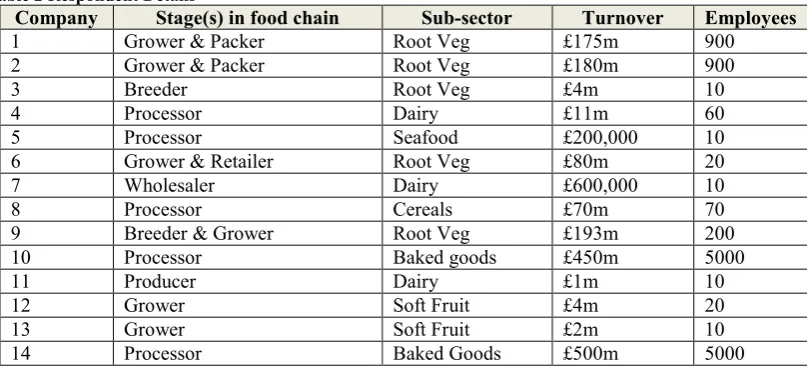
The UK agri-food sector is serves as the contextual setting for several reasons. First, it is suggested that agri-food faces the greatest scrutiny with environmental impacts and the conservation of natural resources (Jensen et al, 2013), encouraging increased innovativeness in terms of sustainability (Shi et al, 2012; Cuerva et al, 2014). Second, the UK agri-food sector prioritises sustainability as a core competitive strategy and has experienced impressive growth in recent years (DEFRA, 2013). Third, Matapolous et al (2014) suggest that the resources, tools and methods employed in agri-food chains remain understudied and ill-defined. In order to be representative of the agri-food chain on the whole, this study is inclusive of UK agri-food companies of any size or sub-sector. Employing a non-purposive sampling technique, theoretical parameters are used to identify UK agri-food companies that exhibit some (albeit tacit) experience of the NRBV and possess advanced experience or knowledge of sustainable and innovative operations. Edwards et al (2014) recommends decreased academic focus on senior managers to encourage greater understanding of the wider working environment, and accordingly this study targets respondents based on their knowledge of and proximity to the topics of discussion. Interviews continue until a point of saturation is reached in which satisfactory descriptions of NRBV capabilities have been collected. Following a successful pilot study, 14 companies have participated to this point, the details of which are depicted in table 2.
Table 2 Respondent Details
Company Stage(s) in food chain Sub-sector Turnover Employees
1 Grower & Packer Root Veg £175m 900
2 Grower & Packer Root Veg £180m 900
3 Breeder Root Veg £4m 10
4 Processor Dairy £11m 60
5 Processor Seafood £200,000 10
6 Grower & Retailer Root Veg £80m 20
7 Wholesaler Dairy £600,000 10
8 Processor Cereals £70m 70
9 Breeder & Grower Root Veg £193m 200
10 Processor Baked goods £450m 5000
11 Producer Dairy £1m 10
12 Grower Soft Fruit £4m 20
13 Grower Soft Fruit £2m 10
14 Processor Baked Goods £500m 5000
PRELIMINARY FINDINGS
Preliminary results from the 14 conducted interviews support the amalgamation of the NRBV, SSCM and innovation. Perhaps most forcefully, this is indicated in repeated use of supply chain terminology and reliance on supply chain strategies by respondents, in spite of them not being asked about supply chain management at any point. In addition, 12 of the 14 companies listed innovation as a fundamental capability in support of their successful sustainability endeavours, and innovation in a more general sense emerged as a dominant theme in all interviews. With regards to specific NRBV capabilities, preliminary results indicate a high correspondence between those derived from literature review and those employed in practice, as well as revealing additional capabilities of significance. The empirical results are depicted in table 3.
Pollution Prevention Capabilities
Sensing Activities
Seizing Activities
Employee training featured prominently in terms of pollution prevention seizing activities. 13 of the 14 companies suggested that all employees, regardless of their role, received basic training in the avoidance of waste. This encouraged employees to turn off all unused machinery and lighting, to avoid printing where possible, to segregate all waste at source from factory floor right up to staff cafeteria, and in two of the 14 companies to make use of electric vehicles, public transport or car-share for the commute to work. This was communicated via both training and internal signage. 11 of the 14 interviewed companies reinforced a link between environmental management systems and seizing pollution prevention, with ISO 14001, supermarket environmental accreditation schemes, NGO certification schemes and company own designed systems emerging with significance. Reinforcing the value of a lean approach, references were also made to Six Sigma. Again, machinery maintenance emerged with significance, but no references were made to advanced safety measures. Discussion of machinery maintenance, as well as carbon measurement and lean, often led to references for technological know-how.
Transforming Activities
Continuous improvement of internal operations was evident in 12 of the 14 companies interviewed, and pertinently featured dominantly in discussion of company plans for future environmental sustainability. Similarly, companies claimed to be committed to the environment, and aside from some financial constrains and conflicts, implied that investment in waste prevention technologies, machinery and training would continue. 4 of the 14 interviewed companies presented themselves as entrepreneurial leaders in terms of waste management, placing a heavy dependency on innovation and technology, rendering discussion of various awards and patents. Interestingly, family ownership also emerged as a pollution prevention transforming activity, in that 9 of the companies interviewed suggested it allowed them to take a long-term perspective in which the conservation of resources was more important and financial constraints were easier to overcome due to extended periods of expected pay-offs. 3 of those 9 suggested that innovation in terms of environmentalism was built into the company’s family heritage.
Product Stewardship Capabilities
Sensing Activities
Seizing Activities
Repeated discussions of internal and external awareness of environmental issues and goals, and well as discussion of financial barriers to environmental initiatives, support cross functional management and cooperative supply chains as product stewardship seizing activities. In addition, several companies spoke of sharing technologies and machinery with suppliers, for example anaerobic digesters or energy efficient tractors or lorries, as a means by which to enhance environmentalism and overcome financial constraints. Environmental auditing also featured prominently in discussion of product stewardship, but pertinently this was often third-party audits. More specifically, rather than audit suppliers themselves, companies checked supplier’s accreditations and certifications and took this as a guarantee for environmental behaviour. This also played an active role in supplier selection. 5 of the 14 interviewed companies spoke of holding environmental seminars or training programmes for supplier, and accordingly presented themselves as environmental leaders in the supply chain. Vertical integration and use of local suppliers emerged as new product stewardship seizing capabilities, in that companies indicated that they permitted greater control and transparency and consequently played a fundamental role in the creation of wholly sustainable operations. In addition, 2 of the 14 companies spoke of government funding for collaborative projects assisting sustainable operations.
Transforming Activities
The literature review only uncovered three product stewardship transforming capabilities, each of which feature in interview results at some point. New product development featured heavily and pertinently was often presented as an on-going shared activity, commonly relating to resuse of waste products or enhancements in packaging. For example the distribution of commercially unviable products throughout the supply chain for use as stock feed, land spread or biomass or rolling out biodegradable packing from one company to the full supply chain. Companies also spoke of taking risks in relation to product stewardship, albeit to a lesser extent, suggesting that having built trusting and mutually beneficial relationships throughout the supply chain encouraged them to take risks with regards to new technologies if supply chain partners had already invested them. As mentioned shared beliefs and goals regarding environmental issues and opportunities features as a product stewardship sensing activity, but also acts a transforming activity in that the shared pursuit of initiatives like zero waste to landfill, reduced food miles or carbon impact encourage ongoing environmental enhancements from the supply chain as a whole.
Clean Technologies Capabilities
Sensing Activities
impacts of sourced ingredients. In relation to this, process optimization often served as a driver of clean technologies. Rewards for environmental behaviours and initiatives were also mentioned, but these tended to be company-wide involving patented technologies and submission to various competitions.
Seizing Activities
As well as confirming internal reporting of environmental impacts, largely in relation to results of new technologies or systems, the interview results indicate that external reporting of environmental impacts serves as a clean technology seizing capability. Not only were results widely reported and publicised, but several companies implied that they felt some responsibility to promote new technologies and systems throughout industry. Employee training and environmentally driven resource allocation are also confirmed at clean technology seizing activities. However, assuming the greatest significance was a closed-loop supply chain approach which featured in 12 of 14 interviews and was presented as a fundamental capability in the realisation of clean technologies. Expanding on product stewardship’s reverse approach to the reuse of waste goods, the closed loop approach reincorporated waste goods and emissions and effluents into the supply chain. In addition, the closed loop approach didn’t just apply to the supply chain, but was also applied in internal operations. For example grey waters were recollected, treated and used again or cold air was captured, stored and blown into cold stores instead of using refrigerators. This in turn placed a reliance on both internal and external collaboration. With regards to quality management systems, IS0 9001 emerged with significance, but interestingly no evidence was found to support the use of technological management systems in clean technology seizing capabilities.
Transforming Activities
Unsurprisingly organisational vision featured heavily in discussion of clean technologies, and in particular 3 of the 14 interviewed companies included references to clean technologies in mission statements or five year plans. In relation to this, future positioning, strategic decision making, top management support and a long term perspective were all confirmed as clean technologies transforming capabilities. Again this rendered discussion of family management or ownership and company heritage, in that companies that expected the next generation to come into the business were more inclined to invest in clean technologies and often an inclination for new technologies was engrained into the company. This in turn appeared to drive on-going technological innovation and capacity building.
BoP Capabilities
Sensing Activities
suggests that BoP has evolved to become a local rather than global strategy, and that its competitive intentions have all but diminished. Continuing on this line of investigation, companies also looked to the supply chain to seek out opportunities for social alleviation, and claimed to help suppliers and customers meet their own socially sustainable objectives. Interview results supported the power of individuals with regards to BoP sensing activities in that companies commonly relied on employees to highlight local causes, and favoured causes that related to specific employees. 3 of the 14 interviewed companies described themselves as social enterprises and suggested that this encouraged them to continuously seek social enhancement, but again on local levels.
Seizing Activities
Given the divergence from Hart’s original BoP, it is of little surprise that the interviews did not confirm socially driven market entry strategies as a BoP seizing activity However, references were made to supplier training and supply chain governance in that suppliers were also expected and encouraged to maintain socially responsible operations, and this in turn led to some discussion of fair trade certifications. Vertically integrated systems, on account of enhanced control and transparency, were also referenced by 2 companies in ensuring socially responsible operations. References to integration of external resources were notable throughout discussion of philanthropic activities and the amalgamation of funding for local causes. Companies also implied that creating and maintaining good relationships with externals, particularly councils, supported the propensity to assist local causes.
Transforming Activities
Table 3 Empirical findings of NRBV capabilities
Sensing Seizing Transforming
P ollu tio n P re vent io n
- Proactive approach to the environment
- Employee awareness of environmental impact - Rewards for ‘environmental ideas’
- Internal environmental audits - Machinery auditing
- Stakeholder integration - Shared industry know-how via conferences or online forums
- Employee training of practices to prevent waste
- Internal signage to promote environmental behaviours - ISO 14001
- Supermarket accreditation schemes
- Environmental certification - Company-designed environmental management systems
- Lean/ Six Sigma approach - Machinery maintenance - Technological know-how
- Continuous improvement of internal operations - Organisational commitment to the environment
- Internal cooperation - Organisational capacity & shared learning - Entrepreneurial leadership
- Long term perspective on resource conservation - Extended period for financial pay-offs - Family management
P ro du ct Ste wa rds hip
- Environmentally proactive supply chains
Lifecycle analysis - Carbon measurement throughout supply chain - Stakeholder integration - Intra-organisational learning - Shared industry know-how via conferences and online forums
- Problem sharing throughout supply chain
- Cross functional management - Cooperative supply chains - Shared environmental resources & technologies - Third party environmental audits
- Seeking out environmental certifications and accreditations to assist supplier selection - Environmental supplier seminars & programmes - Vertical integration - Use of local suppliers - Government funding for collaborative projects
- New product development
- Redistribution of waste products for reuse - Risk taking
- Construction of mutual goals throughout the supply chain Clea n T ec hn olo gies
- Proactive & flexible approach to new technologies - Looking to other industries for inspiration
- Working with research & academic bodies
- Designated person/ team to seek out new technologies - Process optimization - Extensive audits of internal & external environments - Resource impact assessment & sensitivity
- Company-wide incentives for environmental initiatives & behaviours
- Internal and external reporting of environmental impacts -Promotion of new,
environmental technologies & systems
- Employee training - Environmentally driven resource allocation - Closed loop supply chain approach
- Closed-loop approach to internal operations - Internal & external collaboration - ISO 9001
- Organisational vision - Future positioning - Top management support - Long term perspective - Strategic decision making - Family membership or ownership
- Company heritage - Ongoing advanced technological innovation - Capacity building
B
oP
- Awareness of local social issues
- Affiliations with local councils, charities or bodies - Transparency throughout the supply chain
- Power of individuals to highlight social issues - Social enterprising
- Supplier training
- Supply chain governance - Fair trade certification - Vertically integrated systems - Integration of external resources
- Relationship with externals (NGOs, governments)
-- Joint planning with externals for social objectives
- Top management support - Organizational culture & shared beliefs regarding social issues
- Family management or ownership
CONCLUSIONS
Both the results of the literature review and the preliminary findings of the empirical study support the modern day relevance of the NRBV in terms of innovative and sustainable operations. However, whilst literature suggests that the NRBV doesn’t exist in industry (Hart & Dowell, 2011), this study argues that it does exist, albeit tacitly, and pertinently is supported by SSCM strategies and capabilities and innovative capabilities. The explication of these capabilities not only resolves inconsistencies in literature and contests the theory-practice gap, but it provides a comprehensive framework with which to promote competitive and innovative sustainable operations to managers.
Interestingly, pollution prevention, product stewardship and clean technologies demonstrate high correspondence between theory and reality in terms of their intentions and capabilities, but the same cannot be said for BoP. In contrast with seminal BoP research (London & Hart, 2002; Prahalad & Hart, 2002) this study presents BoP as strategy which seeks the alleviation of social ills on a local rather than global scale. Furthermore, this is seen either as a philanthropic activity or as a means by which to communicate and promote social responsibility to the end customer, rather than a means by which to access new markets or experiment with innovation. Given that these findings are supported by Kolk et al’s (2014) earlier review of BoP, this study recommends that BoP be further divided into two resources: the first a locally-based, philanthropic resource which assists in differentiation; and second a broader, global resource more in line with Hart’s original intentions. Pertinently, 6 of the 14 interviewed companies did have a global presence, but nonetheless only sought social enhancement on local, philanthropic levels.
REFERENCES
Ageron, B., Lavasrte, O. and Spalanzani, A. (2013). Innovative supply chain practices: the state of French companies. Supply Chain Management: An International Journal, 18 (2), 265-276.
Aragon-Correa, J.A. and Sharma, S. (2003). A contingent resource-based view of proactive corporate environmental strategy. Academy of Management Review, 28 (1), 71-88.
Arnold, D.G. and Valentin, A. (2014). Corporate social responsibility at the base of the pyramid. Journal of Business Research, 66 (10), 1904-1914.
Ashby, A., Leat, M. and Hudson-Smith, M. (2012). Making connections: a review of supply chain management and sustainability literature. Supply Chain Management: An International Journal, 17 (5), 497-516.
Baker, S. and Abid, M. (2015). Social innovation and the governance of sustainable places. The International Journal of Justice and Sustainability, 20 (3), 321-334. Barney, J.B. (2001). Resource-based theories of competitive advantage: a ten year
retrospective on the resource-based view. Journal of Management, 27 (6), 643-650. Birkenshaw, J. Hamel, G. and Mol, M.J. (2008). Management Innovation. Academy
of Management Review, 33 (4), 825-845.
Bjornali, E.S. and Ellingsen, A. (2014). Factors effecting the development of clean-tech start-ups: a literature review. Energy Procedia, 58, 43-50.
Chakrabarty, S. and Wang, L. (2012). The long-term sustenance of sustainability practices in MNCs: A dynamic capabilities perspective of the role of R&D and Internationalization. Journal of Business Ethics, 110 (2), 205-217.
Christmann, P. (2000). Effects of “best practices” of environmental management on cost advantage: the role of complementary assets. The Academy of Management Journal,43-4, p663-680.
Christensen, C.M. (1997). The innovators dilemma: When new technologies cause great firms to fail.Boston: Harvard University Press.
Christensen, C.M., Baumann, H., Ruggles, R. and Sadtler, T.M. (2006). Disruptive innovation for social change. Harvard Business Review, 84 (12), 94-101.
Cuerva, M.C., Triguero-Cano, A. and Corcoles, D. (2014). Drivers of green and non-green innovation: empirical evidence in low-tech SMEs. Journal of Cleaner Production, 68, 104-113.
de Medeiros, J.F., Ribeiro, J.D.L. and Cortimiglia, M.N. (2014). Success factors for environmentally sustainable product innovation: A systematic literature review. Journal of Cleaner Production, 65 (1), 76-86.
Dües, C.M., Tan, K.H. and Lim, M. (2013). Green as the new lean: How to use Lean practices as a catalyst for greening your supply chain. Journal of Cleaner Production, 40 (1), 93-100.
Edwards, P.K., O’Mahoney, J. and Vincent, S. (2014). Studying organizations using critical realism: a practical guide. Oxford: Oxford Scholarship.
Eisenhardt, K.M. and Martin, J.A. (2000). Dynamic capabilities: what are they? Strategic Management Journal, 21 (10-11), 1105-1121.
Fiol, C.M. (2001). Revisiting an identity-based view of sustainable competitive advantage. Journal of Management,27 (6), 691-699.
Ferenhof, H.A., Vignochi, L., Selig, P.M., Lezana, A.G.R. and Campos, L.M.S. (2014). Environmental management systems in small and medium sized enterprises: an analysis and systematic review. Journal of Cleaner Production, 74, 44-53.
Galeazzo, A., Furlan, A. and Vinelli, A. (2013). Lean and green in practice: interdependencies and performance of pollution prevention strategies. Journal of Cleaner Production. 68, (4) 1-10.
Garg, K., Kannan, D., Diabat, A. and Jha, P.C. (2015). A multi-criteria optimization approach to manage environmental issues in closed-loop supply chain network design. Journal of Cleaner Production,100, 297-314.
Golicic, S. and Smith, C.D. (2013). A meta-analysis of environmentally sustainable supply chain management practices and firm performance. Journal of Supply Chain Management, 49 (2), 78-95.
Hall, J. and Vrendenburg, H. (2004). Sustainable development innovation and competitive advantage: implications for business, policy and management education. Innovation, 6 (2), 129-140.
Hajmohammad, S., Vachon, S., Klassen, R.D. and Gavronski, L. (2013). Lean management and supply management: their role in green practices and perfromance. Journal of Cleaner Production, 39, 312-320.
Hart, S.L. (1995). A natural-resourced-based view of the firm. Academy of Management Review, 20 (4), 986-1014.
Hart, S.L. (1997). Beyond greening: strategies for a sustainable world. Harvard Business Review, 75 (1), 68-75.
Hart, S.L. and Dowell, G. (2011). A natural-resource-based view of the firm: fifteen years after. Journal of Management, 37 (5), 1464-1479.
Hart, S.L. and Milstein, M.B. (1999). Global sustainability and creative destruction of industries. Sloan Management Review, 41 (1), 23-33.
Hoejmose, S., Brammer, S. and Millington, A. (2013). An empirical examination of the relationship between business strategy and socially responsible supply chain management. International Journal of Operations and Production Management, 33 (5), 589-621.
Ikasson, R., Johansson, K. and Fischer, P. (2010). Detecting supply chain innovation potential for sustainable development. Journal of Business Ethics, 97 (3), 425-442. Jensen, J.L., Munksgaard, K.B. and Arlbjorn, J.S. (2013). Chasing value offerings
through green supply chain innovation. European Business Review, 25 (2). pp124-146
Johnsen, T.E., Howard, M. and Miemczyk, J. (2014) Purchasing and supply chain management: a sustainability perspective. London: Routledge.
Klassen, R.D. and Vereecke, A. (2012). Social issues in supply chains: capabilities link responsibility, risk (opportunity) and performance. International Journal of Production Economics, 140, 103-115.
Kolk, A., Rivera-Santos, M. and Rufin, C. (2014). Reviewing a decade of research on the base/bottom of the pyramid (BoP) concept. Business Society, 53 (3), 338-377. Lee, K. and Min, B. (2015). Green R&D for eco-innovation and its impact on carbon
emissions and firm performance. Journal of Cleaner Production, 108 Part A, 534-542.
London, T. and Hart, S.L. (2004). Reinventing strategies for emerging markets: beyond the transitional model. Journal of International Business Studies, 5, 350-370.
Markley, M.J. and Davis, L. (2007). Exploring future competitive advantage through sustainable supply chain management. International Journal of Physical Distribution and Logistics Management, 37 (9), 763-774.
Matopolous, A., Barros, A.C. and Van der Vorst, J. (2014). Resource-efficient supply chains: a research framework, literature review and research agenda. Supply Chain Management, 20 (2), 218-236.
Menguc, B. & Ozanne, L.K. (2005). Challenges of the ‘green imperative’: a natural-resource-based approach to the environmental orientation-business performance relationship. Journal of Business Research, 58 (4), 440-438.
Quist, J. and Tukker, A. (2010). Knowledge collaboration and learning for sustainable innovation and consumption: introduction to the ERSCP portion of this special volume. Journal of Cleaner Production,48, 167-175.
Pagell, M. and Shevchenko, A. (2014). Why research in sustainable supply chain management should have no future. Journal of Supply Chain Management, 50, (1), 363-389
Prahalad, C.K. amd Hart, S.L. (2002). The fortune at the bottom of the pyramid. Strategy & Business,26 (2), 1-23.
Russo, M.V. and Fouts, P.A. (1997). A resource-based perspective on corporate environmental performance and profitability. Academy of Management Journal, 40 (3), 534-559.
Schrettle, S., Hinz, A., Scherrer-Rathje, M. and Friedli, T. (2014). Turning sustainability into action: explaining firms’ sustainability efforts and their impact on performance. International Journal of Production Economics,147, 73-84. Shang, S.S.C., Wu, S.H. and Yao, C.Y. (2008). A dynamic innovation model for
managing capabilities of continuous innovation. International Journal of Technology Management, 41 (2/3/4), 300-318.
Shi, V.G.. Koh, L., Baldwin, J. and Cucchiella, F. (2012). Natural resource based green supply chain management. Supply Chain Management: an International Journal. 17 (1), 54-67.
Story, V., O’Malley, L. and Hart, S. (2011). Roles, role performance and radical innovation competencies. Industrial Marketing Management, 40 (6), 952-966. Svensson, G. and Wagner, B. (2012). Implementation of a sustainable business cycle:
the case of as Swedish dairy producer. Supply Chain Management: An International Journal, 17 (1), 93-97.
Szekely, F. and Strebel, H. (2013). Incremental, radical and game-changing: strategic innovation for sustainability. Corporate Governance, 13 (5), 467-481.
Teece, D.J., Pisano, G. and Shuen, A. (1997). Dynamic capabilities and strategic management. Strategic Management Journal,18 (7), 509-533.
Teece, D.J. (2007). Explicating dynamic capabilities: the nature and micro-foundations of (sustainable) enterprise performance. Strategic Management Journal,28 (13), 1319-1350.
Vachon, S. (2007). Green supply chain practices and the selection of environmental technologies. International Journal of Production, 45 (18-19), 4357-4379.
Vachon, S. and Klassen, R.D. (2008). Environmental management and manufacturing performance: The role of collaboration in the supply chain. International Journal of Production Economics, 111 (2), 299-315.
Wang, G., Dou, W., Zhu, W. and Zhou, N. (2015). The effects of firm capabilities on external collaboration and performance: the moderating role of market turbulence. Journal of Business Research,68 (9), 1928-1936.
Walker, R.M. (2014). Internal and external antecedents of process innovation: a review and extension. Public Management Review, 16 (1), 21-44.
Wu, C.G. (2013). The influence of green supply chain integration and environmental uncertainty on green innovation in Taiwan’s IT industry. Supply Chain Management: an International Journal, 18 (5), 539-552.