511-518 0022-538X/82/080511-08$02.00/0
Vol.43,No. 2
Evidence
for
an
Early
Evolutionary Origin
and Locus
Polymorphism
of Mouse VL30 DNA Sequences
MICHAEL G. COURTNEY,1tPAULA K.ELDER,1 DAVID L. STEFFEN,2ANDMICHAEL J.GETZ1*
Departmentof Cell Biology, MayoClinic/Foundation,Rochester, Minnesota55905,1 and The Worcester Foundation for ExperimentalBiology, Shrewsbury, Massachusetts, 015452
Received 16February1982/Accepted3May1982
TheVL30 sequencesofmouseDNAare afamilyofsequenceswith retrovirus-likestructurewhich code fora30S RNAtranscriptthatcanbepackagedinto the
virions of murine leukemia viruses and thereby transmitted from cellto cell. A
Southern blot analysis of these sequences revealed that multiple copies are
present in the DNA of all mice examined, regardless ofspecies orgeographic
origin. Considerable locuspolymorphismwas also apparent,and atleastone of
thesepolymorphisms appeared toreflect thedifferingchromosomal location ofa
complete VL30sequence.These dataindicated that VL30 elementsarenotrecent
additions to the mouse genome and suggested that the evolution of the VL30
multigene family has been accompanied by duplication and dispersion of VL30
sequences to diverse genomic sites. In addition, we reexamined the issue of
genetic relatedness between mouse VL30 sequences and a physically similar
family ofvirus-like elements in theratgenome.Wefound thatmany,ifnotall,rat
and mouse VL30 loci contain regions of sequence homology. These data
suggested that rodent VL30 sequences have evolved from a common ancestral
sequence.
The mouse VL30 family ofDNA sequences
derive their namefrom the fact that their
tran-scriptscanbe packaged into either infectingor
activated endogenous retrovirus particles and
transmitted between cells by pseudotype
infec-tion (1, 10, 21, 22), making themvirus-like, and
from the fact that these transcripts are 30S.
These VL30sequences areorganizedas afamily
of related structureswhichare presentin
multi-ple copies and dispersedthroughout the mouse
genome (4, 14). VL30 DNA sequences are 5.5
kilobases (kb) long and contain 0.4-kb direct
terminal repeats (13). This type of structure is
analogous tothoseof bothintegratedretrovirus
provirtises (5, 23, 24, 29) and procaryotic and
eucaryotic transposable geneticelements (2, 15).
The structural similarities among proviruses,
transposable elements, and VL30 sequences
suggest an evolutionary relationship (30).
Ret-rovirusescould thus be regardedastransposable
elementswhich haveevolvedinsuch away as to
extend theirrepertoire of reintegration beyond
thegenome oforigin. VL30 sequences may be
additionalexamples of thisprocess,being
capa-bleof virionpackaging, cell-to-cell transmission,
andcopyingbyreversetranscriptasebutlacking
afunctionalsetofreplicativegenes. An
alterna-tive explanation is that VL30 sequences
repre-sent defective retroviral genomes which have
tPresentaddress:TransgeneS.A.,Strasbourg,France.
arisen by infection of thegermline. This could
have occurred either early in rodent evolutionor
relatively recently. A thirdpossibility is that the
VL30 sequences originated from a cellular
mRNAwhich fortuitouslywasable tobe
pack-aged and transcribed by the RNA-dependent
DNA polymerase of a murine leukemia virus.
Successivecycles of transmission of this cellular
RNA would selectfor variants able tobemore
efficiently packaged and transcribed as well as
introduce multiple copies ofthese sequences at
dispersed sites in themousegenome.
Earlystudies with cDNAprobesprovide
evi-dence that multiple copies of VL30 sequences
arealsopresent in the DNA oftwoAsian Mus
species, M. caroli and M. cervicolor (22).
Al-though alternative explanations are possible,
one interpretation of these results is that VL30
sequences arosein thegermlineof mice before
Mus speciation. In thepresent study we
exam-ined thegeographical distribution, locus
varia-tion, andsequenceconservation ofmouseVL30
sequences in a variety of different laboratory
strains and feral subspecies ofMus musculus
and otherMus species. Ourfindings confirmed
that VL30 sequences are notlimited tomice of
restrictedgeographic origin, as is the casewith
the endogenous ecotropic AKR-type provirus
genome(27), and also suggestedthatVL30DNA
did not arise from relatively recent insertions
into thegermline.
511
on November 10, 2019 by guest
http://jvi.asm.org/
512 COURTNEY ET AL.
MATERIALS AND METHODS
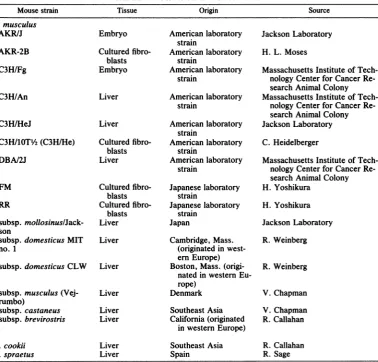
Mice. The sources for the mice used are shown in Table 1.
Cells and cell culture. The cell lines and culture conditions used were those described previously (7, 8).
DNApreparation. Theisolation of DNA from mouse livers and mouse embryos was as described previously (26). Theisolation of DNAfrom culture cells and the preparation of phage were performed according to standard procedures aspreviouslydescribed (4).
Restriction endonucleases. Restriction endonucle-ases wereobtained from NewEnglandBiolabs, Boeh-ringer Mannheim Corp., and Bethesda Research Laboratories. Generally, thedigestionconditions rec-ommended by the supplierwereused. Reaction
com-pletion was monitored by adding a sample of each incubation at time zero to 1 ,ugofwild-typephage A DNAand assayingfor completedigestionof phage X DNAbyelectrophoresis.
Southern blots.Themethod used for Southern blots was that ofSouthern (25) with the modifications of
Jeffreys and Flavell (12). Probes were prepared by preparative gel electrophoresis (18) and labeled in vitro by nick translation (17). Hybridizations were performed in thermally sealed plasticbagsas previous-ly described (4).
RESULTS
Weused the Southern blot technique to study
the organization of VL30-related sequences in
DNA isolated from various cell lines, inbred
laboratory animals, and wild isolates
repre-sentative of widely diverse geographic origins
(Table 1). Figure1illustratesapartial restriction
mapof aVL30 clone used in these studies. This
clone, termed BVL-1, was isolated from a
BALB/c Charon 4A X library and contains a
complete 5.5-kb VL30sequence(4).Inaddition,
it contains non-VL30 flankingsequences
harbor-ing both sharbor-ingle-copy and highly repetitive
se-quences. The repetitive sequences were
detect-edby annealing fragments of the clonetototal
TABLE 1. Mousestrains and cell lines
Mousestrain Tissue Origin Source
M.msuu
M. musculus
AKR/J
AKR-2B
C3H/Fg
C3H/An
C3H/HeJ
C3H/10Tl/2 (C3H/He)
DBA/2J
FM RR
subsp.
mollosinus/Jack-son
subsp. domesticus MIT no. 1
subsp. domesticus CLW
subsp. musculus
(Vej-rumbo)
subsp.castaneus subsp. brevirostris
Embryo
Cultured fibro-blasts
Embryo
Liver Liver
Cultured fibro-blasts Liver Cultured
fibro-blasts Cultured
fibro-blasts Liver Liver Liver Liver Liver Liver
American laboratory
strain
American laboratory
strain
American laboratory
strain
Americanlaboratory
strain
Americanlaboratory
strain
Americanlaboratory
strain
Americanlaboratory
strain
Japaneselaboratory
strain
Japaneselaboratory
strain
Japan
Cambridge, Mass.
(originatedin
west-ernEurope)
Boston, Mass.
(origi-natedinwester
Eu-rope)
Denmark
SoutheastAsia
California(originated
inwester Europe)
Jackson Laboratory H. L.Moses
Massachusetts Institute of Tech-nology Center for Cancer Re-search AnimalColony
MassachusettsInstitute of Tech-nology Centerfor Cancer Re-search AnimalColony
Jackson Laboratory C. Heidelberger
MassachusettsInstitute of Tech-nologyCenter for Cancer Re-searchAnimalColony
H. Yoshikura H. Yoshikura JacksonLaboratory R. Weinberg R.Weinberg
V.Chapman V.Chapman R.Callahan
Liver Southeast Asia
Liver Spain
M. cookii M.spraetus
R. Callahan R. Sage
J. VIROL.
on November 10, 2019 by guest
http://jvi.asm.org/
[image:2.491.63.442.315.677.2]0 2 4 6 8 10 12
KILOASE PANS
VL 30
I . w 0U9
Id
w 9 9
IL0 00prb
VL30 probe
t
FIG. 1. Map ofVL30 cloneBVL-1.Orientationisdefinedwithrespect tothephage A Charon4Avectorarms.
The solid bar represents the internal portion of the VL30 sequence, the hatched bars represent VL30long terminalrepeats,and theopenbarsrepresenthighlyreiterated DNA. Restrictionenzymecleavagesites shown
areEcoRI(
I),
HindIII(6),XhoI(V), KpnI (V),PstI(9),and BamHI(9).Thelocus-defining(Id)sequencelies betweenthe indicated XhoI and PstI sites. TheVL30probe (wavyline)usedwas amixtureof theVL30internal fragments derived fromaHindIII-XhoI digestandisolatedby preparative gelelectrophoresis. Thisprobewasdeterminedtobe representative of the entire VL30sequence,includingonecopyofthelongterminalrepeat,and
wasnotdetectably contaminated by non-VL30sequences asdeterminedby analytical gel electrophoresis.
mouse DNA under conditions in which only
repetitive sequences hybridize (9).
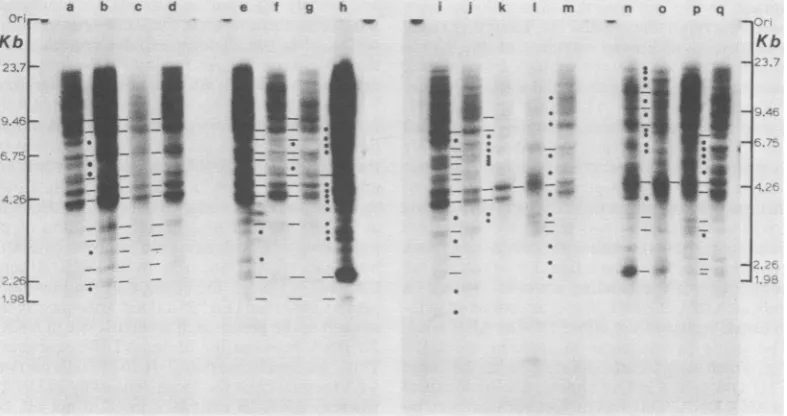
In our initial analysis, DNAs from various
strains and subspecies of mice were digested
with restriction endonuclease EcoRI,
electro-a b c d e f g h
C)rl
Kb
23.7
phoresed in a 1% agarose gel, transferred to
nitrocellulose, and hybridized to a VL30
se-quence probe (Fig. 2). Thisprobe was derived
from the BVL-1 clone (4) and consists of all of
the VL30 sequences, includingone copyof the
iik m n o p q
!
1"
----*
[*9
[image:3.491.50.457.60.214.2]Kb
FIG. 2. VL30sequence organization invarious mouse strains. Sampleswere digestedtocompletion with EcoRI, electrophoresed (10 p.g perlane)through0.7%agarosegelsfor36 hat25V,transferredtonitrocellulose, andhybridizedto32P-labeledVL30probes.HindlIl-cutwild-type phage DNAfragmentsservedassizemarkers.
Asaguide, pairwise comparisonswere made between adjacentlanes. Certainfragments which appearedtobe
common were joined with a line; those different werejoined with a dot. Some of the apparently common
fragmentsmayrepresentcoincidentalcomigrationof different DNAsequences.DNAsampleswerefrom AKR-2B(a); C3H/10T1/2 (b);C3H/An (c);C3H/HeJ(d);C3H/Fg (e);FM(f);RR(g);M.musculussubsp. mollosinus (h); M. musculus subsp. domesticusMITno. 1 (i);M. musculus subsp. domesticus CLW(j);M. spraetus(k);M. cookii(1); DBA (m);M. musculus subsp. musculus(Vejrumbo) (n); M. musculus subsp. castaneus (o); M.
musculussubsp. brevirostris(p);andAKR/J(q).
*
I I
i 43,
.4
0
0
on November 10, 2019 by guest
http://jvi.asm.org/
[image:3.491.53.447.372.580.2]514 COURTNEY ET AL.
longterminal repeat (Fig. 1). Internal
heteroge-neity withinthe VL30 sequences results in the
presenceof EcoRI sites in some, but not all, of
thesesequences. As a consequence, the sizes of
the DNA fragments detected by the Southern
technique are a function of the distribution of
EcoRI sites within each VL30 sequence as well
as the positions of these sequences within the
mouse genome.
VL30 sequences were present in multiple
copies in the genomes of all mice analyzed (Fig.
2). Inspite of this uniform geographic
distribu-tion, however, considerable polymorphism in
the organization of these VL30 sequences was
observed. This is apparent when different
spe-cies, different subspecies, different individuals
of the same subspecies, and different inbred
American laboratory strains, e.g., AKR, C3H,
and DBA, are compared (Fig. 2). Our
impres-sion is that more distantly related mice have a
greaternumberof differences from one another,
but the complexity of the pattern makes this
conclusion less certain.
Itis also of interestto notethatwithinagiven
inbred strain, e.g.,C3H/He, C3H/An,andC3H/
10T'/2,all DNAsgenerally appeared to be
identi-cal. This finding was ofinterest since it could
indicate that VL30 sequences have not
under-gone extensive rearrangementsortranspositions
duringthe 40 yearsor sothat thesesublines have
beenseparatelymaintained(3). Tofurtherstudy
this aspect, additional sublines of the highly
viremic AKR strain weresubjectedto a similar
analysis. The additional sublines chosen were
AKR/Gs, AKR/Fu, AKR/Ski, and AKR/N.
These sublines have beenseparatelymaintained
for several decades and exhibit considerable
variation in the number ofendogenousecotropic
murine leukemia virus genomes (28). Inspiteof
this, nopolymorphismin VL30bandingpatterns
could be detected in two separate experiments
(data not shown). Although subtle variations
could have escapeddetection duetotheoverall
complexity of the banding patterns, these data
indicated that mostVL30 lociarecommon
with-in testedsubstrainsofeither C3H or AKRmice.
The single exception to this pattern was C3H/
Fg, which was clearly different from the other
C3HDNAs and infactappearedtobeidentical
toAKR DNA.Thiswasfurther substantiatedby
the BVL-1 locus analysis described below and
may indicate genetic impurity in the derivation
of theC3H/Fgsubstrain. Thismaybe
particular-ly significant in view of the fact that C3H/Fg
animals are highly viremic and leukemic, quite
unlike other C3H lines but very similar to the
AKR strain.
It was important to determine whether the
observed differences in the Southern blot
pro-files (Fig. 2) reflected simple restriction site
polymorphisms, perhaps due to single base
changes, or differentlocations of VL30 elements
inthe various genomes. To investigate this
ques-tion, we studied the organization of DNA at a
specific locus defined by a piece ofsingle-copy
DNA (ld) located adjacent to theVL30 sequence
in clone BVL-1 (Fig. 1).
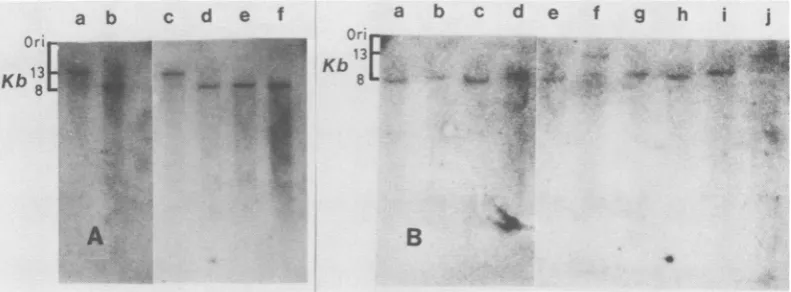
Initially, we hybridized the ld nucleic acid
probe to DNA from AKR-2B and C3H/10T'/2
cells digested with various restriction
endonu-cleases (Fig. 3A). Digestion ofC3H/10T/2DNA
with EcoRI produced a single hybridizing DNA
fragment of approximately 13 kb (lane a). This is
the same size as the BVL-1 clone, which was
also derived from an EcoRI digest, indicating
that a VL30 sequence is present at the locus
defined by the ld probe in the C3H/10T'/2
genome. EcoRIdigestion of AKR-2B DNA
pro-duced a single hybridizing fragment of approxi-mately 8 kb. Since the difference in size between
the fragments from AKR-2B DNA and C3H/
10TI/2 DNA (5 kb) is about the size of the VL30
sequence present in the BVL-1 clone, this result
suggested that the difference observed between
these two DNAs might be due to the presence of
aVL30 sequence in the locus defined by Id in the
C3H/10T'/2 genome and the absence of a VL30
sequence at this locus in the AKR-2B genome.
To test this hypothesis, these two DNAs were
additionally digested with HindIII, an enzyme
which cuts three times in the VL30 sequence but
not at all in the adjacent cellular sequences of
the BVL-1 clone. As predicted, the fragment
detected inC3H/10T'/2DNAwas reducedin size
byabout 5kb,whereas thefragment from
AKR-2B DNA wasunaffected.Similarly, KpnI
diges-tion produced the expected 1.5-kb reduction in
the size of the C3H/10T'/2 fragment but had no
effect on the AKR-2B fragment. Both DNA
samples were also analyzed by using HindIIl
and KpnI without prior EcoRI digestion (data
notshown). In both cases the Idprobe detected
fragments of different sizes in the AKR-2B and
C3H/1OTV2 DNAs, indicating that the
polymor-phismsobserved(Fig. 3) didnotarise merelyas
aresult of thepresence of anEcoRIsite in
AKR-2B DNA between the ld and VL30 sequences.
Thus, we concluded thatC3H/10T/2 cells carrya
VL30sequence at the locus definedbyld DNA,
whereas AKR-2B cells lack most, if not all, of
such asequence.
The ld sequence was also used to study the
distribution of allelesamong geographically
dis-persed mice (Fig. 3B).DNAfromMusmusculus
subsp. brevirostris and Mus musculus subsp.
musculus generated 13-kb fragments, indicating
that they carry VL30 sequences at this locus,
whereas DNA fromAKRIJ, DBA/2J, and Mus
musculus subsp. domesticus generated an 8-kb
band, suggestingthatthey lack a VL30 sequence
J. VIROL.
on November 10, 2019 by guest
http://jvi.asm.org/
MOUSE VL30 SEQUENCES 515
a b c d e f
.s ....
, _
_s.9;I
_#E*...X|Ti
'wR+t.IFw
-- v g.w..i...
...|.t_
t 5 F2 _ _
Kb13I
A
a b c d e f g h i
Or_ K13wF
Kb
8 "-.
....4&.
..'Amil
.4-1&,
&2A:.. -1-M
p
B
FIG. 3. Polymorphism at the BVL-1 locus. A portion (10 ,ug) of each appropriately digested DNA sample was run on 1% agarose gels at 30 V for 20 h, transferred to nitrocellulose, andhybridized witha32P-labeled Id sequence(seeFig. 1). This probewaspreparedbycuttingthe sequence from between theregions of reiterated DNAwithPstIand XhoI and waspurifiedbypreparative gel electrophoresis. DNA samples in (A)werefrom
C3H/10T'/2digestedwithEcoRI (a); AKR-2BdigestedwithEcoRI(b); C3H/1OTI/2digestedwithEcoRI-KpnI(c);
AKR-2Bdigested withEcoRI-KpnI (d);C3H/10TI/2 digestedwithEcoRI-HindIII (e); and AKR-2Bdigestedwith
EcoRI-HindIII (f). Samples in (B)werealldigested tocompletionwith EcoRI. These were from M. musculus
subsp. domesticus MIT no. 1 (a);M. spraetus(b);AKR/J (c); M. cookii(d);DBA/2J (e); M. musculus subsp.
musculus (Vejrumbo) (f); M. musculus subsp. castaneus (g); C3H/Fg (h); M. musculus subsp. mollosinusl Jackson (i); and M. musculus subsp. brevirostris(j).
atthis locus. Interestingly,DNAs from the other
mice examined appeared to generate bands
slightlylarger than 8 kb but smaller than 13 kb.
This may have resulted from slight technical
problems in the gels; alternatively, it may
indi-cate additional perturbations atthis locus,
per-hapsinvolvingthehighlyrepetitivesequencesin
theflanking region.
Rat genomes contain a family of virus-like
elements(21,31)whicharephysicallysimilarto
the mouse VL30 sequences. To determine
whether theratandmouseVL30elementswere
related by nucleotide sequence, we hybridized
clonedratandmouseVL30sequencesto
restric-tion enzyme digests ofrat, mouse, and cloned
rat VL30 DNAs. Direct hybridization between theratand mouseVL30 clones is shown inFig.
4, lane e. An intensely hybridizing band was
detected,demonstratingsequencehomology
be-tween ratandmouseVL30 elements. This band
representsaninternal 2.5-kb EcoRI fragmentof
rat clone 27A (6). Moreextensivemapping
ex-periments, tobe presented in detail elsewhere,
have established the presence of additional
mouse-relatedsequencesinanapproximately
1-kb Kpn/Bglll fragment corresponding to 27A
linearmap coordinates 0.2 to 1.2 (6). No other
mouse-relatedsequences weredetectable in this
clone. Complementary experiments also
estab-lished approximate locations forthe rat-related
sequences incloneBVL-1. Thesewere
restrict-edtoaPstIlKpnI fragmentthatmappedbetween
coordinates 1.0 and 1.7andaHindIlIlPstI
frag-mentthat mapped betweencoordinates 4.3 and
5.6(Fig.1). These resultscontrastwithprevious
experiments which suggest a lack of homology
betweenmouseandratVL30elements (21, 31).
This discrepancy might be explained by the
greater sensitivity afforded by representative
cloned probes, whichwereused here.
EcoRIdigestion of totalratDNAproduced a
complex pattern of bands detectable with arat
VL30probe, includingtwohigh-intensity bands
withapparentlengths of2.9and2.7 kb,
respec-tively (Fig.4,lane a). These presumably
result-ed fromEcoRI cleavage within many of therat
sequences. Whethereither band correspondsto
the 2.5-kb internalEcoRIfragment ofrat clone
27A is not clear. These same fragments were
detected, albeit with less sensitivity, with a
mouse VL30 probe (lane b), confirming the
notion that therat and mouseVL30 sequences
represent homolqgs. EcoRIdigestion ofmouse DNAproduced acomplex patternoffragments
detectable withamouseVL30probe (lanec). A
differentpattern offragmentswasdetected with
a rat VL30 probe. The complexity ofthe
pat-terns made it difficult to determine the exact
relationship between them, and, as a
conse-quence, we do notfully understand this result.
Nevertheless, it is apparent that mouse DNA
contains many sequences at least partially
ho-mologous to sequences present in a rat VL30
clone.
VOL.43,1982
i
.x":.I: ,ow A.'O
on November 10, 2019 by guest
http://jvi.asm.org/
[image:5.491.53.449.81.227.2]516 COURTNEY ET AL.
Kb
Ori 23.7 9.46 6.75 4.26i
97fiL
a b
I
c
I
d_i_
e
-I
vl
rat DNA rat DNA mouse DNA mouse DNA rat VL30 clone rat probe mouseprobe mouseprobe rat probe mouse probe
FIG. 4. Homology betweenratand mouse VL30 sequences.EcoRI-digestedratand mouse DNAs(10p,gper sample) wereelectrophoresed through0.8% agarose gels for 36 h at 20 V, transferred to nitrocellulose, and hybridized to either3"P-labeledratVL30 (6) or mouse VL30 probes. Samples were: NRK DNA (exposure time, 2h) hybridized to a ratprobe(a); NRK DNA (exposuretime, 20 h)hybridized to a mouseprobe (b); AKR-2B DNA(exposure time, 2 h)hybridized to a mouseprobe (c); AKR-2B DNA (exposure time, 20 h)hybridized to a ratprobe (d); and clone 27A rat VL30 DNA (exposure time, 2.5 h)hybridized to a mouse probe (e). All filters werewashed in 3xSSC (1x SSC is 0.15 M NaCl plus 0.015 M sodium citrate) before development. Stringent
washing (0.1x SSC)reduced thesignal, but most, if not all, fragments remained hybridized (data not shown).
DISCUSSION
VL30 sequences were present in multiple
copies in the genomes ofmice of diverse
geo-graphic origins (Fig. 2). The DNAs studied
in-cluded samplesfromvarious inbred strains and
feral subspecies ofM. musculus and from two
othermousespecies,M. spraetusandM.cookii.
Twootherspecies,M.cervicolorandM. caroli,
havepreviously been showntocontainmultiple
copies of VL30sequencesintheirgenomes(22).
Thesefindingsareincontrast tothedistribution
of theendogenousmousemammarytumorvirus
sequences in mice (3), the endogenous
Rous-associatedvirus-0-relatedsequencesin chickens
(11), and theecotropicAKR-type murine
leuke-mia provirus (27), all of which are absentfrom
somemembers of their host species. The
pres-ence of VL30 sequences in mice of diverse
geographicorigins implies thattheyarepresent
in all mice and argues that they did not arise
from recent insertions into the germ lines but werepresentmuch earlier in the evolution ofthe mouse, possibly beforespeciation.
The similarity of organization within inbred
strains and derived cell lines suggests that the
VL30 loci are presently stable within the
genome and would seem to argue against the
possibility that VL30 sequences are currently
highly active transposable elements. The two
C3H strains studied here were derived from a
crossbetweenaBaggalbino andaDBAmouse
60 years ago and have been separately
main-tainedfor approximately40 years(3). The lack
of any detectable differences among C3H/An,
C3H/HeJ, and the cell line C3H/1OTV2, which
wasderived fromC3H/Hemice8 years ago (16),
argues in favor of the stability of VL30 se-quences overthis time period. Further evidence
ofthis stability is the apparent identity among
DNAsfrom the variousAKRsublines and from
the embryo-derived cell culture line AKR-2B,
which was established approximately 10 years
ago (19). Thus, ifVL30 sequences are mobile,
rearrangement mechanisms such as
transposi-tion mustbe taking place at a low rate over a
longer periodof time. Similarly, these
observa-tionsargueagainst the frequent and widespread
introduction by retrovirus-associated
transmis-sion ofnewVL30 elementsinto thegermlinesof
the contemporary laboratory breeding
popula-tions we examined. The various AKR sublines
used are uniquely suited for detecting such an
occurrence since two of them, AKR/Gs and
AKR/Ski, appear to haverecently acquired
ad-ditionalAKV-type murineleukemiaproviral
se-quences intheirgermline DNA(28).
The studies of polymorphism at the BVL-1
locus indicated thatatleast someof the variation
observed among the VL30 sequences of
differ-entmice derives from differentlocations ofthe
VL30sequencesin themousegenome.Also, the
J.VIROL.
1.
on November 10, 2019 by guest
http://jvi.asm.org/
[image:6.491.102.392.80.266.2]presence of a VL30 sequence at the locus de-fined by the Id probe occurred only in certain laboratory strains of M. musculus, M. musculus subsp. brevirostris, and M. musculus, subsp. musculus. Based on the distribution of polymor-phic proteins, M. musculus subsp. brevirostris probably does not constitute a separate
subspe-cies; it appears, rather, to be indistinguishable
from M. musculus subsp. domesticus (20). The
M. musculus subsp. musculus individual used
for these studies came from a colony which
derives from mice trapped in the town of
Vej-rumbo, Denmark, which lies in the hybrid zone between M. musculus subsp. domesticus and M.
musculussubsp. musculus. Mice from this
colo-ny appear to be90% M. musculus subsp.
muscu-lus and 10%M. musculus subsp. domesticus in
their genetic makeup (A. Wilson, personal com-munication). Therefore, it would seem most
likelyapriori thatthis mouse derived its VL30
sequence at the ld locus from its M. musculus
subsp. musculus background. If this were true,
the VL30 sequence at the ld locus would have
been introduced before the separation of M.
musculus subsp. domesticus and M. musculus
subsp. musculus 2,000,000 years ago. Toexplain
theheterogeneity amongindividuals ofM.
mus-culussubsp. domesticus, it would be necessary
topostulate that the filledBVL-1 locuswas still
segregating atthe timeof thedivergence ofM.
musculus subsp. musculus and M. musculus
subsp.domesticusorthatVL30 sequenceswere
able to leave the BVL-1 locus after this
diver-gence. An alternative explanation, however, is
that in theVejrumbo mouse, the VL30 sequence
atthe Id locus may have been derived from its
10% M. musculus subsp. domesticus
back-ground.If this is the case,then,within the limits
ofourstudy,all micecarryingaVL30 sequence
at the ld locus are of or are related to M.
musculussubsp. domesticus,indicatingthatthe
VL30 sequence at the ld locus was introduced
within the last 2,000,000 years, after the
separa-tion ofM. musculus subsp. domesticus and M.
musculussubsp. musculus, and is still
segregat-ing.
In summary, the results of this study clearly
differ from several recent analyses of
endoge-nous retrovirus genomes. In contrast to the
endogenousmousemammarytumorproviruses,
theendogenous Rous-associated virus-0-related
proviruses of chickens, and the endogenous
AKV-type murine leukemia proviruses, VL30
sequences areubiquitous among tested animals
of the host species. We conclude that VL30
sequences have an earlier evolutionary origin
than theseproviruses. Inspite of this, however,
VL30 sequences exhibitadegree of locus
poly-morphism, as do the aforementioned
endoge-nous retroviruses. Thus, either many of the
VL30 sequences were introduced recently
enough so that several allelesare still
segregat-ing in the population (presumably inconsistent with their uniform and broad geographic
distri-bution), or, alternatively, VL30 elements are
more likely than cellular genes to undergo
marked genetic alterations such as
rearrange-ments, duplications, transpositions, or unequal
crossover. It is also possible that
retrovirus-assisted transmission via mixed pseudotype
viri-ons is an important source of locus
polymor-phism,although we were unable to find evidence
for this. The existence of genetic relatedness
between mouse and rat VL30 sequences is com-patible with the thesis that these elements are
quite ancient and evolved from a common
se-quence present in aprimordial rodent ancestor.
This early sequence could have been of either
cellular or retroviral origin.
ACKNOWLEDGMENTS
We aregratefultoH. A.Youngforproviding theratVL30
clone27A.
This work was supported byPublic Health Servicegrant
GM 25510 from the National Institute of General Medical Sciences andbytheMayo Foundation.
LITERATURE CITED
1. Besmer, P., U.Olshevsky,D.Baltimore,D.Dolberg, and H.Fan.1979.Virus-like 30S RNA in mouse cells. J. Virol. 29:1168-1176.
2. Cameron, J. R., E. Y. Loh, and R. W. Davis. 1979. Evidence fortransposition of dispersed repetitive DNA
familiesin yeast. Cell 16:739-751.
3. Cohen, J. C., and H. E. Varmus. 1979. Endogenous
mammary tumorvirus DNA varies among wild mice and segregatesduring inbreeding. Nature(London) 278:418-423.
4. Courtney, M.G., L. J. Schmidt,andM.J. Getz. 1982.
Organization and expression of endogenous virus-like (VL30) DNA sequences in nontransformed and
chemical-ly transformed mouse embryo cells in culture. Cancer
Res. 42:569-576.
5. Dhar, R., W. L.McClements, L. W. Enquist, and G. F.
Vande Woude. 1980. Nucleotide sequencesofintegrated
Moloneysarcomaproviruslong terminal repeats and their host and viraljunctions. Proc. Natl. Acad. Sci. U.S.A. 77:3937-3941.
6. Ellis,R.W.,D.DeFeo, J. M. Maryak, H. A. Young, T. Y.
Shih,E. H.Chang,D. R.Lowy, and E. M.Scolnick.1980. Dualevolutionaryorigin for the rat genetic sequences of Harvey murine sarcoma virus. J. Virol. 36:408-420. 7. Getz,M.J.,P. K.Elder,andH.L.Moses.1978.
Equiva-lent expression ofendogenous murine leukemia virus-related genes inC3H-10T2 cells andchemically trans-formed derivative cells.CancerRes. 38:566-569. 8. Getz, M. J., H. M. Reiman, Jr., G. P. Siegal, T. J.
QuinIan,J. Proper, P. K. Elder, and H. L. Moses. 1977. Gene expression inchemically transformed mouse
em-bryocells: selective enhancement of theexpression of C-type RNA tumor virus genes. Cell 11:909-921. 9. Hellig,R., F. Perrin, F. Gannon, J. L. Mandel, and P.
Chambon. 1980. Theovalbumin genefamily: structure of the X gene and evolution of duplicated split genes. Cell 20:625-637.
10. Howk, R.S., D. H.Troxler,D.Lowy, P. H. Duesberg, and
E. M.Scolnick. 1978. Identification of a30S RNA with properties of a defective type C virus in murine cells. J. Virol. 25:115-123.
VOL.43,1982
on November 10, 2019 by guest
http://jvi.asm.org/
518 COURTNEY ET AL.
11. Hughes, S. H., F. Payvar, D. Spector, R. T. Schimke, H. L. Robinson, G. S. Payne, J. M. Bishop, and H. E. Varmus. 1979. Heterogeneity of geneticloci in chickens:analysis of endogenous viral and nonviral genesby cleavage of DNAwith restrictionendonucleases. Cell 18:347-359. 12. Jeifreys,A. J., and R. A. Flavell.1977. Aphysicalmapof
the DNA regions flanking therabbitP-globingene. Cell 12:429-439.
13. Keshet, E., and Y. Shaul. 1981.Terminal directrepeatsin a retrovirus-like repeated mouse gene family. Nature (London) 289:83-85.
14. Keshet, E., Y. Shaul, J. Kaminchik, and H. Aviv. 1980. Heterogeneity of"virus-like"genesencoding retrovirus-associated 30S RNA and theirorganization within the mousegenome.Cell20:431-439.
15. Potter, S. S., W. J. Brorein, P. Dunsmuir, and G. M.
Rubin.1979. Transpositionof elementsof the412,copia
and 297dispersed repeatedgenefamilies inDrosophila. Cell17:415-427.
16. Rapp, V. R., R. C. Nowinski, C. Reznikoff, and C. Heidelberger.1975.Endogenous oncornavirusesin
chemi-cally inducedtransformation.I.Transformation indepen-dent virusproduction. Virology65:392-409.
17. Rigby, P. W. J., M.Dieckmann, C. Rhodes,andP.Berg.
1977. Labelling deoxyribonucleic acid to high specific activityin vitroby nicktranslation with DNApolymerase
I. J. Mol.Biol. 113:237-251.
18. Roop, D. R., M. J. Tsai, and B. W. O'Malley. 1980.
Definition ofthe 5' and 3' ends oftranscripts of the
ovalbumingene.Cell 19:63-68.
19. Rowe, W. P., J. W. Hartley, M. R.Lander,W. E.Pugh, and N.Teich. 1971. NoninfectiousAKRmouseembryo cell lines in which each cell has the capacity to be
activated to produce infectious murine leukemia virus.
Virology46:866-876.
20. Sage, R. D. 1978.GeneticheterogeneityofSpanishhouse
mice (mus musculus complex), p. 519-553. In H. C. Morse (ed.), Origins of inbred mice. Academic Press,
Inc., NewYork.
21. Scolnick, E. M., W. C. Vass, R. S. Howk,and P. H.
Duesberg. 1979. Defective retrovirus-like 30S RNA spe-cies of rat and mouse cells areinfectious if packaged by typeC helper virus. J. Virol. 29:964-972.
22. Sherwin, S. A., U. R. Rapp, R. E. Benveniste, A.Sen, and G. J. Todaro. 1978.Rescue of endogenous 30S retroviral sequencesfrommousecellsby baboon type C virus. J. Virol. 26:257-264.
23. Shimotohno, K., S. Mizutani, and H. M. Temin. 1980.
Sequenceof retrovirus provirus resembles that of bacteri-altransposable elements. Nature (London) 285:550-554. 24. Shoemaker, C., S. Goff, E. Gilboa, M. Paskind, S. W.
Mitra, and D. Baltimore. 1980. Structure of a cloned circular Moloney murineleukemia virus DNA molecule
containing aninverted segment: implications for retro-virus integration. Proc. Natl. Acad. Sci. U.S.A. 77:3932-3936.
25. Southern, E. M. 1975. Detection of specific sequences among DNAfragments separated by gel electrophoresis. J. Mol.Biol. 98:503-517.
26. Steffen, D. L., S. Bird, W. P. Rowe, and R. A.Weinberg. 1979.Identification ofDNA fragments carrying ecotropic
provirusesof AKRmice. Proc. Natl. Acad. Sci. U.S.A. 76:4554-4558.
27. Steffen, D. L., S. Bird, and R. A. Weinberg. 1980. Evi-dence for the Asiatic origin ofendogenous AKR-type murine leukemiaproviruses.J.Virol.35:824-835. 28. Steffen, D. L., B. A. Taylor, and R. A. Weinberg. 1982.
Continuinggermlineintegration of AKV proviruses
dur-ingthebreeding of AKR mice and derivative recombinant inbred strains. J. Virol. 42:165-175.
29. Sutcliffe,J. G., T. H. Shinnick, I. M. Verma, and R. A. Lerner.1980.Nucleotide sequence of Moloney leukemia virus: 3' end reveals details of replication, analogy to bacterial transposons and anunexpected gene. Proc. Natl. Acad.Sci. U.S.A.77:3302-3306.
30. Temin, H. M. 1980.Originsofretrovirusesfromceliular
moveable genetic elements. Cell21:599-600.
31. Tsuchida, N., R.Gilden,and M. Hatanaka. 1974.Sarcoma
virus-related RNA sequence in normal ratcells. Proc. Natl. Acad. Sci. U.S.A. 71:4503-4507.
J. VIROL.
on November 10, 2019 by guest
http://jvi.asm.org/