Two-Species Bose-Einstein Condensates in Optical Lattices
Russsell Campbell and Gian-Luca OppoInstitute of Complex Systems, SUPA and Department of Physics, University of Strathclyde, 107 Rottenrow, Glasgow G4 0NG, Scotland, UK.∗
Mateusz Borkowski
Institute of Physics, Faculty of Physics, Astronomy and Informatics, Nicolaus Copernicus University, Grudziadzka 5, 87-100 Torun, Poland
(Dated: November 26, 2014)
The dynamics of static and traveling breathers in two-species Bose-Einstein condensates in a one-dimensional optical lattice is modelled within the tight-binding approximation. Two coupled discrete nonlinear Schr¨odinger equations describe the interaction of the condensates in two cases of relevance: a mixture of two ytterbium iso-topes and a mixture of87Rb and41K. Depending on their initial separation, interaction between static breathers of different species can lead to the formation of symbiotic structures and transform one of the breathers from a static into a traveling one. Collisions between traveling and static discrete breathers composed of different species are separated in four distinct regimes ranging from totally elastic when the interspecies interaction is highly attractive to mutual destruction when the interaction is sufficiently large and repulsive. We provide an explanation of the collision features in terms of the interspecies coupling and the negative effective mass of the discrete breathers.
PACS numbers: 03.75.Mn, 03.75.Lm, 03.75.Kk, 05.45.Yv
I. INTRODUCTION
Bose-Einstein condensates have become a formidable tool for studying basic fundamentals of atomic physics [1, 2]. When confined to an optical lattice they serve as an interest-ing analogue to a solid-state system [3,4], providing means to study solid-state phenomena at an unprecedented level of parameter control. These include quantum phase transitions from the superfluid to Mott-insulator regimes [5], transport phenomena [6], Anderson localization [7], low-dimensional systems [8], discrete breathers [9] and solitons [10]. The latter can exist both with or without a periodic potential, although a lattice environment makes it possible for solitons and dis-crete breathers to exist even when the interactions in the BEC are repulsive (“gap solitons”) [11–13]. Such states have been observed experimentally in [14]. Several other methods have been proposed in the literature, including the use of an addi-tional harmonic potential [15] and boundary dissipations [16], which could also be used for non-demolition probing of these states [17].
The introduction of a second atomic species, i.e. the cre-ation of a binary mixture of Bose-Einstein Condensates leads to even richer physics. In a harmonic trap the two species may be immiscible due to the interspecies interaction, leading to phase separation [18,19]. In an effectively one-dimensional environment, the repulsive interaction between atoms of dif-ferent species (‘interspecies’ interactions) during the forma-tion of the condensate can leave the mixture far from its ground state [20,21]. The interspecies interactions heavily influence the transport properties of a condensate in a lattice
∗
Electronic address:[email protected]
[22,23]. Repulsive interactions enable the formation and ex-tend the stability region of the so-calledsymbiotic gap soli-tons [24–26], i.e. two-species solitons localized together in the same spot of the lattice. Somewhat counter-intuitively, an attractive interspecies interaction may split the two overlap-ping solitons [27].
So far most of the work has concentrated on the existence of two-species solitons and their stability [24–32]. Without a lattice potential, two-component (symbiotic) solitons were found with attractive interspecies interaction [33]. Collision of single species solitons without a lattice potential have also been shown to form symbiotic structures [34]. Collisions of symbiotic breathers were studied in [35]. In this paper we take a complementary approach – we start with well-defined single-species discrete solitons (two traveling breathers or a self-trapped state and a traveling breather, the first made of one species and the other of the second species) far apart in the lattice and simulate their collisions. For a single species BEC confined to a one-dimensional lattice collisions of trav-eling breathers have been analyzed in detail in [36]. Such an approach has also been used in the case of binary BECs in harmonic traps [37,38]. We perform our simulations using experimentally reachable conditions, with specific reference to two feasible experiments of two-species BECs in optical lattices.
spec-troscopy [45] and are now well established. The rich isotope structure of ytterbium enables mass tuning of the scattering length. It has been shown that, unlike in alkali-metal species, optical Feshbach resonances can be used to effectively change the intraspecies scattering length [46–48], thus raising hope for optical control of interactions between different isotopes, especially that now their positions are known from inter-isotope photoassociation spectroscopy [49]. Three bosonic isotopes of ytterbium, namely168,170,174Yb, have positive in-traspecies scattering lengths of the order of a few nanometers leading to similar stable condensates. Since the isotope shifts are small compared to the detuning of the far offresonant trap (FORT), the potential seen by different isotopes is basically identical. Consequently, given the mass ratios also close to one, this will result in very similar tunneling rates.
Even though these three isotopes are similar in terms of the single-species scattering length, the interspecies interactions of different pairs of isotopes differ dramatically. The inter-action between a 170Yb and 174Yb atoms is described by a large negative scattering length of -27.3 nm, while for168Yb and170Yb it is positive and equal to 6.2 nm. Halfway be-tween these two is the case of168Yb and174Yb characterized by a negligible scattering length of 0.13(18) nm, where the two condensate species should essentially ignore each other.
An interesting mixture of heteronuclear BECs has been ob-tained in an experiment of Thalhammer et al. [50], where 41K and87Rb atoms are condensed together in an optical lat-tice. A remarkable property of this mixture is that the inter-species scattering lengtha1,2 describing the effective interac-tion of colliding potassium and rubidium atoms can be tuned over a wide (both positive and negative) range using a mag-netic Feshbach resonance, while the single-species scattering length remains positive for either species. This mixture is an example of one with a large tunneling rate ratio, in contrast to the ytterbium mixtures, where this ratio is close to one.
We present an analysis of the interaction and collisional behavior of discrete breathers in two-species BEC in op-tical lattices in the tight-binding approximation which has been successfully used to describe single-species experiments [9,11,12,51]. In Section II the derivation of the model and an estimate of the parameters are provided. Interaction of sta-tionary breathers in close proximity to each other is described in section III. Collisions of traveling breathers and trapped states are described in Section IV as a function of the inter-species coupling parameter. Section V provides an explana-tion of the different kind of collisions observed in the nu-merical simulations where inelastic behavior is found in the mutually-repulsive case and elastic in the mutually-attractive case. Finally, the Appendix shows that the main results of the breather collisions and interactions are robust to survive in a model where the spatial variable is continuous rather than discrete.
II. THE TIGHT-BINDING APPROXIMATION APPLIED
TO A TWO-SPECIES BOSE GAS
We analyze the behavior of the two-species Bose gas with the use of the tight-binding approximation, follow-ing the treatment described in [23]. The time-dependent Gross-Pitaevskii equations describing the dynamics of the two species’ order parametersΨi(wherei=1,2) read
i~Ψi˙ (~r)=
−~ 2
2mi∇
2+U(~r)+X j=1,2
gi,j|Ψj(~r)|2 Ψi
(~r), (1)
where the coefficients gi,j describe the effective mean-field intra- and interspecies interactions and are given by
gi,j= 4π~2ai
,j 2µi,j
, (2)
whereµi,j=(mi−1+m−j1)−1is the reduced mass of the atomic pair andai,jis the scattering length relevant in the scattering properties of the species’ atoms.
The external potential confining the BECs is due to two overlapping and counter-propagating laser beams that create a standing wave in the axial direction and, as a result, a peri-odic potential of depthV0,i. The Gaussian profile of the two laser beams gives rise to an approximately harmonic off-axis confinement described by the frequenciesωr,i. Thus the exter-nal potential reads
Vi=V0,isin2(kx)+ 1 2miω
2 r,i(y
2+
z2). (3)
Note that real optical lattices also have a shallow harmonic potential superimposed in the axial direction, which we here assume to have negligible effects. We also introduce the lattice strengthssi = V0,i/ER,i, whereEr,i = ~2k2/2mi is the recoil energy calculated for the lattice wavelength. The axial on-site frequency of the lattice is thenωi=
√
si~k2/mi.
Both order parameters obey the normalization condition R
d3~r|Ψi|2 =Ni, whereNidenotes the total number of atoms of thei-th species in the lattice.
If the lattice is strong enough, i.e. the trap depth is suffi -ciently large, the condensate is well localized around poten-tial minima. For each of the mixture’s order parameters we use the followingansatz[11,23,30]:
Ψi=X n
ψi,n(t)φi(~r−~ri,n), (4)
whereφiis an on-site wavefunction and~ri,nis the location of then-th lattice site seen by thei-th species. When the atomic interactions are weak, the on-site ground state wavefunction can be replaced by the ground state harmonic oscillator wave-function in the off-axis direction and a Wannier function [52] of the lowest band in the axial direction to account for tunnel-ing. Consequently,|ψi,n(t)|2may be interpreted as the number ofi-th species atoms in the n-th lattice site as a function of time andP
Substituting thisansatzinto the Gross-Pitaevskii equations and dropping all terms mixing different lattice sites except for the ones that describe tunneling (see [11,23]) one obtains
i~ψ˙i,n = −Ji ψi,n−1+ψi,n+1 +
λi,i|ψi,n|2+λ1,2|ψ3−i,n|2+i,n
ψi,n (5)
where
Ji= Z
d3~rφi(~r−~ri,n) −~2
2mi∇ 2+V
i !
φi(~r−~ri,n+1) (6)
is the hopping integral describing the tunneling of the i -th species and is proportional to -the intersite tunneling rate γi=Ji/~, whilei,n=
R
d3~rφi(~r−~ri,n) −
~2 2mi∇
2+Vi
φi(~r−~ri,n) is the on-site chemical potential. The self- and mutual interac-tion is described by the parametersλi,i=gi,i
R d3~r|φ
i(~r)|4and
λ1,2=g1,2 R
d3~r|φ1(~r)|2|φ2(~r)|2, respectively.
A. Normalization
In order to move towards a more standard and compu-tationally efficient form of two coupled discrete nonlinear Schr¨odinger equation (DNLSE), we introduce
zi,n = r
1 Niψ
∗
i,n exp −i
iτ ~γ1 !
(7)
τ = γ1t (8)
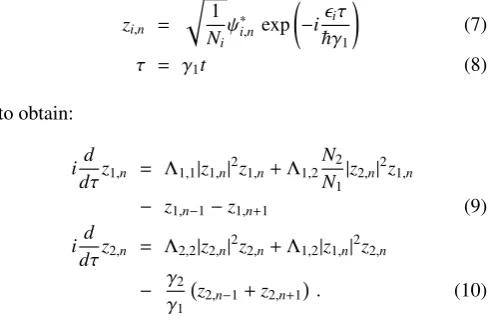
to obtain:
i d
dτz1,n = Λ1,1|z1,n| 2
z1,n+ Λ1,2 N2 N1
|z2,n|2z1,n
− z1,n−1−z1,n+1 (9)
i d
dτz2,n = Λ2,2|z2,n| 2z
2,n+ Λ1,2|z1,n|2z2,n
− γ2
γ1
z2,n−1+z2,n+1. (10)
In Eqs. (9-10) we have defined the following parameters:
Λi,i=
λi,iNk
~γ1 Λ
1,2 = λ1,2N1
~γ1
. (11)
Thus the atomic distribution of each species over the entire lattice is normalized to unity:
X
n
|zi,n|2=1. (12)
[image:3.595.55.303.380.540.2]To ensure that the energy and density in the system are con-served, we use a symplectic fourth-order integrator of the Yoshida type [53,54]. The energy and density are both con-served up to 9 decimal places at each integration time step.
TABLE I: Values of parameters used in the simulations
Pair s1 s2 γ2/γ1 Λ1,1 Λ2,2 Λ1,2 168Yb+170Yb 3.19 3.27 0.96 5.28 1.368 2.51 170Yb+174Yb 3.27 3.43 0.91 1.368 2.486 –12.24
87Rb+41K 3.03 7 6.97 12.31 5.89 (free)
B. Estimate of the calculation parameters
In Section III(A) we present results that model different Bose gas mixtures, notably mixtures of ytterbium isotopes and that of41K+87Rb. At present, the only ytterbium isotope mixture BEC obtained so far is that of174Yb+176Yb where, however, the176Yb part instantly collapses because of its neg-ative scattering length [42]. Thus we focus on ytterbium mix-tures of isotopes whose scattering length is positive, namely 168Yb,170Yb and174Yb. The latter two have already reached BEC separately [39,40] while the major technical difficulty in reaching a168Yb BEC is its low natural abundance of 0.13%. To calculate the self nonlinear parameter, λi,i, it is suffi -cient to approximate the on-site wavefunctionφi,n(~r) with a harmonic oscillator ground state, which is basically a Gaus-sian, to yield
λi,i=ai,i r
mω2 rω
2π~ (13)
In the case of ytterbium mixtures the mutual interaction pa-rameterλ1,2can also be estimated from the above formula as the masses of the two isotopes are very similar and the two wavefunctions are well overlapped.
In the case of the41K+87Rb mixture the two wavefunctions are differently shaped (one is narrower than the other due to the difference in masses). The difference in the masses of the two species has a further effect - the two clouds are separated due to gravity but an additional laser can be used to force over-lap of the two species [55]. The scattering length of87Rb is 5.25 nm [56] while for 41K it is 3.1 nm [57,58]. The inter-species scattering length can be changed by the use of a con-venient magnetic Feshbach resonance [59] so thatλ1,2can be considered as a free parameter.
To estimate the tunneling rates γi, it is not sufficient to approximate the on-site wavefunctions with Gaussians and one has to use the Wannier wavefunctions. This is because the tunneling rate is mostly determined by the wings of the on-site wavefunction which have an oscillatory-exponential rather than a Gaussian tail. In this case the tunneling rate can be approximated as [4]
Ji=~γi= 4 √
πEr,is 3/4 i exp(−2
√
si). (14)
cleartraveling breather at larger densities. This is a general property of gap solitons [15]. The results apply, however, to larger values ofNiup to 105.
In the case of the87Rb and41K mixture we consider a lattice wavelength of 1064 nm and we take the (tunable) lattice depth to beVe = 7Er for rubidium so that the same parameter for potassium is around 3. This is done to ensure that we can still use the tight-binding approximation (i.e. tunneling rates to further sites are at least an order of magnitude smaller thanγi, see table I in [4]). On the other hand the tunneling rate needs to be large enough for traveling breathers to exist.
The calculation parameters discussed above are shown in tableI.
III. BREATHER INTERACTION
It has been demonstrated that initially Gaussian wavepack-ets can evolve via the single species DNLSE into static breathers [9,11,51]. If the wavepacket is given a momentum in a certain direction, traveling breathers that translate across the lattice can also be formed. The general expression of the initial wavepacket is:
zi,n= v u
t 1
q 2πσ2i
exp −
(n−n¯i)2 4σ2
i e
ipin (15)
whereσiis the initial width of the Gaussian cloud, and ¯niis its position. For the single species case, low nonlinearity and val-ues of|pi|between zero andπ/2, corresponding to a positive cospi, the cloud expands diffusively within the lattice. Local-ization into static breathers is then observed when increasing the repulsive self-interaction Λi,i. However, when the pseu-domomentum crosses π/2 and the repulsive self-interaction Λi,i is not too large, traveling breathers are formed (unless cospi is exactly 1, in which case the breather is stationary) [9,11,16,17,51,60].
In this section, we run simulations starting from sta-tionary breathers of 168Yb and 170Yb in separate positions. These are formed by running simulations of initially Gaus-sian wavepackets with Λ1,2 = 0 and letting them reshape with dissipation applied at the boundaries to get rid of the background (see [9] for a detailed description of the effects of dissipation). The final stable single-species breathers are of the “staggered” type and evolve in time aszi,n(τ)= exp (−iµiτ)(−1)nυi,nwhereυi,nsatisfies the stationary
equa-tions
µ1υ1,n− υ1,n+1+υ1,n−1−
υ2 1,n+βυ
2 2,n
υ1,n=0 (16)
µ2υ2,n−
γ2 γ1
υ2,n+1+υ2,n−1−
αυ2 2,n+βυ
2 1,n
υ2,n=0
withβ = Λ1,2/Λ1,1 andα = Λ2,2/Λ1,1. The breathers are
spatially localized (see inset of Fig.1(a), in which the ex-ponential tails of the breathers are seen clearly in a loga-rithmic scale). Substituting the exponential ansatz
vi,n=Aiexp (−qi|n|) (17)
into equations (16), as in [26], we find that the decay rates
qiand frequenciesµiof the breathers are related via:
q1=ln
µ1+ q
µ2 1−4
(18)
q2 =ln γ2 γ1
µ2+ s γ2 γ1 µ2 !2 −4 .
Following again [26], we obtain variational equations from an effective Lagrangian given by
A21coth(2q1)+βA22coth(q1+q2)=2 tanh(q1/2)+
(µ1−2) coth(q1) (19)
αA22coth(2q2)+βA21coth(q1+q2)= 2γ2
γ1
tanh(q2/2)+
µ2− 2γ2
γ1 !
coth(q2).
Solutions with bothA1andA2different from zero and
cor-responding to symbiotic breathers may exist forβ > 0. In contrast to [26], single-species staggered breathers exist in the uncoupled case ofβ = 0. For this reason we can-not exclude the existence of symbiotic breathers forβ <0. We can however state that symbiotic breathers that are more localized than the original single-species interacting breathers, such as those generated in the numerical sim-ulations below, do not exist forβ < 0. In the case of in-creasing values ofqi, one can see from Eqs. (19) that the fastest growing terms are those containingµithat depends
exponentially onqi, while the intensitiesA2i grow only lin-early withqi. Such growth can only be compensated by a positive term containingcoth(q1+q2)on the left hand sides
of Eqs. (19) and corresponding toβ >0. We can then con-clude that no symbiotic breathers corresponding to fur-ther localization of the atomic density can form with nega-tiveβfrom the interaction of two staggered single-species breathers.
In the simulations presented in this subsection, the fre-quencies of the single-species breathers forΛ1,2 = β = 0
are found to beµ1=2.1andµ2=4.1. The decay rates are
then calculated using equations (18) to get q1 = 0.3 and q2 =1.3, respectively. Once the breathers are formed and
the background noise has vanished, we turned the dissi-pations offand measured values ofq1andq2within a few
percents from the predictions of (18).
To study the interactions of these breathers, we have set
Λ1,2to the value of 2.51 and changed the initial distanceD
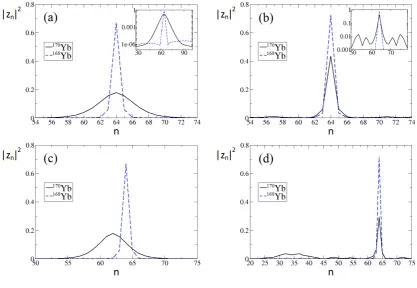
between the centers of two single-species breathers. With the stationary breathers centered on the same site at the start of the simulation (D =0), a symbiotic staggered breather is formed, with the170Yb breather moving atomic density into the background (see the insets of Fig. 1 (a) and (b) where we show that the background of the170Yb breather has
increased from around10−6 to around10−2). The density profile of the symbiotic breather is then different from that of the two single-species breathers corresponding toΛ1,2 = 0.
FIG. 1: (Color online) Density profiles of170Yb (black solid line)+168Yb (blue dashed line) mixture. (a) Initial density profile of170Yb+ 168Yb breathers withD =0. Inset displays the logarithmic profile of this, which shows the exponential tails of the breathers. (b) Density profile of170Yb+168Yb breathers atτ=1000 afterΛ
1,2is switched on forD=0. Note that the density profiles have changed when forming the symbiotic breather. The inset shows the logarithmic profile, in which the background of the170Yb species can be seen more clearly. (c) Initial density profile of170Yb+168Yb breathers withD=2. The wavefunctions of the two species still overlap significantly. (d) Density profile of170Yb+168Yb breathers atτ=1000 afterΛ
1,2is switched on forD=2. Note that the170Yb is smaller and some of the background has become localized to the left of the main breather.
the frequencies µi and the exponential slopes qi of the
breathers, making the breathers narrower and more lo-calized. The frequencies are increased to µ1 = 3.1 and µ2=5.3and the decay rates are both increased toq1=1.0
andq2 =1.6. The measured values ofµi,qiandAisatisfy
the variational Eqs. (19) within less than one percent in spite of the approximations made.
This behaviour keeps occurring when the initial distance between the breathers is larger, but still small enough that the initial density profiles overlap significantly. An example of this behavior is shown in Fig. 1 (c) and (d), forD = 2. Here, we see that less of the170Yb atoms join with the sym-biotic breather and more are expelled into the background. A small traveling packet is then formed from the atoms in the background. The reshaping process of the168Yb breather is much the same as withD = 0. The formation and evolu-tion of a traveling breather out of the interacevolu-tion of two static breathers of separate species is presented in Fig.2. With D = 8, the initial density profiles of the breathers only overlap at the tails (see Fig.2(b)). The result of this is that only a small density of170Yb atoms contributes to the symbiotic breather. AsDis increased, more170Yb atoms
go into the backeground to support the traveling breather
and less in the symbiotic one. A nonzero background is required for the traveling breather to exist [9]. The in-set of Fig.2(b) shows the logarithmic profile of the170Yb condensate, in which it is clear that the background is sig-nificantly higher than that of the initial condition.
It is important to stress that the motion of the traveling breather made of170Yb atoms is due to the interaction of
the two species viaΛ1,2being different from zero. In the
case of no interaction (Λ1,2 = 0) both breathers remain
stationary at all times. No symbiotic breather has been observed to form via the interaction of two single-species breathers forΛ1,2 <0.
IV. COLLISION OF TRAVELING AND STATIONARY
BREATHERS
[image:5.595.87.505.53.341.2]confin-FIG. 2: (Color online) Interaction between initially stationary breathers in the170Yb (black solid line)+168Yb (blue dashed line) mixture forD=8. (a) Evolution of170Yb part of the mixture. The majority of170Yb atoms forms a traveling breather while the remain-ing atomic density is absorbed by the168Yb breather to form a sym-biotic breather. We only show the170Yb part of the mixture since the 168Yb evolution is rather straightforward, with the breather highly
lo-calized in the center. (b) Density profile of the initial condition in a logarithmic scale, showing the overlap at the tails. The inset shows the density profile of the170Yb mixture atτ =1000. Note that the background is significantly higher than in the iniital condition, al-lowing the breather to travel.
ing the condensate. Such accelerations were realized experi-mentally in [61] and were used to observe a lensing effect on the condensate cloud. In the case of two different species in the same lattice the difference in the masses will naturally lead to different pseudomomenta of the clouds after acceleration to the same group velocity, thus making collisions possible.
In Fig.3, we show three symplectic simulations of two col-liding traveling breathers, with carefully chosen parameters so that there would be a minimal amount of sound-waves emitted from the initial Gaussian distributions. In all simulations pre-sented in Fig.3the breathers start from the same initial con-ditions but with different values of the interspecies interaction
FIG. 3: (Color online) Collision of two “clean” traveling breathers, with minimal sound-waves. The initial conditions areΛ1 = Λ2 = 1.1, ¯n1=16, ¯n2=112,σ1=σ2=3 and cosp1=cosp2=−0.95 for all panels. Note thatp1 =−p2and therefore the traveling breathers move in opposite directions.Λ1,2=0 is set to: (a)0, (b)-20 and (c)30. In (a), the breathers ignore each other acting as if the other species was not present. In (b), the breathers collide elastically. In (c), the breathers are destroyed and a new symbiotic breather is created. The color here represents the total density of the two species, unlike the other figures.
parameterΛ1,2. The color represents the (normalized) atomic density|zn,i|2withi=1 for one species andi=2 for the other. The simulations start with two Gaussian wavepackets of the form (15) with cosp1=cosp2=−0.95 andp1=−p2to form two colliding traveling breathers.
In Fig.3(a) when the interspecies interaction parameterΛ1,2 is set to zero, the breathers follow the dynamics of single-species condensates and pass through each other unaffected. WhenΛ1,2 is a non-zero value, the two species affect each other when occupying the same lattice sites. This is shown in Fig.3(b) and (c). At the beginning of the simulations, when the breathers are far apart from one another in the lattice, they follow the same path as in Fig.3(a), until they collide. For large negative values ofΛ1,2, the breathers collide elastically, as shown in figure3(b). In this example,Λ1,2 =−20 and the breathers become narrower when they collide. In Fig.3(c), Λ1,2 is changed to a positive value and the collision is not elastic. At the collision, the breathers explode, emitting a large amount of sound waves and a stationary symbiotic soli-ton composed of both species is formed.
It is worth noting that elastic collision occurs when the in-terspecies interaction parameter is negative, which would nor-mally implyattractiveinteractions between the two species. Normally the two clouds try to achieve maximal overlap in or-der to minimize energy [34], while in our case the tendency is to minimize the overlap and retain separation of at least a few lattice sites. An explanation of this phenomenon by using the negative effective mass of the discrete breathers is provided in Section V.
[image:6.595.320.560.53.214.2] [image:6.595.67.283.54.420.2]FIG. 4: (Color online) Collisions of two breathers in the 170Yb (Species 1) +174Yb (Species 2) mixture characterized by a large negative interspecies scattering length of -27.3 nm. The Gaussian parameters for the initial condition in (a) are ¯n1 = 16, ¯n2 = 112, σ1 = σ2 = 3 and cosp1 = cosp2 = −0.95. For (b), the phys-ical situation is the same as in Fig. 4(a), except that ¯n2 = 64 and cosp2 = −1 to make a stationary breather. In (a), 2 travel-ing breathers collide elastically. In (b).A traveltravel-ing breather transfers large part of its (pseudo)momentum to a stationary one and nearly stops.
survive well localized for extremely long timescales. For the simulations in Fig.3, we have carefully chosen the pa-rameters so that the amount of sound-waves emitted from the breathers is minimal and find that, at the moment of collision, the breathers have only lost less than 0.47% of their densities. We also found that without interactions be-tween species, they survive in simulations with timescales ofτ ≈106, which is much higher than the collision times
considered here.
In the following we turn our attention to values of the pa-rameters chosen from tableIto model mixtures of ytterbium isotopes and that of41K+87Rb in realistic configurations. In these simulations, although the initial condition emits large amount of noise, we show that the main dependance of the collision from the interaction parameterΛ1,2remains that dis-played in Fig.3.
In Fig.4we show numerical simulations of two colliding breathers in the170Yb +174Yb mixture that display similar results to that of Fig.3(b). Note that for all following sim-ulations, the dynamics of each species is shown in separate panels, unlike Fig.3. For example, the left column in Fig.4 shows the170Yb species, while the right column shows the 174Yb species. In Fig.4(a), at aboutτ≈90 the two breathers collide elastically, as in Fig.3(b) since the interspecies scat-tering length is large and negative.
Figure4(b) shows a similar situation, except that now one of the breathers (174Yb) is at first stationary (cosp2=−1). Af-ter the collision the initially traveling breather (almost) stops while the other, up to now stationary, starts traveling. One
FIG. 5: (Color online) Inelastic collisions of ytterbium isotopes. In (a), a traveling (170Yb, species 1) and stationary breather (168Yb, species 2) collide for a positive interspecies scattering length of 6.2 nm. The initial condition parameters are ¯n1 = 16, ¯n2 = 64, σ1 =5,σ2 =3, cosp1 = 0.8, cosp2 =1.0. As in Fig. 3(c), the traveling breather is destroyed and a newsymbioticsoliton is cre-ated. In (b) we have the same physical situation as in Fig.4(a), except that the parameterΛ1,2 describing the interspecies has now been increased to 4, corresponding to a positive interspecies scatter-ing length of 8.9 nm. In this regime, the two breathers tunnel through each other. Note that a small part of each breather is trapped inside the other forming double-species traveling breathers.
could argue that this is a manifestation of a form of conserva-tion of momentum. Again, as in Fig.3, the elastic behaviour occurs even though the170Yb and174Yb pair is described by a large negative scattering length ofa1,2 =−27.3 nm, which, under normal circumstances, stands forattractionbetween the atoms of the two species.
Compared to the examples in Fig. 3, there is a much larger amount of sound waves emitted from the breathers in Fig.4 due to the parameter values used from TableI. For example, in Fig.4(a), the170Yb (174Yb) breather loses 1.83% (15.5%) of its density from the sound waves. Small amplitude sound waves do not affect the main collision in a significant way since the central part of each breather acts as an effective barrier to the sound waves emitted by the breather of the other species. Sound waves that would normally expand over the entire lattice are now confined to a region limited by the central parts of the two breathers. The scattering of sound waves due to discrete breathers is investigated in detail in [62].
[image:7.595.66.285.53.241.2] [image:7.595.328.547.53.241.2]FIG. 6: (Color online) A collision of a traveling (41K, species 1) and a stationary breather (87Rb, species 2), with the interspecies in-teraction parameter Λ1,2 = 3 (a) andΛ1,2 = −9 (b). The initial condition parameters are ¯n1 = 64, ¯n2 = 12, σ1 = 0.5, σ2 = 3, cosp1 = 1, cosp2 = −0.9. In (a), the traveling breather tunnels almost completely through the self-trapped state, while in (b), the traveling breather bounces elastically from the self-trapped state with only a minor proportion tunneling through.
the two breathers literally explode emitting a large amounts of sound waves and forming a double-species symbiotic station-ary breather. In this state, the two component wavefunctions are well overlapped. Moreover, the final breather is much nar-rower than any of the original breathers before the collision. The frequency of oscillation of the two final co-located and co-existing breathers is species dependent. In the case dis-played in Fig.5(a) the frequency of the168Yb breather is about 1.5 times that of the170Yb breather located on the same site.
To further explore these phenomena we carried out a sim-ulation for the physical situation described in Fig. 4(a) of the 170Yb+174Yb mixture but with the interaction parameter Λ1,2increased to 4 corresponding to an interspecies scattering length ofa1,2 =8.9 nm. Such an increase can potentially be achieved using an optical Feshbach resonance. In this situa-tion, we observe the collision of two traveling breathers with a positive interspecies interaction as shown in Fig.5(b). We find yet another collision behavior with these parameters: the two breathers mainly tunnel through each other but at each collision a fraction of the atomic species in one soliton be-comes trapped inside the other. Moreover, the breathers ap-pear to accelerate or decelerate for a brief time during the strong interaction. In this simulation we consider that lat-tice sites outside the condensate are empty resulting in traveling breathers to ”bounce” off at reflective bound-aries [63]. This is realized experimentally by fixing the size of the condensate with external magnetic fields. We have included this effect here to show that when the breathers collide with each other for a second time, the result is a stationary symbiotic breather.
Quite different results are obtained for the41K+87Rb
mix-ture, characterized by a large tunneling rate ratio ofγ2/γ1 ≈ 6.97. This, together with the large self-interaction of Rb, changes the physics dramatically.
In Fig. 6we show a collision of a traveling breather and a self-trapped state of rubidium atoms. Within the range of our simulation parameters that simulates possible experimen-tal realizations, it has proved not possible to initiate a trav-eling breather state with the Rb condensate due to its large self-interaction. We set the interspecies interaction parameter Λ1,2 = 3 for Fig.6(a) andΛ1,2 = −9 for Fig.6(b). In both cases the rubidium breather acts only as a potential barrier, through which some of the incoming potassium soliton can either reflect or tunnel. This behavior, which contrasts with the phenomena seen in the simulation with ytterbium, can be attributed to the drastically different tunneling rates of potas-sium and rubidium.
V. THE COLLISION MECHANISM
To understand the mechanisms at the base of the collision outcomes, we have investigated the dependence of the result of the collisional process with respect to the heteronuclear in-teraction. By treating the discrete condensate wavefunctions as distributions we define the mean lattice site
hnii= X
n n
zi,n 2
, (20)
and its standard deviation,
h∆nii=
X
n
(n− hnii)2 zi,n
2
1/2
. (21)
These two parameters describe theglobalbehavior of the con-densate. In fact, if a breather splits or is destroyed in a colli-sion, the standard deviation increases dramatically. To assess thelocalbehavior, i.e. looking for a new breather created in a collision, we also search for the site with the largest num-ber of atoms,nmax,iand attempt to estimate the new breather’s width (Full Width Half Maximum, FWHM) by counting the adjacent sites which contain at least half the number of atoms of those in the site of the maximum.
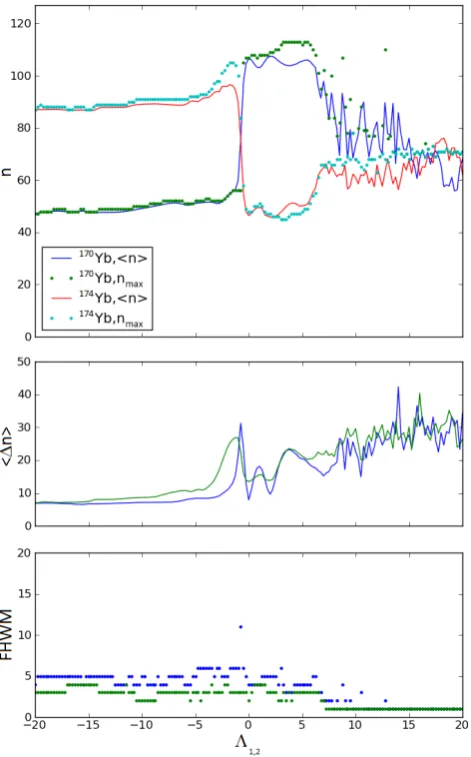
Figure 7 shows the parameters hnii, nmax,i, h∆nii and the FWHM as a function of the mutual interaction parameterΛ1,2. For each value of Λ1,2 a simulation was performed up to τ = 150, just past the collision. The initial conditions and interaction parameters are the same as in Fig.4, except for the scannedΛ1,2and the tunneling ratioγ2/γ1, which is set to 1.
[image:8.595.65.286.53.241.2] [image:8.595.317.560.347.428.2]FIG. 7: (Color online) The collision outcome as a function of the interspecies interaction,Λ1,2. The top panel displays the mean and
the peak site per species, the center panel the standard deviation per species, and the bottom panel the FWHM per species as defined in the text. Symplectic simulations corresponding to the170Yb+174Yb mixture.
For small, but positive values ofΛ1,2(i.e. less than 6) the two breathers tunnel through each other. Note thath∆ni re-mains low in this regime (about 15 sites, growing slowly to 20) which means that the breathers are not destroyed. This is shown in Fig. 5(b) forΛ1,2 = 4. As the two breathers tun-nel through each other, a part of their wavefunction is trapped inside the other soliton; this effect grows as the interspecies in-teraction increases leading to a slow increase in the standard deviation of the atomic density distributions.
A rather sudden change takes place at aboutΛ1,2=6. The system becomes visibly sensitive to small changes in the mu-tual interaction. This is the regime where the collision results in the destruction of the two breathers. Fig.5is an example of such a case. The process is chaotic, yet in many cases leads to the creation of a double-species symbiotic breather mani-fested by its very low FWHM.
A. Discussion
The presented results can be reasonably explained by using one of the key phenomena at the base of gap solitons: the neg-ative effective mass. The dynamics of a gap soliton in an ex-ternal potential are exactly opposite to what one would expect - a gap soliton attempts to climb potential hills and in itself is a balance between its negative effective mass that tries to make it collapse and its repulsive self-interaction that prevents it [11,27]. In fact, the variational model of a wavepacket used in Trombettoniet al. [11] shows that the wavepacket center obeys a Newton-like dynamics whenp ≈ 0 and exactly the contrary whenp≈π.
This ‘contrary’ behavior of the solitons seems to be the key to the explanation of our findings. The totally elastic colli-sion encountered when the interspecies interaction is highly attractivewould be caused by the fact that the solitons ‘see’ each other as potential walls rather than wells.
The splitting behavior has been investigated in a slightly different context by Matuszewskiet al. [27] where the dy-namics of two already overlapped stationary solitons was an-alyzed. In our case splitting happens if the attractive interac-tion is small enough to let the two breathers overlap briefly. Then the system becomes unstable and each breather splits in two. It is also possible to look at this phenomenon from a dif-ferent angle. Due to its negative effective mass, the split of the breather is quite similar to the case of a wavepacket en-countering a potential barrier where, depending on the barrier height (or the interaction between the breathers) part of the wavepacket goes through while the rest is reflected.
In the repulsive interaction regime the breathers behave as if they saw each other as potential wells. This is again an effect of their negative effective mass and, consequently, reversed dynamics. Thus, for the collision’s duration, their speed in-creases (at the cost of wavepacket spreading and of a reduc-tion of their energy due to atomic self-interacreduc-tion).
The chaotic behavior when the interspecies interaction is large and repulsive is probably caused by the system enter-ing an unstable regime as predicted by Gubeskyset al.[24]. The chaotic dynamics would then cause the destruction of the original two breathers and possibly the creation of a stable intragapsoliton. It is beyond the capabilities of our model to establish if it is possible for anintergapsoliton to emerge during the collision since the tight-binding approximation is limited to the lowest band-gap by definition.
VI. CONCLUSION
[image:9.595.60.296.58.437.2]acts as an effective potential wall to the other and the whole process can be viewed as a case of one-particle scattering on a potential wall.
In the case where the tunneling rates are comparable (like in the case of mixtures of ytterbium isotopes) we have iden-tified four collision regimes. For large negative scattering lengths the collision is elastic and the two traveling breathers remain intact, with considerable momentum transfer between the two. For small negative scattering rates, the breathers overlap briefly and split in two, as originally predicted in [27]. When the interspecies interaction is weakly repulsive, the two breathers tunnel through each other unharmed for a wide range of interspecies interacions. Finally, with the inter-species interaction sufficiently large, the dynamics becomes chaotic and the two breathers are destroyed with a possible creation a new two-component soliton similar to anintragap soliton as predicted in [24]. Feasible explanations to the above phenomena have been provided using the concept of negative effective mass and the resulting reversed dynamics.
Interaction and collision properties of localized excitations in BEC in optical lattices can have interesting applications in the realization of ultracold Bose-Fermi mixtures where gap solitons can be viewed as matter-wave counterparts of quan-tum dots and antidots [64]. Changing the species interaction allows one to tune the character of the collisions from fully elastic to fully inelastic and/or tunneling with clear advantages in the manipulation of information in matter-wave systems.
Acknowledgements
We are indebted to Stefano Iubini, Massimo Inguscio, Francesco Minardi, Roberto Franzosi and Yoshiro Takahashi for useful discussions. This work was partially supported by the Institute of Complex Systems at Strathclyde and an EP-SRC doctoral training fellowship. The research is part of the program of the National Laboratory FAMO in Toru´n, Poland and partially supported by the Polish MNISW (Project No. N N202 1489 33).
Appendix: Simulations of the Continuous Model
The DNLS model describes BEC in optical lattices in the limit of deep potential wells. The interactions and collision mechanisms of breathers in two-species BECs presented in Sections III, IV and V survive the tight-binding approxima-tion. Here we use a scaled version of the one-dimensional Gross-Pitaevskii equation [65] extended to two-species BEC in optical lattices:
iu˙i=
−∂ 2
∂x2 +V0sin 2πx
2
+X j=1,2
βi,j|uj|2
ui, (A.1)
whereuiis the wavefunction of thei-th species,V0=10 is the potential depth scaled to the recoil energy,βi,iandβ1,2 =β2,1 are the intra- and interspecies interaction parameters respec-tively. The spatial variablexis now continuous and the
Lapla-FIG. 8: (Color online) Collision of two traveling breathers in the continuous case (A.1) forβi,i =1. β1,2 is set to (a) -18, giving an elastic collision, and (b) 20.4, with the destruction of the breathers and creation of a symbiotic one. These results are similar to those displayed in Fig.3(b) and (c) for the DNLS model.
cian term describes the momentum of the atoms in the lattice. We show here that the collision mechanisms survive from the discrete to continuous limit by simulating an optical lattice of 80 potential wells.
In Fig. 8 (a), we show an elastic collision of moving lat-tice solitons (continuous breathers) with a large attractive in-terspecies interaction ofβi,j = −18 obtined by the numeri-cal integration of Eq. (A.1). Likewise, inelastic collisions take place with repulsive interactions as shown in Fig.8, with βi,j =20.4. The inelastic collision here ends in the formation of a symbiotic lattice soliton.
The simulations of the continuous model (A.1) take at least three times as long as those of the discrete model, even with the smaller number of potential wells (80 in the continuous compared to 127 in the discrete). We also note that the nu-merical method used for the continuous case is not symplectic and uses periodic boundary conditions that limit its applica-tion. In spite of these limitations, the results of the continuous model simulations confirm those of the DNLS model in the deep potential case as demonstrated in Fig.8. For these rea-sons, the DNLS model represent an accurate and trustworthy testbench for the realistic investigation of the collision mech-anism of breathers in two-species BEC as shown for example in the exhaustive Fig.7.
[1] F. Dalfovo, S. Giorgini, L. P. Pitaevskii, and S. Stringari, Rev. Mod. Phys.71, 463 (1999).
[image:10.595.319.559.105.219.2][3] O. Morsch and M. Oberthaler, Rev. Mod. Phys.78, 179 (2006) [4] I. Bloch, J. Dalibard, and W. Zwerger, Rev. Mod. Phys.80, 885
(2008)
[5] M. Greiner, O. Mandel, T. Esslinger, T. W. H¨ansch, and I. Bloch, Nature415, 39 (2002)
[6] M. L. Chiofalo and M. P. Tosi, J. Phys. B34, 4551 (2001) [7] G. Roati, C. D’Errico, L. Fallani, M. Fattori, C. Fort, M.
Zac-canti, G. Modugno, M. Modugno and M. Inguscio, Nature453, 895 (2008)
[8] C. J. Pethick and H. Smith,Bose-Einstein Condensation in Di-lute Gases(Cambridge University Press, Cambridge, 2013) [9] R. Franzosi, R. Livi, G.-L.Oppo, and A. Politi, Nonlinearity24,
R89 (2011)
[10] K. E. Strecker, G. B. Partridge, A. G. Truscott, and R. G. Hulet, Nature417, 6885 (2002); D. J. Frantzeskakis, J. Phys. A23, 213001 (2010)
[11] A. Trombettoni and A. Smerzi, Phys. Rev. Lett. 86, 002353 (2001).
[12] F. Kh. Abdullaev, B. B. Baizakov, S. A. Darmanyan, V. V. Konotop, and M. Salerno, Phys. Rev. A64, 043606 (2001) [13] H. A. Cruz, V. A. Brazhnyi, V. V. Konotop, and M. Salerno,
Physica D238, 1372 (2009)
[14] B. Eiermann, P. Treutlein, Th. Anker, M. Albiez, M. Taglieber, K.-P. Marzlin, and M. K. Oberthaler, Phys. Rev. Lett. 91, 060402 (2003); Th. Anker, M. Albiez, R. Gati, S. Hunsmann, B. Eiermann, A. Trombettoni, and M. K. Oberthaler, Phys. Rev. Lett94, 020403 (2005)
[15] M. Matuszewski, W. Krolikowski, M. Trippenbach, and Y. S. Kivshar, Phys. Rev. A73, 063621 (2006)
[16] R. Livi, R. Franzosi, and G.-L. Oppo, Phys. Rev. Lett. 97, 060401 (2006)
[17] R. Franzosi, R. Livi, and G.-L. Oppo, J. Phys. B401195 (2007) [18] D. S. Hall, M. R. Matthews, J. R. Ensher, C. E. Wieman, and E.
A. Cornell, Phys. Rev. Lett.81, 1539 (1998)
[19] P. ¨Ohberg and S. Stenholm, Phys. Rev. A57, 1272 (1998) [20] S. B. Papp, J. M. Pino, and C. E. Wieman, Phys. Rev. Lett.101,
040402 (2008)
[21] S. Ronen, J. L. Bohn, L. E. Halmo, and M. Edwards, Phys. Rev. A78, 053613 (2008)
[22] S. Hooley and K. A. Benedict, Phys. Rev. A75, 033621 (2007) [23] J. Ruostekoski and Z. Dutton, Phys. Rev. A76, 063607 (2007) [24] A. Gubeskys, B. A. Malomed, and I. M. Merhasin, Phys. Rev.
A73, 023607 (2006)
[25] S. K. Adhikari and B. A. Malomed, Phys. Rev. A,77, 023607 (2008)
[26] B. A. Malomed, D. J. Kaup, and R. A. Van Gorder, Phys. Rev. E85, 026604 (2012)
[27] M. Matuszewski, B. A. Malomed, and M. Trippenbach, Phys. Rev. A76, 043826 (2007)
[28] Sk. Golam Ali and B. Talukdar, Annals of Physics324, 1194 (2009)
[29] H. A. Cruz, V. A. Brazhnyi, V. V. Konotop, G. L. Alfimov, and M. Salerno, Phys. Rev. A76, 013603 (2007)
[30] F. Kh. Abdullaev, A. Gammal, M. Salerno, and L. Tomio, Phys. Rev. A,77, 023615 (2008).
[31] Z. Shi, K. J. H. Law, P. G. Kevrekidis, and B. A. Malomed, Phys. Lett. A372, 4021 (2008)
[32] S. K. Adhikari, J. Phys. B44, 075301 (2011)
[33] A. I. Yakimneko, K. O. Shchebetovska, S. I. Vilchinskii, and M. Weyrauch, Phys. Rev. A85, 053640 (2012)
[34] Z. M. He, D. L. Wang, J. W. Ding, and X. H. Yan, Eur. Phys. J. D66, 139 (2012)
[35] V. M. Perez-Garcia and J. B. Beita, Phys. Rev. A.72, 033620
(2005)
[36] B. J Dabrowska, E. A. Ostrovskaya and Y. S. Kivshar, J. Opt. B: Quantum Semiclass. Opt.6423 (2004)
[37] X. F. Zhang, X. H. Hu, X. X. Liu, and W. M. Liu, Phys. Rev. A
79, 033630 (2009)
[38] Th. Busch and J. R. Anglin, Phys. Rev. Lett.87, 010401 (2001) [39] Y. Takasu, K. Maki, K. Komori, T. Takano, K. Honda, M. Ku-makura, T. Yabuzaki, and Y. Takahashi, Phys. Rev. Lett.91, 040404 (2003)
[40] T. Fukuhara, S. Sugawa, and Y. Takahashi, Phys. Rev. A76, 051604(R) (2007)
[41] S. Sugawa, R. Yamazaki, S. Taie, and Y. Takahashi, Phys. Rev. A84, 011610(R) (2007)
[42] T. Fukuhara, S. Sugawa, Y. Takasu, and Y. Takahashi, Phys. Rev. A79, 021601(R) (2009)
[43] K. Kasamatsu and M. Tsubota, J. Low Temp. Phys.150, 599 (2008).
[44] K. Enomoto, M. Kitagawa, K. Kasa, S. Tojo, and Y. Takahashi, Phys. Rev. Lett.98, 203201 (2007)
[45] M. Kitagawa, K. Enomoto, K. Kasa, Y. Takahashi, R. Ciurylo, P. Naidon, and P. S. Julienne, Phys. Rev. A77, 012719 (2008) [46] R. Ciurylo, E. Tiesinga, and P. S. Julienne, Phys. Rev. A71,
030701(R) (2005)
[47] K. Enomoto, K. Kasa, M. Kitagawa, and Y. Takahashi, Phys. Rev. Lett.101, 203201 (2008)
[48] M. Borkowski, R. Ciurylo, P. S. Julienne, S. Tojo, K. Enomoto, and Y. Takahashi, Phys. Rev. A80, 012715 (2009)
[49] M. Borkowski, R. Ciurylo, P. S. Julienne, R. Yamazaki, H. Hara, K. Enomoto, S. Taie, S. Sugawa, Y. Takasu, and Y. Taka-hashi , Phys. Rev. A84, 030702 (2011)
[50] G. Thalhammer, G. Barontini, L. De Sarlo, J. Catani, F. Mi-nardi, and M. Inguscio, Phys. Rev. Lett100, 210402 (2008) [51] T. Neff, H. Hennig, and R. Fleishmann, Dynamical phase
diagram of Gaussian BEC wave packets in optical lattices arXiv:1309.7939 (2014)
[52] W. Kohn, Phys. Rev.115, 809 (1959) [53] H. Yoshida, Phys. Lett. A170, 262 (1990)
[54] S. Iubini, R. Franzosi, R. Livi, G.-L.Oppo, and A. Politi, New Journal of Physics15, 023032 (2013)
[55] M. Inguscio, private communication.
[56] A. Marte, T. Volz, J. Schuster, S. D¨urr, G. Rempe, E. G. M. van Kempen, and B. J. Verhaar, Phys. Rev. Lett.89, 283202 (2002) [57] G. Modugno, M. Modugno, F. Riboli, G. Roati, and M.
Ingus-cio, Phys. Rev. Lett.89, 190404 (2002)
[58] H. Wang, A. N. Nikolov, J. R. Ensher, P. L. Gould, E. E. Eyler, W. C. Stwalley, J. P. Burke, Jr., J. L. Bohn, C. H. Greene, E. Tiesinga, C. J. Williams, and P. S. Julienne, Phys. Rev. A62, 052704 (2000)
[59] J. Catani, L. De Sarlo, G. Barontini, F. Minardi, and M. Ingus-cio, Phys. Rev. A77, 011603(R) (2008)
[60] J. Gomez-Gardenes, L. M. Floria, M. Peyrard, and A. R. Bishop, Chaos14, 1130 (2004)
[61] L. Fallani, F. S. Cataliotti, J. Catani, C. Fort, M. Modugno, M. Zawada, and M. Inguscio, Phys. Rev. Lett.91, 240405 (2003) [62] S. Flach and A. V. Gorbach, Phys. Rep.467, 1 (2008)
[63] Simulations showing traveling breathers bouncing at bound-aries are presented in [9]. Details about the mechanism behind this phenomenon will be presented elsewhere.
[64] M. Salerno, Phys. Rev. A72, 063602 (2005)