City, University of London Institutional Repository
Citation
:
Cirelli, L. K., Dickinson, J. & Poirier, M. (2015). Using Implicit Instructional Cues to Influence False Memory Induction. Journal of Psycholinguistic Research, 44(5), pp. 485-494. doi: 10.1007/s10936-014-9301-yThis is the accepted version of the paper.
This version of the publication may differ from the final published
version.
Permanent repository link: http://openaccess.city.ac.uk/15432/
Link to published version
:
http://dx.doi.org/10.1007/s10936-014-9301-yCopyright and reuse:
City Research Online aims to make research
outputs of City, University of London available to a wider audience.
Copyright and Moral Rights remain with the author(s) and/or copyright
holders. URLs from City Research Online may be freely distributed and
linked to.
City Research Online: http://openaccess.city.ac.uk/ [email protected]
Using implicit instructional cues to influence false memory induction
Laura K Cirelli
Joël Dickinson
Department of Psychology
Laurentian University
Marie Poirier
Department of Psychology
City University
Joël Dickinson
Department of Psychology Laurentian University Sudbury, Ontario Canada
P3E 2C6
Abstract
Previous research has shown that explicit cues specific to the encoding process
(endogenous) or characteristic of the stimuli themselves (exogenous) can be used to direct a
reader’s attentional resources towards either relational or item-specific information. By directing
attention to relational information (and therefore away from item-specific information) the rate
of false memory induction can be increased. The purpose of the current study was to investigate
if a similar effect would be found by manipulating implicitly endogenous cues. An instructional
manipulation was used to influence the perceptual action participants performed on word stimuli
during the encoding of DRM list words. Results demonstrated that the instructional conditions
that encouraged faster processing also led to an increased rate of false memory induction for
semantically related words, supporting the hypothesis that attention was directed towards
relational information. This finding supports the impoverished relational processing account of
false memory induction. This supports the idea that implicitly endogenous cues, exogenous cues
(like font) or explicitly endogenous cues (like training) can direct attentional resources during
encoding.
Keywords: impoverished relational processing, false memory induction, word recognition,
Using implicit instructional cues to influence false memory induction
When we are exposed to information that we will later have to remember, many
encoding-specific factors contribute to the quality and strength of the memory trace. For example, if we
must memorize a list of words, our memories for the words themselves are influenced by cues
exogenous to the encoding process such as word font or color, as well as cues endogenous to the
encoding processes, such as being trained to implement specific memory strategies (Arndt &
Reder, 2003; Park, Arndt, & Reder, 2006; McCabe, Presmanes, Robertson & Smith, 2004).
Endogenous and exogenous cues can also interact during the encoding process, and are
hypothesized to encourage distinct attentional processes (Hopfinger & West, 2005). These cues
not only influence our memory for the presented list words, but also can reliably influence false
memories for semantically related words. By understanding how false memories can be elicited
experimentally by manipulating these cues, we can begin to understand how they influence
encoding (Loftus, Miller & Burns, 1978; Roediger & McDermott, 1995). The
Deese-Roediger-McDermott (DRM) paradigm is a popular paradigm that can be used to elicit and measure false
memory induction (Roediger & McDermott, 1995). In this paradigm, participants are presented
with a list of thematically related words such as bed, rest, and awake. They then might later
wrongfully determine that the critical lure word sleep had also been presented (Roediger &
McDermott, 1995; Stadler, Roediger & McDermott, 1999). The current study investigated how
false memory induction might be affected by manipulating the way that participants cognitively
process and encode a word list, but doing so without giving explicit training on an encoding
strategy. This would therefore be an implicitly endogenous cue.
We used methodology developed by Dickinson and Szeligo (2008) in this study to
implicitly manipulate encoding. These authors demonstrated that by changing only one key word
in the instructions for a visual task, participant response times to subsequently presented visual
stimuli could be reliably manipulated. This key word was the visual encoding word (such as
sense, notice, distinguish, etc.) that was embedded into the instructions for a visual task. In the
English language, there are many words available to describe visual processes. Using
multidimensional scaling, Dickinson and Szeligo (2008) determined that despite the overlap in
the meaning of these words, participants consistently differentiate them from one another along
one continuum of meaning. Because of this consistent differentiation, these words can be used as
cues to direct the encoding process, without explicitly training participants on specific encoding
strategies.
In the original experiment by Dickinson and Szeligo (2008), a within-subjects design
revealed that participants respond faster to visual stimuli when they are asked to ‘see’ them
(M=325ms) than when they are asked to ‘perceive’ them (M=369ms). In further experiments
(Dickinson, Cirelli & Szeligo, 2013), these response time differences were not found to be
associated with the frequency, familiarity, or word length of the visual encoding word used in the
instruction. These findings support the hypothesis that what differs across instructional
conditions is endogenous to the cognitive visual processes elicited when these visual actions are
performed, and not merely word characteristics exogenous to the cognitive processes that affects
response time, such as the retrieval of the meaning of the visual instruction verb itself. Prior to
the current study, however, the way in which these instructional manipulations might affect
recognition and false recognition rates in a within-subjects experiment had not yet been explored.
As mentioned above, there have been a variety of experiments looking at how false
memory can be manipulated by changing cues specific to the words being encoded (exogenous
cues) and cues specific to the cognitive processes explicitly used during encoding (endogenous
cues). Hunt and Einstein (1981) discuss the trade-off during encoding between item-specific
information and relational information. For example, imagine you are given a list of words and
asked to memorize them. Item-specific information refers to the features that distinguish one
word from all the other words that must be encoded. For example, if all the words in a list were
written in the color red, then remembering that the word bed was written in blue would be
‘item-specific’. On the other hand, relational information refers to the features that are consistent
between words that must be encoded. For example, if you see the words bed, rest, and awake,
then remembering that all the words were related to the critical word sleep would be relational
information. When relational information is encoded, the likelihood of false memory induction
for critical lure words in a DRM paradigm increases (Hunt & Einstein, 1981; McCabe et al.,
2004).
Arndt and Reder (2003) investigated how attentional focus on item-specific or relational
information can be influenced by manipulating exogenous cues for encoding. When these
authors presented participants with DRM word lists that were written in unique fonts, they found
that false recognition of the critical lure word was lowest when each word during the encoding
phase was presented in a unique font and highest when the words related to one semantic theme
shared a font style. The authors argued that when each word was associated with a unique font,
the font became a distinctive cue. This cue focused the participants’ attentional resources
towards item-specific information during encoding, and therefore away from relational
Arndt and Reder (2003) such processing would reduce the likelihood of false memory induction.
On the other hand, when a set of related words shared a font style, this cue became no longer
distinctive. This then focused participants’ attentional resources towards relational information
during word encoding, which is thought to increase the likelihood of false memory induction
(Arndt & Reder, 2003).
These results support the impoverished relational processing account of false memory
induction (Arndt & Reder, 2003; Hege & Dodson, 2004; Hunt & McDaniel, 1993). This model
suggests that during word encoding, attentional resources can be allocated towards a balance of
relational information or item-specific information. When more distinctive item-specific
information is encoded (and therefore the encoding of relational information becomes
‘impoverished’), the likelihood of false memory induction is reduced. The impoverished
relational processing account of false memory induction is congruent with other models
suggesting false memory is affected at the level of encoding. For example, the source of
activation confusion (SAC) model (Diana, Reder, Arndt & Park, 2006; Park, Arndt, & Reder,
2006) suggests that during encoding, activation can occur in both the content nodes, containing
relational information about studied items, or episode nodes, containing item-specific
information about studied items. The activation-monitoring model of false memory induction
(Roediger, Balota, & Watson, 2001; Roediger, Watson, McDermott, & Gallo, 2001) also
describes how during encoding, activation of critical lure words occurs because of the spreading
of semantic activation during list word encoding.
Such encoding accounts contrast with the distinctiveness heuristic account of false
memory induction (Dodson & Schacter, 2001; Dodson & Schacter, 2002; Schacter, Israel, &
processes (as opposed to true encoding differences) can impact false memory induction rates at
the time of recognition. It is argued that if participants expect to remember a certain type of cue
during a recognition task, the absence of this cue will be sufficient to reject this word as having
been previously presented (Dodson & Schacter, 2001). However, when cues used during
encoding are later used to guide decision-making, differences are only found when
between-subject and not within-between-subject designs are used (Schacter et al, 1999). In this sense, if researchers
can use cues during encoding to affect false memory induction rates using a within-subject
manipulation, as we have done in the present study, then differences found during recognition
are likely due to encoding differences and not decision-making differences.
Present Study
The goal of the present study was to determine if and how implicitly manipulating
endogenous cues for word processing affects false memory recognition in a DRM paradigm. By
using a within-subjects design, findings will specifically address differences in how words are
encoded, and will not address decision-making differences during recognition. Four of Dickinson
and Szeligo’s (2008) visual encoding words (sense, notice, distinguish, and discern) were
embedded into the instructions for a word response task, during which words from 20 DRM lists
(Stadler et al., 1999) were presented consecutively. Participant response times to the words in the
word response task were recorded. This task was followed by an unexpected recognition task,
which contained not only words that had been presented in the first task and distractor words, but
also words from these DRM lists (including the critical lure words) that had not been presented
in the first task. The four visual encoding words were assigned to specific DRM lists
response task and the recognition task could be attributed to one of the four visual instruction
conditions.
We hypothesized that, since these visual encoding words have been shown to influence
how subsequent stimuli are processed, we can use response time to predict differences in
relational versus item-specific encoding. For example, relational processing is considered to take
less time and effort than item-specific processing (Butler, McDaniel, McCabe, & Dornburg,
2010; Hunt & McDaniel, 1993). Therefore, instructional conditions that encourage faster
processing and encoding might encourage relational information processing, and lead to higher
indices of false memory induction. Being asked to ‘sense’ or ‘notice’ visual stimuli has been
found to elicit shorter response times in a subsequent visual task than being asked to perform
visual actions such as ‘distinguish’ or ‘discern’ (Dickinson & Szeligo, 2008). It was therefore
hypothesized that there would be a higher rate of false memory induction for words from lists
that had been ‘sensed’ or ‘noticed’ versus words from lists that had been ‘distinguished’ or
‘discerned’. Essentially, instructional conditions that lead to faster word encoding during the
response task were expected to lead to higher indices of false memory induction.
Method
Participants
Fifty-six undergraduate students (forty-seven females and nine males) from Laurentian
University participated in this study and received course credit for their time. Ages of the
students ranged from 17-26 years, with a mean age of 19.6 years.
Apparatus
The experimental program was written on Borland Delphi Professional Version 5 (Build
response task followed by a recognition memory task. The word stimuli in each part of the
program were presented one at a time in black lowercase 80-character font on a white
background. Participants responded to words in a response task by clicking the left mouse key.
They also used this mouse key to click the buttons labelled either “old word” or “new word”
during a surprise recognition task. The experiment took roughly 35 minutes to complete.
Materials
The visual encoding verbs ‘sense’, ‘notice’, ‘distinguish’ and ‘discern’ were embedded
into the trial instructions “Press the mouse key immediately after you _______ that there is a
word”. This created four instructional conditions. Each instruction was assigned to 5 of the 20
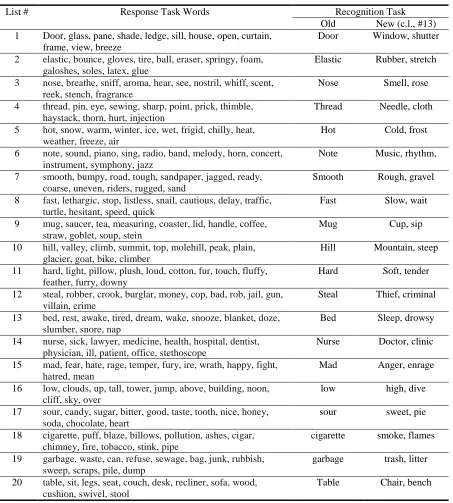
DRM word lists used (see appendix A for the word lists used). The order of the pairings was
counterbalanced across participants to ensure that each of the four instructions was paired with
each of the twenty lists an equal number of times. As a result, a false memory induction score for
each instructional condition could be calculated. For example, consider a participant who had
been asked to ‘sense’ the words from the DRM list related to the critical lure word ‘sleep’. If this
participant later falsely recognized the word ‘sleep’, which was not presented in the original
word response task, this would represent an example of false memory induction to words from
lists that had been ‘sensed’. This is similar to the way in which false memory induction scores
can be calculated for words related to words that had been previously presented in a certain font
(an exogenous cue), which was done by Arndt and Reder (2003).
Procedure
The design was fully within-subjects. Participants, who were tested in groups consisting
of one to three individuals, completed the word response task and then a recognition task that
Word response task. During the word response task, twelve of the fourteen words used from
each DRM word list were presented one at a time in order. This resulted in 240 response trials in
total, during which presentation of words was blocked in such a way that each word list was
presented in full before the next list began. The order in which the lists appeared was held
constant across participants (only the DRM list/instructional condition pairing was
counterbalanced based on random assignment). This ensured that only the instructional
manipulation and not changes in list order would be responsible for any observed effects across
subjects.
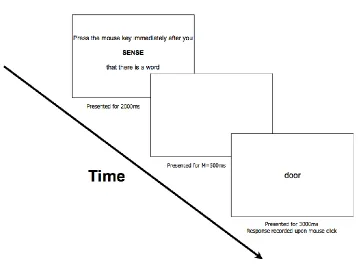
In each of the 240 word response trials, the instruction containing one of the four visual
action words would appear for 2000 ms, followed by a blank screen presented for an average of
500 ms (ranging from 250 to 750). The varying presentation rate of the blank screen was
implemented to prevent anticipatory responding. This blank screen was followed by the
presentation of the trial target word, to which participants responded with a click of the mouse.
The latency of this response was measured by the computer as time of stimulus onset to time of
mouse click. The words remained displayed on the screen until a total of 3000 ms had elapsed
since word onset. It was necessary to hold presentation rate constant in order to control for
exposure time. Between each of the 240 trials, a blank screen was presented for 500 ms. An
example of a typical response task trial can be found in Figure 1. From this task, average
Recognition task. After the response task was complete, participants were given the following
instruction for the recognition task (which the participant had not been warned about
beforehand): <In the following task, when each word is presented use the mouse to click “old
word” if the word WAS presented in the previous word response task, or click “new word” if it
was NOT. Respond as quickly and accurately as possible. When you are ready, click the button
below to proceed>. This signified the beginning of the recognition task. There were 120 trials in
this task. The words were presented randomly, one word per trial. During each trial, two buttons
were presented below the word; one read ‘old word’ and the other read ‘new word’. Upon
clicking one of these two buttons the word disappeared, a blank screen (500 ms) was displayed,
[image:12.612.104.462.109.380.2]and the next recognition word appeared. The words used in this task were as follows: (1) One
previously presented and two previously unpresented words from each of the DRM lists used in
the response task (60 in total), and (2) 60 distractor words not related to any of the lists. From
participant performance on this task, three dependent variables were calculated: response time to
the words during the response task, hits (correct recognition of previously presented words), and
false memory induction (incorrect recognition of previously unpresented words from the DRM
lists).
Results
All analyses were tested using an alpha of .05. In some instances Mauchly’s test
indicated that the assumption of sphericity had been violated. Therefore, Greenhouse-Geisser
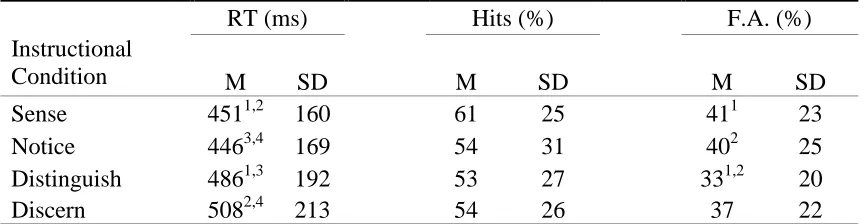
corrections are reported where necessary. See Table 1 for a summary of the results.
Response Time
To determine if response time to words during the word response task differed by
instructional condition, a repeated measures ANOVA was used. Results revealed that there was a
significant effect of instructional condition on response time, F(3, 165)=9.30, p<.05, η2=.15. A
post-hoc contrast analysis using a Bonferroni correction showed that words that participants had
been asked to either ‘sense’ or ‘notice’ were responded to significantly faster than words they
had been asked to ‘distinguish’ or ‘discern’, replicating previous findings (Dickinson & Szeligo,
2008) and validating our use of these words as an implicitly endogenous cue for encoding. There
was no such instructional effect on response time found for DRM list words (previously
presented or previously unpresented) during the recognition task, F(3,165)=0.85, p>.05.
Hits
To determine the effect of processing instruction on correct recognition of previously
condition was used. There were no significant effects of instructional condition on hits, F
(3,165)=1.89, p>.05.
False Memory Induction
False memory induction was calculated by combining false alarms during the recognition
task to the two DRM list words that had not been presented in the word response tasks; the
critical lure word (commonly used in false memory analyses) and the thirteenth word on each of
the lists. Again, since five of the 20 DRM lists were assigned to each of the four instructional
conditions, an overall false alarm rate per instructional condition could be calculated. A repeated
measures ANOVA was then used to determine if false alarm rates differed as a function of the
instructional condition. A significant effect of instruction type on false alarm rate was found, F
(3,165)=3.42, p<.05, η2=.06. A post-hoc contrast analysis using a Bonferroni correction
(experimentwise alpha < 0.5) showed that the proportion of false alarms were higher for words
from DRM lists that participants had been instructed to ‘sense’ or ‘notice’ compared to those
[image:14.612.79.511.537.649.2]from DRM lists that participants had been instructed to ‘distinguish’.
Table 1
Means and Standard Deviations (SD) per instructional condition for Response Time (RT), Hits, and False alarms to related but previously un-presented words (F.A.).
RT (ms) Hits (%) F.A. (%)
Instructional
Condition M SD M SD M SD
Sense 4511,2 160 61 25 411 23
Notice 4463,4 169 54 31 402 25
Distinguish 4861,3 192 53 27 331,2 20
Discern 5082,4 213 54 26 37 22
Note. Instruction conditions with matching superscripts were found to be significantly
Discussion
The current study investigated how implicitly manipulating encoding cues endogenous to
the process of encoding itself can influence false memory induction. It was hypothesized that by
using cues that encourage faster encoding, participants will process more relational information
than item-specific information, and therefore false memory induction will be more likely.
Replicating the finding that these visual action verbs can influence the speed of encoding
(Dickinson & Szeligo, 2008), participants responded faster to word lists they had been asked to
‘sense’ or ‘notice’ verses word lists they had been asked to ‘distinguish’ or ‘discern’. In line with
the hypotheses, false memory induction was more prevalent for lists participants had been asked
to ‘sense’ or notice’ than lists they had been asked to ‘distinguish’. These results support the
assumption that these visual action words are commonly understood across participants, and
affect perceptual processing in a reliable way.
In conclusion, faster encoding led to greater indices of false memory induction. Because
these findings were the result of a within-subject manipulation as opposed to a between-subject
manipulation, they represent encoding differences as opposed to decision-making differences.
Therefore, the results of the present study provide evidence supporting the encoding-focused
accounts such as the impoverished relational processing account of false memory induction by
suggesting that implicitly endogenous cues can be used to direct attentional resources to either
relational or item-specific information during encoding. This complements previous results
suggesting that either stimulus driven (exogenous) or overtly instructionally driven (explicitly
References
Arndt, J., & Reder, L. M. (2003). The effect of distinctive visual information on false recognition.
Journal of Memory and Language, 48(1), 1-15.
Butler, K. M., McDaniel, M. A., McCabe, D. P., & Dornburg, C. C. (2010). The influence of
distinctive processing manipulations on older adults’ false memory. Aging,
Neuropsychology, and Cognition, 17(2), 129-159.
Diana, R. A., Reder, L. M., Arndt, J., & Park, H. (2006). Models of recognition: A review of
arguments in favor of a dual-process account. Psychonomic Bulletin & Review, 13(1), 1-21.
Dickinson, J., & Szeligo, F. (2008). Impact of mental operation instructions. Canadian
Journal of Experimental Psychology, 62(4), 211-222.
Dickinson, J., Cirelli, L., Szeligo, F. (2013). Do you ‘see’ what I ‘see’? Differentiation of visual
action words. Journal of Psycholinguistic Research, doi: 10.1007/s10936-012-9235-1.
Dodson, C. S., & Schacter, D. L. (2001). “If I had said it I would have remembered it”: Reducing
false memories with the distinctiveness heuristic. Psychonomic Bulletin & Review, 8, 155–
161.
Dodson, C. (2002). When False Recognition Meets Metacognition: The Distinctiveness Heuristic.
Journal of Memory and Language, 46(4), 782-803.
Gunter, R. W., Bodner, G. E., & Azad, T. (2007). Generation and mnemonic encoding induce a
mirror effect in the DRM paradigm. Memory & cognition, 35(5), 1083-92.
Hege, A. C. G., & Dodson, C. S. (2004). Why distinctive information reduces false memories:
evidence for both impoverished relational-encoding and distinctiveness heuristic accounts.
Hopfinger, J.B. & West, V.M. (2005). Interactions between endogenous and exogenous attention
on cortical visual processing. NeuroImage, 31, 774-789.
Hunt, R. R., & Einstein, G. O. (1981). Relational and Item-Specific Information in Memory.
Journal of Verbal Learning and Verbal Behavior, 20, 497-514.
Hunt, R. R., & McDaniel, M. A. (1993). The Enigma of Organization and Distinctiveness.
Journal of Memory and Language, 32, 421-445.
Loftus, E., Miller, D., & Burns, H. (1978) Semantic integration of verbal information into a
visual memory. Journal of Experimental Psychology: Human Learning and Memory, 4(1),
19-31.
McCabe, D. P., Presmanes, A. G., Robertson, C. L., & Smith, A. D. (2004). Item-specific
processing reduces false memories. Psychonomic bulletin & review, 11(6), 1074-9.
Park, H., Reder, L. M., & Dickison, D. (2005). The effects of word frequency and similarity on
recognition judgments: The role of recollection. Journal of Experimental Psychology:
Learning, Memory, and Cognition, 31(3), 568-578.
Roediger, H.L., & McDermott, K. (1995) Creating false memories: Remembering words not
presented in lists. Journal of Experimental Psychology: Learning, Memory, and Cognition,
21(4), 803-814.
Roediger, H. L., Watson, J. M., McDermott, K. B., & Gallo, D. a. (2001). Factors that determine
false recall: a multiple regression analysis. Psychonomic bulletin & review, 8(3), 385-407.
Roediger, H. L., Balota, D. A., & Watson, J. M. (2001). In Roediger H. L., Nairne J. S., Neath I.
and Surprenant A. M. (Eds.), Spreading activation and arousal of false memories.
Schacter, D. L., Israel, L., & Racine, C. (1999). Suppressing False Recognition in Younger and
Older Adults : The Distinctiveness Heuristic. Journal of Memory and Language, 40, 1-24.
Stadler, M. A., Roediger, H. L., & McDermott, K. B. (1999). Norms for word lists that
Appendix A
List # Response Task Words Recognition Task
Old New (c.l., #13) 1 Door, glass, pane, shade, ledge, sill, house, open, curtain,
frame, view, breeze
Door Window, shutter
2 elastic, bounce, gloves, tire, ball, eraser, springy, foam, galoshes, soles, latex, glue
Elastic Rubber, stretch
3 nose, breathe, sniff, aroma, hear, see, nostril, whiff, scent, reek, stench, fragrance
Nose Smell, rose
4 thread, pin, eye, sewing, sharp, point, prick, thimble, haystack, thorn, hurt, injection
Thread Needle, cloth
5 hot, snow, warm, winter, ice, wet, frigid, chilly, heat, weather, freeze, air
Hot Cold, frost
6 note, sound, piano, sing, radio, band, melody, horn, concert, instrument, symphony, jazz
Note Music, rhythm,
7 smooth, bumpy, road, tough, sandpaper, jagged, ready,
coarse, uneven, riders, rugged, sand
Smooth Rough, gravel
8 fast, lethargic, stop, listless, snail, cautious, delay, traffic, turtle, hesitant, speed, quick
Fast Slow, wait
9 mug, saucer, tea, measuring, coaster, lid, handle, coffee, straw, goblet, soup, stein
Mug Cup, sip
10 hill, valley, climb, summit, top, molehill, peak, plain, glacier, goat, bike, climber
Hill Mountain, steep
11 hard, light, pillow, plush, loud, cotton, fur, touch, fluffy, feather, furry, downy
Hard Soft, tender
12 steal, robber, crook, burglar, money, cop, bad, rob, jail, gun, villain, crime
Steal Thief, criminal
13 bed, rest, awake, tired, dream, wake, snooze, blanket, doze, slumber, snore, nap
Bed Sleep, drowsy
14 nurse, sick, lawyer, medicine, health, hospital, dentist, physician, ill, patient, office, stethoscope
Nurse Doctor, clinic
15 mad, fear, hate, rage, temper, fury, ire, wrath, happy, fight, hatred, mean
Mad Anger, enrage
16 low, clouds, up, tall, tower, jump, above, building, noon, cliff, sky, over
low high, dive
17 sour, candy, sugar, bitter, good, taste, tooth, nice, honey, soda, chocolate, heart
sour sweet, pie
18 cigarette, puff, blaze, billows, pollution, ashes, cigar, chimney, fire, tobacco, stink, pipe
cigarette smoke, flames
19 garbage, waste, can, refuse, sewage, bag, junk, rubbish, sweep, scraps, pile, dump
garbage trash, litter
20 table, sit, legs, seat, couch, desk, recliner, sofa, wood, cushion, swivel, stool
Table Chair, bench
[image:19.612.70.523.178.681.2]