City, University of London Institutional Repository
Citation
:
Giudici, A. & Reinmoeller, P. (2012). Dynamic capabilities in the dock: A case of reification?. Strategic Organization, 10(4), pp. 436-449. doi: 10.1177/1476127012457977This is the accepted version of the paper.
This version of the publication may differ from the final published
version.
Permanent repository link:
http://openaccess.city.ac.uk/16521/Link to published version
:
http://dx.doi.org/10.1177/1476127012457977Copyright and reuse:
City Research Online aims to make research
outputs of City, University of London available to a wider audience.
Copyright and Moral Rights remain with the author(s) and/or copyright
holders. URLs from City Research Online may be freely distributed and
linked to.
City Research Online: http://openaccess.city.ac.uk/ [email protected]
1
DYNAMIC CAPABILITIES IN THE DOCK:
A CASE OF REIFICATION?
Alessandro Giudici
Cranfield School of Management Cranfield University Cranfield, Bedford MK43 0AL
United Kingdom Tel: +44 (0) 1234 751122 Fax: +44 (0) 1234 754373
Patrick Reinmoeller, PhD
Cranfield School of Management Cranfield University Cranfield, Bedford MK43 0AL
United Kingdom Tel: +44 (0) 1234 751122 Fax: +44 (0) 1223 751806
(Forthcoming in Strategic Organization)
2
DYNAMIC
CAPABILITIES
IN
THE
DOCK:
A
CASE
OF
REIFICATION?
In his award-winning SO!APBOX essay, Donald Hambrick observed that the strategic
management field “is rapidly being pulled apart by centrifugal forces. Like a supernova that
once packed a wallop, our energy is now dissipating and we are quickly growing cold” (2004:
91), and included dynamic capabilities as one of the constructs that appeared to be most
detrimental to the field’s stability. At first sight, as scholars interested in dynamic
capabilities, we conceded that Hambrick appeared to be right. Navigating the literature we
encountered a plethora of dynamic capability definitions, countless number of capability
types (e.g. R&D, marketing, etc.) labelled as ‘dynamic’ and a variety of formulaic
expressions under the generic umbrella of ‘to adapt and change firms need dynamic
capabilities’. Yet, after nearly two decades, a rising number of over 100 articles, special
issues and conference presentations (Di Stefano, Peteraf and Verona, 2010) seem to suggest
that dynamic capabilities were, instead, one of the centripetal forces that helped keep the field
together. So we were faced with a puzzle: were dynamic capabilities the last flash of the
dying supernova, or could they rather save strategic management from its anticipated
self-destruction?
More recently, dynamic capability research appears to have become an academic
conversation polarized between equally passionate critics and supporters. Perhaps a
paramount example is the exchange between Arend and Bromiley (A&B) and Helfat and
Peteraf (H&P) on the future of dynamic capabilities published in Strategic Organization in
2009: whereas A&B suggested that the dynamic capability construct should be abandoned
due to its weak theoretical foundations and inconsistencies, H&P called for further
3
surprisingly, this paradigmatic match between advocates of rigor and defendants of relevance
(Hirsch and Levin, 19991) has regularly appeared in Strategic Organization’s2 ‘Most-Read’
rankings, together with Hambrick’s (2004) call for the consolidation of strategic
management. How to solve this dilemma, then: should we discard dynamic capabilities or
persist with them?
In the face of the possibility of either the demise of strategic management (Hambrick,
2004) or the discovery of its “Holy Grail” (H&P, 2009: 99), we decided to let the evidence
speak for itself. In this essay, we intervene in the debate between A&B and H&P to propose
that a specific developmental process of conceptual and empirical work might explain their
different assessment of dynamic capabilities. A remarkable number3 of prior reviews on
dynamic capabilities have focused on conceptual inconsistencies and contradictions (e.g.
Barreto, 2010), but have not taken fully into account the effects of a process which often
leads researchers to cease “to specify the assumptions that underlie the concept or construct
and treat it like a general-purpose solution to an increasing range of problems” (Lane, Koka
and Pathak, 2006: 835). Labelling this process ‘reification’, Lane et al. (2006) developed a
rigorous assessment methodology based on the analysis of a construct’s usage by and within
its research community.
In what follows, we investigate the reification of dynamic capabilities by systematically
considering the evidence from an extensive sample of 578 articles published in 132 journals
from 1997 to 2009. We argue that understanding reification is critical, since it represents the
underlying process that makes the construct both particularly attractive and profoundly
divisive at the same time. This assessment is therefore of special importance in strategic
management, a field plagued by “parochialism and disjointedness” (Hambrick, 2004: 97) and
by “pressures to jump on emerging research bandwagons, to publish quickly, and to avoid
4
we corroborate A&B’s characterization of the state of dynamic capabilities. We next discuss
the unfolding of the reification process, confirming H&P’s recognition that the construct’s
development path is far from complete, and that there are promising early signs of
consolidation. We then build on our findings to offer actionable indications for reconciling
the divergent views and producing “cumulative, valid, and useful” knowledge (Lane et al.,
2006: 859) about dynamic capabilities. We conclude with an important reflection on
reification.
Evidence for A&B`s view: Dynamic capabilities are reified
A&B concluded that the dynamic capability construct “serves mainly as a label for an area
of study… a label with an implied coherence it does not possess” (2009: 86). Dedicating a
substantial amount of time to reviewing whether dynamic capabilities have become a reified
(i.e. taken-for-granted) construct, we have relied fully on Lane et al.’s (2006) methodology,
assessing reification as being reflected by three concurring indicators: a) the importance of a
construct in a paper’s core topic; b) the closeness of each paper’s usage of a construct to its
original conceptualization; and c) the level of cohesion about the construct within the
research community.
a) The importance of dynamic capabilities in each paper
We first assessed whether the construct was of central importance to each paper’s core
topic or whether it was simply “a grace note that embellishes a paper without adding
substance” (Lane et al., 2006: 834). To define the notion of ‘substantial usage’, we counted
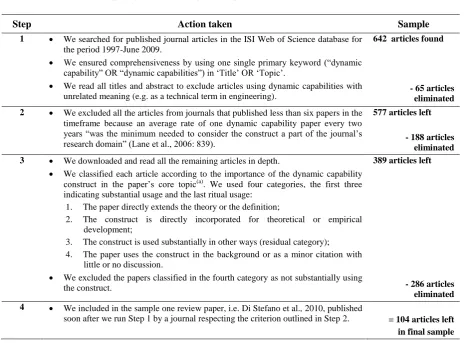
articles in three categories (see Table 1 for our sampling methodology). The first category
contains papers where the authors claim, as their central contribution, to extend the theory or
5
Winter (2003). In the second, we included papers where the construct was directly
incorporated in authors’ hypotheses, propositions and/or models, or where it was clearly
instrumental in developing them: examples here include Blyler and Coff (2003) and Salvato
(2009). We coded the remaining papers into a third category, where dynamic capabilities
were used in other substantial ways, embracing such studies as those by Newbert (2007),
whose review of the resource-based view formally covered dynamic capabilities, and
Nightingale (2008), who discussed the construct within the theme of meta-paradigm change
and the theory of the firm. Despite attempting to be very inclusive (see Lane et al., 2006), we
nonetheless ended up with only 104 articles that made substantial use of the dynamic
capability construct.
---
Insert Table 1 about here
---
b) The closeness to the original conceptualization of dynamic capabilities
Second, we considered the extent to which prior research built incrementally on the
seminal conceptualization of dynamic capabilities. In their widely cited paper4, Teece, Pisano
and Shuen (1997: 518) proposed three basic components of the dynamic capability construct
as a firm’s “managerial and organizational processes, shaped by its (specific) asset position,
and the paths available to it” (see also A&B, page 79 and H&P, page 96). To verify the extent
to which later studies “have sought to make incremental improvements” (H&P, 2009: 94), we
compared how our sample’s substantial papers built on Teece et al.’s (1997) components.
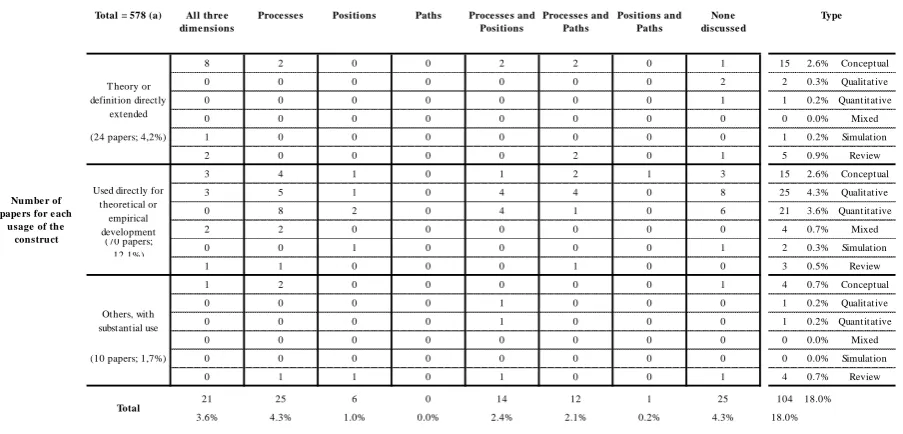
Table 2 summarizes the findings of our two criteria and shows that only the 79 papers
6
synonyms such as routines, trajectories and strengths) in relation to the dynamic capability
construct.
---
Insert Table 2 about here
---
c) The cohesion of the dynamic capability research community
The taken-for-grantedness of a construct reflected by the first two indicators is not
sufficient to determine its reification: the third critical determinant is a low degree of
cohesion within a research community, with different studies or authors sharing labels but not
meanings (Lane et al., 2006). We assessed the degree of cohesion by analysing the citation
patterns in our final sample, and by verifying whether the literature presented a strong and
interdependent citation network. Put differently, the less tightly interlinked the 104 papers in
our final set were, the more the dynamic capability construct’s reification would be signalled.
Using two software tools (SITKIS [Schildt, 2006] and UCINET [Borgatti, Everett and
Freeman, 2002]), we created a database of the references in the final sample’s substantial
papers, and then determined how often each paper had cited (‘Citations Sent’) or been cited
by others (‘Citations Received’) in the sample, and the average annual numbers of such links
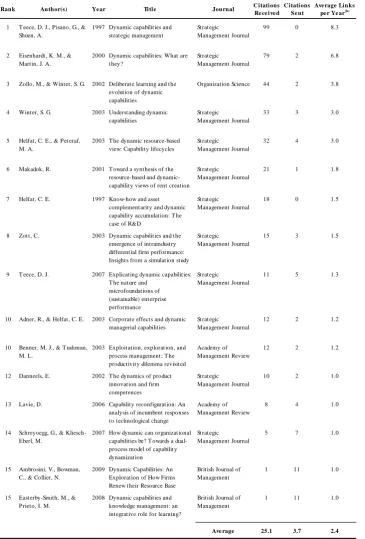
(Lane et al., 2006). We found that nearly half (51 articles) of the final sample papers had not
been cited by any other sample article and that over half (53 articles) produced less than 0.5
average links per year. Overall (excluded review studies) only 16 papers averaged more than
1.0 link per year and the number of citations received (25.1 on average) was significantly
7
---
Insert Table 3 about here
---
Reification`s Implications
It is hard to deny that our reification assessment casts a shadow on the construct`s past
development. Only a rather limited number of papers used dynamic capabilities in substantial
(i.e. non ritual) ways and “the cross-citations between the papers in this body of literature
show little evidence of an accumulated body of knowledge” (Lane et al., 2006: 858). Taken
together, it appears dynamic capabilities have become a reified construct in strategic
management, surely adding grist to A&B’s (and Hambrick’s) mill.
Evidence for H&P`s view: Reification is retrenching
Given this evidence of reification, A&B’s suggestion that the construct should be
abandoned seems justified. However, H&P argued that “theory concerning dynamic
capabilities has had little time to develop… as a field of inquiry, it is still in its infancy”
(2009: 92) and claimed to see “strong signals in terms of scholarly interest regarding dynamic
capabilities potential” (2009: 99). Whereas the attractiveness of dynamic capabilities is a
matter of fact (see Di Stefano et al., 2010), this very attractiveness may carry the risk of
confining the construct to the realm of academic fashion (Abrahamson, 1996; Bort and
Kieser, 2011; Starbuck, 2009). While H&P’s argument that time would rectify the construct’s
defects seemed compelling, it was supported by little evidence. Probing our data, we found
two elements which might imply that the reification of dynamic capabilities was not
8
a) Evolution of the usage of the dynamic capability construct
A curious aspect of Lane et al.’s (2006) methodology was the definition of reification as a
dynamic process but its assessment as a static outcome, a drawback which they addressed by
proposing a thematic analysis and a reconceptualization of their focal construct, i.e.
absorptive capacity. Given the nature of the debate on dynamic capabilities, we looked
instead at the reification of dynamic capabilities as a process, exploring how it unfolded over
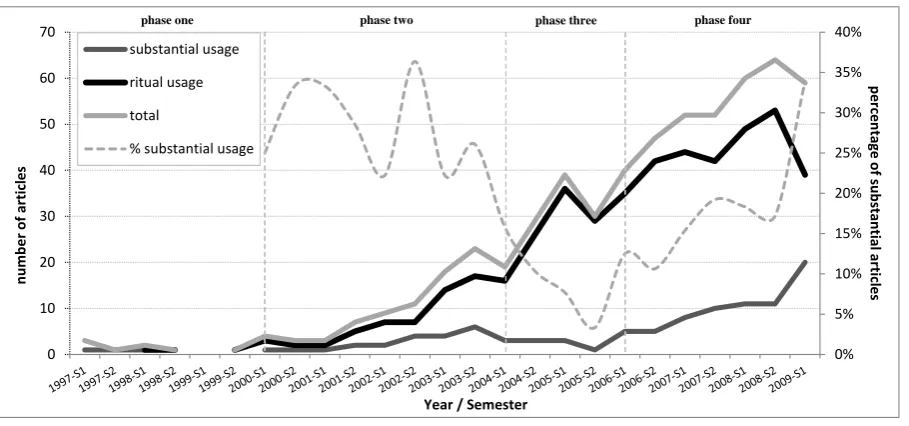
time, and found that, far from being unidirectional, it passed through at least four phases (see
Figure 1). Crucially for our purposes, this suggests that, at the time of A&B and H&P’s
debate, a static assessment of past literature would have produced the ‘mirage’ of a
problematic conversation about dynamic capabilities, which was actually the persistent
lagged consequence of the earlier excitement about the construct (Hirsch & Levin, 1999).
However, a closer look at the diffusion of dynamic capabilities shows that the proportion of
substantial contributions had grown significantly by 2009, and had already climbed beyond
its worryingly low earlier levels (e.g. Hirsch & Levin, 1999).
---
Insert Figure 1 about here
---
b) The influential role of leading authors in the research community
The second piece of evidence which concurs with H&P’s view is that dynamic capability
literature has built a strong and recognized core of several fundamental papers over time.
Despite the literature’s general lack of cohesion, the construct has been nurtured by many
influential scholars, who have helped the community to better understand specific aspects.
From those who have focused on routines (e.g. Helfat and Peteraf, 2003; Winter, 2003) to
those who have paid attention to path dependence and cognitive boundaries (e.g. Posen and
9
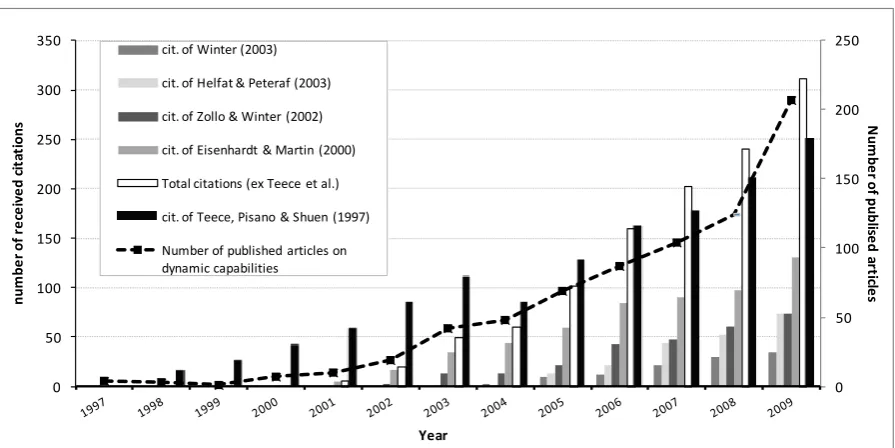
incrementally specialized research on dynamic capabilities. More specifically (as Figure 2
shows) the collective reputation of such important voices as Eisenhardt and Martin (2000),
Zollo and Winter (2002), Helfat and Peteraf (2003) and Winter (2003) has helped shape the
diffusion of dynamic capabilities within academic circles (Bort and Kieser, 2011). We found
that the cumulative influence of these important contributions, coupled with the appearance
of the first published reviews on dynamic capabilities (i.e. Zahra, Sapienza and Davidsson,
2006; Wang and Ahmed, 2007), constituted a retrenchment after 2006, which began to
counterbalance the negative effect of reification.
---
Insert Figure 2 about here
---
The Implications of Retrenchment
H&P pointed out that “emerging and evolving theories develop slowly, over long periods
of time” (2009: 92), reinforcing this defense in their essay title. But, while devoting much
effort to addressing A&B’s conceptual issues, H&P offered little support for their temporal
argument. Nonetheless, our close examination of the reification of dynamic capabilities
seems to substantiate their claim in two ways. First, we found that ritual use of the construct
appears less prominent recently than at earlier stages of its diffusion. Second, in contrast to
the lack of cohesion that signals a truly reified construct, the dynamic capability research
community recognizes a strong group of intellectual touchstones, and its leading authors have
proactively engaged in driving the construct’s consolidation (Hirsch and Levin, 1999).
Considering this evidence carefully, it seems that the construct’s reification has retrenched
10
‘So-What’: At the crossroads between abandonment and persistence
In our essay, we have investigated the dilemma of a construct, i.e. dynamic capabilities,
facing the tension between the search for relevance and the requirement for rigor. We have
demonstrated how this tension may be explained by seeing conceptual reification as an
unfolding process, and our findings make us lean, albeit cautiously, towards suggesting the
construct deserves more focused research, rather than to be prematurely abandoned. We
argue that, in the early days of excitement about dynamic capabilities (Hirsch and Levin,
1999), research on the construct suffered from “a scattered pattern of knowledge
accumulation” (Lane et al., 2006: 859) which led to its relatively extensive but ritual usage.
Increasing perceptions of the detrimental effects of reification led to widespread concerns in
the academic community and to early attempts to review the construct (e.g. Zahra et al.,
2006; Wang & Ahmed, 2007), culminating in A&B openly throwing down the gauntlet and
challenging its very validity (Hirsch and Levin, 1999). At the same time, however, we have
found evidence of the dynamic capability construct as becoming consolidated “along a
developmental path” (H&P, 2009: 91), and believe that, if their argument had not been
grounded in a static picture of past reification phases, A&B might have tempered their overall
condemnation.
By shedding light on how the reification process has helped shape the diffusion of
dynamic capabilities, we have arguably resolved one dilemma, but opened up another, more
significant one. Once a validity challenge starts, its outcome may be quite uncertain. As
Hirsch and Levin (2009: 205) suggest, “scholars either make the construct coherent (override
of challenges), agree to disagree over its definition (permanent issue), or call for its demise
(construct collapse)”. We caution the community that dynamic capabilities are at the
crossroads between establishing itself as a robust strategic management theory and being
11
2011). But A&B’s rigorous criticisms cannot just be ignored, as they are important warnings
of the potential detrimental effects of reification, such as a loss of significance and theoretical
fragmentation. We view the growing number of articles aiming to develop and refine the
construct as a promising sign, but nonetheless counsel scholars to pay careful attention when
engaging with dynamic capabilities, as they are still affected by many inconsistencies and
much confusion. In this respect, we believe dynamic capability research would benefit if
authors adopted one or more of three basic safeguards against reification:
1) Striving for clarity of definition(s). First and foremost, avoiding the effects of reification
requires definitional clarity, which helps build incremental knowledge and facilitates the
establishment of a ‘winning path’. In practice, we encourage researchers to state openly
and upfront which definition their papers follow and why, and, more importantly, to
incorporate specific components of their chosen definition into their proposed theoretical
and/or empirical structure. Recent instances of exemplary practice include Danneels
(2010), who clearly builds on Eisenhardt and Martin’s (2000) work, and Hodgkinson and
Healy (2011), who expand on Teece’s (2007). Independent of which definition researchers
choose, we strongly believe continuous theoretical cherry-picking and mixing
sub-elements from competing definitions will be the surest route to the construct’s collapse. In
addition, given the construct’s burgeoning definitional complexity, “perhaps the largest
source of confusion” (Cepeda and Vera, 2007: 426), we consider dynamic capability
researchers would be well advised to engage in a profound scrutiny of the numerous
underlying meanings that have been attached to the construct over time (Suddaby, 2010).
2) Standing on the shoulders of ‘engaged giants’. With the caveat that the central
definition should be transparently selected, we suggest future research would benefit from
directly engaging with the foundational core of the dynamic capability construct (see
12
confirms, extends, refines or challenges the key papers in the field. At worst, by
encouraging critical reviews of the core literature, this will reduce the number of ritual
contributions; at best, this route can foster the construct’s consolidation and substantial
incremental refinement. In either case, we suspect the threat of the collapse of the dynamic
capability construct becoming a permanent issue will be reduced. At the same time,
however, counterbalancing reification pleads for ‘engaged giants’ (such as those in our
Figure 2) to continue their integrative theorizing effort. If it is probably too much to expect
dynamic capabilities to develop “like Athena springing forth from Zeus’s forehead fully
armed” (H&P: 2009: 92), it seems reasonable to demand Zeus to nurture his other children
a bit more. Contributions such as Helfat et al.’s (2007) book have clearly showed an
impact, but the persistency of reification requires constant attention on how the dynamic
capability construct develops.
3) Engaging in empirical research. Despite the construct’s progress, we need much more
empirical research on dynamic capabilities. A&B and H&P both placed considerable
emphasis on arguing about the empirical support of a discussion which had not yet been
fully theorized. Our investigation found excellent pieces of empirical research, but only
very few (see Table 2), making it impossible to assess dynamic capability research`s
empirical support. We maintain that an increase in carefully crafted empirical work would
enhance the chances of challenges to the construct’s validity being overcome by both
strengthening the recognition of dynamic capabilities in academia and supporting its
relevance for external practitioners (Hirsch and Levin, 1999). We suspect we need not call
for more theoretical contributions: in proportion to other constructs, dynamic capabilities
13
Reflections on reification
The reification of academic constructs poses an intriguing question that goes beyond the
dynamic capabilities case and relates to fashions in management research (e.g. Abrahamson,
1996). Bort and Kieser (2011) recently demonstrated that fashionable constructs are
predominant and, to a certain extent, unavoidable in organization theory. Building on earlier
work by Blumer (1969) and Starbuck (2009), they speculate whether “fashion is negative or
positive for the development of science” (Bort and Kieser, 2011: 672), but, sticking to a
bird-eye perspective on academic constructs, stop short of localizing the underlying processes
which shape fashion-like diffusion.
With signs of faddishness already suggested for such successful strategic management
ideas as the resource-based view (Arend, 2006; Newbert, 2007), absorptive capacity (Lane et
al., 2006) and dynamic capabilities, as well as for research streams including transaction cost
economics (David and Han, 2004) and entrepreneurship (Ogbor, 2000; Aldrich, 2011), we
wonder too whether fashions really constitute necessary yet fundamentally detrimental
phenomena. More specifically, in this essay we have provided granular evidence that
reification may accurately represent a critical process behind academic fashions. So we ask
explicitly: Is reification merely an evil?
Prior research warns of the damaging impact of reification on the production of valid and
cumulative knowledge (Lane et al., 2006), and Arend and Bromiley (2009) have voiced
similar concerns in observing that dynamic capabilities may be “susceptible of halo effects
[…] [they] may become a talisman” (2009: 83). Yet, noticing that breakthrough ideas often
take a long time to develop (e.g. Williamson, 1999), Helfat and Peteraf suggested that “terms
that are vague and elastic may offer the advantage of facilitating a more flexible
developmental path” (2009: 92). In the same vein, Green (2004) has observed that, when
14
become institutionalized, producing theoretical stability (see also Bort and Kieser, 2011). If
reification clearly carries this risk of conceptual fuzziness, it is perhaps time for future
research to explore its brighter side more thoughtfully.
Postscript
We do not yet know if dynamic capabilities will ultimately become a fully formed theory
or will be abandoned. Irrespective of what eventually happens, it is probably fair to observe
at the end of this essay that the construct has not yet extinguished Hambrick’s (2004)
supernova. Nearly another decade has gone by, and strategic management seems still to be in
shape: to date, we can at least argue that the reports of its imminent demise have been greatly
15
Notes
1
We are grateful to the reviewers for this suggestion.
2
Strategic Organization publishes a monthly ranking of its 50 Most-Read Articles based on
full-text and pdf views (http://soq.sagepub.com/reports/most-read). The articles by Arend
and Bromiley (2009), Hambrick (2004) and Helfat and Peteraf (2009) figured constantly in
these ranking in 2011 and 2012.
3
We are aware of at least eight published reviews focusing specifically on dynamic
capabilities, plus a number of others (e.g. Newbert, 2007) which include the construct as
part of their assessments of broader themes.
4
At the time of our final revision of this essay (April 2012), Teece et al. (1997) had received
over 3,000 citations in the ISI Web of Science.
5
As a point of reference, Lane et al. (2006) concluded that the absorptive capacity construct
had become reified after finding that a) 52% of the papers they considered had not been
cited by any other article and that b) 56% of them averaged less than 0.5 citation links per
16
References
Abrahamson, E. (1996) ‘Management fashion’, Academy of Management Review 21(1): 254–
285.
Adner, R. and Helfat, C. E. (2003) ‘Corporate effects and dynamic managerial capabilities’,
Strategic Management Journal 24(10): 1011-1025.
Aldrich, H. E. (2011) ‘Lost in Translation: Cultural Codes are not Blueprints’, Working paper
presented at the Innovation, Strategy and Structure, DRUID 2011.
Ambrosini, V., Bowman, C. and Collier, N. (2009) ‘Dynamic capabilities: An exploration of
how firms renew their resource base’, British Journal of Management 20: S9-S24.
Arend, R. J. (2006) ‘Tests of the resource-based view: do the empirics have any clothes?’,
Strategic Organization 4(4): 409-421.
Arend, R. J. and Bromiley, P. (2009) ‘Assessing the dynamic capabilities view: spare change,
everyone?’, Strategic Organization 7(1): 75-90.
Barreto, I. (2010) ‘Dynamic capabilities: A review of past research and an agenda for the
future’, Journal of Management 36(1): 256-280.
Benner, M. J. and Tushman, M. L. (2003) ‘Exploitation, exploration, and process
management: The productivity dilemma revisited’, Academy of Management Review 28(2):
238-256.
Blyler, M. and Coff, R. W. (2003) ‘Dynamic capabilities, social capital and rent
17
Blumer, H. (1969) ‘Fashion: From class differentiation to collective selection’, The
Sociological Quarterly 10(3): 275–291.
Borgatti, S. P., Everett, M. G. and Freeman, L. C. (2002) Ucinet for Windows: Software for
Social Network Analysis. Harvard, MA: Analytic Technologies.
Bort, S. and Kieser, A. (2011) ‘Fashion in organization theory: An empirical analysis of the
diffusion of theoretical concepts’, Organization Studies 32(5): 655-681.
Cepeda, G. and Vera, D. (2007) ‘Dynamic capabilities and operational capabilities: A
knowledge management perspective’, Journal of Business Research 60(5): 426-437.
Danneels, E. (2002) ‘The dynamics of product innovation and firm competences’, Strategic
Management Journal 23(12): 1095-1121.
Danneels, E. (2010) ‘Trying to become a different type of company: Dynamic capability at
Smith Corona’, Strategic Management Journal 32(1): 1–31.
David, R. J. and Han, S. K. (2004) ‘A systematic assessment of the empirical support for
transaction cost economics’, Strategic Management Journal 25(1): 39–58.
Di Stefano, G., Peteraf, M. A. and Verona, G. (2010) ‘Dynamic capabilities deconstructed: A
bibliographical investigation into the origin, development, and future directions of the
research domain’, Industrial and Corporate Change 19(4): 1187-1204.
Easterby-Smith, M. and Prieto, I. M. (2008) ‘Dynamic capabilities and knowledge
management: an integrative role for learning?’, British Journal of Management 19(3):
18
Eisenhardt, K. M. and Martin, M. (2000) ‘Dynamic capabilities: What are they?’, Strategic
Management Journal 21(10-11): 1105-1121.
Green, S. E. Jr. (2004) ‘A rhetorical theory of diffusion’, Academy of Management Review
29(4): 653-669.
Hambrick, D. C. (2004) ‘The disintegration of strategic management: it’s time to consolidate
our gains’, Strategic Organization 2(1): 91-98.
Helfat, C. E. (1997) ‘Know-how and asset complementarity and dynamic capability
accumulation: The case of R&D’, Strategic Management Journal 18(5): 339-360.
Helfat, C. E. and Peteraf, M. A. (2003) ‘The dynamic resource-based view: Capability
lifecycles’, Strategic Management Journal 24(10): 997-1010.
Helfat, C. E. and Peteraf, M. A. (2009) ‘Understanding dynamic capabilities: Progress along
a development path’, Strategic Organization 7(1): 91-102.
Hirsch, P. M. and Levin, D. Z. (1995) ‘Umbrella advocates versus validity police: A
life-cycle model’, Organization Science 10(2): 199–212.
Hodgkinson, G. and Healey, M. (2011) ‘Psychological foundations of dynamic capabilities:
reflexion and reflection in strategic management’, Strategic Management Journal 32(13):
1500-1516.
Lane, P. J., Koka, B. R. and Pathak, S. (2006) ‘The reification of absorptive capacity: A
critical review and rejuvenation of the construct’, Academy of Management Review 31(4):
19
Lavie, D. (2006) ‘Capability reconfiguration: An analysis of incumbent responses to
technological change’, Academy of Management Review 31(1): 153-174.
Makadok, R. (2001) ‘Toward a synthesis of the resource-based and dynamic-capability views
of rent creation’, Strategic Management Journal 22(5): 387-401.
Newbert, S. L. (2007) ‘Empirical research on the resource-based view of the firm: An
assessment and suggestions for future research’, Strategic Management Journal 28(2):
121-146.
Nightingale, P. (2008) ‘Meta-paradigm change and the theory of the firm’, Industrial and
Corporate Change 17(3): 533-583.
Ogbor, J. O. (2000) ‘Mythicizing and reification in entrepreneurial discourse:
Ideology-critique of entrepreneurial studies’, Journal of Management Studies 37(5): 605-635.
Posen, H. E. and Levinthal, D. A. (2012) ‘Chasing a moving target: Exploitation and
Exploration in dynamic environments’, Management Science 58(3): 587-601.
Salvato, C. (2009) ‘Capabilities unveiled: The role of ordinary activities in the evolution of
product development processes’, Organization Science 20(2): 384-409.
Schildt, H. A. (2006) ‘SITKIS: Software for bibliometric data management and analysis
v.1.5’. Helsinki: Institute of Strategy and International Business, Available at
www.hut.fi/_hschildt/sitkis.
Schreyögg, G. and Kliesch-Eberl, M. (2007) ‘How dynamic can organizational capabilities
be? Towards a dual-process model of capability dynamization’, Strategic Management
20
Starbuck, W. H. (2009) ‘The constant causes of never-ending faddishness in the behavioral
and social sciences’, Scandinavian Journal of Management 25(1): 108–116.
Suddaby, R. (2010) ‘Editor’s comments: Construct clarity in theories of management and
Organization’, Academy of Management Review 35(3): 345-357.
Teece, D. J. (2007) ‘Explicating dynamic capabilities: The nature and microfoundations of
(sustainable) enterprise performance’, Strategic Management Journal 28(13): 1319-1350.
Teece, D. J., Pisano, G. and Shuen, A. (1997) ‘Dynamic capabilities and strategic
management’, Strategic Management Journal 18(7): 509-533.
Wang, C. L. and Ahmed, P. K. (2007) ‘Dynamic capabilities: A review and research agenda’,
International Journal of Management Reviews 9(1): 31-51.
Williamson, O. E. (1999) ‘Strategy Research: Governance and Competence Perspectives’,
Strategic Management Journal 20(12): 1087–108.
Winter, S. G. (2003) ‘Understanding dynamic capabilities’, Strategic Management Journal
24(10): 991-995.
Zahra, S. A., Sapienza, H. J. and Davidsson, P. (2006) ‘Entrepreneurship and dynamic
capabilities: A review, model and research agenda’, Journal of Management Studies 43(4):
917-955.
Zollo, M. and Winter, S. G. (2002) ‘Deliberate learning and the evolution of dynamic
21
Zott, C. (2003) ‘Dynamic capabilities and the emergence of intraindustry differential firm
performance: Insights from a simulation study’, Strategic Management Journal 24(2):
22
Table 1
Sampling methodology (adapted from Lane et al., 2006)
Step Action taken Sample
1 We searched for published journal articles in the ISI Web of Science database for
the period 1997-June 2009.
We ensured comprehensiveness by using one single primary keyword (“dynamic
capability” OR “dynamic capabilities”) in ‘Title’ OR ‘Topic’.
We read all titles and abstract to exclude articles using dynamic capabilities with
unrelated meaning (e.g. as a technical term in engineering).
642 articles found
- 65 articles eliminated
2 We excluded all the articles from journals that published less than six papers in the
timeframe because an average rate of one dynamic capability paper every two years “was the minimum needed to consider the construct a part of the journal’s research domain” (Lane et al., 2006: 839).
577 articles left
- 188 articles eliminated
3 We downloaded and read all the remaining articles in depth.
We classified each article according to the importance of the dynamic capability
construct in the paper’s core topic(a)
. We used four categories, the first three indicating substantial usage and the last ritual usage:
1. The paper directly extends the theory or the definition;
2. The construct is directly incorporated for theoretical or empirical
development;
3. The construct is used substantially in other ways (residual category);
4. The paper uses the construct in the background or as a minor citation with
little or no discussion.
We excluded the papers classified in the fourth category as not substantially using
the construct.
389 articles left
- 286 articles eliminated
4 We included in the sample one review paper, i.e. Di Stefano et al., 2010, published
soon after we run Step 1 by a journal respecting the criterion outlined in Step 2. = 104 articles left
in final sample
(a) In line with Lane et al. (2006), we conducted a conservative assessment of reification. We were thus very inclusive by considering all
23
Table 2
Analysis of the usage of the dynamic capability construct and its seminal components
8 2 0 0 2 2 0 1 15 2.6% Conceptual
0 0 0 0 0 0 0 2 2 0.3% Qualitative
0 0 0 0 0 0 0 1 1 0.2% Quantitative
0 0 0 0 0 0 0 0 0 0.0% Mixed
(24 papers; 4,2%) 1 0 0 0 0 0 0 0 1 0.2% Simulation
2 0 0 0 0 2 0 1 5 0.9% Review
3 4 1 0 1 2 1 3 15 2.6% Conceptual
3 5 1 0 4 4 0 8 25 4.3% Qualitative
0 8 2 0 4 1 0 6 21 3.6% Quantitative
2 2 0 0 0 0 0 0 4 0.7% Mixed
(70 papers;
12,1%) 0 0 1 0 0 0 0 1 2 0.3% Simulation
1 1 0 0 0 1 0 0 3 0.5% Review
1 2 0 0 0 0 0 1 4 0.7% Conceptual
0 0 0 0 1 0 0 0 1 0.2% Qualitative
0 0 0 0 1 0 0 0 1 0.2% Quantitative
0 0 0 0 0 0 0 0 0 0.0% Mixed
(10 papers; 1,7%) 0 0 0 0 0 0 0 0 0 0.0% Simulation
0 1 1 0 1 0 0 1 4 0.7% Review
21 25 6 0 14 12 1 25 104 18.0%
3.6% 4.3% 1.0% 0.0% 2.4% 2.1% 0.2% 4.3% 18.0%
Numbe r of pape rs e mphasiz ing e ach se minal compone nt of the construct
All thre e dime nsions
Proce sse s Positions Paths Proce sse s and Positions
Proce sse s and Paths Positions and Paths Type None discusse d Total Numbe r of
pape rs for e ach usage of the
construct
Total = 578 (a)
T heory or definition directly
extended
Used directly for theoretical or
empirical development
Others, with
substantial use
24
Table 3
The most central and substantial papers in the dynamic capability literature(a)
Rank Author(s) Ye ar Title Journal C itations
Re ce ive d C itations
Se nt
Ave rage Links pe r Ye ar(b)
Total re fe re nce s
Se lf-re fe lf-re nce
Se lf-citation
1 T eece, D. J., Pisano, G., & Shuen, A.
1997 Dynamic capabilities and strategic management
Strategic Management Journal
99 0 8.3 123 10.6% 17.1%
2 Eisenhardt, K. M., & Martin, J. A.
2000 Dynamic capabilities: What are they?
Strategic Management Journal
79 2 6.8 102 26.5% 9.8%
3 Zollo, M., & Winter, S. G. 2002 Deliberate learning and the evolution of dynamic capabilities
Organization Science 44 2 3.8 51 17.6% 11.8%
4 Winter, S. G. 2003 Understanding dynamic capabilities
Strategic Management Journal
33 3 3.0 7 57.1% 42.9%
5 Helfat, C. E., & Peteraf, M. A.
2003 T he dynamic resource-based view: Capability lifecycles
Strategic Management Journal
32 4 3.0 56 28.6% 17.9%
6 Makadok, R. 2001 T oward a synthesis of the resource-based and dynamic-capability views of rent creation
Strategic Management Journal
21 1 1.8 33 24.2% 0.0%
7 Helfat, C. E. 1997 Know-how and asset complementarity and dynamic capability accumulation: T he case of R&D
Strategic Management Journal
18 0 1.5 57 0.0% 1.8%
8 Zott, C. 2003 Dynamic capabilities and the emergence of intraindustry differential firm performance: Insights from a simulation study
Strategic Management Journal
15 3 1.5 61 19.7% 0.0%
9 T eece, D. J. 2007 Explicating dynamic capabilities: T he nature and
microfoundations of (sustainable) enterprise performance
Strategic Management Journal
11 5 1.3 111 16.2% 19.8%
10 Adner, R., & Helfat, C. E. 2003 Corporate effects and dynamic managerial capabilities
Strategic Management Journal
12 2 1.2 53 24.5% 13.2%
10 Benner, M. J., & T ushman, M. L.
2003 Exploitation, exploration, and process management: T he productivity dilemma revisited
Academy of Management Review
12 2 1.2 136 4.4% 10.3%
12 Danneels, E. 2002 T he dynamics of product innovation and firm competences
Strategic Management Journal
10 2 1.0 101 23.8% 1.0%
13 Lavie, D. 2006 Capability reconfiguration: An analysis of incumbent responses to technological change
Academy of Management Review
8 4 1.0 68 4.4% 1.5%
14 Schreyoegg, G., & Kliesch-Eberl, M.
2007 How dynamic can organizational capabilities be? T owards a dual-process model of capability dynamization
Strategic Management Journal
5 7 1.0 120 10.8% 1.7%
15 Ambrosini, V., Bowman, C., & Collier, N.
2009 Dynamic Capabilities: An Exploration of How Firms Renew their Resource Base
British Journal of Management
1 11 1.0 57 3.5% 1.8%
15 Easterby-Smith, M., & Prieto, I. M.
2008 Dynamic capabilities and knowledge management: an integrative role for learning?
British Journal of Management
1 11 1.0 93 4.3% 5.4%
Ave rage 25.1 3.7 2.4 76.8 17.3% 9.7%
(a) The table is based on the final sample of 104 papers making substantive usage of the construct. We included only papers with at least one
average link per year to other papers in the final sample. Review papers are not included in the table.
25
Figure 1
The diffusion of the dynamic capability construct and reification phases
0% 5% 10% 15% 20% 25% 30% 35% 40% 0 10 20 30 40 50 60 70 p e rc e n tage o f su b stan tial ar ticl e s n u m b e r o f ar ticl e s
Year / Semester substantial usage
ritual usage
total
% substantial usage
26
Figure 2
The role of influential authors in diffusing the dynamic capability construct
0 50 100 150 200 250 0 50 100 150 200 250 300 350 N um be r of pub lis e d ar tic le s num be r of r e ce iv e d ci ta ti ons Year
cit. of Winter (2003)
cit. of Helfat & Peteraf (2003)
cit. of Zollo & Winter (2002)
cit. of Eisenhardt & Martin (2000)
Total citations (ex Teece et al.)
cit. of Teece, Pisano & Shuen (1997)
27
Author biographies
Alessandro Giudici is a PhD Student in Strategy at Cranfield School of Management, UK.
His PhD is expected in 2012 and focuses on how organizations can support one another in
systematically sensing and seizing new opportunities. He is particularly interested in network
intermediaries and entrepreneurial firms. Alessandro holds an MSc (Hons) in Strategy from
the University of Pisa, Italy, and a Master of Research from Cranfield School of
Management. He has industry background in marketing in the fast-moving consumer goods
sector and he collaborates with a number of business schools as a research and teaching
assistant at the MSc, MBA and EMBA level in the area of strategy. He obtained a SMS
Outstanding Reviewer Award and is an ad-hoc reviewer for Long Range Planning and the
Journal of Management Studies for capability-related topics. Address: Cranfield School of
Management, Cranfield, Bedford, England MK430AL, United Kingdom [email:
Patrick Reinmoeller, PhD is Professor of Strategic Management at Cranfield School of
Management in the UK and a Visiting Professor at Erasmus University, The Netherlands. His
research on strategy and innovation with an emphasis on knowledge creation and exploitation
has been published in the Asia Pacific Journal of Management, the European Management
Journal and the MIT Sloan Management Review. Patrick was full-time member of faculty at
Rotterdam School of Management, the Netherlands, and at the Japan Advanced Institute of
Science and Technology and Visiting Faculty at the University of Pretoria, South Africa,
Hitotsubashi University, Japan, and St. Gallen University, Switzerland. Patrick was educated
in Germany, Italy and Japan. He received his PhD at the University of Cologne in 1995 and
completed his post-doctoral research at the Institute of Innovation Research, Hitotsubashi
University. Address: Cranfield School of Management, Cranfield, Bedford, England