Rochester Institute of Technology
RIT Scholar Works
Theses Thesis/Dissertation Collections
10-25-2017
Seek Another Land
Phillip LetekaFollow this and additional works at:https://scholarworks.rit.edu/theses
This Thesis is brought to you for free and open access by the Thesis/Dissertation Collections at RIT Scholar Works. It has been accepted for inclusion
in Theses by an authorized administrator of RIT Scholar Works. For more information, please [email protected].
Recommended Citation
Thesis Approval
____________________________________________________________________ Thesis Title
____________________________________________________________________ Thesis Author
Submitted in partial fulfillment of the requirements for the degree of
The School
Rochester Institute of Technology | Rochester, New York
__________________________________________
Name Title
____________________________________________________________________ Electronic Signature: Use Adobe Acrobat
__________________________________________
Name Title
____________________________________________________________________ Electronic Signature: Use Adobe Acrobat
__________________________________________
Name Title
____________________________________________________________________ Electronic Signature: Use Adobe Acrobat
__________________________________________
Name (Optional for some programs) Title (Optional for some programs)
____________________________________________________________________ Electronic Signature: Use Adobe Acrobat (Optional for some programs)
Seek Another Land
Phillip Leteka
Master of Fine Arts
of Film and Animation | Film and Animation
Frank Deese Chief Thesis Advisor
Mari Jaye Blanchard Associate Thesis Advisor
Tom Gasek Associate Thesis Advisor
---A Thesis Submitted in Partial Fulfilment of the Requirements
For the degree of Master of Fine Arts in Film and
Animation
SCHOOL OF FILM AND ANIMATION COLLEGE OF IMAGING ARTS AND SCIENCES
ROCHESTER INSTITUTE OF TECHNOLOGY October 25, 2017
FRANK DEESE, THESIS CHAIR Assistant Professor
MARI JAYE BLANCHARD, COMMITTEE MEMBER Assistant Professor
Contents
Dedication………iii
Acknowledgments………..iv
Abstract………...v
Foreword/Director’s Statement………...vi
Origins………...1
The Proposal……….6
The Script………..8
The Funds……….9
Scheduling………..13
Casting……….16
Rehearsals………..23
The Photographic Style………...24
The Cinematographic Process………...29
Costume Design……….32
Production Design……….34
Principal Photography……….35
Production Sound………..37
Directing……….38
Editing……….40
Music………40
Exhibition………...43
It’s Done………..45
Appendix A: Thesis Proposal
Appendix B: Screenplay
Appendix C: Spotting Sheet for Sound Design
Appendix D: Spotting Sheet for Music
Appendix E: Film Stills
For:
My brother Brown Leteka who passed away three months
before the making of this film. Having been brought up in a country
with a non-existent film industry, he was the only family member
who realised what I was going for and did everything
he could to support that cause.
…and:
My mother ‘Me’ ‘Manapo Leteka who doesn’t fully understand
what I do or why I have decided to do it but supports me fully anyway –
Acknowledgments
This film would not have been possible without the unwavering support of a
number of people. My representative Kristen Van Vleck who took my proposal
around to a few entities resulting in substantial funding from IIE. My thesis chair
Frank Deese who took a chance on this story which started off as a crazy feature
length idea but helped hammer it down to a 17-minute short film. The rest of my
committee: Mari Jaye Blanchard for the very insightful feedback and Peter Kiwitt
for those Skype calls that got me thinking and reconsidering every single time.
I would like to also acknowledge Janice Emerson and Karen Beatty at the
RIT Inn for facilitating the inn’s move to provide my cast from New York City with
free accommodation in support of the film, Peter Wisbey at the Genesee Country
Village, Sejake Mats’ela, Tokoloho Masemene for coming up with names for my
characters, Cat Ashworth and the rest of my thesis seminar class, SAGindie and
SAG-AFTRA for making the casting of the actors a much smoother process, Molefi
Nyaka, Nancy Bernado and Matt Ansini.
It would be remise of me to not recognise Sam O’Hana for writing a poem
that inspired certain themes of the film and of which the title of the film is taken
from, Joe Bellavia and Dan LaTourette for providing invaluable critique on my
earlier drafts of the script and then my very hardworking cast and crew.
Finally, I owe my sincerest thanks to my friends Fraaz Khan and Manojh
Reddy who have supported me from my very first film until the end. Their
Abstract
A family in a country village is tested and torn apart by their own religious
fanaticism. A young shoemaker, Eynaud (Matty Oaks), has to stand up against
conformity after his sick wife, Çyska (Caroline Duncan), is put through an extreme
I think Seek Another Land is parable-like. It takes place in an unspecified
place and time. The characters are dealing with societal norms that perhaps the
viewer can relate with in one form or another regardless of the time, place or
culture. I think this is a simple story about ordinary human beings in a world that
is far more complex and bigger than they are.
Origins
After completing Seek Another Land in May of 2017, I looked back at all the
different phases of its journey in terms of what it could or could not have been. I
was amazed at how different the final film was from anything else that I thought it
was going to become – or at least my idea of the meaning of a ‘thesis film’. It was
also interesting to me that this story, as it is today, almost did not come into being
at all as I was initially exploring other ideas. There certainly was a lot of growth
and re-discovery throughout the entire process.
When I came to graduate school back in 2014, I was a bit nervous about what
the future was eventually going to look like for me – in terms of storytelling and
making films. Most of my fears emanated from the fact that I did not have that
much experience in filmmaking before graduate school. I felt like catching up with
the rest of the class was going to be a bit of a mission. A couple of short films that I
had made before then were not close to anything good. It was for this reason that I
felt the need to begin developing ideas for what might eventually become my thesis
film. I was under the impression that a thesis film had to show a certain kind of
utter maturity in student filmmaking – or perhaps in filmmaking in general.
I watched a few extraordinary thesis short films at the High Falls Film
Festival in the fall of 2014. These were films made at other film schools (other than
at Rochester Institute of Technology) throughout the country. I was blown away by
some of the work that I saw and then I started thinking to myself “oh boy! If you
to survive in this field”. When I returned from the festival I started looking around
for ideas. It was hard. I failed dismally. Perhaps I came at it with the wrong
mentality. I gave up – at least for a while.
In the summer of 2015, just a little less than six months before proposing my
thesis idea, I thought of maybe writing a story that would be set in the countryside
in my home country of Lesotho. At that point, I had been searching for so long but
could not come close to anything that resonated with me in this new environment
(the United States) that I was to work within. My screenwriting professor from first
year of graduate school, Johannes Bockwoldt advised that perhaps I try sticking to
stories that were more personal or write about incidents that I knew really well.
The rural, rustic, countryside sort of a setting became quite significant from
the onset regardless of whatever story I was going to end up telling. I felt like
getting the atmosphere right for an environment like that would not be a problem
at all as I grew up and have lived most of my teenage life in it.
I took my writing pad and started working on a story about territorial
disputes between two small villages in Lesotho. The idea was to have herd boys
from both villages meet at the pastures and engage in a stick fighting battle that
would determine who gets to have their cattle graze there. This was a topic I knew
quite well as I have seen incidents like this happen many times before. I also
thought perhaps presenting this particular world of the story cinematically would
The deeper I delved into my territorial disputes story, the more I started to
realise that it was going to become a huge logistical undertaking as it would have to
be an international shoot. A few things became clear to me right away; I would not
have any access to film equipment from the School of Film and Animation at RIT.
Lesotho had an almost non-existent film industry (still does) – all of the equipment
and crew would probably have had to be from the neighbouring South Africa. At
that point, I hadn’t yet taken the story into my screenwriting software but I was so
married to it that I thought ‘something somewhere will have to give’.
In the fall, my friend Fraaz Khan introduced me to the Lore Podcast on
iTunes; and that changed my direction drastically – perhaps completely. I fell in
love with it, particularly the episode, Black Stockings. There was something about it
that felt eerily familiar to me.
Black Stockings explored superstition and the folklore in Ireland, Germany
and most of East Europe. It was about how throughout history humans were always
trying to find meaning to explain odd things that happened around them. When
they couldn’t explain the unexplainable, they would then make up stories; and
when these were taken seriously, the outcome would often be quite tragic. The
episode also made mention of the writings of William Butler Yates including Fairy
and Folk Tales of the Irish Peasantry. In the book, Yates goes into more details in
his telling these stories.
After listening to the podcast and half-way into Yates’ book, it slowly dawned
love with my Lesotho “territorial disputes” idea but because its making was most
certainly going to be a logistical nightmare, I was going to try and find a common
ground between the two. The result was then going to be a film I would eventually
make in the United States. I tried to somehow morph one into the other but it just
wasn’t going to work so I begrudgingly decided to abandon my “territorial disputes”
idea but perhaps there was a way I could retain certain elements from it?
I devised a way in which I could somehow still capture the spirit (regardless
of how subtle) of my previous idea so that it would be a bit easier for me to do the
new one well in an environment (America) I was still trying to get a hang of. The
biggest part was the setting – it needed to take place in a village that was small,
rural and rustic. One could have said, “Good luck finding a place like that in New
York.” The characters would be based on people I knew and they would have certain
personalities that I was familiar with – could be the way they talked, walked and so
on.
An earlier version of Seek Another Land was born under the working title, A
Ballad. It was dense. The story was big – perhaps way too big. It had lots of
characters that I felt all served a certain purpose and needed to be in there. When I
was working on this story and its characters, I would be so consumed in this world
that I had just created so much that every little detail seemed more important than
the other. I was wrong.
I was very keen on having the story play out as a parable-like folk ballad. The
process of writing a song based on his experiences as he travels through the world of
my story. In our eyes, the troubadour is only almost like a frame through which we
can watch and see events unfold – there is not much he can do to help the situation.
In fact, the rules of the story do not allow him to interact too much with the subjects
of his writings. As the story progresses, the troubadour settles in a peasantry
village by the hill where superstition reigns.
The troubadour quickly realises that there is a lot of strange incidents taking
place in this particular village and are worth exploring for his songwriting. He
watches one family closely. The family has a teenage girl, Çyska, who catches a
fever after being drenched in the rain. The family, their neighbours and the rest of
the village believe that Çyska has a “supernatural being” nested inside of her,
attacking her. Her mother, Isolde, believes it is out of jealousy from fellow villagers.
They are jealous because her daughter would not agree to marry their sons. She
cannot, however, be certain of her claim. That is the only logical (as she sees it)
explanation she is able to come up with. The only solution, as her neighbour
advises, is to go see The Orslan (we may equate him to a witch doctor) who is from a
couple of villages away and is the last of his kind. He is supposedly the only one who
can eradicate this deathly “being” inside of the girl.
On the other hand, science is in its infancy. A medical doctor, Dr. Elbekind,
who is new in this village knows that the cure for Çyska would be simple and
turn them against what they have believed in from centuries before? What does he
know?
Dr. Elbekind manages to lure Çyska’s husband, Eynaud, onto his side. This
seems to be a huge accomplishment for what the doctor stands for but how on earth
can two people win against the entire village? Particularly Çyska’s father, Anden,
who is a beast in his own right.
Several days later, when I thought I knew what the story was, I asked Frank
Deese to be my thesis chair. He liked the idea. He was onboard and wanted to see it
through. In our initial meeting, I might have told him just the straight story – no
mention of how the troubadour would come into play. I did not want to scare him
off. That was my thought. Perhaps I should have told him everything. We could
have simplified this entire thing then – as we would eventually do.
The Proposal
I felt that the story outlined above had a lot going for it. I realised though, as
I was compiling my proposal to present before the proposal committee that the story
was riddled with a lot of complex themes and mythology. While having complex
themes might not have been a bad idea at all, it was becoming quite difficult to
handle and flesh it all out in a short film format. My treatment alone ran for pages
and pages.
After compiling my proposal for the film that I thought I wanted to make, I
the story I was trying to tell, the scale of my production was starting to look like it
would be very high. My nervousness emanated from the thought that perhaps my
thesis proposal committee would need a whole lot of convincing that this world that
I was trying to create and stage in upstate New York could be pulled off. I also
needed to assure them that I could afford to produce it. At the time, I could not. In
the very same manner, I also could not afford to have the proposal denied.
I finally came before the thesis proposal committee. Not that I had a choice.
All the issues that I had anticipated and perhaps more, were raised during the
meeting. The biggest of them all, as I had already feared was that this project was
too big and would cost a lot to make. The question of the rustic country village
setting was easy to answer at that point. I was going to shoot the film at the
Genesee Country Museum in Mumford, about 40 minutes away from RIT. The only
sliver of doubt lingering in mind was the fact that I had not spoken with anybody at
the museum yet. I had no idea whether or not they would be willing to make the
location available for me to shoot at. I knew of another student who had shot their
film at the museum the year before so there was a bit of hope that they would let
me use the place.
When the meeting ended, my thesis was green lit under a number of
conditions. (1) I needed to find a good producer to help me maneuver all the
impending logistical challenges. Understood their point. This was the biggest and
most ambitious thing I had ever done and I did not want it to turn out disastrous
characters that the story could do without. (3) I needed to find a dedicated crew and
also move principal photography up a couple of weeks to avoid harsh weather
conditions towards the end of the year. The third one is almost always impossible –
students work on tons of other projects.
The Script
Now that I had passed the hurdle of getting the thesis approved, I went to
work. Writing is one of the most challenging stages in the making of a film. It is
even worse for someone like me who is working with English as a second language.
There is always the need to put in a little bit more effort than the rest of the class. I
figured I had to find a way to make the process a little bit less grilling than it has
always been in the past.
I compiled a list of songs that I thought best captured the mood, atmosphere
and an overall spirit of my story. I then played the music on shuffle mode so that it
was less predictable by the time I had gome through the entire playlist. Some of this
lovely music was by artists that have remained my favourite even today: Hildur
Guonadóttir, Ùlfur, Jacaszek, Hammock, The Library Tapes and many more. I
cannot confirm that the music made my story any better or worse but it certainly
helped me revel in this world and its characters in a way I never thought possible.
Based on some of the comments from my proposal committee and with the
goal of making the story simpler, I did away with the troubadour and focused more
write his ballad about. In the story, Eynaud was a poet and so I collaborated with
my friend in New York, Sam O’Hana and we came up with a poem that
sub-textually addressed the main themes of film. The poem had, in a way, taken the
place of the troubadour. I wrote the first draft of the script in about a week and a
half and It came to about twenty pages.
Frank and I met to discuss my first draft – what worked and what didn’t. He
liked where it was going but thought something was still missing. The story was
still a bit confused and could be better and even simpler. There was not much of a
point of view even though the script kind of hinted at Eynaud being in the
foreground. He also thought perhaps I needed to make it more about Eynaud
fighting conformity and the consequences of his rebellion in the village. The
consequences, in this case, could be that he would lose his stance in the village or
that their family could be vulnerable to attack from fellow villagers.
Frank then asked me to write a whole new treatment based on my current
one but almost as if I was re-proposing my thesis. It was a very interesting process
because in a way, it was almost as though I was doing an adaption of my own work.
I started seeing the story in a different light. I was re-discovering my characters
and the purpose they each served. By the time I began working on my second draft,
the story was quite manageable.
We had a schedule but no money. I delved deeper into the script – writing
draft after draft not knowing where I was going to get the money to make it. This
was a rather difficult position to be in. It was utterly terrifying. During this time, I
had a co-producer – one of the students in the undergraduate program. His role was
not necessarily to help me find money (as things are usually different in student
films compared to the real world) but to manage the project to prevent even the
slightest chance of it going off the rails. Even in student films there is always a
number of people (be it your advisor, your mum, your friends, etc) rallying behind
you, trusting you to see the entire thing through. Therefore, it goes without saying
that the pressure is often high.
There were a number of options (Indiegogo, Kickstarter, GoFundMe, etc) I
could have tried to raise money for the film but I had a lot of Visa issues so these
were all out of the picture from early on. I was in the United States on a J-1 Visa. It
came with a long list of restrictions regarding finances. I was not allowed to do any
work and earn money for the duration of my Visa, I spoke to my representative in
New York regarding crowdfunding and she strongly advised against it as this was
considered as earning money. I could not have anyone support the project as long as
it was in the form of money.
While I was getting a stipend from the US government every month, this was
barely enough to cover my personal cost of living and educational needs. There was
Time was rapidly eating up the yards, shooting dates were approaching,
perhaps it was time to bend the rules, even if it was just a little bit. I remembered
reading a quote on IndieWire – one director was talking about the difficulties he
faced during the making of his film. He talked about how demanding the audience
is, about how sticking to set budgets and schedules are never going to help make a
film any better. My situation did not in any way come close to his, but his statement
most certainly got me thinking. Perhaps there were things I could do to make
things work – perhaps I could, in a way fight conformity, as my advisor Frank
suggested my main character do.
I wrote a long letter to my representative in New York, Kristen Van Vleck. It
was personal. I put a lot of heart into it. I wanted to get my film made and I needed
all the support I could get. Along with the letter, I sent my estimated budget.
Kristen was going to look into it, she was going to speak to a few people to see what
could be done.
While I waited to hear back from her, I was working on finding other means.
I worked with Arlen Tarlofsky and Tim Philo (The Evil Dead) on a small portrait
documentary for Damiani Wine Cellars. Got to risk it. The remuneration from that
project was nothing close to my budget but at least it got me started. I also wrote to
Molefi Nyaka at the Lesotho Embassy in DC. He knew of a few people that could
put some funds into my project. Now there was a bit of momentum and I wanted to
As much as there were a few people trying to help, it was still not enough and
it was taking so long. I decided to increase my credit card loan and the idea was to
use it to pay for half of my budget with the hope that I could successfully pay it all
off in the future. Little did I know how difficult that would eventually be. But then
again, I had to risk it.
I wrote a few other letters to several organisations for non-monetary
sponsorships. I had also started casting at that point (see Casting) and most of the
actors that I was interested in working with were from New York so I would have to
facilitate their accommodation for the duration of the shoot (five days) in Rochester.
The RIT Inn and Conference Center gave me a very positive response. They were
willing to accommodate all three of my actors for free during production. They also
wanted names and addresses right away in order to have rooms reserved. This was
a little tricky as the actor I was eyeing for lead had not yet confirmed doing the role.
Fingers crossed, I sent his name along with the other two to the RIT Inn and then
started messaging him daily. He agreed.
Now that accommodation had been taken care of, I thought of finding another
sponsorship for air travel. I contacted a number of airlines – at random. American
Airlines, Delta and JetBlue got back to me with a strikingly similar response – they
would be willing to look into sponsoring my project but needed at least three
months notice as processing takes a while. I did not have three months; I was
shooting in a little less than four weeks. I was a little sad but that was okay. Lesson
Two of my actors, Caroline Duncan and Zenon Zeleniuch were in a union
(Screen Actors Guild) and so I needed to negotiate rates. While the SAG Student
Agreement applied to my project, I still needed it to go a bit lower. SAGindie
suggested that I negotiate deferred payments with my actors. This was not entirely
possible but Zenon agreed to work on a lower rate. I also did not have to pay them
right away so that also helped me to organise better.
Things seemed to be shaping up. Kristen got back to me. She had found
something. There were research funds available at the International Institute of
Education. I put a proposal together and my graduate advisor Tom Gasek wrote a
powerful letter of support on my behalf. IIE approved my proposal and I was able to
cover the other half of my budget. It was now $3000 more than what I had
presented at my initial thesis proposal meeting bringing the entire budget to about
$8000. Now that I had a little bit of money to work with, it was time to get ready to
make the actual film. Producing can be quite draining – I was already getting
exhausted but had to keep going.
Scheduling
I have to say, coordinating things and trying to get everything and everyone
to work together for one common good might just be the most difficult thing I’ve
ever had to do. My producer Ian Ladd and I had a meeting with Peter Wisbey at the
Genesee Country Village to discuss contracts and schedules. We agreed on October
during that time as they would not shut it down just for us. They gave us their
calendar as well as the schedule for events held throughout the day. Locations that
we were interested in using seemed to not be affected by their schedule for
exhibitions and activities that they held. I was still a bit worried that this would
disrupt the shoot one way or another but I was willing to sort of roll with it.
About two days later, Peter Wisbey from Genesee emailed us. The museum
wanted to add more events and a certain building that we were planning to shoot in
would now be in use. Therefore, they wanted us to either shoot the film at the end of
October or push principal photography to November when they would be closed for
the season. This drastic change threw us off in a number of ways. My
cinematographer Jacob had other plans and had signed up to do other things later
on. To be utterly fair, these were the dates we had agreed on since he signed up to
work with me the year before. I understood where he was coming from. I thought I
was going to lose him. I was frustrated. There was no way I could find a
replacement in that short period of time and we did not have a backup location
either. Shooting in November seemed a bit problematic too because of how brutal
the Rochester weather can be.
My frustration became a little too real and therefore I started to think of
other options – moving the shoot to Berlin. Yes, Berlin, Germany. My friends
Hannah Stockmann and Jeremiah Mosese would help me make the film there.
Hannah is a producer/editor and Jeremiah a cinematographer. They also had a
We would be working on a €7000 budget and Hannah thought it would be doable.
They also had a bit of film gear which would minimise equipment costs. The
simplistic approach to the film, that Jacob and I had already put together was going
to make it achievable with the new team. The idea was that Jacob would still be
credited as the main cinematographer for the the film and rightly so – in Berlin, we
would only be sort of modifying what he had already put in place. I sent Hannah the
script for Seek Another Land to translate it into German and also begin the casting
process. Hannah is very good at what she does that she anticipated we would
probably need just three weeks or less until we were ready to shoot. The decision to
move production to Berlin was so drastic that I did not tell anybody about it, not
even my best friend or my committee. Once Hannah was ready, the latter would
have no choice but to let me do it. Amid this somewhat secret operation, I looked
into possible shoot days. This was not going to work either.
I was hit by one of the most brutal realities of living as a foreigner in another
country. My United States visa had expired in September and this had completely
skipped my mind. If I left to Germany for the shoot, I would not have been able to
re-enter the United States. While I could have tried renewing my visa in a third
country (Germany), I thought it was not worth the risk as the process is long but
without any guarantees.
I still needed to make the film so there had to be another plan. I needed
another cinematographer and also work out dates with Genesee and hopefully stick
was not going to be easy. My friend Erlendur Sveinsson who was at NYU, had
always wanted to do a project together and perhaps this would have been it.
Unfortunately, three of the five shoot days were going to be weekdays, and that was
not going to work with his schedule either – perhaps if we had planned it much
earlier.
Jacob and I were still talking and it seemed like there was a bit of a shake-up
in his schedule and could possibly shoot Seek Another Land early November. Phew!
My producer Ian got in touch with Genesee and we settled on a schedule for
November 2nd to the 6th.
Casting
My producer Ian and I put up casting calls on social media. This is usually
how a lot of student films get cast in Rochester. There are always people looking to
be in films and they do it for close to nothing, if anything at all. This is good as
students do not always have funds to pay talent. The danger though, I do feel, is
that; these actors take up too many projects in the same term to the extent that one
face would show up in multiple films that were most likely shot a week or two
apart. The sad reality, as I have learned during the making of my previous two
films, is that the process tends to be less focused on their part. And the results? Not
always the best.
Ian and I got a few responses from our social media casting notices and
shockingly disappointing. I say shocking because only four people showed up even
though we received a bunch of messages that showed interest. The messages came
back with headshots and there were a few unfamiliar faces. I was mostly looking
forward to auditioning these new faces to see what was possible, as I had not seen
them in anything before.
The four people that came in to read were unfortunately not right for the
roles they were interested in. It was disappointing. I knew right then that there was
no need to re-watch the audition tapes. Joe Bellavia, who was also one of my
readers when I was doing earlier drafts of my script had cast his 2015 short film
through the website Backstage and he recommended it. Other talent was discovered
through local agencies: AMS and Wilhelmina-Rochester.
The Main Players
Matty Oaks (Eynaud)
Matty was not my original choice for the role of Eynaud but when
circumstances did bring him on board, I wasn’t disappointed. I was eyeing a
different actor, also on Backstage. Things did not work out. That other actor
initially showed interest in the role but turned it down much later because
something “much more lucrative” was on his radar. I didn’t blame him. I moved on.
I watched the reels that were on Matty’s Backstage Profile including a NYU
kind of an actor he was or what he was capable of doing. There was a clip from the
HBOshow, Girls but he was playing a bartender with barely any lines. The NYU
thesis did not impress either. I think I was almost going to pass on him but there
was something about the way he looked: his eyes, his beard and his stature. I was
going to take a chance.
Matty Oaks during a pivotal moment in Seek Another Land
Caroline Duncan (Çyska)
I cast Çyska a bit earlier compared to the other characters. My casting notice
for the role of Çyska had over 197 applications on Backstage – all outside of
Rochester.This was a lot of profiles and reels to go through as opposed to the four
people that showed up for my Rochester-only audition. Having a large number of
applications did not necessarily make things any easier – I was faced with a
sure I was going to miss out on an opportunity for best talent. Even throughout my
vetting process, there were a number of applications that stood out and Caroline’s
was one of those.
As time elapsed, Caroline’s application was becoming one that I was leaning
more towards. Even though I had already liked what I saw in her reel, it wasn’t
until I saw her powerful in Kitty Kitty, a psychological thriller/horror short film
about love, cats, and toxoplasmosis, that I was finally sold.
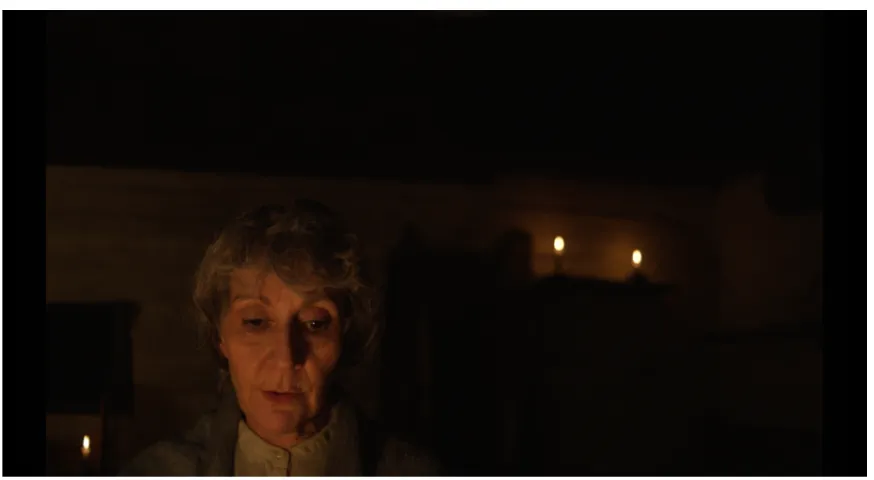
Caroline Duncan’s character about to face a life-changing moment
Zenon Zeleniuch (Anden)
This role did not have as many applications on Backstage as the other ones –
in fact it had not more than 20. This narrowed it down quite a bit for me. By just
could see Zenon embodying that really well as I was going through his profile. He
was also by far, the most decorated of all my cast and I was really excited and
looking forward to working with him.
Zenon Zeleniuch as a commanding head of the family
Marge Mattioli (Isolde)
This is the role that got me on my knees, panicking. I was searching daily to
no avail. I remember sitting at Java’s café on Gibbs Street hoping I would see
someone that looked the part. While I was there, I overheard an older woman
talking to someone on the phone about doing rehearsals for a local theatre play. I
approached her afterwards and she had a few pointers. I had hope. She had a list of
people that she thought would be interested in auditioning for me. I sent out a
string of emails and Facebook messages that night. Many of the Facebook accounts
A little less than a week before production, I had a Skype meeting with one of
my committee members, Peter Kiwitt, to discuss my story. He suggested I talk to
Liz Cameron – one of the local actors that he had worked with on his then recent
short film (written by my thesis chair, Frank Deese), The Guy on the Show. “She is
good” he said. I did a quick google search when I got home and went through her
pictures to see if she would look right for the part. Peter also sent me a private link
to a rough cut of The Guy on the Show that very same night. I liked her. I pictured
her in the role and in my mind she had to say yes. She did not. “Hi Phillip thanks
for your email…I really enjoyed the script and would have loved to be a part of this
project but I cannot commit as I am already involved in a couple of other
films…good luck”. My heart sank. Production was on my heels.
I had cast a wider net so I was always hoping that something somewhere was
eventually going to give. It was the wait that was tormenting. There would often be
times when it felt like it was not going to happen and it was utterly terrifying.
I could not cast this role on Backstage as I did with the other three – my
budget was not going to allow me. I contacted Wilhelmina-Rochester – a local
casting agency to see if I could find the right person and possibly cut a deal. I found
Marge Mattioli. I watched her reel on the website but did not really like what I saw;
there was so much overacting in it, very cartoonish characters. There was
something about her face though, that I thought resonated and I could see Isolde in
her. There was so much work to be done in as far as the acting was concerned but I
filming dates. ‘What the hell!’ I thought, where was I going to find someone for this
role in just a few days before filming?
My costume designer Denyse Funk was grilling me day in and day out. Time
was running out, she needed to know size information for the person playing this
role in order to put a costume together. It was literally a constant rush of blood to
the head. I had no answers to her questions other than something to the effect of
“We’ll find someone soon…”
Exactly four days before principal photography, I received a call from
Wilhelmina-Rochester. Marge had just cancelled her vacation and was wondering if
the part was still available. Phew! It was time to make the movie. There was not
going to be enough rehearsal time with Marge but that was the least of my worries
at this point. I sent her the script and then met with her the following day to talk
about the character. I got incredibly worried when she showed up – she had short
hair. Perhaps a little too short. We had to work something out quickly and in the
following couple of days. This was pretty much crunch time. We were so lucky.
Marge knew of a school that had a small theatre group (which we later donated all
Marge Mattioli as an obedient wife.
Rehearsals
In mid-October, I thought of holding a Skype table read for characters that I
had already cast. Skype would have been the only way to do it as some of the talent
was based outside of Rochester. This was also way before Marge Mattioli came into
[image:32.612.84.521.71.311.2]the picture (see Casting) but the idea was to work with those that were there. A
table read seemed like a great way for everybody to meet before the shoot. We were
to do a run-through of the script. I thought this would also help me to sort of be on
the look out to catch lines of dialogue that were not working as I would have liked.
Once the table read was done, I would then rehearse with different actors
individually. The former was impossible. There was never a time that worked for
I personally often take a bit of time to make decisions. I don’t know if this is
good or bad but I try and avoid throwing myself into a situation whereby I am
completely paralysed and being forced to say “yes” without carefully considering
what I am giving a “go ahead” to. Who am I kidding? Of course there are unique
situations that do not always allow me this liberty but I try, if I can, and reduce
some of the load. It is for that reason and perhaps several others such as language
barriers that propel me to do rehearsals (even if it’s just a chat on the phone), and
mesh out a few important story points so that everybody is on the same page on the
day of the shoot.
The Photographic Style
While I was writing the script and with the feeling created by the music I
would always be playing during the process, I started seeing the story sort of
playing out like a portrait or a single frame in my mind. A portrait of a family being
tested for what they believe in. I would imagine all the characters on a single frame
having different expressions depending on what their role was in the story. The idea
of a single frame got me thinking about approaching the filming of it differently
from what I had done in the past.
First thing that came to mind was: I wanted the cinematography to be very
muted – I don’t think I knew what I meant by that at the time. I remember telling
my cinematographer, Jacob Mallin, “I think the cinematography will need to be
Less expressionistic or muted in terms of colors or?” I would be having these ideas
pop-up in my mind from time to time but then have trouble explaining what I was
imagining to the next person. At the end I blurted out something like “well you
know, very minimalistic, few camera movements, if any at all, film it as though we
were shooting photographs.” I think after that we were on the same page. Perhaps
the idea of a single frame, as I have mentioned above, should have made it easy for
me to explain what I was envisioning but I just could not figure out how you could
shoot a film that way and make it work all the way through.
At the beginning of fall 2016, I walked around downtown Rochester shooting
photographs on both my 35mm Minolta and the medium format Mamiya 645. The
photographs were not always anything special but I was mostly figuring out what
the possibilities were for framing and then perhaps adapt that for my film if the
results were interesting enough. While I continued doing this, I also came across
two films: Béla Tarr’s last film, The Turin Horse (2011) and Pawel Pawlikowski’s
Ida (2013). These films were shot differently from each other but I felt both
perfectly captured the spirit of what I was going for. The Turin Horse makes use of
long shots, a moving camera, very precise, controlled, and deliberate framing that
epitomises a photograph the entire time, whereas Ida utilises shots with a locked
camera approach with almost no coverage at all; certain scenes take place in just a
In the two films above, I had found something that I could refer back to
whenever I needed to find a way to make certain shots work. There were certain
elements I also liked from Robert Egger’s The VVitch (2015) and Mike Leigh’s Vera
Drake (2004). I was going to steal from all these wonderful films to arm myself
better for my own Seek Another Land.
A few stills I shot on the Mamiya m645 to figure out framing.
Stills grabbed from “Ida” (left) and “The Turin Horse (right).
In mid September, Jacob and I met to prepare the shot list that would serve
as a guideline during principal photography. At this point we were more or less in
sync on the kind of shots we wanted to have in the film. The only thing that we still
needed to nail was specificity. This was a struggle. Sometimes we would settle on a
shot or two that we felt covered the scene better and then realise at some point
along the way that certain significant details were likely to be missed or lost. So
then we would go back, start from scratch or revise, but it always took a bit of time
and a lot of figuring out.
We came up with a rule that we thought would help in approaching any scene
in the script. For scenes that we see all the family members dealing with the
tension amongst themselves, the camera would be distant as though we are merely
listening in on a private conversation. For intimate scenes with two characters,
when it is not necessarily about what concerns the entire family, then we would get
closer and yet not too close. Now that we had this established, it was just a matter
of getting the shots right but within that rule.
When the shot list was complete, we still needed to sort of convince ourselves.
We wanted to make sure that what we came up with would actually work. Along
with my co-producer Ian Ladd, Jacob and I took a camera and went to the location.
Ian and I acted out the scenes as they appear in the script and Jacob took pictures.
It was also during that time that I started having more ideas of what the blocking
could be for each scene. Certain shots from our initial shot list were not working
and we had a hard time fixing it during that time.
Even after all the practise framing with the camera, something was still
content the second time – anything that was still rough had to be smoothed out on
set. At the end of it all, I was amazed how close the shots in the final film are to
those pictures we took on location during preproduction.
A still of Anden - preproduction (left) and the other (right) from the final film.
Anden and Isolde - preproduction (left) and then in the final film (right).
Isolde and Dr. Elbekind - preproduction (left) and then in the final film (right).
The Cinematographic process
Jacob Mallin signed on as a cinematographer on Seek Another Land back in
2015; way before the script or a well thought out story existed. He was working as
first assistant camera for Of Words; a different short film that I was directing. He
was in the undergraduate program but I had shared a few classes with him. I was
mostly charmed by his reticence but yet willingness to take up a challenge. This
was even more evident when I saw a film (In Somber Veritas) that he shot at the
RIT screenings. Outlined below is Jacob’s approach to the cinematography of Seek
Another Land:
Going into preproduction for Seek Another Land, the thing that
really stuck out about the story was the oppression of the rigid, pre-industrial society that they live in. Religion rules the day and anyone who violates the religious edicts of the time is rejected. We really wanted to boil this oppression down into the framing, so with the help
of references from films like Ida and The Witch we came up with a
style that we felt fit the condition the main characters were in. To get across the oppressiveness of their existence we played with adding large amounts of headroom over the characters, even in a few points letting the characters bleed over the edges of the frame when they were in situations of distress compounding on their already poor situation.
The complete lack of camera movement until the end of the film added to this effect and made the rigidity of the society evident; even if the characters wanted a change, there are few avenues for them to influence change in the position they’re in. When Eynaud makes the fateful decision to leave in one final attempt to save his wife, the frame finally breathes but the framing doesn’t change, he’s openly
challenging the societal norms but they’re not out of the woods yet and the danger of Çyska losing her life is as great as ever.
With lighting and color, we went for a very naturalistic look, keeping the lighting loyal to the motivated source in each scene.
a few arri 650 and 300 watt fresnels and a collection of 150 watt bulbs always dimmed down to give them a warm, orange color, and always with a person or two gently dimming them up and down during the scenes. The “candle” light was always left as a hard source, and this is where having completely locked down frames became very helpful, since we were able to sneak the lights into the very edge of the frame without worrying that they might slip into the shot. In the dinner table scenes, this was especially important since we had three of the 150 watt bulbs attached to a quarter applebox that we just moved around the scene to light for each shot, which occasionally we had to hide behind actors to get to the correct spot.
To capture the film, we used a Sony A7Sii recording 8 bit 4:2:2,
4K footage externally to a Atomos Shogun. We used a set of old Pentax
prime photo lenses always wide open to an f/2.8 which offered a beautiful soft look typical of vintage lenses, though it was slightly sullied by some of the internal sharpening on the A7Sii and we
actually had to add a slight blur in post to get them back closer to what we intended. Before production I created a two stop over exposure LUT for the Slog2 footage, which I found very helpful to light for since it gave me room to light for the monitor on set as dark and colorful as I felt right without exposing the actual footage that darkly, so in post if something had dropped too low and I needed to bring it back up I was able to without creating noise. In the color grading process we ended up desaturating the daylight scenes to give the world a much grittier look, and as the A7Sii footage ended up being completely devoid of all noise thanks to the overexposure, we added some film grain using the Filmconvert plugin for Davinci Resolve.
– Jacob Mallin
Costume Design
This was one of the most difficult areas of my production to have to figure
out. I don’t think I was ever satisfied. Perhaps I was, but just to a certain degree. I
cannot blame anyone but myself. I shall attempt to explain why.
you want. I wanted the film to be timeless and not necessarily feel like it resembles
a certain period. While I feel like this does come across, it also takes place in a very
rural and rustic setting which is most certainly not modern or feel like “today.” This
already, in a way, adds an element of time to it. Even though the story hopefully
transcends this, there was no way to avoid having the characters dress up to
identify with a certain period. I had never been so conflicted. Whenever the question
of, “Oh so when does it take place?” came up, I would always be up against a brick
wall trying to come up with a suitable answer. I honestly didn’t know. On the edge
of a possible blackout, I would often end up saying “In the 1800s”, which is what my
costume designer Denyse Funk and I ended up going for – or at least some variation
of it.
My friend Dan LaTourette who was also one of my very helpful readers when
I was doing earlier drafts of my script would always say, “I know what you’re trying
to do but you also gotta figure out what they’ll be wearing.” That and many other
questions about this world that I was creating haunted me the whole time up until
just a few days before production. There was a time when I thought of maybe
designing something from scratch, something completely new and unique. That idea
got me excited for a while until I was sadly reminded of my budget constraints.
I found my costume designer Denyse Funk through the Rochester Film Office
website. I had made a long list of random costume designers that I found on the site
and then contacted them all individually. I pleaded “student poverty” right off the
read my synopsis…” I had also attached my script and reference photos of what I
was envisioning the wardrobe to look like. Well, of course at that point, whatever
the look in the photos were somewhat a compromise as I was still confused about
what they were supposed to wear.
Everyone but Denyse, respectfully declined. Denyse and I met at Glen Edith
coffee shop. She told me how fascinated she was about the world of my story. She
was also excited about the fact that by working on my project, she would get to
make something she had not made before. she would also get to sew some of the
materials (which she had not done in a long time). Denyse brought with her, a
costume design folder from which I could see that she had already started prepping
for the film. I was amazed. She was also very much aware that I could not afford
her but was willing to give me a break. Right from that first meeting, we got right
One of the reference pictures sent to potential costume designers including Denyse.
Production Design
This was an aspect of my film where I did not have to spend a cent on
anything. Literally. Well, that’s obviously not including actual locations fee. The
Genesee Country Village had every little piece of our required set design available.
Even though we had everything at our disposal, we still needed a production
designer to rearrange the set to tell the story of Seek Another Land. This is where
my production designer Susie Cody became very helpful.
Just like Denyse, I met Susie through the Rochester Film Office. She
expressed interest in doing the project. She had just done a film called Mohawk set
me that she went to RIT in the early 2000s and therefore she understood “the
struggles” of making a thesis film. Now looking back, I would imagine (because she
never stated explicitly) it was for her understanding of the familiar struggles that
she was willing to do it free of charge. Two days before principal photography, she
drove in from Syracuse. She could not be on set for the five days of production but
we agreed that she would get the set ready ahead of time, such that we would only
have to do minimal tweaking here and there in her absence.
Principal Photography
We had five days of production. The first day of principal photography got off
to a bumpy start: a mediocre call sheet, not enough cars to pick people up, a little
less crew than we had expected, people struggling to find the set (might seem small
but it affected us somewhat). The call sheet was the biggest of our problems as it
threw everybody off. Dave Pheilshifter, my production sound recordist, whom I had
not yet met before our first day, got to the set a little earlier than he was supposed
to. My cast, lodging at the RIT Inn, was waiting in the lobby for a car to pick them
up much earlier than they had to. There certainly was a communication breakdown
somewhere and it was getting everybody (myself included) a bit frustrated. We had
to keep going though.
Once we got everybody on the same page, the confusion subsided. My
After calling the first “action!” of the day, that was it – we seemed to be going with a
lot more ease than before.
The second day of the shoot was brutal. We lost almost the entire crew
because of scheduling issues. We had to run the set as a crew of just four people:
me, Jacob, our gaffer Andrew Sevigny (who joined on the day) and second assistant
camera Allegra Dziedzic. If it was not for the minimalistic approach that Jacob and
I had taken in the shooting of this film, we would have been doomed. We also did
not have a contingency day because of our out-of-town talent so we needed to try our
best to keep on track no matter what. We were able to get through it – little did we
know what the third day had in store for us.
We thought we had done a bit of preparation for each day of the shoot – at
least to a certain extent. The final scene of the film, however, was not scouted. The
scene takes place in an open field; Eynaud makes a decision to defy the
establishment in the village to save Çyska – he is prepared to take her far away.
Late afternoon on the third day of the shoot, the sun was rapidly going down. We
had to quickly wrap at the Genesee Country Village location and find an open land
to film the scene in question. We drove around in the area for a while. Farms, lots of
them. We eventually found a place that looked amazing and was exactly what we
were going for. We stopped by the side of the road. There was a “no trespassing”
sign a dozen yards away. This felt wrong. I must have posed a question (to no
particular person) “is this okay?” Time was running out; it would be dark soon.
second shot, a grey pickup truck pulled up. A man confronted us. Fuming with rage.
We had done what the sign said we shouldn’t – trespassed. We had no business
there. We were wrong. My production sound mixer, Dave Pheilshifter, who was
older and perhaps the most mature of the entire crew, talked him down and he let
us go.
Moments before we were forced to vacate this fantastic location.
We then continued steady with a crew of four, sometimes five, for the
remaining days of the shoot and we were wrapped.
Production Sound
I had a hard time finding a production sound mixer at RIT so it quickly
became clear to me very early on that I had to hire one. I had worked on a small
corporate video directed by Matt Spaull and I was able to connect with his sound
mixer Randy Sparazza during the shoot. He was the first person that quickly came
to mind to possibly work with. While I was going through his website to see his
work, there was a page which displayed his rates. I couldn’t afford him. Having him
on for five days would have been almost half of my entire budget. Perhaps we could
work something out though, perhaps I could utilise the weapon every student
filmmaker should be using – plead student poverty! So I contacted him anyway.
Randy could not do it. It is worth pointing out though, that he was willing to
help me out for a ridiculously lower rate but unfortunately there were scheduling
issues. He was going out of town to work on another project and that would be on
the last three days of my shoot days. He would consider doing the first two days but
was also not fond of the idea of doing less than half of my sound on his equipment
and then have somebody else come in to complete it on theirs which would likely be
different.
Randy was going to talk to his friend whom he trusted and worked with
regularly. No guarantees. He then introduced me to Dave Pheilshifter who not only
agreed to do it but for a much lower rate as well.
Directing
I took an acting class with Tina Chapman the semester before shooting my
thesis. This was not necessarily to try and become an actor but I wanted to learn
class than a lot of students thought. I have to admit though, there were times when
I thought we could do better. There was a time when we did an exercise that I found
particularly fascinating whereby we were talking about character goals; each
character had to determine a goal that they wanted to achieve at the end of the
scene and they would stop at nothing until they had that fulfilled. I thought that
would eventually come in handy in my directing of Seek Another Land.
When I was working on my directing prep, I would identify, in every scene
regardless of how big or small, a simple goal for each character. I would then
discuss it with my actors until we came to a certain agreement in terms of what we
would be trying to get out of a scene. I cannot confirm that this made directing any
easier but there certainly was a place to begin and then went on from there.
Directing actors on the set of Seek Another Land.
Editing
I started working with my editor Fraaz Khan since 2014 starting with Target
of Convenience, my first short film at RIT. He also became my best friend as time
went on and I think working together became a bit easier because he was always
within reach whenever I wanted to talk about the project.
Seek Another Land was shot differently from all my previous projects (see The
Photographic Style). It was minimalistic; we took the locked camera approach and
we held on certain shots longer. The entire film had a total of 66 shots. I think this
allowed my editor to try out a few techniques to help make the film look better. Of
these, was using a split screen technique whereby he would pick a good performance
for one actor, and then find just as good a performance for a different in a another
take, and then combine the two shots together to make the scene work. The locked
camera made this approach seem almost effortless on his part.
Music
I have always had a hard time figuring out how to use music better to help
me tell a story in my films but also in a way that the picture cannot. I made three
short films before Seek Another Land; two of these had no music at all while one
had some but barely. I had a bit of hope that the process was going to be a little less
brutal this time around because I had been listening to music that I thought sort of
music kept changing over time. I wanted the end of the film to almost feel like a
lamentation and therefore I started leaning more towards having the music be
minimalistic with a dominating cello. This was very much present in a lot of music
by Hildur Guonadóttir and Thurídur Jónsdottír. These two artists, along with many
others such as Maria Huld Markan Sigfúsdóttir became a very good reference for
my composer.
I still wanted to use music very sparingly. I think I am of the belief that it
should only be use when it is absolutely necessary. It is rare, in my experience, to
find films that make a very good use of music. A lot of times it often feels like
background music just playing beneath the picture. Saying it is ‘rare’ does not
necessarily insinuate that I know how – in fact I think it is very obvious as stated
above, that it tends to scare me off whenever I am faced with the choice.
For Seek Another Land, I thought it would be a good idea to have music
complement the picture in two places: during the prayer scene where Çyska is being
delivered from her illness through superstitious practises and then again at the end
when Eynaud carries out his fateful decision of saving Çyska. For the prayer scene,
I made a note to myself that I wanted the music to ‘not sound ordinary’ but I did not
really know what I meant by that at the time. I thought it would be interesting if
the composer could experiment with stringed instruments to create unsettling
sounds that could elevate the scene by taking us into an uncomfortable space that is
sort of spiritual but also a little disturbing, and then be brought into a halt when
I compiled my notes, the reference music and then made a spotting sheet to
send to my composer Eliška Cílková. She and the cellist Judita Škodová spent some
time recording the music in the countryside just outside of Prague. She thought the
area where they recorded it was a nice little extra touch of inspiration.
I met Eliška at an Arts and Civic Engagement Seminar hosted by the
International Institute of Education in Philadelphia early 2015. In the spring of
2015, I made Insolite, a short film inspired by one of her experimental songs even
though the film itself did not have any music in it. When the IIE seminar ended, we
talked about the possibility of doing a project together in the future, and when Seek
Another Land came along, I thought the time was finally right to collaborate.
Sound Design
During both preproduction and production, I had no idea who was going to
work on my post-production sound. Connor McGlynn, one of the students in the
undergrad program did sound mixing for all my previous projects but I could not
work with him again on Seek Another Land as he was already fully booked. I also
talked to alumnus Ryan Meadows who is doing incredible work on some of the
biggest films in Hollywood. He had just finished work on Power Rangers (2017) and
there was a possible opening for March 2017 in his schedule but he could not
confirm that. I did not want to wait.
Anany. After the screening, we had a chat with the producer of the film who was
from ProMedia, a production house in New York City. That worked on the
post-production aspects of the film. I took his card with the hope that it would be useful
in the future. Indeed.
I contacted ProMedia. I knew right away that I probably was not going to
afford them. I was right. I could not. I pulled out one of the best tools at my disposal
– one that I certainly had used before: plead student poverty. It worked. It also
helped that I had seen one of their films (Children of the Mountain) at Tribeca the
year before. There was a condition though – there is often always one or two when
you are pleading student poverty. They were to do my film in between their other
higher-paying projects. They were very honest about that. I was okay with it; my
sound design was going to be done. I got a call from the sound designer Brian
Langman and the sound editor Mike Poppleton. I emailed them a spotting sheet
and we got to work.
Exhibition
By the time I had to sit down and see the film with an audience, I had
already seen it so many times that I was sort of getting tired of it. I was happy with
what I had been able to achieve. There were so many things I could have done
better or differently. The film was out of my hands at that point and it was up to the
A viewer, Nick Kinney liked that the conflict for the story was set up in the very
first scene and then the rest of the film is just events unfolding based on what we
had already been introduced to.
A faculty member, Mark Reisch liked the tone and the shots but also thought
perhaps it would have been nice to have close-ups of the father (Anden) in the
opening scene since he is the commanding voice.
Administrative chair as well my previous teacher, Malcolm Spaull appreciated how
far I had come in learning the craft, also taking into consideration that I started in
journalism. He also enjoyed the film such that every frame could be viewed and
enjoyed individually because of the interesting photography.
Patrick Hogue, a student in the undergraduate film program loved the world of the
story and the atmosphere that was created but also thought some of the fades could
have been better.
Knhik Haefner liked that the film does, sort of feel like a parable – the rules of the
world of the story are not necessarily overly explained. It takes place in a nameless
My thesis seminar teacher, Cat Ashworth enjoyed seeing the final film as it was a
surprise because of how different it was from the initial idea pitched in the class.
She liked that it did not really matter where the story takes place. She thought the
characters and the world were relatable.
Graduate director Tom Gasek liked the framing whereby the characters are given a
lot of head space – their world and surroundings are revealed more and more with
each frame.
It’s Done
I am glad I made this film. I wanted to make it. I was aware of the fear in the
eyes of people around me when I told them the story that I was interested in telling.
I did not blame them. It was not very often that a student came in and pitched an
idea for a story that took place in an old and rustic village sort of a setting with the
thought of staging that somewhere in New York and on a shoestring budget. I also
think I understand where their fears emanated from – they did not wish to see me
attempt to do something that was likely going to crash and burn. My friend used to
say ‘I’d rather fail attempting to do it than not do it at all’. I don’t know if he would
still remember ever saying that but it stuck with me and I was planning to do
exactly that. I also fell in love with the poem by Charles Bukowski called Roll the